
Posted on 2 Comments

Maple Syrup VS Sugar: Is Maple Syrup Better Than Sugar?

MAPLE SYRUP vS. SUGAR

You stand in your kitchen, eyeing that bottle of pure maple syrup beside your familiar white sugar jar. The pancake is hot and ready—so what do you pour? If you’ve wondered whether maple syrup is actually a healthier alternative or just another sugar in disguise, you’re not alone.

Let’s dig deep—beyond marketing, beyond myths—and use the latest science (including a 2024 human clinical trial!) to discover: Is maple syrup better than sugar?


1. The Basics: What Are We Comparing?

White Sugar (Sucrose):

  • Made from sugar cane or sugar beets.
  • 100% refined sucrose (glucose + fructose).
  • Neutral flavor, highly versatile.
  • Virtually no nutrients beyond pure carbohydrate.

Maple Syrup:

  • Tapped from the sap of sugar maple trees, then boiled down.
  • Roughly 60% sucrose + water + traces of glucose/fructose.
  • Distinct, robust flavor and aroma.
  • Contains minerals, antioxidants, and unique plant compounds.

2. Nutrition Showdown: Calories, Carbs, and More

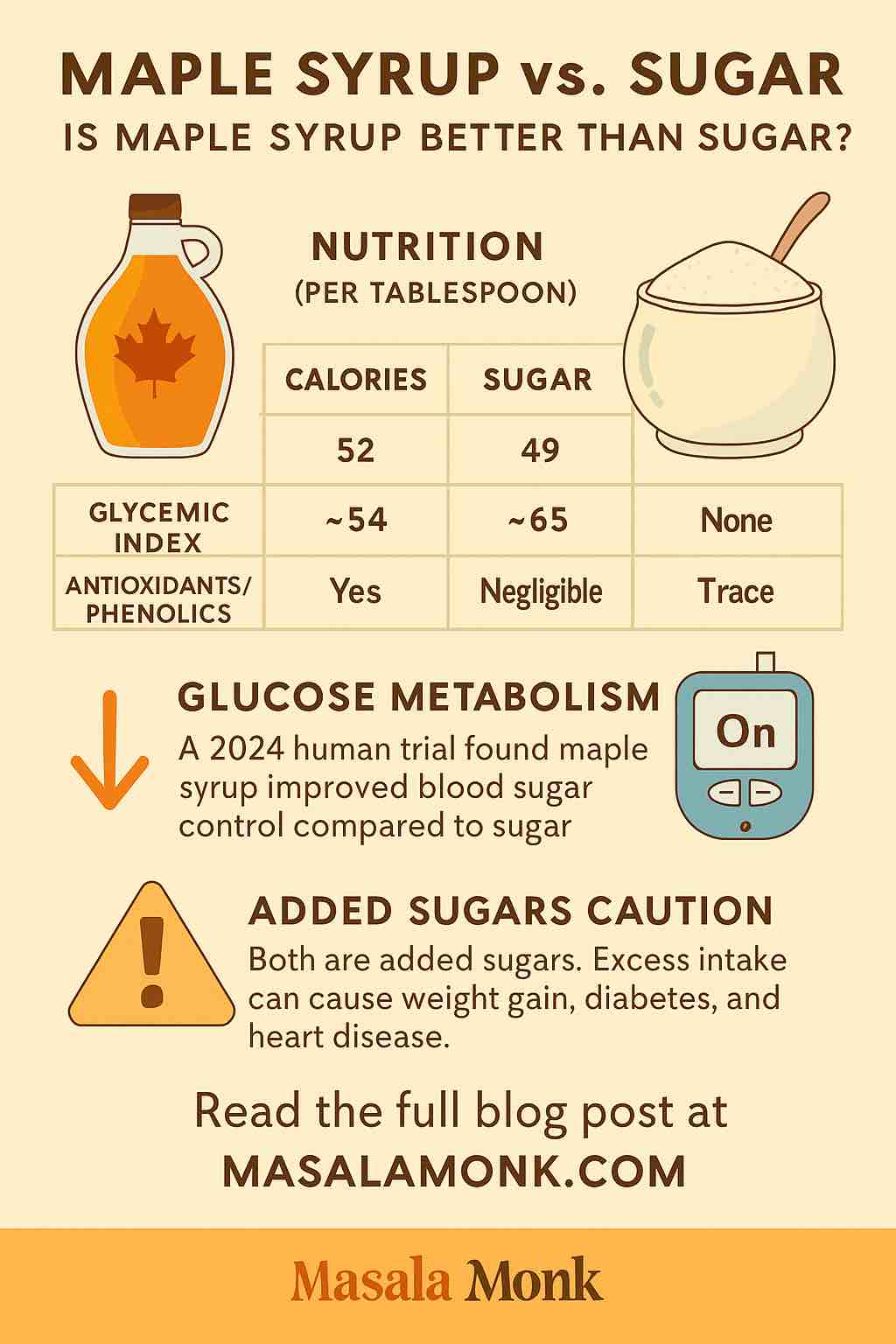
Per TablespoonMaple SyrupWhite Sugar
Calories52 kcal49 kcal
Carbohydrates13g12.5g
Sucrose Content~60%100%
Glycemic Index (GI)~54~65
Nutrients (e.g. Mn, Zn)Trace amountsNegligible
Antioxidants/PhenolicsYesNone

Takeaway:
Both are concentrated sources of sugar and calories. But maple syrup has a slightly lower GI, plus trace nutrients and plant compounds that white sugar lacks.


3. What Does the Latest Research Say?

🍁 The 2024 Human Trial: Maple Syrup Gets Its Day in Court

In late 2024, researchers ran a gold-standard, placebo-controlled trial (n=42 adults) where participants swapped 2 tablespoons of sugar a day for the same amount of maple syrup. After 8 weeks, those using maple syrup (vs sugar) saw:

  • Better blood sugar control: Lower blood glucose spikes during a glucose tolerance test.
  • Reduced abdominal fat: Small but measurable decreases in belly fat.
  • Lower systolic blood pressure: On average, a drop of nearly 3 mm Hg.
  • Healthier gut: Maple syrup improved gut bacteria, increasing helpful strains and reducing harmful ones.

Caveat: This is a small, short-term study. More research is needed for big health claims, but the results are promising.

🧬 Lab & Animal Studies

Animal studies confirm maple syrup’s modest benefits for blood sugar, fat metabolism, and inflammation, thanks to its unique antioxidants (like quebecol, formed only during the syrup’s boiling process).


4. Beyond Nutrition: The Flavors and Practical Kitchen Wisdom

Flavor

  • Maple syrup: Deep, caramelized, sometimes smoky. Pairs beautifully with pancakes, oatmeal, yogurt, roasted veggies, and more.
  • Sugar: Neutral—perfect for recipes where you don’t want added flavor.

Baking & Cooking Tips

  • Substitute: Maple syrup is sweeter by volume than sugar, so you can use slightly less. Try replacing 1 cup sugar with ¾ cup maple syrup, and reduce other liquid by 3 tablespoons.
  • Watch for moisture: Maple syrup adds liquid. Adjust recipes or cooking time, especially in baked goods.
  • Don’t use “pancake syrup”: Most commercial syrups are corn syrup + artificial flavor, not real maple.

5. The Real Health Bottom Line

Maple Syrup’s Advantages:

  • Lower glycemic index (raises blood sugar a bit more slowly).
  • More than 100 bioactive compounds, including polyphenols with anti-inflammatory and antioxidant effects.
  • Trace minerals: manganese, zinc, calcium, potassium.

But… Don’t Overdo It:

  • Both are added sugars.
    Overconsumption—of any sugar—raises risk for obesity, type 2 diabetes, heart disease, and tooth decay.
  • No miracle cure: To get significant minerals from maple syrup, you’d need to consume way too much.
  • Calories still count: Maple syrup is not “diet food.”

6. Environmental and Ethical Considerations

  • Maple syrup production: Often small-scale, supports sustainable forestry, low pesticide use, and keeps forests standing.
  • Sugar production: Can involve deforestation, heavy pesticide/fertilizer use, and global shipping.

7. Practical Verdict: Should You Switch?

If you love the taste, real maple syrup is a smarter sweetener choice—in moderation. It’s less processed, has a unique flavor, and delivers trace nutrients and plant compounds that sugar simply doesn’t.
But don’t fall for the “natural equals healthy” myth: you still need to limit all added sugars for long-term health.

Smart Strategies

  • Use pure maple syrup for flavor-forward dishes (pancakes, yogurt, roasted nuts).
  • Keep both sweeteners as occasional treats, not daily staples.
  • Train your palate to appreciate less overall sweetness—your body and taste buds will thank you.

References & Further Reading

  1. USDA FoodData Central: Maple Syrup
  2. PubMed: 2024 Human Clinical Trial
  3. Cleveland Clinic: Is Maple Syrup Healthier Than Sugar?
  4. Healthline: Maple Syrup
  5. Ohio State: Monthly Maple Review
  6. Verywell Health: Maple Syrup vs. Honey

Conclusion

Maple syrup wins on flavor, nutrients, and research-backed modest benefits. But the healthiest move? Sweeten less, no matter what you choose.

What’s your favorite way to use maple syrup? Any baking experiments or recipes you love? Let’s keep the conversation (and the pancakes) going in the comments!

10 FAQs About Maple Syrup vs Sugar

1. Is maple syrup healthier than white sugar?

Answer: Maple syrup has a lower glycemic index, more minerals, and antioxidants than white sugar. However, both are added sugars and should be used in moderation.


2. Can people with diabetes use maple syrup instead of sugar?

Answer: Maple syrup has a slightly lower impact on blood sugar but still raises glucose. People with diabetes should treat both as added sugars and limit their use.


3. How much maple syrup is safe to consume daily?

Answer: Nutritionists recommend limiting all added sugars to less than 6 teaspoons (25g) per day for women and 9 teaspoons (36g) for men—including maple syrup.


4. Does maple syrup contain nutrients that sugar doesn’t?

Answer: Yes. Maple syrup has trace amounts of manganese, zinc, calcium, potassium, and antioxidants. Sugar has virtually none.


5. Is “pancake syrup” the same as real maple syrup?

Answer: No. Pancake syrup is usually corn syrup with artificial flavor. Always check labels and choose “100% pure maple syrup” for health and flavor benefits.


6. Can I use maple syrup in baking instead of sugar?

Answer: Yes, but you’ll need to reduce the recipe’s other liquids by about 3 tablespoons for each cup of maple syrup used, since maple syrup adds moisture.


7. Does maple syrup help with weight loss?

Answer: No. Maple syrup is calorie-dense and, like sugar, can contribute to weight gain if overused. Use it as an occasional treat, not a weight-loss aid.


8. Is maple syrup environmentally friendly?

Answer: Generally yes. Maple syrup production is sustainable, supports forest preservation, and uses fewer pesticides compared to large-scale sugar cane or beet farming.


9. What are the unique compounds in maple syrup?

Answer: Maple syrup contains over 100 bioactive compounds, including antioxidants and a unique molecule called quebecol, formed during boiling.


10. Does maple syrup spoil? How should I store it?

Answer: Unopened maple syrup can last for years. Once opened, refrigerate it to prevent mold and use within 6–12 months.



Posted on Leave a comment

Can You Really Not Whip Egg Whites if There’s Yolk in Them? Let’s Crack This Myth!

In the culinary cosmos, whipping egg whites into a flawless foam stands as a cornerstone technique, pivotal for airy meringues, soufflés, and angel food cakes. Yet, a widely held belief casts a shadow over this endeavor: the notion that even a minuscule trace of egg yolk can thwart your efforts to achieve peak perfection. Is this kitchen lore grounded in truth, or merely a myth? Armed with scientific insights and practical wisdom, let’s embark on a journey to demystify the impact of yolk contamination on egg white foams.

The Culinary Conundrum: Yolk’s Impact on Egg Whites

At the heart of this culinary puzzle lies the complex interaction between proteins and fats. Egg whites are a marvel of nature, composed predominantly of water and proteins. When whipped, these proteins unfurl and intertwine, capturing air and forming a stable foam. Enter the culprit: egg yolk. Rich in fats, even a speck of yolk can coat the proteins in egg whites, hindering their ability to bond and thus compromising the foam’s integrity.

Scientific Scrutiny: What Research Reveals

Diving into the depths of food science, studies illuminate the nuanced effects of yolk contamination. It’s confirmed: fats, including those from yolks, do interfere with the foaming process. The extent of this interference hinges on the amount of contamination. A concentration as low as 0.022% of yolk can notably diminish the foam’s capacity and speed. The neutral lipids in yolks emerge as the primary antagonists, while phospholipids play a lesser role in this culinary drama.

Navigating the Nuances: Practical Insights for Culinary Enthusiasts

Precision in Separation

The first line of defense against yolk contamination is meticulous separation. Employ a clean, dry bowl and consider using the three-bowl method: crack the egg into one bowl, separate the yolk and white carefully, then transfer the white to a new bowl. This reduces the risk of ruining your entire batch with accidental yolk spills.

Remedial Measures

Should a rogue yolk breach your defenses, all is not lost. Removing the contaminant with a clean utensil or piece of shell can salvage the situation, especially if the intrusion is minimal.

Tools and Techniques

The cleanliness of your equipment is paramount. Any residue of fats on your whisk or bowl can mirror the effect of yolk contamination. Opt for stainless steel or glass bowls over plastic, as plastic can retain grease despite washing.

Enhancing Stability

Acidic substances, like a dash of lemon juice or cream of tartar, can fortify the egg white foam against the destabilizing effects of fats. These additives bolster the protein network, offering a buffer against minor yolk intrusions.

Beyond the Myth: A Balanced Perspective

Our culinary quest reveals that while yolk contamination is a foe to be reckoned with, it’s not an insurmountable barrier to whipping egg whites successfully. Understanding the science equips us with strategies to mitigate its impact, transforming potential culinary despair into delectable triumphs.

Culinary Wisdom for the Modern Cook

In light of scientific evidence and practical know-how, the narrative around egg whites and yolk contamination requires a nuanced understanding. It’s a tale not of absolute ruin but of manageable challenge, with knowledge and technique as our allies. So, the next time you stand at the precipice of whipping egg whites, armed with a bowl and whisk, remember: perfection lies not just in avoiding the yolk but in mastering the art and science of recovery and resilience.

FAQs for “Can You Really Not Whip Egg Whites if There’s Yolk in Them? Let’s Crack This Myth!”

1. Can a tiny bit of egg yolk really ruin egg white foam?

Yes, even a small amount of yolk can affect the stability of egg white foam because fats from the yolk interfere with the protein bonds necessary for forming a stable foam.

2. Why does egg yolk affect egg white foam?

Egg yolk contains fats that coat the proteins in egg whites, preventing them from linking together effectively to trap air and create a stable foam.

3. What’s the best way to separate egg whites from yolks to avoid contamination?

Use a clean, dry bowl, and consider employing the three-bowl method for separation to minimize the risk of yolk getting into the egg whites.

4. Is it possible to whip egg whites into foam if they get contaminated with yolk?

While minor contamination might not prevent foaming entirely, it will compromise the foam’s stability and volume. Removing any yolk spill immediately with a clean utensil can help.

5. How can I increase the stability of my egg white foam?

Adding a small amount of acid, like lemon juice or cream of tartar, can help stabilize the foam by strengthening the protein network.

6. What should I do if my equipment might have fat residue on it?

Ensure all equipment is impeccably clean and free from grease. Glass or metal bowls are preferred over plastic, as they’re less likely to retain grease residues.

7. How long does it take for egg white foam to collapse if contaminated with yolk?

Foams contaminated with yolk or other fats may initially whip up but will collapse much faster than pure egg white foams due to their compromised structure.

8. Can I fix egg white foam that has started to collapse due to yolk contamination?

Once the foam has started to collapse, it’s challenging to recover its stability. It’s best to start over if the foam’s integrity is crucial to your recipe.

9. Are there any foolproof methods for whipping egg whites successfully every time?

While there’s no foolproof method, practicing good separation techniques, using clean equipment, and adding stabilizers like acid can significantly improve your success rate.

10. Can all recipes that require whipped egg whites tolerate a bit of yolk contamination?

Recipes that depend on the structure and stability provided by whipped egg whites, like meringues or soufflés, are less forgiving of yolk contamination.

Blog Tags for the Post

egg whites, yolk contamination, whipping techniques, culinary science, baking tips, kitchen myths, protein structures, food chemistry, recipe success, culinary techniques

FAQs for “Can You Really Not Whip Egg Whites if There’s Yolk in Them? Let’s Crack This Myth!”

1. Can a tiny bit of egg yolk really ruin egg white foam?

Yes, even a small amount of yolk can affect the stability of egg white foam because fats from the yolk interfere with the protein bonds necessary for forming a stable foam.

2. Why does egg yolk affect egg white foam?

Egg yolk contains fats that coat the proteins in egg whites, preventing them from linking together effectively to trap air and create a stable foam.

3. What’s the best way to separate egg whites from yolks to avoid contamination?

Use a clean, dry bowl, and consider employing the three-bowl method for separation to minimize the risk of yolk getting into the egg whites.

4. Is it possible to whip egg whites into foam if they get contaminated with yolk?

While minor contamination might not prevent foaming entirely, it will compromise the foam’s stability and volume. Removing any yolk spill immediately with a clean utensil can help.

5. How can I increase the stability of my egg white foam?

Adding a small amount of acid, like lemon juice or cream of tartar, can help stabilize the foam by strengthening the protein network.

6. What should I do if my equipment might have fat residue on it?

Ensure all equipment is impeccably clean and free from grease. Glass or metal bowls are preferred over plastic, as they’re less likely to retain grease residues.

7. How long does it take for egg white foam to collapse if contaminated with yolk?

Foams contaminated with yolk or other fats may initially whip up but will collapse much faster than pure egg white foams due to their compromised structure.

8. Can I fix egg white foam that has started to collapse due to yolk contamination?

Once the foam has started to collapse, it’s challenging to recover its stability. It’s best to start over if the foam’s integrity is crucial to your recipe.

9. Are there any foolproof methods for whipping egg whites successfully every time?

While there’s no foolproof method, practicing good separation techniques, using clean equipment, and adding stabilizers like acid can significantly improve your success rate.

10. Can all recipes that require whipped egg whites tolerate a bit of yolk contamination?

Recipes that depend on the structure and stability provided by whipped egg whites, like meringues or soufflés, are less forgiving of yolk contamination.

Blog Tags for the Post

egg whites, yolk contamination, whipping techniques, culinary science, baking tips, kitchen myths, protein structures, food chemistry, recipe success, culinary techniques






