
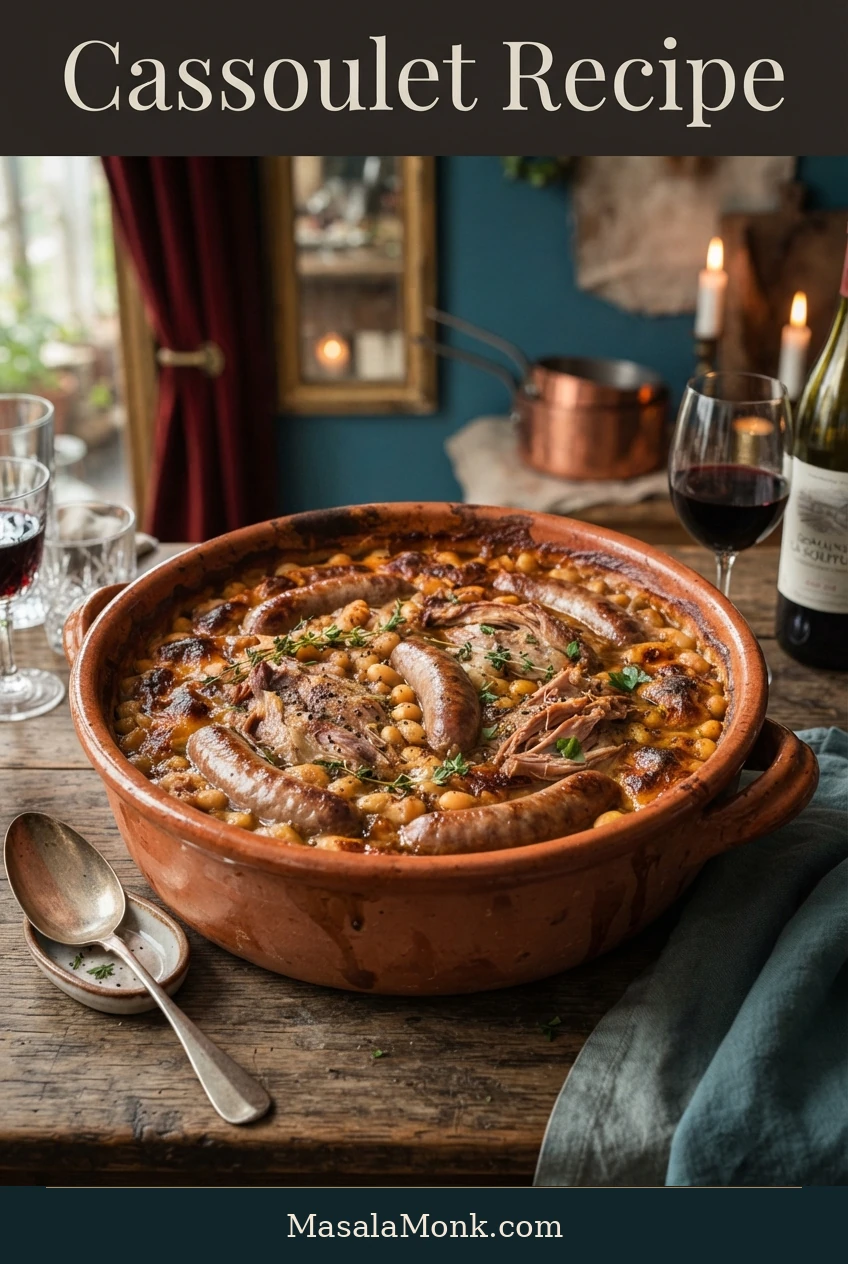
In a good cassoulet, the white beans matter as much as the duck and sausage. They soak up the savory cooking juices, turning creamy beneath a deeply browned crust. Break through that top and you should find tender meat and beans surrounded by rich, spoonable broth—not a dry, compact casserole.
This cassoulet recipe takes its cue from Castelnaudary in southwestern France. It uses fully cooked duck-leg confit, so there is no need to make confit from scratch. Soak the beans the night before and set aside much of the following day for the stovetop and oven stages. The beans and pork simmer in separate pots; afterward, an unhurried oven bake brings the dish together.
Jump to: Ingredients · Cooking steps · Troubleshooting · Substitutions · Make-ahead and storage.
Classic French Cassoulet Recipe
The method makes six hearty servings. The beans and pork cook separately before being assembled with fully cooked duck confit and finished in the oven with fresh Toulouse-style sausage.
| Yield | 6 hearty servings |
| Active preparation | About 70–90 minutes, spread across the cooking day |
| Bean soaking | 8–12 hours, overnight |
| Bean cooking | 5–30-minute preliminary boil, then 45–90+ minutes of simmering; see bean-specific instructions below |
| Pork braising | About 60–90 minutes; can overlap with bean cooking |
| Final oven bake | About 1¾–2½ hours at 165°C / 325°F; add browned sausage partway through, checking the crust and temperatures |
| Main cooking day | Allow roughly 4½–6 hours after soaking, including overlapping stages and resting; older beans can extend this |
| Equipment | Bean pot, skillet, covered braising pot, 5–6 US qt (4.7–5.7 L) ovenproof casserole and thermometer |
The long cooking day is mostly hands-off. Get the beans simmering, then braise the pork while they cook. The timeline below shows how the stages fit together.
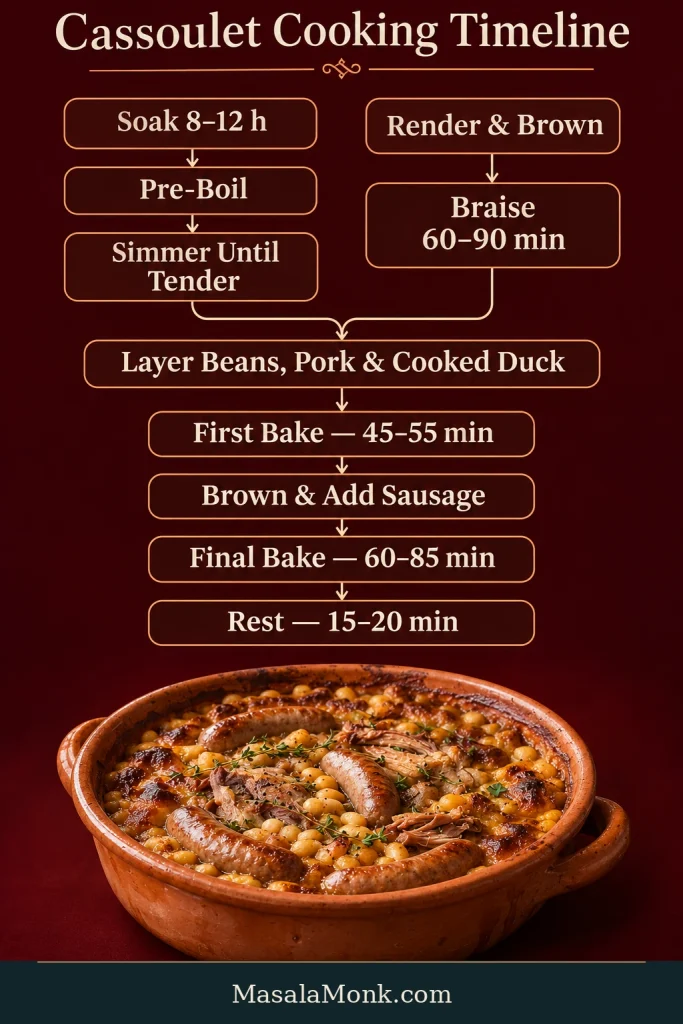
- Night before: Soak the dried beans for 8–12 hours.
- Start cooking: Simmer the beans and braise the pork in separate pots until each is tender.
- Assemble: Layer the cooked duck, beans, pork and reserved juices in the casserole.
- Bake: Begin uncovered; after 45–55 minutes, brown the fresh sausage and transfer it straight into the hot casserole.
- Finish: Check the crust, moisture and internal temperatures; rest 15–20 minutes before serving.
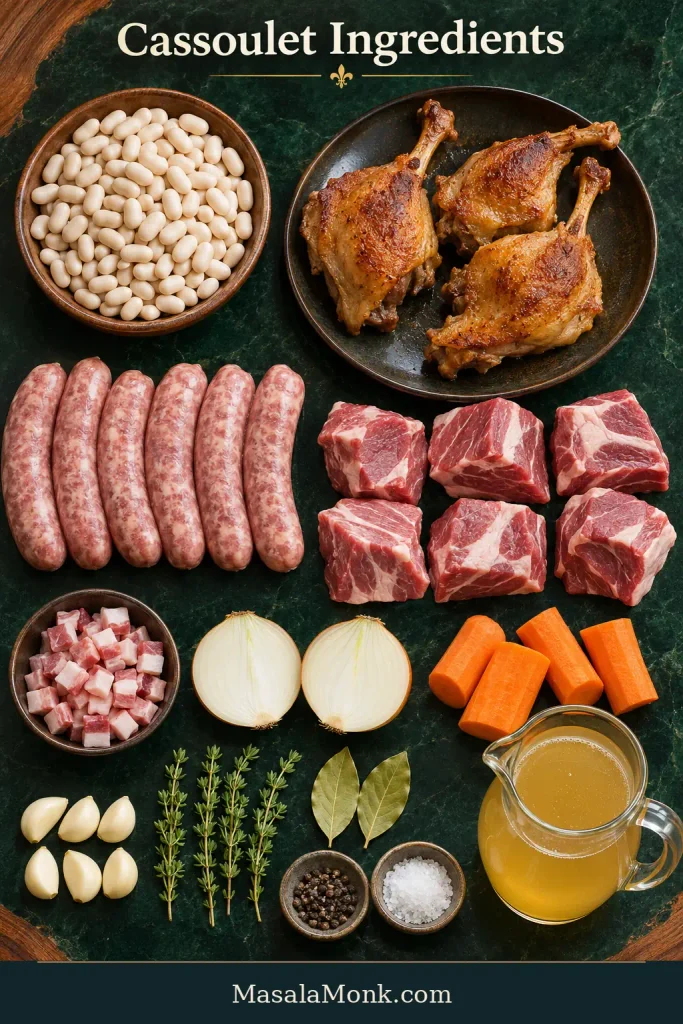
Ingredients for Six Servings
Choose three substantial duck confit legs: their meat is divided among six servings rather than served as a whole leg per person.
Beans, Broth and Aromatics
- 500 g (17.6 oz) dried white beans — preferably lingot beans; Great Northern or cannellini are suitable alternatives
- 2 L (about 68 US fl oz / 8½ US cups) unsalted chicken or pork stock, divided between bean cooking and pork braising; have additional water available
- 1 large onion, about 180 g (6.3 oz), peeled and halved
- 1 medium carrot, about 120 g (4.2 oz), cut into large pieces
- 6 garlic cloves, peeled; 4 lightly crushed and 2 finely chopped
- 4 fresh thyme sprigs
- 2 bay leaves
- Freshly ground black pepper, to taste
- Fine salt, only as needed after tasting the meats and cooking liquid
Choosing an unfamiliar variety? Compare white beans for cassoulet before beginning the overnight soak.
Duck, Sausage and Pork
- 3 meaty, fully cooked duck confit legs, bone-in, from a jar, tin or vacuum pack; the picked meat will be shared among six servings; reserve up to 1 tbsp (15 ml) of their fat only if needed
- 420 g (14.8 oz) fresh Toulouse-style pork sausage, ideally 6 roughly equal portions or links
- 350 g (12.3 oz) boneless pork shoulder, trimmed and cut into six large pieces
- 80 g (2.8 oz) unsmoked salt pork, diced small; check the package before cooking, as heavily salted varieties may need soaking or blanching; pancetta is an alternative
How Much Stock Does Cassoulet Need?
Divide the initial 2 L of stock between the bean pot and pork braise. Save the cooking juices from both; the assembly and reserve amounts below are flexible guides, not additional stock to buy.
| When you need it | Liquid |
|---|---|
| Simmering the beans | 1,600 ml (54 US fl oz / about 6¾ US cups) unsalted stock, plus hot water if needed |
| Braising the pork | 400 ml (13½ US fl oz / about 1⅔ US cups) unsalted stock |
| At assembly | Recovered cooking juices, often around 750 ml (25 US fl oz); add to the upper-bean level |
| During baking | Set aside up to 250 ml (8½ US fl oz / about 1 cup) recovered liquid, if available |
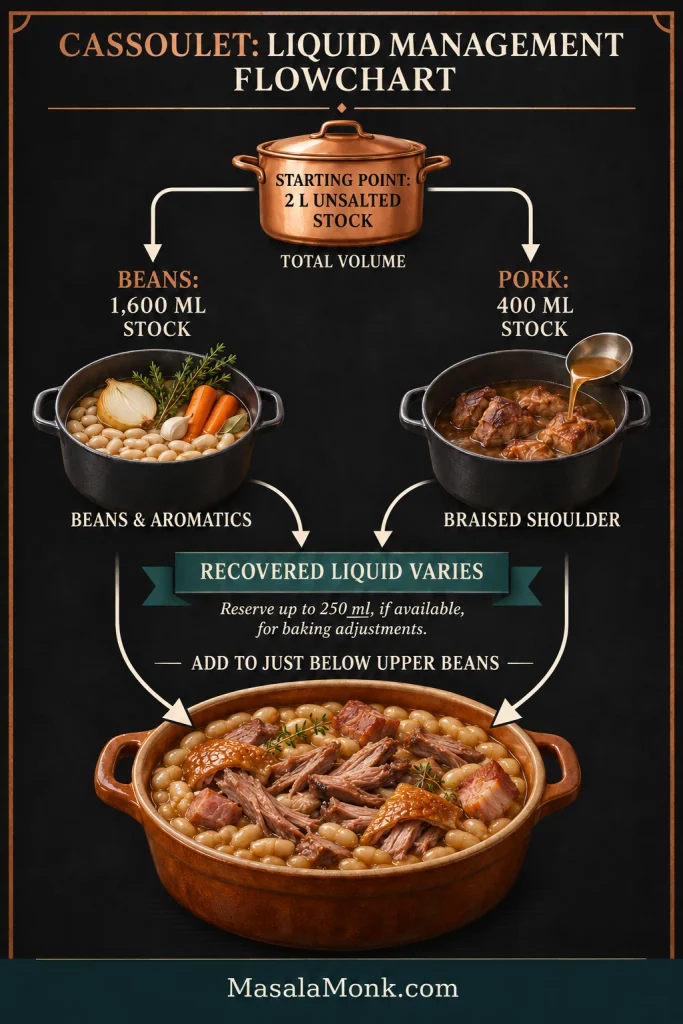
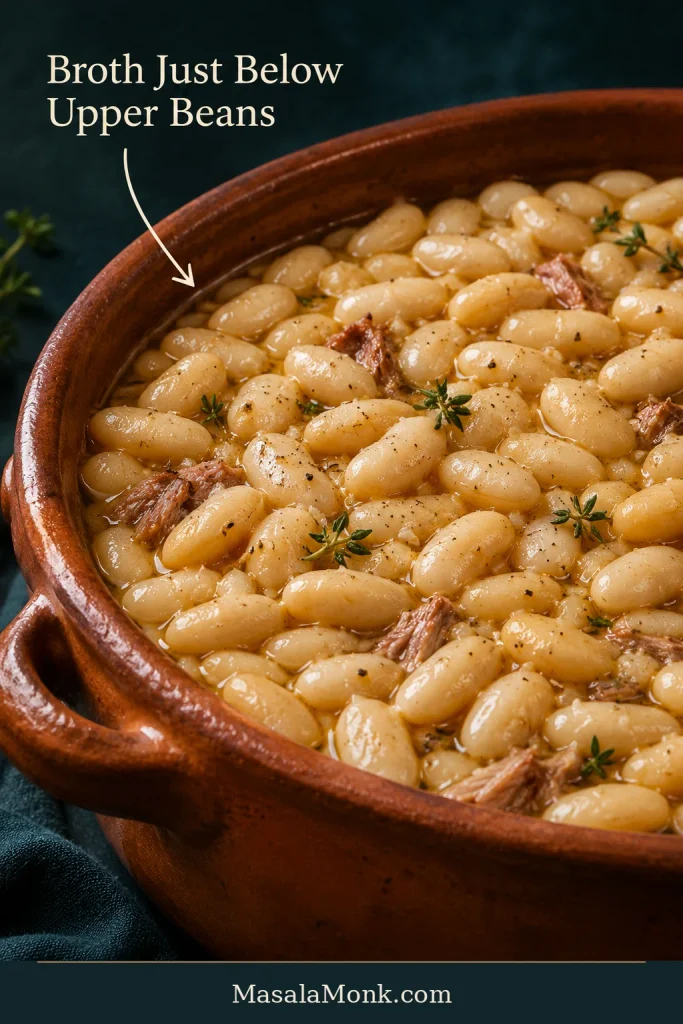
Use the liquid level, not an exact volume, as your guide. Keep the upper beans exposed, with broth just beneath them. If the recovered juices run short, add hot water or unsalted stock. Refrigerate reserved broth that will not be used promptly, and reheat only the amount needed for later adjustments.
Equipment You’ll Need
Use a large pot for the beans, a heavy skillet for browning, a small covered pot for the pork, a ladle and an instant-read thermometer. For baking, choose a wide 5–6 US qt (4.7–5.7 L) ovenproof casserole or Dutch oven. Its exposed surface helps the beans brown, while space above the food lets the juices bubble without overflowing.
A tray on the rack below the casserole can catch bubbling juices.
How to Make Cassoulet
Soak and Boil the White Beans
- Soak the beans. Sort and rinse 500 g (17.6 oz) dried white beans. Cover with cool water by 7–8 cm (3 in) and soak 8–12 hours; refrigerate in a warm kitchen. Drain and rinse.
- Boil the beans in fresh water. For dried cannellini (white kidney beans), boil vigorously for at least 30 minutes, then drain. For lingot or Great Northern beans, blanch for 5 minutes before the full simmer. When the variety is uncertain, use the 30-minute boiling approach. Never use a slow cooker alone to cook raw dried kidney beans.

Simmer and Test the White Beans
- Simmer with the aromatics. Return the drained beans to the pot with 1,600 ml (54 US fl oz) unsalted stock, the halved onion, chopped carrot, 4 crushed garlic cloves, 4 thyme sprigs and 2 bay leaves. Add hot water until the beans are covered by about 3 cm (1¼ in). Simmer gently, partly covered, for about 45–90 minutes, or longer if needed. Add hot water whenever the beans begin to emerge from the liquid.
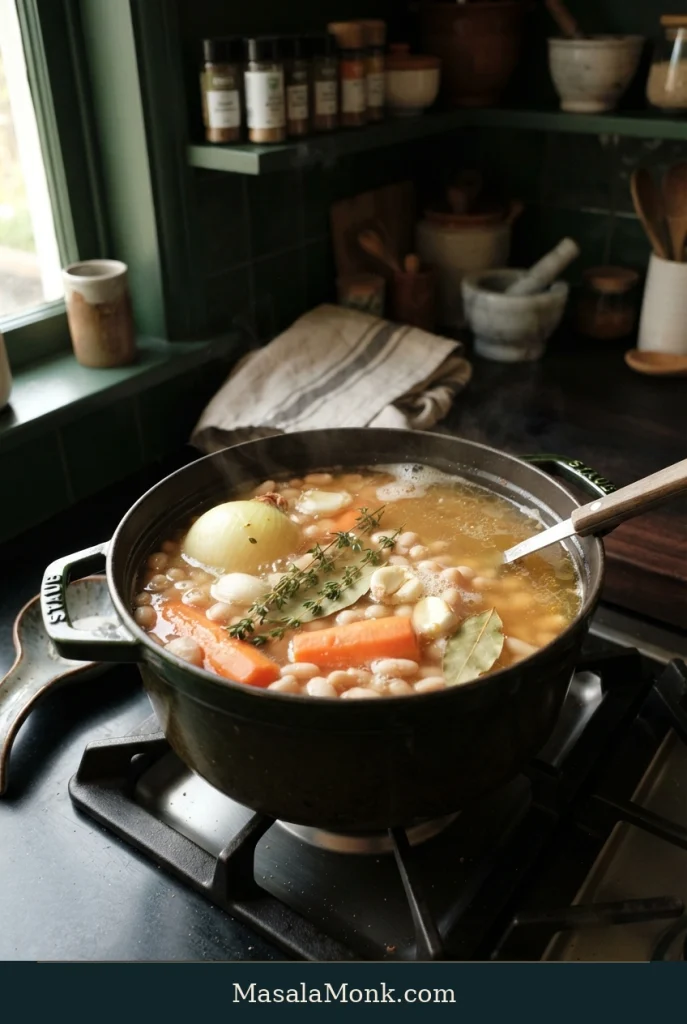
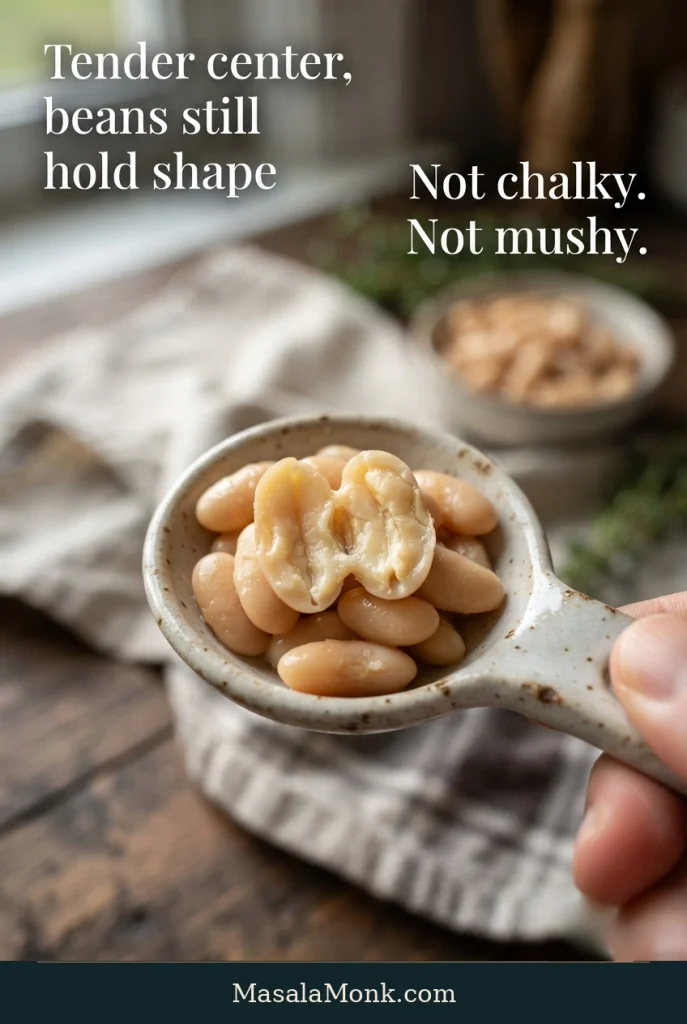
- Check the beans and save the broth. Taste several beans, not just one. Their centers should be tender, while most skins remain intact; a chalky center means they need more simmering. Lift out the bay leaves, herb stems, onion and carrot. Leave the softened garlic with the beans. Drain over a large bowl and save all the cooking liquid. If the beans remain hard or become mushy, consult the cassoulet troubleshooting guide before assembly.
Render and Braise the Pork
- Render the salt pork. If the package calls for desalting, soak or blanch it first. While the beans simmer, cook 80 g (2.8 oz) diced unsmoked salt pork in a heavy skillet over medium-low heat for 6–10 minutes, until some of the fat has rendered and the pork pieces are lightly golden. Transfer the pork to a bowl. Leave about 1 tbsp (15 ml) fat in the pan; remove the excess.

- Brown the shoulder. Cut 350 g (12.3 oz) pork shoulder into six large pieces. Brown for about 2–3 minutes per side, in batches. Add the remaining 2 chopped garlic cloves for the last 30 seconds, stirring so they soften without burning.
- Deglaze and braise the pork. Transfer the browned shoulder, garlic and salt pork to a covered pot. Add a splash of the measured 400 ml (13½ US fl oz) stock to the hot skillet and scrape up the browned bits; pour everything into the pot with the rest of that stock. Cover and simmer gently for 60–90 minutes, turning the pork occasionally. The shoulder is ready when a fork slides in easily. Add hot water if the pot gets dry, and save the braising juices.

Prepare the Duck Confit
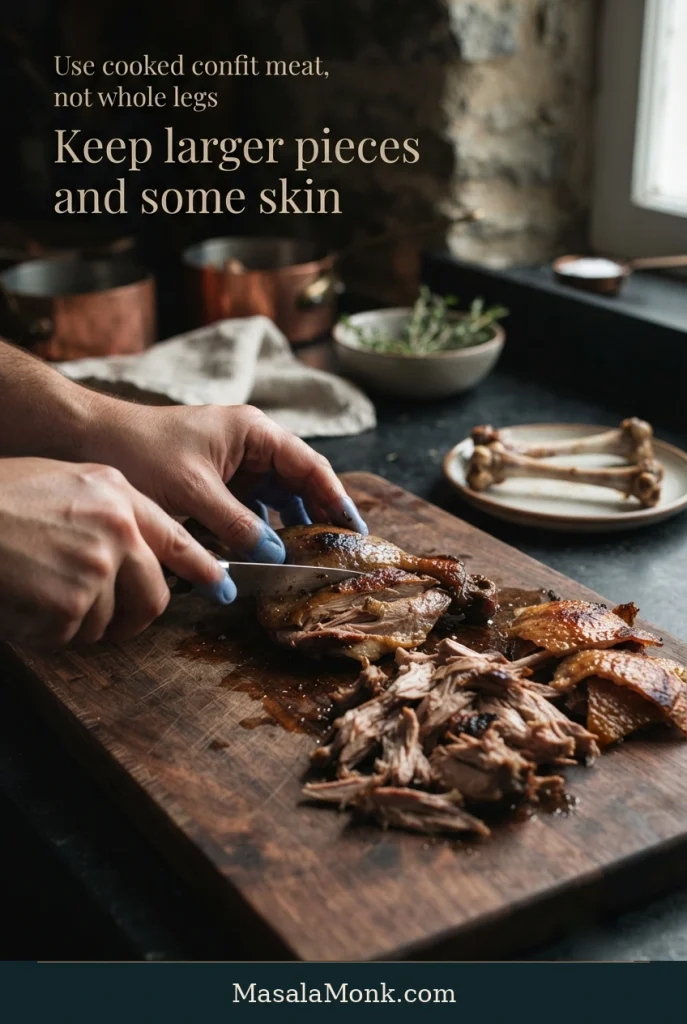
- Prepare the cooked confit. Remove 3 fully cooked duck confit legs from their packaging; if frozen, thaw them in the refrigerator first. Lift the meat from the bones and divide into six loose portions, retaining larger pieces and some skin. Taste a little fully cooked duck: it may already be quite salty. Set aside up to 1 tbsp (15 ml) duck fat only if the bean liquid later needs richness. Keep the duck refrigerated until you assemble the casserole.
Layer the Beans, Duck and Pork
- Layer the cassoulet. Preheat a conventional oven to 165°C (325°F); the times below assume this setting. For a fan-only oven, use the manufacturer’s guidance for a comparable setting and begin checking browning earlier; the thermometer endpoints still apply. Spread one-third of the beans in a wide 5–6 US qt (4.7–5.7 L) ovenproof casserole. Add the fork-tender shoulder, salt pork and cooked duck confit. Cover with the remaining beans, leaving a few pieces of duck near the surface but protected by some beans. Level the top without packing it down.
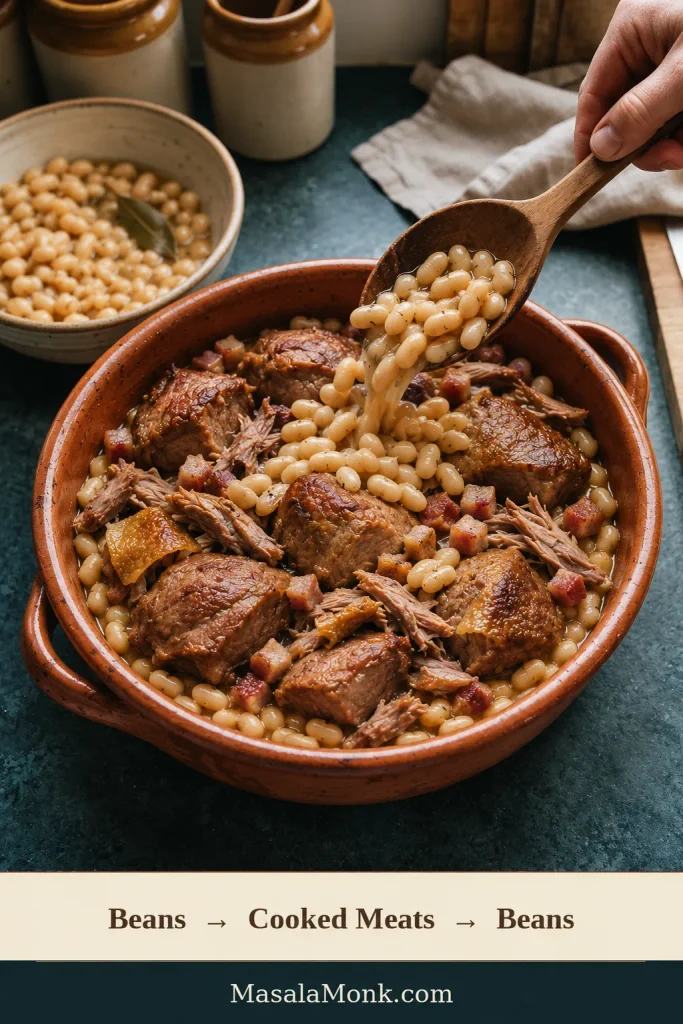
- Add the cooking juices. Combine the saved bean broth and pork-braising juices. Reserve up to 250 ml (8½ US fl oz) for baking adjustments, if available; refrigerate it if not using promptly. Pour the remaining juices around the beans until the liquid sits just below the top layer. You may need roughly 750 ml (25 US fl oz), but the level matters more than the volume. If necessary, top up with hot water or unsalted stock. Check the seasoning: Taste the liquid before adding black pepper or a little salt; the confit and fresh sausage will contribute more. Add up to 1 tbsp (15 ml) reserved duck fat only if additional richness is needed.
Start the Bake and Add the Sausage
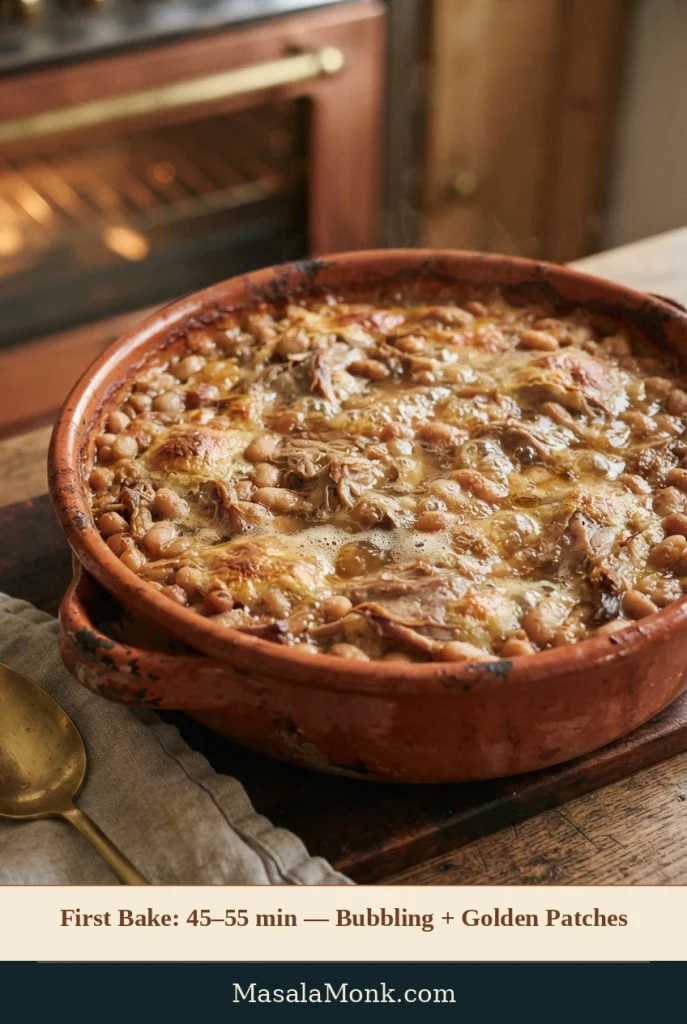
- Start the crust. The beans and pork are already tender; the oven now brings them together. Bake uncovered on the middle rack for 45–55 minutes. At first, broth will bubble between the beans; then exposed patches will begin to turn golden. If the edges look dry, add a few spoonfuls of hot broth down the side of the casserole.
- Brown the fresh sausage. Near the end of the first bake, brown the 420 g (14.8 oz) fresh sausage in a skillet over medium heat for 2–3 minutes per side. The links will be colored but may still be raw inside; transfer them directly into the hot casserole to finish cooking. Do not brown them earlier and refrigerate them partly cooked.
- Nestle the sausage into the beans. Lift a few small patches of the still-developing surface near the edges and tuck the links partly into the moist beans, with their tops visible. Avoid stirring the casserole. Return it to the oven promptly so the sausage finishes cooking in the hot bean mixture.

Finish Baking and Check Doneness
- Finish the bake. Bake uncovered for another 60–85 minutes, watching for a browned surface over saucy beans. If the edges dry out, add a little hot reserved broth, water or unsalted stock down the side. Check the temperatures: the thickest sausage link must reach at least 71°C (160°F) and the casserole center 74°C (165°F). If the crust browns too soon, cover loosely with foil and keep baking until both temperatures are reached. For more detail, see how the cassoulet crust forms.

- Check seasoning and texture. Lift a spoonful from near the edge. The crust should yield to creamy beans and rich, spoonable cooking juices—not a dry, compact layer. Taste the liquid before adding salt. If you want especially crisp duck skin, brown a little cooked skin separately under a hot broiler and add it to the serving bowls.
- Rest and serve. Let the cassoulet stand for 15–20 minutes. Break through the browned top gently, sharing the duck, pork, sausage, beans and cooking juices among six servings.
Back to the beginning · Review ingredients
Cassoulet and Its French Origins
Cassoulet takes its name from the earthenware cassole in which the beans and meats traditionally bake. Castelnaudary, Toulouse and Carcassonne each have their own associations with the dish, but the essential pleasure is shared: tender white beans absorb the cooking juices beneath a browned surface. The Castelnaudary Tourist Office’s traditional method provides the regional reference for this version.
In traditional Castelnaudary cooking, the meats are generally assembled with the beans from the beginning, and the crust may be pressed back into the pot several times as it reforms. Here the fresh sausage joins later, so it can finish cooking without spending the entire bake exposed to the oven. The surface is then left largely undisturbed to develop its browned layer.
Choosing Beans, Duck Confit and Sausage
Which Beans Work Best?
French lingot beans are the traditional choice. Great Northern beans are a good practical substitute because they become creamy while generally keeping their shape. Dried cannellini also work, but their cooking time varies with size, age and storage. Buy beans from a supplier with good turnover if possible. When you are ready to cook them, return to the preliminary boiling instructions. For a quicker way to enjoy their creamy texture, our white bean soup recipe uses cooked cannellini beans and a much shorter stovetop method.
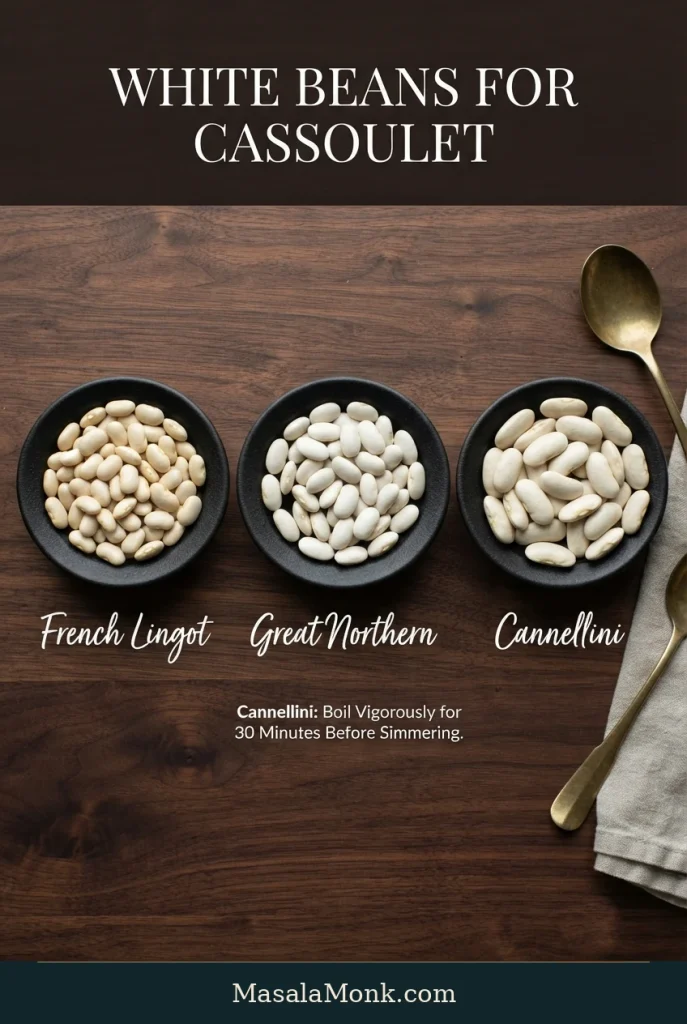
Important: Cannellini are white kidney beans. Dried kidney beans must be boiled thoroughly—not merely warmed in a slow cooker—to reduce naturally occurring lectins, as explained in the FDA’s guidance on kidney-bean lectins. The main cooking method begins with a vigorous boil for cannellini, then simmers the beans until fully tender. Do not use raw dried cannellini directly in an unmodified slow-cooker shortcut.
What to Look for in the Meats
Duck confit: Choose duck legs labeled fully cooked, usually packed in fat in a tin, jar or vacuum pack. The meat is already tender, so nestle it among the beans before baking rather than treating it like raw duck. If you want to make the confit yourself, our duck confit recipe explains that separate preparation. Raw duck legs require thorough cooking before they can replace prepared confit. For the prepared product, follow the duck confit deboning step.
Toulouse-style sausage: Choose fresh pork sausage seasoned primarily with garlic and pepper. Strongly smoked kielbasa, fennel-heavy Italian sausage and spicy chorizo will change the dish noticeably. For the closest substitution, ask a butcher for a mild, coarse-ground fresh pork sausage.
Salt pork: Check the package for soaking or blanching instructions before you cook. Curing strength varies, so taste the finished cooking juices before adding salt. Pancetta is an alternative, though its seasoning differs.
Unlike a simmered bean stew, cassoulet depends on an uncovered oven finish: the liquid concentrates at the surface while remaining plentiful below.
Castelnaudary cassoulet traditionally uses pork rind to enrich the pot. This version relies on good unsalted chicken or pork stock and the juices from the braised shoulder instead. A stock that gels lightly when chilled usually gives the finished broth more body, but a lighter stock still works if the beans are cooked properly.
How the Cassoulet Crust Forms
Watch the surface during the bake. At first, broth bubbles between the beans. As moisture evaporates, exposed patches darken and join into a thin crust formed from the beans, starch, fat and concentrated juices. A wide casserole gives more beans that exposure, while the deeper layer stays soft. If the surface dries before it browns, add hot broth around the edge rather than pouring it over the developing crust.

What about crispy duck skin? A cassoulet crust and crisp duck skin are different textures. The duck skin can brown where it is exposed, but submerged skin softens. If exceptionally crisp duck skin is important, crisp the cooked confit separately under a hot grill or broiler briefly and place it onto the finished cassoulet. Watch closely to prevent burning.
How to Tell When Cassoulet Is Done
Before serving, look for creamy beans that mostly hold their shape, fork-tender pork, properly cooked sausage, hot duck and a browned top. Beneath the crust, the beans should sit in rich cooking juices; the mixture can be fairly loose, but it should not be thin and watery.

Check the center of the casserole with a thermometer for 74°C (165°F), and the thickest sausage for at least 71°C (160°F). Then check that the pork is fork-tender and the beans have the texture you want.
Cassoulet Troubleshooting: Problems and Fixes
Bean and Broth Problems
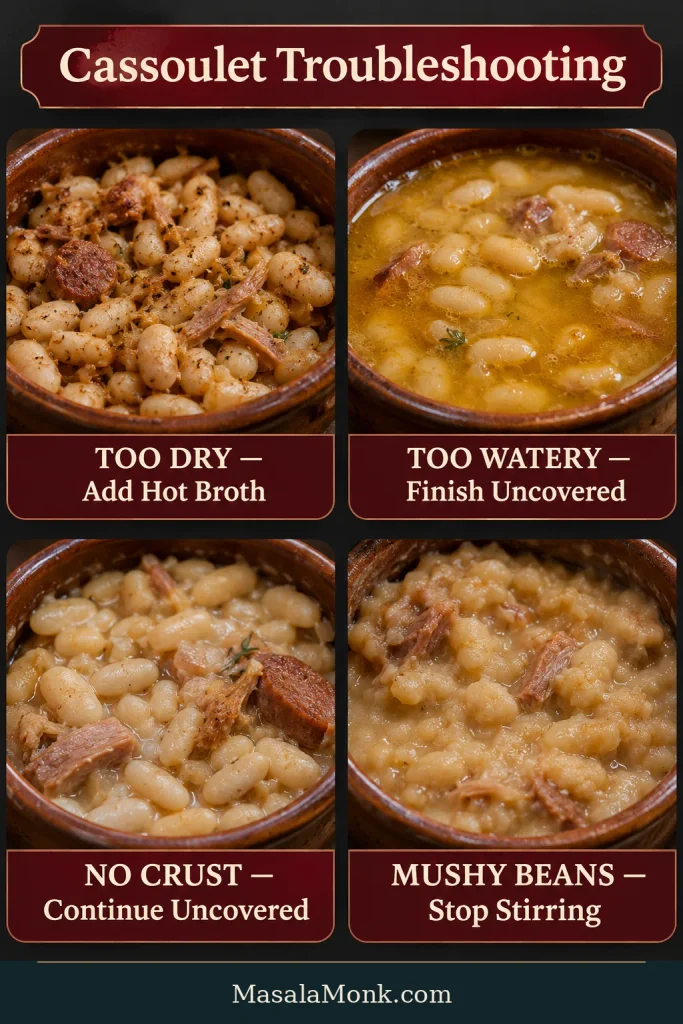
- Beans still hard. Before assembly, continue simmering with hot liquid until completely tender. If already assembled, cover and cook gently with more liquid; the crust may be sacrificed. Likely cause: Old beans, insufficient simmering or liquid, uneven heat.
- Beans mushy. Stop stirring and handle gently. You cannot restore their original shape; preserve remaining texture. Likely cause: Overcooking or vigorous stirring.
- Too salty. Add no more salt. If possible, dilute with unsalted cooked beans and a little unsalted liquid; extreme oversalting may not be repairable. Likely cause: Combined salt from confit, salt pork, sausage and stock.
- Dry casserole. Add a few tablespoons of hot reserved liquid around the edges, then check again. Avoid pouring a large volume across the crust. Likely cause: Too much evaporation or too little retained cooking liquid.
- Watery casserole. Continue uncovered for a short period while monitoring the surface. Do not overcook the meat simply to evaporate liquid. Likely cause: Excess stock or insufficient evaporation.
Crust, Heat and Meat Problems
- No crust. Expose more bean surface and let the uncovered top brown. Do not rely on higher heat alone to fix an overfilled pot. Likely cause: Surface submerged, narrow pot, crowded meat or excess moisture.
- Burned bottom. Stop scraping the burnt layer into the food. Transfer the unburned portion gently into another pot, add hot liquid if needed and finish carefully. Likely cause: Too little liquid, strong bottom heat or unsuitable rack position.
- Greasy surface. Skim pools of fat with a spoon. Next time, measure the fat retained after browning. Likely cause: Too much rendered pork or duck fat.
- Tough pork. Continue moist, covered cooking until fork-tender; do not expect a short uncovered bake to fix it. Likely cause: Shoulder not braised long enough before assembly.
- Dry sausage or duck. Protect meat from further dry heat and serve with moist beans. Next time, keep the confit tucked into moist beans and the sausage partly submerged as it finishes in the oven. Likely cause: Prolonged oven exposure after already cooked or adequately browned.
Make-Ahead Cassoulet, Storage and Reheating
- Best for a fresh crust — cook components ahead: A day ahead, simmer the beans and braise the pork. Cool promptly in shallow containers with their juices, then refrigerate. Keep the confit and uncooked sausage chilled separately. On serving day, reheat the beans, pork and juices until hot, assemble with the confit, and follow the oven method. Brown the fresh sausage just before adding it to the hot casserole.
- Best for a simpler serving day — bake ahead: Cook the complete cassoulet, cool promptly in shallow containers and refrigerate. Reheat with a little stock or water in an oven set to at least 163°C (325°F) until the center reaches 74°C (165°F); uncover toward the end to bring back some browning.
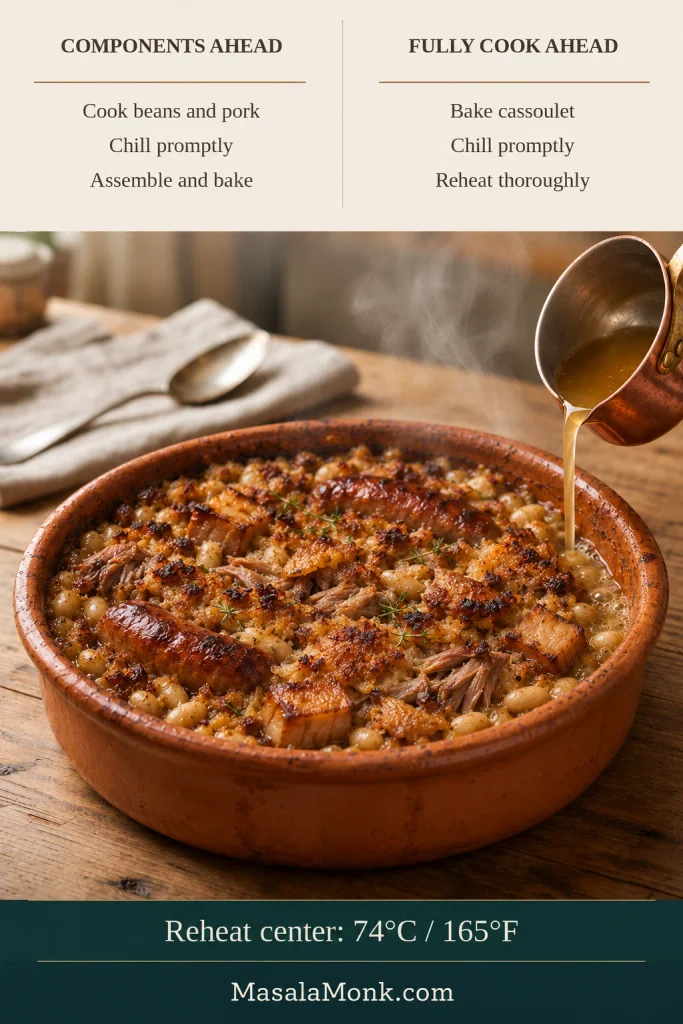
For either plan, cool perishable food promptly. Use shallow storage containers; avoid putting a refrigerator-cold ceramic or earthenware baking dish straight into a hot oven unless its manufacturer specifically permits it. Fresh sausage must either remain raw until its final cooking or be cooked completely before refrigeration.
How to Store and Reheat Leftovers
Following USDA guidance for leftovers, divide the cassoulet into shallow containers and refrigerate within 2 hours of cooking—or within 1 hour if the surrounding temperature exceeds 32°C (90°F). Refrigerate at 4°C (40°F) or below and eat within 3–4 days, or freeze in suitable containers for longer storage.
Beans absorb liquid as cassoulet rests, so leftovers will usually be thicker. Add a splash of unsalted stock or water before reheating. Cover during the first part of reheating to protect moisture, then uncover briefly if you want to refresh the top. For reheating in an oven, use an oven temperature of at least 163°C (325°F) and verify the center reaches 74°C (165°F), consistent with USDA reheating recommendations. A smaller portion can also be reheated on the stovetop, gently, to the same internal temperature.
Cassoulet Substitutions and Easier Versions
The canned-bean shortcut changes the broth and oven timing. The meat alternatives below also need their own handling, especially when replacing slow-cooked duck confit with chicken.
Can You Use Canned White Beans?
Yes. Canned beans make a faster, softer-textured cassoulet-inspired version. Use 1.2–1.3 kg (2.6–2.9 lb) drained, rinsed canned white beans in place of the dried beans. This is the drained weight, not the weight printed on the cans. Unlike the dried-bean method, the shortcut does not require the full 2 L of stock: use 400 ml for the pork braise, then add only enough unsalted stock or water during assembly to reach 350–500 ml of liquid in total, counting the recovered braising juices.

Cook and Assemble the Canned-Bean Version
- Prepare the aromatic pork braise. Render the 80 g (2.8 oz) salt pork and brown the 350 g (12.3 oz) shoulder as in the main method, briefly stirring in the 2 chopped garlic cloves at the end. Deglaze with part of the measured 400 ml (13½ US fl oz) stock. Transfer to the braising pot with the remaining stock, the halved onion, carrot, 4 crushed garlic cloves, thyme and bay leaves. Cover and simmer until the shoulder is fork-tender, about 60–90 minutes or longer if needed. Remove onion, carrot, thyme stems and bay leaves; retain the soft garlic and save the braising juices.
- Cook the fresh sausage completely in a skillet to 71°C (160°F) internally before assembly. The shortened oven time is not intended to finish raw sausage. Prepare the confit as described in the main recipe.
- Combine the beans and meat in the casserole. Measure the recovered pork-braising juices first, then add only enough unsalted stock or water to make approximately 350–500 ml (12–17 US fl oz) liquid in total. Add it gradually: the upper beans should be moist, not submerged.
- Bake uncovered at 165°C (325°F) for roughly 30–45 minutes, with the cooked sausage and confit added at the start. Check for a browned surface and a center temperature of 74°C (165°F). A casserole assembled from cold components may need longer. The canned beans are already tender, so handle them gently.
What If You Cannot Find Toulouse Sausage?
Use 420 g (14.8 oz) mild, fresh pork sausage with garlic and pepper. Fennel-heavy Italian sausage, spicy chorizo and smoked kielbasa bring stronger flavors. For a simpler sausage-centered dish without cassoulet’s slow-baked crust, try our slow cooker sausage casserole.
How to Make Cassoulet Without Duck Confit
For a duck-free, cassoulet-inspired variation, replace the picked confit with 450–600 g (1–1⅓ lb) raw, boneless chicken-thigh meat. Cook the chicken separately until its center reaches 74°C (165°F); refrigerate it if not using promptly. Begin baking the beans and pork without the chicken.

During the final 20–30 minutes of baking, tuck the cooked chicken into the moist beans. Allow enough time for the center to reach 74°C (165°F) again. If the surface browns before the chicken is hot, cover loosely with foil. Adding chicken later protects its texture better than leaving cooked thighs in the oven for the full bake.
Raw duck legs cannot replace prepared confit directly; cook and tenderize them separately first. For another French dish centered on chicken, see our coq au vin recipe.
Do You Need Tomatoes or Breadcrumbs?
No. This Castelnaudary-inspired version uses neither. Its flavor comes from white beans, pork, confit and savory broth; the uncovered oven bake forms a natural crust. Other French-style versions may add tomatoes or breadcrumbs, creating a different flavor or surface.
Prefer the original method? Return to the classic cassoulet instructions.
What to Serve with Cassoulet
Cassoulet is a meal in itself. The best accompaniment is something crisp and bright: a simple green salad dressed with Dijon mustard vinaigrette, lightly dressed bitter greens, or steamed green vegetables with a little lemon. A cold, tangy cucumber salad with vinegar and dill is another light option. Crusty bread is useful for catching the last of the cooking juices.
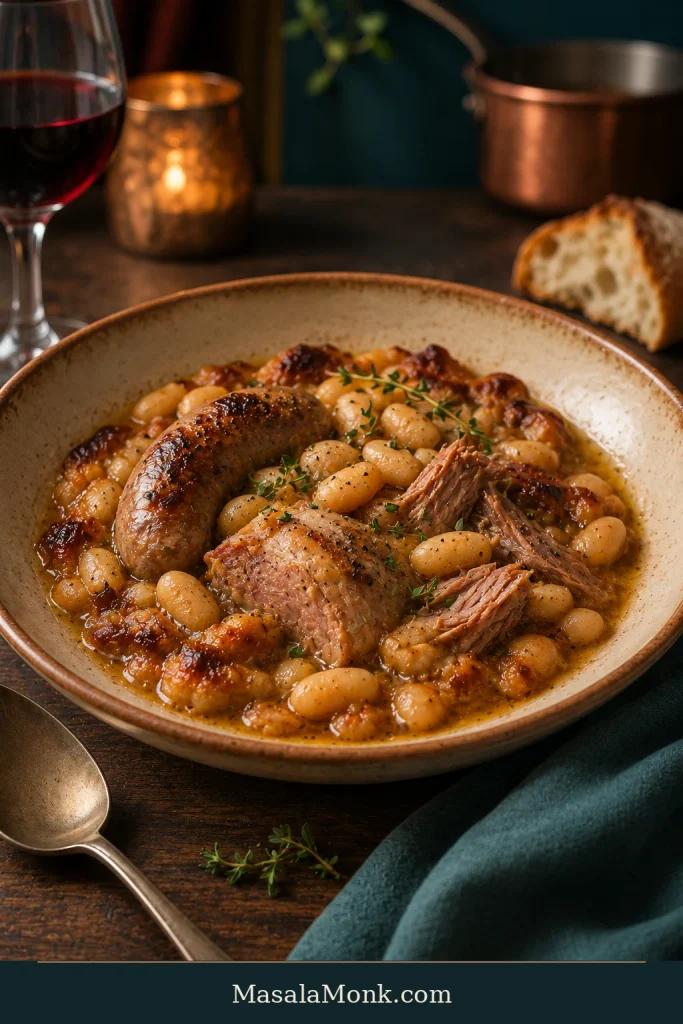
Bring the casserole to the table with its browned surface intact. Break through the crust as you serve so each bowl gets some of the top, plenty of creamy beans and a share of the meats.








