Posted on Leave a comment

Sourdough Starter Recipe: Make, Feed, Store & Fix Your Starter (Beginner Guide)

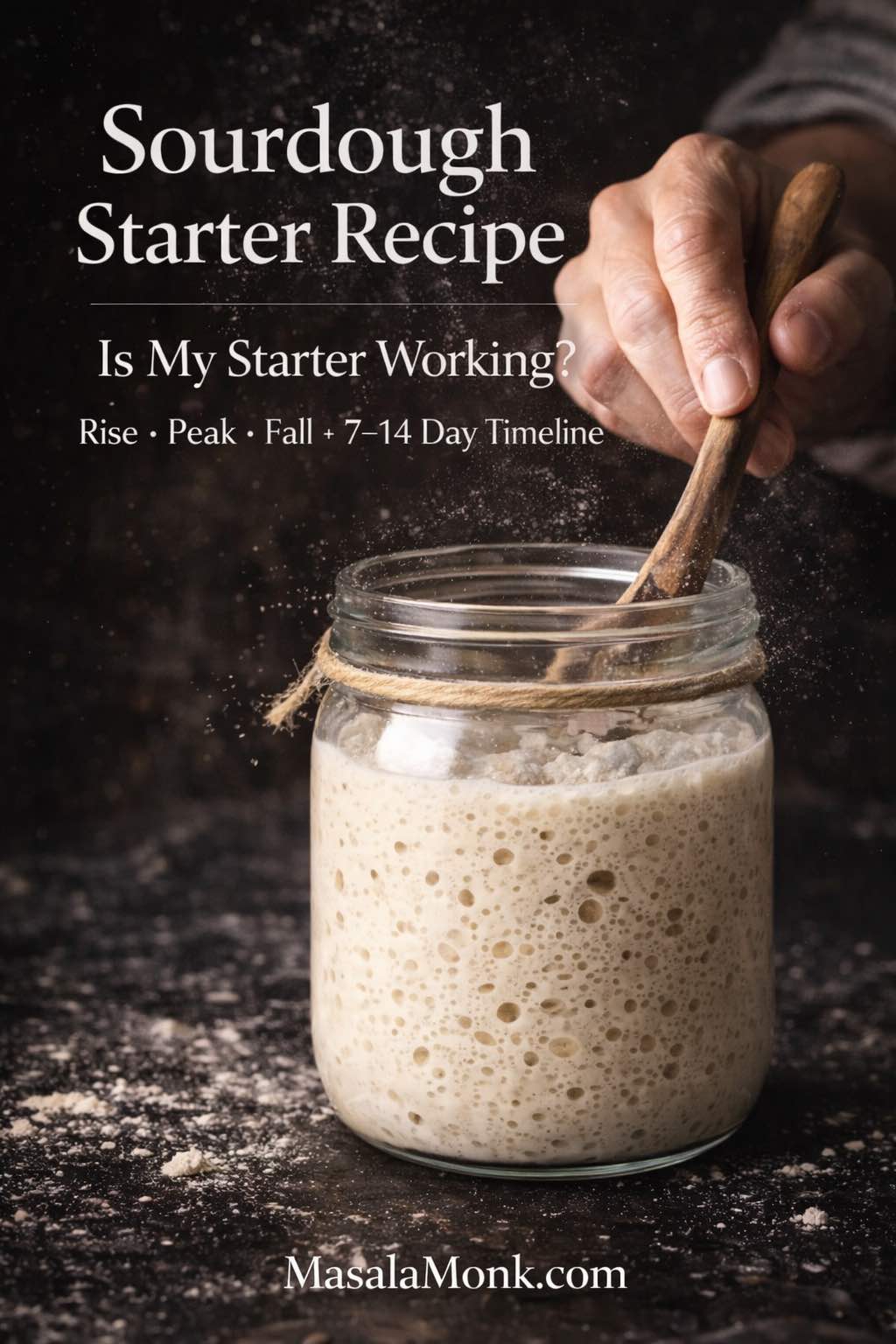
Photo of a glass jar of bubbly sourdough starter being stirred with a wooden spoon as flour dust floats in the air. Text overlay reads “Sourdough Starter Recipe” and “Is My Starter Working? Rise • Peak • Fall + 7–14 Day Timeline,” with “MasalaMonk.com” in the footer.

There’s a particular kind of satisfaction that comes from opening a jar, giving it a stir, and watching it wake up—bubbles rising, the surface smoothing out, the aroma turning from plain flour into something gently tangy and alive. A sourdough starter can feel mysterious at first, yet once you learn the rhythm, it becomes one of the most dependable things in your kitchen.

This sourdough starter recipe is designed to be steady rather than fussy. You’ll start with flour and water, build strength over several days, then settle into a feeding routine that fits your real schedule—whether you bake often, only on weekends, or “when life allows.” Along the way, you’ll learn what an active sourdough starter actually looks like, how to feed it without stress, how to manage discarded sourdough starter without wasting it, and how to rescue a jar that seems to have lost its spark.

When your starter is finally ready to bake, you can move seamlessly into your sourdough bread recipes and start turning that jar into loaves, rolls, buns, and more.


Sourdough starter: what it is, and why it’s worth keeping

A sourdough starter is a culture of wild yeast and lactic acid bacteria. Together, they turn flour and water into a living leavening system—one that creates lift, adds flavor, and develops the kind of crust and chew people fall in love with. Even more importantly, it becomes yours: your kitchen’s temperature, your flour choices, your feeding rhythm, and your preferences all shape it.
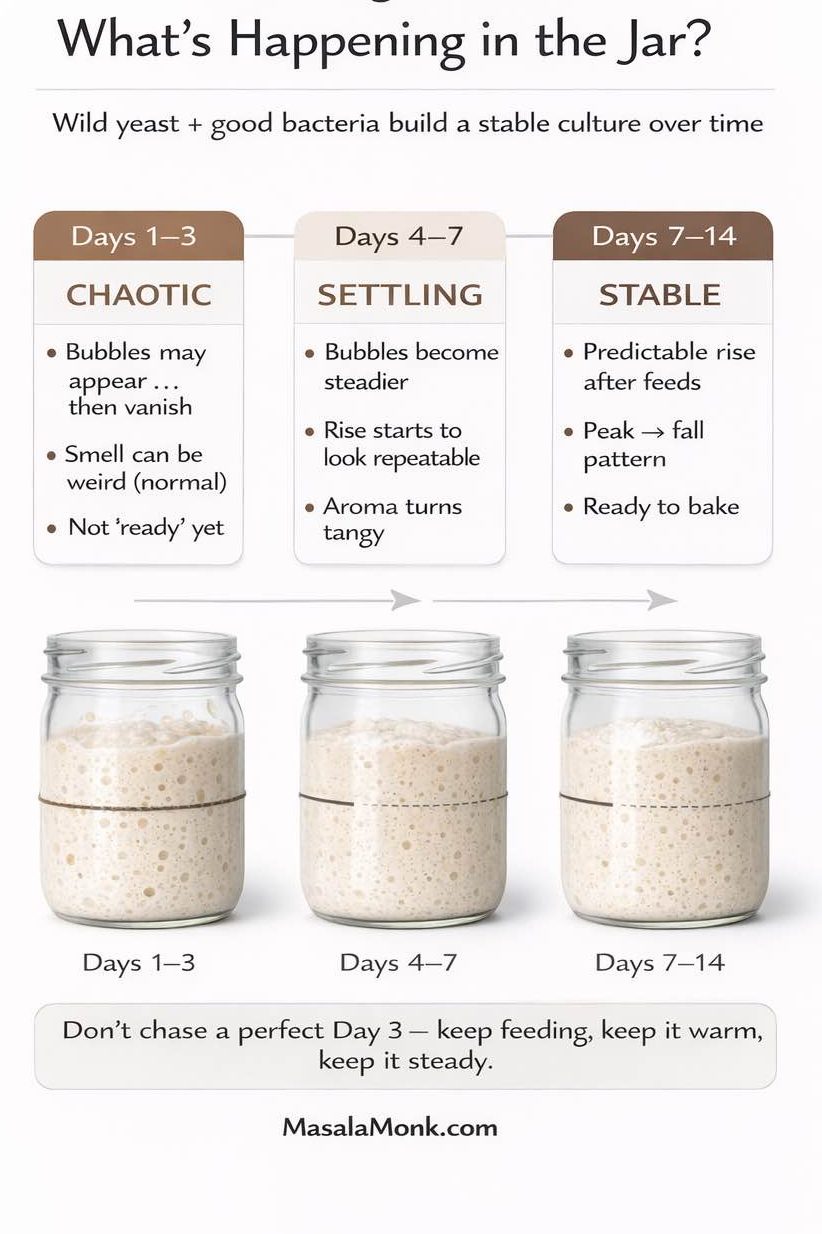
Vertical infographic titled “Sourdough Starter: What’s Happening in the Jar?” showing a simple timeline of starter development: Days 1–3 “Chaotic” (bubbles may appear then vanish, smell can be weird, not ready yet), Days 4–7 “Settling” (steadier bubbles, repeatable rise, aroma turns tangy), and Days 7–14 “Stable” (predictable rise after feeds, peak then fall pattern, ready to bake). Three jar photos illustrate increasing activity. Footer: MasalaMonk.com.
Day 3 can feel like a rollercoaster—bubbles one day, silence the next. This quick timeline shows what’s actually normal as a sourdough starter shifts from early “chaos” to a steadier, bake-ready rhythm (Days 1–3, 4–7, and 7–14). Use it to calm the guesswork, stay consistent with feeds, and watch for a repeatable rise pattern instead of “perfect” early drama.

At the beginning, the jar can look chaotic. One day it might surge with bubbles; the next day it might sit quietly, as if it forgot what it was supposed to do. That’s normal. Early activity often comes from a shifting cast of microbes, and it takes time for the stable, sourdough-friendly community to establish itself.

So, instead of expecting perfection on day three, aim for something calmer: repeat the same simple routine, keep conditions steady, and let the starter find its balance.

Also Read: Chicken Adobo — Step-by-Step Recipe — Classic Filipino Adobong Manok


Sourdough starter recipe ingredients

You only need two ingredients, although the choices you make can change how quickly the culture strengthens.

Flour

All-purpose flour works well. Still, many starters develop faster and more reliably with some whole grain flour, because the bran and germ bring extra nutrients and microbes. For that reason, including a portion of whole wheat flour for sourdough starter feeds can be a genuine advantage, especially in the first week.

If you’re using atta or choosing among common Indian wheat flours, you’ll often get better results with fresher flour that smells clean and slightly sweet. If you want a practical reference when you’re deciding what to keep in the pantry, best wheat flour (atta) in India is a useful companion.

Water

Room-temperature water is ideal. Filtered water can help if your tap water is heavily chlorinated. If you only have tap water, letting it sit uncovered for a while can reduce chlorine in some areas, although that depends on local treatment methods.

Simple tools that make life easier

You can begin with a jar and a spoon. However, a small kitchen scale quickly becomes your best ally because it keeps your feeding ratios consistent.

If you like a minimalist “starter kit” setup, think of it like this: jar + scale + spatula. Everything else is optional. Later in this guide, you’ll see what belongs in a sourdough starter kit and what you can skip without losing quality. For a broader kitchen setup that supports fermentation and baking, essential kitchen tools is a helpful internal reference you can explore when you’re ready.

Also Read: Sweetened Condensed Milk Fudge: 10 Easy Recipes


Sourdough starter recipe method: Day 1 to Day 7

This sourdough starter recipe uses a classic approach: equal parts flour and water by weight. It’s straightforward, repeatable, and easy to adjust later.

Day 1: Begin

  1. Add 50g flour and 50g water to a clean jar.
  2. Stir until no dry flour remains.
  3. Scrape down the sides.
  4. Loosely cover the jar and leave it at room temperature.
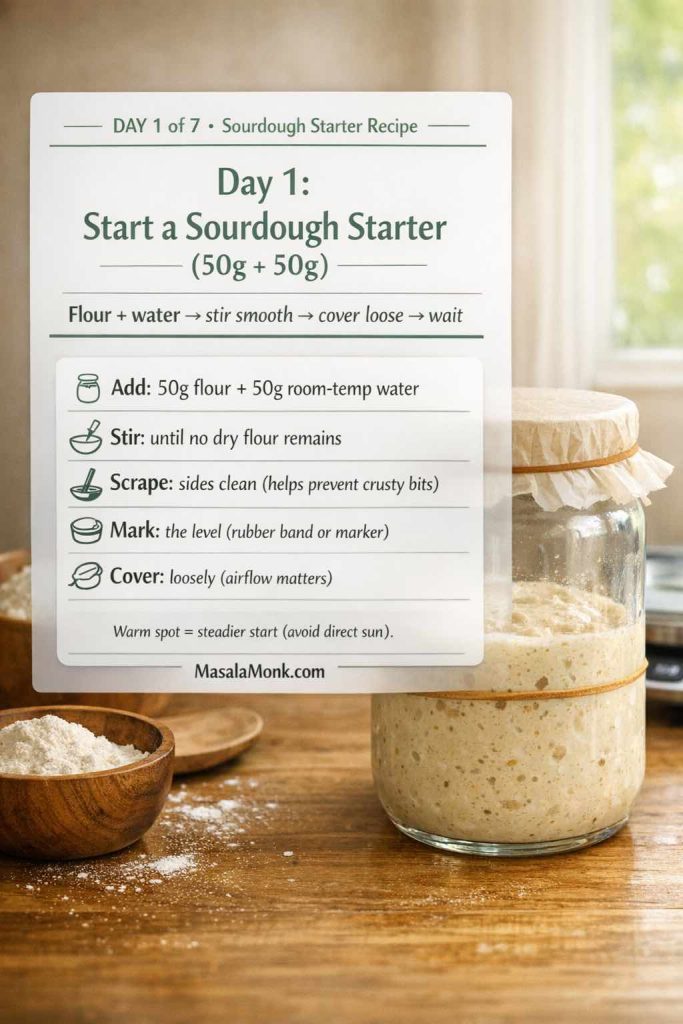
Infographic over a realistic kitchen photo of a glass jar of sourdough starter on a wooden counter. The overlay reads “Day 1 of 7 • Sourdough Starter Recipe” and “Day 1: Start a Sourdough Starter (50g + 50g).” Steps list: add 50g flour + 50g room-temp water, stir until no dry flour remains, scrape sides clean, mark the level, and cover loosely; note says a warm spot helps. MasalaMonk.com appears in the footer.
Day 1 is the easiest part of sourdough—yet it’s also where a calm, clean setup makes the rest of the week smoother. Mix 50g flour + 50g room-temp water, stir until there’s no dry flour, then scrape the sides, mark the level, and cover loosely so the culture can breathe. After that, your only job is to let time do its thing in a gently warm spot (no direct sun). Save this card so you can start in two minutes and come back tomorrow for Day 2—because the “quiet” days are normal, and sticking to the rhythm is what gets you a strong, active starter.

If your kitchen is chilly, place the jar somewhere gently warm—near a router, inside an off oven with the light on, or in a cozy corner away from drafts. Warmth doesn’t force success, although it does encourage steadier fermentation.

Day 2: Stir and observe

Stir once or twice during the day.
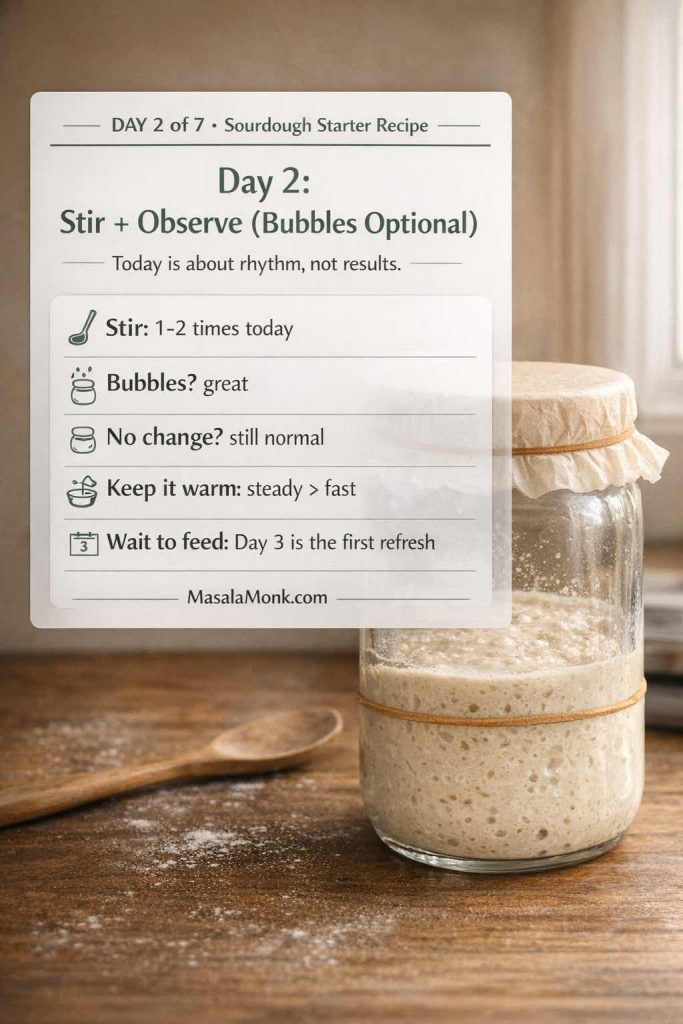
Infographic over a realistic kitchen photo of a glass jar containing early sourdough starter on a wooden countertop with a rubber band marking the level. The overlay text reads “DAY 2 of 7 • Sourdough Starter Recipe” and “Day 2: Stir + Observe (Bubbles Optional).” It lists: stir 1–2 times today, bubbles are great, no change is still normal, keep it warm for steadier fermentation, and wait to feed because Day 3 is the first refresh. MasalaMonk.com is shown in the footer.
Day 2 is the “quiet confidence” day. Give your jar a stir once or twice and then let it be—because bubbles are a bonus, not a requirement this early. Some starters look lively today, while others barely change, and both can still become strong if you keep conditions steady. Aim for a comfortably warm spot, keep the lid loose, and resist the urge to add extra flour or restart. Save this card so you don’t second-guess tomorrow—Day 3 is the first real refresh, and that’s when the rhythm starts to click.

You might see a few bubbles. Alternatively, it might look unchanged. Either way, keep going. Early calm is not failure; it’s simply the quiet part before the culture strengthens.

Day 3: First feed (discard + refresh)

  1. Discard all but 50g of what’s in your jar.
  2. Add 50g water and 50g flour.
  3. Stir thoroughly, then mark the level with a rubber band or marker.
  4. Cover loosely again.
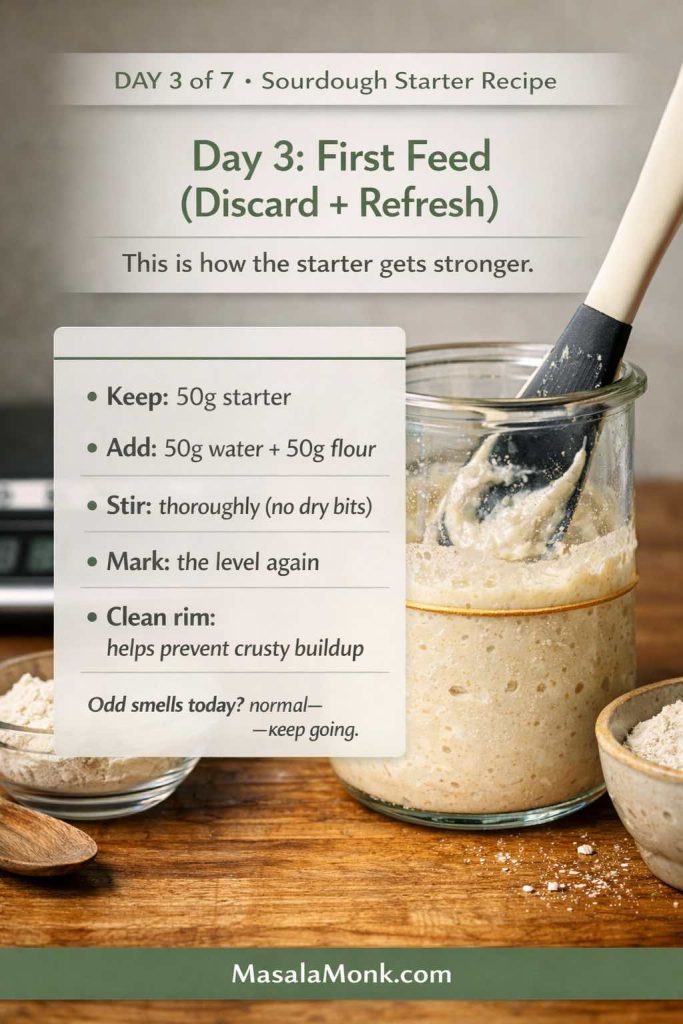
Infographic for Day 3 of a sourdough starter recipe showing “Day 3: First Feed (Discard + Refresh).” A glass jar of starter sits on a wooden counter with a spatula inside and a rubber band marking the level, with bowls of flour and a kitchen scale nearby. Overlay steps say: keep 50g starter, add 50g water + 50g flour, stir thoroughly with no dry bits, mark the level again, and clean the rim to prevent crusty buildup; note says odd smells today are normal. MasalaMonk.com appears in the footer.
Day 3 is where your starter starts behaving like a real culture—because you’re finally giving it fresh food on a schedule. Keep 50g starter, then add 50g water + 50g flour, stir until it’s fully smooth (no dry pockets), and mark the level so you can actually see what happens over the next several hours. One small habit makes a big difference today: wipe the rim clean so crusty bits don’t dry out and cause problems later. And if the smell feels a little “weird”? That’s normal in the early days—stick to the routine and the jar usually settles into a cleaner, tangier rhythm soon.

Many starters smell “odd” around day 3 or day 4. That stage passes. Keep your jar clean around the rim, use a clean spoon, and continue.

Day 4: Repeat the feed

Repeat the same discard and feed:

  • Keep 50g starter
  • Add 50g water + 50g flour
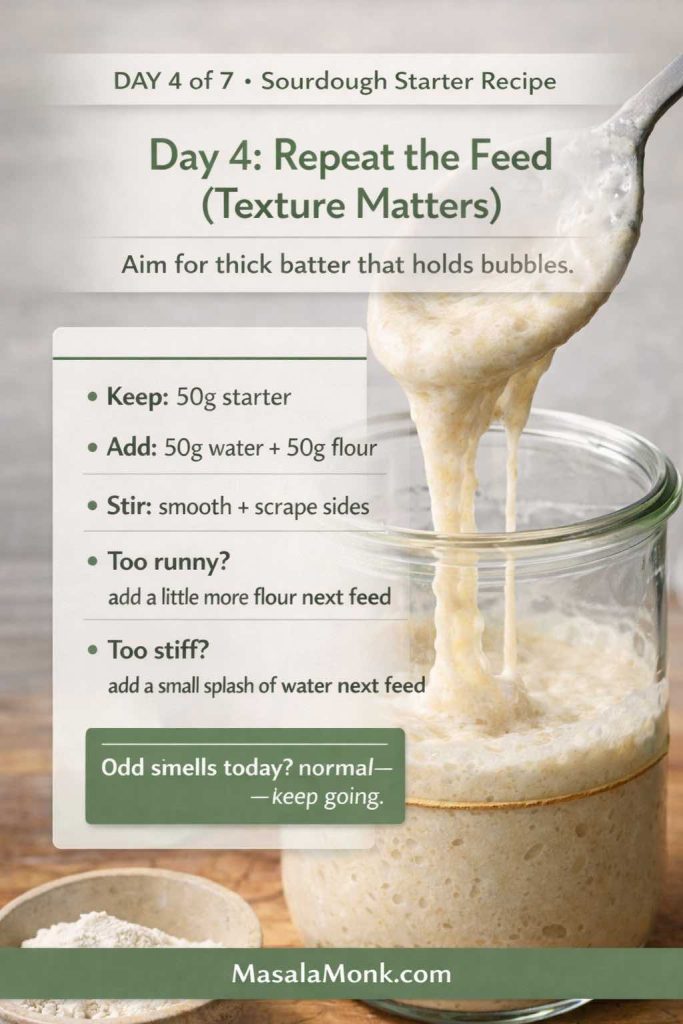
Infographic for Day 4 of a sourdough starter recipe showing “Day 4: Repeat the Feed (Texture Matters)” and “Aim for thick batter that holds bubbles.” A spoon lifts thick, stretchy sourdough starter above a glass jar on a countertop. The overlay instructions say: keep 50g starter, add 50g water + 50g flour, stir smooth and scrape sides; if too runny add more flour next feed, if too stiff add a small splash of water next feed. MasalaMonk.com is displayed in the footer.
Day 4 is the day to stop guessing and start reading the texture. You’re repeating the same feed (keep 50g starter + add 50g water + 50g flour), but now you’re watching how the jar behaves. The goal is thick batter that can hold bubbles—not watery, not dough-stiff. If your starter looks runny, it often ferments but won’t rise well because it can’t trap gas; next feed, nudge it thicker with a little more flour. If it’s stiff and hard to stir, loosen it with a small splash of water. Save this card as your “texture compass”—it’s one of the fastest ways to turn an unpredictable starter into a steady, active one.

As you stir, notice the texture. You want something like thick batter. If it’s too watery, it won’t trap gas well. On the other hand, if it’s too stiff, fermentation can slow. Adjust gradually rather than dramatically.

Day 5: Shift toward strength

If you see clear bubbling and some rise, strengthen the culture with a slightly higher feed ratio. This helps prevent the starter from becoming overly acidic too quickly.

Try:

  • Keep 25g starter
  • Add 50g water + 50g flour
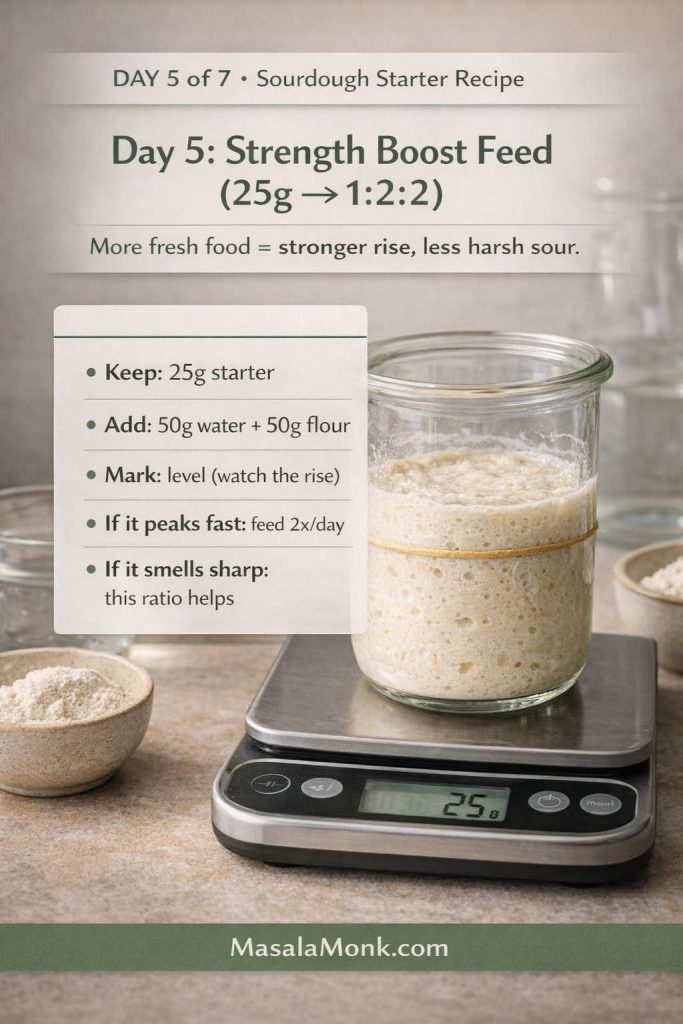
Infographic for Day 5 of a sourdough starter recipe titled “Day 5: Strength Boost Feed (25g → 1:2:2)” with the line “More fresh food = stronger rise, less harsh sour.” A glass jar of sourdough starter sits on a digital kitchen scale reading 25g, with a rubber band marking the level and bowls of flour nearby. Overlay steps say: keep 25g starter, add 50g water + 50g flour, mark the level and watch the rise, feed twice daily if it peaks fast, and use this ratio if it smells sharp. MasalaMonk.com appears in the footer.
Day 5 is the “make it stronger” pivot. Instead of carrying a big amount forward, you keep 25g starter and give it a bigger refresh (50g water + 50g flour). That extra fresh food helps the culture build power without tipping overly sour or harsh—so you’re more likely to see a steadier rise and a cleaner aroma. Mark the level right after feeding and watch what happens over the next few hours; if it peaks and collapses quickly, that’s your sign it may want two feeds a day in a warm kitchen. Save this card as your Day 5 reset—this is often where a starter starts acting “reliable.”

Feed once a day if activity is modest. Feed twice a day if the starter rises and falls quickly or smells hungry and sharp by evening.

For a reliable reference on the logic of feeding and maintaining a starter—especially once you move into predictable routines—this resource on feeding and maintaining a sourdough starter is a solid companion when you want a second set of eyes on ratios and timing.

Day 6: Look for a pattern, not a miracle

By now, the starter should be showing more consistent bubbles. You may also see a clearer rise after feeding, even if it doesn’t double yet.
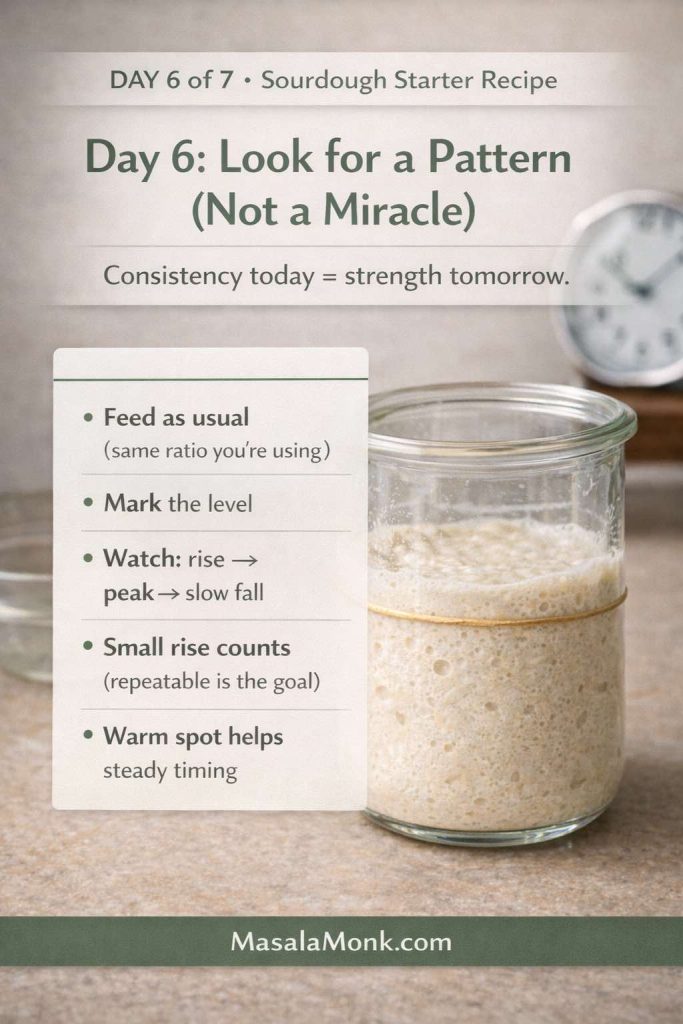
Infographic for Day 6 of a sourdough starter recipe titled “Day 6: Look for a Pattern (Not a Miracle)” with the note “Consistency today = strength tomorrow.” A glass jar of bubbly sourdough starter sits on a countertop with a rubber band marking the starter level; a blurred clock appears in the background. Overlay steps say: feed as usual (same ratio you’re using), mark the level, watch rise to peak then slow fall, small rise counts because repeatable is the goal, and a warm spot helps steady timing. MasalaMonk.com is shown in the footer.
Day 6 is where sourdough starts rewarding patience. Instead of chasing a dramatic “overnight miracle,” you’re watching for something more useful: a repeatable rise after feeding. Feed as usual, mark the level, and then check in a few times to catch the rhythm—rise → peak → slow fall. Even a modest rise is a win if it happens consistently, because that predictability is what turns a starter into something you can bake with on purpose. Save this card as your Day 6 mindset check: steady progress today usually becomes real strength tomorrow.

At this stage, the goal is repeatability. One huge rise followed by two flat days can happen early. Still, a starter that rises a little after every feed is moving in the right direction.

Day 7: Active sourdough starter checkpoint

An active sourdough starter usually shows several traits together:

  • It rises reliably after feeding (often close to doubling once it matures)
  • It smells pleasantly tangy, fruity, or mildly yogurty
  • Bubbles appear throughout, not just along the surface
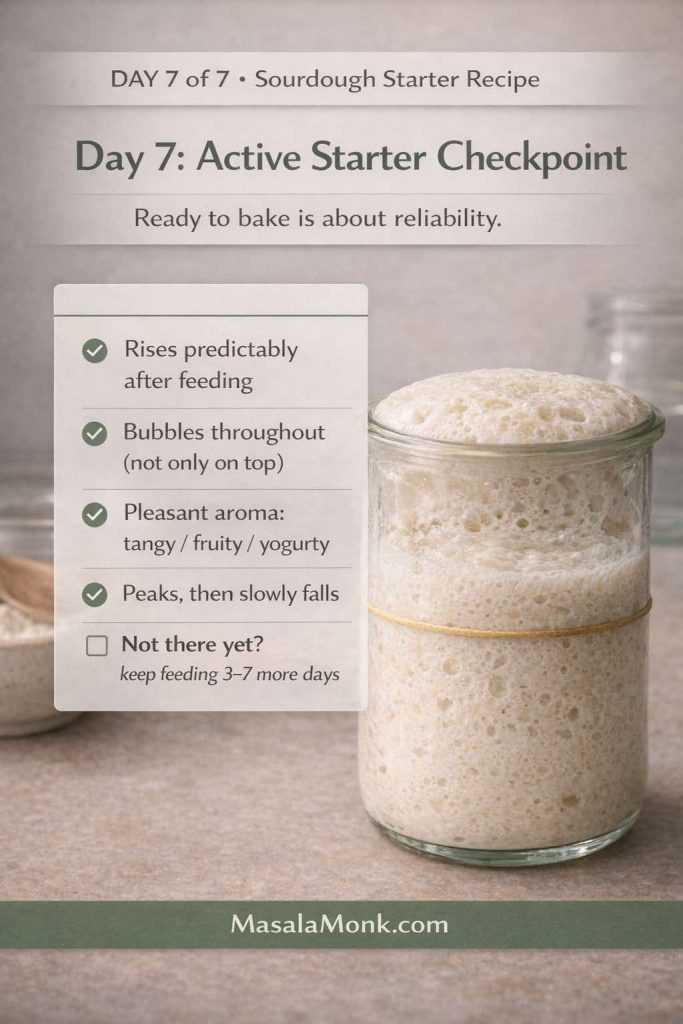
Infographic titled “DAY 7 of 7 • Sourdough Starter Recipe” and “Day 7: Active Starter Checkpoint” over a realistic photo of a glass jar of sourdough starter at peak rise with a domed top and many bubbles; a rubber band marks the level. The checklist reads: rises predictably after feeding, bubbles throughout (not only on top), pleasant aroma tangy/fruity/yogurty, peaks then slowly falls, and if not there yet keep feeding 3–7 more days. MasalaMonk.com appears in the footer.
Day 7 is your “can I bake yet?” moment—and the answer is less about a magic day and more about reliability. After a feed, a starter that’s ready will rise predictably, look bubbly throughout (not just on top), and smell clean and pleasantly tangy—sometimes even lightly fruity or yogurty. Ideally, you’ll see it peak (highest dome) and then slowly fall, which shows it’s completing a full cycle. If you’re close but not quite there, don’t restart—keep the same routine for a few more days and it usually locks in. Save this checkpoint card so baking day feels confident instead of guessy.

If you’re not there yet, don’t force it. Continue the routine for a few more days. Many starters take 10–14 days to become fully dependable, especially in cooler kitchens or with lower-protein flours.

For a deeper explanation of the “starter at peak” idea—what it looks like and why it matters—this Serious Eats sourdough starter guide is useful when you want to fine-tune timing.

Also Read: Peanut Butter Fudge: Recipes & Guide (8 Methods + Easy Variations)
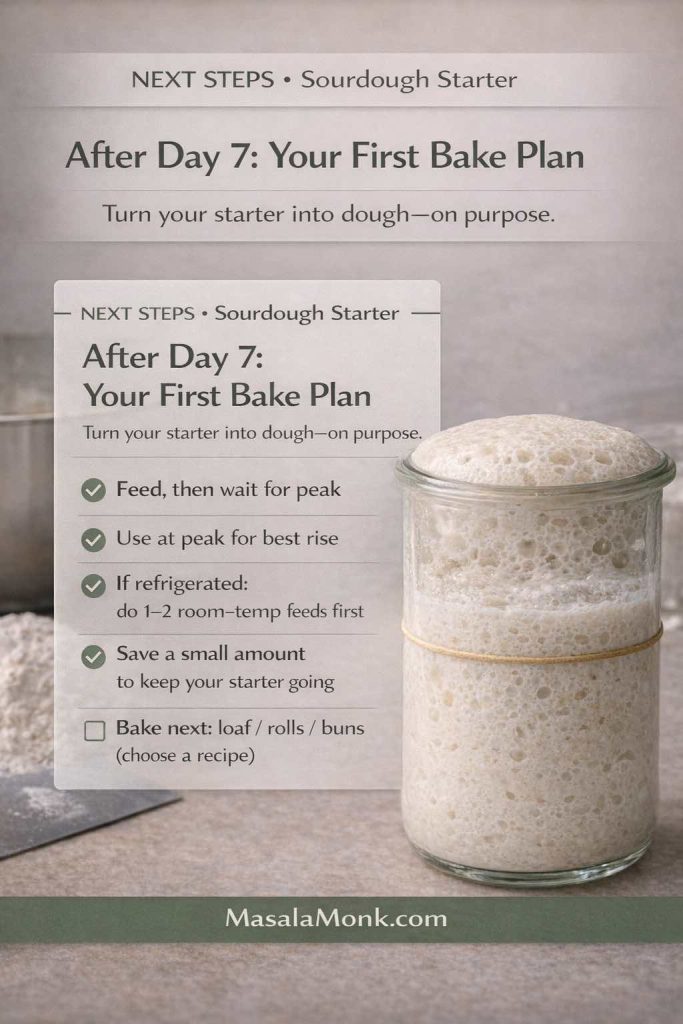
Infographic titled “After Day 7: Your First Bake Plan” over a realistic photo of an active sourdough starter in a glass jar with a rubber band marking the level. Checklist text says: feed then wait for peak, use at peak for best rise, if refrigerated do 1–2 room-temperature feeds first, save a small amount to keep your starter going, and bake next loaf/rolls/buns by choosing a recipe. MasalaMonk.com is in the footer.
You’ve built the starter—now turn it into bread without guessing. Feed your starter, then wait until it reaches peak (highest dome, lacy bubbles, clean tangy aroma). That’s the sweet spot for mixing dough because the starter is at its most active for the best rise. If your starter lives in the fridge, give it 1–2 room-temperature feeds first so it wakes up and behaves predictably again. Finally, save a small amount to keep your starter going, then choose your next bake—loaf, rolls, or buns—and head into your sourdough bread recipes for the full step-by-step.

Making sourdough starter more reliable: what helps most

Once you understand the levers, starter-building becomes much less confusing.

Warmth: your quiet advantage

A cold kitchen slows fermentation. A gently warm spot smooths out the process. Even a small change can help: moving your jar away from a cold window, or keeping it in a turned-off microwave between feeds.
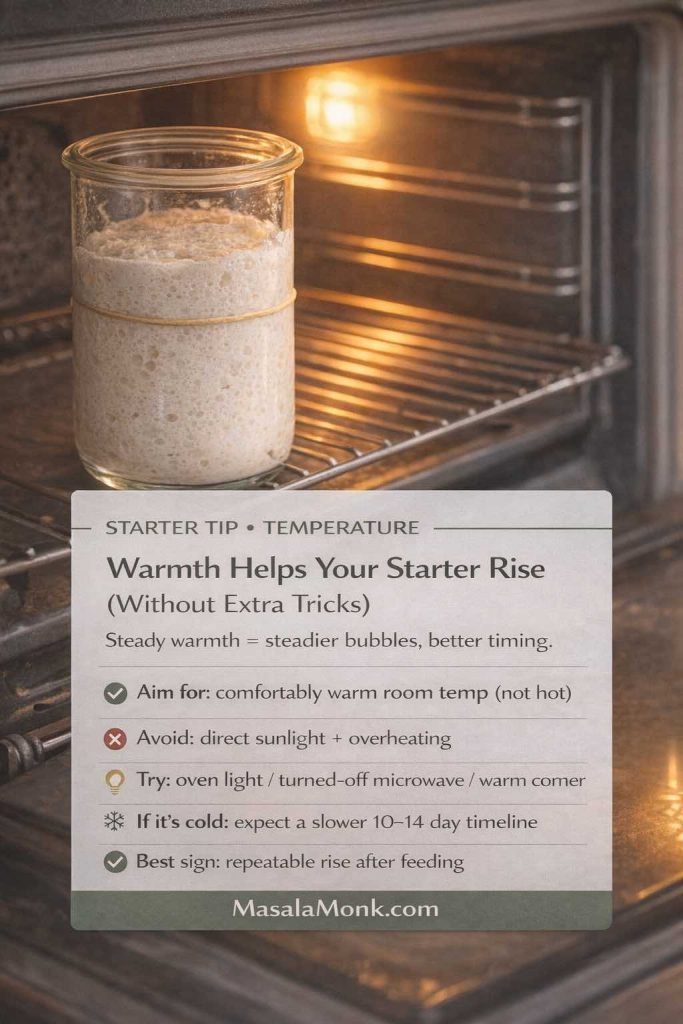
Infographic titled “Starter Tip • Temperature” over a realistic photo of a glass jar of bubbly sourdough starter sitting inside a turned-off oven with the oven light on. Text reads “Warmth Helps Your Starter Rise (Without Extra Tricks)” and “Steady warmth = steadier bubbles, better timing.” Bullet points say: aim for comfortably warm room temperature, avoid direct sunlight and overheating, try oven light/turned-off microwave/warm corner, if it’s cold expect a slower 10–14 day timeline, and best sign is a repeatable rise after feeding. MasalaMonk.com appears in the footer.
If your sourdough starter feels slow, temperature is usually the missing piece—not a new flour, not a “hack.” A comfortably warm spot helps fermentation stay steady, which means more consistent bubbles and more predictable rise times after feeding. An easy option is a turned-off oven with the light on (gentle warmth), or a draft-free warm corner. Avoid direct sun or overheating; you’re aiming for steady, not hot. Save this card for the days your kitchen runs cool—because once warmth is stable, the starter’s rhythm becomes much easier to read.

Consistency: aim for thick batter

If your starter pours like milk, it struggles to trap gas. Instead, aim for something thicker—like pancake batter that slowly drops from a spoon. If needed, add a touch more flour at the next feed.
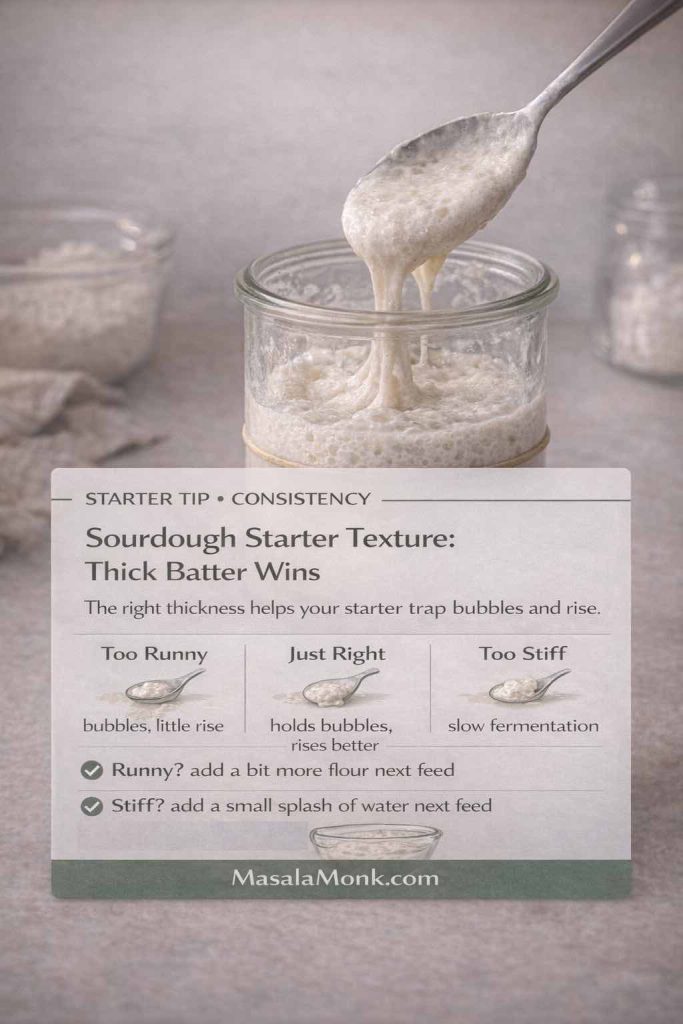
Infographic titled “Starter Tip • Consistency” reading “Sourdough Starter Texture: Thick Batter Wins,” shown over a photo of a spoon lifting sourdough starter above a glass jar. The graphic compares three textures: “Too Runny—bubbles, little rise,” “Just Right—holds bubbles, rises better,” and “Too Stiff—slow fermentation.” It also says: “Runny? add a bit more flour next feed” and “Stiff? add a small splash of water next feed.” MasalaMonk.com appears in the footer.
If your starter is bubbling but barely rising, texture is often the difference. A thick-batter consistency helps your sourdough starter trap gas, so the rise becomes more visible and predictable after feeding. Use this quick guide: if it’s too runny, it may ferment but struggle to hold bubbles—so add a bit more flour next feed. If it’s too stiff, fermentation can slow—so loosen it with a small splash of water next feed. Save this card as your “texture compass” for the days your starter feels confusing.

Flour choice: use whole wheat strategically

If the starter seems sluggish, adding whole wheat can help. Many bakers find that whole grain flour gives the culture extra nutrition and speeds up activity, especially early on.

You don’t have to switch permanently. A simple approach works well:

  • For 2–3 feeds, use 50% all-purpose + 50% whole wheat
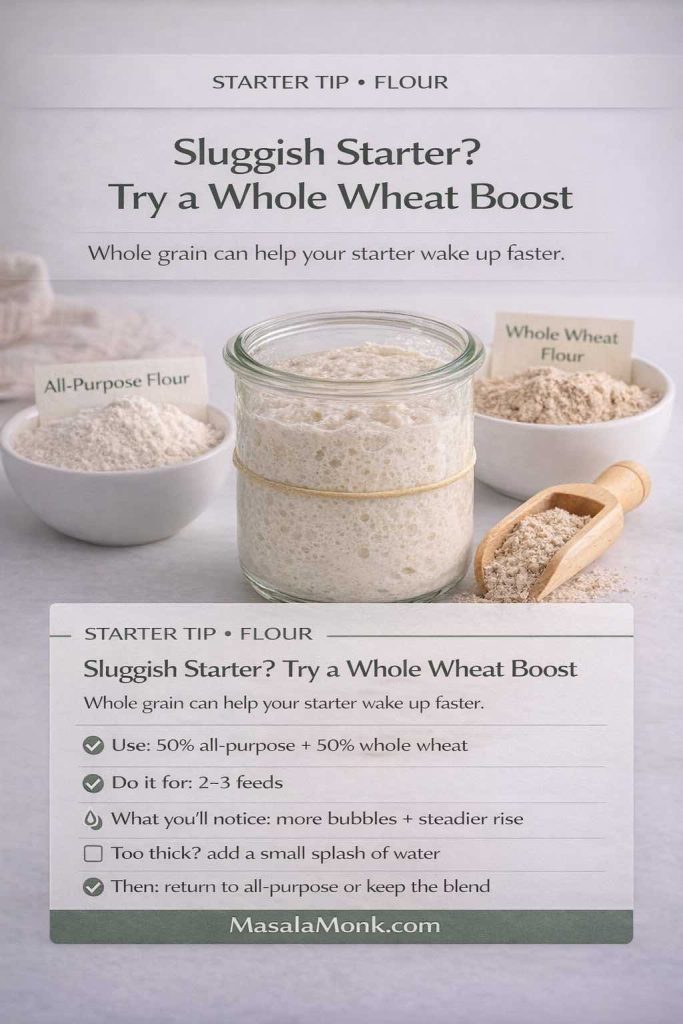
Infographic titled “Starter Tip • Flour” that says “Sluggish Starter? Try a Whole Wheat Boost.” It shows a glass jar of bubbly sourdough starter on a clean countertop with bowls labeled all-purpose flour and whole wheat flour. The overlay checklist says: use 50% all-purpose + 50% whole wheat, do it for 2–3 feeds, you’ll notice more bubbles and a steadier rise, add a small splash of water if too thick, then return to all-purpose or keep the blend. MasalaMonk.com is in the footer.
If your starter feels sleepy—bubbles are tiny, the rise is modest, and timing is all over the place—this is a simple, low-drama fix: switch to a 50/50 blend of all-purpose + whole wheat for 2–3 feeds. Whole grain brings extra nutrients that often help the culture “wake up,” so you’ll usually see more bubbling and a steadier rise after feeding. If the mix turns thick (whole wheat absorbs more water), add a small splash of water next feed and keep going. Save this card for cold days or slow weeks—it’s one of the easiest ways to build a stronger, more reliable starter.

If you’re curious about why different flours behave differently in starters, this best flour for sourdough starters investigation offers a clear breakdown.

Also Read: 10 Vegan Chocolate Cake Recipes (Easy, Moist, & Dairy-Free)


Feeding sourdough starter: daily routine that doesn’t take over your life

Once your starter is established, feeding becomes a small habit rather than a project.

A simple daily feeding ratio

A steady baseline is:

  • 1:1:1 (starter : water : flour by weight)

That said, slightly larger feeds can keep the culture stronger and less acidic:

  • 1:2:2 or 1:3:3

For example:

  • Keep 20g starter
  • Add 40g water + 40g flour (1:2:2)

This is a gentle way to support a starter that runs sour or seems weak.
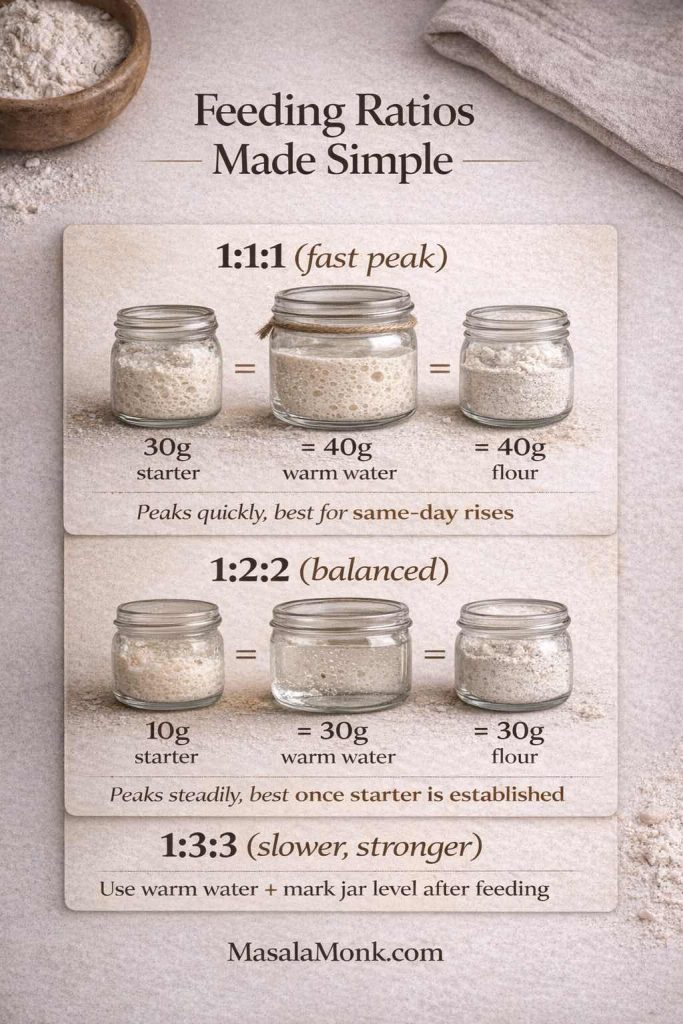
Infographic showing sourdough starter feeding ratios 1:1:1, 1:2:2, and 1:3:3 with example gram measurements for starter, warm water, and flour, plus notes on peak speed and strength.
Sourdough starter feeding ratios at a glance: use 1:1:1 when you need a faster peak, 1:2:2 for a steady everyday rhythm, and 1:3:3 when you want a slower, stronger rise. Keep the jars small and the math simple—once you know which ratio matches your schedule, feeding becomes predictable instead of guessy.

Low-waste maintenance (smaller starter, same power)

If you don’t bake every day, you don’t need a giant jar. Keeping a smaller amount means you discard less, while still maintaining strength.
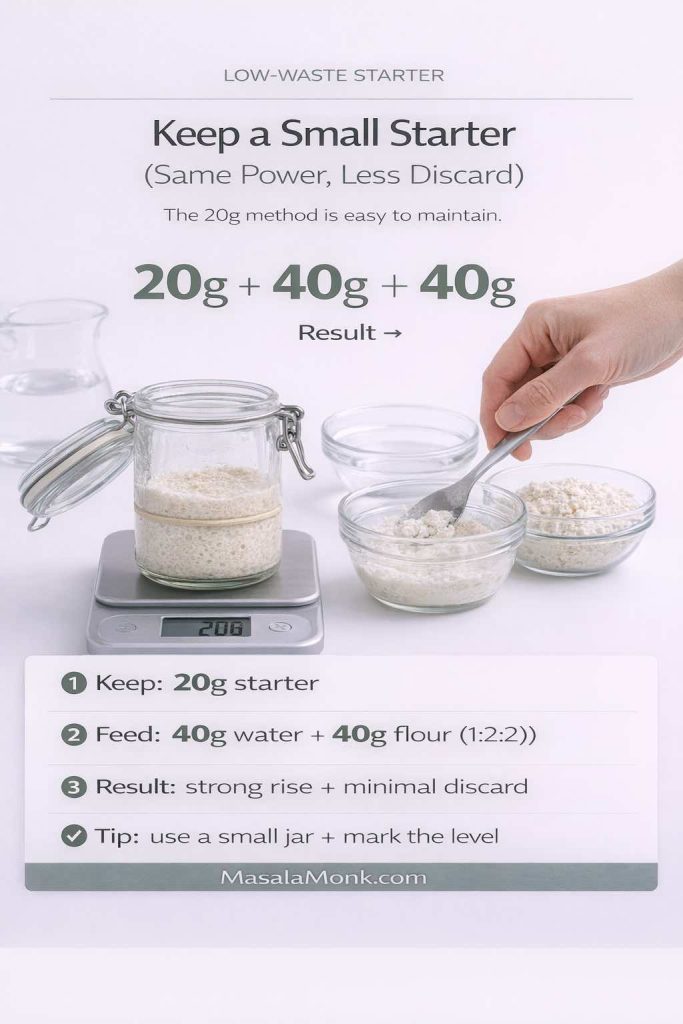
Studio-style infographic titled “Low-Waste Starter: Keep a Small Starter (Same Power, Less Discard).” It shows a small jar of bubbly sourdough starter on a digital kitchen scale and bowls of flour and water, with a hand mixing. Large text reads “20g + 40g + 40g.” A checklist says: Keep 20g starter; Feed 40g water + 40g flour (1:2:2); Result strong rise + minimal discard; Tip use a small jar + mark the level. MasalaMonk.com appears in the footer.
Want a strong starter without throwing out loads of discard? This low-waste 20g routine keeps things simple: keep 20g starter, then feed 40g water + 40g flour (1:2:2). You still get a lively, reliable rise—just with a smaller jar and far less waste. Mark the level after feeding so you can see the rise clearly, then repeat on the schedule that fits your kitchen. Save this card if you want sourdough to feel easy, not messy.

A practical approach:

  • Keep 20–30g starter
  • Feed 40–60g water + 40–60g flour

If you want a well-explained philosophy around reducing waste while maintaining performance, keeping a smaller sourdough starter to reduce waste is a helpful reference when you’re dialing in your routine.

Also Read: Kahlua Drinks: 10 Easy Cocktail Recipes (Milk, Vodka, Coffee)


Feeding sourdough starter without a scale

Sometimes you’re traveling. Sometimes the scale battery dies. And then sometimes you simply want to keep things simple for a day. You can feed without a scale and still keep a starter healthy, as long as you aim for the right texture.
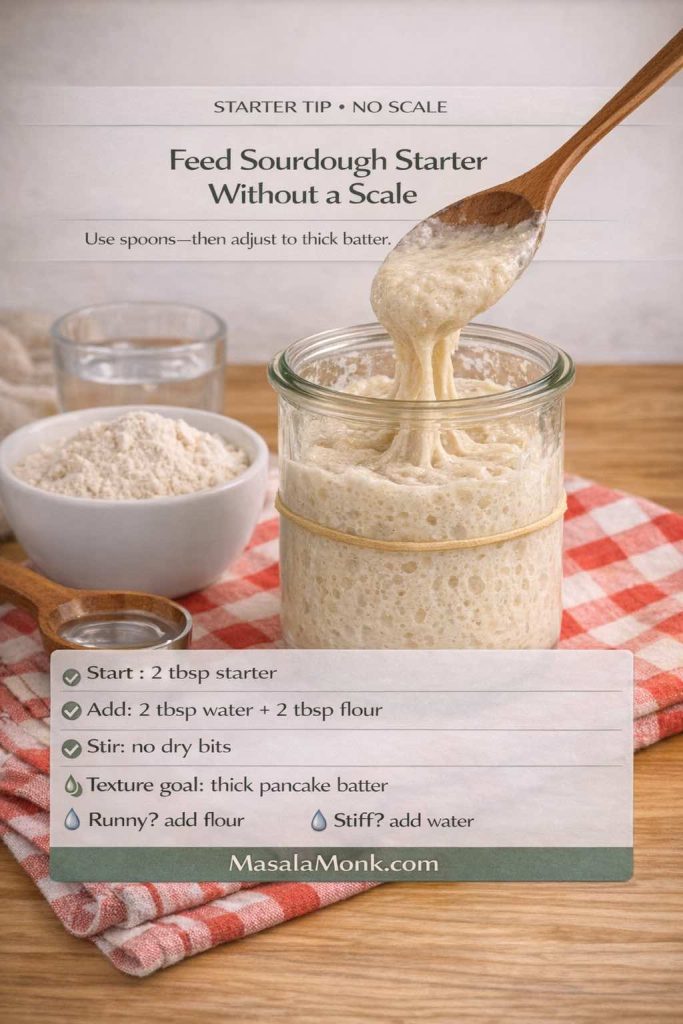
Infographic titled “Starter Tip • No Scale” with the heading “Feed Sourdough Starter Without a Scale.” A glass jar of sourdough starter is shown with a spoon lifting starter to demonstrate texture. Nearby are a bowl of flour, a glass of water, and measuring spoons on a countertop. The checklist says: start with 2 tbsp starter; add 2 tbsp water + 2 tbsp flour; stir until no dry bits; texture goal is thick pancake batter; if runny add flour; if stiff add water. MasalaMonk.com appears in the footer.
No scale? You can still keep your starter healthy. Start with a small, repeatable spoon method—2 tbsp starter + 2 tbsp water + 2 tbsp flour—then let texture be the judge. You’re aiming for thick pancake batter so the starter can trap bubbles and rise more reliably after feeding. If it turns runny, add a bit more flour next time; if it’s stiff and hard to stir, loosen it with a small splash of water. Save this card for travel days, dead batteries, or when you just want to keep feeding simple.

Start with roughly equal spoonfuls of flour and water, then adjust until the mixture looks like thick batter. If it feels thin, add flour. If it feels stiff, add water.

The most important part is consistency across a few feeds. If you change methods every day, the starter can feel unpredictable. Conversely, if you stick to one approach for several days, it settles into a rhythm again.

Also Read: Hot Chocolate Coffee: 3 Easy Recipes (Cocoa, Mix, or Espresso)


Active sourdough starter: how to know it’s ready to bake

A strong starter behaves like a reliable friend: it shows up when it says it will.
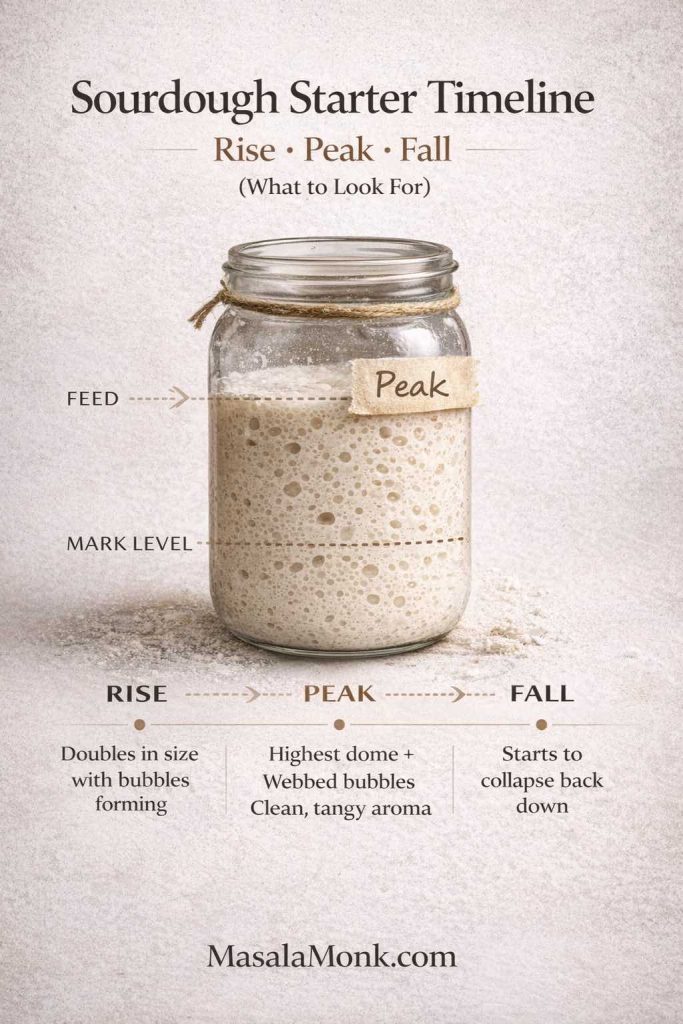
Infographic showing a jar of sourdough starter with a marked level line and the starter at “Peak.” Headline reads “Sourdough Starter Timeline: Rise • Peak • Fall (What to Look For).” The bottom explains: Rise—starter doubles with bubbles forming; Peak—highest dome, webbed bubbles, clean tangy aroma; Fall—starter starts to collapse back down. MasalaMonk.com appears in the footer.
Wondering when to feed—or when your starter is actually ready? Use this timeline as your quick visual check. Mark the level right after feeding, then watch for Rise → Peak → Fall. Peak is the sweet spot for baking: the starter is at its highest dome, looks lacy/webbed with bubbles, and smells clean and tangy. Once it begins to fall, it’s running out of food—so either feed again or plan your next step based on the schedule in the guide below.

The rise pattern

After feeding, many starters:

  1. bubble steadily,
  2. rise and dome slightly,
  3. then flatten and fall once they’ve peaked.

That “rise and fall” rhythm matters because you generally get best baking performance when the starter is used near peak, when it’s most buoyant and energetic.
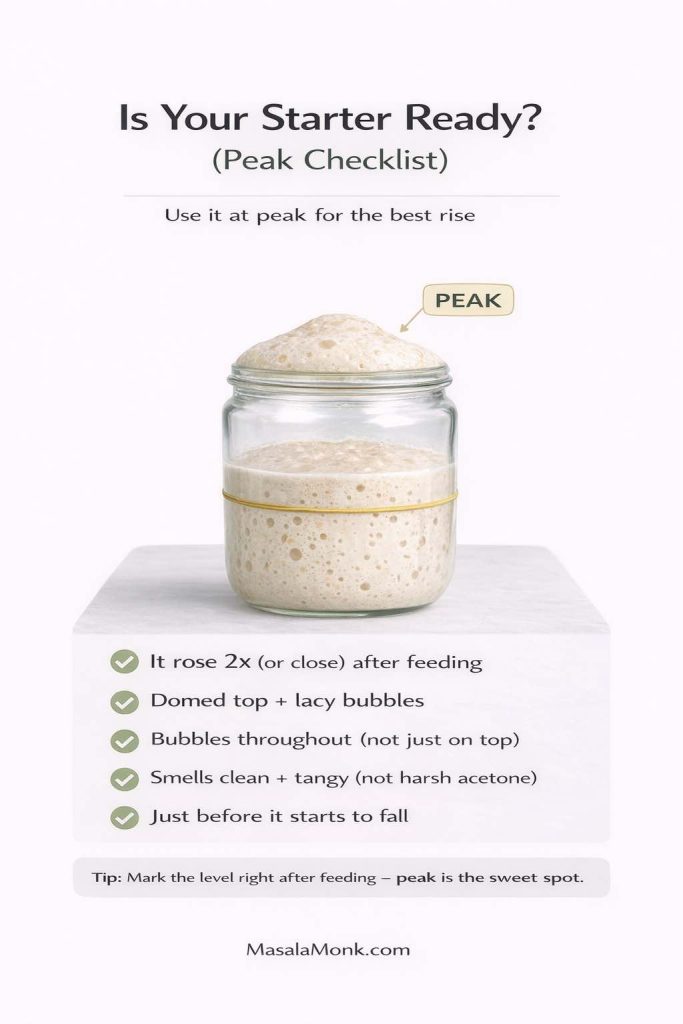
Infographic titled “Is Your Starter Ready? (Peak Checklist)” showing a glass jar of sourdough starter marked with a rubber band and domed at peak with visible bubbles, labeled “PEAK.” Checklist items: it rose 2× (or close) after feeding; domed top with lacy bubbles; bubbles throughout, not just on top; smells clean and tangy, not harsh acetone; and it’s just before it starts to fall. Tip reads: “Mark the level right after feeding — peak is the sweet spot.” Footer reads MasalaMonk.com.
“Ready to bake?” is the hardest part of sourdough—because timing matters more than tricks. Use this Peak Checklist to know when your starter is at its strongest: rise + dome + lacy bubbles + clean tangy smell, right before it starts to fall. Save this for baking day so you stop guessing and start catching your starter at the sweet spot for better lift, better crumb, and a more reliable loaf.

The float test (useful, but not absolute)

The float test can be one clue: a spoonful of starter floating in water suggests it’s trapping gas. Still, it’s not a verdict. Hydration and flour type affect results. Use it as a hint, then rely more on the rise pattern and smell.

Also Read: Cappuccino Recipe: How to Make a Perfect Cappuccino at Home


Sourdough starter in the fridge: storing it without losing momentum

If you bake occasionally, refrigeration makes starter life easier.

Feeding refrigerated sourdough starter: a weekly rhythm

Here’s a simple weekly plan:

  1. Feed your starter.
  2. Leave it at room temperature until you see early activity (a few bubbles and slight expansion).
  3. Refrigerate it, loosely covered.
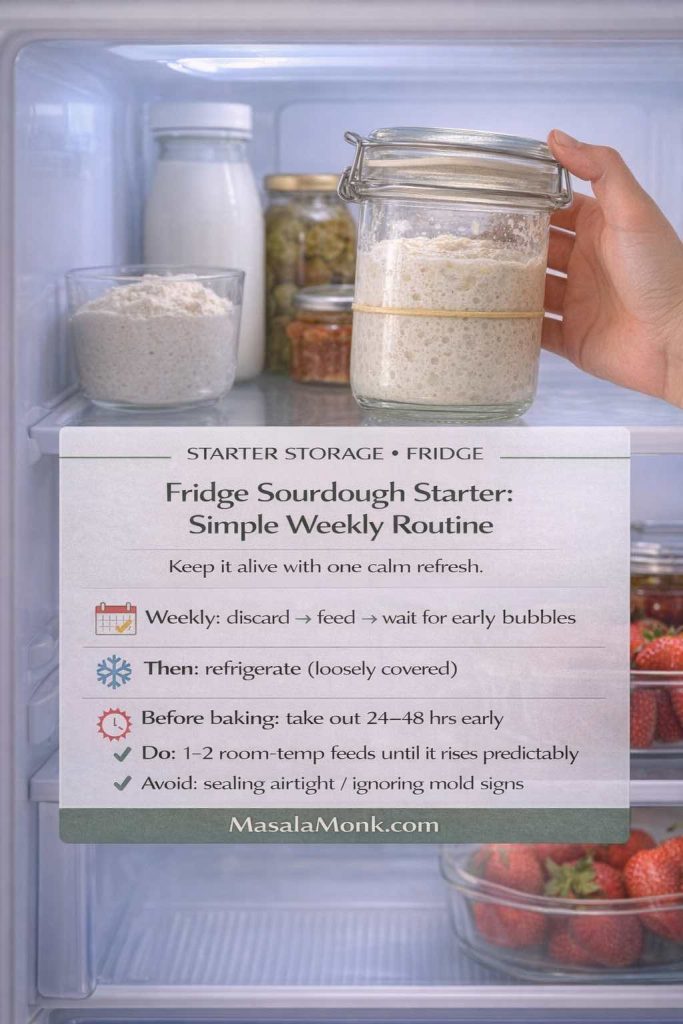
Infographic titled “Starter Storage • Fridge” and “Fridge Sourdough Starter: Simple Weekly Routine” shown inside an open refrigerator. A hand holds a glass jar of bubbly sourdough starter with a rubber band marking the level; nearby are flour and other fridge items. The overlay steps say: weekly discard → feed → wait for early bubbles; then refrigerate loosely covered; before baking take out 24–48 hours early; do 1–2 room-temperature feeds until it rises predictably; avoid sealing airtight or ignoring mold signs. MasalaMonk.com appears in the footer.
If you don’t bake every day, the fridge is your best friend—as long as you keep one simple rhythm. Once a week, discard down, feed, and let the starter show early bubbles before it goes back into the refrigerator (loosely covered). Then, when baking day is coming, pull it out 24–48 hours ahead and do 1–2 room-temperature feeds until it rises on schedule again. Save this card for the weeks you’re busy—it keeps your starter alive without turning sourdough into a full-time job.

Once a week:

  • Take it out
  • Discard down to a small amount
  • Feed it
  • Return it to the fridge after it shows early activity

This method keeps the starter stable without demanding daily attention.

For a clear overview of sourdough basics and starter care, extension resources can be helpful when you want straightforward guidance, such as Colorado State’s sourdough basics.
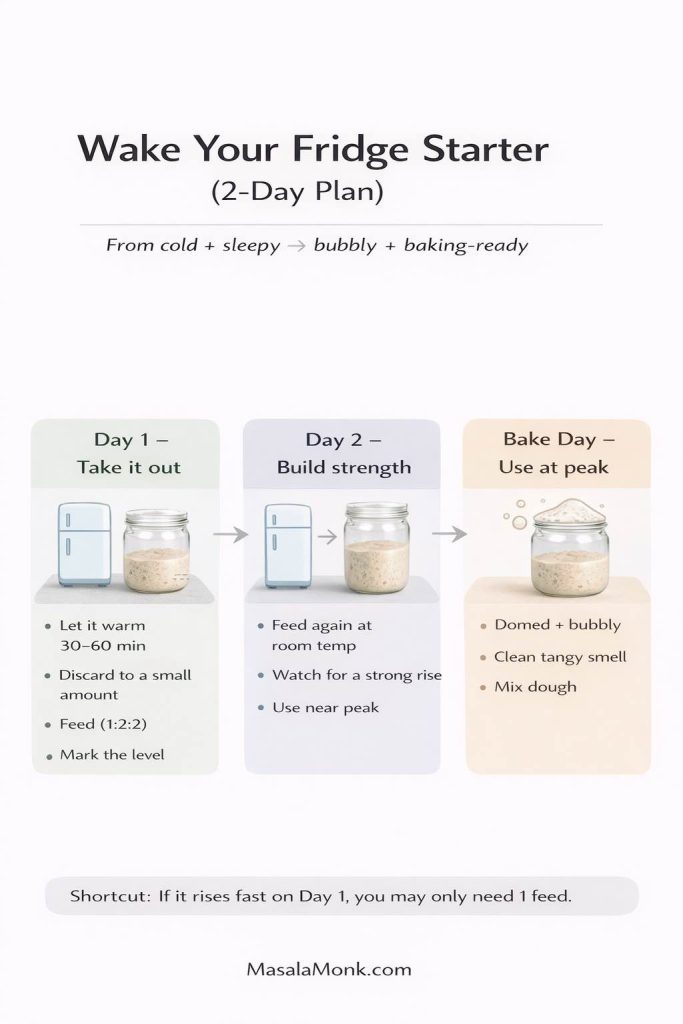
Infographic titled “Wake Your Fridge Starter (2-Day Plan)” showing a three-step timeline to make a refrigerated sourdough starter baking-ready. Day 1: take it out, warm 30–60 minutes, discard to a small amount, feed at 1:2:2, and mark the level. Day 2: feed again at room temperature, watch for a strong rise, and use near peak. Bake day: use at peak when domed and bubbly with a clean tangy smell, then mix dough. Footer reads MasalaMonk.com.
Pulled a sourdough starter from the fridge and it feels sleepy? This 2-day wake-up plan takes you from cold → bubbly → baking-ready without guesswork: warm it, refresh it, then use it right at peak for better rise and flavor. Save this timeline for your next bake day—especially if you keep your starter refrigerated most of the week.

Feeding sourdough starter from the fridge before baking

When you want to bake, give your starter a “wake-up” window:

  • Pull it out 24–48 hours before mixing dough
  • Feed it, let it rise
  • Feed again if needed until it reliably rises on schedule
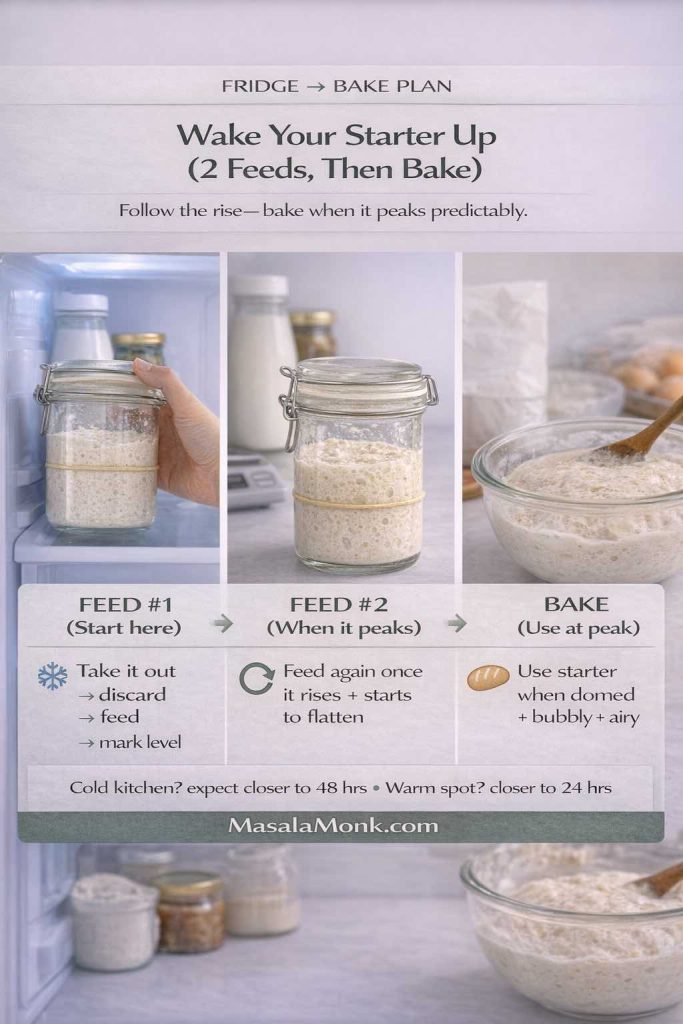
Infographic titled “Fridge → Bake Plan” and “Wake Your Starter Up (2 Feeds, Then Bake).” It shows three panels: Feed #1 with a jar of starter being taken out of the fridge and steps “take it out, discard, feed, mark level”; Feed #2 showing the starter jar on the counter with text “feed again once it rises and starts to flatten”; and Bake showing a bowl of bubbly dough with text “use starter when domed, bubbly, and airy.” A note reads “Cold kitchen? expect closer to 48 hrs • Warm spot? closer to 24 hrs.” MasalaMonk.com appears in the footer.
This is the simplest way to bring a refrigerated starter back to full strength without overthinking it: Feed #1, mark the level, and let it rise until it’s clearly active. Then do Feed #2 right when it peaks (or just begins to flatten), so the culture is strong and predictable again. Finally, bake using the starter at peak—domed, airy, and bubbly—so your dough gets the best lift. Save this plan for busy weeks: it turns “starter in the fridge” into a clear path back to bake-ready.

This routine builds strength quickly, especially after longer refrigeration.

Once it’s lively again, you can head into your sourdough bread recipes and choose the bake that matches your mood—boule, sandwich loaf, rolls, or something else.

Also Read: Cold Brew Espresso Martini: How to Make It (Step-by-Step Recipe)


Whole wheat flour for sourdough starter: how to use it well

Talking about whole wheat, it can be a powerful ally, though it behaves a little differently than white flour.
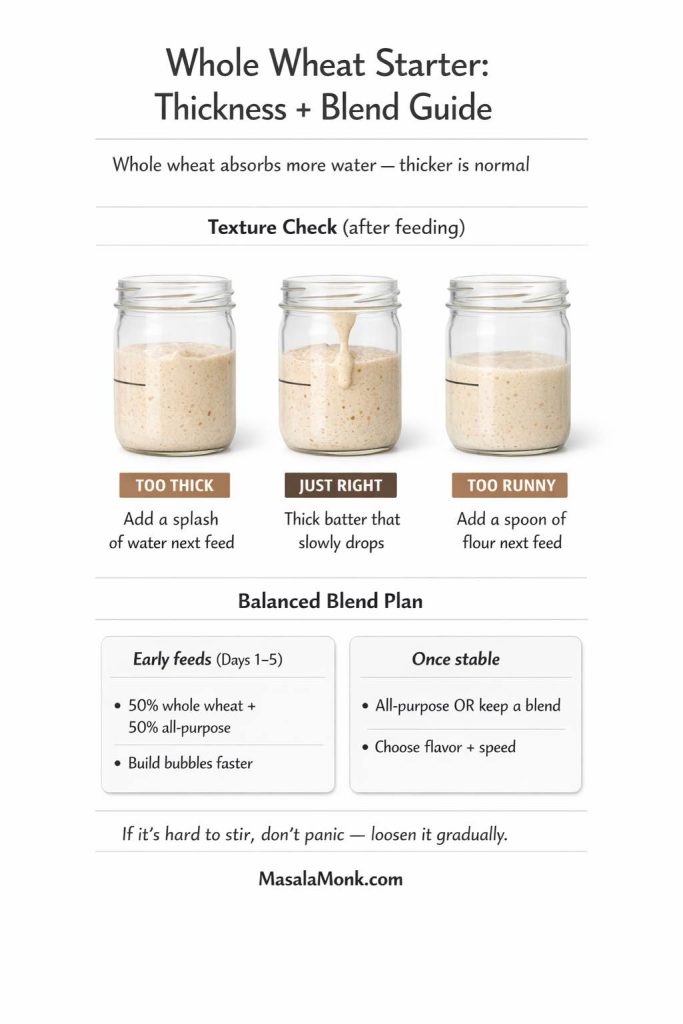
Infographic titled “Whole Wheat Starter: Thickness + Blend Guide” explaining that whole wheat absorbs more water so thicker starter is normal. Three panels show texture checks after feeding: “Too Thick—Add a splash of water next feed,” “Just Right—Thick batter that slowly drops,” and “Too Runny—Add a spoon of flour next feed.” A “Balanced Blend Plan” suggests early feeds (Days 1–5) use 50% whole wheat + 50% all-purpose to build bubbles faster, then once stable use all-purpose or keep a blend to choose flavor and speed. Tip says: “If it’s hard to stir, don’t panic — loosen it gradually.” Footer: MasalaMonk.com.
Whole wheat is a starter superpower—if you expect the texture shift. Because it absorbs more water, your starter will feel thicker (and that’s often a good thing for trapping bubbles). Save this guide for quick fixes: too thick → splash of water, too runny → spoon of flour, and a simple 50/50 whole wheat + all-purpose plan for the early days so your starter gets active faster without turning fussy.

Because whole wheat absorbs more water, it often makes your starter feel thicker. That’s not a problem. In fact, a slightly thicker starter can trap bubbles more effectively. Still, if it becomes difficult to stir, add a small splash of water at the next feed.

A balanced approach tends to work best:

  • Use whole wheat in early feeds to build activity
  • Then shift to all-purpose once the starter is stable, or keep a blend if you prefer the flavor and speed
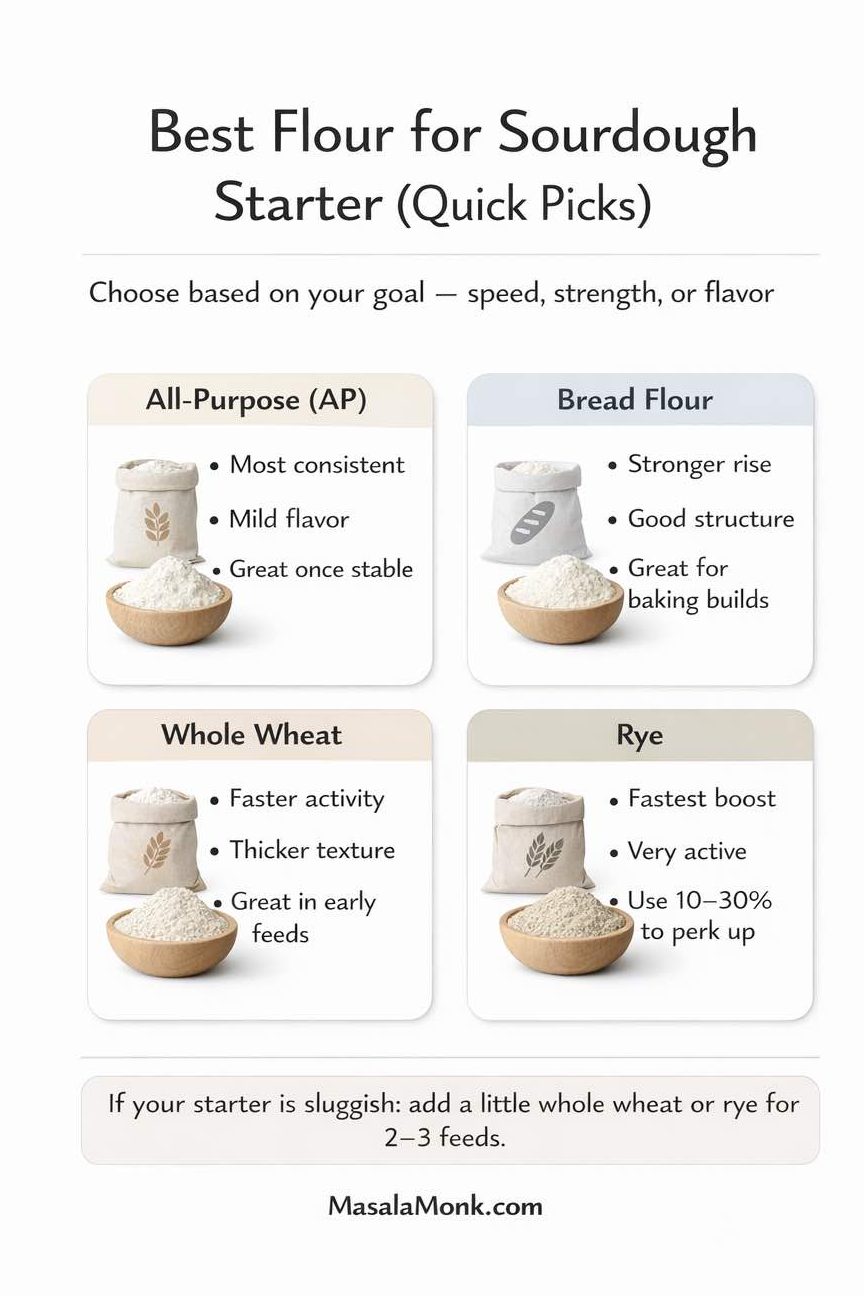
Infographic titled “Best Flour for Sourdough Starter (Quick Picks)” with four comparison cards. All-Purpose (AP): most consistent, mild flavor, great once stable. Bread flour: stronger rise, good structure, great for baking builds. Whole wheat: faster activity, thicker texture, great in early feeds. Rye: fastest boost, very active, use 10–30% to perk up. A tip says: “If your starter is sluggish: add a little whole wheat or rye for 2–3 feeds.” Footer reads MasalaMonk.com.
Choosing flour shouldn’t feel like a rabbit hole. Use this quick guide to match your starter to your goal: AP for steady maintenance, bread flour for strength, whole wheat for faster early activity, and rye for the quickest boost when things feel sluggish. Save it for your next feeding so you can troubleshoot with one simple switch instead of starting over.

If you want to explore gluten and how flour structure affects baking outcomes in general—especially if you’re considering gluten-free routes later—what gluten is and how it works is a useful internal reference.

Also Read: Iced Coffee: 15 Drink Recipes—Latte, Cold Brew, Frappe & More


Gluten-free sourdough starter: a simple sidebar

If you’re working with gluten-free flours, the process is similar: flour + water + consistent feeding. However, gluten-free starters often behave differently because they don’t form the same elastic network. As a result, rise can be less dramatic, even when the starter is healthy.
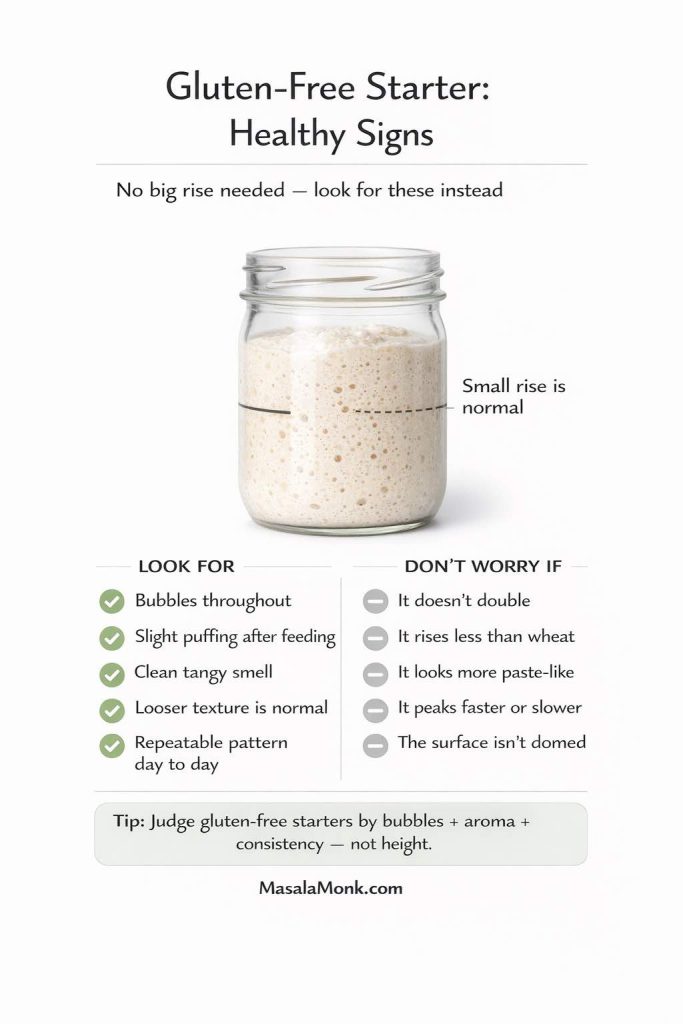
Infographic titled “Gluten-Free Starter: Healthy Signs” explaining that a gluten-free sourdough starter may not rise much and that a small rise is normal. A central jar shows bubbly starter with a marked line. Two lists compare what to look for (bubbles throughout, slight puffing after feeding, clean tangy smell, looser texture is normal, repeatable pattern day to day) versus what not to worry about (doesn’t double, rises less than wheat, looks more paste-like, peaks faster or slower, surface isn’t domed). Tip says to judge gluten-free starters by bubbles, aroma, and consistency—not height. Footer: MasalaMonk.com.
Gluten-free starters play by different rules—so don’t judge yours by “did it double?” Save this checklist and look for the signs that actually matter: bubbles throughout, a clean tangy aroma, a repeatable daily pattern, and even a small puff after feeding. If it’s healthy, it can still bake beautifully—even when the rise looks subtle.
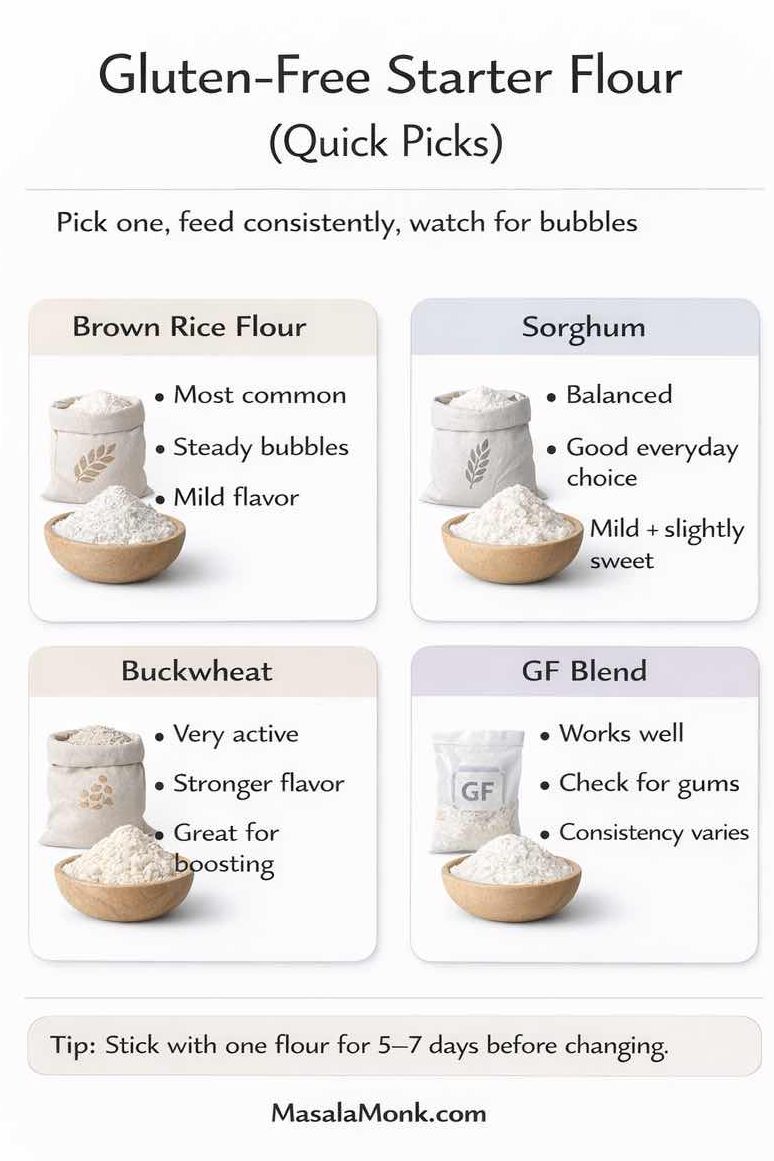
Infographic titled “Gluten-Free Starter Flour (Quick Picks)” with the subtitle “Pick one, feed consistently, watch for bubbles.” Four cards show recommended gluten-free flours for a sourdough starter: Brown Rice Flour (most common, steady bubbles, mild flavor), Sorghum (balanced, good everyday choice, mild + slightly sweet), Buckwheat (very active, stronger flavor, great for boosting), and GF Blend (works well, check for gums, consistency varies). A tip reads: “Stick with one flour for 5–7 days before changing.” Footer: MasalaMonk.com.
Building a gluten-free sourdough starter? Save this quick reference. Different flours behave differently, so the real win is consistency: pick one (brown rice, sorghum, buckwheat, or a GF blend), feed on a steady schedule, and watch for bubbles + aroma instead of a dramatic rise. Bonus tip: stick with one flour for 5–7 days before switching—your starter gets more predictable fast.

For a detailed gluten-free starter method, King Arthur’s gluten-free sourdough starter recipe is a solid reference. If you’re also exploring alternative flours for different dietary needs, you might find keto-friendly flour options useful as a general internal guide to how non-wheat flours behave in baking.

Also Read: Cranberry Moscow Mule Recipe: A Festive Holiday Cocktail With Easy Variations


Sourdough starter kit: what belongs in it (and what doesn’t)

A starter doesn’t require a shopping spree. Still, some tools genuinely make the process easier, especially if you want consistent results.
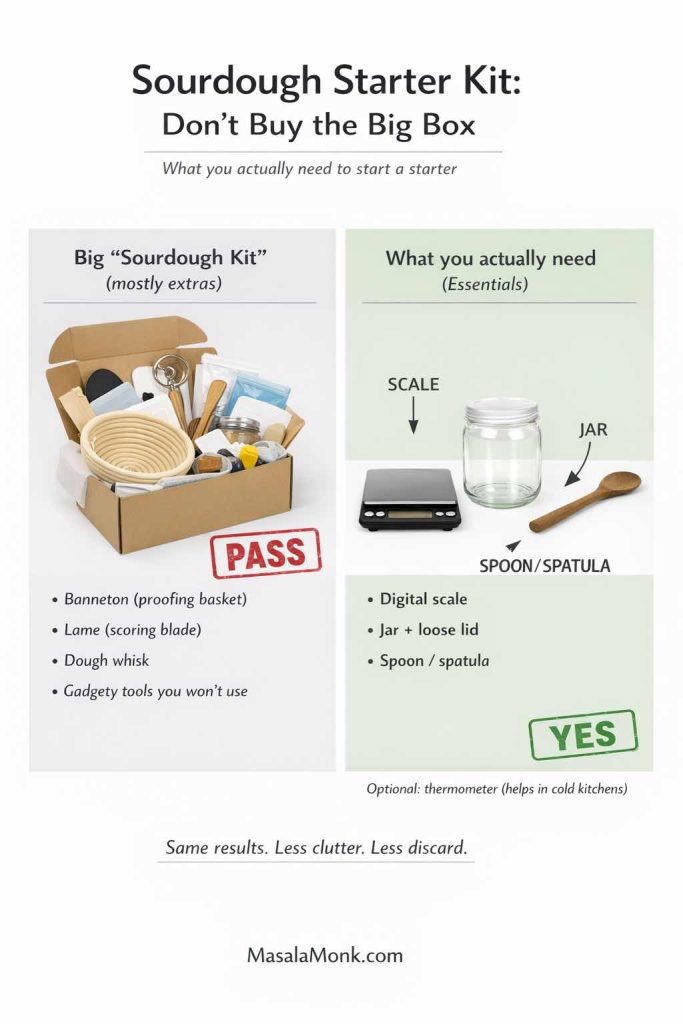
Most “sourdough starter kits” look tempting… but you can start a strong, bubbly sourdough starter with just three essentials: a digital scale, a jar with a loose lid, and a spoon/spatula. The rest is mostly clutter (and usually ends up unused). Save this as your quick shopping filter—then jump into the full starter guide on MasalaMonk to follow the day-by-day build, feeding ratios, fridge routine, and troubleshooting.

The essentials

  • A clear jar (or two, so you can swap to a clean one occasionally)
  • A spoon or spatula
  • A scale
  • A loose cover

That’s enough for most people, even if they never buy a “kit.”

The nice-to-haves

  • Extra jars for cleaner maintenance
  • A small silicone spatula (it scrapes well)
  • A thermometer if you like precision
  • A warm spot solution for cold kitchens

If you’re comparing options or considering the idea of a best sourdough starter kit, focus on function rather than brand: jar size, an accurate scale, and a practical tool for stirring and scraping.

Also Read: Baked Ziti Recipe Collection: 15 Easy Variations


Sourdough starter troubleshooting: common problems, calm solutions

Even a good starter has off days. Fortunately, most issues are fixable with small adjustments.

My starter is bubbling but not rising much

Bubbles show fermentation is happening, which is good. Lack of rise can come from thin consistency or weak gluten structure (especially with certain flours).

Try this:

  • Thicken slightly at the next feed by adding a touch more flour
  • Keep the jar in a warmer spot
  • Feed at a slightly higher ratio (1:2:2) for a few cycles

With time, the rise typically improves.

My starter smells too sour or harsh

A sharp smell often means the starter is hungry or overly acidic.

A person holds a glass jar of bubbly sourdough starter close to their nose in a bright kitchen. An overlay card reads “Starter Troubleshooting: What Does Your Starter Smell Like?” and lists four smell clues with fixes: sharp/acetone means hungry so feed bigger (1:3:3); very sour means too acidic so feed sooner; cheesy in early days is normal so keep routine; clean tangy or fruity means healthy so bake at peak. MasalaMonk.com appears in the footer.
If you’ve ever opened your starter and thought “uh… is this normal?”, this quick smell check saves a lot of panic. Sharp/acetone usually means it’s hungry—give it a bigger feed (1:3:3). Very sour often means it’s getting too acidic—feed sooner for a day or two. A cheesy smell early on can happen while the culture stabilizes—stay consistent. And when it smells clean, tangy, or lightly fruity, you’re in the sweet spot—use it at peak for your best rise. Save this for the next time your starter surprises you.

Instead of feeding the same small amount, refresh more generously:

  • Keep 20g starter
  • Feed 60g water + 60g flour (1:3:3)

Also, feed a little sooner than usual for a day or two. As the acidity balances, the aroma softens.

My starter has liquid on top

That liquid is commonly called hooch. It’s usually a sign of hunger.

You can either stir it in for a stronger tang or pour it off for a milder profile. Then feed.

My starter seems “stuck” after an early burst of activity

That early burst happens to many beginners. Then the jar goes quiet. It’s frustrating, yet it’s also normal.

Keep feeding consistently. Add warmth. Consider using a portion of whole wheat for a couple feeds. In most cases, the starter returns with steadier, healthier activity.

Mold vs hooch: when to discard

Here’s the simple rule: fuzzy mold is not something to negotiate with.

If you see fuzzy growth—especially green, blue, or white fuzz—discard the starter and start again. Food safety guidance explains why mold can be risky, particularly in soft foods where it can spread beyond what you see, such as USDA guidance on molds in food.
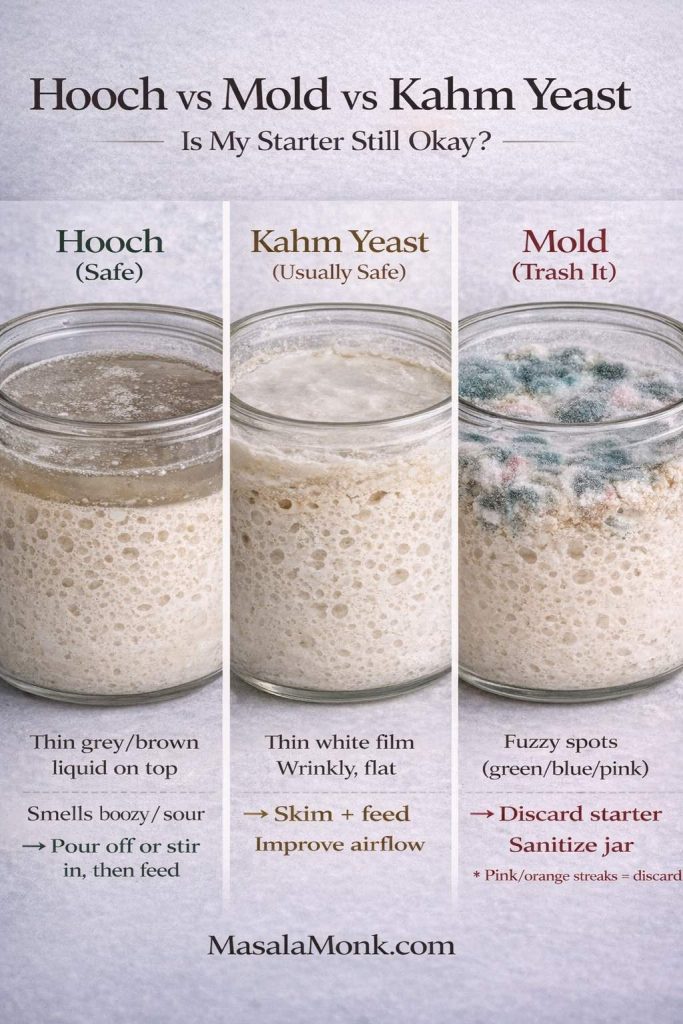
Infographic showing three sourdough starter problems: hooch (thin gray-brown liquid on top; safe—pour off or stir then feed), kahm yeast (thin white wrinkly film; usually safe—skim and feed, improve airflow), and mold (fuzzy green/blue/pink spots; discard starter and sanitize jar).
Hooch vs kahm yeast vs mold: a quick visual guide to tell what you’re seeing on top of your sourdough starter—and what to do next (pour off and feed, skim and feed, or discard and sanitize).

On the other hand, a grayish liquid layer, a sharp smell, or a dark “skin” can happen when a starter is neglected. Those cases usually respond to discarding down to a clean portion and feeding well for a few days.

If you enjoy fermentation projects beyond sourdough—and you want a consistent “clean jar, observe daily, discard if mold” mindset—your internal posts on fermented garlic honey safety and DIY fermented fruit juices pair naturally with the same habits.

Also Read: Manhattan Cocktail Recipe (Classic + 6 Variations)


Dried sourdough starter and dehydrated sourdough starter: backup that’s surprisingly easy

Once your starter is strong, drying a small amount is like making a spare key. It’s useful if you travel, want a backup, or plan to share starter with someone else.
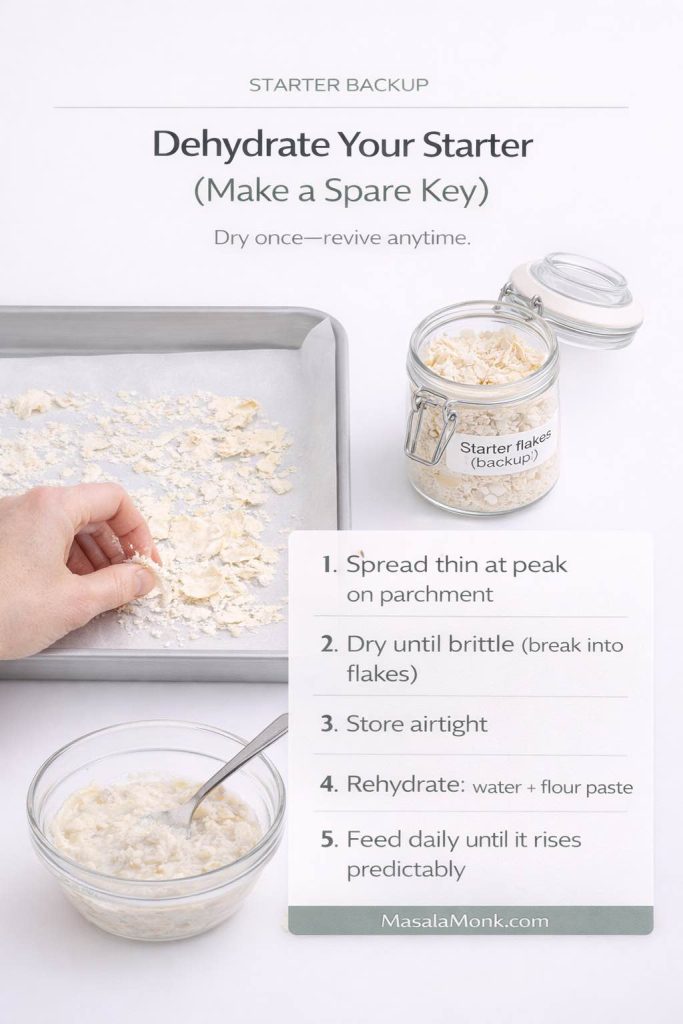
Studio-style infographic titled “Starter Backup: Dehydrate Your Starter (Make a Spare Key)” showing sourdough starter dried into flakes on a parchment-lined baking tray, a glass jar labeled “Starter flakes (backup),” and a bowl where flakes are being mixed with water and flour to rehydrate. The steps read: 1) Spread thin at peak on parchment, 2) Dry until brittle (break into flakes), 3) Store airtight, 4) Rehydrate: water + flour paste, 5) Feed daily until it rises predictably. MasalaMonk.com appears in the footer.
When your starter is strong, drying a small amount is like making a spare key—perfect for travel, emergencies, or gifting. Spread a thin layer at peak, dry until brittle, and store the flakes airtight. When you need it again, rehydrate with a little water and flour into a paste, then feed daily until it’s rising on schedule. Save this card if you want a backup starter you can revive anytime (without panic or starting from scratch).

How to make a dehydrated starter

  1. Feed your starter and let it reach peak activity.
  2. Spread a thin layer on parchment paper.
  3. Let it dry completely until it becomes brittle.
  4. Break it into flakes and store airtight.

Rehydrating dried sourdough starter

To rehydrate:

  1. Add flakes to a little water and let them soften.
  2. Stir in flour to create a paste.
  3. Feed daily until it begins rising consistently again.

Revival can take a few days, so patience matters. Still, it’s very doable. For additional guidance on starter routine and refresh cycles, The Perfect Loaf’s starter maintenance routine is a strong reference when you want deeper context on timing and consistency. Likewise, Breadtopia has practical notes on starter care and reactivation that many home bakers find helpful, such as their starter guidance and revival information.

Also Read: Rob Roy Drink Recipe: Classic Scotch Cocktail (Perfect + Dry + Sweet Variations)
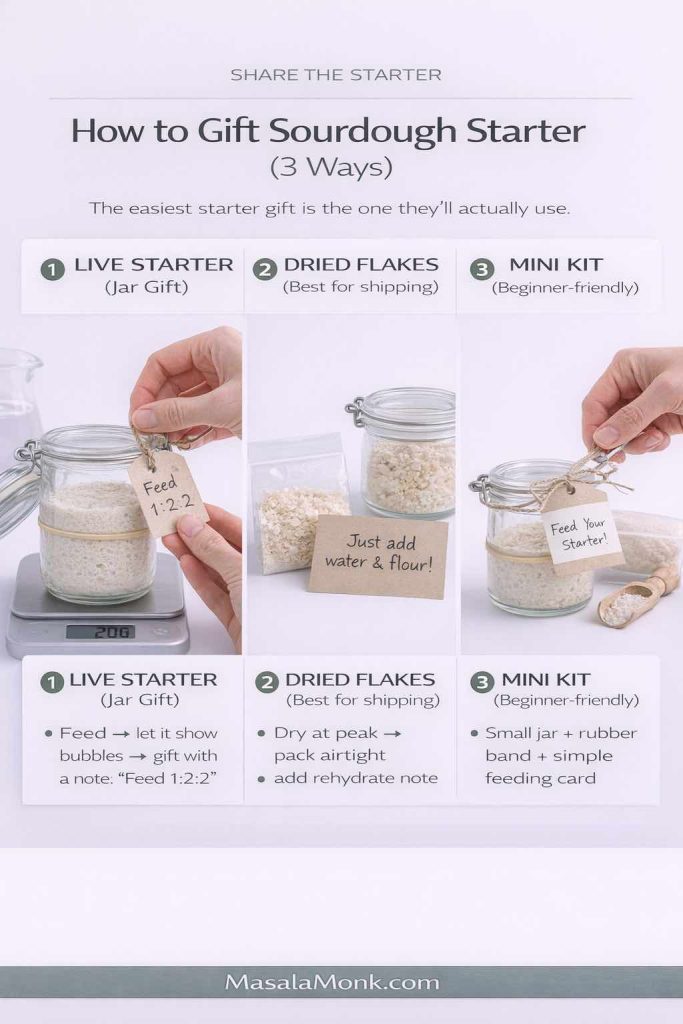

Vertical infographic titled “How to Gift Sourdough Starter (3 Ways)” with the header “Share the Starter.” Three panels show: 1) Live starter jar gift on a kitchen scale with a tag that says “Feed 1:2:2”; 2) Dried flakes in a small bag and jar with a note “Just add water & flour!”; 3) A mini kit with a small jar of starter and a tag “Feed Your Starter!” with a rubber band and simple items. A short checklist under each panel explains the steps. MasalaMonk.com appears in the footer.
Sourdough is one of the sweetest “pass-it-on” gifts—because it keeps going. You can share it as a live jar starter (include a simple note like feed 1:2:2), as dried flakes that travel well (just add water + flour to revive), or as a tiny beginner-friendly mini kit with a jar, rubber band, and a quick feeding reminder. Save this for holidays, housewarmings, or that friend who keeps saying they “want to try sourdough someday.”

Levain starter recipe: how it fits into your starter routine

Once your starter is established, you’ll often hear the word “levain.” Levain is simply a build: a portion of starter mixed with fresh flour and water to create the amount—and the strength—you want for a specific bake.
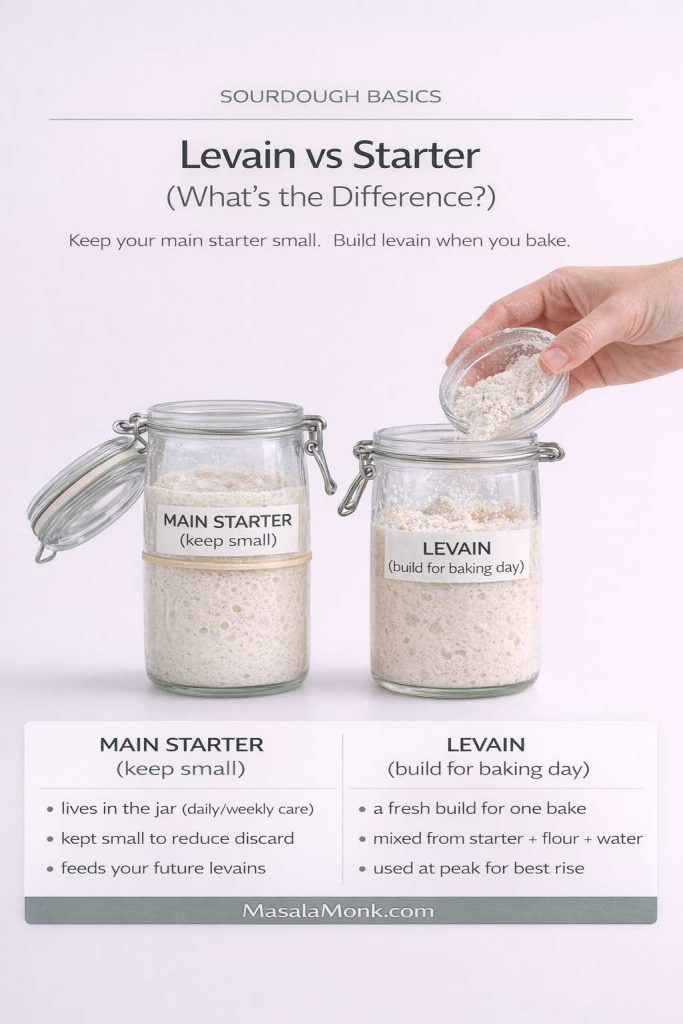
Studio-style infographic titled “Levain vs Starter (What’s the Difference?)” showing two glass jars of sourdough: one labeled “Main Starter (keep small)” and one labeled “Levain (build for baking day).” A hand pours flour into the levain jar. A two-column chart explains: the main starter lives in the jar with daily/weekly care, is kept small to reduce discard, and feeds future levains; levain is a fresh build for one bake, mixed from starter plus flour and water, and used at peak for best rise. MasalaMonk.com is in the footer.
If “starter” and “levain” sound like two different things, this is the simple truth: your main starter is the small jar you maintain, while levain is the fresh build you make for baking day. Keep the main starter small so it’s easy to feed (and you waste less). Then, when you want to bake, mix a portion of starter with fresh flour and water to create a levain—use it at peak for your best rise and loft. Save this card for the next time a recipe calls for “levain” and you want the difference in one glance.

Think of it as a fresh batch made for baking day:

  • You keep your main starter small
  • You build levain when you need more volume or a particular flavor profile

This approach keeps your everyday maintenance simple while giving you flexibility for different breads.

When you’re ready to use levain in practice, your sourdough bread recipes make a natural next step, because you can match starter strength with a specific loaf method and timeline.

Also Read: Best Vermouth for a Negroni Cocktail Drink Recipe


Discarded sourdough starter: how to use it without feeling like you’re “wasting” anything

Discard can feel annoying at first. Then it starts to feel like a bonus ingredient—tangy, tenderizing, and useful in quick bakes.
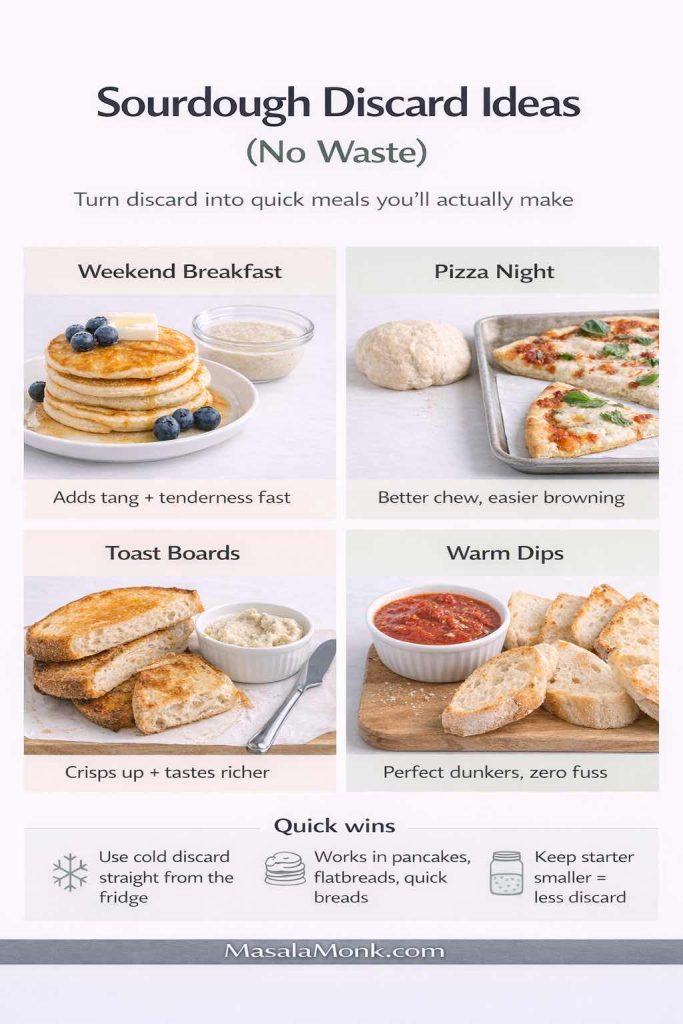
Vertical infographic titled “Sourdough Discard Ideas (No Waste)” showing four meal-moment tiles: Weekend Breakfast pancakes, Pizza Night flatbread/pizza, Toast Boards with toast and spread, and Warm Dips with marinara and bread. Each tile notes a benefit like tang, tenderness, chew, browning, crispness, and easy dunkers. A “Quick wins” strip mentions using cold discard, using it in pancakes/flatbreads/quick breads, and keeping a smaller starter to reduce discard. MasalaMonk.com in the footer.
Discard isn’t trash—it’s your shortcut ingredient. Use it for pancakes that stay tender, pizza/flatbreads with better chew, toast that crisps up beautifully, and quick dunkers for marinara nights. Save this as your “no-waste” reminder for the next time you feed your starter—then turn the jar into something you’ll actually eat.

If you keep a smaller starter, you’ll naturally produce less discard. Still, even a little discard can add flavor and softness to pancakes, flatbreads, and quick breads.

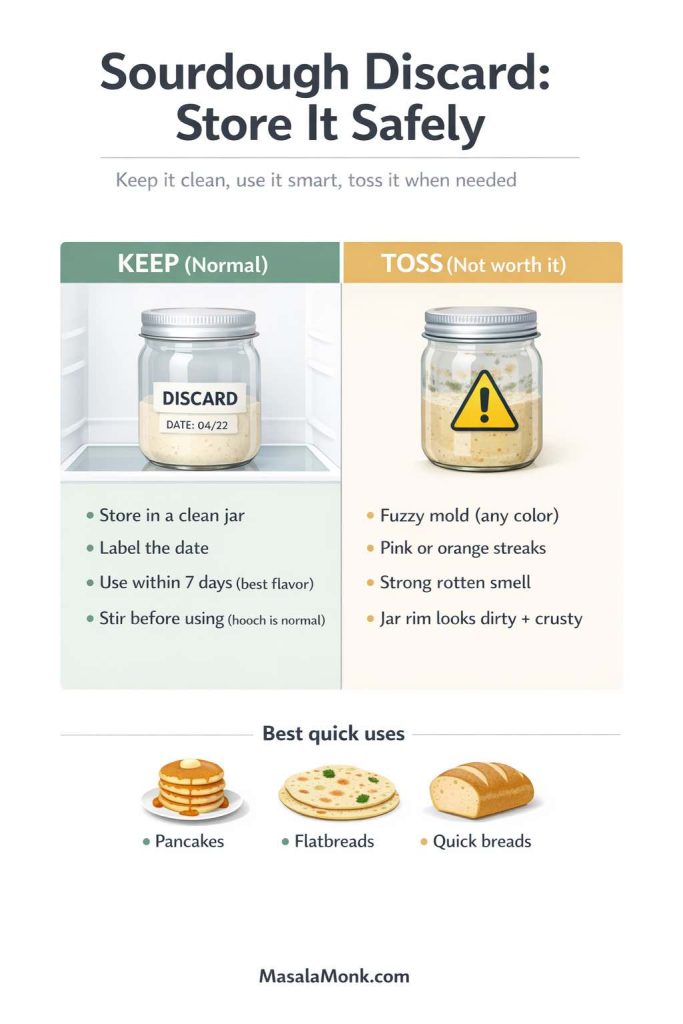
Infographic titled “Sourdough Discard: Store It Safely” comparing when to KEEP vs TOSS sourdough discard. Keep (Normal): store in a clean jar, label the date, use within 7 days for best flavor, and stir before using because hooch is normal. Toss (Not worth it): fuzzy mold of any color, pink or orange streaks, strong rotten smell, or a dirty crusty jar rim. Bottom strip lists best quick uses: pancakes, flatbreads, and quick breads. Footer reads MasalaMonk.com.
Discard doesn’t have to feel like waste—it can be your secret ingredient. Save this Keep vs Toss guide so you always know what’s normal (including hooch) and what’s a hard no (mold, odd colors, rotten smell). Then use your discard in quick wins like pancakes, flatbreads, and quick breads—easy ways to add tang and tenderness while keeping your starter routine low-stress.

Meanwhile, if you want a simpler “practice bake” while your starter matures—something that builds confidence without needing perfect timing—your homemade garlic bread loaf and braided coconut and banana bread are friendly, approachable options.


A calm, repeatable routine for long-term starter success

Once the starter is healthy, the best results come from a routine you can actually keep.
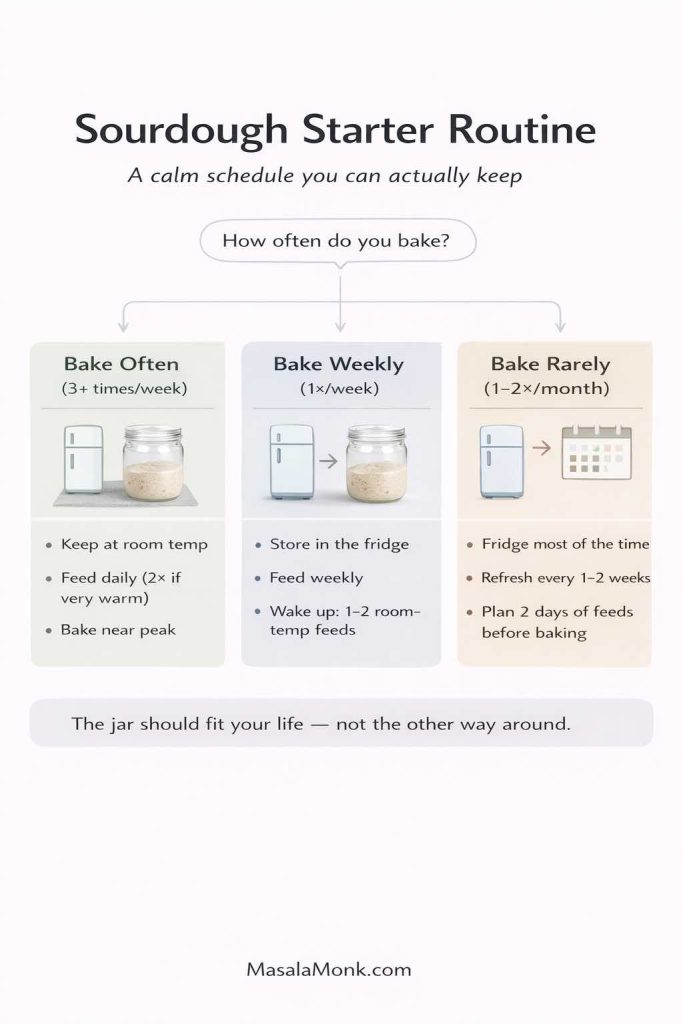
Infographic titled “Sourdough Starter Routine” showing three schedules based on how often you bake: Bake Often (3+ times/week)—keep starter at room temperature, feed daily (twice if very warm), bake near peak; Bake Weekly (1x/week)—store in fridge, feed weekly, wake up with 1–2 room-temp feeds; Bake Rarely (1–2x/month)—fridge most of the time, refresh every 1–2 weeks, plan 2 days of feeds before baking. Footer reads MasalaMonk.com.
Not everyone bakes sourdough on the same rhythm—and that’s the point. Use this simple starter routine picker to match your feeding schedule to real life: room-temp maintenance for frequent bakers, fridge storage for weekly bakes, and a low-effort refresh plan if you bake rarely. Save this as your quick reference so your starter stays strong without constant guessing—then follow the steps in the post to time feeds, hit peak activity, and wake a sleepy fridge starter before baking.

You bake often (several times a week)

  • Keep the starter at room temperature
  • Feed daily (or twice daily if warm and fast-moving)
  • Use it near peak activity for baking

If you bake once a week

  • Store in the fridge
  • Feed weekly
  • Wake it up with 1–2 room-temperature feeds before baking

And if you bake rarely

  • Keep it in the fridge most of the time
  • Refresh every 1–2 weeks
  • Plan a couple days of feeds before baking day

This flexibility is what makes sourdough sustainable. You don’t have to serve the jar; the jar can fit your life.

Also Read: Paper Plane Cocktail Recipe + Best Amaro Substitutes & Tips


Before you bake: a small ritual that improves consistency

If you want dependable performance, especially when you’re moving from “starter building” into real dough, do this:

  1. Feed your starter and let it reach a strong rise.
  2. Feed again if needed until it rises predictably.
  3. Use it when it looks domed, bubbly, and lively.

Then head into our sourdough bread recipes and choose the bake that suits your day—something quick and forgiving, or something slow and deep in flavor.


A sourdough starter can begin as a jar of floury paste. Still, over time, it becomes a rhythm—one that makes your kitchen feel a little more alive, your baking more personal, and your bread more satisfying. Keep it simple, keep it steady, and let the culture do what it’s built to do.

Also Read: Green Chutney Recipe (Coriander–Mint / Cilantro Chutney)


FAQs

1) How long does a sourdough starter recipe take to work?

Most starters become reliable somewhere between 7 and 14 days. Even so, the exact timing depends on temperature, flour type, and how consistently you feed it. If your kitchen is cool, it may take longer; meanwhile, in warmer conditions it often strengthens faster. Rather than chasing a specific day, watch for a repeatable rise-and-fall pattern after feeding.

2) What’s the difference between sourdough starter and “starter dough for sourdough bread”?

They’re essentially describing the same base culture: flour and water fermented over time. “Starter dough for sourdough bread” is simply a more literal phrase some people use for sourdough starter. In practice, you’re building the same living leaven—one you can maintain indefinitely once it’s active.

3) How do I know when my starter is an active sourdough starter?

Look for consistency more than drama. A truly active sourdough starter rises predictably after feeding, shows bubbles throughout (not only on the surface), and smells pleasantly tangy or lightly fruity. Additionally, it should peak and then slowly begin to recede, which shows it’s completing a full fermentation cycle.

4) Does the float test prove my sourdough starter recipe is ready?

Not always. Although a floating spoonful can suggest good gas retention, hydration and flour type can skew results. Instead, treat it as a bonus sign. For a clearer read, rely on steady doubling (or near doubling), a domed peak, and a balanced aroma after feeding.

5) Why did my starter rise a lot on day 2 or 3, then stop?

That early surge is common. At first, a mix of microbes can create quick activity; afterward, the culture often “resets” while the more stable yeast-and-bacteria community establishes itself. Consequently, a quiet phase doesn’t mean it failed. Keep feeding consistently and it usually returns stronger.

6) What’s the best flour for sourdough starter recipe success?

All-purpose flour works, yet many starters get going faster with whole grain flour, especially whole wheat or rye. Because whole grain flour carries more nutrients, it can boost activity, particularly in the first week. That said, once your starter is stable, you can switch back to all-purpose or keep a blend, depending on flavor and performance.

7) Can I make a sourdough starter with whole wheat flour only?

Yes. In fact, a whole-wheat-only starter often becomes active quickly. However, it may absorb more water, so it can feel thicker. If stirring becomes difficult, add a small splash of water at the next feed until it returns to a thick-batter consistency.

8) What feeding ratio should I use when feeding sourdough starter?

A common everyday ratio is 1:1:1 by weight (starter:water:flour). Still, if your starter turns overly sour or sluggish, larger feeds such as 1:2:2 or 1:3:3 can help. In other words, more fresh flour and water can refresh the culture and improve rise strength.

9) How often should I be feeding sourdough starter at room temperature?

Usually once a day is enough at moderate room temperature. Nevertheless, if your kitchen is warm and the starter peaks quickly, feeding twice daily can keep it steadier. Watch the timing: if it rises, peaks, and falls well before your next feed, it’s probably asking for more frequent refreshment.

10) What if I’m feeding sourdough starter without a scale?

You can still succeed. Begin with roughly equal spoonfuls of flour and water, then adjust until it resembles thick pancake batter. Even better, stay consistent for several feeds in a row. Since cup measures vary, texture becomes your most dependable guide.

11) What does hooch mean, and should I stir it in?

Hooch is the liquid that can collect on top when the starter is hungry. You can stir it in for a sharper flavor, or pour it off for a milder starter. Either way, follow with a feeding. Over time, regular feeds reduce how often hooch appears.

12) How do I store a sourdough starter in the fridge?

Feed it, let it begin to show activity at room temperature, then refrigerate. After that, refresh it weekly if you bake occasionally. When baking day approaches, bring it back to room temperature and feed it once or twice until it rises predictably again.

13) How do I handle feeding refrigerated sourdough starter before baking?

Pull it out 24–48 hours ahead, discard down to a small amount, then feed. Once it rises and peaks, feed again if needed. As a result, you rebuild strength and timing, which tends to improve oven spring and flavor.

14) Why is my starter bubbling but not rising much?

Often it’s either too thin or not strong enough yet. Try thickening the texture slightly at the next feed, keep it warmer, and use a larger feed ratio for a couple of days. Additionally, switching one or two feeds to whole wheat can support stronger activity.

15) Why does my sourdough starter smell very sour, sharp, or like acetone?

That usually points to hunger. In that case, feed more frequently or increase your feed ratio. For example, keep a smaller amount of starter and add more fresh flour and water. After a few refresh cycles, the aroma typically softens.

16) How do I know if it’s mold or just normal starter funk?

Normal starter funk can be tangy, sharp, or even a bit “cheesy” early on, yet it won’t look fuzzy. Mold usually appears as fuzzy patches or colored growth. If you see fuzz or anything unmistakably mold-like, it’s safest to discard the starter and start over with a clean jar.

17) Can I save my starter if I accidentally forgot to feed it?

Often, yes. If there’s no mold, discard down to a small portion from the cleanest area, then feed at a higher ratio (like 1:3:3) for a few days. Meanwhile, keep it warm and consistent. Most neglected starters bounce back surprisingly well.

18) What is a levain starter recipe, and do I need one?

A levain is a build made from your main starter plus fresh flour and water for a specific bake. You don’t need levain to keep a starter alive; rather, levain helps you scale up the amount you need for bread while keeping your main starter small and easy to maintain.

19) What’s the difference between dried sourdough starter and dehydrated sourdough starter?

They’re the same idea: starter that has been fully dried into flakes or powder so it can be stored long-term. “Dehydrated sourdough starter” is simply a more explicit phrase. Either way, you rehydrate it with water, then feed it repeatedly until it becomes active again.

20) How long does reviving dried sourdough starter take?

Usually a few days, although it can take up to a week depending on how dry it was, how warm your kitchen is, and which flour you use. At first, you’ll see small bubbles. Then, with steady feedings, it begins rising more predictably again.

21) How do I rehydrate dried sourdough starter without messing it up?

Start small. Soak the flakes in a little water until softened, stir in flour to form a paste, and let it sit. After that, feed daily at consistent intervals. If it seems weak, use whole wheat for a feed or two and keep it comfortably warm.

22) What should I do with discarded sourdough starter?

Discarded sourdough starter can be used in quick bakes where you want tang and tenderness. For instance, it can enrich pancakes, waffles, crackers, or flatbreads. Alternatively, you can keep discard in the fridge for a short period and use it in batches, as long as it stays clean and mold-free.

23) Can I buy sourdough starter online, and is it better than homemade?

Buying sourdough starter online can be convenient, especially if you want a quick start or a backup culture. However, homemade starter is just as capable once it’s established. Ultimately, the best sourdough starter is the one you can maintain consistently, whether it began at home or arrived in the mail.

24) What makes the best sourdough starter, long term?

Consistency wins. A predictable feeding routine, a stable temperature, and a texture that traps bubbles will take you further than any single trick. Moreover, keeping your starter smaller and feeding at a ratio that matches your schedule reduces stress, which makes it easier to stick with it—and that’s where the real magic happens.
Posted on 4 Comments

Sourdough Recipe: 10 Easy Bread Bakes (Loaves, Rolls & Bagels)

Portrait magazine-style cover on a dark slate background with a rustic sourdough boule dusted with flour. Text overlay reads “Sourdough Recipe” and “10 Easy Bread Bakes — Loaves • Rolls • Bagels,” with “MasalaMonk.com” in the footer.

Some days you want a dramatic crusty loaf that sings when it cools. Other days you just want a soft sandwich slice that behaves, a pan of dinner rolls that tear like cotton, or a chewy bagel that makes breakfast feel like a small win. This sourdough recipe guide is built for all of those moods—without forcing you to become a different person each time you bake.

We’ll work in metric, lean on a single “house” starter, and then branch into ten bakes you can rotate through: a classic boule, a loaf-pan sandwich bread, a same-day loaf, a no-knead Dutch oven bread, English muffin bread, soft dinner rolls, burger buns, hot dog buns, hoagie/sub rolls, and sourdough bagels—plus one gluten-free vegan boule that still feels like real bread.

Along the way, you’ll also see where discard fits naturally, how to nudge your bread more sour when you want that tang, and how to choose equipment—cast iron, Dutch oven, bread pot, loaf pan, baking dish, stand mixer—without overthinking it.

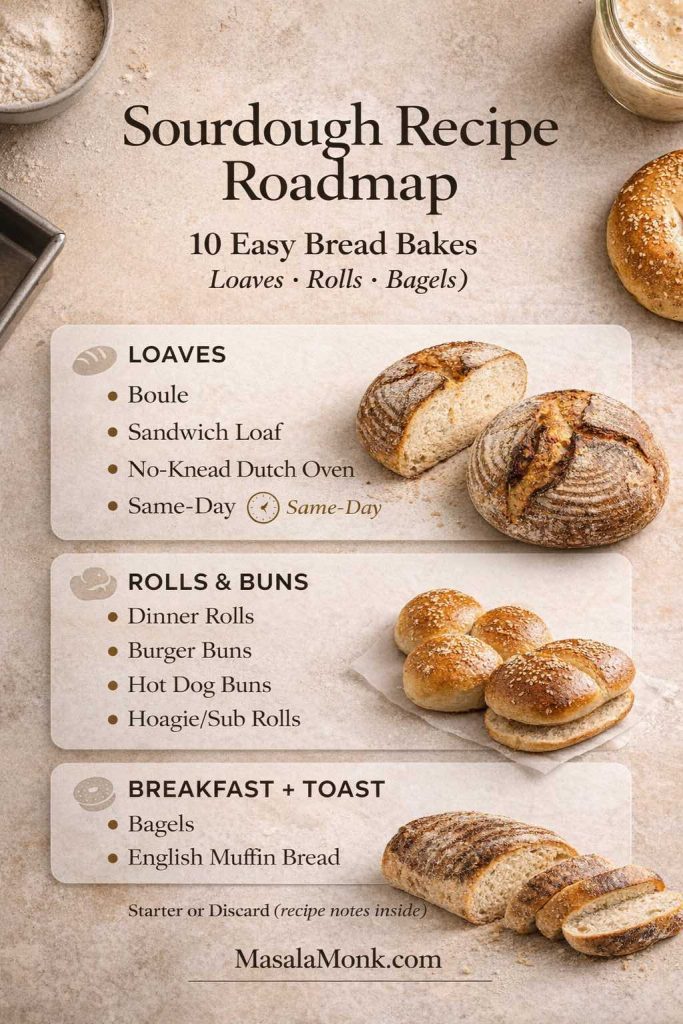
Portrait infographic titled “Sourdough Recipe Roadmap” showing 10 easy bread bakes grouped into three sections: Loaves (boule, sandwich loaf, no-knead Dutch oven, same-day), Rolls & Buns (dinner rolls, burger buns, hot dog buns, hoagie/sub rolls), and Breakfast + Toast (bagels, English muffin bread). Photoreal bread flatlay background with MasalaMonk.com in the footer.
This sourdough recipe roadmap helps you pick your next bake at a glance—classic loaves, soft rolls and buns, plus bagels and English muffin bread. Use it as a quick guide while you work through the 10 recipes below (and save it for future baking days).

For foundational starter and technique references, these are genuinely useful reads you can keep open in another tab:


The starter you have vs the starter you need

A sourdough starter isn’t one thing—it’s a living culture that behaves differently depending on when you use it. Once you get that, the entire process becomes easier.

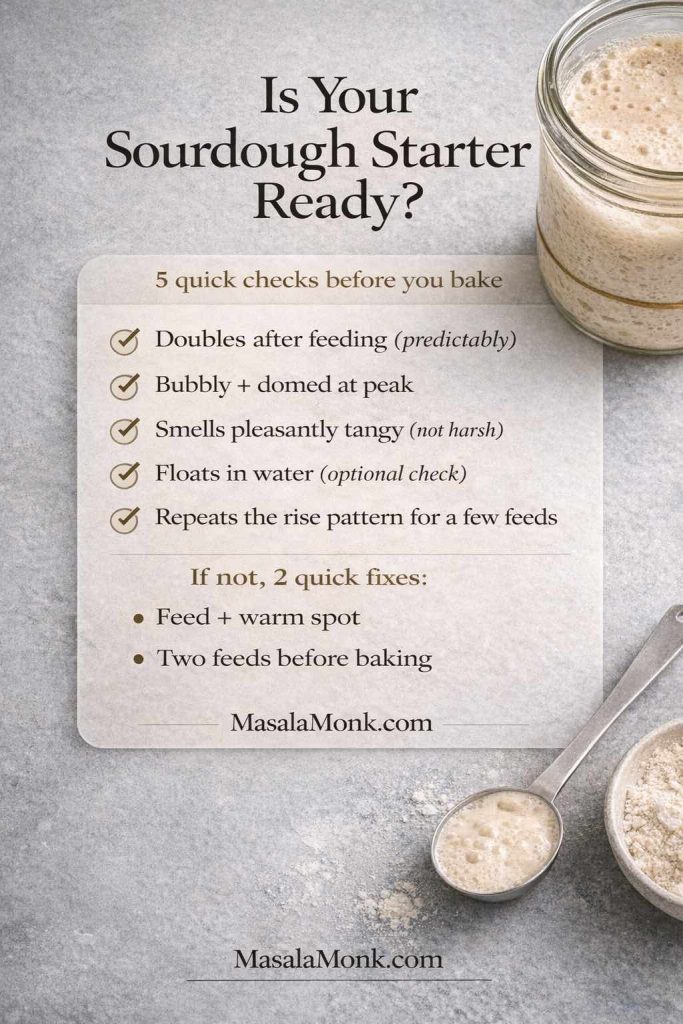
Portrait infographic titled “Is Your Sourdough Starter Ready?” on a gray stone background with a jar of bubbly starter. Text lists 5 quick checks before you bake (doubles after feeding, bubbly and domed, pleasant tangy smell, optional float test, repeats rise pattern) plus 2 quick fixes, with MasalaMonk.com in the footer.
Before you start any sourdough recipe, run this 60-second starter checklist—especially if your last loaf turned out dense or flat. A starter that rises predictably and looks bubbly at peak makes every bake below (boule, sandwich loaf, rolls, buns, and bagels) far more reliable.

Active (ripe) starter

This is the starter that’s been fed and has risen predictably—bubbly, domed, and at or near peak. It has the strength to lift dough without help. Most “true sourdough bread” recipes use this version: boules, baguette-style loaves, bagels, and most rolls.

If your starter feels sluggish, it’s usually not “dead,” it’s just underfed, too cold, or too new. A steady feed schedule and a warmer spot often fixes it. King Arthur’s step-by-step method is a solid reference: Sourdough starter recipe.

Discard (unfed starter)

Discard is starter that hasn’t been fed recently—often pulled straight from the fridge. It brings flavor, but it doesn’t always bring the same lift. That’s why many discard-friendly doughs either:

  • use a longer fermentation window, or
  • add a small amount of commercial yeast (a common, perfectly valid approach for a same-day sourdough bread).
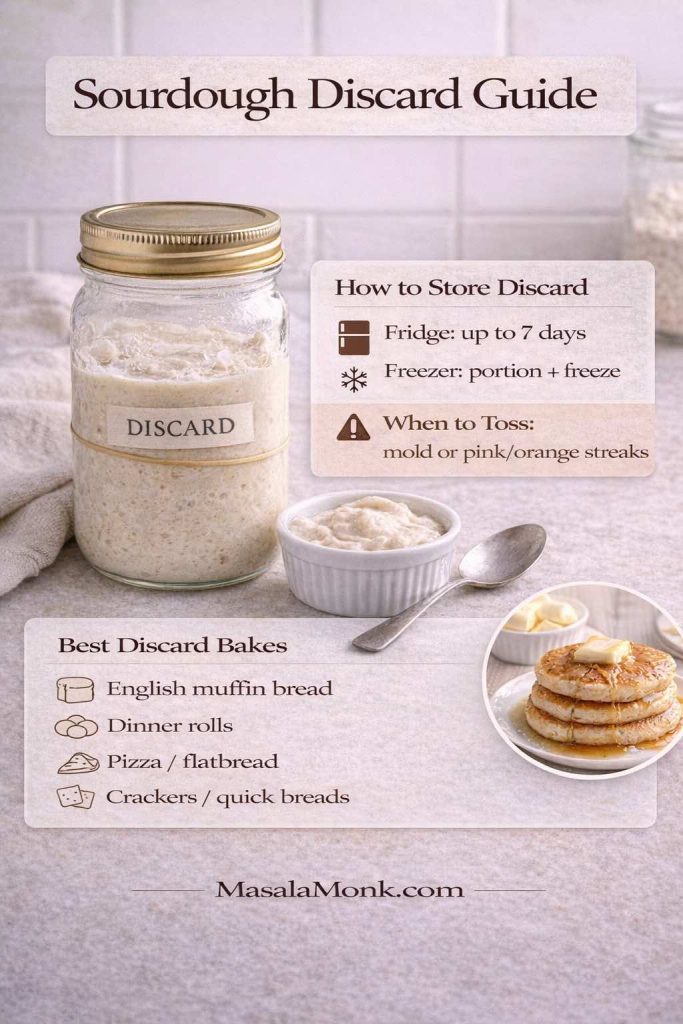
Portrait infographic titled “Sourdough Discard Guide” showing a jar labeled “DISCARD” on a neutral kitchen counter. A text card explains how to store discard (fridge up to 7 days, freezer portion and freeze) and when to toss (mold or pink/orange streaks). Another card lists best discard bakes: English muffin bread, dinner rolls, pizza/flatbread, and crackers/quick breads. MasalaMonk.com appears in the footer.
Don’t waste starter—this sourdough discard guide shows how to store discard safely, when to toss it, and the best ways to use it. Keep it handy whenever you’re baking through this sourdough recipe collection, especially for quick breads, rolls, and easy discard bakes.

Discard also shines in recipes that don’t rely solely on fermentation for rise—crackers, pancakes, waffles, English muffins. Serious Eats has a great discard roundup if you like repurposing: What to do with sourdough discard.

Freezing or drying sourdough starter (so you always have a backup)

If you want a safety net, keep a backup starter in one of these forms:

  • Freeze: spoon starter into small portions (ice-cube style), freeze solid, then store airtight. Thaw in the fridge, then feed 2–3 times until it rises predictably again.
  • Dry: spread a thin layer of starter on parchment, air-dry until fully brittle, then crush and store airtight. Rehydrate with water and flour, then feed daily until active.

When to toss starter: mold, or pink/orange streaks and an unpleasant “off” smell. Otherwise, most “dead” starters are simply cold, underfed, or inconsistent.

Also Read: Peanut Butter Fudge: Recipes & Guide (8 Methods + Easy Variations)


Equipment that makes sourdough feel simpler

You can bake great sourdough with very little. Still, a few choices remove friction.

Dutch oven, cast iron, or “bread pot”

A preheated Dutch oven (including enameled cast iron like a Le Creuset-style bread pot) traps steam, which helps oven spring and crust. If you don’t have one, a heavy lidded pot works. If all you have is a sheet pan, you can still bake—steam becomes the puzzle instead of the pot.

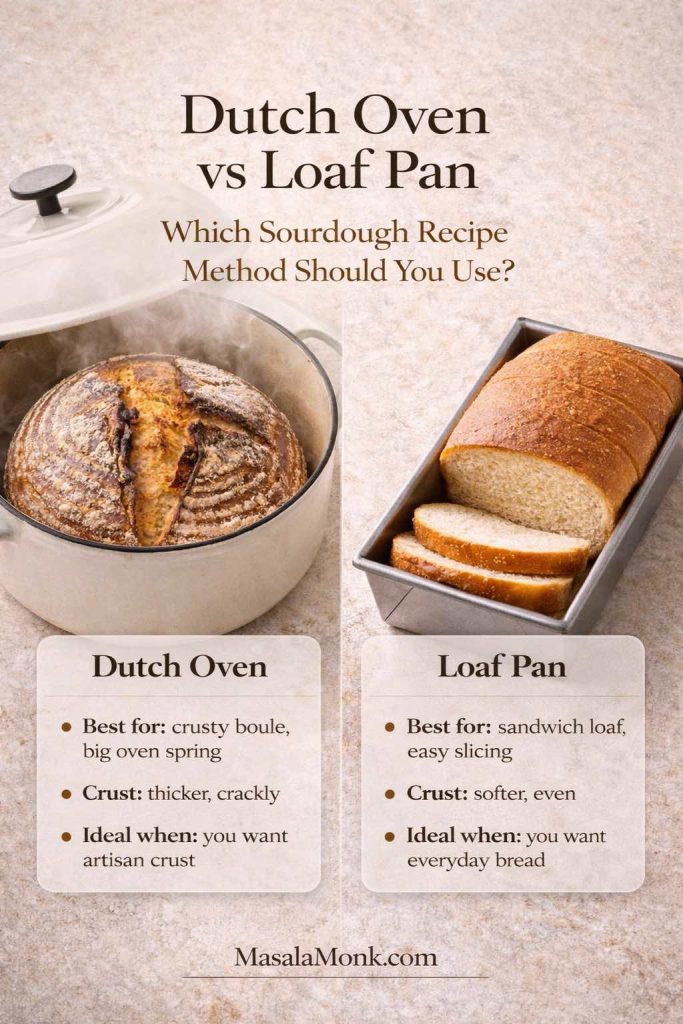
Portrait infographic titled “Dutch Oven vs Loaf Pan: Which Sourdough Recipe Method Should You Use?” showing a sourdough boule steaming in a Dutch oven on the left and a sliced sandwich loaf in a loaf pan on the right. Text compares each method: Dutch oven for a crusty boule and big oven spring with a thicker crackly crust, and loaf pan for easy-slicing sandwich bread with a softer even crust. MasalaMonk.com appears in the footer.
Not sure which sourdough recipe method to choose? Use this quick comparison: bake in a Dutch oven when you want a crusty artisan boule and strong oven spring, or use a loaf pan for softer sandwich bread that slices neatly for everyday toast and lunches.

Loaf pan, bread tin, baking pan

Loaf-pan sourdough is underrated. It’s practical, it slices cleanly, and it turns “homemade bread” into “weekday bread” immediately. If you’re building a sourdough sandwich loaf routine, a loaf pan becomes your best friend.

Loaf pan size matters more than people think

A standard 9×5 in / 23×13 cm pan gives the most forgiving rise and clean slices. Smaller pans make taller loaves but can overproof faster; larger pans can look “short” unless you scale the dough up. When in doubt, use the 9×5 and proof until the dough crowns 2–3 cm above the rim.

Stand mixer (KitchenAid and friends)

A stand mixer can make softer enriched doughs—rolls, buns, sandwich loaves—feel effortless. Meanwhile, high-hydration boules still benefit from folds and time more than aggressive mixing. If you do use a mixer for rustic dough, keep it gentle and brief, then rely on folds to finish the job.

Bread makers and Bread machine sourdough: what it’s best for (and how to adapt)

Some machines include a sourdough setting, and many can handle mixing, kneading, and baking a loaf-pan style sourdough bread. The main limitation is crust and shape, not flavor. A bread machine is most useful for loaf-pan style sourdough—think sandwich bread, English muffin bread, and soft everyday loaves. The machine won’t mimic a Dutch-oven crust, yet it can still deliver excellent flavor.

A simple way to adapt any loaf-pan sourdough in this guide:

  • Use active starter for the most reliable rise (discard can work, but timing gets unpredictable).
  • Choose the machine’s “Dough” cycle to mix + knead, then let the dough rise in the pan until it’s puffy and close to the rim.
  • If your kitchen is cool or your starter is young, a tiny pinch of instant yeast (like in the same-day loaf) keeps the schedule dependable without killing sourdough flavor.
  • For a softer crust, remove the loaf promptly and cool on a rack; for a deeper crust, use the “dark crust” setting if available.

If your goal is consistent everyday sandwich bread, a bread maker can be the easiest “set it and forget it” sourdough routine.

King Arthur even builds machine options into their recipes, including a bread-machine note for their beginner-friendly loaf: Basic sourdough bread recipe.

Also Read: 10 Vegan Chocolate Cake Recipes (Easy, Moist, & Dairy-Free)


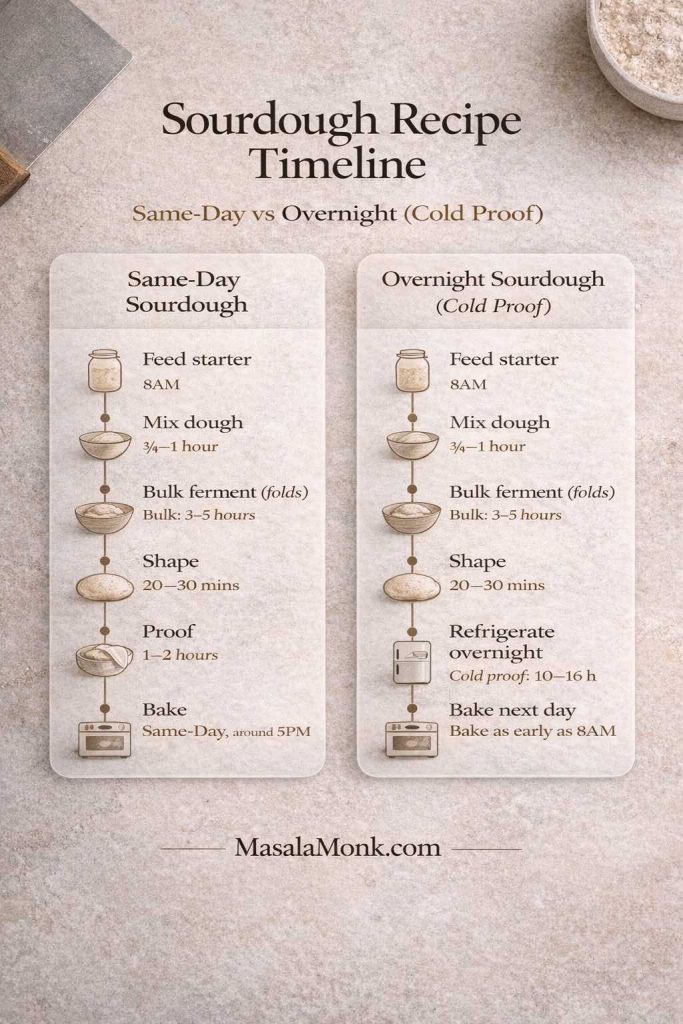
Portrait infographic titled “Sourdough Recipe Timeline: Same-Day vs Overnight (Cold Proof)” showing two side-by-side timelines. The Same-Day sourdough column lists feed starter, mix dough, bulk ferment with folds, shape, proof, and bake. The Overnight column lists feed starter, mix dough, bulk ferment with folds, shape, refrigerate overnight (cold proof 10–16 hours), then bake next day. Warm neutral stone background with simple step icons and MasalaMonk.com in the footer.
Use this sourdough recipe timeline to plan your bake without guesswork. Choose Same-Day sourdough when you want fresh bread by evening, or go Overnight (cold proof) for an easier schedule and deeper flavor—then follow the matching recipe method below.

One base rhythm that makes every sourdough recipe easier

Before we dive into the ten bakes, it helps to know the three levers you can pull:

  1. Time: longer fermentation tends to build more flavor.
  2. Temperature: warmer ferments move faster, cooler ferments move slower and can deepen flavor.
  3. Hydration: wetter doughs can give a more open crumb, while tighter doughs (bagels!) give chew.

If you want to keep starter at a steady temperature—especially in a warm climate or a cold kitchen—temperature control helps. Serious Eats has a clear explanation of the “sweet spot” and cooler maintenance ranges in their review of a dedicated starter box: Brod & Taylor Sourdough Home review. Even without a device, that concept matters: warmer for activity, cooler for steadier, slower fermentation.

Now, let’s bake.


1) Classic Country Boule Recipe (crusty sourdough bread in a Dutch oven)

This is the loaf that anchors everything else. Once you can bake a confident sourdough boule, you can branch into rye, wholegrain, spelt, einkorn, seeded loaves, cinnamon raisin bread, cranberry walnut bread, and even mini sourdough bread bowls without changing your identity.

Ingredients (1 large boule)

  • Bread flour: 450 g
  • Whole wheat flour: 50 g
  • Water: 350 g
  • Active starter (100% hydration): 100 g
  • Salt: 10 g
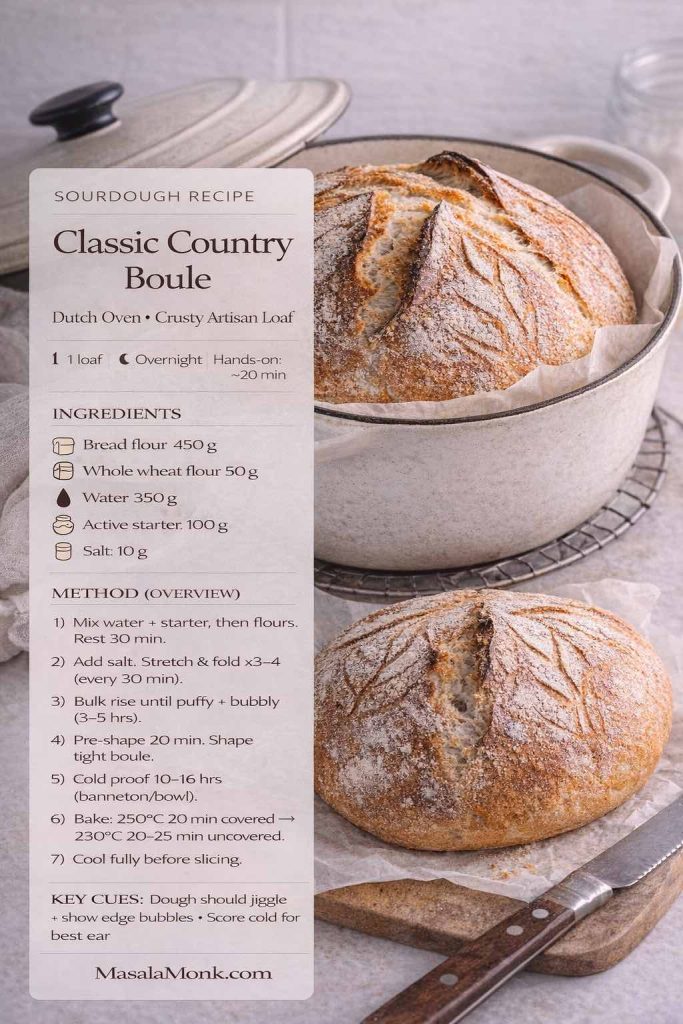
Recipe card for a classic country sourdough boule baked in a Dutch oven, showing two crusty round loaves and a clean overlay with ingredients (bread flour, whole wheat flour, water, active starter, salt) plus an overnight method overview, bake temperatures, and key dough cues for oven spring.
This Classic Country Boule sourdough recipe card condenses the full method into one scannable reference—ingredients, key fermentation cues, and the Dutch oven bake schedule—so you can bake the crusty artisan loaf confidently without jumping around the page.

Method

Mix (evening works beautifully)

  1. Stir water and starter until milky.
  2. Add the flours and mix until no dry flour remains.
  3. Cover and rest 30 minutes. This pause makes the dough easier to strengthen later.

Build strength
4. Sprinkle salt over the dough and work it in with pinches and folds.
5. Over the next 2 hours, do 3–4 rounds of stretch-and-folds (every 30 minutes). Each round should feel easier as the dough tightens.

Bulk ferment
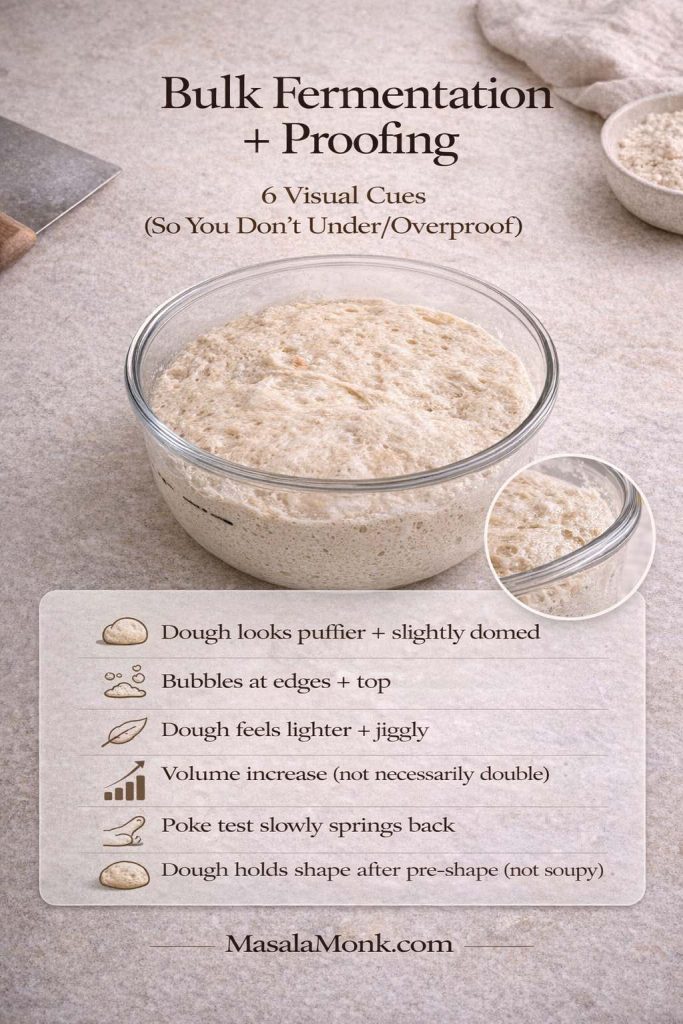
6. Let the dough rise until it looks puffier and lively—jiggly, with bubbles forming along the sides. Depending on room temperature, this can take 3–5 hours after your last fold.

Shape
7. Turn the dough onto a lightly floured surface. Pre-shape into a loose round, then rest 20 minutes.
8. Final shape into a tight boule: pull the dough toward you to create surface tension without tearing.

Cold proof
9. Place seam-side up in a floured banneton or cloth-lined bowl. Refrigerate 10–16 hours.

Bake
10. Preheat a Dutch oven to 250°C for 30–45 minutes.
11. Tip the dough onto parchment, score, and place it into the hot pot.
12. Bake 20 minutes covered, then reduce to 230°C and bake 20–25 minutes uncovered until deeply browned.
13. Cool fully. The crumb keeps setting as it cools, and slicing early can make it gummy.

Make it more sour (without making it dense)

If you want extra sour sourdough bread, the simplest shift is time and temperature: a longer cold proof often deepens tang. Another option is using a slightly lower hydration starter and letting the dough ferment a little longer before shaping. Serious Eats explains the microbial balance clearly in their deep dive on starter behavior: The Science of Sourdough Starters.

Wholegrain, spelt, rye, and einkorn variations

  • For a whole wheat sourdough bread: increase whole wheat flour to 150 g and reduce bread flour to 350 g. Add 10–20 g extra water if the dough feels tight.
  • For a rye sourdough or sourdough rye loaf: replace 50–100 g of bread flour with rye flour. Rye ferments enthusiastically, so watch the dough rather than the clock.
  • For spelt sourdough: swap 100 g of bread flour with spelt. Spelt dough can feel softer, so handle gently and avoid over-proofing.
  • For einkorn flour sourdough: start small—swap 50–75 g first. Einkorn’s gluten behaves differently, so the dough may spread more; a loaf pan version can be easier at first.
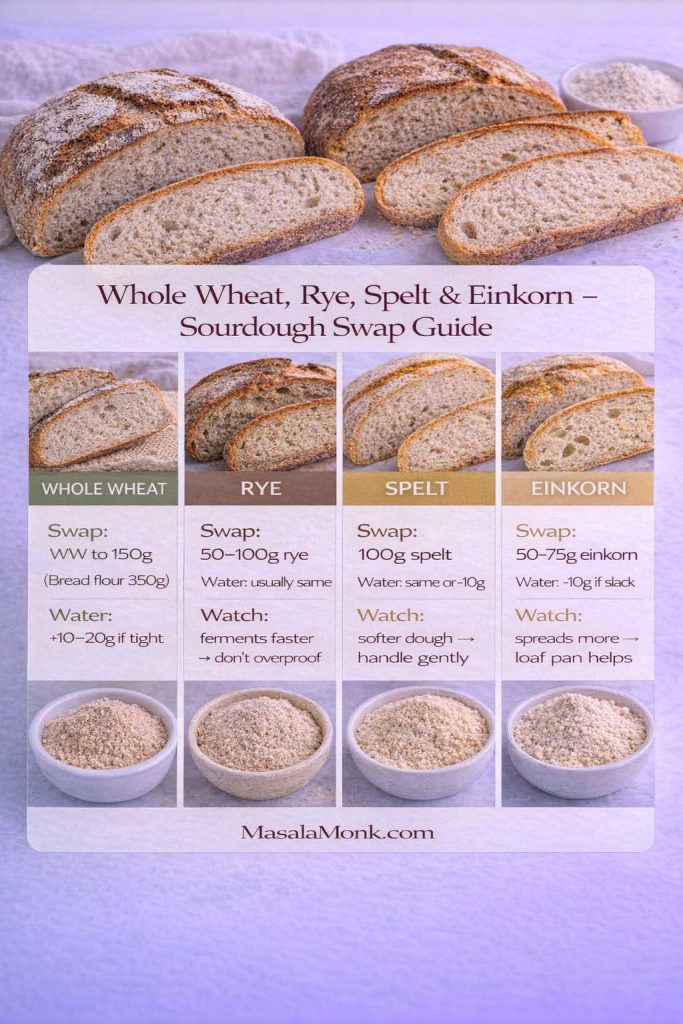
Infographic titled ‘Whole Wheat, Rye, Spelt & Einkorn — Sourdough Swap Guide’ with four columns. Each column shows a loaf/crumb photo and a quick swap rule: Whole wheat—raise whole wheat to 150 g and reduce bread flour to 350 g; add 10–20 g water if dough feels tight. Rye—swap 50–100 g rye; ferments faster so don’t overproof. Spelt—swap 100 g spelt; dough feels softer so handle gently. Einkorn—swap 50–75 g; spreads more so a loaf pan helps. MasalaMonk.com footer.

Use this sourdough flour swap guide when you want to push the classic boule toward whole wheat, rye, spelt, or einkorn without guessing. It keeps the change simple (what to swap) and practical (what to watch) so you can get the flavor you want while keeping structure, rise, and scoring predictable.

If you’re curious which flours help starters thrive, Serious Eats tested options and explains why rye and wholegrain often jump-start activity: The best flour for sourdough starters.

Easy add-ins: cinnamon raisin, cranberry orange, cranberry walnut, pumpkin

Once you’ve made the classic boule, add-ins become straightforward—keep the dough the same, then fold these in after the first fold set:

  • Cinnamon raisin swirl: 120–150 g raisins + a thin cinnamon-sugar layer during shaping (don’t overdo sugar or the swirl can leak).
  • Cranberry orange: 120 g dried cranberries + zest of 1 orange (add 10–15 g extra water if the dough tightens).
  • Cranberry walnut: 100–120 g cranberries + 80–100 g toasted walnuts (toast first for better flavor).
  • Pumpkin sourdough: replace 50–80 g of the water with pumpkin purée (pumpkin changes dough feel—watch texture, not the clock).

These small swaps help you hit a lot of “flavored sourdough bread” searches without writing full extra recipes.

Turn this boule dough into mini sourdough bread bowls

Instead of one boule, divide the dough into 4–6 pieces after bulk fermentation. Shape each piece tightly into a small round, cold proof on a tray, then bake on a preheated stone or heavy sheet with steam. Once cooled, slice the tops and hollow gently. These sourdough soup bowls are perfect with thick stews or creamy soups.

Also Read: Kahlua Drinks: 10 Easy Cocktail Recipes (Milk, Vodka, Coffee)


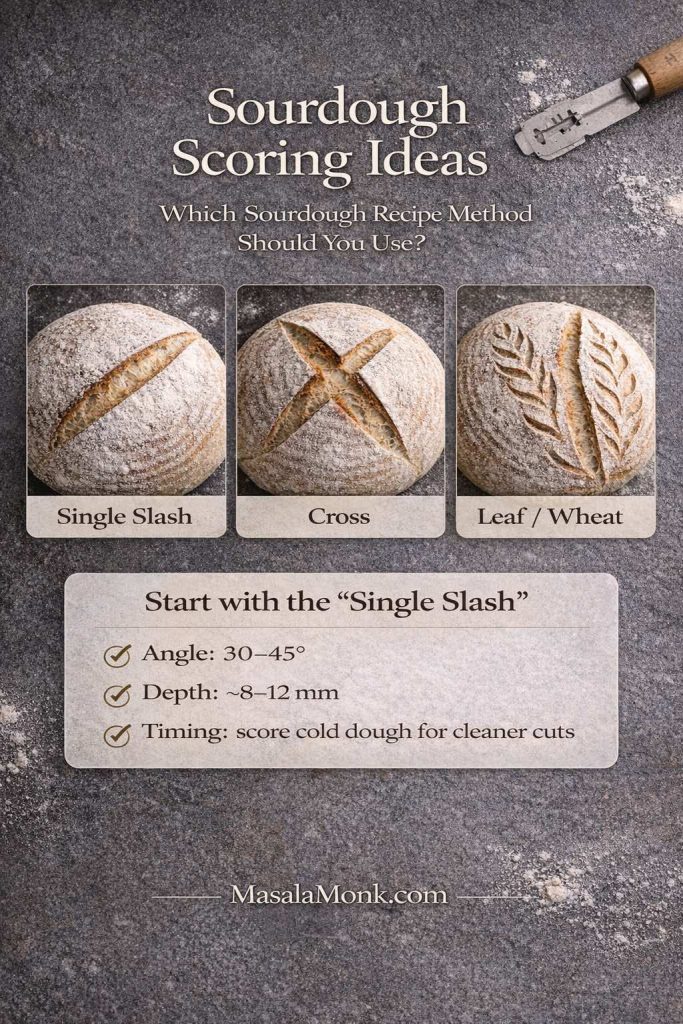
These sourdough scoring ideas make shaping and baking feel less intimidating. Start with the single slash for the most reliable oven spring, then try a cross or leaf pattern once you’re comfortable. Use the angle + depth cues here right before baking your boule.

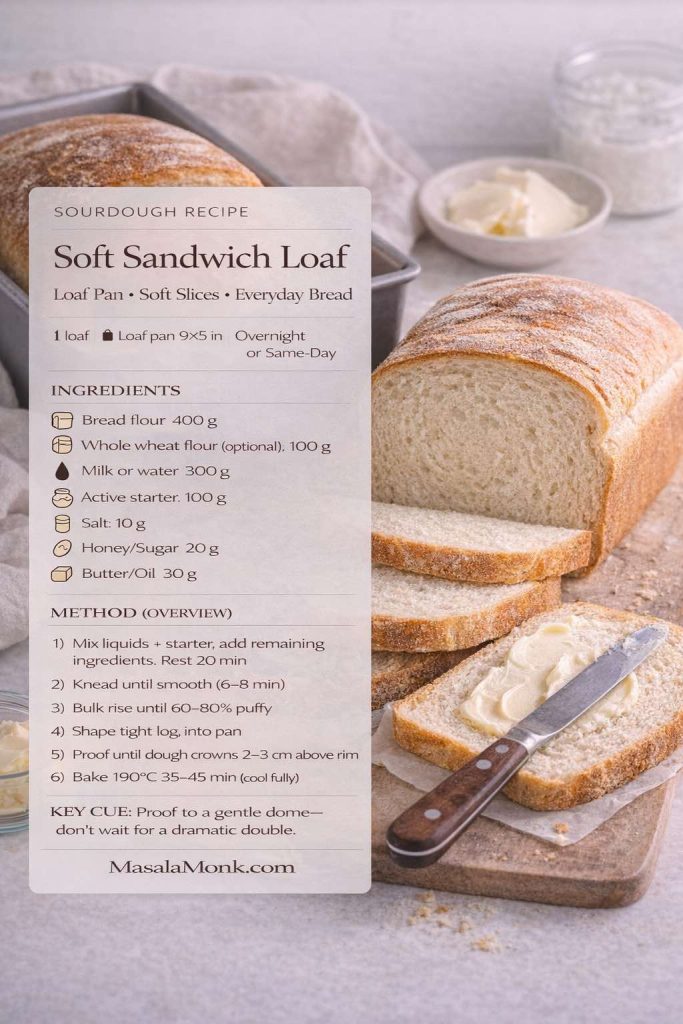
2) Soft Sandwich Loaf Recipe (loaf pan sourdough bread for everyday)

A sourdough sandwich bread recipe should slice cleanly, toast beautifully, and feel soft enough for breakfast and lunch. This is the bread you’ll reach for when you want peanut butter, grilled cheese, or a turkey sourdough sandwich without wrestling a crust.

Ingredients (1 loaf pan, about 23×13 cm / 9×5 in)

  • Bread flour: 400 g
  • Whole wheat flour: 100 g (optional; replace with bread flour for a whiter loaf)
  • Milk or water: 300 g
  • Active starter: 100 g
  • Salt: 10 g
  • Honey or sugar: 20 g
  • Butter or neutral oil: 30 g
Soft sourdough sandwich loaf on a cutting board with buttered slices and a clean text overlay recipe card titled “Soft Sandwich Loaf,” showing loaf-pan size, ingredients (flour, milk/water, active starter, salt, honey/sugar, butter/oil) and a short method overview; MasalaMonk.com in the footer.
This soft sourdough sandwich loaf recipe card is the quick-glance version of the loaf-pan method below—ingredients + the exact proofing cue to watch so your slices stay tender, even, and clean-cut.

Method

  1. Mix milk and starter until combined.
  2. Add flours, honey/sugar, salt, and butter/oil. Mix to a shaggy dough, then rest 20 minutes.
  3. Knead until smoother and elastic—6–8 minutes by hand or 4–5 minutes in a stand mixer on low.
  4. Cover and let rise until noticeably puffy, about 60–80% increased in size.
  5. Shape into a log: flatten into a rectangle, roll tightly, pinch the seam.
  6. Place seam-side down in a greased loaf pan.
  7. Proof until the dough crowns 2–3 cm above the pan rim.
  8. Bake at 190°C for 35–45 minutes. Cool fully before slicing.

Make it sandwich-ready with MasalaMonk pairings

Once this loaf becomes routine, sandwiches become a rotating habit rather than a repetitive meal:


Portrait infographic titled “Bulk Fermentation + Proofing: 6 Visual Cues (So You Don’t Under/Overproof)” showing a glass bowl of risen sourdough dough on a light stone counter with a small bubble close-up inset. Text lists six cues: dough looks puffier and slightly domed, bubbles at edges and top, dough feels lighter and jiggly, volume increase not necessarily double, poke test slowly springs back, and dough holds shape after pre-shape. MasalaMonk.com is in the footer.
Nail the rise on every sourdough recipe with these bulk fermentation and proofing cues. Use the dome, bubbles, jiggle, and poke-test signals here to know when your dough is ready to shape and bake—so your loaves, rolls, buns, and bagels come out lighter instead of dense or flat.

3) Same-Day Sourdough Bread Recipe (fast, reliable, still flavorful)

Some days you want fresh bread by dinner without the full overnight arc. This same day sourdough recipe borrows the best idea from “everyday sourdough” approaches: give the starter a head start, then use a tiny pinch of yeast as backup so the loaf rises on your schedule.

Ingredients (1 loaf)

  • Bread flour: 500 g
  • Water: 340 g
  • Active starter: 120 g
  • Salt: 10 g
  • Instant yeast: 1 g (optional but extremely helpful)
Recipe card overlay for Same-Day Sourdough Bread showing a sliced loaf on a board. Text lists ingredients (bread flour, water, active starter, salt, optional instant yeast) and a short method: mix + rest, 2–3 fold sets, bulk until airy, shape + proof, bake covered then uncovered. MasalaMonk.com in footer.
Same-Day Sourdough Bread (quick visual checklist): This card is the fast version of Recipe #3—ingredients + the five checkpoints that matter most (folds → airy bulk → short proof → covered bake → uncovered finish). Use it to keep your timing on track while you follow the full steps in this section.

Method

  1. Mix water and starter, then add flour, salt, and yeast (if using). Mix until no dry flour remains. Rest 20 minutes.
  2. Over the next 60–90 minutes, do 2–3 sets of folds.
  3. Bulk ferment until the dough looks inflated and airy, typically 2–4 hours depending on warmth.
  4. Shape into a boule and proof 45–75 minutes while you preheat the oven and pot.
  5. Bake in a preheated Dutch oven at 250°C for 20 minutes covered, then 230°C for 20–25 minutes uncovered.

If you love this “forgiving but tasty” lane, King Arthur’s loaf-pan version is worth bookmarking because it’s built for success, even when your starter isn’t perfect: Easy everyday sourdough bread recipe.

Also Read: Hot Chocolate Coffee: 3 Easy Recipes (Cocoa, Mix, or Espresso)


If a sourdough recipe ever turns out dense, flat, or gummy, use this quick troubleshooting guide to diagnose the problem and fix your next bake. It’s especially helpful when you’re switching between methods (same-day vs overnight) or moving from loaf pans to Dutch oven boules.

4) No-Knead Dutch Oven Loaf Recipe (hands-off, overnight, crusty)

No knead sourdough is ideal when you want a rustic loaf without shaping drama. You mix, you wait, you fold a little, and time does the rest. It’s also a nice entry point when you’re still learning what “fermented enough” feels like.

Ingredients (1 loaf)

  • Bread flour: 500 g
  • Water: 375 g
  • Active starter: 100 g
  • Salt: 10 g
Photographic recipe card for “No-Knead Dutch Oven Loaf” (sourdough recipe). A golden sourdough loaf sits in a white Dutch oven as a hand lifts the lid; steam rises. A clean text overlay lists ingredients (bread flour, water, active starter, salt) and a simple method overview (mix at night, rest, fold, shape + proof, bake covered then uncovered). MasalaMonk.com appears in the footer.
No-knead sourdough Dutch oven loaf (recipe card): a hands-off, overnight method you can follow at a glance—ingredients + the exact flow (mix → rest → fold → shape → bake) so you get a crusty loaf without overthinking timing. Save this card as your quick checkpoint while you bake the full method in Section 4.

Method

  1. In the evening, mix everything until combined. Cover.
  2. Leave at room temperature 10–14 hours.
  3. In the morning, gently fold the dough over itself a few times to tighten it. Rest 20 minutes.
  4. Shape lightly into a round and proof 45–90 minutes.
  5. Bake in a preheated Dutch oven: 250°C for 20 minutes covered, then 230°C for 20–25 minutes uncovered.

If you like seeing the method explained step-by-step with visuals, King Arthur’s guide-style post is clear: How to make no-knead sourdough bread.

Also Read: Cappuccino Recipe: How to Make a Perfect Cappuccino at Home


5) English Muffin Bread Recipe (toaster-friendly sourdough, minimal effort)

English muffin bread is the bread you bake when you want nooks and crannies without shaping rounds or dealing with a stone. It’s especially good for breakfast—toast it hard, then let butter and jam do their thing.

Ingredients (1 loaf)

  • Bread flour: 450 g
  • Water or milk: 360 g
  • Active starter: 120 g
  • Salt: 10 g
  • Honey or sugar: 15 g
  • Baking soda: 2 g
  • Cornmeal (for dusting): as needed
Photograph-style recipe card for sourdough English muffin bread in a loaf pan with cornmeal crust and two buttered toasted slices. Clean overlay lists ingredients and a short method overview for a no-shaping, toaster-friendly sourdough loaf with “nooks and crannies,” plus MasalaMonk.com branding in the footer.
This sourdough English muffin bread card is the “easy breakfast loaf” in this guide—no shaping, no Dutch oven, just a sticky batter-style dough that bakes up with nooks and crannies. Use it as a quick visual checklist while you follow the full method below (and save it for repeat toaster mornings).

Method

  1. Mix liquids and starter, then add flour, salt, and honey/sugar. The dough will be sticky—closer to a thick batter than a kneadable dough.
  2. Cover and rise until noticeably airy, often 3–6 hours.
  3. Grease a loaf pan and dust lightly with cornmeal.
  4. Scrape in the dough, smooth the top with wet fingers, and proof until it nears the rim.
  5. Bake at 190°C for 35–40 minutes.

Breakfast ideas with this sourdough bread recipe

Once you have this loaf, breakfast becomes easy to repeat without feeling repetitive:


Portrait infographic titled “Soft Sourdough Rolls & Buns” showing one dough made into three shapes on a baking tray: dinner rolls (pull-apart), burger buns (round seeded buns), and hot dog buns (oval rolls). Text notes “Same dough, different shape” and “Tight surface = better rise,” with MasalaMonk.com in the footer.
This soft sourdough rolls and buns guide shows how one dough becomes three bakes—dinner rolls, burger buns, and hot dog buns. Use it as a quick shaping reference before you start the rolls section below, so your dough rises higher and bakes up pillowy.

6) Soft Dinner Rolls Recipe (pull-apart sourdough rolls with starter)

Soft sourdough dinner rolls are a different kind of pleasure: tender crumb, gentle sweetness, a golden top, and a pan that disappears faster than you expect. They’re also forgiving, especially if you keep the dough enriched.

Ingredients (for recipe of 12 sourdough dinner rolls )

  • Bread flour: 500 g
  • Milk: 280 g
  • Active starter: 120 g
  • Salt: 10 g
  • Sugar: 35 g
  • Butter: 60 g
  • Egg: 1 (about 50 g) — optional
    • If skipping egg, add 30 g extra milk.
Soft sourdough dinner rolls in a baking pan with a clean recipe card overlay titled “Soft Dinner Rolls.” The card lists ingredients for 12 rolls (bread flour, milk, active starter, salt, sugar, butter, optional egg) and a short method overview: mix and rest, knead in butter, bulk ferment until puffy, divide and shape, proof until touching, then bake and brush with butter. MasalaMonk.com in the footer.
This soft sourdough dinner rolls recipe card gives you the full ingredient list plus the key checkpoints (bulk ferment “puffy + marshmallowy,” proof until the rolls touch, then bake). Use it as a quick visual recap while you follow the detailed steps in Section 6: Soft Dinner Rolls—especially helpful when you’re baking enriched dough and don’t want to overproof.

Method

  1. Mix milk and starter (plus egg, if using). Add flour, sugar, and salt. Mix until shaggy. Rest 20 minutes.
  2. Knead until smoother, then knead in butter until the dough is cohesive and elastic.
  3. Bulk ferment until it looks puffy and lighter, typically 3–6 hours depending on temperature.
  4. Divide into 12 pieces (about 85–90 g each). Shape into tight balls.
  5. Place in a greased pan, cover, and proof until the rolls are soft and touching.
  6. Bake at 190°C for 18–22 minutes. Brush with butter while warm.

If you like comparing your rolls to a well-tested benchmark, this recipe is excellent for technique and texture: Super soft sourdough rolls.

Also Read: Cranberry Moscow Mule Recipe: A Festive Holiday Cocktail With Easy Variations


7) Burger Buns Recipe (soft sourdough buns for sandwiches)

A sourdough bun should be sturdy enough to hold sauces yet tender enough to bite through cleanly. This dough builds on the roll formula because it already has that soft, enriched structure.

Ingredients (for recipe of 8 sourdough buns for sandwiches)

Use the same dough as the Soft Dinner Rolls. After bulk fermentation, shape as buns instead of rolls.

Method

  1. Divide dough into 8 pieces (about 105–115 g each).
  2. Shape into tight balls, then gently flatten to a thick disc.
  3. Proof on a tray until puffy and marshmallowy.
  4. Brush with milk or egg wash if desired.
  5. Bake at 190°C for 15–18 minutes.
Photo of soft sourdough burger buns on a cooling rack with sesame tops, plus a clean recipe overlay card titled “Soft Sourdough Burger Buns” showing ingredients and a short step-by-step method for pillowy, sandwich-ready buns, with MasalaMonk.com in the footer.
This soft sourdough burger buns recipe card gives you the full buns-at-a-glance view—ingredients, proofing checkpoints, and the bake window—so you can follow the bun method without scrolling back and forth while shaping and proofing.

Sandwich pairings that make buns feel “planned”

  • Build a spicy, street-style vibe with authentic grilled Bombay sandwich flavors adapted into bun form—chutney, potatoes, crisp veg, and heat.
  • For a creamy upgrade, the base ideas in homemade mayo variations let you swing from garlic mayo to spicy mayo without changing the whole sandwich.
  • If you want chicken options that don’t feel repetitive, chicken sandwich recipes gives multiple directions that work brilliantly in soft sourdough buns.

8) Hot Dog Buns Recipe (sourdough hotdog buns that stay soft)

Hot dog buns often dry out quickly. Sourdough can help them stay tender longer, especially when the dough includes milk and butter.

Ingredients (for recipe of 10 sourdough hotdog buns)

Use the same dough as Soft Dinner Rolls.

Recipe card photo of golden sourdough hot dog buns in a baking pan with one bun sliced open to show a soft crumb. Text overlay reads ‘Sourdough Hot Dog Buns’ with ingredients, short method steps, and a pro cue for softer buns. MasalaMonk.com in the footer.
This sourdough hot dog buns recipe card gives you the full at-a-glance method—soft crumb, split-top shape, and a proofing cue that keeps the buns pillowy. Use it right before shaping so your buns bake up tall and tender, then follow the full steps in the section above for timing details and swaps.

Method

  1. Divide into 10 pieces (about 85–90 g).
  2. Shape each piece into a tight ball, rest 10 minutes, then roll into a short log.
  3. Place seam-side down on a tray or in a bun pan.
  4. Proof until the logs look puffy and almost doubled.
  5. Bake at 190°C for 14–17 minutes.

If you want to keep buns soft for longer, cool them fully, then store airtight. For freezing, slice before freezing so you can toast from frozen without thawing.

Also Read: Baked Ziti Recipe Collection: 15 Easy Variations


9) Hoagie + Sub Rolls Recipe (sourdough sandwich rolls)

These are the rolls you bake when you want an honest-to-goodness sub: crisp edge, chewy bite, enough structure to handle fillings. They’re also the shape that makes leftover chicken, roasted vegetables, or paneer feel like an actual meal.

Ingredients (for recipe of 6 sourdough sandwich rolls)

  • Bread flour: 500 g
  • Water: 320 g
  • Active starter: 120 g
  • Salt: 10 g
  • Sugar: 15 g
  • Olive oil: 20 g
Photographic recipe card for sourdough hoagie and sub rolls (sourdough sandwich rolls) showing sesame-topped rolls on a board plus a filled sub. Overlay lists ingredients for 6 rolls and a short method (mix, knead, bulk ferment, shape, proof, bake) with a steam tip; MasalaMonk.com in the footer.
Sourdough hoagie + sub rolls, at a glance: use this quick recipe card when you want sandwich rolls that hold fillings—crisp edge, chewy bite, and a soft interior. Screenshot/save it for repeat bakes, then follow the full method below for timing cues during bulk fermentation and proofing.

Method

  1. Mix water and starter, then add flour, sugar, salt, and oil. Mix until combined. Rest 20 minutes.
  2. Knead until smooth—6–8 minutes by hand or 4–5 minutes on low in a stand mixer.
  3. Bulk ferment until puffy, usually 3–5 hours depending on warmth.
  4. Divide into 6 pieces (about 160–170 g). Pre-shape into small logs, rest 15 minutes.
  5. Shape tightly into longer rolls: flatten gently, roll up firmly, pinch seam, then taper ends if you like.
  6. Proof seam-side down until the rolls feel lighter and look expanded.
  7. Bake at 220°C for 16–20 minutes. For better crust, create steam by placing a tray of hot water on the bottom rack during the first 10 minutes.

For a filling that’s simple but ridiculously satisfying, try a hot, melty build based on mushroom cheese sandwich flavors—sautéed mushrooms, spice, cheese, and a spread.

Also Read: Manhattan Cocktail Recipe (Classic + 6 Variations)


10) Chewy Sourdough Bagels Recipe (boil + bake, real bagel texture)

Sourdough bagels are a different animal: stiff dough, serious kneading, tight shaping, then a quick boil that sets the crust before baking. The payoff is huge—chew, shine, and that “real bagel” bite.

For a classic reference recipe with a proven method, King Arthur’s version is excellent: Sourdough bagels recipe. Here’s a streamlined metric approach that stays true to the technique.

Portrait four-panel infographic titled “Sourdough Bagels” showing the steps: Shape (raw bagel rings on a floured surface), Float Test (bagel floating in water), Boil (bagels boiling with note “30–60 sec/side”), and Bake (golden sesame bagels on a tray). Text at bottom says “Chewy crust, tender inside,” with MasalaMonk.com in the footer.
This sourdough bagels step card breaks the method into four simple checkpoints—shape, float test, boil, then bake—so you get that classic chewy crust and tender inside. Save it as a quick reference, then follow the full sourdough bagel recipe below for exact timings and quantities.

Ingredients (for Recipe of 8 Sourdough bagels)

  • Bread flour: 500 g
  • Water: 250 g
  • Active starter: 150 g
  • Salt: 10 g
  • Honey or sugar: 25 g

Water bath

  • Water: 2000 g
  • Honey: 20 g
  • Salt: 3 g
Photograph of sesame sourdough bagels on a rack and board with a clean recipe overlay titled “Sourdough Bagels: Chewy Bagels (Boil + Bake),” listing ingredients (bread flour, water, active starter, salt, honey/sugar), a water-bath formula, float-test cue, boil time per side, bake temperature, and MasalaMonk.com in the footer.
This sourdough bagels recipe card gives you the full method in one glance—stiff dough, a quick float test, 30–45 seconds per side in the honey water bath, then bake until deep golden. Use it right before you boil so you nail the chew without over-proofing or over-boiling.

Method

  1. Mix everything into a stiff dough. Knead until very smooth, 8–10 minutes. A stand mixer helps here, although hand kneading works if you stay patient.
  2. Bulk ferment 2–4 hours. Bagel dough doesn’t need to double; it should simply look slightly puffier and smoother.
  3. Divide into 8 pieces (about 115–120 g). Rest 10 minutes.
  4. Shape: either poke a hole in the center and stretch, or roll into a rope and wrap around your hand.
  5. Proof 30–60 minutes. A quick float test helps: if a bagel floats in water, it’s ready to boil.
  6. Boil 30–45 seconds per side in the honey-salt water bath.
  7. Bake at 220°C for 18–22 minutes until deeply golden.

Bagels make breakfast feel effortless, especially when you pair them with a spread and something crunchy. For ideas that stay practical, this roundup is full of combinations: breakfast sandwich recipes.

Also Read: Classic Rum Punch + 9 Recipes (Pitcher & Party-Friendly)


Bonus: Gluten-Free Vegan Sourdough Boule Recipe (a true gluten-free boule path)

Gluten-free sourdough can be genuinely good—provided you treat it like its own category instead of pretending it will behave like wheat. The dough is usually more like a thick batter, structure often comes from psyllium husk, and baking in a pot helps hold shape.

This gluten-free vegan sourdough bread recipe uses a gluten-free starter (often built from brown rice flour). If you need a starter method, Serious Eats offers a clear baseline starter guide (wheat-based), and the fermentation logic still helps even when your flour changes: Sourdough starter basics.

Gluten-free vegan sourdough boule recipe card showing measured ingredients (brown rice flour, sorghum flour, tapioca starch, psyllium husk, salt, maple/sugar optional, active gluten-free starter, olive oil optional) plus a hydration dial recommending water 430–470 g, target texture “thick paste that holds soft peaks,” and key checkpoints (rest 15 minutes, proof for bubbles + slight lift, cool before slicing). MasalaMonk.com in footer.
Gluten-Free Vegan Sourdough Boule (Formula + Hydration Dial): Use this as your mixing reference—start your water at 430 g, then only move toward 470 g if the dough feels too stiff to spread. For gluten-free sourdough, the goal isn’t a kneadable dough; it should look like a thick paste that holds soft peaks, then show bubbles + a little lift before baking in a pot.

Ingredients (for 1 small Sourdough Boule Recipe)

  • Brown rice flour: 250 g
  • Sorghum flour: 150 g
  • Tapioca starch: 100 g
  • Psyllium husk powder: 15 g
  • Salt: 10 g
  • Maple syrup or sugar: 15 g (optional, helps fermentation)
  • Water: 430–470 g (start with 430 g, add as needed)
  • Active gluten-free starter (100% hydration): 150 g
  • Olive oil: 20 g (optional, improves tenderness)
Gluten-free vegan sourdough boule in a Dutch oven with a clean recipe-card overlay listing brown rice flour, sorghum, tapioca, psyllium, starter, and quick bake steps, plus “success cues,” with MasalaMonk.com in the footer.
This gluten-free vegan sourdough boule recipe card pulls the full method into one glance—key flours, psyllium “structure,” the paste-like dough reminder, and the two-stage Dutch oven bake. Use it while you mix and proof so you don’t chase a wheat-style “double,” and save it as your quick checkpoint for repeat gluten-free bakes.

Method

  1. Whisk dry ingredients thoroughly so psyllium distributes evenly.
  2. Stir in water and starter. The dough should resemble a thick, sticky paste that holds soft peaks. Rest 15 minutes to let psyllium gel.
  3. Scrape into a parchment-lined bowl or proofing basket. Smooth the top with wet fingers.
  4. Proof at warm room temperature until slightly risen and aerated—often 3–5 hours. Don’t chase a dramatic double; aim for visible lift and bubbles.
  5. Bake in a preheated Dutch oven at 240°C for 25 minutes covered, then 220°C for 25–35 minutes uncovered.
  6. Cool completely before slicing. Gluten-free sourdough firms as it cools, and cutting early can make it feel gummy.
Gluten-free vegan sourdough boule visual guide showing thick paste-like dough after mixing and a proofed dough in a lined basket, with notes to look for bubbles and slight lift (not a full double), plus tips: wet hands to smooth, parchment for transfer, and cool completely before slicing.
Gluten-free sourdough behaves differently from wheat dough—use these dough + proof cues to stay on track. Aim for a thick paste that holds soft peaks, then proof for visible bubbles and a slightly aerated lift (don’t wait for a dramatic double). Finish by cooling the boule fully before slicing so the crumb sets instead of turning gummy.

This loaf pairs beautifully with soups and sauces, because gluten-free crust loves something to soak up. If you want a simple sauce rotation for dipping and topping, keep these handy:


A sourdough pizza detour that fits naturally (starter or discard)

Even if you’re not baking pizza weekly, sourdough pizza dough is one of the best ways to “use your starter without a ceremony.” It’s also a satisfying path for evenings when you want something baked, but not another loaf.

When pizza night happens, the dough is only half the story. A great sauce makes sourdough crust taste intentional—whether you want classic red, garlicky, spicy, or creamy. Start with your pizza sauce recipes for easy options that work on sourdough bases, then switch it up with a fresh, herby spread like pesto recipes and variations when you want something brighter.

Sourdough pizza dough: an easy base formula (starter or discard)

Sourdough pizza works because the dough doesn’t need a dramatic rise to taste great—fermentation does the heavy lifting for flavor.

Base formula (2 medium pizzas):

  • Bread flour: 500 g
  • Water: 325–350 g (start lower if your flour is weaker)
  • Salt: 10 g
  • Active starter: 100 g (or discard 150–200 g if you’re using it for flavor)
  • Olive oil (optional): 10–20 g

Simple timeline options:

  • Same-day: warm kitchen, starter at peak → mix → 2–3 fold sets → bulk until airy → divide → rest → stretch and bake.
  • Overnight: mix → bulk partway → refrigerate → next day portion → warm up → stretch and bake.

If you want the crust more sour, choose the overnight path and give it more time cold.


Where this leaves you (and what to bake first)

If you want the most “foundational” two-bake pairing, start with the classic country boule and the soft sandwich loaf. You’ll get crust, crumb, shaping, and loaf-pan confidence in one week, and after that the rolls and buns feel like friendly variations rather than new projects.

Meanwhile, if you want quick wins, the same-day loaf plus English muffin bread makes sourdough feel useful immediately—toastable, sliceable, repeatable.

Whenever you’re ready to turn today’s bread into tomorrow’s meal, a few MasalaMonk staples make the rotation easy:

FAQs: Sourdough Recipe Questions (Starter, Timing, Flavor, Tools)

1) What’s the difference between a sourdough recipe using active starter vs discard?

An active (ripe) starter has peak strength, so it can lift the dough on its own and gives you the most predictable rise for a true sourdough bread. By contrast, discard is older and usually less powerful; still, it brings flavor, and it works well in longer-fermented doughs or recipes designed for discard. In practice, if you want a classic sourdough bread recipe with a tall loaf and open crumb, use active starter. Meanwhile, if you want a faster, more flexible bake or you’re trying to reduce waste, a sourdough discard recipe can be the right fit.

2) How do I know when my sourdough starter is ready to bake with?

Look for a starter that rises reliably after feeding, shows plenty of bubbles, and smells pleasantly tangy rather than harsh. Ideally, it should reach its peak in a predictable window in your kitchen. If it’s doubling, holding some structure at peak, and looks airy instead of watery, it’s generally ready. Even so, if your starter is new, it may still bake fine in a sandwich loaf recipe or same-day sourdough bread recipe before it’s strong enough for a lofty country boule.

3) Why didn’t my sourdough bread rise?

Usually it’s one of three things: the starter wasn’t strong enough, the dough was under-fermented, or the dough was over-fermented. Under-fermentation can happen if your kitchen is cool or the dough didn’t get enough time. Over-fermentation can happen if the dough sat too long in warmth and lost strength before baking. Additionally, too much flour during shaping can prevent a good seal and weaken structure. When in doubt, aim for dough that feels lighter, looks puffier, and shows bubbles at the edges before you shape.

4) Why is my sourdough recipe turning out dense and tight?

Density often comes from either weak fermentation or insufficient gluten development. If the dough never becomes airy during bulk, the crumb stays tight. On the other hand, if the dough is handled roughly late in fermentation, you can knock out the gas that would have become lift in the oven. Also, very low hydration doughs tend to be tighter. If you want a more open crumb, choose a slightly higher hydration sourdough boule recipe and handle it more gently near the end.

5) How do I make my sourdough more sour?

To get extra sour sourdough bread, extend fermentation in cooler conditions. A longer cold proof in the fridge generally increases tang without sacrificing structure. Similarly, using more whole grain flour (especially rye) can boost flavor. Another approach is keeping the starter on a slightly stiffer feeding routine, which can shift acidity. However, if you push too far, the loaf can turn slack, so aim for “more sour” through time and temperature rather than simply letting dough sit forever.

6) How do I make my sourdough less sour?

If your loaf tastes sharper than you like, shorten the cold proof, reduce the total fermentation time, and keep the starter on a regular feeding rhythm so it stays mild. In addition, using more bread flour and less whole grain can soften acidity. Finally, bake sooner once the dough is properly fermented; waiting far past readiness can intensify sour notes.

7) What does “same-day sourdough” really mean?

Same-day sourdough usually means you bake within a single day rather than doing an overnight cold proof. Sometimes it’s a true starter-only approach in a warm kitchen with excellent timing. More often, it’s a hybrid sourdough bread recipe that uses starter for flavor plus a tiny amount of yeast for reliability. Either way, the goal is similar: a good loaf today, without needing to plan two days ahead.

8) Is a no-knead sourdough recipe actually better for beginners?

Often, yes. No-knead sourdough relies on time and folds rather than intensive kneading, which reduces the chance of overworking the dough. Additionally, the schedule can feel simpler: mix, rest, fold occasionally, then shape and bake. That said, even a no-knead method still needs fermentation awareness, so learning what “puffy and airy” looks like is more important than memorizing minutes.

9) Can I bake sourdough without a Dutch oven?

Absolutely. While a Dutch oven makes steam management easy, you can bake on a preheated tray or stone with a steam setup. For example, you can place a metal tray in the oven while it preheats, then pour hot water into it when the bread goes in. Alternatively, you can bake in a loaf pan to support shape and still get great results. The crust may be slightly different, yet the flavor can be just as good.

10) Can I bake sourdough in a loaf pan instead of shaping a boule?

Yes, and it’s one of the most practical ways to make sourdough bread for sandwiches. Loaf-pan sourdough is easier to slice, easier to store, and less sensitive to shaping technique. Additionally, if you’re working with higher whole grain content or softer dough, the pan provides helpful structure.

11) What’s the best flour for sourdough starter?

Bread flour works well, although many starters become more vigorous with some whole wheat or rye added to feedings. Rye flour, in particular, often boosts activity quickly. That said, the best flour for starter is ultimately the one you can feed consistently, because regular feeding rhythm matters more than chasing a “perfect” flour.

12) What’s the best flour for sourdough bread?

For a classic loaf with strong structure, bread flour is the easiest choice. Whole wheat flour adds flavor and nutrition but can reduce loft if you go too high without adjusting hydration. Rye flour increases fermentation activity and adds a deeper flavor. Spelt and einkorn bring character; however, they behave differently, so smaller substitutions are easier at first.

13) Why is my sourdough dough so sticky?

Stickiness can come from higher hydration, insufficient gluten development, or fermentation that has gone too far. First, use slightly wet hands for folds and shaping rather than dumping in extra flour. Next, add an extra fold set early to strengthen the dough. Finally, watch fermentation—if the dough becomes slack and puddly, it may be over-proofed.

14) How do I know when bulk fermentation is done?

Instead of waiting for a perfect “double,” look for a dough that feels lighter, looks puffier, and shows bubbles along the edges. The surface should appear smoother and slightly domed rather than flat. If you gently shake the bowl, the dough should jiggle. Once those signs show up, shaping usually goes better and the crumb improves.

15) How long should I cold proof sourdough?

Most loaves do well with an overnight cold proof, roughly 10–16 hours. Shorter proofs can still work, especially for same-day sourdough bread. Longer proofs can increase sourness and improve scoring, although if you go too long the dough can weaken and lose oven spring.

16) Why did my sourdough spread out instead of rising up?

Spreading often happens when the dough is over-fermented, under-shaped, or too wet for your flour’s strength. Additionally, if the dough isn’t tightened enough during shaping, it won’t hold a tall profile. A banneton can help support the dough during proofing. Otherwise, using a loaf pan is a simple fix while you build shaping confidence.

17) Why did my sourdough crust go soft after cooling?

A soft crust usually means steam got trapped during cooling or the loaf wasn’t baked long enough to drive off moisture. Cool bread on a rack with airflow. Also, bake a bit longer until the crust is deeply browned. Finally, avoid storing the loaf in a sealed bag until it’s fully cool.

18) How do I score sourdough so it opens nicely?

Scoring works best when the dough is cold and the surface is slightly dry, which is why many bakers score after a fridge proof. Use a sharp blade, make confident cuts, and angle slightly to encourage an “ear.” Additionally, one clean primary cut usually performs better than many shallow decorative lines when you’re chasing oven spring.

19) Can I use a stand mixer for sourdough dough?

Yes, especially for sandwich loaf recipes, buns, and sourdough dinner rolls. For rustic boules, mixing briefly in a stand mixer can help, yet folds still matter for structure. Either way, avoid overheating the dough—if it warms too much, fermentation can race ahead before the dough is strong.

20) Can I make sourdough in a bread machine?

You can, particularly for loaf-pan style sourdough bread. Bread machines are great for mixing and baking a consistent sandwich loaf. However, if you want a crusty Dutch-oven boule with a bold ear, an oven bake is usually better. Still, a bread machine can be a practical everyday sourdough option when you value convenience.

21) What’s the easiest sourdough recipe for beginners?

A loaf-pan sourdough sandwich bread recipe is often the easiest place to start because the pan supports the dough and slicing is straightforward. Alternatively, a no-knead sourdough recipe can be beginner-friendly because it relies more on time than technique. If your starter is still maturing, those two styles tend to be forgiving.

22) How should I store sourdough starter?

If you bake often, keeping the starter at room temperature with regular feedings works well. If you bake occasionally, storing it in the fridge slows it down and reduces maintenance. Either way, try to feed it once or twice after refrigeration before you use it in a true sourdough bread recipe, especially for a boule or bagels.

23) How do I store sourdough bread so it stays fresh?

For crusty loaves, a paper bag or bread box helps maintain the crust better than plastic. For soft sandwich loaves and buns, airtight storage keeps them tender. And for longer storage, slice and freeze; then toast straight from frozen to revive texture.

24) Can I make sourdough rolls from starter without commercial yeast?

Yes. Soft sourdough rolls can rise solely from active starter, although they take longer and benefit from a warm proof. If your starter is young or your kitchen is cool, the dough may need extra time. Alternatively, a tiny amount of yeast can make timing easier without erasing sourdough flavor.

25) Why do my sourdough bagels turn out tough?

Bagels need a stiff dough, but if they ferment too long or bake too hard, they can become overly tough. Also, too much flour during shaping can dry the surface. Aim for a smooth, well-kneaded dough, proof until slightly puffy, then boil briefly rather than excessively. That balance keeps chew pleasant rather than jaw-breaking.

26) How do I revive a frozen or dried sourdough starter?

If your starter was frozen, thaw it in the fridge first, then give it a few patient feeds at room temperature. Start small: stir 20–30 g starter with equal parts water and flour (by weight), keep it warm, and feed again once it rises and begins to fall. Most starters need 2–4 feed cycles to regain predictable lift, especially if they were frozen for a while.

For a dried starter, crumble a small amount into water first and let it soften fully before adding flour. It may look sleepy for a day or two, so focus on signs of life—tiny bubbles and a mild tang—before you judge strength. Once it begins rising in a repeatable pattern after feeding, it’s ready to bake with. Until then, use it in loaf-pan breads or same-day methods rather than a tall country boule.

27) What’s the best hydration for a beginner sourdough loaf?

For most beginners, a “middle” hydration is the sweet spot: wet enough to get a tender crumb, but not so wet that shaping feels like wrestling. In practical terms, dough that feels tacky yet manageable usually performs better than dough that’s either stiff and dry or so loose it spreads instantly.

If you’re using strong bread flour, you can push hydration higher over time. Meanwhile, if you’re using more whole wheat, rye, spelt, or einkorn, the dough can feel stickier or softer even at the same hydration, so it helps to start slightly lower and add water only if the dough truly feels tight. The goal is not maximum water—it’s a dough you can strengthen with folds and shape with confidence.

28) Can I bake sourdough in a loaf pan without a banneton?

Yes—and it’s one of the easiest ways to make sourdough more consistent. A loaf pan supports the dough during proofing, which means you can get good height even if your shaping is still developing. It’s also the most practical path to sourdough you can slice neatly for toast and sandwiches.

To make it work smoothly, focus on one cue: proof until the dough crowns above the rim of the pan, looks aerated, and feels lighter. If you underproof, the loaf stays tight; if you overproof, it can collapse or bake up gummy. The pan won’t replace fermentation, but it does remove a lot of stress from the shaping stage.

29) What’s the easiest way to use sourdough discard every week without waste?

The easiest rhythm is to keep a small “discard jar” in the fridge and use it in one repeatable bake you actually enjoy—something that fits your week. For many people that’s English muffin bread (toaster-friendly), pancakes/waffles, quick flatbreads, or a simple discard pizza crust. Those options use discard for flavor and don’t demand perfect starter strength.

A good habit is portioning: if you know you’ll only bake once or twice, freeze discard in small amounts so you can thaw exactly what you need. Also, label the jar with the date so you’re not guessing. If the discard ever shows mold or pink/orange streaks, toss it—otherwise, most “old” discard is still perfectly useful for baking.

30) Why did my sourdough bagels fail the float test?

The float test is really a fermentation test: a bagel that sinks is usually underproofed, meaning there isn’t enough gas trapped inside yet. The fix is simple—give the shaped bagels a little more proofing time in a warm spot, then test again. Bagel dough is stiff, so it can look “fine” on the surface while still needing more time.

Less often, bagels fail the float test because the starter wasn’t strong enough, the dough was too cold, or the bagels were over-tightened and degassed during shaping. If your kitchen is cool, proofing takes longer. If your starter is young or sluggish, you’ll need more time—or you can choose a more forgiving schedule (like a longer fermentation or a small yeast assist) until your starter becomes reliably powerful.

Posted on 4 Comments

Homemade Garlic Bread Loaf from Scratch- Easy Recipe

Baking gives me so much joy. I don’t consider myself as an exceptionally good baker but whenever I chance upon a good baking recipe, I would often bookmark it and bake it at home. So, when I saw this amazing recipe on Pinterest, I immediately bookmarked it. 

My interest in bread baking started during Covid time. It was when there was a lockdown in my city and procuring everyday things became such a hassle. I think that was the time when many people tried baking recipes at home. Before bread baking, I was used to making a lot of tea cakes and cookies at home but 2020 was the first time I tried my hands in bread baking. After a couple of trials, I started baking decent bread at home. Taking confidence from that, I started baking buns, dinner rolls, focaccia and many more kind of breads at home. Now 3 years down the line, I can say I am pretty good at it. You can try my Braided Coconut Banana Bread which is mildly sweet and delicious.

I absolutely love garlic bread- that buttery aromatic garlicky flavoured bread that I can just munch away. This recipe is exactly that. I don’t like making those dishes that involve too many ingredients and have too many complicated steps. I often go for recipes which are fuss free, has easy to follow steps and tastes absolutely delicious. The moment I saw this recipe, I was excited to bake it. The next day I gathered all the ingredients and spend some time in the kitchen baking this wonderful garlic bread. The recipe is adapted from a blog Magic from Indian Rasoi. 

This an easy recipe and if you are a beginner you can definitely try this. Let’s see how you can make this

Recipe: Bakes 2 loaves

Ingredients: cup measurement 250 ml

  • All Purpose Flour: 2.5 cups
  • Sugar: 1 tbsp
  • Extra Virgin Olive oil: 3 tbsp
  • Instant Dry Yeast: 1.25 tsp tsp
  • Salt: 1.5 tsp
  • Lukewarm Milk: 1/2 cup
  • Milk Powder: 2 tbsps
  • Minced Garlic: 2 tbsp
  • Melted Salted Butter: 2 tbsps, for brushing
  • Mixed Italian Herbs for garnish (optional)

Instructions 

  • In a bowl add minced garlic, mixed Italian herbs and melted salted butter. Keep aside.
  • In another bowl add yeast, sugar & lukewarm water & milk. Mix it. Keep aside for 7-10 minutes for yeast to proof. You know the yeast has proofed if it becomes foamy. You can use instant yeast directly, but I like to proof it just to be sure. 
  • In another large bowl, add flour, milk powder & salt. After proofing, mix the mixture to form a soft & sticky dough. The dough will be very sticky at this point, and you will get tempted to add more flour but strictly avoid it.
  • Sprinkle very little flour on the kitchen counter or your work surface. Take the dough out on kitchen counter and add olive oil. Knead in forward and backward motion for 10 minutes or till the dough becomes smooth and non-sticky. I kneaded it for 15 minutes. 
  • To be sure if you have kneaded enough, poke the dough. If it bounces back, it’s done. If not and the indentation remains, knead for some more time. 
  • Grease a big bowl with oil. Place the dough in it, apply oil on top and even out the dough with your hands.
  • Cover with a cling wrap or a kitchen towel to avoid dough from drying and proof it at a warm place for 1 to 1.5 hours or till the dough doubles in size. It might take more time depending on the temperature in your area. 
  • After the dough has doubled, punch it down and knead again for 1-2 mins.
  • Divide the dough into two equal portions (approx. 260 gm each). 
  • Using a rolling pin, roll each portion into a rectangle and generously apply garlic butter on the inside covering all the corners with a brush.
  • Now tightly roll the rectangle into a log shape and place both the loafs on two different 6 by 3-inch loaf pans.
  • Cover the pans loosely with a cloth and keep it in dark place for second proofing. It’ll take 35-40 minutes. Just gently poke on the side. If the indentation remains, your bread has proofed and is ready to bake.
  • In the meantime, pre-heat the oven at 180C/350F for 10-12 mins. 
  • After the second proof, apply remaining garlic oil on the top of the loaf & sprinkle some mixed herbs. 
  • Place the pans on a baking tray at the centre rack (both rods on) & bake at 180C for 30 mins or until a golden crust form on top. Once done, tap the bread, if it makes a hollow sound, it’s done. 
  • Once baked, remove the Garlic Bread Loaves from the oven & brush it generously with melted butter.
  • Transfer the bread to a cooling rack & allow it to cool completely for 1-2 hours before slicing it.

Notes: 

  • How do you know the first rise is done: This can take one to three hours, depending on the temperature and moisture in the dough. Check your dough. If it has doubled in size, it’s good for second proofing. Generally speaking, a warm, humid environment is best for rising bread.
  • How do you know your bread is ready for baking? To check that your dough has risen to its full capacity, gently press a fingertip into the surface – if the dough springs back, it means the gluten hasn’t developed fully, so you can leave it for a little longer. If the indentation left by your finger remain, it means the gluten has stretched as much as it can, and the dough is ready to bake. Don’t leave it any longer or the air bubbles will start to collapse, and your bread will be dense.
  • Dough will feel sticky at the starting but do not add more flour to it. It will become smooth after kneading for 10 mins. 
  • While rolling the dough into a log, make sure you tuck in all the edges. Leave no gaps. 

You can half the recipe if you want to make only 1 loaf. You can also keep the dough in the refrigerator after putting it in the loaf tin after the first proofing and bake it the next day. The dough will proof slowly in the refrigerator. In fact, it will develop more flavour.

I hope you enjoyed reading this recipe. Do give this recipe a shot. I am sure this recipe will bring you a lot of joy. If you try this recipe, do give us a shout out. Just click a picture and tag us on @masala.monk or use the hashtag #MasalaMonkRecipe and share on Instagram and Facebook. We would love to hear from you. Happy Baking! 🙂