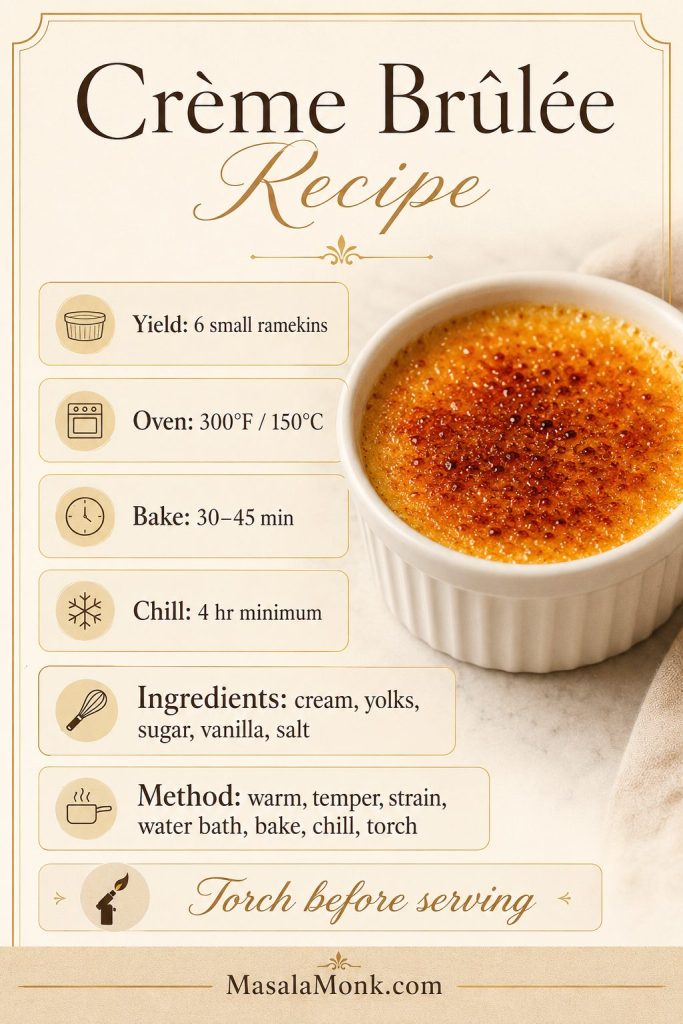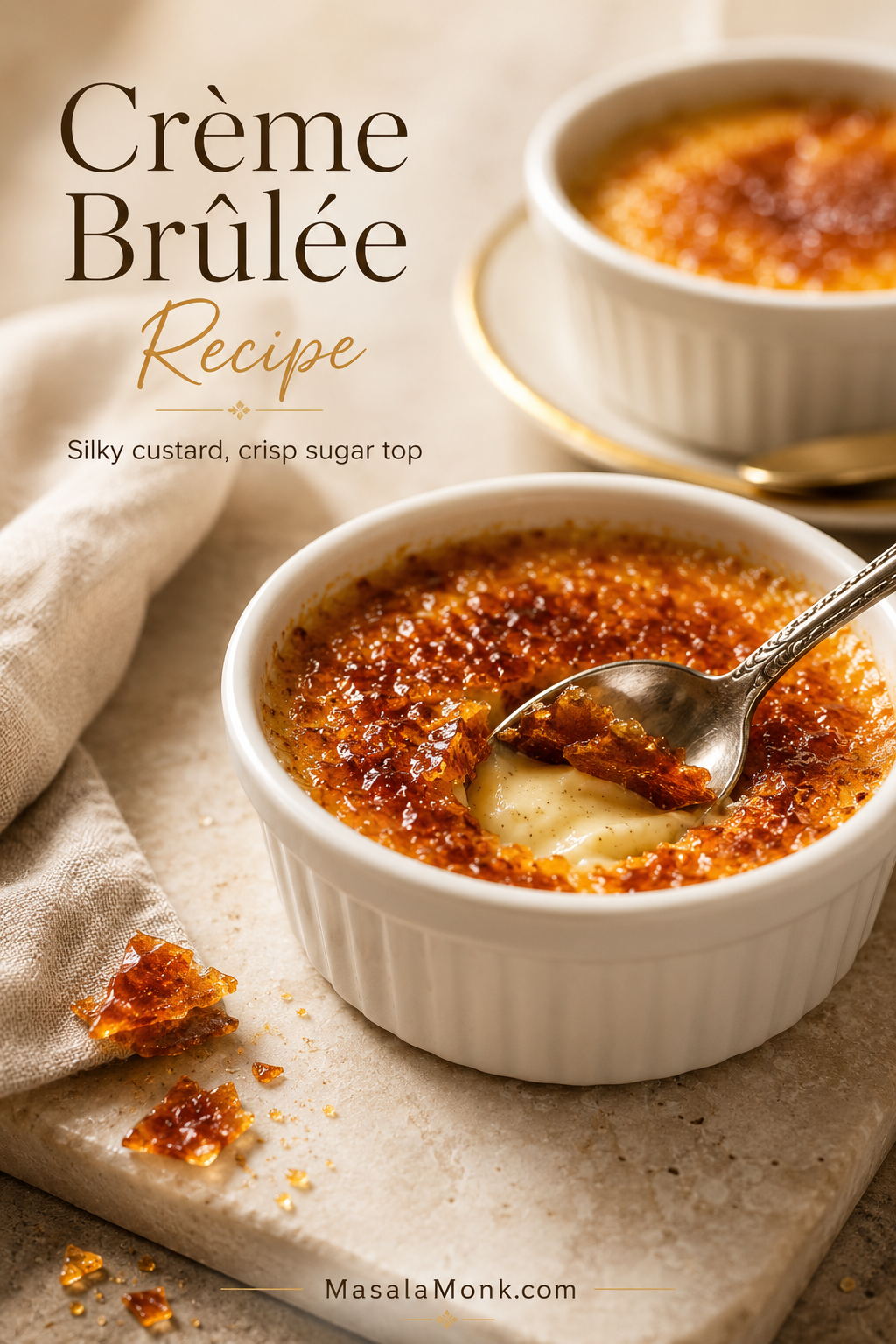
Crème brûlée looks like restaurant drama in a ramekin: a cold, silky vanilla custard hidden under a thin amber sheet of caramelized sugar. The first spoon tap is the whole point. The top cracks, the custard gives way, and a dessert made from cream, egg yolks, sugar, and vanilla suddenly feels far more luxurious than its ingredient list suggests.
It tastes like a restaurant dessert, but the base is simple: cream, egg yolks, sugar, vanilla, and salt. This is a restaurant-style crème brûlée recipe built around cues, not guesswork: warm the cream, whisk the custard, bake gently, chill fully, then torch.
Whether you spell it crème brûlée or creme brulee, the promise is the same: cold vanilla custard under a crisp caramelized sugar shell. This version keeps that promise clear: rich cream, shallow ramekins, gentle baking, a proper chill, and a sugar top that cracks instead of burns.
What You’ll Find in This Guide
Quick Answer: What Is Crème Brûlée?
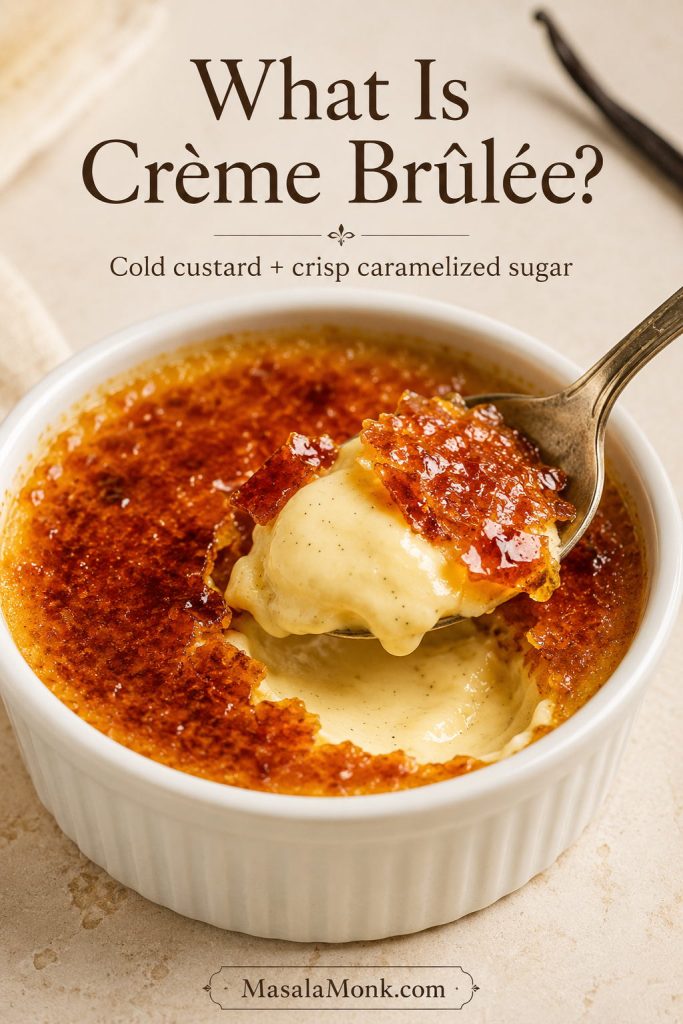
Crème brûlée is a chilled baked custard finished with a thin caramelized sugar crust. The custard is usually made with heavy cream, egg yolks, sugar, vanilla, and a little salt. After baking and chilling, sugar is sprinkled over the top and melted with a kitchen torch until it forms a crisp amber shell.
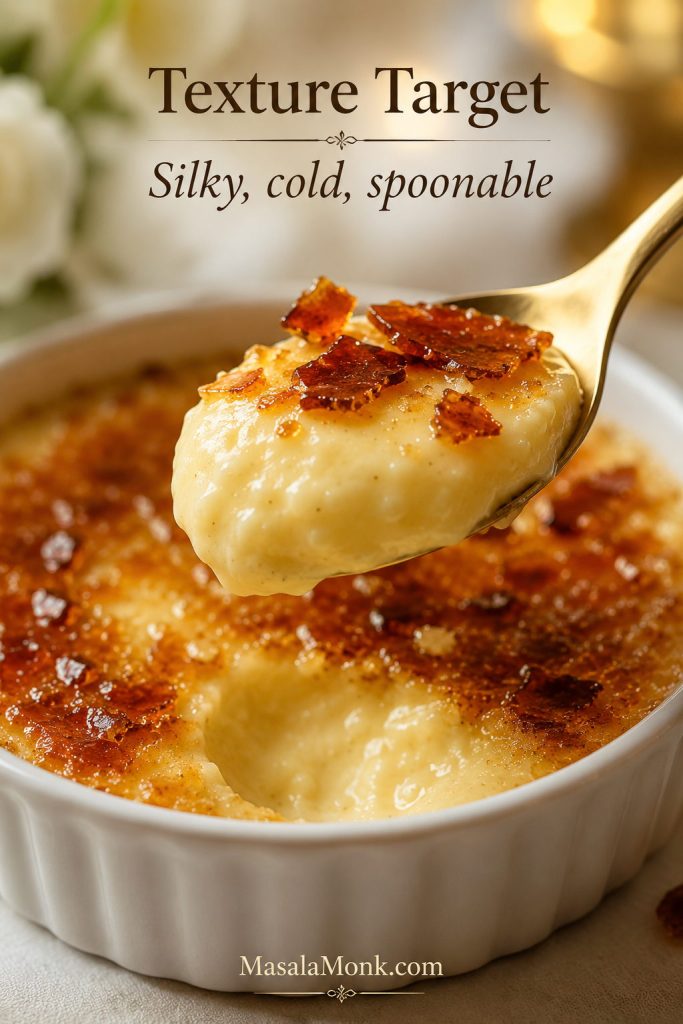
The name means “burnt cream,” but the best versions should not taste harsh or smoky. The sugar top should be caramelized, nutty, and bittersweet. Underneath, the custard should be cold, smooth, and spoonable — rich like vanilla cream, but not firm like flan or loose like pudding.
At a glance: crème brûlée is ready when the edges are set and the center still has a gentle jelly-like tremble. Chill the custards for at least 4 hours, preferably overnight, then caramelize the sugar just before serving. A thermometer is optional, but the center should be about 170–175°F / 77–80°C.
That slight tremble is not a mistake. Once you know the cues — warm cream, slow tempering, shallow dishes, and a full chill — crème brûlée becomes much easier to trust. If you want to compare the doneness cue later, see the bake-time and jiggle test.
Crème Brûlée Recipe Snapshot
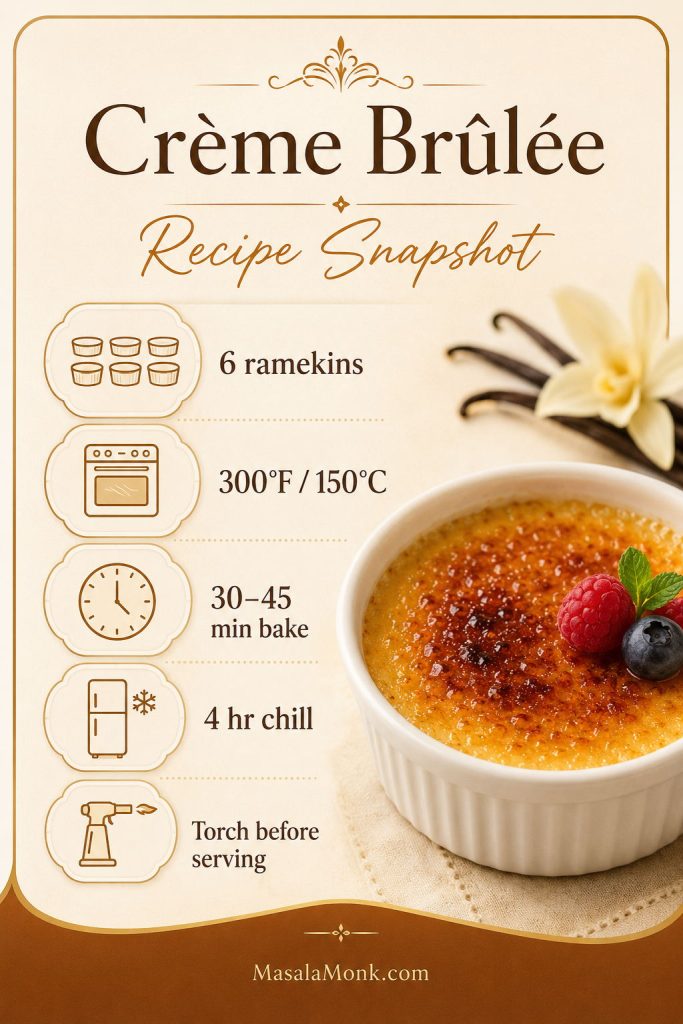
Here is the recipe at a glance before we get into the details. The classic torch method is the cleanest finish. Broiler and caramel-pour backups are included later only for no-torch situations, so check the no-torch options before choosing a backup finish.
| Detail | What to aim for |
|---|---|
| Yield | 6 modest 4 oz / 120 ml servings, filled below the rim |
| Best dish | Wide, shallow 4 oz / 120 ml ramekins |
| Oven temperature | 300°F / 150°C, middle rack |
| Bake time | 30–45 minutes, depending on ramekin depth and oven |
| Water bath | Hot water halfway to two-thirds up the ramekins |
| Doneness cue | Set edges with a softly moving center |
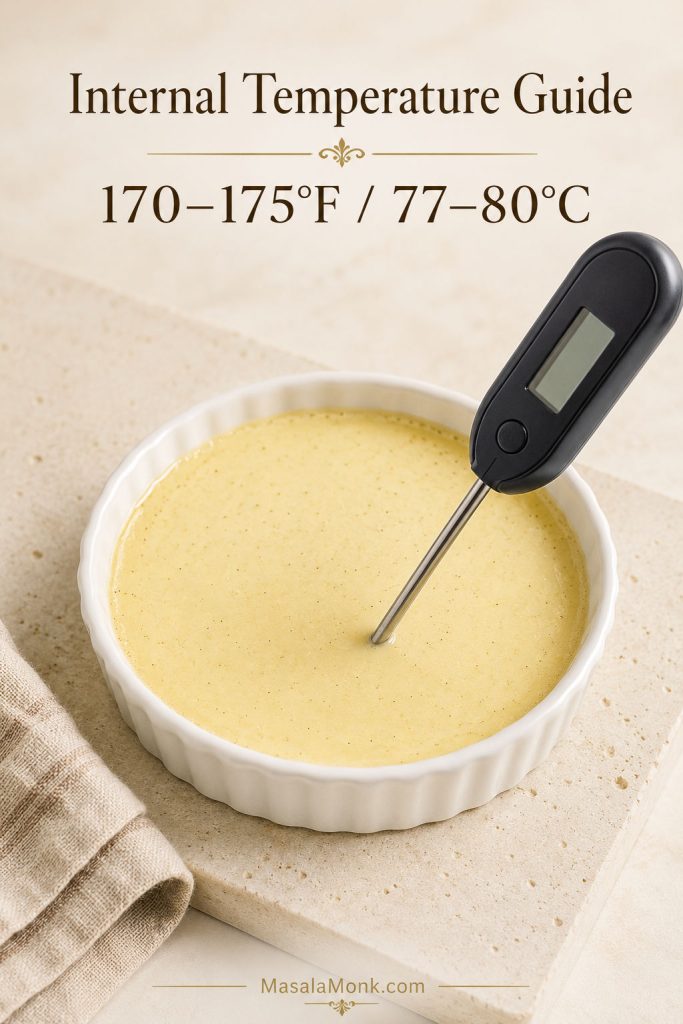
| Internal temperature | 170–175°F / 77–80°C in the center |
| Chill time | 4 hours minimum; overnight is best |
| Sugar topping | Light, even coating, usually 1½–2 tsp per ramekin |
| Recommended finish | Kitchen torch |
Choose your finish: use a kitchen torch if you have one. Use the broiler only with broiler-safe ramekins. Use the caramel-pour method only as a last-resort no-torch/no-broiler backup.
Do not panic if: the custard looks slightly soft when it leaves the oven, a few bubbles appear on top, or the vanilla seeds settle near the bottom. Those are manageable. Worry only if the center sloshes like liquid, the surface puffs and cracks, or the custard smells strongly eggy.
The reward is calm timing: most of the dessert is finished before anyone is waiting, and the only last-minute job is the crackly sugar top.
Why This Crème Brûlée Recipe Works
This recipe works because it keeps heat gentle at every stage: warm cream instead of boiled cream, yolks tempered slowly, shallow ramekins in a water bath, and a low oven so the edges do not tighten before the center sets. The custards should leave the oven slightly soft, then finish setting as they cool and chill. The sugar coating stays light so it caramelizes quickly without warming the custard too much.
Gentle heat gives the custard its silk; fast heat gives the sugar its crack.
The key: do not wait for the custards to look fully firm in the oven. A slight center tremble is part of the method.
Crème Brûlée Ingredients
Crème brûlée is not a long-ingredient dessert, so the quality and role of each ingredient matter. This is a vanilla custard first. The sugar top is the contrast, not the whole dessert.
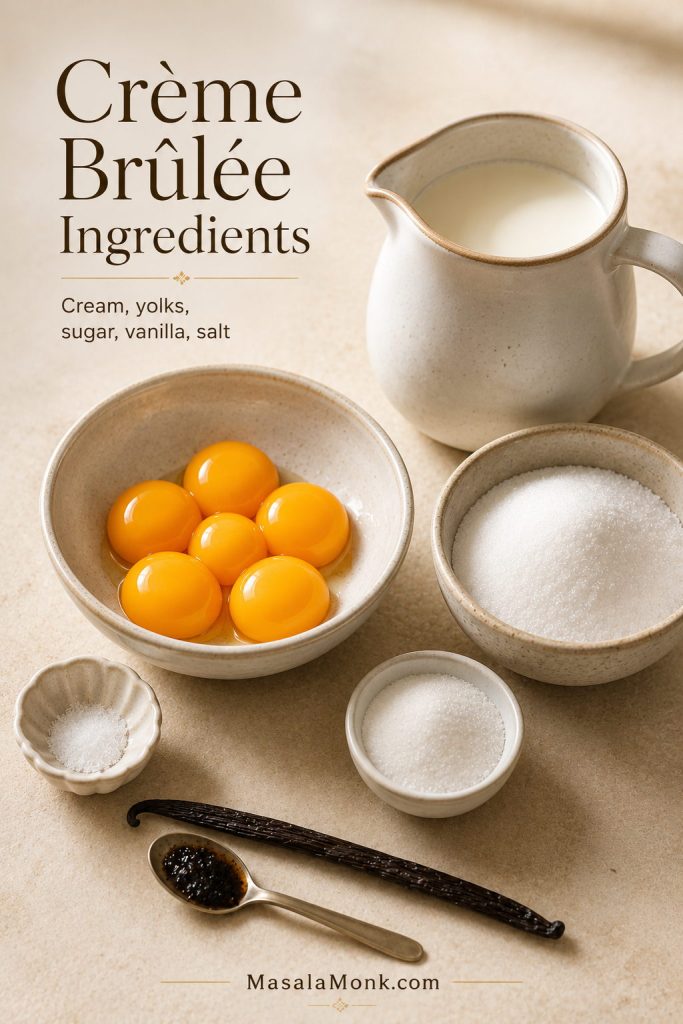
- Heavy cream: This is where the custard gets its slow, silky richness. Use the richest plain dairy cream you can find.
- Egg yolks: Yolks set the custard gently and make it smoother and richer than a whole-egg custard.
- Granulated sugar: Sugar sweetens the base and softens the set. Too much can make the custard overly sweet and slower to set.
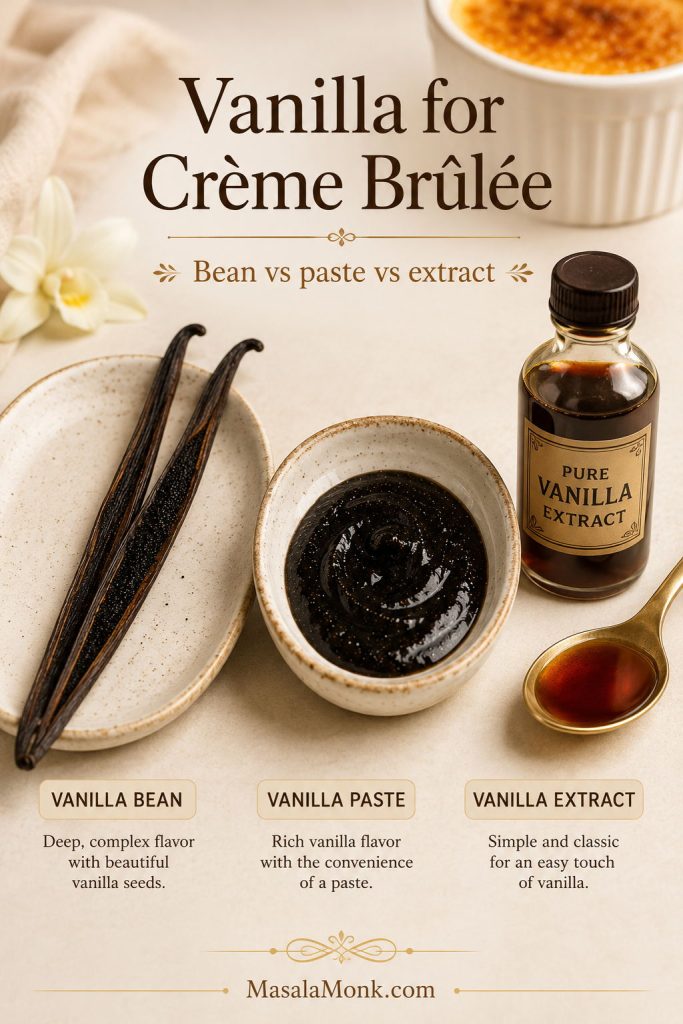
- Vanilla: Because there are so few ingredients, vanilla is the flavor you notice as soon as the caramel cracks. Vanilla bean gives the deepest aroma and visible specks, vanilla bean paste is excellent, and good vanilla extract also works.
- Fine salt: A small amount sharpens the vanilla and keeps the custard from tasting flat.
- Sugar for topping: Superfine/caster sugar or white granulated sugar gives the most reliable crackly crust. For timing and amount, see the sugar-top guide.
Ingredient amounts for 6 small ramekins
- 2 cups / 480 ml heavy cream
- 5 large egg yolks
- 1/3 cup / 65–70 g granulated sugar
- 1 vanilla bean, or 1 tsp vanilla bean paste, or 1½ tsp vanilla extract
- 1/8 tsp fine salt
- 9–12 tsp superfine/caster sugar or white granulated sugar, for topping
Vanilla options for crème brûlée
Use this cue when choosing vanilla: bean gives the deepest aroma and specks, paste is convenient and strong, and extract works well when it is good quality.
Small but important: once you whisk sugar into the egg yolks, temper soon after. If sugared yolks sit for too long, they can tighten and turn clumpy. Warm the cream first, then whisk the yolks and sugar when you are ready to combine. Save the leftover egg whites for meringues, pavlova, macarons, or an egg-white omelet.
Best Cream for Crème Brûlée
For the smoothest custard, use heavy cream or heavy whipping cream. A fat percentage around 35–36% gives the most reliable set and the most luxurious texture. That extra fat is what makes each spoonful feel rich, creamy, and plush instead of thin.
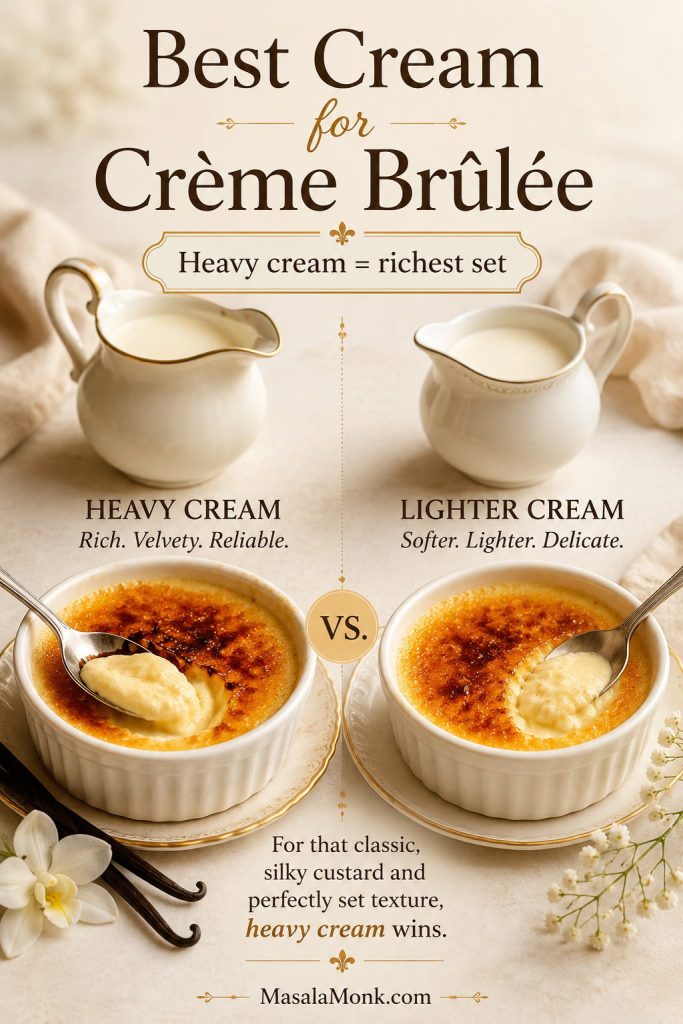
High-fat whipping cream can also work if it has enough fat. Lower-fat cream or light cream can still make a pleasant custard, especially in shallow ramekins with an overnight chill, but it will be softer and lighter than one made with heavy cream. Milk is not a direct swap here; a milk-heavy custard needs a different formula. If your custard turns loose, see the troubleshooting guide before changing the whole recipe.
Buying cream: choose the highest-fat plain dairy cream you can find. Avoid sweetened topping cream, non-dairy whipping topping, and very thin cooking cream. They are designed for different jobs and may not set like plain heavy cream in a baked custard.
Best Ramekins and Equipment for Crème Brûlée
Once the custard formula is right, the next big variable is the dish. The same custard behaves very differently in a shallow ramekin than it does in a deep bowl.
For the most even bake, choose wide, shallow 4 oz / 120 ml ramekins. They are not just traditional; they help the custard set before the edges turn firm and give you more crackly sugar per bite.
Ramekin size and fill depth
As a practical shopping cue, look for ramekins about 4–5 inches / 10–13 cm wide, with a filled custard depth of roughly 3/4–1 inch / 2–2.5 cm. A 5–6 oz dish can still work if you do not fill it deeply.
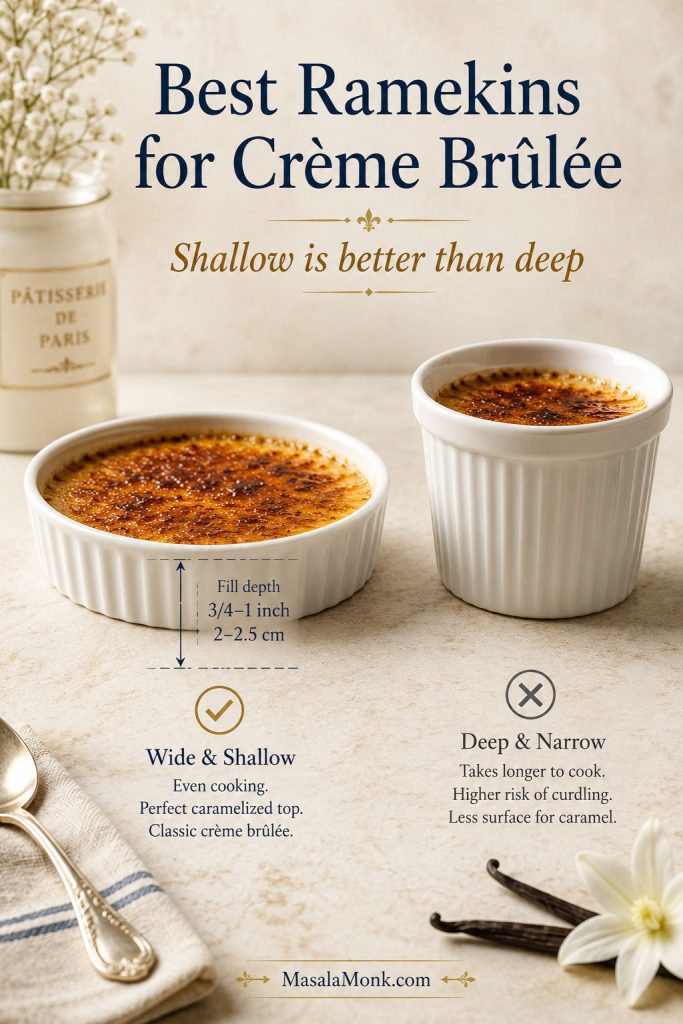
Narrow, deep bowls are riskier because the edges can overcook before the middle sets. Do not fill any ramekin to the brim; the custard should sit below the rim so you can move, chill, and sugar it cleanly. If you are using deeper dishes, see the bake-time and jiggle test before deciding they are done.
| Dish | Works? | What changes |
|---|---|---|
| 4 oz / 120 ml shallow ramekins | Best | Most even bake; usually 30–40 minutes |
| 5–6 oz ramekins | Yes | Works best if filled shallowly |
| Deep ceramic bowls | Possible but risky | Edges can overcook before center sets; thermometer helps |
| One large shallow oven-safe dish | Possible, not ideal | Longer bake, less sugar-top ratio, softer scooping |
| Oven-safe glass dishes | Possible | Avoid thermal shock; do not broil unless specifically broiler-safe |
| Metal cups | Not ideal | Conduct heat aggressively and can overcook the edges |
A similar cooling-and-setting idea appears in a baked New York cheesecake recipe, where cooling and chilling protect the final texture as much as the bake itself.
Equipment you need
- 6 shallow 4 oz / 120 ml ramekins
- 9×13-inch baking dish or another deep oven-safe pan
- Medium saucepan
- Mixing bowl
- Whisk
- Fine-mesh sieve
- Measuring jug with a spout
- Kettle or saucepan for hot water
- Thin kitchen towel for the water bath
- Kitchen torch for the recommended finish
- Broiler-safe ramekins if using the broiler backup
- Small saucepan if using the caramel-pour backup
- Instant-read thermometer, optional but helpful
How to Make Crème Brûlée Step by Step
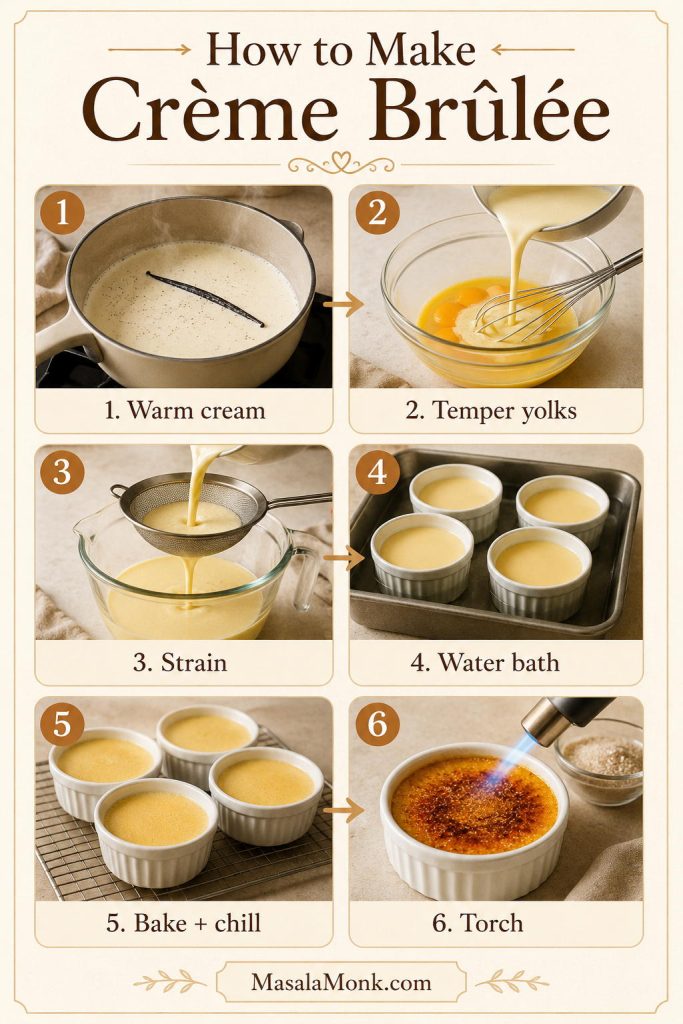
Read through the method once before starting. Crème brûlée feels much easier if everything is ready: ramekins in the pan, cream warming, yolks ready, sieve nearby, and hot water prepared for the water bath.
1. Preheat the oven
Preheat the oven to 300°F / 150°C with a rack in the middle. Place the ramekins in a 9×13-inch baking dish. If they slide around, lay a folded thin kitchen towel in the bottom of the dish before adding them.
2. Warm the cream
Add the heavy cream to a saucepan. If using a vanilla bean, split it, scrape the seeds into the cream, and add the pod too. If using vanilla bean paste, whisk it into the cream while warming. Warm over medium-low heat until the cream is steaming and small bubbles appear around the edges. Steaming is enough; a hard boil makes tempering riskier.
For deeper vanilla-bean flavor, turn off the heat and let the vanilla steep in the warm cream for 10 minutes. Remove the pod before tempering. If the cream cools too much after steeping, rewarm it gently. If using vanilla extract, stir it in after the cream comes off the heat so the aroma stays cleaner.
3. Whisk yolks, sugar, and salt
In a mixing bowl, whisk the egg yolks, granulated sugar, and salt until smooth. You do not need to whip them until pale and fluffy. Too much air creates bubbles on the custard surface.
4. Temper the eggs slowly
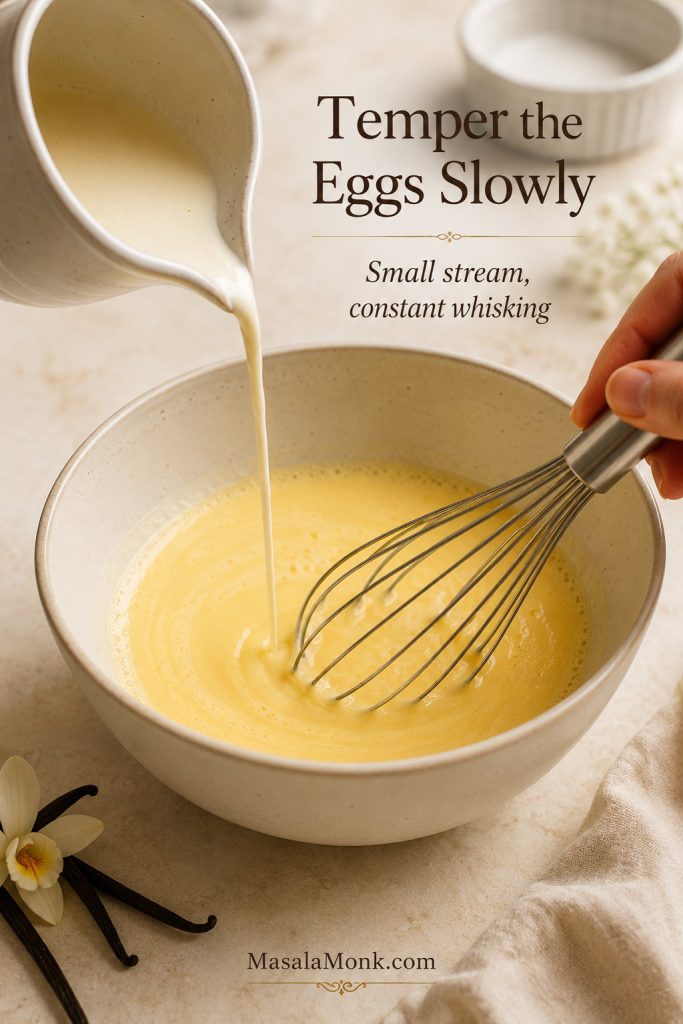
Slowly pour a small stream of warm cream into the yolks while whisking constantly. Start with just a little cream. Once the bowl feels warm, the riskiest part is mostly over; add the rest more steadily and keep whisking.
5. Strain and de-bubble the custard
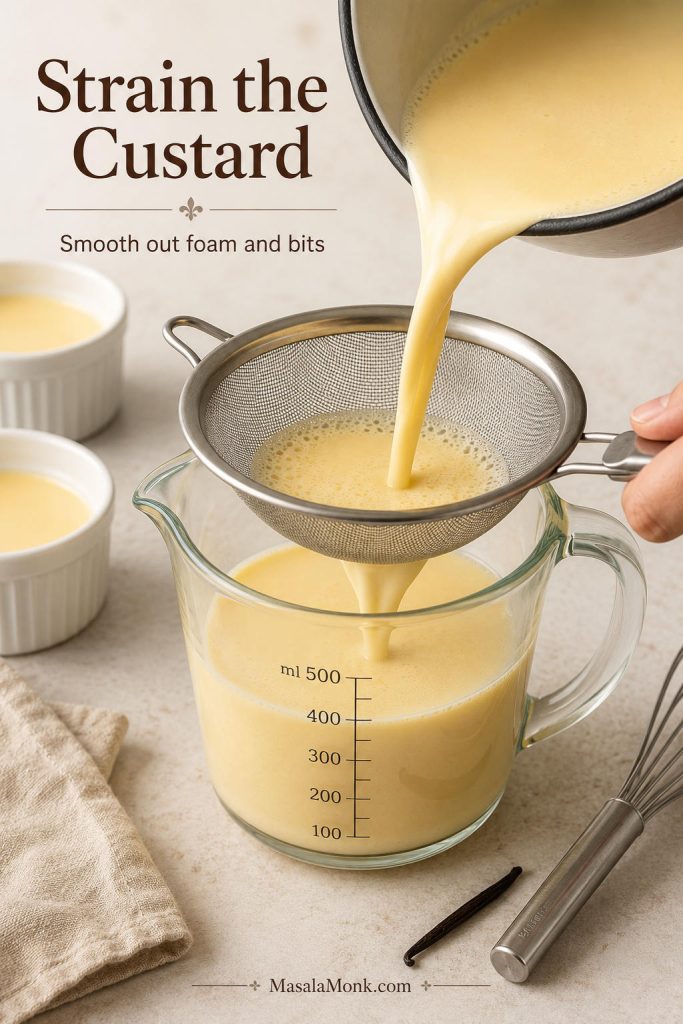
Pour the custard through a fine-mesh sieve into a measuring jug. Straining catches vanilla pod pieces, foam, and any tiny cooked egg bits. If the surface is foamy, let the custard sit for 2 minutes, then skim off the foam with a spoon.
6. Fill the ramekins
Divide the custard evenly among the ramekins. Fill below the rim so you can move the pan safely and later add the sugar topping. At this point, the custard should look thin and pourable. That is right; the oven and fridge do the setting later.
7. Add the hot water bath
Pour hot water into the baking dish until it reaches halfway to two-thirds up the sides of the ramekins. Pour slowly so water does not splash into the custard. If the pan feels heavy, place it on the oven rack first, then pour in the hot water.
8. Bake until just set
Bake for 30–40 minutes for shallow ramekins, longer for deeper dishes, until the edges are set and the center gives a soft, controlled wobble — not a liquid ripple. If using a thermometer, aim for 170–175°F / 77–80°C in the center without touching the bottom of the ramekin.
9. Remove from the water bath
Lift the ramekins out of the hot water bath after baking. Residual heat can keep cooking the custard, so move them to a rack or towel once they are done. They will firm as they cool and chill.
10. Cool and chill
Cool the custards uncovered just until warm, then cover loosely and refrigerate. Avoid covering hot ramekins tightly because condensation can drip onto the custard surface. Chill for at least 4 hours, preferably overnight.
At this point, the custard is finished; the torch is only there to create the crack.
11. Torch the sugar top
Just before serving, gently blot any surface moisture. Sprinkle each custard with 1½–2 teaspoons sugar in a light, even layer. Torch in small circles until the sugar melts, bubbles, and turns amber. Let it stand 1–2 minutes; the sugar needs that short pause to turn from melted caramel into a crisp shell.
Visual Cues to Check Your Crème Brûlée
Use this table as a check after reading the method. It keeps the texture cues in one place so you do not have to rely only on the clock.
| Stage | What you should see | What to avoid |
|---|---|---|
| Warm cream | Steam and tiny bubbles around the edges | A hard rolling boil |
| Tempered custard | Smooth, pale mixture with no large curds | Scrambled bits or thick cooked-egg streaks |
| Before baking | Pourable custard with little foam on top | A frothy surface full of bubbles |
| Done baking | Set edges with a soft center tremble | Liquid ripples or a fully firm, puffed surface |
| After chilling | Cold, spoonable custard that holds its shape | Watery custard or a wet surface before sugaring |
| After torching | Amber, glassy sugar that hardens after 1–2 minutes | Black patches, grainy sugar, or a sticky refrigerated top |
How to Temper Eggs Without Scrambling Them
Tempering simply means warming the egg yolks gradually. Hot cream can cook yolks on contact if it is added too quickly. A slow stream gives the yolks time to warm without curdling.
The first few splashes are the most important. Whisk constantly, add a little warm cream, whisk again, then add more. Once the yolk mixture is warm to the touch, you can pour in the rest more steadily. If you see one or two tiny bits, straining will usually catch them. If the mixture has large curds, the cream was too hot or added too fast.
Why Crème Brûlée Needs a Water Bath
The water bath acts like a heat cushion. The oven heats the water, and the water warms the ramekins gently, so the eggs set slowly instead of tightening too quickly around the edges. It is the simple step that gives you that spoon-smooth texture later.
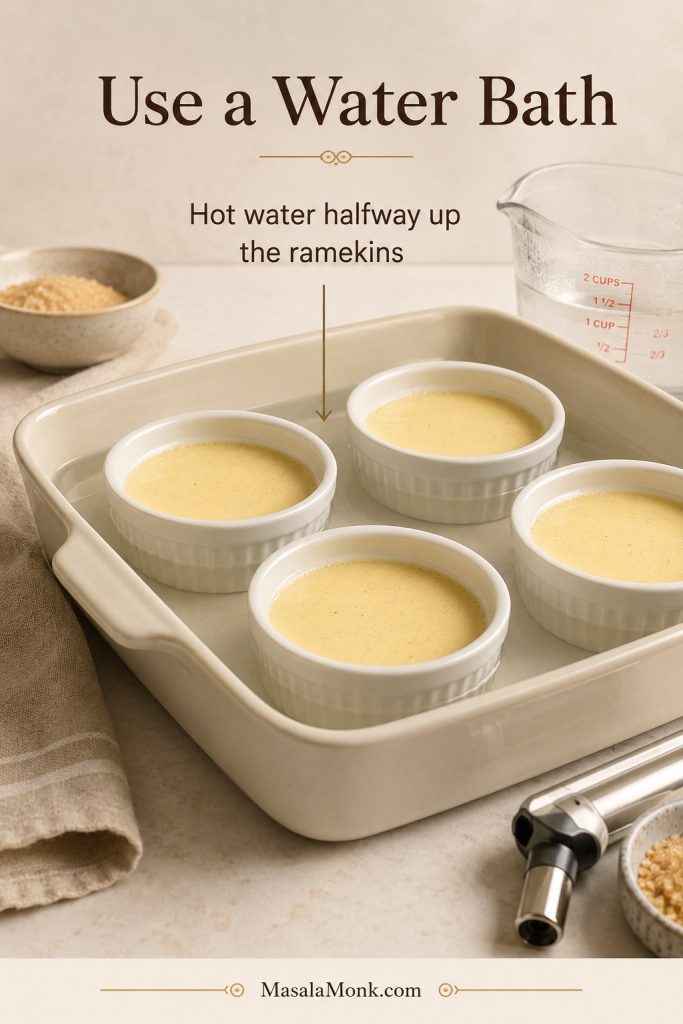
- Start with hot water, not cold.
- Fill halfway to two-thirds up the ramekins.
- Pour carefully so water does not splash into the custard.
- Remove ramekins from the water bath after baking.
- Use a thin towel under the ramekins if they slide around.
Bake Time, Oven Temperature, and the Jiggle Test
This method uses 300°F / 150°C because a lower oven gives the custard more time to set gently. For shallow 4 oz ramekins, start checking at 30 minutes. Most batches finish between 30 and 40 minutes. Deeper dishes may need 40–45 minutes or more.
This recipe gives you three ways to judge doneness: time, wobble, and temperature. The timer gets you close, the wobble tells you texture, and the thermometer gives extra confidence.
The edges should look set, while the center should move softly, like gentle jelly. It should not ripple like liquid, puff dramatically, or crack. If using a thermometer, the center should read about 170–175°F / 77–80°C. This is the moment to trust softness, not fight it.
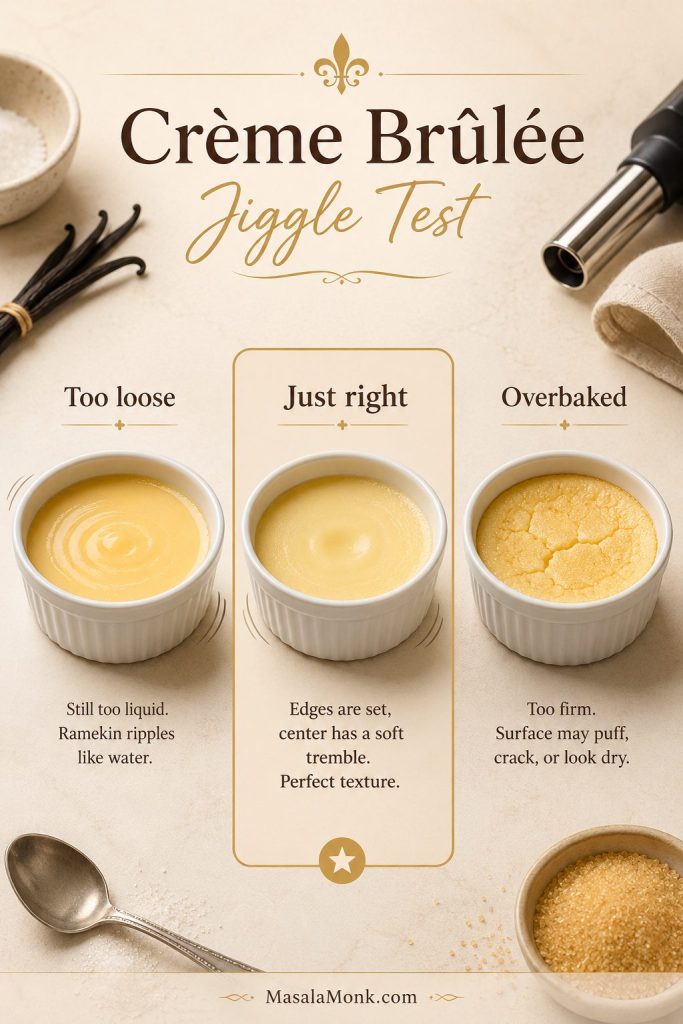
Crème brûlée temperature guide
A thermometer is optional, but it is useful if you are learning the custard’s doneness cue for the first time.
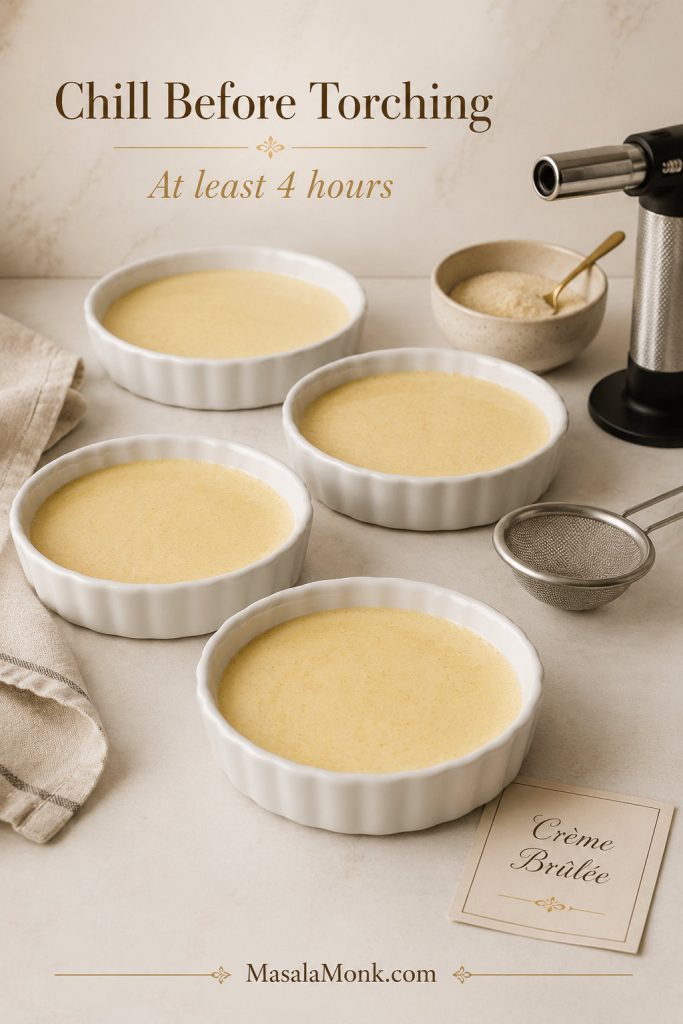
How Long to Chill Crème Brûlée
Crème brûlée needs at least 4 hours in the refrigerator after baking. Overnight chilling is better because the chill finishes the custard’s set and gives it the clean spoonable texture you want.
For best texture, bake the custards 1 day ahead. The baked, untorched custards can be refrigerated for 2–3 days, but the sugar top should be caramelized shortly before serving.
Make-ahead rule: bake early, chill fully, and caramelize late. The custard finishes in the fridge; the sugar top should happen close to serving.
The Sugar Top: Best Sugar, Amount, and Timing
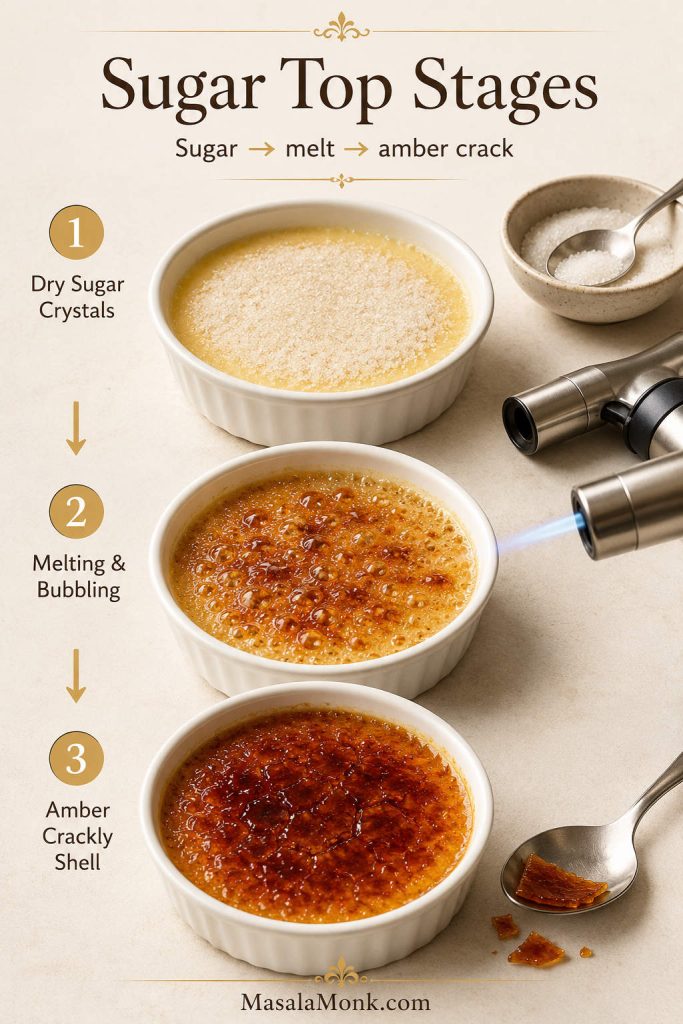
The ideal top should crack under a spoon, not chew like thick candy or sink into the custard like syrup. You are looking for amber glass, not dark candy: delicate enough to shatter, caramelized enough to taste nutty.
Use enough sugar to make a light, even coating — usually 1½–2 teaspoons per 4 oz ramekin. A wider dish may need a little more than a narrow one.
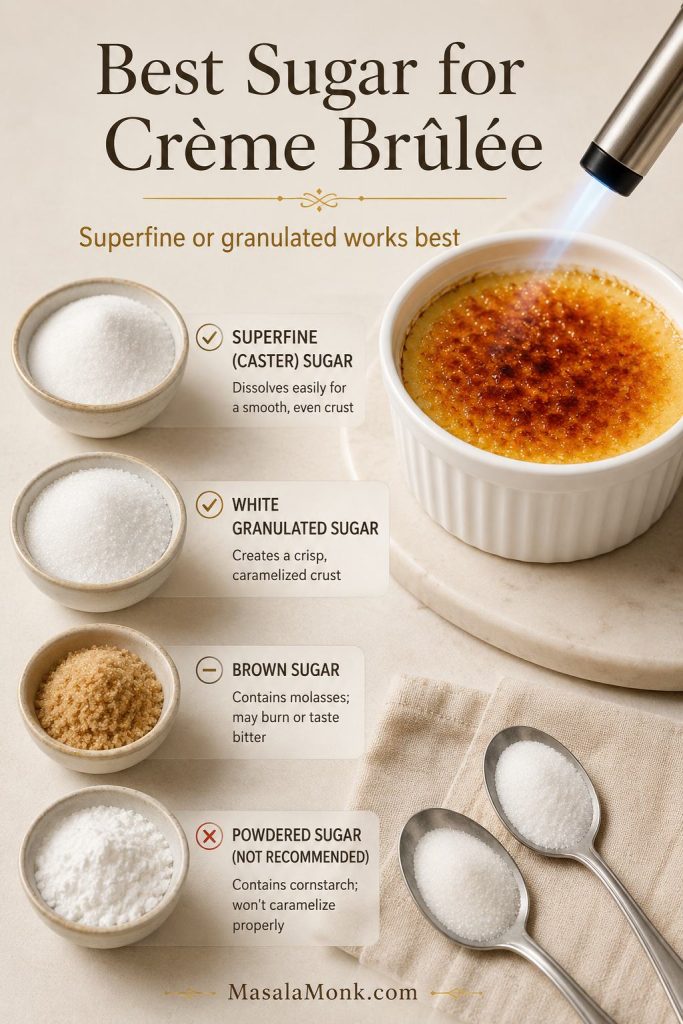
- Superfine or caster sugar: Best if available because it melts quickly and evenly.
- Regular white granulated sugar: Reliable and easy to find.
- Raw sugar: Can work, but may need more careful torching.
- Brown sugar: Less reliable because it can clump and burn unevenly.
- Powdered sugar: Not recommended for the classic crackly crust.
One even coating is easiest. For a slightly sturdier crack, torch a very light coating until melted, sprinkle on a second light coating, and torch again. Heavy sugar burns before it melts evenly, so keep the layer light and move the flame constantly. If the top burns, sinks, or softens, see sugar-top troubleshooting.
How to Torch Crème Brûlée
A kitchen torch gives the best control because it melts the sugar quickly without warming the whole custard. Keep the flame moving in small circles. The sugar will melt, bubble, and then turn amber and glossy.
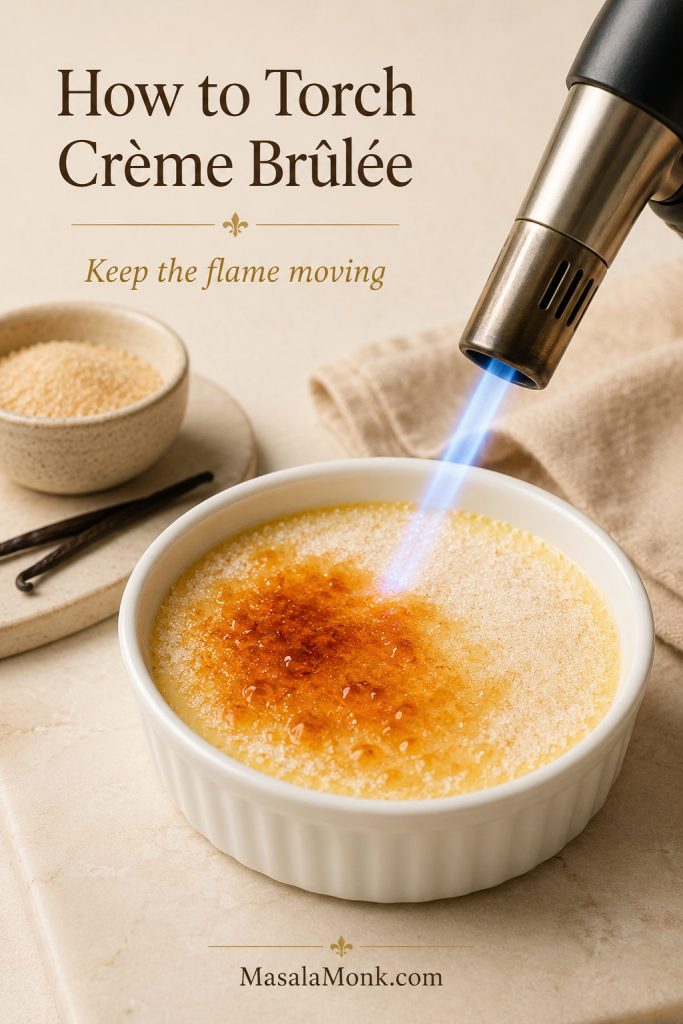
Stop before the sugar turns black or smoky. Let the ramekin sit for 1–2 minutes so the caramel hardens. The best spoonful gives you a brittle tap, a warm caramel aroma, and cold vanilla custard underneath.
Crème brûlée sugar top stages
Use the stages below as a visual check: stop at amber and glossy, before the sugar turns black or smoky.
How to Make Crème Brûlée Without a Torch
A kitchen torch is the recommended finish. If you do not have one, use the broiler only when your ramekins are broiler-safe. If you have neither a torch nor broiler-safe dishes, the caramel-pour method is a last-resort backup. No torch does not have to end the recipe, but it does change how carefully you need to finish the top.
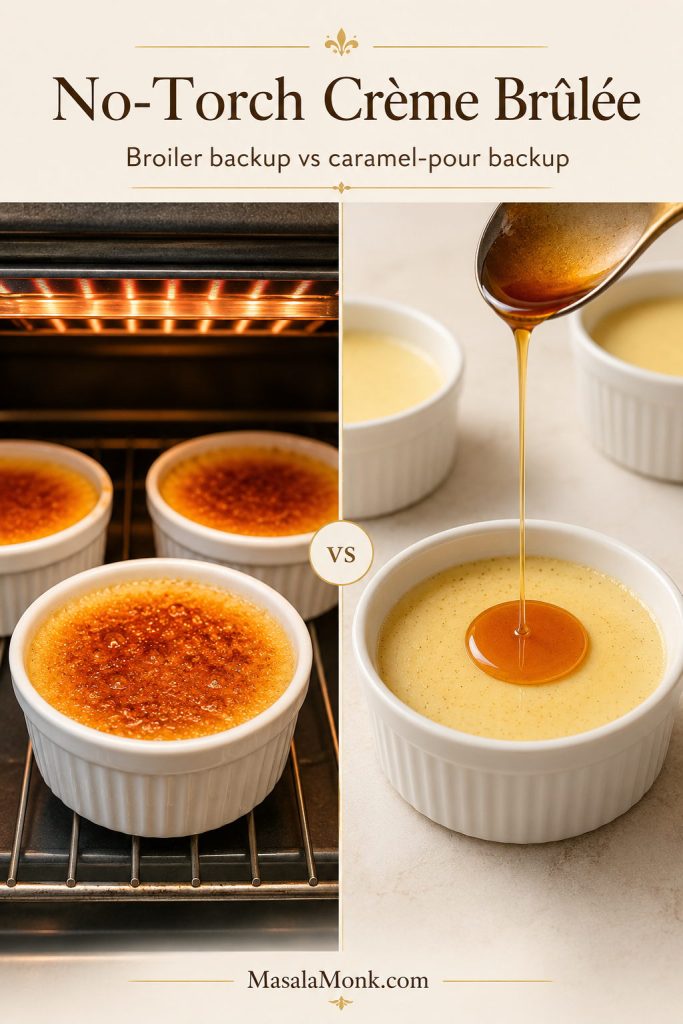
| No-torch option | Best for | Tradeoff |
|---|---|---|
| Broiler backup | Broiler-safe shallow ramekins | Fast, but can warm the custard and brown unevenly |
| Caramel-pour backup | No torch and no broiler-safe dishes | No broiler needed, but hot sugar is trickier and can set too thick |
Broiler backup
Use this path only if the ramekins are specifically broiler-safe. The image below shows the goal: controlled top heat and amber sugar, not a scorched crust or warmed-through custard.
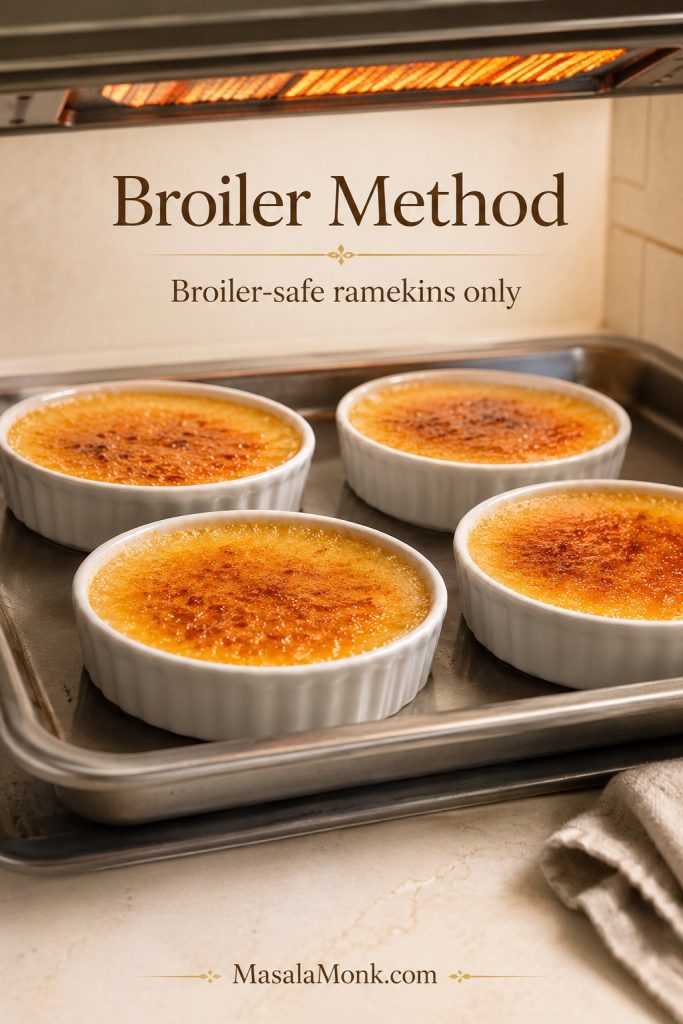
- Chill the baked custards thoroughly, preferably overnight.
- Use only shallow broiler-safe ramekins.
- Blot surface moisture, then add a light sugar coating.
- Preheat the broiler fully.
- Broil 2–4 inches below the heat for 1–3 minutes, watching constantly.
- Rotate the pan if some tops caramelize faster than others.
- Remove once amber; chill 10–20 minutes if the custard softens.
Broiler safety: only broil dishes that are specifically labeled broiler-safe. Oven-safe does not always mean broiler-safe, especially with glass or ceramic.
Last-resort caramel-pour backup
This is not a perfect torch replacement. It can give you a crisp caramel layer, but it is more advanced because hot sugar sets quickly and can become thick if you pour too much.
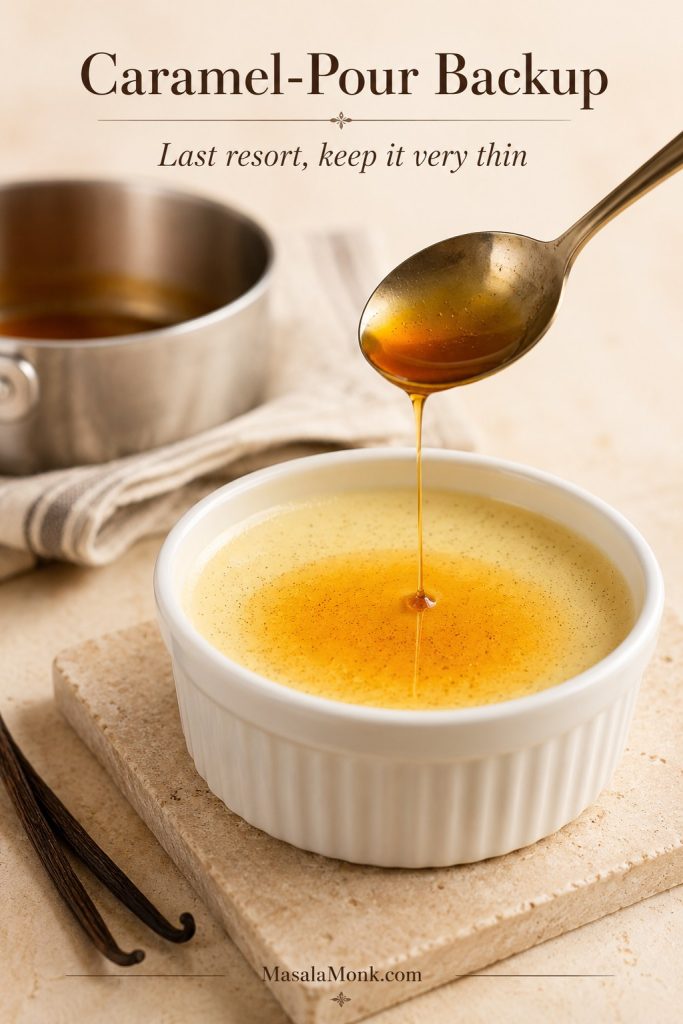
For 6 ramekins, start with about 1/3 cup / 65 g white sugar. You may not use every drop; the goal is the thinnest possible layer.
- Use very cold baked custards.
- Cook the sugar in a clean saucepan until it turns amber.
- Working quickly, pour a very thin layer over each custard.
- Tilt the ramekin gently so the caramel spreads before it hardens.
- Let the caramel set for 1–2 minutes before serving.
Caramel-pour caution: hot caramel can burn badly. Keep the layer very thin, keep children away from the pan, and do not touch the caramel while it is hot. If the layer is too thick, it will eat more like hard candy than a delicate crème brûlée crust.
When to Serve Crème Brûlée After Torching
Crème brûlée is best served shortly after the sugar is caramelized. Wait 1–2 minutes after torching so the sugar hardens, then serve within about 15–30 minutes for the crispest crack. For planning ahead, see the make-ahead timing.
For guests, this is the dessert you prepare earlier in the day and finish right before serving, when the sugar top becomes part of the moment. Keep the baked custards chilled, then caramelize them near the end of the meal. The custard should be cold, and the top should be freshly crisp.
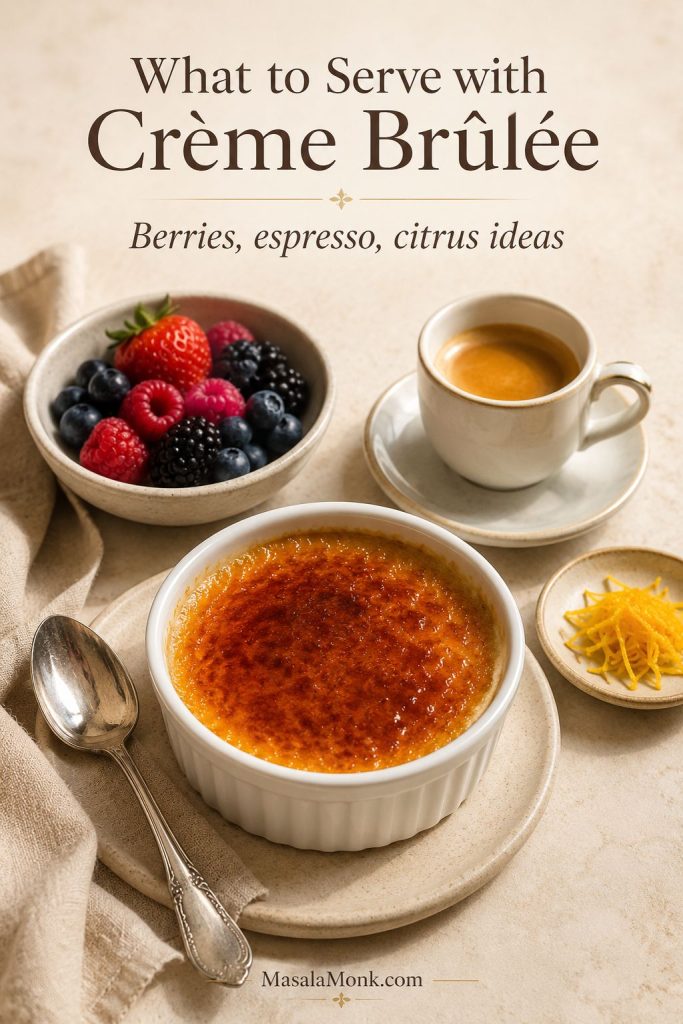
What to serve with crème brûlée
Classic crème brûlée is best served plain so the contrast stays clear: cold vanilla custard, crisp caramel, and that first spoon crack. If you want a little extra, serve berries on the side, add espresso after dinner, or use a citrus variation for a brighter meal. Avoid piling juicy fruit on the sugar top before serving because it softens the crust.
Quick Guardrails Before You Bake
Most crème brûlée mistakes come from rushing heat, timing, or the sugar top. These quick guardrails keep the custard silky and the crust crisp.
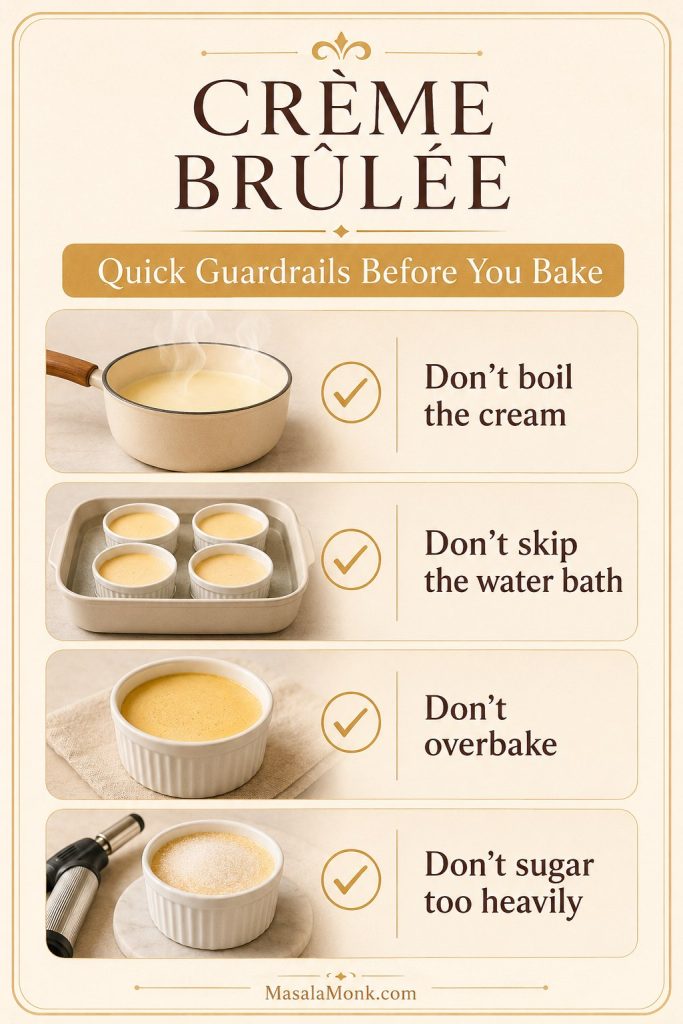
- Hard-boiling the cream: steaming cream is enough and easier to temper.
- Adding hot cream too quickly: start with a small stream so the yolks warm gradually.
- Baking without a water bath: direct heat can make the custard grainy.
- Waiting for a fully firm center: pull the custards before they look completely set.
- Using too much sugar on top: a heavy coating burns in patches instead of forming a clean crack.
- Caramelizing hours ahead: the crisp top softens as it sits.
- Torching a wet surface: blot gently first so the sugar can melt instead of sinking.
Crème Brûlée Flavor Variations
The safest way to flavor crème brûlée is through the cream, not by adding watery ingredients to the finished custard. These are starting points for the base recipe; keep the mixture smooth, strain when needed, and avoid thinning the custard.
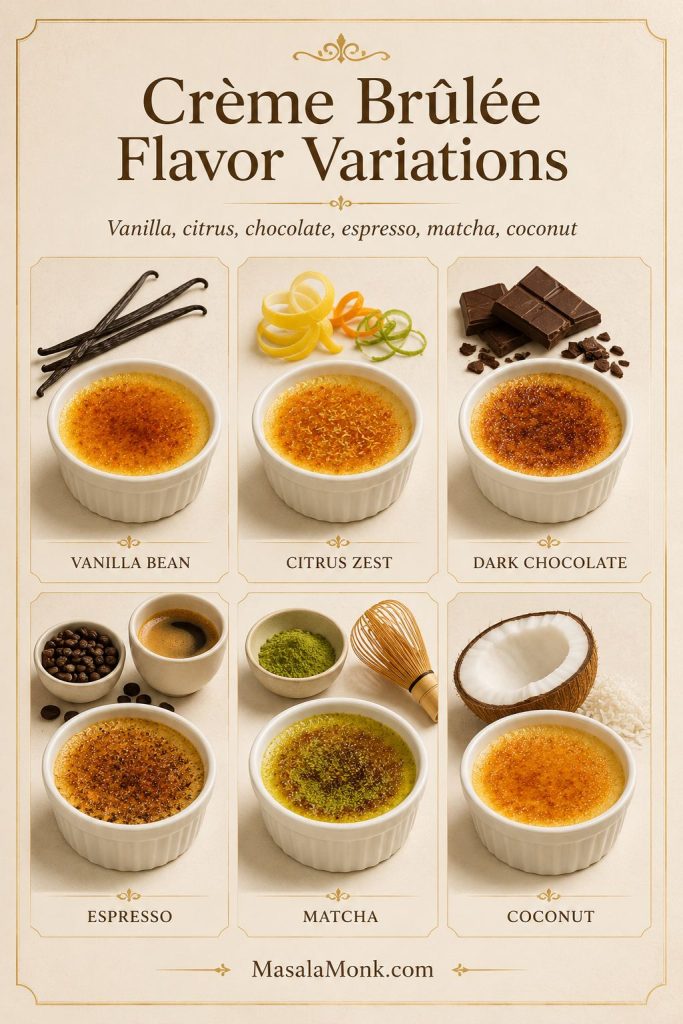
| Variation | How to add it | What it brings |
|---|---|---|
| Vanilla bean | Use 1 vanilla bean or 1 tsp vanilla bean paste. | Deeper vanilla flavor and visible specks. |
| Citrus | Steep the zest of 1 lemon or 1 orange in the warm cream, then strain. | Brighter, fragrant custard. |
| Chocolate | Melt 2 oz / 55 g finely chopped dark chocolate into the warm cream. | Deeper, denser dessert flavor. |
| Espresso | Add 1–2 tsp instant espresso powder to the warm cream. | More bittersweet, after-dinner flavor. |
| Matcha | Whisk 1–2 tsp sifted matcha with a little warm cream first, then add it to the rest. | Earthy, slightly bitter balance. |
| Coconut | Replace 1/2 cup / 120 ml cream with thick coconut cream; expect a changed texture. | Softer, lightly tropical custard. |
Dairy-Free, Vegan, and Milk Substitution Notes
Cream and egg yolks are doing most of the structural work here. Dairy-free and vegan versions are possible, but they need different formulas.
- Dairy-free but not vegan: use a separate tested coconut-cream-and-yolk formula rather than a direct cream swap.
- Vegan: use a coconut, cashew, starch, or agar-based formula. Egg-free custard sets differently.
- Lower-fat custard: use lower-fat cream only if you accept a softer, lighter result.
- Milk-only custard: use a different baked custard formula. Milk is too lean for this version.
Make-Ahead and Storage
Crème brûlée is one of the best make-ahead desserts because the custards need time to chill. For best texture, bake the custards 1 day ahead. Baked, untorched custards can be refrigerated for 2–3 days, but caramelize the sugar topping shortly before serving.
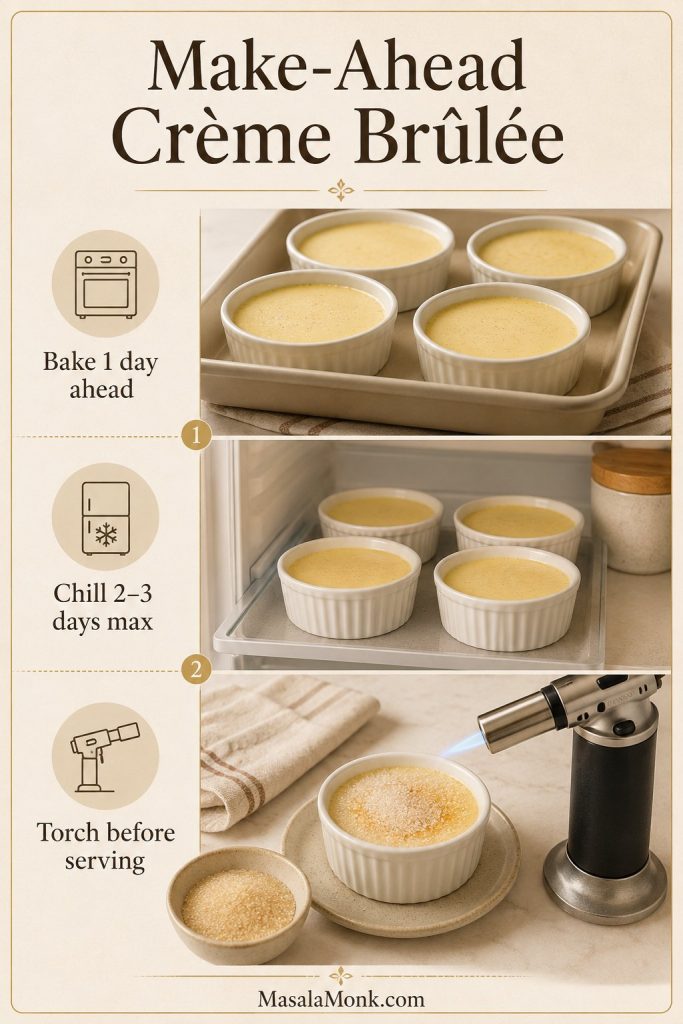
Because crème brûlée is an egg-and-dairy custard, refrigerate it promptly once it has cooled enough to cover, following standard two-hour food-safety guidance for perishable foods.
- Best make-ahead timing: bake 1 day ahead, chill overnight, and torch before serving.
- Before torching: keep baked custards covered in the fridge for 2–3 days.
- After torching: serve within 15–30 minutes for the crispest top.
- Leftovers: refrigerate, but expect the sugar top to soften.
- Freezing: not recommended for best texture. The custard can become grainy or watery after thawing.
- Covering: cover only once the custards are no longer hot, so condensation does not drip onto the surface.
Crème Brûlée Troubleshooting
If a batch goes wrong, it is usually not mysterious. Crème brûlée tells you where the problem happened: in the custard, in the water bath, or on the sugar top.
Most mistakes are fixable in the next batch, and many imperfect custards still taste good today. Use the clues below to decide whether to chill longer, serve it differently, or change the method next time. A failed crackly top or a loose center can feel disappointing, but it does not always mean dessert is lost.
Custard problems
Use this guide to read the custard first, then choose the fix. A loose center, watery surface, curdled texture, or cracked top points to a different part of the process.
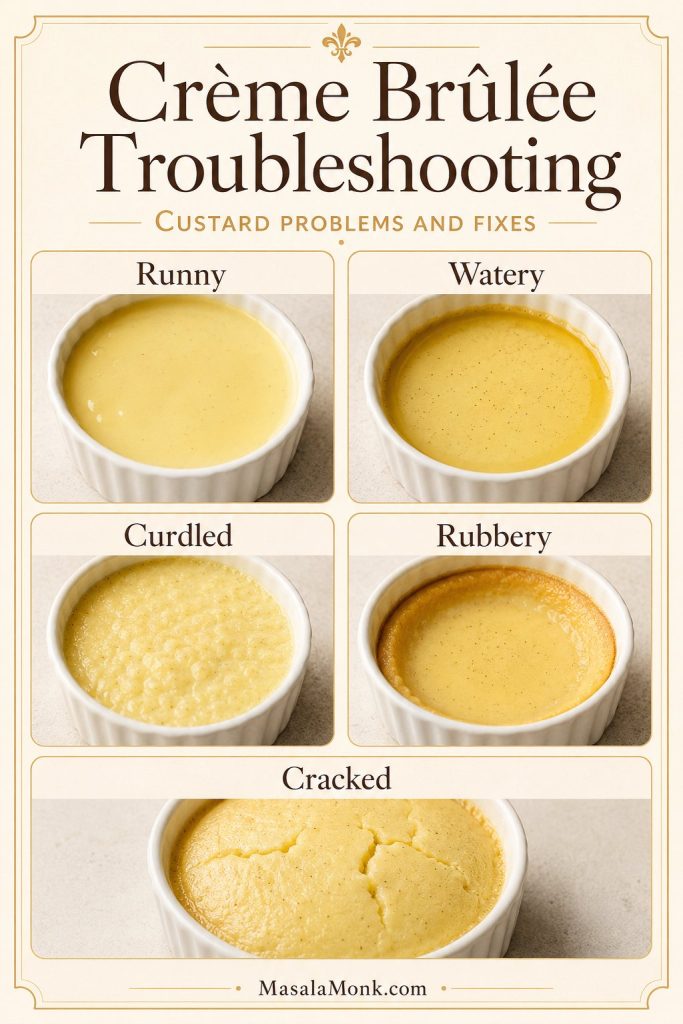
Runny or watery custard
| Problem | Likely cause | Save it today | Fix next time |
|---|---|---|---|
| Custard is runny | Underbaked, too deep a ramekin, low-fat cream, or short chill | Chill longer if slightly loose. If it sloshes, skip the torch and serve it as soft vanilla custard in small cups. It will not be classic crème brûlée, but it can still be dessert. | Use shallow ramekins, bake until softly moving, and check 170–175°F / 77–80°C. |
| Custard is watery after chilling | Water splashed in, custard underbaked, or cream too low in fat | Blot minor surface water. If watery throughout, serve cold in small glasses with berries or whipped cream. | Pour water carefully and use heavy cream for the richest set. |
Curdled, eggy, or rubbery custard
| Problem | Likely cause | Save it today | Fix next time |
|---|---|---|---|
| Custard curdled | Yolks overheated, oven too hot, no water bath, or overbaking | Chill and serve with berries or whipped cream. The texture will not become silky again, but a mild curdle can still taste good cold. | Temper slowly, strain, and bake gently. |
| Custard tastes eggy | Overbaked, overheated yolks, or too little vanilla/salt balance | Serve very cold with a fresh caramelized top. Cold temperature and caramel help soften the eggy impression. | Use good vanilla, add salt, and avoid overheating the custard. |
| Edges are rubbery | Oven too hot, dishes too deep, or custards left in hot water | The edges may be firm, but the center can still be worth serving. | Use shallow ramekins and remove promptly from the water bath. |
Surface cracks, bubbles, and vanilla specks
| Problem | Likely cause | Save it today | Fix next time |
|---|---|---|---|
| Surface cracked | Overbaked or too much heat | The sugar topping will hide small cracks. | Start checking earlier and pull before the custard looks firm. |
| Custard has bubbles | Whisked too aggressively, skipped straining, or left foam on top | Mostly cosmetic. Once the sugar top is on, small bubbles matter less. | Whisk gently, strain, and skim foam before baking. |
| Vanilla seeds sank | Custard was thin or not stirred gently before pouring | No real fix needed; flavor is still fine. | Stir gently before dividing into ramekins. |
Sugar-top, water-bath, and equipment problems
Use this second troubleshooting guide for problems that happen after the custard is baked, especially the sugar crust, water bath, and no-torch finishing methods.
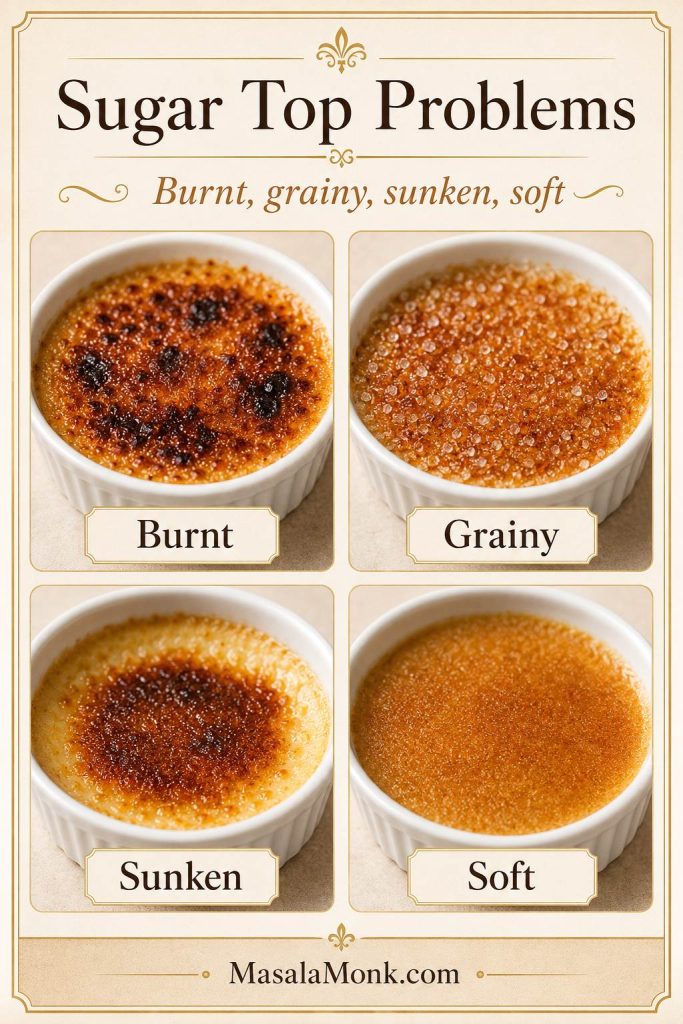
Caramelized sugar-top issues
| Problem | Likely cause | Save it today | Fix next time |
|---|---|---|---|
| Sugar top burned | Sugar too thick, flame too close, or broiler too strong | Scrape off badly burnt patches if needed. A slightly bitter edge is manageable; a black smoky crust is worth removing. | Use a lighter coating and keep the flame moving. |
| Sugar stayed grainy | Uneven sugar layer or not enough heat | Torch pale or grainy patches a little longer. | Use superfine or regular white sugar and spread evenly. |
| Sugar sank into custard | Surface was wet or sugar layer was too thin | Blot gently, chill uncovered briefly, then add fresh sugar. Do not torch a wet surface. | Blot surface moisture before sugaring. |
| Top turned soft | Torched too early or refrigerated after torching | Re-torch lightly if the custard is still cold. | Caramelize close to serving. |
Water-bath and equipment issues
| Problem | Likely cause | Save it today | Fix next time |
|---|---|---|---|
| Water got into ramekins | Water splashed while pouring or moving the pan | Blot lightly if it is only a little water. If the custard is diluted, serve cold instead of torching. | Pour water after the pan is on the oven rack and move slowly. |
| Broiler melted the custard | Custard was not cold enough or stayed too long under heat | Chill again before serving. The top may not be perfect, but the custard can still recover some firmness. | Chill overnight and broil briefly, watching constantly. |
| No kitchen torch | Equipment limitation | Use the broiler only with broiler-safe dishes, or use the caramel-pour backup as a last resort. | Use a torch for the most controlled finish. |
Crème Brûlée FAQs
Crème brûlée basics
Is crème brûlée served cold?
Crème brûlée is meant to be served cold. The freshly caramelized top gives you the warm, crisp contrast.
What sugar is best for crème brûlée?
Superfine or caster sugar melts most evenly. Regular white granulated sugar also works well. Brown sugar and powdered sugar are less reliable for a crisp, even crust.
Why is my crème brûlée runny?
Runny crème brûlée is usually underbaked, under-chilled, baked in dishes that are too deep, or made with cream that is too low in fat. If the custard is only slightly loose, chill it longer. If it sloshes like liquid, serve it as soft custard and bake the next batch longer.
How do I know when crème brûlée is done?
The edges should be set, while the middle should still look delicate rather than firm. If using a thermometer, aim for 170–175°F / 77–80°C in the center without touching the bottom of the ramekin.
Is crème brûlée supposed to be jiggly after baking?
A gentle jiggle is exactly what you want. The center should tremble when hot; it should not slosh like liquid, but it should not look fully firm either. A custard that looks perfectly firm in the oven often becomes too firm after chilling.
How do I halve this crème brûlée recipe?
For 3 ramekins, halve the cream, sugar, salt, and vanilla. Use 2 yolks for a slightly lighter set or 3 yolks for a richer, firmer set. For a true crème brûlée for two, use a dedicated small-batch formula because yolks do not divide perfectly.
Equipment and method questions
No kitchen torch? Use these backups
A broiler can work if your dishes are broiler-safe, and the caramel-pour method can help when they are not. A kitchen torch is still the most controlled method because it caramelizes the sugar without warming the whole custard.
Is a regular lighter safe for the sugar top?
A regular lighter is the wrong tool for this job. It is usually uneven, slow, and not designed for caramelizing food. Use a kitchen torch, the broiler method with broiler-safe dishes, or the caramel-pour backup.
Does this method work without an oven?
This baked version needs an oven because the custard sets gently in a water bath. No-oven or stovetop versions are usually pudding-style shortcuts, so the texture is different.
Do I really need a water bath?
Not for this classic method. The water bath keeps the heat gentle so the edges do not overcook before the center sets. No-water-bath methods exist, but they use different timing, dish depth, or oven technique. For this recipe, the water bath is the safest path to a silky custard.
What changes if I use one large dish?
A large shallow dish can work, but it is less beginner-friendly. It takes longer to bake, is harder to judge, and gives less crisp sugar top per spoonful. Individual shallow ramekins are more reliable.
What about countertop or convection ovens?
A countertop or convection oven can work if it holds a gentle, steady temperature. Start checking early if using convection. Air fryer and sous vide versions need separate methods, so they are not direct swaps.
Substitutions and comparisons
Why use only egg yolks?
Not for this texture. Egg whites make custard firmer and less silky. For classic crème brûlée, use yolks only and save the whites for another recipe.
Why milk is not a direct cream swap
Milk is not a direct swap in this recipe. It creates a lighter, thinner custard and needs a different formula. For rich crème brûlée texture, use heavy cream or heavy whipping cream.
What changes with lighter cream?
Lighter cream can work, but the custard will be softer and less rich. Use shallow ramekins, bake gently, and chill overnight for the best chance of a clean set.
Vanilla extract versus vanilla bean
Vanilla extract works well. Vanilla bean gives the deepest flavor and visible specks, but vanilla bean paste or good vanilla extract is enough for a smooth, fragrant custard. If using extract, stir it into the warm cream after taking the cream off the heat.
What is the difference between crème brûlée, flan, and panna cotta?
Crème brûlée is a baked egg-yolk custard served in its dish with a hard caramelized sugar top. Flan is usually unmolded and served with a softer caramel sauce. Panna cotta is typically cream set with gelatin rather than eggs.
Make-ahead and storage questions
How far ahead can I make crème brûlée?
For a party, bake the custards 1 day ahead and keep them chilled. Add and caramelize the sugar shortly before serving so the top stays crisp.
Should I cover crème brûlée while chilling?
Let the custards cool first, then cover them. Covering hot ramekins tightly can create condensation, which drips onto the custard and makes the surface wet.
Why did my caramel top taste bitter?
Bitter caramel usually means the sugar was taken too far. Stop when the top is amber and glossy, before it turns black or smoky. A thin sugar layer is easier to control than a heavy one.
What happens if water gets into the custard?
A few drops on the surface can usually be blotted away. If water mixes into the custard, the texture may turn loose or watery. Serve it cold if it tastes good, and pour the water bath more slowly next time.
Does crème brûlée freeze well?
Freezing is not recommended for the best texture. The custard can become grainy or watery after thawing. It is better to make the custards ahead and keep them refrigerated for 2–3 days before torching.
Once you know what the wobble should look like, crème brûlée stops feeling like a restaurant secret. The custards wait in the fridge, the sugar cracks at the end, and you can bring the dessert to the table already knowing it worked.
Crème Brûlée Recipe
This crème brûlée recipe makes cold, silky vanilla custard with a crisp caramelized sugar top that cracks under a spoon. The kitchen torch method is the cleanest finish; broiler and caramel-pour backups are included below for no-torch situations.
Equipment
- 6 shallow 4 oz / 120 ml ramekins
- 9×13-inch baking dish
- Medium saucepan
- Mixing bowl
- Whisk
- Fine-mesh sieve
- Measuring jug
- Thin kitchen towel
- Kitchen torch for the recommended finish
- Broiler-safe ramekins if using the broiler backup
- Small saucepan if using the caramel-pour backup
- Instant-read thermometer, optional
Ingredients
- 2 cups / 480 ml heavy cream
- 5 large egg yolks
- 1/3 cup / 65–70 g granulated sugar
- 1 vanilla bean, or 1 tsp vanilla bean paste, or 1½ tsp vanilla extract
- 1/8 tsp fine salt
- 9–12 tsp superfine/caster sugar or white granulated sugar, for topping
Instructions
- Preheat the oven to 300°F / 150°C with a rack in the middle.
- Place 6 shallow ramekins in a 9×13-inch baking dish. Add a folded thin kitchen towel underneath if the ramekins slide around.
- Warm the cream over medium-low heat until steaming. If using vanilla bean, scrape in the seeds, add the pod, steep off heat for 10 minutes, then remove the pod. If using vanilla bean paste, whisk it into the warm cream. If using vanilla extract, add it off heat.
- In a mixing bowl, whisk egg yolks, granulated sugar, and salt until smooth.
- Slowly stream warm cream into the yolks while whisking constantly, starting with a small amount and adding more as the bowl warms.
- Strain the custard through a fine-mesh sieve into a measuring jug. Skim off foam if needed.
- Divide the custard among the ramekins, filling below the rim.
- Pour hot water into the baking dish until it reaches halfway to two-thirds up the ramekins, taking care not to splash the custard.
- Bake for 30–45 minutes, or until the edges are set and the centers move softly.
- If using a thermometer, aim for 170–175°F / 77–80°C in the center without touching the bottom of the ramekin.
- Remove the ramekins from the water bath. Cool uncovered just until warm, then cover loosely and refrigerate for at least 4 hours, preferably overnight.
- Just before serving, gently blot any surface moisture. Sprinkle each custard with 1½–2 tsp sugar in a light, even layer.
- Torch the sugar in small circles until melted, bubbling, and amber. Let stand 1–2 minutes so the top hardens.
No-Torch Options
- Broiler backup: Use only broiler-safe ramekins. Broil very cold custards 2–4 inches below the heat for 1–3 minutes, watching constantly. Chill briefly if the custard softens.
- Caramel-pour backup: Use only as a last resort. Cook about 1/3 cup / 65 g white sugar until amber, then pour a very thin layer over very cold custards. You may not need all of it. Hot caramel burns badly.
Recipe Notes
- Use shallow ramekins and fill below the rim for the most even bake and cleanest sugar top.
- Use the timer as a guide, but judge doneness by texture: set edges, soft center movement.
- Low-fat cream can set softer and may not give the same rich texture.
- For best make-ahead texture, bake 1 day ahead; untorched custards can be refrigerated for 2–3 days.
- For the crispest top, torch shortly before serving and serve within 15–30 minutes.
- A custard that puffs, cracks, or looks fully firm has likely baked too long.
- Cover ramekins only after they cool so condensation does not drip onto the surface.
- Save leftover egg whites for meringues, pavlova, macarons, or omelets.