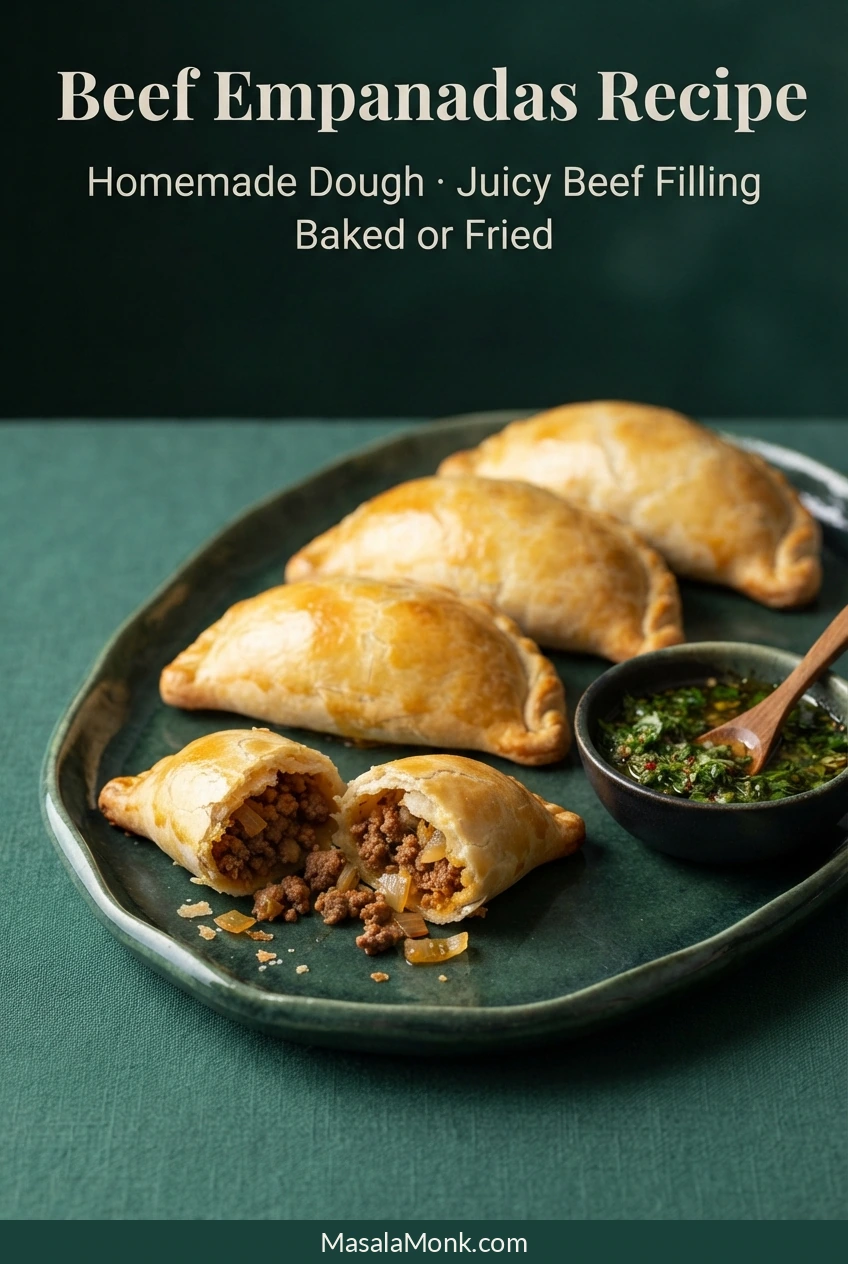
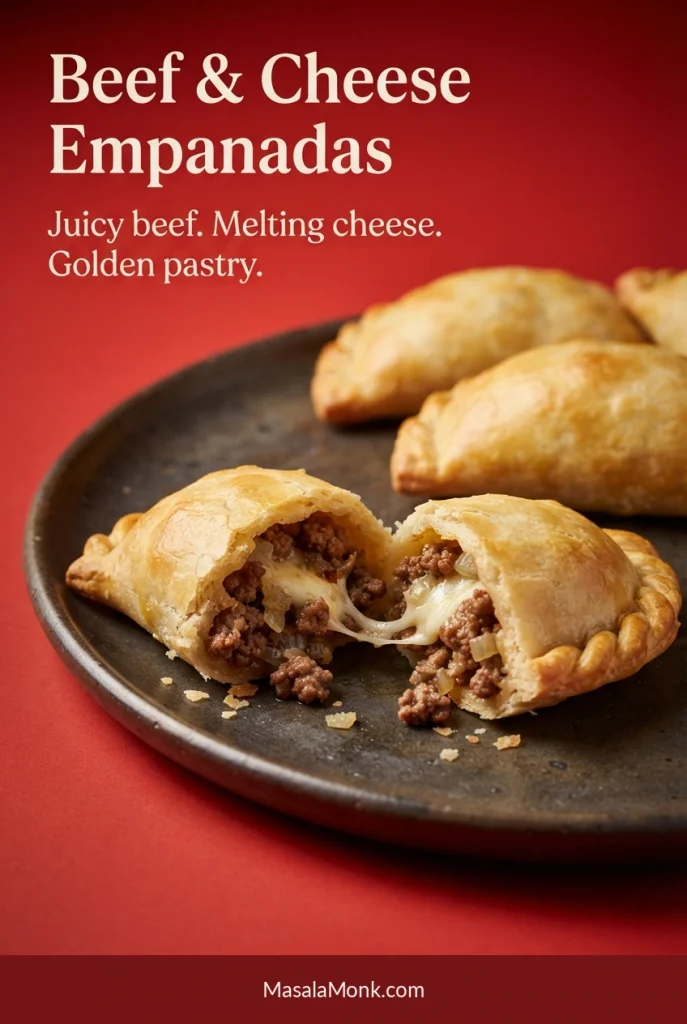
Break open a warm beef empanada and you’ll find tender crumbles of beef seasoned with paprika and cumin, tucked inside golden pastry. Plenty of softened onion brings sweetness to the filling, while a spoonful of sharp, garlicky chimichurri makes each bite even better.
Inspired by Argentina, this homemade beef empanadas recipe pairs juicy ground beef with tender butter-and-egg pastry. Make the dough yourself or use ready-made wrappers, then bake, fry or air-fry the empanadas.
At a glance: Makes about 12 medium empanadas. Bake at 205°C (400°F) for 20–25 minutes or fry at 175°C (350°F) for 5–7 minutes per batch.
Recipe note: This recipe draws on established empanada-making techniques, but the exact formulation has not been kitchen-tested. Yield and cooking times are estimates. The illustrative cooking guides explain the intended techniques and results; use the written texture and doneness cues as you cook.
Short on time? Use the ready-made wrapper method.
In This Guide
Make the Empanadas
Homemade Beef Empanadas Recipe
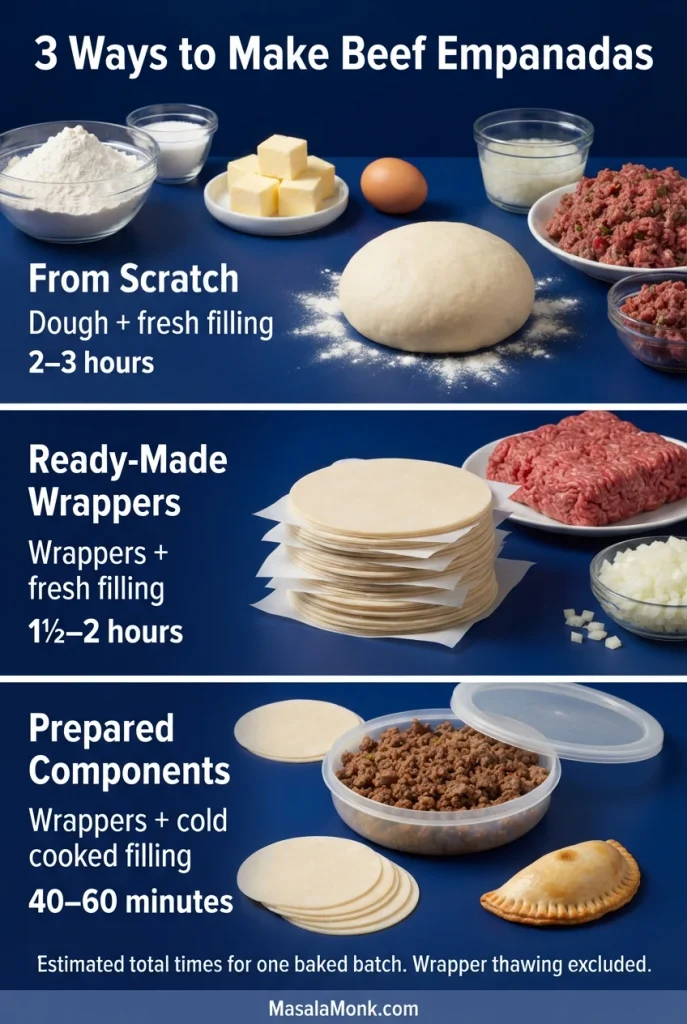
How Much Time Do You Have?
Choose your preparation method according to the time available. These estimates include resting and chilling where required:
- Homemade dough and fresh filling: 2–3 hours.
- Ready-made wrappers and fresh filling: 1½–2 hours, excluding wrapper thawing.
- Prepared cold filling and wrappers: 40–60 minutes.
Make the dough first so it can rest while the beef cooks. You can also begin rolling the pastry while the cooked filling chills. Allow extra time for longer chilling or additional cooking batches.
Ingredients for Beef Empanadas
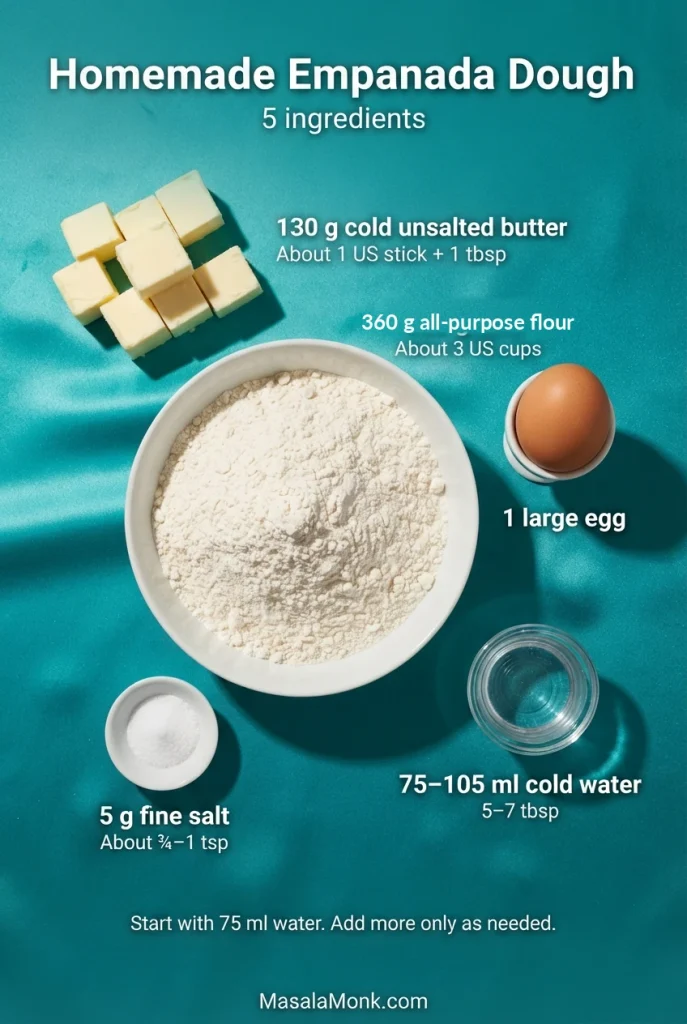
For the Homemade Empanada Dough
- 360 g (about 3 US cups) all-purpose flour (plain flour), plus extra for rolling
- 130 g (about 1 US stick + 1 tbsp) cold unsalted butter, cubed
- 1 large egg (about 50 g without shell)
- 75–105 ml (5–7 tbsp) cold water
- 5 g (about ¾–1 tsp) fine salt
Butter gives the pastry a tender bite, while the egg helps it hold together when folded. For cup measurements, spoon the flour in loosely and level the top.
Allergy note: The homemade dough contains wheat, egg and milk (butter). Check purchased wrappers, sauces and other ingredients for allergens, and avoid cross-contact when cooking for someone with a food allergy.
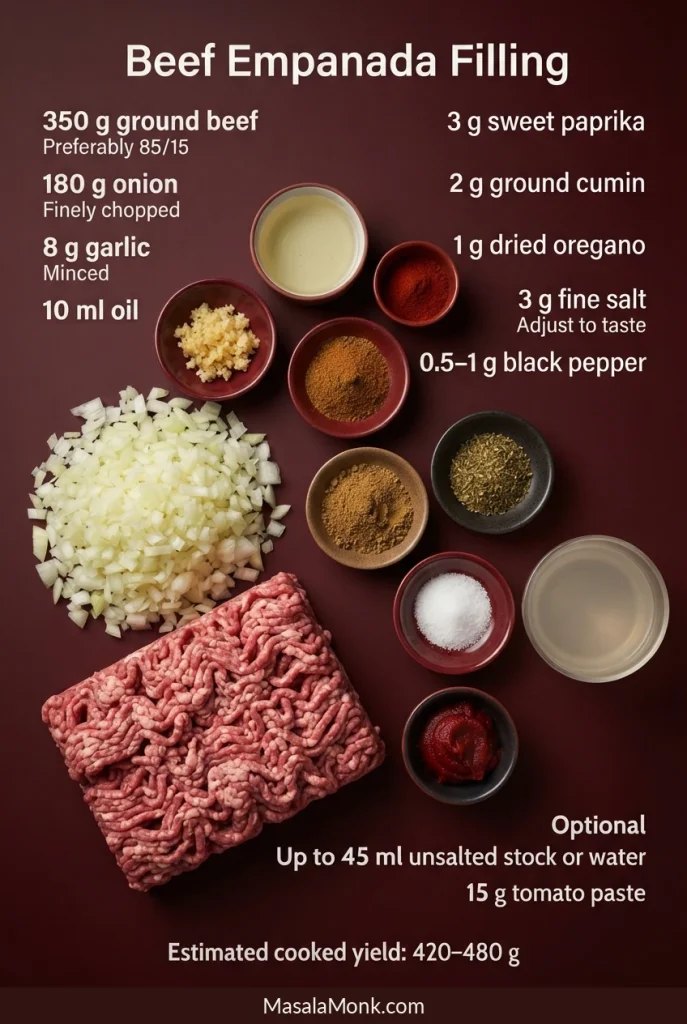
Beef Empanada Filling
Expect roughly 420–480 g (14.8–16.9 oz) of cooked filling, depending on how much liquid and fat the beef loses. The same filling works with homemade dough or ready-made wrappers.
- 350 g (12.3 oz) ground beef (beef mince), preferably 85% lean and 15% fat
- 180 g (about 1 large) yellow onion, weighed after peeling and finely chopped
- 8 g (about 2–3 cloves) garlic, peeled and minced
- 10 ml (2 tsp) olive oil or neutral cooking oil
- 3 g (about 1½ tsp) sweet paprika
- 2 g (about 1 tsp) ground cumin
- 1 g (about 1 tsp) dried oregano
- 3 g (about ½ tsp) fine salt, plus more to taste
- 0.5–1 g (about ¼–½ tsp) ground black pepper
Optional: Up to 45 ml (3 tbsp) unsalted beef stock or water, as needed, and 15 g (1 tbsp) tomato paste for a deeper savory flavor. Start with less salt when using salted stock, olives or salty cheese.
Using purchased wrappers? Gather the filling and cooking ingredients, then begin with Step 2: Cook the Beef.
Which Ground Beef Is Best for Empanadas?
85/15 ground beef gives the filling a welcome richness without as much excess grease as fattier mince. An 80/20 mixture works too; spoon off pooled fat. Leaner beef, such as 90/10 or 93/7, benefits from careful cooking and a little stock if needed.
For Baking, Frying or Air Frying
- Baking: 1 additional large egg beaten with 5 ml (1 tsp) water, optional.
- Frying: Neutral high-temperature oil, such as sunflower, canola or refined peanut oil. Use about 5 cm (2 inches) in a sufficiently deep pot, no more than one-third of its capacity.
- Air frying: A little oil or egg wash for brushing, optional.
- A little water for sealing dry wrapper edges, if needed.
For a mixed batch, see the filling variations before shopping.
Equipment You’ll Need
- Preparation: Mixing bowl, rolling pin, wide skillet, spatula, fork, shallow cooling container and a round cutter, bowl or lid about 14 cm (5½ inches) across.
- Baking: Oven, metal baking sheet, parchment paper and wire rack.
- Frying: Deep, heavy-bottomed pot, well-fitting metal lid, slotted spoon, frying thermometer and wire rack over a tray.
A kitchen scale is helpful but optional. Use an instant-read food thermometer for the beef and finished empanadas, and a thermometer rated for hot oil when frying.
How to Make Beef Empanadas from Scratch
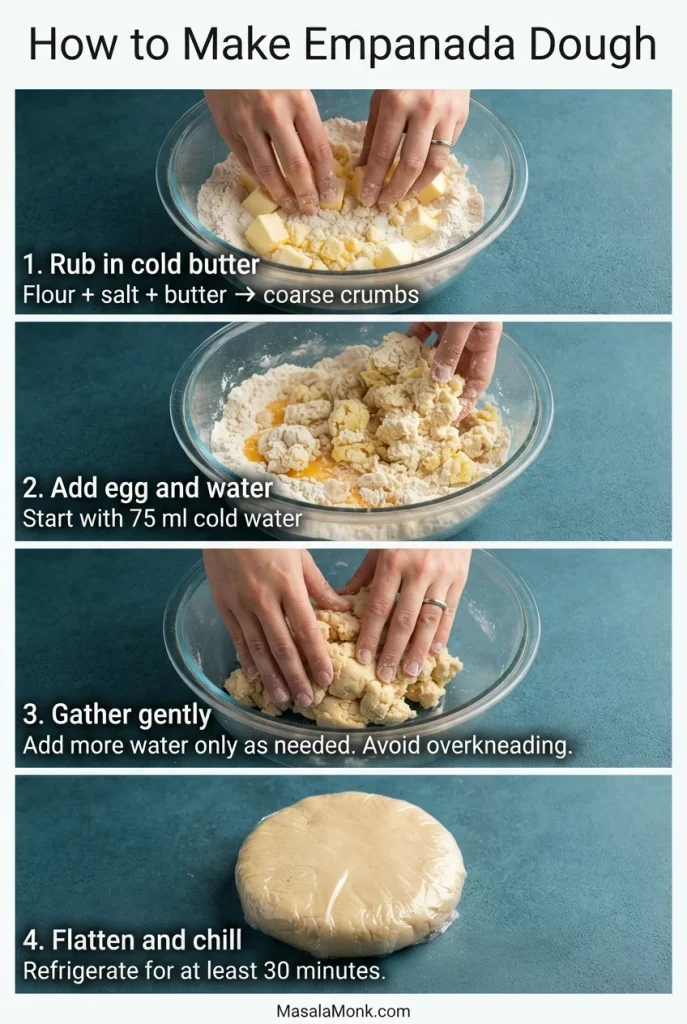
Step 1: Make and Chill the Empanada Dough
- Mix the flour and salt. Combine 360 g (about 3 US cups) flour with 5 g (about ¾–1 tsp) fine salt. Add 130 g (about 1 US stick + 1 tbsp) cold, cubed butter.
- Rub in the butter. Work quickly with your fingertips until the mixture resembles coarse crumbs with a few small pieces of butter remaining.
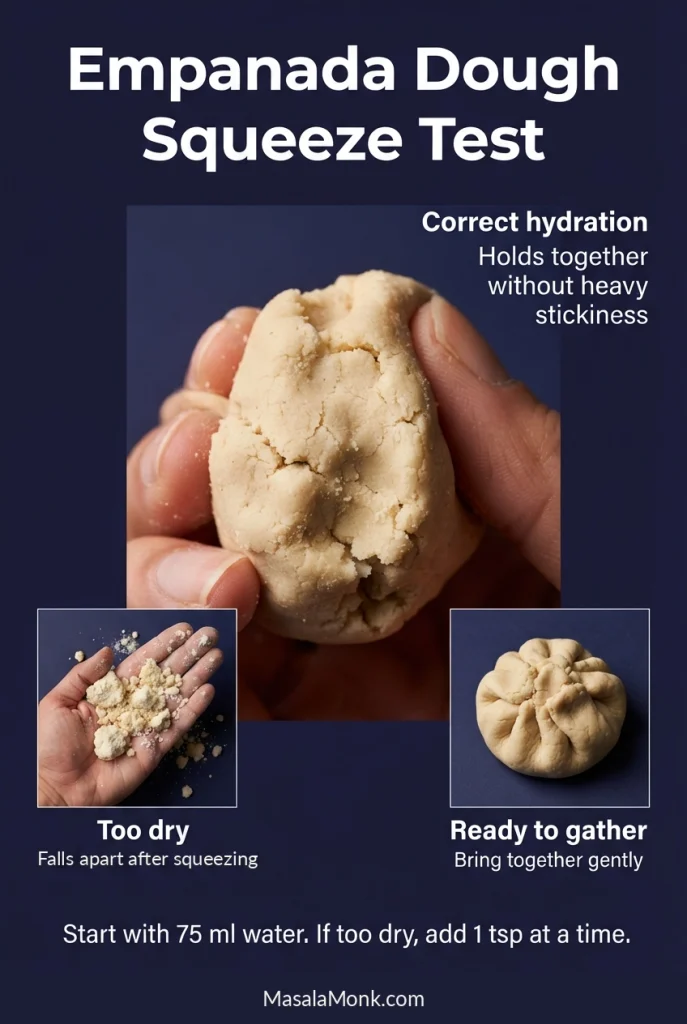
- Add the egg and water. Lightly beat one large egg and mix it into the crumbs with 75 ml (5 tbsp) cold water. Squeeze a little in your hand before adding more water; add it a teaspoon at a time only if the dough falls apart.
- Gather the dough. Bring it together gently until soft and pliable, without sticking heavily to your fingers or breaking into dry crumbs. Stop once it comes together; prolonged kneading can make it tough.
- Rest and chill. Flatten into a thick disc, wrap tightly and refrigerate for at least 30 minutes.
Check the Empanada Dough Hydration
The squeeze test used when adding water helps you judge whether the empanada dough is ready to chill. A small portion should hold together without breaking into dry crumbs. Add extra cold water only if necessary; you may not need the full 105 ml.
Keep the butter cold: Refrigerate greasy dough briefly instead of adding flour to compensate for soft butter.
Food processor alternative: Pulse the flour, salt and butter into coarse crumbs. Add the egg and 75 ml (5 tbsp) cold water, then more water a teaspoon at a time as needed. Stop when the dough comes together; wrap and chill for at least 30 minutes.
While the dough rests in the fridge, cook the beef.
Step 2: Make the Juicy Beef Empanada Filling
The 180 g of onion may seem generous next to 350 g of beef. That’s deliberate: the onion softens into the meat, bringing sweetness and moisture without a heavy sauce.
- Soften the onion. Heat 10 ml (2 tsp) oil in a wide skillet over medium heat. Add 180 g (about 1 large) finely chopped onion and cook for 5–7 minutes, until translucent and tender.
- Add the garlic. Stir in 8 g (2–3 cloves) minced garlic for 30–60 seconds, until fragrant.
- Brown the beef. Add 350 g (12.3 oz) ground beef. Increase to medium-high heat and break the meat into small crumbles. Cook for about 5–8 minutes. As the liquid evaporates, listen for a frying sizzle and let some crumbles brown lightly. Spoon off pooled grease.
- Season. Reduce to medium heat. Add 1½ tsp sweet paprika, 1 tsp cumin, 1 tsp oregano, ¼–½ tsp pepper, optional 1 tbsp tomato paste and up to ½ tsp fine salt. Stir for 1–2 minutes, until fragrant.
- Adjust moisture. If dry, add stock or water a tablespoon at a time, up to 45 ml (3 tbsp) in total. Reduce any watery liquid gently.
- Finish and chill. Ensure the filling is moist without pooled liquid and the beef reaches 71°C (160°F). Taste and adjust the seasoning, then spread in a shallow container and refrigerate promptly.
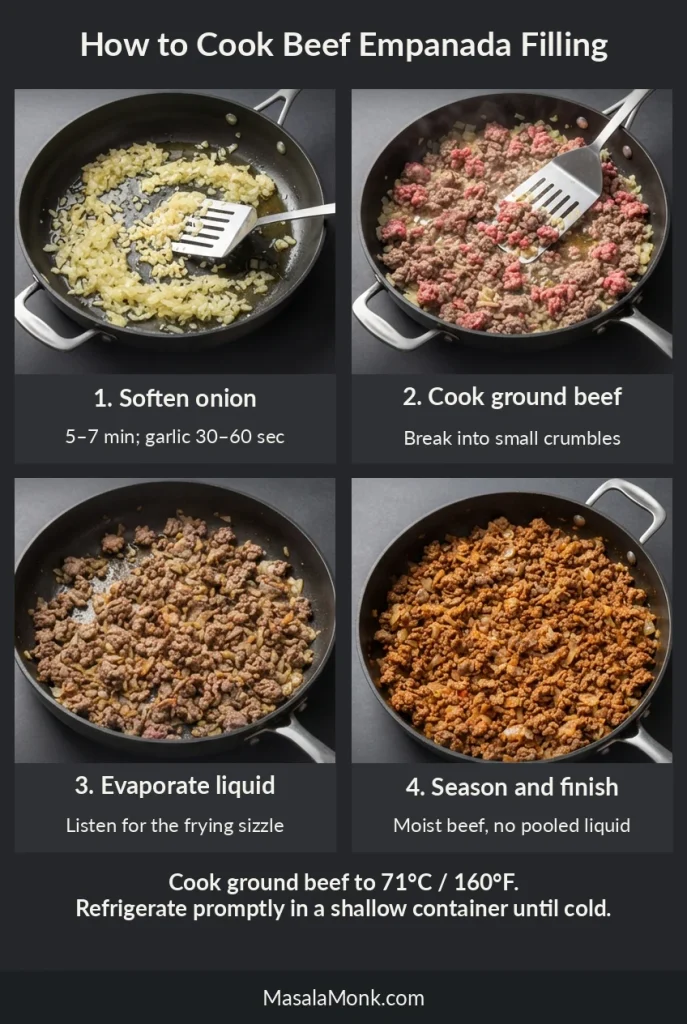
Check the Beef Temperature Before Chilling
For the final temperature check in the beef method, gather a mound of meat and insert the thermometer into its center without touching the skillet. Measure in several places to confirm it reaches 71°C (160°F). See the FoodSafety.gov temperature chart.
Beef Empanada Seasoning
Every bite will also contain pastry, so the filling needs to taste well-seasoned on its own. When tasting the fully cooked beef before chilling, adjust salt first. Cumin should complement the meat without overpowering it, while sweet paprika adds pepper flavor without much heat. For a smoky version, replace a little sweet paprika with smoked paprika. Briefly cook any additional spices before refrigerating the filling.
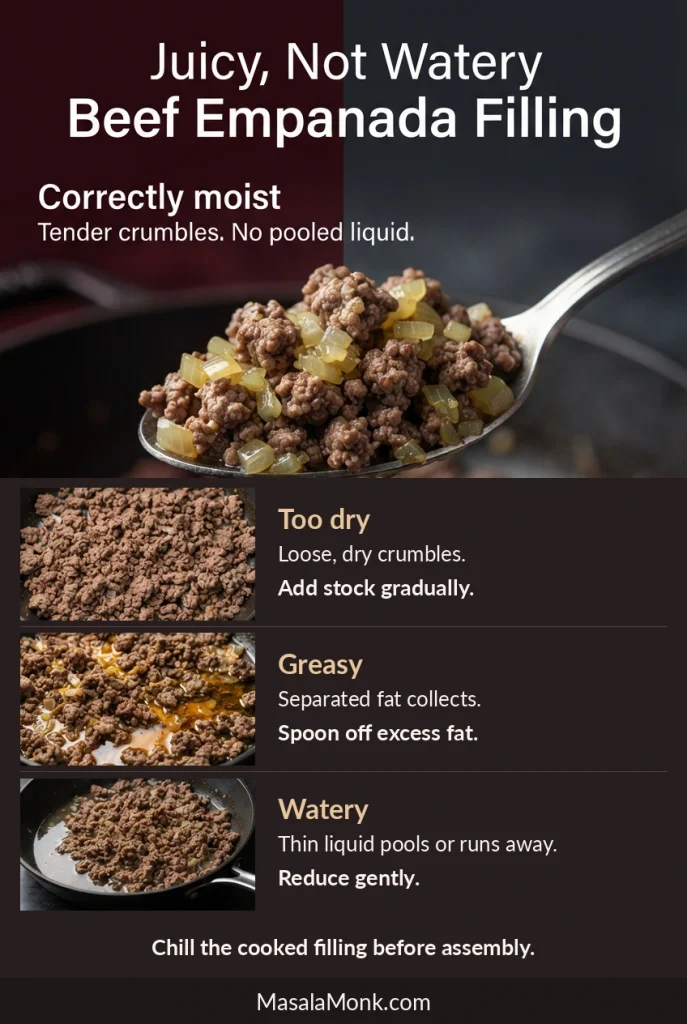
How Juicy Should Empanada Meat Be?
Juicy, not watery. Before refrigeration, the beef and onion mixture should form a soft mound of moist crumbles without leaving a puddle. A spoonful lifted from the skillet helps distinguish properly moist filling from excess liquid.
| Texture | What You See | What to Do |
|---|---|---|
| Dry | Loose, dry crumbles | Add stock gradually, up to 3 tbsp total |
| Moist | Tender beef without pooled liquid | Ready to chill once fully cooked |
| Greasy | Fat collects around meat | Spoon off excess |
| Watery | Thin liquid runs away | Reduce gently |
Some retained fat firms up as the filling chills, making it easier to portion, then melts again during cooking. There is no need to drain away every trace of it. Once the texture is right, confirm the beef reaches 71°C (160°F) before tasting, adjusting the final seasoning and chilling.
Step 3: Chill the Filling and Roll the Pastry
Allow about 30–45 minutes or longer for the refrigerated filling to become thoroughly cold. Warm beef can soften butter pastry and make assembly difficult. Meanwhile, begin rolling the dough once it has rested sufficiently. If using ready-made wrappers, skip rolling and continue to Step 4 once the filling is cold.
Roll and Cut the Empanada Wrappers
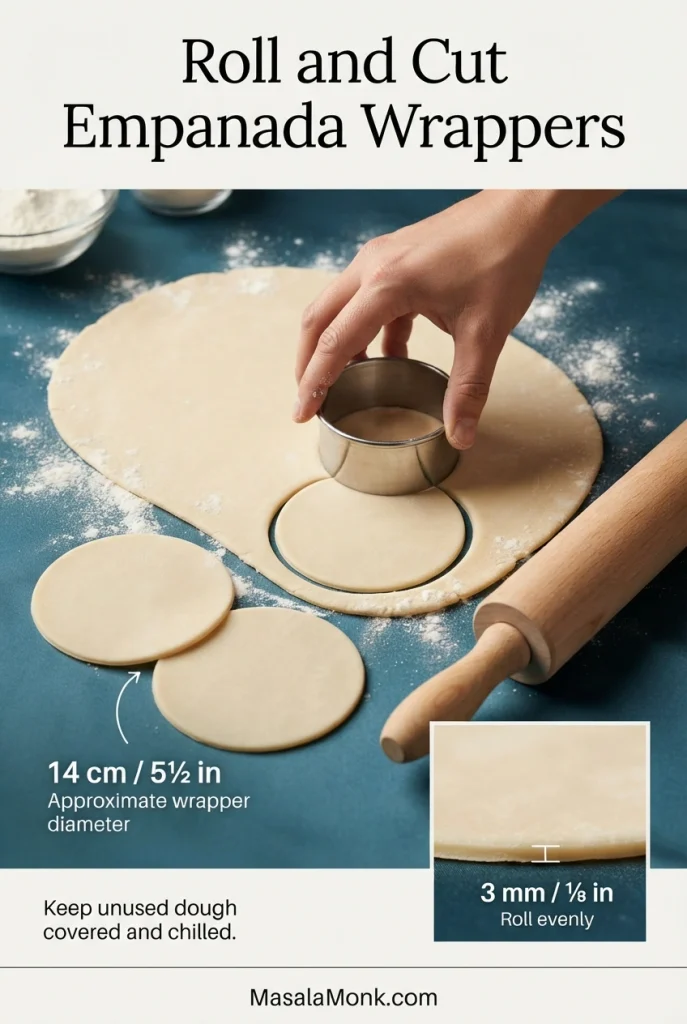
Once the dough has chilled for at least 30 minutes, take out a manageable piece, leaving the rest covered in the fridge. Let it soften briefly if too firm to roll.
On a lightly floured surface, roll to an even 3 mm (⅛ inch) thickness. Cut one circle about 14 cm (5½ inches) across.
Test the Wrapper Before Filling
Bend the wrapper gently into a half-moon, then open it flat again. It should fold without cracking or requiring excessive stretching. Make adjustments before cutting the remaining discs.
- Shrinking back: Cover and rest another 10–15 minutes.
- Cracking while cold: Let it soften briefly.
- Genuinely dry and crumbly: Gather the unusable wrapper back into the dough only if the remaining dough is also dry. Incorporate cold water a teaspoon at a time, then rest again.
- Cool but slightly sticky: Dust the rolling surface lightly with flour.
- Soft and greasy: Refrigerate briefly.
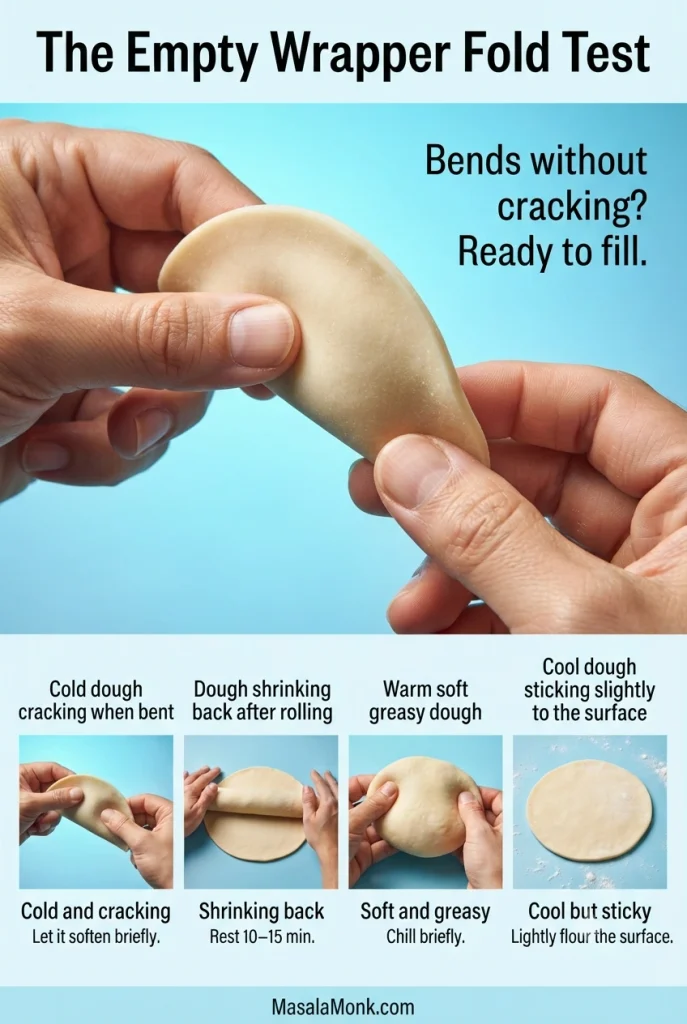
Once the first wrapper bends comfortably, you are ready to test the filling portion and seal. If the beef is still chilling, continue cutting circles, aiming for twelve wrappers and gently rerolling the trimmings. Keep the cut wrappers covered and refrigerated, with parchment between stacked circles.
Step 4: Fill, Fold and Seal the Empanadas
If baking, preheat the oven to 205°C (400°F), or 190°C (375°F) for a fan oven, while assembling the empanadas. Make sure the filling is thoroughly cold before you begin.
How Much Filling Goes in Each Empanada?
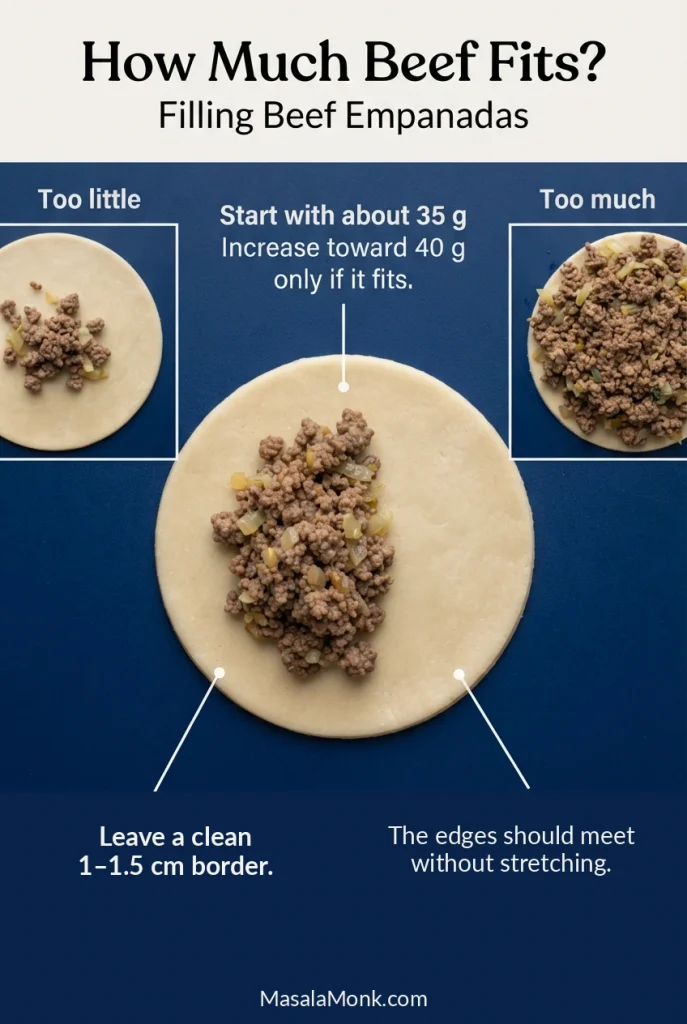
Divide the cooked filling by the number of empanadas you plan to make. For a 14 cm wrapper, start with about 35 g (1.2 oz), or less if the yield is lower. Increase toward 40 g (1.4 oz) only if there is enough for the batch and the wrapper closes comfortably.
| Example Cooked Filling Weight | Portions for 12 |
|---|---|
| 360 g (12.7 oz) | 30 g (1.1 oz) each |
| 420–480 g (14.8–16.9 oz) | 35–40 g (1.2–1.4 oz) each, if they fit |
| More than 480 g | Reserve surplus or cut extra wrappers |
Without a scale, divide the filling into roughly equal piles. About two generous tablespoons is a starting portion for a medium wrapper. Use the wrapper size guide for other sizes. When making cheesy empanadas, replace some of the meat with cheese.
Fill and Seal the First Empanada
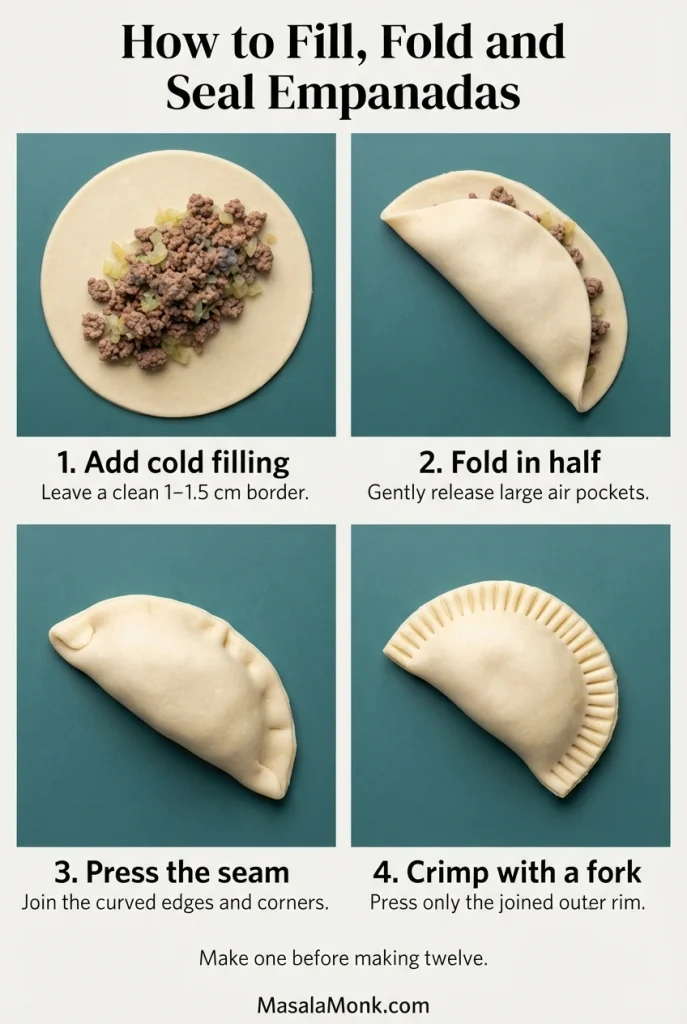
Make one before making twelve. Adjust the filling portion and wrapper thickness using the first empanada as your guide.
- Place a portion of cold beef slightly toward one half of the wrapper. Leave a clean border of 1–1.5 cm (about ½ inch).
- Lightly moisten one edge with water if dry, then fold the empty half over the beef.
- Gently press around the filling to release large air pockets, keeping the meat away from the seam.
- Press the two layers together with your fingers, closing both pointed corners. Remove some filling if the edges need stretching to meet.
- Crimp the rim with a fork without piercing the filled part.
Your empanadas don’t all need to look alike. A comfortable fit and a secure seal matter more than a perfect shape.
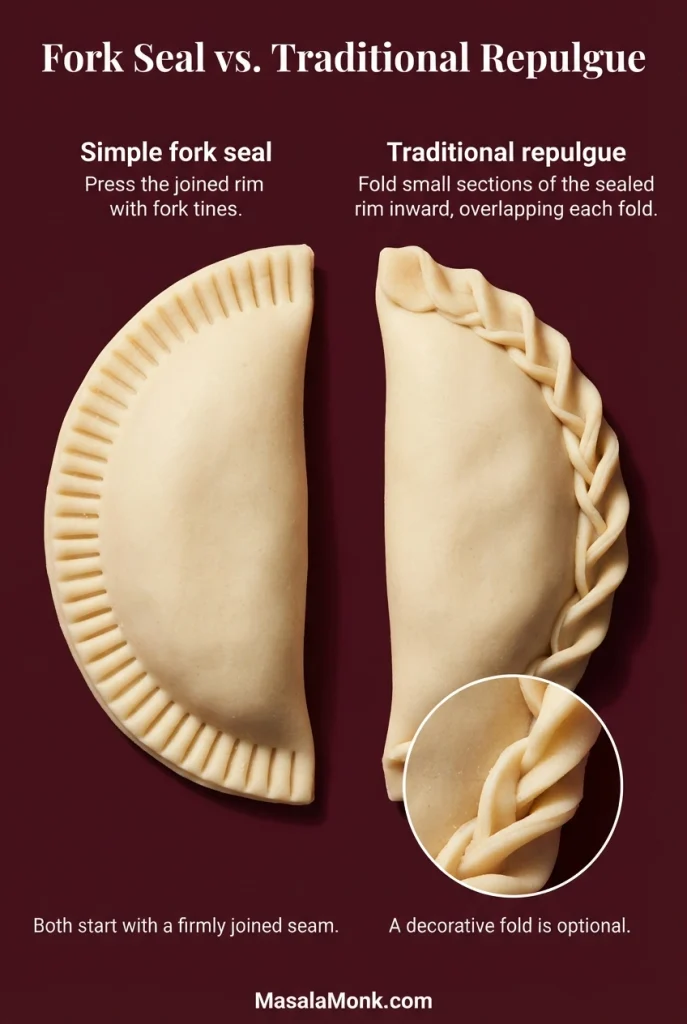
Fork Seal or Traditional Repulgue?
A fork seal is enough. For a decorative rim instead, start at one corner of the finger-sealed empanada. Fold a small piece of the rim inward and pinch it down. Move along the curve, overlapping each new fold slightly with the previous one. Keep the folds small so the seam cooks through, then pinch the final corner closed.
Roll any remaining wrappers and assemble the rest. Keep unused filling and assembled empanadas refrigerated as you work. If the dough becomes very soft, chill the batch for another 15–20 minutes before cooking.
Save surplus dough rather than making thicker wrappers. Refrigerate it tightly wrapped for the next day, freeze it, or make little turnovers with cooled, thick homemade apple pie filling.
For a smaller meal, air-fry a few empanadas and freeze the rest unbaked.
Beef Empanadas Recipe: Baking, Frying and Air Frying Times
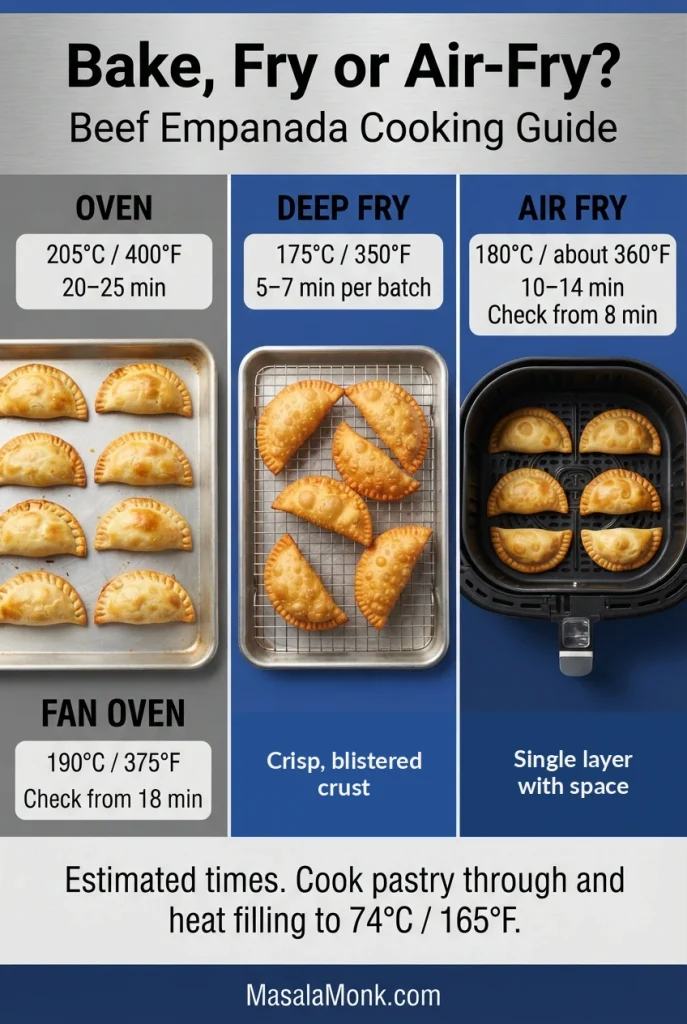
Baking is the straightforward choice for this homemade dough, especially for a full tray. Frying gives you a crisp shell, sometimes with little surface blisters, whereas an air fryer is convenient for smaller batches.
| Method | Temperature | Time / First Check |
|---|---|---|
| Conventional oven | 205°C (400°F) | 20–25 min |
| Fan oven | 190°C (375°F) | Check from 18 min |
| Deep frying | 175°C (350°F) | 5–7 min per batch |
| Air fryer | 180°C (about 360°F) | 10–14 min; check from 8 min |
These are estimated settings for medium empanadas containing cooked, chilled beef. The pastry must cook through and the filling must reach 74°C (165°F). Remove an empanada from the cooking appliance, then insert a food thermometer through its side into the center of the beef, not just the pastry. Never return a pierced empanada to hot oil.
How to Bake Beef Empanadas in the Oven
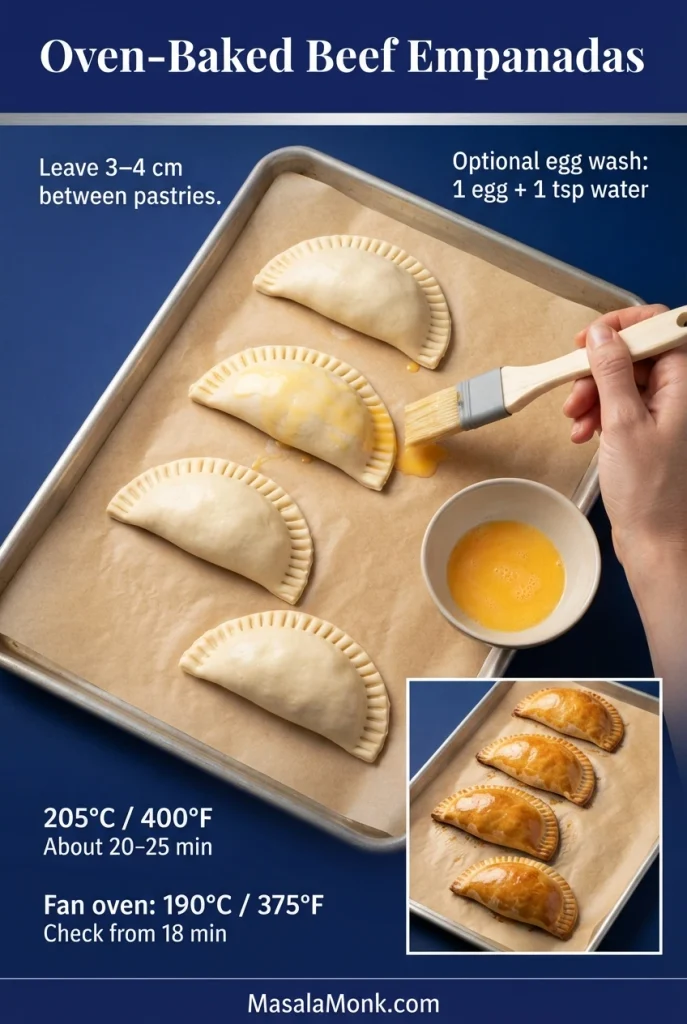
- Ensure the oven is fully preheated to 205°C (400°F), or 190°C (375°F) for a fan oven. Position a rack near the center.
- Line a metal baking sheet with parchment. Arrange empanadas 3–4 cm (1–1½ inches) apart. Bake one tray at a time if necessary, refrigerating waiting empanadas.
- For a glossy finish, brush lightly with one egg beaten with 5 ml (1 tsp) water. Otherwise, leave plain.
- Bake for about 20–25 minutes in a conventional oven. For fan ovens, start checking at 18 minutes.
- Before removing the tray, confirm the pastry is cooked through and the filling reaches 74°C (165°F). Shield the tops loosely with foil if they brown too quickly.
- Transfer the cooked empanadas to a wire rack and rest for about 5 minutes so steam escapes underneath.
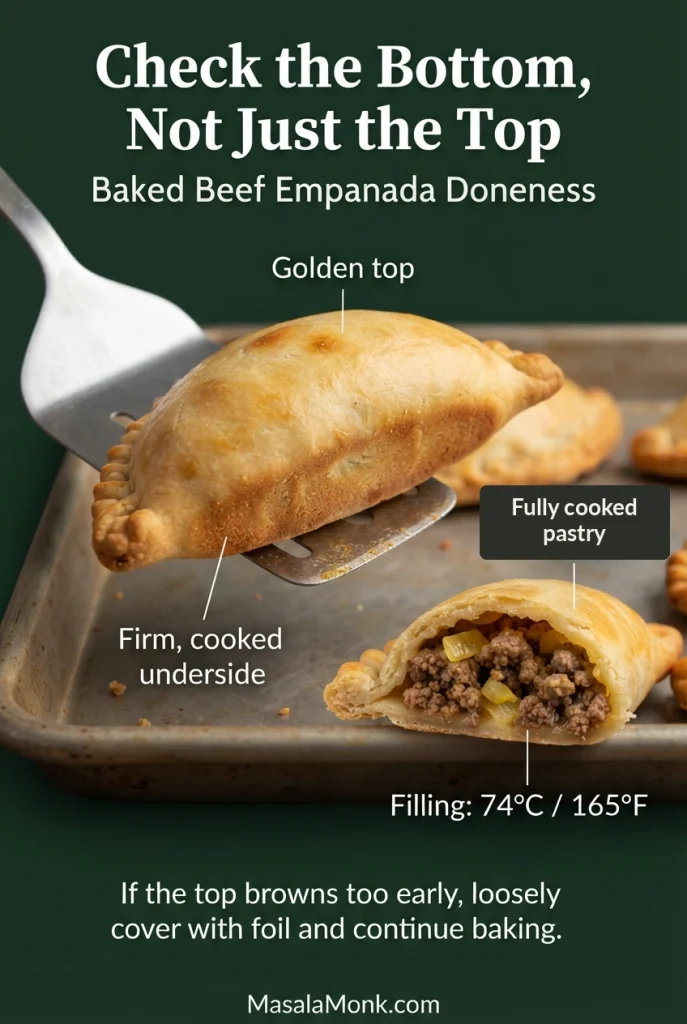
How to Tell When Baked Empanadas Are Done
Before removing a tray of baked empanadas, look beyond the golden tops. The undersides should be firm and cooked, with no raw pastry inside the folded seams. Lift one with a spatula to inspect the base, then check that the center of the filling reaches 74°C (165°F).
Serve warm with chimichurri or another dipping sauce. If the bottoms remain pale and pasty, use the undercooked pastry troubleshooting guide.
How to Fry Beef Empanadas
Fry at 175°C (350°F) for about 5–7 minutes per batch. Skip the egg wash and cook one empanada first to see how the dough behaves in your pot.
Frying safety: Never leave hot oil unattended. Keep a well-fitting metal lid nearby. Fry only securely sealed empanadas with dry, intact wrappers; never fry torn, punctured, icy or visibly wet empanadas.
Turn off the heat if oil starts smoking. Should it catch fire, turn off the heat and cover the pot with the metal lid only if safe to do so. Never move a burning pot or use water on an oil fire. If you cannot safely contain the fire, evacuate and call emergency services.
Fry Empanadas Safely: Step by Step
- Pour about 5 cm (2 inches) of neutral oil into a deep, heavy-bottomed pot, filling no more than one-third of its capacity.
- Heat to 175°C (350°F), monitoring with a frying thermometer.
- Check that the empanada is dry, intact and securely sealed. Brush off loose flour.
- Carefully lower the first empanada with a slotted spoon. Fry for about 5–7 minutes, turning as needed to brown both sides.
- Remove and drain on a rack over a tray. Turn off the heat while inspecting the test empanada, keeping the hot oil attended. Confirm the center reaches 74°C (165°F), then cut it open when safe to handle and inspect the thick folded edge.
- Once the test empanada is cooked through, bring the oil back to 175°C (350°F). Fry one or two at a time, depending on pot size. Check an empanada from each batch for pastry and filling doneness. Turn off the frying heat during inspection if working alone, and restore the temperature before continuing. Refrigerate the waiting pastries.
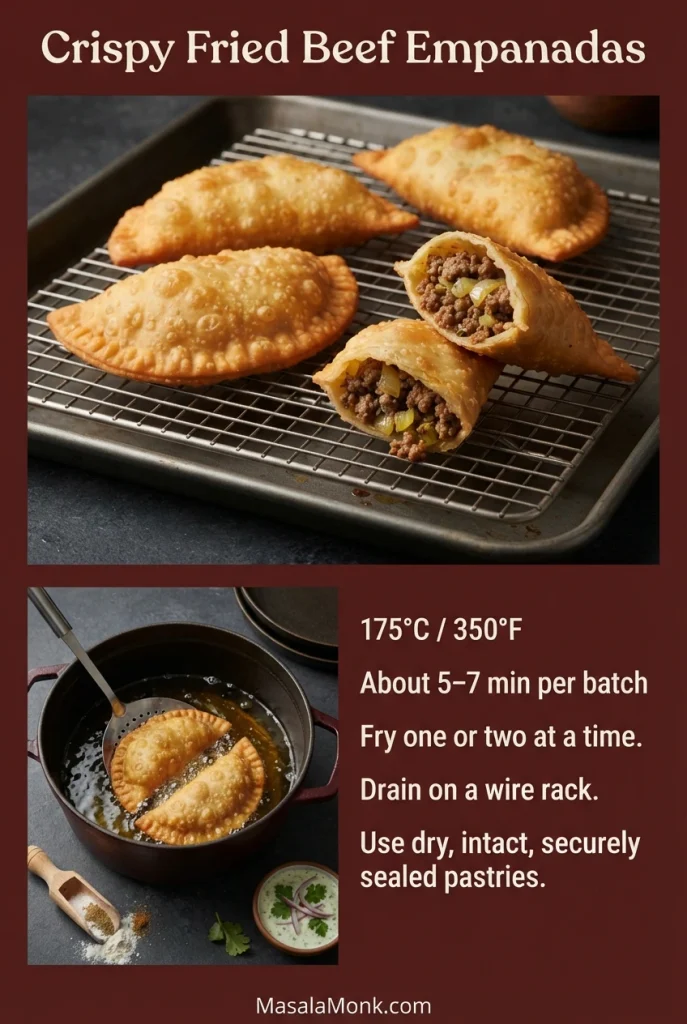
The Thick Folded Edge Takes Longer to Cook
There should be no raw, pasty layer inside the folded rim. If the crust is already dark or the center is too cool, finish cooking the test empanada in the oven. Keep the frying heat off while attending to the oven; never leave hot oil unattended.
Should an empanada break open in the oil, stop adding more. Remove the damaged one with a slotted spoon when safe. If the oil splatters violently, turn off the heat if safe to reach the controls and step away.
Allow roughly 35–50 minutes of frying alone for twelve empanadas when cooking two at a time after the first test, or 1–1½ hours when frying individually. Heating, inspection and temperature recovery take additional time.
To serve everyone together, hold cooked empanadas on a rack over a baking sheet in a low oven, around 90°C (200°F). Use a thermometer to ensure the food itself stays at 60°C (140°F) or above. Avoid stacking or tightly covering them, and serve promptly.
Let freshly fried empanadas rest briefly before eating. The filling stays surprisingly hot beneath the crisp shell.
Air Fryer Beef Empanadas
Expect a baked-style crust rather than a blistered fried shell. Start with one or two medium empanadas to judge the timing for your appliance.
- Preheat the air fryer if the manufacturer recommends it.
- Arrange in a single layer with space for air to circulate. Brush with a little oil or egg wash if desired.
- Air-fry at 180°C (about 360°F) for an estimated 10–14 minutes, checking from 8 minutes.
- Cook until the base and folded edge are done and the filling reaches 74°C (165°F). Adjust subsequent batches accordingly, keeping waiting empanadas refrigerated.
- Transfer to a wire rack and rest briefly before serving.
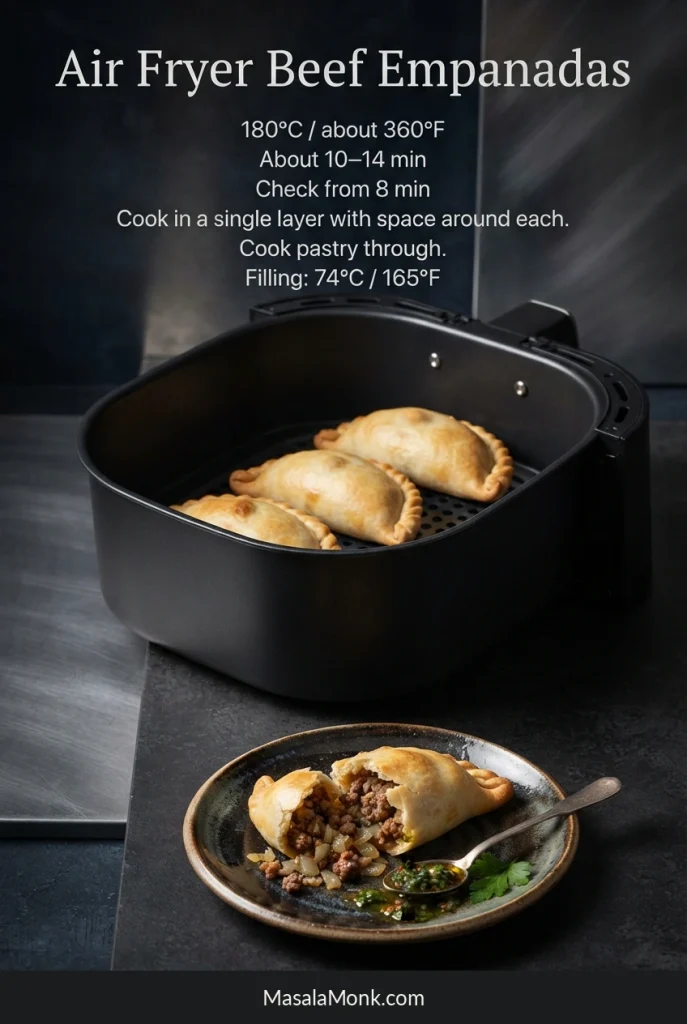
For purchased wrappers with air-frying instructions, use the package settings and heat the filling to 74°C (165°F).
What to Serve with Beef Empanadas
You don’t need an elaborate spread. A crisp salad with a sharp dressing, sliced tomatoes and onions, or a few pickled vegetables will balance the richness of the beef and pastry.
Sauces for Beef Empanadas
- Chimichurri: Fresh parsley, garlic and vinegar make this a natural first choice for Argentine-inspired empanadas.
- Pico de gallo: Fresh tomatoes, onion and lime, particularly good alongside fried empanadas.
- Salsa verde: Tangy roasted tomatillos and green chili, especially good with melted cheese.
- Garlic yogurt sauce: Stir together 120 g (½ cup) plain yogurt, one small grated garlic clove, 5 ml (1 tsp) lemon juice and salt to taste. Serve chilled with spicy empanadas.
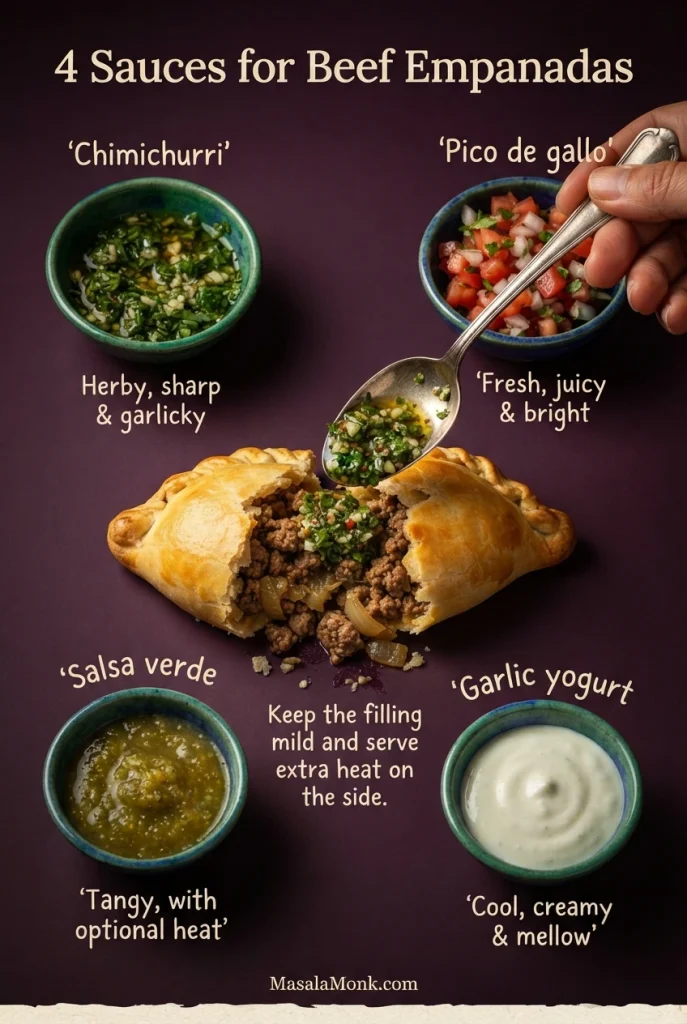
Turn Empanadas into a Meal
Allow three medium empanadas per person for a four-person dinner, or two with substantial sides. For appetizers, allow one or two per person. Mini empanadas also pair well with crispy homemade croquettes on a mixed platter.
A bowl of chilled cowboy caviar adds beans, corn and crunchy peppers without another hot dish. For a heartier meal, serve crispy potato wedges alongside.
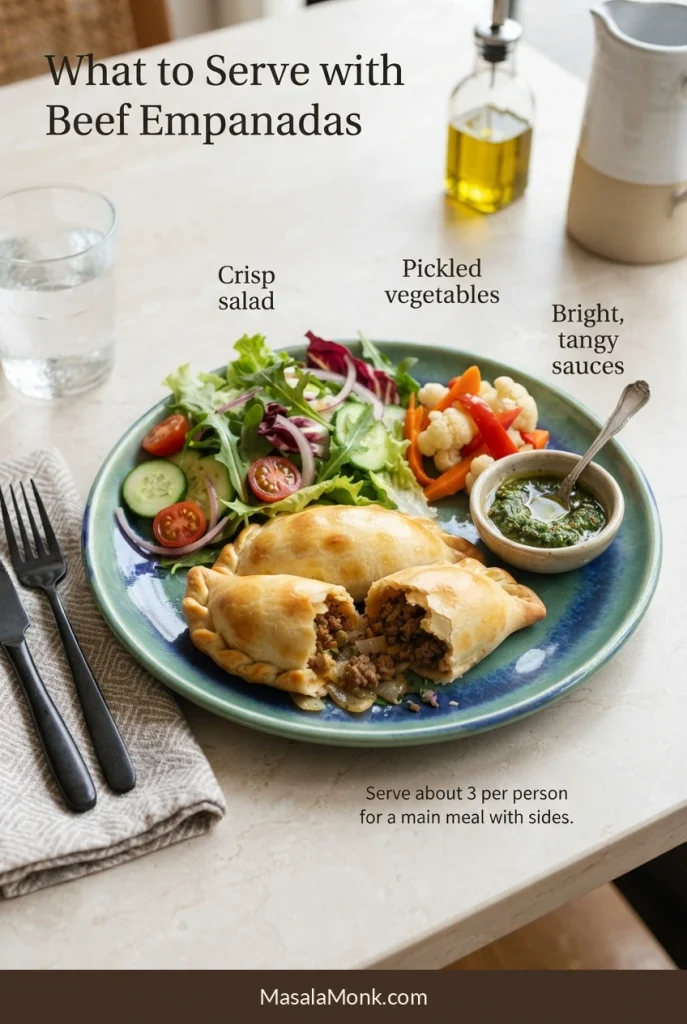
Bring the empanadas to the table warm, with little bowls of sauce for everyone to share. Spoon chimichurri over individual bites rather than soaking the entire crust.
Beef and Cheese Empanadas and Other Filling Variations
Keep some empanadas plain, make a few cheesy ones or add olives and eggs to the rest. Replace part of the cooked beef mixture with your additions so the wrappers still close comfortably. Refrigerate or freeze any surplus filling promptly.
Beef and Cheese Empanadas
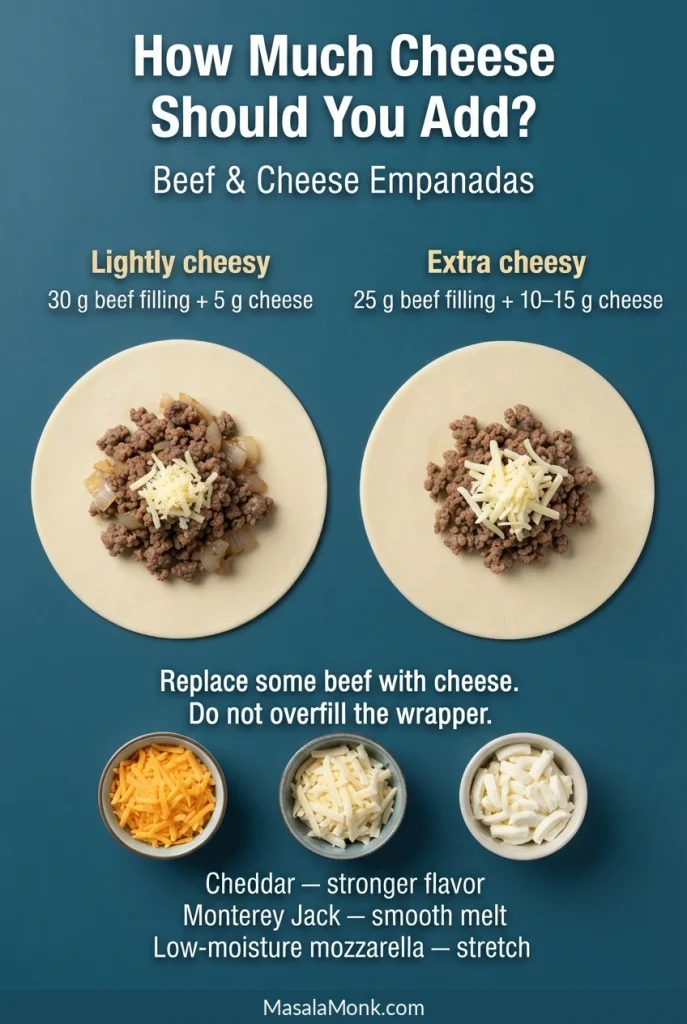
Mix grated cheese into the cold beef or tuck it into the middle of each portion. Without a scale, replace part of your usual spoonful of meat with grated cheese. It can take up more room than expected, so keep the seam clear.
Cheese Filling Proportions and Best Cheese for Empanadas
Use these starting proportions for medium wrappers. The filling weights refer to the cooked beef and onion mixture, not raw mince.
| Version | Per Empanada | For 12 |
|---|---|---|
| Lightly cheesy | 30 g filling + 5 g cheese | 360 g (12.7 oz) filling + 60 g (2.1 oz) cheese |
| Extra cheesy | 25 g filling + 10–15 g cheese | 300 g (10.6 oz) filling + 120–180 g (4.2–6.3 oz) cheese |
- Cheddar: A pronounced, tangy flavor that stands up to the beef.
- Monterey Jack: Mild, creamy and easily melted.
- Low-moisture mozzarella: A soft, stretchy pocket of melted cheese.
- Fresh mozzarella: Releases more moisture; drain thoroughly and use sparingly if substituting.
Use different crimping patterns or separate the fillings on the tray to tell plain and cheesy empanadas apart. Surplus beef and cheese can go into loaded nachos within their safe storage period.
Beef and Potato Empanadas
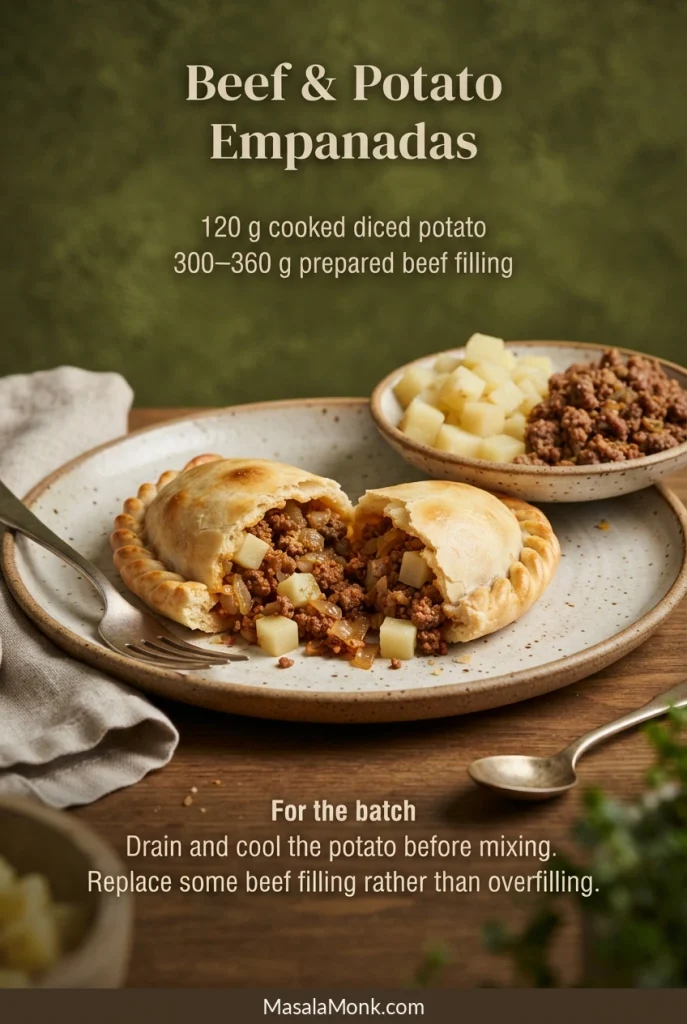
Cut a potato into small dice and boil or steam until tender. Raw potato may not soften during the short final cooking time. Drain well and refrigerate promptly until cold.
For twelve medium empanadas, combine 120 g (4.2 oz) cooked, drained potato with 300–360 g (10.6–12.7 oz) cooked beef filling. For four, use 40 g potato with 100–120 g filling. Adjust portions to fit the wrappers.
Beef Empanadas with Olives, Eggs or Raisins
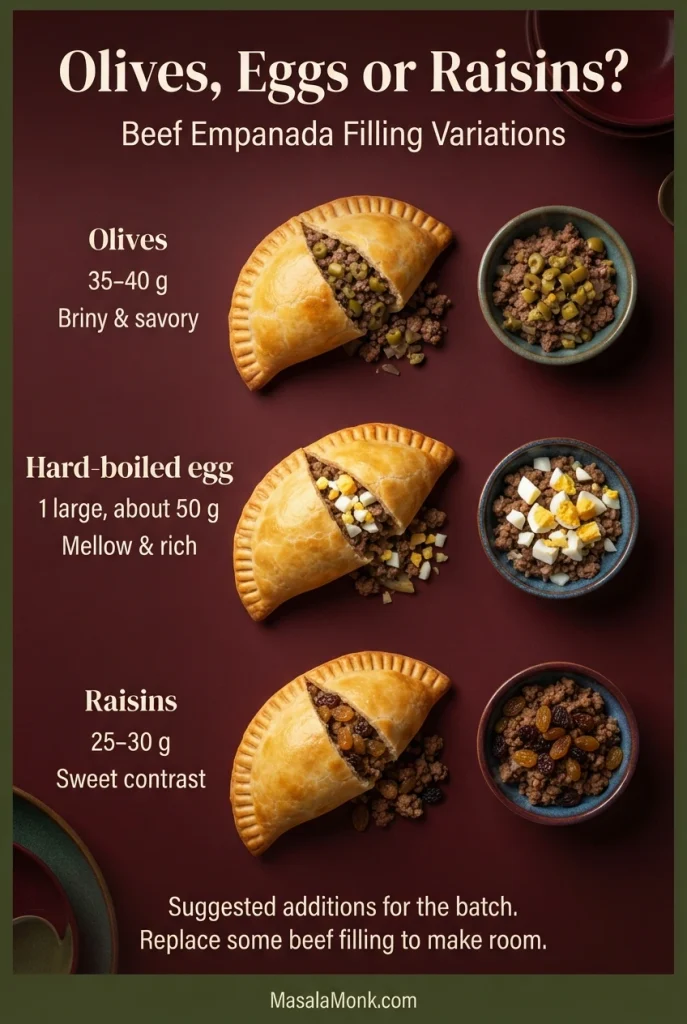
Hard-boiled eggs and olives appear in traditional empanadas mendocinas from Mendoza, Argentina. For twelve medium empanadas, try one or more of these additions:
- Green olives: 35–40 g (1.2–1.4 oz), chopped and drained, for a salty, briny bite.
- Hard-boiled egg: One large egg, about 50 g (1.8 oz) after peeling, chopped.
- Raisins: 25–30 g (0.9–1.1 oz), for little pockets of sweetness.
Replace roughly the same weight of prepared beef filling as the combined additions. Taste before adding more salt, especially with olives, and keep the filling cold.
Are These Authentic Argentine Beef Empanadas?
The beef, softened onions, paprika and cumin draw on Argentine empanada traditions, but this recipe is an adaptation rather than a traditional preparation from one specific region. Some Argentine versions use hand-cut beef, potatoes or spring onions; others feature eggs, olives or different pastry fats.
Spicy Beef Empanadas
Add ¼–½ teaspoon crushed chili flakes to the full filling along with the other spices, or use a little minced fresh chili. For a Tex-Mex variation, use the seasoning from our ground beef tacos recipe and let excess liquid evaporate. When serving people who enjoy different levels of heat, keep the meat mild and offer salsa verde alongside.
Easy Beef Empanadas Recipe with Store-Bought Dough
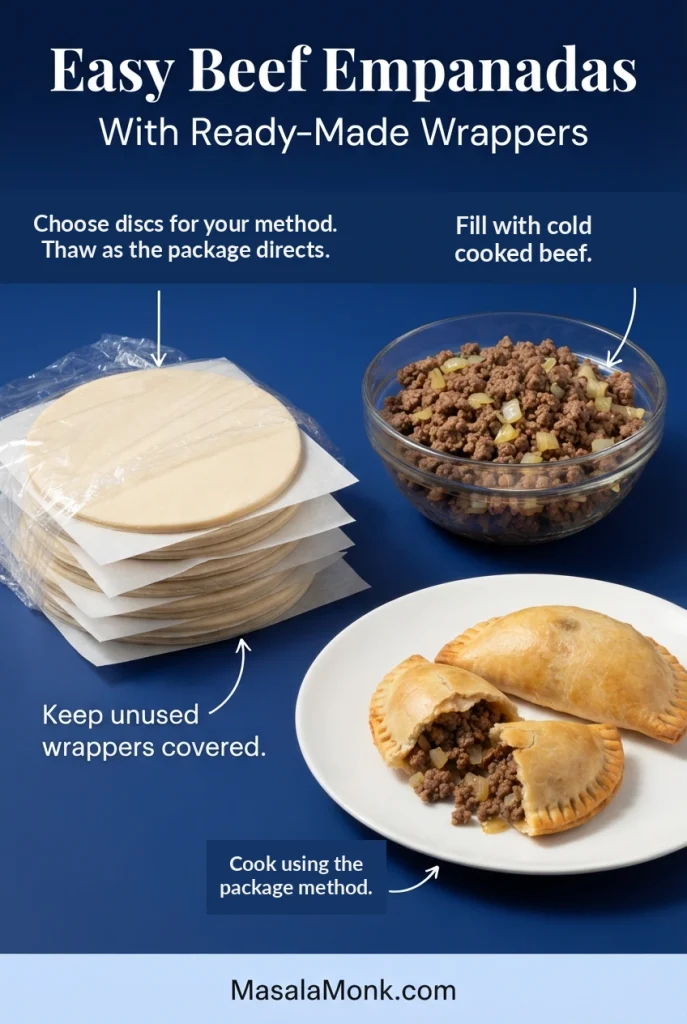
Buy around twelve medium discs measuring 14 cm (5½ inches), or roughly 25 mini wrappers depending on portion size. This shortcut skips making and rolling the dough.
The Ready-Made Wrapper Method
- Choose and thaw. Select wrappers intended for your cooking method. Thaw according to the package until pliable enough to fold without cracking; keep unused discs covered.
- Gather ingredients. Use the beef filling ingredients and cooking ingredients.
- Cook and chill. Follow Step 2 and the chilling instructions in Step 3, skipping the homemade rolling stage.
- Assemble. Choose a suitable portion for your wrapper size, then fill and seal the wrappers.
- Cook. Follow the baking, frying or air-frying method appropriate for the wrappers, using package directions where they differ. Cook the pastry through and heat the filling to 74°C (165°F).
How Much Filling Fits Different Wrapper Sizes?
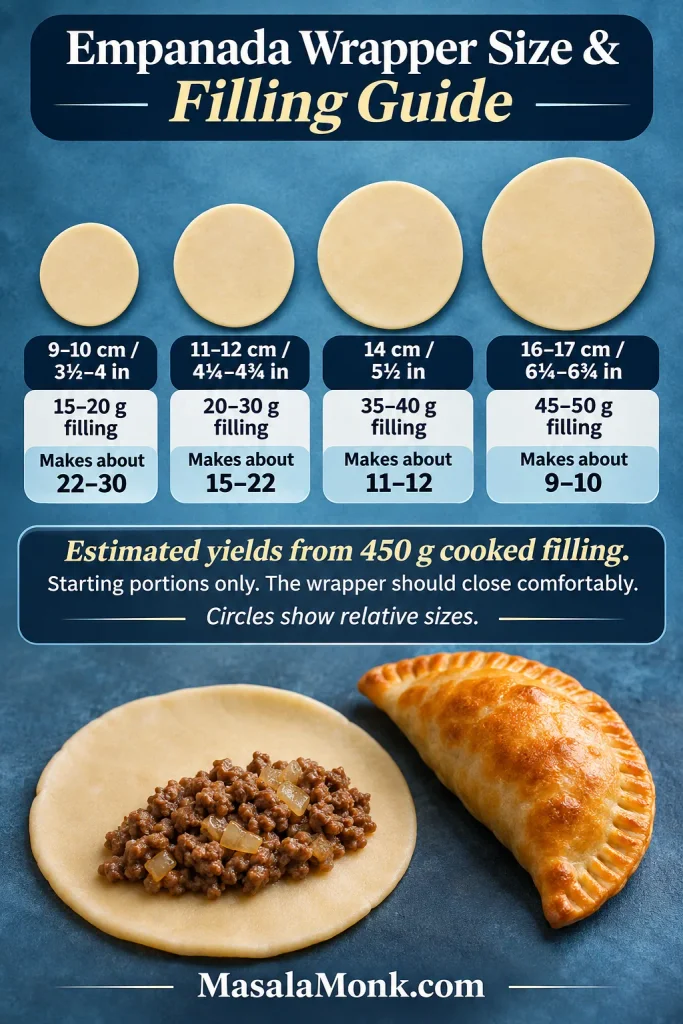
The table estimates the number of full portions you can make from 450 g (15.9 oz) of cooked beef filling.
| Wrapper Diameter | Filling Each | Approx. Empanadas |
|---|---|---|
| 9–10 cm (3½–4 in) | 15–20 g (0.5–0.7 oz) | 22–30 |
| 11–12 cm (4¼–4¾ in) | 20–30 g (0.7–1.1 oz) | 15–22 |
| 14 cm (5½ in) | 35–40 g (1.2–1.4 oz) | 11–12 |
| 16–17 cm (6¼–6¾ in) | 45–50 g (1.6–1.8 oz) | 9–10 |
These are starting portions, not tested wrapper capacities. Thickness and flexibility matter too. About one tablespoon is a starting point for mini wrappers. Check smaller empanadas earlier during cooking, and give larger ones longer if needed.
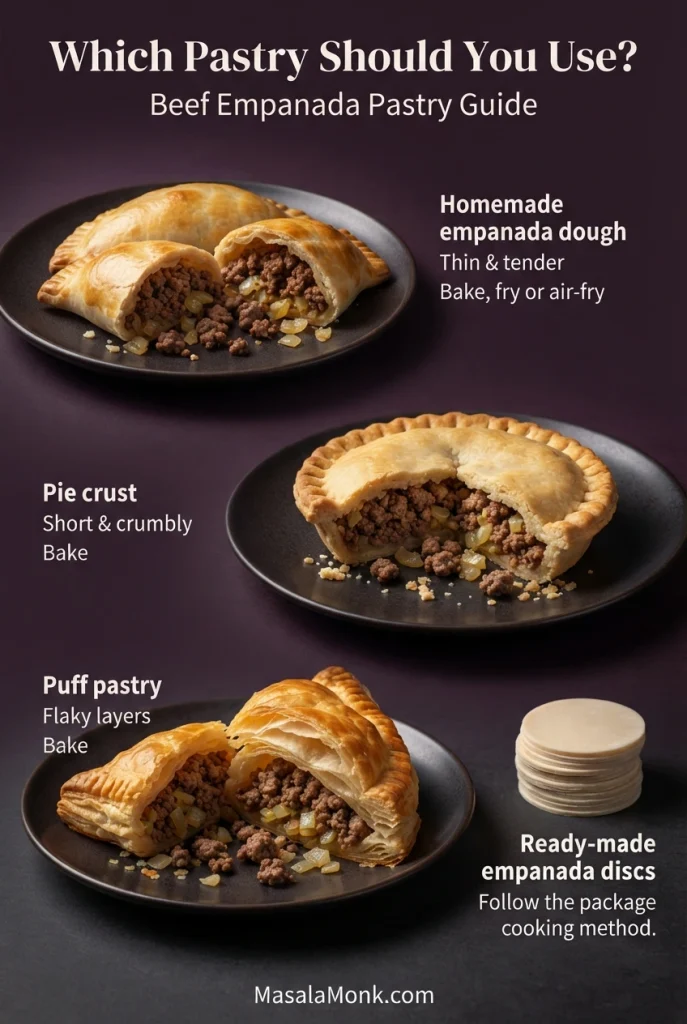
Can You Use Pie Crust or Puff Pastry for Empanadas?
Both make convenient baked beef turnovers, with different textures from empanada dough. Use pie crust and puff pastry for baking, not deep frying in this recipe.
| Pastry | Cooking Method | Expected Texture |
|---|---|---|
| Homemade butter-and-egg dough | Bake; fry or air-fry as adaptations | Tender, buttery |
| Commercial baking discs | Bake; air-fry if suitable | Varies with ingredients |
| Commercial frying discs | Fry; follow package for alternatives | Crisp shell |
| Pie crust | Bake | Tender, crumbly |
| Puff pastry | Bake | Light, flaky layers |
Cut rounds from either pastry, add chilled filling and seal the edges. Keep puff pastry cold and press only around the seam, leaving the layers over the filling free to expand. Follow the package baking directions until the dough cooks through and the filling reaches 74°C (165°F).
Why Beef Empanadas Leak, Burst or Turn Soggy
A split seam or pale underside does not necessarily mean the whole batch is ruined. Often, a small change is enough to save the remaining empanadas.
Dough That Cracks, Sticks or Shrinks
Give shrinking dough another 10–15 minutes to rest. Let cold, cracking dough soften briefly. Chill soft, greasy dough; dust the work surface lightly if cool dough sticks. The wrapper fold test helps distinguish cold pastry from genuinely dry dough.
A tough crust can result from prolonged kneading, too much flour or repeatedly rolling scraps. Handle the next batch gently. Our homemade empanada dough recipe has more detailed pastry guidance.
Dry, Greasy or Watery Beef Filling
A little stock can moisten dry meat, although it cannot fully reverse overcooking. Spoon off pooled grease or reduce watery liquid gently, following the texture guide. After correcting warm filling, refrigerate it promptly until cold.
Next time, try slightly fattier beef if the filling was dry. Soften the onions thoroughly and avoid prolonged cooking once the beef reaches 71°C (160°F) and the filling has the appropriate consistency.
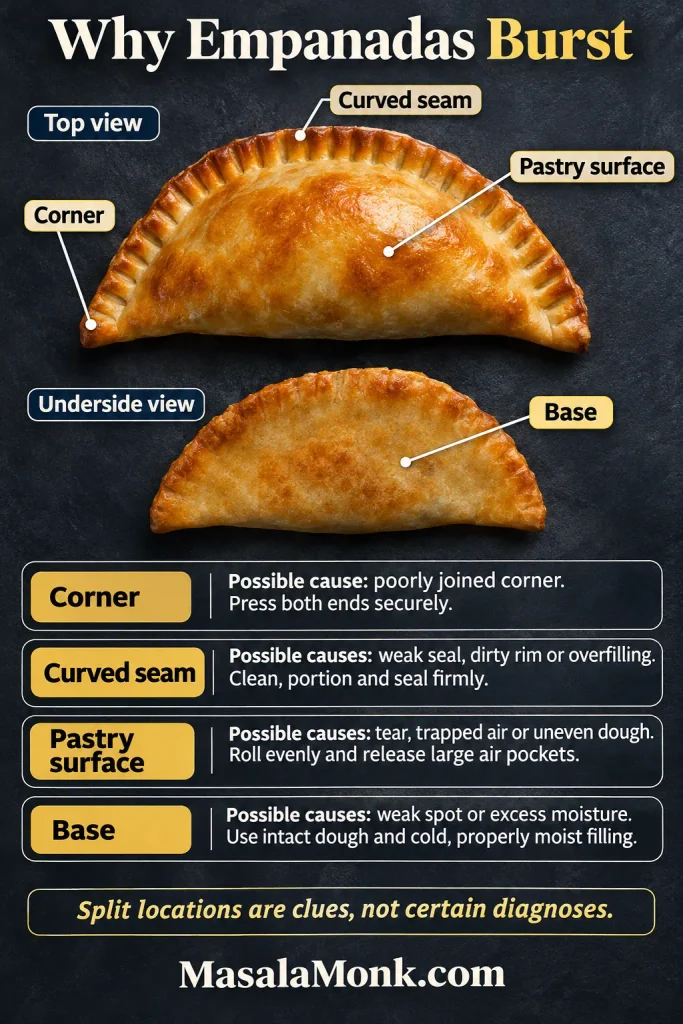
Why Do Empanadas Burst Even When Sealed?
A firm fork seal alone cannot prevent every leak. Trapped air, wet filling and thin or stretched pastry can also cause openings. Where it breaks gives you a clue about why.
| Where It Opens | Possible Cause | What to Change |
|---|---|---|
| Curved seam | Greasy edges, poor seal or overfilling | Clean rim, reduce portion and reseal |
| Pointed corners | Unsealed ends or stretched pastry | Press both corners firmly without stretching |
| Middle of pastry | Thin spots, trapped air or excess moisture | Roll evenly, control moisture and release air |
| Base | Wet filling, weak pastry or undercooking | Reduce excess liquid and check the underside |
How to Rescue the Remaining Batch
A split baked empanada is not necessarily wasted. Finish baking until the pastry is cooked and the center reaches 74°C (165°F).
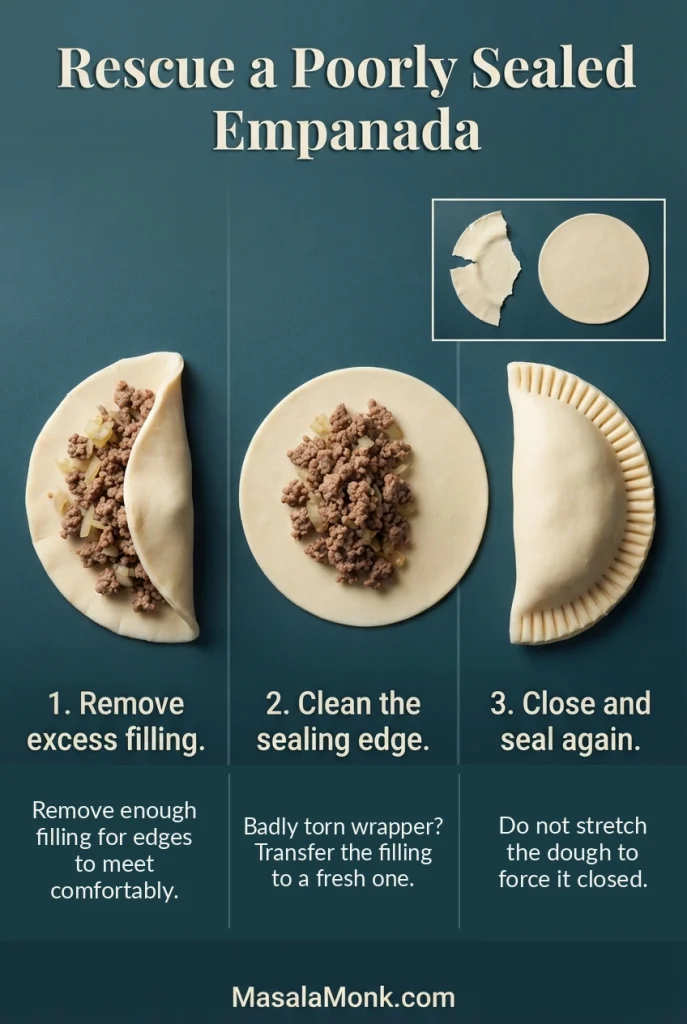
Before cooking more, remove excess filling, clean the edges and reseal where necessary. Transfer the meat to a fresh wrapper if the original has torn badly. Steam vents are not a universal solution and may let juices or cheese escape. Never puncture empanadas intended for deep frying.
Golden Tops but Raw or Soggy Bottoms
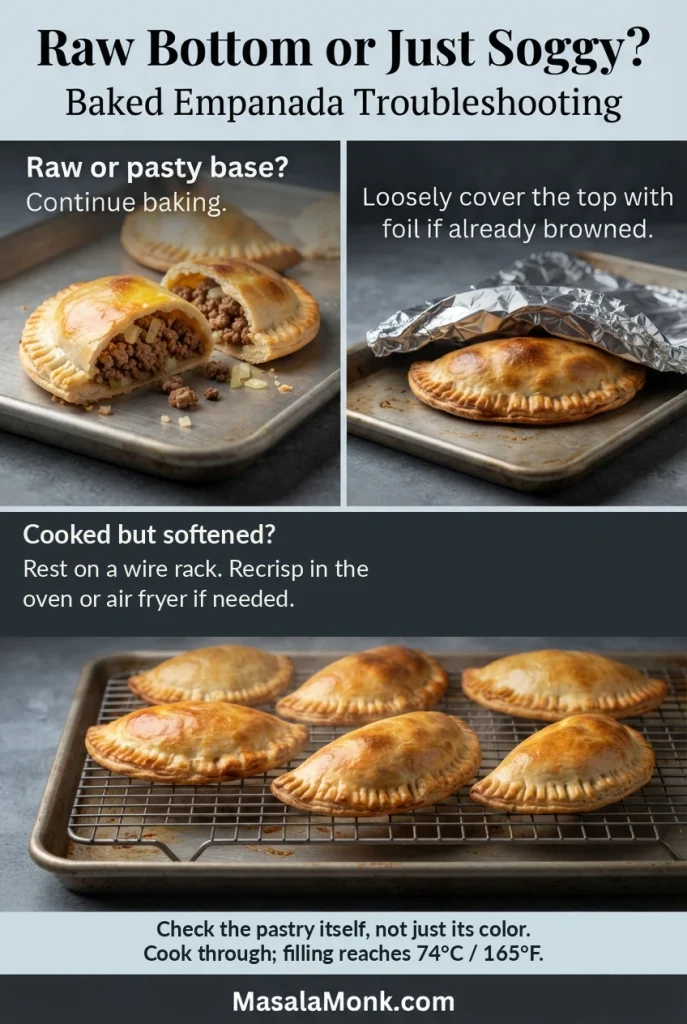
If the underside looks pasty or has a raw layer beneath the beef, return the empanadas to the oven. Shield dark tops loosely with foil and continue baking until the base and seam are cooked and the filling reaches 74°C (165°F). Leave them flat instead of flipping fragile bases.
A fully cooked crust that softens after baking is a different problem. Rest on a wire rack so steam escapes, or briefly crisp them again using the oven or air-fryer reheating method.
For the next tray, check filling moisture, wrapper thickness and oven preheating. A metal baking sheet and a slightly lower rack may help the bottoms brown.
Fried Empanadas Are Greasy or Raw at the Seam
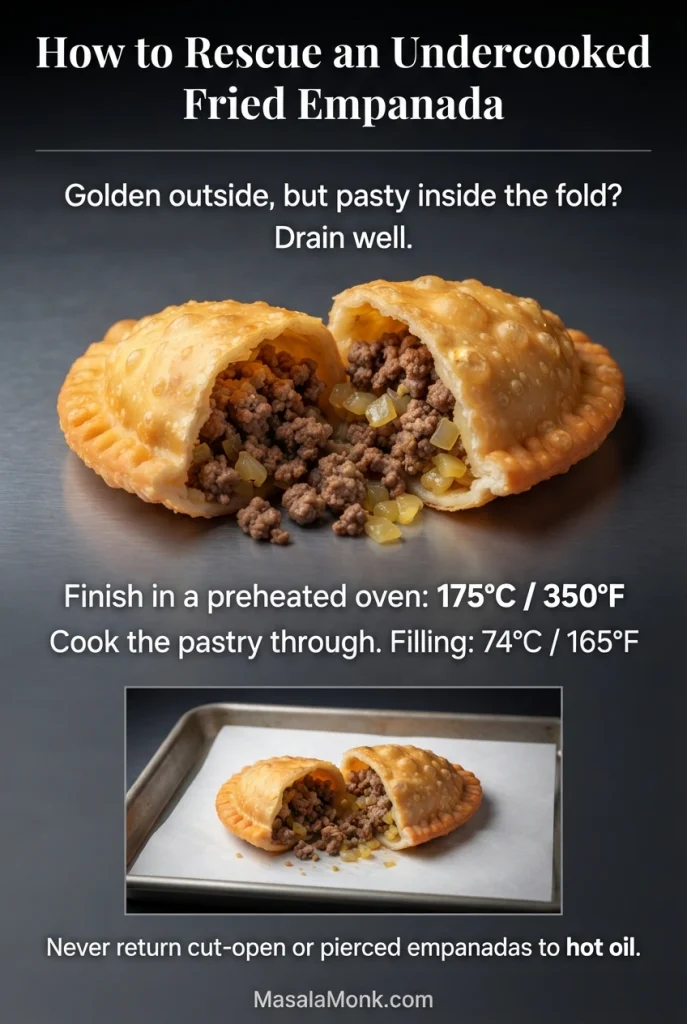
If a fried empanada is browned outside but raw at the seam, remove it from the oil and drain thoroughly. Turn off the frying heat and keep the oil attended. Transfer the empanada to an oven-safe tray and finish in a preheated 175°C (350°F) oven until the pastry is cooked and the filling reaches 74°C (165°F).
Use the oven for a pierced or cut-open test empanada too; never return it to hot oil. The exposed filling may dry out a little, but the aim is to finish cooking it safely.
Before frying more, check the oil temperature. If it is already near 175°C (350°F), the seam may be too thick. Make smaller decorative folds or use a fork seal. For greasy empanadas, drain on a rack; fry fewer at once and let the oil heat back up between batches.
Why Are My Empanadas Hollow or Mostly Pastry?
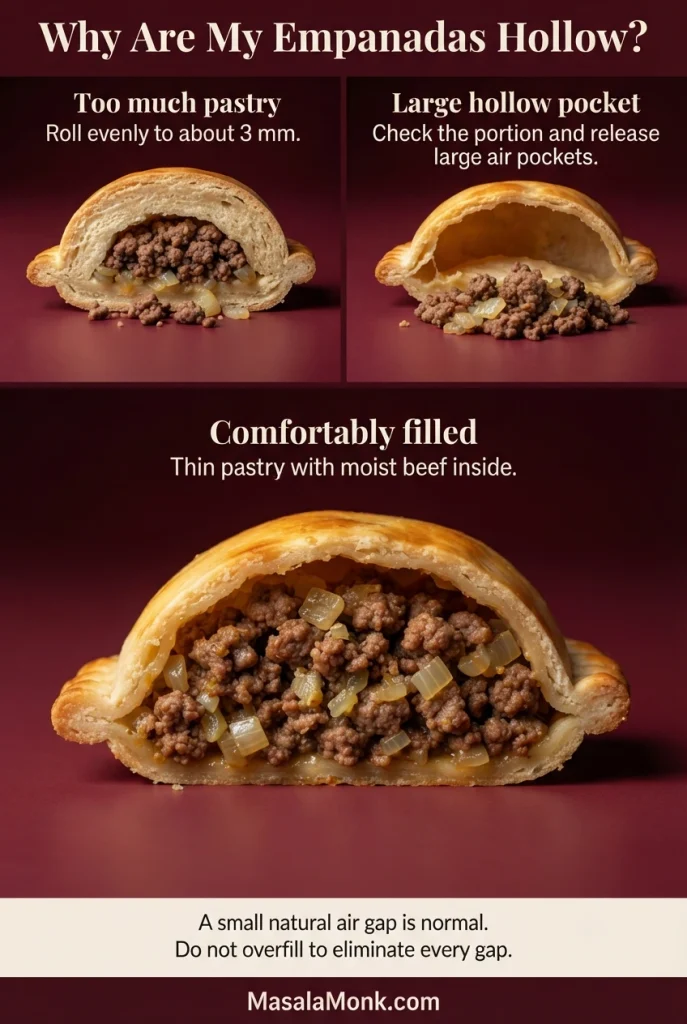
A small gap between beef and crust is normal. Larger hollow pockets can develop from trapped air, puffing pastry or filling shrinkage. If the crust dominates every bite, roll evenly to about 3 mm and gently press around the beef before sealing. Use the portion guide instead of forcing more filling inside.
Refrigerate or freeze surplus filling promptly. The seasoned beef makes a good topping for crispy tostadas or a rice bowl.
Make-Ahead, Freezing and Reheating Beef Empanadas
Make Empanadas the Day Before
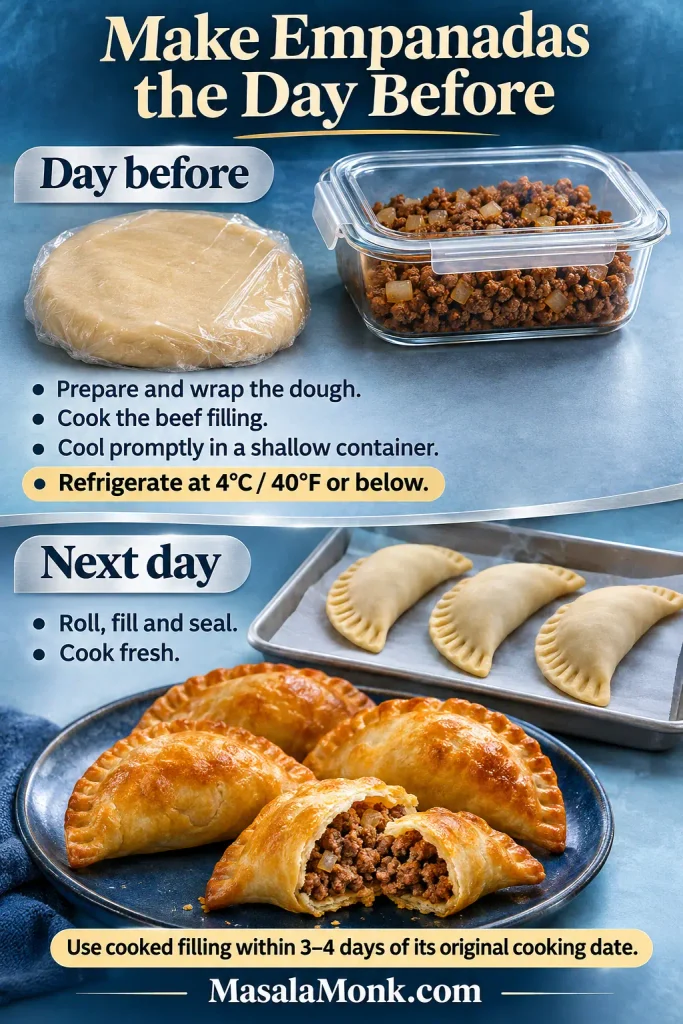
If you’re having people over, make the dough and cook the beef the night before. Refrigerate the tightly wrapped dough and chill the filling promptly in a shallow container. The next day, you can get straight to rolling and folding without waiting for a skillet of hot meat to cool.
Alternatively, assemble the empanadas the previous evening. Refrigerate covered, with parchment between layers. Cook within 24 hours for pastry quality and within the filling’s 3–4-day refrigerated storage window.
Doubling the Recipe for a Party
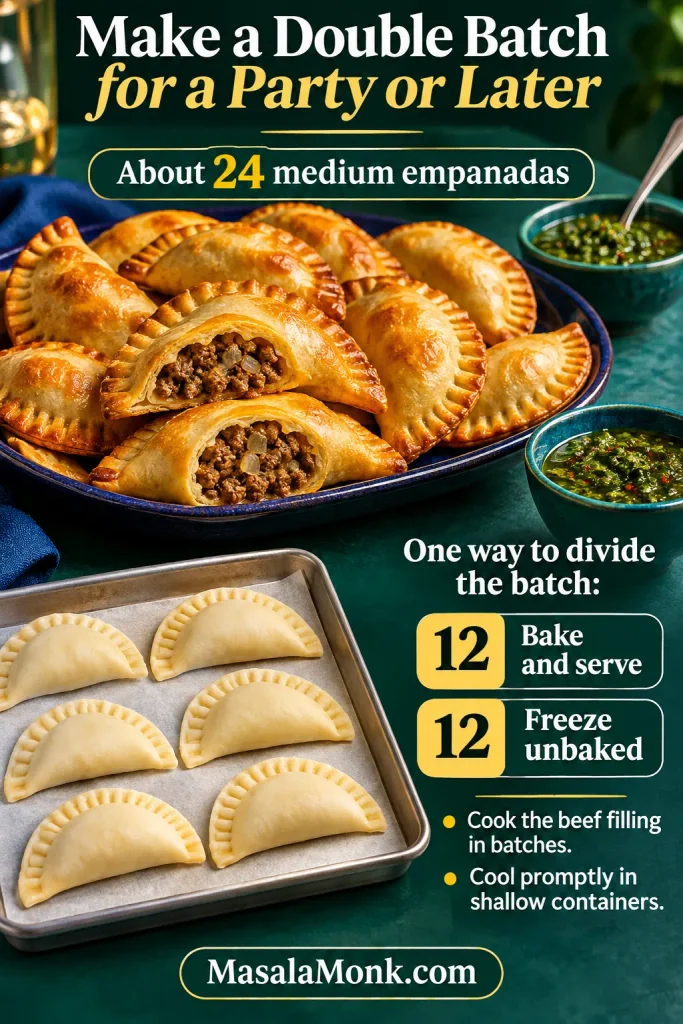
Double the recipe to make about 24 medium empanadas. Use 720 g (about 6 US cups) flour, 260 g (9.2 oz) butter, 2 eggs, 150–210 ml cold water and 10 g fine salt for the dough.
For the filling, use 700 g (24.7 oz) ground beef and 360 g (12.7 oz) peeled onion, then double the remaining ingredients. Start with the lower amount of dough water and add stock only as needed.
Cook the beef in separate batches so it has room to brown, then refrigerate promptly in shallow containers. Use the same cooking temperatures for the pastries, allowing time for extra batches.
If someone is helping, one person can roll while the other fills and seals. Alternatively, bake twelve for dinner and freeze twelve unbaked.
How to Freeze Unbaked Beef Empanadas
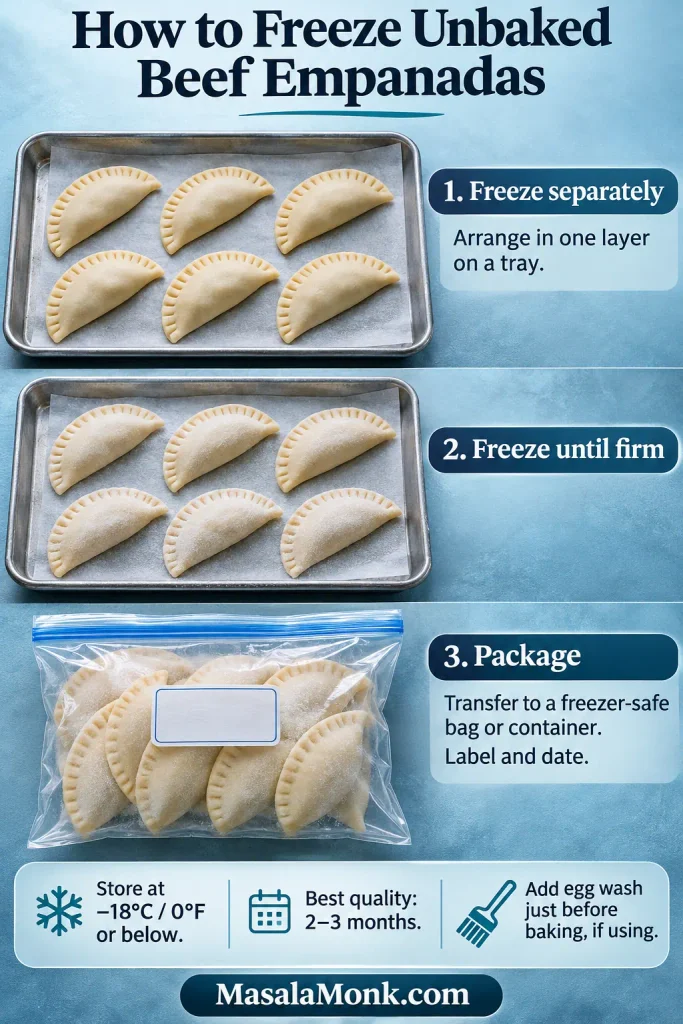
Freeze after filling and sealing but before baking or frying. The beef should already be cooked and thoroughly chilled. Use within 2–3 months for best pastry quality.
- Arrange on a parchment-lined tray in a single layer without touching.
- Freeze until firm enough to lift without losing shape.
- Transfer to a freezer-safe bag or airtight container, separating layers with parchment if necessary.
- Label and return to the freezer.
Freeze without egg wash and brush just before baking if desired. Freezing individually means you can take out two or three for lunch without defrosting the whole batch.
How to Cook Frozen Beef Empanadas
Homemade empanadas with uncooked pastry and cooked beef inside can go straight from the freezer into a preheated oven.
- Fully preheat the conventional oven to 205°C (400°F).
- Arrange frozen empanadas on a parchment-lined metal sheet, leaving space between them. Apply optional egg wash.
- Bake for an estimated 25–35 minutes, checking from 20–25 minutes. Shield tops loosely with foil if they brown before the centers heat through.
- Continue until the base and thick seam are cooked and the filling reaches 74°C (165°F).
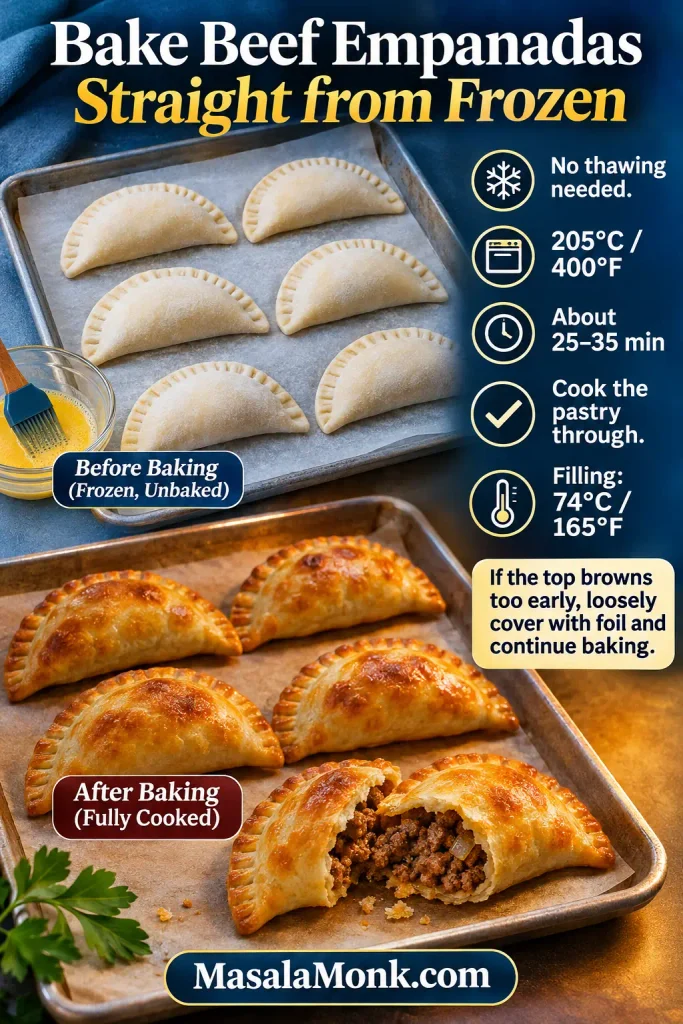
Baking is preferable for frozen homemade empanadas. To deep-fry, thaw completely in the fridge first and ensure the wrappers are intact and free from visible ice or surface water. Follow package instructions for commercially frozen empanadas.
Empanadas fully cooked before freezing need reheating instead.
How Long Do Beef Empanadas Last?
| Food | Storage |
|---|---|
| Homemade dough | Refrigerate tightly wrapped for use the next day. |
| Cooked beef filling | Refrigerate; use within 3–4 days of cooking. |
| Assembled, unbaked empanadas | Refrigerate covered; cook within 24 hours for pastry quality and within the filling’s 3–4-day refrigerated storage window. |
| Cooked empanadas | Refrigerate for 3–4 days; as a precaution, include earlier filling storage. |
| Frozen cooked or unbaked empanadas | Use within 2–3 months for best quality. |
If the filling spent two days in the fridge before assembly, don’t automatically allow another four days after baking. As a precaution, count from when the meat was first cooked, excluding time kept frozen.
Keep the fridge at or below 4°C (40°F) and freezer at or below −18°C (0°F). Refrigerate perishables within two hours, or one hour above 32°C (90°F). Freeze while still within the safe refrigerated storage period.
Cool cooked food in shallow containers, following FoodSafety.gov food handling guidelines. Returning food to the fridge does not reset its cumulative time at room temperature.
Use refrigerated raw ground beef within one or two days of purchase, or sooner if the use-by date requires it, or freeze promptly. At parties, replenish smaller platters and keep the rest chilled or hot at 60°C (140°F) or above. The same precautions apply to packed lunches and picnics.
How to Reheat Beef Empanadas Without Making Them Soggy
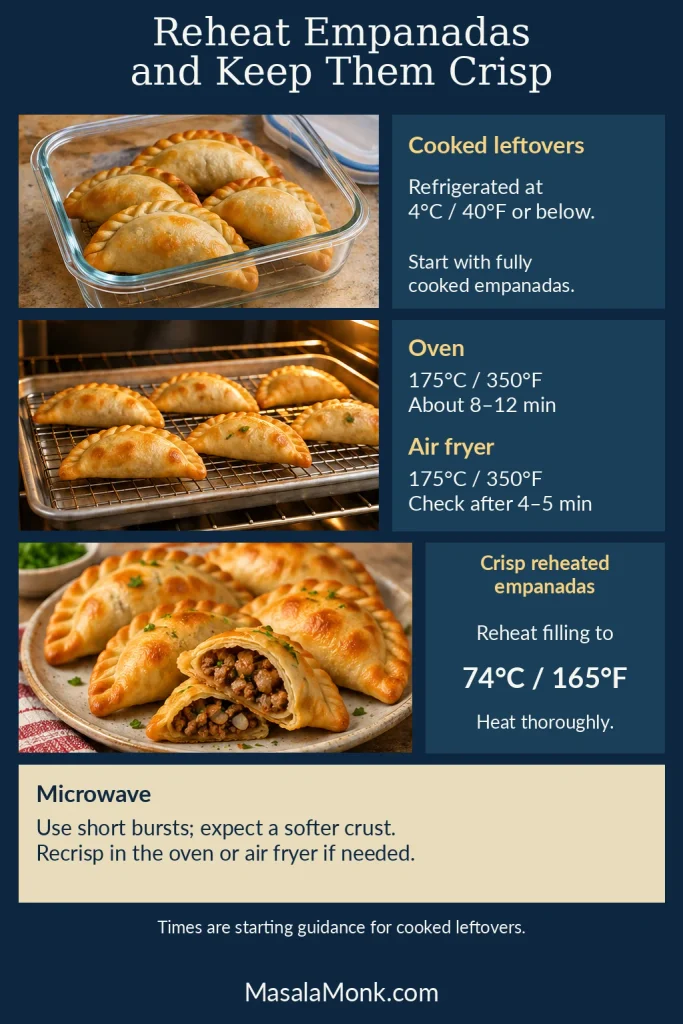
The oven or air fryer helps restore the crust. Start with these settings for refrigerated, fully cooked empanadas:
- Oven: Heat at 175°C (350°F) for about 8–12 minutes on a baking sheet.
- Air fryer: Heat at 175°C (350°F), checking after 4–5 minutes.
- Microwave: Heat in short intervals. The crust will soften, so finish briefly in the oven or air fryer if you want it crisp.
For fully cooked frozen empanadas, thaw in the refrigerator until completely thawed and use the same methods. Alternatively, reheat directly from frozen in a 175°C (350°F) oven, allowing longer and shielding the tops loosely with foil if they brown too early.
Whichever method you choose, reheat leftovers to 74°C (165°F) at the center. Rest briefly on a rack before eating.
Frequently Asked Questions About Beef Empanadas
Do You Cook Ground Beef Before Putting It in Empanadas?
Yes, for this recipe. Cooking first lets you season the beef, remove excess liquid and bring ground meat to 71°C (160°F). Refrigerate promptly until cold before filling the wrappers.
Can I Use Leftover Cooked Beef Instead of Ground Beef?
Safely stored leftover beef works too. Finely chop or shred it. Cook onions, garlic and spices separately, refrigerate promptly until cold, then mix with the beef and a little stock if dry. There is no need to reheat the meat before assembly. Cook the finished empanadas to 74°C (165°F) at the center, counting earlier refrigerated storage time.
Can I Use Ground Turkey Instead of Beef?
Ground turkey also works. Keep the softened onion and add a little stock if the turkey looks dry. Cook ground turkey to at least 74°C (165°F), then refrigerate promptly until cold. Heat the filling to 74°C (165°F) again when cooking the assembled empanadas.
Can You Bake Empanadas Without Egg Wash?
Egg wash is optional. It adds color and shine, but the empanadas can develop a golden crust without it. Keep the egg mixed into the homemade dough, since it helps the pastry hold together when folded.