
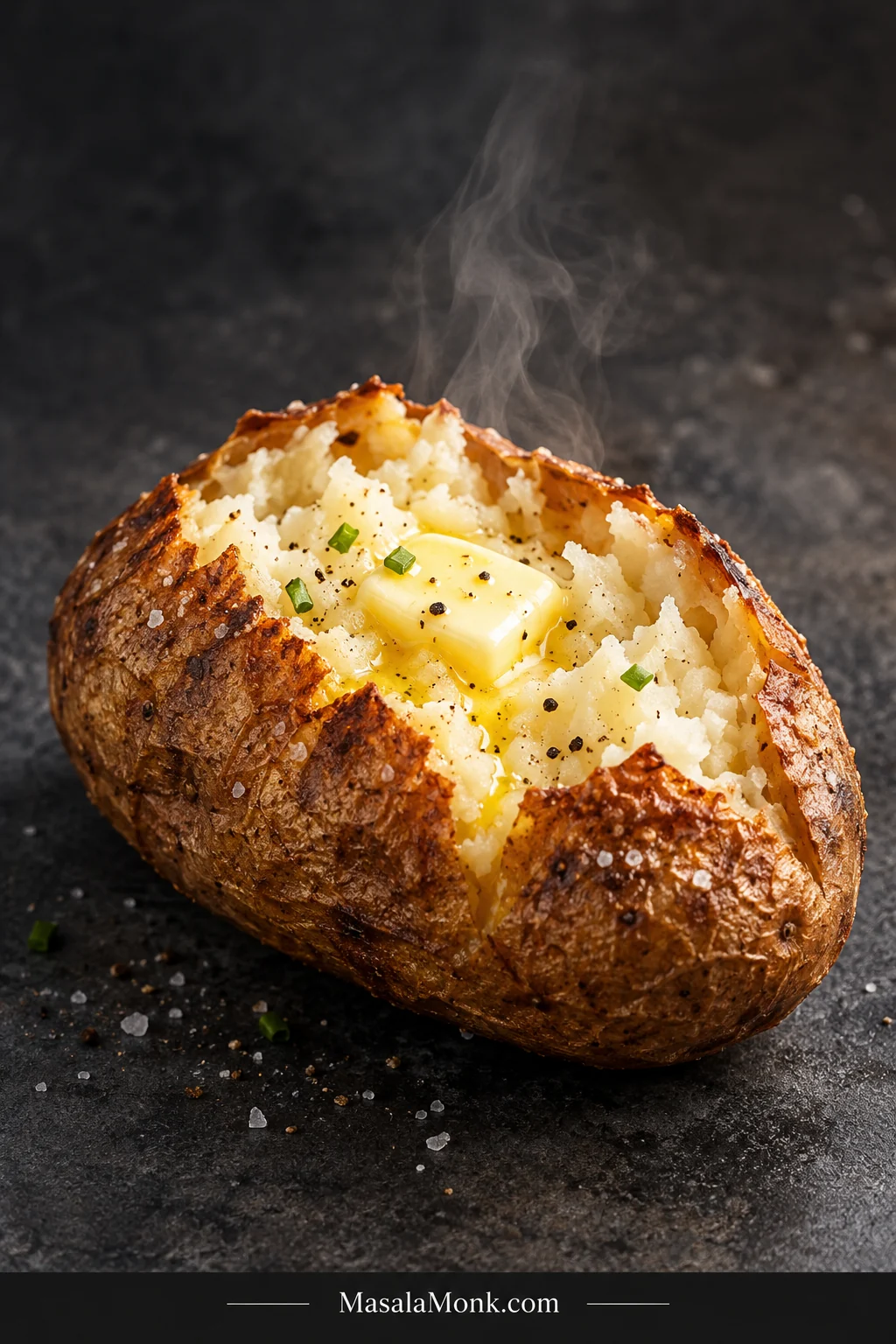
A great baked potato should make the skin worth eating. It should come out crisp and salty on the outside, then split open to reveal a hot, loose, fluffy center rather than a firm white core that somehow survived an hour in the oven.
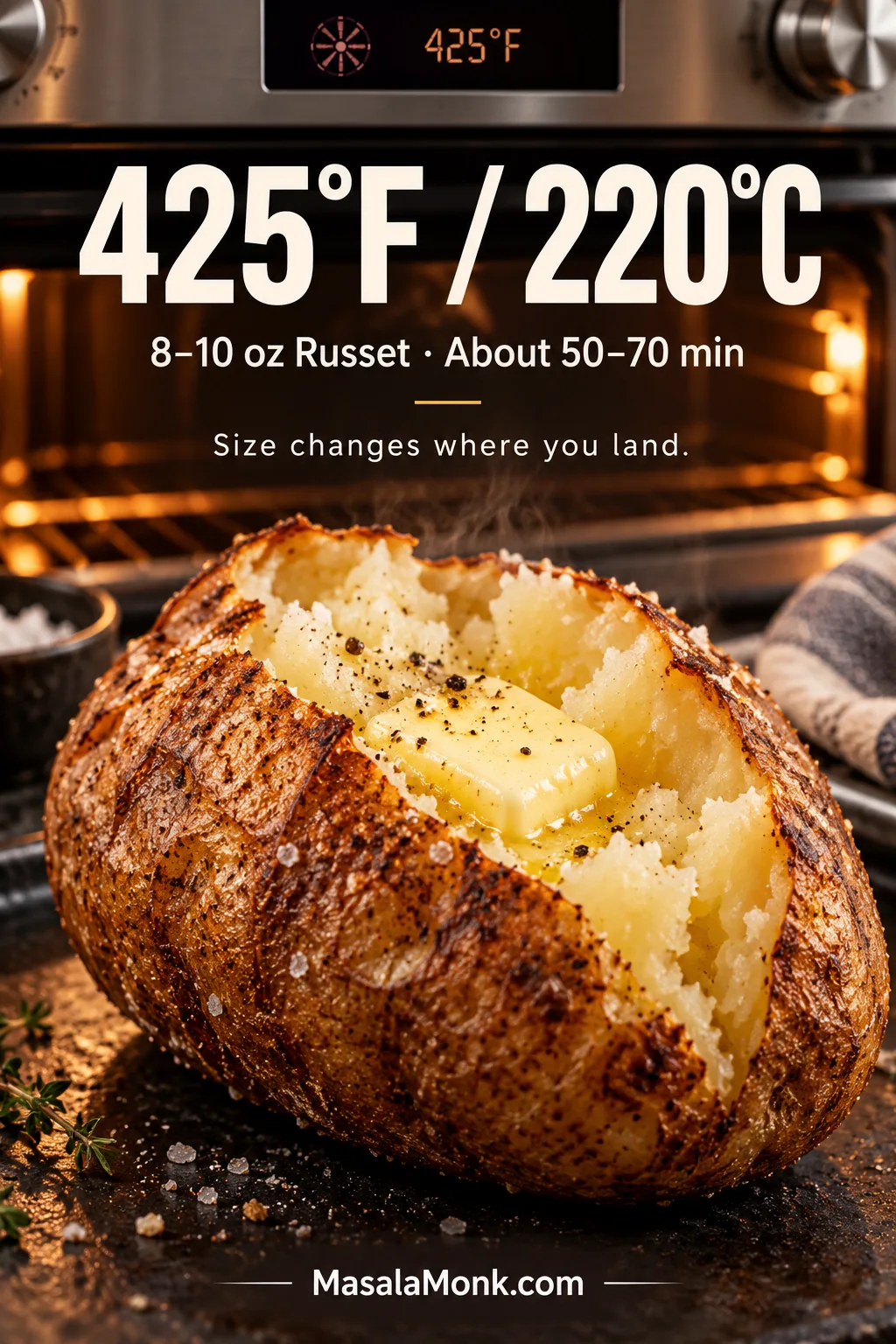
For crisp skin and a fluffy middle, use medium-large Russet potatoes, rub them lightly with oil and salt, and bake them uncovered at 425°F / 220°C for roughly 50–70 minutes.
A 7-ounce potato and a 15-ounce potato may both be sold as “baking potatoes,” but they do not belong on the same timer. For the potatoes used in this baked potato recipe, start checking around 50 minutes. If a fork still meets a firm middle, keep baking.
Crispy-Skin Baked Potato Recipe
Russet potatoes baked uncovered until the skins are crisp and the centers are soft, steaming and easy to fluff with a fork.
Equipment
You need a fork, a rimmed baking sheet and an oven mitt or clean kitchen towel. An oven-safe wire rack and instant-read thermometer are useful but optional.
Ingredients
- 4 firm medium-large Russet potatoes, about 8–10 oz (225–285 g) each, similar in size and without soft spots or obvious green areas
- 2 teaspoons (10 mL) olive oil or neutral cooking oil
- 1–1½ teaspoons coarse kosher salt, enough for a light coating; use less if your salt is fine
- Butter, black pepper and a little extra salt, for serving, optional
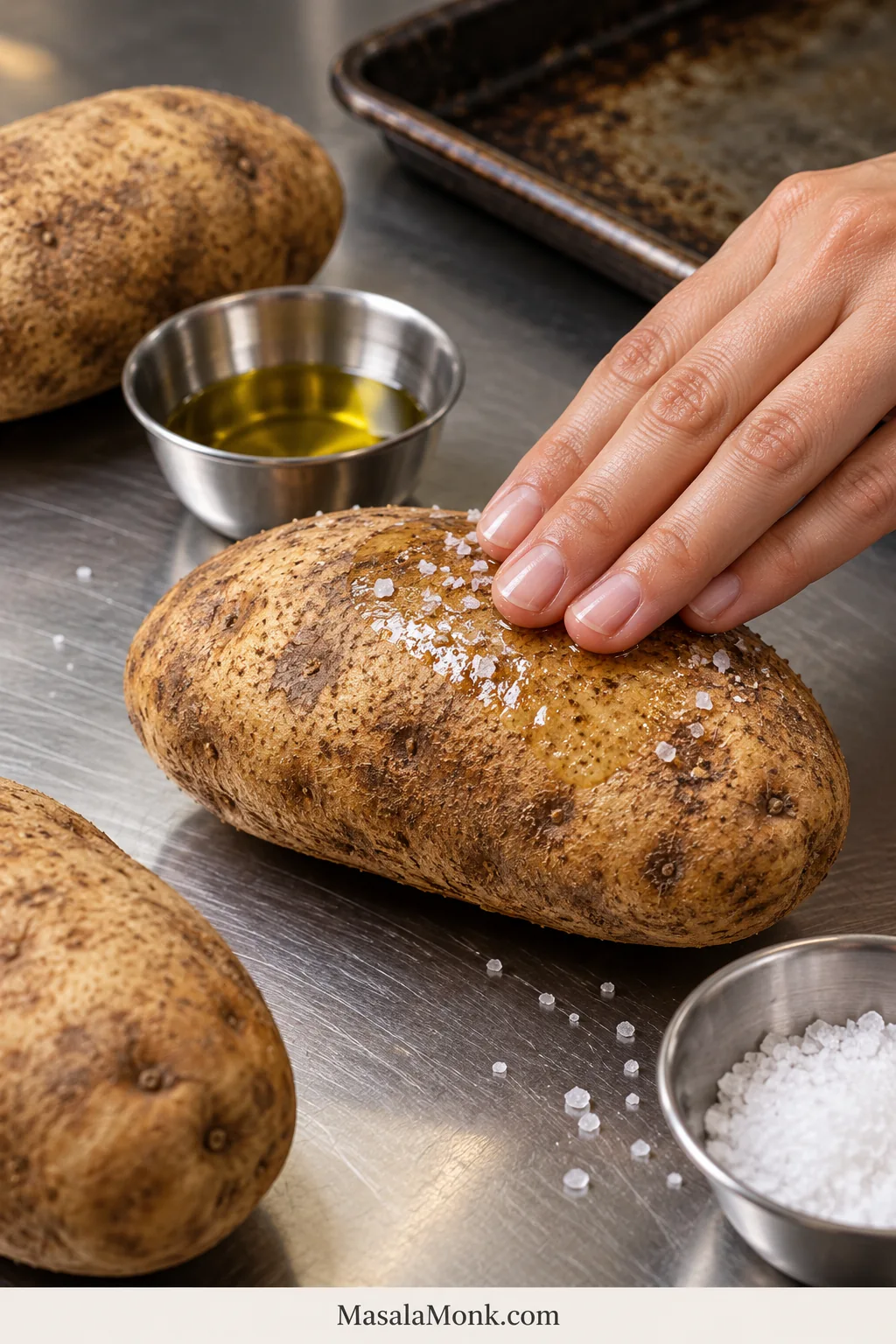
Before you start: choose potatoes close in size and weight. The largest one will usually set the pace.
Instructions
- Heat the oven. Preheat a conventional oven to 425°F / 220°C. For a fan or convection oven, about 400°F / 200°C is a useful starting point. Set a wire rack over a rimmed baking sheet if you are using one.
- Scrub and dry. Wash the potatoes well, then towel them completely dry. A wet skin has to lose that moisture before it can crisp.
- Pierce them. Prick each potato about 5–6 times with a fork so steam has several escape routes as the potato heats.
- Add oil and salt. Rub the potatoes with just enough oil to leave a thin film, then scatter the coarse salt over the skins. They should look lightly coated, not wet or heavily slicked with oil.
- Bake uncovered. Put the potatoes on the wire rack. No rack? Place them directly on the oven rack with the rimmed baking sheet below to catch drips, or use the baking sheet itself and turn them once. Begin testing at about 50 minutes; many potatoes this size finish somewhere in the 50–70 minute range.
- Test the middle. Press gently through an oven mitt. The potato should give under your fingers, and a fork should slide through the thickest part without suddenly meeting a firm core. If you like using a thermometer, aim for about 210°F / 99°C in the center.
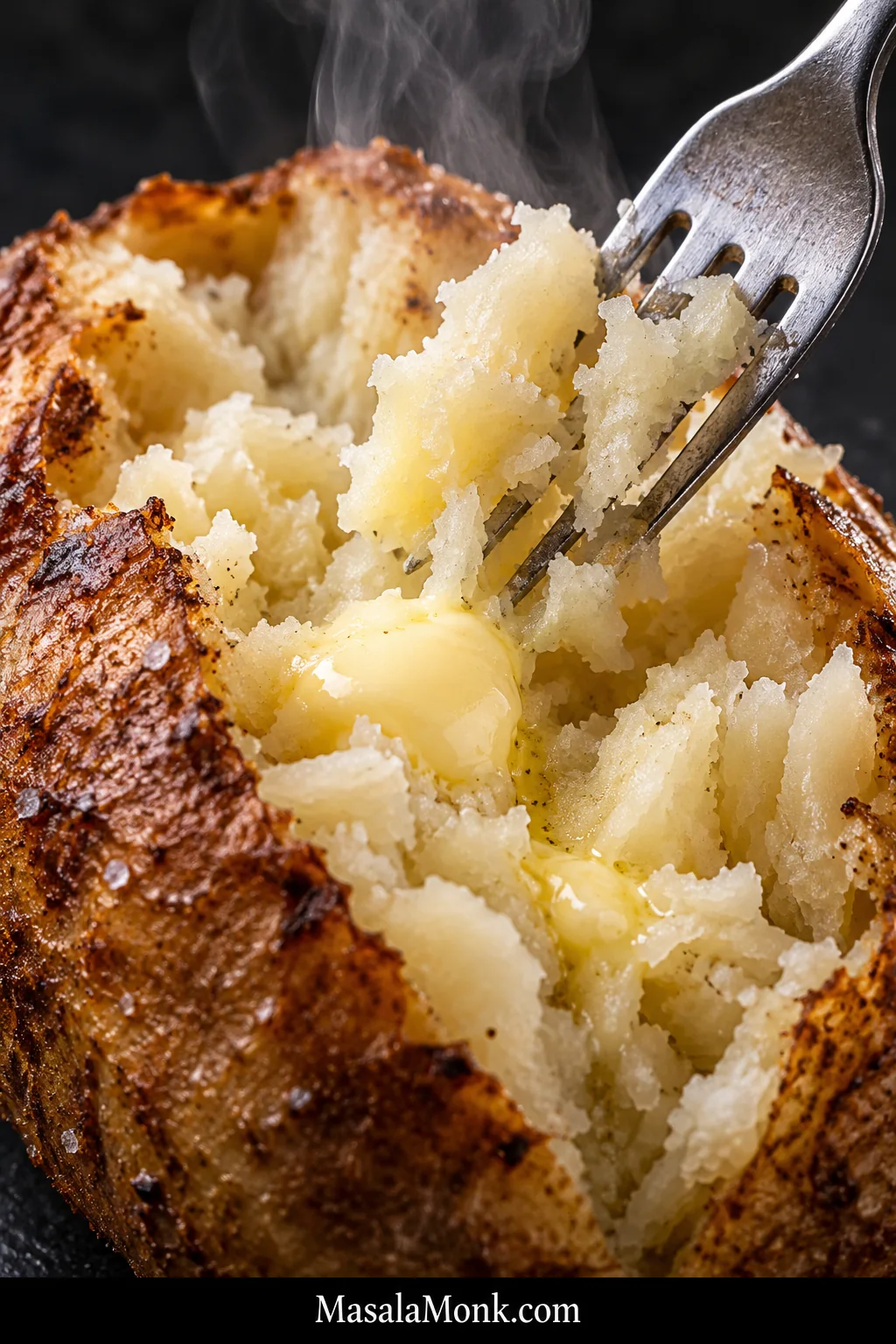
- Open and fluff while hot. With a fork, prick a short line across the top, then a second line across it to make a small cross. Press the ends gently toward the center so the potato opens and the fluffy flesh pushes upward. Rough it up with the fork, season with a little salt and black pepper, and add butter or your chosen toppings while everything is still steaming.
Recipe Notes
- Very large potatoes: expect them to need longer than the recipe range. Let the middle decide when they are done.
- For even crisper skin: use the short finishing method in Crisp Skin Without Turning Tough.
Baked Potato Guide
Best Potatoes for Baking and Why Size Matters
Russets are the best choice for the classic fluffy baked potato. Their high-starch, relatively dry flesh breaks into a light, loose center, while the thicker skin handles a hot oven well. That is one reason the Idaho Potato Commission recommends Russet-type potatoes for baking.
Yukon Gold and red potatoes bake perfectly well too, but their flesh stays naturally creamier and denser. That same starch difference matters in mashed potatoes, where Russets turn lighter and Yukon Golds stay naturally creamier.
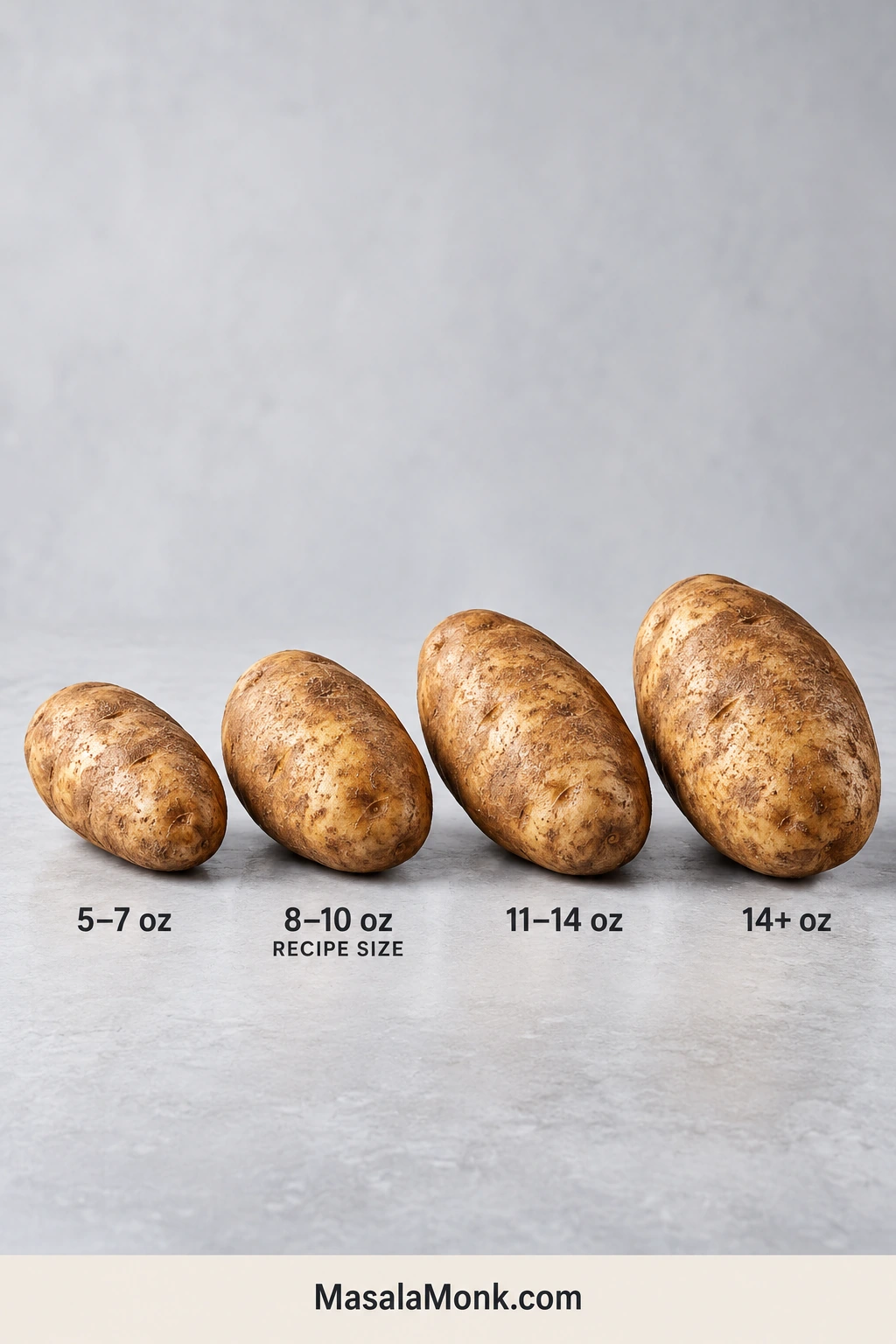
A supermarket “baking potato” might weigh 6 ounces or well over a pound, which is why one fixed cooking time causes so much frustration.
| Potato size | Approximate weight | At 425°F / 220°C |
|---|---|---|
| Smaller | 5–7 oz / 140–200 g | Check from about 40–45 minutes |
| Recipe size | 8–10 oz / 225–285 g | Check from about 50 minutes |
| Large | 11–14 oz / 310–400 g | Start looking around 60 minutes |
| Jumbo | More than 14 oz / 400 g | Plan on considerably longer |
These are checking points, not deadlines. Your potato may still need another 10 or 15 minutes.
How Long to Bake a Potato
For the 8–10 oz Russets used here, 425°F / 220°C usually means about 50–70 minutes total. At other temperatures, use the ranges below as a starting point.
If something else is already in the oven, use the temperature you have. The potato can work around dinner; our baked chicken breast, for example, also cooks at 425°F / 220°C, although the chicken will finish much sooner.
- 350°F / 175°C: plan on roughly 75–90 minutes, sometimes longer.
- 375°F / 190°C: roughly 65–80 minutes.
- 400°F / 205°C: roughly 55–70 minutes.
- 450°F / 230°C: start checking around 45 minutes; the skin cooks more aggressively at this heat.
- About 400°F / 200°C fan or convection: begin checking earlier than in a conventional oven, often from about 45–50 minutes.
How to Tell When a Baked Potato Is Done
If you like using a thermometer, a fully baked Russet is usually around 210°F / 99°C in the center. You do not need one, though. The potato should feel soft and offer almost no resistance through the middle.
- Squeeze: use an oven mitt and press gently. The potato should give under your fingers.
- Probe: a fork should slide through the thickest part without suddenly meeting a firm white core.
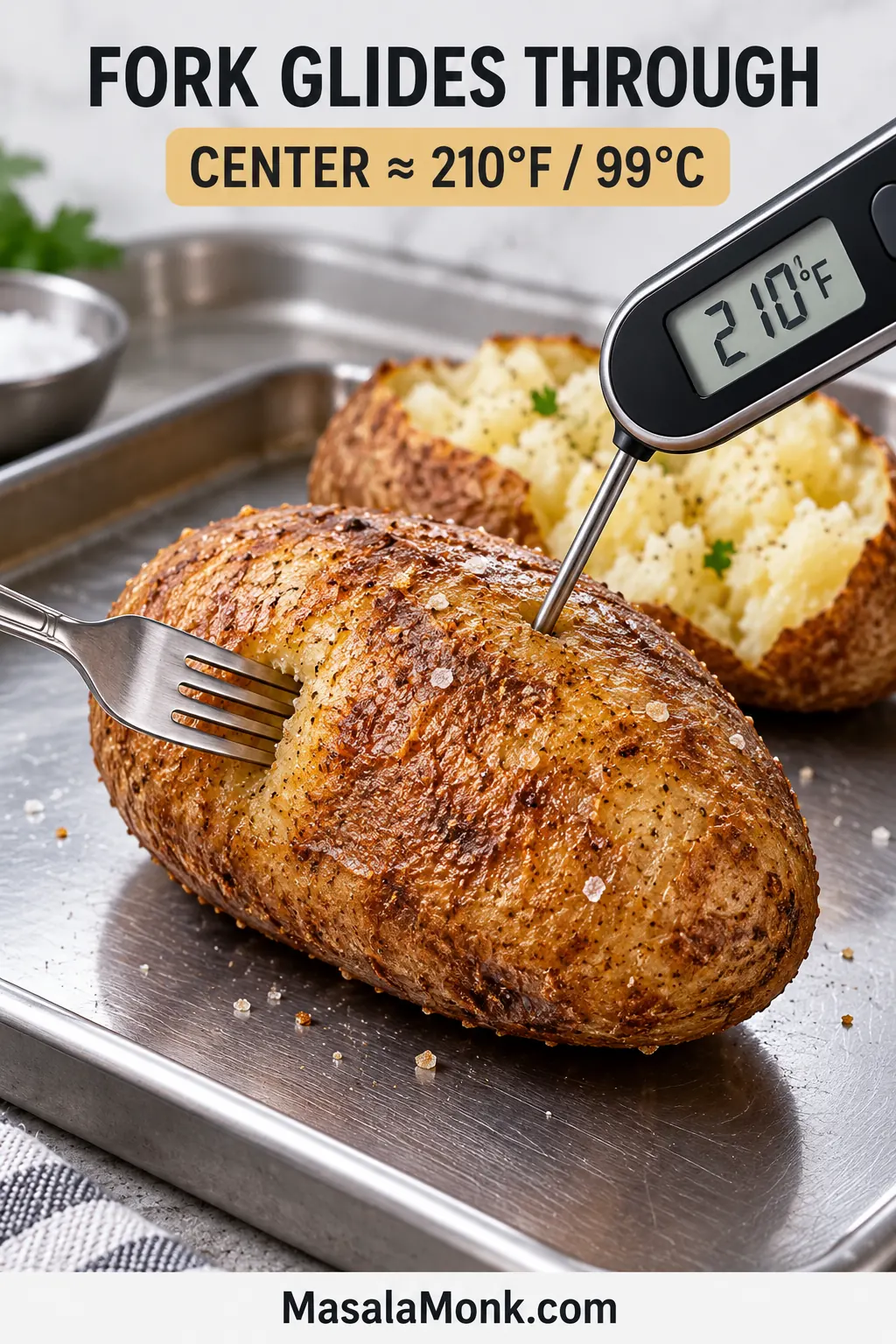
If the fork stops in the middle, it needs more oven. Give it another 10 minutes and try again. If the outside is already deeply browned while the center stays firm, use the troubleshooting guide below.
When it is truly ready, the opened center should separate easily under a fork. Butter will melt into those rough, fluffy edges instead of sitting on top of a dense slab of potato.
Foil Makes a Different Potato
No—do not wrap a baked potato in foil if you want crisp skin. Foil traps steam around the surface and keeps the skin softer.
Prefer soft skin? Foil will give you that. It will not make a very large potato cook through faster.
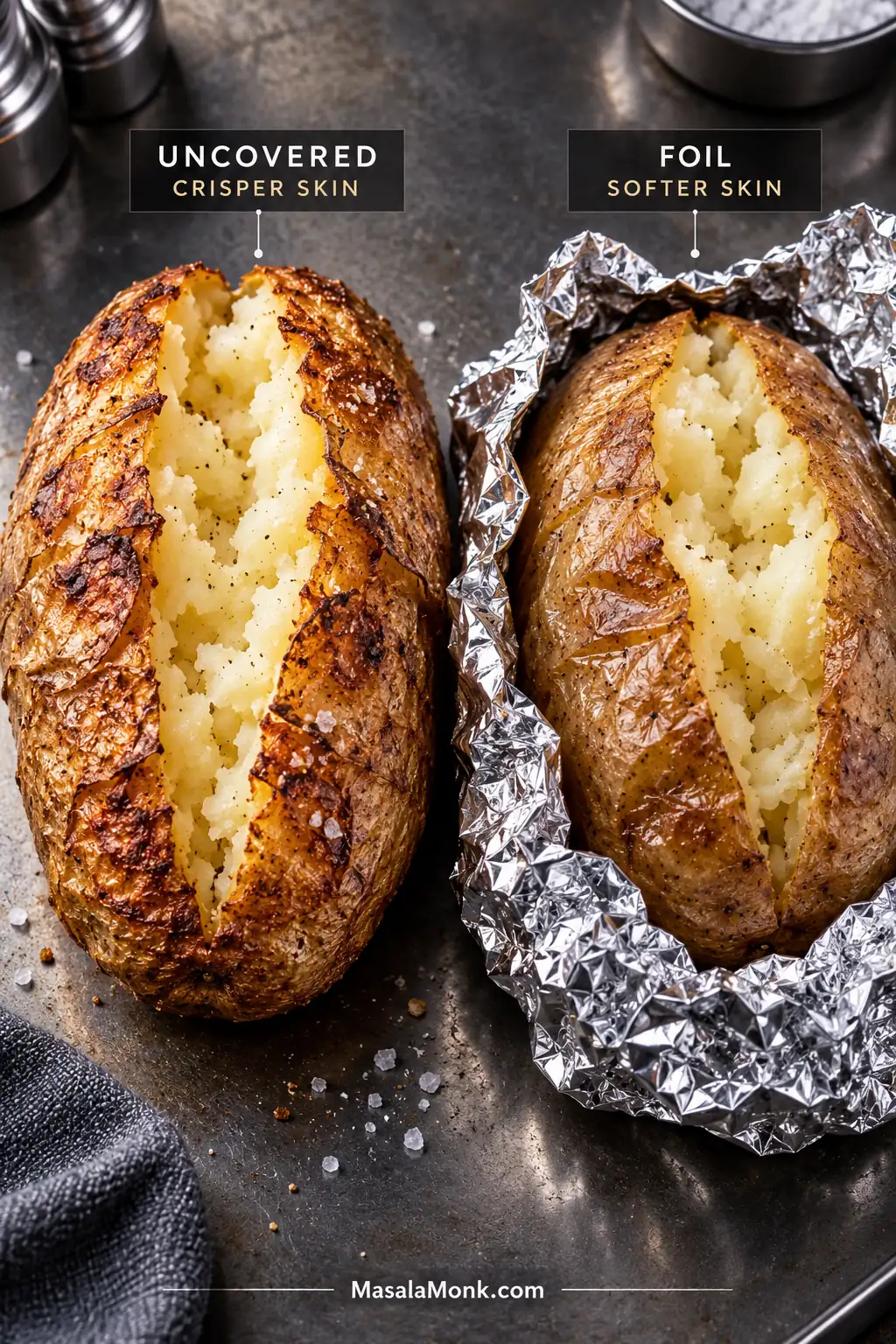
If you prefer the softer skin that foil gives, serve the potatoes promptly. If they are not being served soon, do not leave them wrapped at room temperature; loosen or remove the foil and refrigerate them promptly.
Crisp Skin Without Turning Tough
Soft skin is usually a moisture problem. Tough skin is usually a time problem.
A potato that went into the oven damp, was wrapped in foil or sat covered after baking is likely to stay soft. Leathery skin usually means the potato stayed under heat too long after the center was already cooked.
A wire rack helps hot air reach the underside. On a regular baking sheet, turn the potatoes once and keep going. When the skin is right, it should feel dry and crisp rather than damp or tacky. Serve it fairly soon and leave it uncovered so trapped steam does not soften that surface again.
Extra-crisp finish: when the center is ready but the skin is not, brush on a very thin film of oil and return the potato to the hot oven for about 5 minutes. Check the skin, then give it a few more minutes only if needed.
Hasselback potatoes take the crisp-edge idea further, with thin roasted ridges surrounding a soft center.
Baked Potato Troubleshooting
Something went wrong? Start with what the potato is doing, not what the clock says. Use the symptom that matches it below.
| What happened | What it usually means — and what to do |
|---|---|
| Hard center | The potato is undercooked or larger than expected. Give it another 10 minutes, then probe the thickest part again. |
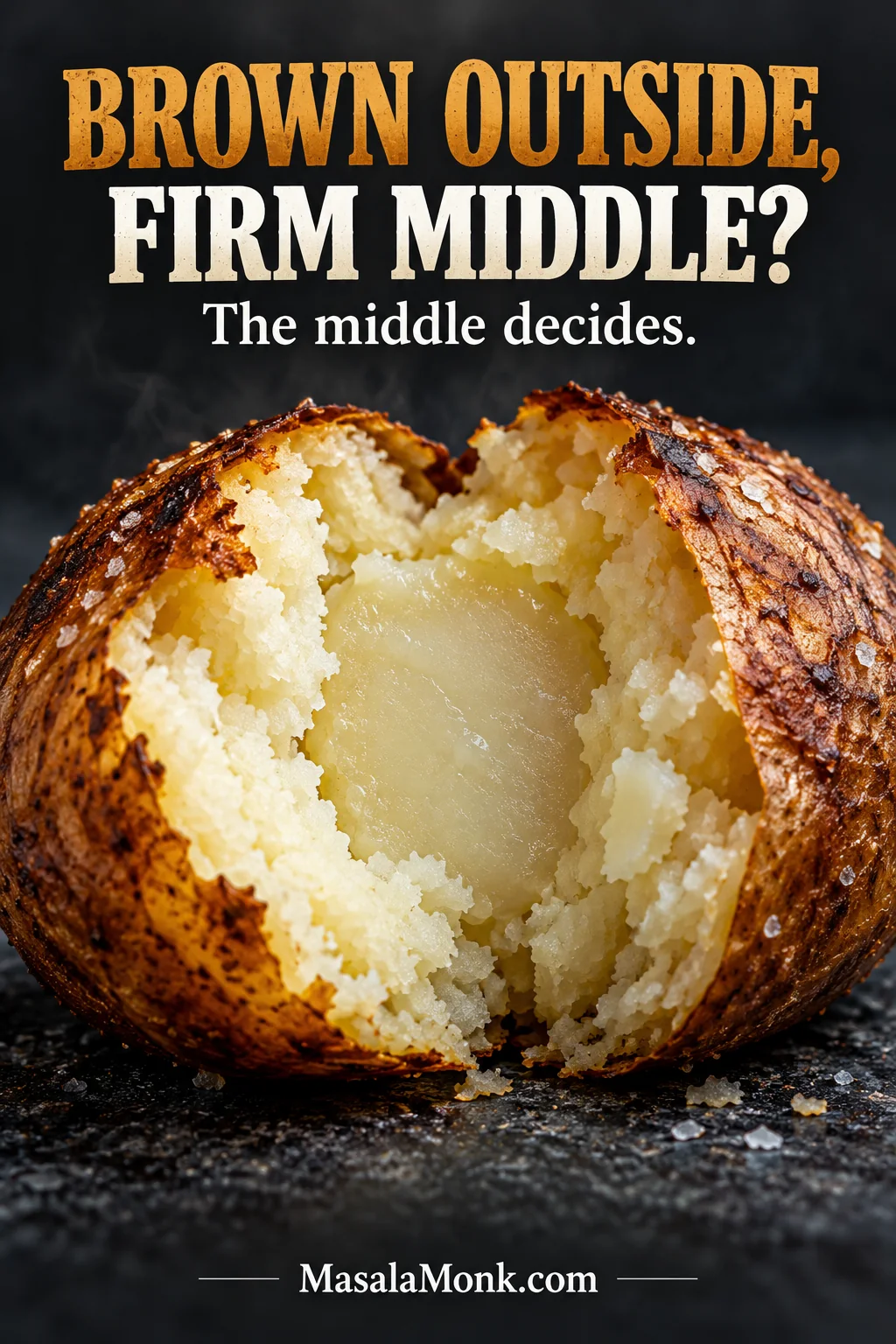
| Brown skin, firm middle | The potato may be larger than expected, or the oven may be running hot. Keep cooking until the middle is tender; if ordinary-size potatoes repeatedly brown too early, check the oven temperature. |
| Tender but not fluffy | The potato may simply be lower in starch or higher in moisture. More oven time will not turn waxy flesh into a floury Russet. |
| Soft or soggy skin | Look for trapped moisture: damp skin, foil or prolonged covered holding. |
| Leathery skin | The potato may have baked too long or stayed hot after the center was already ready. |
| Soft bottom | Long contact with a solid baking sheet can do this. Turn the potato once next time or use a wire rack. |
| Smoking oven | There is probably too much oil dripping from the potatoes. They only need a thin film. |
| One potato finishes much earlier | Take it out. Potatoes vary, even when they look similar. The others can keep cooking. |
| Everything takes much longer than expected | Check the potato weight first. If ordinary-size potatoes consistently run late, an inexpensive oven thermometer can tell you whether your oven is actually reaching the temperature on the dial. |
Quick Microwave-to-Oven Method
For a faster baked potato, let the microwave cook most of the center, then let the oven crisp the skin.
- Pierce the potato several times with a fork.
- Microwave on high for about 5 minutes, turn it, then continue in 1–2 minute bursts until the middle has begun to soften but is not fully tender. Feel the potato between bursts; microwave power varies.
- Dry the skin, then add a thin coat of oil and salt.
- Finish in a 425°F / 220°C oven until the skin is crisp and the center is soft, usually another 15–25 minutes depending on how far the microwave took it.
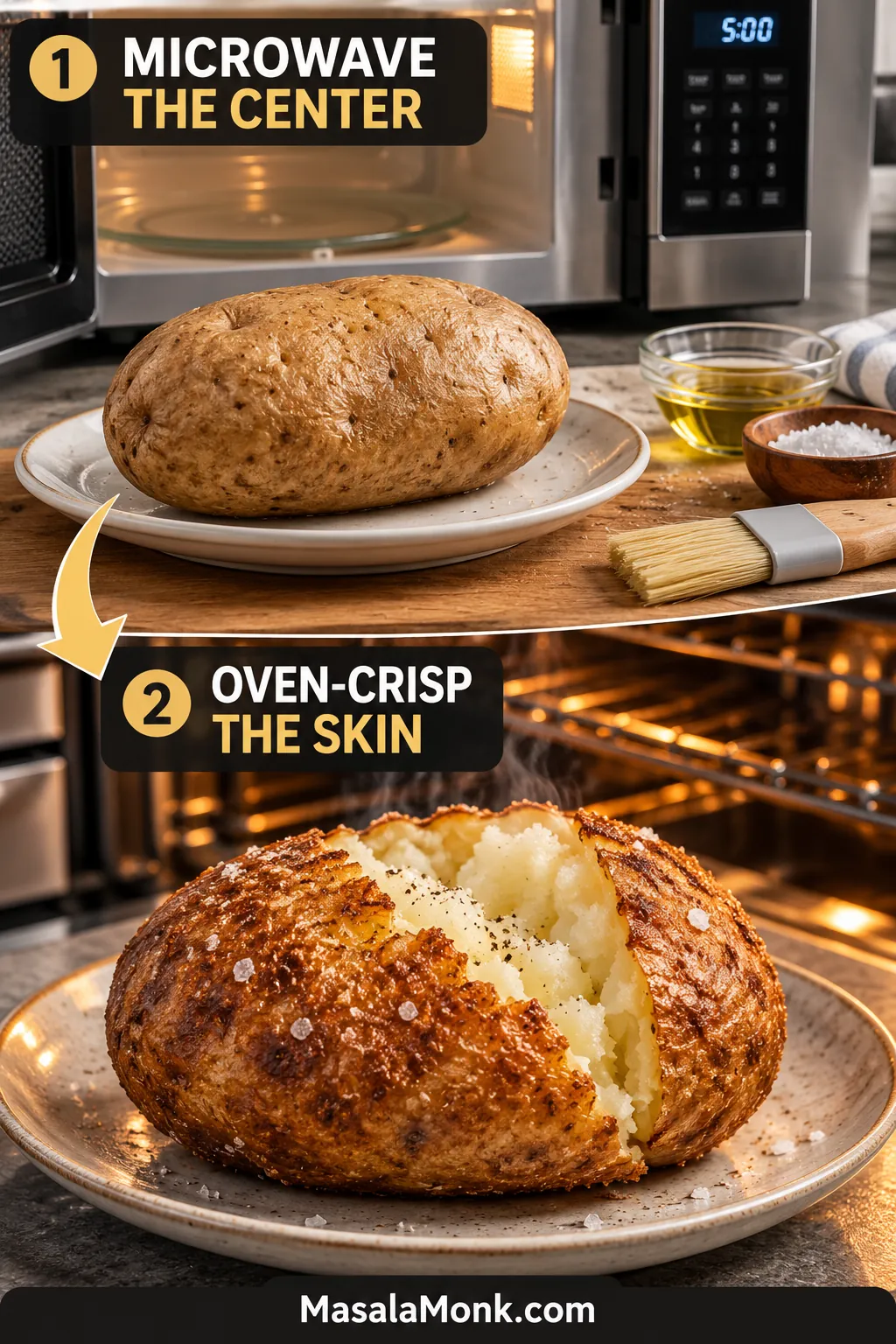
A microwave-only potato is faster still, but the skin stays softer. The oven finish is what brings the contrast back. For the conventional oven route, compare the full baking times and temperatures.
Baking Potatoes for a Crowd
Twenty potatoes do not bake like four. Loading the oven with that many cold potatoes temporarily pulls down the temperature and leaves less room for hot air to circulate. A large batch can take quite a bit longer, so if the potatoes need to be on the table at a fixed time, start earlier rather than relying on the four-potato timing.
Choose potatoes close in weight and keep them in single layers with space around them; do not pile or stack them in a deep pan. Rotate pans between racks if your oven heats unevenly. There is no reliable “add 10 minutes per tray” rule, so check the potatoes and remove them individually as they finish.
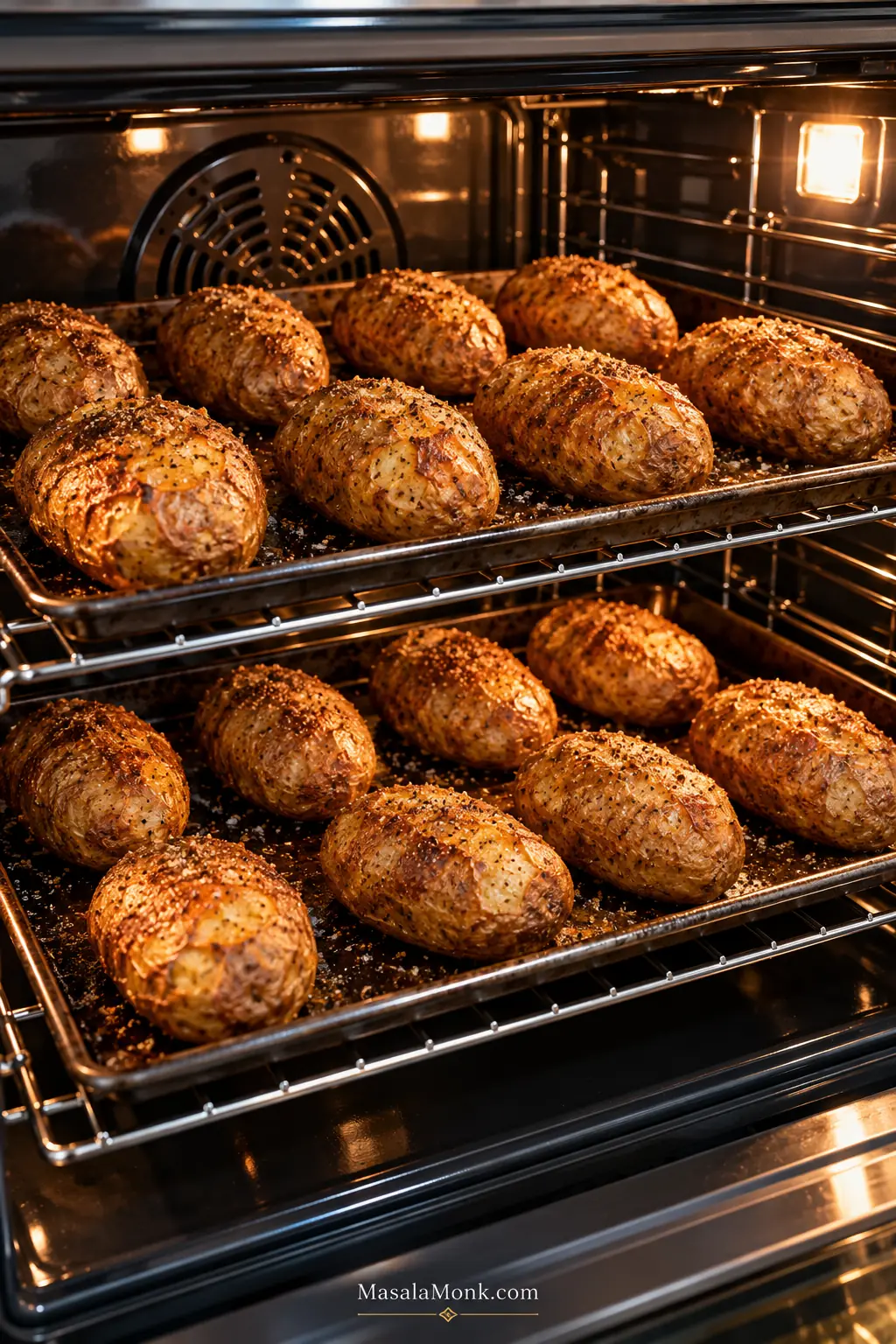
If service will stretch over a long window, bake in waves instead of holding every finished potato hot for hours; crisp skin and freshly fluffed centers both deteriorate as they sit. For a self-serve spread, the topping ideas below work well. With a very large batch, a twice baked potato casserole can also be easier to serve than dozens of individual potatoes.
Baked Potato Toppings
Add butter while the potato is still steaming, then season the fluffy center before piling anything else on top.
Keep It Classic
- Butter + black pepper
- Sour cream + chives
- Sharp cheddar + scallions
- Bacon + sour cream + chives
Make It Dinner
- Crockpot chili + sharp cheddar + sour cream
- Broccoli + cheddar + black pepper
- Shredded chicken + cheese + scallions
- Seasoned beans + salsa or pico de gallo
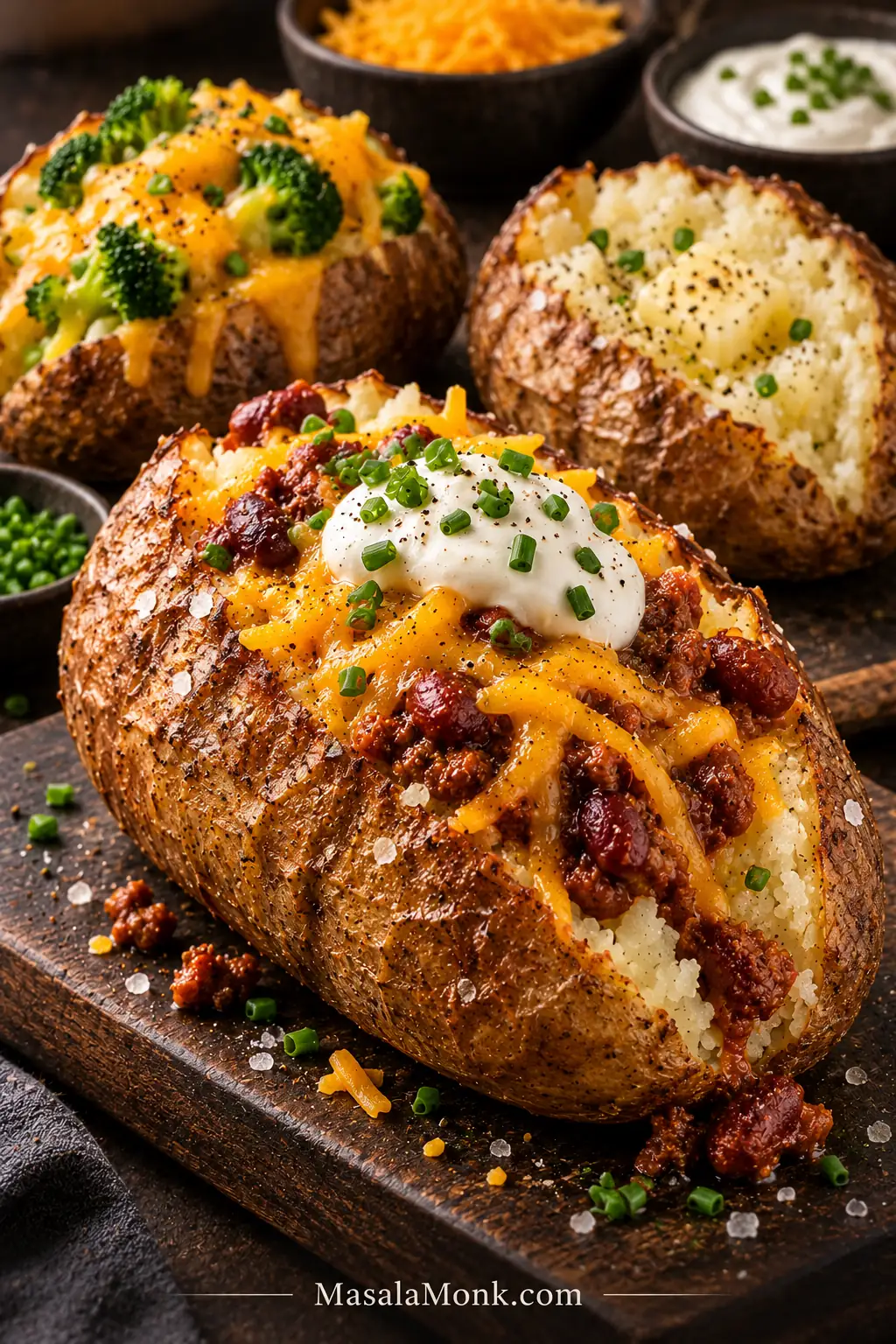
As a side, baked potatoes work with steak, roast chicken, salmon and pork. Something with sauce is especially good: the onion gravy from these smothered pork chops runs straight into the fluffed center.
Storage and Reheating
For leftovers, refrigerate the potatoes promptly rather than leaving them on the counter until completely cold. If they were wrapped in foil, loosen or remove it before refrigerating so the potatoes are not stored tightly wrapped.
USDA leftovers guidance recommends refrigerating cooked food within 2 hours and generally using refrigerated leftovers within 3–4 days.
- Best for the skin: reheat a whole medium potato unwrapped at 350°F / 175°C for about 15–20 minutes, then check the center.
- Faster with some crispness: use an air fryer at 350°F / 175°C and begin checking around 5 minutes. Larger potatoes will need longer.
- Fastest: use the microwave. It heats the potato quickly, but the skin will soften.
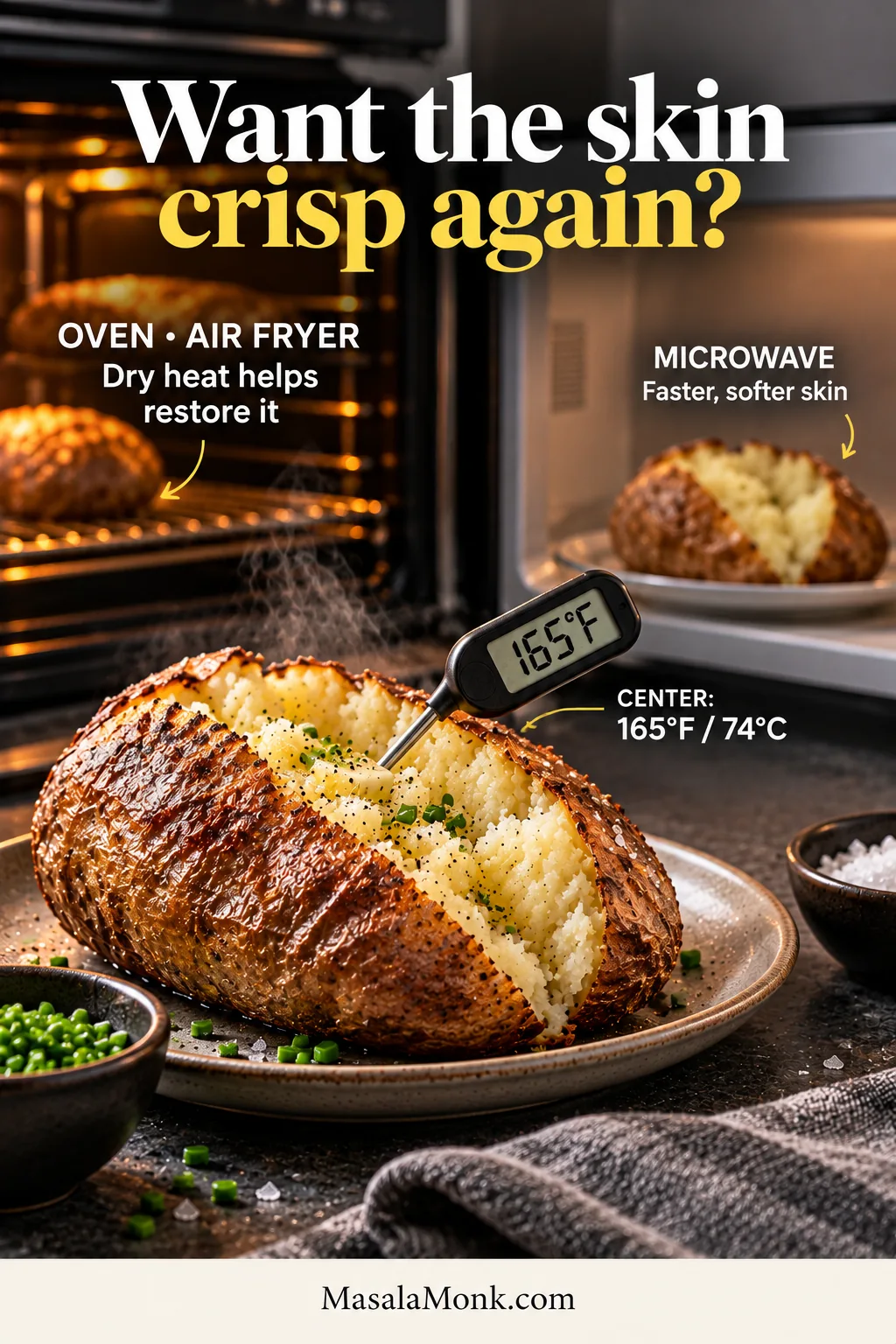
Whichever method you use, reheat the center to 165°F / 74°C rather than relying on the clock alone.
A leftover potato also gives you another option: scoop out the center, season the filling and turn it into twice baked potatoes instead of trying to recreate the first night’s skin.
Once the texture is right, a baked potato does not need much. Crack open the crisp skin while it is hot, rough up the center with a fork, add butter and let the potato do the rest. If the middle is fluffy and the skin is worth eating, you have done the important part.








