
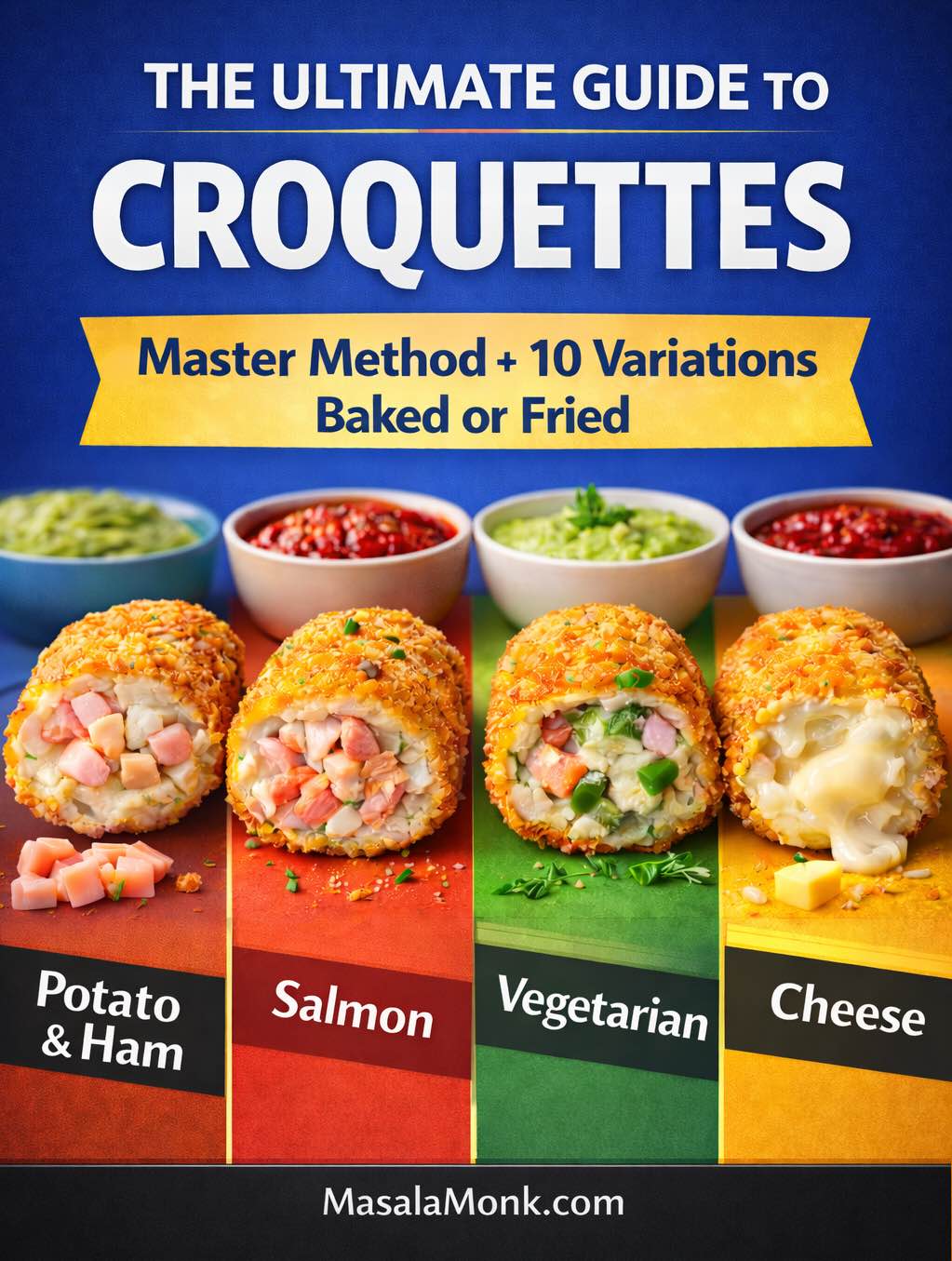
This post was updated on:
A good croquette should crackle when you bite into it, then give way to a soft, savory center. The frustrating batches usually fail for ordinary reasons: the filling is too warm or wet, the coating is loose, the croquettes skip their chill, or the cooking temperature is off.
Start with the classic potato version below, then use the same logic to understand the rest of the family: creamy Spanish béchamel croquetas, fish and poultry fillings, vegetable and vegan versions, and the choice between frying, baking and air frying. Once you know what a croquette filling should feel like, changing the filling stops feeling like starting over.
Quick Answer: What Is a Croquette?
A croquette is a small portion of seasoned filling that is shaped, usually coated in breadcrumbs, and cooked until crisp outside. The center changes by style: potato croquettes are fluffy and sturdy, Spanish croquetas use a thick chilled béchamel for a creamy center, while fish, chicken and vegetable versions often use potato or another binder to control moisture and hold their shape.
Whatever the filling, the useful pattern is the same: get the center flavorful and firm enough to shape, build a complete coating, chill when the mixture needs it, then cook hot enough for the shell to set before the inside pushes through.
Jump to What You Need
- Classic potato croquettes recipe
- Choose your croquette
- Master the texture and coating
- Fry, bake or air fry
- Salmon, chicken, fish, veg and other variations
- Fix a batch that is too soft, oily or cracked
- Make ahead, freeze and reheat
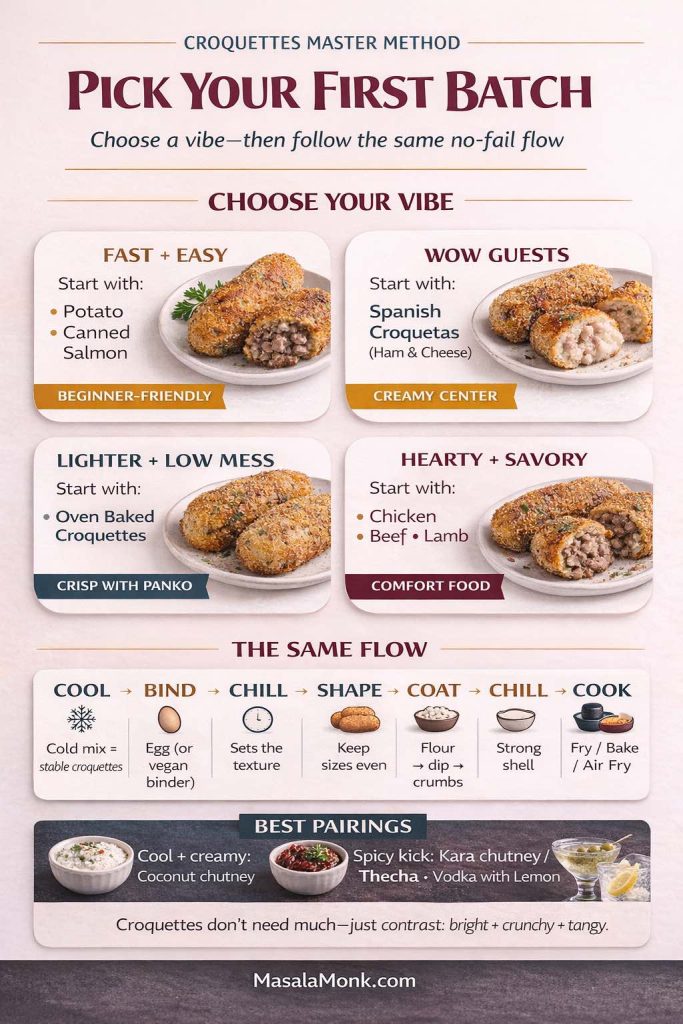
Which Croquette Should You Make?
If you already know which kind of croquette you want, start here. The coating method overlaps, but the filling changes how much moisture, binder and chilling time you need.
| You want | Start with | What changes |
|---|---|---|
| The easiest first batch | Potato croquettes | Cold mash gives the mixture natural structure. |
| A creamy tapas-style center | Spanish croquetas | A thick béchamel replaces potato and needs a longer chill. |
| A pantry-friendly fish version | Salmon croquettes | Drain canned salmon well; patties are often easier than logs. |
| A leftover-meat batch | Chicken or turkey croquettes | Potato keeps cooked poultry moist and cohesive. |
| A lighter white-fish version | Cod or tuna croquettes | Dry the fish before adding binder. |
| A meat-free batch | Vegetarian or vegan croquettes | Cook moisture out of vegetables; use a reliable eggless binder when needed. |
Croquettes Recipe: Classic Potato Croquettes
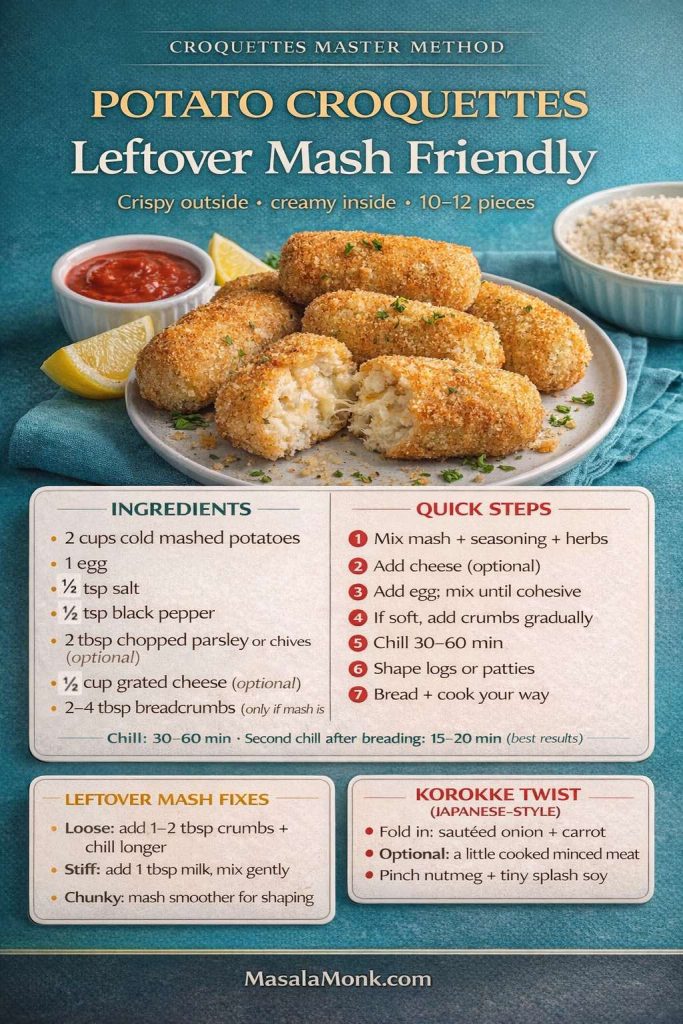
This is the easiest place to learn the croquette method: a brittle, golden crumb shell around a soft potato center. You can start with potatoes cooked specifically for the recipe or with leftover mash. The important thing is that the potato is cold and fairly dry before you judge whether it needs extra binder.
| Yield | 10–12 croquettes |
|---|---|
| Hands-on time | About 30 minutes |
| Chilling | 45–80 minutes total |
| Cooking | 2–22 minutes, depending on method |
Ingredients
For the potato filling
- About 600 g / 1⅓ lb starchy or floury potatoes, such as Russet, or 2 packed cups (about 450 g) cold, fairly dry mashed potatoes
- 1 large egg
- ½ teaspoon salt, or less if your leftover mash is already seasoned
- ½ teaspoon black pepper
- 2 tablespoons chopped parsley or chives, optional
- ½ cup grated cheese, optional
- 2–4 tablespoons breadcrumbs, only if needed for a soft or creamy mash
For the coating
- ½ cup all-purpose flour
- 2 eggs, beaten with a pinch of salt
- 1½ cups breadcrumbs or panko
- Neutral oil for frying, or a light oil spray/brush for baking or air frying
Method
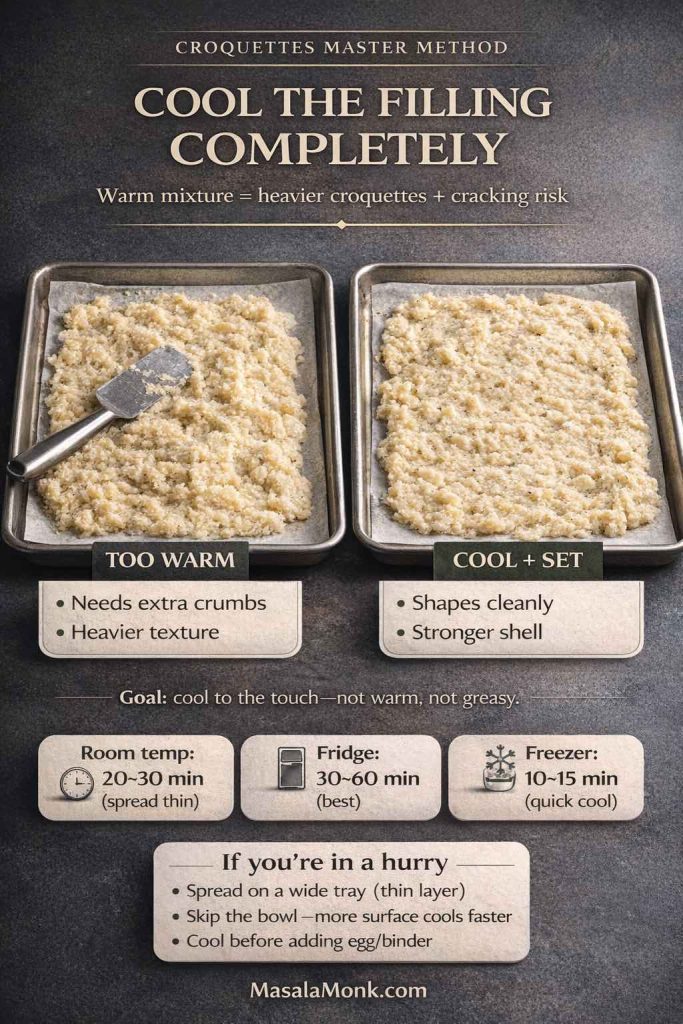
- If starting with raw potatoes, cook them dry. Peel and cut the potatoes into even chunks, cover with cold salted water, and simmer until a knife slides through easily, about 15–20 minutes. Drain very well, return them to the hot pan for a minute or two so excess steam can escape, then mash without milk or cream. Spread the mash out and cool completely.
- Season and bind. Measure 2 packed cups of cold mash. Mix with salt, pepper and herbs, then add cheese if using and stir in the egg. Press a spoonful in your palm. If it holds a ridge, stop. If it slumps or smears, add breadcrumbs 1 tablespoon at a time rather than burying the potato under dry crumbs.
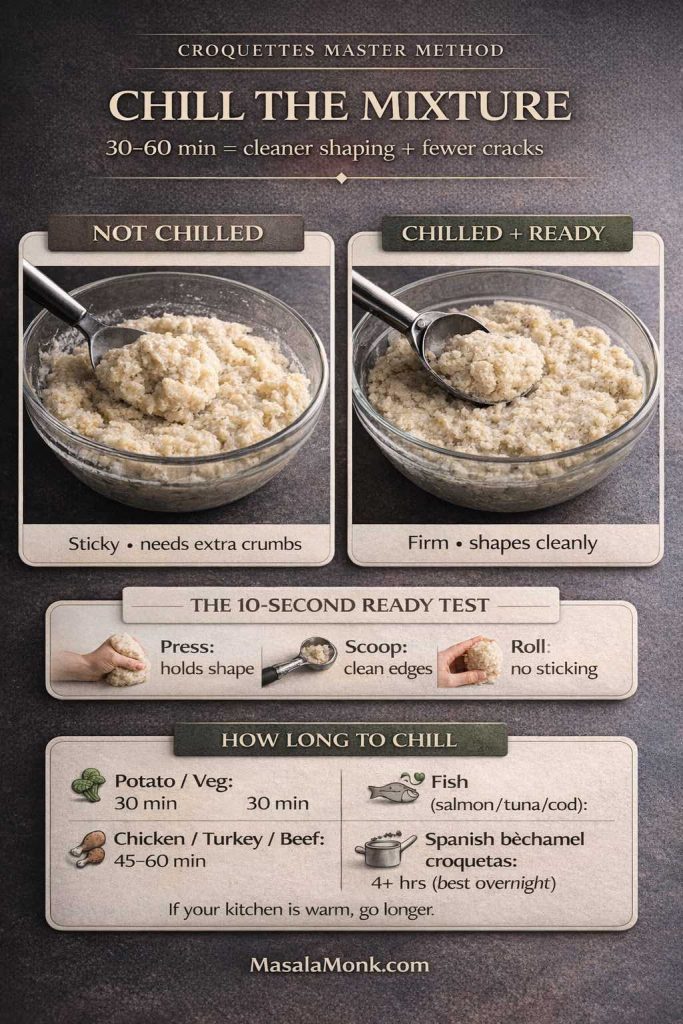
- Chill for 30–60 minutes. The mixture should scoop cleanly and hold a rough shape. Leftover mashed potatoes made with plenty of milk, cream or butter usually benefit from the longer end of the chill.
- Shape. Divide into 10–12 equal portions and form logs, short cylinders or thick patties. Good croquette mixture feels sturdy in your hand without feeling packed or bready.
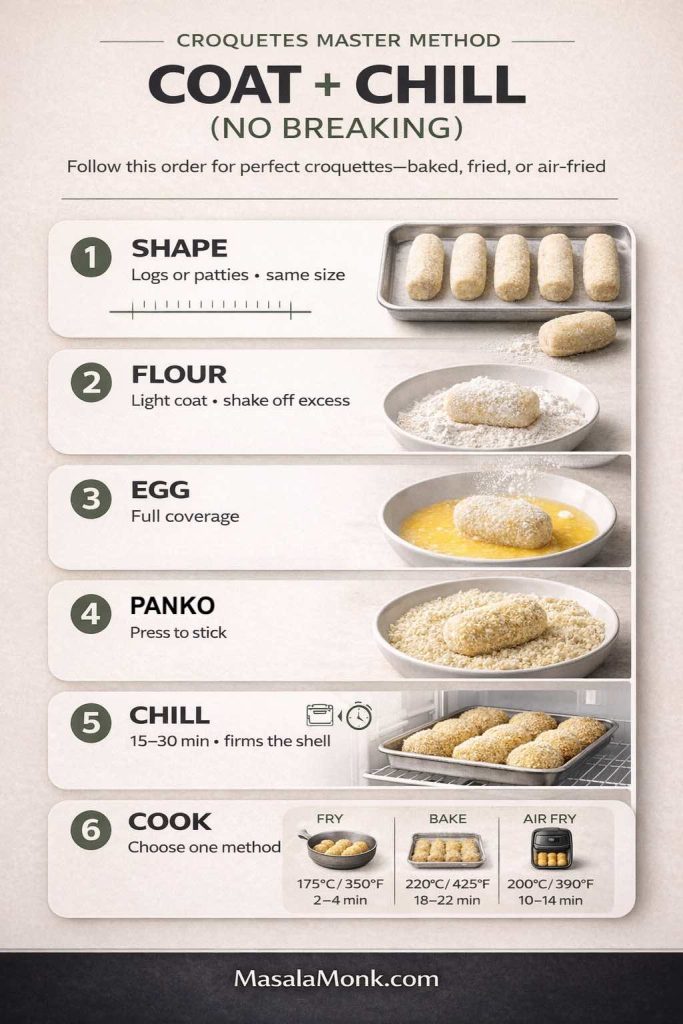
- Coat completely. Roll lightly in flour, dip in beaten egg, then press into breadcrumbs or panko. Cover the ends and any small cracks; exposed filling is where leaks begin.
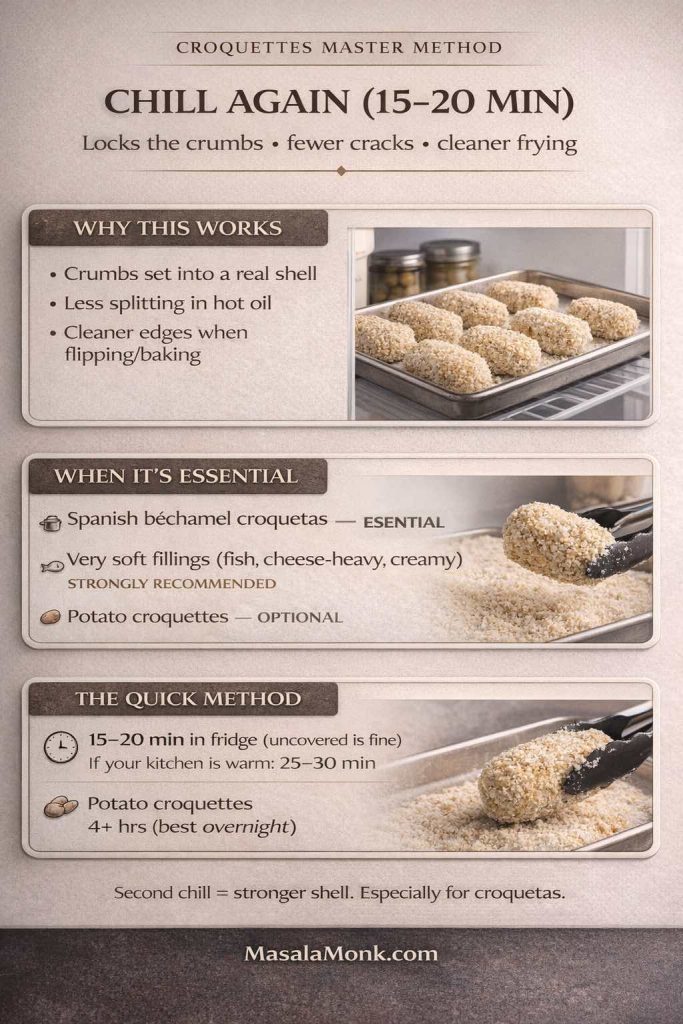
- Chill the breaded croquettes for 15–20 minutes. This gives the shell time to settle, especially useful with soft mash or in a warm kitchen.
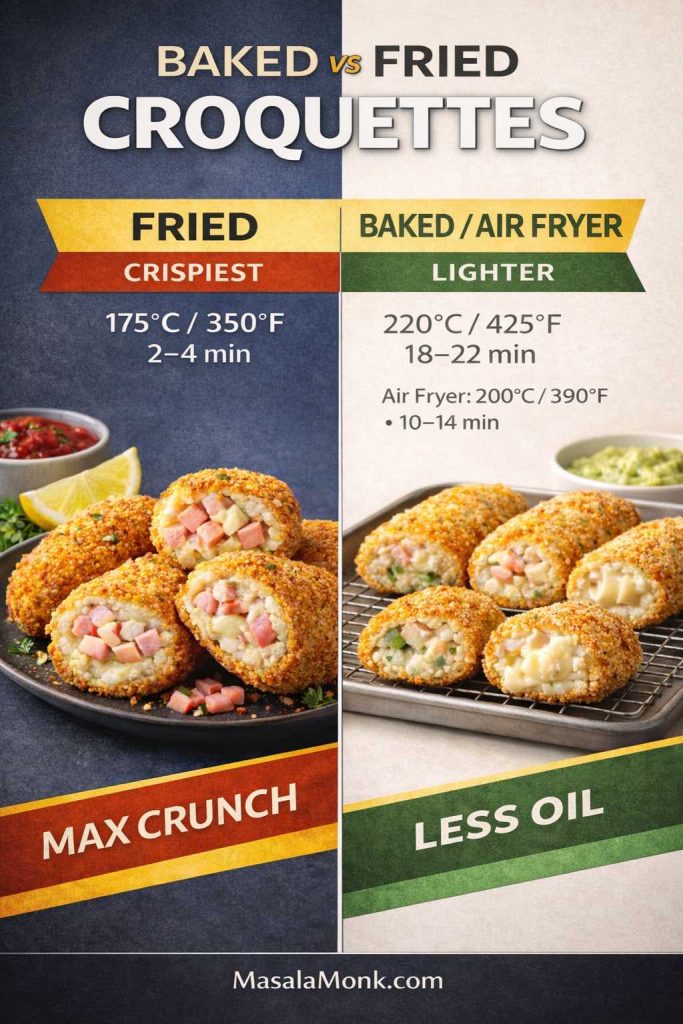
- Cook. Deep-fry at 175°C / 350°F for 2–4 minutes, bake at 220°C / 425°F for 18–22 minutes, or air fry at 200°C / 390°F for 10–14 minutes. Lightly oil baked or air-fried croquettes and turn once for more even browning.
Using leftover mash? Taste it before adding salt. If it is very loose, add a little breadcrumb and chill before adding more. If it is stiff from the fridge, the egg may be enough to loosen it. The goal is not a dry mixture; it is a filling that can be shaped without flowing back into itself.
If you want to make the mash first as a separate side and save some for croquettes, use MasalaMonk’s mashed potatoes recipe, but keep the croquette portion on the drier side and cool it before mixing.
The Four Rules That Make Croquettes Work
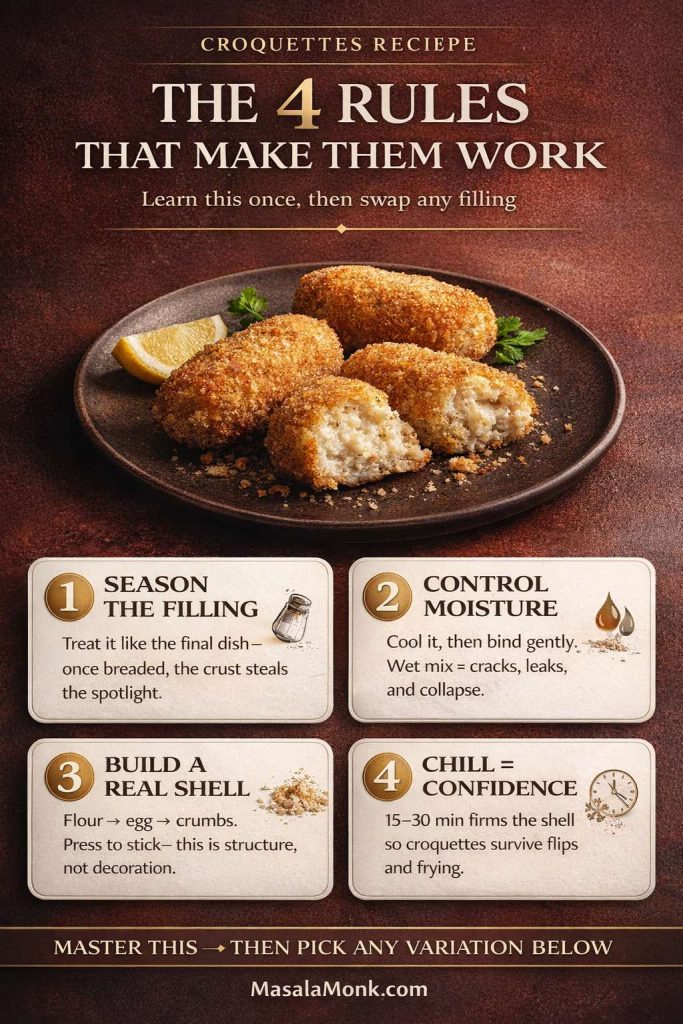
1. Season the filling before you bread it
Taste the filling before it disappears under the crust. Potato, chicken and fish all mute seasoning once they are chilled and breaded, so a bland center rarely improves in the pan. Lemon and herbs help fish; black pepper and nutmeg suit béchamel; cumin, paprika or fresh herbs can carry vegetable fillings.
2. Control moisture before adding more binder
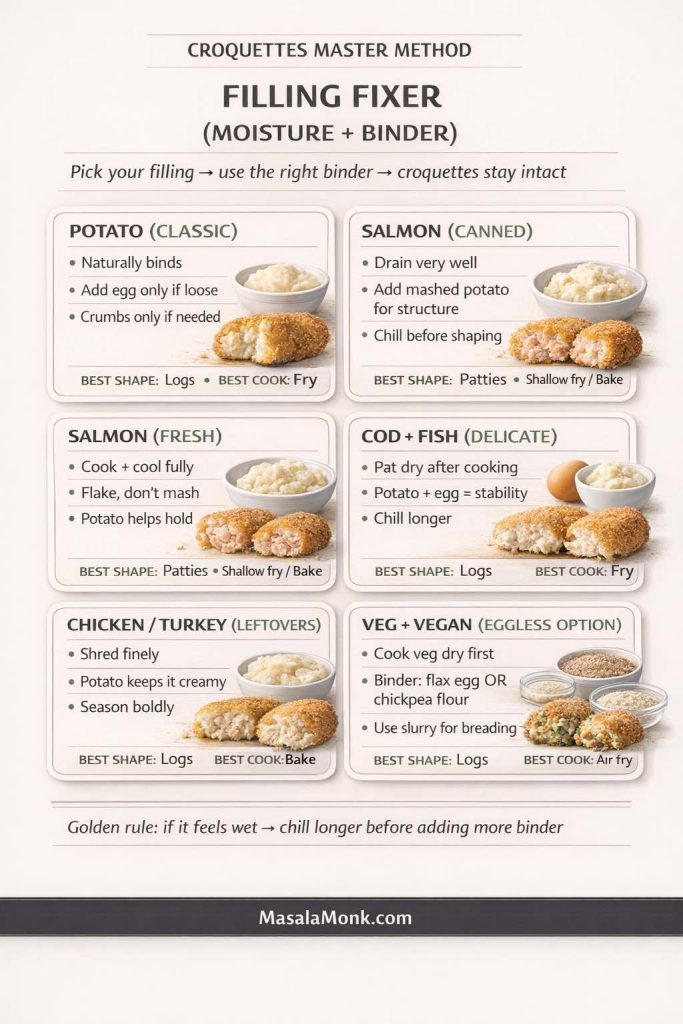
A wet filling is not automatically short on breadcrumbs. Warm potato, watery vegetables and poorly drained fish all feel loose for different reasons. Cool the mixture first, drain or sauté away excess moisture where you can, then add dry binder gradually.
3. Treat the coating like a shell
Flour helps the egg cling; egg gives the crumbs something to grip; crumbs create the shell. Coat the ends and sides as carefully as the flat surfaces. Thin or bald patches are the places where soft filling escapes first.
4. Chill when the mixture needs structure
Cold filling shapes more cleanly, and a short rest after breading helps the coating stay attached. Potato may only need a modest rest; béchamel croquetas usually need hours before shaping. The clock matters less than the physical cue: the portion should lift, shape and hold without flowing back into itself.
How to Make Croquettes: The Texture Cues That Matter
The recipe above tells you what to do. This section is the part that makes the method portable: what the filling should feel like, when chilling has actually done its job, and how to build a shell that can protect a creamy center. Those cues matter more than memorising one ratio because salmon, chicken, béchamel and vegetables all behave differently.
Step 1: Cool the filling completely
Spread a warm filling over a plate or tray instead of leaving it in a deep bowl. A thin layer sheds heat and steam faster. Binding a hot mixture usually forces you to add more crumbs than you actually need, which can make the center heavy.
Step 2: Bind only as much as needed
Press a spoonful in your palm. If it holds together without leaving a wet smear, stop. If it breaks apart, it needs more cohesion; if it feels slick or slumps, look for excess moisture before adding handfuls of crumbs.
Step 3: Chill the mixture
For the potato base, 30–60 minutes is a useful window. The mixture is ready when a scoop keeps its edges and rolls without sticking heavily to your hands. Very soft fillings need longer.
Step 4: Shape evenly
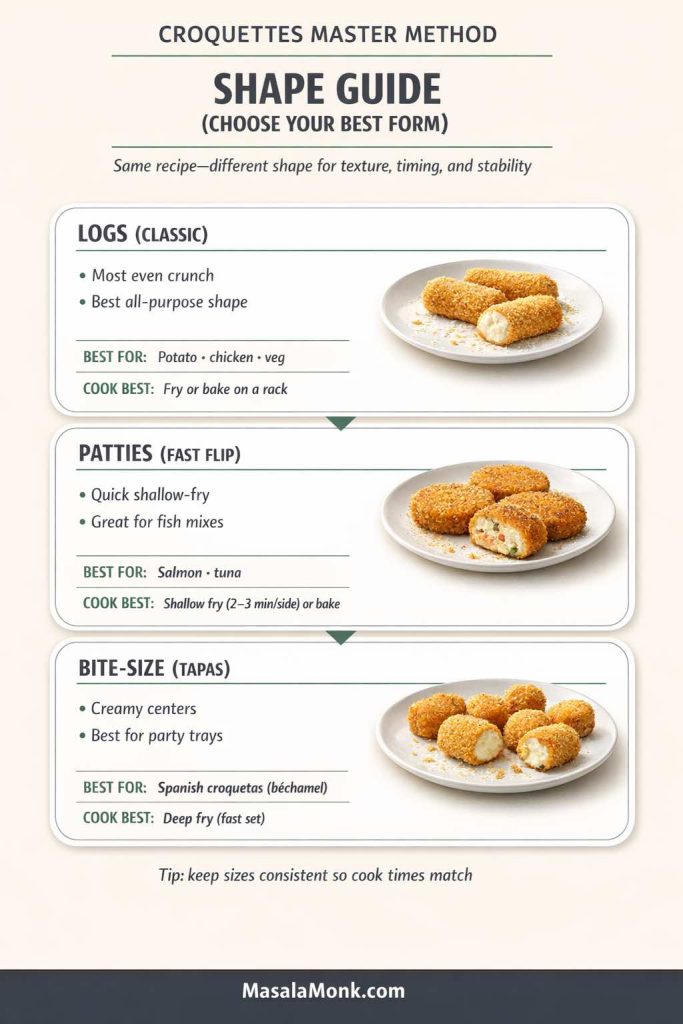
Logs are the classic all-purpose shape. Patties are easier to turn in a shallow pan and suit salmon or tuna. Small cylinders work beautifully for creamy tapas-style croquetas. Whatever you choose, equal size matters more than perfect geometry.
Step 5: Bread completely
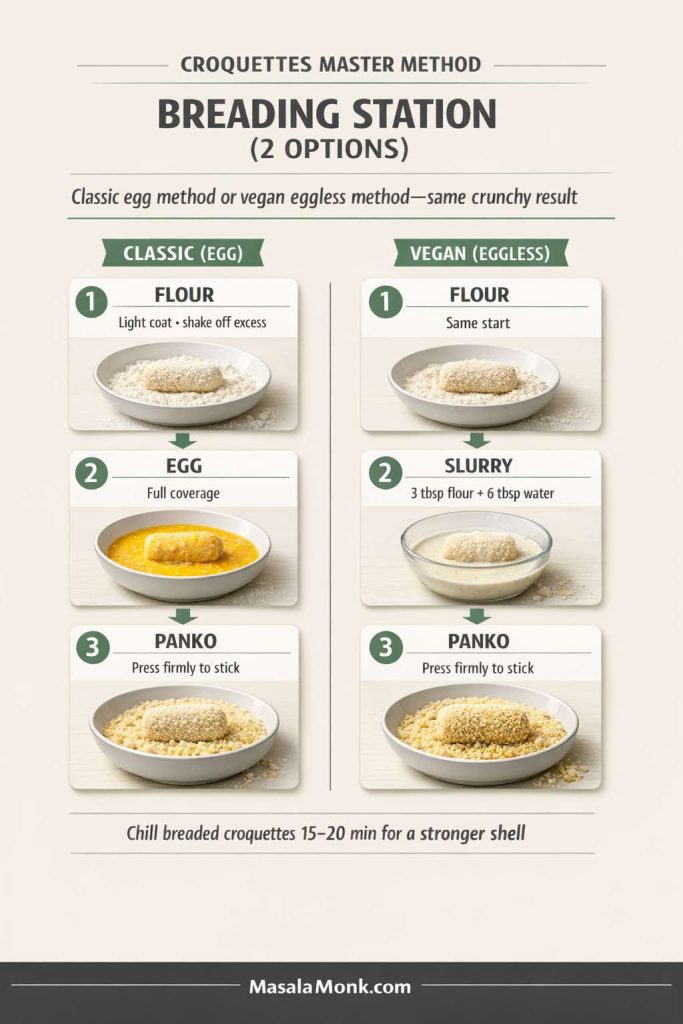
Use three shallow bowls: flour, beaten egg, and crumbs. Shake off loose flour, let excess egg drip away, then press the crumbs on rather than rolling the croquette through them once and hoping for coverage.
Step 6: Chill the breaded croquettes
A 15–20 minute rest is cheap insurance for soft fillings. It gives loose crumbs time to hydrate and grip the surface, which means fewer bald spots and fewer cracks when the croquette meets heat.
Fried vs Baked vs Air Fryer Croquettes
| Method | Time + temperature | Result |
|---|---|---|
| Deep fry | 175°C / 350°F · 2–4 min | Fast, even browning and the crispest shell. |
| Shallow fry | Medium heat · 2–3 min per side | Excellent for patties, especially fish croquettes. |
| Oven | 220°C / 425°F · 18–22 min | Best for larger batches; a rack and light oil improve browning. |
| Air fryer | 200°C / 390°F · 10–14 min | Fast for smaller batches, reheating and frozen croquettes. |
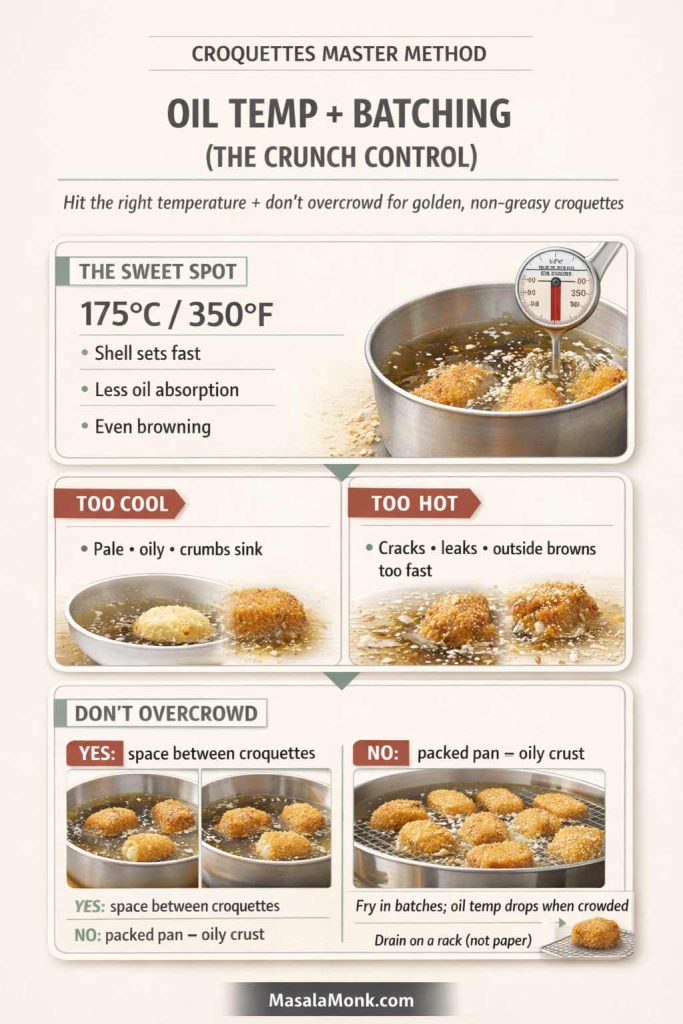
If you fry, watch the oil rather than the clock
At about 175°C / 350°F, the coating sets quickly enough to protect the center without racing to dark brown. Oil that is too cool gives the crumbs time to absorb fat; oil that is too hot can brown the outside before a soft center heats through. Fry in small batches so the temperature does not collapse.
The Main Types of Croquettes
Croquettes are a family rather than one fixed filling. The useful question is not “which version is the real one?” but “what is holding this particular center together?” Potato brings starch, Spanish croquetas rely on a cooked béchamel, fish needs careful draining, and vegetables need their water cooked away. Use the compact formulas below when that is the croquette you came to make; where MasalaMonk already has a dedicated guide, you can follow through for the full version.
Potato croquettes
Potato is the easiest learning base because its starch gives you structure before the egg or crumbs do anything. The full potato croquettes recipe above works from raw potatoes or leftover mash. For a Japanese korokke direction, fold finely cooked onion, minced meat or dry-cooked vegetables into the potato and shape slightly flatter for quick frying.
Spanish croquetas
Spanish croquetas are the important exception to the potato pattern. Their center is a very thick béchamel, so the finished croqueta should be creamy rather than fluffy.
Quick jamón formula: melt 3 tablespoons butter, cook in ⅓ cup flour for 1–2 minutes, then gradually whisk in 2 cups warm milk. Keep stirring until the béchamel is thick enough to pull away from the pan. Fold in 1 cup very finely chopped ham or jamón, ¼ teaspoon nutmeg and plenty of black pepper. Spread into a shallow tray, cool, then refrigerate at least 4 hours—overnight is easier. Shape quickly, bread, chill again for 15–20 minutes, then fry at 175°C / 350°F until golden.
This branch is worth remembering because it explains why “add more breadcrumbs” is not a universal croquette fix: here, the structure comes from properly cooked flour, milk and a long chill.
Salmon croquettes
Salmon croquettes are often shaped as patties and are less forgiving of excess moisture. For a dependable canned-salmon batch, drain 2 cans very well, then mix with 1½ cups mashed potato, 1 egg, ¼ cup finely minced onion or scallions, 1 tablespoon lemon juice, paprika or Old Bay, black pepper and about 2 tablespoons parsley. Chill 30–60 minutes before shaping. Fresh cooked salmon works too; cool it first and use the same moisture test before adding the egg.
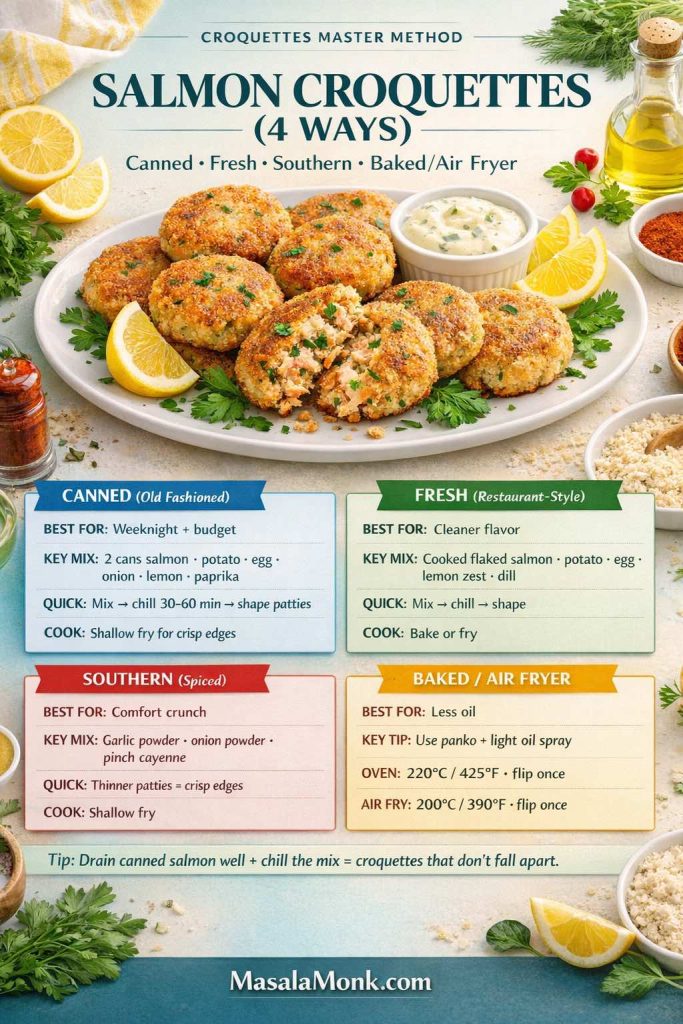
For a Southern-style direction, add garlic powder, onion powder and a pinch of cayenne and make thinner patties for shallow frying. For exact quantities, pan-frying, baking, air-fryer timing and salmon-specific troubleshooting, use the dedicated Salmon Croquettes Recipe.
Chicken and turkey croquettes
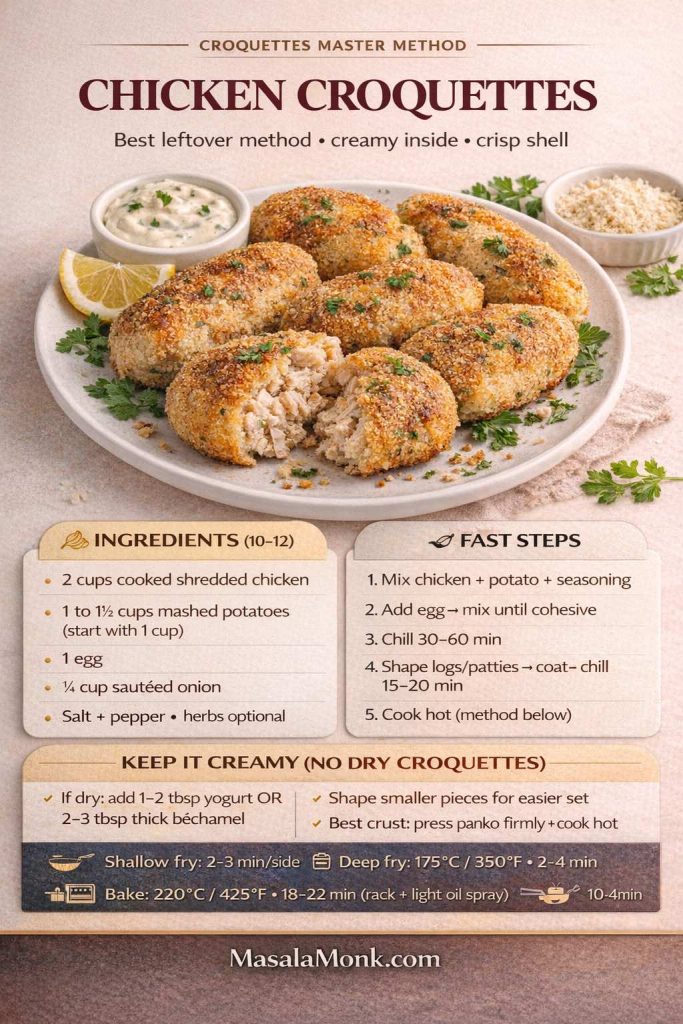
Cooked poultry is already lean, so the potato is not just glue—it keeps the reheated center from eating dry. For 10–12 chicken croquettes, mix 2 cups cooked shredded chicken with 1 to 1½ cups mashed potato, 1 egg, ¼ cup sautéed or very finely minced onion, salt, pepper and thyme or mixed herbs if you like. Start with 1 cup potato and add more only if the chicken still dominates the texture. Chill, shape, bread and use any of the cooking methods above.
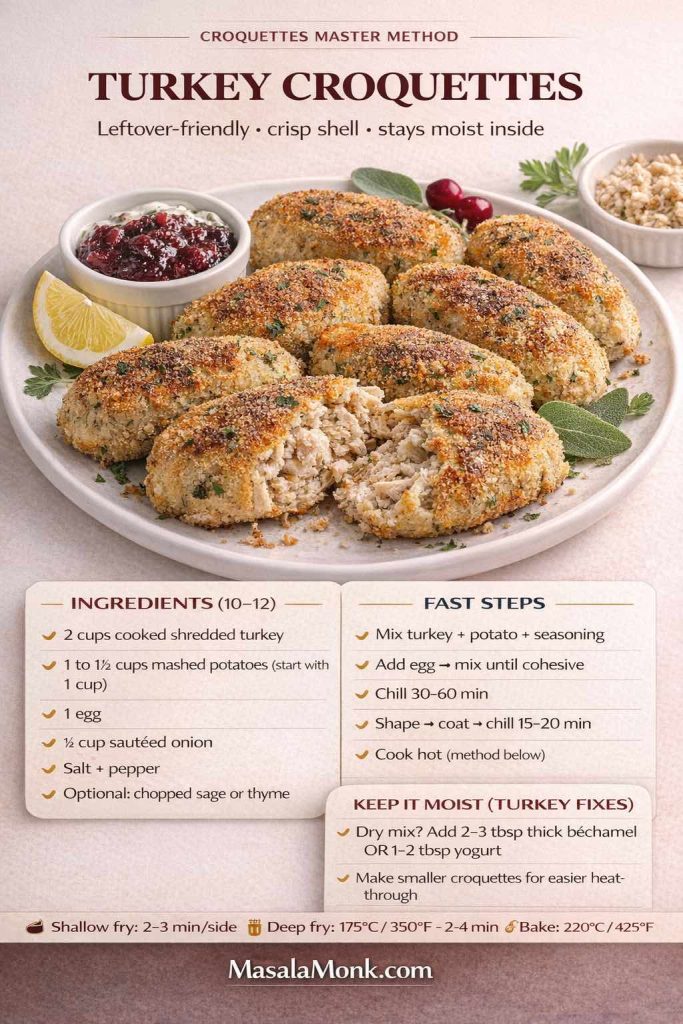
Turkey follows the same formula, but it is often drier. Use the higher end of the potato range, season generously with black pepper and, if it suits the leftovers, add chopped sage. A tiny cranberry center is optional but works naturally with roast-turkey flavours.
Tuna and cod croquettes
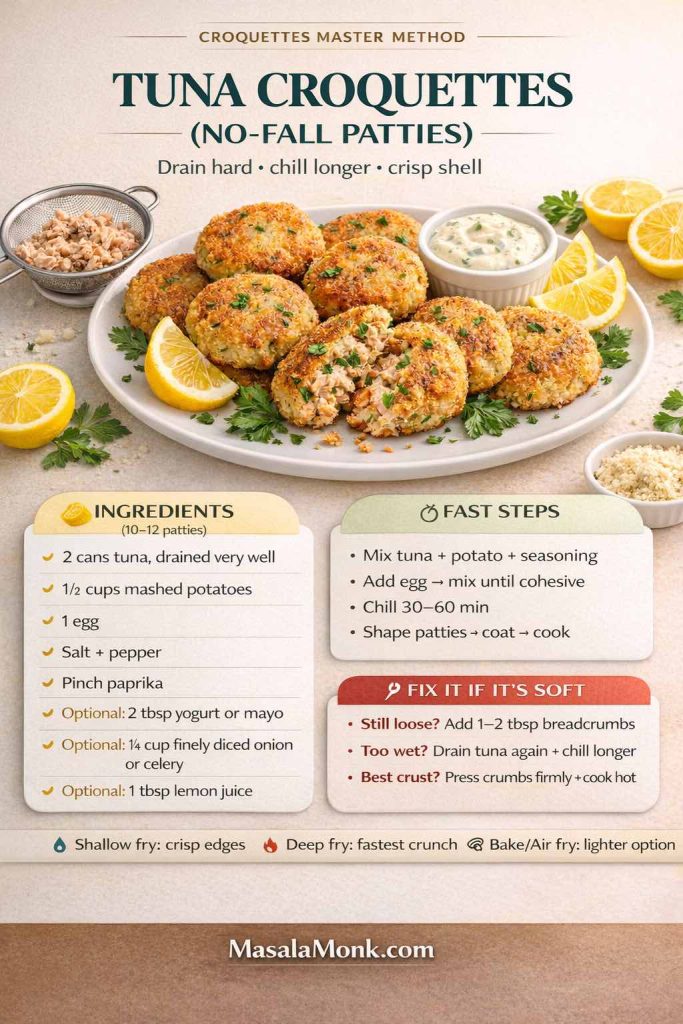
Tuna: for 10–12 patties, drain 2 cans tuna very well and mix with 1½ cups mashed potato, 1 egg, 1 tablespoon lemon juice, salt, pepper and a pinch of paprika. Up to ¼ cup finely diced onion or celery adds crunch; 2 tablespoons yogurt or mayo is optional if the tuna is particularly dry. Chill before shaping. The mixture should feel cohesive, not wet.
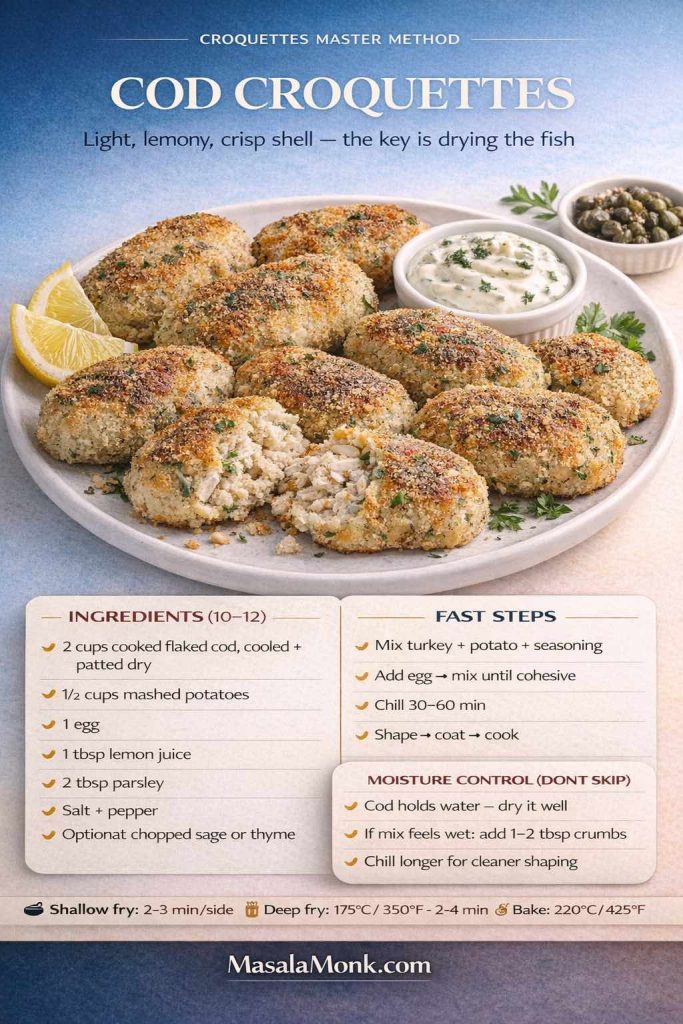
Cod: use 2 cups cooked flaked cod that has been cooled and patted dry, 1½ cups mashed potato, 1 egg, 1 tablespoon lemon juice, 2 tablespoons parsley, salt and pepper. Fold gently so some flakes survive, then chill before shaping and breading.
If you want a more substantial cod-and-potato patty with visible flakes of fish, MasalaMonk’s Fish Cakes Recipe goes deeper into fish-to-potato balance and pan-frying. For fresh or frozen seafood handling, the FDA seafood safety guidance covers buying, storage and safe preparation.
Vegetarian and vegan croquettes
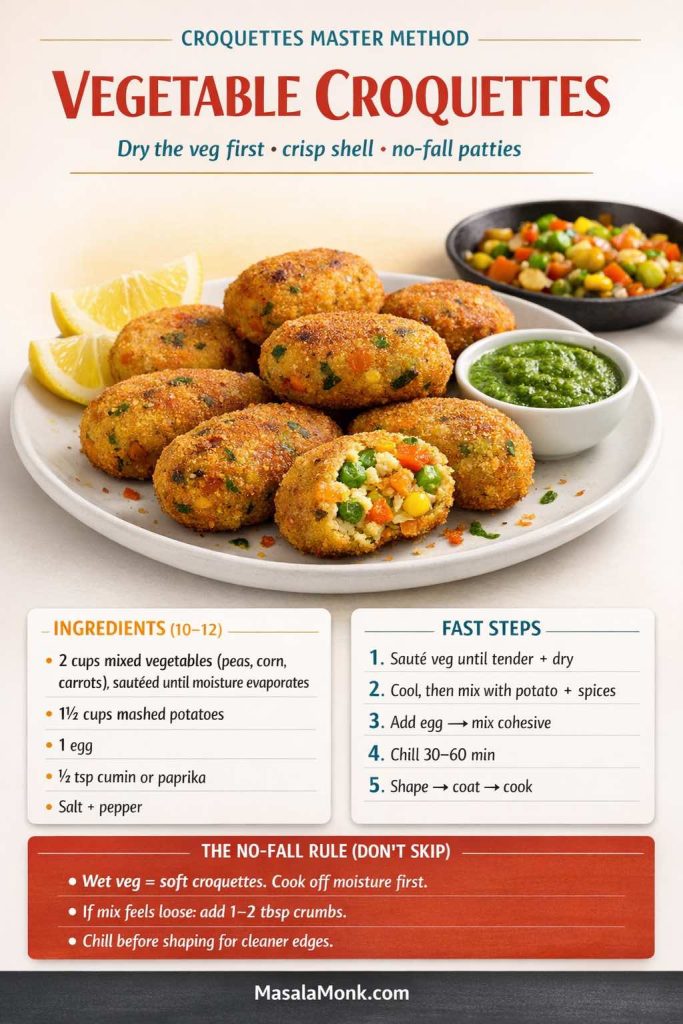
Vegetarian: sauté 2 cups mixed vegetables—peas, corn and carrots are an easy starting point—until tender and the pan no longer looks wet. Cool, then mix with 1½ cups mashed potato, 1 egg, ½ teaspoon cumin or paprika, salt and pepper. Chill before shaping. Mushrooms or courgette/zucchini need even more attention to moisture because they can look cooked while still carrying enough water to soften the mix.
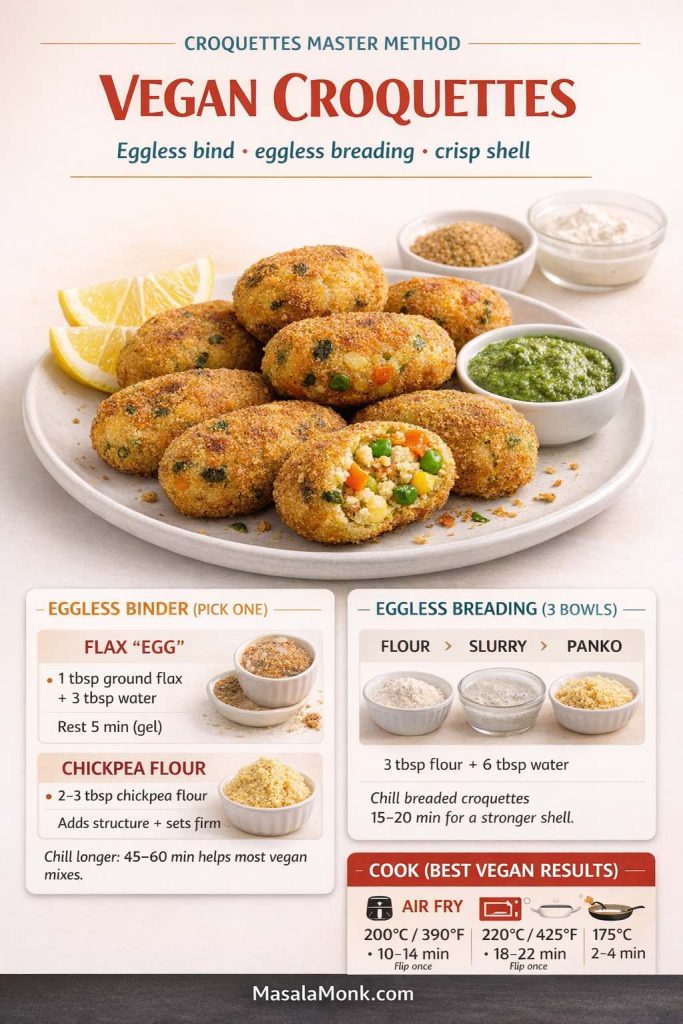
Vegan: start with 2 cups mashed potato, or use half potato and half mashed chickpeas. For binding, use either a flax “egg” made from 1 tablespoon ground flax plus 3 tablespoons water rested for 5 minutes, or stir in 2–3 tablespoons chickpea flour. Chill for 45–60 minutes. For the coating, use flour → a slurry of 3 tablespoons flour and 6 tablespoons water → panko.
These versions are especially good with something bright and herby. The Green Chutney Recipe gives you a coriander–mint option, while South Indian Coconut Chutney is cooler and creamier.
Beef and lamb croquettes
These are particularly good for leftovers. Cool cooked minced beef or finely chopped roast meat before mixing it with sautéed onion, mashed potato and egg. Beef is happy with paprika, cumin or plenty of black pepper. Lamb takes the same structure but carries warmer spice well: cumin plus a very small pinch of cinnamon is enough.
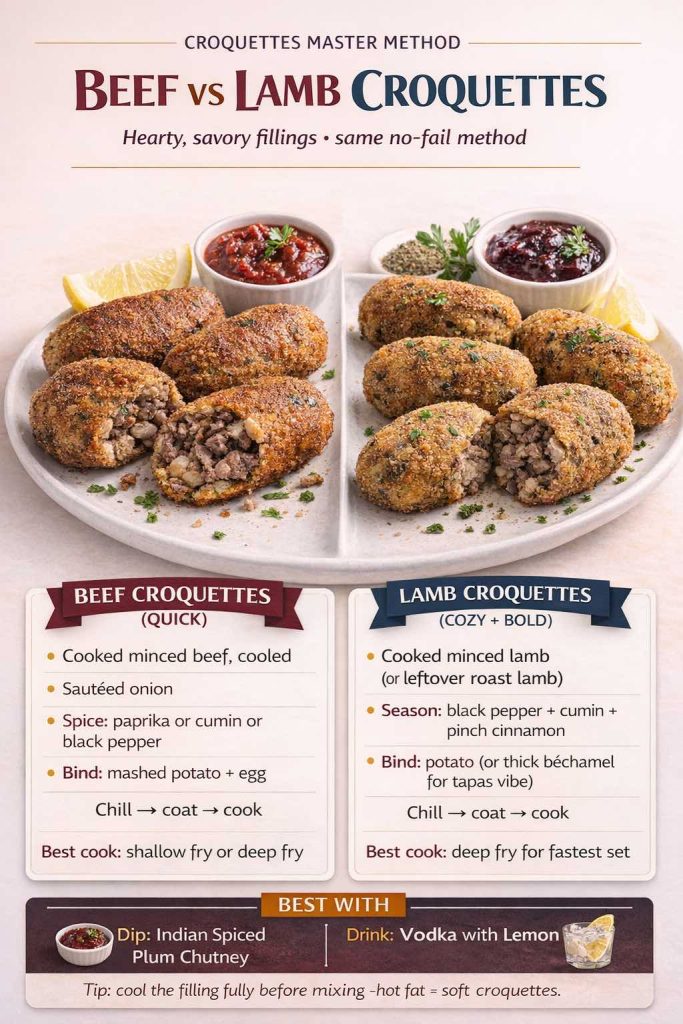
There is no need to force these richer fillings into a separate technique. If the cooked meat is already moist, use less potato; if it is lean and crumbly, the potato can do more of the work. Chill before breading just as you would with chicken. A sweet-tangy plum chutney is a good counterpoint to either version.
Croquette Troubleshooting: Fix the Batch You Have
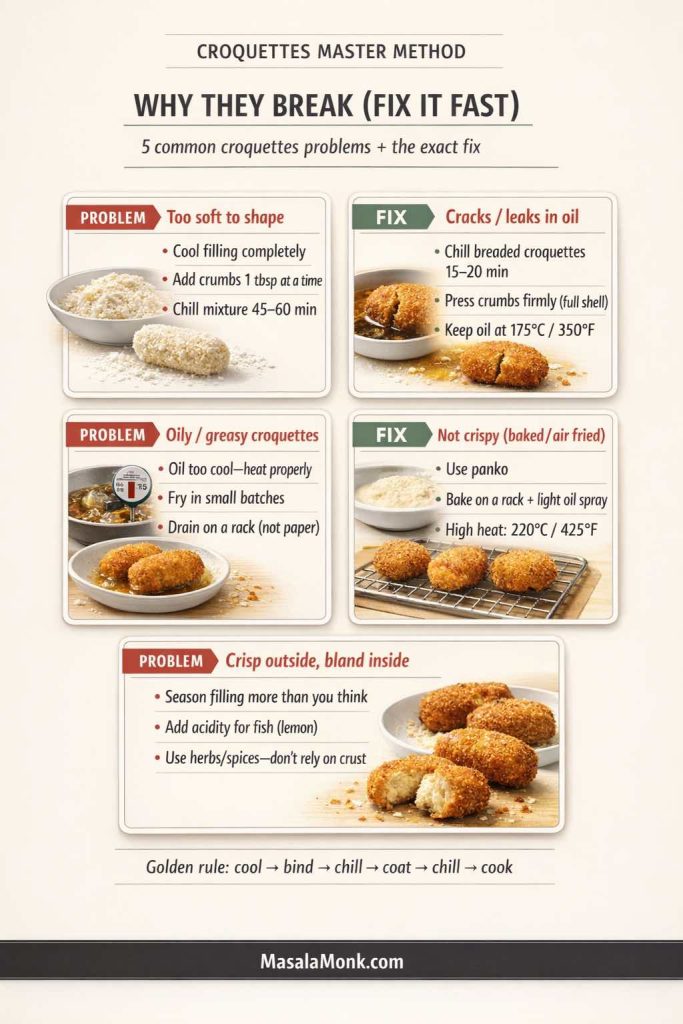
| Problem | Likely cause | What to do now |
|---|---|---|
| Too soft to shape | Warm or wet filling | Cool completely; chill; then add breadcrumbs 1 tablespoon at a time only if still needed. |
| Cracks or leaks while frying | Weak coating, soft center or very hot oil | Patch bare spots, chill the breaded tray, and keep frying oil near 175°C / 350°F. |
| Greasy croquettes | Oil too cool or pan overcrowded | Let the oil recover and fry smaller batches. Drain on a rack. |
| Baked croquettes stay pale/soft | Not enough surface oil or airflow | Use panko, lightly oil the coating, bake on a rack at high heat and turn once. |
| Crisp outside, bland inside | Under-seasoned filling | Season and taste the filling before shaping; use acid and herbs where they fit. |
| Crumbs fall off | Loose breading | Shake off excess flour, let excess egg drip, press crumbs firmly, then chill. |
Make Ahead, Freeze and Reheat Croquettes
Croquettes are one of the better make-ahead fried foods because the pause actually helps the structure. Bread them, arrange them on a tray, cover and refrigerate for up to 24 hours before cooking. For longer storage, freeze the breaded croquettes in a single layer until firm, then transfer them to a freezer container or bag.
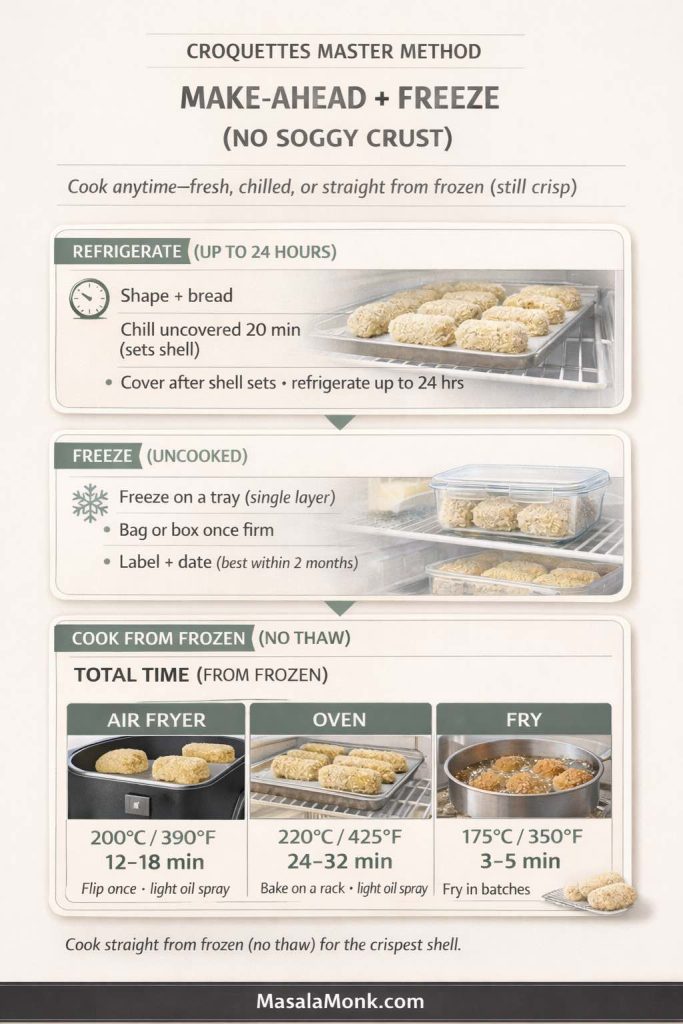
| From frozen | How to adjust |
|---|---|
| Air fryer | Keep the same temperature and add about 2–4 minutes; turn once and lightly oil if needed. |
| Oven | Keep the same temperature and add about 6–10 minutes; use a rack and turn once. |
| Frying | Lower the frozen croquettes carefully into steady 175°C / 350°F oil and fry a little longer than chilled croquettes. |
Cook times change with size and filling, so use the surface color and a hot center as the real finish line. Meat and poultry fillings should be handled and reheated safely; check the USDA safe-temperature chart when you need exact internal-temperature guidance.
What to Serve With Croquettes
Croquettes are rich and crisp, so the plate gets better when something beside them is cold, sharp, fresh or crunchy. Lemon wedges are almost always useful. A green salad, pickles, cucumber, herbs or a bright dip can do more than another heavy side dish.

Fish croquettes are a natural match for homemade tartar sauce. Potato and vegetable croquettes work beautifully with green chutney, coconut chutney or a sharper chilli chutney such as thecha. For a cocktail-night platter, the visual above pairs the salty, crisp croquettes with briny or citrus-led drinks such as a Dirty Martini, Lemon Drop or vodka with lemon. Spanish croquetas need only a few salty bites alongside; there is no reason to overload the plate.
Croquettes FAQ
Which potatoes are best for croquettes?
Choose a starchy or floury potato rather than a waxy salad potato. Russets are a reliable example. You want a mash that dries and fluffs rather than staying glossy and dense, because a drier potato needs less corrective breadcrumb later.
Are croquettes the same as fritters?
Not quite. Croquettes usually start with a cooked, cohesive filling that is deliberately shaped and often breaded before cooking. Fritters are more often made from a batter or looser mixture that is dropped or spooned into the pan.
Can you make croquettes without eggs?
Yes. Inside the filling, flax or chickpea flour can provide structure depending on the recipe. For breading, a flour-and-water slurry gives panko or breadcrumbs something to grip. The vegan section above gives the working ratios.
What is the best binder for croquettes?
There is no single best binder. Potato already contains starch and may need only egg; fish and vegetables often need better moisture control before they need more crumbs; Spanish croquetas get their structure from a cooked béchamel. The best binder is the smallest amount that lets the filling hold together without making the center dry.








