Posted on — Leave a comment

Hummingbird Cake Recipe (Old-Fashioned Southern Classic)

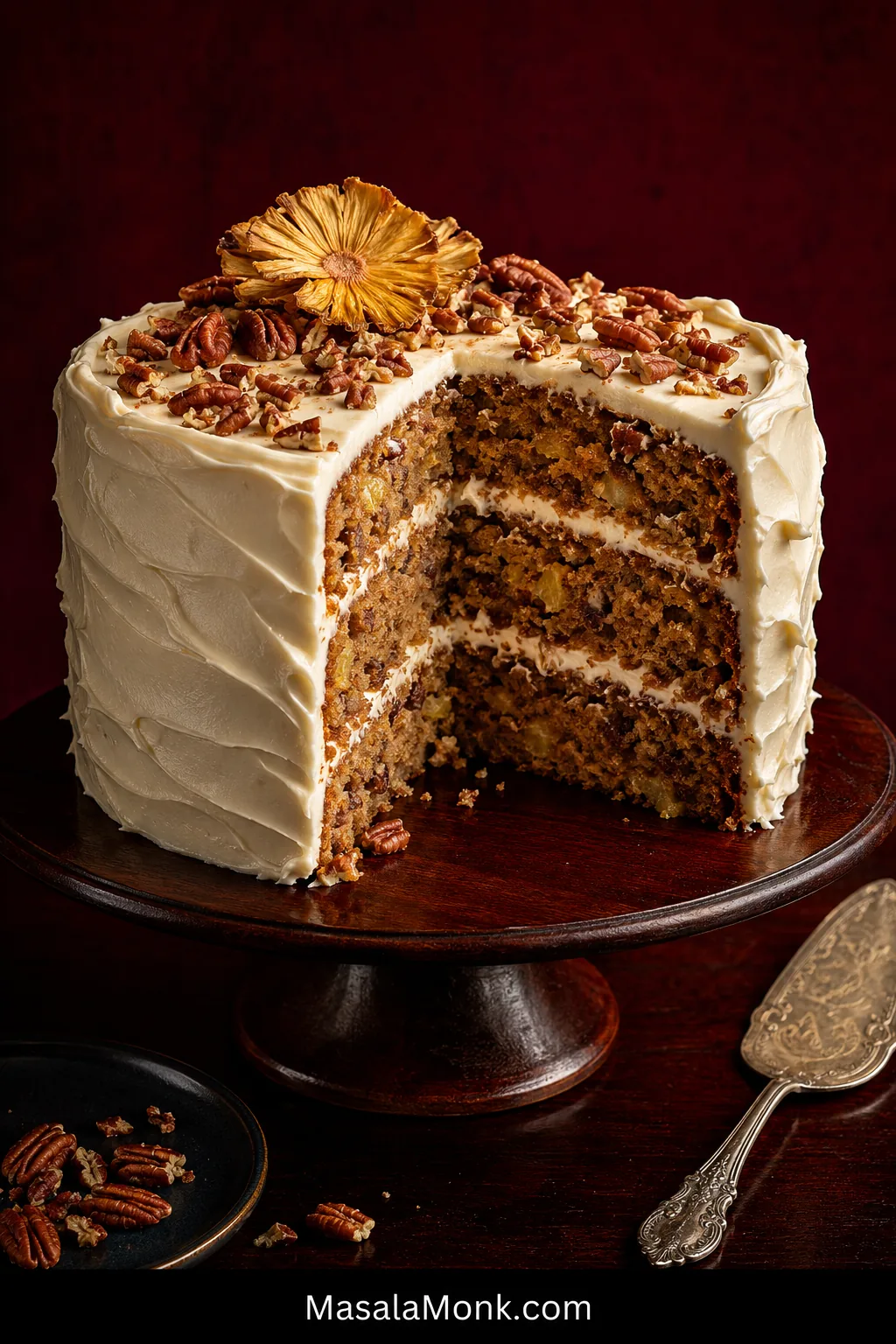
Three-layer Hummingbird Cake with cream cheese frosting and pecans, with a wedge removed to reveal golden fruit-and-nut cake layers.

Hummingbird Cake has a delicate name for a decidedly generous cake. Beneath the cream cheese frosting are three fruit-rich layers where ripe banana leads, pineapple brings a little brightness, and toasted pecans break up the moist crumb with roasted crunch.

All that fruit is part of the appeal. It also leaves less room for guesswork: extra banana, too much free pineapple liquid, very deep pans or an underbaked center can take the crumb from lush to sticky. What you want is an abundant old-fashioned cake that stands tall enough to slice cleanly.

Rich is right. Gummy isn’t.

What Does Hummingbird Cake Taste Like?

Hummingbird Cake is a banana-and-pineapple spice layer cake with pecans and cream cheese frosting, now a Southern classic with roots in Jamaica’s Doctor Bird Cake.

Banana is usually the first flavor you notice, but it shouldn’t flatten everything else. Pineapple gives the crumb a brighter fruitiness, toasted pecans add little pockets of crunch, and cinnamon stays comfortably in the background. Cream cheese frosting brings the tang that keeps a generous slice from feeling simply sweet.

Carrot cake is an easy comparison, although the two eat quite differently. Carrot cake gets much of its character from grated carrot and a stronger spice profile; Hummingbird Cake is fruitier and more tropical, with banana and pineapple doing most of the work. If spice cake is your other reference point, Hummingbird Cake is its fruitier, less spice-led cousin.

Jump to: Recipe · Is it supposed to be dense? · Drain the pineapple? · Fix the frosting · Fix my cake
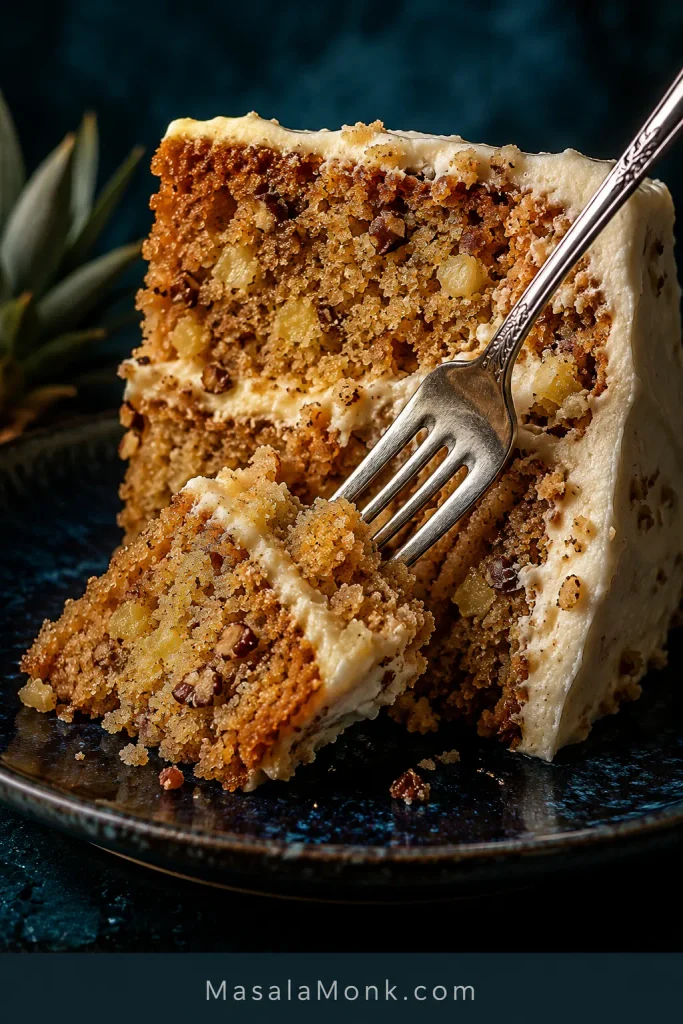
Close-up of a fork cutting into Hummingbird Cake, showing golden crumb, pineapple pieces, pecans and cream cheese frosting between the layers.
A moist pocket beside pineapple is normal; a wet, paste-like center is not. Judge the crumb around the fruit.

The Short Version

Despite the three layers, the cake batter itself is straightforward: two bowls, mixed by hand, no mixer needed. Most of the roughly four-hour total is waiting for the cake to bake, cool and firm up; the hands-on work is much shorter.

Use 360 g mashed very ripe banana, one 8-ounce / 227-g can crushed pineapple with its juice, neutral oil, cinnamon and toasted pecans. Divide the batter between three 8-inch / 20-cm pans and bake at 350°F / 177°C conventional / about 160°C fan. Start checking at 28 minutes; expect a bake somewhere around 28–34 minutes, depending on your pans and oven.

The batter should look thick, rough and visibly full of fruit. Stop folding once the flour disappears. The layers are ready when the centers look set, spring back gently under a fingertip and a skewer comes out without wet batter. Once cool, the crumb should be moist and tender, not glossy, gluey or pudding-like.


Three-Layer Hummingbird Cake: The Recipe

What this version is aiming for: the rich, fruit-heavy character that makes Hummingbird Cake distinctive, with a clear line between deeply moist and gummy. The banana is weighed, one small can of pineapple goes in with its juice, and the batter is spread across three relatively shallow layers. The cream cheese frosting relies on butter and cool handling for much of its structure, so its tang doesn’t have to disappear under a mountain of powdered sugar.

YieldOne three-layer 8-inch / 20-cm cake
Serves12 generous or about 16 smaller slices
Active timeAbout 50 minutes
Bake28–34 minutes; begin checking at 28
Total timeAbout 4 hours, including cooling and chilling
Oven350°F / 177°C conventional / about 160°C fan
Make aheadExcellent prepared a day before serving

Ingredients

Use the gram amounts if you have a kitchen scale. Cup measurements are included for convenience, but flour and mashed banana are both easy to misjudge by volume.

For the Cake

  • 150 g chopped pecans — about 1⅓ cups, divided
  • 375 g all-purpose flour — 3 cups, spooned and leveled
  • 1 teaspoon baking soda
  • 1 teaspoon baking powder
  • ¾ teaspoon fine salt
  • 1½ teaspoons ground cinnamon
  • ¼ teaspoon ground allspice
  • 3 large eggs, preferably at room temperature
  • 1 cup / 240 ml neutral oil, such as vegetable or canola oil
  • 1 cup / 200 g granulated sugar
  • 125 g packed light brown sugar — about ½ cup + 2 tablespoons
  • 2 teaspoons vanilla extract
  • 360 g mashed very ripe banana — about 1½ cups or roughly 3 large bananas after peeling; use bananas that are soft, deeply spotted and fragrant
  • 1 x 8-ounce / 227-g can crushed pineapple in juice, undrained; with a larger can, weigh out 227 g of fruit and juice together

For the Cream Cheese Frosting

  • 300 g unsalted butter — about 1⅓ cups, softened but still cool
  • 300 g confectioners’ / powdered sugar — about 2½ cups, sifted if lumpy
  • 2 teaspoons vanilla extract
  • ¼ teaspoon fine salt
  • 16 ounces / 452 g full-fat block-style cream cheese, chilled and cut into small pieces

The frosting amount is enough for two sensible filling layers and a comfortable rustic coat over the top and sides. Make extra only if you want an unusually thick coat or elaborate piping.

Equipment: three 8-inch / 20-cm round cake pans, parchment, two large bowls, a whisk, flexible spatula, cooling racks and preferably a kitchen scale. The batter is mixed by hand; use a hand or stand mixer for the frosting.
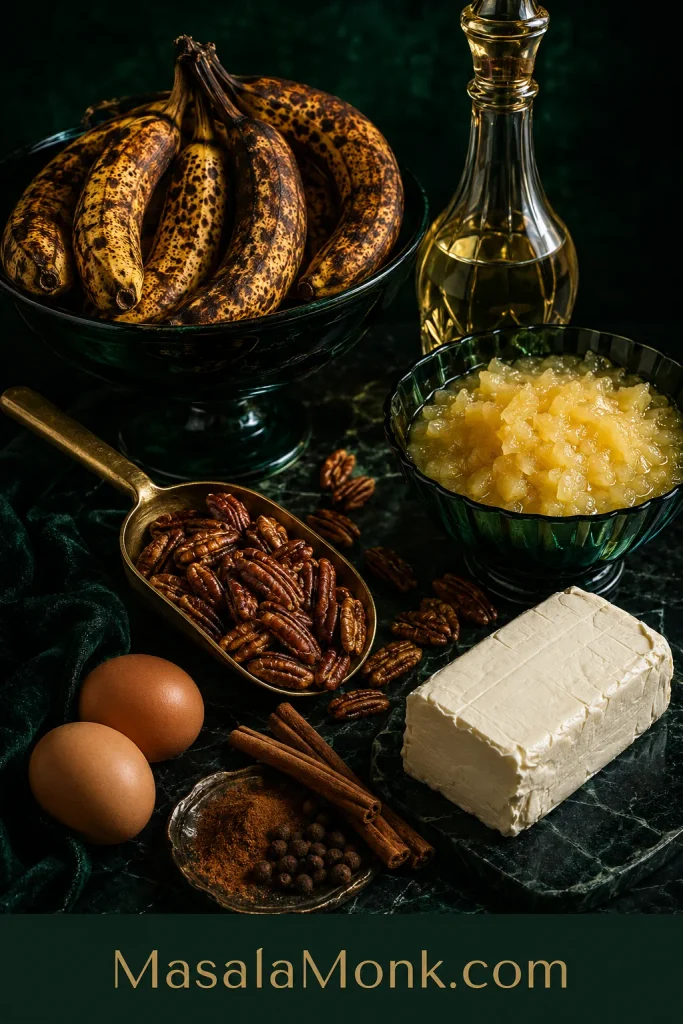
Dark green still life with very ripe bananas, crushed pineapple and juice, toasted pecans, eggs, oil, spices and a block of cream cheese.
Weigh the mashed banana when you can; fruit count varies too much to be a reliable moisture measure.

Method

Prepare the Batter

  1. Heat the oven and prepare the pans. Preheat to 350°F / 177°C conventional / about 160°C fan. Grease three 8-inch / 20-cm round pans, line the bottoms with parchment and lightly grease the parchment.
  2. Toast the pecans. Spread the chopped pecans on a baking sheet and toast for 5–7 minutes, starting to watch closely at 5. Stir or shake the tray once. Take them out when they smell deeply nutty and have darkened slightly. Cool completely. Reserve about 30 g for the finished cake and use the remaining 120 g in the batter.
  3. Mix the dry ingredients. Whisk the flour, baking soda, baking powder, cinnamon, allspice and salt in a large bowl, breaking up any obvious flour lumps.
  4. Mix the wet ingredients. In another large bowl, whisk the eggs and oil together. Add both sugars and the vanilla, then stir in the mashed banana and crushed pineapple with all of its measured juice.
  5. Fold the batter gently. Pour the wet mixture into the flour mixture and fold with a flexible spatula. Add the 120 g toasted pecans while a few dry streaks remain, then stop as soon as the flour disappears. The finished batter should look thick, rough and crowded with fruit.
  6. Divide it evenly. The batch makes roughly 1.8 kg of batter, so aim for about 600 g per pan. Exact grams are not important; similar layer depths are.
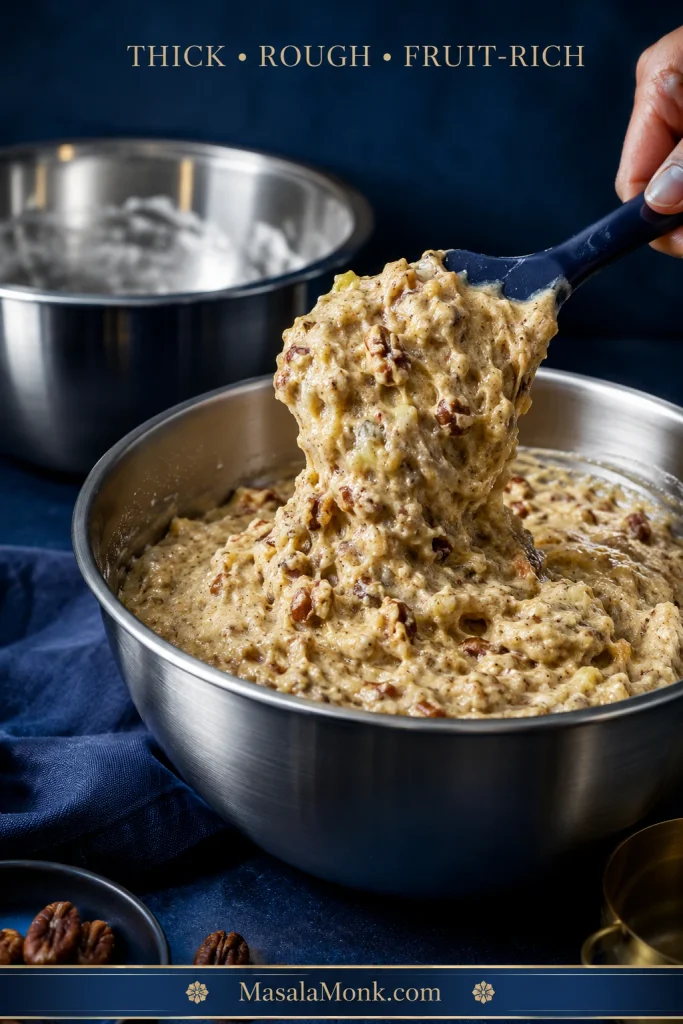
Thick Hummingbird Cake batter lifted on a spatula from a metal bowl, with visible fruit and pecan pieces and a second bowl in the background.
Before the pans go in, scrape the bowl once more. Thick batter can hide dry flour at the bottom.

Bake and Cool the Layers

  1. Bake the layers. Put all three pans on one rack near the center of the oven when they fit with some air around them. Otherwise stagger them across two racks. Begin checking at 28 minutes; expect the bake to fall somewhere around 28–34 minutes.
    Using two racks? Leave the pans alone during the early bake. Once the centers have visibly begun to set, swap the upper and lower pans if your oven is browning unevenly.
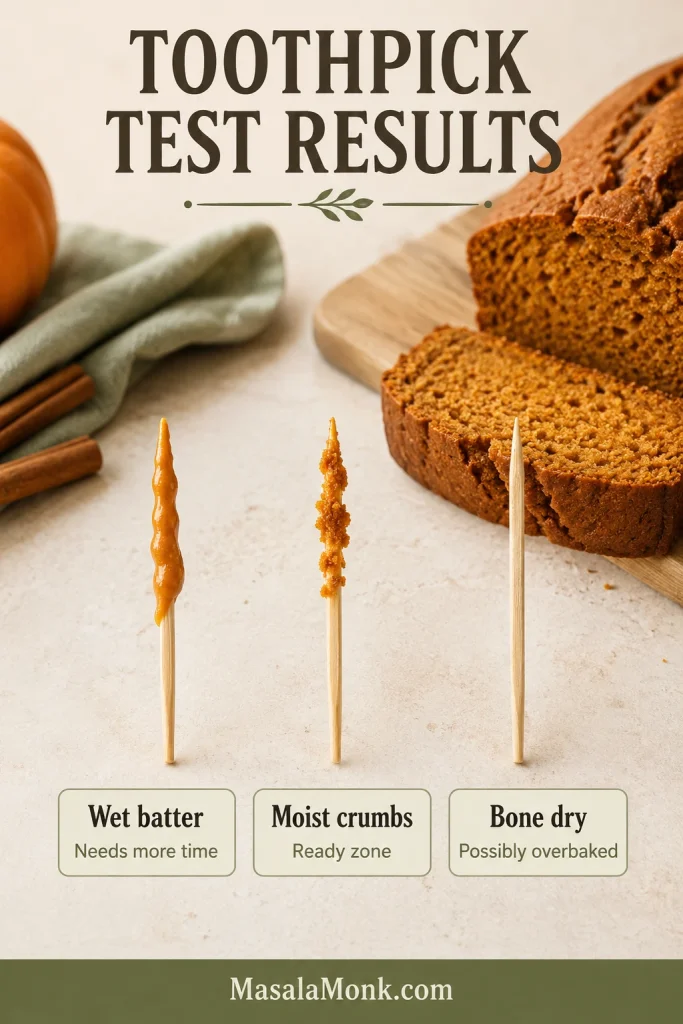
    They’re done when: the wet shine in the center has disappeared, a light fingertip press springs back and a thin skewer comes out without wet batter. A few moist crumbs are fine.
  2. Cool completely. Leave the layers in their pans for about 10 minutes, then turn them onto wire racks and peel away the parchment. Let them cool fully before frosting. A 30–60 minute chill afterward can make the layers easier to handle and stack, but it isn’t a substitute for cooling them first.
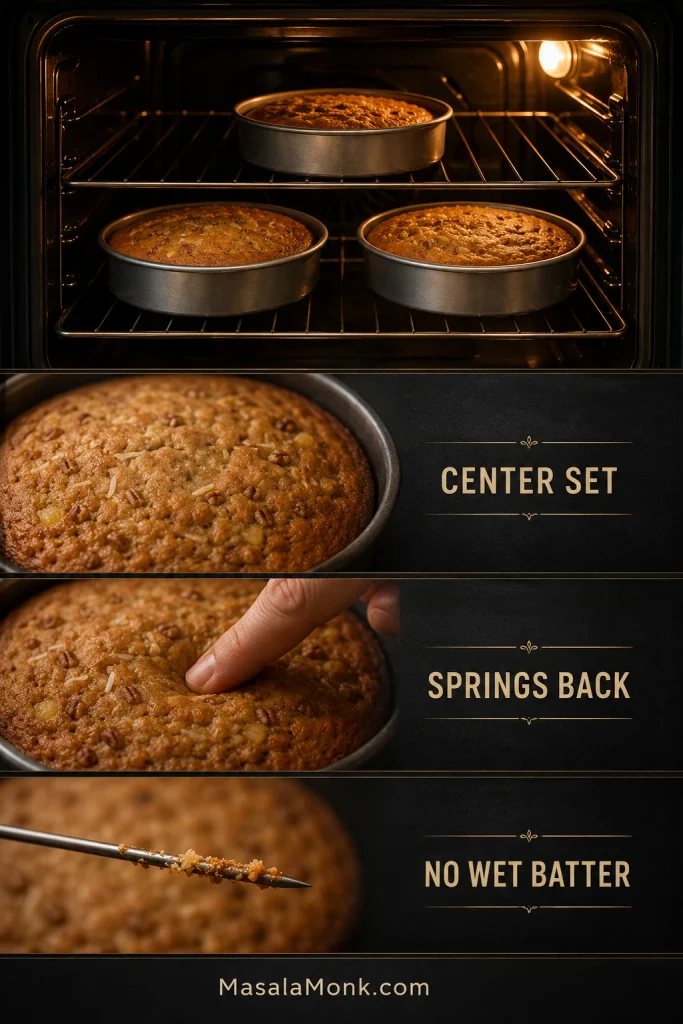
Cake doneness guide showing pans in an oven, a set cake center, a fingertip springback test and a skewer checking the crumb.
Matching pans can finish a few minutes apart. Check each center for set, springback and no wet batter.

Make the Cream Cheese Frosting

  1. Make the frosting base. Beat the slightly cool butter until smooth. Gradually beat in the powdered sugar, then add the vanilla and salt.
  2. Add the cream cheese last. Take the cream cheese from the refrigerator when you begin making the frosting. Add it to the finished butter-sugar base a few pieces at a time on low to medium-low speed. Stop once the frosting is smooth. Longer beating can make cream cheese frosting softer.
  3. Check the consistency. Lift your spatula. A soft peak should hold and a swipe of frosting should stay where you put it. When the frosting slowly slumps, refrigerate it for 20–30 minutes before deciding it needs more sugar.
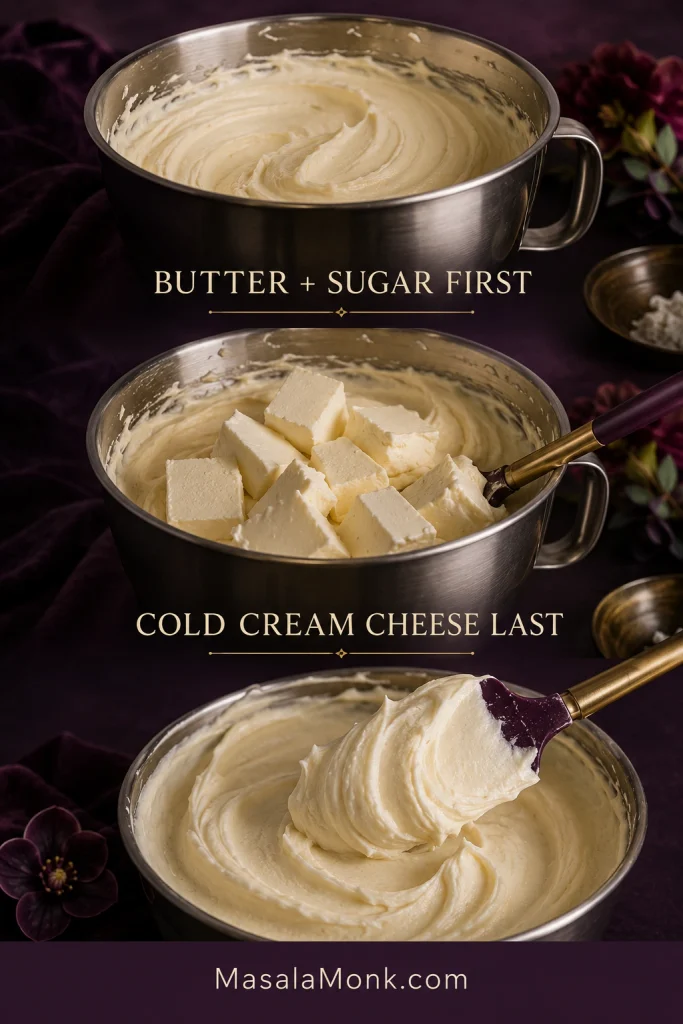
Three-stage cream cheese frosting guide showing butter and powdered sugar first, cold cream cheese pieces added afterward, and finished thick frosting.
Smaller pieces of cold block cream cheese incorporate faster, limiting mixer time and helping the frosting stay thick.

Stack and Finish the Cake

  1. Stack the cake. Put the first layer on a cake plate or board and spread about 170 g frosting over the top. Repeat with the second layer, then add the third. Should the stack begin drifting sideways, refrigerate it for about 20 minutes before continuing.
  2. Frost and finish. Cover the top and sides with the remaining frosting. A relaxed coat suits Hummingbird Cake; nothing has gone wrong because the sides are not ruler-straight. Scatter over the reserved pecans, or add dried pineapple flowers for a more celebratory finish.

Refrigerate the assembled cake for about 20–30 minutes, or until the frosting feels firm enough for a clean first cut. For the best eating texture, give chilled slices about 15–20 minutes at a comfortable room temperature before eating.
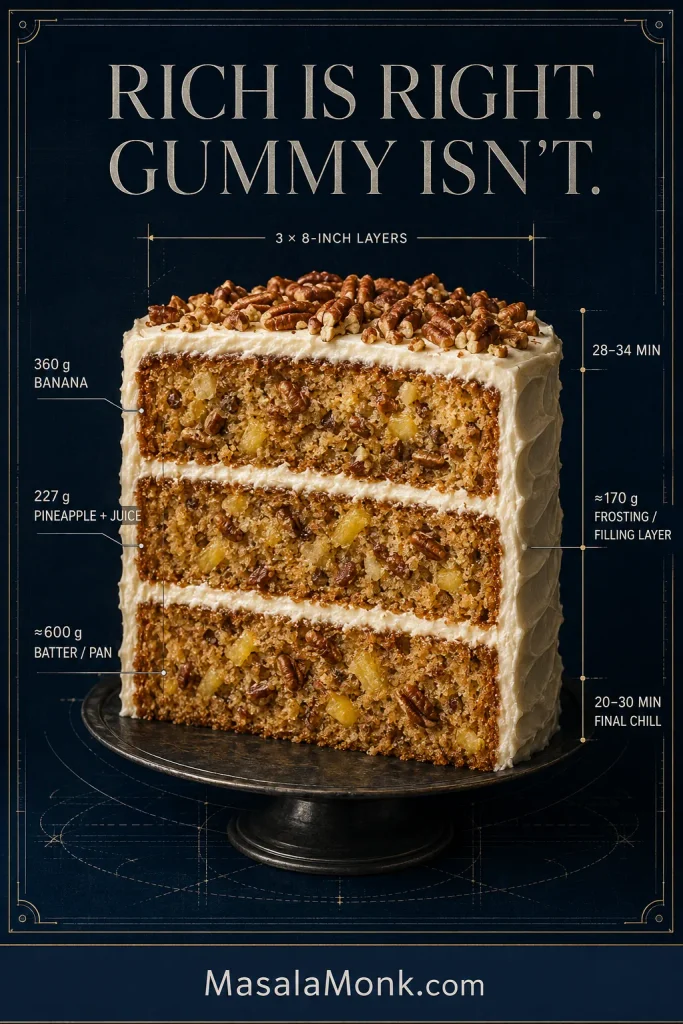
Hummingbird Cake blueprint centered on a three-layer cutaway with measurements for banana, pineapple, batter per pan, bake time, frosting and final chilling.
The structural numbers matter most: fruit, batter depth, bake cues and frosting consistency. Perfectly straight sides do not.

If your pans are ready, that’s everything you need to bake the cake. The rest is here for the moment you cut into it and wonder whether the crumb looks right, where the pineapple went, or why the frosting isn’t behaving the way you expected.

Already baked it? Check the crumb · Find the pineapple · Fix the frosting · Troubleshooting


Is Hummingbird Cake Supposed to Be Dense?

Substantial, yes. Stodgy, no. Hummingbird Cake naturally has more heft than a fluffy vanilla butter cake. Banana, pineapple, oil, eggs and pecans all contribute to a richer, closer crumb.

A good slice looks moist without looking shiny. Press a fork through the center and a piece comes away cleanly, with the occasional bit of pineapple or toasted pecan along the way. That’s the texture worth aiming for: generous and substantial, but still unmistakably cake.

A center that smears into paste is different. So is a rubbery, compressed crumb. Wetness usually points back toward bake time, fruit quantity or layers that were too deep; a tight, rubbery texture can point toward excess flour or too much mixing. A substantial layer that slices neatly and tastes good needs no fixing.

That’s the reassuring part of this cake: a layer can look lower and richer than the sponge cakes you may know and be exactly as it should be. The fork should meet cake, not wet paste.
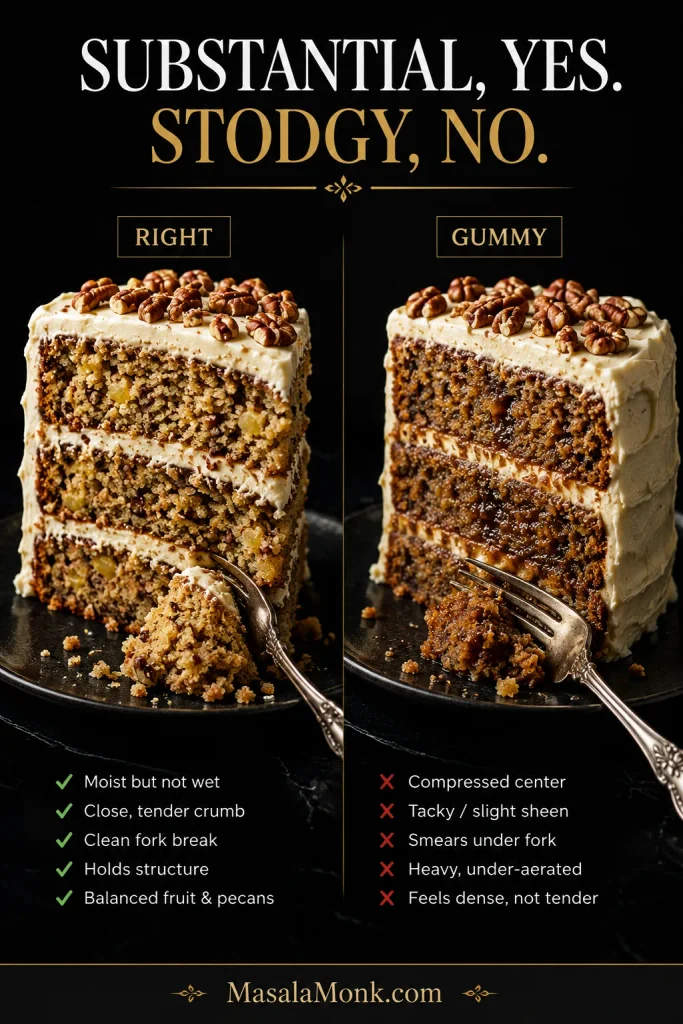
Side-by-side Hummingbird Cake slices comparing a moist structured crumb with a darker, compressed gummy crumb that smears under a fork.
Let the cake cool before diagnosing it. Warm fruit-heavy crumb can feel wetter than the same layer once settled.

Center looks genuinely wet or gummy? Jump to troubleshooting.

Why Does Hummingbird Cake Sometimes Taste Like Banana Bread?

Banana is the loudest fruit in the room. It brings aroma, sweetness, moisture and fruit solids all at once, which makes it easy for the pineapple to disappear into the background.

Hummingbird Cake shouldn’t simply eat like frosted banana bread. A wet or underbaked crumb can push it in that direction even when the banana quantity is reasonable, and extra banana makes the effect stronger.

Weigh the mashed banana and stop at 360 g. Any extra is better used in banana bread, where a strongly banana-forward crumb is exactly the point.

Pineapple in Hummingbird Cake: Drain It or Don’t?

Use all 227 g here, juice included.

That isn’t a universal Hummingbird Cake rule. A wetter formula or one with more fruit may need the pineapple drained.

The stranger problem is putting a whole can of pineapple into a cake and barely tasting it afterward. Choose crushed pineapple that still resembles tiny pieces of fruit instead of smooth pulp. Those fragments have a better chance of surviving the bake as something you can actually notice in a slice.

For stronger pineapple flavor, concentrate it instead of making the batter wetter. A very thin layer of thick pineapple jam or pineapple curd between the layers gives you a brighter burst of fruit. Keep the filling restrained so the layers still stack comfortably.

The pineapple doesn’t need to dominate. Finding a small piece here and there against banana and toasted pecan is enough to keep the slice changing as you eat it.

Fresh pineapple: use it in a recipe designed for it. Chopped fresh pineapple does not bring exactly the same balance of fruit and liquid as canned crushed pineapple with juice, so canned remains the predictable choice for this batter.

Pineapple guide showing crushed pineapple with juice, visible fruit pieces, smoother pineapple pulp and concentrated pineapple filling.
Using a larger can? Stir fruit and juice together before weighing 227 g so the moisture ratio stays consistent.

Ready to bake? Back to the ingredient amounts.

Cream Cheese Frosting Should Taste Like Cream Cheese

Hummingbird Cake is already sweet and fruit-rich, so the frosting needs contrast. Its cream-cheese tang should be obvious when you eat it with the cake.

Runny frosting often sends bakers straight to the powdered-sugar bag. Temperature is a better first lever here. The generous amount of butter and cool cream cheese give the frosting the body it needs for a layer cake while letting the cream-cheese flavor remain clear.

Getting the Consistency Right

  • Too soft: a swipe slowly slumps or the frosting creeps down the bowl. Refrigerate it for 20–30 minutes.
  • Ready: a lifted spatula leaves a soft peak that holds, and the frosting spreads across a cooled layer without tearing it.
  • Too stiff or too sweet: it becomes very firm or grainy and powdered sugar starts drowning out the cream-cheese flavor.
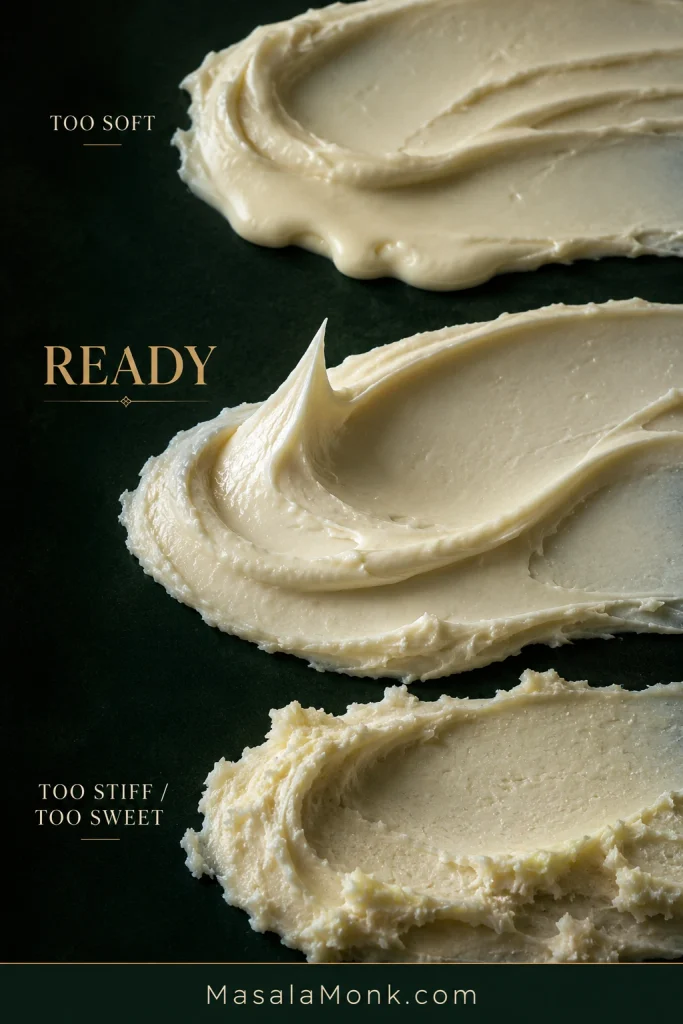
Three swipes of cream cheese frosting labeled Too Soft, Ready, and Too Stiff or Too Sweet, showing their different consistencies.
Ready frosting should spread over a cool layer without tearing crumbs or losing the ridges you leave behind.

Firm American block cream cheese is easiest to work with. Where only softer spreadable cream cheese is available, choose the firmest full-fat version you can find and keep the frosting cool. Sometimes twenty minutes in the refrigerator is all a loose bowl needs.

The finished frosting should feel creamy against the fruit-rich crumb, not like a thick layer of sweetness sitting on top of it. For detailed piping or sharp edges that must hold for a long time at room temperature, a more structured buttercream is the better choice.

Frosting the cake now? Back to the frosting steps · Stack and finish · Troubleshooting

Hummingbird Cake Pan Sizes: Why Layer Depth Matters

Three layers aren’t only about appearance. They keep this fruit-heavy batter relatively shallow, allowing the center to set before the outside has spent too long in the oven.

Pan setupWhat to expect
3 x 8-inch / 20-cm roundsMain recipe. About 600 g batter per pan; begin checking at 28 minutes.
3 x 9-inch / 23-cm roundsThinner layers. Begin checking around 24 minutes and use the same center-set and skewer cues.
2 x 9-inch / 23-cm roundsUse pans at least 2 inches deep. Begin checking around 30–35 minutes and rely on the center-set cues for the endpoint.

A 9×13 sheet cake, Bundt cake, cupcakes or a smaller 6-inch cake changes the layer depth enough to deserve directions written for that format instead of a guessed conversion.

The timer tells you when to start looking. Batter depth and the cake tell you when to stop baking.
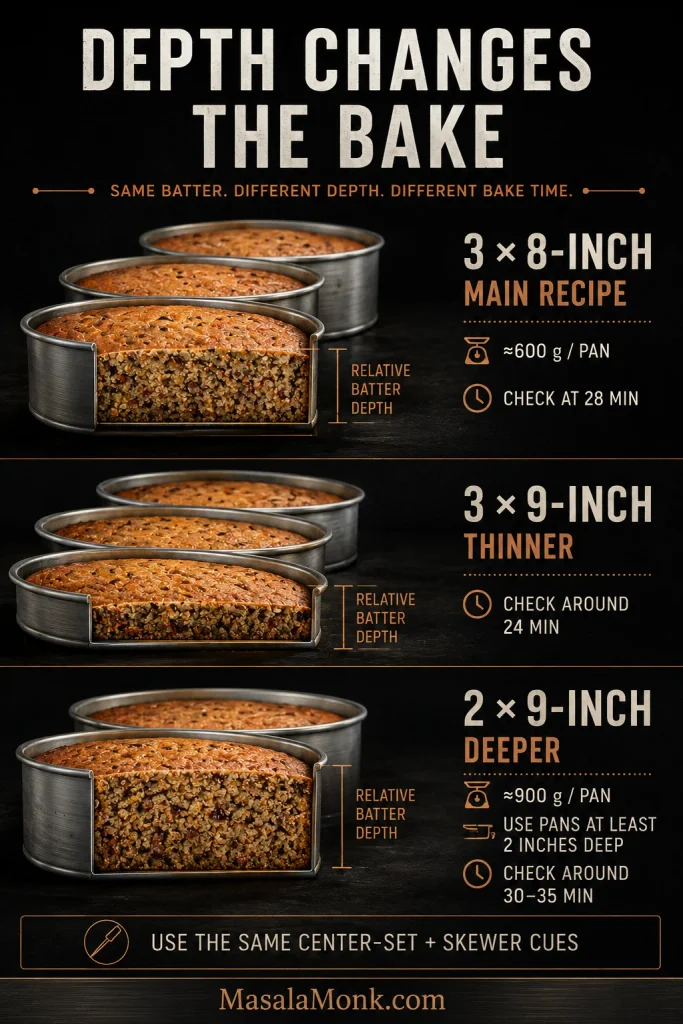
Pan-depth guide comparing three 8-inch cake pans, three shallower 9-inch pans and two deeper 9-inch pans with batter amounts and suggested check times.
When changing pans, compare batter weight and depth—not fill lines alone. Shallower layers usually reach the center sooner.

Using the main three 8-inch pans? Back to baking the layers.

Troubleshooting: What Went Wrong?

If you’ve already cut the cake and something looks wrong, start here. The longer sections explain the details; this table is for the ten-second diagnosis.

ProblemMost likely causeTry this
Tastes like banana breadBanana dominates or crumb is too wetWeigh the banana; choose pineapple with visible fruit pieces
Dense but tenderOften normalJudge the crumb, not the height
Gummy or stodgyUnderbaked, too wet, too deep or overmixedCheck fruit amounts, pan depth and doneness
Wet centerNeeds more baking or batter is too deepKeep baking until the center sets
Dry and heavyToo much flour or oven timeWeigh flour; check earlier
Pineapple disappearsFruit is mild or too finely processedUse visible fruit pieces or concentrated filling
BlandUnripe banana, weak pineapple, untoasted nuts or low seasoningUse deeply spotted bananas and toast the pecans
Tastes too much like carrot cakeSpices are crowding out the fruitKeep secondary spices restrained
Runny frostingWarm/soft cream cheese, warm room or overmixingRefrigerate before adding more sugar
Filling squeezes outToo much loose frostingUse less filling; firm the stack before continuing
Layers slideWarm cake/frosting, domes or overfillingCool, level if needed, then continue
Cake tears while frostingLayers are too warm or delicateCool completely; chill briefly if needed
Outside done, center rawDeep batter or hot ovenCheck pan setup; tent a browning top if needed

Assembly Problems: Fix the Stack First
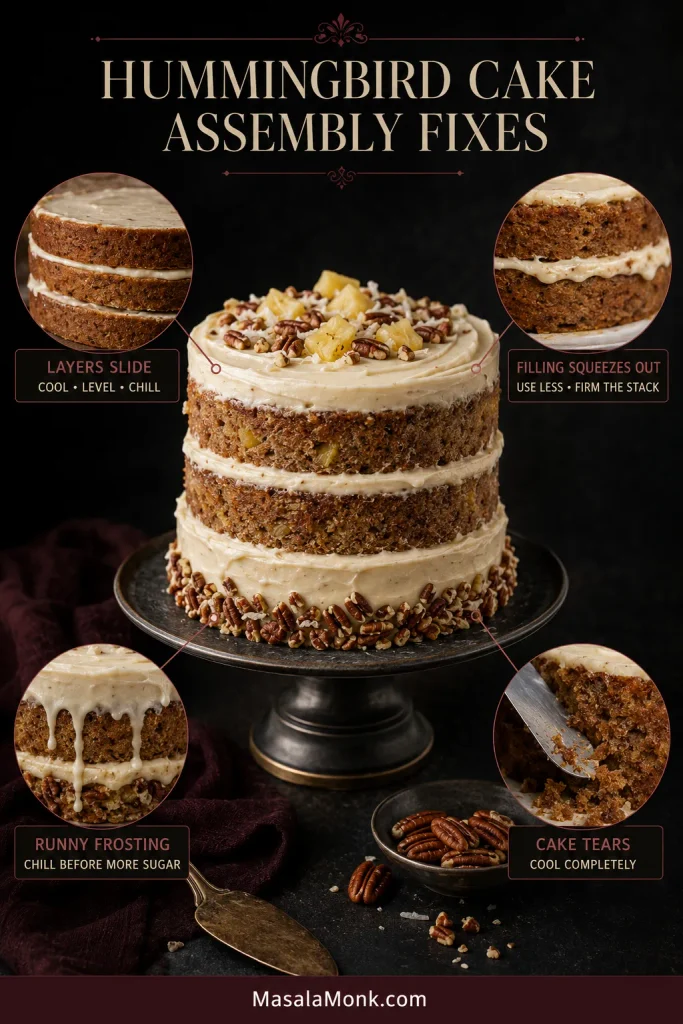
Hummingbird Cake troubleshooting graphic with a central layer cake and close-ups showing sliding layers, squeezed filling, runny frosting and cake tearing.
A warm layer can soften frosting, which squeezes outward and lets the stack slide. Fix the earliest problem first.

Back to the recipe method · Back to top

What You Can Change

  • Walnuts: swap them for the pecans in the same amount and toast them first.
  • No nuts: leave them out. Nothing structural needs replacing.
  • Coconut: common in some versions, but not essential to the classic banana-pineapple-pecan cake.
  • Frozen bananas: thaw completely, mash them with the liquid they release, then weigh out 360 g.
  • Butter instead of oil: use a recipe built around butter or a butter-oil blend. Neutral oil is one reason these refrigerated layers remain moist.
  • More pineapple: put concentrated fruit between the layers instead of another can of liquid-heavy pineapple in the batter.

Gluten-free, vegan and substantially reduced-sugar Hummingbird Cakes change the structure enough to deserve recipes of their own. At some point a substitution list simply becomes a different cake.

Why Hummingbird Cake Recipes Differ

Hummingbird Cake recipes can look surprisingly different because they aren’t all working with the same balance of fruit, fat and liquid. Some old-school versions are exceptionally rich, with more banana, oil and sugar and sometimes no baking powder. Others pull back a little and rise somewhat higher.

The 1978 Hummingbird Cake made famous by Southern Living belongs firmly to that lavish old-school tradition. Modern versions may handle the pineapple, leavening or pans differently because the rest of the recipe changed too.

Keep the formula together. Pineapple handling, leavening, pan depth and bake time only make sense alongside the rest of the recipe they belong to. Borrow one instruction from a very different version and an otherwise sensible piece of advice can suddenly work against you.
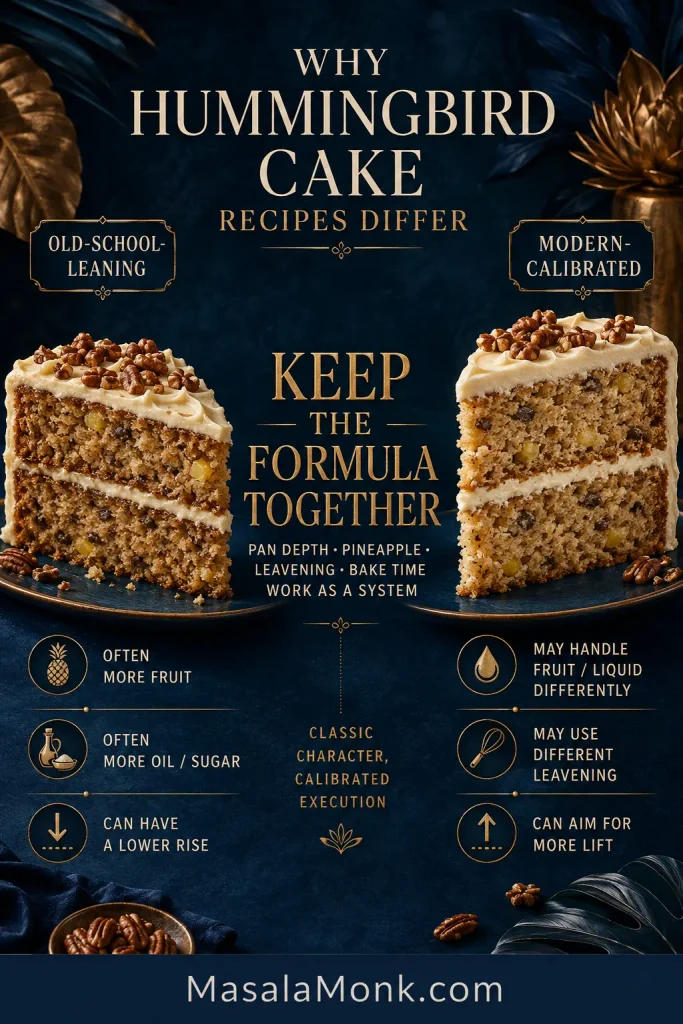
Comparison of old-school-leaning and modern-calibrated Hummingbird Cake formulas with notes about fruit, fat, leavening, pan depth and bake time.
Different pineapple instructions often reflect different formulas. Compare fruit, liquid, flour and batter depth before borrowing one rule.

Bake It Today, Serve It Tomorrow

Hummingbird Cake is unusually friendly for a three-layer celebration cake. The oil and fruit help the crumb stay moist, and an overnight rest does it no harm. That’s useful when the cake is for a birthday, holiday table or gathering and serving day already gives you plenty to think about.

Does Hummingbird Cake need to be refrigerated? Once it is covered with cream cheese frosting, yes. Keep the finished cake refrigerated and give chilled slices about 15–20 minutes at room temperature before serving.

Storage, Freezing and Serving

  • The day before: bake and cool the layers completely, wrap them well and refrigerate. Or assemble and frost the entire cake, cover it and refrigerate overnight.
  • Serving day: keep the cake cool until you need it, especially in a warm room. That short rest before eating brings the crumb and frosting back to a much better texture.
  • Leftovers: cover and refrigerate. For the best texture and flavor, aim to finish the cake within about 4–5 days.
  • Freezing: unfrosted layers are easiest. Cool them, wrap tightly and freeze, then thaw in the refrigerator while still wrapped. Firm chilled slices of frosted cake can also be wrapped and frozen. For best quality, use frozen cake or slices within about 1 month.

This is one of those celebration cakes that does not punish you for getting ahead. There is a great deal to be said for opening the refrigerator the next day and finding the difficult part already done.
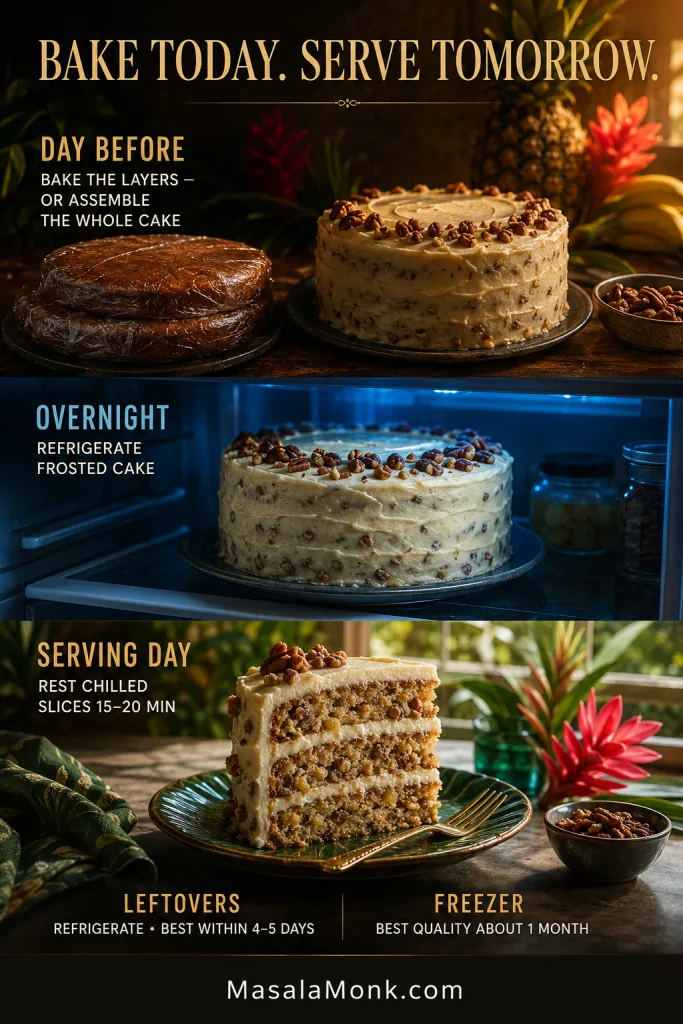
Make-ahead Hummingbird Cake guide showing wrapped cake layers, a frosted cake refrigerated overnight, a serving-day slice and leftover and freezer guidance.
Cold keeps the cake stable; a short room-temperature rest restores a softer crumb and creamier frosting before serving.

Back to the recipe · Back to top

Why Is It Called Hummingbird Cake? The Jamaican Doctor Bird Story

For a cake now so strongly associated with Southern baking, the earlier trail is wonderfully tropical. Its name points back to Jamaica and its national bird, the red-billed streamer-tail hummingbird known as the Doctor Bird.

The Jamaican Doctor Bird Cake

Versions of Doctor Bird Cake were already circulating in Jamaica-related promotional material by the late 1960s. Visit Jamaica’s archival account preserves an Air Jamaica recipe published in The Daily Gleaner on February 4, 1971. The feature covered dishes served on the airline’s in-flight menu, and the cake took its name from the Doctor Bird — both Jamaica’s national bird and a symbol used by Air Jamaica.

That version was described as a rich pineapple-and-banana dessert loaf. It’s a wonderful contrast with the cake many people picture today: the tropical fruit was already there, but the towering American layer cake came later.

The 1978 Southern Living Cake

In 1978, Mrs. L.H. Wiggins of Greensboro, North Carolina, submitted her Hummingbird Cake to Southern Living. The three-layer recipe became one of the magazine’s best-known desserts and helped turn Hummingbird Cake into a fixture of Southern celebration tables.

That gives the cake an identity that is hard to squeeze into one place. Its name and tropical fruit reach back toward Jamaica; the towering cream-cheese-frosted layer cake became deeply Southern. Both histories are sitting in the same slice.

Food-history poster showing Jamaica's Doctor Bird hummingbird, a 1971 Air Jamaica ring-style Doctor Bird Cake and a 1978 Southern three-layer Hummingbird Cake.
The Jamaican Doctor Bird trail predates the Southern layer cake; the tall cream-cheese-frosted version came later.

For a cake named after something as tiny as a hummingbird, there is nothing timid about it. Three generous layers, soft under a fork and sturdy enough to stand proudly on the plate. Then someone cuts the first slice, and suddenly the cake doesn’t look quite so enormous after all.
Posted on — Leave a comment

Gingerbread Cake Recipe: Moist, Easy & Perfectly Spiced

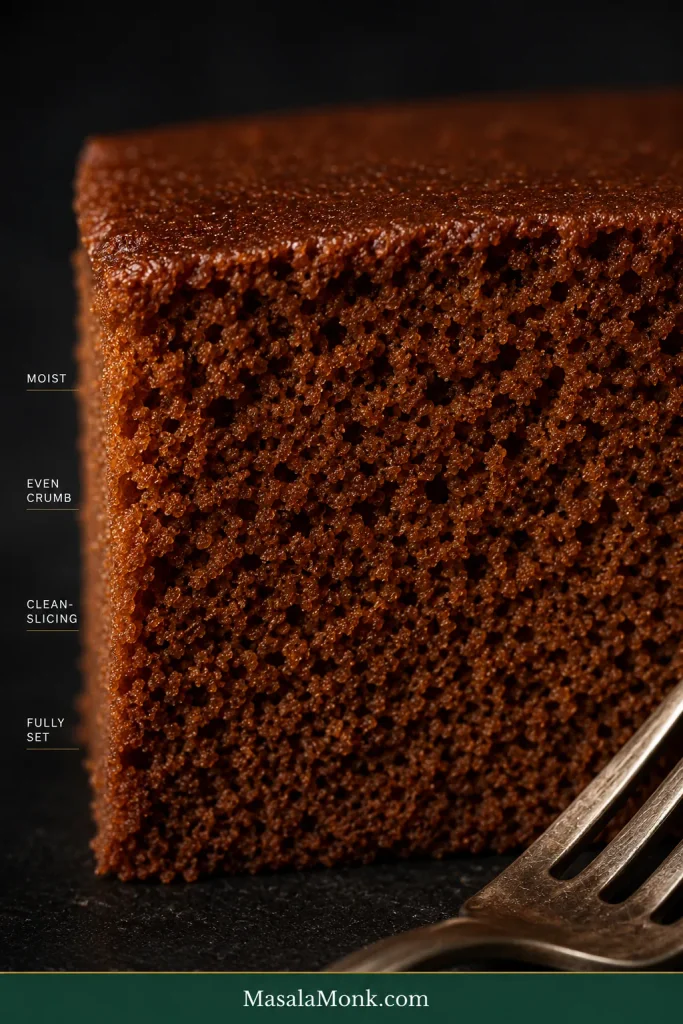
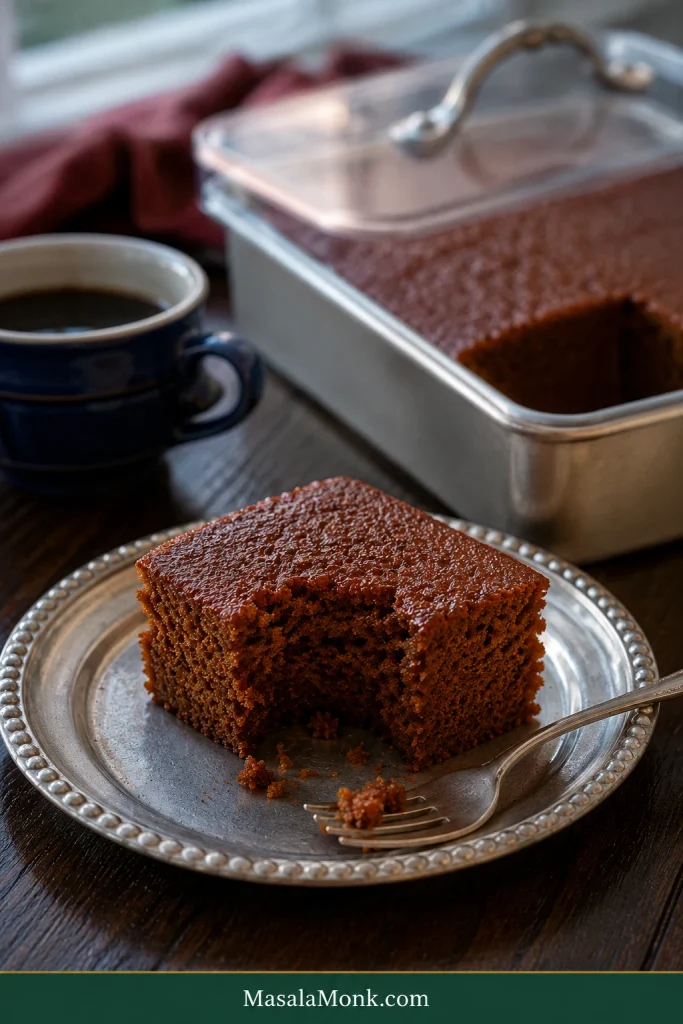
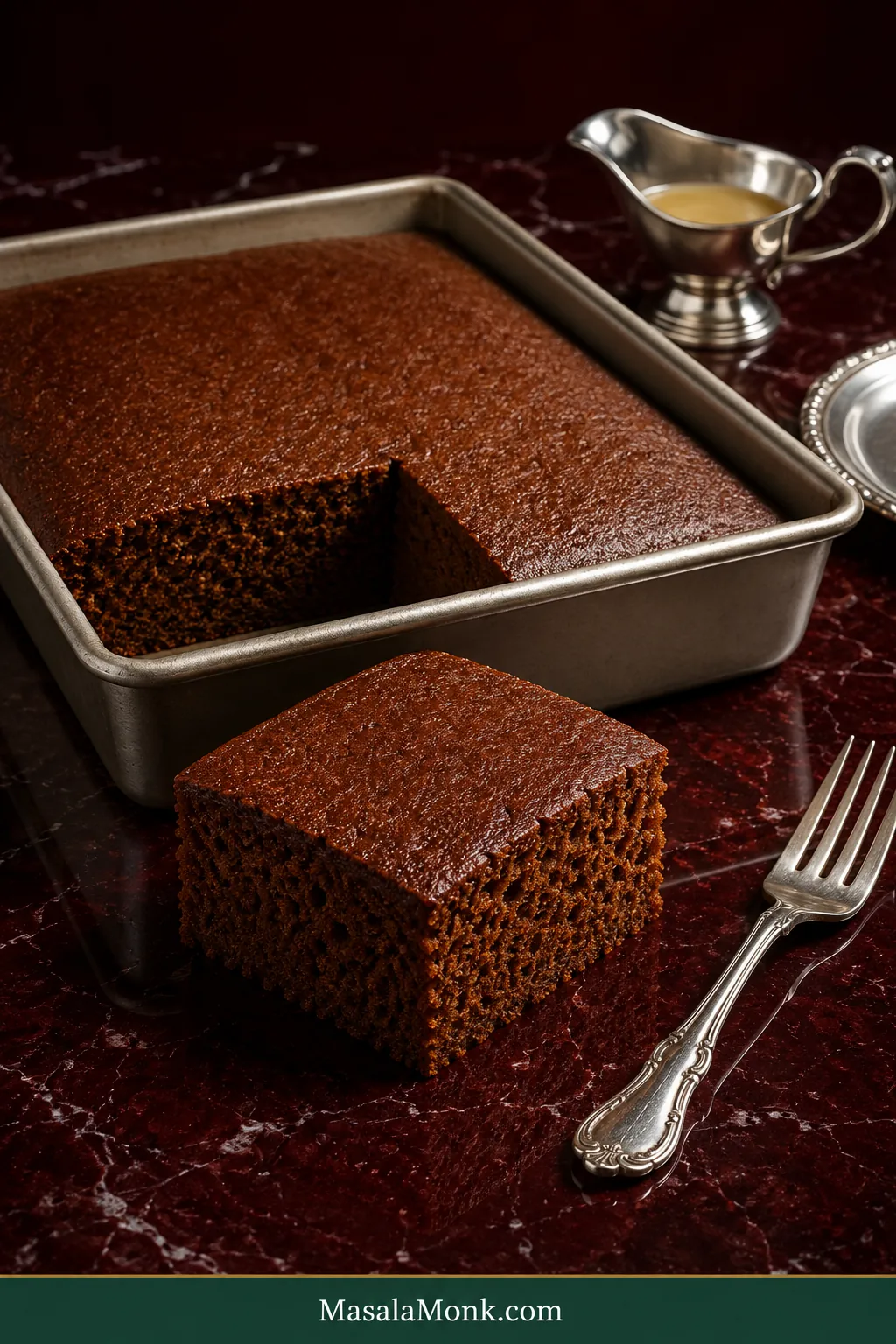
Square of mahogany gingerbread cake cut from a light metal 9×13 pan, showing a moist, evenly baked crumb beside a silver fork.

A good gingerbread cake announces itself before you cut it. The kitchen fills with the deep smell of molasses and warm ginger, the top settles into a rich mahogany brown, and a square gives easily under the fork while the crumb holds together.

Its middle is soft and moist, the edges stay tender, and once cooled the crumb cuts cleanly. Ginger comes through clearly against the molasses.

This is old-fashioned gingerbread in the best sense: one uncomplicated 9×13-inch molasses cake, mixed by hand, cut into squares and perfectly happy without decoration. It has the easygoing feel of a snacking cake—good with coffee in the afternoon, comfortable after dinner, and simple enough to sit beside richer desserts on a holiday table.

Quick Answer: How to Make Moist Gingerbread Cake

For moist gingerbread cake, bake a fluid molasses batter in a light-colored 9×13-inch pan at 350°F / 175°C for about 30–35 minutes, until the center is set and springy and a tester carries moist crumbs but no wet batter.

Mix regular unsulphured molasses with brown sugar, melted butter, a little neutral oil and hot water. Once the mixture feels comfortably warm, with no steam rising, add the eggs, then mix in the dry ingredients until evenly combined and no dry flour remains.

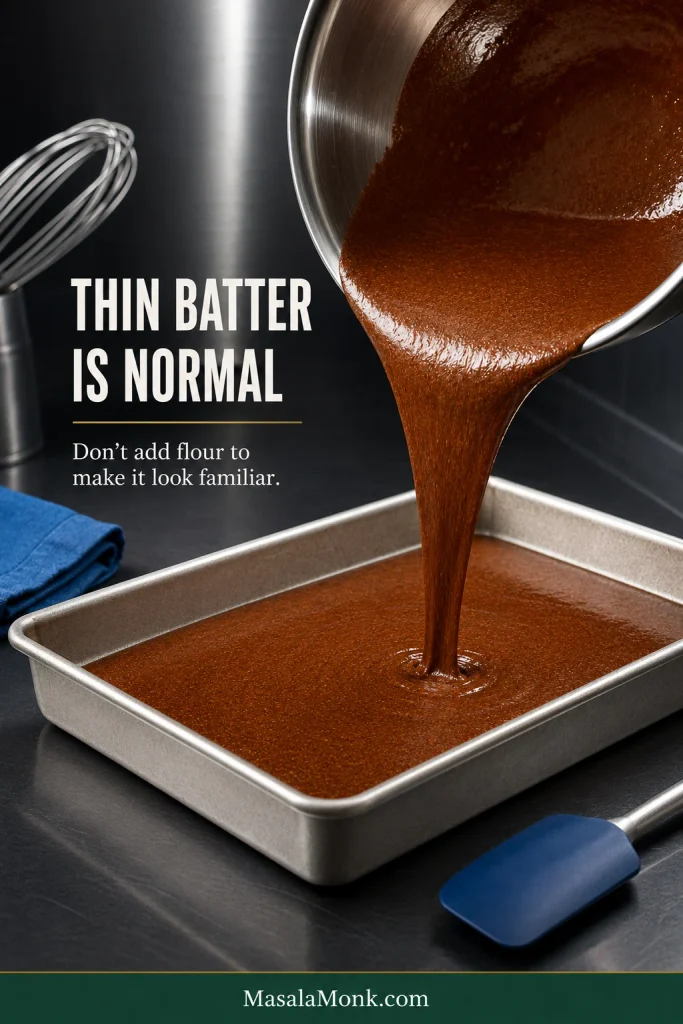
The batter will be dark and unusually fluid. Pour it into the prepared pan promptly and start checking around 28–30 minutes. Let the cake itself—not the timer alone—tell you when it is ready.

Thin batter is normal here. It will look much looser than ordinary butter-cake batter. Do not add extra flour to make it look more familiar.

Gingerbread Cake Recipe

Moist & Easy Gingerbread Cake

A soft, ginger-forward molasses cake baked in one 9×13-inch pan, with a tender crumb that stays moist into the next day.

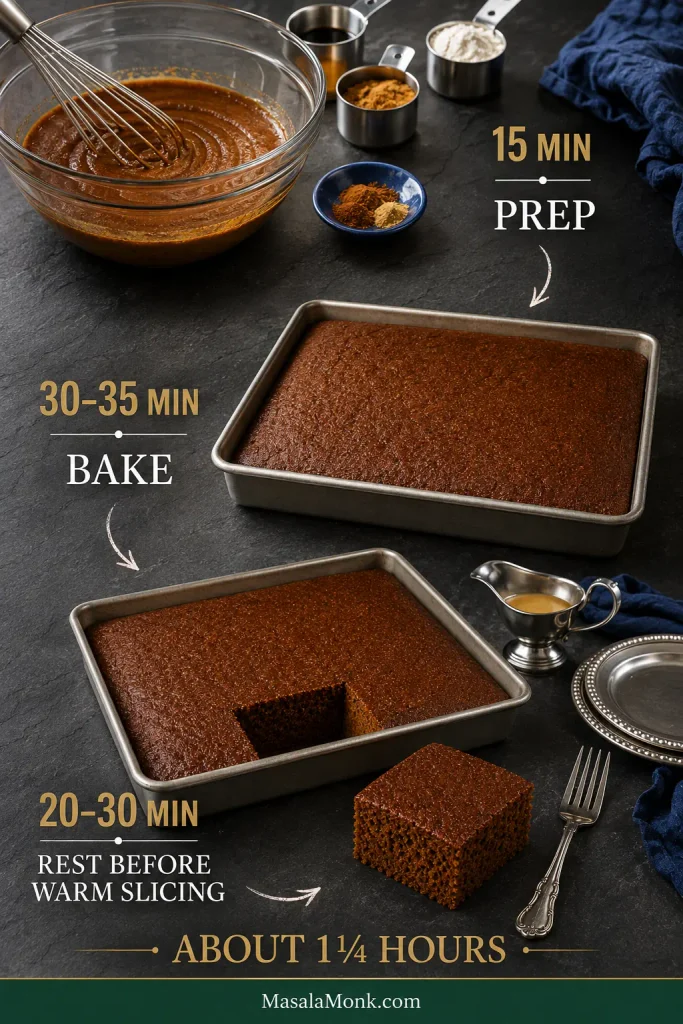
Hands-on prep15 minutes
Bake time30–35 minutes
Minimum cooling20–30 minutes
Total to warm servingAbout 1¼ hours
Yield12 generous or 15 smaller squares
Pan9×13 in / 23×33 cm light-colored metal, about 2 in / 5 cm deep
Oven350°F / 175°C conventional / 160°C fan
MixerNot needed
Make aheadExcellent 1 day ahead

Cool completely before frosting or cutting especially neat squares.

Equipment

  • 9×13-inch / 23×33 cm light-colored metal baking pan, about 2 inches / 5 cm deep
  • Parchment paper, with enough overhang for a sling if you want to lift the whole cake out
  • Large mixing bowl
  • Medium mixing bowl
  • Whisk
  • Flexible silicone or rubber spatula
  • Digital kitchen scale, preferably
  • Kettle or small saucepan for the hot water
  • Wire cooling rack

Dry ingredients

  • 320 g all-purpose flour (2⅔ cups)
  • 2½ teaspoons ground ginger
  • 1½ teaspoons ground cinnamon
  • ¼ teaspoon ground cloves
  • ¼ teaspoon ground nutmeg
  • 1 teaspoon baking soda
  • 1 teaspoon baking powder
  • ½ teaspoon fine salt

Wet ingredients

  • 150 g packed dark brown sugar (¾ cup)
  • 330 g regular/original unsulphured molasses (about 1 cup / 240 ml)
  • 113 g unsalted butter (½ cup / 4 oz), melted
  • 60 ml neutral oil (¼ cup), such as sunflower, canola or vegetable oil
  • 240 ml hot water (1 cup)
  • 2 large eggs
  • 1 teaspoon vanilla extract

Using a scale? Set the large mixing bowl on it, tare to zero and pour the molasses directly into the bowl. It is much easier than scraping sticky molasses from a measuring cup.

Mix and assemble

  1. Prepare the oven and pan. Heat the oven to 350°F / 175°C conventional / 160°C fan with a rack in the center. Lightly grease the pan and line the base with parchment. If you want to lift the whole cake out before cutting, leave parchment overhang along two opposite sides to form a sling.
  1. Mix the dry ingredients. Whisk the flour, ginger, cinnamon, cloves, nutmeg, baking soda, baking powder and salt together thoroughly.
  1. Make the molasses mixture. Whisk the brown sugar, molasses, melted butter and oil in a large bowl. Slowly whisk in the hot water. Let the mixture stand for a few minutes, until comfortably warm and no longer steaming, then whisk in the eggs one at a time and add the vanilla.
  1. Bring the batter together. Add the dry ingredients and mix until evenly combined and no dry flour remains. Sweep a flexible spatula around the sides and firmly across the bottom to catch hidden pockets. There is no need to beat the batter for volume.
  1. Pour the batter. It will be dark and easily pourable. Resist the urge to thicken it with extra flour. Pour it straight into the prepared pan.

Bake and cool

  1. Bake. Transfer the pan directly to the oven. Avoid opening the door during roughly the first 25 minutes. Begin checking around 28–30 minutes; most cakes will finish in about 30–35 minutes.
  1. Check the center. The middle should look set and spring back gently when touched. A tester may carry a few moist crumbs but should not have wet batter. The edges may also begin to pull slightly from the pan; consider that an extra clue, not something you have to wait for.
  1. Let the crumb settle. Cool on a wire rack for at least 20–30 minutes before cutting. Let the cake cool completely for the neatest slices or before frosting. If you made a parchment sling, wait until the cake is completely cool before lifting it from the pan; warm gingerbread is softer and easier to break.

To serve: enjoy it plain, dust it with powdered sugar, add softly whipped cream, spread on a restrained layer of cream cheese frosting, or spoon over lemon sauce.

Timeline showing gingerbread cake preparation, baking, cooling and serving stages.
For gingerbread cake, baking time and serving time are not the same thing. Build the cooling rest into the plan so the crumb can settle before the first clean slice.

The Slice We’re Aiming For

  • Soft with a little body: tender enough for the fork to slide through easily, but not airy like sponge cake.
  • Moist and clean-slicing: the crumb feels almost plush and still holds together once cooled.
  • Ginger-forward: ginger reaches you first; cinnamon warms it; clove and nutmeg stay in the background.
  • Deeply colored: expect a rich mahogany-brown crumb with the rounded caramel edge of molasses.

After its initial rest, the crumb is especially yielding. Once fully cool, it cuts into neat, dark squares.

Close-up of gingerbread cake with a fine, evenly baked mahogany crumb that looks moist, tender and fully set.

Gingerbread Cake vs Ginger Cake vs Sticky Ginger Cake

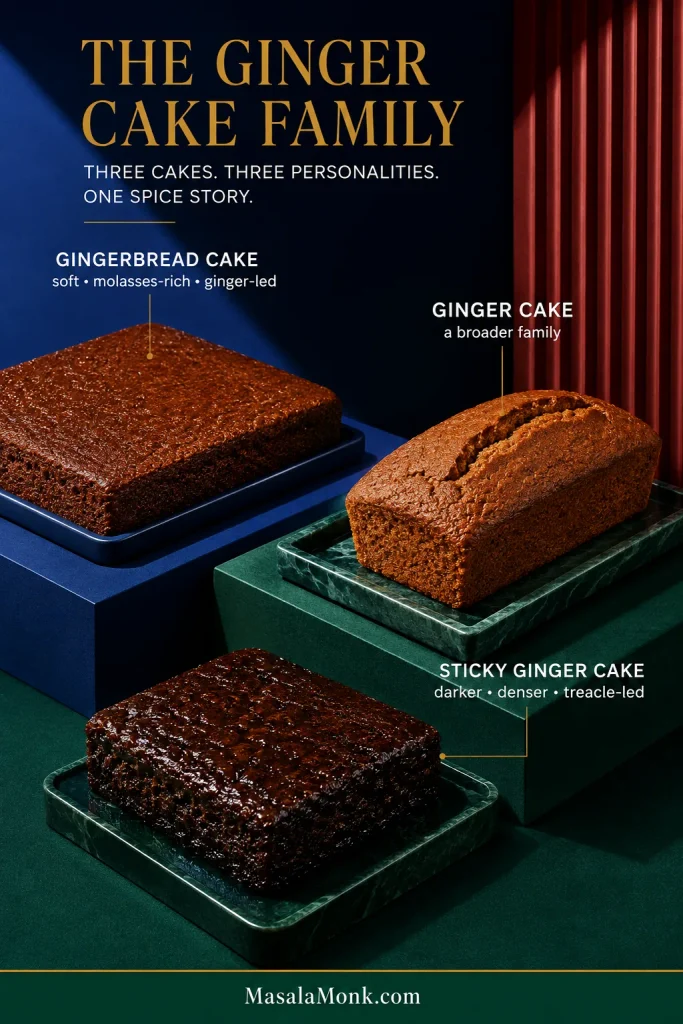
American-style gingerbread cake is usually a soft molasses cake with ginger leading the spice. “Ginger cake” is a broader term; sticky ginger cake usually points toward a darker, denser British-style cake.

Three cakes labeled gingerbread cake, ginger cake and sticky ginger cake, showing differences in shape, crumb and surface.
When a recipe is called simply “ginger cake,” check its syrup, pan and intended texture before assuming it will behave like American gingerbread cake.

Gingerbread cake: this is the family our recipe belongs to—molasses-rich, ginger-led and commonly baked as a straightforward single layer.

Ginger cake: a broader name that can describe molasses gingerbread, a loaf, a fresh-ginger cake or another regional style altogether.

Sticky ginger cake: usually a more British style, often made with black treacle, golden syrup or stem ginger and intended to become darker, denser and stickier as it rests.

If it is the same molasses-and-ginger family you want in a completely different texture, the Gingerbread Cookies Recipe turns those flavors into soft-centered cut-outs that roll cleanly and hold their shapes.

Why This Recipe Works

Molasses does more than sweeten the cake. It gives gingerbread its deep color, caramelized flavor and characteristic moisture. Regular unsulphured molasses brings plenty of depth and still leaves room for the ginger to stay clear.

Butter brings fuller cake flavor; the smaller amount of neutral oil helps the crumb stay tender after cooling.

Baking soda and baking powder share the lifting work. Baking soda reacts with acidity in the molasses-rich batter, while baking powder supplies additional lift. Together they help this substantial, fluid batter rise without turning the crumb light and sponge-like.

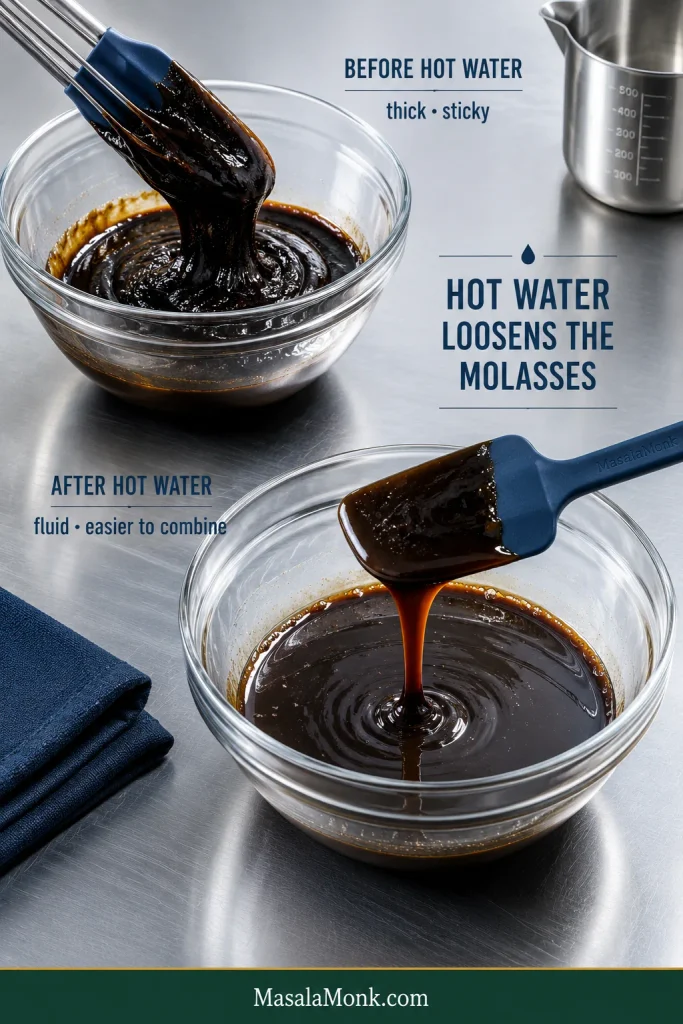
Hot water thins the molasses so it mixes evenly through the batter. The heavy, sticky mixture becomes much easier to combine by hand.

Cinnamon adds warmth around the ginger. Clove and nutmeg stay quieter. If you prefer several warm spices to share the spotlight more evenly, the Spice Cake Recipe takes that broader approach.

Ingredients That Matter Most

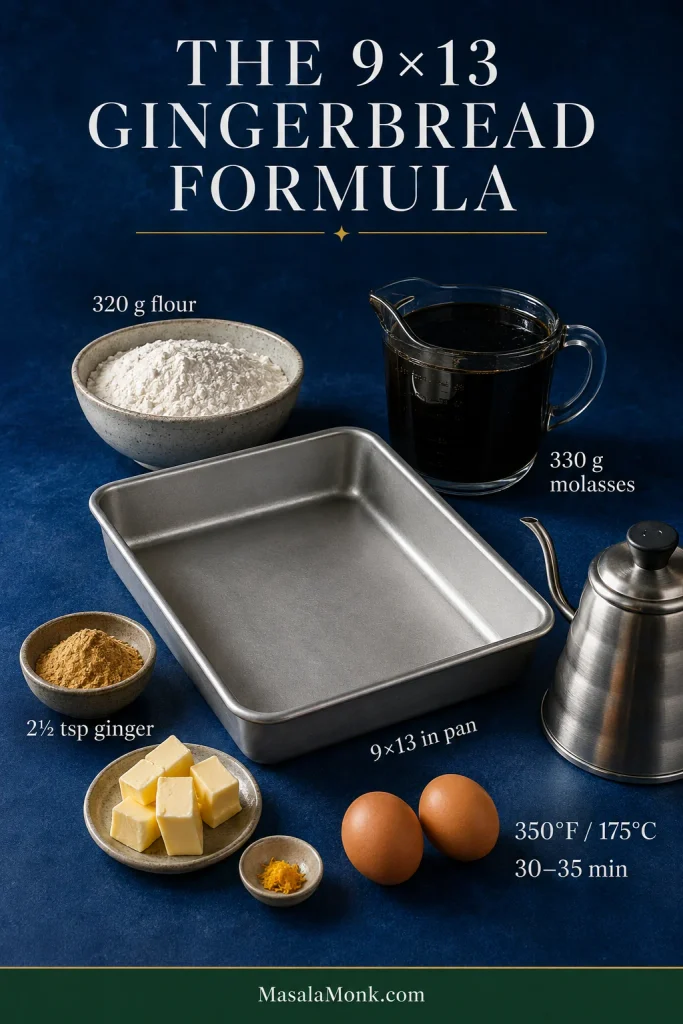
Infographic of measured ingredients for a 9×13 gingerbread cake, including flour, molasses, sugar, butter, oil, eggs, hot water and spices.
Treat the 9×13 gingerbread formula as a system: flour, molasses, fat and pan depth all push the final crumb in different ways, so one change can affect more than one trait.

Which Molasses Should You Use?

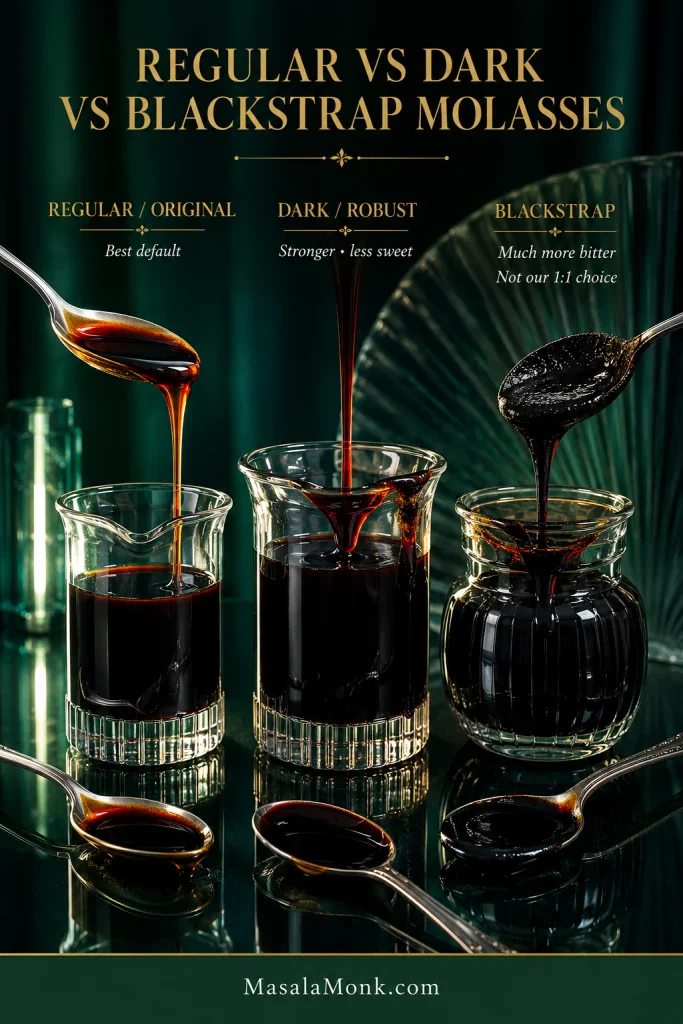
The best molasses for this gingerbread cake is regular/original unsulphured molasses. Dark or robust molasses makes a stronger, less sweet cake; blackstrap is considerably more bitter and is not the best choice here.

Regular, dark and blackstrap molasses shown side by side in glass containers with spoons displaying their different colors.
Molasses strength changes more than sweetness: as the syrup grows darker and more bitter, ginger has to compete harder to stay distinct in the finished cake.
MolassesHow it tastes hereBest use
Regular/original unsulphuredDeep, rounded and pleasantly sweetBest default
Dark/robustDarker, stronger and somewhat less sweetGood if you already enjoy assertive molasses
BlackstrapMuch more bitter, mineral-forward and intenseNot recommended as a straight 1:1 swap

Outside the US, the labels change. Canadian fancy molasses is generally closest to the flavor we’re after. In the UK, black treacle is a practical related substitute when American-style molasses is hard to find, but it is not identical. Some black treacles taste somewhat sweeter and rounder, so expect a slightly different cake.

Guide comparing common molasses labels in the United States, Canada and United Kingdom with bottles and small pitchers of dark syrup.
Regional names are only a starting point. When buying molasses for gingerbread outside the US, match flavor intensity first; equally dark syrups can still taste very different.

If the labels on different jars are confusing, King Arthur Baking has a useful guide to light, dark and blackstrap molasses.

Ground, Fresh and Crystallized Ginger

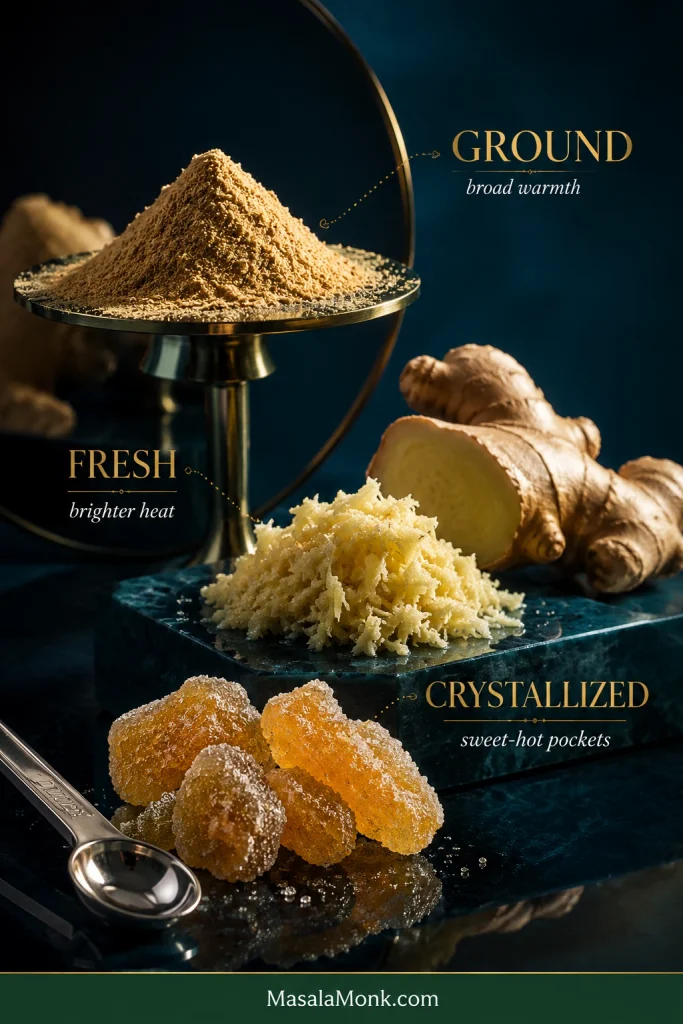
Ground ginger gives the whole cake its broad, familiar ginger warmth. Fresh ginger is brighter and sharper. Use it as a boost; keep the ground ginger as the foundation.

Ground ginger powder, grated fresh ginger and chopped crystallized ginger displayed together on a dark surface.
Think of the three forms as different kinds of ginger impact: ground spreads through every bite, fresh flashes brighter, and crystallized ginger creates concentrated sweet-hot pockets.

To make a stronger cake, increase the ground ginger to about 3 teaspoons. For brighter, fresher heat, keep the ground ginger and add 1 tablespoon finely grated fresh ginger to the wet mixture.

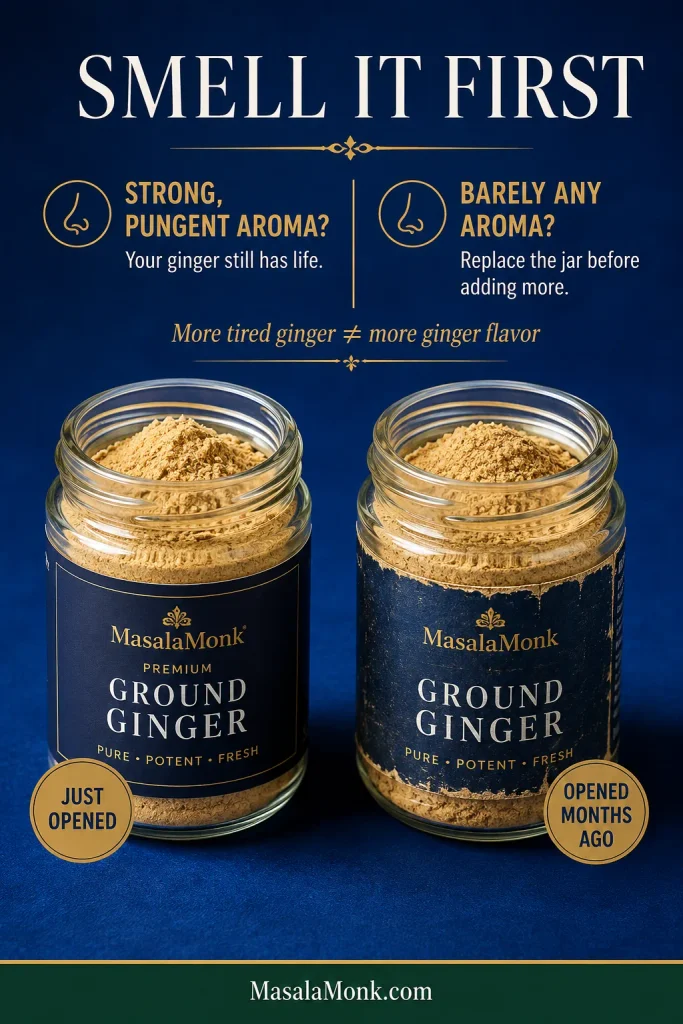
Before adding more: smell the ground ginger already in your jar. Fresh spice smells warm and pungent as soon as you open it. A faint aroma means a new jar will do more for the cake than another spoonful of tired ginger.

Fresh and older ground ginger shown in an aroma comparison with open spice containers.
Aroma can fade long before ground ginger looks stale. Smell it before measuring; pungency matters when the spice has to stand up to molasses.

If you want to experiment with crystallized ginger, dice it finely and fold in only a small amount. It creates concentrated sweet-hot pockets through the cake. In a batter this fluid, some pieces may settle toward the bottom, and tossing them in flour does not reliably prevent that.

Tempted to use a premixed warm-spice blend? Check what is actually in it first. The Apple Pie Spice Recipe, for example, is intentionally cinnamon-led; gingerbread needs ginger to lead.

As for the hot liquid, water is deliberate. Coffee can be lovely in gingerbread, but some people notice it before the ginger. Hot water loosens the molasses without introducing another strong flavor.

What the Batter Should Look Like

If this is your first molasses gingerbread, the batter may look loose enough to make you check the ingredient list again. Nothing is missing.

When the hot water reaches the molasses mixture, it loosens dramatically. After the flour goes in, mix until no dry streaks remain, then sweep the spatula firmly across the bottom of the bowl; dry pockets can hide easily in such a dark batter.

Two bowls of molasses mixture showing a thick consistency before hot water and a much looser, pourable consistency afterward.
The dramatic loosening is useful: once the molasses flows freely, it distributes more evenly through the batter without requiring aggressive mixing.

The finished batter falls easily from the spatula and spreads across the pan almost by itself. Keep that consistency rather than thickening it. Once everything is combined, pour it into the prepared pan and get it into the oven promptly.

Ready for the oven? See how to tell when the center is done.

Thin brown gingerbread batter pouring in a ribbon into a light metal rectangular baking pan.
This loose ribbon is the consistency we are looking for. Judge the finished gingerbread, not how closely the bowl resembles a conventional butter cake.

How to Tell When It’s Done

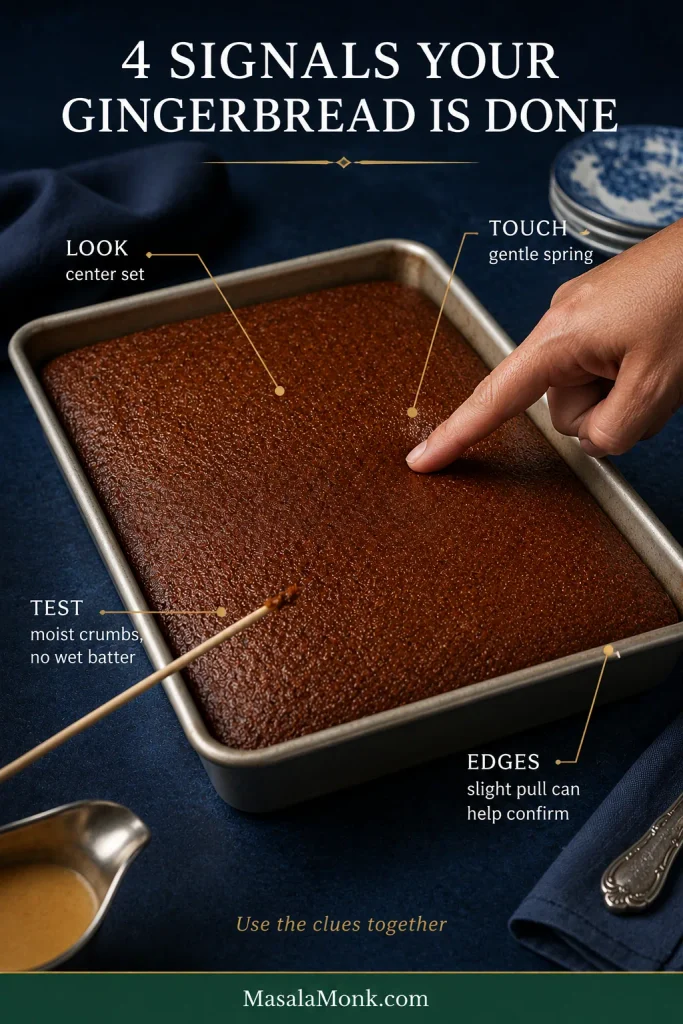
Gingerbread cake is done when the center looks set, springs back gently and a tester shows moist crumbs but no wet batter. The edges may also begin to pull slightly from the pan.

A dark cake makes the last few minutes harder to read. Use several clues together; no single one has to carry the decision.

Gingerbread cake with four doneness checks: a set center, springy touch, moist crumbs on a tester and slight edge pull.
The four doneness signals are strongest as a pattern. One odd clue can mislead; several cues arriving together are much harder to misread.

Use the Four-Signal Doneness Test

  1. Look: the center is set, with no liquid or visible rippling.
  2. Touch: a light press near the center springs back.
  3. Test: a few moist crumbs are good; wet batter means it needs longer.
  4. Check the edges: they may just begin to pull from the pan. Treat this as supporting evidence.
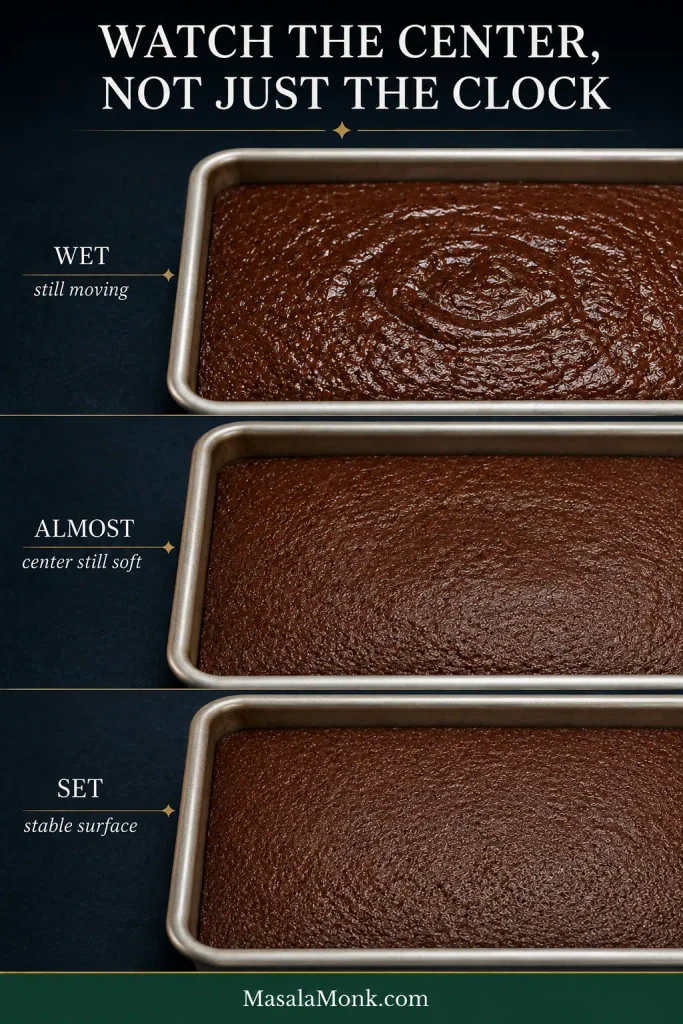
Three gingerbread cakes showing the center progressing from wet and rippled to almost set and fully stable.
Use this progression to calibrate your eye. Once you have seen wet → almost set → set, the final minutes of a dark gingerbread cake become much less guesswork.

Start checking around 28–30 minutes. Your oven and pan may move the finish slightly earlier or later.

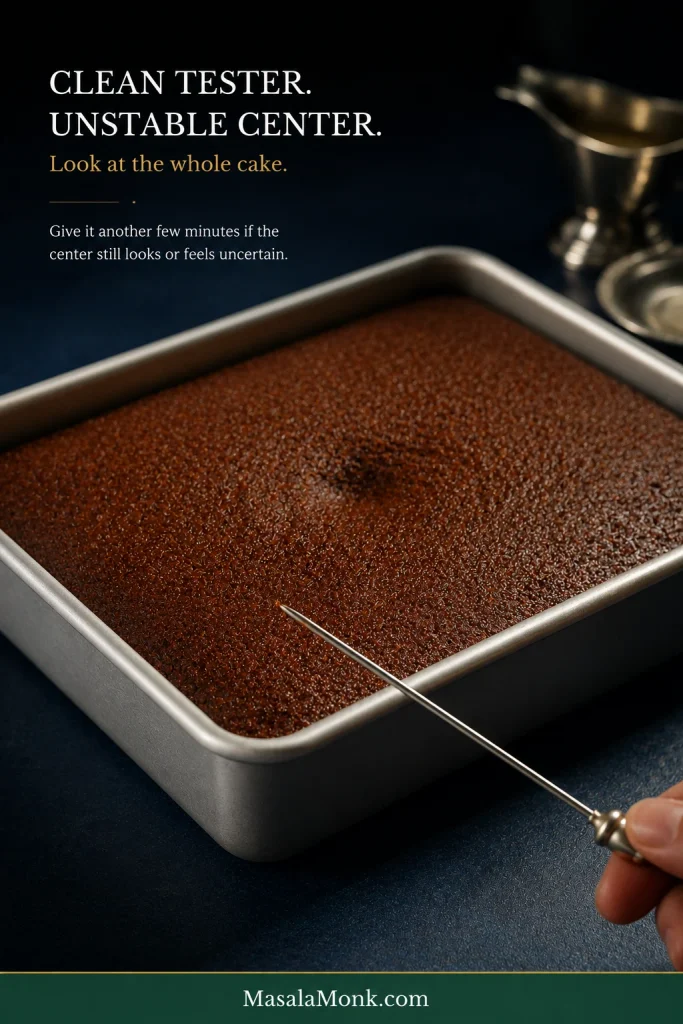
What if the tester looks clean but the center still seems uncertain? Look at the whole cake. If the middle remains visibly unstable or stays indented when lightly touched, give it another few minutes.

A clean cake tester beside gingerbread whose center still appears slightly soft and unstable.
A cake tester samples one narrow path through the cake. The center’s overall movement and spring tell you something that single puncture cannot.

Moist vs Gummy: Know the Difference

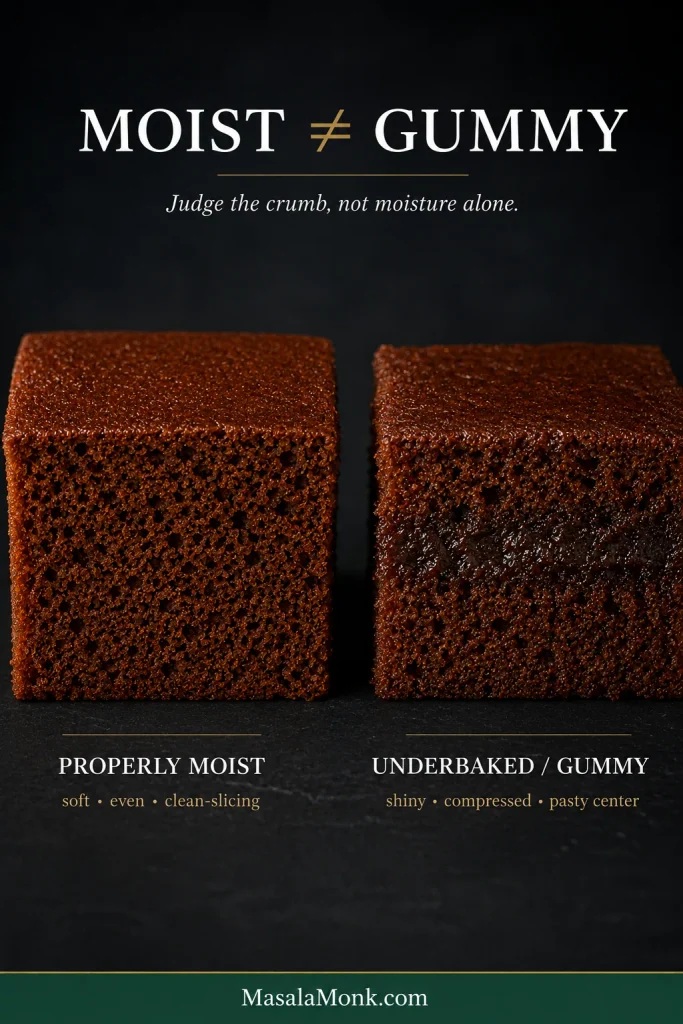
Properly moist gingerbread has a soft, even crumb that holds together when sliced; underbaked gingerbread looks shiny, compressed or pasty through the center.

Properly moistGummy or underbaked
Soft, even crumbShiny or compressed strip through the center
Holds together once cooledPasty or wet-looking interior
Moist crumbs on a testerWet batter on the tester
Slices cleanly after restingKnife smears with raw-looking batter
Side-by-side gingerbread cross-sections comparing an evenly moist crumb with a darker, compressed gummy center.
Cooling clarifies the diagnosis: true moisture remains tender and structured, while an under-set center keeps its compressed or pasty look.

If the first slice looks suspiciously dense, remember when you cut it. Molasses-rich cake continues settling as steam escapes, and a slice taken too soon can look wetter and more compressed than it will after the recommended 20–30 minutes of cooling.

Still not sure what went wrong? Go to the troubleshooting guide.

What to Serve With It

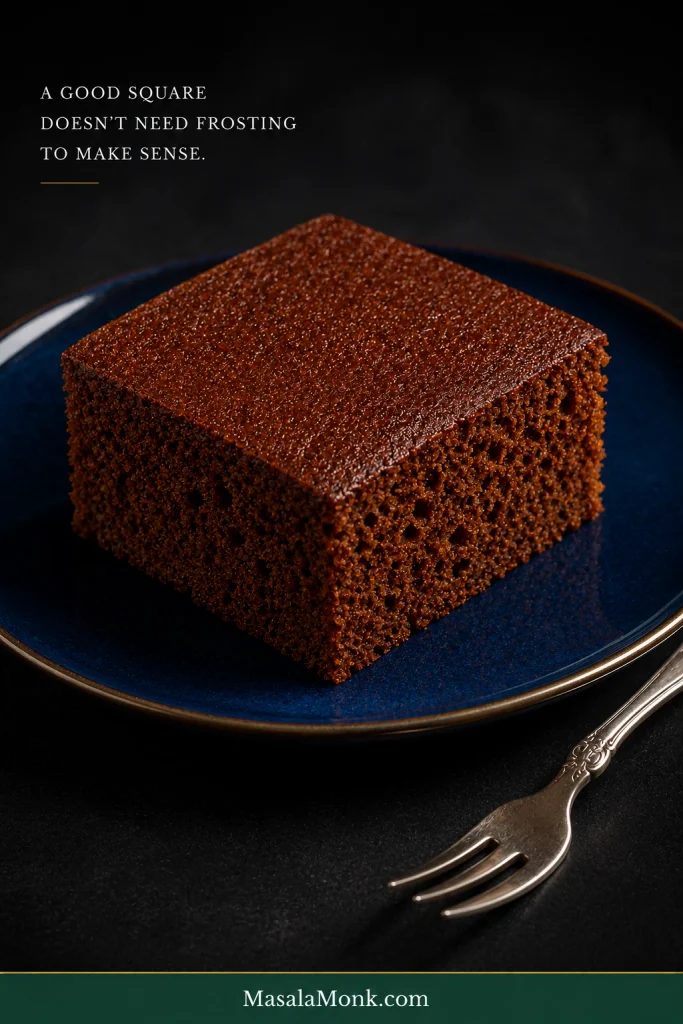
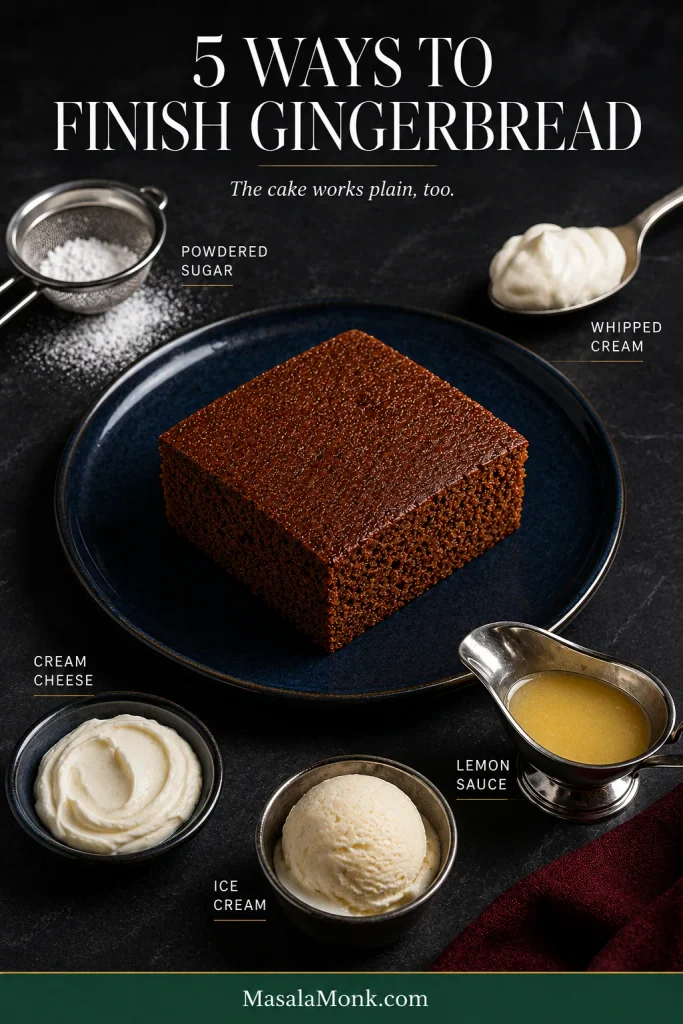
A good square does not need frosting to make sense. Plain gingerbread carries plenty of ginger and molasses on its own; the options below simply take it in different directions.

Plain unfrosted gingerbread cake square on a dark blue plate with a silver fork.
  • Powdered sugar: dust the fully cooled cake shortly before serving.
  • Whipped cream: add a softly whipped spoonful beside each square.
  • Cream cheese frosting: keep the layer thin and tangy so the ginger still leads.
  • Lemon sauce: spoon it over the cut cake with the sauce still warm and pourable.
  • Vanilla ice cream or custard: let a little soften into the crumb.
Plain gingerbread square surrounded by powdered sugar, whipped cream, cream cheese, lemon sauce and vanilla ice cream.
Choose a topping by contrast, not by sweetness alone: tang, acidity and cool creaminess each change how the molasses and ginger register on the palate.

Softly whipped cream works especially well when it bends gently from the whisk. Firm decorating peaks are more than this cake needs. The Whipped Cream Recipe shows exactly what soft, medium and firm peaks look like.

Old-Fashioned Lemon Sauce for Gingerbread

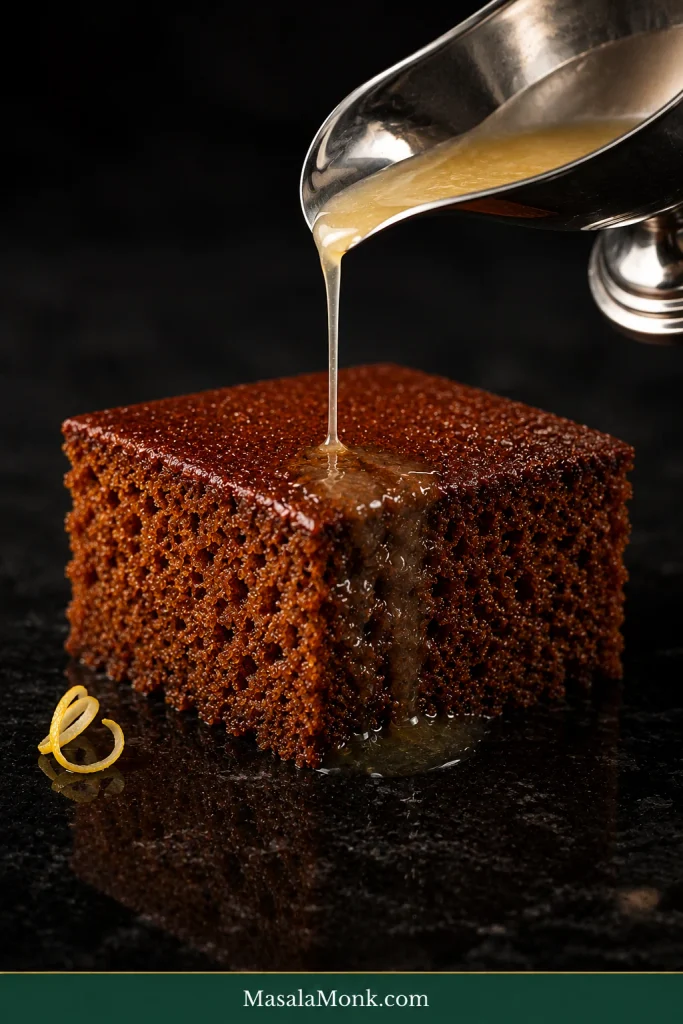
Warm lemon sauce can sound unexpected if you grew up eating gingerbread with frosting, but the pairing makes immediate sense on the plate. The cake is dark and warmly spiced; lemon brings brightness. A little sauce slips into the cut face of the crumb while the zest keeps each bite lively.

Pale golden lemon sauce being poured from a silver sauce boat over the cut edge of a gingerbread cake square.
Aim warm lemon sauce at the cut face rather than flooding the top; exposed crumb takes up a small pour quickly while the cake’s surface stays intact.

Quick Warm Lemon Sauce

Makes about 1 cup / 240 ml, enough for 12–15 light servings.

  • 100 g granulated sugar (½ cup)
  • 8 g cornstarch (1 tablespoon)
  • 240 ml water (1 cup)
  • 45 ml fresh lemon juice (3 tablespoons)
  • Finely grated zest of 1 lemon
  • 28 g unsalted butter (2 tablespoons)
  • Small pinch of salt

Whisk the sugar and cornstarch together in a small saucepan, then gradually whisk in the water. Bring to a gentle boil over medium heat, stirring regularly.

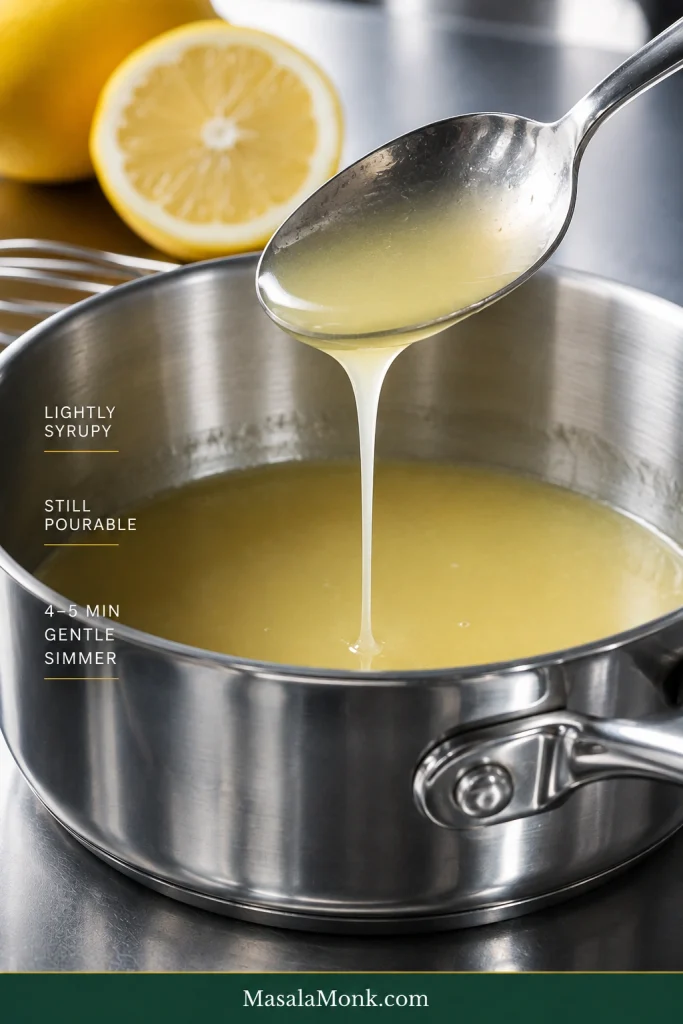
Lower the heat and simmer gently for about 4–5 minutes, stirring often, until lightly syrupy. Remove from the heat and stir in the lemon juice, zest, butter and salt.

Pale yellow lemon sauce running in a thin ribbon from a spoon into a stainless steel saucepan.
Judge the lemon sauce while it is warm: it tightens as it stands, so the right stopping point is a little looser than the texture you expect on the plate.

Serve it warm and pourable. The sauce should be thin enough to slip into the cut surface of the cake. If it thickens as it stands, loosen it with a small splash of warm water.

Refrigerate leftover sauce separately in a covered container and warm it gently before serving, adding a splash of water if needed to restore its pourable consistency.

The pairing has history behind it, too. Toni Tipton-Martin’s Jubilee pays homage to an old-time ginger cake served with lemon sauce and bourbon Chantilly; the James Beard Foundation’s gingerbread with lemon sauce is a lovely place to explore that tradition further.

If Something Went Wrong

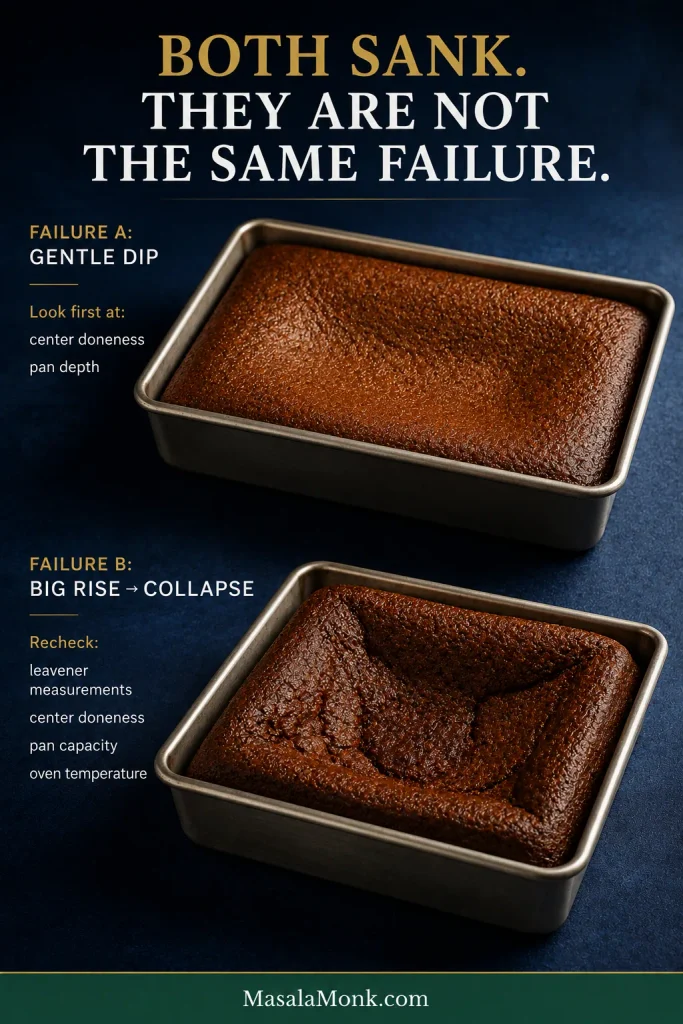
When the sunken center is wet or gummy, start with bake completion and pan depth. A cake that rises unusually high and then collapses points somewhere else: recheck the leaveners, center doneness, pan capacity and oven temperature.

Two gingerbread cakes in rectangular pans comparing a mild central dip with a much larger risen-and-collapsed center.
Failure shape is diagnostic evidence. A small settled depression points you toward a different cause than a cake that dramatically expanded before collapsing.
What happenedLikely causesWhat to change
Center sankCenter needed longer; layer too deep; oven running cool; door opened earlyUse the intended pan and judge the center with the doneness cues above
Rose dramatically, then collapsedToo much or mismeasured leavener; center not fully set; pan overfilled or too deep; oven-temperature problemRecheck the small measurements, pan and oven, then make sure the center is fully baked
Dry throughoutToo much flour; too long in the oven; oven running hotUse 320 g flour and begin checking sooner
Dry edges, damp middleLayer too deep or pan very darkUse the specified light-colored 9×13-inch pan
Gummy middleUnderbaked or sliced very hotUse the doneness guide above and allow the crumb time to settle
Dense or heavyToo much flour; old baking powder or soda; batter left standing for an extended timeMeasure flour accurately, use fresh leaveners and bake soon after mixing
BitterBlackstrap/very robust molasses; too much clove; leavener measurement errorUse regular molasses and recheck the small measurements
Not gingery enoughOld ground ginger; very mild spiceReplace stale ginger or use the stronger-ginger option above
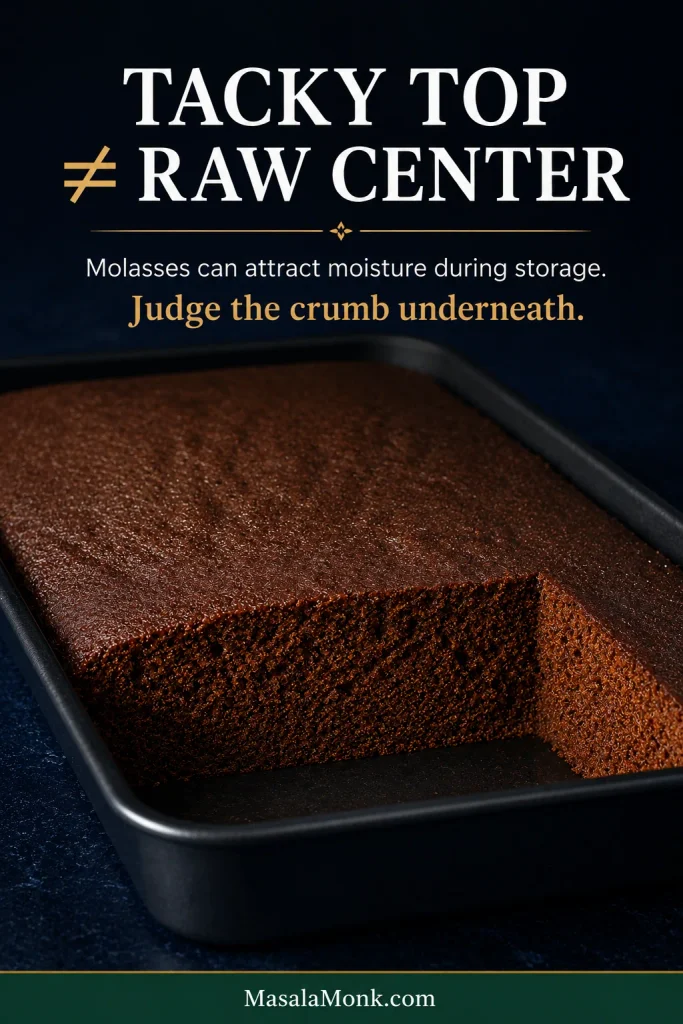
Tacky top after storageMolasses attracting moistureOften normal; judge the crumb underneath separately

Why did the middle sink?

If the cake rose normally and later developed a gentle dip, the middle probably needed a little more time. In a deeper layer, the edges can look finished while the center is still trying to catch up.

A cake that balloons dramatically, overflows or builds a large dome before collapsing tells a different story. Recheck the baking soda and baking powder measurements, the amount of batter in the pan and the oven temperature.

Don’t blame the molasses first. A sunken middle usually sends you back to bake completion, pan depth, leaveners or oven temperature.

Why is it dry?

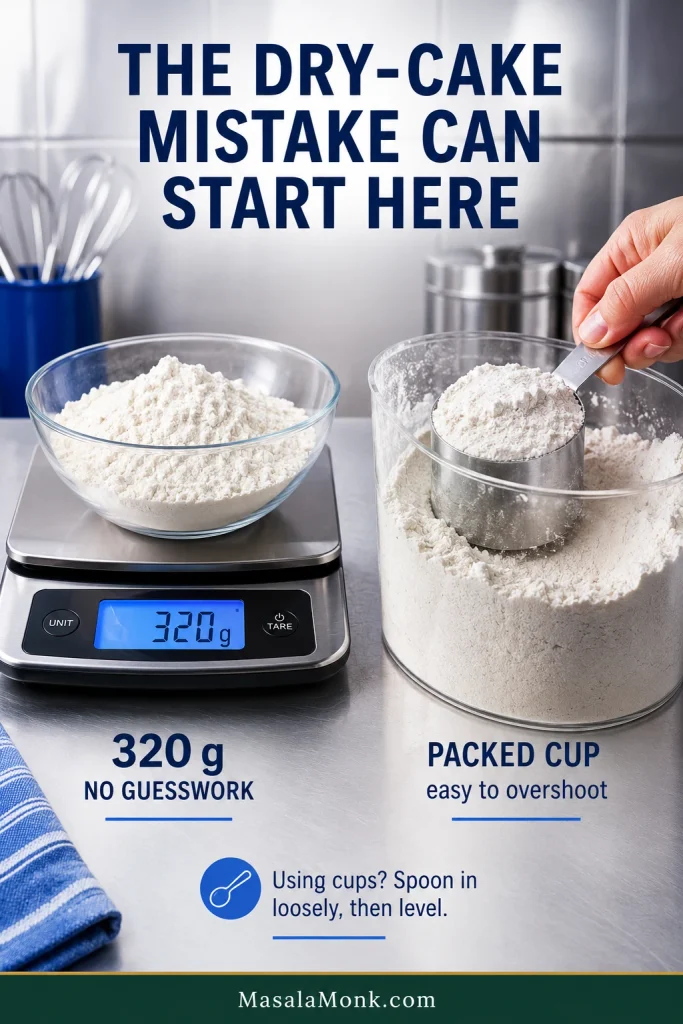
Start with flour. Scooping directly from the bag can pack much more into a measuring cup than the cake needs; a scale removes the guesswork at 320 g. If using cups, spoon the flour loosely into the cup and level the top.

Digital kitchen scale showing 320 grams of flour beside a measuring cup being scooped directly into a container of flour.
With 2⅔ cups of flour, a small packing error repeated cup after cup can add up. The 320 g scale target removes that cumulative drift.

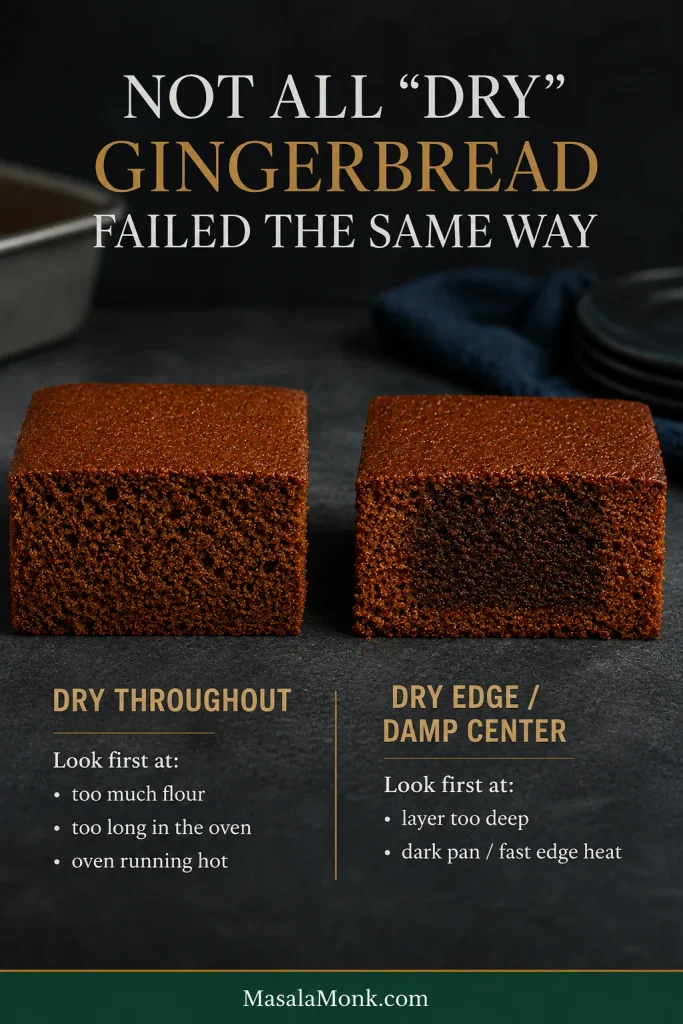
Then look at the bake. Once the center has set, extra oven time mainly means more moisture leaving the cake. Dry edges around a damp middle are different: the outside has moved ahead while the center still needs time.

Two gingerbread cross-sections comparing a uniformly dry crumb with drier edges surrounding a darker, denser damp center.
Cut the cake before diagnosing dryness. Where the dry crumb appears can tell you whether the problem affected the whole batter or developed unevenly during baking.

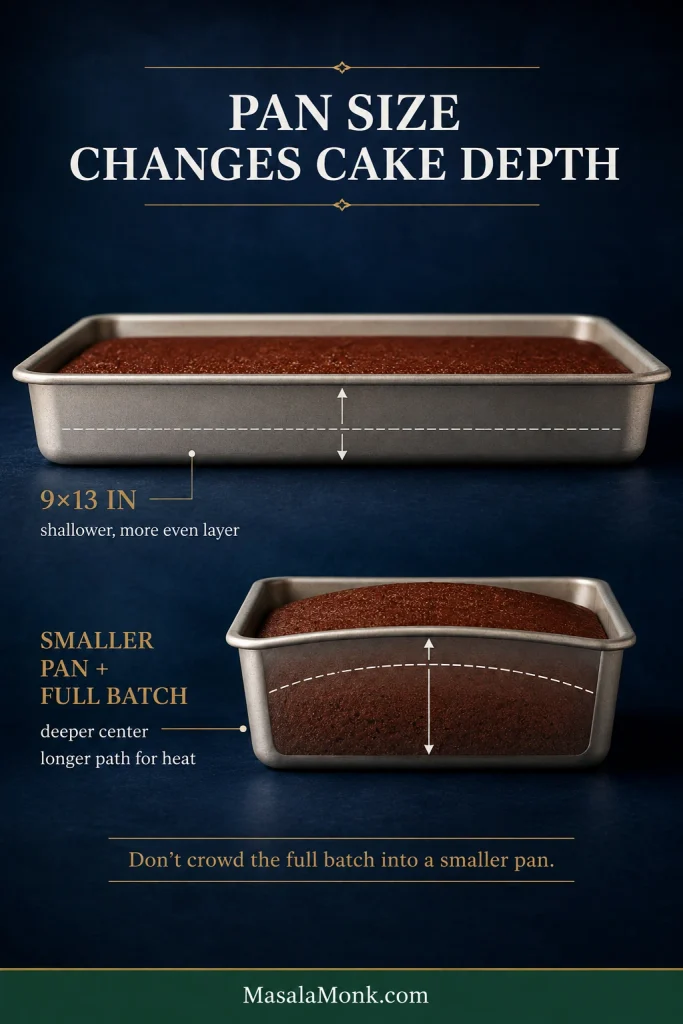
Can You Use a Different Pan?

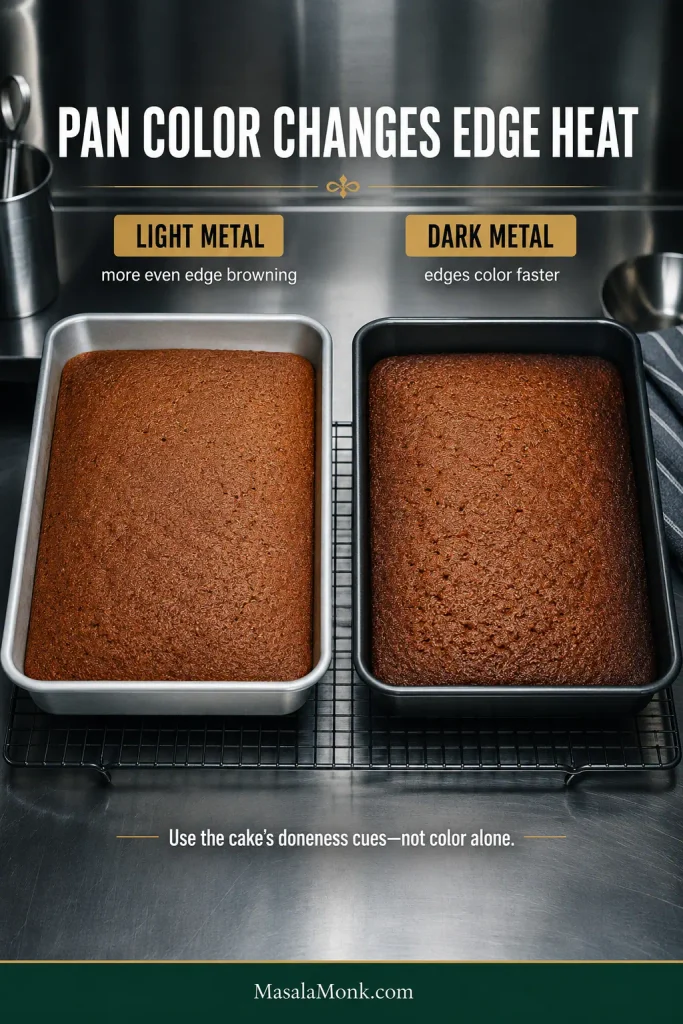
Change the pan and you change the bake. A deeper cake needs more time at the center; dark metal pushes the edges faster.

Light metal 9×13 pan with a shallow gingerbread layer compared with a smaller pan holding a visibly deeper layer.
Pan dimensions change the distance heat must travel. Moving the same gingerbread batter into a smaller footprint is therefore a structural recipe change, not merely a container swap.
PanWhat changesBest approach
9×13-inch light metalRelatively shallow, even layerBest choice for this recipe
Smaller square panDeeper batter and longer center bakeDon’t crowd the full batch into it; use a recipe quantity intended for that pan
Dark metalBase and edges color fasterBegin checking earlier
Glass or ceramicDifferent heat transfer and more retained heatFollow the physical doneness cues instead of copying metal-pan timing
Two rectangular gingerbread cakes baked in light and dark metal pans, with stronger edge browning visible in the dark pan.
Dark metal narrows the margin for error: faster edge heating gives the center less time to catch up before the outside looks finished.

For loaf, Bundt or layer-cake versions, use a formula written for that shape. Those pans change the depth and handling enough that borrowed bake times become unreliable.

Make It a Day Ahead

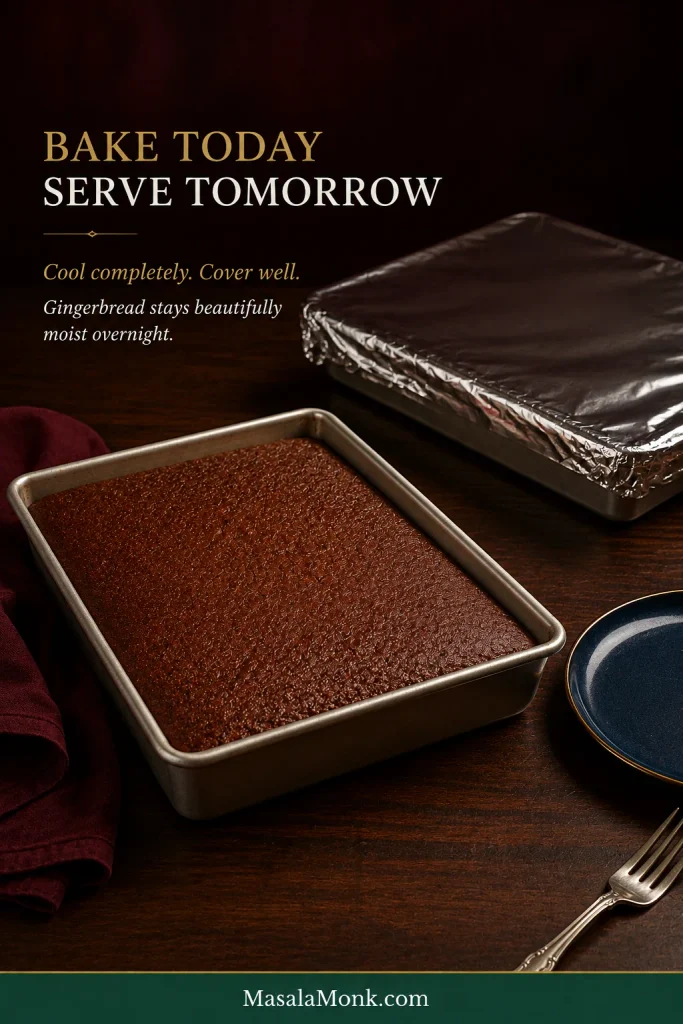
Gingerbread is unusually friendly to making ahead. Kept well covered, it stays moist overnight. The spice settles more deeply into the molasses as it rests.

Fresh gingerbread cake in a light metal 9×13 pan beside another pan tightly covered for overnight storage.

The day before

  • Bake the cake and let it cool completely.
  • Leave it whole when possible; exposed cut edges dry faster.
  • Cover the pan tightly or move the whole cake to an airtight container.
  • Keep an unfrosted cake at cool room temperature.

On serving day

  • Add powdered sugar shortly before serving.
  • Keep whipped cream chilled separately.
  • Frost only after the cake is completely cool.
  • Warm lemon sauce gently before serving.

Storage and Freezing

Store unfrosted gingerbread airtight at room temperature for about 3 days; refrigerate it once topped with cream cheese frosting, or freeze it well wrapped for up to 2 months for best quality.

Room temperature

Leave the cake whole or in larger pieces when practical. Every fresh cut gives the interior another exposed edge.

A tacky top after a day or two can be part of molasses-rich gingerbread’s character, not a sign that the cake is raw. Judge the crumb underneath separately.

Cut gingerbread cake showing a faintly tacky top surface and a fully baked, evenly set crumb underneath.
Surface feel and internal doneness are separate clues. Storage can alter the first without undoing the crumb structure established in the oven.

If your kitchen is particularly warm or humid, keep the cake tightly covered in the refrigerator and let individual slices come back toward room temperature before serving.

Refrigerator

Let refrigerated slices lose some of their chill before serving. As they move back toward room temperature, the crumb becomes more tender again.

Freezer

Cool the cake completely, wrap the whole cake or individual portions tightly, and place them in a freezer-safe container or bag.

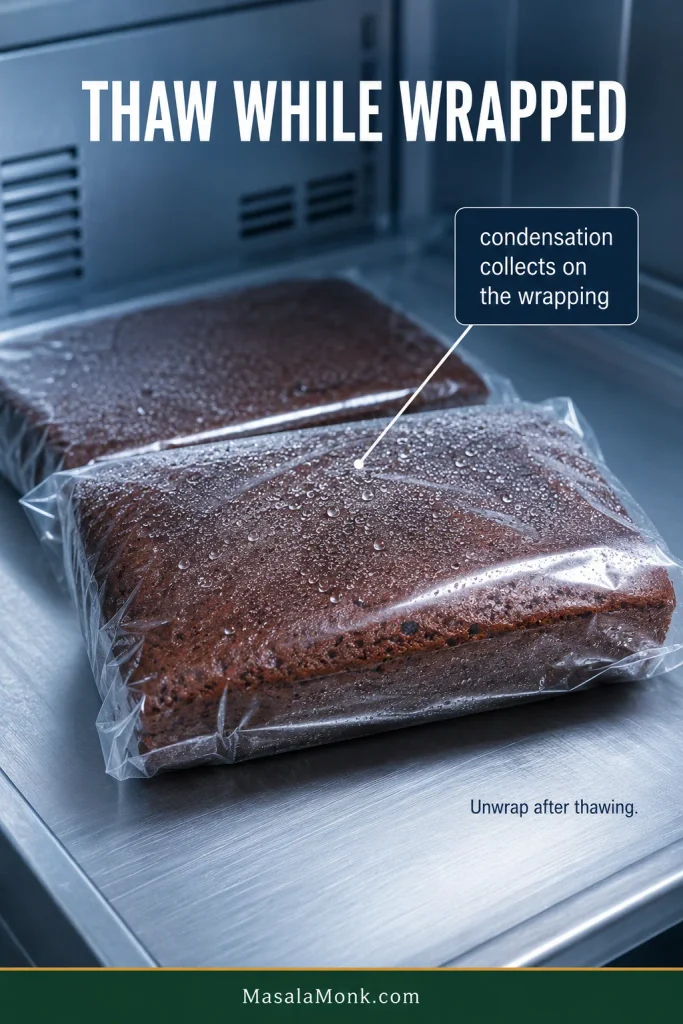
Thaw while still wrapped so condensation collects on the wrapping instead of directly on the cake.

Wrapped gingerbread portions thawing on a metal surface with condensation droplets collected on the clear plastic wrapping.
During thawing, the wrapping becomes the colder surface where airborne moisture condenses first. That barrier helps keep condensation off the gingerbread itself.

Substitutions and Variations

Some flavor changes are easy. Once you change the main syrup, flour system or eggs, you are changing the structure of the cake too.

Light brown sugar: use the same amount. The cake will taste slightly lighter, but the molasses still provides most of its character.

Other syrups: honey, maple syrup and golden syrup are not full-cup substitutes for the molasses here. If one of those is what you have, choose a cake that uses it as the main sweetener.

Gluten-free: use a gingerbread built around a gluten-free flour blend. Different blends absorb liquid differently, so a straight cup-for-cup swap can change the center considerably.

Vegan: an egg-free gingerbread is the cleaner route. Replacing the butter is fairly straightforward; replacing the eggs changes both rise and tenderness.

A Cake That’s Even Better Tomorrow

Serve the first square slightly warm if you can. The crumb gives easily under the fork, and the smell of ginger and molasses rises as soon as you break through the top.

Add softly whipped cream if you want something cool against the spice. Warm lemon sauce brings brightness, while vanilla ice cream melting into one edge makes the dessert more indulgent.

Then cover what is left.

Partly eaten gingerbread square on a silver plate with a fork and coffee, with the remaining cake covered in a light metal pan behind it.

Tomorrow, cut another square and notice how the ginger has settled into the molasses. The crumb is still tender, the spice tastes rounder, and somehow that simple second slice can be the one that makes the recipe worth keeping.

↑ Back to recipe  ·  Back to top

Posted on — Leave a comment

Zucchini Bread Recipe: Easy, Moist and Never Soggy

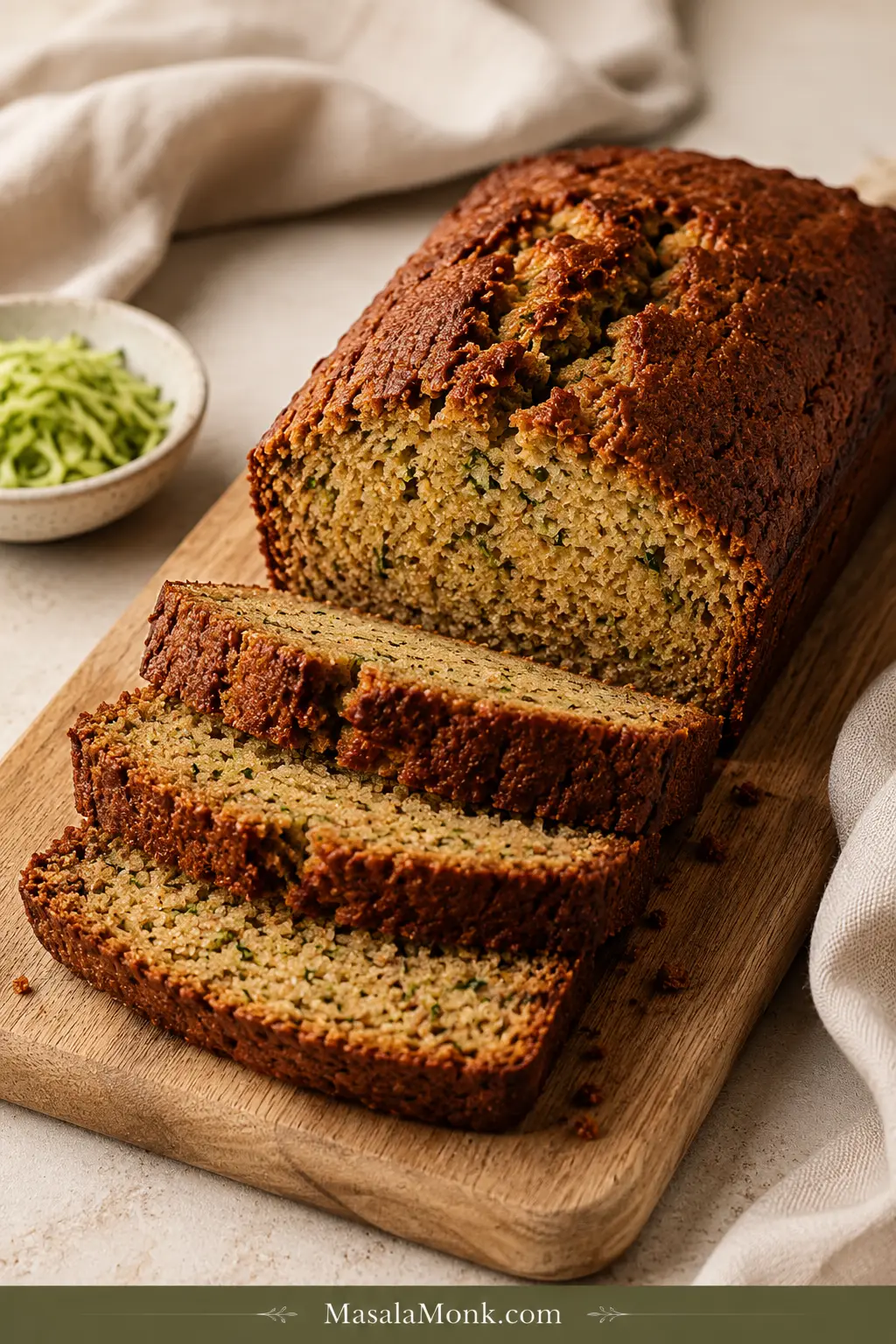
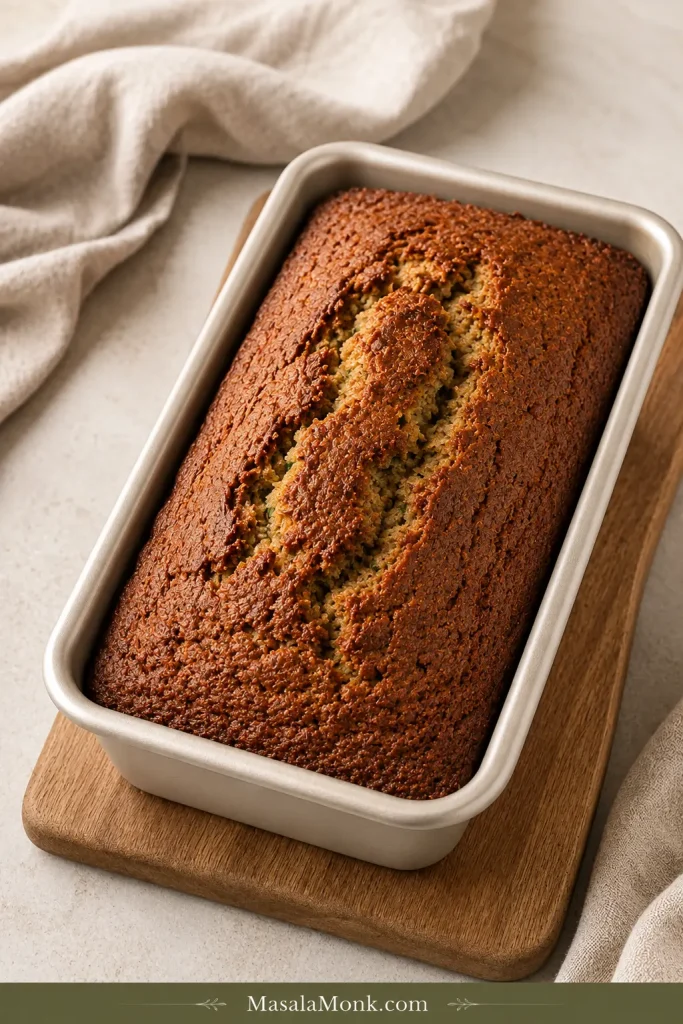
Sliced homemade zucchini bread with a deeply golden cracked top, tender cinnamon-colored crumb and small green zucchini flecks.

A good zucchini bread has a deeply golden top with a natural split down the middle, warm cinnamon in the first bite, and a tender crumb dotted with little green flecks. A slice should bend gently without falling apart, with enough moisture to stay lovely today and still be worth reaching for tomorrow.

Zucchini creates that tenderness, but it can also make the middle deceptive. The crust may look beautifully baked while the batter underneath still needs a few more minutes.

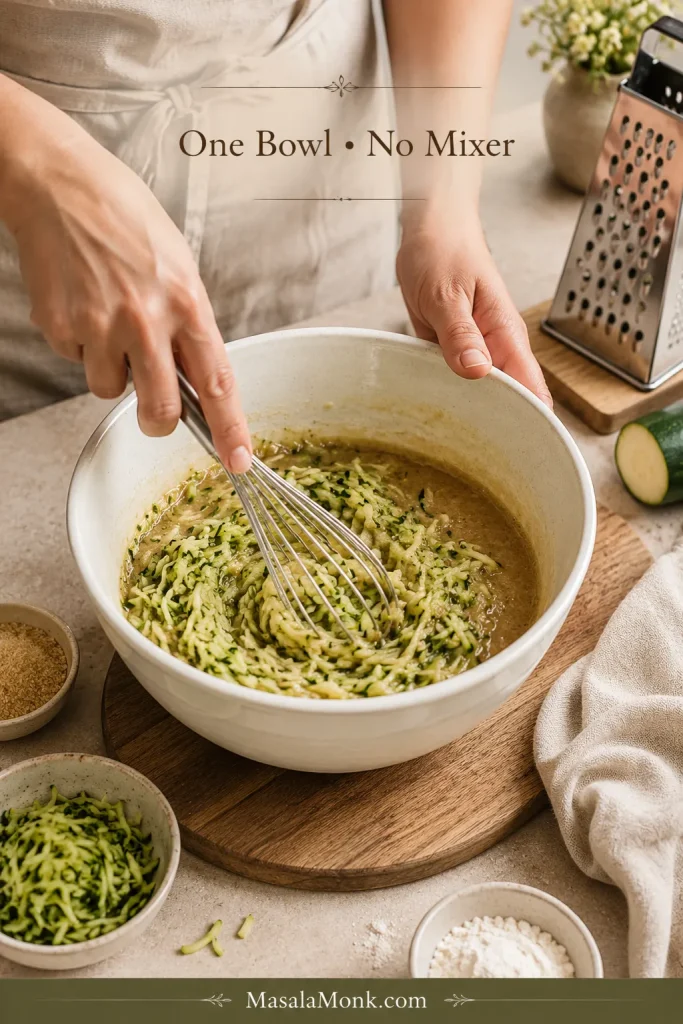
This version keeps the process easy: one bowl, no mixer, no peeling small or medium zucchini, and no wringing fresh shreds dry. You grate, stir, fold and bake.

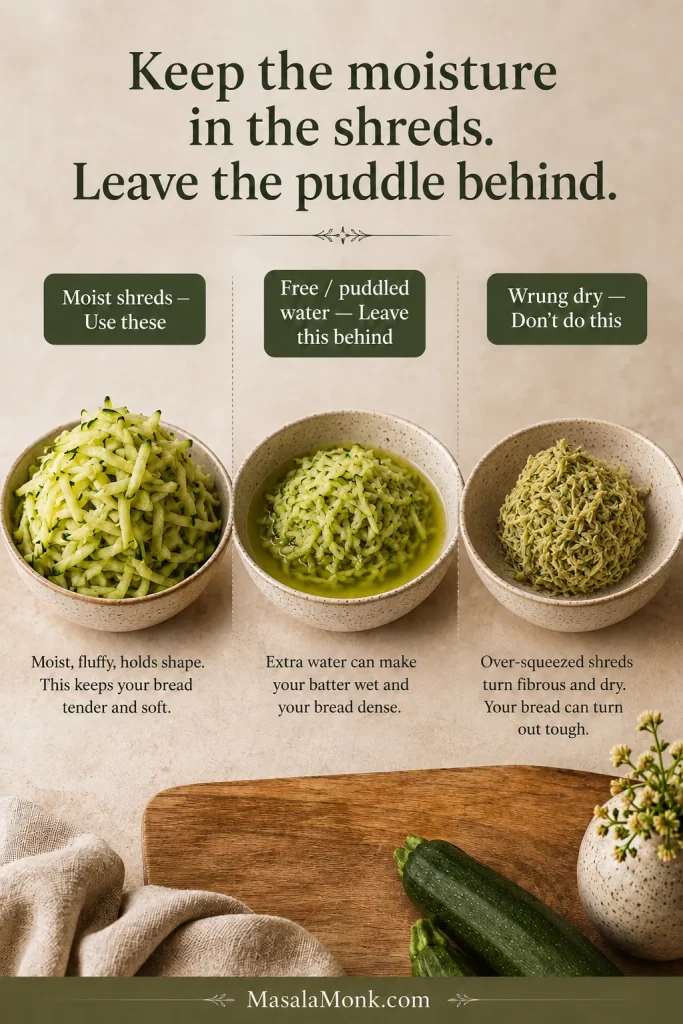
Keep the moisture in the shreds, leave the puddle behind, and bake until the middle is set.

Quick Answer: How Do You Make Moist Zucchini Bread Without a Wet Middle?

Do not squeeze fresh zucchini dry for this recipe. Grate it on the large holes of a box grater and use 370g / 13 oz, about 2 firmly packed cups. Weigh the shreds themselves; if liquid has collected separately beneath them, leave that puddle behind.

Bake the thick batter in a 9 × 5-inch / 23 × 13 cm loaf pan at 350°F / 175°C. The crack across the top should reveal baked crumb, and a thin skewer or knife pushed into the loaf should show no raw batter.

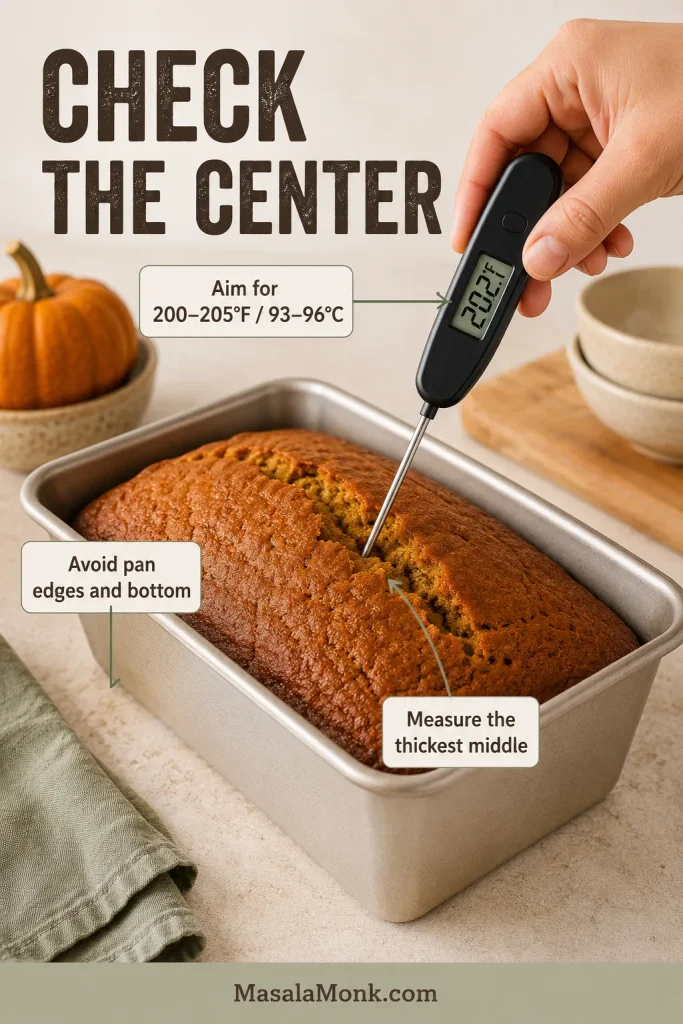
You can make good zucchini bread without a thermometer. If you have one, it gives you the most objective final check when the crack or tester leaves any doubt. Around 200–205°F / 93–96°C indicates the loaf is baked through.

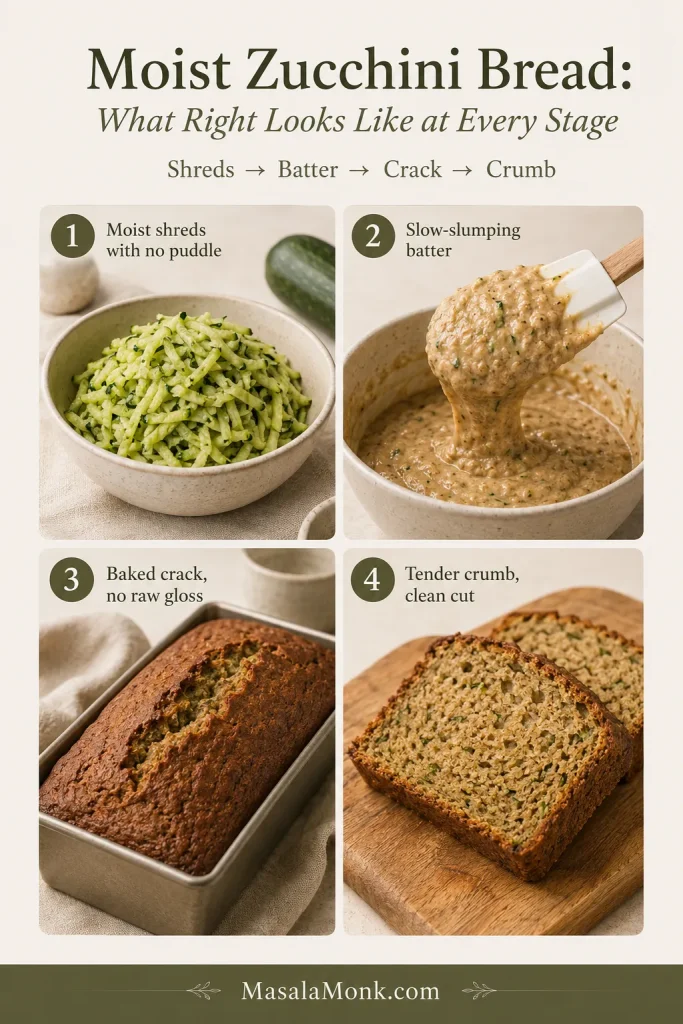
Four-stage zucchini bread guide showing moist grated zucchini, thick batter, a baked center crack and a clean-cut finished crumb.
Use the sequence as checkpoints: moist shreds → thick batter → baked crack → settled crumb. Problems are easier to correct before the loaf reaches the oven.

Zucchini Bread Recipe

This is a cinnamon-forward, oil-based loaf with plenty of zucchini, a golden split top and a crumb that stays tender without feeling wet. Make it plain, or fold in nuts or chocolate when that sounds better.

Recipe at a Glance

Yield1 loaf, about 8–10 generous slices
Pan9 × 5-inch / 23 × 13 cm loaf pan; light-colored metal preferred. Using glass or dark metal? See the pan notes.
Oven350°F / 175°C
PrepAbout 15 minutes
BakeAbout 55–60 minutes; check the loaf itself for doneness
Zucchini370g / 13 oz freshly grated zucchini, not wrung dry
Cooling15 minutes in the pan, then completely on a rack

You will need: one large mixing bowl, a box grater, fork or whisk, flexible spatula, 9 × 5-inch loaf pan, parchment paper and a cooling rack. A digital scale is particularly helpful; an instant-read thermometer is optional.

Ingredients

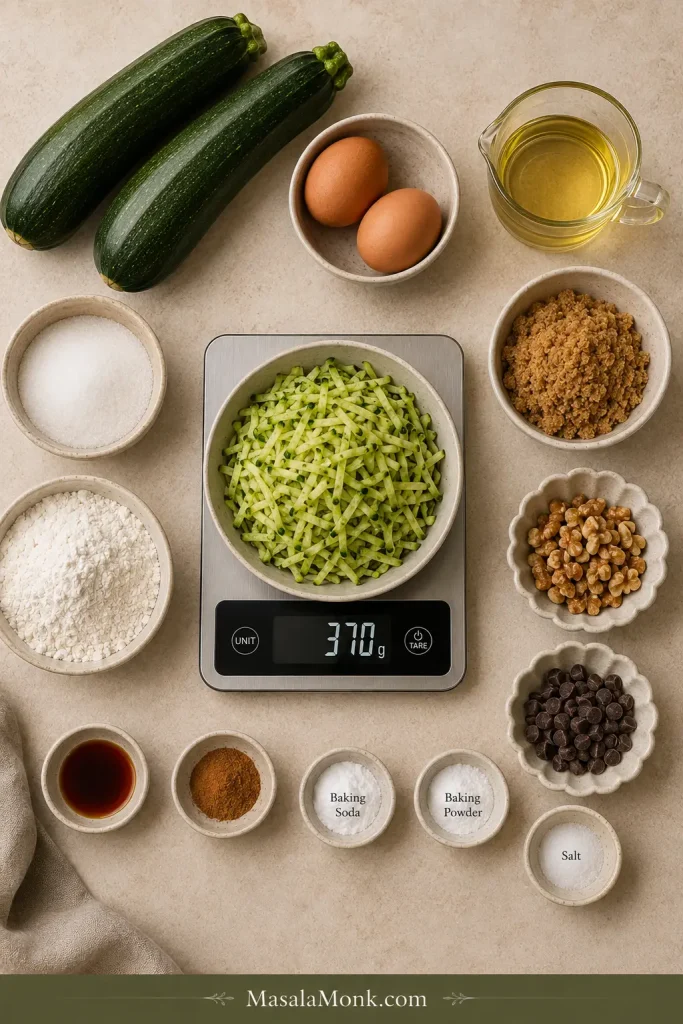
Zucchini bread ingredients arranged around a digital scale holding grated zucchini at 370 grams, with two eggs, flour, sugars, oil and spices.
Weigh 370g of the grated flesh you will actually use, especially if an oversized zucchini needs trimming first.
  • 370g / 13 oz freshly grated zucchini, about 2 firmly packed cups, not wrung dry
  • 2 large eggs
  • 160ml / ⅔ cup neutral oil, such as sunflower, canola or vegetable oil
  • 95g / 3.4 oz (½ cup packed) brown sugar, light or dark
  • 100g / 3.5 oz (½ cup) granulated sugar
  • 1 teaspoon vanilla extract
  • 1 teaspoon fine salt
  • ¾ teaspoon baking soda
  • ½ teaspoon baking powder
  • 1¼ teaspoons ground cinnamon
  • ⅛ teaspoon ground nutmeg, optional
  • 260g / 9.2 oz (2 cups) all-purpose flour, spooned and leveled if using cups
  • Up to 85g / 3 oz chopped walnuts, pecans or chocolate chips, optional

Instructions

Hands mixing grated zucchini and wet ingredients in a large cream bowl beside a box grater, with no electric mixer present.
Hand mixing makes it easier to stop as soon as the batter comes together.

Prep and Mix the Batter

  1. Heat the oven. Set a rack in the center and preheat to 350°F / 175°C. Lightly grease a 9 × 5-inch / 23 × 13 cm loaf pan and line the long sides with a parchment sling.
  2. Grate the zucchini. Leave small and medium zucchini unpeeled and grate them on the large holes of a box grater. Measure 370g / 13 oz. Keep the moisture in the shreds, but leave behind any liquid that has pooled separately. Using oversized or frozen zucchini? See the prep notes first.
  3. Mix the wet ingredients. Put the grated zucchini in a large bowl. Add the eggs, oil, brown sugar, granulated sugar, vanilla and salt. Stir until evenly combined.
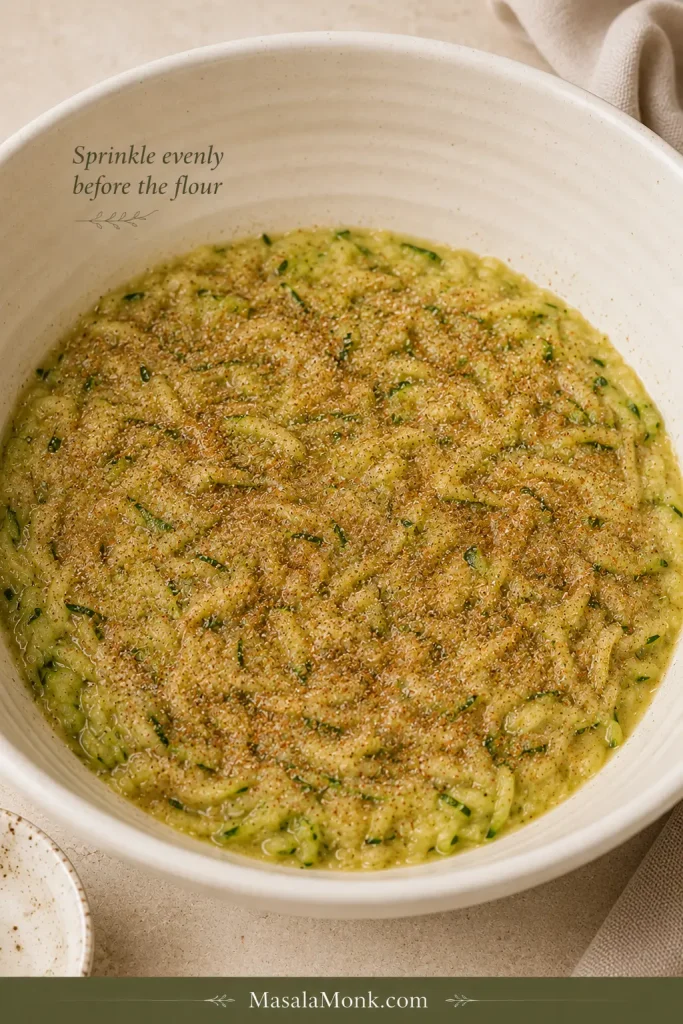
  4. Add the spices and leaveners. Sprinkle the cinnamon, nutmeg, baking soda and baking powder evenly across the surface. Stir thoroughly, scraping around the bowl, so everything is well distributed before the flour goes in.
Cinnamon and small amounts of baking soda and baking powder evenly scattered over a wet zucchini mixture before flour is added.
Scatter the leaveners broadly before the flour goes in so they distribute evenly through the loaf.
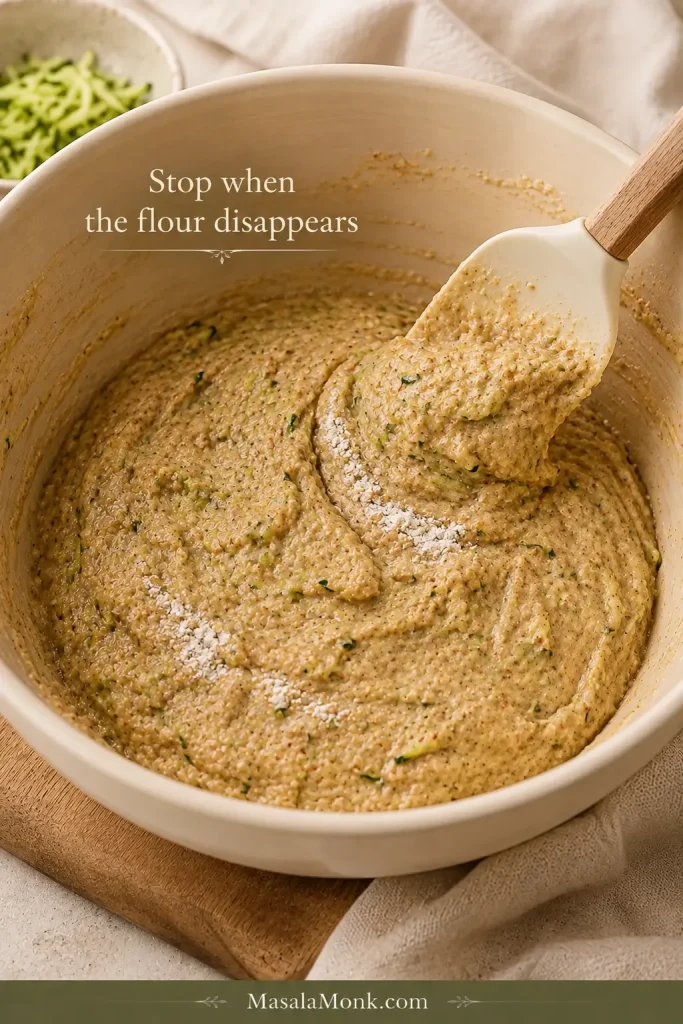
  1. Fold in the flour. Add the flour and fold just until the last dry streak disappears. Fold in nuts or chocolate chips now, if using. The batter should spread easily with a spatula and slump slowly when lifted.
Zucchini bread batter being gently folded with a spatula while a few final streaks of dry flour remain visible.
Stop when the last dry flour streak disappears; extra folding only works the batter harder.

Fill, Bake and Cool

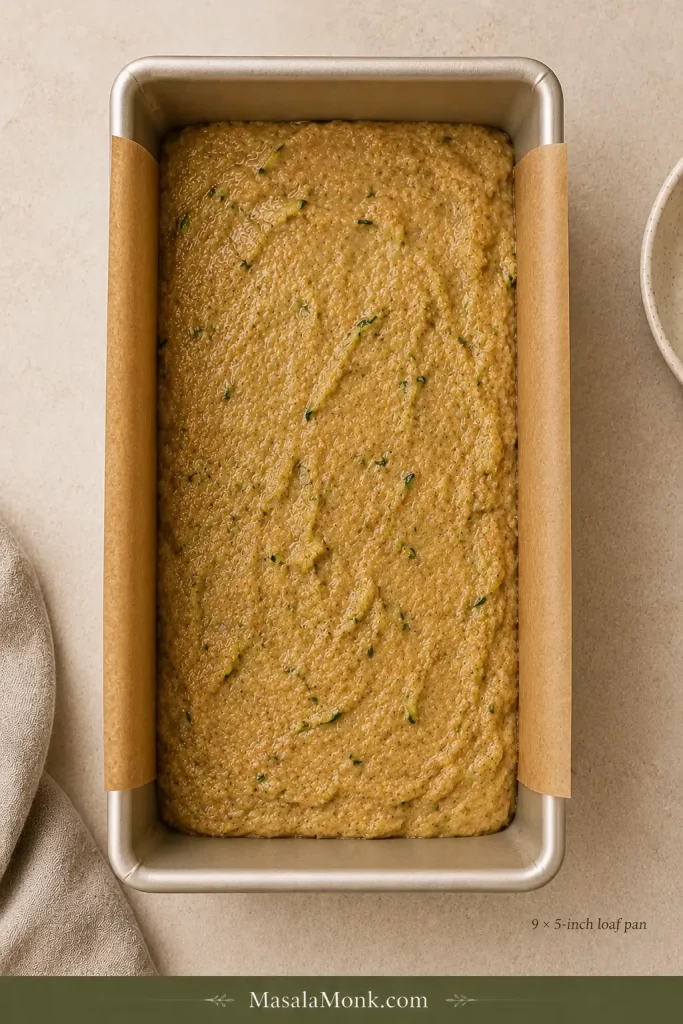
  1. Fill the pan. Scrape the entire batch into the prepared pan and smooth the top lightly.
Thick zucchini bread batter spread in a parchment-lined light metal 9 by 5 inch loaf pan with space remaining above the batter.
Use the full batch in the intended 9×5-inch pan so the center bakes at the expected depth.
  1. Bake. Bake for about 55–60 minutes. Near the end of that window, the top will usually be deeply golden with a natural crack running across it.
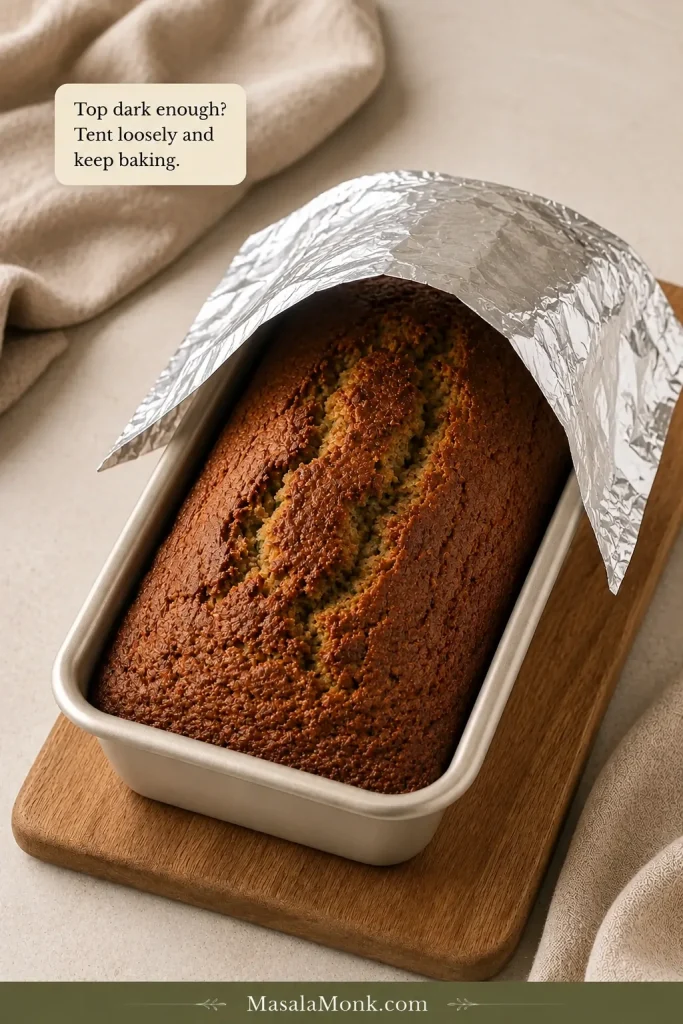
  2. Check before removing it. Look into the crack and test the loaf with a thin skewer or knife. A few tender crumbs are fine; shiny raw batter needs more time. Loosely tent the top with foil if it already has enough color.
Golden-brown zucchini bread with a natural central crack still inside a light-colored metal loaf pan after baking.
Once the top is golden and split, the center—not surface color—decides whether the loaf is done.
  1. Cool. Leave the bread in its pan for about 15 minutes, then lift it onto a rack. Cool completely for clean slices and a fully settled crumb.

Recipe source: Adapted from Smitten Kitchen’s Ultimate Zucchini Bread, with additional guidance here on zucchini moisture, doneness and common texture problems.

Table of Contents

Which Zucchini Are You Using?

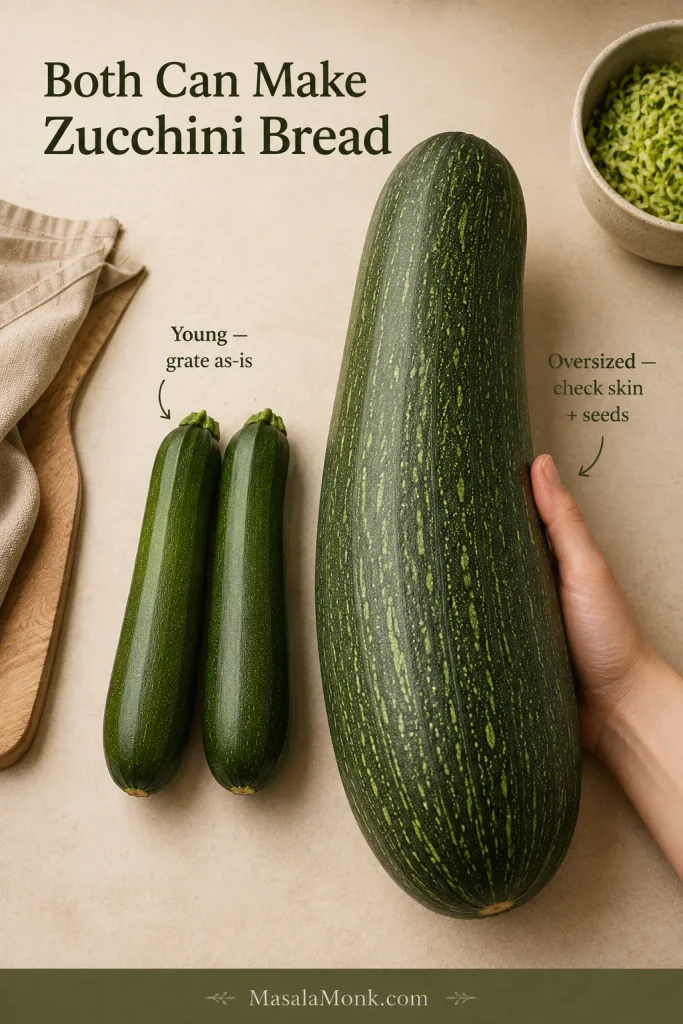
Freshly grated zucchini is the reference point for this loaf. Small supermarket zucchini are the simplest route, but the oversized one hiding beneath the garden leaves can work too.

Several small young zucchini beside one very large garden zucchini, comparing the sizes that can be used for zucchini bread.
Prep changes with zucchini size; the target stays 370g of usable grated flesh.
You haveWhat to do
Small or medium fresh zucchiniLeave the skin and seeds in place. Grate and measure 370g.
Large garden zucchiniCut it open first. Remove tough skin or a pale, spongy cavity full of hard seeds if necessary, then grate and measure 370g of the usable flesh.
Frozen shredded zucchiniIt can work, but it will not behave exactly like fresh zucchini after thawing. See the note below.

How to Prepare Zucchini for Bread

Peel, Seeds and Grating

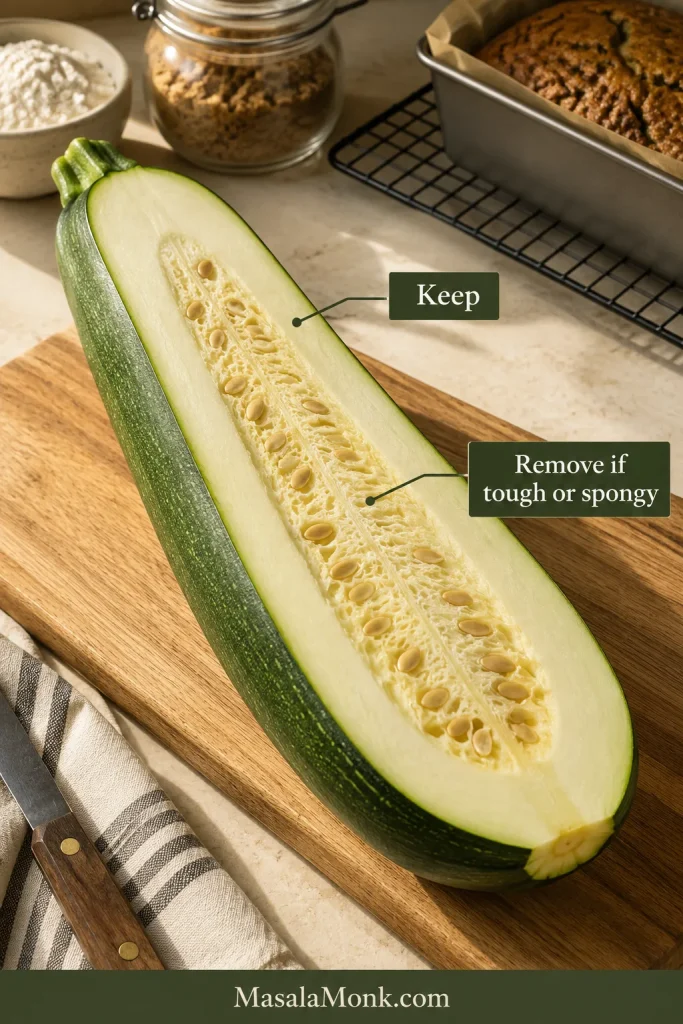
Do you need to peel it? No. Thin zucchini skin softens during baking and leaves the familiar green flecks through each slice. Peel only an oversized mature zucchini whose skin has become leathery.

What about the seeds? Leave young seeds alone. With a huge garden zucchini, scoop out the middle only when it has become pale, spongy and filled with hard mature seeds.

Large mature zucchini cut lengthwise to show firm usable outer flesh and a pale, seeded central cavity that may need removing.
Remove a hard-seeded, spongy center before weighing so the 370g reflects usable flesh.

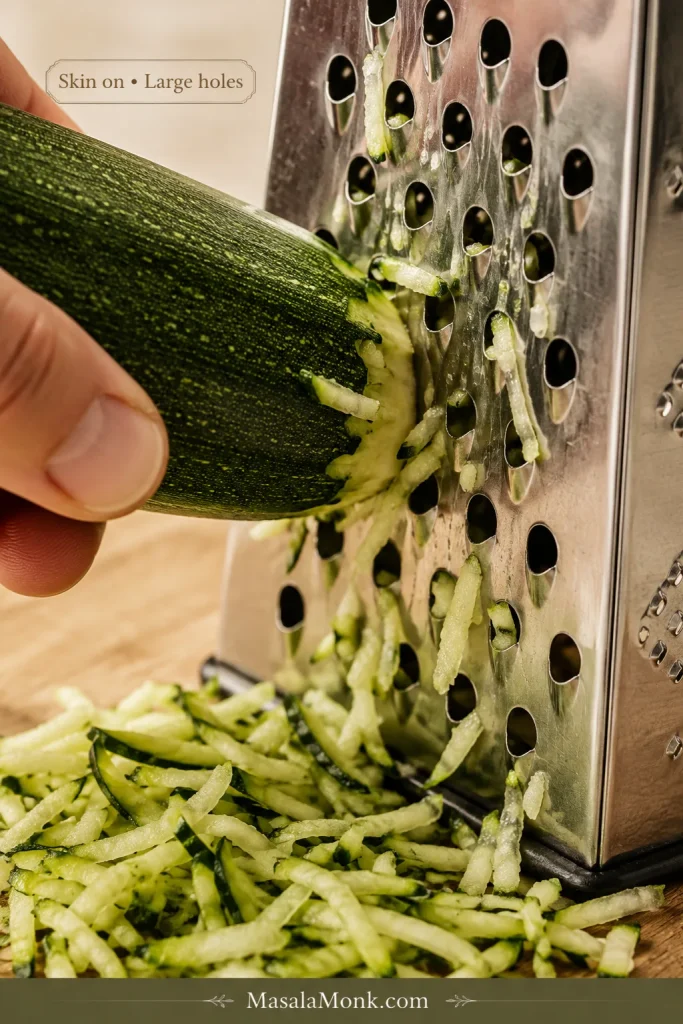
Which grater? Use the large holes of a box grater. They produce strands that disappear comfortably into the baked crumb without turning the raw zucchini into pulp.

Unpeeled green zucchini being grated on the large holes of a stainless steel box grater, with green-edged shreds collecting below.
Grate over a plate or shallow bowl so separately pooled liquid is easy to leave behind.

Should You Squeeze Zucchini for Zucchini Bread?

No—fresh zucchini should not be squeezed dry for this loaf. Its moisture is part of what keeps the crumb tender.

A bowl of freshly grated zucchini can look surprisingly wet. That alone does not mean anything has gone wrong.

Moisture held inside and on the shreds belongs in the recipe. Water that has collected separately as a puddle does not. Leave that free liquid behind, but do not twist or wring the zucchini into a dry, fibrous mass.

Keep the moisture in the shreds; leave the puddle behind.

Three grated zucchini states showing moist fluffy shreds, zucchini sitting in separately pooled liquid and tightly squeezed dry zucchini.
Judge separated liquid, not simple dampness: keep moist shreds, leave the puddle, and don’t wring them dry.

Grated too much? Keep the extra out of the batter so the ratio stays intact. These crispy zucchini chips turn the surplus into something thin, salty and crunchy instead.

Can You Use Frozen Zucchini for Zucchini Bread?

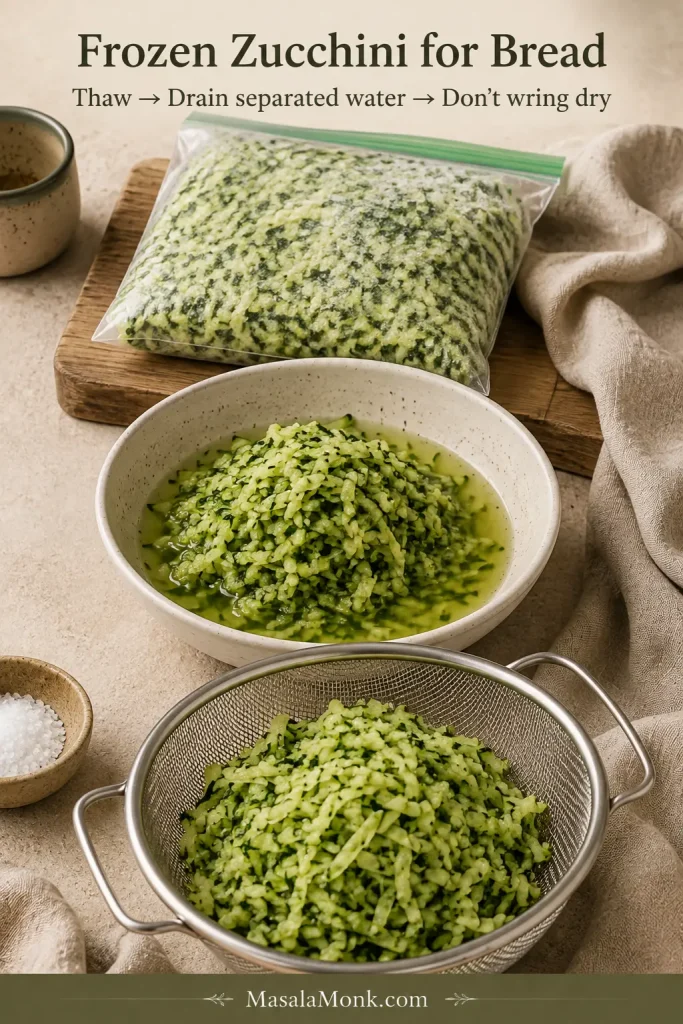
Yes, but fresh zucchini gives the most predictable result here. Freezing breaks down the shreds and makes them release considerably more water as they thaw.

Thaw frozen zucchini completely and let any liquid that has separated freely drain away. Do not wring the remaining shreds dry. Drained frozen zucchini is not a gram-for-gram equivalent to the fresh amount in the recipe, so some variation is unavoidable.

The batter checkpoint matters more when you use frozen zucchini. It should still spread easily, slump slowly from the spatula and have no distinct layer of liquid collecting around it. A bag of summer zucchini saved for later can still make a good loaf; it simply asks you to pay closer attention to the bowl.

Frozen grated zucchini, thawed zucchini releasing liquid and drained zucchini shreds that remain visibly moist.
After thawing, drain freely separated liquid without wringing the shreds; then use batter consistency as the better checkpoint.

What Should Zucchini Bread Batter Look Like?

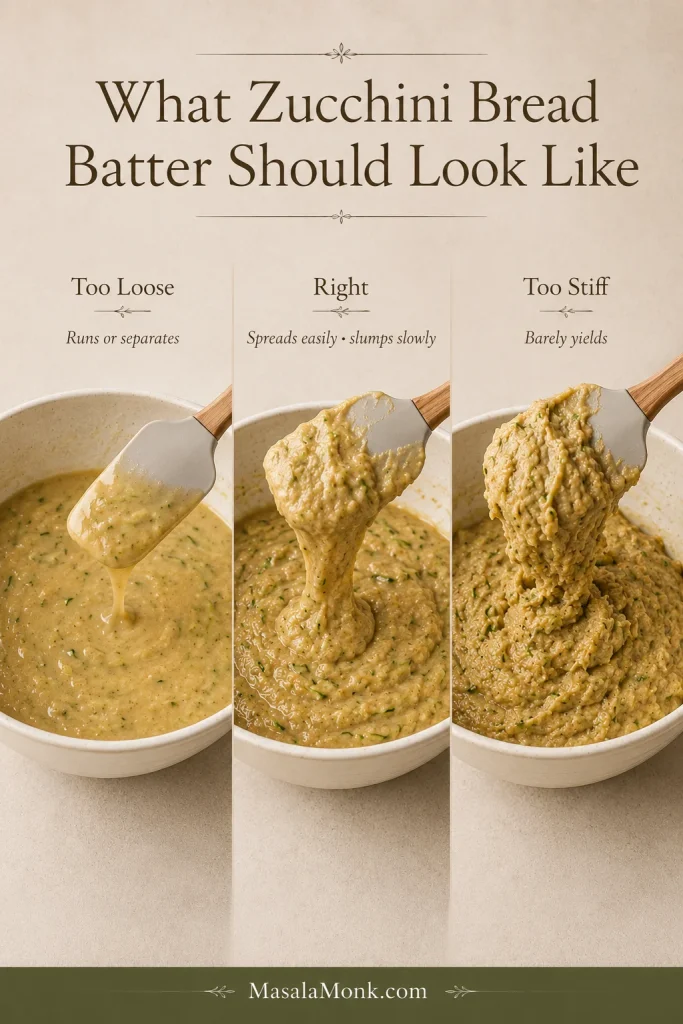
The batter should be thick enough to spread into the pan and loose enough to slump slowly from the spatula. Green strands of zucchini will still be visible through the cinnamon-speckled mixture.

A little visible moisture from the grated zucchini is normal. A distinct layer of liquid separating around the batter is different; check whether free zucchini water went into the bowl and recheck the measurements before baking.

Three zucchini bread batters comparing a thin runny mixture, thick slow-slumping correct batter and an overly stiff batter.
If the batter is too loose or stiff, recheck zucchini water and flour before adding anything.

A mixture that barely yields to the spatula can point to too much flour.

How to Know Zucchini Bread Is Done

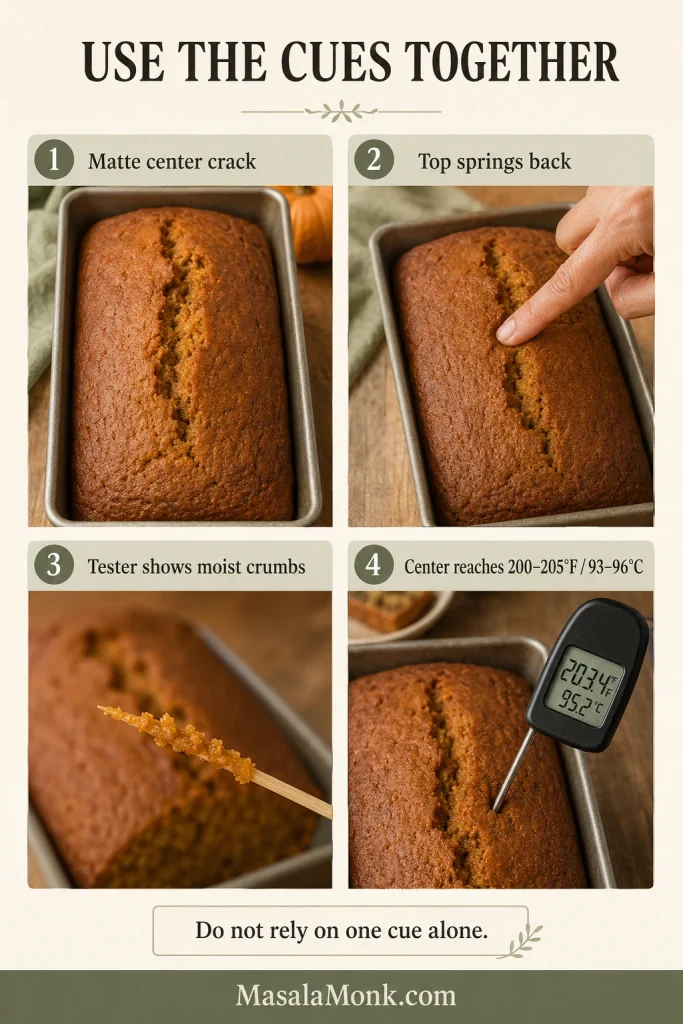
Zucchini bread is done when the crack through the top reveals baked crumb and a tester pushed into the loaf carries no raw batter. The clock tells you when to begin looking; these cues tell you when to stop baking.

Check the Crack, Then Use a Tester

A deeply golden top is persuasive, especially once the kitchen smells like the loaf must be done. Check the crack anyway.

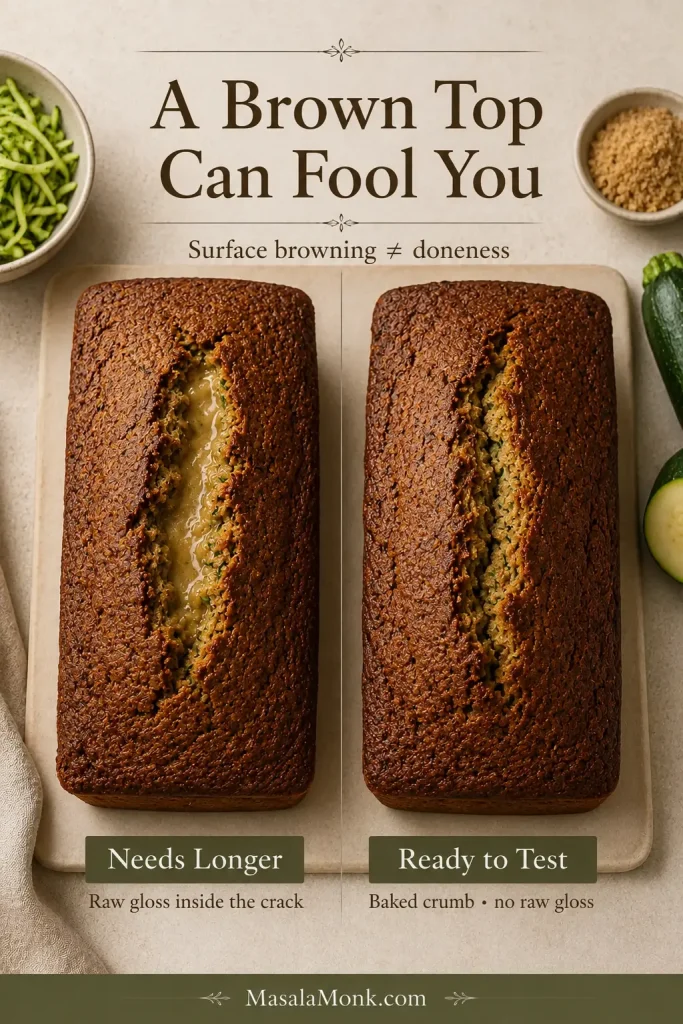
Shiny batter down inside that opening needs more oven time. Baked crumb has lost the raw gloss.

Two similarly browned zucchini loaves comparing a crack with glossy raw batter and a crack showing opaque baked crumb.
Once the crust is brown enough, judge the center—not the surface color or the clock.

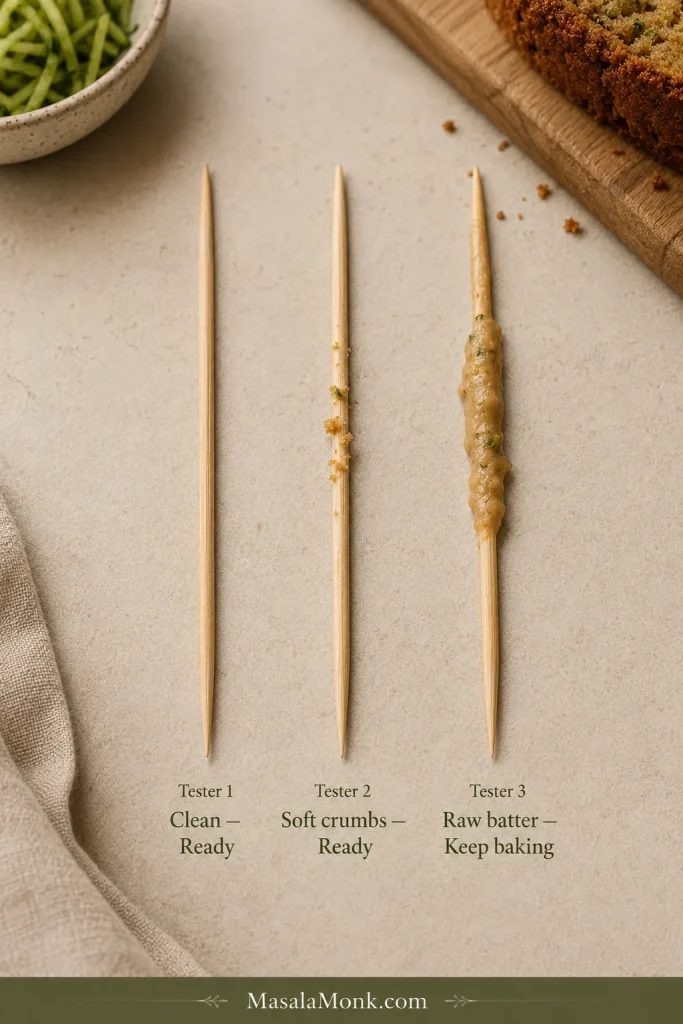
Next, push a thin skewer or knife into the thickest part. A clean tester or a few tender crumbs are both fine. A streak of uncooked batter is not.

Three wooden testers showing a clean tester, a few soft baked crumbs and a thick smear of raw zucchini bread batter.
Test the thickest center; an edge can look done while the deepest batter still needs time.

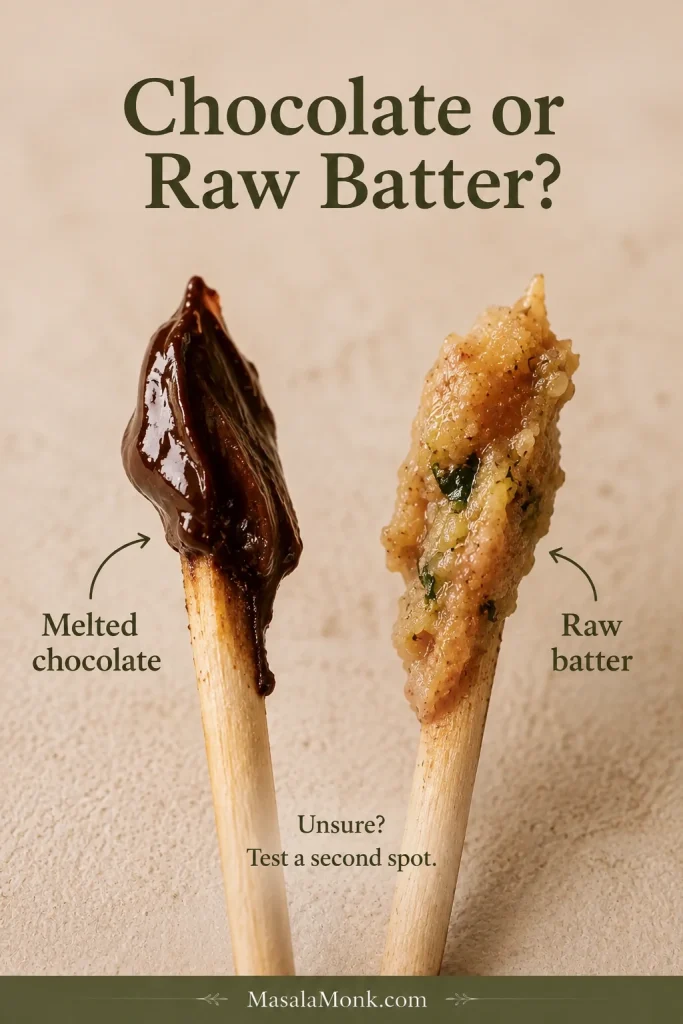
Chocolate chips can imitate wet batter, so test another spot before deciding.

Two close-up baking testers comparing dark melted chocolate residue with a pale, wet smear of raw zucchini bread batter.
If a tester hits melted chocolate, test a nearby spot before extending the bake.

A Thermometer Gives You One More Check

You can make good zucchini bread without a thermometer. If you have one, it gives you the most objective final check when the crack or tester leaves any doubt.

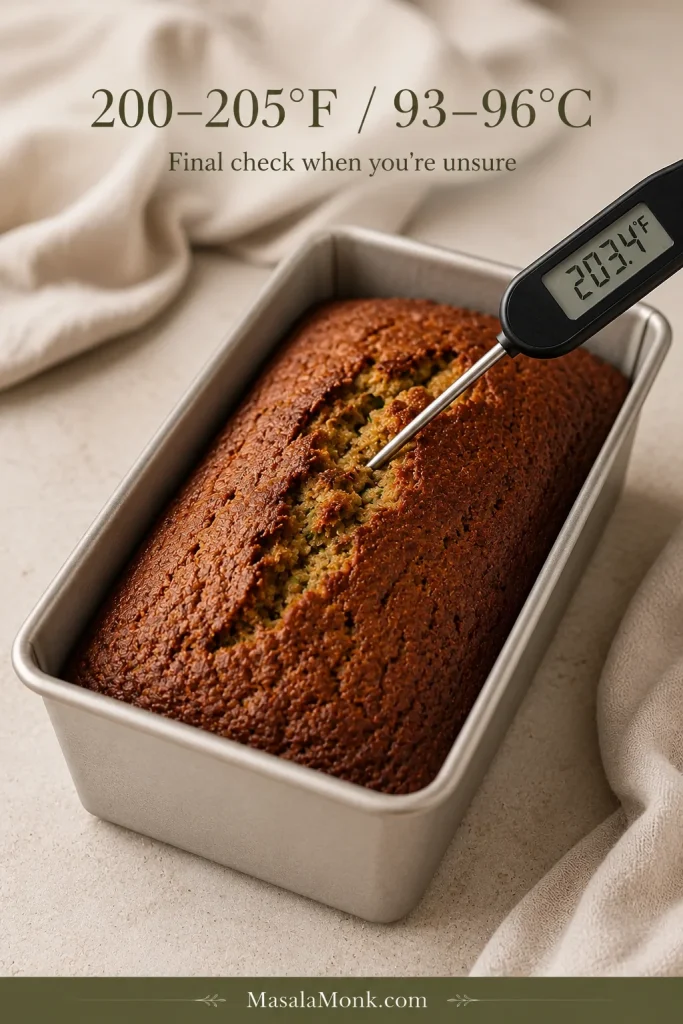
Move an instant-read probe slowly through the loaf and note the lowest reading. Around 200–205°F / 93–96°C indicates that the bread is baked through.

Instant-read thermometer inserted into the thick center of zucchini bread in a light metal pan, displaying about 203 degrees Fahrenheit.
Keep the probe off the pan and read the thickest part of the loaf.

King Arthur Baking’s quick-bread doneness guide explains the thermometer method in more detail.

Already baked it and found a wet or raw center? Go straight to troubleshooting →

The Hard Part: Let It Cool

This is the instruction nobody wants when the kitchen smells like cinnamon and the loaf is sitting three feet away.

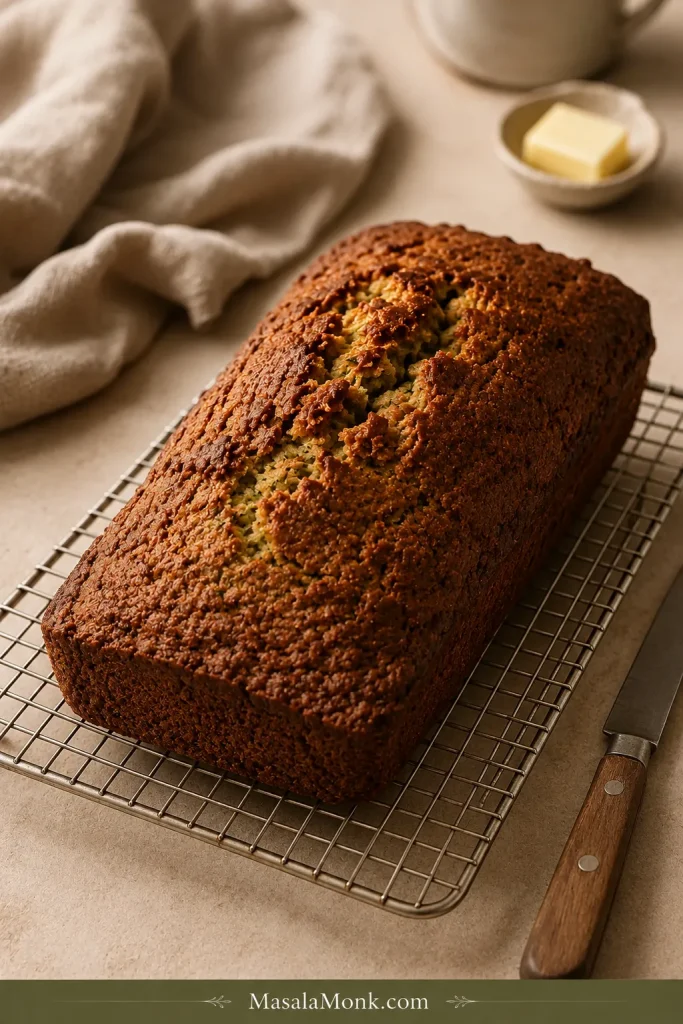
Whole golden zucchini bread cooling on a wire rack beside a knife, butter and neutral linen in warm natural light.

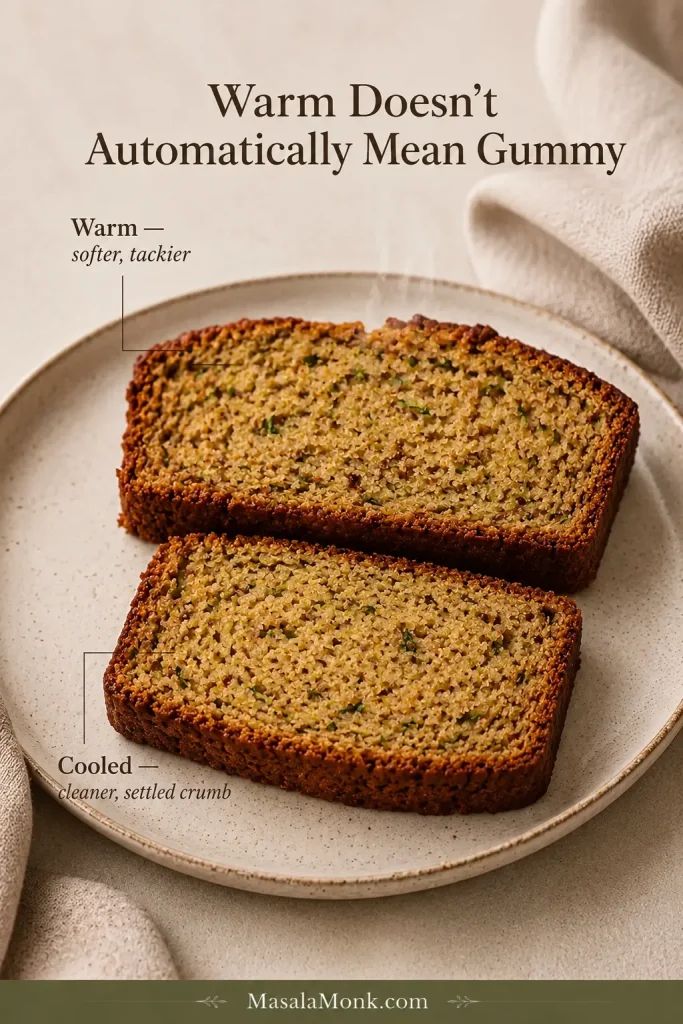
Give it about 15 minutes in the pan, then move it to a rack. Steam continues to escape while the crumb settles, so a just-baked slice naturally feels tackier than one cut later.

You can steal a warm slice. Just wait until the loaf has cooled before deciding that its tender middle is actually gummy.

Two fully baked zucchini bread slices comparing a softer warm crumb with a cleaner, more settled cooled crumb.
Judge gumminess on a cooled slice; warmth and trapped steam can temporarily make a fully baked crumb feel tackier.

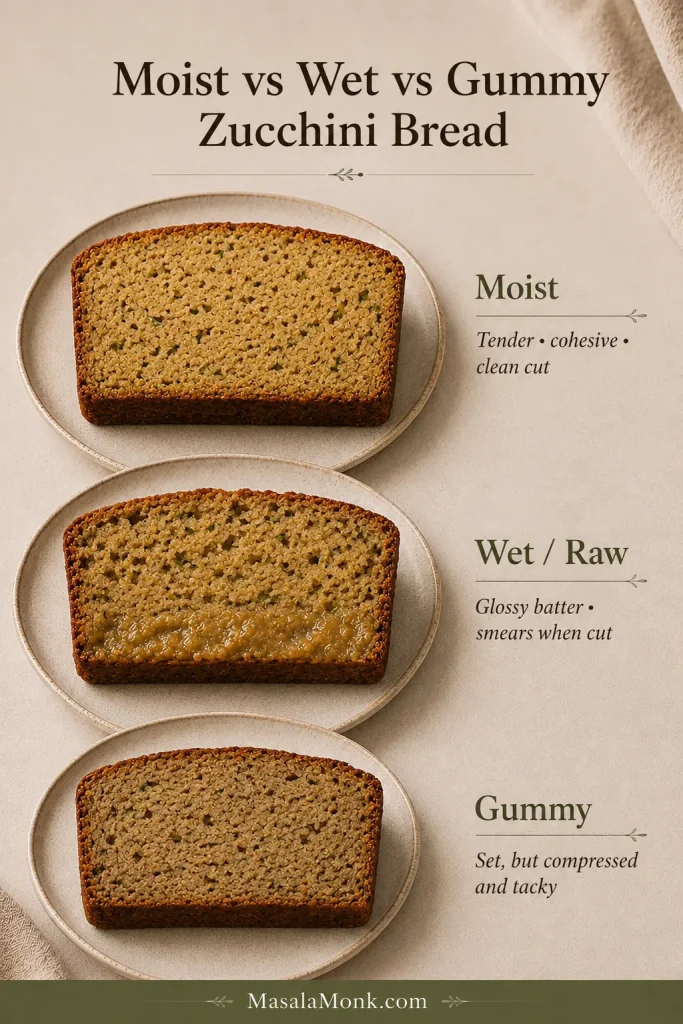
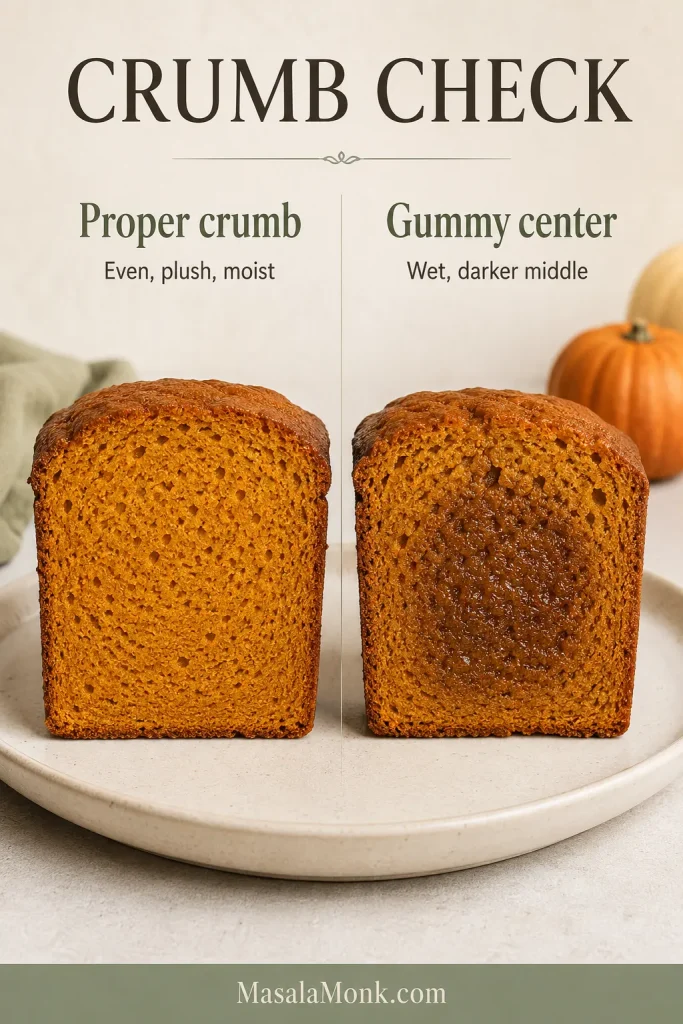
Moist, Wet or Gummy?

Moist: The cooled crumb is tender, holds together and cuts cleanly. That’s the texture you’re after.

Wet: Raw-looking or paste-like batter remains through the loaf and smears onto the knife. It needed more baking.

Gummy: The bread holds together but feels tacky, compressed or rubbery. Underbaking can cause it, but excess free water, heavy mixing or cutting while very hot can contribute too.

A slightly tacky patch directly beneath the top crust is different from a stripe of raw batter running through the loaf.

Three zucchini bread slices comparing a tender baked crumb, a glossy raw band and an opaque but compressed gummy crumb.
Wet or raw points back to doneness; a fully set but gummy crumb points to moisture, mixing or cooling.

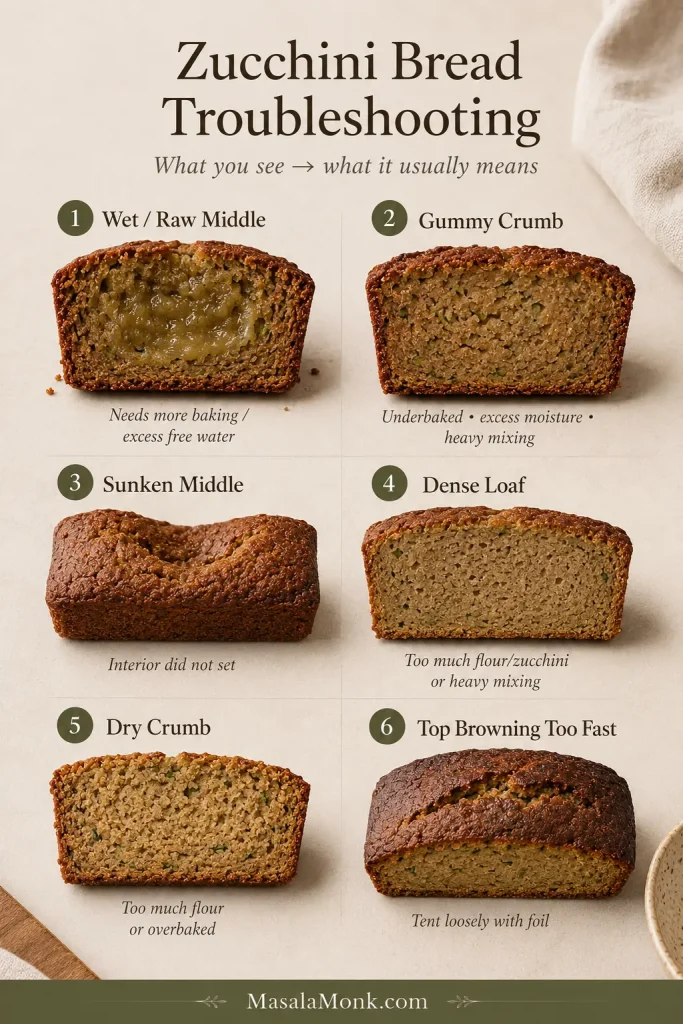
Zucchini Bread Troubleshooting

Troubleshooting guide showing zucchini bread with a raw center, gummy crumb, sunken middle, dense crumb, dry crumb and an overly browned top.
Start with the symptom you can see and change one variable at a time.
ProblemLikely causeNext move
Wet or raw middleMore baking time needed; excess free water; oven running coolKeep a whole, hot loaf baking until the raw batter is gone
Gummy crumbUnderbaking, excess moisture, heavy mixing or cutting very hotMix only until combined, bake fully and cool before judging
Sunken middleInterior had not set; inaccurate leavener; pan too small or overfilledCheck measurements, pan size and doneness
Dense loafToo much flour, too much zucchini or heavy mixingWeigh the key ingredients and stop folding once combined
Dry crumbToo much flour, zucchini wrung dry or loaf overbakedKeep the zucchini’s natural moisture and remove the loaf once baked through
Top browning too quicklyDark pan or strong top heatLoosely tent with foil while the loaf finishes

If the top is already dark enough while the center still needs time, loosely tent the loaf with foil and continue baking. The foil is a shield for the crust, not a signal that the middle is finished.

Deeply browned zucchini bread in a light metal loaf pan with aluminum foil loosely arched above the top to prevent further browning.
Keep the foil loose with an air gap; shield the browned crust without wrapping the loaf.

Why Is My Zucchini Bread Raw in the Middle?

Usually because the loaf needed more time, excess free water entered the batter, or the oven was running cooler than expected.

A loaf that is still whole and hot can go back into the oven. Cover the top loosely with foil when it already has enough color and continue until the raw batter is gone.

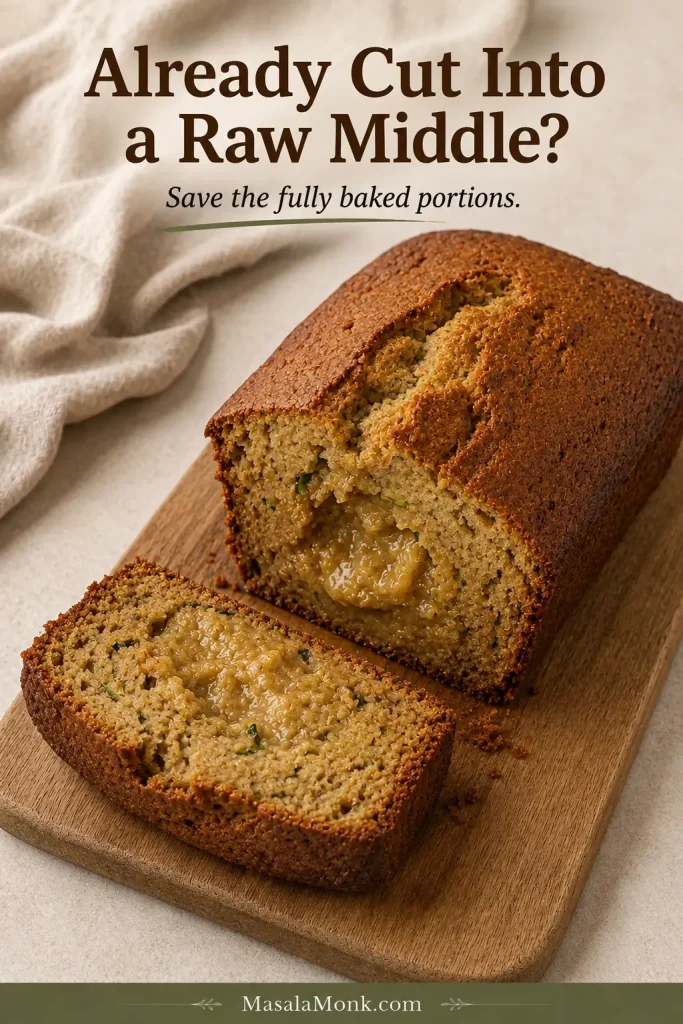
If you’ve already cut into it and found a genuinely raw middle, the options are unfortunately narrower. Save the fully baked portions. Continuing to bake the whole cut loaf tends to dry the parts that were already done before the exposed batter cooks evenly.

Cut zucchini bread showing fully baked outer crumb surrounding a glossy raw section in the middle of the loaf.
Once the loaf is cut open, protect the baked portions rather than trying to finish it like an intact loaf.

↑ Back to the recipe · Recheck doneness

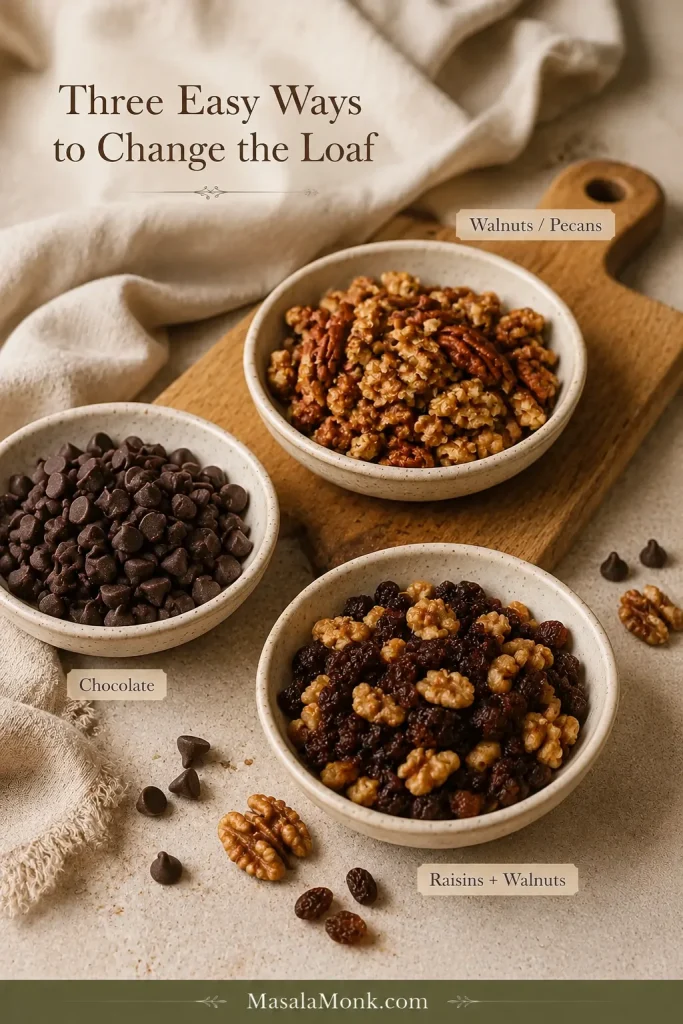
Easy Add-Ins

Walnuts or pecans: Fold in up to 85g / 3 oz. Walnuts give the loaf the more familiar old-fashioned crunch; pecans are slightly sweeter.

Chocolate chips: Use up to 85g / 3 oz semi-sweet or dark chocolate. In a slightly warm slice, the chips soften into little melted pockets against the cinnamon crumb.

Raisins: About 75g / 2.6 oz, roughly ½ cup, gives the loaf a more old-fashioned recipe-box feel. Raisins and walnuts work especially well together.

Walnuts and pecans, chocolate chips, and raisins with walnuts arranged in bowls as optional zucchini bread add-ins.
Distribute add-ins evenly so every slice gets some without heavy clusters weakening the crumb.

If that combination of grated vegetables, cinnamon and nuts is the part you love most, it takes a richer turn in this carrot cake with cream cheese frosting.

Before You Start Swapping Ingredients

Zucchini bread is forgiving, but flour, eggs, sugar, oil and zucchini moisture all help determine the final crumb. Change several at once and you’re effectively making a different recipe.

For the first loaf, keep the eggs and oil as written. Butter and applesauce both work in zucchini breads designed around them, but they do not perform exactly the same job as neutral oil here.

If applesauce is the change you are considering, this banana bread made with applesauce shows how a quick bread can be built around fruit puree from the start.

Eggless, vegan, gluten-free, keto and almond-flour versions change the structure enough that they are better treated as their own recipes instead of casual swaps inside this one.

Ready to bake? Return to the zucchini bread recipe →

The Pan Matters More Than It Seems

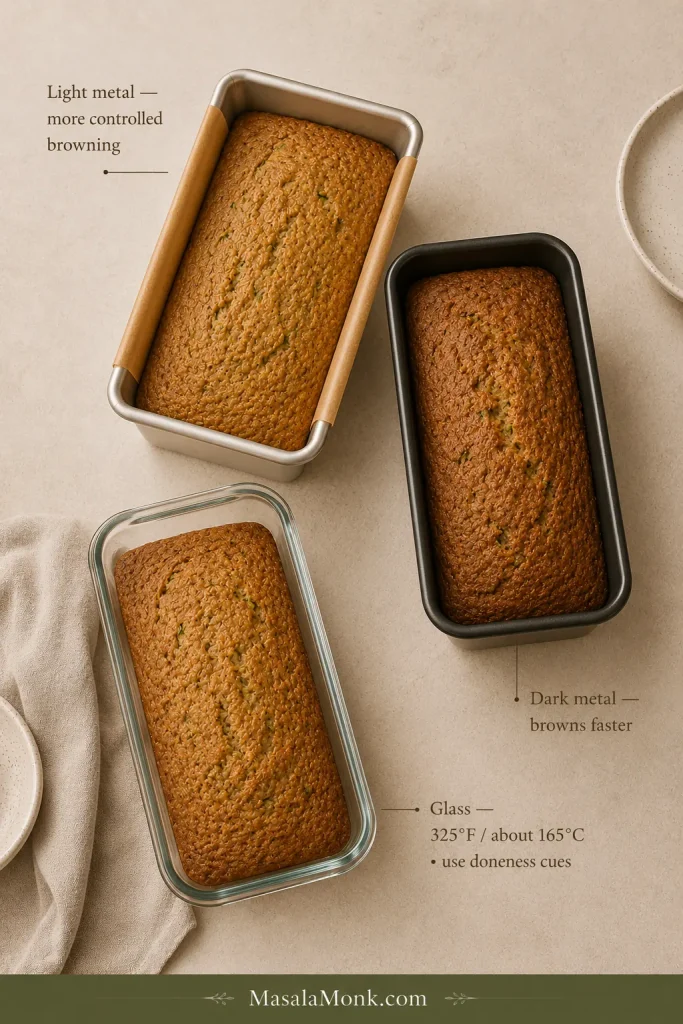
The full batch fits a 9 × 5-inch / 23 × 13 cm loaf pan. A light-colored metal pan gives you more control over browning during the long bake.

Dark metal usually browns the crust faster. When the top has enough color before the loaf is finished, cover it loosely with foil and keep baking.

Glass behaves differently from metal and holds heat longer. If glass is what you have, King Arthur Baking recommends reducing the oven temperature by 25°F; for this loaf, that means 325°F / about 165°C. Expect the timing to change and use the same doneness cues instead of relying on the original clock time.

Three zucchini loaves baked in similarly sized light metal, dark metal and clear glass pans to compare pan materials and browning.
Keep the 9×5 size constant when comparing pan materials so batter depth does not become a second variable.

A noticeably smaller loaf pan makes the batter deeper and changes the bake. Use the specified 9 × 5-inch pan when possible instead of forcing the full batch into something smaller. Muffins and mini loaves need their own baking times, so the full-loaf timing should not be used for either.

Storing and Freezing Zucchini Bread

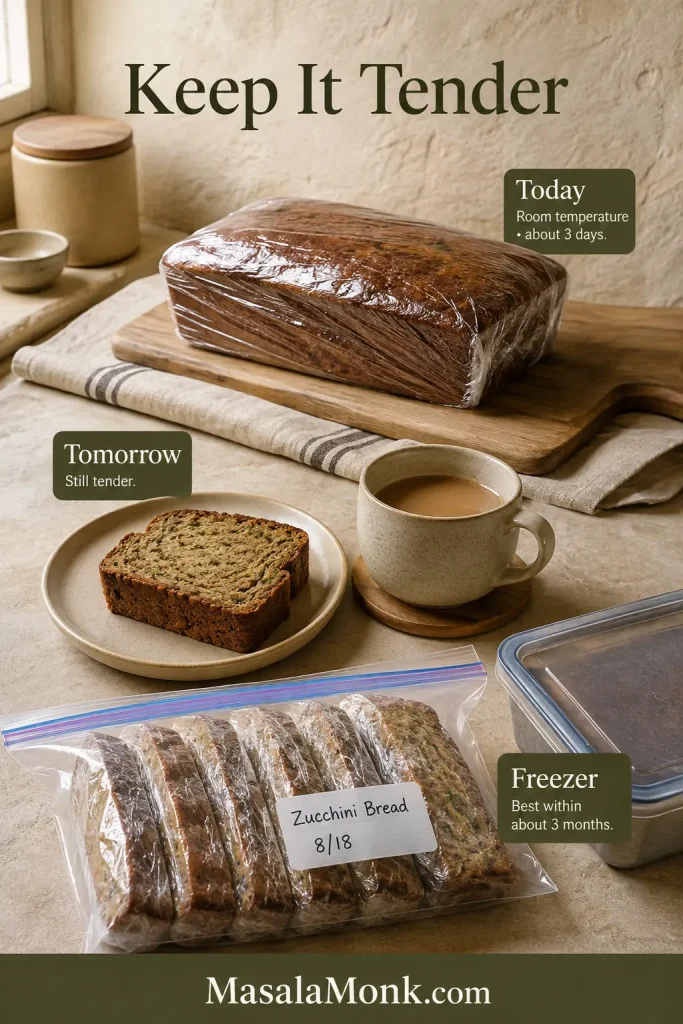
Room temperature: Cool the loaf completely before covering it. Keep it well wrapped or in an airtight container for about 3 days. Wrapping while warm traps steam against the crust.

Refrigerator: A very hot or humid kitchen is the main reason to refrigerate it. Chilled quick bread firms up, so let a slice lose its chill or warm it gently before eating.

Freezer: Wrap the completely cooled loaf or individual slices tightly and place them in a freezer-safe bag or container. For best quality, use them within about 3 months. Individual slices are especially handy: pull one out, let it thaw on the counter, and breakfast is mostly handled.

Wrapped whole zucchini bread for room-temperature storage, a slice served with coffee and individually wrapped slices packed for freezing.
Freeze the cooled loaf in portions so you can thaw one slice without repeatedly exposing the rest.

For another simple cinnamon bake that keeps well for the next day, try this fresh apple cake.

Frequently Asked Questions

Can You Taste the Zucchini in Zucchini Bread?

Not strongly. Cinnamon, vanilla and brown sugar reach you first. The zucchini mostly contributes moisture, tenderness and little green flecks instead of an obvious vegetable flavor.

Can You Use Yellow Summer Squash Instead?

A young, firm yellow summer squash can work much like zucchini. Grate it the same way. An oversized mature squash may need tough skin or a coarse seed cavity removed first.

Can You Double the Recipe?

Yes. Divide a double batch between two 9 × 5-inch pans. One extra-deep loaf would bake very differently; the pan section explains why depth and material matter.

The Slice You’re Looking For

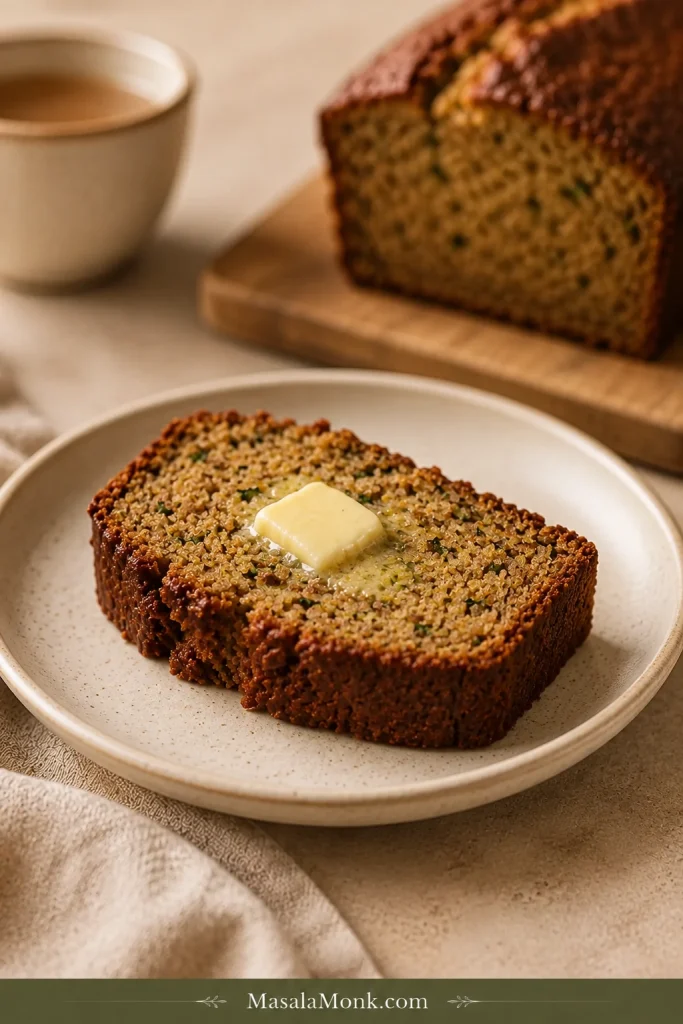
Once the loaf has cooled, the knife should pass through without dragging a wet streak behind it. The slice bends gently, the crumb holds together, and cinnamon reaches you before zucchini ever does.

That’s the balance this bread is after: the zucchini keeps the crumb tender, while enough oven time turns the middle from batter into bread.

Add butter if you like. It does not need much else.

Thick slice of golden zucchini bread with tender green-flecked crumb and a small pat of melting butter, with the remaining loaf softly blurred behind.

What did you make yours with: small fresh zucchini, one of those enormous garden zucchini, or zucchini from the freezer?

↑ Back to the recipe · ↑ Back to top

Posted on — Leave a comment

No-Bake Lemon Bars Recipe

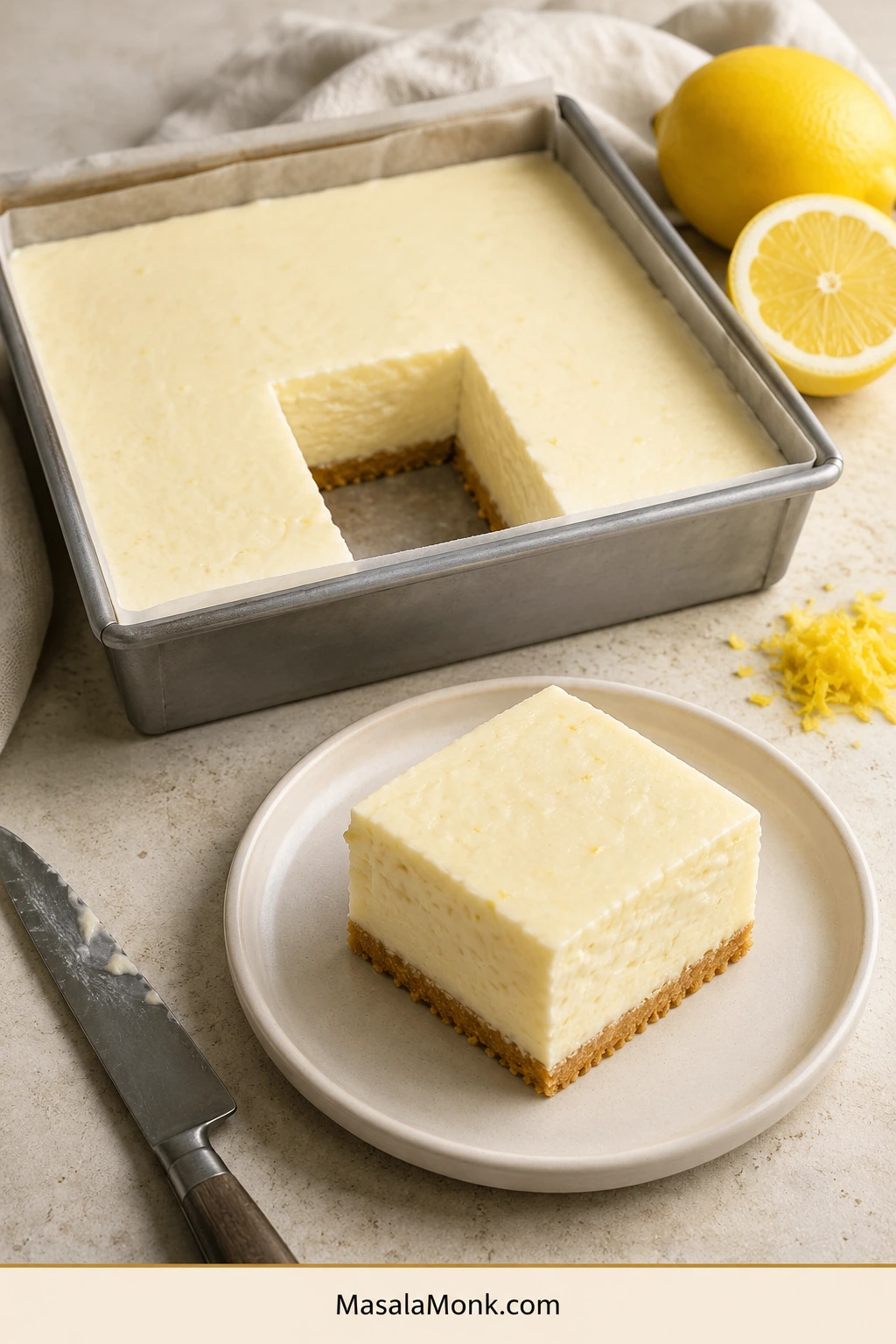
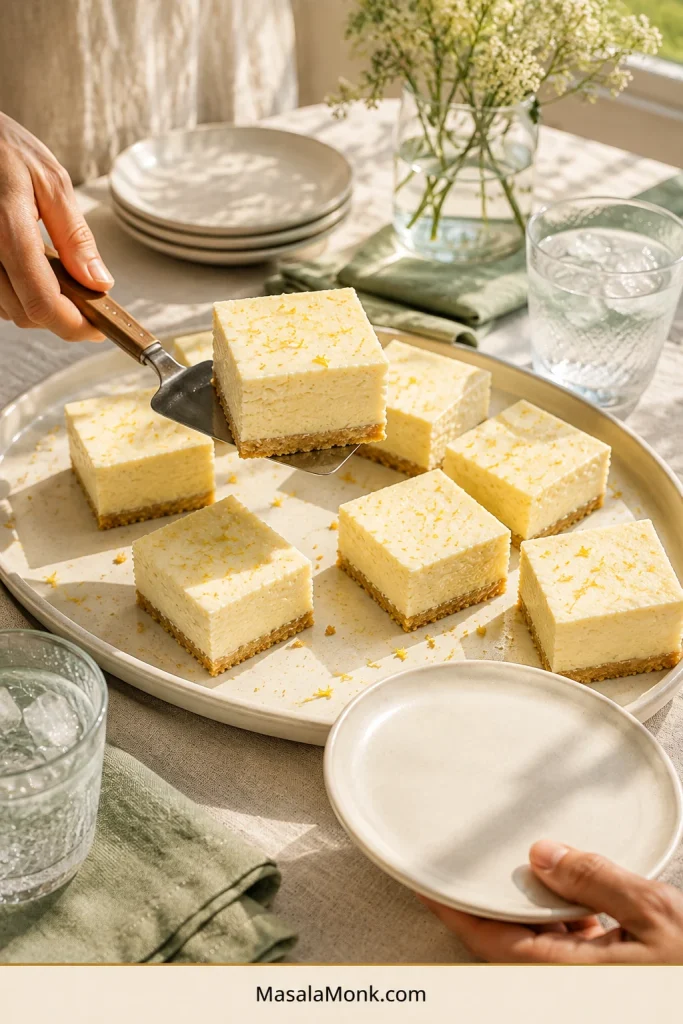
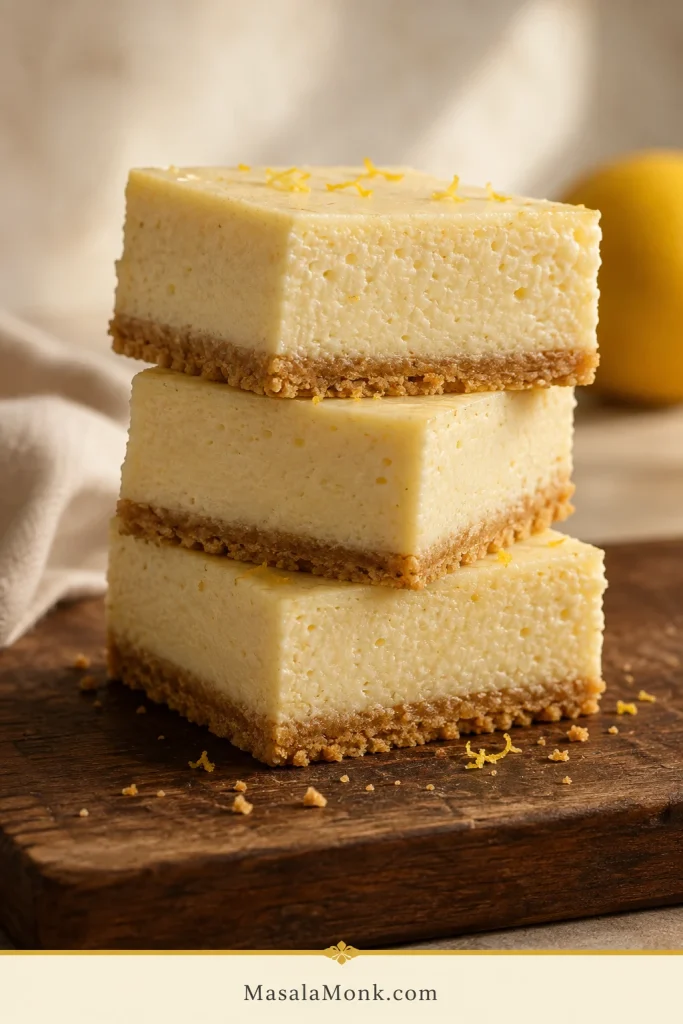
One square lifted from the centre of a pan reveals thick pale lemon filling standing above a thin golden biscuit crust.

The first centre cut tells the truth. A no-bake lemon filling can taste bright and creamy in the bowl, yet still slump when the parchment lifts and the knife reaches the middle.

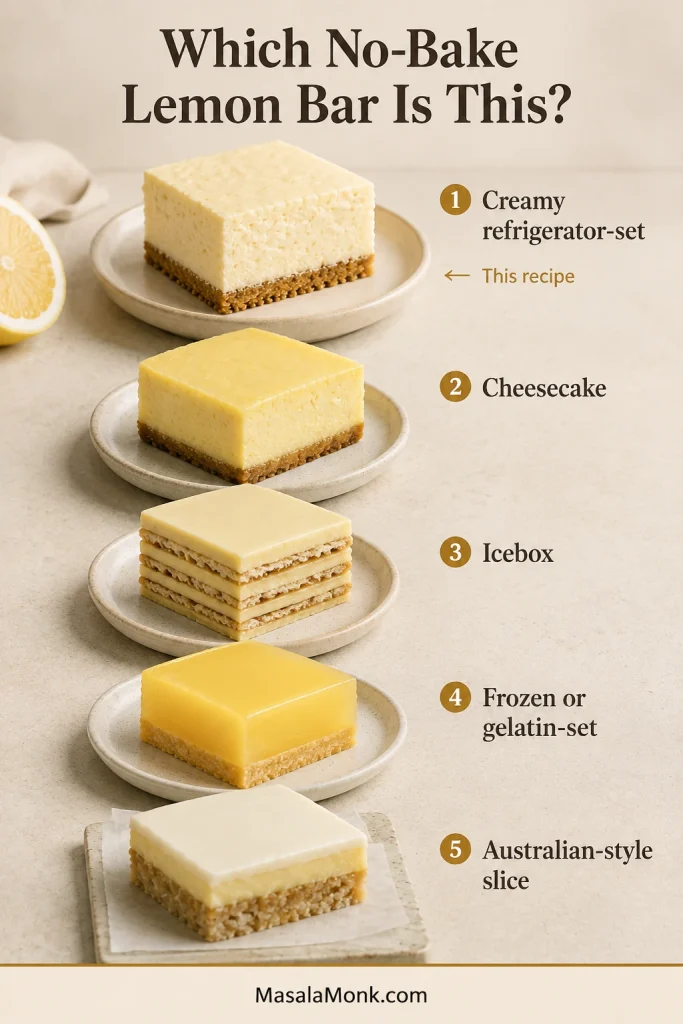
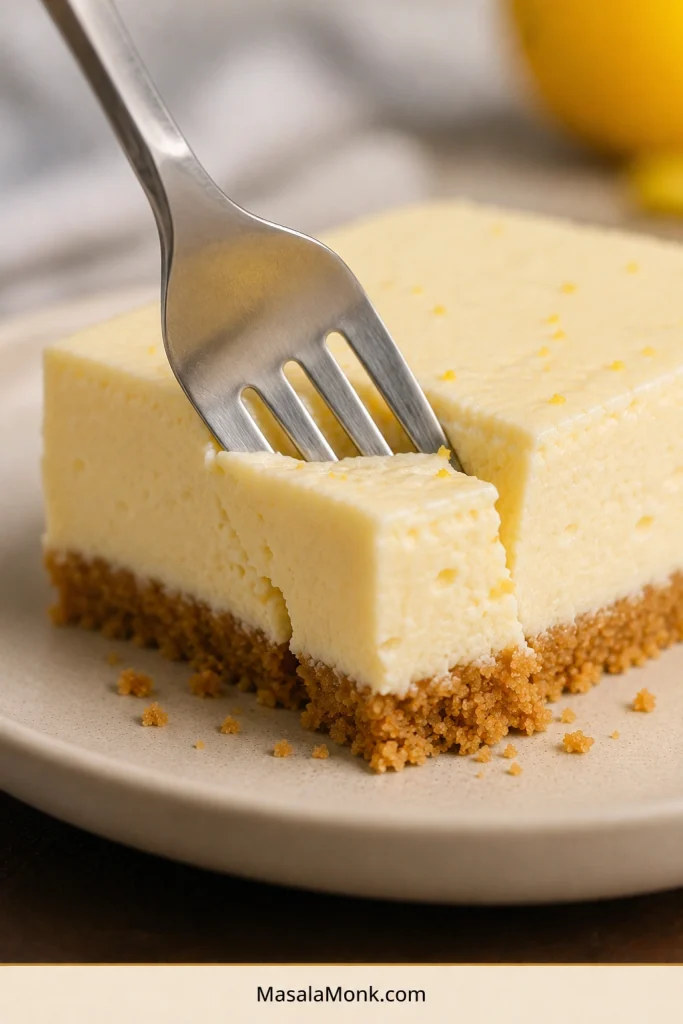
These easy no-bake lemon bars stay creamy while holding their shape. Cold and silky, the filling carries the fragrance of fresh zest and melts into the buttery crumbs underneath. Fresh lemon arrives first, so the condensed milk never tastes as heavy as it might sound.

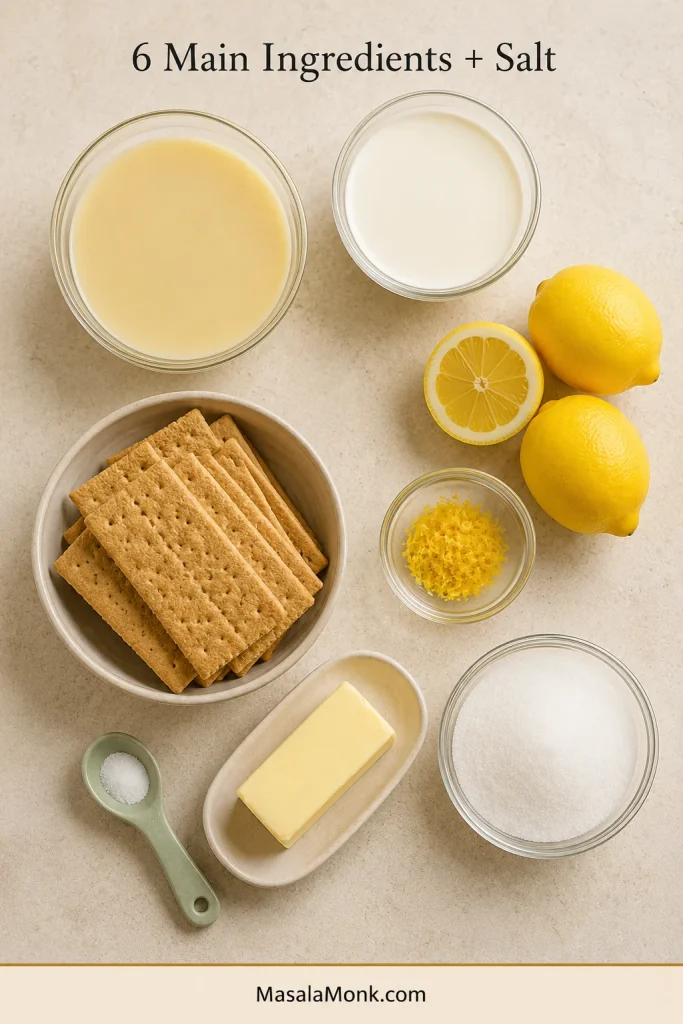
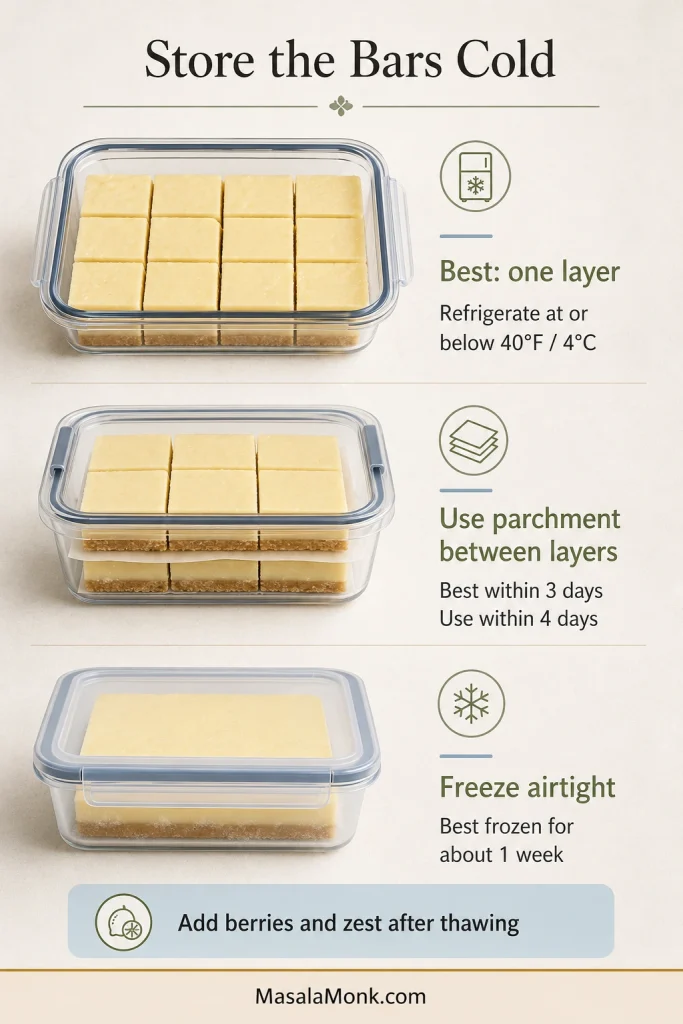
Classic lemon bars can mean baking a shortbread crust, whisking an egg-based filling and waiting for a hot pan to cool. Here, six main ingredients plus salt come together in about 25 minutes of hands-on work. The bars set fully in the refrigerator without cream cheese or gelatin. A brief freezer chill is only an optional aid when extra-sharp edges matter.

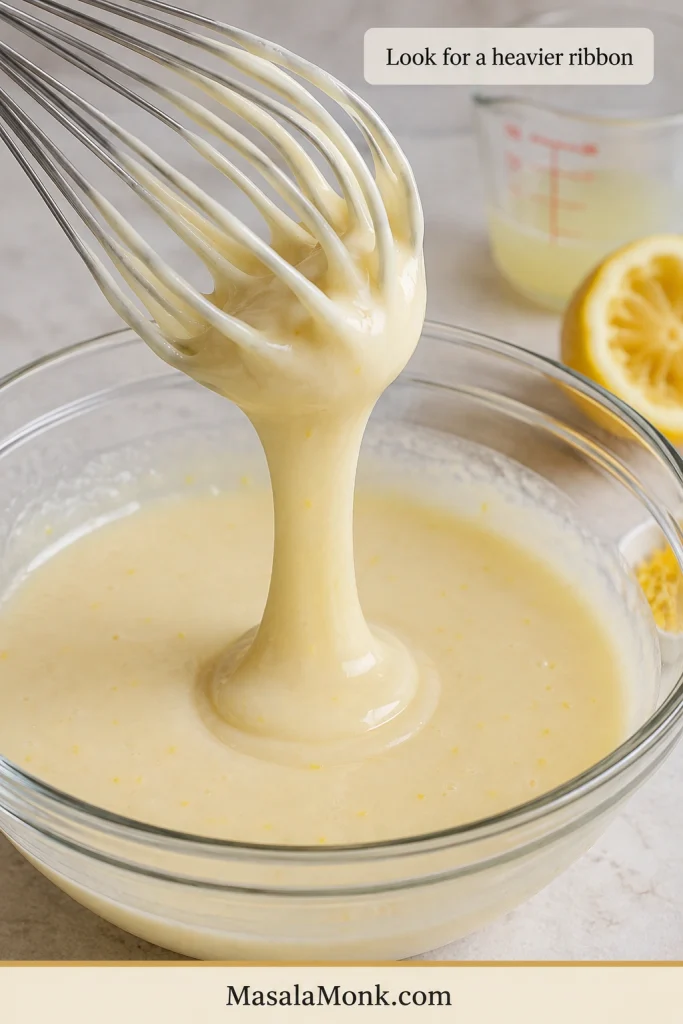
The Masala Monk rule is simple: let the lemon thicken the condensed milk; let the refrigerator finish the set.

Quick answer

How to make no-bake lemon bars that hold their shape

Press the crumb mixture firmly into an 8-inch square pan and chill it. Whisk one standard can of sweetened condensed milk with ½ cup fresh lemon juice, finely grated zest and a little salt until the mixture falls from the whisk in a heavier ribbon.

Whip the cream until the peaks stand firmly and the surface still looks glossy. Fold it into the lemon mixture, spread the filling over the chilled crust and refrigerate for about 6 hours. A longer chill makes lifting and cutting even easier.

The finished bars are lighter than no-bake cheesecake, firmer than spoonable lemon mousse and softer than traditional baked lemon bars. Serve them straight from the refrigerator, while the filling still holds a clean edge.

Choose this version when you want the lightness of lemon mousse with enough structure for proper bars—without cream cheese, gelatin or a frozen filling.

Make it now

No-bake lemon bars recipe

A buttery graham-cracker crust topped with a fresh lemon filling made from condensed milk and whipped cream. The only stage that asks for close attention is whipping the cream; everything else can be done at an unhurried pace.

Condensed milk, whipping cream, lemons, graham crackers, butter, sugar and salt arranged separately on a pale work surface.
Condensed milk gives body, lemon brings acidity and aroma, cream adds air, and crumbs support the filling.
Pan and yield8 × 8-inch / 20 × 20 cm square pan; 16 regular bars or 12 generous bars
Prep timeAbout 25 minutes
Earliest check4 hours
Recommended chillAbout 6 hours
Best for clean cutsOvernight
Total timeAbout 6 hours 25 minutes
Texture and dietary noteCold, creamy and sliceable; the filling is egg-free and gelatin-free

What you need

  • 8 × 8-inch / 20 × 20 cm square pan and parchment paper
  • Food processor, or a rolling pin and sturdy food bag
  • Electric hand mixer or stand mixer
  • Fine zester and flexible spatula
  • Large straight-edged knife

Ingredients

For the no-bake graham-cracker crust

  • About 1½ cups graham-cracker crumbs (180 g / 6.3 oz); the number of sheets varies by brand
  • 6 tablespoons unsalted butter (85 g / 3 oz)
  • 1 tablespoon granulated sugar (13 g / about ½ oz)
  • ¼ teaspoon fine salt

For the lemon filling

  • One 14-ounce / 397 g can full-fat sweetened condensed milk, or one 400 g can
  • ½ cup fresh lemon juice (120 ml / 4 fl oz)
  • 2 tablespoons finely grated lemon zest, loosely packed
  • ¼ teaspoon fine salt
  • 1½ cups cold whipping cream (355 ml / 12 fl oz), ideally 35% milk fat or higher

Optional finish

  • Fresh lemon zest
  • A few reserved biscuit crumbs
  • Fresh blueberries or raspberries, added shortly before serving
  • Up to 2 tablespoons homemade lemon curd for a light surface swirl, or about ½ teaspoon per bar

Buying lemons: four or five medium lemons should provide enough measured juice and zest. Lemon yield varies considerably, so measure the juice rather than relying on fruit count alone.

Whole lemons, a fine zester, fresh yellow zest and a measuring jug containing half a cup of lemon juice sit on a work surface.
Zest only the yellow skin, then measure the juice so flavour and thickening stay consistent.

Cream note: use a product specifically labelled for whipping. Some regular fresh or table creams sold in India and elsewhere contain too little fat to whip properly. British double cream works well but thickens quickly, so reduce the mixer speed early.

Instructions

Prepare the pan and crust

  1. Line the pan. Lay two strips of parchment across the pan in opposite directions, leaving enough overhang to lift the chilled slab later.
  2. Make the crust. Process the graham crackers until evenly fine. Melt the butter briefly in the microwave or in a small pan, then mix it with the crumbs, sugar and salt. A firmly squeezed handful should hold together without releasing visible butter.
  3. Press and chill. Spread the crumbs evenly, compact them with the flat bottom of a cup and finish the corners with the back of a spoon. Freeze for 15 minutes or refrigerate for about 30 minutes.
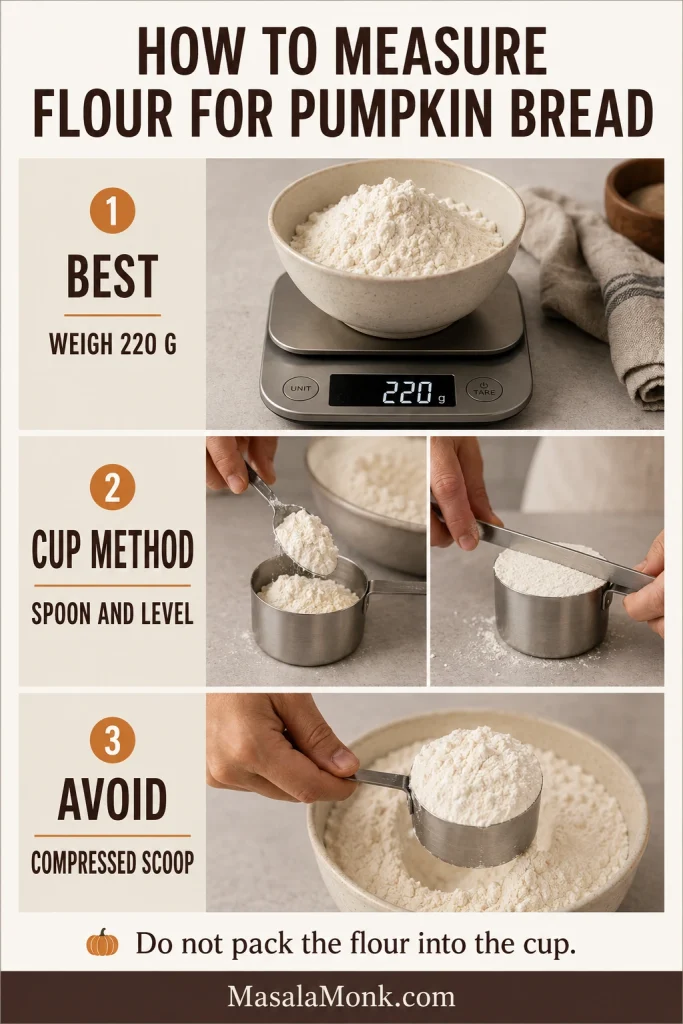
Build the lemon filling

  1. Make the lemon base. Zest the lemons before cutting and juicing them. In a glass or stainless-steel bowl, whisk the condensed milk, measured lemon juice, zest and salt for 1–2 minutes. The mixture is ready when it falls from the whisk in a heavier ribbon. Set it aside while you whip the cream.

Visual cue

Watch the lemon base change: after a minute or two with the juice, it should feel more resistant and fall from the whisk in a brief, heavier ribbon. It will still look softer than the finished filling.

A whisk lifts a smooth pale lemon and condensed-milk mixture that falls back into a glass bowl in a slow, thick ribbon.
Look for a brief, heavier ribbon—not peaks. Whipped cream and chilling create the final structure.
  1. Whip the cream. Beat to firm-to-stiff peaks; the tip may bend slightly, but the peak should not collapse.

Visual cue

Stop at a firm, glossy peak: once the whisk leaves deep tracks, reduce the speed. The peak may bend slightly at the tip, but it should not collapse or look rough and grainy. For every stage, see the whipped cream peak guide.

Three bowls compare cream with a collapsing peak, cream with a firm glossy peak and overwhipped cream with a rough grainy texture.
Stop while the peak stands and the surface stays glossy; rough, grainy cream has gone too far.
  1. Fold the filling. Start by folding about one-third of the cream into the lemon base to loosen it. Add the rest in two portions, using broad movements only until no large white streaks remain.
  2. Fill the pan. Spoon the filling across the chilled crust in several mounds, ease it into the corners and level the top. Once the corners are filled, stop smoothing. A few gentle ripples will not affect the set.

Chill, check and serve

  1. Cover and chill. Tent foil or plastic wrap loosely over the pan. A fitted lid works too, provided it does not touch the filling. Refrigerate for about 6 hours, or until the middle moves with the pan rather than rippling on its own.
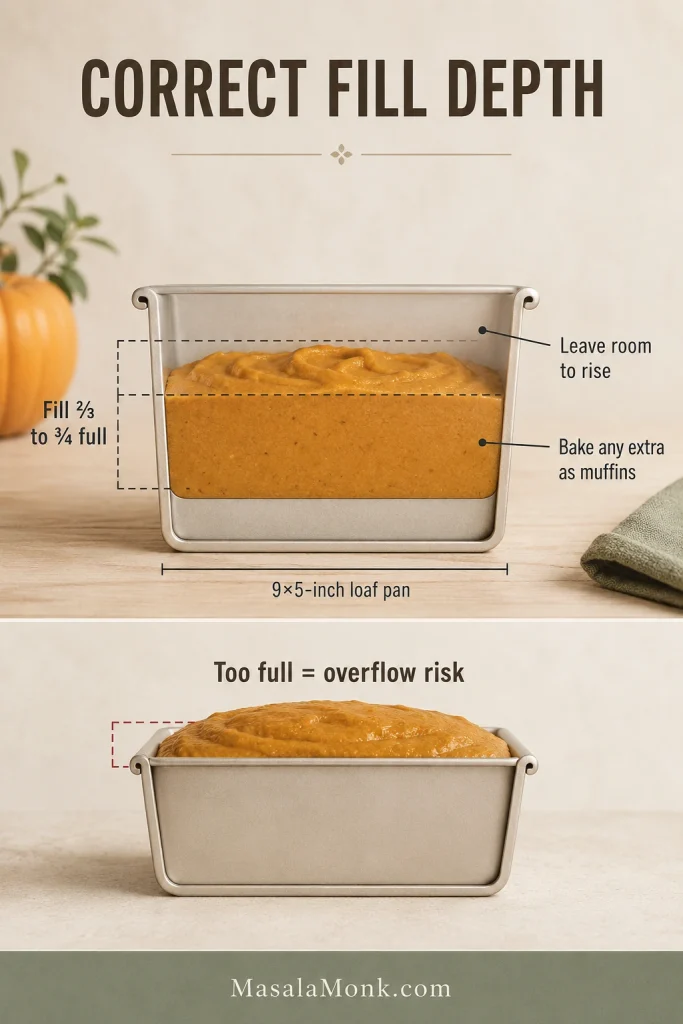
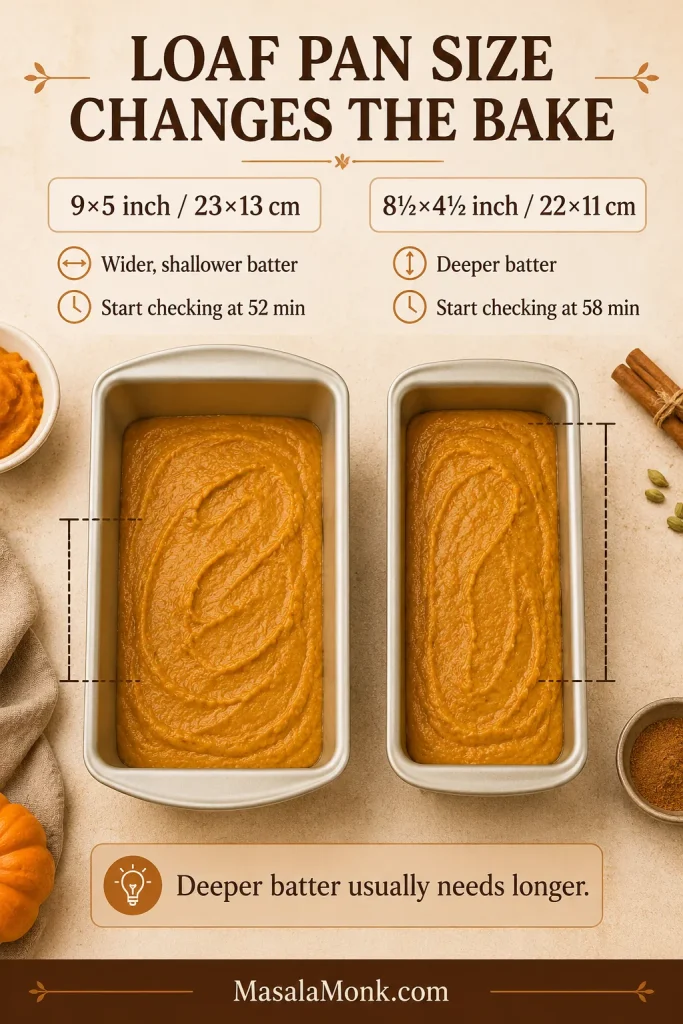
  2. Check the middle. The surface should look set rather than wet. For especially neat cuts, give the fully chilled slab a 20–30-minute freezer chill.
  3. Lift, cut and serve. Use the parchment to lift the slab. Heat a large straight-edged knife in hot water, dry it completely and press straight down. Clean and reheat the blade between cuts. Serve straight from the refrigerator.

Recipe notes

  • No oven is needed. The only heat required is enough to melt the butter.
  • Salted butter works. Omit the added salt from the crust or reduce it to a small pinch.
  • Use sweetened condensed milk, not evaporated milk. Condensed milk provides both sweetness and body.
  • A metal pan chills fastest. Glass or ceramic works, but the filling may need additional time.
  • A 9-inch square pan makes slightly thinner bars. Double the recipe for a 9 × 13-inch pan when you want a similar filling depth.
  • The filling is egg-free. Check the biscuit label and omit egg-based lemon curd if the entire dessert must be egg-free.

Pan-size guide

Choose the pan before scaling: changing the surface area alters filling depth, chilling speed and the crust-to-cream balance.

An eight-inch square pan, a nine-inch square pan and a nine-by-thirteen-inch pan compare standard, thinner and doubled batches.
A larger pan makes thinner bars that warm and soften faster; scale both layers to preserve the intended balance.

Need help before starting? Set and cut cleanlyChoose your crustFix a problem

You can stop at the recipe and start making the bars. Still deciding whether this is the style you want? The comparison below separates it from cheesecake bars, icebox squares, frozen bars and Australian-style lemon slice.

Visual comparison

How this version differs from other no-bake lemon bars

Start with the texture you want. The visual gives the quick distinction; the table beneath explains how each style is built.

Five lemon desserts are compared: refrigerator-set bars, cheesecake bars, layered icebox squares, frozen bars and Australian-style lemon slice.
Choose by texture first: creamy refrigerator bars, denser cheesecake, softened layers, frozen bars or a firm lemon slice.
StyleHow it is madeResult
Creamy lemon barsCondensed milk, fresh lemon and whipped cream over a pressed crumb crustLight, creamy and softly sliceable when cold
Lemon cheesecake barsUse a cream-cheese-based no-bake cheesecake fillingRicher, tangier and substantially denser
Icebox lemon squaresLayer lemon filling with whole crackers, much like the softened cookie layers in no-bake banana puddingSoft and cake-like after resting
Frozen or gelatin-set barsUse a frozen cream filling or lemon gelatinFirmer, colder or more elastic
Australian-style lemon sliceMake a biscuit-and-coconut base topped with lemon icingDense and chewy rather than creamy

This is the sort of dessert that earns its place on a hot afternoon: make it before anyone arrives, leave it in the refrigerator and bring it out only when the table is ready.

Hands serve creamy lemon bars from a white platter at a bright table with small plates, glasses and pale-green napkins.
Serve a few bars at a time so the remaining slab stays cold, firm and neatly sliceable.

What success tastes like

Cold lemon cream over tender buttery crumbs

Cold from the refrigerator, the filling feels airy at first and then melts into smooth lemon cream. Fresh zest gives it a fragrant lift, while the buttery, lightly salted crumbs keep the sweetness grounded.

Each square is soft enough for a fork to pass through easily, but substantial enough to lift and serve neatly.

A dessert fork cuts through thick pale lemon filling and a thin golden crumb crust, lifting a small creamy bite.
The fork should compress the cream before meeting gentle resistance from a thin, compact crust.

Visual timing guide

How long to chill—and how to cut clean squares

Allow about 6 hours for dependable slices. For the most even set and easiest cuts, chill the pan overnight.

Four hours may be enough in a very cold refrigerator, especially with a metal pan. Six hours gives more margin for warmer refrigerators, glass or ceramic pans and a centre that chills slowly.

Three lemon bars show a softer early set after four hours, a dependable slice after six hours and cleaner edges after overnight chilling.
Corners set first; judge the centre before lifting or cutting the slab.
Chilling timeWhat to expect
4 hoursAn early checkpoint when the bars are needed urgently; the middle may still be delicate
About 6 hoursA dependable point for lifting and cutting in a properly cold refrigerator
OvernightThe most even set and easiest cuts
Plus 20–30 minutes in the freezerSharper edges for photographs, parties or warm-weather transport

A crowded refrigerator or a door that keeps opening can slow the middle down. If it still looks soft, more refrigerator time is usually the best fix.

Before lifting or cutting

  • Surface looks set rather than wet
  • Centre moves with the pan instead of rippling on its own

After the first cut

  • Cut stays open instead of closing behind the knife
  • Exposed sides hold their shape instead of slowly spreading
  • A light, creamy trace on the blade is normal

The first square does not have to be the prettiest. Use it to judge the set, then clean the blade and continue.

A chilled lemon-bar slab with one centre square removed shows a matte top, upright sides, a defined opening and a light trace on the knife.
A light knife trace is normal; sides that spread slowly need more refrigerator time.

How to get clean lemon-bar squares

  1. Chill the slab fully and give it the optional freezer chill when especially neat edges matter.
  2. Lift the slab onto a stable board with the parchment.
  3. Heat a large straight-edged knife in hot water and dry it completely.
  4. Press straight down without sawing.
  5. Wipe, reheat and dry the blade between cuts.
Four steps show a straight knife warmed in hot water, dried with a towel, pressed through lemon bars and wiped clean.
Dry the warmed blade, then press straight down; moisture and sawing both roughen the cut edges.

Cut the slab 4 × 4 for 16 regular bars or 3 × 4 for 12 generous portions. For a dessert tray, a 5 × 5 grid makes 25 small bites.

Three square slabs show cutting grids for 16 regular bars, 12 larger portions and 25 small party bites.
Mark equal intervals on two edges before cutting so every row finishes at the same size.

Remove the bars only when you are ready to serve them. In a warm room, return the remaining slab to the refrigerator between servings. Trimming the edges is optional; for everyday serving, keep them.

Back to recipeChoose your crustBack to top ↑

Graham crackers, digestives, Marie biscuits or shortbread?

Crumb crusts can feel annoyingly vague because every biscuit absorbs butter differently. The figures below are practical starting ranges, not universal ratios. Biscuit fat, sugar and dryness vary by brand, so reserve a little butter and let the squeeze test make the final decision.

The same principle keeps the biscuit base in Banoffee Pie from becoming either sandy or greasy.

Five labelled biscuit types are shown whole, broken and as crumbs: graham crackers, digestives, Marie biscuits, shortbread and ginger biscuits.
Biscuit richness and dryness predict butter needs more reliably than the name printed on the packet.

Starting-point guide

Starting butter ratios by biscuit

Biscuit richness changes how much butter the crumbs need. Begin conservatively, then confirm the mixture with the squeeze test.

A guide pairs five biscuit types with starting crumb weights and melted-butter quantities for a no-bake crust.
Start low with rich biscuits, then let the squeeze test decide whether more butter is needed.
BiscuitStart withResultWhat to watch
Graham crackers180 g crumbs + 85 g butter + 13 g sugarLight, mildly sweet and easy to cut when coldA very lean brand may need another teaspoon or two of butter
Digestive biscuits200 g crumbs + 70–80 g butterDeeper, toastier and less sweetUsually omit added sugar
Marie biscuits200 g crumbs + 85–95 g butterMild and relatively leanAdd the final butter gradually
Shortbread cookies250 g crumbs + 50–65 g butterRich and closest to classic lemon-bar flavourToo much butter quickly makes it greasy or hard
Ginger biscuits200 g crumbs + 70–80 g butterWarm, spiced and excellent with lemonUsually needs no added sugar
Gluten-free biscuitsBegin with the closest matching biscuit aboveDepends strongly on the brandLet the squeeze test decide the final butter amount

Let the squeeze test decide

The crumb mixture is ready when every crumb looks moistened and a firmly squeezed handful holds together. It should hold when your fingers open, then break apart when you press it deliberately.

  • Loose and sandy: add melted butter one teaspoon at a time.
  • Wet or butter-releasing: add more crumbs one tablespoon at a time.
  • Using shortbread: stop earlier because the cookie already carries plenty of fat.

Because this base is chilled rather than baked, it will be firm enough to lift but slightly softer than an oven-baked crust—especially on the second or third day.

Fine buttered crumbs form a clump that holds in one hand, with loose coarse crumbs and a deliberately broken clump shown nearby.
The crumbs should clump firmly without leaving oily shine on the hand or bowl.

Graham crackers keep the lemon in front. Digestives bring a deeper, toastier base. Shortbread makes each square richer, while ginger biscuits leave a warm finish after the lemon fades.

Small details that make the bars reliable

Press through the whole crust

A crust can look smooth on top while remaining loose underneath. Press in overlapping passes across the whole base rather than polishing only the surface. Crumbs may resist the corners at first; the back of a spoon usually reaches them more easily than a round cup.

A flat-bottomed glass compacts biscuit crumbs across a lined pan while a spoon presses firmly into the corners.
Lift and reposition the glass instead of sliding it continuously, which pushes compacted crumbs into ridges.

Hot-kitchen note: refrigerate the bowl and beaters for 10–15 minutes, keep the cream cold until the last moment and set the mixing bowl over a larger bowl of ice when necessary. An electric mixer makes it much easier to stop at the right stage.

A metal bowl rests over ice beside cold whipping cream, chilled beaters on a dry towel and an electric hand mixer.
Keep the bowl cold and dry; the ice bath should chill the cream, never dilute it.

Fold and finish without overworking

Fold the first third of the cream more confidently to loosen the lemon base. Once the mixture feels lighter, use slower, broader movements for the remaining cream.

Two stages show whipped cream loosening a thick lemon base and then being folded into a smooth, airy filling.
The folded filling should mound softly rather than pour, showing that enough air remains.

Everything else in the bowl is sturdy; the air in the cream is not. Stop once no large white streaks remain, spread the filling gently and leave a few harmless ripples on top.

Creamy lemon filling reaches the corners of a lined square pan, with soft spatula ripples visible across the top.
Soft ripples are harmless; filling that runs flat immediately needs more structure.

Illustrated structure guide

Why this filling firms up in the refrigerator

Lemon thickens the condensed milk, whipped cream carries air through the mixture, and refrigeration firms the dairy. Together, they give the filling enough body to slice without making it dense.

Lemon works on condensed milk in much the same way lime juice does in key lime pie. Here, the whipped cream keeps the texture lighter, while the refrigerator completes the set.

Three stages show lemon thickening condensed milk, whipped cream holding air and a chilled lemon bar retaining a square shape.
All three stages matter; extra chilling cannot repair weakly whipped cream or an improperly mixed lemon base.

What each ingredient contributes

Condensed milk supplies sweetness, concentrated dairy flavour and most of the filling’s body. Either a 397 g or 400 g can works.

Lemon juice balances the condensed milk and helps thicken it. Measure ½ cup / 120 ml / 4 fl oz after squeezing rather than relying on a fruit count.

Lemon zest carries the fragrant oils that make the bars smell unmistakably citrusy without loosening the filling. Grate only the yellow skin; white pith can taste bitter.

Whipping cream introduces the air that keeps the filling light, while its fat firms as it chills.

Salt makes the lemon taste brighter and keeps the second bite as appealing as the first.

Evaporated milk, regular milk and ordinary pouring cream are much thinner. None will thicken and set the filling in the same way as condensed milk.

No-bake lemon bar troubleshooting

Visual troubleshooting guide

Use the symptom to choose the fix: soft filling, cream that will not whip, a crumbly crust and a greasy or hard crust each need a different response.

A troubleshooting guide compares soft filling, cream that did not whip, a crumbling crust and an overly dense greasy crust.
Match the visible symptom to its cause before choosing a rescue; different failures need different fixes.

Filling and cream problems

ProblemWhy it happened and what to do
Filling looks loose before chillingThe cream may be warm or underwhipped, or too much air was lost during folding. Refrigerate the pan promptly; the filling should mound softly rather than pour.
Bars remain soft after 6 hoursThe refrigerator may be warmer or busier than expected. Leave the pan overnight and use a brief freezer chill before cutting when needed.
Bars remain spoon-soft after chilling overnightThe cream may have been too low in fat, underwhipped or deflated during folding. Freeze the pan and serve the bars as frozen lemon cream squares.
Cream will not whipThe cream may be too warm, too low in fat or intended only for pouring. Chill the cream, bowl and beaters before starting.
Cream became grainyWhen it is only slightly rough, fold in 1–2 tablespoons fresh cold cream. Once liquid begins separating, start again; the cream will not fold back into a smooth filling.

Crust and flavour problems

ProblemWhy it happened and what to do
Crust falls apartThe crumbs may have been coarse, under-buttered, lightly pressed or insufficiently chilled. Cut very cold and support each piece with a wide spatula. Next time, press the crumb mixture more evenly.
Crust is greasy or hardMix in more crumbs when the mixture looks greasy before pressing. When the finished crust is hard, let the slab stand at cool room temperature for about 5 minutes. Next time, use less butter with rich cookies.
Filling tastes too sweetFor the current batch, add fresh zest and serve the bars with tart raspberries. Next time, keep the salt and choose digestives or another less-sweet biscuit.
Lemon flavour is weak or bitterAdd fresh yellow zest at serving time when the flavour is weak. Bitterness usually means pith or crushed seeds entered the filling; avoid both in the next batch.

When the filling stays soft: if the flavour is good, the pan is not lost. Freeze it, cut it cold and serve it as frozen lemon cream bars. The texture changes, but dessert survives.

Very cold lemon bars with firm creamy centres and golden crumb crusts sit on a dark plate as a fork removes a bite.
Cut the slab while firm, then soften each frozen bar for 5–10 minutes before serving.

Back to recipeTry a variationStorage and freezingBack to top ↑

Ways to change the flavour without softening the filling

Choose berries for tartness, ginger or coconut for a more distinctive crust, lemon curd for stronger citrus, or serve the bars partly frozen when the weather is especially hot.

Berry swirls

Blueberry: simmer ½ cup blueberries (70 g / 2½ oz) with 1 teaspoon sugar until thick and jammy. Cool completely, then dot 2–3 tablespoons over the filling and make a few shallow swirls.

Raspberry: simmer ½ cup raspberries (65–70 g / about 2½ oz) with 1 teaspoon sugar until thick. Strain if desired, cool completely and use 2–3 tablespoons.

For any fruit swirl: reduce the fruit until thick and cool it completely. Raw purée can loosen a chilled filling; the no-bake mango cheesecake guide explains why thicker fruit preparations behave better.

Two creamy lemon bars contain thick blueberry-purple and raspberry-red swirls, with berries and reduced fruit mixture nearby.
Keep fruit swirls shallow so extra moisture stays near the surface, not through the filling’s centre.

Crust variations

Ginger biscuits: replace the graham crackers with crisp ginger biscuits. Omit the sugar and begin with less butter because many brands are already rich.

Coconut: replace ¾–1 oz / 20–30 g of biscuit crumbs with fine desiccated coconut. Keep the quantity modest so the crust still packs tightly.

Two lemon bars with identical pale filling show a darker ginger-biscuit crust and a lighter crust containing fine coconut.
Use coconut sparingly to preserve cohesion; ginger biscuits change flavour without weakening the crust.

Extra lemon or a frozen finish

Lemon curd: swirl up to 2 tablespoons lightly over the surface, or add about ½ teaspoon to each bar just before serving.

Meyer lemon: use half Meyer lemon juice and half regular lemon juice, then use Meyer zest for the aroma. The Masala Monk guide to lemon varieties explains how their flavours differ.

Two no-bake lemon bars are finished with a thin lemon-curd swirl and fine zest beside regular and Meyer-style lemons.
Keep curd near the surface and preserve the liquid balance the filling needs to set cleanly.

Partly frozen: freeze the completed slab until firm, then let each bar soften for 5–10 minutes before eating. The bars eat more like lemon ice cream and are especially welcome in very hot weather.

Easy swaps—and changes that need another recipe

Easy swaps

  • Digestives for graham crackers: use the starting range in the crust table and omit the sugar.
  • Shortbread for graham crackers: reduce the added butter substantially.
  • Gluten-free biscuits: use a crisp biscuit and let the squeeze test determine the final butter quantity.
  • Lime for lemon: replace the juice and zest measure for measure for a no-bake lime version.
  • Prepared whipped topping: replace the whipped cream with about 3 cups thawed whipped topping (225 g / 8 oz). The bars will be sweeter and less fresh-tasting.

Changes that need another recipe

Evaporated milk, regular milk, low-fat pouring cream, yoghurt and liquid sweeteners cannot replace condensed milk or whipping cream in equal quantities. They change both the water content and the way the filling sets.

Coconut milk, cashews and agar need a separate recipe designed around those ingredients.

A low-carb version also needs a different filling and crust because condensed milk supplies both sweetness and body. Use the keto cheesecake recipe as a starting formula rather than swapping in a low-carb sweetener alone.

Make-ahead, storage and freezing

Make them one day ahead

Make the pan the day before and dessert is already handled. It can stay cold while dinner happens, guests arrive and everything else asks for your attention.

Add fresh fruit, extra zest or delicate toppings shortly before serving so they remain bright and do not release moisture onto the surface.

A covered pan of lemon bars rests inside an open refrigerator while hands arrange dessert plates and forks nearby.
Chill the slab uncut overnight, then add fresh garnish shortly before serving for cleaner edges.

Refrigerator storage

For the best texture, eat the bars within about three days. Keep any remaining bars continuously refrigerated at or below 40°F / 4°C and use them promptly.

A single layer is preferable. When stacking cannot be avoided, place parchment between layers and keep the container very cold.

Freezing

Freeze only for short-term storage; the texture is best when the bars are used within roughly one week. Store the uncut slab or individual bars in an airtight container and protect them from freezer odours and surface ice.

Thaw in the refrigerator. The filling may feel slightly denser after freezing, but it should remain creamy. Add berries and fresh zest after thawing.

Lemon bars are stored in one refrigerated layer, stacked with parchment between layers and sealed as a slab in an airtight freezer container.
Store in one layer when possible; parchment protects stacked bars from marks and surface damage.

Taking the bars elsewhere? Continue to the hot-weather transport setup so the slab stays cold and level.

Transporting no-bake lemon bars in hot weather

  • Chill the pan fully before travelling.
  • Give it a 20–30-minute freezer chill before departure.
  • Transport the bars in the original pan or a rigid single-layer container.
  • Keep the container level inside an insulated cooler with frozen ice packs.
  • Refrigerate immediately on arrival.
  • Add fruit garnish after transport.
A rigid covered container of lemon bars sits level inside an insulated cooler with frozen packs, a stabilising towel and garnish packed separately.
Pre-chill the cooler, keep the container level and arrange ice packs around rather than above it.

Keep these chilled dairy bars at or below 40°F / 4°C. Do not leave them unrefrigerated for more than two hours—or more than one hour when the surrounding temperature is above 90°F / 32°C. The USDA cold-food safety guidance explains the same limits in more detail.

Frequently asked questions

Do no-bake lemon bars need gelatin or cream cheese?

No. Lemon-thickened condensed milk, whipped cream and refrigeration provide the structure. Cream cheese makes a denser dessert, closer to a no-bake cream cheese pie, while gelatin creates a firmer, more elastic set.

Can I make them without condensed milk?

Not with this formula. Condensed milk supplies sweetness, dairy solids and much of the filling’s body. A version without it needs a separate base built around ingredients such as cream cheese, gelatin, agar, coconut cream or cashews.

Can I use bottled lemon juice?

It may provide enough acidity, but fresh juice tastes cleaner. When bottled juice is the only option, use the same ½ cup / 120 ml / 4 fl oz measure and include fresh zest for aroma.

Why have my lemon bars not set?

They may simply need longer. Leave the pan overnight before assuming the filling has failed. If it remains spoon-soft, the cream was probably too warm, too low in fat, underwhipped or deflated during folding; the troubleshooting guide above shows how to rescue it.

Do these bars taste strongly of condensed milk?

Fresh juice, zest and salt keep the flavour from tasting flat or purely milky. Serve the bars cold, when the citrus tastes brightest and the sweetness feels more restrained.


Final texture

Three thick lemon bars are stacked slightly apart, revealing airy pale filling above thin, compact golden biscuit crusts.
A thin, compact crust supports the filling without competing with its cold, airy texture.

The centre cut is worth the wait

The hands-on work ends quickly: press the crust, whisk the lemon base, fold in the cream and level the pan. Then comes the quiet part, when the refrigerator turns a soft filling into a dessert you can lift.

Give the refrigerator its time. Heat and dry the knife. Make one clean downward cut.

Under the fork, the crust gives gently. The filling stays cold and creamy. Then the lemon arrives before the sweetness has a chance to feel heavy.

Return to the recipeBack to top ↑

Posted on — Leave a comment

Pumpkin Bread Recipe: Easy, Moist Pumpkin Loaf

Pumpkin bread should feel soft and generous when you cut into it: warmly spiced, unmistakably pumpkin and moist enough to stay tender after cooling. The challenge is getting that softness without leaving a heavy, wet stripe through the center.

A loaf that looks beautifully baked on top and turns wet when sliced is especially frustrating. The good news is that the middle gives you clues before the knife goes in. The thickness of the puree, the way the batter falls and the appearance of the center crack all help you judge what is happening inside.

This easy pumpkin bread recipe uses one bowl, a whisk and a spatula—no electric mixer and no complicated technique. It is simple enough for breakfast, warm enough for an autumn afternoon and sturdy enough to wrap and take to someone else. The first slice feels like a treat; the loaf often cuts even more cleanly the next morning.

Quick Answer

Use 340 g / 1½ cups plain pumpkin puree with 220 g / 1¾ cups all-purpose flour. Bake the batter in a light-colored 9×5-inch / 23×13 cm metal loaf pan at 350°F / 175°C and begin checking at 52 minutes.

The center crack should look matte rather than glossy. Press beside it for a gentle spring, then check that a toothpick or thin skewer shows moist crumbs instead of liquid batter. For final confirmation, an optional thermometer usually reads 200–205°F / 93–96°C.

Weigh the pumpkin. Read the crack. Cool before slicing.

These are the three checks to remember before baking.

Three-panel pumpkin bread guide showing 340 g pumpkin puree on a scale, a matte center crack and a cooled sliced loaf.
Weigh the pumpkin, read the crack and cool before slicing—three checks that protect texture.

Easy, Moist Pumpkin Bread Recipe

A lightly firm top gives way to a plush orange crumb. Pumpkin comes first, cinnamon follows, and ginger, nutmeg and cloves stay quietly in the background. The loaf itself is dairy-free, so serve it plain or choose a dairy-free topping when needed.

Judge the crumb after the loaf has cooled.

Close-up of a thick pumpkin bread slice showing orange, fully baked crumb with small pores and browned crust.
The crumb should look plush and moist, not shiny, wet or compressed.

Prep: 15 minutes
Bake: about 55–65 minutes
Cooling: 1½–2 hours

Total: about 2 hours 10 minutes–2 hours 30 minutes
Yield: 1 loaf / about 10 slices
Pan: 9×5 inches / 23×13 cm

Equipment

  • Light-colored metal 9×5-inch / 23×13 cm loaf pan
  • Large mixing bowl
  • Whisk
  • Flexible spatula

A kitchen scale is the most useful extra. Parchment paper and a cooling rack are strongly recommended. Use a toothpick or thin skewer for checking the middle; an instant-read thermometer is optional.

Ingredients

  • 1¾ cups all-purpose flour, 220 g
  • 1 teaspoon baking soda
  • ½ teaspoon baking powder
  • ¾ teaspoon fine salt
  • 2 teaspoons ground cinnamon
  • ½ teaspoon ground ginger
  • ¼ teaspoon ground nutmeg
  • ⅛ teaspoon ground cloves
  • 2 large eggs, preferably at room temperature
  • ¾ cup packed light brown sugar, 150 g
  • ¼ cup granulated sugar, 50 g
  • 1½ cups plain pumpkin puree, 340 g
  • ½ cup neutral oil, 120 ml
  • 2 teaspoons vanilla extract, 10 ml
  • Optional: 2 tablespoons pumpkin seeds
  • Optional cinnamon-sugar top: 1 tablespoon sugar mixed with ¼ teaspoon cinnamon

Pumpkin pie spice option: Replace the cinnamon, ginger, nutmeg and cloves with about 1 tablespoon of homemade pumpkin pie spice.

Keep the main formula steady before changing add-ins.

Overhead pumpkin bread ingredient board with flour, pumpkin puree, eggs, sugars, oil, vanilla, leaveners, salt and spices.
Pumpkin brings moisture, flour and eggs provide structure, and oil keeps the cooled crumb tender.

Instructions

Set Up the Oven and Pan

  1. Preheat the oven. Heat the oven to 350°F / 175°C. Position a rack in the center. When the top regularly browns too quickly, move the pan one level away from the oven’s strongest heat source. In many ovens, that means one level below center.
  2. Prepare the pan. Lightly grease a 9×5-inch loaf pan. If using parchment, line the base and long sides, leaving enough overhang to lift out the bread.

Mix the Batter

  1. Whisk the eggs and sugars. Whisk the eggs, brown sugar and granulated sugar in a large bowl until smooth and slightly lighter.
  2. Add the pumpkin and oil. Whisk in the pumpkin puree, oil and vanilla until the mixture looks evenly orange and no oily streaks remain.
  3. Add the leaveners and spices. Break up any lumps in the baking soda and baking powder. Sprinkle the leaveners, salt and spices across the entire surface, then whisk for about 20 seconds while scraping around the bowl.
  4. Fold in the flour. Add the flour and switch to a spatula. Fold from the bottom until the final dry streak disappears. Scrape across the base once, then stop.
  5. Check the batter. Lift the spatula. The mixture should fall in a slow, broad ribbon and settle back into the bowl. A rough-looking surface and a few small lumps are harmless.

Fill, Bake and Cool

  1. Fill the pan. Scrape in the batter and level the top lightly. Leave the pan about one-quarter to one-third empty so the loaf has room to rise. Add pumpkin seeds or cinnamon sugar, if using.
  2. Bake and protect the crust. Begin checking at 52 minutes. A 9×5-inch metal loaf generally needs about 55–65 minutes. Avoid opening the oven during the first 40 minutes. If the top has enough color before the middle is ready, tent it loosely with foil.
  3. Check the middle. Look for a matte center crack and gentle spring beside it. A toothpick or thin skewer should show moist crumbs rather than liquid batter. If one spot looks clean but the crack still appears glossy, test again slightly beside it.
  4. Cool completely. Leave the bread in the pan for 15 minutes, then transfer it to a wire rack or another dry, heatproof surface. Wait 1½–2 hours before judging the crumb or cutting clean slices.

A successful loaf: risen above the pan, matte inside the center crack and tender enough to bend slightly when sliced, with no wet stripe through the crumb. Moist crumbs are welcome; liquid batter or thick pumpkin paste needs more oven time.

Testing note: This loaf is written around a light-colored 9×5-inch metal pan and 340 g thick pumpkin puree. Treat other pan sizes and formats as starting windows, then finish with the center cues.

Need extra help? If you are using fresh pumpkin, start with choosing and preparing pumpkin puree. If the loaf is already baking, go straight to how to tell when pumpkin bread is done.

What’s in This Guide

Canned Pumpkin, Fresh Pumpkin and Pumpkin Pie Filling

The puree controls more of the final texture than any other wet ingredient. Plain canned pumpkin is the most predictable option because it is smooth and usually thick enough for quick-bread batter. Fresh pumpkin works too, but its water content varies, so adjust the consistency before measuring.

Plain pumpkin puree and pumpkin pie filling behave differently.

Comparison board showing canned pumpkin puree, fresh pumpkin puree and pumpkin pie filling in separate labeled bowls.
Use plain pumpkin puree; pie filling already contains sugar and spices.
Pumpkin productBest usePreparation
Plain canned pumpkin pureeRecommended first choiceMeasure 340 g and use directly.
Homemade cooked pureeGood alternativeBlend until smooth, drain or loosen to match thick canned puree, then weigh 340 g.
Pumpkin pie fillingNot a direct swapIt already contains sugar, spices and other ingredients.
Fresh steamed pumpkinUsually needs drainingPuree smoothly, drain and weigh 340 g.
Fresh roasted pumpkinOften naturally thickerPuree until smooth and loosen only when unusually dry.
Raw grated pumpkinUse a different formulaIt behaves differently from cooked puree.

Can You Use Pumpkin Pie Filling?

Not as a direct substitute here. Plain puree is cooked and blended pumpkin. Pumpkin pie filling has already been sweetened and seasoned and may contain additional ingredients, so it changes the flavor and moisture balance.

Look for plain pumpkin, pumpkin puree or 100% pumpkin on the label.

For fresh puree, choose dense cooking pumpkin when possible.

Pumpkin selection guide showing dense orange kaddu, sugar pumpkin and carving pumpkin with cut pieces and labels.
Dense cooking pumpkin makes thicker puree; watery carving pumpkin can loosen the batter.

How to Prepare Fresh Pumpkin Puree

Dense, orange-fleshed kaddu, sugar pumpkin or another cooking pumpkin works best. Large carving pumpkins tend to be stringier and more watery.

  1. Steam or roast peeled pumpkin pieces until completely tender.
  2. Blend until smooth.
  3. Drain puree that pours or spreads quickly. If roasted puree is dry and pasty, blend in water 1 teaspoon at a time.
  4. Once it resembles thick canned pumpkin, weigh 340 g.

Fresh puree needs thickness control before it goes into batter.

Four-step fresh pumpkin puree process showing peeled pumpkin cooking, blending, draining or loosening, and weighing 340 g.
Cook, blend, adjust thickness and weigh 340 g before adding fresh puree to the batter.

Drag a spoon through the puree. The track should remain visible for a moment. A soft mound that holds briefly is a better sign than a glossy puree that immediately runs flat.

Check the puree texture before measuring it.

Pumpkin puree consistency test showing watery puree, thick puree with a spoon track and overly dry puree.
A spoon track should hold briefly; runny puree can make the loaf heavy.

Can You Use the Whole Can? Why This Recipe Stops at 1½ Cups

A full 15-ounce / 425 g can adds more moisture and more batter than this formula is designed to hold. Whole-can pumpkin breads can be excellent, but they need their own balance of flour, egg, pan capacity and baking time.

This recipe leaves about 85 g, or roughly one-third cup. Keep it covered in the refrigerator for a few days, or freeze it in a labeled portion for oatmeal, pancakes, smoothies or soup.

The extra pumpkin is useful, but not in this loaf.

Pumpkin puree measurement board showing 340 g used in the recipe, about 425 g in a full can and about 85 g left over.
Use 340 g pumpkin puree; save the small leftover from a full can for another dish.

For the full reason this loaf stops at 340 g pumpkin puree, see why this pumpkin bread stays moist without turning gummy.

Why This Pumpkin Bread Stays Moist Without Turning Gummy

Using 340 g of puree keeps the pumpkin flavor clear while leaving enough flour and egg to support the moisture. The loaf stays pumpkin-first rather than tasting like a spice cake with pumpkin added to it.

Neutral oil keeps the cooled crumb soft. Brown sugar adds caramel depth and helps the bread retain moisture, while the smaller amount of granulated sugar rounds out the sweetness without bringing more molasses flavor.

Baking soda helps with early lift and browning. The small amount of baking powder supports the thick batter while the middle catches up. Because ovens and loaf pans vary, the timer tells you when to start looking; the center tells you when to stop.

This is the formula logic in one glance.

Ingredient-ratio board showing 340 g pumpkin puree, 220 g flour, 2 eggs and 120 ml oil with their roles in pumpkin bread.
Pumpkin adds moisture, flour and eggs set structure, and oil keeps the crumb tender.

Ingredient Notes

  • Flour: 220 g gives the most repeatable result. When measuring by cups, loosen the flour, spoon it into the measure and level without pressing.
  • Brown sugar: light brown sugar keeps the pumpkin and spices clear. Dark brown sugar gives the loaf a deeper molasses note and darker color.
  • Oil: vegetable, canola, sunflower, grapeseed or mild avocado oil all suit this loaf.
  • Spices: use cinnamon or a spice blend that still smells lively in the jar. Faint spices become even quieter after baking.

A packed cup can quietly change the loaf.

Flour measurement guide showing 220 g flour on a scale, spoon-and-level cup method and compressed scoop to avoid.
Weigh 220 g flour, or spoon and level it gently to avoid a dry loaf.

Apple pie spice can work when that is what you already have, although its balance is usually softer and less clove-forward. Add a tiny pinch of cloves for a more familiar pumpkin-spice finish.

The Best Pumpkin Bread Pan—and How Other Sizes Change the Bake

A light-colored metal 9×5-inch / 23×13 cm loaf pan is the most dependable choice. Measure across the inside of the top edge. An 8½×4½-inch pan holds the batter more deeply and usually needs extra time.

Pan Fill and Pan Size

Batter depth affects both rise and bake time.

Loaf pan fill-depth guide showing pumpkin bread batter filled two-thirds to three-quarters full with a too-full warning.
Keep the pan two-thirds to three-quarters full so the batter can rise and bake through.

Deeper batter usually needs more time in the center.

Comparison of 9×5 inch and 8½×4½ inch loaf pans showing shallower and deeper pumpkin bread batter.
A narrower pan holds deeper batter, so the center usually needs more time.

Bake Windows by Format

The following times are starting windows, not fixed finish times. How deeply the batter sits, the pan material and the behavior of your oven matter more than the label on the pan.

FormatOvenStarting guidance
9×5-inch light metal loaf350°F / 175°CStart at 52 minutes; expect roughly 55–65 minutes.
8½×4½-inch light metal loaf350°F / 175°CStart at 58 minutes; expect roughly 60–70 minutes, with more time possible in a deep pan.
9×5-inch glass loaf325°F / 165°CStart around 60 minutes; expect roughly 65–75 minutes and follow the center cues.
Small 5¾×3¼-inch mini loaves350°F / 175°CStart at 25 minutes. Bake until the centers spring back and a tester shows moist crumbs.
Standard muffins350°F / 175°CStart at 17 minutes; many batches fall around 18–24 minutes.

Pan Material Notes

Light metal allows the middle to finish without darkening the sides too aggressively. Glass warms more slowly and retains heat for longer, so reduce the oven by 25°F and expect additional time. King Arthur Baking explains the difference in its comparison of glass, metal and stoneware baking pans.

Pan material changes browning and timing.

Pan material guide showing light metal, dark metal and glass loaf pans with baking notes for pumpkin bread.
Light metal is the safest default; dark metal browns faster and glass bakes differently.

Fill mini loaf pans and muffin cups about two-thirds full. Move finished muffins to a rack or another dry, heatproof surface after a short rest so their bottoms do not become damp.

Bake-Windows Visual Guide

Start with the timing window, then trust the center.

Pumpkin bread baking chart showing start-check times for a 9×5 loaf, 8½×4½ loaf, glass loaf, mini loaves and muffins.
Use timing as a starting window, then finish with center cues.

Four Batter and Baking Cues That Matter

What the Batter Should Look Like

  1. Smooth orange base: the eggs, sugars, pumpkin, oil and vanilla should look evenly blended, without oily streaks around the bowl.
  2. Thick but mobile batter: it should fall from the spatula in a slow, broad ribbon. A slightly rough surface is fine; a glossy batter that immediately runs flat may be too loose.
  3. Safe batter depth: leave roughly one-quarter to one-third of the pan empty. A deeper layer takes longer to set through the middle.
  4. Protected crust: the cinnamon-and-pumpkin aroma may arrive before the loaf is ready. If the top darkens early, cover it loosely with foil and let the center continue baking.

The wet base should look smooth before the flour goes in.

Cream mixing bowl with smooth orange pumpkin bread wet mixture and a whisk, labeled no oily streaks.
Whisk until the pumpkin mixture is smooth, orange and free of oily streaks.

Distribute the small dry ingredients before adding flour.

Overhead bowl of pumpkin wet mixture with small amounts of spices, salt and leaveners scattered across the surface.
Scatter spices and leaveners across the wet mix so they distribute evenly.

Stop mixing as soon as the flour disappears.

Hands folding thick pumpkin bread batter with a spatula while a few final dry flour streaks remain in the bowl.
Fold just until the last dry flour streak disappears, then stop.

The finished batter should move slowly, not pour loosely.

Pumpkin bread batter test showing thick batter falling in a slow broad ribbon compared with looser batter that runs flat.
Finished batter should fall in a slow, broad ribbon instead of running flat.

How to Tell When Pumpkin Bread Is Done

Visual Doneness Cues

Color alone is unreliable in a loaf made with pumpkin, brown sugar and spices. Check the deepest part with these four signs:

The center crack tells you when to start checking.

Three-stage pumpkin bread center-crack guide showing glossy wet crack, partly set crack and matte crack ready to check.
A matte center crack means the loaf is ready for crumb, spring and temperature checks.
  • Center crack: the visible crumb looks matte and set, without a glossy pool underneath.
  • Gentle press: the surface beside the crack springs back instead of holding a deep indentation.
  • Toothpick or skewer: a few moist crumbs are ideal. Liquid batter or a thick coating of pumpkin mixture needs longer. When one spot looks clean but the crack remains glossy, test again slightly beside it.
  • Optional temperature: use 200–205°F / 93–96°C as final confirmation after the visual checks look right. Insert the probe through the center crack and place the tip in the deepest part of the loaf, away from the pan. ThermoWorks gives the same range in its guidance for quick-bread doneness temperatures.

Tester and Temperature Checks

Read what the tester brings out of the loaf.

Three toothpicks showing wet batter, moist crumbs and a dry tester beside sliced pumpkin bread.
Wet batter needs more time; moist crumbs usually mean the center is ready.

Temperature is most useful in the deepest center.

Instant-read thermometer inserted into the center of a pumpkin bread loaf with labels for 200–205°F and avoiding pan edges.
Check the thickest center and avoid the pan edges; aim for 200–205°F / 93–96°C.

Use the final cues together, not one by itself.

Four-panel doneness guide showing matte center crack, spring-back test, moist crumbs on a skewer and thermometer reading about 203°F.
Use the cues together: matte crack, gentle spring, moist crumbs and 200–205°F.

Pumpkin Bread Troubleshooting: Gummy, Sunken, Dry or Dark

Match the symptom before changing the whole recipe. Wet puree, inaccurate flour measurement, pan depth, uneven batter and an unfinished center explain many common problems.

If the loaf is still in the oven, check the doneness cues before diagnosing it as a failed loaf.

Wet, Gummy or Sunken Center

Compare the center only after the loaf has cooled.

Side-by-side pumpkin bread slices showing a proper even crumb and a gummy darker wet center.
A wet-looking, darker center usually means the loaf needed more time or thicker puree.

For a bottom stripe, check moisture and the lower crumb.

Comparison of pumpkin bread slices showing even crumb on one side and a dense darker bottom stripe on the other.
A dense bottom stripe usually points to excess moisture, uneven batter or an underbaked lower crumb.
ProblemLikely causesWhat to do next
Wet or gummy middleLoose puree, too much pumpkin, too little flour, deep pan, early removal or slicing while hotDrain fresh puree, weigh the key ingredients and bake until the deepest section no longer shows liquid batter.
Dense stripe along the bottomExcess liquid, separation in the batter or an underbaked lower crumbBlend the wet mixture evenly, confirm the puree is thick and give the lower center enough time.
Sunken middleCenter not set, too much liquid, excess leavening or repeated early oven openingKeep the oven closed during the rise and confirm the center before removing the pan.

Dry, Tough, Dark or Stored Too Soon

Match the symptom before changing the recipe.

Pumpkin bread troubleshooting chart listing gummy center, dry loaf, dense loaf, sunken middle and burnt edges with causes and fixes.
Most fixes trace back to moisture, flour, mixing, pan depth or bake time.
ProblemLikely causesWhat to do next
Dry or crumbly breadToo much flour, excessive baking, dark pan or major reductions in sugar or oilMeasure flour carefully, begin checking on time and protect the crust if it darkens early.
Tough or rubbery crumbVigorous mixing after the flour was addedFold only until the final dry streak disappears.
Dark crust with a wet middleDark pan, strong heat above the loaf, high oven temperature or batter sitting too deeplyUse light metal, move the pan one level away from the strongest heat source and tent the top once it has enough color.
Overflowing batterPan too small or filled too highKeep the batter below three-quarters full and bake excess as muffins.
Repeatedly wet middle despite normal timingOven running cool or not fully preheatedVerify the oven temperature with a separate thermometer before changing the formula.
Sticky bottom after storageLoaf wrapped before it was fully coolCool completely before storing and use parchment or a replaceable paper towel in humid conditions.

Substitutions and What They Change

Bake the original loaf once before changing several structural ingredients together. These exact substitutions have not been validated as separate versions of this formula, so change one structural ingredient at a time and expect the texture to shift.

Once the basic loaf is baking evenly, small changes are easier to judge. For topping ideas instead of structural swaps, jump to easy variations.

Use these swaps as texture direction, not tested ratios.

Substitutions board for pumpkin bread showing melted butter, brown sugar, whole wheat flour, egg-free caution and pumpkin pie filling warning.
Texture direction, not tested ratios: change one structural ingredient at a time.
  • Melted butter: creates a more buttery flavor and a firmer crumb after cooling.
  • Applesauce: adds water and fruit solids without oil’s tenderizing effect. Replace only a small portion rather than all the oil.
  • Yogurt or sour cream: brings richness and acidity, but a large amount can make an already-moist batter heavier.
  • Less sugar: reduces browning, moisture retention and tenderness. A modest reduction is gentler than removing half.
  • Honey or maple syrup: adds liquid as well as sweetness, so neither should replace the granulated sugars cup for cup.
  • Whole-wheat flour: creates a more robust, less delicate crumb. Begin with a partial replacement.
  • Oat, almond or coconut flour: behaves too differently from wheat flour for a dependable cup-for-cup swap here. Use a formula designed around the flour you want.

Gluten-free, vegan, keto and high-protein conversions change several structural parts of the loaf at once. They need separate formulas rather than a chain of small swaps.

Easy Variations

  • Pumpkin seeds: scatter 2 tablespoons over the batter and press lightly so they stay attached.
  • Cinnamon-sugar top: mix 1 tablespoon sugar with ¼ teaspoon cinnamon and sprinkle evenly over the surface.
  • Walnuts or pecans: fold in up to ¾ cup chopped toasted nuts.
  • Raisins: add ½ cup. Soak very dry raisins briefly, then drain and pat them dry.
  • Orange zest: add the finely grated zest of one small orange.
  • Maple glaze: whisk ½ cup / 60 g powdered sugar with 1 tablespoon maple syrup and 1–2 teaspoons milk, adding the milk gradually.

Banana, cream-cheese filling and sourdough change the batter more substantially. For a quick bread built around discard, use this sourdough banana bread recipe.

Keep the topping simple or add nothing at all; this loaf does not need a glaze to feel complete.

Keep the batter steady and change only the finish.

Four pumpkin bread finish options showing plain classic, pumpkin seeds, cinnamon sugar and light maple glaze.
Choose plain, seeded, cinnamon-sugar or lightly glazed depending on the finish you want.

How to Serve Pumpkin Bread

At room temperature, the pumpkin tastes fuller and the spices feel rounder. Serve the loaf plain with coffee, chai or black tea. A warm slice also works beautifully with salted butter, cream cheese or maple butter.

Cool first for clean slices, then rewarm if you like.

Sliced pumpkin bread served with butter, cream cheese, honey and a cup of coffee or tea on a light table.
Cool for clean slices, then serve plain, buttered, or with cream cheese and coffee or tea.
  • Toast day-old slices until the edges are lightly crisp.
  • Use older slices for pumpkin French toast.
  • Wrap a fully cooled loaf as an autumn or holiday gift.

For a richer warm-spice dessert with a tangy finish, try this spice cake with cream cheese frosting.

Why the Second-Day Slice Can Be Even Better

By the next morning, the crust has softened slightly and the loaf cuts more cleanly. Cinnamon, ginger and nutmeg also taste more unified. The first warm slice is hard to resist, but the loaf shows its best crumb after it has cooled completely.

Storage and Freezing

  • Cool room: wrap the completely cooled loaf or place it in an airtight container and keep it at room temperature for up to 3 days.
  • Hot or humid kitchen: refrigerate the loaf sooner. Let slices return toward room temperature or warm them gently before serving.
  • Freezer: wrap the loaf whole or as individual slices, place it in a freezer-safe container and label it with the date. Separate slices with parchment and use within about three months for the best texture.

Thaw pumpkin bread while it is still wrapped so condensation forms on the wrapping rather than soaking into the crumb.

Let steam escape before wrapping the loaf.

Pumpkin bread storage guide showing cooled loaf, airtight container, fridge storage and individually wrapped freezer slices.
Cool completely before wrapping; then store airtight, refrigerate if humid or freeze slices.

Frequently Asked Questions

Can I Prepare the Batter Ahead?

Prepare the wet and dry components separately, then combine them shortly before baking. Once the flour and leaveners meet the wet mixture, get the batter into the oven promptly.

Can I Make Pumpkin Bread Without a Loaf Pan?

Yes. A standard muffin tin is the easiest alternative. Fill the cups about two-thirds full and begin checking at 17 minutes.

Can I Freeze Leftover Pumpkin Puree?

Yes. Freeze it in a small airtight container or measured portion, label the amount and thaw it in the refrigerator. Stir before using and drain briefly if it releases water.

Save the short version once you know the full method.

Pumpkin bread recipe card with sliced loaf, ingredient list, method steps, bake time and doneness note for 200–205°F.
The saveable version: pumpkin amount, flour, pan size, bake window and doneness cue in one place.

Once the loaf is cool, cut a thick slice and notice the contrast: a lightly firm crust, a soft orange crumb and cinnamon arriving just after the pumpkin. Eat it plain, add a little salted butter or wrap part of the loaf for someone else.

Did you use canned or fresh pumpkin? Share your pan size, pan material and actual bake time—it may help the next reader using a similar setup.

Back to recipe ↑ · Back to top ↑