
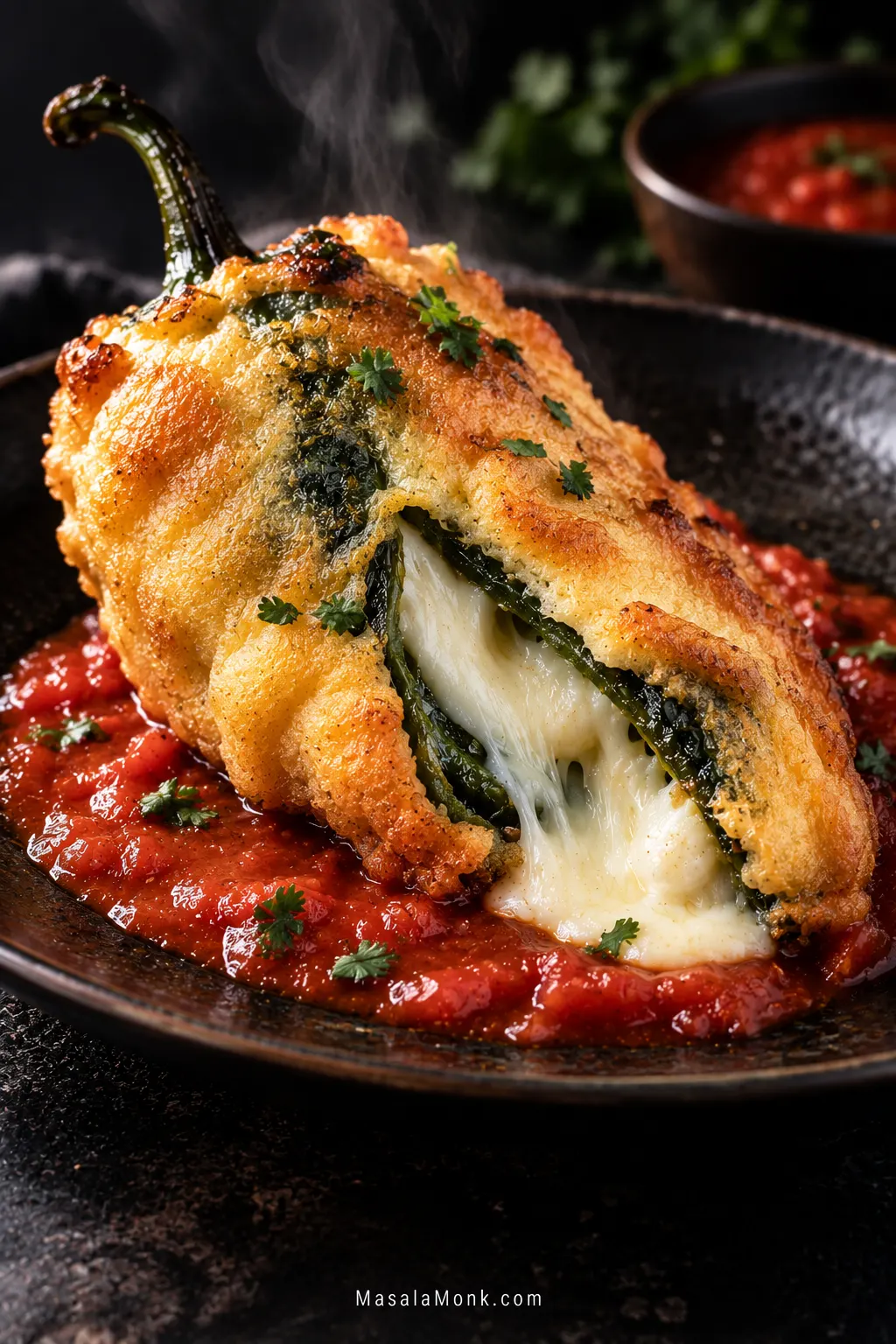
A good chile relleno should still taste like a poblano. Cut through the puffed golden coating and you should find a smoky, tender chile wrapped around molten cheese, with warm tomato sauce underneath. The pepper stays present, the cheese melts into it, and the coating is light enough that neither one disappears.
This chiles rellenos recipe follows a familiar egg-battered style: roasted and peeled poblano peppers stuffed with cheese, coated in fluffy whipped egg and fried until golden. Chile relleno simply means “stuffed chile,” and there is no single universal version; Mexican regional and household traditions use different chiles, fillings, sauces and coatings. Not every stuffed poblano is prepared this way either—many are simply filled and baked.
The egg-battered version has several moving parts, but the method gets much easier once they happen in the right order. The timing-sensitive part is the final stretch, when the whipped egg coating and hot oil come together.
Quick Answer: How Do You Make Chiles Rellenos?
Roast and peel poblanos, make a short slit and fill them with melting cheese. Lightly flour each stuffed chile, coat it in whipped egg and fry around 365°F / 185°C until puffed and golden, about 2–3 minutes per side. Serve with warm tomato-ranchero sauce.
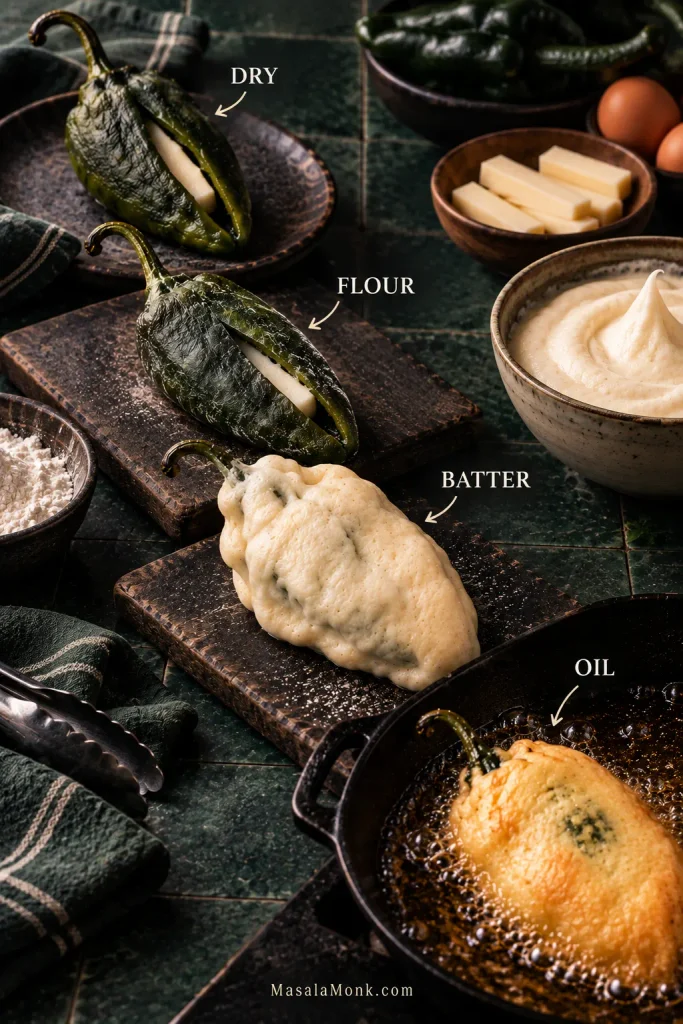
For 6 poblanos, use 4 eggs and start with about 1½ oz / 40–45 g cheese per pepper. Have the sauce, flour, rack and hot oil ready before whipping the eggs: Dry → Flour → Batter → Oil.
Make It Now: Chiles Rellenos Recipe
Roasted poblanos stuffed with melting cheese, coated in whipped egg and fried until puffed and golden, with a warm tomato-ranchero sauce.
Planning note: Most of the prep can be done ahead. Whip the eggs and fry the rellenos close to serving.
Useful tools: blender, electric hand mixer or stand mixer, frying thermometer, tongs, wide heavy skillet, wide flexible or fish spatula, rimmed baking sheet, wire rack and wooden toothpicks only if needed.
Ingredients for the Chiles Rellenos
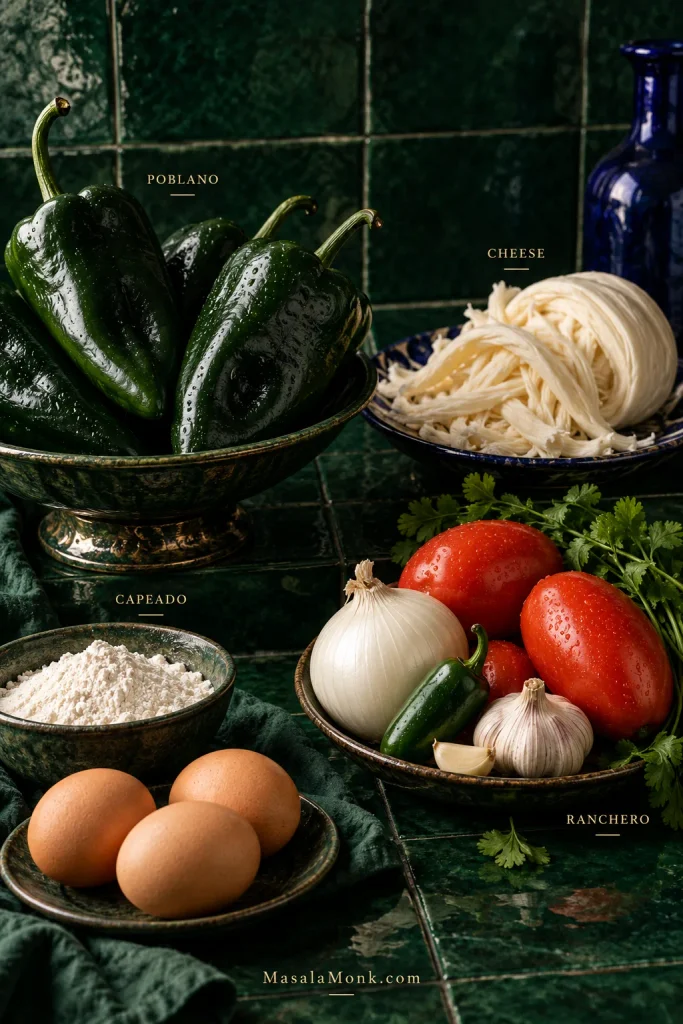
- 6 medium-large poblano peppers, about 1½–2 lb / 700–900 g total
- 9–12 oz / 255–340 g Oaxaca, Chihuahua, Asadero or Monterey Jack cheese, depending on the size and shape of the poblanos
- 4 large eggs, separated
- ½ cup / 60 g all-purpose flour, plus a little more if needed
- ½ teaspoon fine salt
- ⅛ teaspoon cream of tartar, optional
- Neutral high-heat frying oil such as vegetable, canola or avocado oil, enough for about ¾ inch / 2 cm depth in your skillet
For the Tomato-Ranchero Sauce
- 1½ lb / 680 g ripe Roma tomatoes, halved lengthwise
- ½ medium white onion, about 3½ oz / 100 g, cut into thick wedges
- 2 garlic cloves, left unpeeled for roasting
- 1 jalapeño, or about ½ serrano, adjusted to taste; use less or omit for a mild sauce
- ½ cup / 120 ml low-sodium vegetable broth, plus more if needed; chicken broth also works if the dish does not need to stay vegetarian
- 1 tablespoon / 15 ml olive or neutral oil
- ½ teaspoon dried Mexican oregano
- ¾ teaspoon fine salt, plus more to taste
Method
1. Make the tomato-ranchero sauce.
Arrange the tomato halves cut-side down on a rimmed baking sheet with the onion wedges, unpeeled garlic and jalapeño or serrano. Broil until the tomato skins blister and begin to blacken and the onion develops browned edges, about 8–12 minutes. Pull the garlic or fresh chile earlier if either is getting very dark.
Peel the roasted garlic and remove the stem from the chile. Blend everything with the broth, oregano and salt until smooth or slightly textured.
Heat 1 tablespoon / 15 ml oil in a saucepan and carefully pour in the blended sauce. Simmer for 8–12 minutes. The raw tomato smell will mellow and the sauce will deepen in color. It is ready when it lightly coats a spoon but still runs when the spoon is tilted. Add a splash of broth if it gets too thick.
You should have about 2½ cups / 600 ml. Keep it warm over very low heat or reheat it shortly before serving.
2. Blister the poblano skins.
Put the poblanos under a hot broiler and turn them with tongs as each exposed surface blisters and blackens, usually about 6–10 minutes total.
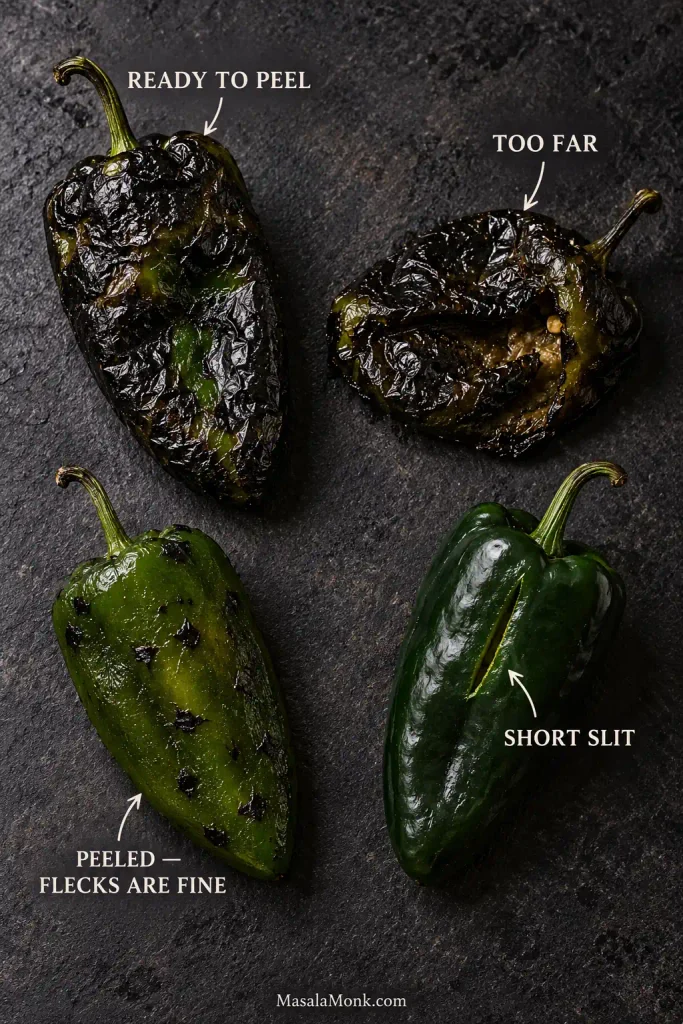
Lift one by the stem. It should smell smoky and bend without collapsing against the tray. Stop there: blistered enough to peel, sturdy enough to stuff.
A gas flame or hot grill works too. Turn the poblanos until the skin blisters all over, stopping before the flesh underneath becomes limp.
3. Steam and peel.
Transfer the hot poblanos to a heatproof bowl and cover for about 10 minutes. Rub away the loosened skin once they are cool enough to handle.
A few stubborn flecks of char are a better outcome than a perfectly clean pepper with a hole in it. The peppers do not need to look identical; they need to stay intact.
4. Make a short slit and remove the center.
Make the smallest practical slit down one side of each poblano—about 2 inches / 5 cm is often enough—and keep the stem intact. Lift or snip out the central seed cluster and any pale internal rib tissue that comes away easily.
Don’t scrape for perfection. Keeping the pepper intact matters more.
5. Add the cheese.
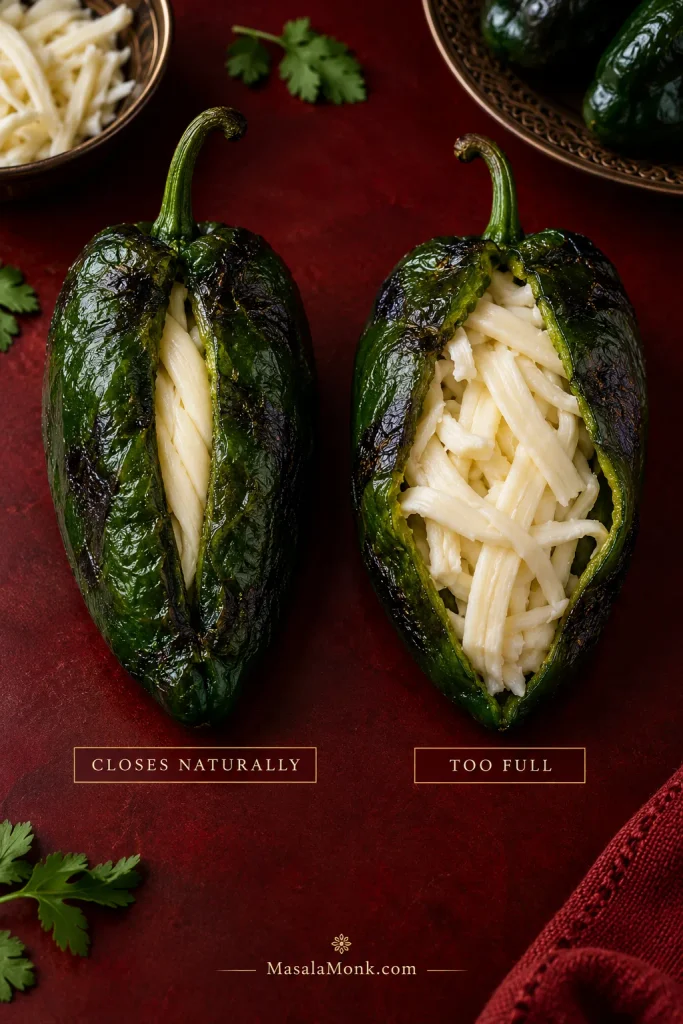
Start with about 1½ oz / 40–45 g cheese in each average poblano, preferably as a thick strip or compact bundle. A particularly roomy chile may comfortably take closer to 2 oz / 55 g.
Bring the cut edges together. If the cheese holds them apart, take some back out. One or two toothpicks are fine when needed, but they should be backup rather than architecture.
6. Set up the frying station.
Put the flour in a shallow dish and set a wire rack over a rimmed baking sheet beside the stove. Pour enough oil into a wide heavy skillet to reach about ¾ inch / 2 cm deep and heat it toward 365°F / 185°C.
This is a shallow-fry-and-baste method, so the chile does not need to be submerged. Leave plenty of headroom in the pan and have the peppers, flour, spatula and rack within reach before you start on the eggs.
7. Whip the egg coating.
Beat the egg whites in a completely clean, dry bowl with the optional cream of tartar until they form glossy peaks that stand upright and remain smooth. An electric hand mixer often takes about 3–5 minutes, though the peaks matter more than the clock.
Lightly stir the yolks to loosen them, then fold them into the whites with the salt. A few streaks are fine. Stop while the foam is full and airy.
8. Flour, batter and fry seam-side up.
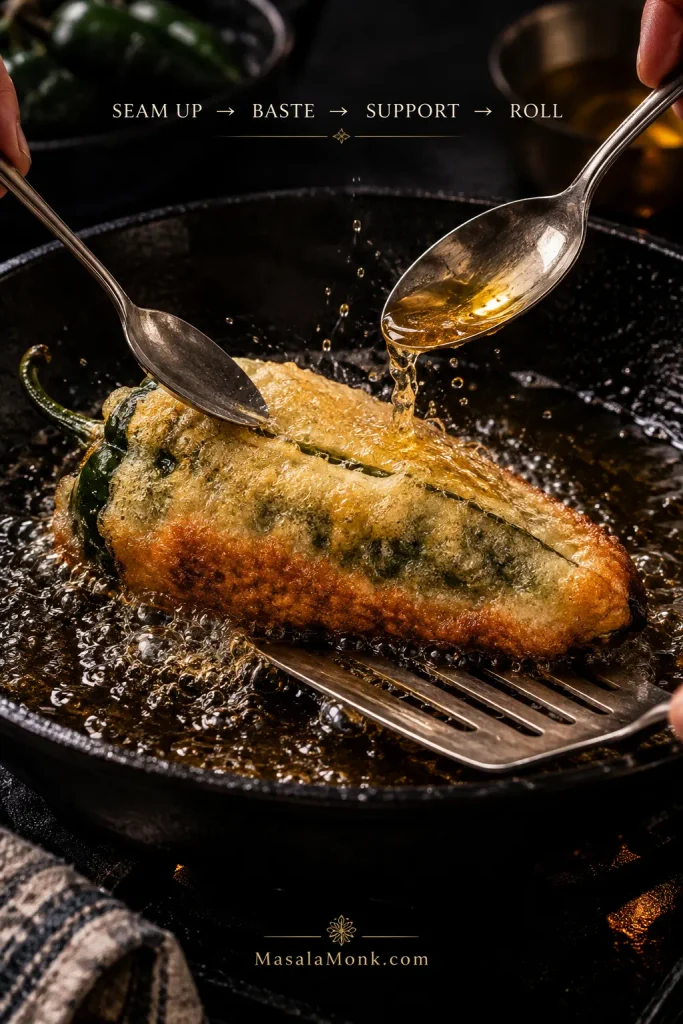
Pat one stuffed poblano dry, coat it lightly in flour and shake away the excess. Cover it generously in the egg mixture and move it straight to the hot oil with the slit facing upward.
Spoon hot oil over the exposed coating. It should begin sizzling and swelling almost immediately. When the underside is golden, slide a wide spatula underneath, steady the chile from above with a spoon or second utensil and roll it over.
Fry for about 2–3 minutes per side, keeping the oil within roughly 350–375°F / 175–190°C.
9. Drain and serve.
Move the relleno to the wire rack and let the oil recover before adding another. One or two at a time is plenty in most home skillets.
For a short hold, keep finished rellenos on their rack in a 200°F / 95°C oven. Spoon warm tomato-ranchero sauce onto the plate just before serving and set the chile over it. Remove every toothpick.
Golden outside, cheese still firm? Give the relleno 5–10 minutes in a 350°F / 175°C oven instead of leaving an already-browned coating in the oil.
The Details That Make Chiles Rellenos Work
The recipe above is enough to cook from. The sections below explain the decisions that make the peppers easier to peel, fill, coat and fry—and what to do when one does not cooperate.
Peppers & Filling
- Choosing Poblanos and Cheese
- Anaheim and Hatch-Grown New Mexican Chiles
- Preparing Poblanos Without Tearing
- Why the Small Slit Matters
Batter & Frying
Something Went Wrong?
Serving & Planning
Start with the peppers themselves. Their shape and how far they are roasted affect almost everything that follows.
Choosing Poblanos and Cheese for Chile Rellenos
Start With Poblanos That Are Easy to Stuff
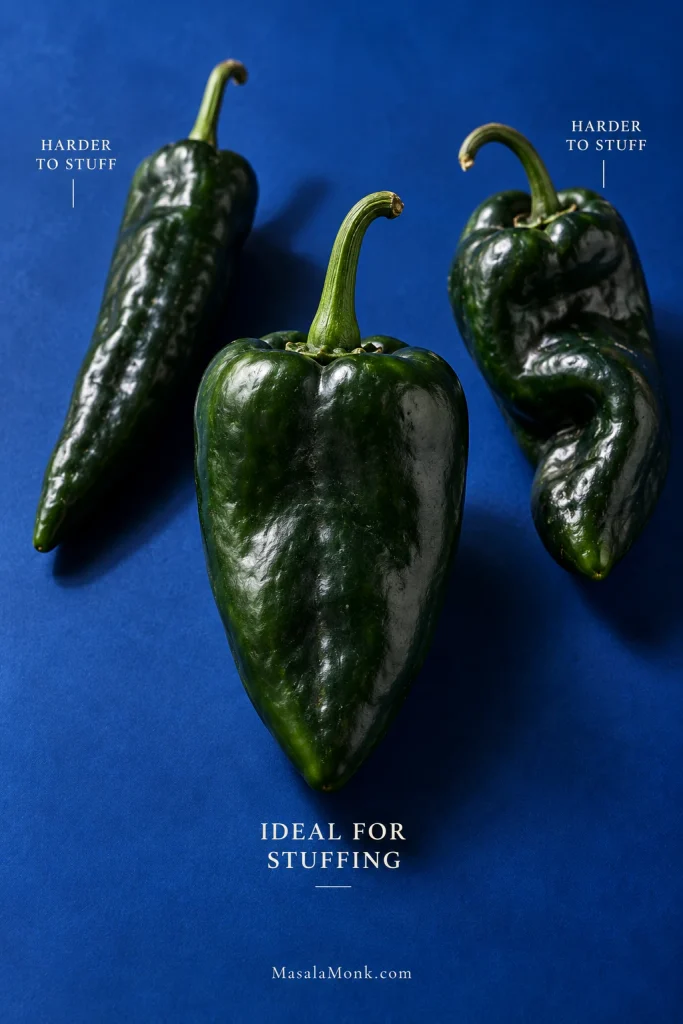
Look for broad, firm, fairly straight poblanos with taut skin and intact stems. A rounded cavity gives the cheese somewhere to sit; a flattened or sharply twisted pepper gives you much less room.
The stem becomes useful once the pepper is hot, slippery and partially peeled, so avoid peppers with broken or badly damaged tops when you have a choice.
Poblano heat can vary surprisingly from pepper to pepper. Much of the pungency is concentrated around the pale placental and rib tissue rather than in the seeds themselves. The New Mexico State University chile guide explains that distinction in more detail. Remove what comes away easily. There’s no prize for scraping a roasted chile until it tears.
Poblano vs Anaheim and Hatch-Grown New Mexican Chiles
Poblanos are broad and convenient for cheese-filled rellenos. Anaheim is a New Mexican-type chile with a longer, narrower shape. “Hatch chile” is not one single cultivar; the name is used for New Mexican-type chiles grown in the Hatch region of New Mexico.
Those longer chiles make narrower rellenos, so use a slimmer piece of cheese rather than trying to force the same amount inside.
Best Cheese for Chiles Rellenos
Use Oaxaca if you can get it. Monterey Jack is the easy fallback.
Both melt smoothly and give this style its molten center. Other cheeses are useful when you want more richness, more stretch or a firmer filling.
| Cheese | Melt | Flavor | Why use it |
|---|---|---|---|
| Oaxaca | Excellent, stretchy | Mild, milky | Molten, stretchy center |
| Chihuahua | Excellent | Buttery, mild | Rich, smooth melt |
| Asadero | Excellent | Mild | Soft, even melting |
| Monterey Jack | Excellent | Mild | Easy to find and handle |
| Low-moisture mozzarella | Very good, stretchy | Neutral | Useful fallback |
| Queso fresco | Minimal; softens more than it melts | Milky, salty | Firmer, less molten center |
How Much Cheese Goes in Each Pepper?
About 1½ oz / 40–45 g is a good starting point for an average medium-large poblano. A very roomy chile may hold closer to 2 oz / 55 g.
The closure tells you more than the scale. If the cheese forces the slit open, remove some. Leaving room inside keeps more roasted poblano wrapped around the filling and gives the melting cheese less opportunity to escape into the pan.
Thick strips or compact pieces are easier to contain than loose shreds.
How to Prepare Poblanos Without Tearing Them
The aim is to blister the skin before the flesh underneath becomes floppy.
Under a hot broiler, the pepper should blacken in patches, smell roasted and bend when lifted. If it slumps flat or starts splitting under its own weight, it has gone farther than you wanted.
Cover the hot poblanos for about 10 minutes. Steam loosens the blistered skin, after which you can rub away whatever comes off willingly.
Peel the skin; do not excavate the pepper. One poblano may peel almost clean while another keeps a few black flecks. That’s fine.
Dry peeling avoids adding more moisture before flouring. If a quick rinse helps with stubborn skin or loose seeds, use one and dry the pepper well afterward.
Keep the Slit Short
A slit of about 2 inches / 5 cm is often enough to remove the center and slide in the cheese.
A longer slit leaves the pepper with less support. Keep the opening small and you keep more roasted poblano wrapped around the molten cheese, the edges meet more naturally, and there is less room for the filling to escape.
Once the peppers are stuffed and closing comfortably, the fussiest part is behind you.
How to Make Fluffy Chile Relleno Capeado
For this egg-battered style, capeado is made from separated eggs: the whites are whipped until glossy and firm, then the yolks are folded back in. Fresh, well-aerated foam puffs around the poblano in the oil and gives you a light golden jacket with fragile crisp edges rather than an omelette-like skin.
Whip the Whites Until They Look Glossy
Start with a clean, dry bowl and clean beaters. A little yolk or grease can keep the whites from building volume.
Beat until the peaks stand upright and look smooth and glossy. Dry, grainy clumps mean you’ve gone too far.
| Stage | What you see | What it tells you |
|---|---|---|
| Underwhipped | Loose foam, droopy peaks | Not enough body to coat the chile well |
| Ready | Glossy, upright, smooth peaks | Enough structure while keeping the air |
| Overwhipped | Dry, grainy or clumpy whites | Difficult to fold without breaking down |
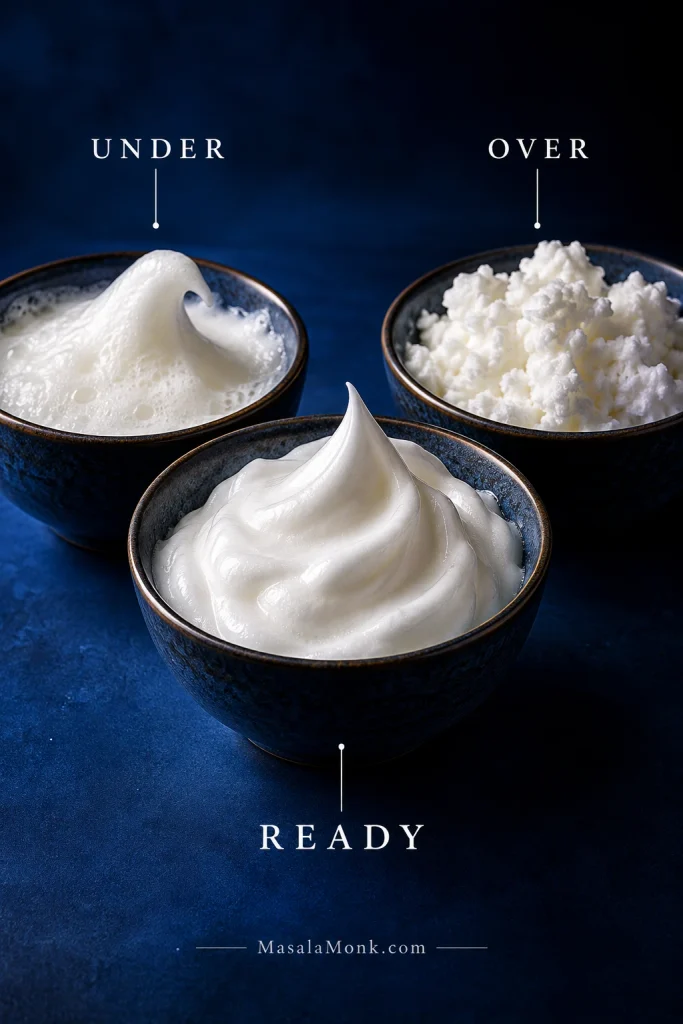
Cream of tartar is optional. About ⅛ teaspoon for 4 whites gives the foam a little extra stability.
Fold in the Yolks and Keep Moving
Fold the yolks and salt into the whites just until they are distributed. A few streaks don’t matter.
Time does. The bowl slowly loses volume as it sits, which is why the first relleno can come out beautifully puffed while the last looks flatter. Have the peppers, flour, rack and oil ready before the mixer goes on.
Making a larger batch? Whip the coating twice instead of asking one bowl of foam to wait beside the stove.
Flour Should Be Barely Visible
Pat the stuffed chile dry, roll it lightly in flour and shake away the loose coating. The flour absorbs surface moisture and gives the egg something to grip.
Dry → Flour → Batter → Oil.
How to Fry Chiles Rellenos Without Losing the Coating
Keep the Oil Around 365°F / 185°C
At around 365°F / 185°C, the egg starts puffing before it has time to sit in the oil and turn heavy. Below about 350°F / 175°C, the coating takes longer to set. Much above 375°F / 190°C, it can darken before the cheese is hot.
The pan will tell you too. Fresh batter should sizzle and begin swelling around the edges soon after it touches the oil. Wet and quiet means wait.
Start Seam-Side Up
The slit is the weakest side, so lower the chile with the opening upward and spoon hot oil over the exposed coating while the bottom sets.
The first flip is the awkward moment. Get a spatula well underneath, steady the top and roll the relleno over. Take it slowly.
Once the first relleno has puffed, browned and made it through the flip intact, the rest of the batch is mostly repetition.
What a Good Chile Relleno Should Be Like
Cut into one while it is hot. The poblano should taste roasted, the cheese should have softened into the cavity, and the capeado should be puffy and golden with a thin crisp edge.
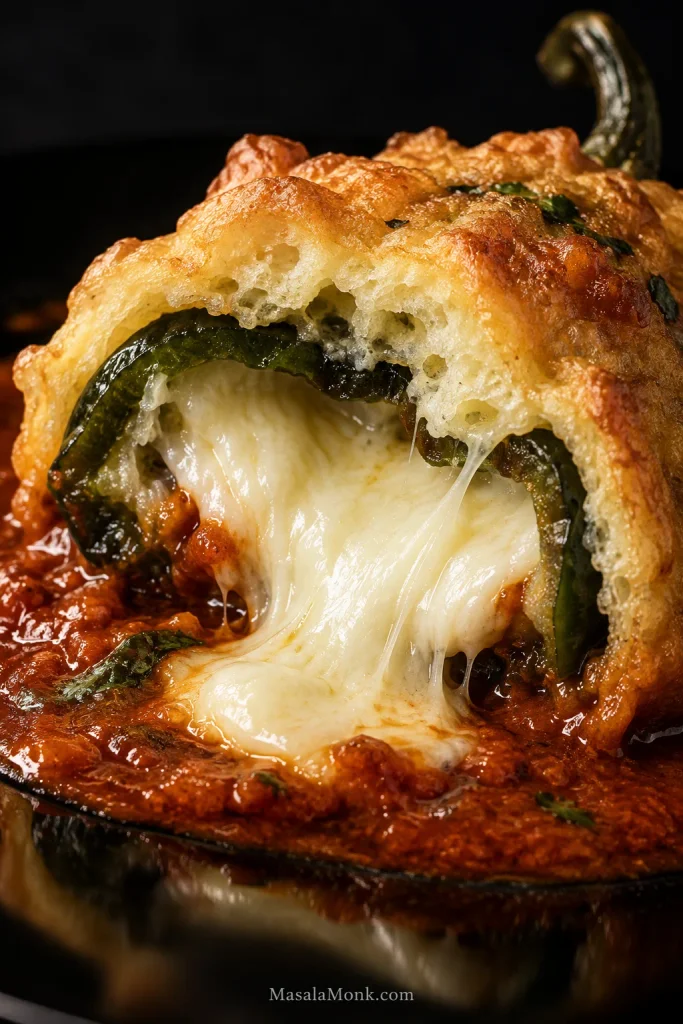
Then comes the first forkful: hot tomato sauce, that fragile fried edge, smoky poblano and melted cheese together. That first forkful is the payoff.
Fix My Chiles Rellenos
If something goes sideways, start here. One torn pepper or patchy coating does not mean the batch is ruined.
Pepper & Filling Problems
| Problem | Likely reason | What to do |
|---|---|---|
| Poblano falls apart while peeling | The flesh cooked too deeply | Blister faster next time and stop while the chile still holds its shape. Review poblano preparation → |
| Skin will not come off | Not enough blistering or steaming | Blister more of the surface and steam covered for about 10 minutes. |
| Chile tears while removing the center | The opening is too large or the flesh is being pulled | Use a shorter slit and remove only what comes away without force. Review poblano preparation → |
| Pepper will not close | Too much cheese | Take some filling out. Check cheese amount → |
| Cheese leaks into the oil | Too much filling or too large an opening | Use less cheese and keep the slit short. Check cheese amount → |
Batter & Frying Problems
| Problem | Likely reason | What to do |
|---|---|---|
| Egg whites will not whip | Yolk, grease or moisture in the bowl | Start again with clean, dry equipment and cleanly separated eggs. |
| Whites look dry and grainy | Overwhipped | Stop earlier, while the peaks are glossy. Compare the egg-white stages → |
| Batter becomes watery | The foam sat too long or was overworked | Make it later and fold less. Compare the egg-white stages → |
| First rellenos look better than the last | The foam is losing volume | Work steadily or whip a fresh second batch. |
| Batter slides off | The chile is wet, has too little flour, or sat too long after coating | Dry, flour lightly and go straight from batter to oil. Review the coating sequence → |
| Coating tears during the flip | The exposed coating was still wet when the chile was turned | Start seam-side up and baste the exposed coating before turning. Return to the frying and flip technique → |
| Sides stay pale | They are above the oil | Spoon hot oil over them while the first side fries. |
| Relleno feels greasy | Cool oil or a crowded pan | Let the oil recover and fry fewer at once. |
| Outside darkens before cheese melts | Oil too hot or filling very cold | Lower the heat and finish the golden relleno briefly in the oven. |
| Bottom gets soggy | Oil or steam is trapped underneath | Drain on a wire rack. |
| Coating softens after saucing | It has been sitting in liquid | Sauce at the last moment. |
Small tear? Dry and flour the damaged spot and handle it as little as possible. Very floppy pepper? A brief chill can firm the cheese and make the chile easier to move.
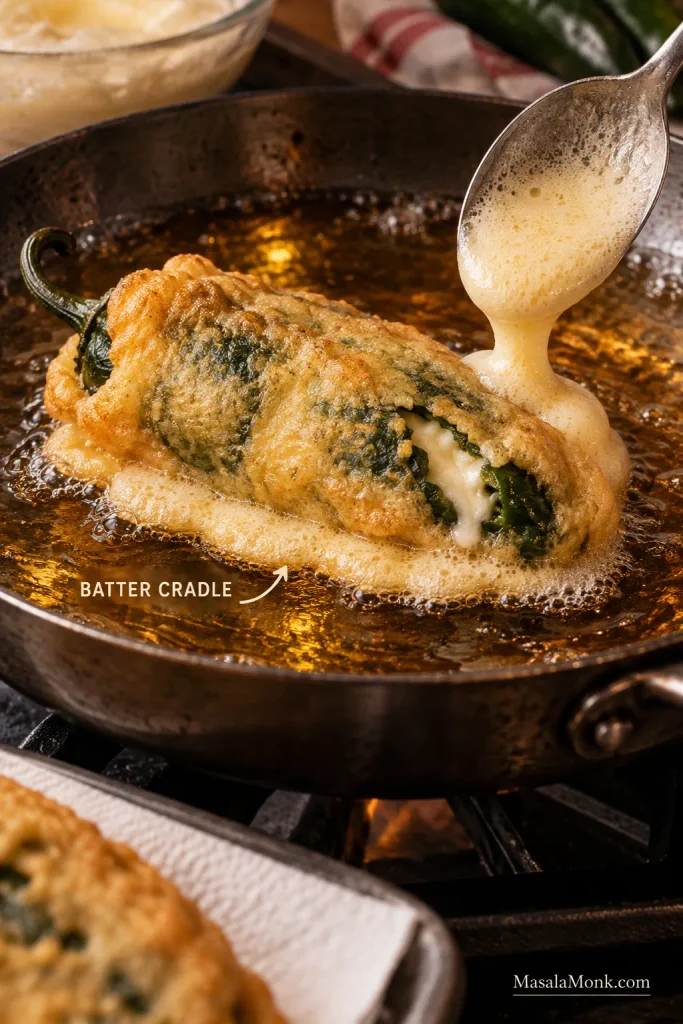
If One Pepper Refuses to Hold Its Batter
Spoon a small puddle of batter into the hot oil where the chile will land, set the pepper on it and add a little more batter around the weak spot. The batter sets into a small cradle underneath, making the chile easier to turn.
This is a rescue, not the standard method.
Jump to Recipe · Back to Frying Technique · Back to Top ↑
Chile Relleno Sauce and the Best Way to Serve It
Once the frying is done, stop fussing with the peppers. Eat them while the coating still has life in it.
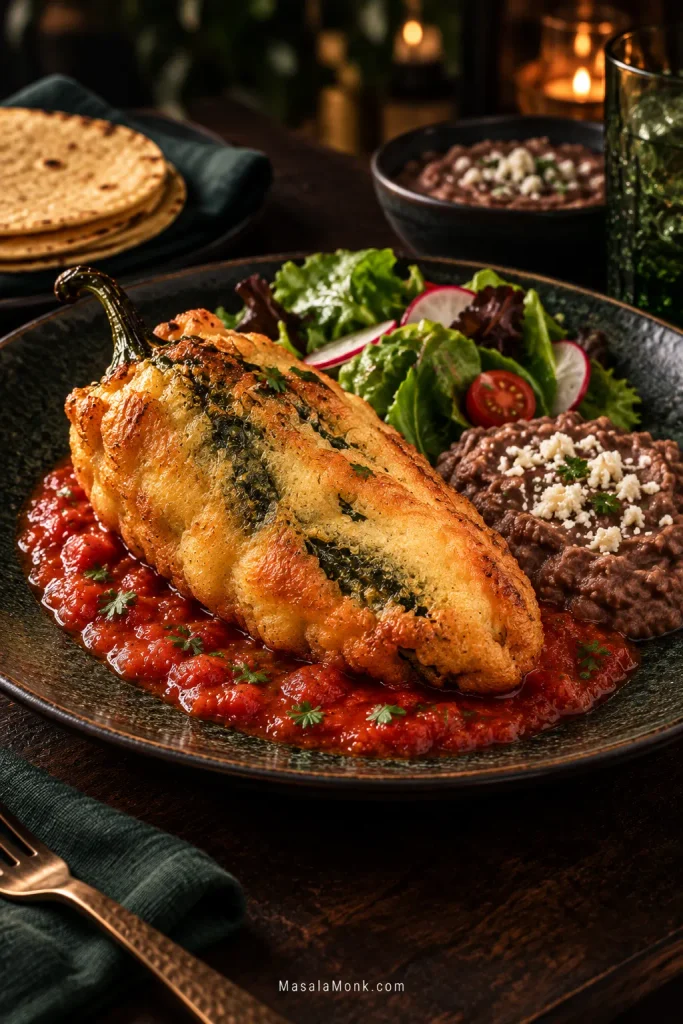
The tomato-ranchero sauce in this recipe is loose enough to spread under the chile. Some rellenos are served with a thinner tomato broth, often called caldillo; others come with green sauce or no sauce at all.
If you want something brighter and tangier, roasted salsa verde works well at the table.
Put the Sauce Down at the Last Moment
Spoon warm sauce onto the plate and set the relleno over it, or add a little over the top just before eating. The first cut gets hot tomato sauce while the fried edge still has some crispness.
What to Serve With Chiles Rellenos
Mexican rice, refried beans, warm corn tortillas or a crisp lime-dressed salad all make sense here. One substantial side and something fresh is usually enough.
Warm homemade corn tortillas are especially good for catching the sauce, cheese and bits of roasted poblano left on the plate.
How to Make Chiles Rellenos Ahead
This recipe is much calmer when most of the work happens before frying time.
Up to 3 days ahead: make the tomato-ranchero sauce and refrigerate it covered. Reheat over low heat with a splash of broth if it has thickened.
Up to 1 day ahead: once the roasted poblanos are cool, peel, seed and stuff them, then refrigerate covered.
When dinner is close, take the stuffed peppers out while you set up the frying station so they are not going into the oil refrigerator-cold. Get the flour and rack out, warm the sauce and bring the oil to temperature. Whip the eggs last.
Homemade refried beans can be made ahead too, leaving very little to do once the skillet comes out.
Ready to cook? Jump to the Recipe Card →
How to Store and Reheat Chiles Rellenos
Refrigerate leftovers within 2 hours and use them within 3–4 days. Store extra sauce separately when possible. For broader refrigerator and freezer guidance, see the FoodSafety.gov cold-food storage chart.
Reheat rellenos in a 350°F / 175°C oven for about 10–15 minutes, until hot through; leftovers should reach 165°F / 74°C in the center. A toaster oven is handy for one or two.
The microwave melts the cheese quickly but turns the capeado soft.
Cooked rellenos can be frozen, but the roasted pepper and egg coating soften noticeably after thawing. Refrigeration preserves the original texture better.
Useful Chile Relleno Variations
Baked or Air-Fried Chiles Rellenos
Baked and air-fried versions need their own coating strategy. This wet whipped-egg capeado relies on hot oil for support as it sets, so moving the same battered pepper directly into an oven or air fryer will not give you the same shell.
Chile Relleno Casserole
If you want roasted chile and melted cheese without stuffing and frying individual peppers, Chile Relleno Casserole is the much easier branch of the family.
Different Fillings
Queso fresco gives you a firmer center. Picadillo, shredded chicken, beef and chorizo are other familiar directions. Meat fillings should be fully cooked and fairly dry before stuffing; the brief fry is for setting the coating and heating the center, not safely cooking raw meat.
For a Harder Crunch
Use a beer-and-flour batter or breadcrumb-style coating if you want a rigid crunchy shell. Frying the whipped-egg version longer only makes it darker.
Once the small decisions are out of the way, chile rellenos stop feeling mysterious. Cut into one while it is hot and you get the reason for doing the extra work: smoky poblano, molten cheese, airy golden capeado and warm tomato sauce in the same forkful.








