
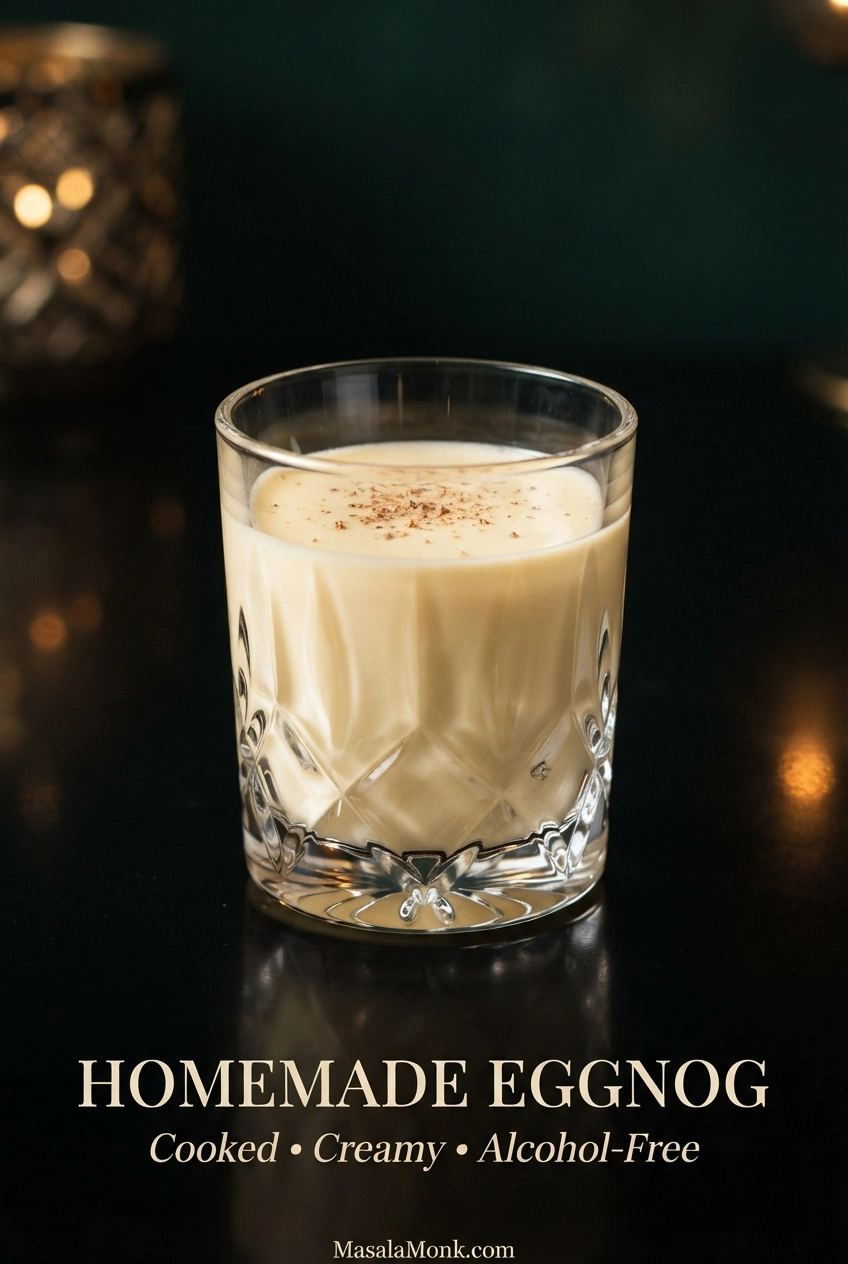
Not all eggnog is thick, foamy, or intensely sweet. This homemade eggnog recipe makes a smooth, cooked custard-style drink with vanilla, cream, and nutmeg. It’s rich enough for a small Christmas treat but still pours easily from a pitcher.
Six egg yolks, whole milk, heavy cream and sugar create the custard base. Unlike frothy versions made with whipped egg whites, this one thickens as the yolks cook. The mixture reaches 160°F (71°C), and the base remains alcohol-free. Adults can add rum, bourbon or brandy to individual glasses.
Allow about 25 minutes for preparation and cooking, followed by cooling and chilling. The method comes down to two things: keep the custard moving over gentle heat and use a thermometer to know when it’s done. The refrigerator gives it its final creamy texture.
Ready to make it? Jump straight to the homemade eggnog recipe, or use the guide below to find cooking tips, texture fixes, variations, and storage advice.
Homemade Eggnog Guide
- Ingredients and Instructions
- What Makes Eggnog Creamy?
- Cooking Eggnog Without Scrambling
- Fixing Eggnog Texture Problems
- Variations and Batch Sizes
- Serving, Make-Ahead and Storage
- Common Questions
Homemade Eggnog Recipe: Ingredients and Instructions
| Prep time | About 10 minutes |
| Cook time | About 15 minutes |
| Cooling and chilling | Ice-bath cooling, then approximately 4 hours refrigerated, or until thoroughly cold |
| Total time | About 4½–5 hours, depending on cooling and chilling |
| Estimated yield | About 3½ US cups |
| Servings | Approximately 6 small glasses |
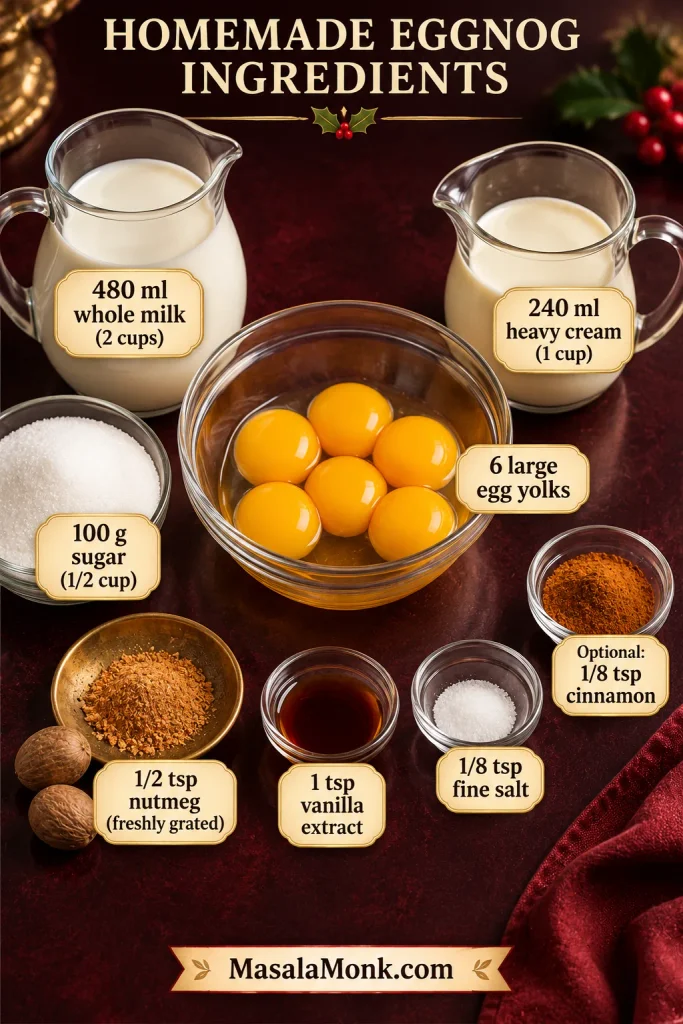
Ingredients for the Six-Yolk Eggnog Recipe
- 6 large egg yolks (approximately 100–110 g)
- ½ cup granulated sugar (100 g)
- 2 cups whole milk (480 ml / approximately 16 US fl oz)
- 1 cup heavy cream (240 ml / approximately 8 US fl oz)
- ½ teaspoon ground nutmeg, preferably freshly grated
- 1 teaspoon pure vanilla extract (5 ml)
- ⅛ teaspoon fine salt
- ⅛ teaspoon ground cinnamon, optional
Equipment: A heavy-bottomed saucepan holding about 2–3 quarts (2–3 litres), a roomy heatproof mixing bowl of approximately 2 litres or larger, a whisk, a heatproof silicone spatula, a food thermometer, and a fine-mesh sieve. You’ll also need a second bowl large enough to hold an ice-water bath.
How to Make Homemade Eggnog
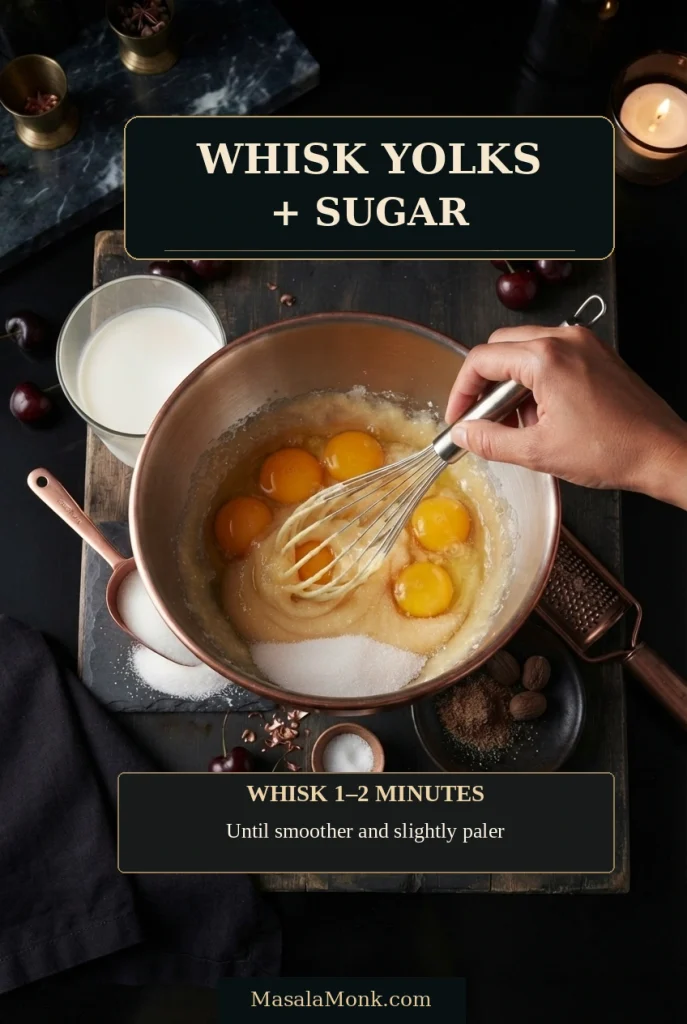
- Whisk the yolks and sugar. Add the egg yolks and sugar to the mixing bowl. Whisk for 1–2 minutes, until the mixture looks smooth, slightly paler, and falls slowly from the whisk.
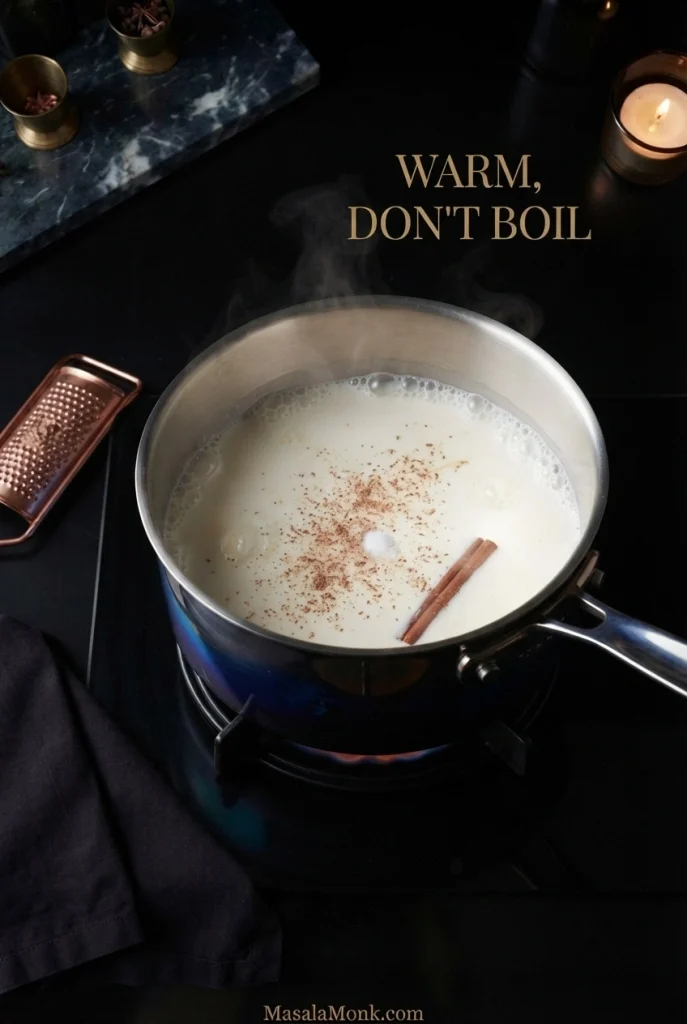
- Warm the milk and cream. Pour both into the saucepan. Add the nutmeg, salt, and optional ground cinnamon. Warm over medium-low heat, stirring occasionally, until gentle steam rises and tiny bubbles appear at the edge. The dairy should be hot but not boiling.
Temper and Cook the Eggnog
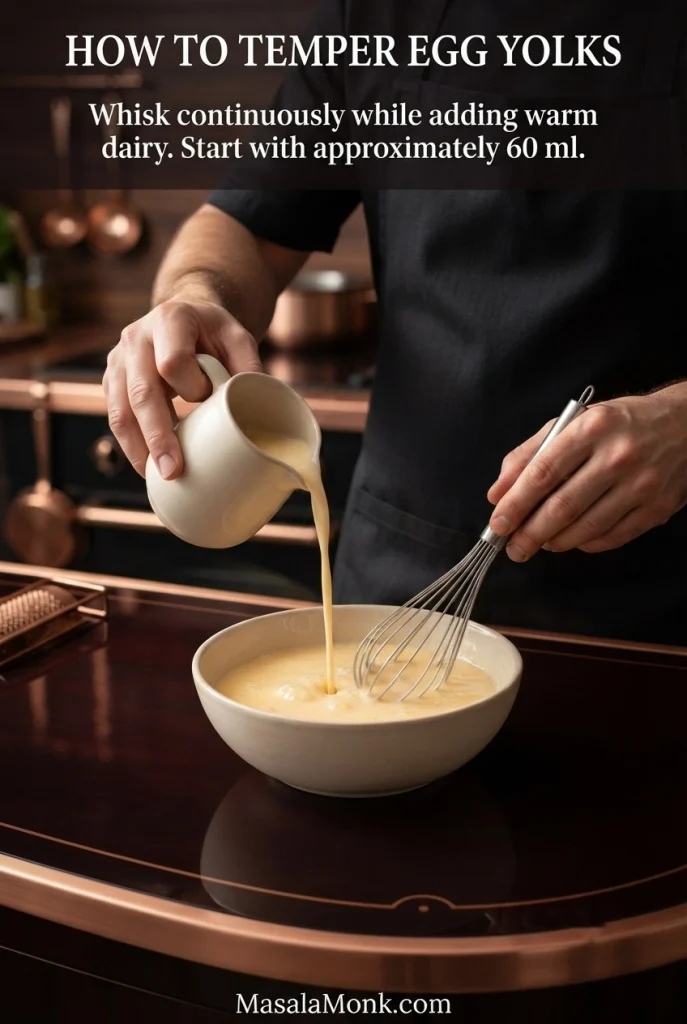
- Temper the yolks. Remove the saucepan from the heat. While whisking the yolks continuously, slowly add ¼ cup (60 ml) of the warm dairy. Repeat with another ¼ cup (60 ml), then gradually whisk in the rest. This gradual warming is called tempering: it helps the yolks combine with hot dairy without scrambling on contact.
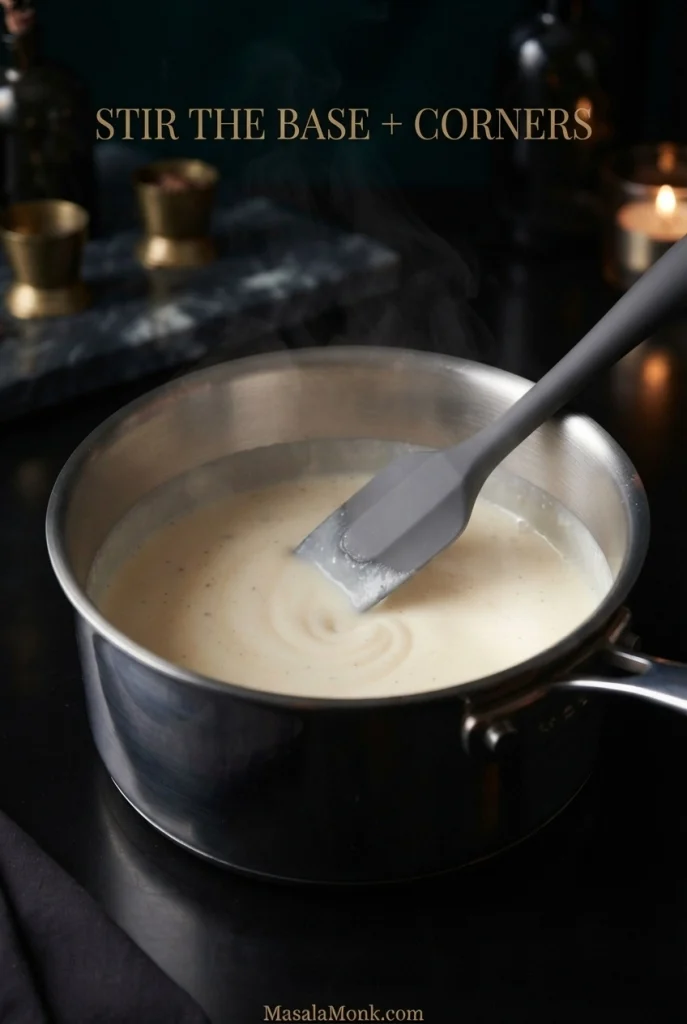
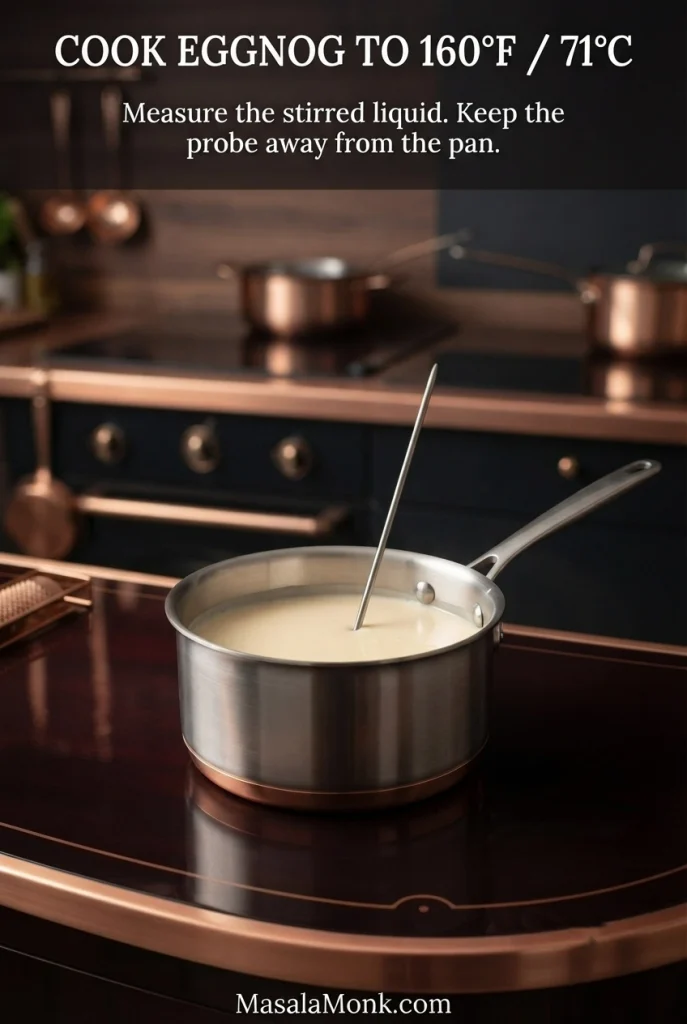
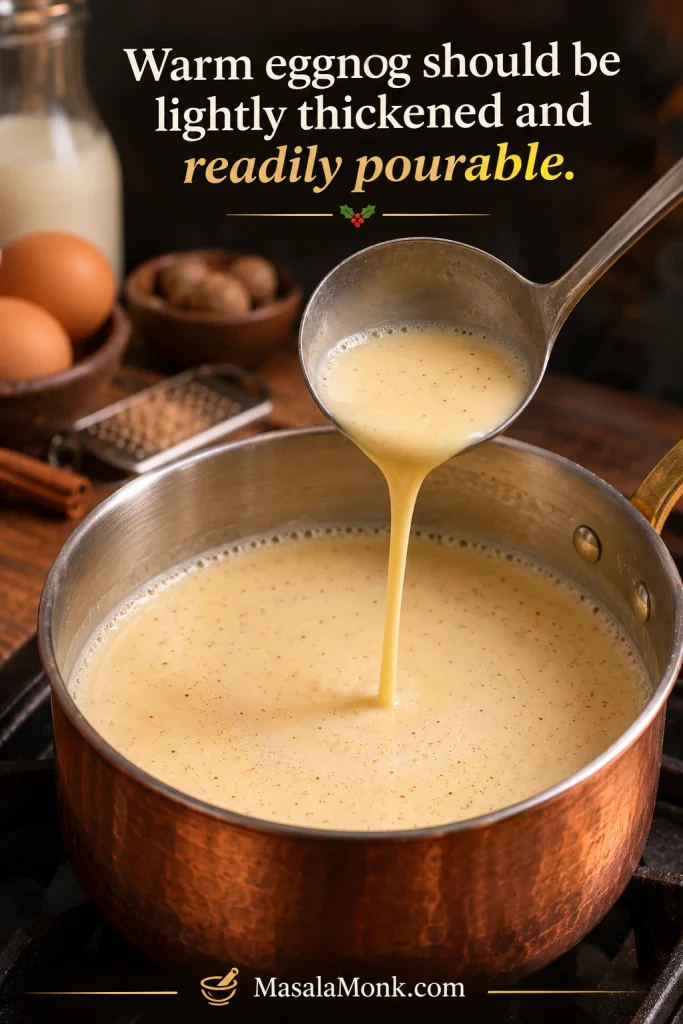
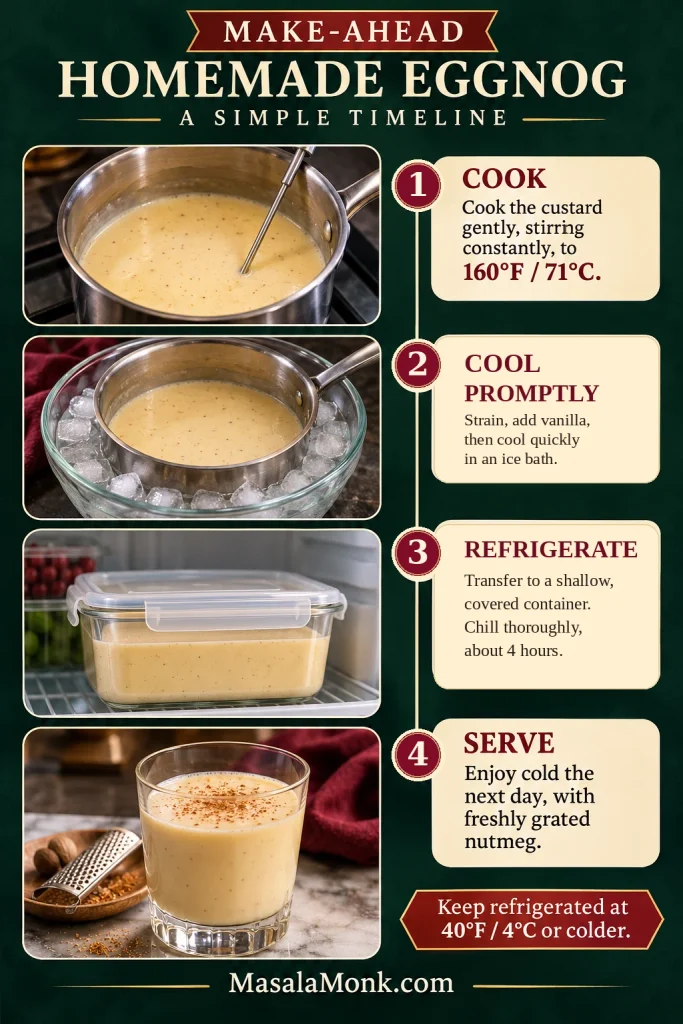
- Cook the custard. Pour the mixture back into the saucepan over low to medium-low heat. Stir constantly, sweeping the spatula across the base and into the corners. Measure the temperature in the well-stirred liquid, keeping the thermometer probe away from the metal. If the temperature rises quickly, lower the heat or briefly lift the pan off the burner. Remove the pan as soon as the eggnog reaches 160°F (71°C). It should be smooth, lightly thickened, and still easy to pour.
As the eggnog approaches 160°F (71°C), check the temperature more frequently. This thermometer image illustrates the cooking endpoint before straining.
Strain, Cool and Serve the Eggnog
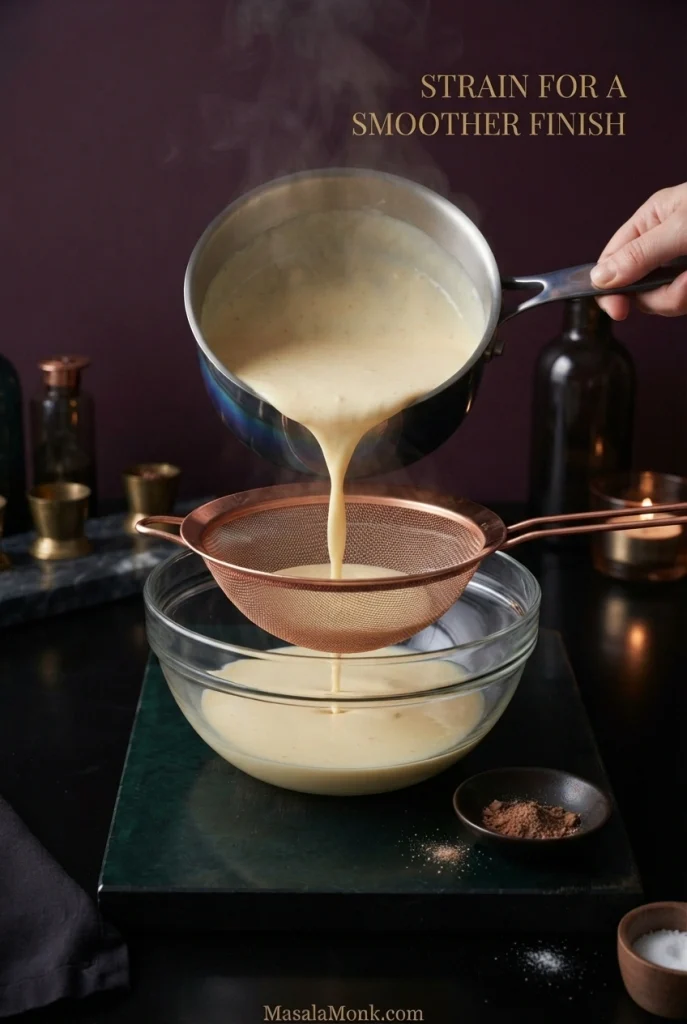
- Strain and add vanilla. Pour the hot eggnog through a fine-mesh sieve into a clean heatproof bowl. The sieve catches small cooked-egg particles and any larger spice fragments. Stir in the vanilla extract.
- Cool promptly. Place the bowl in an ice-water bath, keeping the water below its rim. Stir occasionally to help the eggnog lose heat. Divide it among clean, shallow food-safe containers and refrigerate promptly; it doesn’t need to reach room temperature first. Protect the containers from contamination as they cool, then cover securely for storage.
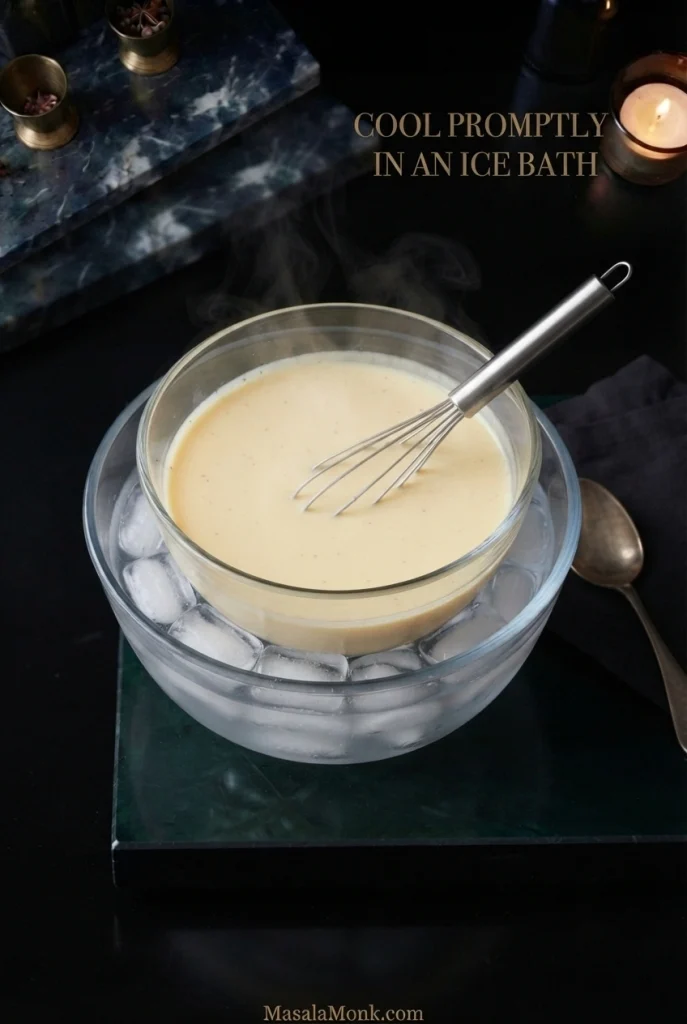
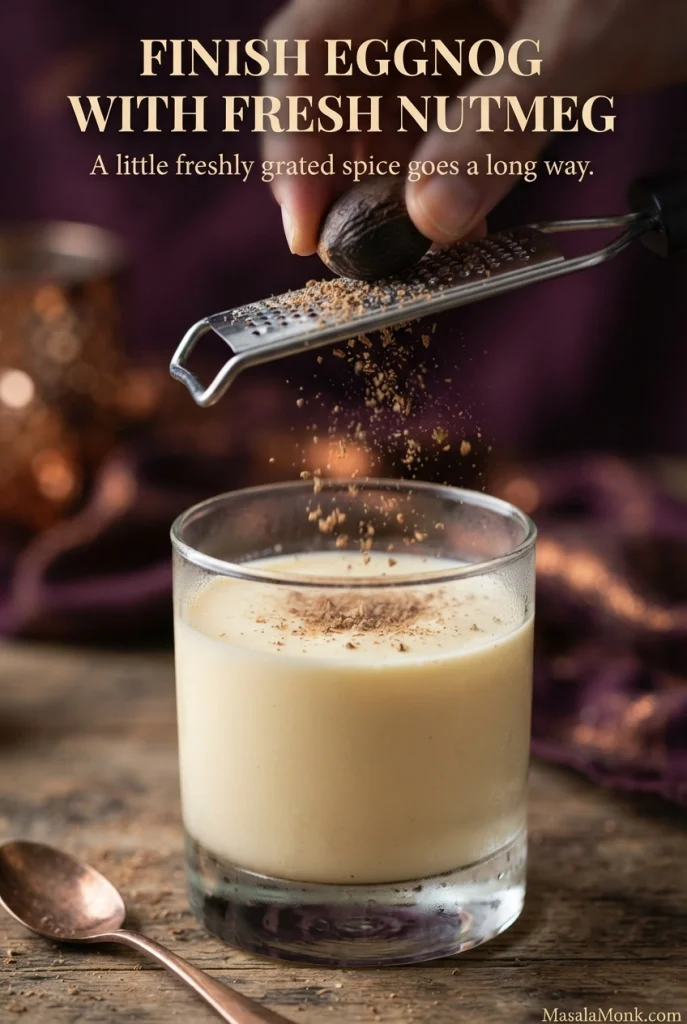
- Chill and serve. Refrigerate for approximately four hours, or until thoroughly cold. Stir gently, pour into small glasses, and finish with freshly grated nutmeg.
Once chilled, the finished drink should form a steady stream without piling up in the glass. If it seems unusually thick or grainy, use the eggnog troubleshooting guide to identify the cause.
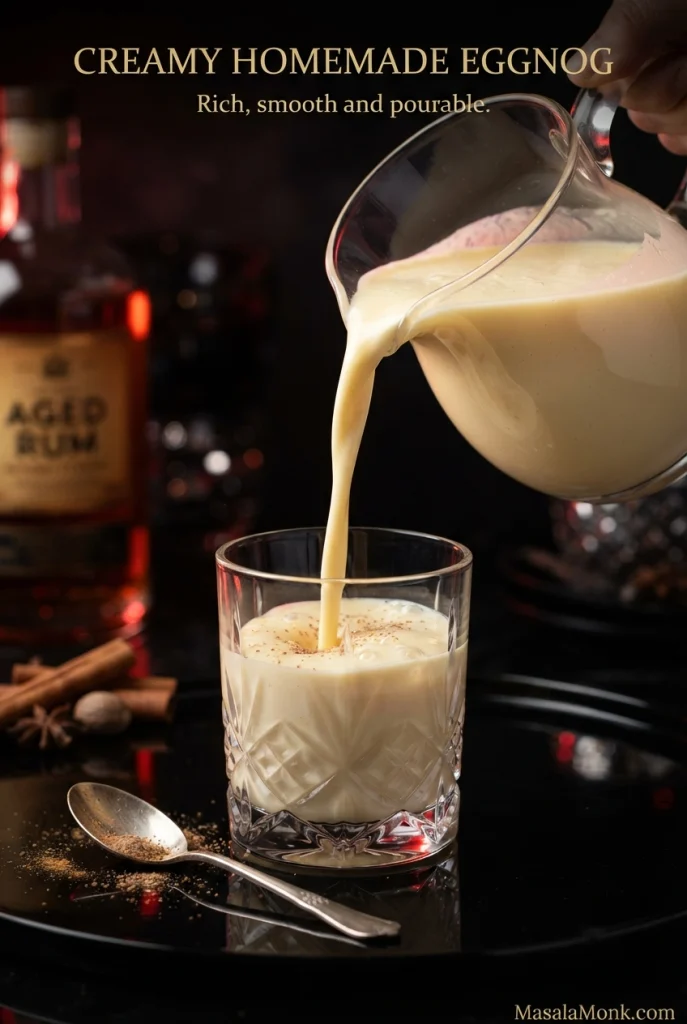
For a classic serving, fresh nutmeg is enough. If you’re offering eggnog as dessert, a small spoonful of homemade whipped cream makes a richer topping.
What Makes Homemade Eggnog Creamy?
How Egg Yolks Create the Custard Texture
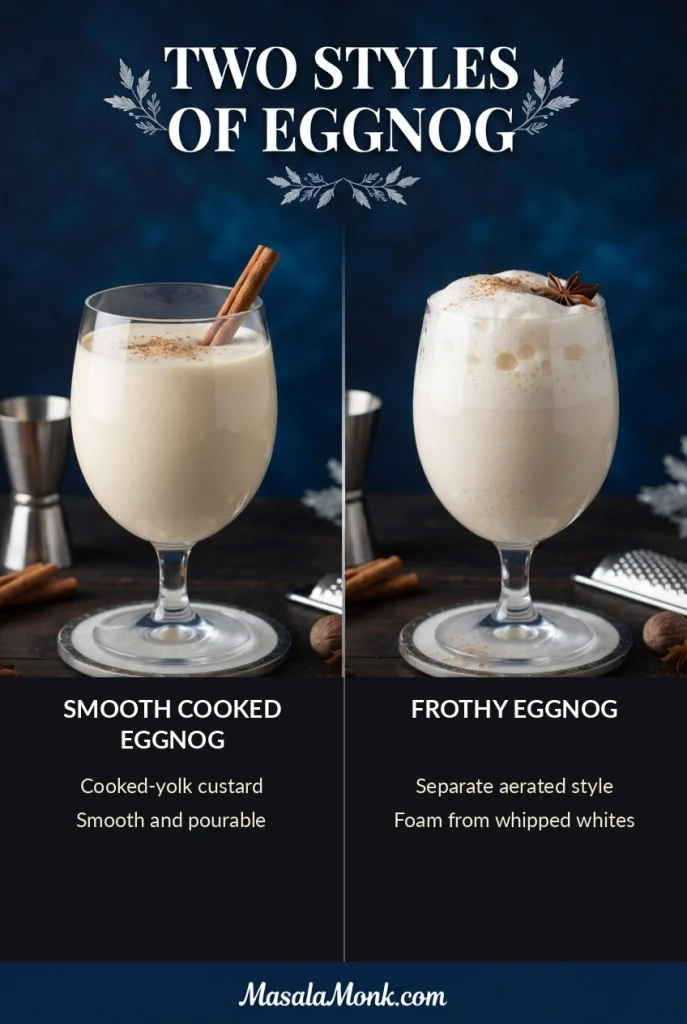
Egg yolks thicken milk and cream as they cook and help keep the mixture smooth. That gives this eggnog its custard-like body; recipes that incorporate whipped egg whites produce a lighter, frothier result.
You’ll have six egg whites left over. Use them for meringues or homemade pavlova, with its crisp shell and soft center. Refrigerate the whites promptly in a covered container and use within 2–4 days, or freeze them for later.
The Milk-to-Cream Ratio
Two parts whole milk to one part heavy cream give this eggnog enough richness for a small after-dinner glass without making it unnecessarily heavy. A version with more cream is better suited to smaller dessert-style portions.
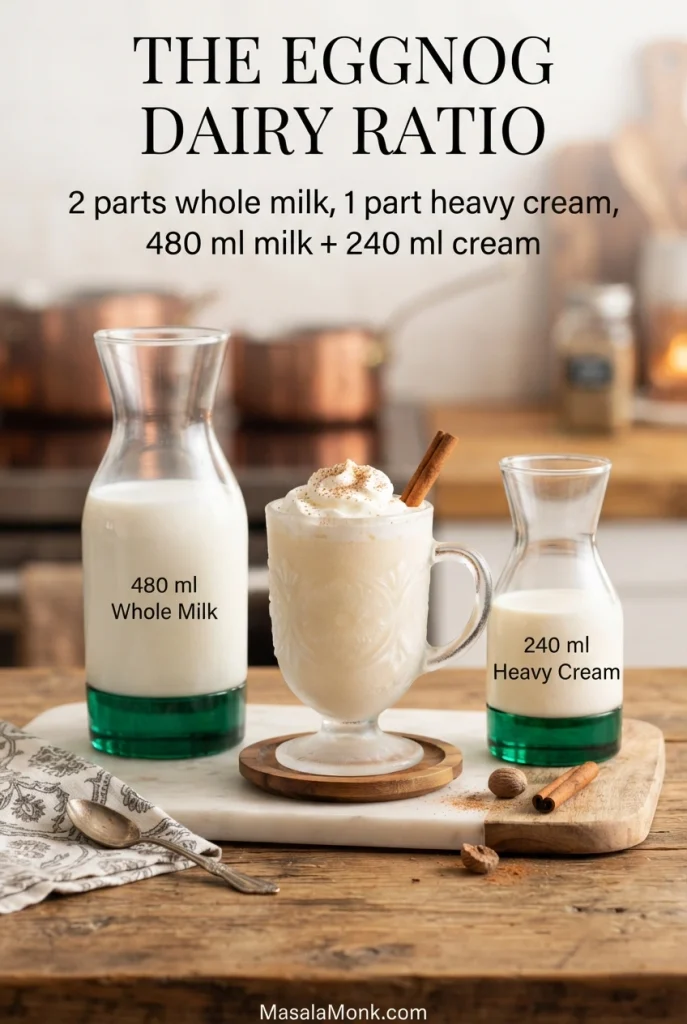
In the US, heavy cream generally contains at least 36% milk fat. If your local cream is sold under a different name, check the fat content. Lower-fat cream produces a lighter drink; very rich double cream can make it heavier. Use plain, unsweetened dairy cream rather than sweetened whipping topping. To adjust the balance, compare the classic, richer and lighter eggnog options.
Balancing Nutmeg, Vanilla and Sugar
Vanilla and dairy provide the custard flavor, while nutmeg adds its distinctive spice. Sugar rounds it all out. If packaged eggnog tends to taste too sweet to you, the lower-sugar variation below is worth considering.
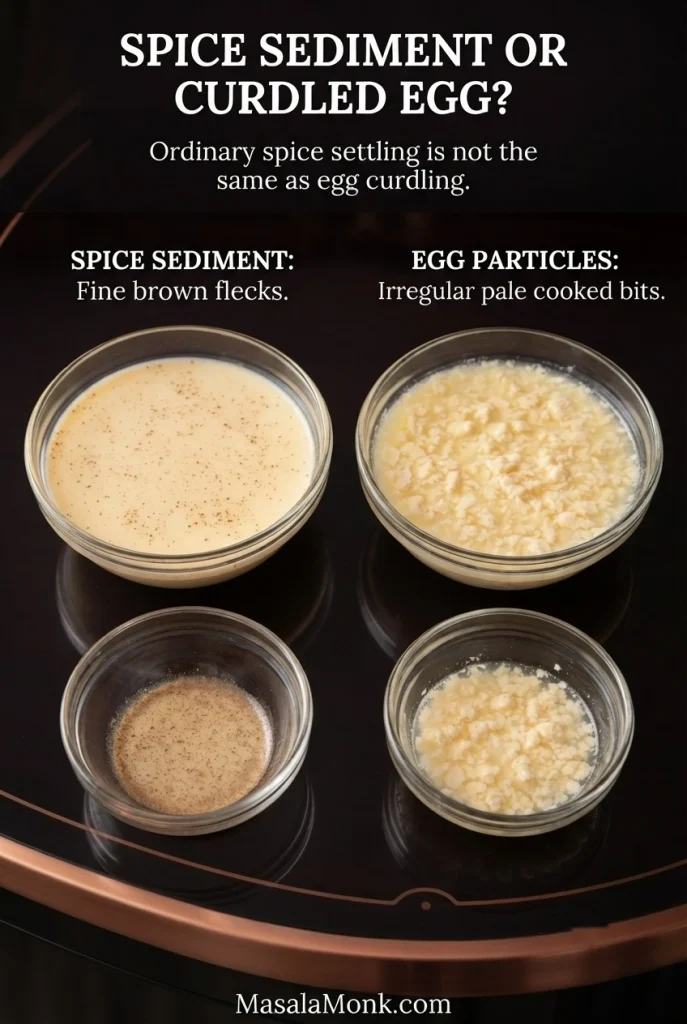
Freshly grated nutmeg has a more immediate aroma than a jar of ground nutmeg that’s been open for months. Both work, but ground spices don’t dissolve completely, so use the measured quantity before deciding whether to add more. If particles appear later, the spice-versus-curdling comparison can help you identify them.
For a Christmas dessert spread, gingerbread cookies make a good pairing. Their stronger spices complement the simpler flavor of the eggnog.
How to Cook Eggnog Without Scrambling the Eggs
Why Eggnog Can Curdle Below 160°F
Your thermometer measures the eggnog, not the bottom of the saucepan. The metal can be hotter than the liquid surrounding the probe. That’s why eggs sometimes start cooking against the pan while the thermometer still reads below 160°F.
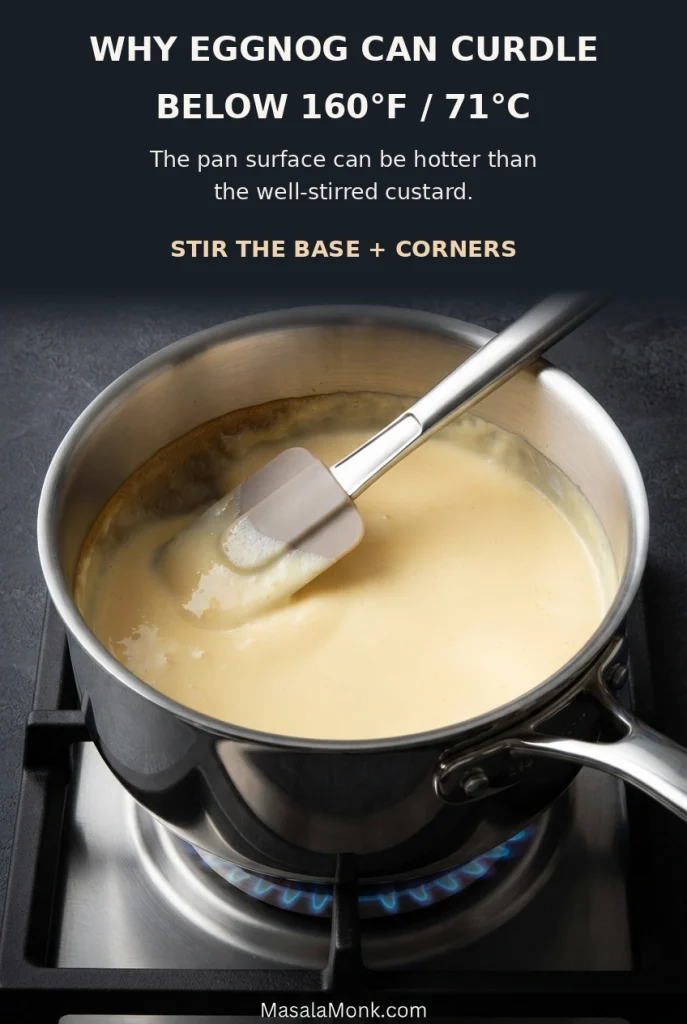
A heavy-bottomed saucepan helps distribute heat, but can’t eliminate hot spots. Sweep your spatula across the whole base while cooking. If small curds begin to form, take the pan off the burner and stir to prevent further overcooking.
Forgot to temper the eggs? If you combined the yolks, sugar, milk, and cream while everything was cold, you can still make eggnog. Warm the mixture gradually over low heat, stirring throughout until it reaches the target temperature. Tempering is helpful when adding hot dairy to yolks; it isn’t essential when everything starts cold.
The Correct Temperature for Cooked Eggnog
The egg-containing mixture must reach 160°F (71°C). The FDA’s food-safety guidance for cooked eggnog recommends this temperature and checking it with a food thermometer.
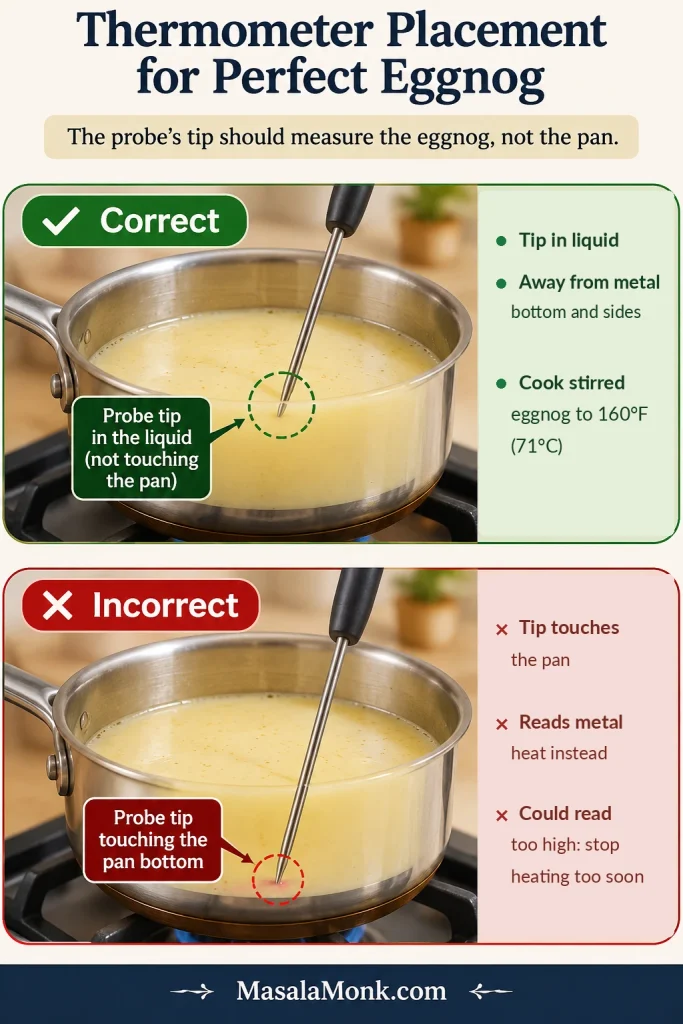
What if the custard thickens before it reaches 160°F? Lower the heat and keep stirring. Thickness alone doesn’t establish that the eggs are sufficiently cooked; continue checking the temperature in the well-stirred liquid, away from the pan’s bottom and sides.
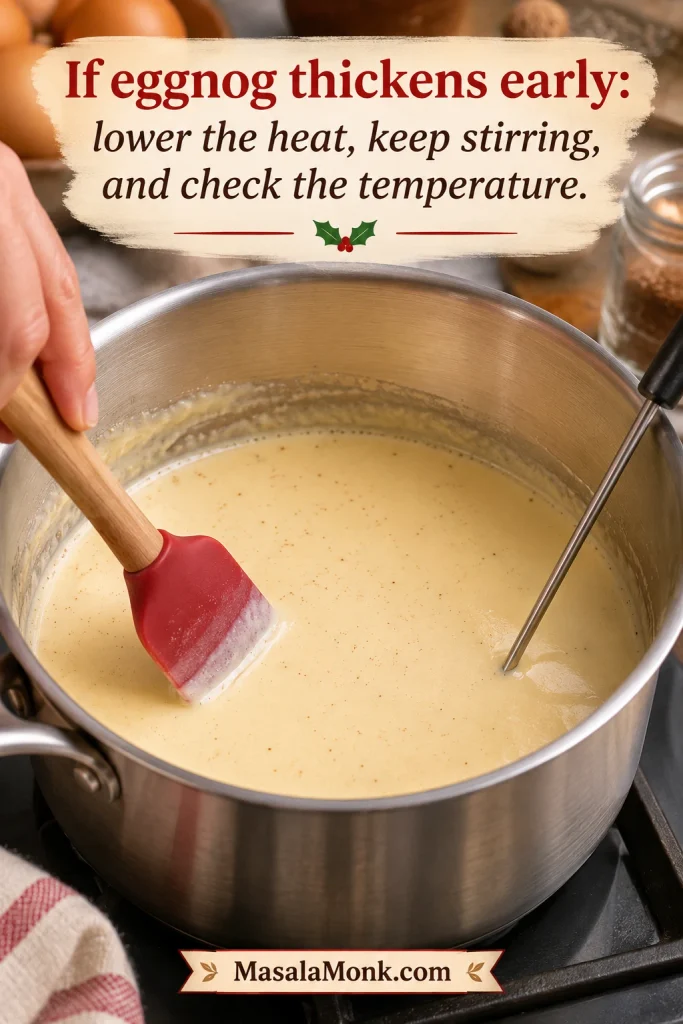
If a few small curds appear before the target temperature, lift the pan off the burner and stir. Return it to gentler heat and continue checking the temperature. Strain only after the eggnog reaches 160°F. A batch that has separated into large scrambled curds will usually have a much poorer texture.
A spoon-coating test can suggest that a custard has thickened, but it cannot confirm safe cooking. Use a food thermometer for this recipe.
How to Fix Eggnog That’s Too Thick, Thin, Grainy or Curdled
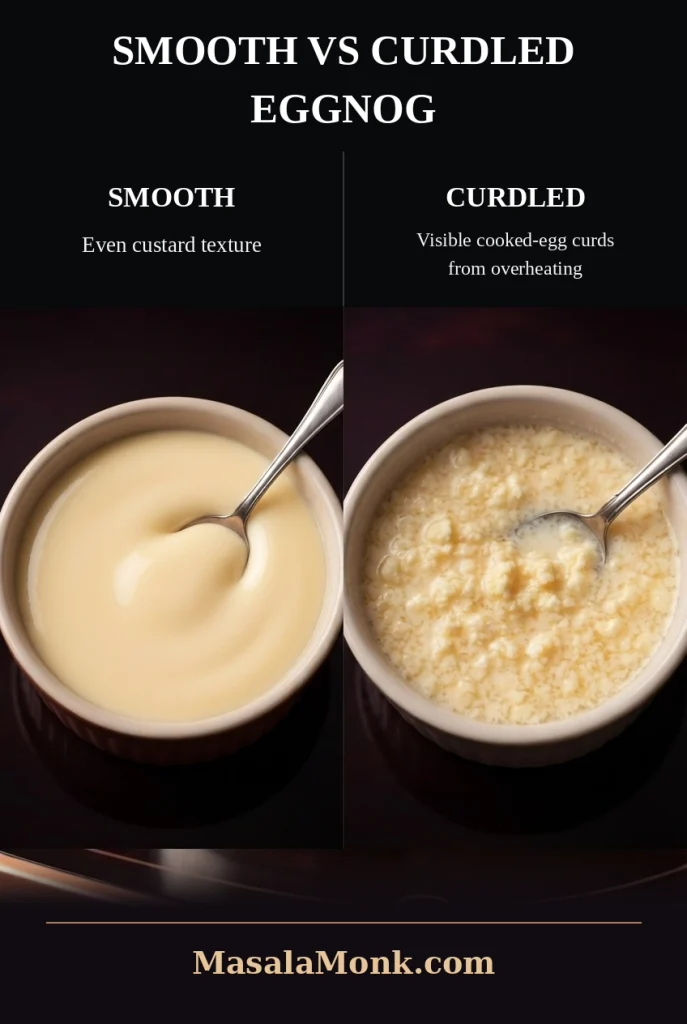
The first question is when the problem appeared: on the stove, after chilling, or later in storage. If it is thickening before reaching 160°F, start with the cooking-stage advice. A thin warm custard isn’t necessarily a problem, but large scrambled curds need a different response.
| Problem | What to Do |
|---|---|
| Thin while warm | If it reached 160°F, chill it fully before deciding whether it’s too thin. |
| Thin after chilling | If safely cooked and stored, serve it as a lighter eggnog. Check the yolk and dairy quantities next time. |
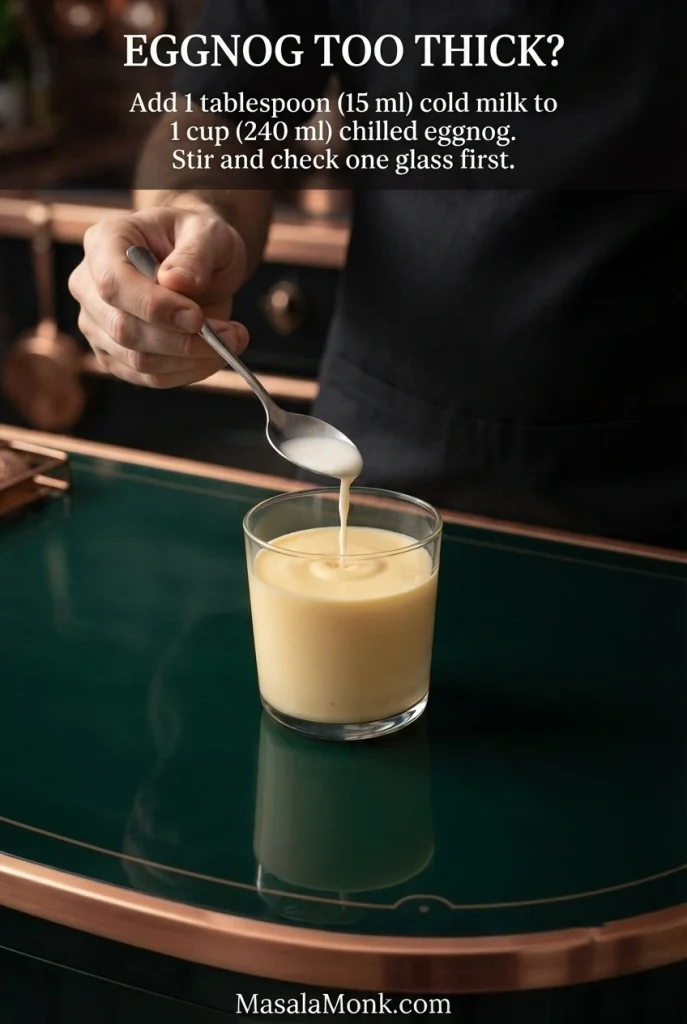
| Too thick | Gradually add cold pasteurized milk to an individual glass. |
| Small cooked-egg particles | After the mixture reaches 160°F, strain it through a fine-mesh sieve. |
| Large scrambled curds | Starting again usually gives a smoother result. |
| Too sweet | Try a little milk in one glass. Use less sugar next time. |
| Weak flavor | Try fresh nutmeg or a few drops of vanilla in an individual serving. |
| Spice sediment | Gently stir a properly stored batch if only the spices have settled. |
To thin chilled eggnog: Test one glass before changing the whole pitcher. Whisk 1 tablespoon (15 ml) of cold pasteurized milk into 1 cup (240 ml) of eggnog, then taste and check how it pours. You can add more, but you can’t easily bring back the flavor of a diluted batch.
Can You Save Curdled Eggnog?
A few small cooked-egg particles can be strained out once the custard has reached 160°F (71°C). Large scrambled curds are harder to rescue: blending breaks the pieces into smaller bits but doesn’t restore the original smooth texture. Starting again generally gives a better result.
Not all graininess means curdling. Nutmeg and cinnamon can settle in a chilled pitcher. That’s different from a sandy texture caused by egg proteins overheating during cooking. Ordinary spice sediment in properly prepared, refrigerated eggnog can be stirred back in.
Eggnog Variations: Less Sweet, Richer, Spiced or With Alcohol
The biggest changes come from adjusting the dairy ratio or sweetness. More cream suits an after-dinner dessert drink; less cream makes a lighter glass for sipping alongside food. Spice and vanilla are smaller adjustments.
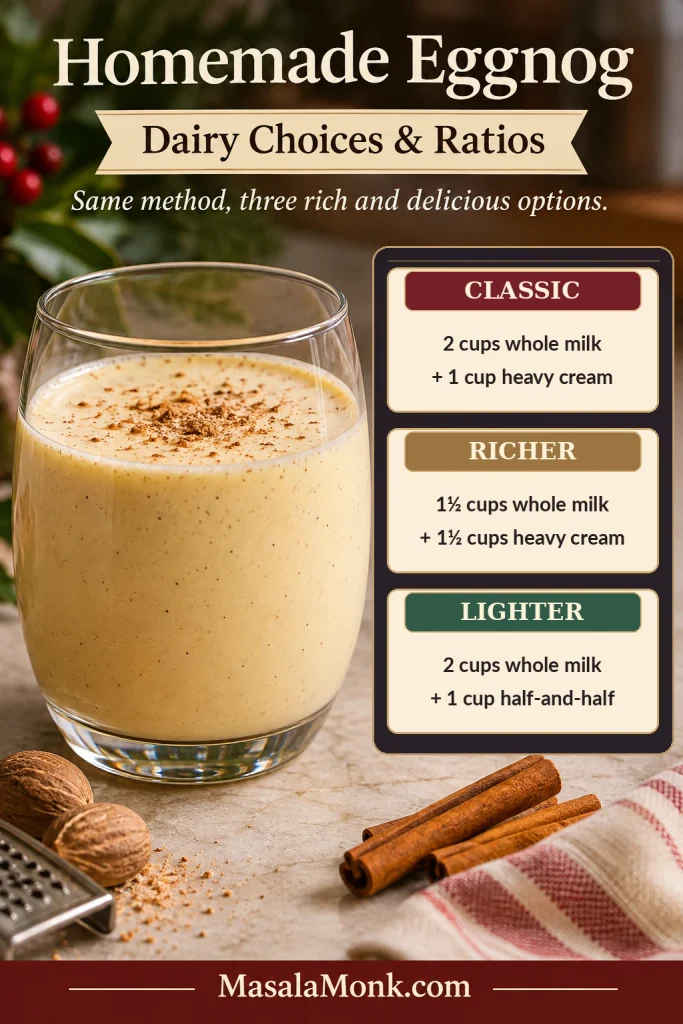
| Variation | Adjustment | Best For |
|---|---|---|
| Less sweet | Use 65–75 g sugar instead of 100 g. | A less-sweet drink. |
| Extra creamy | 360 ml milk + 360 ml heavy cream. | Rich dessert-style servings. |
| Lighter | Replace cream with half-and-half. | A less-rich glass. |
| More cinnamon | ¼ tsp ground cinnamon total. | Stronger cinnamon flavor. |
| More vanilla | Add another ¼ tsp vanilla after cooking. | Vanilla-forward flavor. |
For a cinnamon-stick alternative, warm a small cinnamon stick with the dairy and remove it before tempering instead of adding extra ground cinnamon. Less sugar can slightly affect custard texture, so keep the same 160°F (71°C) cooking endpoint rather than extending the heating time to thicken it.
Adding Rum, Bourbon or Brandy
For an adult glass, stir ½–1 US fl oz (15–30 ml) of rum, bourbon, or brandy into about 5 US fl oz (150 ml) of chilled eggnog. Begin with the smaller amount, then adjust to taste.

- Dark rum contributes caramel and molasses notes.
- Bourbon adds vanilla, oak, and whiskey warmth.
- Brandy brings a mellow, fruity character.
- Spiced rum increases spice and may add sweetness.
Keep the pitcher alcohol-free and refrigerated, then customize individual adult glasses at serving time. Alcohol doesn’t make fresh eggnog shelf-stable or suitable for unrefrigerated aging. For the alcohol-free base, use the original six-yolk recipe.
Small-Batch Homemade Eggnog for Two
A two-yolk batch makes roughly two small servings. The yolks, dairy, and sugar scale to one-third of the full recipe. The vanilla and nutmeg start a little lighter, and you can add more to taste.
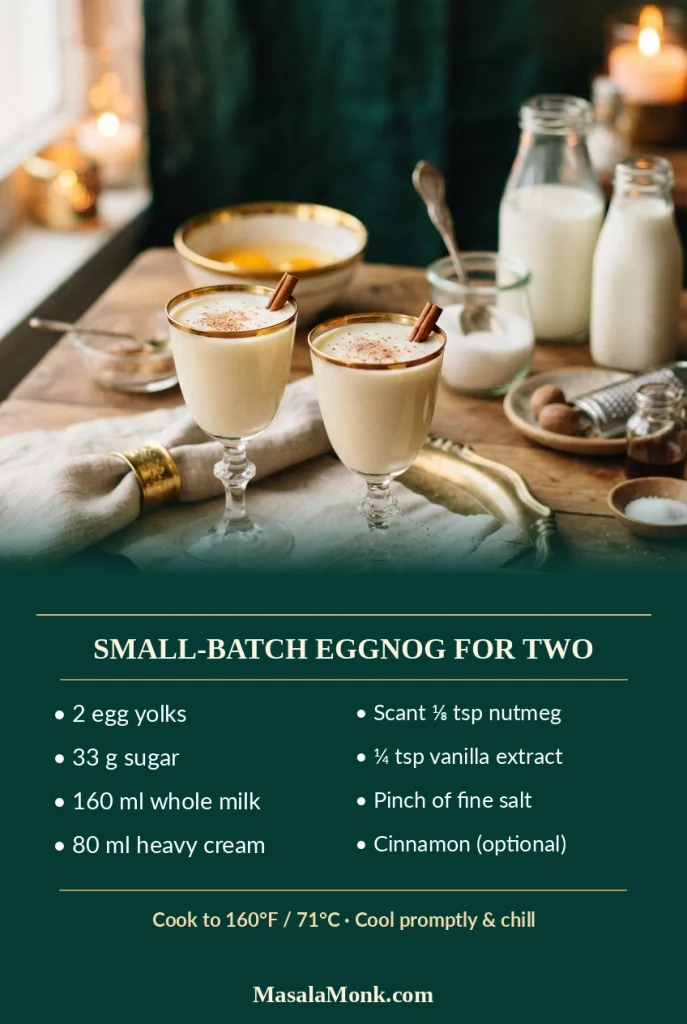
| Ingredient | Amount |
|---|---|
| Large egg yolks | 2 |
| Whole milk | ⅔ cup / 160 ml |
| Heavy cream | ⅓ cup / 80 ml |
| Granulated sugar | 33 g / approximately 2 tbsp + 2 tsp |
| Ground nutmeg | Scant ⅛ tsp, plus more to taste |
| Vanilla extract | ¼ tsp / approximately 1.25 ml |
| Fine salt | A tiny pinch |
| Ground cinnamon | A small pinch, optional |
Follow the same method in a small, heavy-bottomed saucepan. Choose a pan narrow enough for the thermometer probe to sit in the liquid without touching metal. Small batches heat quickly, so follow the thermometer rather than the original cooking time. If the process is unfamiliar, follow the tempering demonstration in the main method. Cool promptly and refrigerate until thoroughly cold.
Doubling Eggnog for Christmas Guests
A double batch makes approximately twelve small servings, depending on the finished volume.
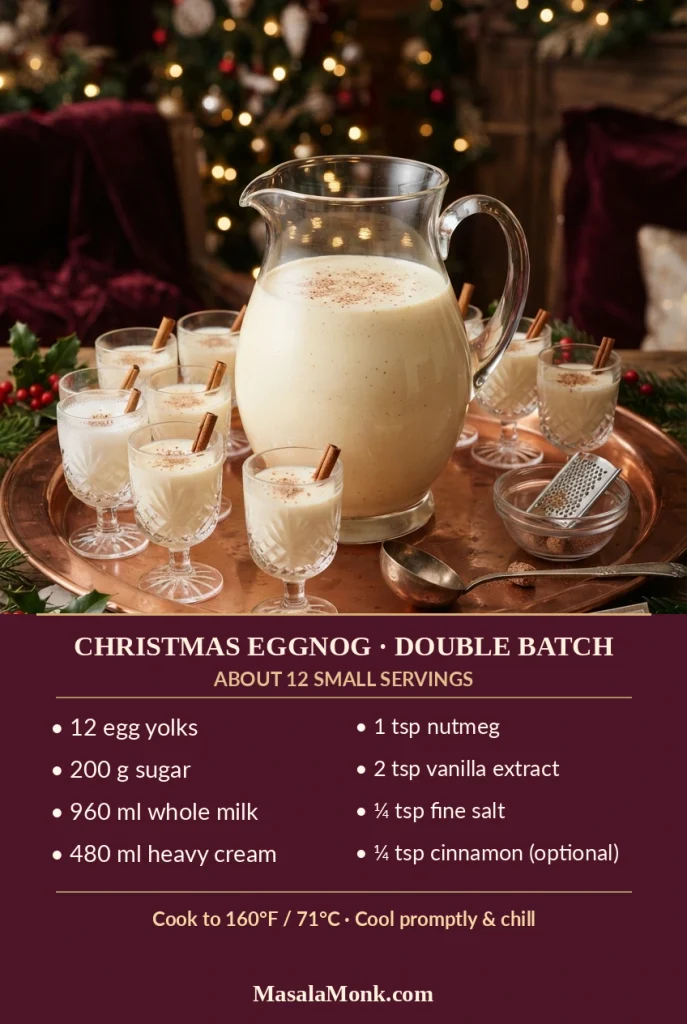
- 12 large egg yolks
- 200 g granulated sugar (1 cup)
- 960 ml whole milk (4 cups)
- 480 ml heavy cream (2 cups)
- 1 teaspoon ground nutmeg
- 2 teaspoons vanilla extract
- ¼ teaspoon fine salt
- ¼ teaspoon ground cinnamon, optional
Use a saucepan large enough for comfortable stirring, or make two separate batches. Don’t double the cooking time; cook to the thermometer reading. Have plenty of ice and refrigerator space for several shallow containers so the larger volume can cool promptly. See the ice-bath cooling step before starting.
How to Serve, Store and Make Homemade Eggnog Ahead

Serving Eggnog Cold or Warm
Serve the eggnog cold in small glasses of about 4–5 US fl oz (120–150 ml) each. It should taste smooth and creamy, with fresh nutmeg adding its fragrance just before the first sip. For a warm serving, gently reheat an individual portion over low heat, stirring to avoid curdling; don’t boil it or repeatedly heat the entire pitcher.
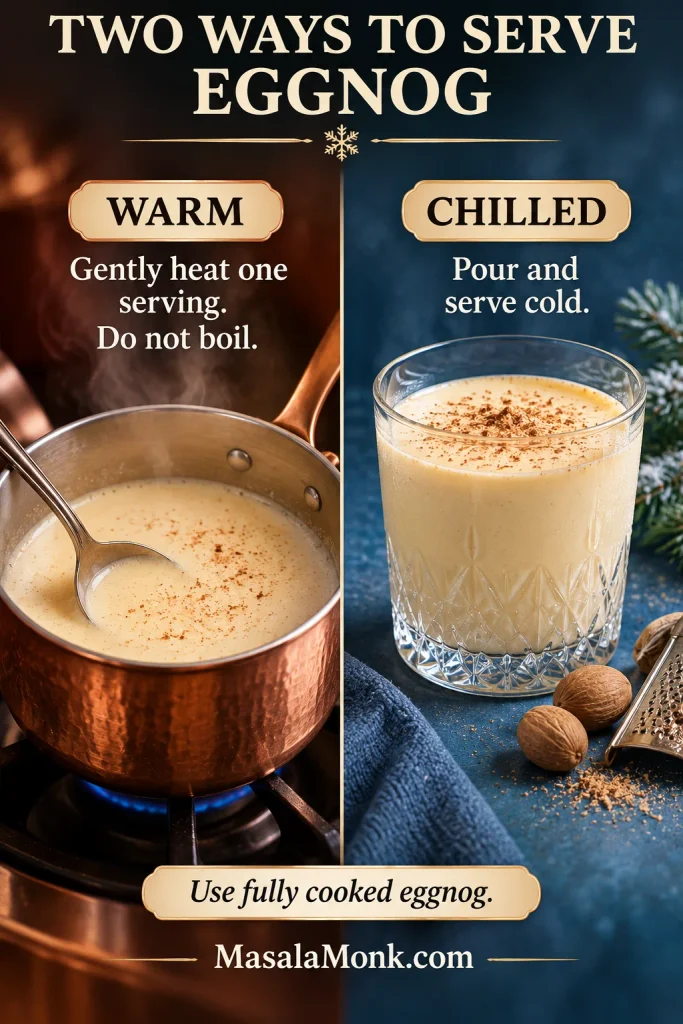
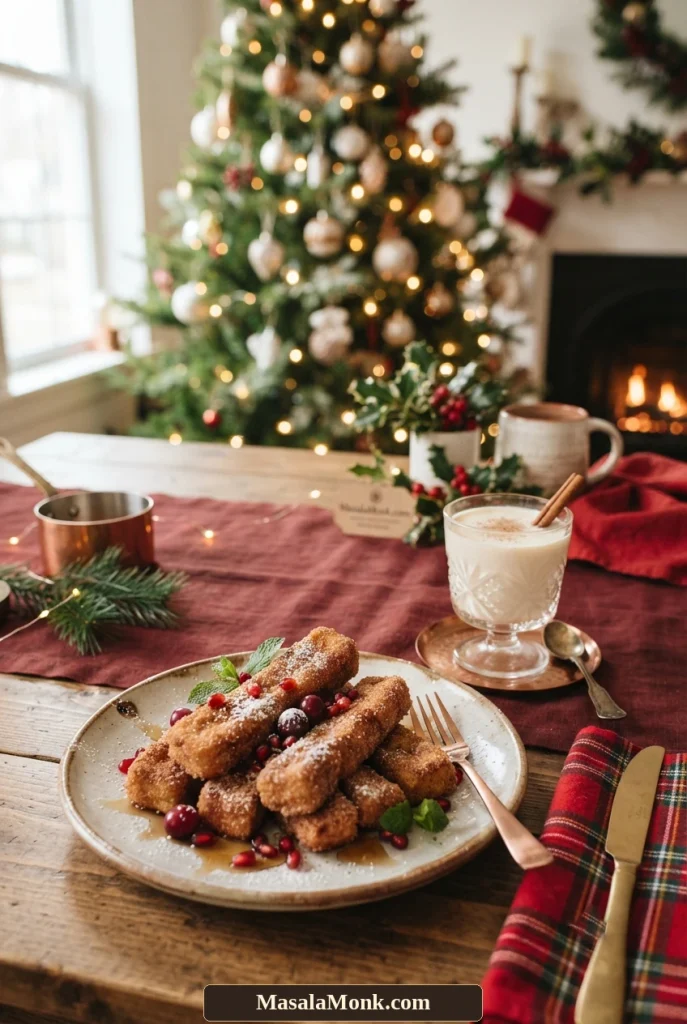
At Christmas breakfast, serve it alongside French toast sticks with a little cinnamon or powdered sugar. A splash of chilled eggnog can also replace part of the milk or creamer in coffee. For guests who prefer a hot drink, homemade hot chocolate with cocoa powder is another option.
Making Eggnog Ahead for Christmas
Make eggnog the evening before you need it so there’s no custard to cook while guests are arriving. For Christmas Day, December 23 or 24 is a convenient choice within the recommended refrigerated storage period. Keep the pitcher covered and chilled until serving. If you’re planning Christmas breakfast too, an overnight French toast casserole is another dish you can prepare ahead.
How Long Does Homemade Eggnog Last?
Store homemade eggnog in clean, covered containers at 40°F (4°C) or colder. The FoodSafety.gov cold food storage chart gives homemade eggnog 2–4 days refrigerated and does not recommend freezing it.
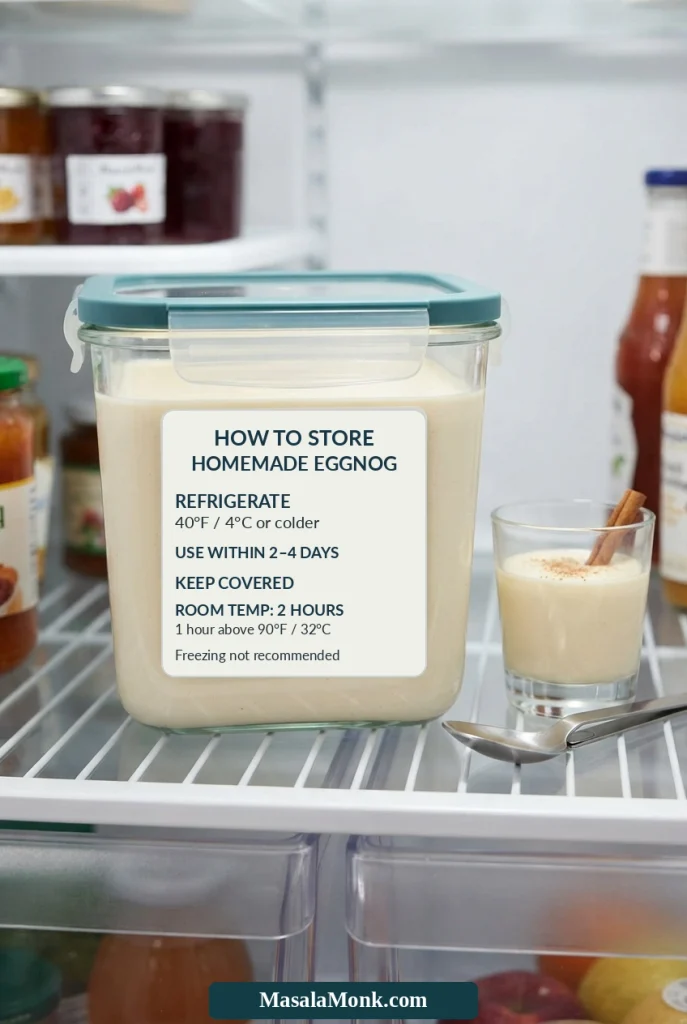
Use clean utensils, keep the pitcher chilled until serving, and return any unused eggnog to the refrigerator promptly. Stir gently if spice has settled.
When to Discard Homemade Eggnog
Discard eggnog that has exceeded its recommended refrigerated storage period or been kept at unsafe temperatures. As with other perishable foods, don’t leave it unrefrigerated for more than two hours, or more than one hour if the surrounding temperature exceeds 90°F (32°C).
Mold, unexpected bubbling, slime, ropiness, or signs of fermentation are reasons to discard the batch. Harmful bacteria can also be present without changes in smell or appearance, so a normal-looking drink isn’t proof that improperly stored eggnog is safe. Don’t taste questionable eggnog; adding alcohol, blending, or reheating cannot reliably make it safe again.
Common Questions About Homemade Eggnog
Does Homemade Eggnog Need to Chill Overnight?
No. Approximately four hours is a useful starting point, although the time varies with container size and refrigerator temperature. Serve only after the eggnog is thoroughly cold.
Why Does Homemade Eggnog Taste Different From Store-Bought?
Packaged eggnog varies in sugar, dairy fat, flavorings, and added thickeners. This homemade version tastes more directly of cooked custard, dairy, vanilla, and nutmeg. It’s smooth rather than frothy and may be easier to pour than some especially thick commercial versions.
Can You Make This Eggnog Without Eggs or Dairy?
Egg-free and dairy-free eggnog can be made, but they need different ingredients and thickening methods. Replacing the yolks or cream directly in this cooked custard won’t necessarily produce the same texture.
A small glass of chilled eggnog with fresh nutmeg is satisfying on its own; richer toppings and spirits can stay optional. Do you prefer yours lighter and easy to sip, or thick enough to feel like dessert? Share how you serve it in the comments.








