

Pipe a little cannoli filling onto a plate and the ridges should stay where the tip left them. The cream should feel cool and creamy on the tongue, taste unmistakably of ricotta, and hold its shape without turning stiff like frosting.
The frustrating bowl is the one that looks fine until the sugar goes in, then suddenly loosens. Or the ricotta drains all night but still feels grainy. Or you keep mixing to make it smoother and somehow make it thinner instead.
Cannoli filling is a sweet ricotta cream piped inside crisp cannoli shells. At its traditional core, it is simply ricotta and sugar. Chocolate, citrus and cinnamon appear in different fillings, while chopped pistachios commonly finish the exposed ends.
Most problems with cannoli filling start with the ricotta, before the sugar ever goes in. Wet ricotta needs draining. Coarse ricotta needs smoothing. Those are different jobs.
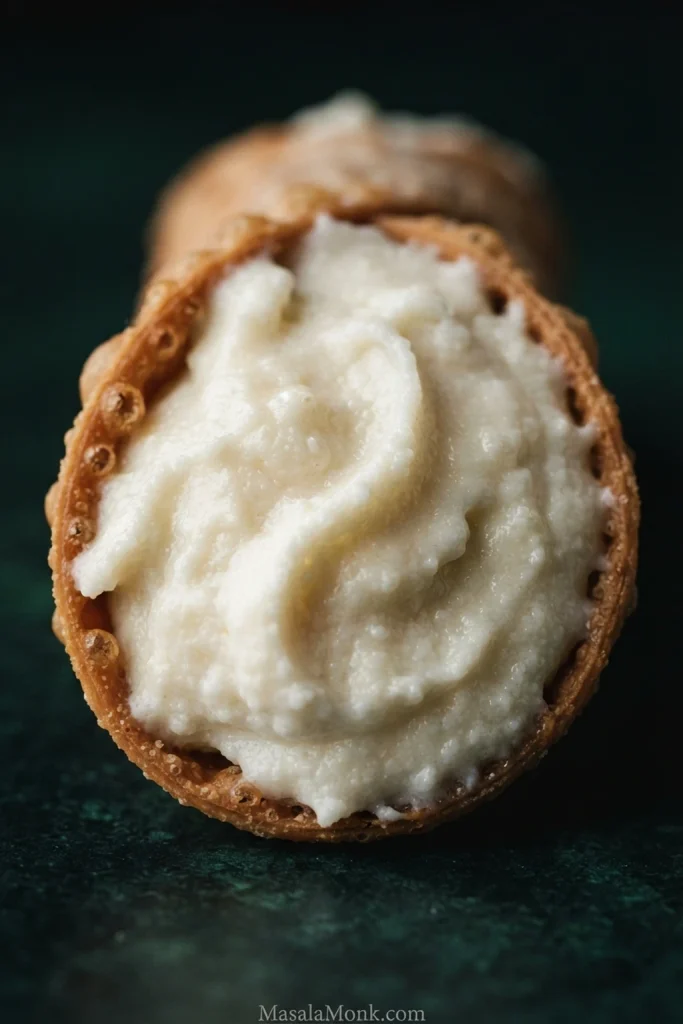
This version keeps the cream firmly ricotta-forward. Mascarpone, whipped cream, cream cheese, cornstarch and gelatin are unnecessary for the main recipe. If you also need homemade shells, rolling thickness, frying temperatures and complete assembly, use our complete cannoli recipe.
Check the Ricotta Before You Add Sugar
Before measuring sugar or reaching for a mixer, look at the ricotta itself. A quick check here is more useful than automatically deciding every tub needs an overnight drain.
| What you see | What it means | Next move |
|---|---|---|
| Whey pools around the ricotta and it spreads instead of holding a mound | Too wet | Drain it |
| Ricotta sits in a thick mound with no watery ring | Moisture is probably right | Start the filling |
| Ricotta is thick but visibly coarse or curdy | Water may not be the problem | Sieve it later for smoothness |
The goal is ricotta with enough moisture to stay creamy but not so much free whey that the finished filling slumps.
Cannoli Filling Recipe
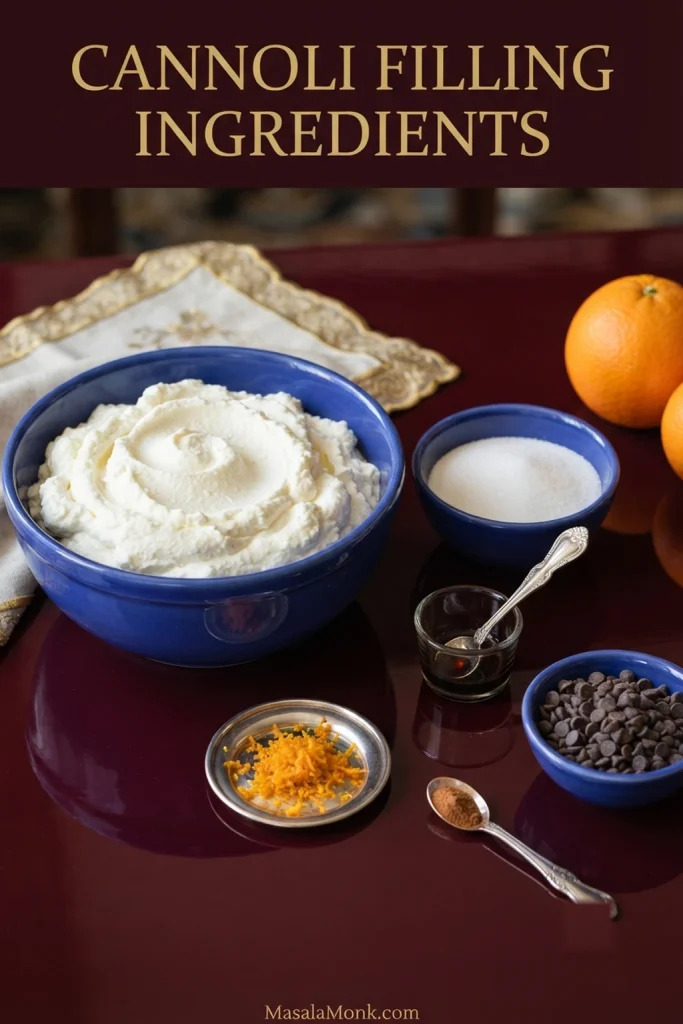
For about 20–24 cannoli, start with 680 g / 24 oz whole-milk ricotta, drained only if needed and weighed after any draining, plus 125 g / 4.4 oz superfine sugar, then add vanilla and optional orange, cinnamon and chocolate.
There are three useful checkpoints: the mound test before sugar, the sieve test while refining the texture, and the pipe test before chocolate or other mix-ins go in.
| Recipe detail | Guidance |
|---|---|
| Active time | About 15–20 minutes |
| Drain time | Only as needed; a few hours may be enough, while very wet ricotta can need overnight draining |
| First sugar rest | 20–30 minutes |
| Optional final sugar rest | 10–15 minutes |
| Cooking | None |
| Approximate finished filling | About 805–890 g / 28–31 oz depending on extra sugar and chocolate |
| Approximate shell yield | About 20–24 cannoli using shells around the size made with a 4-inch / 10-cm cutter; larger shells or more generous filling will reduce the yield |
| Finished texture | Creamy, pipeable and able to hold its ridges |
Equipment
- digital kitchen scale
- fine-mesh sieve
- mixing bowl
- flexible spatula or large spoon
- cheesecloth or a clean thin kitchen cloth for particularly wet ricotta
- small plate and light weight if weighted draining is needed
- piping bag with a large round or star opening
Ingredients
- 680 g / 24 oz / 1½ lb whole-milk ricotta, drained only if needed and weighed after any draining
- 125 g / 4.4 oz superfine or caster sugar
- up to 25 g / 0.9 oz additional superfine or caster sugar, only if the finished cream needs it
- ½ teaspoon / 2.5 ml vanilla extract
- 1 teaspoon finely grated orange zest, optional but recommended
- up to ⅛ teaspoon ground cinnamon, optional
- 60 g / about 2 oz mini dark chocolate chips, or chocolate chopped finely enough to pass through your piping tip, optional
Shopping note: if your ricotta needs draining, about 900 g / 32 oz / 2 lb is a useful starting purchase to end with roughly 680 g / 24 oz. Drain loss varies considerably by brand, so treat this as a shopping allowance rather than a guaranteed conversion.
Drain Only If the Ricotta Needs It
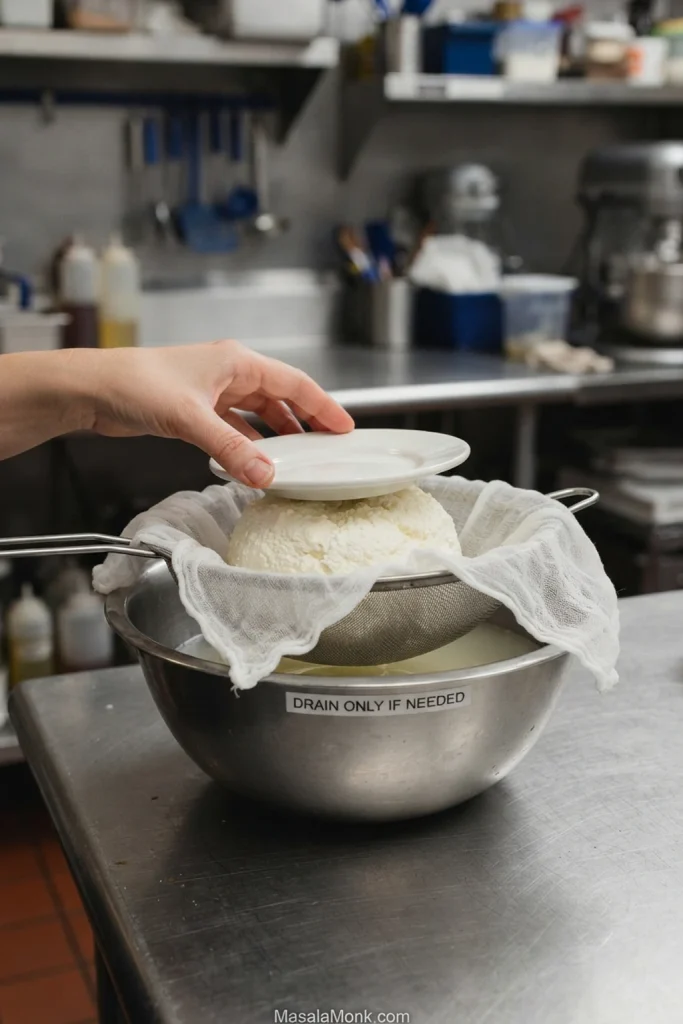
Ricotta that already sits thickly in its container with little free whey may need only brief draining. Wetter cheese should go into a fine-mesh sieve set over a bowl in the refrigerator.
For particularly loose ricotta, line the sieve with cheesecloth or a thin clean kitchen cloth. A small plate with a light weight on top can encourage more whey out.
Keep the ricotta refrigerated throughout.
Make Sure It Passes the Mound Test
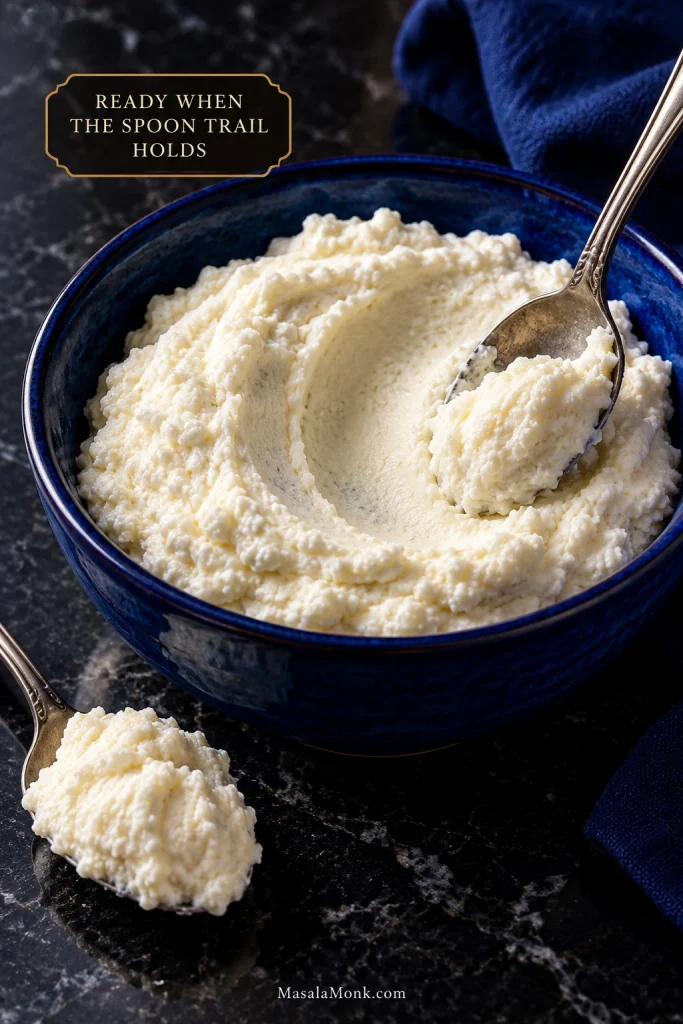
Spoon some ricotta into a bowl. It should sit up without slowly flattening. Drag a spoon through the centre and look at the trail.
If the channel immediately fills with liquid or a watery ring forms around the cheese, keep draining. Once the ricotta is thick, soft and able to hold that trail, move on.
Dry and crumbly ricotta has gone too far in the opposite direction.
Add the Sugar and Give It Time
Fold 125 g / 4.4 oz superfine sugar gently into the ricotta. There is no need to whip it.
Cover and refrigerate for 20–30 minutes. As the sugar dissolves, excess moisture may become more noticeable, which is one reason the mound test matters before sweetening.
Taste the cream cold. If you want a sweeter filling, fold in some or all of the remaining 25 g / 0.9 oz sugar and refrigerate for another 10–15 minutes. Well-prepared ricotta should remain thick and creamy through that rest; wetter ricotta may loosen much more noticeably.
Sieve for Creaminess
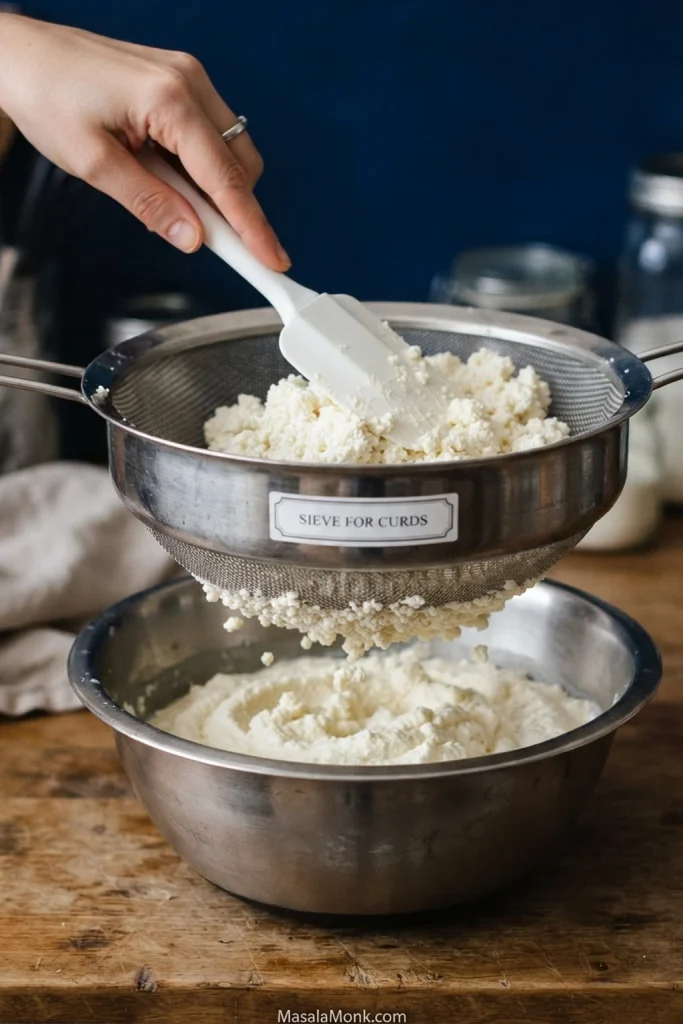
Push the sweetened ricotta through a fine-mesh sieve with a flexible spatula or the back of a spoon.
Look at the first few spoonfuls as they come through. The cream should be noticeably finer while still holding its mound. If it starts loosening as you work, stop there; perfect silkiness is not worth losing the structure.
That is the sieve test: the curds get finer without the structure disappearing. A food processor is faster but easier to overdo; for this recipe, the sieve gives you much more control.
Flavour Lightly
Fold in the vanilla, orange zest and, if you want it, a small amount of cinnamon. You’re looking for cream that still tastes like fresh ricotta, just without coarse curds getting in the way.
Pass the Pipe Test
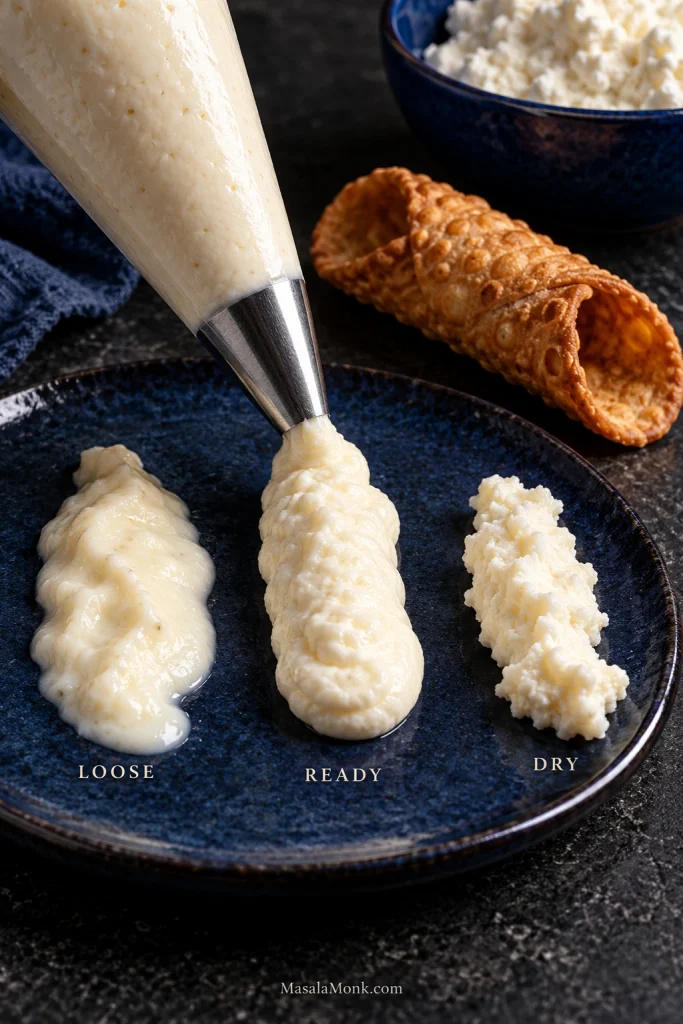
Before adding chocolate or packing the whole batch into a piping bag, test a small amount on a plate or in an empty shell. Fix the texture while the cream is still in the bowl; it is much easier than wrestling with a loaded bag.
| Filling state | What it does |
|---|---|
| Too loose | Ridges disappear quickly and the cream spreads |
| Ready | Flows under moderate pressure and keeps its shape |
| Too dry | Tears, feels chalky or takes excessive force to pipe |
If it holds those ridges and tastes good, leave it alone. You have the filling.
Add Chocolate Last
Fold in mini chocolate chips or finely chopped chocolate only after the plain cream has reached the right consistency. Texture problems are much easier to correct before chips, nuts or candied fruit are scattered through the bowl.
Cover and refrigerate the filling until needed. Keep the shells separate.
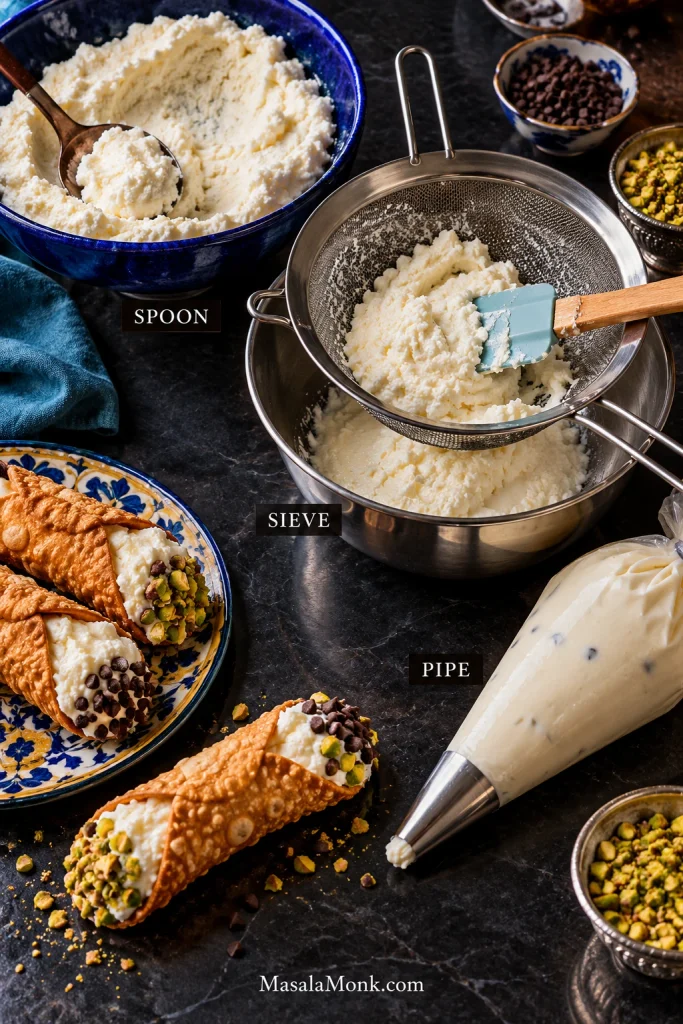
Mound before sugar. Sieve for curds. Pipe before mix-ins. If your cream passes all three checks, you can stop here and fill the shells. The rest is for troubleshooting, choosing ricotta or making variations.
Need More Help With the Filling?
- How long should ricotta drain?
- Why is the filling grainy or runny?
- How do I fix the filling?
- Which ricotta should I buy?
- Can I add mascarpone?
- How do I fill cannoli shells?
- How far ahead can I make it?
Read the Ricotta, Not the Clock
If your ricotta is visibly wet, plan on several hours of draining—but stop when it passes the mound test instead of obeying the clock blindly.
Cannoli recipes often give a fixed time: two hours, overnight, sometimes a full day. In practice, one tub can lose a substantial pool of whey quickly while another stays loose for much longer. Pastry-style ricotta may arrive ready to use.
The clock is useful. It is not the endpoint.
Passive and Weighted Draining
Moderately moist ricotta usually drains well in a fine-mesh sieve over a bowl. Very wet cheese can benefit from a cloth-lined sieve and gentle weight.
The weight should encourage whey out, not compress the ricotta into a dry block. Check the cheese itself; more hours are not automatically better.
When Ricotta Is Too Dry
Ricotta can absolutely become too dry for cannoli filling. Over-drained cheese turns chalky and awkward to pipe, while very dry ricotta impastata may need a little moisture added back.
Loosen an overly stiff batch with cold whole milk, 1 teaspoon / 5 ml at a time. Mix gently and stop as soon as the cream pipes comfortably.
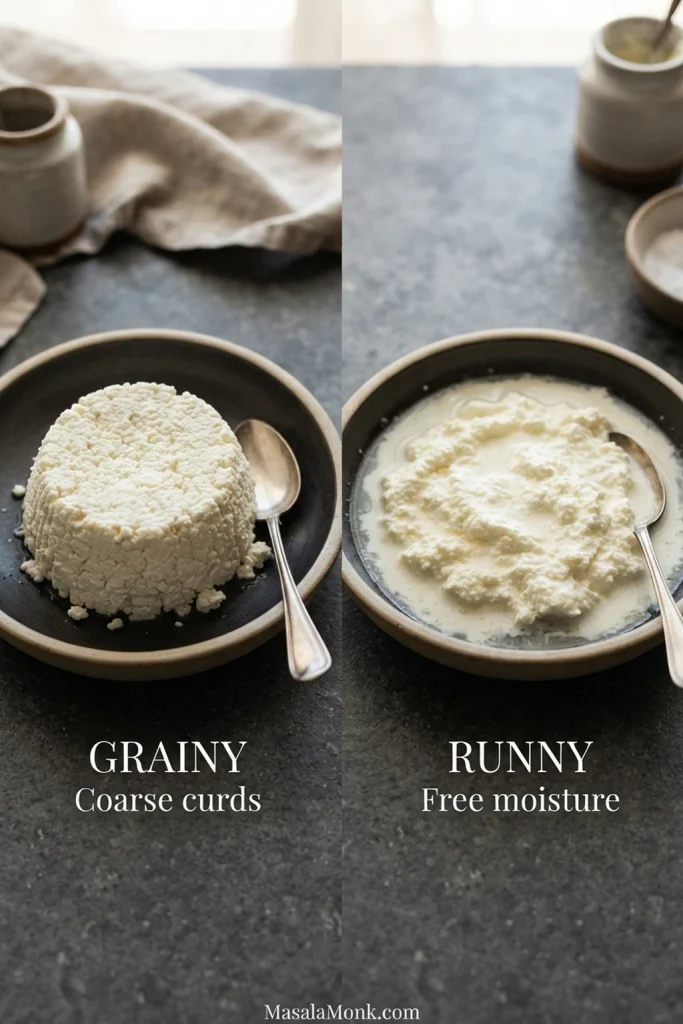
Grainy Is Not Runny
Runny cream usually points to excess moisture. Graininess points toward coarse ricotta curds. A sandy texture can come from sugar that has not fully dissolved.
A well-drained ricotta can still be coarse. More draining will remove water, but it will not make those curds smaller.
A faint ricotta grain is not automatically a flaw if the cream tastes pleasant and pipes cleanly. Traditional cannoli fillings vary in smoothness, and the aim is creaminess without erasing every trace of the cheese.
Fix My Cannoli Filling
Before adding anything else, look at what the cream is actually doing.
| What you see | Likely reason | First move |
|---|---|---|
| Ricotta is loose before sugar | Too much whey | Drain more effectively |
| Filling loosens after sugar | Ricotta may have been carrying more free moisture than it appeared to | Stop adding sugar and reassess moisture |
| Filling gets thinner as you mix | It is being overworked | Stop mixing |
| Filling is thick but grainy | Coarse ricotta curds | Use the fine sieve |
| Filling feels sandy | Sugar has not fully dissolved | Give it more resting time |
| Filling is chalky and difficult to pipe | Ricotta is too dry | Loosen very gradually |
| It doesn’t taste like the bakery cannoli you remember | The cheese, sugar level or aromatics may differ from that bakery’s style | Adjust the cheese or flavour balance |
| Piping ridges disappear immediately | Finished cream is too soft | Chill briefly, then check moisture |
| Chocolate clogs the tip | Pieces are too large | Use smaller chocolate or a wider tip |
| Liquid appears after an overnight rest | Moisture is separating from the ricotta | Reassess the filling instead of simply chilling longer |
It Loosened After I Added Sugar
Sugar can make excess moisture more noticeable as it dissolves. Well-prepared ricotta should remain thick; wetter ricotta may loosen much more noticeably.
If the mixture becomes genuinely wet and is still free of chips or nuts, careful additional draining may help. Taste again afterward because some dissolved sugar may leave with the liquid.
It Gets Thinner the More I Mix
Stop mixing. Once it’s smooth enough, more mixing can make it looser.
It Doesn’t Taste Like the Bakery Cannoli You Remember
The filling you remember may have been smoother, sweeter, more citrusy or almost mousse-like depending on the bakery. Sheep’s-milk ricotta, ricotta impastata, finer curds, different sugar ratios and a little mascarpone can all change that impression.
Changing the ricotta may get you closer to the cannoli you remember than adding more vanilla or cinnamon.
It Is Too Sweet
This often follows an attempt to use sugar as a thickener, or a cup-for-cup substitution between powdered and granulated sugars. Weigh the sugar and make the final sweetness adjustment only after tasting the cream cold.
Using Cornstarch to Thicken Cannoli Filling
Raw cornstarch is a poor first rescue for runny cannoli filling. Stirred into a no-cook ricotta cream, it can leave a chalky texture while the excess whey remains in the bowl.
Not sure where to begin? Stop mixing first. If the cream is simply warm and soft, chill it for 20–30 minutes and check it again. Then decide whether you’re looking at free whey or coarse curds: drain the first, sieve the second. Retaste after any correction. If the bowl is fundamentally soupy, starting again with properly prepared ricotta may give you a better result than piling in thickeners.
Which Ricotta Makes the Best Cannoli Cream?
Start with full-fat ricotta that tastes fresh and is not swimming in whey. A little curdiness is manageable; excessive water is the bigger headache.
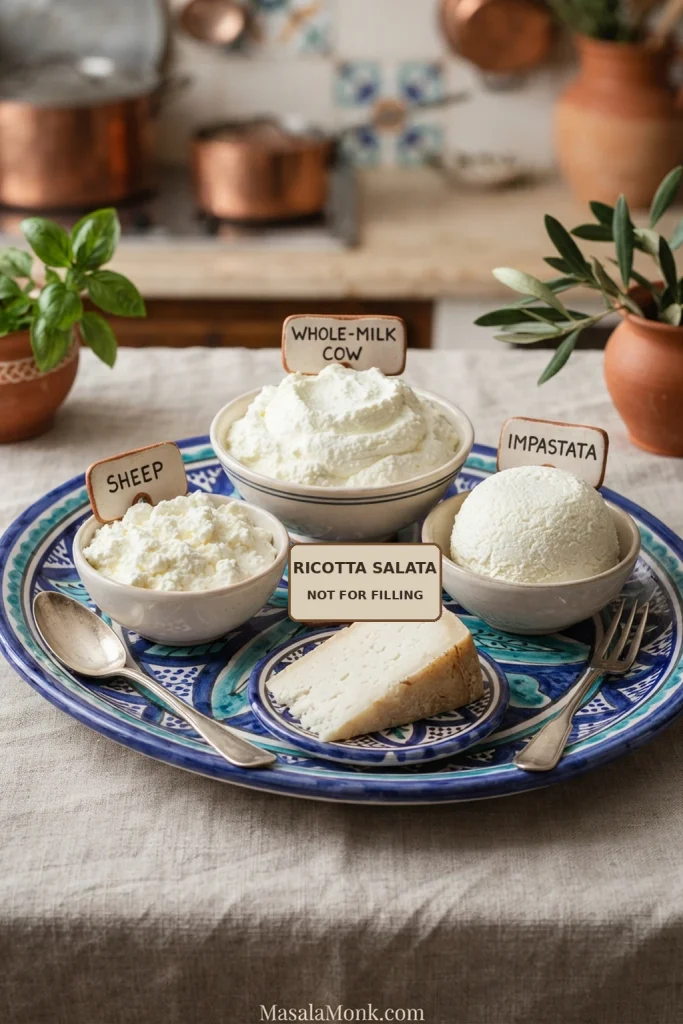
Fresh Sheep’s-Milk Ricotta
Sheep’s-milk ricotta is strongly associated with Sicilian cannoli and has a richer, more distinctive dairy flavour. Use it when good fresh sheep’s ricotta is available to you.
Whole-Milk Ricotta from Cow’s Milk
This is the realistic option for many home cooks and works very well. Look for a fresh, mild whole-milk ricotta that already has some body. If one brand repeatedly releases huge amounts of whey or remains unpleasantly coarse after draining, changing the ricotta may help more than changing the sugar or mixing technique.
Ricotta Impastata
In pastry shops, you may also come across ricotta impastata—a drier, smoother pastry ricotta made for jobs like cannoli. Most versions need little or no additional draining, and some are dense enough to need a small splash of milk before they pipe comfortably.
Don’t confuse impastata with ricotta salata. Ricotta salata is salted, pressed and aged into a firm cheese for slicing, crumbling or grating; it is not a substitute for cannoli filling.
If the cannoli you remember had a deeper, sheepier dairy flavour, technique alone may not recreate it. The ricotta itself may be the difference.
How Traditional Is This Cannoli Filling?
The traditional core of Sicilian cannoli filling is ricotta and sugar. Sheep’s-milk ricotta is particularly important in Sicily, although sweetness, smoothness and garnishes vary by region, pastry shop and family.
The official Visit Sicily cannoli recipe, for example, uses sheep’s-milk ricotta with sugar, vanilla, chocolate and candied orange, and recommends pushing the ricotta through a very fine sieve instead of using electric whisks to smooth it.
Chocolate, pistachios, candied orange or citron, cinnamon and other aromatics all appear in different versions. Mascarpone and whipped cream are not required for the basic Sicilian ricotta-and-sugar filling, although both appear in modern variations.

Sugar Changes More Than Sweetness
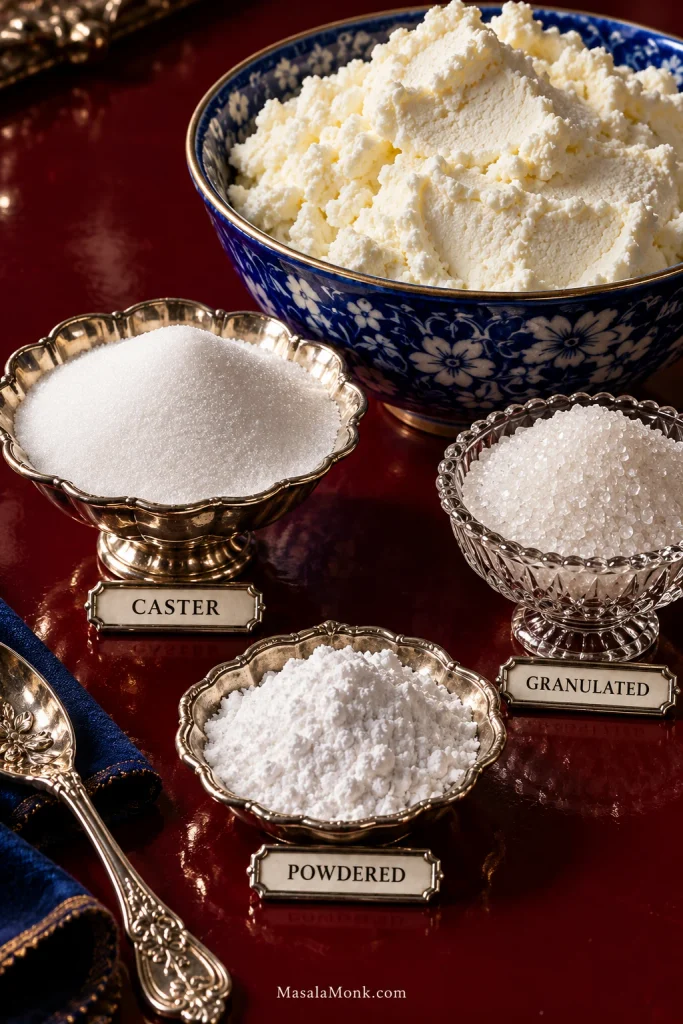
Cannoli cream is made with different sugars depending on the bakery and recipe. This version uses superfine or caster sugar because the small crystals dissolve readily during the refrigerated rest.
Regular granulated sugar can work too, but its larger crystals need more time to dissolve.
Powdered Sugar Works Too
Use 125 g / 4.4 oz sifted powdered, icing or confectioners’ sugar in place of the initial caster sugar. Use the same weight, not the same cup measure.
Some brands contain a little anti-caking starch, so the texture may differ slightly from the caster-sugar version. Extra sugar is still a poor answer to wet ricotta; it raises the sweetness much faster than it solves the moisture problem.
Adding Mascarpone for a Richer Filling
Mascarpone gives cannoli cream a richer, smoother and denser character. Ricotta remains the defining cheese in the traditional filling.
For a richer but still ricotta-forward variation, replace about one-fifth of the ricotta with mascarpone. Sweeten the variation gradually, chilling and tasting the cream before adding more sugar.
Ways to Change the Filling
Once the plain cream is where you want it, variations are much easier to control.
Chocolate. Fold mini dark chocolate chips into the finished cream, or keep the filling plain and press chopped chocolate onto the exposed ends after piping.
Pistachio. Finely chopped pistachios are especially good on the exposed ends. Pistachio paste changes the sweetness, fat and thickness enough that it deserves its own adjusted formula.
Orange or citron. Finely grated orange zest or small pieces of candied orange or citron work beautifully with ricotta. Keep the quantity restrained; citrus peel becomes assertive quickly.

Whipped Cream Makes It Lighter
Some modern recipes fold separately whipped cream into ricotta for a lighter, fluffier result. Pouring liquid heavy cream into loose ricotta is a different technique and can make a wet filling wetter.
If You’re Using Cannoli Cream in a Cake
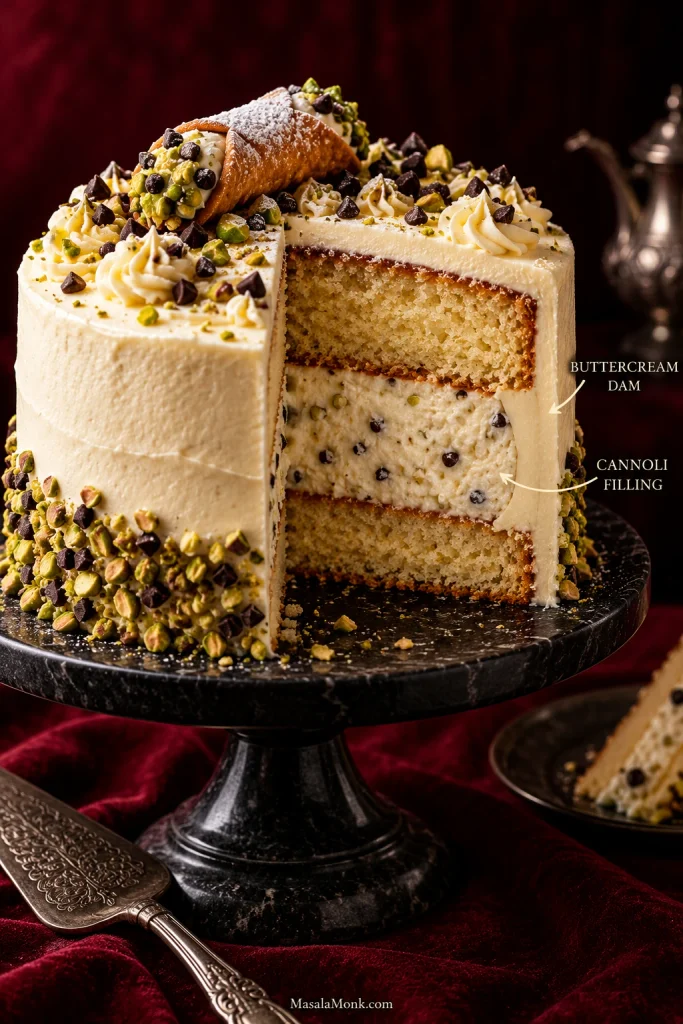
Thick cannoli cream can be delicious between modest cake layers once it is firm enough to pipe cleanly. Taller or heavier cakes may need a buttercream dam around the perimeter so the ricotta does not squeeze outward.
Heavy tiers, fondant-covered cakes and detailed exterior piping need a filling or frosting designed for those structural demands.
A cake filled with fresh ricotta cannoli cream should also remain refrigerated.
If you need something that can cover a cake, hold cupcake swirls or form simple borders, use our cream cheese frosting recipe instead of trying to turn this ricotta filling into frosting.
For the cannoli themselves, once the cream tastes the way you want, the next job is getting it cleanly into the shell.
Pipe the Filling from Both Ends
The best way to fill cannoli shells is to pipe from both ends toward the centre. That prevents a shell that looks full at the openings but hides an empty tunnel through the middle.
- Transfer the cold cream to a piping bag with a large round or star tip.
- Insert the tip well into one end of the shell.
- Pipe while slowly withdrawing the bag toward the opening.
- Turn the shell and repeat from the other side.
- Let the two portions meet in the centre.

With mini chocolate chips in the cream, use an opening around ½ inch / 12–13 mm so the pieces can pass cleanly. A sturdy zip-top freezer bag with one corner snipped off also works when you do not have a pastry bag.
The payoff for all that moisture control is the contrast: cold ricotta cream inside a shell that still fractures when you bite it.

For homemade shells, dough thickness, frying temperature, the first-shell test and complete assembly, return to the full MasalaMonk cannoli recipe.
Make the Filling Ahead. Fill the Shells Late.
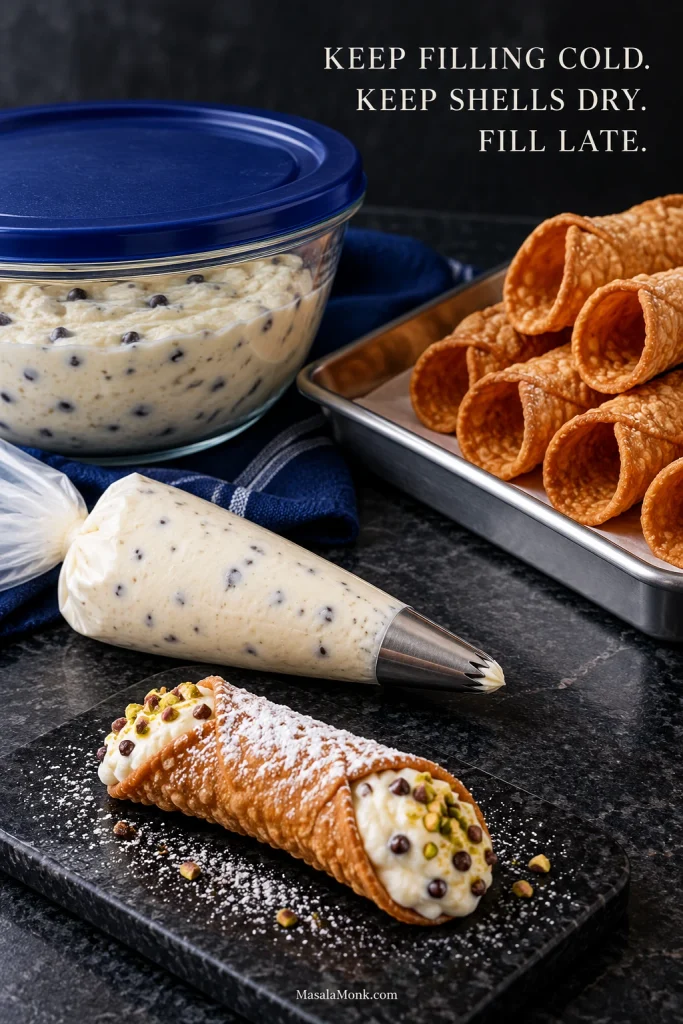
For the crispest shell, fill cannoli as close to serving as practical. The ricotta cream can be prepared earlier; the shells are better kept dry and empty.
Once the cream touches the fried pastry, moisture begins moving into the shell. How quickly it softens depends on the shell, humidity and the filling itself.
For a Party
Day before: make the cream, cover it well and refrigerate it.
Before serving: prepare chocolate, pistachios, candied citrus or other garnishes. Keep the shells dry in an airtight container.
Final hour: fill from both ends, garnish and serve. The closer to serving you fill them, the crisper the shells will be.
A Chocolate Barrier Buys Time
A thin coating of melted chocolate inside the shell slows the movement of moisture from the cream into the pastry. It helps, but it does not make an overnight-filled cannoli taste freshly assembled.

How Long the Filling Keeps
For the best flavour and texture, use cannoli filling within 1–2 days. If it has been kept continuously refrigerated at 4°C / 40°F or colder, plan to use it within about 3 days rather than stretching storage longer.
Follow FoodSafety.gov’s refrigeration guidance for fresh dairy: return perishable food to refrigeration within 2 hours, or within 1 hour when the surrounding temperature is above 32°C / 90°F.
Filling that has spent too long outside safe refrigeration should be discarded even if it still looks normal.
Freezing Changes the Texture
Cannoli filling can be frozen, although thawing usually hurts the texture. Ricotta may become grainier or release water, so refrigeration is the better choice when the finished cream matters.
Keep the filling cold. Keep the shells dry. Fill them late. The crisp shell can take it from there.








