
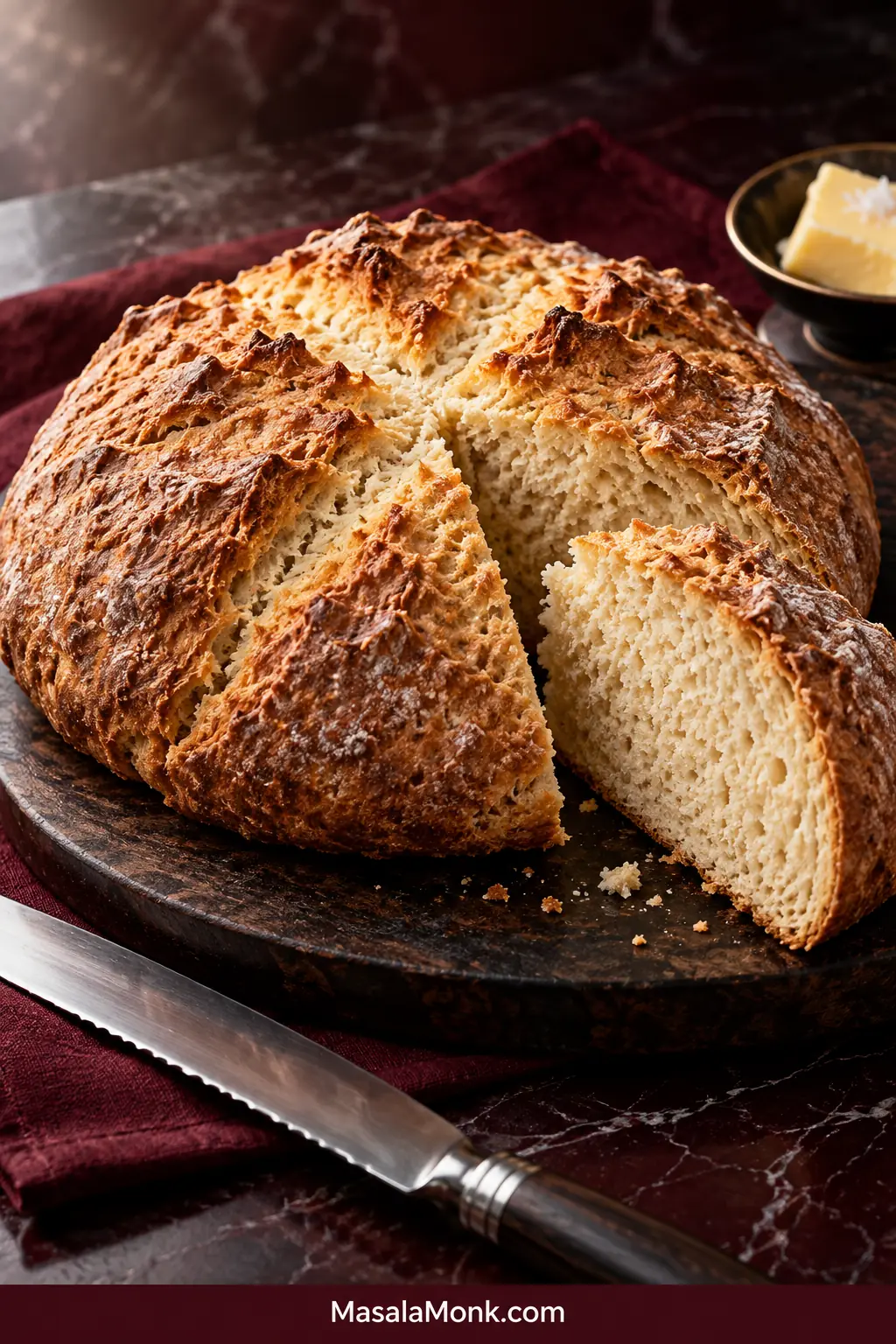
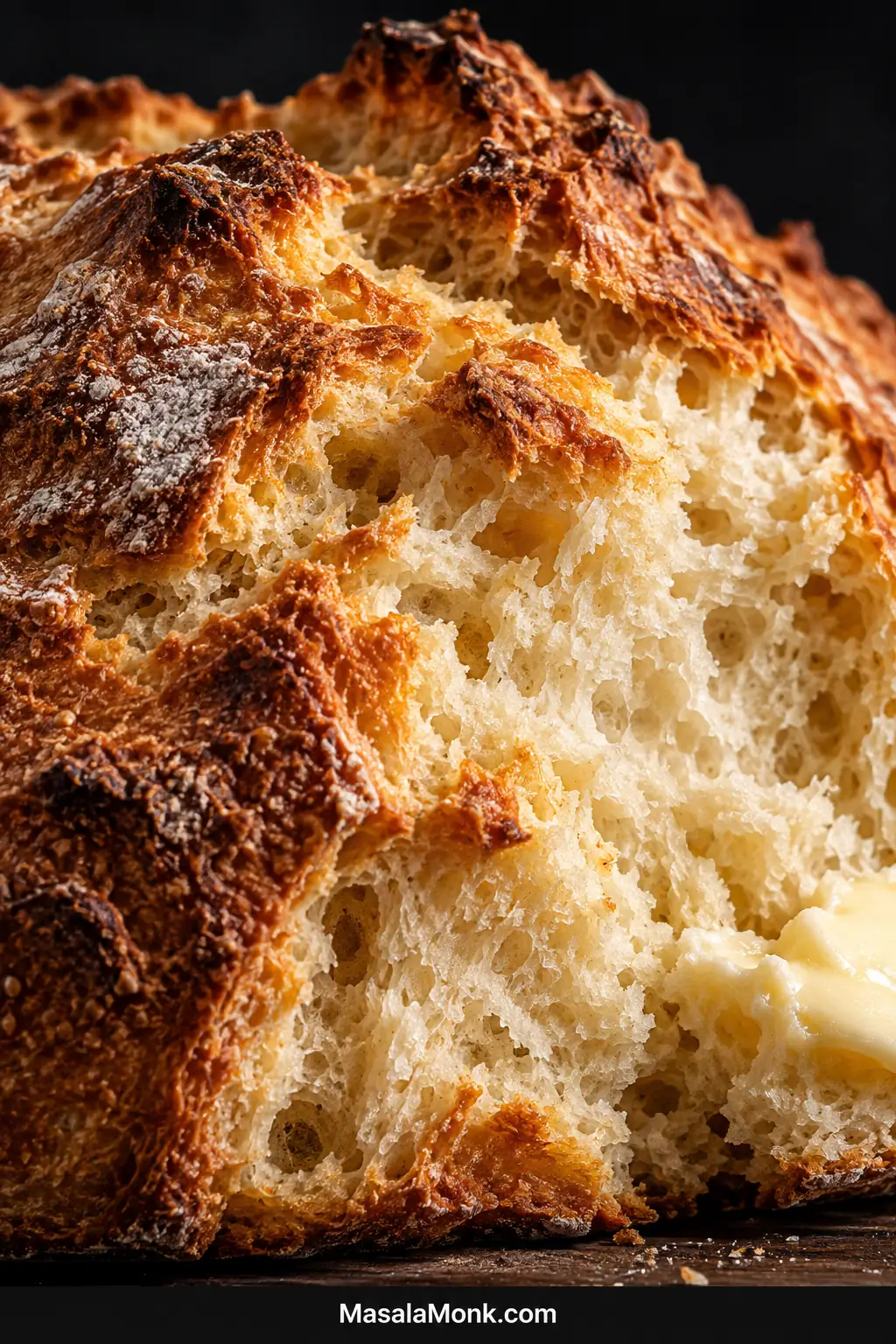
This Irish soda bread recipe gives you a craggy, deeply golden crust around a tender, close-grained buttermilk crumb. Once the loaf has rested, the crust should give a little crackle under the knife.
You only need four ingredients: flour, baking soda, salt and buttermilk. There is no yeast or proofing, and the dough only needs a few quick folds—not kneading until smooth and elastic. Once the oven is hot, mixing and shaping takes about 10 minutes and the loaf bakes for another 40–45 minutes.
The few places that need judgment are the buttermilk, loaf shape, depth of the cross and final doneness. Once you know what to look for, none of them is difficult.
Before you start: keep a little buttermilk back, expect a shaggy dough, flatten the loaf instead of making a tall ball, and plan to check the middle rather than trusting the crust alone.
Irish Soda Bread Recipe
Easy, Crusty & Tender Irish Soda Bread
A lean four-ingredient white soda bread with no yeast or proofing, a craggy crust and a gently tangy, close crumb.
Equipment
You need a large mixing bowl, light-colored baking sheet, sharp knife and cooling rack. A kitchen scale and instant-read thermometer are useful if you have them. If lining the sheet, use parchment rated for 450°F / 230°C.
Ingredients
- 3¾ cups / 450 g all-purpose flour, spooned and leveled if using cups
- 1 level teaspoon baking soda / bread soda / bicarbonate of soda, about 5 g
- 1 teaspoon fine sea salt / about 6 g
- Up to 1⅔ cups / 400 ml cultured buttermilk, divided
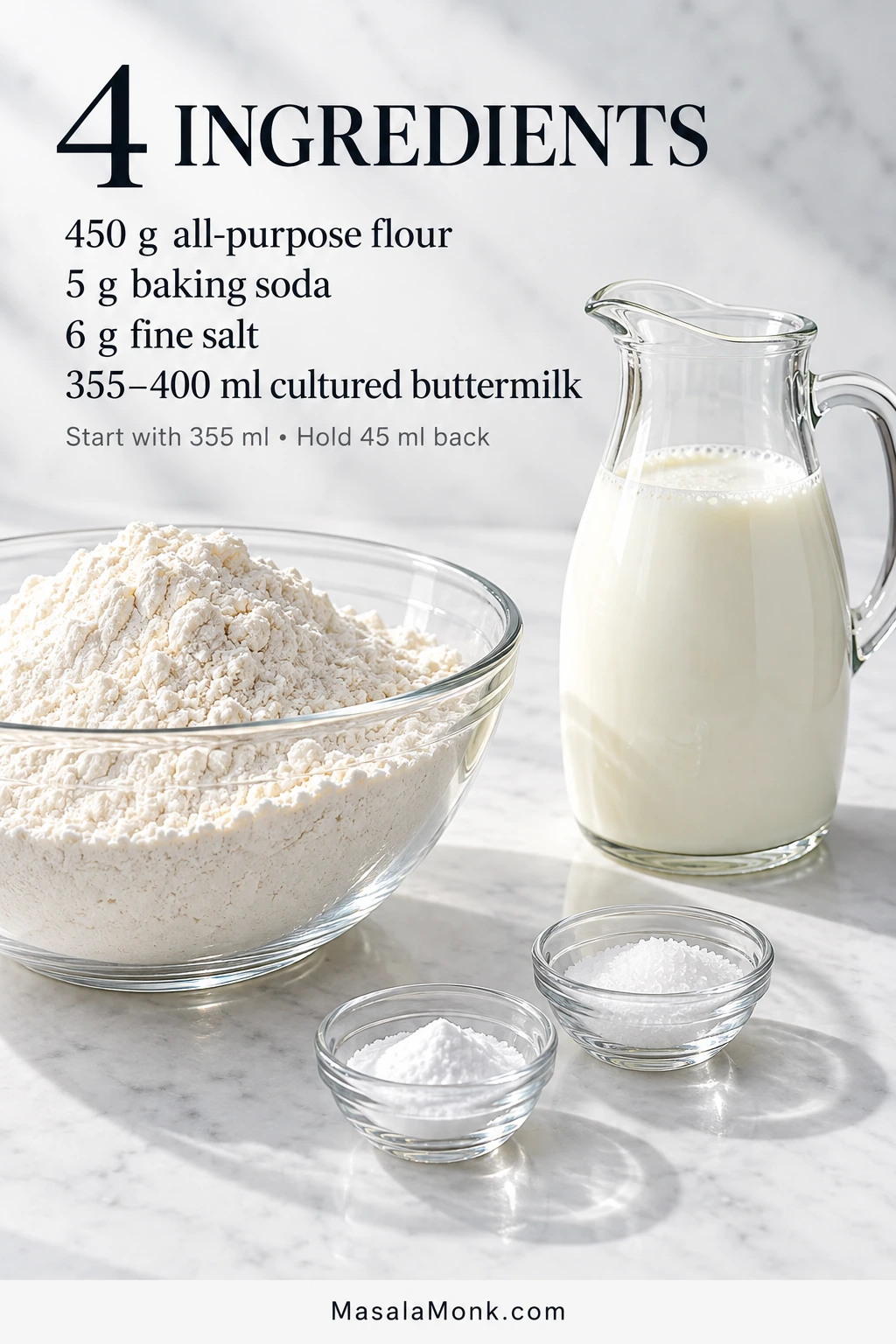
Start with 1½ cups / 355 ml buttermilk. Keep about 3 tablespoons / 45 ml in reserve. You may not need all of it.
Baking soda and baking powder are not interchangeable here. Buttermilk supplies the acid the baking soda needs, so a 1:1 swap changes how the loaf rises.
No buttermilk? See the buttermilk substitutes below.
Dough still looks too dry or too loose? Jump to the dough guide before adding more liquid or flour.
Method
Mix the Dough
- Heat the oven and prepare the sheet. Set the oven to 450°F / 230°C conventional or 410°F / 210°C fan/convection. Use parchment rated for this heat or bake on a clean, unlined light-colored sheet. If your sheet is dark, check the underside a little earlier because it may brown faster.
- Mix the dry ingredients. Put the flour, baking soda and salt in a large bowl and whisk thoroughly. Even mixing helps prevent bitter pockets of soda.
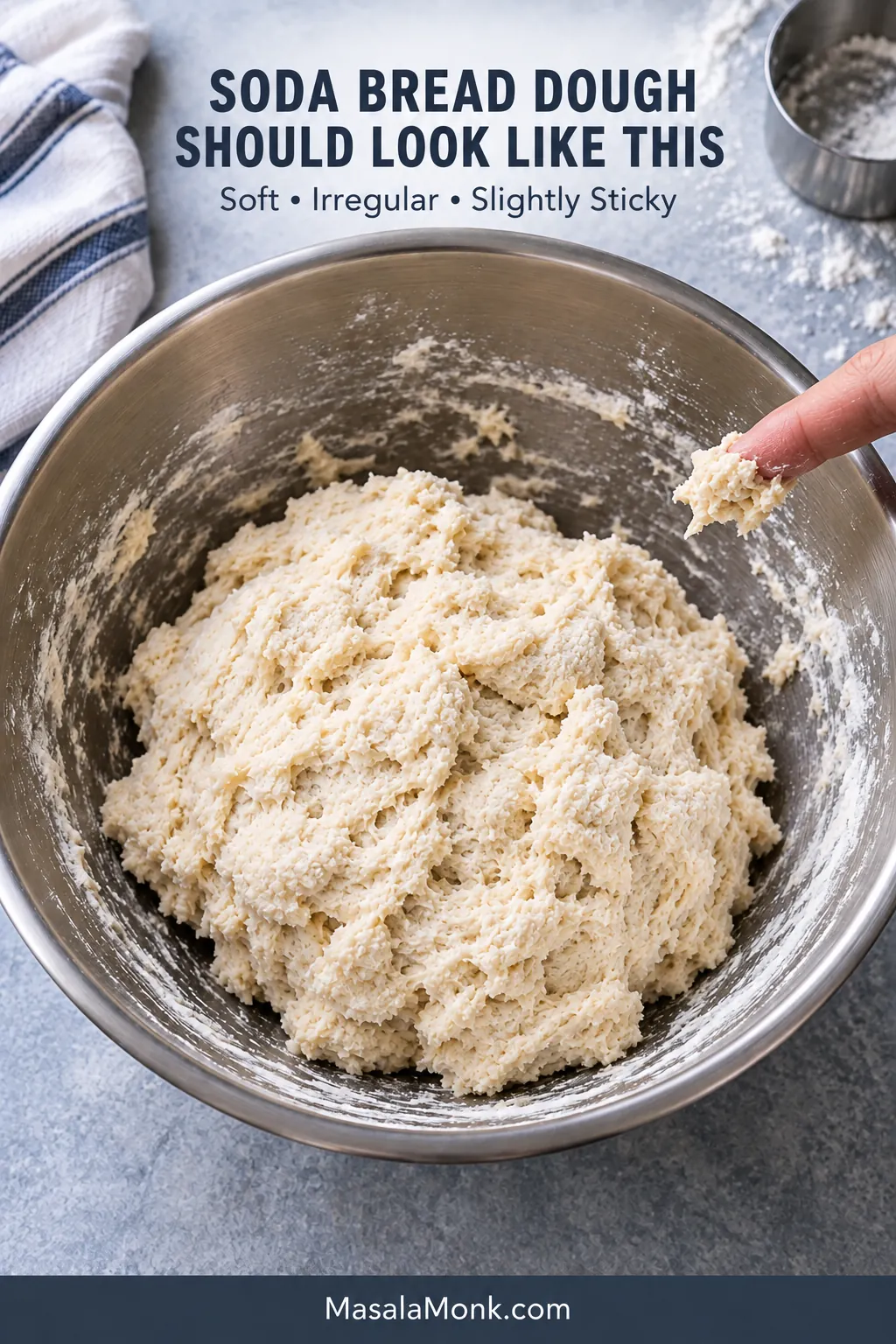
- Add the buttermilk gradually and keep moving. Pour in 1½ cups / 355 ml and quickly draw the flour into the liquid. Once wet meets dry, the soda is already reacting. If dry flour remains, add reserved buttermilk 1 tablespoon / 15 ml at a time. Stop when the dough clings lightly to your fingers but can still hold its shape.
Before shaping, pause here and compare the dough with the visual below. It should move as one shaggy mass and feel lightly tacky, without looking polished or elastic like kneaded yeast dough.
Shape, Score and Bake
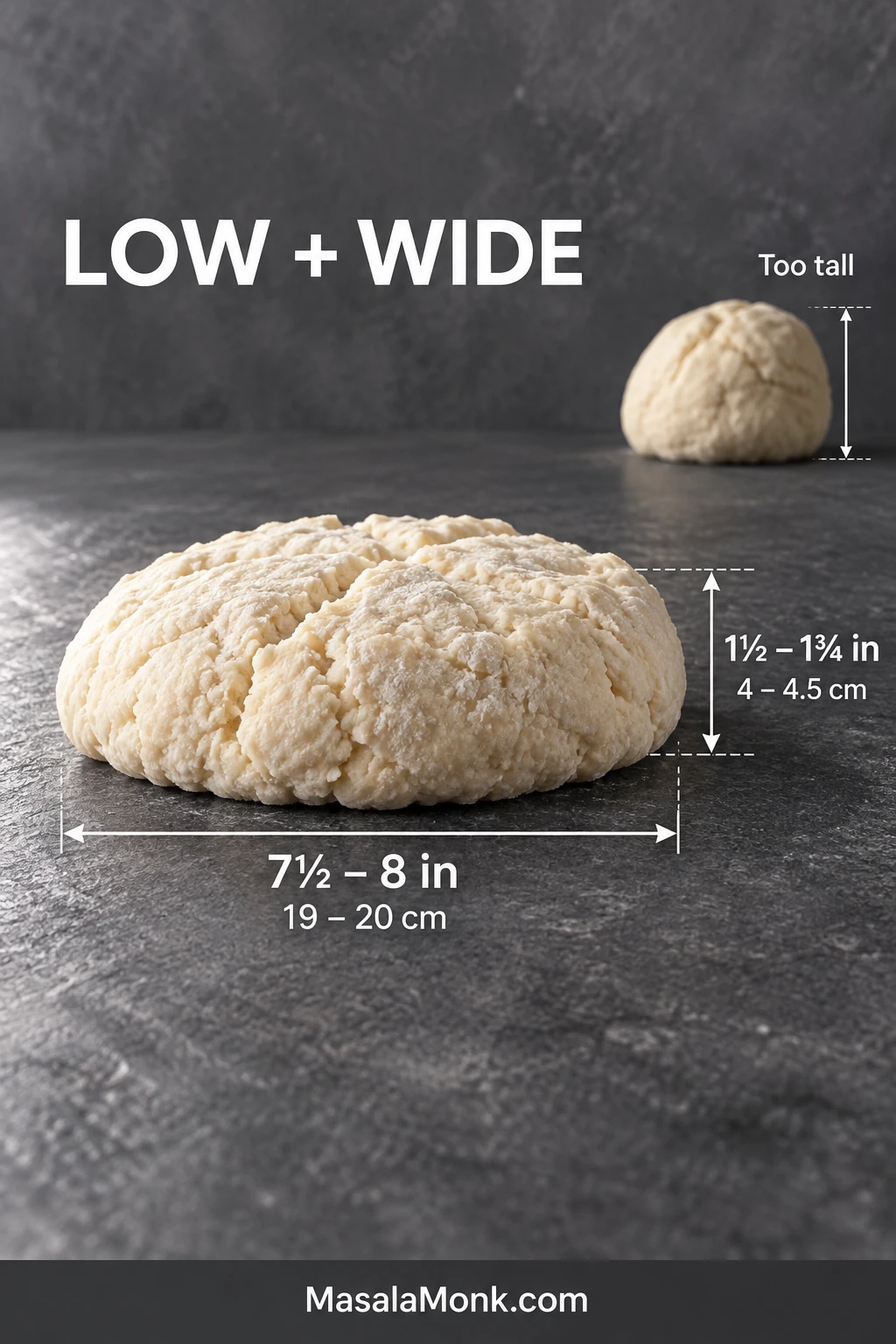
- Gather and shape. Turn the dough onto a very lightly floured surface. One or two gentle folds are enough if it needs tidying. Shape it about 7½–8 inches / 19–20 cm across and 1½–1¾ inches / 4–4.5 cm high. Don’t spend time making it perfect; a few creases and rough edges belong on soda bread.
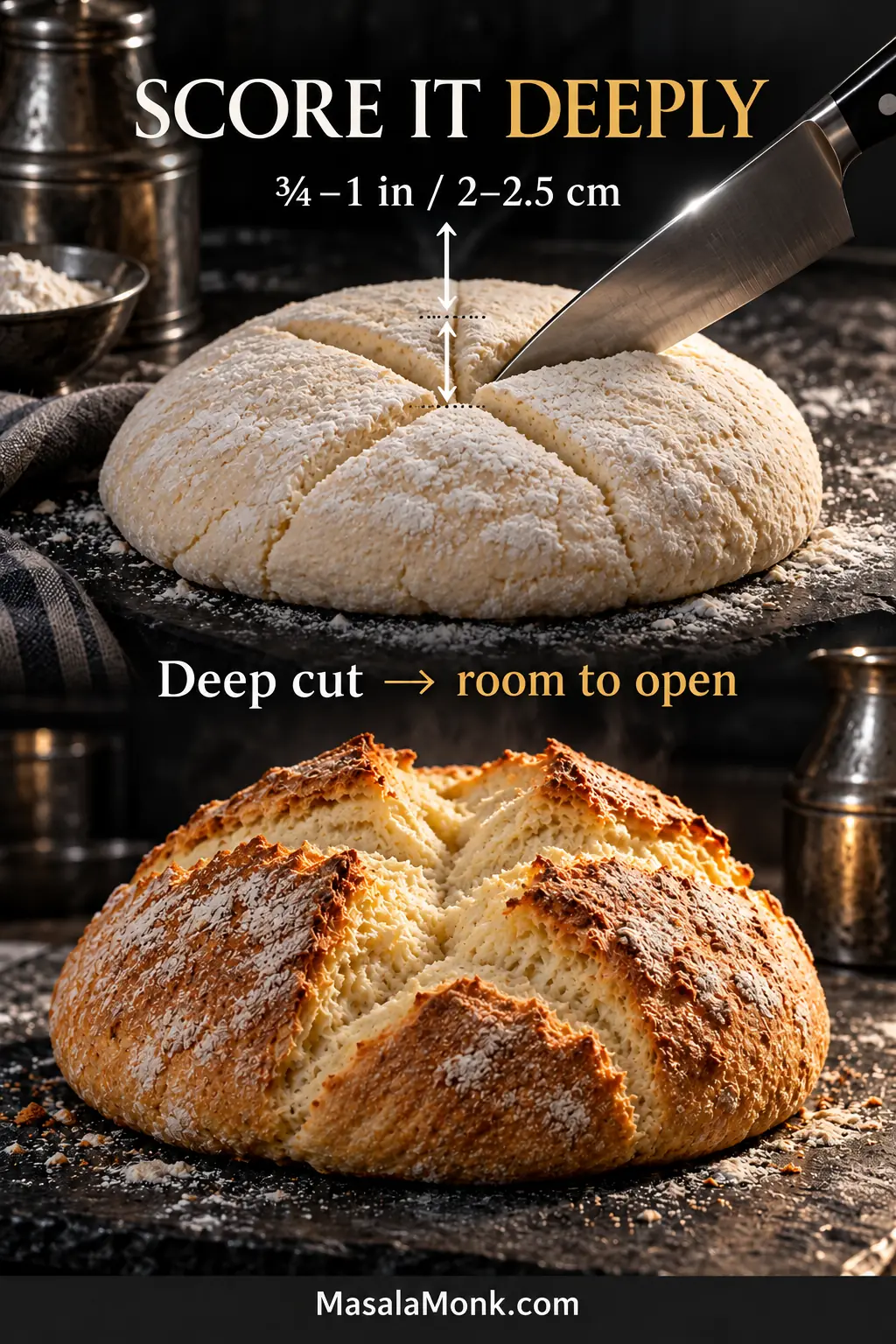
- Give it a deep cross. Slash an X about halfway to two-thirds through the loaf—roughly ¾–1 inch / 2–2.5 cm deep at this thickness—and carry the cuts nearly to the edges.
- Bake hot, then lower the heat. Start with 15 minutes at 450°F / 230°C conventional or 410°F / 210°C fan/convection. Reduce the oven to 400°F / 200°C conventional or about 355°F / 180°C fan/convection and continue for another 25–30 minutes.
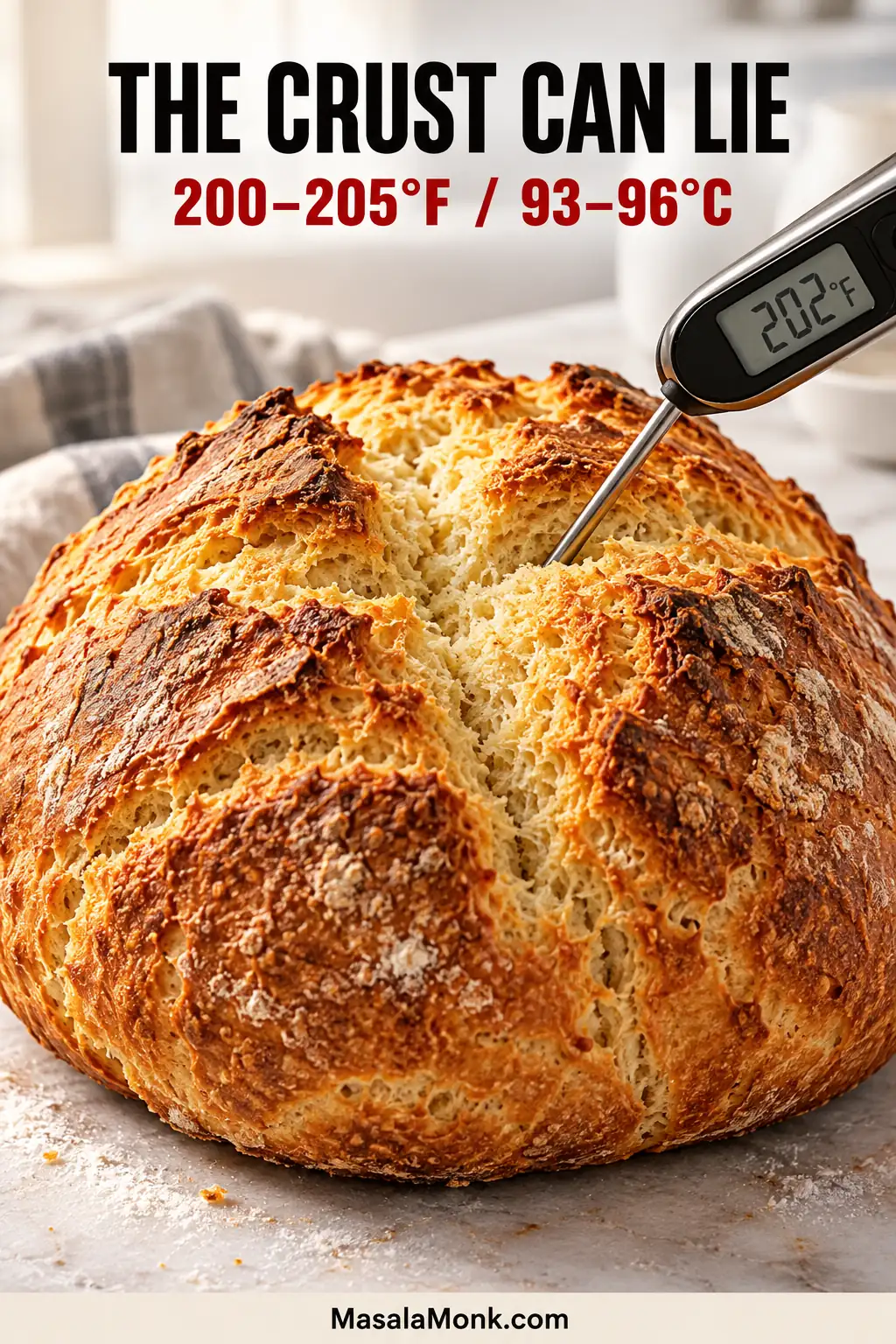
- Check for doneness. Look for a deeply golden crust, a set-looking cross and a hollow sound underneath. If you have a thermometer, the thickest part should be around 200–205°F / 93–96°C. When the crust is ready before the middle, tent it loosely with foil and keep baking.
- Cool before slicing. Move the loaf to a rack and leave it for about 1 hour for the cleanest crumb. If you want warm bread, 30–45 minutes is workable, but expect a softer slice.
Recipe Notes
- Use conventional heat if your oven offers both. Fan/convection temperatures are included for ovens that need them.
- If you’re unsure about an older box of baking soda, test it or replace it rather than guessing.
- For a softer crust, loosely drape a clean tea towel over the loaf while it cools. Leave it uncovered for a crisper crust.
If everything above makes sense, you can stop there and bake. The rest is for the moments when the dough feels odd, the crust gets ahead of the middle, or you need to change an ingredient.
Not Sure About Your Loaf?
Dough & Baking
Ingredients & Variations
Serving & Keeping
Read the Dough, Not the Measuring Jug
This is not a smooth, polished bread dough. It should look irregular and feel soft enough to be slightly sticky while still holding itself together.
Flour does not absorb liquid identically from one bag, brand or country to another, and buttermilk can be thick or surprisingly fluid. Darina Allen’s soda bread masterclass likewise gives a liquid range rather than one compulsory amount.
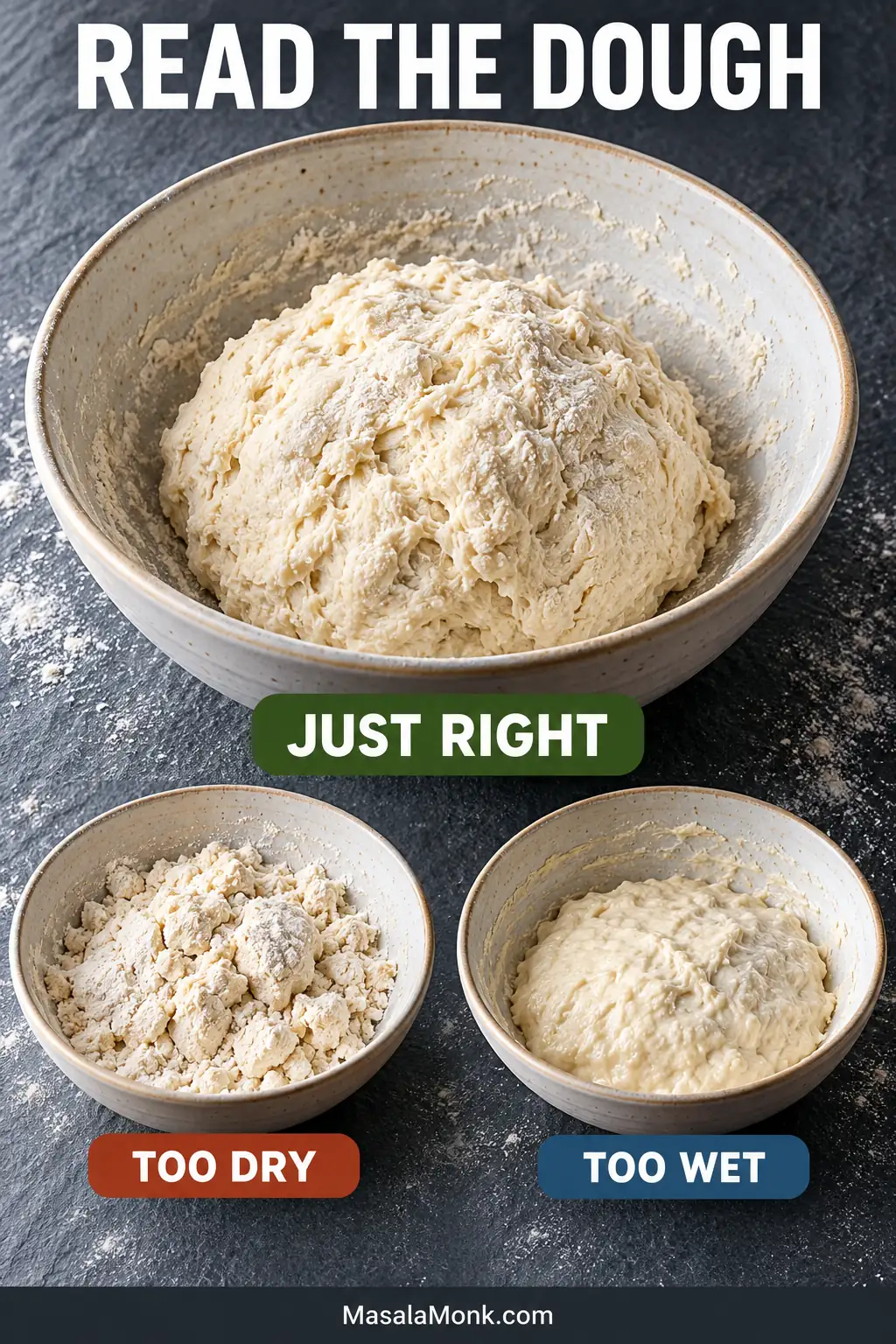
Too dry
Loose flour remains, cracks fall apart, and a gentle squeeze will not make the dough hold together. Add reserved buttermilk 1 tablespoon / 15 ml at a time.
Just right: the dough clings lightly to your fingers but stays where you put it. Sticky is not automatically too wet. Once you reach this stage, leave it alone.
Too wet
The dough flows, puddles or slumps badly instead of keeping its shape. First make sure all the flour has been incorporated. If it still cannot hold itself, add a small amount of flour cautiously.
Weighing the flour makes this easier. A heavily packed measuring cup followed by extra bench flour can push the loaf toward dry before it reaches the oven.
Keep It Rough, Low and Deeply Scored
Once the dough comes together, the less fussing, the better.
Rough: stop early
One or two gentle folds may help the dough come together. Beyond that, there is little to gain from working it. A few creases and rough edges are exactly at home on this bread.
Low: give the middle a chance
Keeping the loaf squat gives heat less distance to travel before the middle sets. Think roughly 8 inches / 20 cm wide and under 2 inches / 5 cm high, rather than a tall compact ball.
Score it deeply
The cross gives the expanding dough room to open and lets heat reach farther into the thickest part. Give it a proper cut—roughly halfway to two-thirds through—instead of scratching the surface.
Irish tradition gives the cross another job too: letting the fairies out. The practical reason is still handy when dinner is waiting.
The Crust Can Lie About the Center
Don’t let color make the decision by itself. Use several cues together.
| Check | What You Want |
|---|---|
| Crust | Deeply golden and firm. |
| Underside | A hollow sound when tapped. |
| Opened cross | The exposed crumb looks set rather than wet or paste-like. |
| Thermometer | The thickest part around 200–205°F / 93–96°C. |
If the crust is ready first, tent the loaf loosely with foil and keep baking. When the underside still feels damp, take the loaf off the baking sheet and return it directly to the oven rack for a few minutes.
Give the crumb time to settle. About an hour on the rack lets the interior set properly. Cut sooner if you want warm bread, but expect a softer slice.
If Your Soda Bread Didn’t Behave
Most soda-bread problems are small and fixable. Find the symptom that matches your loaf and change one thing on the next one; that’s usually enough.
Dough and Shape Problems
| What Happened? | Why It Happens & What to Change |
|---|---|
| Why is my dough sticky? | If it still holds its shape, it may be completely fine. Extra flour is usually unnecessary. |
| Why does the dough spread like batter? | There is too much liquid for the flour. Hold some buttermilk back and add the last of it gradually. |
| Why does the dough crumble apart? | It needs more moisture or started with too much flour. Add reserved buttermilk 1 tbsp / 15 ml at a time. |
| Why is the loaf heavy and tough? | Too much flour, too little liquid and excessive handling are the main causes. |
| Why did the loaf burst or mushroom? | The score may have been too shallow. Give the expanding dough a deeper path through the top. |
Baking, Crumb and Crust Problems
| What Happened? | Why It Happens & What to Change |
|---|---|
| Why is the middle raw or gummy? | A truly raw middle usually points to a loaf that was too tall, too wet or underbaked. If the crumb is baked through but seems gummy, slicing before it had time to cool can be the reason. |
| Why is the crust dark before the center is done? | The outside is cooking faster than the middle. Shape the next loaf flatter; once the crust is dark enough, tent with foil. |
| Why is it dry and crumbly? | Too much flour or too much oven time are common causes. Weigh the flour and use the interior to decide when the loaf is finished. |
| Why does it taste bitter or soapy? | Too much baking soda, too little acidity or unevenly mixed soda can leave an alkaline flavor. |
| Why did it barely rise? | Old soda, weak acidity or dough left sitting after mixing can contribute. Soda bread will still rise less dramatically than yeast bread. |
| Why is the crust so hard? | Loosely drape the well-baked loaf with a clean tea towel while it cools. The trapped steam softens the crust. |
Raw Center vs Soft Crumb
A soft slice is not automatically underbaked. Use the comparison below to separate a genuinely raw center from a tender crumb that is simply still warm.
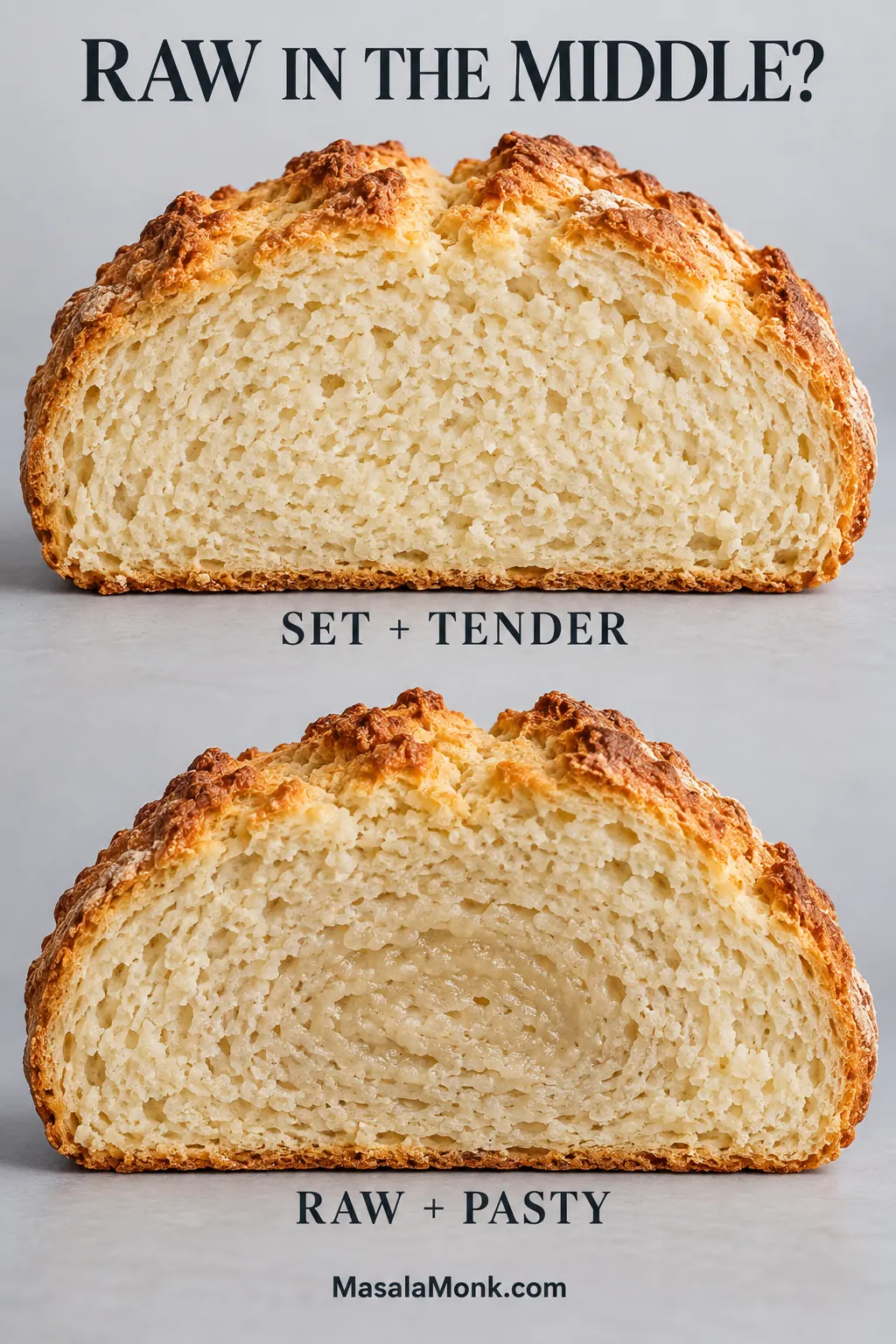
If the center is fully set but simply close-grained, see what normal Irish soda bread texture looks like before changing the recipe.
Is Irish Soda Bread Supposed to Be Dense?
A good soda bread is close-grained and substantial while still feeling tender. Dense is normal; gummy or leaden is not.
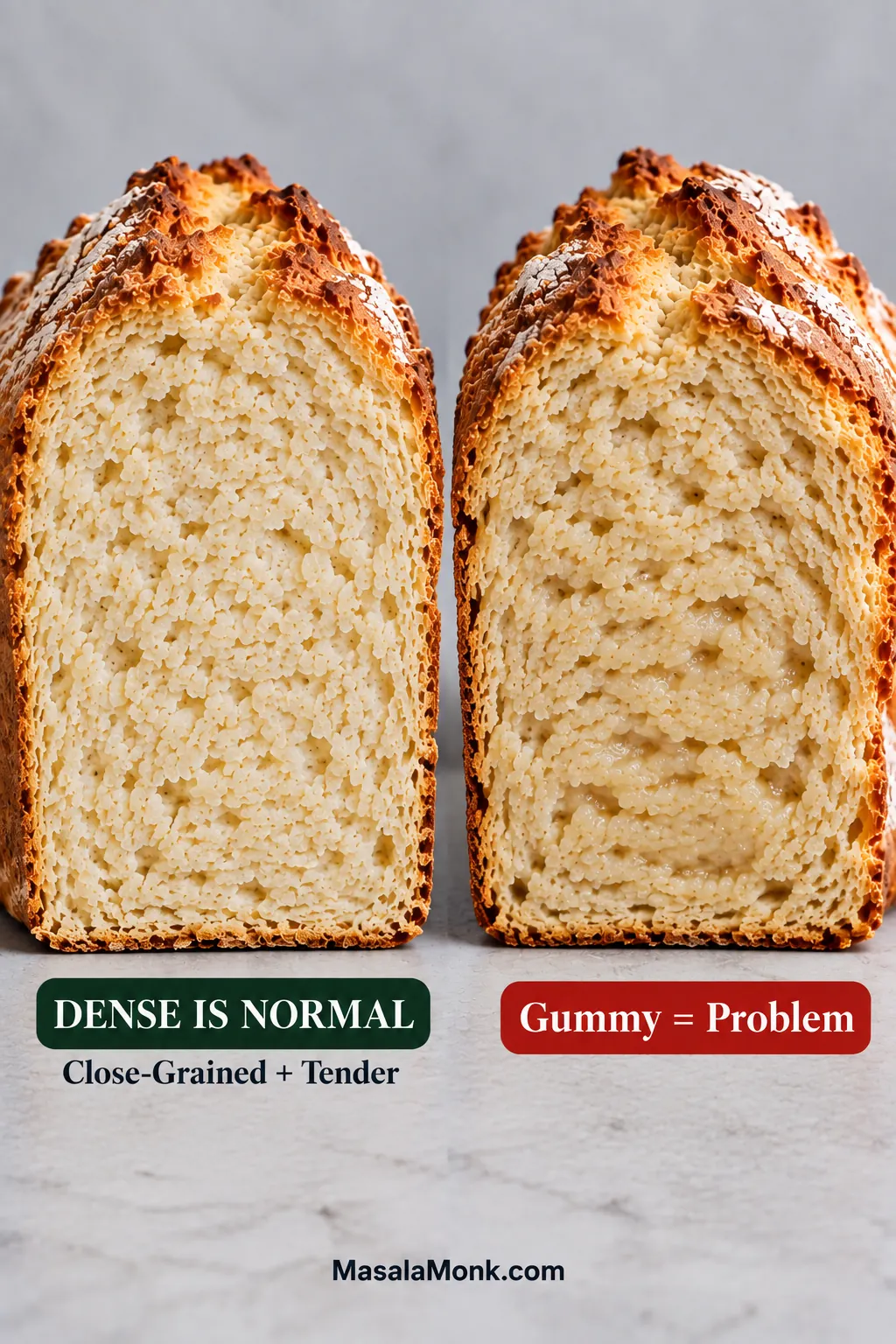
If what you see is actually wet or paste-like in the middle, go back to the raw-center comparison; that is a different problem from ordinary density.
When it is right, a slice feels sturdy in your hand but gives easily under the teeth. The edge has some crackle, while the crumb stays tender enough for butter to sink into it.
That close crumb is one reason soda bread works so well beside Guinness beef stew. A thick slice can catch the stout gravy without immediately collapsing into the bowl.
The flavor should be wheaty, lightly salty and gently tangy. A strong baking-soda taste is a warning sign. Because the acidic dairy helps keep that balance right, substitutions deserve a little care.
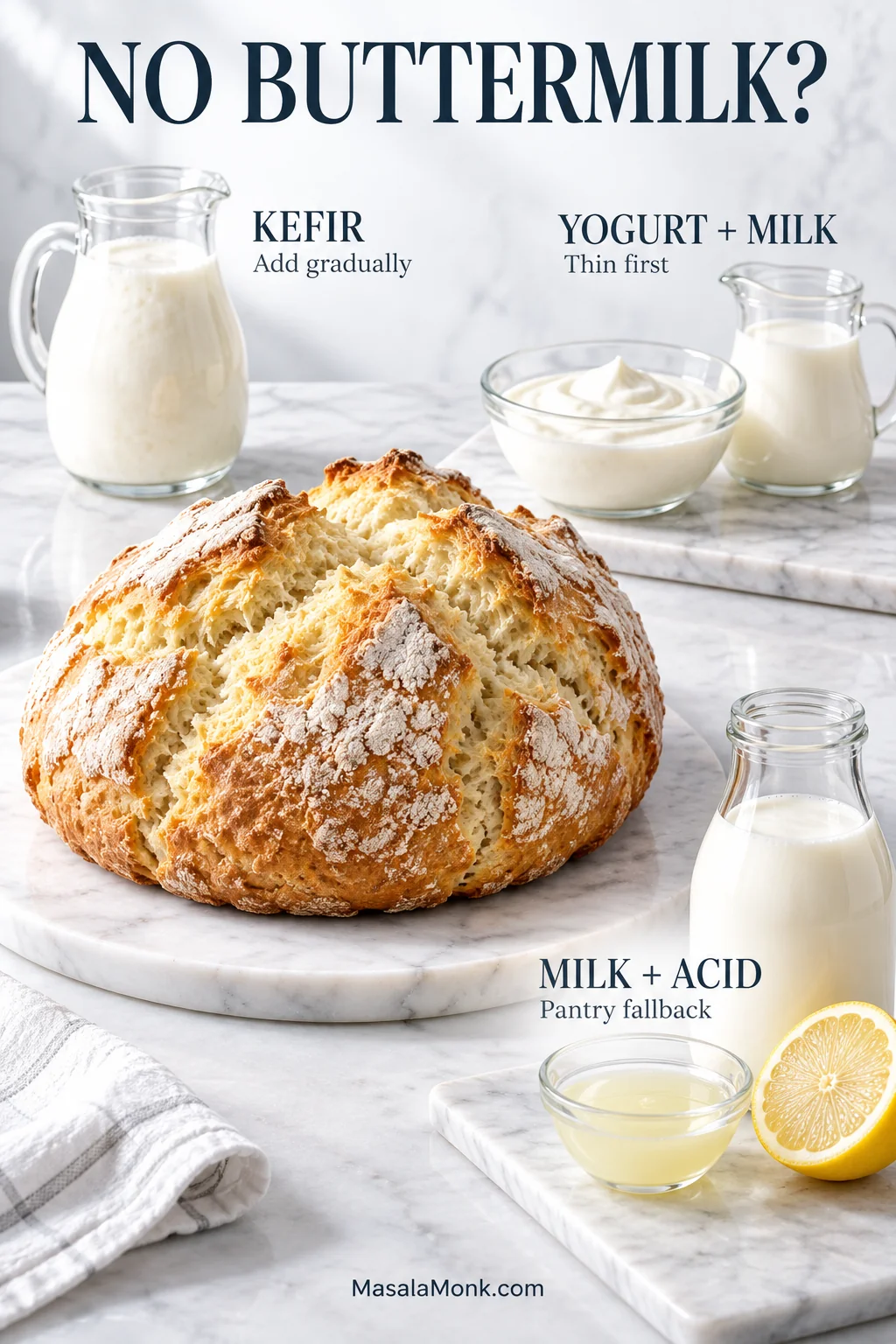
Can You Make Irish Soda Bread Without Buttermilk?
Yes, but keep two things intact: enough acidity for the baking soda and roughly the right consistency for the dough.
| Substitute | How to Use It |
|---|---|
| Kefir | Works very well here. Pour it in gradually because some brands are noticeably thicker than others. |
| Plain full-fat yogurt | Thin it with milk until it pours roughly like cultured buttermilk or heavy cream. Greek yogurt will need more milk than ordinary plain yogurt. |
| Whole milk + lemon or vinegar | Pantry fallback: for 400 ml total, add 25 ml / 1 tbsp + 2 tsp lemon juice or white vinegar to the jug, then fill with whole milk to 400 ml. Rest 5–10 minutes and add gradually because the mixture is thinner than cultured buttermilk. |
| Plain milk | Too low in acidity for this baking-soda recipe. |
Whichever substitute you use, let the dough decide the final amount. If it looks crumbly or too loose, revisit the dough guide before correcting it.
Bought a whole carton of buttermilk? Use the rest in our fluffy buttermilk pancakes the next morning.
Do You Need Irish Flour for Soda Bread?
For this white soda bread, ordinary U.S. all-purpose flour works well. Bread flour is unnecessary, and you do not need to hunt down specialty Irish flour.
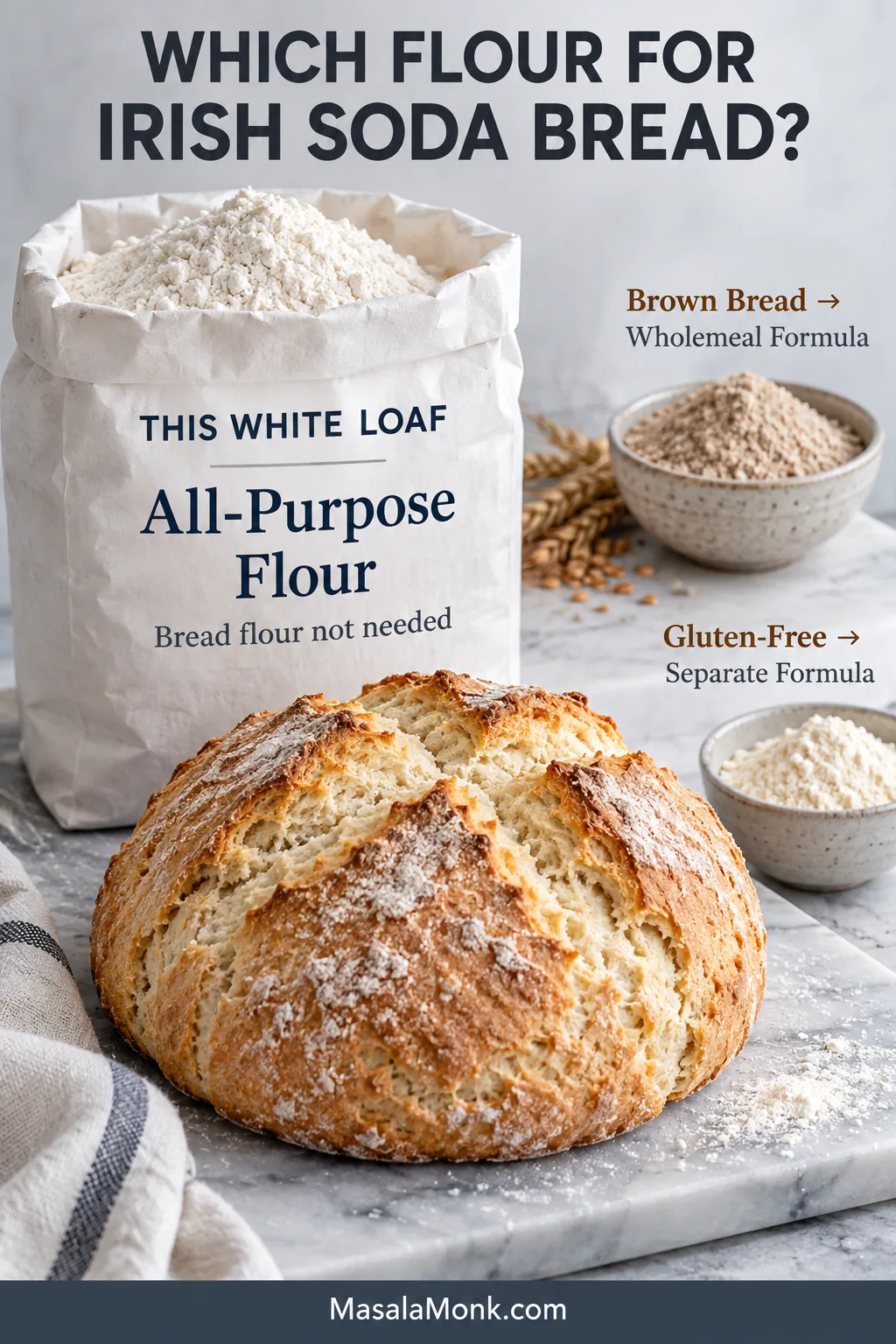
For brown soda bread, wholemeal flour changes both the texture and how much liquid the dough needs. Irish-style wholemeal flour can be an excellent choice there. Gluten-free soda bread likewise needs a formula built around gluten-free flour rather than a straight swap into this loaf.
Raisins or No Raisins?
Plain savory soda bread is a traditional everyday Irish form; dried fruit belongs to enriched relatives such as Spotted Dog and to many Irish-American soda breads. If you grew up with raisins and caraway, your family version is not imaginary—and neither is the plain loaf someone else remembers.
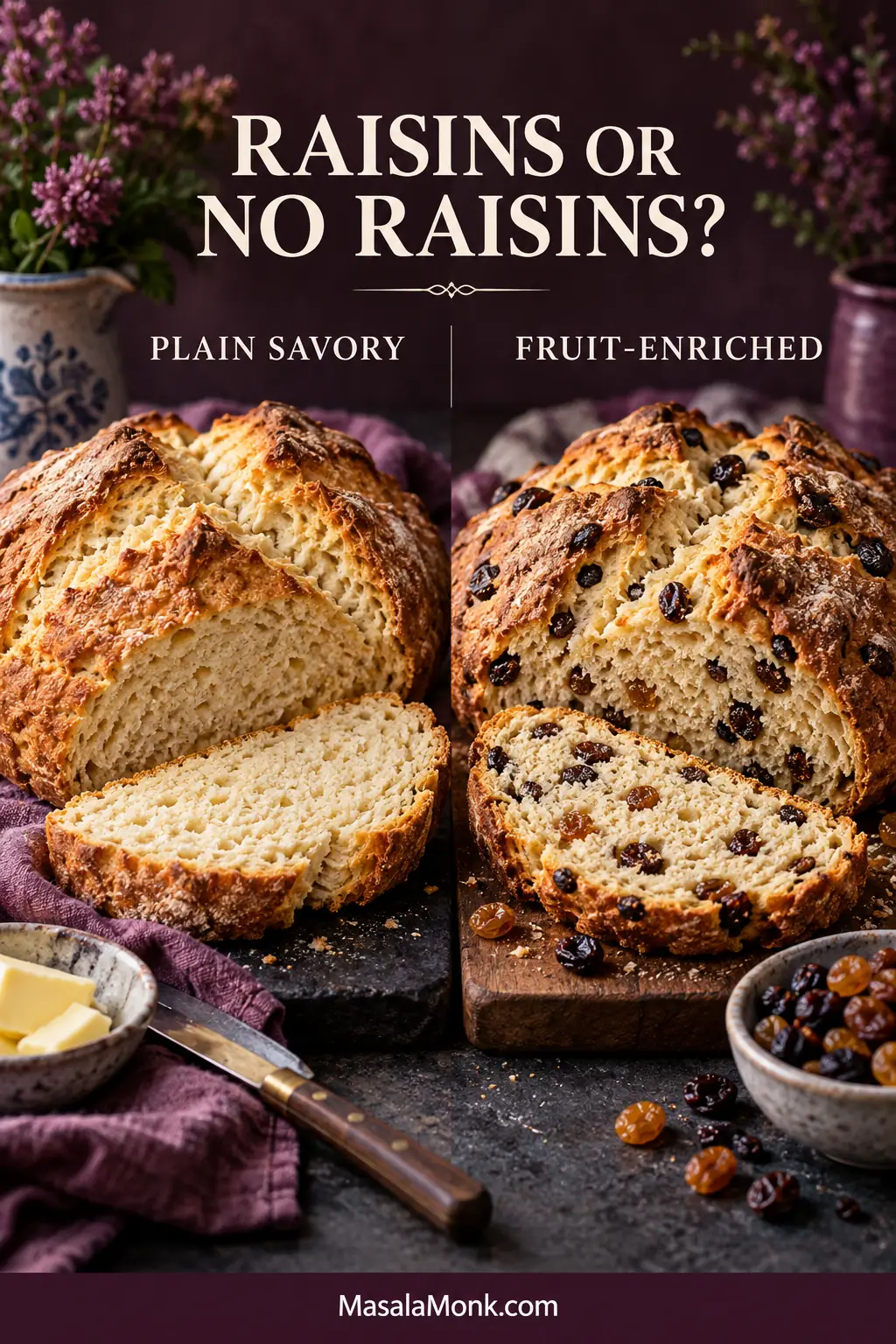
Irish household recipes still vary. Bord Bia’s traditional white soda bread, for example, includes butter and egg and lists cream of tartar as optional.
The main loaf here stays lean and savory. Cultured buttermilk already supplies the acidity needed for the baking soda, so cream of tartar is unnecessary.
A simple fruit version
Toss 3.5 oz / 100 g dried fruit—roughly ⅔ cup, depending on whether you use currants, raisins or sultanas—through the dry ingredients before adding the buttermilk. Then add the liquid gradually as usual.
That gives you a straightforward fruit soda bread. A fully enriched Spotted Dog changes more than the fruit.
Spotted Dog and Irish-American soda bread
Spotted Dog—also known regionally by names including Railway Cake—is an enriched relative of soda bread, made with dried fruit and often egg or sugar.
Irish-American versions commonly add butter, egg, sugar and dried fruit, and some family recipes use caraway. If egg goes into the dough, count it as part of the wet ingredients instead of adding it on top of the full amount of buttermilk.
White, Brown, Wheaten and Farls
- White soda bread: primarily white flour; this is the style used here.
- Brown soda bread / Irish brown bread: substantial wholemeal flour and a different amount of liquid.
- Wheaten bread: a closely related Northern Irish wholemeal bread tradition.
- Soda farls: flatter soda-bread dough divided into quarters and commonly cooked on a griddle.
- Potato farls: a separate potato-based griddle bread, often served alongside soda farls.
What to Eat With Irish Soda Bread
The first slice barely needs a plan. Let the loaf cool enough for the crumb to set, cut through the crust and spread it generously with salted butter while there is still a little warmth inside.
For lunch or dinner, thick slices are particularly good beside creamy white bean soup. The crisp crust brings contrast to the soft beans while the crumb picks up the broth.
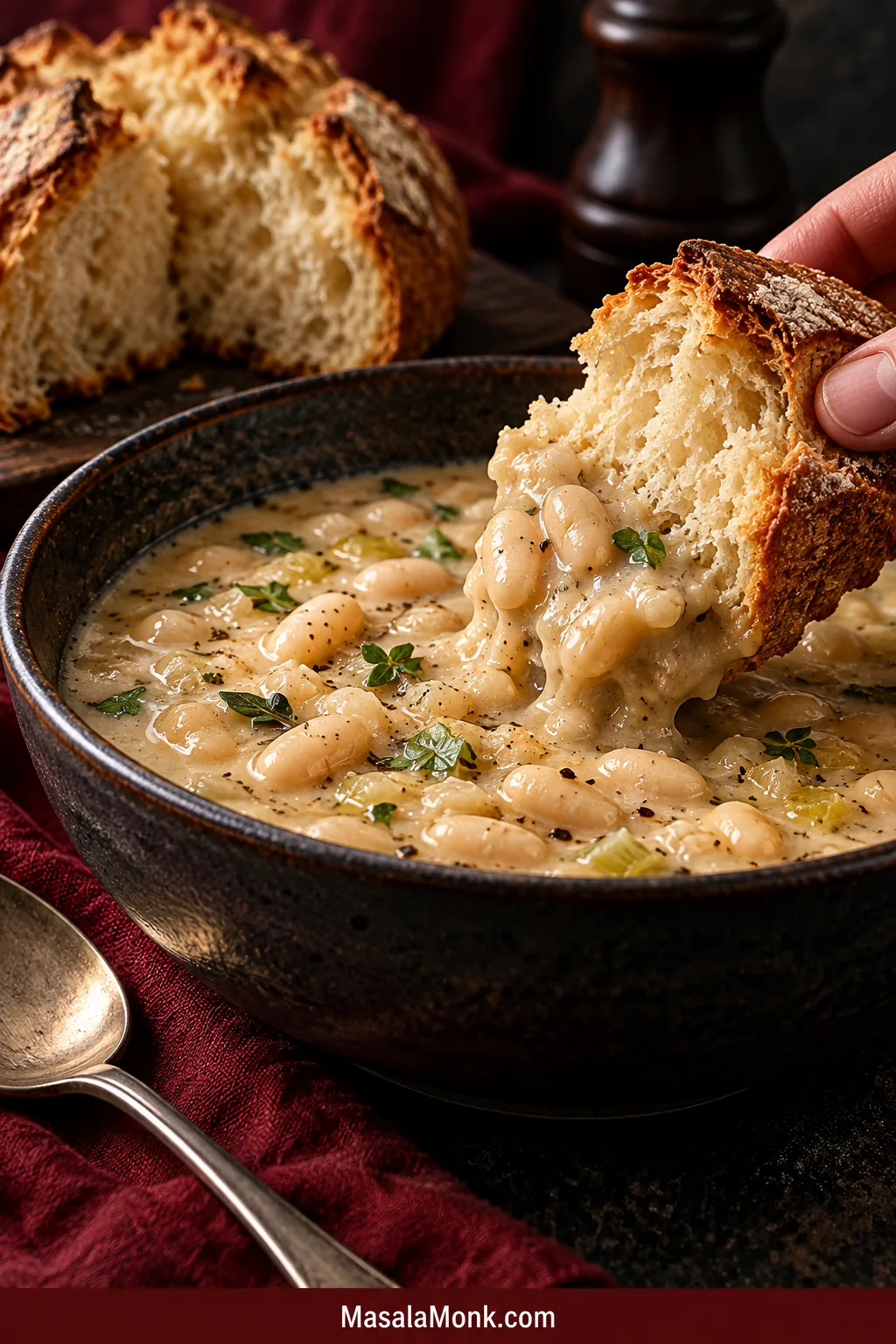
Eggs, mature cheddar and smoked salmon are natural savory partners too.
For something sweeter, salted butter and homemade orange marmalade are excellent against the mild buttermilk tang. Jam and honey work beautifully as well.
Fresh Today, Toast Tomorrow
Soda bread is best on day one, excellent toasted on day two, and better frozen than left to dry out after that.
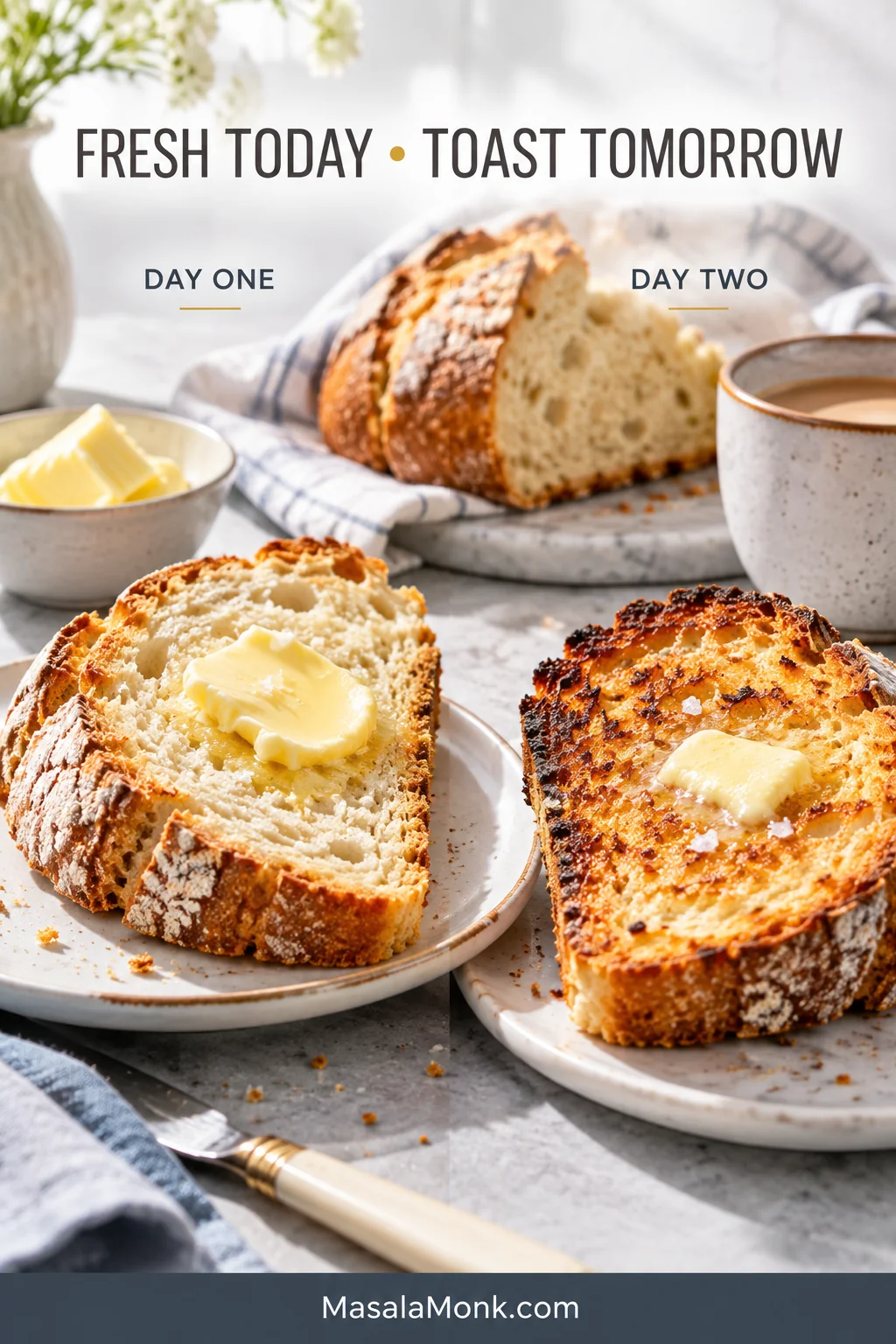
Day one: enjoy it once the crumb has set. Cool completely before wrapping whatever is left.
Day two: keep it well wrapped at room temperature and toast it. A thick slice makes a sturdy base for avocado toast, or use one to scoop up shakshuka and its tomato-pepper sauce and soft yolk.
For longer storage: freeze the cooled loaf or individual slices for up to about 3 months for best quality. Slices can go straight into the toaster from frozen; larger pieces can thaw before reheating. If the bread becomes properly stale, toast it hard, serve it under eggs, or use larger leftovers in bread pudding where the drier crumb becomes useful.
A Few Useful Questions
Why doesn’t Irish soda bread need yeast?
Buttermilk’s acidity reacts with baking soda to make the gas that lifts the loaf, so there is no yeast or proofing stage. Once wet and dry meet, shape and bake the dough without leaving it sitting around.
Can I make the dough ahead?
Better not. Have the baking sheet ready and the oven hot before you mix, then shape and bake the dough straight away.
Can I bake it in a loaf pan?
Yes, but don’t transfer the round-loaf timing blindly to a loaf pan. A deeper pan changes how quickly heat reaches the middle, so rely on the same doneness cues and expect the bake to take longer.
Can I make this gluten-free?
Not reliably with a one-for-one flour swap. Use a soda bread recipe built around gluten-free flour instead.
Is Irish soda bread healthy?
This particular loaf has no added sugar or butter, but it is still made primarily with white flour. Wholemeal soda breads generally provide more fiber, while enriched versions may add butter, egg, sugar and dried fruit. How it fits into your diet depends on the portion and what you eat with it.
After about an hour on the rack, cut through the opened cross. The crumb should be set but still tender. A thick slice with salted butter is enough.








