Posted on Leave a comment

Lobster Bisque Recipe: Easy Creamy Homemade Lobster Bisque With Lobster Tails

Creamy lobster bisque in a white bowl with lobster pieces, chives, cream swirl, crusty bread, spoon, and navy linen.

Lobster bisque feels intimidating for one honest reason: lobster is expensive, and the soup shows every shortcut. Weak stock tastes flat. Boiled cream can turn grainy. Lobster meat that sits in the pot too long becomes rubbery instead of sweet and tender.

This version is built to avoid those problems. It gives you a creamy, silky, restaurant-style bowl using lobster tails, seafood stock, aromatics, tomato paste, dry sherry or white wine, and cream. You can keep it simple with clean-tasting seafood stock, or take the fuller route and simmer the lobster shells into that same stock for a sweeter, more layered base.

It is still an easy lobster bisque built around lobster tails, but when you have an extra 25 minutes, the shells give the stock that deeper restaurant-style flavor.

The goal is simple: make the bowl taste like you used the expensive, old-school method, while giving you a calmer lobster-tail path that is much harder to ruin.

You do not need live lobster. There is no chef-only technique hiding in the fine print. You just need to treat the lobster with care, let the shells do some of the flavor work, and keep the cream stage low and steady instead of boiling hard.

It is the kind of soup that makes dinner feel planned and generous, whether you serve it as a holiday starter, a date-night bowl, or a quiet weekend dinner with bread on the side.

Quick Answer: How to Make Lobster Bisque

To make lobster bisque, briefly poach lobster tails in seafood stock just until the meat turns opaque. Remove the meat, save the shells, and use that same stock as the flavor base. For deeper flavor, simmer the shells with aromatics, tomato paste, herbs, and wine if using, then strain and measure the stock.

In a heavy pot, cook onion, celery, carrot, garlic, and tomato paste in butter, add flour, deglaze with dry sherry or white wine, pour in the prepared stock, and simmer until the vegetables are tender. Blend, strain if you want a polished finish, stir in cream over low heat, adjust the base, and add the lobster meat right before serving.

The whole method is about restraint: build flavor from the shells, then protect the cream and lobster at the finish.

For most home cooks, the best balance is the middle path: lobster tails poached in seafood stock, shells simmered back into that same stock, then cream and lobster added only once the base is ready.

Ready to cook? Go straight to the recipe card, or compare the easy, better, and best lobster bisque methods before you start.

This visual keeps the lobster bisque order simple: cook the tails briefly, use the shells for flavor, smooth the base, and protect the cream and lobster at the finish.
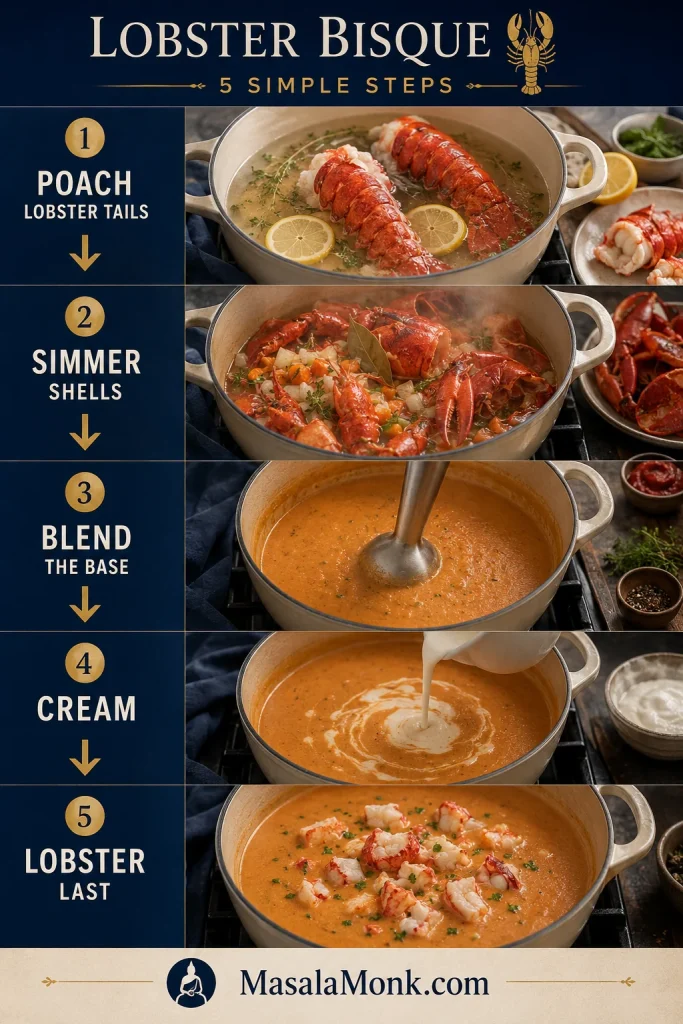
Vertical step-by-step guide showing lobster tails poaching, shells simmering, bisque blending, cream being added, and lobster added last.
First poach the tails, then simmer the shells, blend the base, add cream, and warm the lobster last; that order protects both flavor and texture.

Lobster Bisque at a Glance

Main lobster choiceLobster tails
Servings4 generous bowls or 6 appetizer servings
Finished amountAbout 5½ to 6 cups / 1.3 to 1.4 liters
Total timeAbout 1 hour 20 minutes to 1 hour 30 minutes
Texture goalSmooth, creamy, silky, lightly spoon-coating
Recommended pathPoach tails, simmer shells into the same stock, then finish with cream and lobster
Fullest stock optionSeafood stock simmered with lobster shells
Shortcut stock optionClean-tasting seafood or lobster stock
Main thickenerFlour roux, with gluten-free options below
Classic alcohol optionDry sherry, dry white wine, or a little brandy
No-alcohol optionExtra seafood stock plus lemon juice or sherry vinegar
Make-ahead tipMake the base ahead; add cream and lobster before serving
Freezer tipFreeze the base before adding cream and lobster

As a serving guide, a generous bowl is about 1⅓ to 1½ cups. An appetizer serving is closer to 1 cup.

Lobster Bisque Recipe Card

Creamy Lobster Bisque With Lobster Tails

This creamy lobster bisque is made with lobster tails, seafood stock, aromatics, tomato paste, dry sherry or white wine, and cream. The recommended path is simple: poach the lobster tails in stock, simmer the shells into that same stock for deeper flavor, build the bisque base, blend, strain, add cream, adjust the base, and warm the lobster only right before serving.

Prep Time20 minutes
Cook Time1 hour to 1 hour 10 minutes
Total Time1 hour 20 minutes to 1 hour 30 minutes
Servings4 generous bowls or 6 appetizer servings
YieldAbout 5½ to 6 cups / 1.3 to 1.4 liters

Main path: this card uses the shell-enhanced method because it gives the richest flavor without requiring whole live lobsters. For shortcuts, cooked lobster, no-alcohol swaps, and gluten-free thickening, see the quick notes after the card.

Read this before starting: the same 4 cups of stock are used first to poach the lobster, then simmered with the shells, then measured again for the bisque. You are not starting with 8 cups of stock.
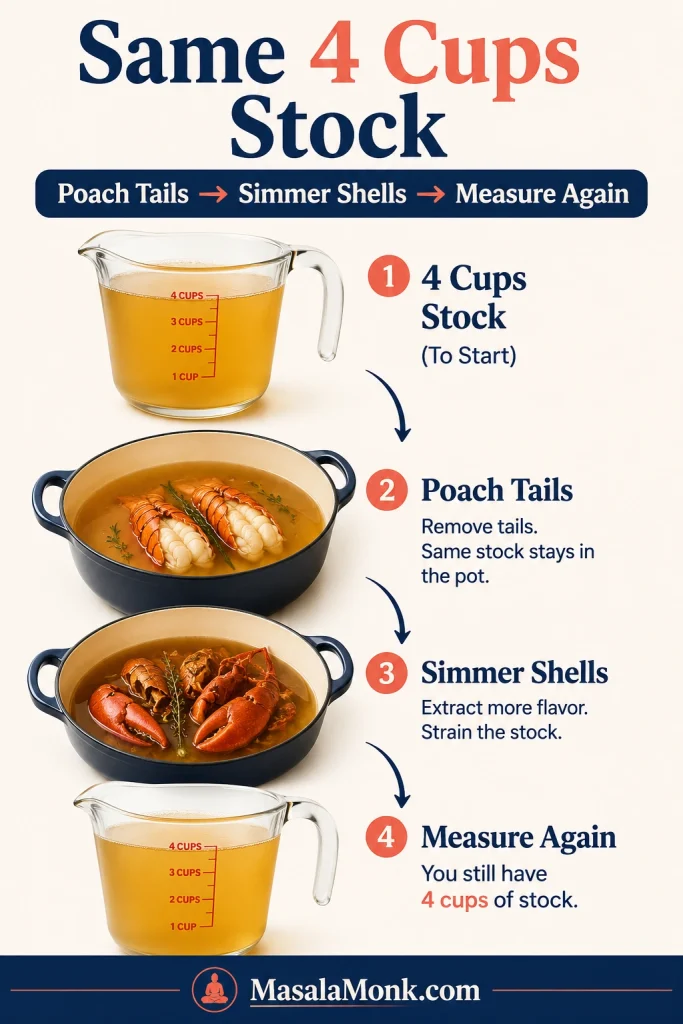
Infographic showing one measuring jug of lobster stock used to poach tails, simmer shells, and measure again for lobster bisque.
The same 4 cups of stock do three jobs: poach the lobster, pull flavor from the shells, and become the measured base for the bisque.

Ingredients

For the lobster and shell-enhanced stock
  • 4 lobster tails, 4 to 5 oz each / 115 to 140 g each
  • 4 cups clean-tasting seafood stock or lobster stock / 960 ml, preferably low-sodium
  • 1 tablespoon olive oil or butter
  • ½ small onion, roughly chopped
  • 1 celery rib, roughly chopped
  • 1 small carrot, roughly chopped
  • 2 garlic cloves, smashed
  • 1 tablespoon tomato paste
  • ½ cup dry white wine / 120 ml, optional for the shell stock
  • Up to 1 cup water or extra seafood stock / 240 ml, only if needed to top up after simmering
  • 1 bay leaf
  • 2 sprigs thyme, or ½ teaspoon dried thyme
For the bisque base
  • 4 tablespoons unsalted butter / 56 g
  • 1 medium onion, finely chopped / about 150 g
  • 2 celery ribs, finely chopped / about 100 g
  • 1 medium carrot, finely chopped / about 75 g
  • 3 garlic cloves, minced
  • 2 tablespoons tomato paste / about 32 g, or 3 tablespoons for deeper color
  • 3 tablespoons all-purpose flour / about 24 g
  • ½ cup dry white wine / 120 ml
  • ¼ cup dry sherry / 60 ml
  • 4 cups prepared lobster-shell stock from above / 960 ml
  • ½ teaspoon sweet paprika
  • Pinch of cayenne pepper, optional
  • ½ teaspoon dried thyme, or 1 teaspoon fresh thyme leaves
  • ¾ to 1 cup heavy cream / 180 to 240 ml
  • 1 teaspoon lemon juice or sherry vinegar, plus more to taste
  • Salt and black pepper, to taste
  • 1 tablespoon chopped chives, parsley, or tarragon, for finishing

Stock note: after simmering and straining, measure the liquid again. You need 4 cups / 960 ml for the bisque. If you are short, top it up with water or more seafood stock.

Instructions

Lobster and shell stock
  1. Prepare the lobster tails. Use kitchen shears to cut along the top of each shell. Leave the meat inside for the brief poach; you will remove it after cooking.
  2. Poach the lobster in the stock. Bring the 4 cups seafood or lobster stock to a low simmer. Add the lobster tails and cook for 3 to 5 minutes, depending on size, just until the meat turns opaque. Remove the tails from the stock. When cool enough to handle, pull out the meat, chop it into bite-size pieces, and set it aside. Save the shells and keep the stock.
  3. Build the shell stock. In a pot, heat 1 tablespoon olive oil or butter. Add the lobster shells, rough-chopped onion, celery, carrot, garlic, and tomato paste. Cook for 5 to 7 minutes, stirring often, until the shells smell fragrant and the tomato paste darkens slightly. Add wine if using, then pour in the lobster-poaching stock. Then add bay leaf and thyme. Simmer for 25 to 35 minutes.
  4. Strain and measure the stock. Pass the shell stock through a fine mesh strainer. Measure the liquid. You need 4 cups / 960 ml for the bisque. If you have less, top it up with water or seafood stock. Extra stock can be saved for thinning the soup or reheating leftovers.
Build and smooth the bisque base
  1. Start the bisque base. In a heavy Dutch oven or soup pot, melt the butter over medium heat. Add finely chopped onion, celery, and carrot. Cook for 6 to 8 minutes, until softened and sweet-smelling but not browned.
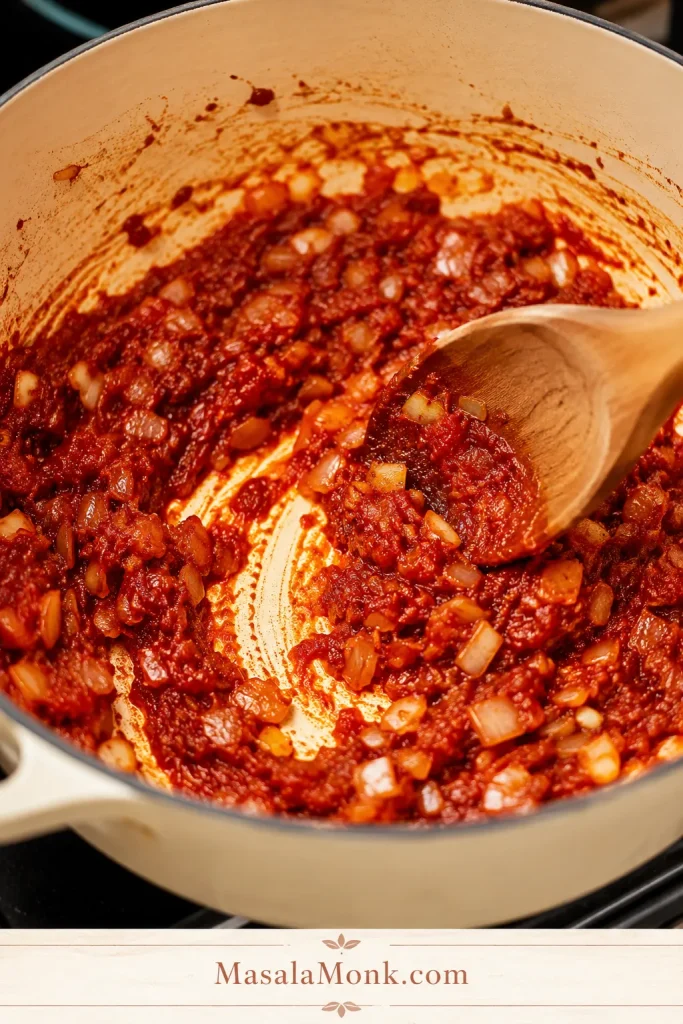
  2. Build the garlic and tomato paste base. Stir in the garlic and cook for 30 seconds. Add tomato paste and cook for 2 to 3 minutes, stirring often, until it deepens from bright red to brick-red and smells savory.
  3. Make the roux. Sprinkle in the flour and stir for 1 to 2 minutes. The mixture should look thick and pasty, like the vegetables are coated in a soft roux. If it looks dry, lower the heat and keep stirring.
  4. Deglaze. Slowly pour in the white wine and sherry, scraping the bottom of the pot. Let it bubble for 2 to 3 minutes so the sharp alcohol smell softens.
  5. Pour in stock and simmer. Add 4 cups prepared stock, paprika, cayenne if using, thyme, and a small pinch of salt and pepper. Bring to a steady simmer and cook for 18 to 22 minutes, until the vegetables are very tender and the broth tastes full. Salt gradually because seafood stock, clam juice, and lobster base can be salty.
  6. Blend. Carefully blend the soup until smooth using an immersion blender or countertop blender. If using a countertop blender, work in batches and vent the lid slightly so steam can escape.
  7. Strain for a silkier texture. For the most polished finish, pass the blended soup through a fine mesh strainer into a clean pot. Press with a ladle for liquid, then leave the gritty bits behind.
Finish with cream and lobster
  1. Add cream over low heat. Set the pot over low heat. Stir in ¾ cup cream. Add more cream if you want a richer bowl. The soup should look smooth and shiny, with steam rising but no hard bubbling.
  2. Finish the bisque base. Taste and adjust salt, pepper, lemon juice, or sherry vinegar. The finished base should lightly coat a spoon, smell sweet and buttery, and taste balanced. If it tastes heavy, add lemon juice or sherry vinegar. A thin base needs a little more simmering before the lobster goes in. Flat flavor usually means salt should be checked first.
  3. Add the lobster and serve. Stir in the chopped lobster meat and warm it for 1 to 2 minutes. For the safest texture, divide the lobster among bowls and ladle the hot bisque over it. Garnish with chives, parsley, or tarragon and serve hot, not boiling.

Shortcuts, Swaps, and Special Cases

Use these notes when real life does not match the main path exactly: no shells, cooked lobster, no wine, gluten-free needs, or making the base ahead. The recipe is forgiving as long as you protect the stock, cream, and lobster texture.

  • Easy version: poach the lobster in seafood stock, skip the shell-simmering step, and use that stock directly in the bisque.
  • Flavor upgrade: poach the lobster in stock, then simmer the shells in that same stock before making the soup.
  • Cooked lobster meat: skip poaching, use 4 cups seafood stock, and add the cooked lobster only right before serving.
  • Without lobster shells: use lobster stock if possible, or strengthen seafood stock with ¼ to ½ cup clam juice or a small spoonful of lobster base. Add salty bases carefully and taste before adding more salt.
  • No alcohol: replace the ½ cup wine and ¼ cup sherry in the bisque base with ¾ cup extra seafood stock. If you are also skipping the optional wine in the shell stock, use another ½ cup stock there too. Finish with lemon juice or sherry vinegar for brightness.
  • Gluten-free: skip the flour. After blending, whisk 1½ tablespoons cornstarch with 2 tablespoons cold water, stir it into the warm soup, and simmer for 1 to 2 minutes. You can also simmer 2 tablespoons uncooked white rice in the stock until tender, then blend it into the base.
  • Dairy-free: use cashew cream for the most neutral finish. Add it near the end over low heat, just as you would heavy cream.
  • Freezing: freeze the base before adding cream and lobster for the smoothest texture.

Back to top

Why This Lobster Bisque Works

The whole recipe is built around one idea: poach the lobster carefully, use the shells to deepen the stock if you can, blend the base smooth, add cream over low heat, and warm the lobster only right before serving. That path gives you a rich, polished bowl without buying whole live lobsters or guessing through the most expensive part of the process.

Method board with lobster tails, saved shells, golden stock, cream, and a finished bowl of lobster bisque.
Lobster tails keep the method approachable, while the saved shells add the deeper stock flavor that makes the bisque taste more restaurant-style.

The tails give you tender meat for the finished bowl, while the shells turn ordinary seafood stock into something sweeter and more seafood-rich. The aromatics soften in butter until sweet. Tomato paste cooks until it turns brick-red, which gives the soup color and savory depth. Wine and sherry brighten the base so the cream does not make everything taste heavy.

The shell step is the one shortcut I would not skip when I have the shells in front of me. It adds more flavor than extra cream ever will.

The final texture comes from three small choices: simmering the vegetables until tender, blending the base thoroughly, and straining if you want a smoother finish. Cream goes in after blending, and the lobster goes in right before serving. That is the quiet trick: the lobster is the prize, so do not make it do extra work in the pot.

What Is Lobster Bisque?

Lobster bisque is the smooth, creamy side of seafood soup: less chunky than chowder, more polished than stew, and built around shellfish stock, aromatics, tomato paste, wine or sherry, and cream. When it is done well, it tastes rich but not heavy, sweet with lobster but not fishy, and smooth enough to feel special.

Thickness is not the real goal. Balance is: a full seafood base, a little sweetness from the aromatics and tomato paste, enough acidity to wake everything up, and cream that makes the soup plush without muting the lobster.

Equipment You Need

You do not need a restaurant kitchen here. A heavy pot builds flavor, a blender smooths the base, and a fine mesh strainer gives the soup its polished finish.

  • Heavy Dutch oven or soup pot: for sautéing, simmering, and finishing the soup.
  • Kitchen shears: for cutting open lobster shells cleanly.
  • Cutting board and sharp knife: for chopping aromatics and lobster meat.
  • Blender or immersion blender: for smoothing the base.
  • Fine mesh strainer: for a silkier, more polished texture.
  • Whisk: for working flour into the base without clumps.
  • Ladle and measuring cup: for straining, measuring, and adjusting stock.

The fine mesh strainer is not mandatory, but it is the difference between a rustic homemade soup and a smooth bisque. Use it if you have one. If you use a countertop blender, blend hot soup in batches and vent the lid slightly so steam can escape.

Ingredients for Lobster Bisque

Once the method makes sense, the ingredient list feels much less fancy. Each item is there to build sweetness, body, brightness, or shellfish depth.
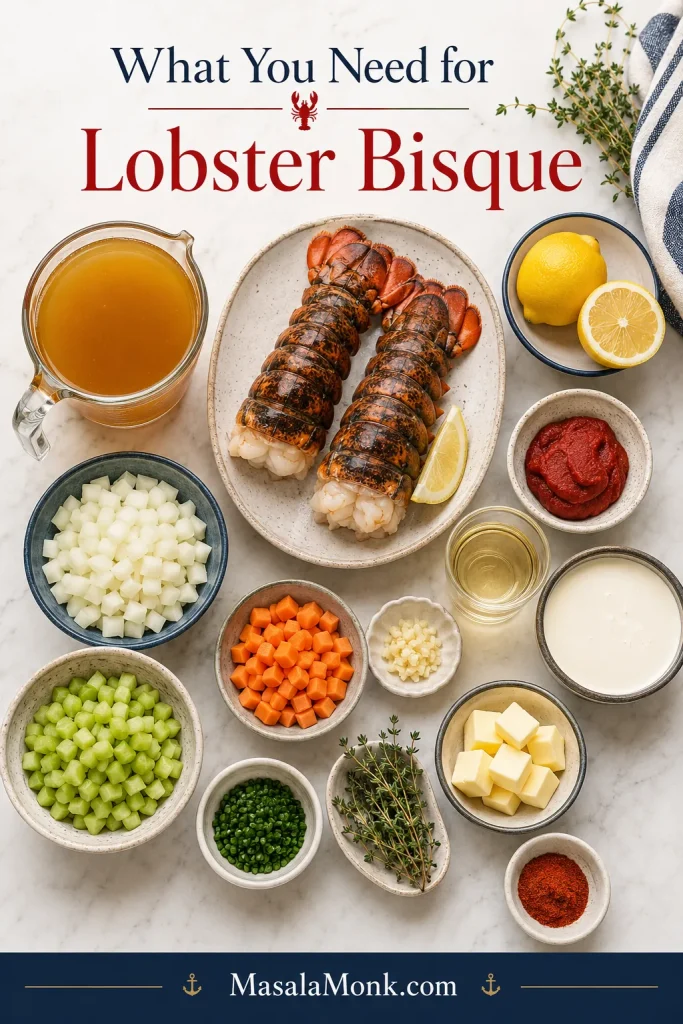
Overhead ingredient board with lobster tails, seafood stock, onion, celery, carrot, garlic, tomato paste, cream, wine, herbs, lemon, and butter.
Once the lobster tails, seafood stock, aromatics, tomato paste, cream, herbs, and lemon are laid out, the recipe feels organized instead of intimidating.

Lobster Tails

For homemade bisque, lobster tails are the most practical choice. They are easier to find than whole live lobsters, simpler to cook, and still give you shells for stock. Four tails, about 4 to 5 oz each, give enough lobster for 4 generous bowls or 6 appetizer portions.

Frozen lobster tails work well. Thaw them overnight in the refrigerator, or place them in a sealed bag in cold water if you need a faster thaw. Pat them dry before cooking so they do not water down the base.

If you bought extra lobster meat and want a colder, buttery seafood-shack style meal later, save some for these lobster rolls with extra lobster meat.

Lobster Shells or Seafood Stock

The shells are where much of the deep lobster flavor lives. You can make a solid soup with store-bought seafood stock, but simmering the tail shells in that stock makes the base taste fuller and more special.

Taste the stock before using it. If it tastes harsh, stale, metallic, or aggressively salty, it will show up in the finished soup. Lobster bisque does not hide bad stock well.

Without shells, use the cleanest seafood or lobster stock you can find. Clam juice can help in a pinch, but it can be salty, so use it carefully. Chicken stock is an emergency backup, not the ideal choice, because it does not give the same seafood depth.

Onion, Celery, Carrot, and Garlic

These aromatics create the savory foundation. Chop them finely for the bisque itself so they soften quickly and blend smoothly. For the shell stock, rough chopping is fine because everything gets strained.

Tomato Paste

This paste is not there to make the bisque taste like tomato soup. Once it cooks to a brick-red color, it gives the soup warmth, sweetness, color, and a savory base note.

Flour or Thickener

You only need a small amount of flour. It gives the soup body without turning it into gravy. For a gluten-free version, cornstarch slurry is the quickest fix, while rice gives a softer, old-school texture once blended.

Sherry, Wine, or Brandy

Dry sherry is classic here. A dry white wine is easier to find and works beautifully. Brandy or cognac can add a deeper special-occasion note. Use dry alcohol, not sweet dessert-style wine.

Heavy Cream

Cream should make the bisque feel plush, not dull. Add it after blending so the lobster and stock still stay in front.

Herbs and Seasoning

Thyme, tarragon, chives, parsley, paprika, and a tiny pinch of cayenne all work well with lobster. Keep the seasoning warm and supportive. The lobster should still be the main flavor.

Best Lobster to Use

You have more options than you might think. The right choice depends on how much work you want to do, how much shellfish depth you want in the stock, and whether you are starting with raw or cooked meat.

Lobster optionWorks?Use it for
Raw lobster tailsYesMost practical default for homemade bisque
Frozen lobster tailsYesThaw first, then cook briefly
Cooked lobster meatYesAdd near serving so it does not overcook
Whole lobsterYesDeepest flavor, but more work
Lobster shells onlyYesUse for stock; add separate cooked lobster if serving
LangostinoYesBudget-friendly variation or pasta add-in
Shrimp or crabYesUseful variation, but not classic lobster bisque

If you are buying lobster tails specifically for this recipe, look for tails that smell clean and mild, not fishy. Avoid tails with gray patches, strong odor, or freezer burn. For more buying context before shopping, NOAA’s American lobster guide is a helpful reference on flavor, texture, and seafood basics. Read NOAA’s American lobster seafood guide.

Choose Your Lobster Bisque Method

Use this table when you are deciding how much time, lobster flavor, and shortcut help you want. The middle path is the sweet spot for most kitchens: easy enough to manage, but deep enough to taste special.

MethodWhat you doFlavor levelUse it for
EasyPoach lobster tails in seafood stock and use that stock directlyClean and simpleWeekends, first-time bisque, simpler cooking
BetterPoach the tails, then simmer the shells in that same stockFuller and sweeterMost home cooks who want deeper flavor
BestMake a fuller lobster stock from shells, bodies, aromatics, and wineDeepest and most layeredSpecial occasions, dinner parties, holiday starters
ShortcutUse lobster base or clam juice with seafood stockStrong but salt-sensitiveWhen you need flavor fast

Most balanced path: poach the lobster tails in seafood stock, then simmer the shells in that same stock for 25 to 35 minutes. It is not much harder than the easy version, but the broth tastes much fuller.
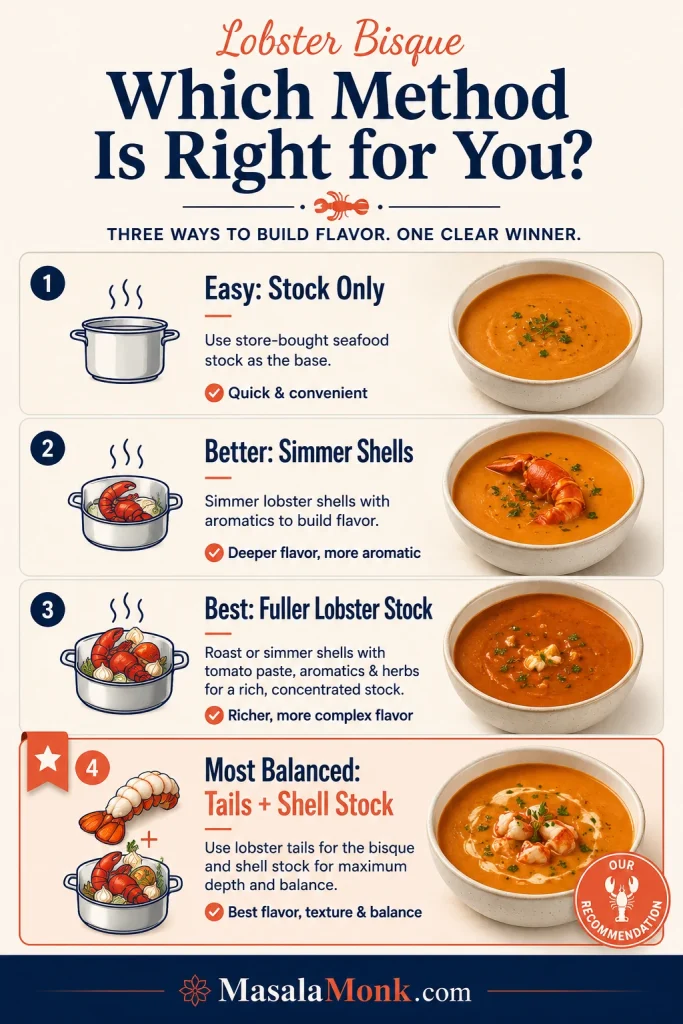
Infographic comparing easy, better, and best lobster bisque methods with stock-only, simmered shells, and fuller lobster stock options.
The middle path is the sweet spot: poach lobster tails in stock, then simmer the shells back into that stock before building the bisque.

How to Make Quick Lobster Stock From Shells

If you have lobster shells, do not throw them away. A quick shell stock turns a simple base into a much better one. This is the step where the soup starts to smell expensive.

Lobster shells cooking in a pot with onion, celery, carrot, garlic, thyme, and tomato paste.
Sautéing lobster shells with aromatics and tomato paste gives the stock a sweeter, deeper base than seafood stock alone.

After poaching the lobster tails in seafood stock, save that stock. Heat a tablespoon of butter or olive oil in a pot. Add the shells and cook them for a few minutes until they smell fragrant. Then add onion, celery, carrot, garlic, and a spoonful of tomato paste. Once the paste darkens slightly, deglaze with dry white wine if using. Add the lobster-poaching stock, a bay leaf, and thyme. Simmer for 25 to 35 minutes, then strain well.

Golden lobster shell stock being strained through a fine mesh strainer with shells and vegetables left behind.
After simmering, strain for liquid rather than solids: press gently for flavor, then leave the gritty shell bits behind.

Next, measure the liquid. Use 4 cups / 960 ml for the bisque. Short on stock? Top it up with water or seafood stock. Extra stock is a bonus — save it for thinning the soup, reheating leftovers, or making a small seafood sauce.

Glass measuring jug filled with golden lobster stock exactly at the 4-cup mark, with herbs and lobster shells in the background.
Measure the strained stock before moving on, because the bisque base needs the right amount of liquid to cook and blend properly.

The simmer should be steady but not rough. A lazy bubble is enough. Press on the shells and vegetables while straining to extract the liquid, then leave the gritty bits behind.

If your stock smells sweet, buttery, and seafood-rich here, you have already done the most important flavor work. That is when the recipe starts to feel less like a gamble and more like a plan.

Success Checkpoints for Lobster Bisque

Use these checkpoints as you cook. They turn the recipe from a list of steps into something you can read with your eyes, nose, and spoon.
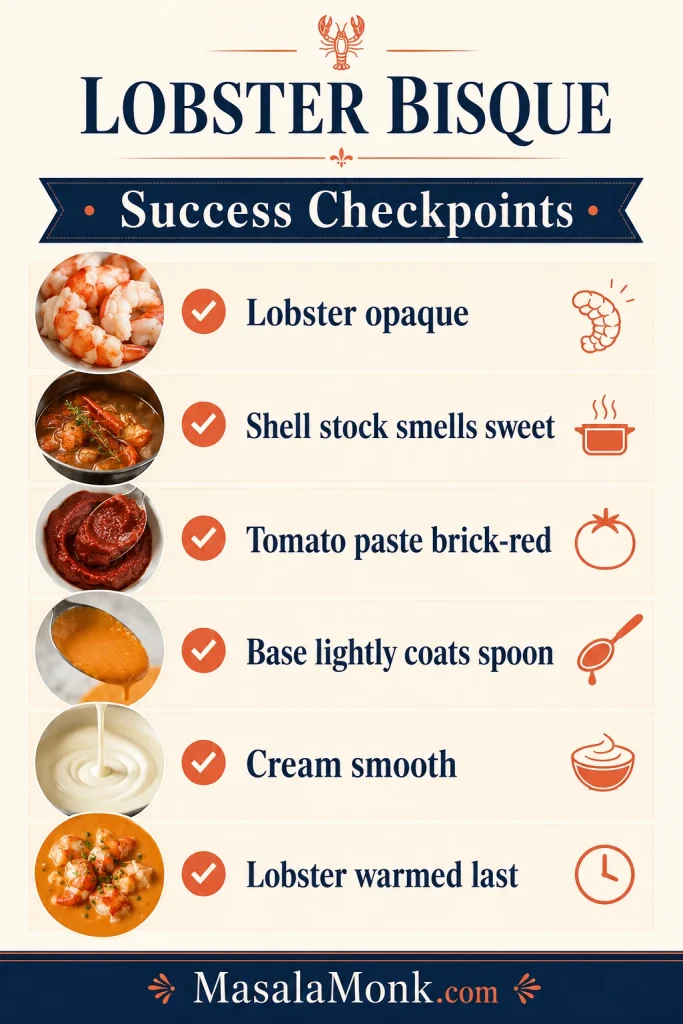
Infographic listing lobster bisque success checkpoints with small visuals for lobster, shell stock, tomato paste, spoon texture, cream, and final lobster.
Use the visual checkpoints as you cook, because color, aroma, texture, and timing matter more than the clock alone.
StageCorrect signProblem sign
Lobster poachMeat turns opaque but still looks tenderTight curl, rubbery texture, or long simmering
Shell stockSweet, buttery, seafood-rich aromaHarsh, stale, or aggressively salty smell
Tomato pasteBrick-red and savory-smellingBright red and raw-smelling
Simmered baseVegetables are very softCarrot or celery still feels firm
Blended soupSmooth and lightly spoon-coatingPasty, gritty, watery, or fibrous
Cream stageSmooth, shiny, and not boiling hardGrainy, split, or aggressively bubbling
Final lobsterWarmed through for 1 to 2 minutesLeft to simmer in the finished soup

If the soup lightly coats a spoon before the lobster goes in, the texture is already close. The lobster only needs to warm through at the finish; that restraint is what keeps it tender.

Once those signs are there, the hard part is behind you. From here, the bisque is less about effort and more about finishing it with restraint.

Before you start the detailed method, use the cook-time table below with the success checkpoints. The lobster should turn opaque and tender before it ever reaches the final bisque.

How Long to Cook Lobster Tails for Bisque

Lobster tails for bisque should be cooked briefly. The meat should turn opaque and firm up slightly, but it should not become tight or chewy.

Lobster tail sizeApproximate cook timeWhat to look for
4 oz / 115 g3 to 4 minutesOpaque meat, still tender
5 oz / 140 g4 to 5 minutesOpaque and just firm
6 oz / 170 g5 to 6 minutesCooked through but not tight
Cooked lobster meatWarm only 1 to 2 minutesDo not simmer for long

When in doubt, slightly undercook the lobster during the first step. It will warm again in the finished soup. Overcooked lobster is the main reason homemade bisque feels disappointing.

Cooked lobster tail meat beside its shell, looking pearly white, opaque, and tender on a clean plate.
Stop when the lobster meat is opaque and tender-looking; meanwhile, a tight curl usually warns that it has gone too far.

For food safety, the FDA says shrimp, lobster, and crab should be cooked until the flesh is pearly and opaque. In this recipe, that means cooking the tails briefly, then warming the chopped meat near serving instead of letting it simmer in the pot. See the FDA safe food handling guidance.

Now that the timing and doneness cues are clear, follow the step-by-step method and keep the lobster out of long simmering.

Step-by-Step Instructions

1. Prep the Lobster Tails

Cut along the top of each shell with kitchen shears. Leave the meat inside for the brief poach. The cut helps heat reach the meat and makes the meat easier to remove after cooking.
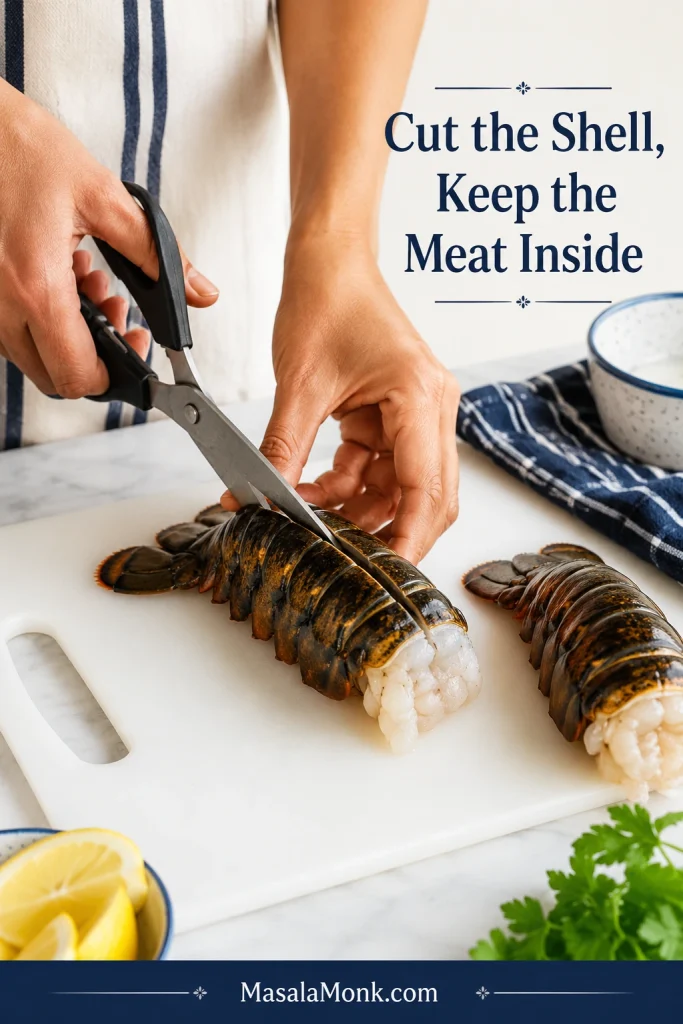
Hands using kitchen shears to cut along the top shell of raw lobster tails on a white cutting board.
Cutting along the top shell helps the lobster tail cook evenly and, later, makes the meat easier to remove without tearing.

2. Poach the Lobster Briefly

Bring the seafood stock to a low simmer, then add the tails. For most 4 to 5 oz tails, 3 to 5 minutes is enough. The meat should turn opaque, but it should not tighten into a rubbery curl. Remove the tails right away, cool them slightly, then pull out and chop the meat.

This is the moment to be conservative. The lobster does not need to be fully pampered yet; it only needs to be protected.
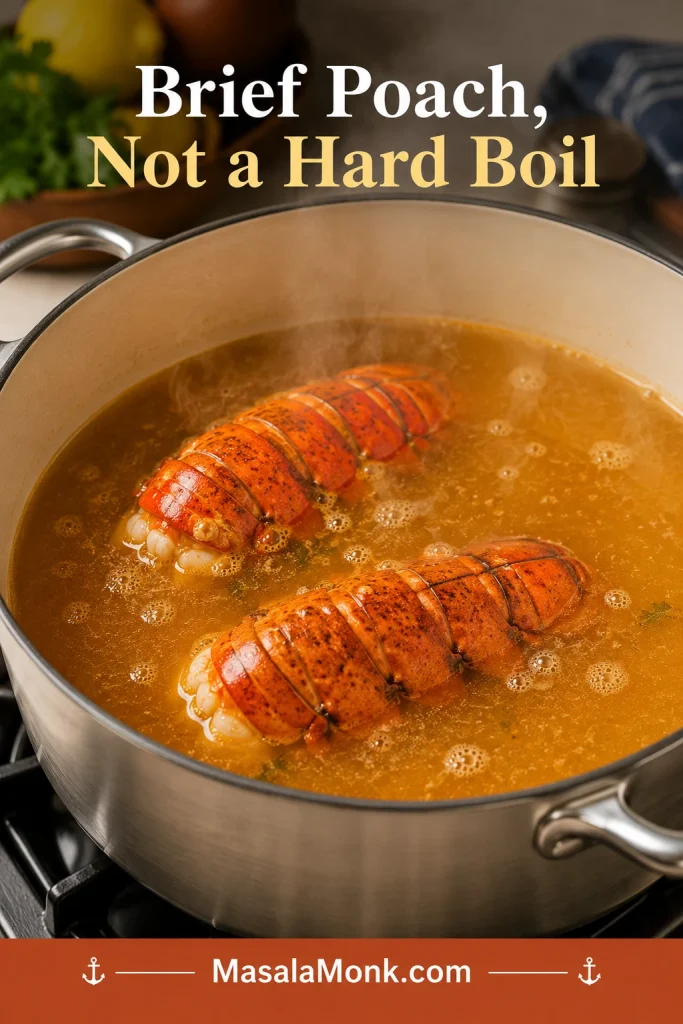
Lobster tails poaching gently in golden seafood stock inside a pot with steam and a low simmer.
Keep the poach brief and gentle; the lobster only needs to turn opaque because it warms once more in the finished bisque.

3. Separate Meat, Shells, and Stock

Save both the shells and the poaching stock. The stock already has a little lobster flavor now, and the shells can make it taste even more layered.

Saved lobster shells and chopped lobster meat separated into bowls with kitchen tools nearby.
Once the tails are poached, the shells go back into the stock, while the meat waits safely for the final warm-through.

4. Make the Shell-Enhanced Stock

Cook the shells with rough-chopped aromatics and tomato paste until the pot smells sweet, buttery, and seafood-rich. Add wine if using, then pour in the lobster-poaching stock. Simmer, strain, measure, and use 4 cups for the bisque.

5. Sauté the Aromatics

Melt butter in a heavy pot and add onion, celery, and carrot. Cook until the vegetables soften and smell sweet, about 6 to 8 minutes. Soft vegetables blend more smoothly and create a better base.
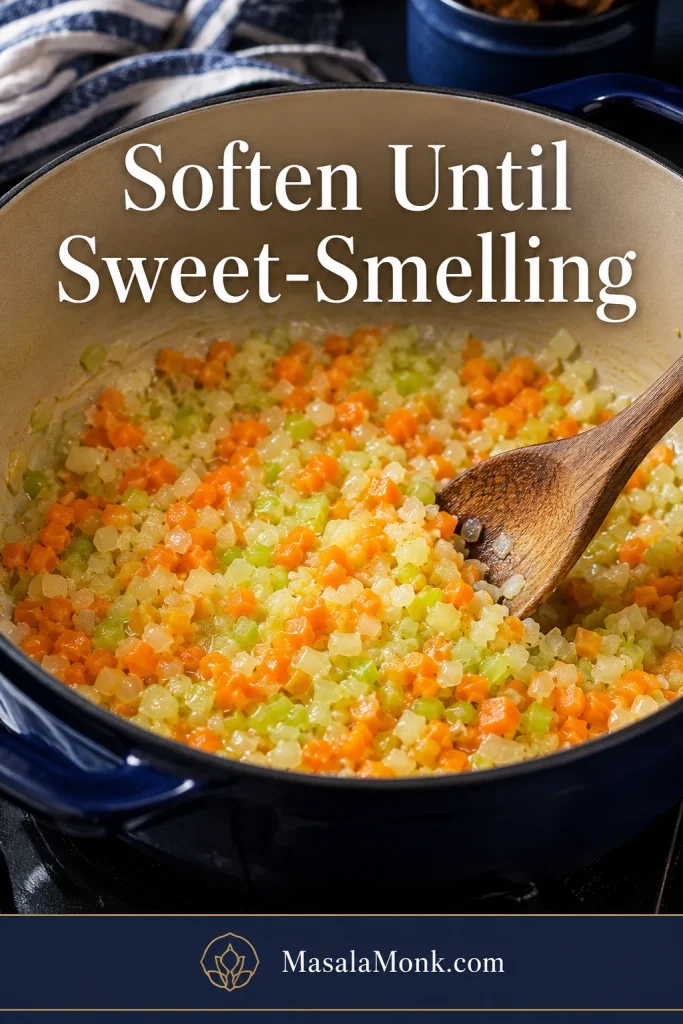
Chopped onion, celery, and carrot softening in butter inside a heavy pot.
Softened onion, celery, and carrot give the bisque a sweeter foundation and help the blended base turn smoother later.

6. Build Brick-Red Tomato Paste Flavor

Add garlic and tomato paste. Stir until the paste darkens from bright red to a deeper brick-red color. That little bit of cooking improves the color and removes raw tomato sharpness.
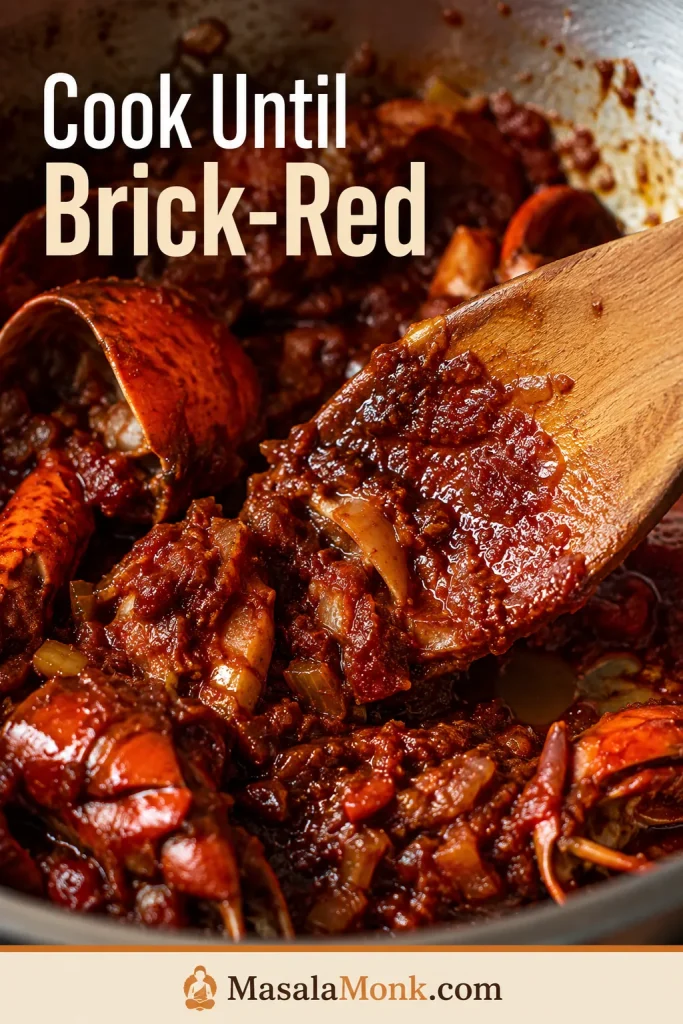
Close-up of brick-red tomato paste cooked with lobster shells, vegetables, and a wooden spoon.
Cook the tomato paste until it turns brick-red; that small color change adds warmth, depth, and a less raw tomato taste.

7. Add Flour

Sprinkle flour over the vegetables and stir until everything looks thick and coated. It should look like a soft paste, not a dry clump. This gives the soup body without making it heavy.
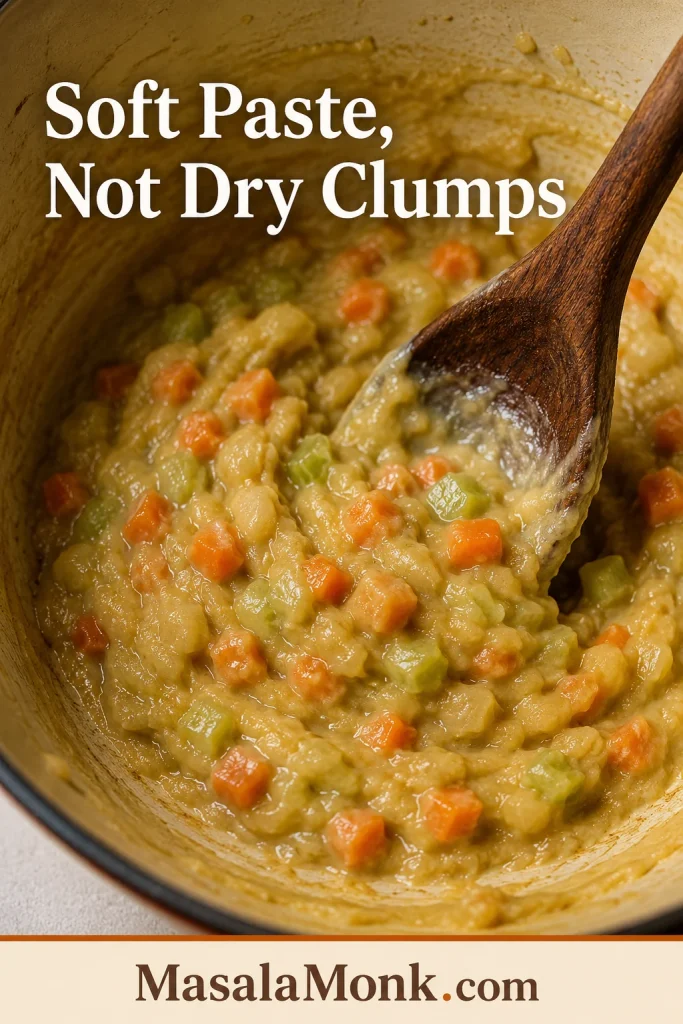
Flour stirred into softened vegetables in a pot, forming a thick roux-like paste.
Before adding liquid, the flour should coat the vegetables like a soft paste; this gives the lobster bisque body without heaviness.

8. Deglaze With Wine and Sherry

Pour in the wine and sherry slowly, scraping up the bottom of the pot. Let it bubble briefly so the sharp alcohol smell softens. This is where the base starts to smell like classic bisque instead of simple vegetable soup.

9. Build the Simmering Base

Pour in the prepared stock, then season with paprika, thyme, cayenne if using, and a little salt and pepper. Simmer until the vegetables are very soft and the broth tastes full. Add salt gradually; stock and seafood bases can sneak up on you.

Golden lobster stock being poured into a brick-red bisque base in a pot.
When the shell stock meets the tomato-aromatic base, the pot shifts from simple vegetables into a true lobster bisque foundation.

10. Smooth the Bisque Base

Use an immersion blender or countertop blender to smooth the base. An immersion blender is convenient, but a countertop blender usually gives the smoothest result. Work in batches if needed and be careful with steam.
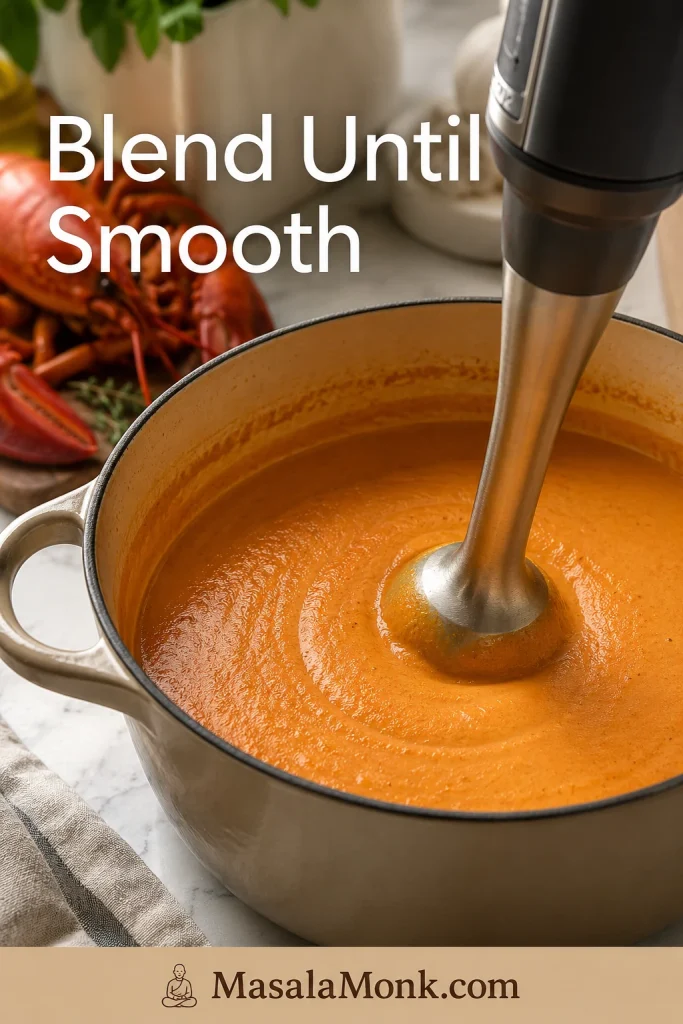
Immersion blender blending coral-orange lobster bisque base in a pot.
Blend only after the vegetables are tender; otherwise, the base can stay fibrous instead of turning silky.

11. Strain for a Polished Finish

For the silkiest finish, strain the blended soup through a fine mesh strainer. If you want the bowl to feel like restaurant bisque, this is the extra minute that pays you back.

Smooth coral-orange lobster bisque being pressed through a fine mesh strainer into a clean pot.
Straining after blending is optional, but it is the step that makes homemade lobster bisque feel polished and restaurant-smooth.

12. Add Cream Over Low Heat

Return the strained soup to the pot and lower the heat. Stir in the cream slowly. The soup should look smooth and shiny, not bubbling like it is still cooking hard.

Heavy cream being poured into smooth coral-orange lobster bisque in a pot.
Add cream over low heat, then keep the soup steaming rather than boiling so the texture stays smooth and silky.

13. Finish the Bisque Base

Taste the base before the lobster goes in. It should lightly coat a spoon, smell sweet and buttery, and taste balanced. If it tastes heavy, add lemon juice or sherry vinegar. A thin base needs a little more simmering. Flat flavor usually means salt should be checked first.

Spoon lifted from creamy coral-orange lobster bisque showing a light coating on the back of the spoon.
The base should lightly coat a spoon before the lobster goes in; thick enough to feel silky, but not heavy like gravy.

14. Warm Lobster Right Before Serving

Stir in the chopped lobster meat during the final minute or two, just long enough to warm it. You can also place it directly in bowls and ladle the hot bisque over it. The soup should arrive at the table hot, smooth, and composed — not bubbling like it is still cooking.

Close-up bowl of silky lobster bisque with lobster tail pieces, chives, cream swirl, and a spoon nearby.
Add the lobster only at the end so the bisque stays creamy and the tail meat remains tender in the finished bowl.

The three texture rules: save the lobster-poaching stock, keep the cream below a hard boil, and keep the lobster out of the long simmer so it stays tender.

If the bisque tastes flat, looks thin, feels too thick, or the cream seems grainy, go to troubleshooting lobster bisque before adding more cream.

Back to top

How to Make Lobster Bisque Smooth and Silky

A well-made bisque should feel creamy and smooth, not grainy or chunky. The easiest way to get that texture is to cook the vegetables until fully tender, blend thoroughly, and strain the soup after blending.

  • Cook the vegetables long enough. Hard carrot or celery pieces will not blend smoothly.
  • Use enough liquid. A very thick base can turn pasty in the blender.
  • Blend in batches if needed. Do not overfill a countertop blender with hot soup.
  • Strain for a smoother finish. This is optional, but it makes the bowl feel more polished.
  • Add cream after blending. Cream finishes the texture instead of getting cooked hard from the beginning.

If the soup looks a little plain before the cream, do not worry; the final richness comes later. When it is thicker than you like after blending, loosen it with warm stock before adding more cream. More cream makes it richer, but stock keeps the lobster flavor cleaner.

How to Thicken Lobster Bisque

The soup should have body, but it should not feel like gravy. The goal is a light spoon-coating texture, not a heavy sauce.

ThickenerUse it forHow it affects texture
Flour rouxClassic creamy bisqueSmooth, reliable, familiar
Cornstarch slurryGluten-free quick fixGlossy and fast-thickening
Cooked riceOld-school silky textureVelvety once blended
ReductionStronger flavorDeepens taste but takes longer
Blended vegetablesLighter bodyNatural thickness, less rich

If the bisque is too thin, simmer it uncovered for a few minutes, or whisk 1 teaspoon cornstarch with 1 tablespoon cold water and stir it into the warm soup. For a fully gluten-free version from the start, skip the flour and use 1½ tablespoons cornstarch mixed with 2 tablespoons cold water after blending. Simmer for 1 to 2 minutes so it thickens.

If it is too thick, loosen it with warm seafood stock. Adding dry flour directly to finished soup can clump and leave a raw flour taste, so use a slurry or reduction instead.

Sherry, Wine, Brandy, and No-Alcohol Options

Lobster bisque often uses alcohol because it adds aroma and balances the richness of cream and shellfish. You have several reliable options.

OptionFlavorUse it for
Dry sherryClassic, nutty, mellowTraditional lobster bisque flavor
Dry white wineBright and cleanEveryday version
Brandy or cognacDeep and special-occasionA more luxurious bowl
No alcoholMilder, still balancedUse extra stock plus lemon or sherry vinegar

For the most balanced version, use white wine and a little dry sherry. To make it without alcohol, replace the ½ cup wine and ¼ cup sherry in the bisque base with ¾ cup extra seafood stock. If you are also skipping the optional wine in the shell stock, use another ½ cup stock there too. Finish with lemon juice or sherry vinegar so the soup still tastes bright.

No-alcohol does not mean flat. The stock gives body, while lemon juice or sherry vinegar gives the lift that wine would normally bring.

The same no-wine idea works beautifully in seafood pasta too. This shrimp scampi without wine uses garlic, lemon, butter, and stock when you want a brighter seafood dinner without opening wine.

Skip sweet sherry unless you intentionally want a sweeter soup. Dry sherry is the safer choice for classic flavor.

Troubleshooting Lobster Bisque

If the soup is not where you want it yet, do not assume it is ruined. Bisque usually needs one clear adjustment: salt, acid, stock, cream, or lower heat.

Before you fix the soup, taste it in this order: salt first, then acid, then stock depth, then cream. Most bland bisque is not missing more cream; it is missing balance.
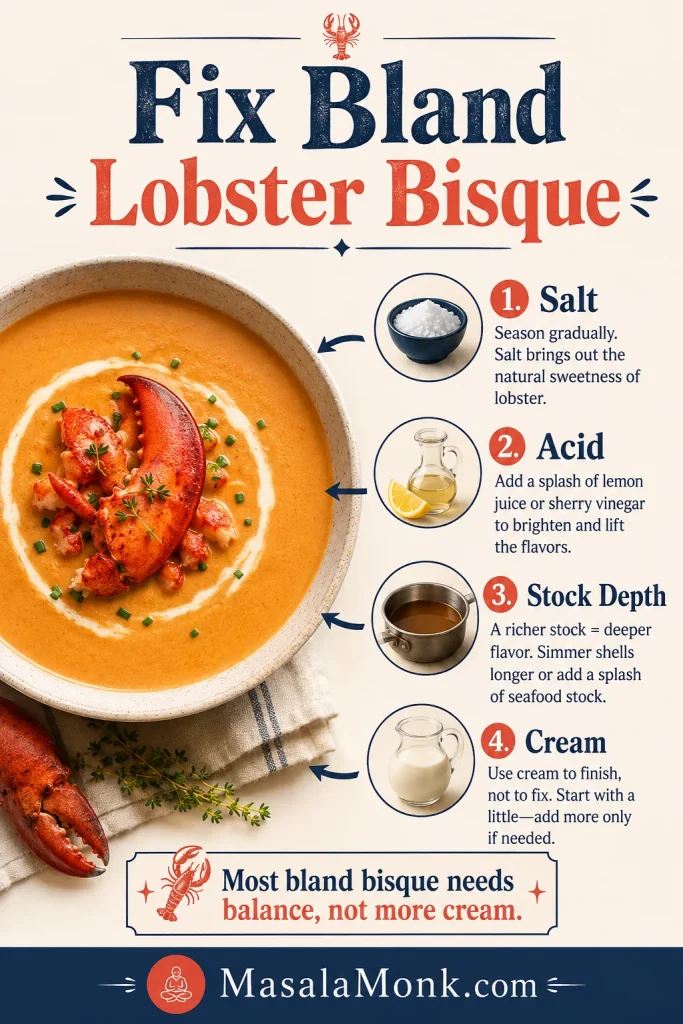
Troubleshooting infographic for bland lobster bisque with numbered steps for salt, acid, stock depth, and cream.
Before adding more cream, fix bland lobster bisque in order: salt first, then acid, then stock depth, and only then richness.

Bland Lobster Bisque

If the bisque tastes bland, do not panic. Check salt first, then add a little lemon juice or sherry vinegar. If it still tastes thin or hollow, the stock may need more shell flavor, reduction, or a small amount of lobster base. Add more cream only after the soup already tastes balanced.

Fishy-Tasting Bisque

A fishy taste usually comes from old seafood, poor-quality stock, or over-reduced briny liquid. Use fresh-smelling lobster, simmer the shells steadily but not aggressively, and balance the finished soup with lemon, herbs, cream, and enough aromatics.

Rubbery Lobster

Chewy lobster almost always means the meat spent too much time in heat. The soup can still taste good, but next time, treat lobster like the finishing touch, not an ingredient that needs to cook in the pot. If you already have cooked lobster, put it in the bowls and ladle hot bisque over it.

Bisque That Is Too Thin

Simmer it uncovered for a few minutes to reduce, or add a small cornstarch slurry. You can also blend in more of the cooked vegetables if you have not strained the soup yet.

Bisque That Is Too Thick

Add warm seafood stock a little at a time until the texture feels right. Use more cream only if you also want it richer.

Split or Grainy Cream

The heat was probably too high after the cream was added. Keep the soup low enough that it steams rather than bubbles hard. If it looks slightly separated, blending can help, but prevention is better.

How to Make Lobster Bisque Pasta or Use Bisque as Pasta Sauce

Lobster bisque pasta is a smart way to use leftover homemade bisque or upgrade a container of store-bought bisque. Think of the soup as a creamy seafood sauce first: reduce it slightly, loosen it with pasta water, and add seafood only near the finish.

Quick lobster bisque pasta formula for 2 servings: use 1½ to 2 cups lobster bisque, 6 to 8 oz pasta / 170 to 225 g, ¼ cup reserved pasta water / 60 ml, and 4 to 6 oz cooked lobster, shrimp, crab, scallops, or langostino.

Creamy lobster bisque pasta with noodles, lobster pieces, herbs, lemon zest, black pepper, and a fork.
Leftover lobster bisque becomes a creamy seafood pasta sauce when you reduce it slightly, toss with noodles, and loosen with pasta water.

To make it, simmer the bisque for 3 to 5 minutes so it thickens slightly. Add cooked pasta and toss with a splash of pasta water until the sauce coats the noodles. Then fold in lobster, shrimp, crab, scallops, or langostino near the end, and finish with lemon juice, black pepper, and herbs.

Pasta shapes that work well include linguine, fettuccine, rigatoni, fusilli, farfalle, and lobster ravioli. Use Parmesan lightly if you like, but do not overdo it. The sauce is already rich, and too much cheese can hide the seafood flavor.

For another creamy seafood pasta that uses pasta water to keep the sauce silky instead of heavy, this creamy salmon pasta with lemon and garlic follows the same gentle-sauce logic with tender fish.

  • Thick sauce: add pasta water.
  • Thin sauce: reduce it before adding pasta.
  • Overly rich: add lemon juice or a little chili.
  • Flat flavor: add herbs, black pepper, or a splash of sherry vinegar.

How to Upgrade Store-Bought Lobster Bisque

Homemade gives you the cleanest lobster flavor, but store-bought bisque can still be useful as a shortcut for soup, lobster bisque pasta, seafood sauce, or a quick starter. Most store-bought lobster bisque needs one of two things: more body or more brightness.

Store-bought problemQuick rescue
WaterySimmer to reduce before serving or tossing with pasta
BlandAdd lemon juice, sherry vinegar, herbs, or a small splash of dry sherry
Lacks lobsterAdd cooked lobster, shrimp, crab, scallops, or langostino
Too saltyLoosen with unsalted stock or cream, not more seafood base
Heavy and flatAdd lemon, herbs, black pepper, or a small splash of acid

If it tastes salty and heavy at the same time, do not add more seafood base. Loosen it with unsalted stock or a little cream, then add lemon or herbs to make it taste cleaner.
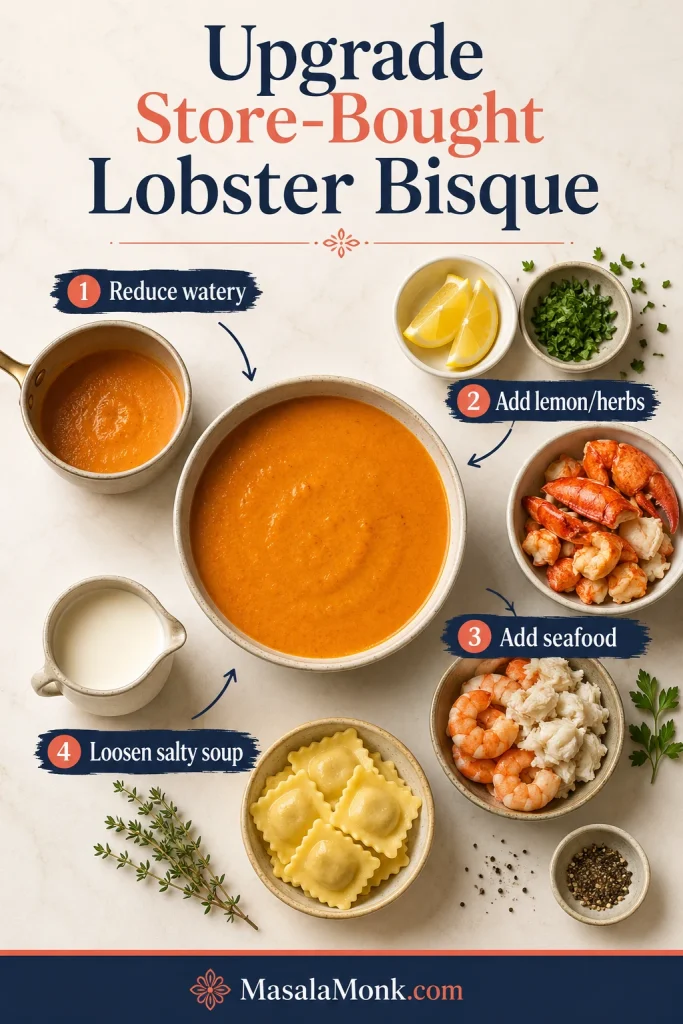
Overhead board showing lobster bisque with lemon, herbs, seafood, cream, pasta, and upgrade notes for store-bought bisque.
Store-bought lobster bisque usually needs one clear fix: reduce watery soup, brighten with lemon and herbs, add seafood, or loosen saltiness.

For ravioli, reduce the bisque until it lightly coats a spoon, then use it as a sauce instead of a full bowl of soup. If the store-bought bisque already contains cream, warm it over low heat so the texture stays smooth.

Back to top

Lobster Bisque Variations

These variations all work best when the core bisque base is balanced first. After that, shrimp, crab, spice, gluten-free thickeners, or dairy-free cream can change the bowl without changing the method.

Lobster bisque variations board with a central soup bowl and surrounding shrimp, crab, chili, gluten-free thickener, and dairy-free cream cues.
Use the same bisque base for shrimp, crab, spicy, gluten-free, or dairy-free variations without changing the core method.

Shrimp and Lobster Bisque

When you want the bowl to feel fuller without buying extra lobster, shrimp is the easiest helper. Add shrimp shells to the stock for extra seafood flavor, then add peeled shrimp during the final few minutes of cooking.

Crab and Lobster Bisque

For a softer, sweeter bowl, crab works especially well when you want delicate pieces of seafood in each spoonful. Stir lump crab meat into the finished soup after the cream and fold carefully so the crab stays in pieces.

Langostino Lobster Bisque

Use langostino when the bisque is heading toward pasta, ravioli, or a budget-friendly seafood dinner. Add it near serving, just long enough to warm through.

Spicy Lobster Bisque

A little heat can make the bisque feel even cozier, especially when you are serving it with bread, rice, or pasta. Add cayenne, smoked paprika, chili flakes, or a small amount of Cajun seasoning, but keep the spice supportive rather than overpowering.

Gluten-Free Lobster Bisque

Skip the flour and thicken after blending with cornstarch slurry, rice, or gluten-free flour. Cornstarch is the quickest route, while rice gives a softer, more old-school texture and a classic blended body.

Dairy-Free Lobster Bisque

Use cashew cream for the most neutral dairy-free option. Coconut milk can work, but it will change the flavor and make the soup taste sweeter. Add dairy-free cream near the end over low heat, just as you would heavy cream.

Lighter Lobster Bisque

Use less cream, rely more on blended vegetables, and finish with lemon juice for brightness. The soup will be lighter, though less rich than the classic version.

Lobster Bisque vs Lobster Soup vs Lobster Chowder

These names are often used loosely, but they are not exactly the same.

DishTextureTypical style
Lobster bisqueSmooth, blended, creamySilky soup made with shellfish stock and cream
Lobster soupVariesBroad term for any lobster-based soup
Lobster chowderChunkyOften includes potatoes, cream, and larger pieces
Lobster stewRusticUsually lobster-forward and less blended

If you want a classic bisque, keep it smooth and strain it if possible. For a chowder-style lobster soup, add potatoes and skip the final fine straining.

Another creamy seafood soup that stays chunkier and simpler than bisque is this salmon soup recipe: potatoes, dill, lemon, cream, and tender salmon added near the end.

What to Serve With Lobster Bisque

This is the kind of soup that does not need a crowded plate around it. A small bowl, good bread, and something crisp on the side are enough to make it feel like a planned meal, whether you serve it as a starter, a light dinner, or part of a special seafood spread.

Lobster bisque served with garlic bread, green salad, lemon wedges, spoon, navy linen, and a warm table setting.
Because lobster bisque is rich, pair it with crusty bread or garlic bread plus something crisp, fresh, and lemony.

Crusty bread is the easiest pairing, but a warm garlic bread loaf from scratch makes the bowl feel more like a full dinner.

  • Good crusty bread or garlic bread
  • Simple green salad with lemony dressing
  • Roasted asparagus or green beans
  • Baked potatoes or twice-baked potatoes
  • Steak for a surf-and-turf dinner
  • Lobster rolls if you have extra lobster meat
  • Shrimp scampi for a seafood dinner spread
  • Light pasta or lobster ravioli

For another cozy starter with a restaurant-style feel, this French onion soup for a cozy starter gives you the same slow, savory comfort in a non-seafood direction.

Make-Ahead, Storage, Freezing, and Reheating

Plan Ahead

The strongest make-ahead method is to prepare the base through the blending and straining step, then refrigerate it before adding cream and lobster. When ready to serve, warm the base, add cream, and finish with lobster.

For dinner-party timing, make the base up to 1 day ahead. Reheat it over low heat, add cream shortly before serving, and warm the lobster in the bowls or in the soup for only the final minute. That approach keeps the soup smooth and lets you serve it like it was finished fresh, even if most of the work happened yesterday.

Refrigerate

Store leftovers in an airtight container in the refrigerator for up to 2 to 3 days. Reheat over low heat.

Freeze

For the smoothest texture, freeze the base before adding cream and lobster. Cream-based soups can separate after freezing, and lobster meat can become less tender after repeated heating. Freeze the base for up to 2 to 3 months, thaw overnight in the refrigerator, then reheat and add cream and lobster just before serving.

Reheat

Warm the soup over low heat, stirring often. Keep the heat low enough that the soup steams rather than bubbles hard. If it thickens in the refrigerator, loosen it with a splash of seafood stock or cream.

Use Leftovers

Leftover bisque is excellent as a pasta sauce, seafood sauce, or base for lobster ravioli. Reduce it, add pasta water if needed, and finish with lemon or herbs.

Have extra bisque? Turn it into lobster bisque pasta, use it as a seafood sauce, or see how to upgrade store-bought lobster bisque with the same balancing tricks.

That is the quiet bonus of a good bisque base: even a small amount can turn pasta, ravioli, or seafood into another special meal.

FAQ

These are the quick answers for the questions that usually come up once you start adapting the recipe.

Can I make lobster bisque with lobster tails?

Yes. Lobster tails are the most practical choice for homemade lobster bisque because they give you tender meat and shells for stock. You get the ease of tails while still building deeper flavor from the shells.

Are lobster shells required?

No, but lobster shells are the easiest way to make homemade bisque taste fuller and sweeter. If you do not have shells, use the cleanest lobster or seafood stock you can find, then balance the finished soup with lemon juice or sherry vinegar.

What if I already have cooked lobster meat?

Add cooked lobster only right before serving, just long enough to warm it. Since cooked meat gives you no shells for stock, use lobster stock if possible or strengthen seafood stock carefully with clam juice or lobster base.

Which stock works best?

Lobster stock or shell-enhanced seafood stock gives the fullest flavor. Clean seafood stock is the next best option, clam juice can help in small amounts, and chicken stock should be treated as an emergency backup because it lacks seafood depth.

How do I make it without wine or sherry?

Replace the ½ cup wine and ¼ cup sherry in the base with ¾ cup seafood stock. Finish with lemon juice or sherry vinegar so the soup still has brightness and does not taste flat.

What thickens lobster bisque best?

A flour roux is the classic choice. For gluten-free bisque, use cornstarch slurry or blended rice. To make a thinner finished soup, reduce it instead of adding more cream.

Why does my lobster bisque taste bland?

Start with salt, then add acid, then check stock depth. A little lemon juice or sherry vinegar often wakes up the soup, but if the stock itself is weak, shells, reduction, or a small amount of lobster base may be needed.

Why does lobster turn rubbery in bisque?

Lobster turns rubbery when it spends too long in heat. Treat it like the finishing touch, not an ingredient that needs to simmer: cook it briefly, remove it, and warm it only right before serving.

Is lobster bisque gluten-free?

It can be. Skip the flour and thicken after blending with cornstarch slurry, rice, or gluten-free flour. Cornstarch is fastest, while rice gives a softer blended texture and a more classic old-school body.

Can lobster bisque be dairy-free?

Yes, but it will taste less classic. Cashew cream is the most neutral option; coconut milk works, but it can make the soup sweeter. Add dairy-free cream near the end over low heat, just as you would heavy cream.

Does lobster bisque freeze well?

The base freezes better than the finished soup. Freeze before adding cream and lobster, then use within 2 to 3 months. Add cream and lobster only after reheating so the texture stays smoother and the seafood stays tender.

Can lobster bisque be used as pasta sauce?

Yes. Lobster bisque pasta works best when the bisque is reduced slightly, tossed with pasta, loosened with pasta water, and finished with seafood, lemon, and herbs.

What is the difference between lobster bisque and lobster chowder?

Lobster bisque is smooth, blended, and creamy. By contrast, lobster chowder is chunkier and often includes potatoes, cream, and larger pieces of seafood or vegetables.

What should I serve with lobster bisque?

Serve lobster bisque with crusty bread, garlic bread, a lemony salad, roasted vegetables, baked potatoes, or steak for a surf-and-turf meal. The best pairings are simple, crisp, or bread-like because the soup is already rich.

Lobster bisque should feel special, but it does not need to feel stressful. Start with lobster tails, use a stock you would happily taste on its own, save the shells if you can, and keep the lobster meat out of the long simmer. The best lobster bisque is not the one with the most complicated method. It is the one where the stock tastes clean, the cream stays silky, and the lobster is still tender when the spoon reaches the bowl.
Back to top

Posted on Leave a comment

Fresh Tomato Soup Recipe With Fresh Tomatoes: Easy Homemade Tomato Basil Soup

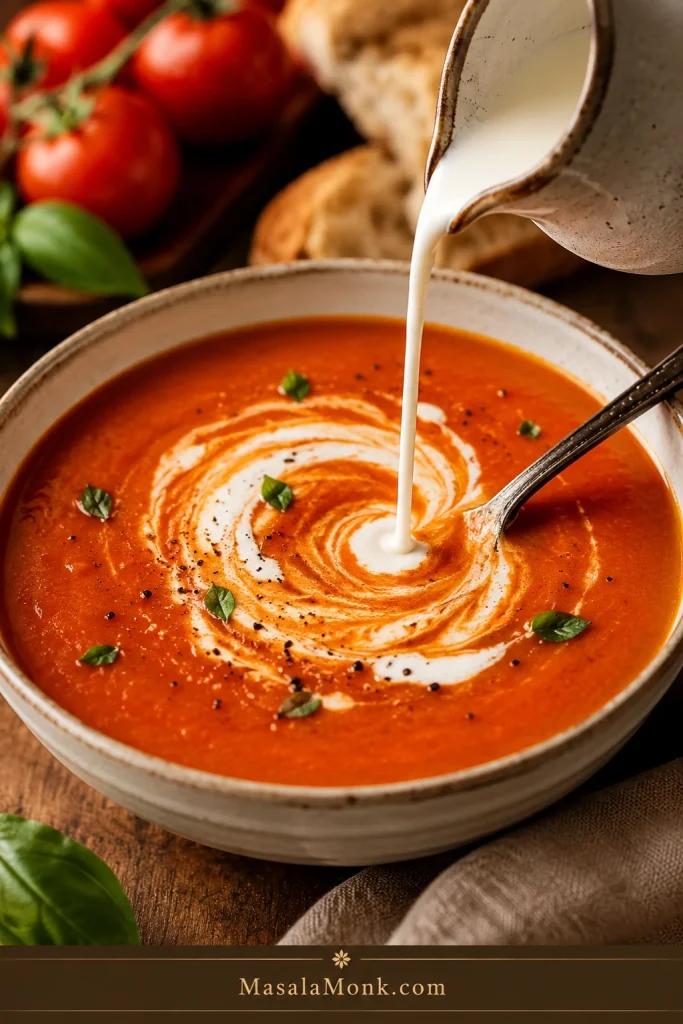
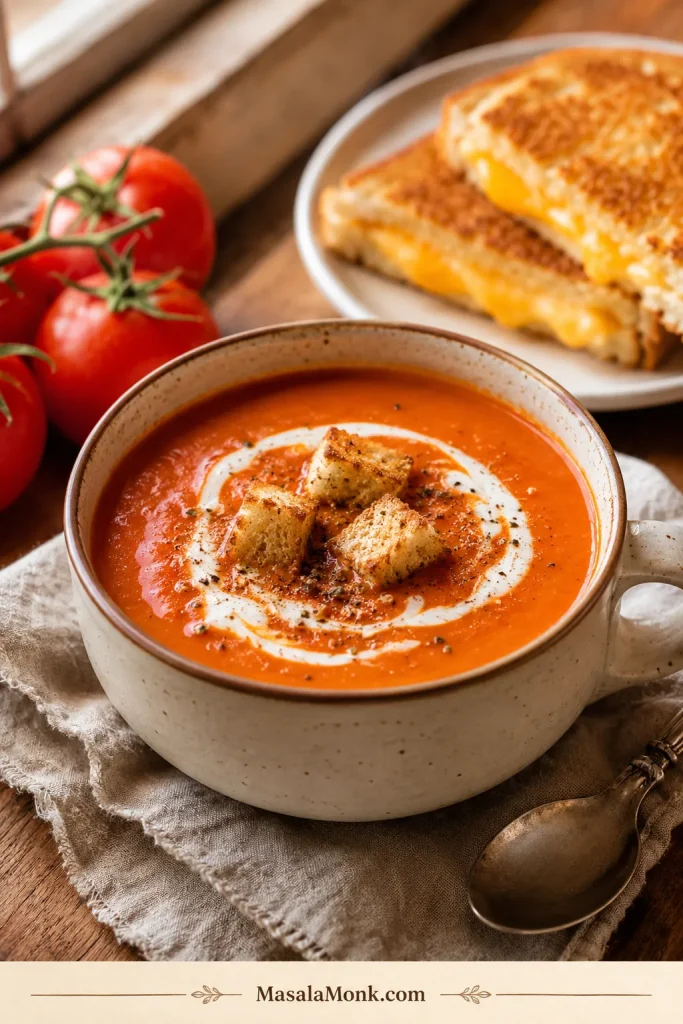
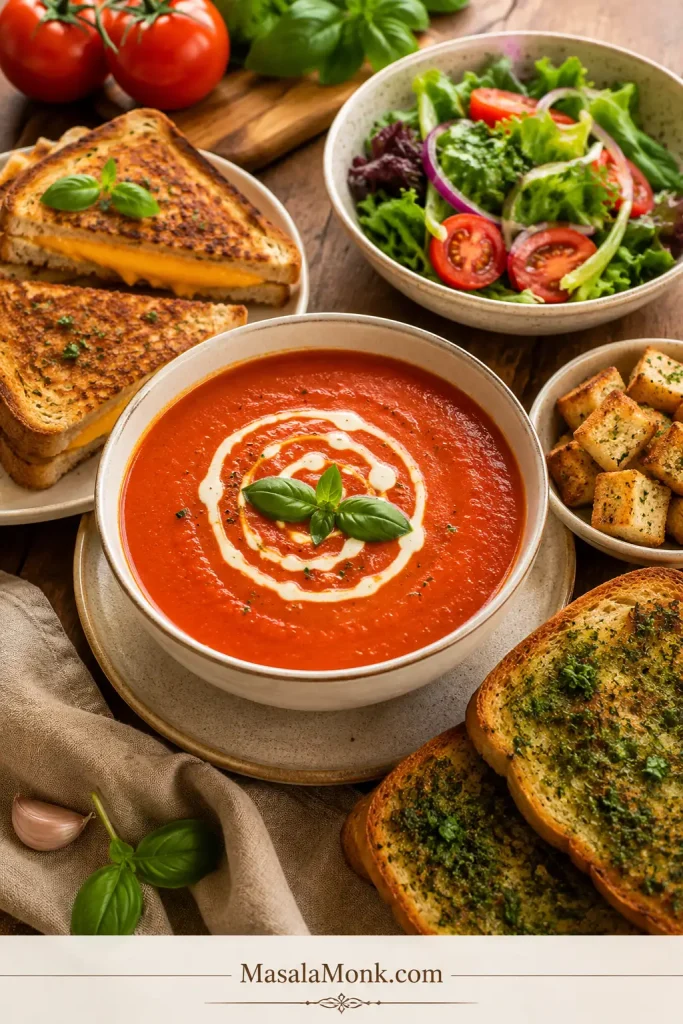
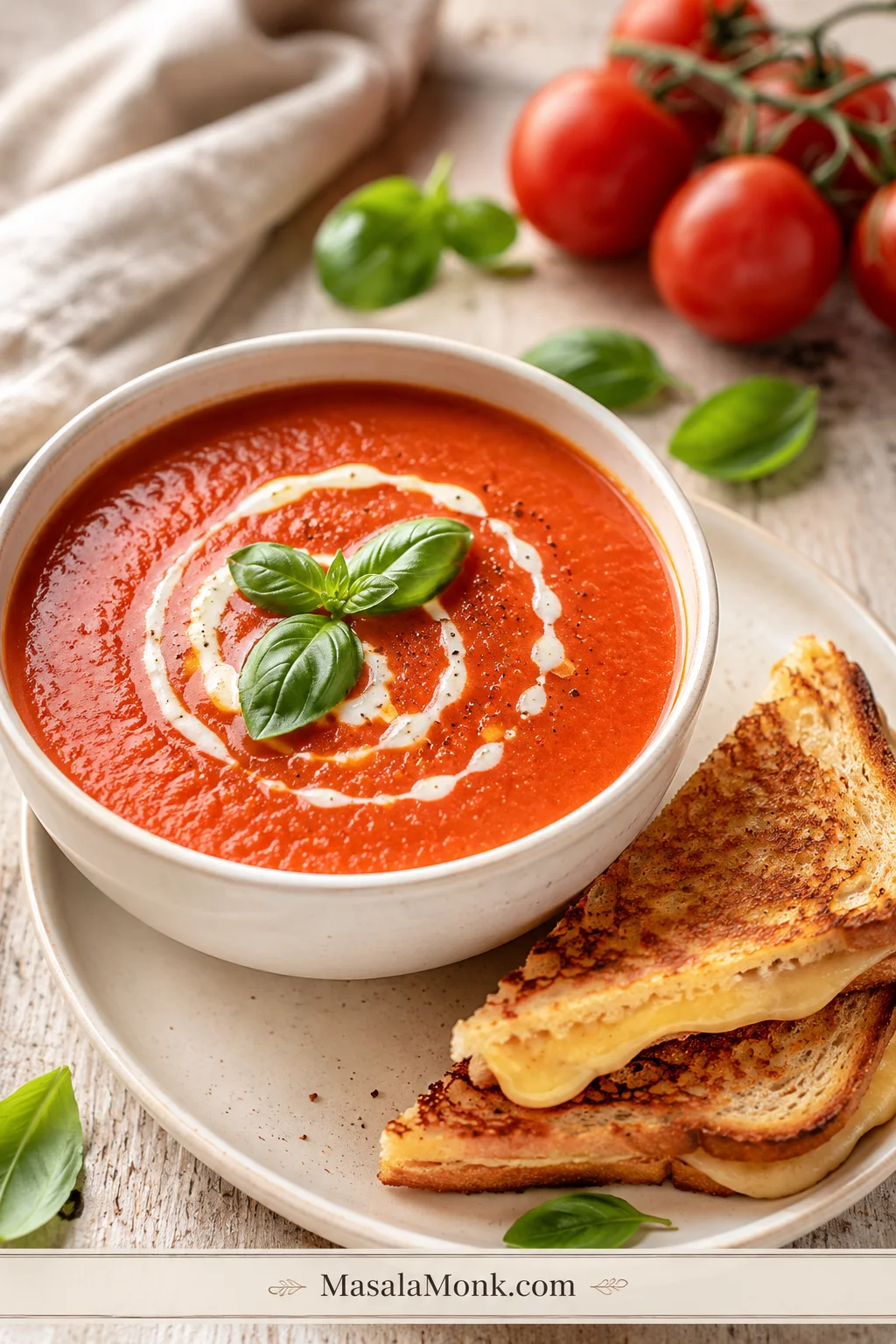
A bowl of smooth fresh tomato soup topped with basil and a cream swirl, with grilled cheese on the side.

Fresh tomato soup should taste bright, smooth, rich, and comforting — not watery, sour, thin, or like hot tomato juice. The goal is simple: take ripe fresh tomatoes, cook them down until they smell sweet and saucy, then blend them into the kind of cozy bowl you actually want to dip grilled cheese into.

This is the soup for the awkward tomato bowl: a few Roma tomatoes, a few garden tomatoes, one soft vine tomato, and cherry tomatoes that need to be used today. It works because you do not force those tomatoes into a fixed amount of liquid. You cook them down first, then loosen the soup after blending.

That makes this recipe useful even when your tomatoes are not identical — Roma, cherry, vine, garden, watery, soft, or mixed. The method keeps the soup from turning thin because the tomatoes get a chance to concentrate before the final broth goes in.

From there, the base recipe is simple; the extra sections are only there to help you adjust the tomatoes you have. Start with the stovetop method for speed, roast the tomatoes for deeper flavor, keep the bowl light, make it creamy, or turn it into tomato basil soup with fresh basil at the end.

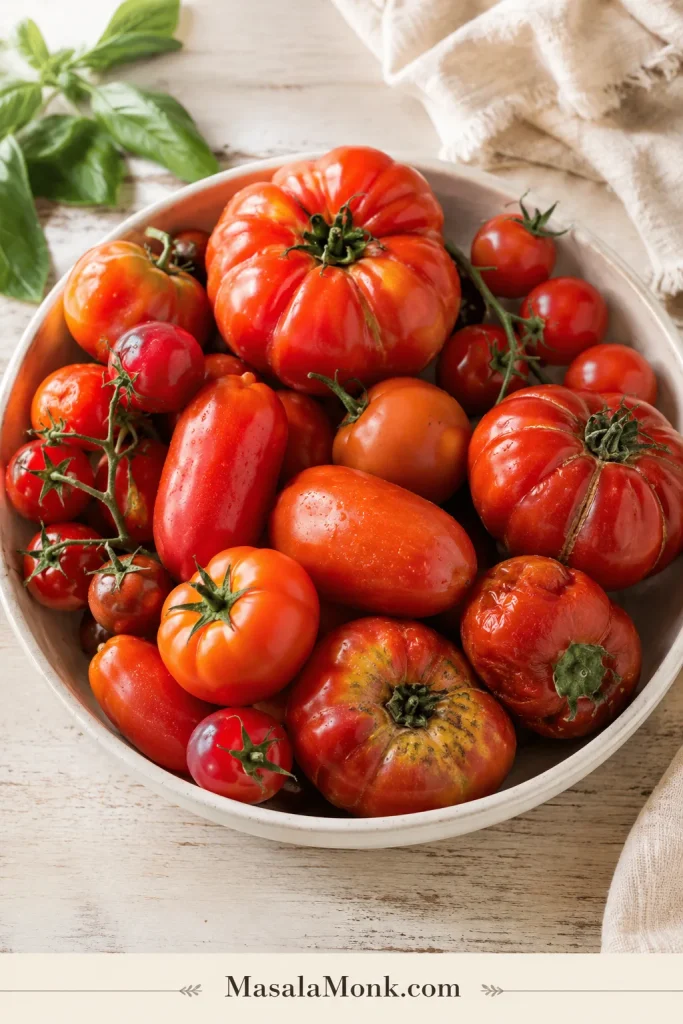
Mixed Roma, vine, cherry, or garden tomatoes can still make smooth homemade tomato soup when the pot is reduced first and loosened later.

A bowl filled with mixed fresh tomatoes, including Roma, cherry, vine, and garden tomatoes.
Even mixed, soft, or uneven tomatoes can make excellent homemade tomato soup when they are cooked down first and loosened only after blending.

Cooking now? Start with the recipe card. Still deciding how to handle your tomatoes? Use the soup ratio, success cues, tomato guide, roasted method, or troubleshooting section before you begin.

Quick Answer: How to Make Tomato Soup With Fresh Tomatoes

To make tomato soup with fresh tomatoes, soften onion in olive oil or butter, add garlic and tomato paste, then add chopped ripe tomatoes, salt, pepper, and herbs. Simmer uncovered until the tomatoes collapse into their own juices and the flavor concentrates. Add broth gradually, blend until smooth, stir in fresh basil near the end, and finish with cream only if you want a richer bowl.

You are not rushing fresh tomatoes into soup; you are letting them collapse, sweeten, and turn saucy before you decide how much broth they need.

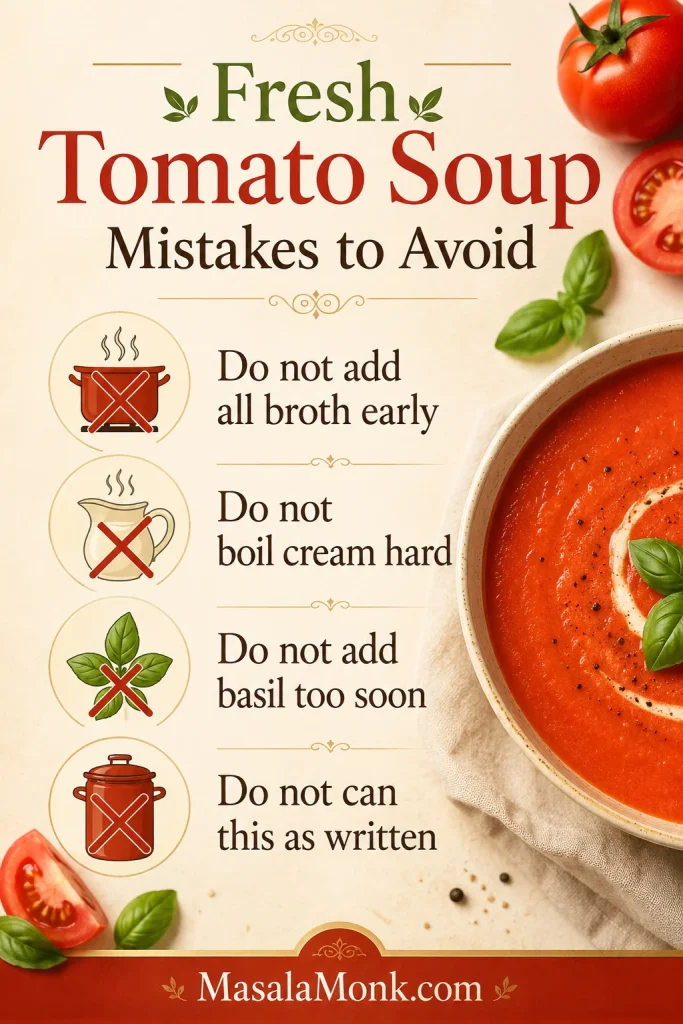
The most important rule is this: do not add all the broth too early. Your tomatoes may release more juice than mine, so hold some liquid back until after blending. That one habit keeps the soup full and spoonable instead of thin.

Next step: Need exact amounts? Jump to the recipe card. Still adjusting your tomatoes? Use the soup ratio first.

The Fresh Tomato Soup Ratio

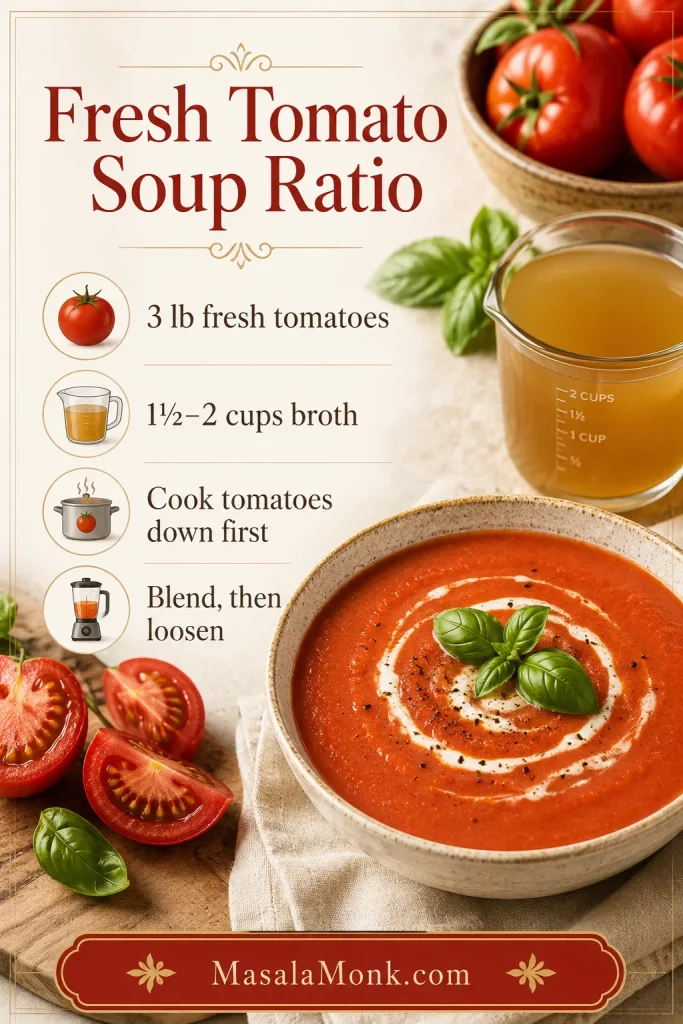
For a balanced fresh tomato soup, use about 3 lb / 1.35 kg fresh tomatoes to 1 1/2 to 2 cups / 360 to 480 ml broth. Start with the lower amount, blend, then add more only if the soup needs loosening.

Before adding extra broth, use the ratio below as a starting point, especially when your fresh tomatoes are very juicy or unusually meaty.

A guide card showing the ratio for fresh tomato soup with 3 pounds of tomatoes and 1 1/2 to 2 cups of broth.
Start with this fresh tomato soup ratio, then adjust after blending because different tomatoes release very different amounts of juice.

Thicker soup

Use Roma or plum tomatoes, begin with 1 1/2 cups broth, and simmer uncovered before blending.

Lighter soup

Add the full 2 cups broth after blending, especially if the tomatoes are meaty and the soup feels too thick.

Watery tomatoes

Roast first or simmer longer. Let the tomato juices reduce before you loosen the soup.

Creamy soup

Keep the base slightly thick, then finish with cream or a no-cream thickener after blending.

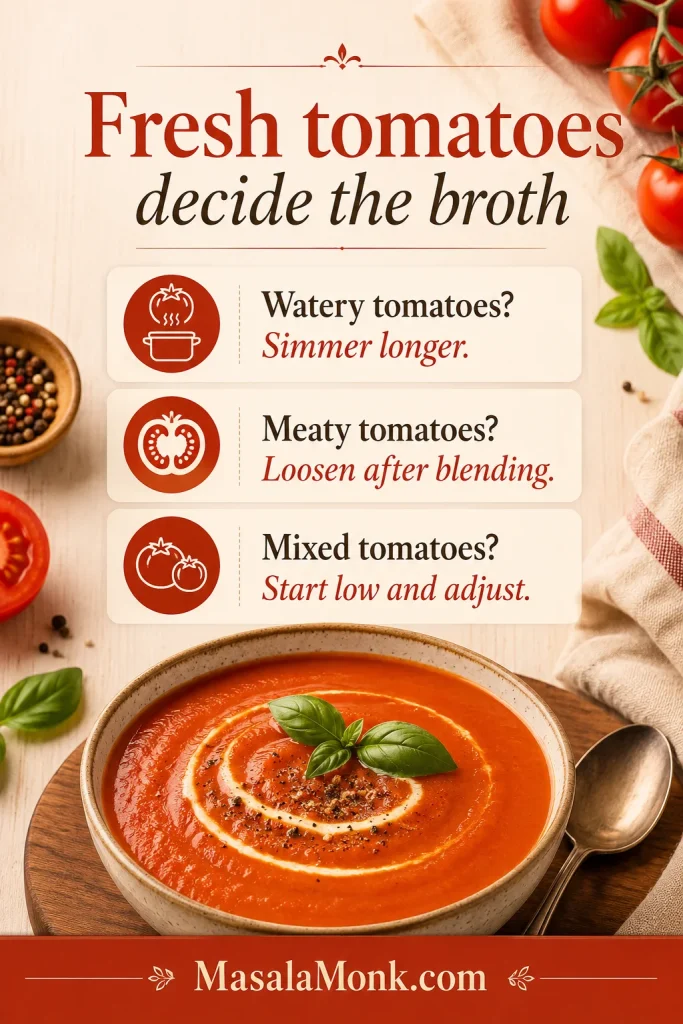
If you remember only one thing: fresh tomatoes decide the broth, not the other way around.

The main method rule is simple: reduce the tomatoes first, then loosen the soup only after blending.

A guide card explaining that fresh tomatoes decide how much broth tomato soup needs.
Instead of forcing a fixed broth amount, let the tomatoes lead; juicy tomatoes need more reduction, while meatier tomatoes may need loosening later.

Still deciding? Compare the best tomatoes for soup, use the roasted method for watery tomatoes, or go straight to troubleshooting.

Recipe Card

Easy Homemade Tomato Soup With Fresh Tomatoes

A smooth, easy homemade tomato soup made with ripe fresh tomatoes, onion, garlic, tomato paste, basil, and optional cream. Use the stovetop method for speed or the roasted method for deeper flavor.

Prep Time
10 minutes
Cook Time
30 to 35 minutes
Total Time
40 to 45 minutes
Servings
6 bowls
Yield
About 7 cups
Tomatoes
About 8 to 10 medium tomatoes
Texture
Smooth, strain optional
Diet
Vegetarian if using vegetable broth; vegan option

Ingredients

  • 3 lb / 1.35 kg ripe fresh tomatoes, roughly chopped
  • 2 tablespoons olive oil, or 2 tablespoons / 28g butter
  • 1 medium onion, chopped, about 150g
  • 4 to 6 garlic cloves, minced
  • 2 tablespoons / about 30g tomato paste
  • 1 small carrot, chopped, or 1/2 red bell pepper, chopped, optional
  • 1 teaspoon fine salt, plus more to taste
  • 1/2 teaspoon black pepper
  • 1/2 teaspoon dried oregano or dried thyme
  • 1 1/2 to 2 cups / 360 to 480 ml vegetable broth or chicken broth
  • 1/2 cup loosely packed fresh basil leaves
  • 1/4 cup / 60 ml heavy cream, optional
  • 1 to 2 teaspoons sugar, honey, or maple syrup, only if the tomatoes taste too sharp; use sugar or maple syrup for vegan soup
  • Extra basil, cream, parmesan, croutons, olive oil, or black pepper, for serving

Equipment

  • Large pot or Dutch oven
  • Sharp knife and cutting board
  • Immersion blender, regular blender, or high-speed blender
  • Fine-mesh strainer, optional, for extra-smooth soup
  • Rimmed baking sheet, only if using the roasted method

Instructions

Cook Down the Tomatoes

  1. Soften the onion. Warm the olive oil or butter in a large pot or Dutch oven over medium heat. Cook the onion for 5 to 6 minutes, until soft, translucent, and lightly golden.
  2. Build the tomato base. Stir in the garlic for about 30 seconds. Spoon in the tomato paste and cook for 1 minute, stirring often, until it darkens slightly and smells rich.
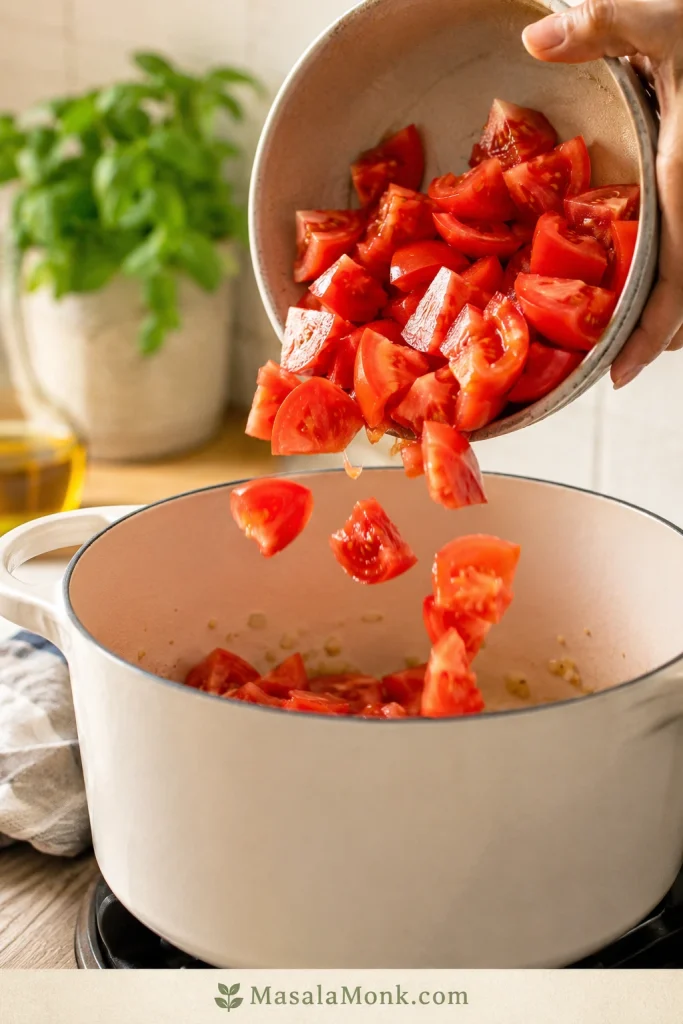
  3. Tip in the tomatoes. Add the chopped tomatoes, carrot or red bell pepper if using, salt, pepper, and oregano or thyme. Stir well.
  4. Cook them down. Simmer uncovered for 20 to 25 minutes, stirring occasionally, until the tomatoes collapse and the mixture looks saucy. Splash in a little broth only if the pot starts to dry out.
  5. Pour in the first broth. Stir in 1 1/2 cups / 360 ml broth and simmer for about 5 minutes. Hold back the remaining broth until after blending.

Blend, Finish, and Serve

  1. Puree until smooth. Turn off the heat. Blend with an immersion blender until smooth, or blend carefully in batches in a regular blender. Vent the blender lid so steam can escape.
  2. Drop in the basil. Add the fresh basil and blend briefly again. For a fresher speckled finish, chop the basil and stir it in after blending instead.
  3. Finish the texture. Loosen with more broth if the soup is too thick. Simmer uncovered for a few minutes if it is too thin.
  4. Make it creamy, if desired. Stir in the cream over low heat. If the soup is very hot, mix a spoonful of soup into the cream first, then add it back to the pot. Do not boil hard after adding cream. Taste and adjust salt, pepper, and acidity.
  5. Serve. Ladle into bowls and finish with basil, black pepper, cream, parmesan, croutons, or olive oil.

Recipe Notes

  • Roma and plum tomatoes make the thickest soup. Garden tomatoes give great flavor but may need more simmering.
  • The broth range is flexible on purpose because Roma tomatoes, vine tomatoes, cherry tomatoes, and mixed garden-style tomatoes release different amounts of juice.
  • Before blending, the tomatoes should look collapsed and saucy, not like chopped tomatoes floating in liquid.
  • No peeling is required for everyday soup. Blend well, then strain only if you want an ultra-smooth finish.
  • If your broth is salty, start with 3/4 teaspoon salt and adjust after blending.
  • The listed cook time is for the stovetop method. Roasted method timing is about 55 to 65 minutes total.
  • For a vegan version, use olive oil, vegetable broth, and skip the cream or replace it with cashew cream, coconut milk, white beans, potato, or carrot.

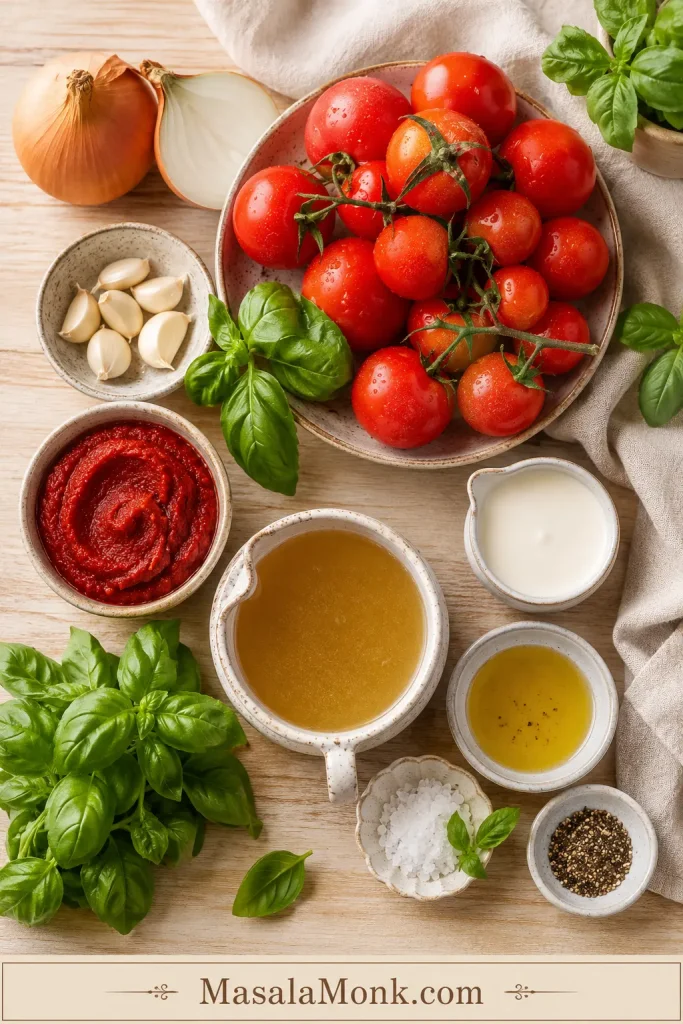
This ingredient view shows why the short list still works: each item builds sweetness, depth, brightness, or body.

Fresh tomato soup ingredients arranged overhead, including tomatoes, onion, garlic, basil, tomato paste, broth, cream, oil, salt, and pepper.
Each ingredient has a clear job: onion builds sweetness, tomato paste adds depth, basil brightens the finish, and broth controls the final texture.

Success Cues

Use these cues more than the clock. Fresh tomatoes vary, but the signs of a good pot stay the same.

Tomatoes before blending

The tomatoes should look collapsed and saucy, not like chopped tomatoes floating in broth.

Puree before more broth

The puree should be smooth first. Loosen the soup only after you know how thick the blended base is.

Before serving

The soup should coat a spoon lightly, pour easily, and taste bright first, then soft and savory.

At the finish

Add basil late, keep cream gentle, and adjust salt after the soup is fully blended.

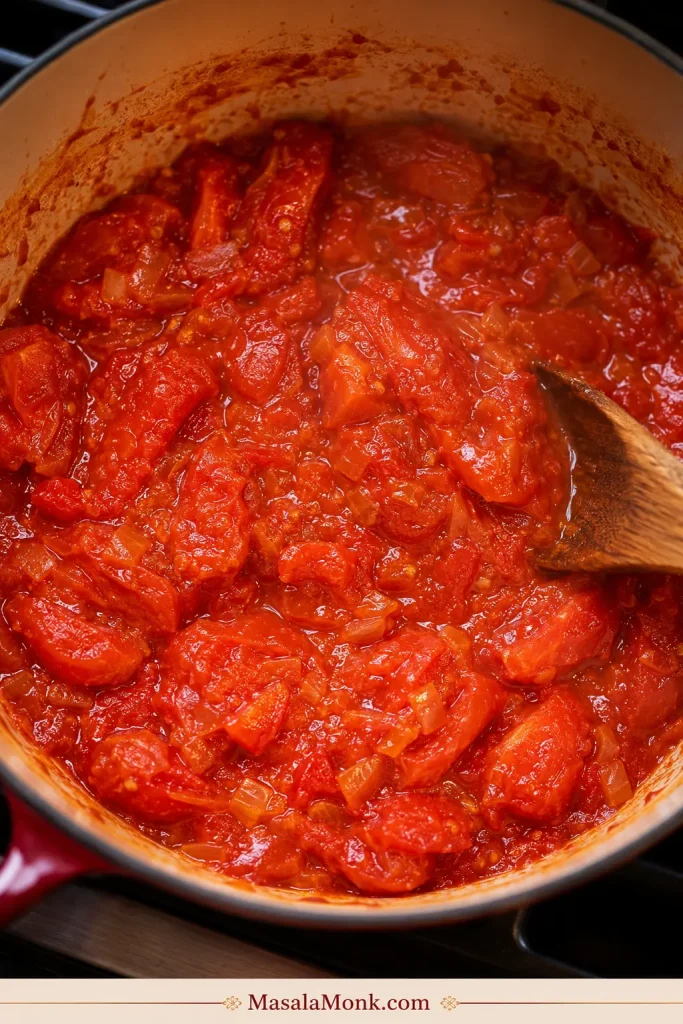
Look for this cue before blending: the tomatoes should be collapsed and saucy, not floating in loose liquid.

Fresh tomatoes cooked down in a pot until soft, thick, and saucy before blending.
Before blending, the tomatoes should look collapsed and saucy rather than loose and chunky; this cue is one of the best ways to avoid watery tomato soup.

Table of Contents

Need a tomato, texture, roasting, storage, or rescue answer? Jump to the section you need.

Fresh Tomato Soup vs Canned Tomato Soup

Fresh tomatoes do not behave like canned tomatoes, and that is exactly why this soup needs a gentler, more flexible method. Canned tomatoes are already cooked, concentrated, and fairly consistent. Fresh tomatoes are brighter and more seasonal, but they also bring their own water, sweetness, acidity, skin, and seeds.

That is why this recipe builds flavor before the pot gets too loose. The same reduction logic matters in this tomato sauce from fresh tomatoes, where the final texture depends on cooking off extra water before adjusting the finished dish.

For a thicker, pasta-ready version of tomato depth, this classic marinara sauce recipe stays in the sauce lane. This soup stays softer, smoother, and more spoonable.

Why This Fresh Tomato Soup Works

Fresh tomatoes give you that bright, just-cut flavor, but they also bring a lot of water with them. The soup gets its body before the blender comes out, while the tomatoes are still bubbling down into something sweeter and fuller.

By the time the blender comes out, the pot should already smell like tomato sauce becoming soup.

  • Onion softens the sharp edge of the tomatoes and adds natural sweetness.
  • Garlic gives the pot savory warmth without overpowering the fresh tomato flavor.
  • Tomato paste boosts color and depth, especially when the tomatoes are juicy or mild.
  • Uncovered simmering concentrates the base before the final texture is adjusted.
  • Fresh basil goes in late so the soup tastes fragrant, not dull.
  • Cream is optional, so the final bowl can be light, creamy, vegan, or dairy-free.

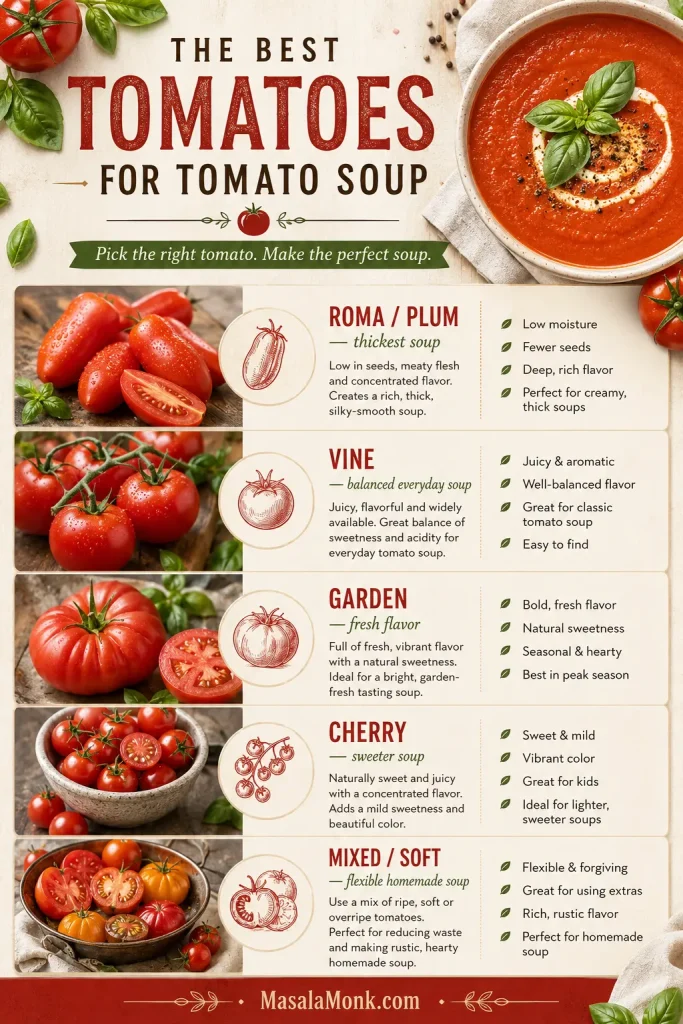
The Best Tomatoes for a Smooth, Flavorful Soup

Start with the tomatoes you have, then decide how much help they need. A soft tomato that smells sweet can still make a beautiful soup, even if it is past its salad-perfect moment.

Use the tomato guide below to decide whether your batch needs more simmering, more sweetness, or a roasted start.

A visual guide showing Roma, vine, garden, cherry, and mixed tomatoes for tomato soup.
Roma tomatoes give body, cherry tomatoes add sweetness, and mixed garden tomatoes bring complexity, so the best tomato choice depends on the flavor and texture you want.
Tomato Type Best Use What to Know
Roma or plum tomatoes Thicker fresh tomato soup Meaty, less watery, and excellent for a smooth soup base.
Vine tomatoes Everyday tomato soup Good balance of sweetness, juice, and acidity.
Garden tomatoes Fresh summer flavor Great when ripe, but may need longer cooking if very juicy.
Cherry tomatoes Sweet roasted tomato soup Sweet and juicy. Roast them or hold back more broth at first.
Overripe tomatoes Rich homemade soup Excellent if soft and fragrant, but avoid spoiled tomatoes.
Watery tomatoes Roasted or reduced soup Roast first or simmer uncovered to concentrate them.
Underripe tomatoes Not ideal They can make the soup sharp, pale, and bland.

The tomato does not have to be perfect. It just needs to taste ripe enough that you would still want another bite — sweet, juicy, and a little fragrant when you cut into it. If you are mixing tomato types, use that to your advantage: Roma tomatoes can thicken juicy garden tomatoes, while cherry tomatoes can add sweetness to sharper ones.

Tomatoes chosen? Review the soup ratio, then move to the stovetop method.

Ingredients That Make the Soup Taste Full

The ingredient list is short, so each ingredient has to pull its weight. The right balance keeps the soup from tasting watery, flat, or too acidic.

Fresh Tomatoes

Choose ripe tomatoes that feel heavy and smell sweet. Roma, plum, vine, garden, and cherry tomatoes all work, but they behave differently. Juicy tomatoes need more time. Meaty tomatoes make a thicker base more easily.

Onion and Garlic

Onion rounds out the acidity and gives the soup a softer base. Garlic adds that warm, savory smell that makes the pot feel fuller before you even blend it. Cook the onion first, then add the garlic briefly so it stays fragrant instead of bitter.

Tomato Paste

Tomato paste is the backup plan for tomatoes that are juicy, pale, or mild. Cook it for a minute before adding the tomatoes so it darkens slightly and makes the soup taste deeper.

Broth

Vegetable broth keeps the soup light and vegetarian. Chicken broth makes it a little more savory and old-fashioned, especially if you are serving it with grilled cheese. Add it in stages so the tomatoes can show you how much they need.

Fresh Basil

Fresh basil wakes up the bowl at the end. Add it late so the flavor stays green and fragrant. When basil is the flavor you want to push harder, this classic basil pesto guide gives you another way to use the same herb as a swirl, toast spread, or pasta sauce.

Dried basil can work, but it should go in earlier with the dried herbs. Fresh basil is more delicate, so save it for the finish.

Cream, Optional

Heavy cream softens the acidity and makes the soup richer, but it is not required. You can keep the bowl bright and light, or use no-cream options like carrot, potato, cashews, white beans, bread, or coconut milk.

Peeling, Seeding, and the Smooth-Soup Shortcut

You do not need to peel or seed tomatoes for everyday homemade tomato soup. Once the tomatoes are cooked until soft and blended well, most skins disappear into the bowl.

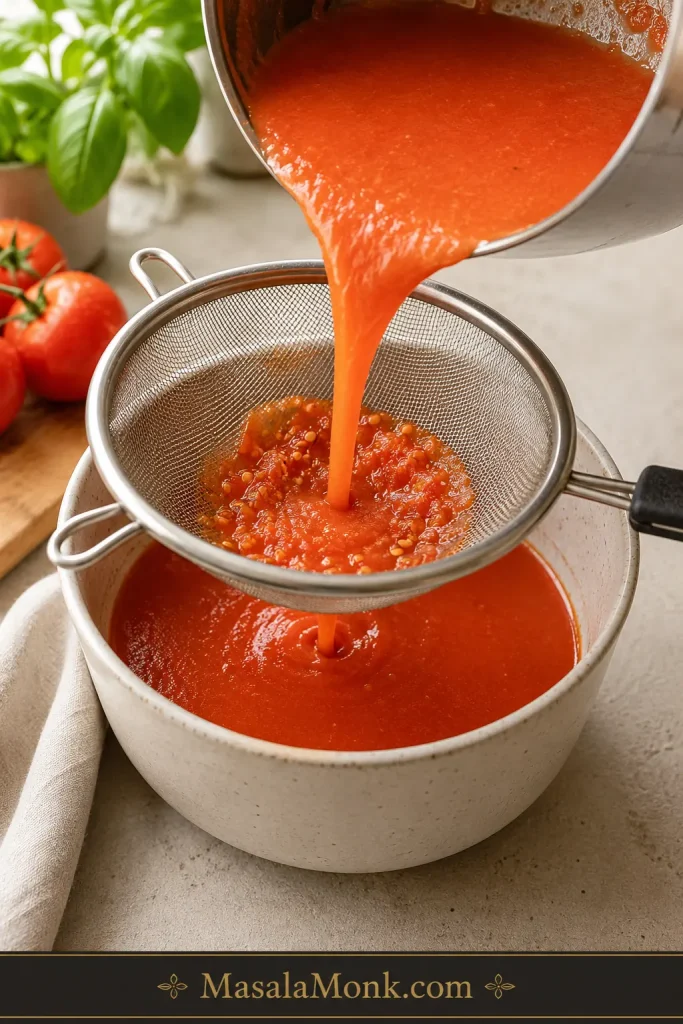
For a very smooth, restaurant-style bowl, blend fully, strain once, and finish with a small splash of cream over low heat. Straining removes seeds, tiny bits of skin, and any grainy texture without making you peel every tomato first.

A silky bowl does not require peeling every tomato; blend first, then strain only if the texture needs it.

Tomato soup being poured through a fine-mesh strainer, with seeds and skin bits left behind.
For silky tomato soup without peeling every tomato, blend first and strain afterward to catch seeds and tiny skin pieces.

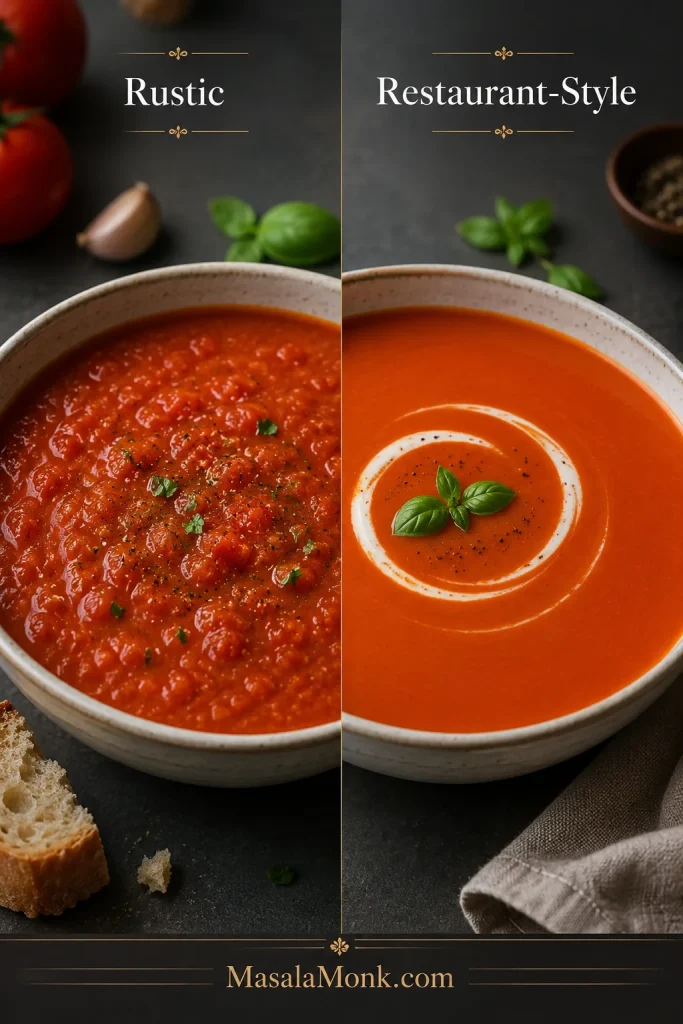
Prefer rustic tomato soup? Blend only half the pot and leave the rest slightly chunky.

Choose the final texture here: leave some body for rustic soup or strain once for a smoother restaurant-style finish.

Two bowls comparing rustic tomato soup and smooth restaurant-style tomato soup.
For a rustic bowl, leave some texture behind; however, for a restaurant-style finish, blend thoroughly and strain once.

Once you know whether you want rustic or silky soup, the stovetop method is straightforward.

Texture chosen? Continue to how to make fresh tomato soup, or keep the visual cues nearby while you cook.

How to Make Fresh Tomato Soup

The stovetop method is the easiest place to start. It is fast, flexible, and lets you taste as you go.

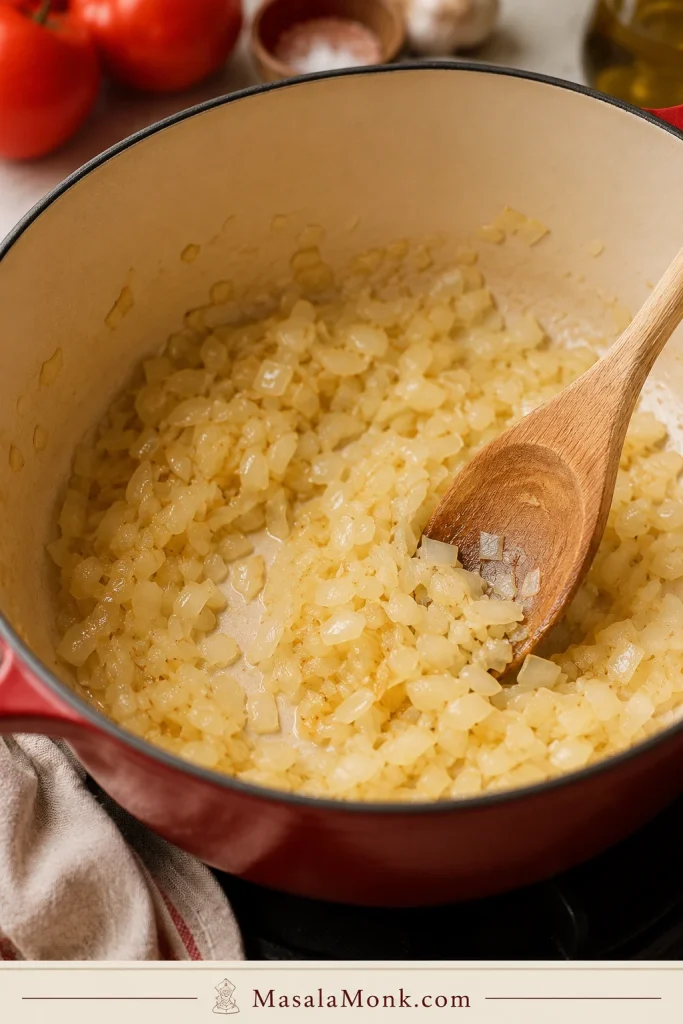
1. Soften the Onion Until Sweet

Warm olive oil or butter in a large pot. Cook the onion until soft and lightly golden. Do not rush this part; it creates sweetness before the tomatoes go in.

At this stage, the onion should smell sweet and look translucent before the acidity of the tomatoes enters the pot.

Chopped onion softening in a Dutch oven with a wooden spoon.
Soften the onion until it smells sweet and turns translucent; this early step helps balance acidity before the fresh tomatoes go in.

2. Add Garlic and Tomato Paste

Let the garlic sizzle for about 30 seconds, then stir in the tomato paste. The paste should darken slightly and smell rich, almost like the tomato flavor is already getting deeper.

Cooking tomato paste briefly with the aromatics gives the soup deeper color and a fuller tomato base.

Tomato paste cooking with onion and garlic in a pot.
Briefly cooking tomato paste with onion and garlic deepens the base, so the finished soup tastes fuller even when the tomatoes are mild or extra juicy.

3. Collapse the Tomatoes

Tip in the chopped tomatoes, seasoning, and carrot or bell pepper if using. Simmer uncovered until the tomatoes collapse into their juices and the pot looks saucy.

Once the fresh tomatoes hit the pot, give them time to soften and concentrate before you decide how much broth they need.

Chopped fresh tomatoes being tipped from a bowl into a pot.
Add the fresh tomatoes before most of the broth so they can soften, concentrate, and build flavor before you decide how loose the soup should be.

4. Blend and Adjust

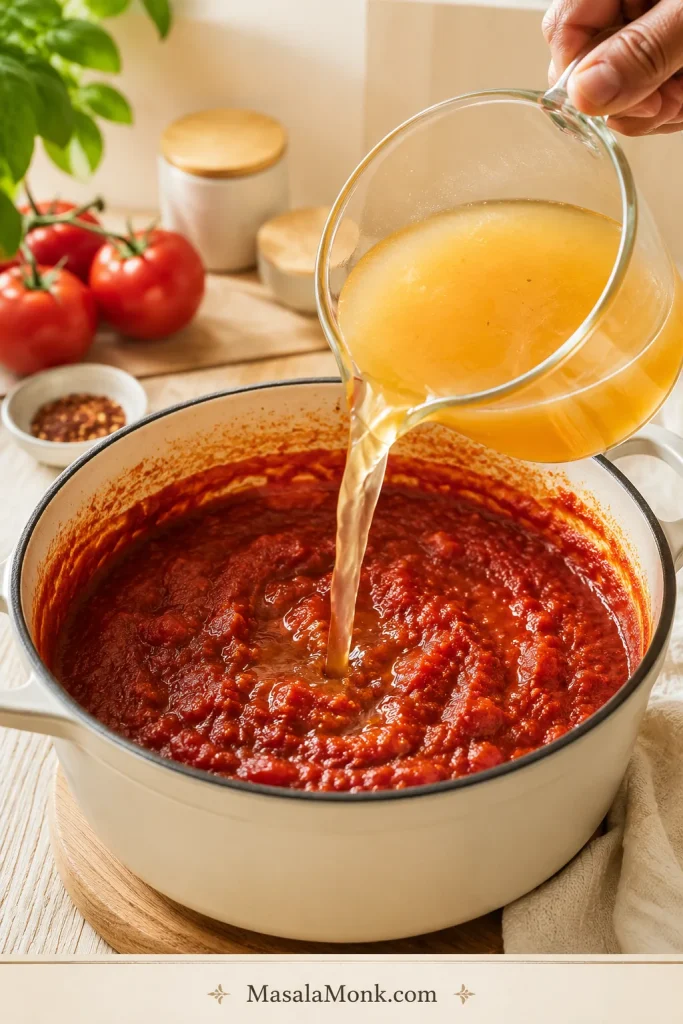
Pour in part of the broth, puree until smooth, then finish the texture. A good bowl should pour like cream but still taste like tomatoes first.

Add broth gradually after the tomato base has cooked down so the soup stays easier to control.

Broth being poured into a pot of concentrated cooked tomato mixture.
Once the tomatoes have cooked down, add broth gradually rather than all at once; that keeps fresh tomato soup full-bodied and easier to control.

After you get used to blending first and loosening after, you can use the same habit in other smooth soups too, like this butternut squash soup.

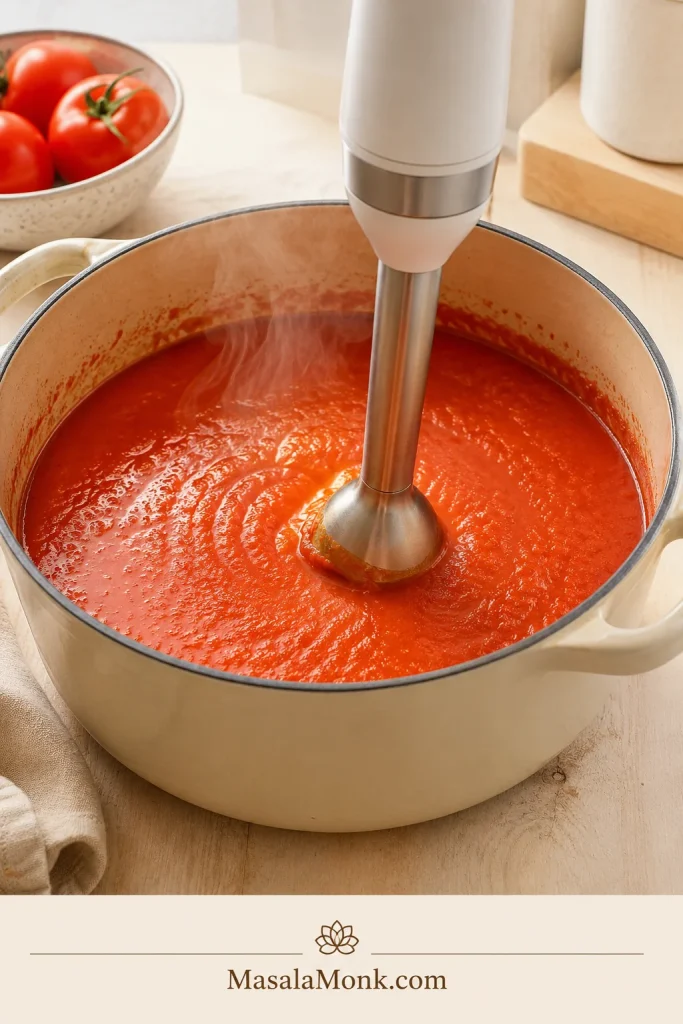
Safety cue: Hot soup expands in a blender. Work in batches, vent the lid, and cover the top with a towel so steam can escape.

When the soup is hot, work carefully and judge the thickness before adding more liquid or cream.

An immersion blender blending tomato soup inside a large pot.
Blend directly in the pot until smooth, then check the thickness before adding anything else because fresh tomato soup often loosens more than expected.

Cooking from the card? Return to the recipe card, or keep going for texture cues and variations.

What to Look For While the Soup Cooks

Tomatoes do not all behave the same, so use the timing as a guide and the texture as the final signal. The pot should smell sweeter before it looks smooth.

Stage What You Should See Why It Matters
Onion cooked Soft, translucent, and lightly golden This adds sweetness before the tomatoes go in.
Tomato paste cooked Darker red and fragrant This deepens the tomato flavor and color.
Tomatoes simmered Collapsed, saucy, and no longer floating in liquid This is where the soup starts getting body.
After blending Smooth, spoon-coating, and pourable You are aiming for soft body, not a thick paste.
Final soup Bright red-orange, balanced, and not grainy At this point, taste once more, then serve.

Aim for the texture shown here: smooth, spoon-coating tomato soup that still pours easily.

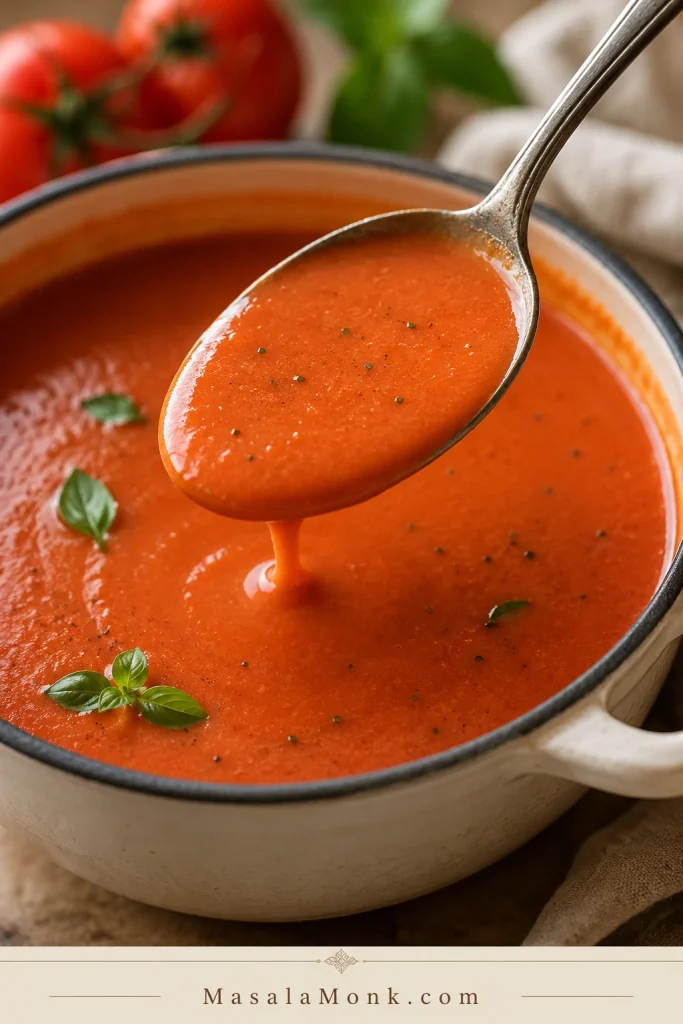
Smooth tomato soup lightly coating a spoon above the pot.
The right texture should coat a spoon lightly while still pouring easily, giving the soup a creamy feel without making it heavy.

Roasted Fresh Tomato Soup Method for Deeper Flavor

When to Roast Fresh Tomatoes

Roasting is the method to choose when your tomatoes taste good but not amazing yet. The oven pulls out sweetness, softens acidity, and gives the soup a deeper red, slightly jammy flavor before it ever reaches the blender.

It is especially useful when your tomatoes are watery, very juicy, mild, or garden-grown.

The roasted method takes longer than the stovetop version, but most of that time is hands-off. Plan on about 55 to 65 minutes total if you roast first.

Roasting helps watery or mild tomatoes taste sweeter and more concentrated before they become soup.

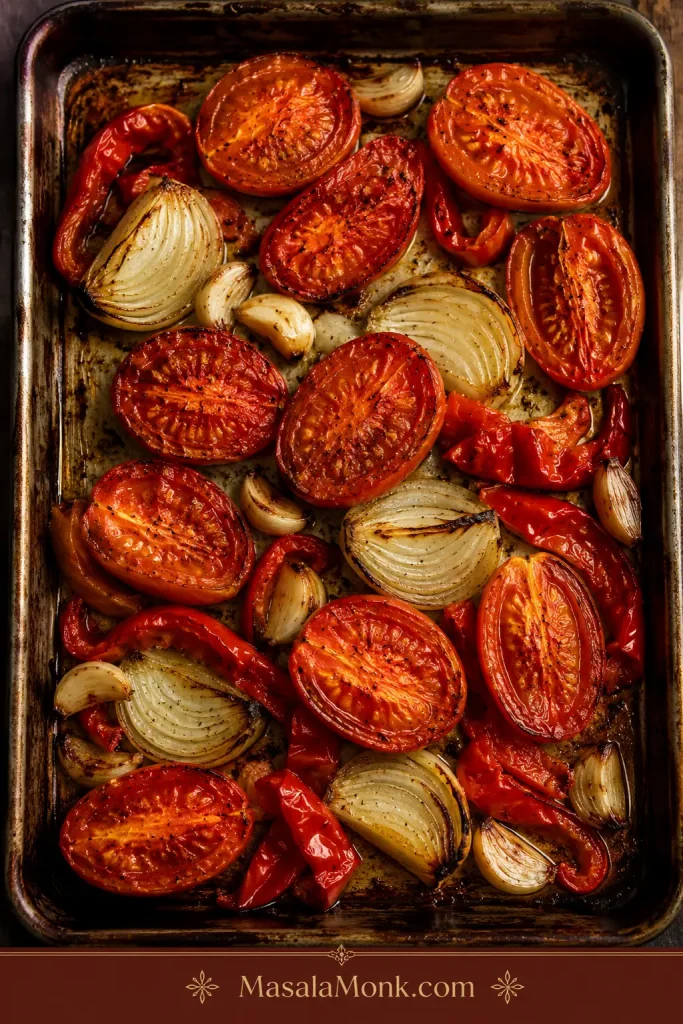
Roasted tomatoes, onions, garlic, and red pepper on a sheet pan.
Roasted fresh tomatoes create a deeper, sweeter soup because the oven concentrates their flavor before they reach the pot.

Roasting Setup

Use the same 3 lb / 1.35 kg fresh tomatoes. For roasting, use olive oil on the baking sheet. If you prefer butter, stir it into the pot after roasting instead. Cut medium tomatoes into halves or quarters. Leave the garlic cloves whole for roasting instead of mincing them, then squeeze the softened garlic out of the skins before blending.

How to Finish the Roasted Soup

  1. Heat the oven to 425°F / 220°C.
  2. Spread the tomatoes, onion, whole garlic cloves, and optional red bell pepper on a rimmed baking sheet.
  3. Toss with olive oil, salt, and pepper.
  4. Roast for 35 to 45 minutes, until the tomatoes are soft, jammy, and lightly browned at the edges.
  5. Transfer the roasted vegetables to a pot. Stir the tomato paste into the roasted juices and cook for 30 to 60 seconds.
  6. Pour in only 1 cup / 240 ml broth at first, then blend.
  7. Loosen gradually with more broth until the soup reaches your preferred thickness.
  8. Simmer for 5 to 10 minutes, blend until smooth, then add basil and blend briefly again. Finish with cream only if you want a richer roasted tomato basil soup.

The roasted tray should smell sweet and garlicky before it ever reaches the pot. If the baking sheet has a lot of tomato liquid, add those juices gradually instead of dumping everything in at once.

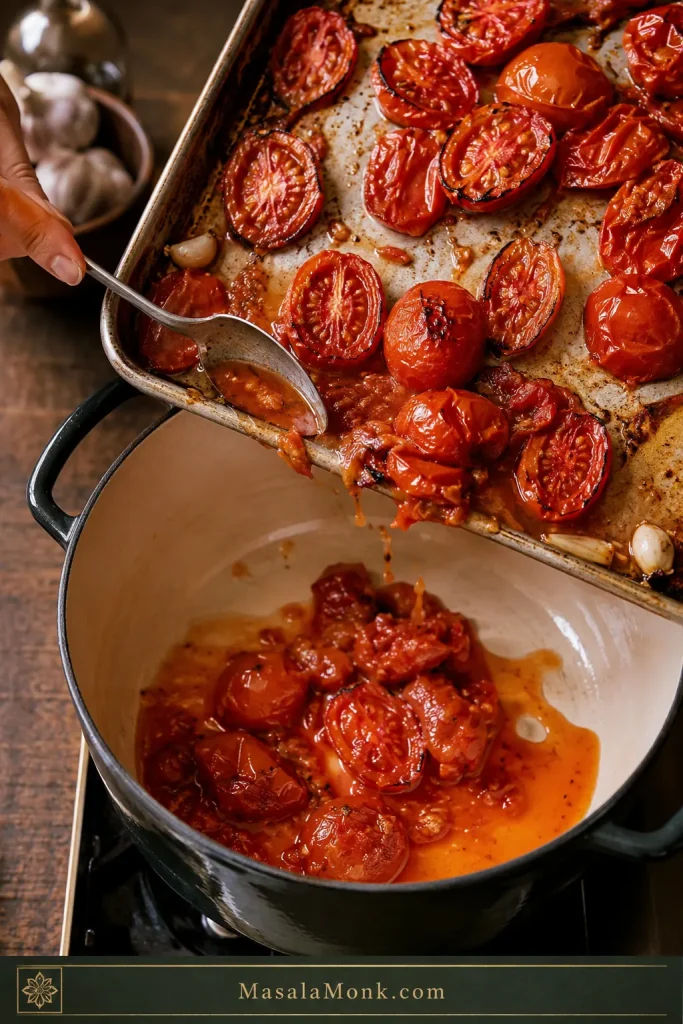
When transferring roasted tomatoes, add the tray juices thoughtfully so the roasted flavor stays strong without thinning the pot.

Roasted tomatoes and juices being transferred from a sheet pan into a pot.
Scrape the roasted tomatoes and tray juices into the pot, but add the liquid thoughtfully so the soup keeps its roasted flavor without thinning too much.

After roasting: Keep the bowl bright, make it creamy or dairy-free, turn it into tomato basil soup, or choose what to serve with it.

Creamy, No-Cream, and Vegan Options

Choose the Creaminess Level

Creaminess is not just about adding cream. It is about deciding how soft, rich, and mellow you want the final bowl to feel. Some bowls want the classic silkiness of dairy; others only need a carrot, a potato, or a handful of cashews to feel round.

Creamy Options and No-Cream Thickeners

Option How Much to Use Best For
Heavy cream 1/4 cup / 60 ml for light creaminess; 1/2 cup / 120 ml for richer soup Classic creamy tomato soup.
Half-and-half 1/4 to 1/2 cup / 60 to 120 ml Lighter everyday creamy soup.
Butter 1 tablespoon blended in at the end Silky texture without much cream.
Cashews 1/4 to 1/3 cup soaked cashews Dairy-free creamy body.
White beans 1/2 cup cooked white beans Thicker soup with more body.
Potato 1 small peeled potato, simmered with the tomatoes Thick, mild, no-cream soup.
Carrot 1 small carrot, cooked with the tomatoes Sweetness, body, and acidity balance.
Bread 1 small slice crusty bread, blended in Rustic creamy texture without cream.
Coconut milk 2 to 4 tablespoons Vegan creamy tomato soup.

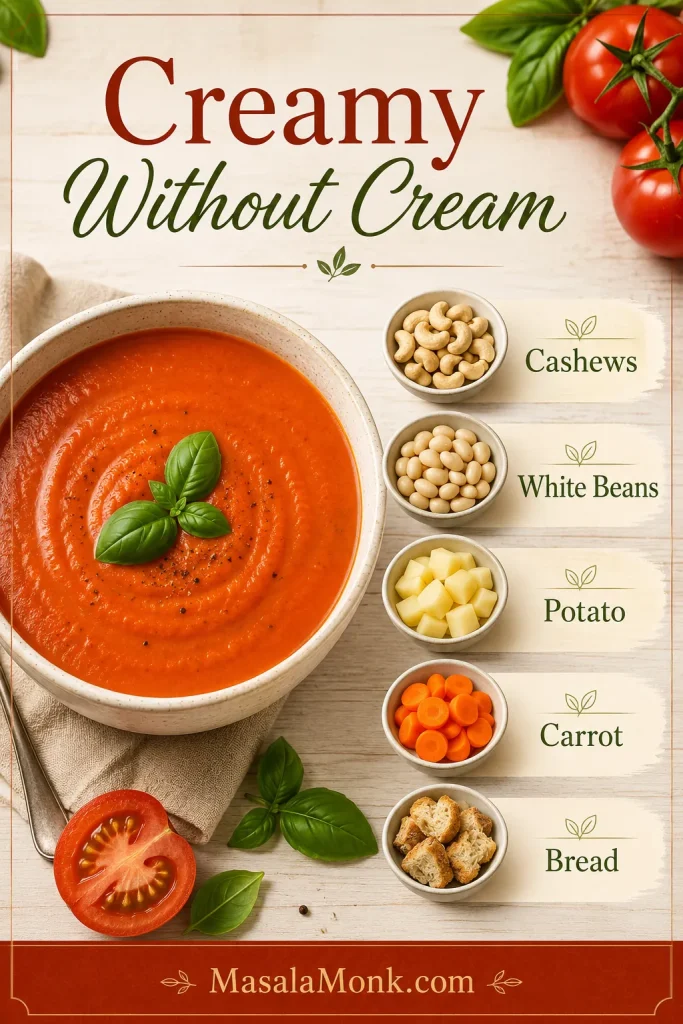
Creaminess can come from dairy or from body-building ingredients like cashews, beans, potato, carrot, or bread.

A guide showing cashews, white beans, potato, carrot, and bread as no-cream thickener options for tomato soup.
For creamy tomato soup without cream, use cashews, beans, potato, carrot, or bread to add body while keeping the tomato flavor clear.

The best creamy version still tastes like fresh tomatoes first. Cream, butter, cashews, beans, potato, or bread should round the edges, not hide them.

The goal is a soup that feels softer on the spoon, not one that forgets it started with fresh tomatoes.

Add Dairy Gently

With dairy, add it after blending and keep the heat low. If the soup is very hot, stir a spoonful of soup into the cream first, then add it back to the pot.

Cream belongs at the end, over low heat, where it softens the tomato flavor without splitting or muting the soup.

Cream being swirled into a bowl of tomato soup.
Add cream gently at the end and keep the heat low; creamy tomato soup should taste softer and rounder, not muted or split.

Vegan Tomato Soup Adjustments

For vegan tomato soup, use olive oil instead of butter and vegetable broth instead of chicken broth. Skip the cream, or blend in cashews, white beans, potato, carrot, or coconut milk for body. If the soup tastes sharp, use carrot, roasted red pepper, or a tiny amount of maple syrup instead of honey.

Tomato Basil Soup Variation

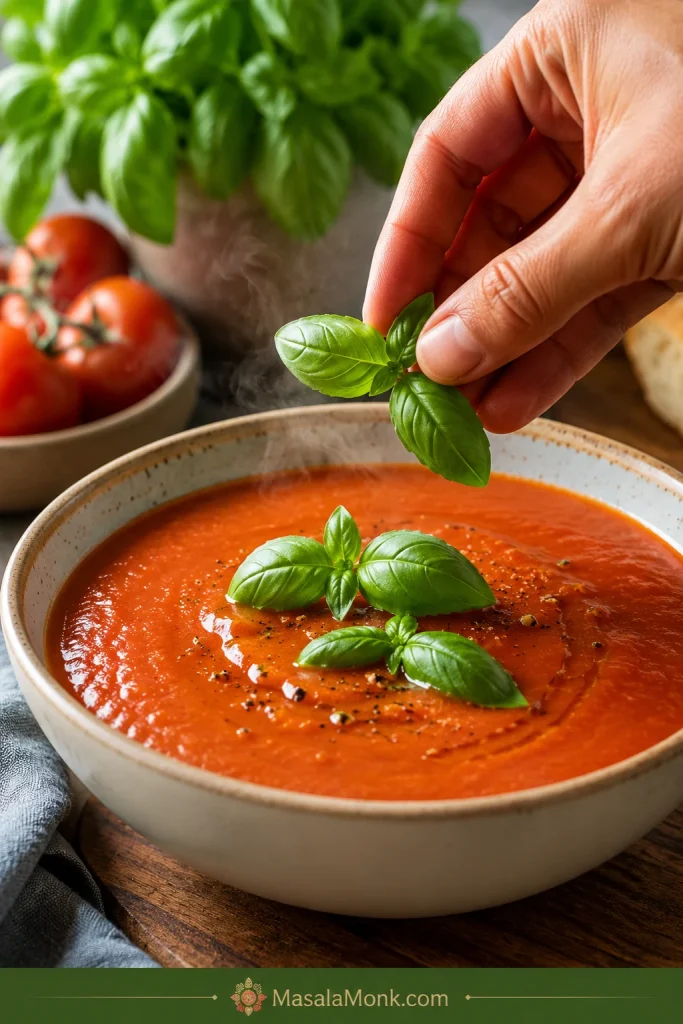
To make this a fresh tomato basil soup, increase the basil to about 3/4 cup loosely packed fresh basil leaves. Add the basil near the end, then blend briefly. For a brighter finish, save a little chopped basil for the bowls.

Fresh basil should go in late so tomato basil soup keeps its green aroma and bright finish.

Fresh basil leaves being added to warm tomato soup.
Add basil at the end so tomato basil soup keeps its fresh green aroma; otherwise, long cooking can flatten both the color and flavor.

The basil should smell fresh the moment it hits the warm soup. If it cooks too long, that bright green lift disappears.

No fresh basil? Use 1/2 to 1 teaspoon dried basil and add it with the oregano or thyme. The flavor will be less fresh, but the soup will still be good. If basil is what you love most, save this pesto pasta recipe for another night — same fresh-herb comfort, completely different dinner.

Old-Fashioned Fresh Tomato Soup Variation

For an old-fashioned tomato soup texture, use butter instead of olive oil and add a light roux. After the onion softens, stir in 1 to 2 tablespoons flour and cook for 1 minute before adding the tomatoes and broth. Finish with a splash of milk or cream and a tiny pinch of sugar if the tomatoes are sharp.

This version is thicker, softer, and more diner-style, especially good with grilled cheese, buttered toast, or homemade croutons. It is for eating fresh, refrigerating, or freezing — not for canning.

This variation leans softer and creamier, with the kind of diner-style texture that suits toast or grilled cheese.

A bowl of old-fashioned creamy tomato soup topped with croutons and black pepper, with grilled cheese in the background.
For an old-fashioned tomato soup feel, go a little creamier and softer in flavor, then serve it with croutons, toast, or grilled cheese for classic comfort.

Once the base method is clear, you can adapt it to the appliance you actually want to use.

Adapt the Method for Instant Pot, Slow Cooker, or Blender

You do not need a separate recipe for every appliance. The same rule still matters: cook the tomatoes into something flavorful before you loosen the soup.

Method How to Adapt It
Instant Pot Sauté onion and garlic, deglaze well, then add tomatoes. Keep tomato paste off the bottom to reduce burn risk. Use 1 cup / 240 ml broth for pressure cooking, pressure cook 15 minutes, release naturally 5 to 10 minutes, then blend and loosen.
Slow cooker For best flavor, sauté onion, garlic, and tomato paste first. For the easiest version, add everything directly. Use only part of the broth. Cook on high for 3 to 4 hours or low for 5 to 8 hours, then blend and add basil and cream at the end.
High-speed blender Use it for the smoothest texture, especially if you do not want to peel tomatoes. When blending hot soup, work in batches, vent the lid, and cover the top with a towel.

These versions are there for convenience, but the best flavor still comes from the same small cues: softened onion, cooked tomato paste, tomatoes that smell sweeter, and final liquid added with care.

When you want the slow-cooker route but a much heartier dinner, this crock pot lasagna soup is the richer tomato-and-pasta version.

Before troubleshooting, check the mistakes most likely to make fresh tomato soup thin, dull, or unsafe to store.

A guide card listing common fresh tomato soup mistakes, including adding broth too early, boiling cream, adding basil too soon, and canning the soup as written.
These fresh tomato soup mistakes are easy to avoid: hold back broth, keep dairy gentle, add basil late, and do not can this recipe as written.

How to Fix Watery, Sour, or Bland Tomato Soup

Start With the Simple Fixes

Do not panic if the first taste is sharp, thin, or a little bland. Fresh tomatoes vary a lot, and most soup problems are easy to fix before the bowls hit the table. Salt wakes the flavor up, cream softens acidity, tomato paste deepens the base, and a few more minutes of simmering can rescue a thin pot.

Use this comparison to see the difference between loose tomato soup and the thicker spoon-coating texture you want.

A side-by-side comparison showing watery tomato soup and thicker tomato soup labeled just right.
If the soup looks watery, keep cooking or add body before serving; the goal is smooth tomato soup that feels spoon-coating, not loose and flat.

Common Tomato Soup Problems

Problem Why It Happens How to Fix It
Watery soup Tomatoes were very juicy or too much broth was added. Simmer uncovered, add tomato paste, roast tomatoes next time, or blend in potato, white beans, cashews, or a small piece of bread.
Sour soup Tomatoes were acidic or underripe. Add carrot, roasted red pepper, cream, butter, or a tiny amount of sugar or maple syrup.
Bland soup Not enough salt, tomato depth, or aromatics. Add salt gradually, more black pepper, tomato paste, basil, or roasted garlic.
Bitter soup Garlic burned, basil overcooked, or tomatoes were underripe. Avoid burnt garlic, add basil late, and balance with cream or carrot.
Thin soup Too much liquid or not enough body. Simmer longer, add potato, white beans, cashews, bread, or cream.
Too thick Soup reduced too much. Add broth or water slowly until the texture loosens.
Seedy soup Tomato seeds remained after blending. Strain the soup through a fine-mesh strainer.
Skins in soup Tomato skins did not fully blend. Blend longer, use a high-speed blender, or strain.
Pale soup Tomatoes were not deeply red or tomato paste was skipped. Use ripe red tomatoes and add tomato paste.
Grainy soup Soup was not blended enough or solids were fibrous. Blend longer and strain for a smoother finish.

After the troubleshooting table, this card gives quick fixes for watery, sour, bland, or grainy soup.

A guide card showing fixes for watery, sour, bland, and grainy tomato soup.
Most tomato soup problems can be fixed before serving: simmer watery soup, soften sour edges, deepen bland flavor, and blend or strain rough texture.

What Not to Overdo

Do not fix everything with sugar. A tiny amount can help sharp tomatoes, but better soup usually comes from ripe tomatoes, enough salt, tomato paste, proper simmering, and a little fat or cream when needed.

For a chunkier tomato-broth soup where beans naturally add body, this minestrone soup is a good next bowl to make.

Soup fixed? Return to the recipe card, choose what to serve with tomato soup, or check storage and freezing.

What to Serve With Tomato Soup

Tomato soup is built for crisp, toasted, cheesy, or herby sides. The best bowl has that red-orange glow, a little basil on top, and something crisp on the side for dipping.

A bowl of tomato soup becomes a fuller meal when you add something crisp, cheesy, herby, or fresh on the side.

Tomato soup served with grilled cheese, toast, croutons, and a fresh salad on a table.
Tomato soup becomes a fuller meal with crisp, cheesy, or herby sides, so grilled cheese, garlic toast, croutons, and a fresh salad all work especially well.
  • Grilled cheese sandwich
  • Garlic bread
  • Cheese toast
  • Croutons
  • Toasted sourdough
  • Basil pesto toast
  • Cucumber salad for a crisp, cool side
  • Parmesan and black pepper
  • Chili flakes or chili oil
  • A swirl of cream or olive oil

For the classic version, make grilled cheese and dip the crisp edges into the soup. The first dip should leave a little orange-red trail on the bread. To keep the bowl lighter, serve it with salad, toasted bread, and extra basil. For a more filling lunch that still stays fresh, pair it with this chickpea salad instead of making the soup heavier.

The grilled cheese dip is also a texture test: the soup should cling lightly instead of running off like water.

A grilled cheese sandwich being dipped into a bowl of tomato soup.
A good tomato soup should cling lightly to grilled cheese and leave a warm orange-red trail, which is another sign that the texture is right.

Storage, Freezing, and Reheating

  • Refrigerate: Store cooled soup in an airtight container for up to 4 days.
  • Freeze: Freeze for up to 3 months for best quality. For best texture, freeze before adding cream.
  • Reheat: Warm gently on the stovetop over medium-low heat, stirring often.
  • Adjust after reheating: Add a splash of broth or water if the soup thickens in the fridge or freezer.
  • Add cream later: If freezing, stir in cream after reheating rather than before freezing.

Freeze the soup in portions for quick lunches. Leave a little space at the top of the container because soup expands as it freezes.

Portion the soup before adding cream, then adjust the texture gently when reheating.

Fresh tomato soup stored in freezer-safe containers labeled for freezing, with a bowl of soup nearby.
Freeze fresh tomato soup before adding cream for the best reheated texture; later, warm it gently and loosen it with a splash of broth if needed.

For general leftover timing, FoodSafety.gov’s cold food storage chart lists soups and stews at 3 to 4 days in the refrigerator and 2 to 3 months in the freezer, which is why this recipe keeps the storage guidance conservative.

Cooking again later? Return to the recipe card, or jump back to the top of the post.

Canning Safety Note

This fresh tomato soup recipe is written for eating fresh, refrigerating, or freezing. It is not a tested shelf-stable canning recipe.

Keep the storage advice clear: fresh eating, refrigeration, and freezing are fine, but this is not a canning recipe.

A safety card stating not to can this soup as written and to use a tested canning recipe for shelf-stable soup.
This recipe is meant for fresh eating, refrigeration, or freezing, while shelf-stable tomato soup should come from a properly tested canning recipe.

Do not can this soup as written, especially if you add cream, milk, flour, cashews, bread, potato, white beans, pasta, rice, or other thickeners. Those ingredients can change density and heat penetration in home-canned soup. If you want pantry-stable tomato soup, follow a tested pressure-canning recipe from start to finish rather than adapting this one. The National Center for Home Food Preservation is a good place to start.

Fresh Tomato Soup FAQs

Do I need to peel tomatoes for tomato soup?

No. You do not need to peel tomatoes for everyday tomato soup. Blend well, then strain the soup if you want a very smooth finish.

How many fresh tomatoes do I need?

For about 6 bowls of soup, use 3 lb / 1.35 kg fresh tomatoes. This is usually around 8 to 10 medium tomatoes, depending on their size.

Can I use cherry, garden, or mixed tomatoes?

Yes. Cherry tomatoes add sweetness, garden tomatoes add fresh flavor, and mixed tomatoes work well together. If the mix is very juicy, cook it longer before adding more broth.

Why did my soup turn watery?

Tomato soup turns watery when the tomatoes are very juicy, the soup is not simmered long enough, or too much broth is added early. Simmer uncovered, add tomato paste, or roast the tomatoes next time for a thicker bowl.

How do you make fresh tomato soup less acidic?

Use ripe tomatoes, add carrot or roasted red bell pepper, and finish with cream, butter, or a small pinch of sugar if needed. Roasting the tomatoes also helps soften sharp acidity.

What if I do not have tomato paste?

You can still make the soup, but it may taste lighter and look paler. Cook the tomatoes longer, use the roasted method if possible, and add a little extra salt or a small knob of butter at the end for depth.

Should I add cream to fresh tomato soup?

Add cream if you want the soup softer, richer, and closer to classic creamy tomato soup. Skip it if you want the fresh tomato flavor to stay brighter. For no-cream body, use carrot, potato, cashews, white beans, bread, or extra simmering.

How do I make tomato basil soup with fresh tomatoes?

Make the base recipe, then add fresh basil near the end and blend briefly. For stronger basil flavor, use extra basil and garnish each bowl with chopped basil or basil oil.

Can this be made without onion or garlic?

Yes. Use carrot, celery, roasted red bell pepper, bay leaf, basil, black pepper, and olive oil or butter for flavor. For an Indian-style no onion no garlic version, an optional tiny pinch of hing can add savory depth.

How long does homemade tomato soup last?

Homemade tomato soup lasts up to 4 days in the refrigerator when stored in an airtight container.

Can I freeze fresh tomato soup?

Yes. Fresh tomato soup freezes well for up to 3 months for best quality. For the smoothest texture, freeze it before adding cream and stir in cream after reheating.

Can I can this tomato soup?

No. This is not a tested shelf-stable canning recipe. It is written for eating fresh, refrigerating, or freezing. Use a tested pressure-canning recipe if you want pantry-stable soup.

Final Thought

The best fresh tomato soup tastes like you caught the tomatoes at the right moment — ripe, sweet, a little messy, and worth turning into something warm. Cook them down until the pot smells saucy, blend until smooth, then let the tomatoes tell you how much broth they need. The final bowl should taste bright enough for summer, soft enough for comfort, and ready for grilled cheese.

Posted on Leave a comment

Smoked Haddock Chowder Recipe: Creamy, Smoky, Easy Fish Soup

Bowl of smoked haddock chowder with fish flakes, potato chunks, herbs, black pepper, crackers, and a lemon wedge on a wooden table.

A good smoked haddock chowder should feel like a full meal in a bowl: soft potatoes, tender flakes of fish, and a creamy broth that carries the smoke without turning salty or heavy. This version is smoke-kissed enough to feel special, rounded enough to be comforting, and sturdy enough to serve with nothing more than bread on the side.

This version keeps the base simple: smoked haddock, milk, potatoes, leek, onion, celery, and herbs. From there, you can make the bowl sweeter with sweetcorn, richer with cream, deeper with bacon, or more seafood-forward with prawns. The heart of the recipe stays the same: gently poached smoked fish, smoky milk, and potatoes mashed just enough to thicken the soup naturally.

The method is built to avoid the usual smoked haddock chowder problems: over-salted broth, split milk, rubbery flakes, and a thin base. It feels like weekend comfort, but the cooking is simple enough for a weeknight.

Those small details matter most at the end, when the milk, seasoning, and flaked haddock come together. For another cozy fish-and-potato bowl, this creamy salmon soup follows the same comforting, gentle-cooked idea.

Quick Answer: What Is Smoked Haddock Chowder?

Smoked haddock chowder is a creamy fish soup made with smoked haddock, potatoes, leek or onion, and milk. The best method is to poach the haddock gently in milk first, use that smoky milk in the soup base, mash some potatoes for body, then fold the fish back in at the end so it stays tender.

It is closely related to Cullen skink, the traditional Scottish smoked haddock soup, but chowder is broader and more flexible. Cullen skink usually stays close to smoked haddock, potatoes, onion or leek, milk, and sometimes cream. Chowder can include sweetcorn, bacon, celery, prawns, stock, herbs, or a richer creamy finish.

The key: Treat the haddock gently. Once it has been poached, the chowder is mostly about building a soft potato base and folding the fish back in without breaking it up.

Jump to the recipe card · See the 3 rules first

Before You Cook: 3 Things That Make the Chowder Better

Smoked haddock is easy to cook, but it has a strong personality. A little care with heat and seasoning keeps the chowder mellow, creamy, and balanced.

  1. Save salt for the end. Smoked haddock, bacon, pancetta, and stock can all bring salt. Taste the finished chowder before seasoning.
  2. Keep the dairy gentle. Milk and cream stay smoother when they are warmed quietly instead of pushed into a rolling boil.
  3. Warm the fish through instead of re-cooking it. Once the haddock is poached and flaked, it only needs a few minutes in the finished chowder.
Guide graphic showing three smoked haddock chowder rules: salt at the end, keep dairy gentle, and warm fish through.
These three rules protect the chowder before trouble starts: season late, keep the dairy gentle, and warm the fish through instead of boiling it.

Best for: smoky comfort without an over-salted soup, a creamy chowder without a heavy roux, and one base recipe you can turn sweeter with sweetcorn, deeper with bacon, or more seafood-forward with prawns.

Jump to the recipe card

Smoked Haddock Chowder Recipe

Easy Creamy Smoked Haddock Chowder

This is a cozy stovetop chowder with milk-poached smoked haddock, soft potatoes, leek, onion, celery, and herbs. Sweetcorn is optional but lovely for a sweeter family-style bowl; cream and bacon are optional richer finishes. The potatoes thicken the base naturally, the poaching milk carries the smoked-fish flavour, and the haddock goes back in at the end so the flakes stay tender.

Prep time15 minutes
Cook time35 to 40 minutes
Total time50 to 55 minutes
Servings4 generous bowls
MethodStovetop
DifficultyEasy
TextureCreamy, chunky, smoky, spoon-coating

Ingredients

  • 400 to 450 g / 14 to 16 oz smoked haddock fillets
  • 600 ml / 2½ cups whole milk
  • 250 to 300 ml / 1 to 1¼ cups unsalted fish stock, unsalted vegetable stock, or water
  • 500 to 600 g / 1 lb 2 oz to 1 lb 5 oz potatoes, peeled and diced into 1 to 1.5 cm pieces
  • 1 large leek, cleaned and sliced
  • 1 small onion, finely chopped
  • 1 celery stick, finely sliced
  • 30 to 40 g / 2 to 3 tablespoons unsalted butter
  • 1 bay leaf
  • 1 teaspoon thyme leaves, or 2 thyme sprigs
  • 100 to 150 g / about ⅔ to 1 cup sweetcorn, optional, recommended for a sweeter family-style bowl
  • 75 to 100 ml / ⅓ cup to scant ½ cup cream, optional
  • 75 to 100 g / about 2½ to 3½ oz bacon or pancetta, optional
  • Black pepper, to taste
  • Chopped parsley or chives, to finish
  • Lemon wedges, optional

Salt note: Taste after the smoked haddock is back in the pot, then add salt only if the chowder needs it.

Instructions

Poach the fish and start the base

  1. Poach the smoked haddock. Place the smoked haddock in a wide pan. Add the milk and bay leaf. Warm over low to medium-low heat until the milk is steaming and barely simmering.
  2. Cook the fish gently. Poach for 5 to 7 minutes, depending on thickness, until the fish is opaque and flakes easily.
  3. Reserve the smoky milk. Lift the fish out with a slotted spoon. Strain and reserve the poaching milk. Remove skin or bones if needed, then flake the haddock into large pieces.
  4. Start the base. Melt the butter in a large soup pot over medium-low heat. If using bacon or pancetta, cook it first until golden, then remove some crispy pieces for topping if you like.
  5. Soften the vegetables. Add the leek, onion, and celery. Cook for 8 to 10 minutes, stirring often, until soft and glossy but not browned. The leeks should smell sweet before the potatoes go in.

Thicken, finish, and serve

  1. Simmer the potatoes. Add the diced potatoes, thyme, and unsalted stock or water. Simmer for 10 to 15 minutes, or until the potatoes are tender.
  2. Thicken naturally. Mash some of the potatoes directly in the pot. Leave some chunks whole so the bowl stays hearty.
  3. Add the milk and sweetcorn. Pour in the reserved poaching milk. Add the sweetcorn, if using. Warm gently for 3 to 5 minutes.
  4. Finish with cream and fish. Stir in the cream, if using, then add the flaked smoked haddock. Keep the heat low and warm through for 2 to 3 minutes. The pot should be hot, not bubbling hard.
  5. Rest, taste, and serve. Let the chowder sit off the heat for 5 minutes if you have time; the potatoes settle and the smoky flavour rounds out. Finish with black pepper, herbs, lemon, and a little salt only if needed. Serve hot with crusty bread, toast, oatcakes, crackers, or a simple green salad.

Best texture cue: The chowder should be spoon-coating, with tender potato pieces and large flakes of fish. It should feel generous, creamy, and smoky without becoming heavy.

Once you understand the base, this chowder becomes easy to bend. Keep the fish tender, keep the seasoning balanced, then choose the version that fits the meal you want.

See the variations · Need a fix?

Smoked Haddock Chowder Variations: Sweetcorn, Bacon, Prawn, Creamy, or Lighter

Choose the bowl you want, but keep the spine of the recipe steady: smoked fish, milk, potatoes, leek or onion, and gentle heat. The variations below let you make the same pot lighter, richer, sweeter, or more generous without relearning the recipe.

Six-panel guide showing classic, sweetcorn, bacon, prawn, lighter, and Cullen skink-style smoked haddock chowder variations.
After the base is right, choose the mood of the bowl: sweeter with sweetcorn, richer with bacon, lighter without cream, or more seafood-forward with prawns.
If you want…Do thisResult
Classic cozy bowlUse milk, potatoes, leek, onion, celery, thyme, and a little cream.Rounded, creamy, balanced
Lighter weeknight bowlSkip bacon and cream, mash extra potatoes, and finish with herbs and lemon.Creamy without feeling heavy
Sweetcorn chowderAdd 100 to 150 g / about ⅔ to 1 cup sweetcorn near the end.Softer smoke, little sweet pops
Bacon chowderCook bacon or pancetta first, then soften the vegetables in the fat.Deeper, savoury, bacon-smoky
Prawn or shrimp chowderAdd raw prawns or large shrimp near the end and cook just until pink.More seafood-forward and generous
Cullen skink-style bowlSkip sweetcorn, bacon, celery, and prawns. Keep smoked haddock, potatoes, onion or leek, milk, and herbs.Simpler, cleaner, more traditional
Dairy-free coconut bowlUse light coconut milk and water instead of dairy milk and cream.Smoke-kissed, lighter, less traditional

Why This Recipe Works

Milk-poaching makes the biggest difference. The fish cooks quietly, the milk takes on a gentle smoke, and the kitchen starts to smell smoky and savoury before the soup base is even built.

Potatoes give the soup body without needing a heavy flour base. Once they are tender, mash some directly into the pot. The starch thickens the broth naturally, leaves the flavour cleaner than a roux, and still gives you enough potato chunks to make the bowl feel hearty.

Adding the fish back at the end keeps the flakes large and tender instead of dry, rubbery, or broken into tiny pieces. The same gentle-finish idea also matters in creamy fish dishes like this creamy salmon pasta.

Late seasoning keeps the bowl balanced. Smoked haddock varies from mild to very salty, and richer add-ins like bacon or pancetta can change the salt level quickly. Waiting until the end gives you control.

The Texture We’re Going For

The finished chowder should sit in the comfortable middle: thicker than a thin fish soup, lighter than a heavy seafood stew, and creamy without becoming heavy or stodgy. The broth should coat a spoon lightly, the potatoes should be soft, and the fish should stay tender instead of breaking down into the base.

Spoon lifting smoked haddock chowder with creamy broth, fish flakes, potato, leek, herbs, and a few sweetcorn kernels.
Look for this texture at the end: spoon-coating broth with tender haddock flakes and potato pieces still clearly visible.

The finished bowl should feel settled and comforting: soft potatoes, mellow smoke, and clear pieces of haddock, not tiny fragments lost in the soup. If the pot looks a little loose before the haddock goes back in, give the potatoes a gentle mash and a few minutes to settle. If it looks too thick, a splash of warm milk or unsalted stock will bring it back.

The Chowder Formula

Once the fish is handled gently, the rest of the chowder is built from simple, comforting things: potatoes for body, leek for sweetness, milk for softness, and herbs for a fresh finish.

Ingredient guide showing a smoked haddock chowder formula with fish, milk, potatoes, leek, herbs, and optional finishes.
The formula is easy to remember: smoked fish for depth, milk for softness, potatoes for body, leek for sweetness, and herbs for lift.
FishSmoked haddock, ideally undyed if available
BaseWhole milk for poaching, plus unsalted stock or water for the potatoes
BodyDiced potatoes, partly mashed into the soup
SweetnessLeek, onion, and optional sweetcorn
RichnessCream or bacon, both optional
FreshnessParsley, chives, black pepper, and lemon at the end
Main cueQuiet heat after the dairy and fish go in

Ingredients and Smart Swaps

The ingredient list is simple, but each choice shapes the bowl: smoke from the fish, sweetness from the leek, body from the potatoes, softness from the milk, and freshness from herbs and lemon.

Overhead flatlay of smoked haddock, milk, potatoes, leek, onion, celery, herbs, sweetcorn, cream, bacon, lemon, and seasonings.
Because smoked haddock brings plenty of flavour, the best base stays simple: milk, potatoes, leek, onion, celery, herbs, and only the extras you need.

Smoked Haddock

Choosing the Fish

Use 400 to 450 g / 14 to 16 oz smoked haddock for four generous bowls. Undyed smoked haddock is ideal if you can find it because the colour is natural and the flavour is usually cleaner. Dyed smoked haddock also works, but it will give the soup a stronger yellow colour.

Side-by-side comparison of yellow dyed smoked haddock and paler undyed smoked haddock on a light surface.
Dyed haddock works, but undyed smoked haddock usually gives the chowder a cleaner colour and a more natural-looking finished bowl.

When the fish has skin, poach it with the skin on, then remove the skin before flaking. Pull out any bones as you break the fish into large pieces.

Frozen Fish, Substitutes, and Salt Balance

Frozen smoked haddock works well when it is thawed overnight in the fridge before poaching. Pat it dry, then cook gently as usual. When poaching from frozen, use lower heat and allow extra time, though thawed fish gives better texture and more even cooking.

When smoked haddock is unavailable, use smoked cod, smoked pollock, smoked whiting, or another smoked white fish. For very strong smoked fish, use part smoked fish and part plain white fish.

Very strong or salty haddock can overpower the pot, so use a little less of the poaching milk and balance the chowder with fresh milk, unsalted stock, or extra potato. You still get the smoked-fish flavour without letting it take over the bowl.

Extra cooked smoked haddock is worth keeping in large flakes for potato-based leftovers. This crispy fish cakes recipe is a useful next idea when you have fish and potato to use up.

Milk

Whole milk gives the best texture and flavour because it does two jobs at once: it poaches the fish and becomes part of the base. Semi-skimmed or 2% milk can work too, but it needs lower heat because leaner milk is less forgiving.

Potatoes

Floury potatoes make the thickest, creamiest chowder because they break down slightly. Maris Piper, King Edward, Russet, or Yukon Gold are all good choices. Waxy potatoes hold their shape and give a chunkier bowl, which is also fine if that is what you like.

Dice the potatoes into roughly 1 to 1.5 cm pieces so they cook in 10 to 15 minutes. Mash some of the cooked potatoes into the soup before adding the fish back, and leave the rest whole for texture. The best bowls have both: a rounded base from the mashed edges and a few soft pieces left for the spoon.

You can replace 150 to 200 g of the potato with sweet potato for a slightly sweeter chowder, especially if you are using prawns, sweetcorn, or a lighter no-cream version.

Leek, Onion, and Celery

Leek gives a soft sweetness that suits smoked fish. Slice it, then rinse well in a bowl or colander to remove grit between the layers. Onion adds depth, and celery gives the pot a classic savoury base.

If you only have onion, use one large onion and skip the leek. If you love leeks, use two leeks and skip the onion. For a more leek-forward smoked haddock and leek chowder, use two leeks and skip the celery.

Sweetcorn

Sweetcorn is optional, but it works beautifully here. It gives little pops of sweetness against the creamy potato base and softens the salty-smoky edge of the fish. Frozen sweetcorn can go straight into the hot chowder. Canned sweetcorn should be drained first. Fresh corn can be cut from the cob and simmered for a few minutes until tender.

Stock or Water

Unsalted fish stock, unsalted vegetable stock, or water gives you the most control. If your stock is already salted, start with less and adjust the finished bowl instead of seasoning early.

Bacon or Pancetta

Bacon or pancetta makes the bowl deeper, richer, and more pub-style. Cook it first, then soften the leek and onion in the rendered fat. If the bacon releases plenty of fat, use less butter before adding the vegetables. Taste the finished chowder before seasoning because bacon can push the salt up quickly.

Cream

Cream is a finishing touch, not the thing that holds the chowder together. Single cream, heavy cream, or cooking cream all work. If using double cream, use the smaller amount because it is richer. Add cream near the end over low heat.

For another rich finish, stir in a small handful of mature cheddar off the heat. Keep it modest and taste before adding salt, because smoked haddock and cheese can make the bowl salty quickly.

Herbs, Pepper, Mustard, and Lemon

Parsley and chives bring freshness to the finished bowl. Black pepper works better than early salt. Lemon is optional, but a small squeeze at the end can wake up a rich chowder, especially if you used cream or bacon.

A small teaspoon of Dijon or English mustard can also sharpen the soup without making it taste obviously mustardy. It is especially useful if the base tastes creamy but a little flat.

Jump to the step-by-step method · Back to recipe card

Useful Equipment

You only need a wide pan for poaching, a soup pot for the base, a sieve for the smoky milk, and a potato masher or sturdy spoon for thickening. An immersion blender is optional, but blend only part of the potato mixture so the chowder keeps some texture.

How to Poach Smoked Haddock in Milk

Milk-poaching is the step that makes the chowder taste rounded instead of sharp. The fish cooks quietly, the milk absorbs the smoke, and you get a base that already tastes like smoked haddock before the soup is built.

Smoked haddock fillets gently poaching in milk in a shallow pan with a bay leaf and light steam.
Poaching the haddock in milk first does two jobs at once: it keeps the fish tender and turns the milk into the smoky chowder base.

Milk-Poaching Steps

  1. Place the smoked haddock in a wide pan in a single layer.
  2. Add the milk and bay leaf. The fish does not need to be submerged perfectly, but it should be mostly covered.
  3. Warm slowly over low to medium-low heat until the milk is steaming and just beginning to tremble at the edges.
  4. Poach for 5 to 7 minutes, depending on the thickness of the fillets.
  5. Lift the fish out as soon as it turns opaque and flakes easily. If checking with a thermometer, look for 63°C / 145°F.
  6. Strain the milk and keep it for the chowder. The reserved milk should smell gently smoky, not harsh; that is the flavour that will carry through the whole pot.
  7. Remove skin and bones if needed, then flake the haddock into large pieces.

Visual cue: Keep the cooked haddock in large flakes before it goes back into the chowder.

Large flakes of cooked smoked haddock on a plate with the text “Keep the flakes large.”
Once the fish is cooked, flake it generously rather than finely so the haddock still feels like the main ingredient in each spoonful.

Give this step gentle heat and a few calm minutes. The fish may not look dramatic at this stage, and that is fine. You are only cooking it until it flakes, not trying to brown or crisp it.

Continue to the step-by-step method · Back to recipe card

How to Make Smoked Haddock Chowder

Once the haddock is poached and the smoky milk is reserved, the chowder comes together like a simple potato soup. Build flavour before the dairy goes back in, then finish with low, patient heat.

1. Soften the Leek, Onion, and Celery

Melt the butter in a large soup pot over medium-low heat. Add the leek, onion, and celery, then cook for 8 to 10 minutes until soft and glossy. The vegetables should smell sweet and savoury, not browned.

Leek, onion, and celery softening in butter in a pan with a wooden spoon and the text “Soften, don’t brown.”
Soften the leek, onion, and celery until glossy and mellow; browning them pushes the chowder away from its soft, creamy flavour.

2. Simmer the Potatoes

Add the diced potatoes, thyme, and unsalted stock or water. Simmer until the potatoes are tender, usually 10 to 15 minutes. Smaller potato pieces cook faster and make the chowder easier to thicken.

Diced potatoes simmering with leek and thyme in a pot, with the text “Small pieces cook faster.”
Next, simmer small potato pieces until tender so they cook evenly and can later thicken the chowder without a floury roux.

3. Mash Some Potatoes for Body

Mash some of the potatoes directly in the pot. This is the easiest way to thicken the soup without making it heavy. Leave enough potato chunks whole so each bowl still has texture.

Potato masher pressing cooked potatoes in a pot with leeks, leaving some potato chunks whole.
Mash only part of the potatoes into the pot; that gives the chowder body while leaving enough chunks for a hearty bowl.

4. Add the Reserved Smoky Milk

Pour in the strained poaching milk and stir gently. The pot should start to smell smoky and mellow, not sharp or fishy. This is the moment it starts to taste like chowder instead of potato soup. If the chowder looks a little loose, mash a few more potatoes and let the base settle for a minute.

Milk being poured from a jug into a pot of potatoes and leeks with steam rising.
Then pour in the reserved smoky milk slowly, letting the potato base loosen into a creamy chowder instead of a thin soup.

5. Finish With Fish, Sweetcorn, and Cream

Stir in the sweetcorn and warm it through. Add the cream if using, then fold in the flaked smoked haddock. A few broken flakes are fine; just avoid stirring so hard that the fish disappears into the soup.

Large flakes of smoked haddock being folded into creamy chowder in a pot with a wooden spoon.
Add the haddock near the end and fold gently, because the flakes only need to warm through, not simmer for ages.

6. Taste at the End

Finish with black pepper, parsley or chives, and a squeeze of lemon if the chowder needs brightness. Add mustard if the base tastes creamy but flat. The final herbs and lemon lift the bowl and make it feel rich without becoming heavy.

Check final texture cues · Troubleshoot the chowder

Final Texture and Taste Cues

A good smoked haddock chowder should look smooth and spoon-coating, not gluey. The broth should coat a spoon lightly, the potatoes should be tender, and the haddock should sit in large flakes rather than tiny broken pieces. The bowl should feel generous, not heavy.

Ladle lifting finished smoked haddock chowder with fish flakes, potatoes, leeks, herbs, and creamy broth.
Before serving, check the ladle: you want creamy broth, tender fish, soft potatoes, and enough movement that the chowder still feels silky.
  • Fish: opaque, tender, and easy to flake.
  • Potatoes: soft enough to mash at the edges, with some chunks left whole.
  • Liquid: smooth and rounded, not separated or grainy.
  • Seasoning: smoke first, gentle sweetness from leek and corn, and only enough salt to feel balanced.

If the chowder tastes flat, it usually needs pepper, herbs, lemon, mustard, or a little extra smoked-fish flavour. If it tastes too salty, the fix is usually more potato, milk, cream, or unsalted stock.

More Ways to Adjust the Chowder

The base recipe gives you a classic spoon-coating chowder. These notes help you steer the same pot lighter, richer, sweeter, or more seafood-heavy without changing the method.

Creamy Version

A splash of cream makes the bowl fuller and softer. Stir in 75 to 100 ml / ⅓ cup to scant ½ cup near the end so it rounds out the broth without drowning the smoked fish.

Lighter or No-Cream Version

Skip the bacon and cream, use milk as the main liquid, mash extra potatoes for body, and finish with herbs and lemon instead of extra fat. The bowl still feels rich and rounded, but the body comes from potatoes rather than cream.

Smoked Haddock and Sweetcorn Chowder

Sweetcorn is the easiest way to soften the smoke. Add 100 to 150 g / about ⅔ to 1 cup near the end for little sweet pops against the salty fish and creamy potato base. Frozen, canned, or fresh corn all work.

Bowl of smoked haddock and sweetcorn chowder with fish flakes, potato chunks, herbs, black pepper, and visible sweetcorn.
For a sweeter family-style version, sweetcorn softens the smoky edge and adds bright pops of texture against the potato base.

Smoked Haddock and Bacon Chowder

Bacon pushes this into pub-style territory. Cook 75 to 100 g / about 2½ to 3½ oz chopped bacon or pancetta first, then let the leek and onion soften in the rendered fat. Taste the finished chowder before seasoning.

Bowl of smoked haddock chowder topped with crispy bacon, herbs, potatoes, leeks, and creamy broth in a dark bowl.
For a deeper pub-style bowl, bacon adds savoury crunch and smoke, but taste before salting because it seasons the chowder too.

Smoked Haddock and Prawn Chowder

Prawns make the bowl feel more generous and seafood-forward. Add raw prawns, or large shrimp, near the end and cook gently for 2 to 3 minutes, just until pink and opaque. If using cooked prawns, add them only long enough to warm through. For a separate quick seafood dinner where prawns are the main event, try this shrimp scampi recipe.

Bowl of smoked haddock and prawn chowder with pink prawns, fish pieces, potatoes, herbs, lemon, and creamy broth.
For the prawn version, add prawns near the end so they stay pink, tender, and sweet instead of shrinking into the broth.

Dairy-Free Coconut Version

This will not taste like a classic British chowder, but it can still be lovely: smoky, light, and gently spiced. Use light coconut milk and water instead of dairy milk and cream, then add ginger, turmeric, chilli, or smoked paprika if you want more warmth.

Small Batch for 2 People

For two bowls, use about 200 to 225 g / 7 to 8 oz smoked haddock, 300 ml / 1¼ cups milk, 250 to 300 g potatoes, and one small leek or half an onion. A smaller pan helps keep the fish mostly covered while it poaches.

Budget-Friendly Version

To stretch the pot, use 250 to 300 g smoked haddock instead of the full amount, then add more potato, sweetcorn, and leek. The flavour will be milder, but the smoky poaching milk still carries through the soup.

Smoked Haddock Chowder vs Cullen Skink

Cullen skink is the more traditional Scottish smoked haddock soup; smoked haddock chowder is the broader, more flexible version. Cullen skink usually stays close to smoked haddock, potatoes, onion or leek, milk, and sometimes cream, while chowder may include celery, sweetcorn, bacon, prawns, stock, herbs, or extra cream.

Make the Cullen skink-style version when you want something simpler and more traditional. Make this chowder when you want a flexible bowl with sweetcorn, bacon, prawns, or a richer finish.

Split comparison showing a simpler Cullen skink-style bowl beside a fuller smoked haddock chowder with optional add-ins.
Cullen skink-style keeps things simpler and more traditional, while chowder gives you more room for cream, herbs, sweetcorn, bacon, or prawns.

For a more traditional direction, this Cullen skink recipe keeps the focus on smoked fish, potatoes, onion, and a simple milk-rich base.

For a stricter Cullen skink-style bowl, skip the sweetcorn, bacon, celery, prawns, and heavy add-ins. Use smoked haddock, potatoes, leek or onion, milk, a little cream if you like, black pepper, and herbs.

DishUsually includesBest for
Smoked haddock chowderSmoked haddock, potatoes, milk, leek or onion, celery, sweetcorn, bacon, cream, herbs, or seafood add-insA flexible creamy fish soup
Cullen skinkSmoked haddock, potatoes, onion or leek, milk, cream, herbsA more traditional Scottish smoked haddock soup

Back to top

Troubleshooting

Most chowder problems happen near the end, when the milk gets too hot, the fish is stirred too hard, or the smoked haddock brings more salt than expected. The fixes below will usually save the pot.

Troubleshooting guide for smoked haddock chowder with fixes for too salty, too thin, split milk, and rubbery fish.
If the chowder needs rescuing, fix the cause: potatoes add body, milk or stock softens saltiness, and lower heat protects the dairy and fish.

Texture and heat fixes

ProblemWhat happenedHow to fix it
Chowder is too thinThe potatoes did not break down enough.Mash some potatoes into the soup or simmer the base uncovered briefly before adding the fish.
Chowder is too thickThe potatoes thickened the base more than expected.Loosen with warm milk, stock, or water until the texture feels right.
Milk split or turned grainyThe heat was too high after the milk or cream went in.Lower the heat and avoid a hard boil. A split chowder is usually edible, but the texture may look grainy.
Fish is rubberyThe haddock was boiled or cooked too long.Poach gently and add the flaked fish back near the end only to warm through.
Fish broke into tiny piecesThe haddock was stirred too much after flaking.Fold the fish in gently at the end and avoid aggressive stirring.

Flavour and seasoning fixes

ProblemWhat happenedHow to fix it
Chowder is too saltyThe smoked haddock, bacon, pancetta, or stock added more salt than expected.Add potato, milk, cream, or unsalted stock to soften the salt. Next time, season at the end.
Chowder tastes too smokyThe smoked haddock was very strongly smoked.Add potato, sweetcorn, milk, or cream to soften the smoke. Next time, use part smoked fish and part plain white fish.
Chowder tastes blandThe base needs more lift or seasoning.Add pepper, herbs, lemon, mustard, or a little extra smoked-fish flavour.
Chowder is too richToo much cream, bacon, or butter made it heavy.Loosen with milk or stock and finish with lemon and herbs. Next time, skip cream and thicken with potato.
Chowder tastes fishyThe fish may not be fresh enough, may have been overcooked, or may be too strong for your taste.Use fresh-smelling smoked haddock, avoid boiling, and finish with lemon and herbs.

Back to recipe card · Storage and reheating

Storage, Freezing, and Reheating

This chowder is best freshly made, but leftovers can still be lovely if you warm them slowly. Fish and dairy prefer patience, not high heat.

Smoked haddock chowder in a bowl and glass storage container with a small jug of milk, herbs, spoon, and lemon.
For leftovers, cool the chowder promptly, store it gently, and reheat it slowly with a splash of milk or stock if it thickens.

To Refrigerate

Let the chowder cool briefly, then store it in an airtight container in the fridge for up to 2 to 3 days. Because it contains fish and dairy, get it into the fridge promptly.

To Reheat

Reheat on low heat, stirring gently, until hot all the way through. Add a splash of milk or stock if the chowder has thickened in the fridge.

To Freeze

You can freeze it, but the texture may change because milk, cream, and potatoes can become slightly grainy after freezing. For the best make-ahead result, freeze the potato and milk base before adding cream and fish, then add freshly poached smoked haddock when reheating.

Best Make-Ahead Method

Make the leek, potato, and milk base ahead of time, then add the flaked smoked haddock when you reheat the chowder. This keeps the fish from breaking apart or turning tough.

What to serve with it · Back to recipe card

What to Serve With Smoked Haddock Chowder

The chowder is filling enough to be a meal on its own, especially when it has potatoes and sweetcorn in the bowl. A simple side makes it feel complete.
Anything toasted, crunchy, or slightly sharp works well here because the chowder itself is soft, smoky, and spoon-coating. Toast, oatcakes, crackers, or crusty bread give you contrast against the creamy bowl.

Bowl of smoked haddock chowder served with toasted bread, salad, lemon wedges, oatcakes, butter, herbs, and black pepper.
To make the chowder feel like a full meal, add contrast with toasted bread, oatcakes, crackers, lemon, herbs, or a crisp green salad.
  • Crusty bread
  • Buttered toast
  • Soda bread
  • Oatcakes or crackers
  • Simple green salad
  • Roasted carrots or other roasted vegetables
  • Lemon wedges
  • Extra chives, parsley, or black pepper

For something homemade to dip into the bowl, this homemade garlic bread loaf is a strong fit.

For a fresher plate, pair the chowder with a crisp salad. This cucumber salad recipe gives you the cool, sharp contrast that creamy soups often need.

Final tips · Back to top

FAQ

Should I poach smoked haddock in milk first?

Yes. It keeps the fish tender and gives you smoky milk for the base.

What should I do with the poaching milk?

Strain it and use it in the chowder. It carries smoked-fish flavour into the whole soup.

Does frozen smoked haddock work for chowder?

Yes. Thaw it overnight in the fridge for the best texture, then poach it in milk. Cooking from frozen works, but it takes longer and cooks less evenly.

Can I use dyed smoked haddock?

Yes. Dyed smoked haddock works, but it gives the soup a stronger yellow colour. Undyed smoked haddock usually looks more natural and often tastes cleaner.

How do I make it without cream?

Skip the cream and mash more potatoes into the soup. Whole milk and potatoes are enough to make the bowl feel full-bodied.

How do I make a lighter version?

Skip bacon and cream, use a little more stock if you want a looser base, and finish with lemon, herbs, and black pepper.

Is sweetcorn good in smoked haddock chowder?

Yes. Sweetcorn softens the salty-smoky edge of the fish and adds little pops of sweetness. Frozen, canned, or fresh corn all work.

Should I add bacon?

Add bacon for a richer, pub-style bowl. Cook it first, then soften the leek and onion in the fat. Taste before adding salt.
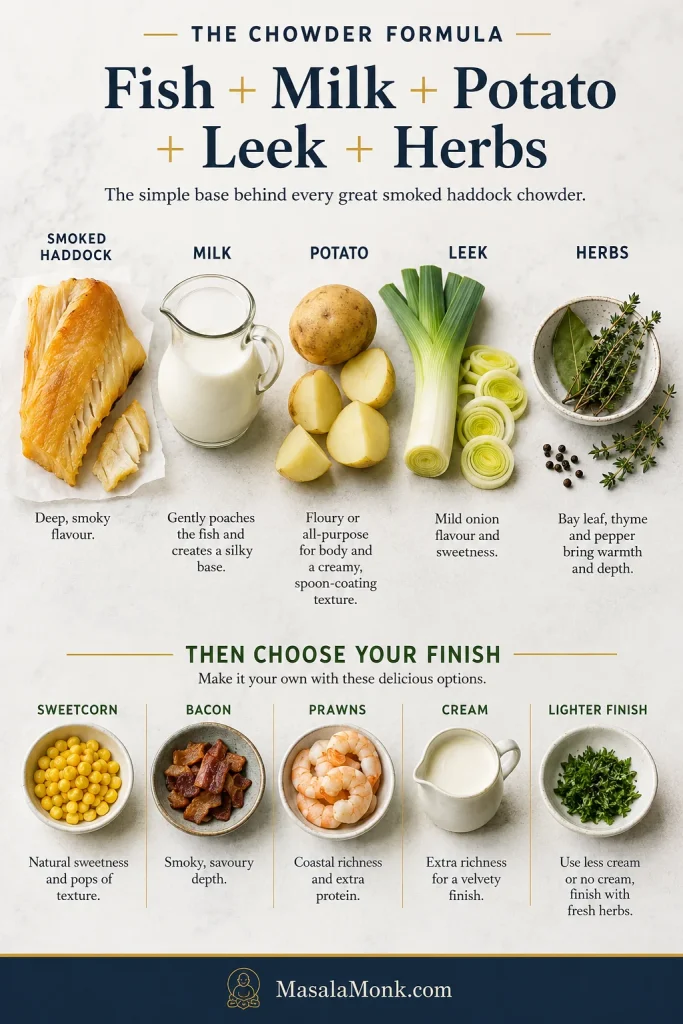
How is this different from Cullen skink?

Cullen skink is usually simpler: smoked haddock, potatoes, onion or leek, milk, and sometimes cream. This chowder is broader and can include sweetcorn, bacon, celery, prawns, herbs, or extra cream.

Why did my chowder turn out too salty?

Smoked haddock, bacon, pancetta, and stock can all add salt. Add more potato, milk, cream, or unsalted stock to soften the saltiness.

Does smoked haddock chowder freeze well?

It can be frozen, but dairy and potatoes may turn slightly grainy. For the best result, freeze the potato and milk base, then add freshly poached haddock when reheating.

What can I use instead of smoked haddock?

Use smoked cod, smoked pollock, smoked whiting, or another smoked white fish. If the flavour is too strong, use part smoked fish and part plain white fish.

How do I make the chowder thicker?

Mash more cooked potatoes into the soup. If it still feels loose, simmer the potato base briefly before adding the milk, cream, and fish.

What is the best make-ahead method?

Make the potato and milk base ahead, then add the smoked haddock when reheating. This keeps the fish tender and prevents it from breaking apart.

Final Tips for the Best Smoked Haddock Chowder

The best smoked haddock chowder is gentle from start to finish. Warm the milk slowly, let the leeks soften properly, use the potatoes for body, and add the fish back only when the base is ready. That is how you get smoke, creaminess, and tender haddock in the same spoonful.

If the first spoonful tastes smoky, mellow, and a little sweet from the leek or corn, you have done it right. Make it richer with cream, lighter with extra mashed potato, sweeter with sweetcorn, or deeper with bacon. Serve it hot, keep the bread close, and do not be surprised if the last bit in the bowl gets wiped clean.

Hand dipping a piece of crusty bread into smoked haddock chowder with fish flakes, potatoes, herbs, and black pepper.
Finally, keep bread close by; the creamy broth, smoky fish, and soft potatoes are exactly the kind of bowl made for dipping.

Back to top

Posted on Leave a comment

Tinola Recipe: Filipino Chicken Tinola / Tinolang Manok with Papaya or Sayote

Bowl of Chicken Tinola with golden broth, bone-in chicken, green papaya or sayote wedges, leafy greens, steamed rice, calamansi, and dipping sauce.

Tinola is the kind of Filipino chicken soup that feels light and restorative, but still filling when poured over rice. In a good pot, the broth is clear, gingery, and savory, the chicken is tender, and the green papaya or sayote softens without falling apart.

It is the kind of soup that feels right when you want something gentle, but not empty — warm broth, tender chicken, fresh greens, and rice that soaks up every spoonful.

This Tinola recipe, also called Chicken Tinola or Tinolang Manok, is made with bone-in chicken, fresh ginger, garlic, onion, fish sauce, green papaya or sayote, and leafy greens like malunggay, dahon ng sili, spinach, or pechay.

This version keeps the flavor classic, but it also works in real kitchens: sayote if you cannot find green papaya, spinach if malunggay is not available, and clear timing cues so the soup tastes full instead of flat.

Most importantly, it is built around the two things that make or break Tinola: a broth that tastes gingery and full, not watery, and vegetables that turn tender without collapsing.

Quick Answer: What Is Tinola?

Tinola is a Filipino broth-based dish. The most common version is Tinolang Manok, which means Chicken Tinola. It is usually made with chicken, ginger, garlic, onion, fish sauce, green papaya or sayote, and leafy greens such as malunggay or dahon ng sili.

In English, Chicken Tinola is best described as a Filipino ginger chicken soup. It is usually eaten as a main dish with rice, not just as a starter soup.

  • Best chicken: bone-in thighs, drumsticks, wings, or mixed cuts.
  • Flavor base: fresh ginger, fish sauce, garlic, and onion.
  • Vegetable choice: green papaya for a softer classic feel, or sayote for a firmer bite.
  • Best greens: malunggay or dahon ng sili if available; spinach, pechay, or bok choy if not.
  • Best cooking cue: simmer gently until the chicken is tender and reaches 165°F / 74°C.

Make It Now

Have your chicken, ginger, and vegetables ready? Use this quick path, then follow the recipe card for exact amounts.

  1. Sauté ginger, garlic, and onion until fragrant.
  2. Add chicken and cook until the surface loses its raw color.
  3. Add fish sauce before the liquid so the chicken is seasoned early.
  4. Simmer gently until the chicken is tender.
  5. Add your chosen vegetable near the end, then finish with greens.

Classic but flexible: classic Tinola often means chicken, ginger, patis, green papaya, and malunggay or dahon ng sili. But Tinola is also a home dish, so many cooks use sayote when papaya is hard to find, spinach when malunggay is unavailable, and chicken broth or rice wash when the chicken needs a little help. The point is not to make the pot rigid; it is to keep the soup gingery, savory, clear, and good with rice.

A good pot of Tinola should feel simple, but not thin. The broth should taste like the chicken, ginger, and patis had time to become one thing, not like separate ingredients floating in hot water. That is why this recipe builds the flavor early and waits before adding the vegetables.

Save this Tinola rule: ginger early, patis before broth, chicken until tender, papaya or sayote late, greens last.

Tinola Recipe Card

Filipino Chicken Tinola / Tinolang Manok

This Chicken Tinola recipe keeps the two common problems away: watery broth and vegetables that fall apart before the chicken is tender. The chicken is seasoned early, the simmer stays gentle, and the vegetables go in when the meat is nearly ready.

Prep Time15 minutes
Cook Time45 minutes
Total Time1 hour
Servings4 to 6
MethodStovetop
CuisineFilipino
Main Equipment5 to 6 quart / 4.7 to 5.7 L pot or Dutch oven

Ingredients

  • 2 to 2 1/2 lb / 900 g to 1.1 kg bone-in chicken pieces, such as thighs, drumsticks, wings, or mixed cuts
  • 1 1/2 to 2 tablespoons neutral oil / 22 to 30 ml
  • 1 medium onion, sliced
  • 4 garlic cloves, minced or crushed
  • 45 to 60 g / 1 1/2 to 2 oz fresh ginger, sliced, julienned, or lightly smashed
  • 2 to 3 tablespoons fish sauce / patis / 30 to 45 ml, plus more to taste
  • 6 cups water, low-sodium chicken broth, or rice wash / 1.4 L
  • 350 to 500 g / 12 to 18 oz green papaya or sayote/chayote, peeled and cut into wedges. Remove seeds if using papaya.
  • 2 packed cups / 60 to 90 g malunggay, dahon ng sili, spinach, pechay, or bok choy
  • 1/2 teaspoon black pepper, plus more to taste
  • Salt, only if needed after tasting

Optional Ingredients

  • 1 chicken cube, only if using water and you want a stronger shortcut broth
  • Calamansi or lime, for serving
  • Fresh chili, for heat
  • Extra fish sauce, for serving
  • 1 stalk lemongrass, bruised, for a fragrant variation

Instructions

  1. Prep the chicken and vegetables. Cut the chicken into similar-sized pieces if needed. Peel your chosen vegetable. If using green papaya, remove the seeds. Cut the pieces into 1 1/2 to 2 inch wedges.
  2. Sauté the aromatics. Heat oil in a large pot over medium heat. Add onion, garlic, and ginger. Cook for 2 to 3 minutes, stirring often, until fragrant and softened. The pot should smell warm and clearly gingery.
  3. Add the chicken. Cook for 5 to 7 minutes, turning occasionally, until the chicken loses its raw color and begins to lightly brown on the surface.
  4. Season early. Add 2 tablespoons fish sauce and stir well. Cook for 1 to 2 minutes so the fish sauce coats the chicken and aromatics.
  5. Add liquid and skim. Pour in water, broth, or rice wash. Bring to a boil, then skim off foam or scum from the surface.
  6. Simmer gently. Lower the heat, cover partially, and simmer for 25 to 35 minutes, or until the chicken is tender and reaches 165°F / 74°C internally.
  7. Add the vegetables. Simmer for 5 to 12 minutes, depending on the size and firmness of the pieces, until fork-tender but not mushy.
  8. Finish with greens. Add malunggay, dahon ng sili, spinach, pechay, or bok choy. Cook for 1 to 2 minutes, or turn off the heat and cover until the greens wilt.
  9. Taste and serve. Adjust with more fish sauce, salt, black pepper, calamansi, or chili. Serve hot with steamed rice.

Recipe Notes

  • Bone-in thighs and drumsticks are the easiest choice if you want tender chicken and a fuller broth.
  • The pot should smell clearly of ginger before the liquid goes in.
  • Green papaya gives a softer, slightly sweet, more classic feel. Sayote stays firmer and fresher.
  • Delicate greens need only enough heat to wilt. Fold them in at the end so they stay bright.
  • A chicken cube can rescue a weak pot, especially if you are using plain water or lean chicken. Start with less fish sauce if you add one, then adjust at the end.

What Good Tinola Should Taste Like

A good bowl of Tinola tastes light, gingery, savory, and balanced. The soup is not heavy, but it has enough seasoning and chicken flavor to make you want to spoon it over rice.

The easiest test is the rice: spoon a little broth over hot rice. If it tastes warm, gingery, and savory without needing rescue, the pot is ready.

  • Ginger tastes noticeable, warm, and fresh.
  • Fish sauce gives depth without making the soup taste fishy.
  • Chicken turns tender, especially near the bone.
  • Green papaya softens more; sayote keeps a slightly firmer bite.
  • The greens taste fresh, not dull or overcooked.

Why This Tinola Recipe Works

This recipe is built to solve two common Tinola problems: broth that tastes watery and vegetables that turn mushy. The fix is not complicated. Start the flavor before the liquid goes in, simmer the chicken gently, then add the pieces only when the meat is nearly tender.

  • The flavor starts before the broth. Ginger, garlic, and onion cook in oil first so the soup has a warm aromatic base.
  • Fish sauce seasons the chicken early. Salt can season Tinola, but patis gives the broth its rounded, savory depth.
  • The simmer stays gentle. A steady simmer helps the chicken turn tender without making the liquid rough or cloudy.
  • The vegetables go in late. Do not add them just because the broth is boiling. Add them when the chicken is already nearly tender.
  • The greens stay fresh. Finish with them at the end so the soup keeps a bright green finish.

The simple idea: build flavor before the broth, wait for the chicken to turn tender, then add the vegetables and greens in stages. That is the difference between flat Tinola and a bowl you want to spoon over rice.

The rule below is the whole Tinola method in one glance: build ginger and patis early, give the chicken time, then protect the vegetables and greens at the end.

Five-step Chicken Tinola cooking rule showing ginger early, patis before broth, chicken until tender, vegetables late, and greens last.
Follow this Tinola order to build flavor and protect texture: ginger early, patis before broth, chicken until tender, vegetables late, and greens last.

Ingredients Explained

Think of the ingredients in layers: ginger for warmth, chicken for body, fish sauce for depth, papaya or sayote for texture, and greens for freshness. Once those layers make sense, the recipe becomes much easier to adjust without losing what makes Tinola taste like Tinola.

Chicken Tinola ingredients on a board, including bone-in chicken, ginger, garlic, onion, fish sauce, green papaya, sayote, malunggay leaves, and rice wash.
These Tinola ingredients each have a job: chicken gives body, ginger brings warmth, patis adds savory depth, and papaya or sayote gives the soup its gentle bite.

Chicken

Bone-in chicken gives Tinola the kind of body that plain water cannot create on its own. Thighs, drumsticks, wings, or a whole chicken cut into serving pieces all work well.

Boneless thighs can work if you want a faster version, but the broth will be lighter. Chicken breast is lean, but it can dry out if boiled hard or cooked too long. Use a gentle simmer and check it earlier if breast meat is what you have.

Ginger

Ginger is the backbone of Tinola. A small token slice is not enough. Use about 45 to 60 g / 1 1/2 to 2 oz fresh ginger for a full pot. Slice it, julienne it, or lightly smash it so it releases flavor into the oil and broth.

When the ginger hits the oil, the pot should smell sharp, warm, and awake. A weak aroma usually means the final broth will taste weak too. If the ginger feels shy, the Tinola will too.

Garlic and Onion

Garlic and onion round out the ginger. Cook them just until fragrant and softened before the chicken goes in; they do not need to brown deeply.

Fish Sauce / Patis

Fish sauce is where the broth starts getting its backbone. Let it hit the hot pot before the water goes in, and it seasons the chicken instead of just floating salty on top later.

Give it a minute in the hot pot so the sharp edge cooks off and the soup starts with depth instead of last-minute saltiness.

Water, Chicken Broth, or Rice Wash

Water works well if you use bone-in chicken, enough ginger, and proper seasoning. Low-sodium chicken broth gives a stronger shortcut flavor. Rice wash, sometimes called hugas bigas, gives the soup a little more body and a softer feel.

If using rice wash, use the second rinse rather than the first. The second rinse is usually cleaner while still giving the soup a little body. Use rice wash when you want a softer, slightly fuller broth; use water or low-sodium broth when you want a cleaner, lighter-tasting pot.

A chicken cube can rescue a weak pot, especially if you are using plain water or lean chicken. Use it if you need it, but let ginger, chicken, and fish sauce do most of the work.

Three bowls labeled water, broth, and rice wash or hugas bigas, with uncooked rice nearby for making Chicken Tinola.
Rice wash, or hugas bigas, gives Tinola a softer body; meanwhile, plain water keeps it light, and broth adds shortcut depth.

Green Papaya or Sayote

Green papaya and sayote are both common in Tinola. Papaya becomes softer and slightly sweet, while sayote, also called chayote, stays firmer with a milder, fresher flavor.

Use the one your market gives you. Tinola is forgiving as long as the broth is gingery and the vegetable goes in at the right time.

Leafy Greens

Malunggay and dahon ng sili are classic Tinola greens. Spinach, pechay, and bok choy are practical substitutes. The exact leaf matters less than the timing.

Add something green and fresh at the end, then stop before the leaves lose their brightness.

Shopping Tip

Filipino markets may have the classic leaves and green papaya. At a regular supermarket, sayote/chayote and spinach can still get you a good, comforting pot.

Best Chicken Cuts for Tinola

The chicken cut matters because Tinola is not only about the meat — it is also about what the meat gives back to the pot.

Bone-in thighs, drumsticks, wings, or mixed cuts are the most forgiving choices for this soup because they can simmer without drying out.

Chicken CutBest ForNotes
Bone-in thighsBest flavor and tendernessThe easiest all-round choice.
DrumsticksBudget-friendly family mealsEasy to serve and good for broth.
WingsExtra collagen and bodyGreat mixed with thighs or drumsticks.
Whole chicken, cut upTraditional family-style potGives different textures in one soup.
Boneless thighsFaster weeknight versionLess broth depth, but still flavorful.
Chicken breastLean versionCan dry out; simmer gently and avoid overcooking.

Chicken should reach 165°F / 74°C internally. FoodSafety.gov lists 165°F / 74°C as the safe minimum internal temperature for chicken, turkey, and other poultry. See the safe minimum internal temperature chart.

Best all-round choice: use bone-in thighs and drumsticks. They give the soup enough flavor, cook evenly, and stay tender even if the pot simmers a little longer.

If you bought a larger pack of thighs and want a dry, crispy dinner another night, this air fryer chicken thighs recipe uses the same reliable cut in a completely different way.

Green Papaya vs Sayote

For many cooks, the first big choice is green papaya or sayote.

Green papaya gives the bowl a softer, more classic feel. Sayote keeps a firmer, cleaner bite. Neither one ruins the dish, so choose based on what you can find and what texture you like.

Green papaya and sayote shown side by side with whole and cut pieces for comparing vegetables used in Chicken Tinola.
Green papaya makes Tinola softer and more classic, while sayote stays firmer, cleaner, and easier to find in many markets.
OptionTextureFlavorBest For
Green papayaSoft-tender and absorbs brothMild, slightly sweetA more classic Tinola feel
Sayote / chayoteFirmer and cleanerMild, fresh, neutralEasy supermarket version
Semi-ripe papayaSofter and sweeterNoticeably sweetUse only if you intentionally want a sweeter soup
UpoSoft and wateryDelicateAvailable substitute
KalabasaCreamier and sweeterRicher, less classicA variation, not the default
Labanos / daikonFirm and slightly pepperySharperWorks in a pinch

If you want a clearer, more ginger-forward bowl, sayote is a very good choice. For the softer texture many people associate with Tinola, use green papaya.

If you buy a whole green papaya and have extra left after Tinola, you can use it in a fresh salad like this raw papaya salad.

Cut whichever one you use into wedges large enough to hold their shape. Add the pieces only after the chicken is nearly tender. If they go in too early, they can turn mushy before the chicken is done.

Tinola Greens: Malunggay, Dahon ng Sili, Spinach, Pechay, or Bok Choy

Traditional Tinola often uses malunggay or dahon ng sili. Outside the Philippines, those can be harder to find. Spinach, pechay, bok choy, or watercress will not make the soup wrong — they simply make it more practical for your kitchen.

Labeled guide board of Tinola greens, including malunggay, dahon ng sili, spinach, pechay, bok choy, watercress, and kale.
Malunggay and dahon ng sili are classic Tinola greens; however, spinach, pechay, bok choy, watercress, or kale can still work when timed well.
GreenTraditional?FlavorHow to Add
Malunggay / moringaYesEarthy, green, slightly bitterLast 1 to 2 minutes
Dahon ng sili / chili leavesYesMildly pepperyLast 1 to 2 minutes
SpinachSubstituteSoft and mildOff heat or last 1 minute
Pechay / bok choySubstituteMild with more bodyStems first, leaves last
KaleSubstituteStronger and chewierSimmer 2 to 4 minutes
WatercressSubstitutePeppery and freshLast minute

Do not add delicate greens too early. The leaves should still look alive, not dull. If you are using bok choy or pechay, add the thicker stems first and the leaves later. With spinach, turn off the heat and let the leaves wilt gently.

Equipment and Pot Size

Tinola is a simple one-pot soup, but the pot still matters. Use a pot wide enough that the chicken can sit in the aromatics before the liquid goes in. If the pot is too crowded, the chicken steams instead of picking up flavor from the ginger, garlic, onion, and fish sauce.

  • 5 to 6 quart / 4.7 to 5.7 L pot or Dutch oven: roomy enough for bone-in chicken, broth, papaya or sayote, and greens without boiling over.
  • Wide spoon or ladle: useful for skimming foam, scum, and extra oil from the surface.
  • Tongs: helpful for turning chicken pieces while they cook with the aromatics.
  • Instant-read thermometer: the most reliable way to check that chicken reaches 165°F / 74°C.

A smaller pot can still work, but keep the simmer gentle and watch the liquid level once the vegetables go in.

Cooking Time by Stage

Tinola is simple, but timing decides whether the bowl tastes clean and tender or flat and overcooked.

Cooking time guide for Chicken Tinola showing aromatics for 2 to 3 minutes, chicken before liquid for 5 to 7 minutes, chicken simmer for 25 to 35 minutes, papaya or sayote for 5 to 12 minutes, and greens for 1 to 2 minutes.
Good Tinola is mostly timing: aromatics first, chicken long enough to tenderize, vegetables near the end, and greens for the final minute.
StageApproximate TimeWhat to look for
Sauté ginger, garlic, and onion2 to 3 minutesAromatics smell warm, sharp, and fragrant.
Cook chicken before liquid5 to 7 minutesChicken loses raw color and lightly browns on the surface.
Fish sauce with chicken1 to 2 minutesFish sauce coats the chicken and smells savory.
Chicken simmer25 to 35 minutesChicken is tender and reaches 165°F / 74°C.
Papaya or sayote5 to 12 minutesPieces are fork-tender but still hold shape.
Leafy greens1 to 2 minutesLeaves are just wilted and still fresh-tasting.

Timing note: in most home pots, bone-in thighs and drumsticks begin turning tender around 30 minutes after the broth starts simmering. Sayote often softens faster than thick green papaya wedges, so start checking the vegetables at 5 minutes. Spinach wilts best off heat, while pechay and bok choy work better when the stems go in before the leaves.

Native chicken or very large bone-in pieces may need more time before the vegetables go in. Wait until the meat is already turning tender, or the pieces may overcook before the chicken is ready.

Back to top ↑

Step-by-Step Tinola Method

Once the aromatics are fragrant, the rest of the soup is mostly about patience: simmer the chicken gently, then add the vegetables when the meat is nearly tender.

1. Prep the Chicken and Vegetables

Pat the chicken dry if it is very wet. If the pieces are very uneven, cut larger pieces down so they cook more evenly.

Peel the green papaya or sayote. If using green papaya, remove the seeds. Cut the vegetable into 1 1/2 to 2 inch wedges so the pieces can simmer without falling apart.

2. Sauté Ginger, Garlic, and Onion

Heat oil in a large pot over medium heat. Add the onion, garlic, and ginger. Cook for 2 to 3 minutes, stirring often.

The aromatics should smell warm, sharp, and fragrant. This is where the soup starts becoming Tinola, so do not rush past the ginger.

Sliced ginger, garlic, and onion sautéing in oil inside a pot for Chicken Tinola.
Start with ginger, garlic, and onion before adding water; as a result, the broth begins with aroma instead of tasting flat later.

3. Add the Chicken and Lightly Brown It

Add the chicken pieces to the pot. Cook for 5 to 7 minutes, turning occasionally. The chicken does not need a deep brown crust, but the surface needs to lose its raw color and pick up some flavor from the aromatics.

This step gives the soup more depth than simply boiling raw chicken in water.

Bone-in chicken pieces cooking with sliced ginger, garlic, and onion in a pot before broth is added.
Cooking chicken with ginger and aromatics before the liquid goes in helps the meat season early and gives Tinola a fuller broth.

4. Add Fish Sauce Early

Add 2 tablespoons fish sauce and stir well. Let it cook with the chicken for 1 to 2 minutes before adding the liquid.

This gives the meat and aromatics a savory base. You can always add more fish sauce at the end, but adding some early helps the flavor cook into the soup instead of sitting only on the surface.

Fish sauce being poured into a pot with bone-in chicken, ginger, garlic, and onion before any broth is added.
Add patis before the broth, not after everything is diluted; this lets the chicken and aromatics absorb savory depth from the start.

5. Add Liquid, Boil, and Skim

Pour in 6 cups water, chicken broth, or rice wash. Bring the pot to a boil. As foam rises, skim it off with a wide spoon or ladle.

Skimming at this stage keeps the liquid clearer. It is much easier to remove foam before the vegetables and greens go in.

Ladle skimming foam from the surface of Chicken Tinola broth with chicken, ginger, greens, and vegetable pieces in the pot.
Skim the foam after the first boil, then lower the heat; this keeps Tinola broth cleaner without overworking the chicken.

6. Simmer Until the Chicken Is Tender

Lower the heat to a gentle simmer. Cover the pot partially and cook for 25 to 35 minutes, or until the chicken is tender and reaches 165°F / 74°C internally.

The chicken should feel tender near the bone. Avoid a hard boil. A rough boil can make the broth cloudy and the chicken tougher.

7. Add Green Papaya or Sayote

Add the green papaya or sayote once the chicken is nearly tender. Do not add them just because the broth is boiling; wait until the meat has already started giving flavor back to the pot. Simmer for 5 to 12 minutes, depending on how large and firm the pieces are.

Look for tender edges with enough firmness in the center that the wedges do not collapse in the bowl. If they start breaking apart, they have gone too far.
Spoon lifting an intact green papaya or sayote wedge from Chicken Tinola broth, with chicken and greens in the background.
Add papaya or sayote near the end so the edges soften while the pieces still hold their shape in the bowl.
8. Add the Greens at the End

Add malunggay, dahon ng sili, spinach, pechay, or bok choy near the end. Delicate leaves need only 1 to 2 minutes. Spinach can often be added off heat and covered until wilted.

Pull them off the heat while they are still bright and just wilted. If they look dull and tired, they have cooked too long.

Hand adding fresh leafy greens to a pot of Chicken Tinola with broth, chicken pieces, and green vegetable wedges.
Greens go in last because they only need enough heat to wilt; that way, Chicken Tinola stays fresh, bright, and not overcooked.

9. Taste and Serve

Taste the soup before serving. Adjust with more fish sauce, salt, black pepper, calamansi, or chili.

The test is the rice: spoon a little broth over hot rice. If it tastes warm, gingery, and savory without needing rescue, the pot is ready. The broth can taste a touch stronger from the spoon than it does in the bowl, because rice softens everything.

Timing cue: add the vegetables after the chicken is mostly tender, not at the beginning. That one choice keeps the pieces from collapsing before the chicken is done.

Fix Bland Tinola Broth

Bland Tinola is frustrating because it can look right before it tastes right — clear broth, chicken, greens, rice — but the spoonful feels empty.

It usually means one of four things: not enough ginger, not enough fish sauce, weak boneless chicken, or too much liquid without final seasoning.

The fix is usually not more salt alone. Tinola needs ginger warmth, chicken flavor, fish sauce depth, and a final taste before serving.

Troubleshooting guide for bland Chicken Tinola broth with ginger, fish sauce, bone-in chicken, and a simmering pot.
When Chicken Tinola tastes thin, fix the base first: strengthen the ginger, deepen with patis, simmer the chicken properly, then taste again.
  • Use bone-in chicken. It gives the broth more body than boneless breast.
  • Use enough fresh ginger. Tinola should smell warm and gingery before the liquid even goes in.
  • Sauté the aromatics first. Do not just boil everything together from the start.
  • Add fish sauce before simmering. Let it coat the chicken and aromatics.
  • Simmer gently. This keeps the chicken tender and the soup balanced.
  • Skim foam and extra oil. This improves both flavor and appearance.
  • Taste at the end. The soup may need more patis, salt, pepper, calamansi, or chili.

If your Tinola has ever tasted like hot water with chicken in it, start with ginger and patis before reaching for more salt. A few extra minutes of gentle simmering can also help the chicken give more back to the pot.

Fast fix for bland Tinola: simmer a few fresh ginger slices in the broth for 5 minutes, add a small splash of fish sauce, then taste again. If the soup still feels thin, let it simmer uncovered for a few minutes to concentrate slightly.

Keep Tinola Broth Clear

Clear Tinola broth comes from gentle cooking and good timing. Bring the liquid to a boil first, then skim off the foam or scum that rises to the surface. After that, lower the heat to a gentle simmer.

Comparison graphic showing gentle simmer with clearer Chicken Tinola broth beside hard boil with cloudier broth and stronger bubbling.
A gentle simmer keeps Tinola calmer and clearer; by contrast, a hard boil can make the broth cloudy and the chicken tougher.
  • Boil first, then skim. Remove foam while the surface is still easy to see.
  • Lower the heat after skimming. A gentle simmer keeps the broth calmer.
  • Use a wide spoon or ladle. It is easier to lift off scum and extra oil without stirring everything back in.
  • Finish with greens at the end. Delicate leaves stay brighter when they are not boiled for long.
  • Avoid hard boiling the chicken. Rough heat can make the liquid cloudy and the meat tougher.
  • Stop stirring aggressively once foam rises. Let it collect on the surface so you can skim it cleanly.
  • Pull delicate leaves before they turn dull. Fresh-looking greens make the whole bowl feel cleaner.

A home pot of Tinola does not need restaurant-perfect clarity. Skim what you can, keep the simmer gentle, and focus on a broth that tastes balanced and aromatic.

Tinola Ingredients in Tagalog and English

Tinola recipes often move between English, Tagalog, and market names, especially when you are shopping outside the Philippines. If you are shopping at a Filipino market, reading a family recipe, or watching a Tagalog cooking video, these are the ingredient names you are most likely to see.

Tagalog-English ingredient guide for Chicken Tinola showing chicken as manok, ginger as luya, fish sauce as patis, green papaya as hilaw na papaya, chayote as sayote, moringa leaves as malunggay, chili leaves as dahon ng sili, and rice wash as hugas bigas.
This Tagalog-English Tinola guide makes shopping and recipe reading easier, especially for manok, luya, patis, sayote, malunggay, and hugas bigas.
EnglishFilipino / Common Name
ChickenManok
GingerLuya
GarlicBawang
OnionSibuyas
Fish saucePatis
Green papayaHilaw na papaya
ChayoteSayote
Moringa leavesMalunggay
Chili leavesDahon ng sili
Rice washHugas bigas
Black pepperPaminta

A short Tagalog-style procedure would be:

Paano lutuin: igisa ang luya, bawang, sibuyas at manok; lagyan ng patis; pakuluan hanggang lumambot; idagdag ang papaya o sayote; tapusin sa malunggay o dahon ng sili.

In English: sauté ginger, garlic, onion, and chicken; season with fish sauce; simmer until tender; add papaya or sayote; finish with malunggay or chili leaves.

Serving Suggestions

Tinola is usually served as a main dish with steamed rice. The broth is often spooned over rice, so it needs enough flavor to carry the meal.

  • Steamed white rice
  • Extra fish sauce / patis on the side
  • Calamansi or lime
  • Fresh chili
  • Black pepper
  • A small dipping sauce of patis and calamansi

The broth does not need to taste salty by itself; it needs to wake up when it hits hot rice. If the soup tastes slightly strong alone but perfect over rice, you are in the right zone.

Golden Chicken Tinola broth being poured from a ladle over steamed white rice, with a bowl of Tinola in the background.
The rice test is simple: once the broth touches hot rice, it should taste rounded, savory, and alive — not weak or watery.

For another Filipino chicken classic, make Chicken Adobo on a different night. Adobo is darker, tangier, and braised, while Tinola is lighter, gingery, and broth-based.

For a Filipino vegetable dish that also belongs with rice, try Pinakbet Tagalog, a savory mix of tender vegetables and bagoong.

Tinola is especially good when you want something warm, light, and restorative. It is the kind of soup that feels gentle but still satisfying.

Storage, Freezing, and Reheating

Let leftover Tinola cool, then transfer it to an airtight container and refrigerate within 2 hours.

  • Refrigerator: store for up to 3 days.
  • Freezer: freeze the chicken and broth if needed, but expect the vegetables and greens to soften after thawing.
  • Best texture: freeze without the greens, then add fresh spinach, malunggay, pechay, or bok choy when reheating.
  • Reheating: warm gently on the stovetop until hot throughout. Reheated chicken should reach 165°F / 74°C.

Green papaya and sayote can soften after freezing, so expect a gentler texture if you freeze the finished soup.

Tinola Variations

Once the basic ginger broth method makes sense, you can adjust the vegetable, greens, broth, or protein. Keep the same quiet logic: build the flavor first, cook the main ingredient gently, and finish with the delicate pieces last.

Easy Swaps for This Recipe

  • Tinola with green papaya: softer, slightly sweet, and more classic in feel. Use firm green papaya, not ripe orange papaya.
  • Tinola with sayote: firmer, cleaner, and easy to find in many markets.
  • Tinola with malunggay: earthy, green, and traditional. Add it at the end.
  • Tinola with spinach or pechay: practical when malunggay or dahon ng sili are not available.
  • Tinola with rice wash: slightly fuller broth. Use the second rice rinse for a clearer flavor.

Variations That Cook a Little Differently

  • Native chicken Tinola: deeper flavor, but usually needs a longer simmer before the vegetables go in.
  • Instant Pot Tinola: pressure cook the chicken first, then add the vegetables separately so they do not overcook.
  • Fish or seafood Tinola: use the same ginger-broth idea, but cook fish or mussels briefly so they stay tender.
  • Tinola sa gata or golden Tinola: coconut milk, turmeric, or squash make the soup richer and less like the clear classic version.

Back to top ↑

Common Mistakes

MistakeWhat HappensFix
Using only boneless breastWeak broth and dry meatUse bone-in pieces, or simmer breast gently and check it early.
Not using enough gingerSoup tastes flatUse 45 to 60 g / 1 1/2 to 2 oz fresh ginger.
Adding fish sauce only at the endFlavor tastes salty but shallowAdd some before simmering, then adjust later.
Using a chicken cube with full fish sauceSoup becomes too saltyStart with less patis if using a cube, then adjust after simmering.
Adding too much waterSoup tastes thin even after seasoningUse about 6 cups liquid for 2 to 2 1/2 lb chicken, then simmer uncovered briefly if needed.
Boiling too hardCloudy broth and tougher chickenSkim first, then simmer gently.
Adding the vegetable too earlyPieces turn mushyAdd them after the chicken is nearly tender.
Overcooking greensDull, tired leavesFinish with greens at the end.
Not tasting before servingFinal soup tastes blandAdjust with patis, salt, pepper, calamansi, or chili.
Using ripe papaya by mistakeSoup becomes too sweetUse green papaya or switch to sayote.

FAQ

What is Tinola in English?

Tinola is often described in English as Filipino ginger chicken soup. The chicken version is called Tinolang Manok or Chicken Tinola.

What does Tinola mean?

Tinola generally refers to a Filipino broth-based dish. Tinolang Manok is the chicken version most people mean when they say Chicken Tinola.

Is Tinola the same as Tinolang Manok?

Tinola is the general dish. Tinolang Manok is the chicken version. Since chicken is the most common version, many people use Tinola and Tinolang Manok to mean the same thing.

What should Tinola taste like?

Tinola should taste light but not empty: gingery, savory, and good enough that the broth makes plain rice feel like a meal. If the soup tastes flat, it usually needs more patis, more ginger, or a few more minutes for the chicken to flavor the broth.

What are the main ingredients of Chicken Tinola?

The main ingredients are chicken, ginger, garlic, onion, fish sauce, water or broth, green papaya or sayote, and leafy greens such as malunggay, dahon ng sili, spinach, or pechay.

Do you use green papaya or sayote for Tinola?

Both work. Green papaya gives Tinola a softer, slightly sweet, more classic texture. Sayote stays firmer and tastes mild and fresh, which makes it useful when you want cleaner pieces in the bowl.
What can I substitute for green papaya in Tinola?

Sayote or chayote is the best substitute for green papaya. Upo, kalabasa, or labanos can work in some variations, but they change the flavor and texture.

What leaves are used in Tinola?

The classic choices are malunggay and dahon ng sili. When those are hard to find, spinach, pechay, bok choy, watercress, or kale can work. The important part is adding the greens late enough that they stay fresh.

What can I substitute for malunggay?

Spinach is the easiest substitute for malunggay. Pechay, bok choy, watercress, or kale can also work. Add delicate greens at the end so they do not overcook.

Can I use spinach, pechay, or bok choy in Tinola?

Yes. Spinach wilts quickly and can be added off heat. Pechay and bok choy work best when the thicker stems go in before the leaves.

What is dahon ng sili?

Dahon ng sili means chili leaves. They are used in some traditional Tinola recipes and give the soup a mild peppery green flavor.

What is the best chicken part for Tinola?

Bone-in thighs and drumsticks are the easiest all-round choice. They stay tender, add body to the broth, and are harder to overcook than breast meat.

How long should Tinola simmer?

Tinola usually simmers for about 25 to 35 minutes after the liquid is added, depending on the size of the chicken pieces. Add the vegetables near the end and cook for another 5 to 12 minutes.

How do you keep Tinola broth clear?

Bring the broth to a boil, skim off the foam, then lower the heat to a gentle simmer. Avoid hard boiling the soup for a long time.

Why does my Tinola taste bland?

Tinola tastes bland when the broth lacks ginger, patis, bone-in chicken flavor, or enough simmering time. More salt alone will not fix an empty broth; add ginger warmth, fish sauce depth, and enough time for the chicken to give flavor back to the pot.

Can I make Tinola without fish sauce?

You can, but fish sauce gives Tinola much of its savory depth. If avoiding fish sauce, use salt plus low-sodium chicken broth, and consider adding a little soy sauce or coconut aminos. The flavor will not be exactly traditional.

Can I freeze Chicken Tinola?

Chicken Tinola can be frozen, but the greens and vegetables may soften after thawing. For best results, freeze the chicken and broth, then add fresh greens when reheating.

What is the difference between Tinola and Nilagang Manok?

Tinola is a ginger-forward Filipino chicken soup usually made with fish sauce, green papaya or sayote, and leafy greens. Nilagang Manok is a simpler boiled chicken soup that often uses vegetables like cabbage, potatoes, or saba banana and does not have the same strong ginger profile.

Final Note

Served bowl of Chicken Tinola with ginger broth, bone-in chicken, green papaya or sayote, leafy greens, steamed rice, calamansi, and dipping sauce.
A finished bowl of Chicken Tinola should feel quiet but complete: warm broth, tender chicken, bright greens, and rice that makes the soup feel like dinner.

Tinola does not need to shout. No watery broth, no collapsed vegetables, no loud tricks — just generous ginger, chicken that has time to flavor the pot, patis added early, and greens folded in last. When those pieces come together, the soup tastes calm but complete: simple food that still feels cared for.

Back to top ↑

Posted on Leave a comment

Pea and Ham Soup Recipe: Split Pea Soup with Ham Bone, Ham Hock or Gammon

Bowl of thick pea and ham soup with shredded ham, black pepper, parsley, crusty bread, and a spoon on a rustic table.

This pea and ham soup recipe is for the ham bone in the fridge — the one you almost tossed, then kept because it still had one good meal left in it. A smoked hock, gammon joint, ham hough, or diced leftovers can get you there too.

The main recipe is the classic dried split pea version: green split peas, ham, vegetables, water or stock, and enough time for the peas to collapse into a thick, comforting bowl. This recipe is built around the ham you actually have — a leftover bone, smoked hock, ham hough, gammon joint, or diced cooked ham — so you can get the salt, timing, and texture right the first time.
Start with the ham you have. The soup follows from there.

It will not stay bright green, and it does not need to. This is a smoky, spoonable, bread-dipping soup that gets its comfort from time, not flash.

Quick Answer

Best default formula

For classic pea and ham soup, simmer 500g / 1 lb dried green split peas with 1.2–1.5kg / 2.5–3 lb ham bone, smoked ham hock, ham hough, or gammon, plus 2 litres / about 8 cups water or low-sodium stock. Cook until the peas lose their shape, the broth coats a spoon, and the ham is soft enough to shred.

Split peas usually do not need soaking. Salt only after the ham has cooked into the broth. If the soup gets too thick, loosen it with hot water or stock; if it is too thin, simmer uncovered or blend a small portion after removing bones and bay leaves.

Before you cook: Use this as the quick mental map: split peas build body, ham seasons the broth, vegetables balance the pot, and time does the thickening.

Pea and ham soup ingredients arranged with the text “Split peas + ham + vegetables + time.”
Before the pot goes on, think of the soup in four parts: split peas for body, ham for seasoning, vegetables for sweetness, and time for the thick, spoonable finish.

Choose Your Ham Route

First, identify the ham before you worry about the exact method. A meaty bone gives depth, a smoked hock gives smoke, gammon gives a UK-style pot, and diced ham needs stock behind it. Use this table as a quick matchmaker for the ham in front of you.

Route cue: Choose the ham before the method.

Four ham options for pea and ham soup labeled ham bone, smoked hock or hough, gammon, and diced ham.
Your ham choice sets the path. A bone, smoked hock, ham hough, gammon joint, or diced leftover ham changes how salty, smoky, and long-cooked the soup needs to be.
You haveBest routeKey tip
Meaty ham boneClassic stovetop soupSimmer from the start, then shred any attached meat.
Smoked ham hock or ham houghTraditional slow-simmer soupCook until the meat pulls away easily; remove skin and excess fat.
Gammon jointClassic soup with careful salt controlIf raw, cook fully until tender before shredding. Rinse or soak first if very salty.
Leftover diced ham onlyFaster split pea soupUse low-sodium stock and add the ham near the end so it stays tender.

Most pots start with one of these four ham situations. Frozen peas, yellow split peas, and no-ham versions can still work, but they move away from the classic dried split pea pot. Extra cooked ham is also perfect for ham and cheese quiche if you have more than this soup needs.

Next: cook the soup or check cook time by ham type.

Pea and Ham Soup Recipe Card

Pea and Ham Soup Recipe with Ham Bone, Ham Hock or Gammon

Servings: 6–8
Prep time: 15 minutes
Cook time: 2 hours 15 minutes
Total time: About 2 hours 30 minutes
Method: Stovetop
Equipment: 5–6 qt / 5–6 L Dutch oven or heavy soup pot

Done when: the peas have collapsed, the broth coats a spoon, and the ham pulls away easily from the bone, hock, hough, or gammon.

Pot size note: do not use a small saucepan. Split pea soup foams, thickens, and needs room to simmer. A 5–6 qt / 5–6 L pot gives the peas and ham enough space.

Ingredients

  • 500g / 1 lb dried green split peas, about 2¼ cups, rinsed and sorted
  • 1.2–1.5kg / 2.5–3 lb ham bone, smoked ham hock, ham hough, or gammon joint
  • 2 litres / about 8 cups water or low-sodium chicken stock, plus more as needed
  • 1 large onion, finely chopped, about 180–220g
  • 2 medium carrots, diced, about 150g
  • 2 celery ribs, diced, about 80–100g
  • 3 garlic cloves, minced, about 1 tablespoon
  • 1 tablespoon olive oil or butter
  • 2 bay leaves
  • 1 teaspoon dried thyme, or 1 tablespoon fresh thyme leaves
  • ½ teaspoon black pepper, plus more to taste
  • Fine salt, to taste after cooking, added in small pinches
  • Fresh parsley or mint, optional, for finishing

If using leftover diced ham instead of a bone or hock: use 300–450g / 10–16 oz diced cooked ham and choose low-sodium stock instead of plain water for better flavor. Add the diced ham near the end.

If using raw gammon: cook it until fully cooked and tender before shredding, following the package guidance if needed. Use a meat thermometer if needed and follow the package’s safe-cooking guidance. For very salty gammon, rinse it or soak it according to the package directions before adding it to the soup.

Instructions

Build the Base
  1. Rinse the split peas. Place the split peas in a sieve, rinse well under cold water, and remove any small stones or damaged peas.
  2. Soften the vegetables. Heat the oil or butter in a large Dutch oven or heavy soup pot over medium heat. Add the onion, carrot, and celery. Cook for 6–8 minutes, stirring often, until the vegetables soften.
  3. Stir in the aromatics. Add the garlic, bay leaves, thyme, and black pepper. Cook for 30 seconds, just until fragrant.
  4. Combine peas, ham, and liquid. Add the rinsed split peas, your chosen ham, and 2 litres / about 8 cups water or stock. The ham does not have to be fully underwater, but it should be mostly submerged. Add a little extra water if your pot is wide or the ham sits too high.
  5. Bring to a boil. Increase the heat and bring the pot to a boil. Skim off any foam if needed.
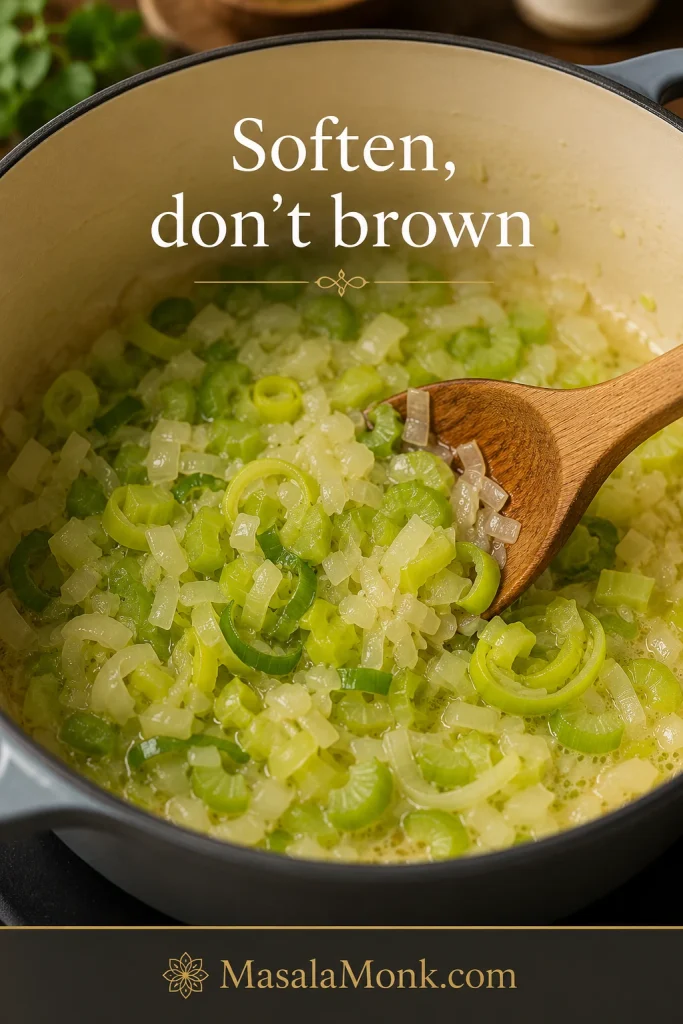
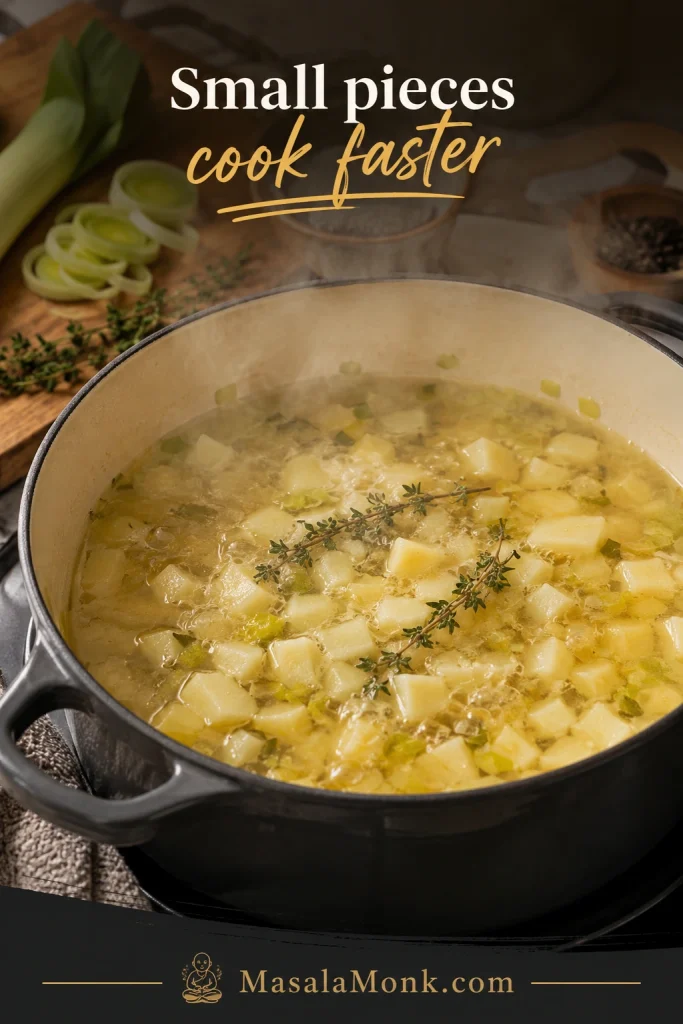
  6. Simmer gently. Reduce the heat to low, partly cover the pot, and simmer for 2 to 2½ hours, stirring occasionally, until the split peas have softened, the soup has thickened, and the ham is tender.
Shred, Adjust and Finish
  1. Stir more often near the end. Once the split peas begin breaking down, keep the heat low and stir from the base of the pot so the soup does not catch.
  2. Remove the ham and bay leaves. Lift out the ham bone, hock, hough, or gammon. Remove and discard the bay leaves. Let the ham cool slightly.
  3. Shred the meat. Remove the meat from the bone. Discard bone, tough skin, and excess fat. Shred or chop the ham.
  4. Return the meat to the soup. Stir the shredded ham back into the pot.
  5. Adjust the thickness. For a too-thick soup, add hot water or stock, ½ cup / 120ml at a time. When it is too thin, simmer uncovered for 10–20 minutes or blend a small portion after the bones and bay leaves have been removed.
  6. Taste before salting. Add salt in small pinches only after the ham has seasoned the broth. Finish with parsley, mint, extra black pepper, or a small squeeze of lemon if desired.

Recipe Notes

  • Cook time varies by ham size, pea age, and whether the ham is raw, smoked, cured, or already cooked.
  • A glazed ham bone makes a slightly sweeter soup; smoked hock gives the pot a deeper smoky edge.
  • For a smoother soup, blend only part of it so you still keep some shredded ham and texture.
  • Always remove bones and bay leaves before blending.
  • This soup thickens as it cools, so expect to loosen leftovers with water or stock.

If you remember only three things: salt late, cook until the peas collapse, and adjust the thickness after the ham is shredded back in.

While it simmers: Keep these guardrails in mind, especially before adding salt, blending, or thinning the soup.

Rustic note card beside soup ingredients with the rules “Salt late. Cook until peas collapse. Thin after ham returns.”
Use these as your guardrails while cooking: season near the end, wait for the split peas to break down, then judge the final thickness after the ham returns.

Pea and Ham Soup: Key Cooking Cues

The finished soup should be thick enough to coat the spoon, soft enough to settle back into the bowl, and loose enough that it does not sit like paste. Use these cues before you decide it is done.

Texture cue: Do not stop at the clock alone; check whether the split peas have broken down and the soup coats a spoon.

Spoon lifting thick pea and ham soup with collapsed split peas, shredded ham, and steam rising from the bowl.

Once the split peas stop looking like firm little discs and the soup coats the spoon, the pot is ready for final seasoning, thinning, or serving.
CueWhat it means
Peas still look like little discsKeep simmering. They need to collapse for the soup to thicken properly.
Soup is olive green or khakiNormal for dried split peas cooked with ham. Do not judge the pot by frozen-pea color.
Ham does not shred easilyIt needs more time, especially if using hock, hough, or gammon.
Soup coats the spoonGood sign. It should be thick but still spoonable.
Soup stands up too stifflyThin it after cooking with hot water or stock.
Broth tastes salty earlyWait before adding more salt; the flavor changes as the pot cooks.
Bottom starts catchingLower the heat and stir from the base of the pot.

Cook’s note: do not judge the soup before the ham is shredded back in. The broth, salt, color, and thickness all settle after the peas collapse and the meat returns to the pot.

Need help? Jump to troubleshooting or fix the thickness.

Why This Recipe Works

Every part of the pot has a job: ham seasons the broth, split peas build body, and vegetables add sweetness. Wait until the ham has flavored the liquid before you decide how much salt the soup needs.

  • Split peas thicken the soup naturally. They soften, collapse, and create a creamy texture without cream.
  • Bone-in ham builds the broth. Simmering a bone, hock, hough, or gammon piece from the beginning gives the soup depth that diced ham alone cannot provide.
  • The recipe follows texture, not just time. The soup is ready when the peas lose their shape and the ham shreds.
  • It works with real-life leftovers. Use the ham you have, then adjust the method and timing around it.

Make This Soup When

This is the kind of soup that makes leftovers feel intentional.

  • Leftover ham bone is waiting after Christmas, Easter, Thanksgiving, a Sunday roast, or honey glazed ham.
  • Smoked ham hock sounds right because you want an old-fashioned soup with deep flavor.
  • Ham hough is what you have, and a Scottish-style pea and ham soup makes sense.
  • Gammon is in the fridge, and you want a UK-style pot that is hearty, thrifty, and freezer-friendly.
  • The slow cooker would help because dinner can simmer gently while you do other things.
  • Only diced leftover ham is left, and you need stock to make the broth taste deeper.

What Is Pea and Ham Soup?

Pea and ham soup is a hearty soup made by cooking peas with ham until the peas soften and the ham flavors the broth. In the UK and Australia, it is often called pea and ham soup. Across the US and Canada, many people search for the same style of soup as split pea soup with ham, ham bone split pea soup, or ham hock split pea soup.

The names change by region, but the comfort is the same: peas, ham, vegetables, and time turning into a bowl that feels bigger than its ingredients.

For the classic version, dried split peas are the usual base. Frozen peas make a brighter, lighter soup, but they do not thicken the pot in the same way. The old-fashioned spoonable version needs dried split peas for body.

Ingredients for Pea and Ham Soup

Ingredient cue: This base gives the soup body, smoke, sweetness, and balance without needing cream, flour, or complicated extras.

Dried green split peas, ham, onion, carrot, celery, garlic, herbs, black pepper, and stock arranged on a rustic surface.
Each ingredient has a job. Split peas thicken the soup, ham flavors the broth, vegetables round out the base, and herbs keep the pot from tasting flat.

Green Split Peas

Dried green split peas are the best choice for classic pea and ham soup. They start dry and plain, then slowly melt into the broth until the soup turns creamy without cream. Rinse them well before cooking and quickly sort through them for small stones or dry, damaged pieces.

Freshness matters. A very old bag of split peas can take longer to soften. If your pot looks dull and khaki halfway through, do not judge it yet; dried split pea soup deepens as it cooks.

Ham Bone, Ham Hock, Ham Hough, Gammon or Leftover Ham

The ham choice changes the flavor, salt level, and cook time. A meaty ham bone is excellent after a roast, while a smoked hock or hough gives deeper flavor.

Gammon works well for a UK-style soup, but it can be salty and may be raw depending on how it is sold. Leftover diced ham is the fastest option, but it needs stock because it will not flavor the broth as strongly as a bone-in piece.

A hock or hough is a tough, bony cut with skin, fat, connective tissue, and deep flavor. Even a bare ham bone can give more flavor than it looks like it should. After cooking, keep the tender meat and discard tough skin or any fat you do not want in the bowl.

Onion, Carrot, Celery and Garlic

This simple vegetable base gives the soup sweetness and balance. The vegetables should not shout in the bowl; they should melt into the background and make the ham and peas taste rounder. A leek can also be added if you want a slightly sweeter UK-style flavor.

Bay, Thyme and Black Pepper

Bay leaf and thyme are classic with split peas and ham. Black pepper cuts through the richness. Parsley gives a clean finish, while mint works especially well if you add frozen peas for a brighter green variation.

Water or Stock

If you are using a strong ham bone, smoked hock, or gammon joint, water can be enough because the ham will create a rich broth as it cooks. With diced leftover ham only, use low-sodium chicken stock or vegetable stock so the pot does not taste flat.

Best Ham for Flavor: Bone, Hock, Hough or Gammon?

Here, the ham is not just an ingredient; it is the seasoning. The best ham for this soup is the piece that can flavor the broth while the peas soften. Bone-in pieces build the pot slowly; diced cooked ham is faster, but it needs good stock behind it so the soup still tastes full.

If you are buying ham just for this soup, choose a smoked ham hock for deeper flavor, or ask for a meaty ham bone if you want more shredded ham in each bowl. This is where the soup starts tasting like more than peas and water.

Ham Options at a Glance

Ham optionBest forHow to use it
Ham boneLeftover holiday ham or roast ham flavorSimmer from the start, then remove and shred any attached meat.
Meaty ham boneBest leftover optionGives broth, meat, and body. Add extra diced ham only if needed.
Smoked ham hockDeep smoky flavorSimmer until tender, then remove skin, excess fat, and bone before shredding the meat.
Ham houghScottish-style pea and ham soupUse like ham hock. Cook until the meat pulls away easily.
Gammon jointUK-style pea and ham soupIf raw, simmer until fully cooked and tender. Taste carefully before adding salt.
Leftover diced hamQuick split pea soup with hamAdd near the end so it does not dry out. Use stock for better flavor.
Smoked turkey legSmoky non-pork optionUse like a ham hock if it fits your diet, then adjust seasoning at the end.
BaconExtra smoky flavorUse with stock and, if possible, diced ham. Bacon adds flavor but does not replace the body of a bone or hock.

Ham stock upgrade: for extra-deep hock flavor, simmer a ham hock or ham hough first, strain the cooking liquid, then use that ham stock as the soup liquid. It adds time, but the broth tastes rounder and more deeply hammy. Shred the cooked meat and add it back near the end. Taste the ham stock before adding salt, because it can be very salty.

What if the Ham Bone Has Barely Any Meat?

Use it anyway if it has good flavor. Simmer the bone with the split peas and vegetables, then add diced cooked ham near the end. The bone gives the broth body, while the diced ham makes sure every bowl still has enough meat.

If you like the smoky beans-and-meat direction, red beans and rice is another slow-simmer comfort meal where seasoning, bean age, and final texture matter.

What if the Gammon Is Very Salty?

Check the package first. Some gammon should be soaked or rinsed before cooking. If yours is very salty, soak or rinse it as directed, use water or unsalted stock, and do not add salt until the soup is finished.

Best Peas to Use for Pea and Ham Soup

The peas decide the texture, which is why split peas and frozen peas should not be treated as the same soup. Green split peas are the classic choice because they break down and thicken the broth. Frozen peas are sweeter and brighter, but they make a different bowl.

Pea choice: Pick the pea by the texture you want: dried split peas for the classic thick soup, frozen peas for a brighter variation.

Dried split peas and frozen peas shown with two different pea and ham soups for comparison.
Split peas and frozen peas do not behave the same way. Dried split peas make the classic thick soup, while frozen peas create a brighter, lighter variation.
Pea typeResultBest use
Green split peasSpoonable, classic, earthy soupBest for this main recipe.
Yellow split peasThick, milder, earthier soup with yellow colorGood variation, especially with gammon or smoked ham.
Frozen peasBright green, sweeter, lighter soupBest for a quick cooked-ham variation, not the classic version.
Fresh peasSweet and delicateBetter for a light spring soup than a ham bone soup.

Important: frozen peas and split peas are not a direct swap. Split peas break down and thicken the soup. Frozen peas stay sweet and bright, but they need potato, cream, or blending for body.

Using frozen peas? See the quick variation. Ready to cook? Go to the method.

How to Make Pea and Ham Soup with a Ham Bone or Hock

The method is simple: soften the vegetables, add split peas, ham, herbs, and liquid, then simmer until the peas collapse and the ham turns tender. As it cooks, the broth goes from thin and separate to cloudy, then creamy.

Method cue: Early simmering looks loose and separate; the creamy texture comes later as the split peas soften and collapse.

Pea and ham soup simmering in a Dutch oven with ham, split peas, carrots, celery, and broth visible.
At first, the soup may look thin and separate. As it simmers, the split peas soften, the ham seasons the broth, and the texture slowly turns creamy.
  1. Rinse the split peas. This removes dust and gives you a chance to check for small stones.
  2. Soften the vegetables first. Onion, carrot, and celery taste better when cooked before the liquid is added.
  3. Stir in herbs and garlic. Bay, thyme, black pepper, and garlic create the classic soup base.
  4. Add the ham and liquid. Bone-in ham, hock, hough, or gammon should go in early so it can flavor the broth.
  5. Simmer slowly. Keep the heat gentle once the pot has boiled. Hard boiling can make thick pea soup stick.
  6. Remove bones and bay leaves before blending. This is the one step not to skip.
  7. Shred the ham. Return only the tender meat to the pot.
  8. Finish by texture and taste. Adjust thickness, then season after tasting.

Shredding cue: After the ham is tender, remove the bones and bay leaves first, then return only the edible shredded meat to the pot.

Tender ham being shredded from a bone on a wooden board with a soup pot in the background.
After simmering, lift out the ham bone, hock, hough, or gammon before shredding the tender meat. Keep the meat, but discard bones, bay leaves, tough skin, and excess fat.

By the end, the ham should be soft, the broth settled, and the finish peppery.

Pea and Ham Soup Cook Time by Ham Type

This is the part where patience pays you back. Diced leftover ham is already tender. A ham bone, hock, hough, or gammon joint needs longer because it has to flavor the broth and soften enough to pull apart.

MethodApproximate timeBest for
Stovetop with diced leftover ham1 hour 30 minutes to 1 hour 45 minutesQuickest split pea soup with ham.
Stovetop with ham bone2 to 2½ hoursLeftover roast ham bone soup.
Stovetop with ham hock or ham hough2 to 2½ hours, sometimes longerTraditional pea and ham soup, smoky if the ham is smoked.
Stovetop with gammon2 to 2½ hours, depending on sizeUK-style pea and ham soup.
Slow cooker on low8–10 hoursHands-off ham hock or ham bone soup.
Slow cooker on high5–6 hoursFaster crockpot version.
Instant Pot with diced ham or small bone15–25 minutes high pressure + natural releaseFast pressure-cooker version.
Instant Pot with large ham hock, hough, or gammon45–75 minutes high pressure + natural releaseLarge pieces that need time to become shreddable.

If the peas still look firm or the ham does not pull away easily, keep cooking. Trust the pot, not just the clock.

Changing method? See slow cooker notes or see Instant Pot notes.

Do You Need to Soak Split Peas?

No, split peas usually do not need soaking for pea and ham soup. Soaking is mainly useful if the peas are old or you want to shorten the cook time.

Most split peas can go straight into the pot. They are small enough to cook without soaking, which is why this soup can start straight from the bag.

If you add lemon, vinegar, wine, or tomatoes as a variation, wait until the split peas are soft. Acidic ingredients can slow softening when added too early.

Slow Cooker Pea and Ham Soup Notes

The slow cooker is especially good for bone-in ham, smoked hocks, ham houghs, and gammon because the long, gentle heat gives the meat time to soften. It is also the version that makes the kitchen smell like dinner long before anyone asks what is cooking.

Slow-cooker cue: For a hands-off version, give ham hock, ham hough, gammon, or a meaty bone enough time to soften gently.

Slow cooker filled with thick pea and ham soup, shredded ham, carrots, split peas, and a ladle.
The slow cooker works especially well for ham hock, ham hough, gammon, or a meaty ham bone because the meat softens slowly as the split peas thicken the broth.
  • Add the split peas, onion, carrot, celery, garlic, bay, thyme, ham, and liquid to a 6 qt / 5.7 L slow cooker.
  • Cook on low for 8–10 hours or high for 5–6 hours.
  • Remove the ham and bay leaves when the soup is done.
  • Shred the meat and stir it back into the soup.
  • Let the soup rest for a few minutes before judging the thickness.
  • Taste before adding salt.

If the soup looks too thick near the end, stir in hot water or stock before serving. Slow cooker split pea soup often thickens more after it rests.

For another busy-day soup, this slow cooker broccoli cheese soup goes creamy and cheesy instead of smoky and hearty.

Instant Pot Pea and Ham Soup Notes

Use the pressure cooker when you want the split peas softened faster, but do not expect it to cheat a tough hock into tenderness without enough time. Large hocks, houghs, and raw gammon need a longer cook; diced leftover ham and small cooked bones are much faster.

A 6 qt or larger pressure cooker is best because split pea soup foams, thickens, and leaves starchy residue.

Pressure-cooker cue: Pressure cooking speeds up the split peas, but tough ham pieces still need enough time and natural release.

Instant Pot filled with pea and ham soup, shredded ham, split peas, carrots, steam, and a ladle.
Pressure cooking softens split peas faster, but large ham hocks, houghs, and gammon still need enough time to become tender. Use natural release for a better final texture.
Pressure cooker versionSuggested timingNote
Diced leftover ham15 minutes high pressure + 10–15 minutes natural releaseFastest version; use stock for flavor.
Small ham bone20–25 minutes high pressure + natural releaseGood when the bone is already from cooked ham.
Large smoked ham hock or ham hough45–75 minutes high pressure + natural releaseNeeds longer to become tender enough to shred.
Raw gammon joint45–75 minutes high pressure + natural release, depending on sizeMust be fully cooked and tender before shredding.

Use the longer end of the range for large, tough, or raw pieces, and the shorter end for smaller cooked bones or diced ham. Keep the soup below your pressure cooker’s max-fill line for beans, grains, or foamy foods if your model has one.

Let the pressure release naturally, and clean the lid, gasket, and valve after cooking because split pea soup can leave starchy residue.

Quick Frozen Pea and Ham Soup Variation

This is not the classic split pea version, but it is useful when you want a brighter green soup in about 30 minutes. Use frozen peas with leftover ham or cooked gammon for a lighter, fresher bowl.

Cook onion and garlic in butter, add diced potato if you want extra creaminess, then pour in stock and simmer until the potato is tender. Add frozen peas near the end and cook just until bright green. Blend the soup, then stir in diced ham or shredded gammon. Finish with mint, parsley, black pepper, or a little cream.

Avoid These Pea and Ham Soup Mistakes

Before you blend: Most problems start before the final simmer, so scan this checklist before you salt, blend, or swap the peas.

Pea and ham soup mistake board with labels for salting late, removing bones, using split peas, low simmer, and stock.
Most pea and ham soup mistakes happen early. Salt near the end, remove bones before blending, keep the simmer gentle, and use stock when diced ham cannot flavor the broth alone.
  • Salting before the ham has simmered. Ham can season the whole pot as it cooks.
  • Judging the soup before the peas collapse. Split peas need to lose their shape for the broth to thicken.
  • Blending before removing bones and bay leaves. Take them out first every time.
  • Using water with diced ham only and expecting deep broth. Diced ham needs stock behind it.
  • Boiling hard once the soup thickens. A low simmer protects the bottom of the pot.
  • Assuming frozen peas behave like split peas. Frozen peas make a different, lighter soup.

Already happened? Go to the fix-it section.

How to Thicken Pea and Ham Soup

To thicken pea and ham soup, simmer it uncovered, mash some peas, or blend a small portion after removing the bones and bay leaves.

  • Need it thicker? Simmer uncovered for 10–20 minutes.
  • Want it smoother? Blend a small portion with an immersion blender after removing bones and bay leaves.
  • Prefer it rustic? Mash some peas against the side of the pot.
  • Did it thicken too much? Add hot water or stock, ½ cup / 120ml at a time.

You usually do not need flour, cornstarch, or potato flakes. Split pea soup is supposed to thicken from the peas themselves.

Troubleshooting Pea and Ham Soup

This is a forgiving soup, but it does have moods: sometimes the peas take longer, sometimes the ham is saltier, and sometimes yesterday’s perfect soup turns into a thick block in the fridge. None of that means the pot is ruined.

Quick Texture and Salt Fixes

Fix-it cue: Use this section when the pot is already cooked but the texture, thickness, or salt level still needs fixing.

Troubleshooting board for pea and ham soup with bowls labeled too thick, too thin, and too salty.
If the pot goes wrong, it is usually fixable. Add hot stock when the soup is too thick, simmer or blend when it is too thin, and dilute carefully when it tastes too salty.
ProblemUrgencyWhat to do
Split peas are still hardNeeds timeKeep simmering and add hot water if needed. Old peas, hard water, salt too early, or acidic ingredients can slow softening.
Too saltyFix carefullyAdd unsalted water or stock, more cooked peas, diced potato, cream, or a little lemon for balance.
Too thinEasy fixSimmer uncovered, blend a portion, mash some peas, or let the soup rest.
Too thickEasy fixAdd hot water or stock, ½ cup / 120ml at a time, until it loosens.
Bland brothEasy fixAdd black pepper, thyme, parsley, bay, a little lemon, or more ham. If using diced ham only, use stock instead of water.
Bottom starts catchingAct nowLower the heat and stir from the base of the pot before it burns.
Ham hock is fattyNormalRemove skin and excess fat before returning the shredded meat to the soup.
Solid after chillingNormalReheat gently with water or stock until spoonable again.
Too smokyBalance itAdd more stock, a little cream, parsley, black pepper, or a small squeeze of lemon.
Too sweetBalance itThis can happen with a glazed ham bone. Balance with black pepper, herbs, lemon, and unsalted stock.

Most imperfect pots need only one thing: more time, more liquid, or a better final balance.

Once fixed: serve the soup or store and freeze leftovers.

What to Serve with Pea and Ham Soup

This is a bread-dipping soup, not a delicate starter. Serve it with something crisp, buttery, or slightly sharp to balance the bowl.

Serving cue: Serve the soup with something sturdy and crisp enough to balance the thick split pea texture and smoky ham.

Thick pea and ham soup served with crusty bread dipping into the bowl.
Choose bread that can handle dipping. The thick split pea texture, smoky ham, and crusty edges make this bowl feel like dinner, not just a starter.
  • Crusty bread or sourdough
  • Buttered toast
  • Garlic croutons
  • Soda bread
  • Grilled cheese
  • A simple green salad
  • Pickles or mustard on the side
  • Extra black pepper, parsley, or mint

For bread that can stand up to a thick bowl, sourdough focaccia is especially good because the crisp edges and airy center can handle dipping.

Later in the week, French onion soup goes in a completely different direction with caramelized onions, savory broth, toast, and melted cheese.

How to Store, Freeze and Reheat Split Pea Soup with Ham

Leftovers are one of the reasons to make the full pot. This is a good make-ahead soup because it thickens and deepens after a night in the fridge. The next-day bowl is often even better, especially with extra black pepper and a splash of stock to loosen it.

  • Fridge: Store in an airtight container for 3–4 days.
  • Freezer: Freeze in portions for up to 3 months for best quality.
  • Cooling: Cool the soup before storing it, and divide large batches into smaller containers so they chill faster.
  • Reheating: Warm gently on the stovetop or in the microwave, stirring often, until steaming hot throughout.
  • Thinning after storage: Add water or stock until the soup returns to the texture you like.

For safe leftover timing, the USDA recommends using refrigerated leftovers within 3–4 days; freeze extra soup if you want to keep it longer.

Back to Recipe Card · Back to Table of Contents

Frequently Asked Questions

These are the doubts that usually come up once the pot is already on the stove.

Is a ham bone enough for pea and ham soup?

Yes, especially if it still has some meat attached. Simmer it with the split peas, then remove the bone, shred any meat, and stir the meat back in.

Ham hock or ham bone: which tastes better?

A smoked ham hock is usually smokier and richer, while a ham bone tastes more like the roast it came from. Both work well. Choose smoked hock for smoke and ham bone for leftovers.

What is ham hough?

Ham hough is another name for ham hock, commonly used in Scotland. Use it the same way: simmer until tender, then remove the skin, excess fat, and bone before shredding the meat.

How salty is gammon in soup?

Gammon can be quite salty, depending on how it is cured. Use water or low-sodium stock, follow any soaking or rinsing guidance on the package, and season only after tasting near the end.

How much diced ham do I need without a bone?

Start with 300–450g / 10–16 oz diced cooked ham. Add it near the end and use stock instead of plain water so the broth has enough flavor.

Do split peas really need soaking?

No, not usually. Split peas can cook directly in the soup. Soaking can help if your peas are old or you want to shorten the cook time.

Why did my split peas stay hard?

They may be old, the water may be hard, or acidic ingredients may have gone in too early. Keep simmering and add hot water as needed.

Why did my soup turn khaki instead of green?

That is normal. Dried split peas cooked with ham usually turn olive green, khaki, or golden-green. Bright green pea soup is usually made with frozen or fresh peas.

Should pea and ham soup be smooth or chunky?

Either works. For the best texture, blend only part of the soup so it stays creamy but still has shredded ham and a little body.

Can I use yellow split peas?

Yes. Yellow split peas still make a thick, comforting soup, but the flavor is a little earthier and the color will be golden instead of green.

Can I use frozen peas instead of split peas?

You can, but it becomes a different soup. Frozen peas make a brighter, sweeter, lighter bowl; split peas make the old-fashioned thick version.

Can I use the water from cooking ham hock?

Yes, if it tastes good and is not too salty. Strain it first, then use it as part or all of the soup liquid.

Best way to fix pea and ham soup that is too salty?

Add unsalted water or stock, more cooked peas, diced potato, or a splash of cream. A small squeeze of lemon can help balance the flavor.

Can I make pea and ham soup the day before?

Yes. It is an excellent make-ahead soup. Chill it, then reheat gently with extra water or stock until it loosens back to a spoonable texture.

Can I make it in a slow cooker?

Yes. Use a 6 qt / 5.7 L slow cooker and cook on low for 8–10 hours or high for 5–6 hours. Remove and shred the ham at the end.

Can I make it in an Instant Pot?

Yes, but timing depends on the ham. Diced leftover ham or a small cooked ham bone can work in about 15–25 minutes at high pressure, plus natural release. Large hocks, ham hough, or raw gammon need longer, often 45–75 minutes.

What if I need a no-ham version?

Use vegetable stock, onion, carrot, celery, garlic, bay, thyme, smoked paprika, and olive oil or butter for richness. For a vegetable-heavy soup instead, try minestrone soup.

Best way to freeze pea and ham soup?

Freeze it in portions for up to 3 months for best quality. Thaw, then reheat with a splash of water or stock because the soup thickens after freezing.

Final Recipe Notes

The best pea and ham soup starts with the ham in front of you. Once you know whether it is a bone, hock, hough, gammon, or diced leftovers, the rhythm is simple: simmer until the peas collapse, shred the tender meat, and adjust the final texture.

It is humble food, but that is the point: peas, ham, vegetables, water, time, and patience becoming a pot that feeds people well.

Back to Table of Contents