A good tray of ham and cheese sliders comes apart warm and glossy, with browned buttery tops, folds of hot ham, and Swiss stretching at the center seams. The rolls stay soft where they should, while the bottoms hold together instead of sitting in a puddle of butter.
They look almost impossible to mess up. The catch is that sweet rolls can brown before a cold center has melted, while too much glaze—or too much time sitting in it—can leave the bottom softer than you wanted.
What you want is a hot, fully melted middle and a bottom that stays soft without turning soaked. Keep the filling sensible, put Swiss on both sides of the ham, and brush on only as much glaze as the tops need.
For 12 sliders, split one connected pack of Hawaiian rolls. Layer half of 8 oz / 225 g Swiss cheese over the bottom rolls, add 10 oz / 285 g thinly sliced ham, then cover the ham with the remaining Swiss. Replace the tops, brush them with the buttery Dijon glaze, and bake at 350°F / 175°C.
Begin checking at about 18 minutes with the pan still covered. Once the cheese in the middle is soft and melting, uncover the pan for another 4–6 minutes to brown the tops, then rest the sliders for about 5 minutes before pulling them apart.
Ham and Cheese Sliders Recipe
This makes 12 warm ham and Swiss sliders with soft rolls and a savory butter glaze. The recipe is written for a standard connected 12-roll pack and a 9 × 13-inch / 23 × 33 cm baking dish.
Recipe at a Glance
Makes
12 sliders
Prep
About 15 minutes
Bake
Usually about 22–31 minutes
Rest
5 minutes
Total
About 45–50 minutes; allow a few extra minutes for a refrigerator-cold tray or slower-heating pan
Oven
350°F / 175°C
Pan
9 × 13 in / 23 × 33 cm, or another snug-fitting baking dish
Equipment
You’ll need: a 9 × 13-inch / 23 × 33 cm baking dish, long serrated bread knife, small bowl, pastry brush or spoon, and aluminum foil.
Heavy ceramic dishes can take longer to heat than metal. Keep the foil on until the cheese in the middle has actually melted, even if the tray needs a few extra minutes.
Ingredients
For the Sliders
12 Hawaiian sweet rolls, about 12 oz / 340 g, kept connected
10 oz / 285 g thinly sliced deli ham
8 oz / 225 g thinly sliced Swiss cheese
For the Buttery Dijon Glaze
5 tbsp / 70 g unsalted butter, melted
1 tbsp / 15 mL Dijon mustard
1 tsp / 5 mL Worcestershire sauce
½ tsp onion powder
¼ tsp garlic powder
1–1½ tsp poppy seeds, optional
There is no added salt in the glaze. Ham, Swiss, and Worcestershire already bring plenty of their own.
This is the repeatable 12-roll tray formula. When you need more sliders, repeat the same ham, Swiss, and butter proportions in another pan rather than making the first tray heavier.
Instructions
Build the Ham and Swiss Layers
Build the slab in loose, even layers so the center heats predictably and the outer sliders get the same filling as the middle.
Heat the oven to 350°F / 175°C. Lightly grease the baking dish if food tends to stick to it.
Split the rolls as one slab. Keep all 12 connected and cut horizontally with a long serrated knife, leaving the bottom slab slightly thicker than the top. Very soft rolls squashing under the knife? Chill the connected slab for 10–15 minutes and try again.
Keep the rolls connected; their original seams become your cutting guide later.
Add the first layer of Swiss. Put the lower slab cut-side up in the pan and arrange roughly half the cheese across it, taking the slices close to the edges. That lower layer also keeps the wetter ham directly off the bread.
Add the ham in loose folds. Some packaged ham comes out surprisingly wet. Give visibly wet slices a quick blot, then fold or ruffle the ham over the cheese instead of pressing it into one dense sheet.
Add the remaining Swiss and replace the tops. Take the filling right to the outer edges so the corner sliders are as well filled as the ones in the middle.
Glaze, Bake and Finish
From here, use the center cheese—not the color of the roll tops—as the cue for when to uncover and finish browning.
Mix the glaze. Stir together the melted butter, Dijon, Worcestershire, onion powder, garlic powder, and poppy seeds if using.
Brush the tops. Coat the surface and work a little glaze into the seams. Once every top looks glossy, stop. A spoonful left in the bowl is better than a puddle under the bread.
Glossy is enough. Stop before glaze begins pooling under the bread.
Cover and bake. Cover the dish with foil and start checking at 18 minutes. Look between two sliders near the center. If the cheese still holds the firm shape of a cold slice, cover again and continue in 3–5 minute increments. Many trays need roughly 18–25 minutes covered.
Uncover and brown. Once the Swiss in the middle has lost its neat slice shape and is melting into the seams, remove the foil. Bake another 4–6 minutes, until the tops are golden and well browned around the edges. Sweet rolls can darken quickly near the end.
Rest for about 5 minutes. Follow the original roll lines to separate the sliders. If a slice of ham or melted cheese bridges two sandwiches, cut through it with the knife instead of pulling hard. Serve while the cheese is still warm and soft.
Cut through any ham or cheese bridging the seams before serving.
Recipe Notes
If the tops darken early, put the foil back on. Darker bread will not make the center melt any faster.
Making only 4–6 sliders or using a toaster oven? Start checking earlier. Small batches heat quickly, and the sweet tops may sit much closer to the upper element.
When using leftover cooked ham, slice it thinly and reheat the filling in the center to 165°F / 74°C.
King’s Hawaiian is the familiar choice, but another soft connected Hawaiian-style, potato roll, or dinner-roll slab works too. Potato rolls and plain dinner rolls are handy when you want less sweetness around the ham and cheese.
Homemade bread works as well. These soft dinner rolls make 12 fluffy pull-apart rolls in the same 9 × 13-inch pan; let them cool completely before slicing them horizontally for sliders.
Thin Ham Works Best
You don’t need a special ham from a special deli. What matters most is getting it thin enough to warm quickly and bite through cleanly. Buying it at the deli counter? Ask for thin or shaved slices.
Black Forest or smoked ham is especially good against sweet Hawaiian rolls. Honey ham pushes the tray sweeter, while plain deli ham stays mild. Leftover baked ham works beautifully too—just slice it thinly across the grain.
The recipe targets 10 oz / 285 g, but anywhere around 9–11 oz / 255–310 g works well. A much thicker pile will simply need more time for the middle to heat.
Blot obvious surface moisture; the ham should still stay soft and supple.
Leftovers from a honey glazed ham are an easy way to make another tray; resist stacking thick carved slices just because there is plenty left in the refrigerator.
Swiss is mild enough to let the ham and Dijon come through, but it still gives you that soft pull when the sliders separate. Provolone is the easiest milder swap; Havarti makes the middle softer and creamier. Cheddar brings a sharper bite and may melt a little less smoothly, while American cheese stays mild and melts with almost no effort.
Whatever you choose, thin slices disappear into the filling more easily and cover the slab better than a few thick pieces.
Keep roughly the same total cheese weight if you swap varieties; a flavor change does not need a thicker center.
The Buttery Dijon Glaze
The butter gives the rolls their shiny, buttery top; Dijon keeps the finished slider from tasting like nothing but sweet bread, ham, and melted cheese. Worcestershire adds a little more savory depth, while the small amounts of onion and garlic season the butter without making the sliders noticeably garlicky.
Poppy seeds add the familiar speckled top but are completely optional. One tablespoon of Dijon is spread across twelve sliders, so the mustard should come through as tang rather than take over. Prefer it gentler? Use 2 tsp / 10 mL. No Worcestershire? Leave it out.
Want a creamier sandwich? Spread about 2–3 tablespoons of mayo thinly over the cut sides of the rolls. Store-bought is fine, or use homemade mayonnaise if you already have it on hand.
Choose Your Glaze
You want…
Make this change
Savory buttery Dijon
Use the recipe as written
A sweeter finish
Add 1–2 tsp light brown sugar or honey
Honey mustard
Replace Dijon with honey mustard and skip extra sugar
Everything bagel seasoning
Use a light sprinkle instead of poppy seeds and check the blend for salt
No mustard
Omit the Dijon for a milder, more butter-forward glaze
The rolls already bring sweetness, so brown sugar is an option, not a requirement. Prefer honey mustard on the side? This honey mustard dressing can be kept bright and tangy or made thicker for dipping.
How to Keep the Bottoms From Getting Soggy
Blot visibly wet ham, add the butter glaze just before baking, and stop brushing once the tops are glossy. Want a firmer bottom? Pre-toast the lower roll slab for 3–5 minutes at 350°F / 175°C before filling it.
If the bread still turns soft, the useful question is: when did it become wet? Straight from the oven points to a different problem than sliders that soften overnight or during transport.
Diagnose before changing the recipe: reducing glaze will not fix sliders that left the oven well but softened later under trapped steam.
What happened
Likely cause
Next time
Greasy straight from the oven
Too much glaze ran underneath
Brush only until the tops are evenly coated
Wet despite modest glaze
Ham carried excess surface moisture
Blot visibly wet slices before assembly
Softened overnight
The bread sat in glaze for hours
Assemble ahead but glaze just before baking
Good from the oven, soft later
Steam condensed under a tight cover
Shorten the sealed hot hold
Soggy after transport
Hot bread sat in trapped condensation
Keep the trip short or bake/reheat at the destination
Making these ahead? See the 24-hour make-ahead plan so the glaze stays off the bread until baking.
How Long to Bake Ham and Cheese Sliders at 350°F
Start checking after about 18 minutes covered. Many normally filled trays need roughly 18–25 minutes covered, followed by another 4–6 minutes uncovered. Refrigerator temperature, cookware, filling thickness, and the oven itself can move that timing.
If the cheese in the middle is still firm after 25 minutes, leave the foil on and check again in another 3–5 minutes.
How to Know They’re Done
Look between two sliders near the center rather than judging by an edge sandwich.
The Swiss in the middle should be soft and glossy, losing its square slice shape and beginning to melt into the seams.
Once the center is melted, uncover the pan and let the tops finish golden.
If the bread colors too quickly, put the foil back on. The center matters more than getting the tops darker.
Quick Rescue Guide
Something went sideways? Use the shortest fix that solves the problem.
Problem
Do this
Bottom is soggy
Lift the sliders out of any pooled butter, serve promptly, and skip extra sauce. Use the soggy-bottom diagnosis before the next tray.
Tops are dark, center is cold
Re-cover the pan and keep heating; the cold-center fix below shows what to watch for.
They feel greasy
Leave pooled butter behind in the pan. Next time, stop glazing once the tops are evenly coated.
They taste too sweet
Add sharp mustard or pickles. Next time, use smoked ham or less-sweet rolls.
They fall apart
Rest briefly, then cut through any ham or cheese bridging the roll seams instead of pulling hard.
Once the rolls are as brown as you want, stop using top color as the doneness signal. Re-cover the pan and check the center Swiss again after a short interval; the middle still decides when the tray is finished.
Once the tops are brown enough, foil buys the center more time.
Make Them Ahead — Up to 24 Hours
Yes—you can assemble the sliders up to 24 hours ahead. Layer the rolls, Swiss, and ham, replace the tops, cover the dish, and refrigerate. Mix the glaze separately and brush it on just before baking so the soft bread does not spend the night soaking in butter.
A refrigerator-cold tray may need about 5 extra covered minutes as a starting point. Keep the foil on until the center cheese melts. Assemble the tray the night before and you also avoid layering sandwiches while people are already walking through the door.
Do the layering ahead; keep the glaze separate until baking.
Sliders for a Party or Crowd
Plan on about 2 sliders per person when plenty of other food is being served, or about 3 per person when the sliders are the meal. With a large appetizer spread, 1–2 each may be plenty. Feeding a very hungry crowd with little else on the table? Allow 3–4.
One tray is easy. With three or four, oven space and timing begin to matter almost as much as ingredient amounts. Small hot sandwiches also have a habit of disappearing without anyone keeping very careful count.
Scale the Recipe for 12, 24, 36 or 48
Sliders / pans
Ham
Swiss
Butter
12 / 1 pan
10 oz / 285 g
8 oz / 225 g
5 tbsp / 70 g
24 / 2 pans
1¼ lb / 570 g
1 lb / 450 g
½ cup + 2 tbsp / 140 g
36 / 3 pans
1 lb 14 oz / 850 g
1½ lb / 680 g
¾ cup + 3 tbsp / about 210 g
48 / 4 pans
2½ lb / 1.13 kg
2 lb / 900 g
1¼ cups / about 280 g
Multiply the Dijon, Worcestershire, onion powder, garlic powder, and poppy seeds by the same factor as the number of pans. Double the recipe, not the thickness of one pan.
Plan the Oven Before You Need It
Two pans may fit comfortably while four can block circulation or force trays onto very different rack levels. With several trays to bake, assemble them ahead and work in rounds.
If guests are already in the kitchen, don’t chase perfect synchronization. Get one hot tray onto the table and let the next one bake.
Leave enough rack clearance to check centers and remove foil safely.
Transporting and Holding Them
For a short drive, bake the sliders, rest them briefly, cover the pan, and serve reasonably soon after arrival. If the trip is longer and there is an oven at the destination, taking the assembled tray cold and baking it there usually gives you better bread than sealing hot sliders in steam for an extended ride. Taking it cold? The make-ahead method shows how to keep the glaze separate until baking.
Hot sliders should be held at 140°F / 60°C or warmer. Otherwise, refrigerate perishable food within 2 hours, or within 1 hour when the surrounding temperature is above 90°F / 32°C, following USDA buffet food-safety guidance.
A quick note on “funeral sandwiches.” The name is commonly used for baked ham-and-cheese sandwiches served at Southern church suppers, funerals, potlucks, and family gatherings. Some versions deliberately let a buttery mustard sauce soak into the bread before baking. Here, the glaze goes on at the end of assembly for a more defined bottom.
The easiest party sides are the ones that do not compete for oven space.
What to Serve With the Sliders
The sandwiches already bring soft bread, melted cheese, salty ham, butter, and a little sweetness. Crunchy, acidic, or fresh sides keep the plate from feeling heavy.
When oven space is tight, sides that are cold or stay warm somewhere else earn their place. A make-ahead potato salad can be ready before the first tray goes in, while a crockpot buffalo chicken dip can stay warm in the slow cooker without competing for oven space.
Coleslaw is especially good here because it brings something cold, crisp, and tangy beside the warm bread. For a fuller dinner, crispy roasted Brussels sprouts add browned edges and enough bitterness to balance the filling.
Dijon, honey mustard, spicy mustard, or a tangy pickle dip all work on the side. For sweet heat, stir a little hot honey sauce into Dijon.
Store, Freeze and Reheat
Leftovers can be eaten cold, but these sliders are much better warm while the Swiss is soft and the buttered tops still have some life in them. For a picnic or lunchbox, build cold sandwiches from the start instead of baking this tray just to chill it again.
Refrigerate Leftovers
Refrigerate leftovers promptly in a covered container or well-covered pan and use them within about 3–4 days, in line with USDA leftovers guidance.
Freezing
Freeze the assembled, unbaked sliders before adding the glaze. Wrap them well, thaw overnight in the refrigerator, then glaze and bake as a refrigerator-cold tray. For best texture, use them within about 1–2 months—before the package disappears into the back of the freezer until nobody remembers what it was.
Keep the assembled slab flat while wrapping so the 3×4 arrangement survives freezing and thawing.
Best Way to Reheat Them
Oven or toaster oven: Heat at 325°F / 165°C, loosely covered, until the center reaches 165°F / 74°C. A small batch often takes around 8–10 minutes.
Air fryer: For one or two sliders, use about 325°F / 165°C and start checking around 3–4 minutes. The sweet tops can color quickly, so continue only until the center reaches 165°F / 74°C.
Microwave: Fastest, but softer. Heat until the center reaches 165°F / 74°C and let it stand briefly before eating.
Reheat only what you plan to eat; smaller batches heat more evenly and spare the rest from repeated warming.
Pull Apart the First One While They’re Warm
Give the pan those few minutes out of the oven, then follow the original lines between the rolls. The tops should still feel warm and buttery, the Swiss should stretch without pouring out, and the ham in the middle should be just as hot as the sandwiches around the edge.
Then put the tray on the table. If these are the main hot food for a hungry crowd, the second pan usually stops looking excessive somewhere around the moment the first one is half gone.
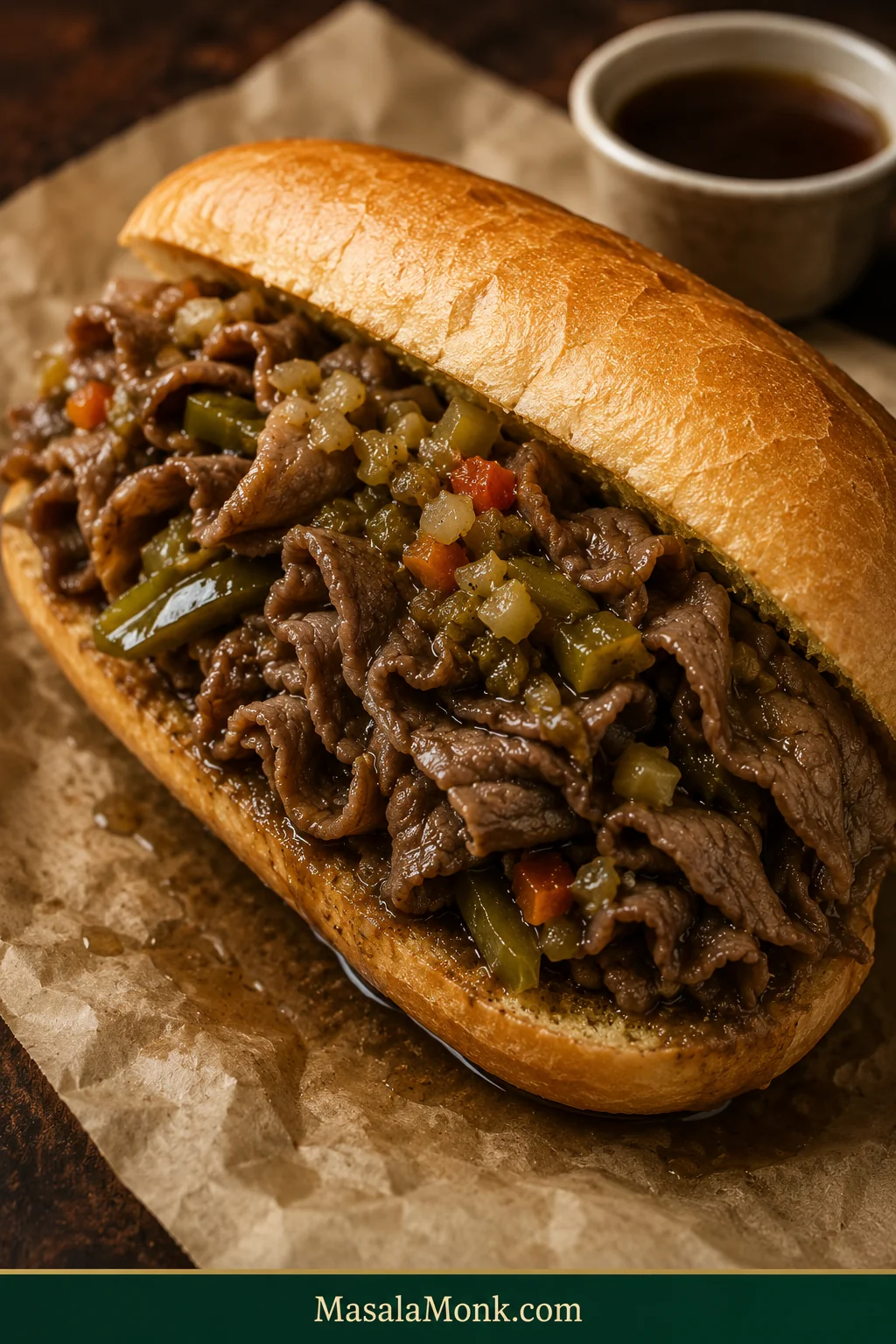
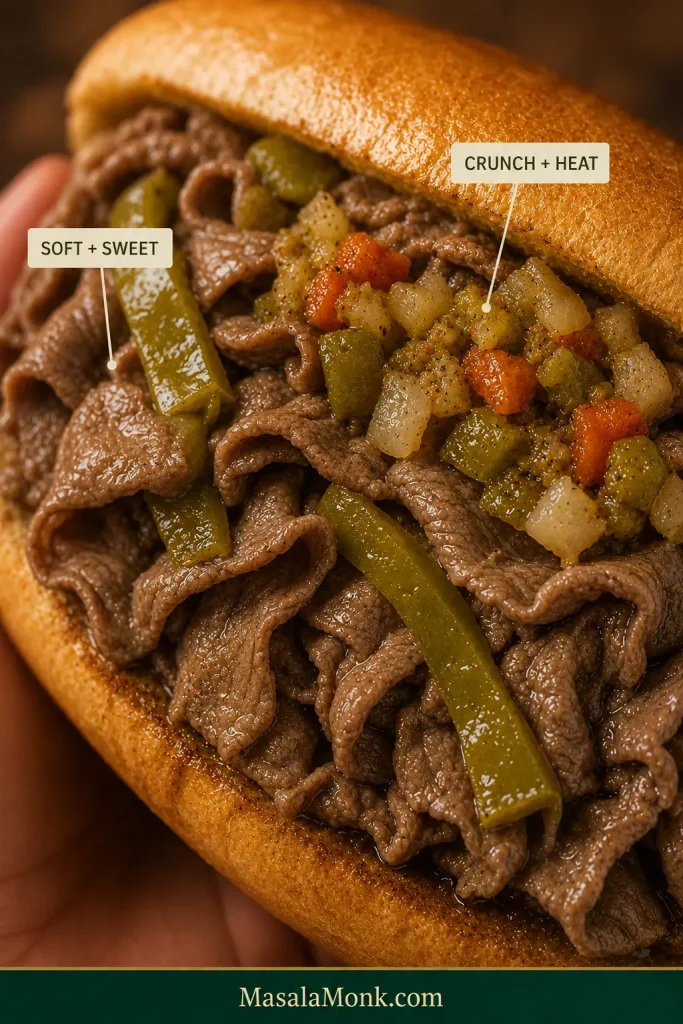
A good Chicago Italian beef sandwich looks a little out of control before you ever take a bite. The beef sits in loose, thin folds rather than neat carved slabs. Hot, seasoned gravy has worked into the meat and the edges of the roll. Sweet peppers slump into the filling, giardiniera cuts through with crunch and heat, and if you chose yours dipped, the bread is carrying far more liquid than bread normally should.
What separates the memorable versions from ordinary roast beef on a roll is not one secret spice. Thick slices can feel chewy even when the roast itself was cooked well. Weak jus leaves everything flat. Too much reduction turns it salty. Shredded chuck can be delicious but eats like a different sandwich. And a roll that cannot handle gravy may collapse before you reach the second half.
Here, a relatively lean round roast stays sliceable, chills until firm, gets shaved very thin, then returns briefly to a deeply seasoned beef jus. Add soft sweet peppers, hot Chicago-style giardiniera, or both, and decide for yourself how far the gravy goes.
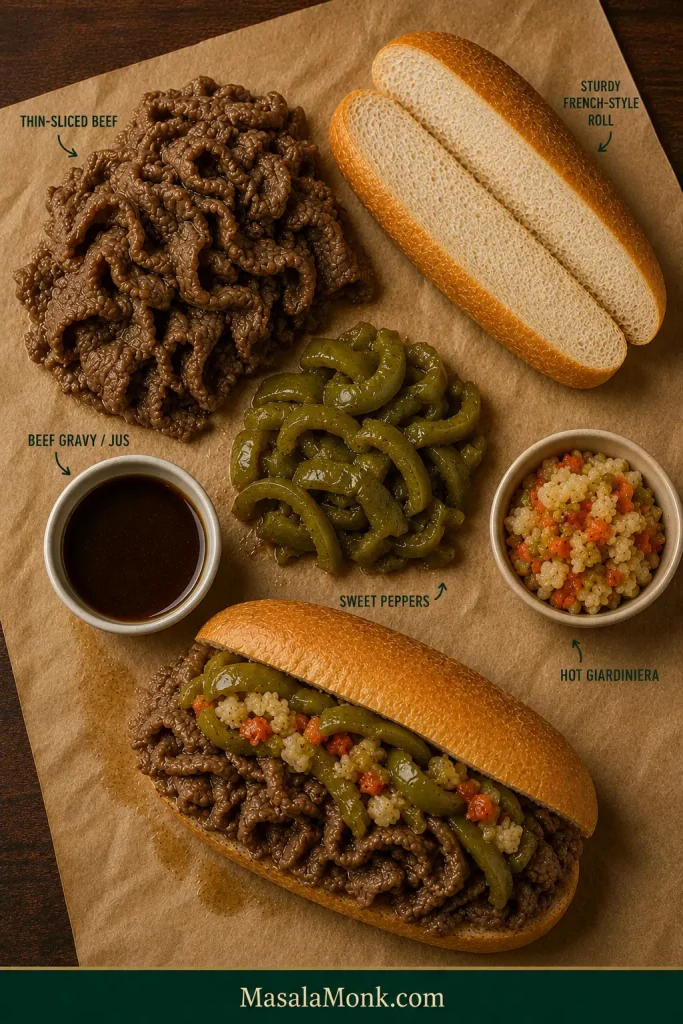
Chicago Italian beef is a Chicago-born sandwich of thinly sliced seasoned beef piled onto a French-style roll with beef gravy or jus, then often finished with sweet peppers, hot giardiniera, or both. The bread can stay relatively dry, take extra gravy, or be dipped right into the jus.
The exact origin of Italian beef is debated, but the sandwich grew out of Chicago’s Italian-American communities in the early 20th century. A commonly told history links its very thin beef and abundant gravy to feeding large wedding crowds economically: stretch the roast, put its juices back to work, and serve it on bread sturdy enough to catch them. However it began, that practical, crowd-friendly logic helped make Italian beef one of the city’s defining sandwiches.
The sandwich works as liquid management: sturdy roll, thin beef, seasoned jus and peppers all control how the bite holds together.
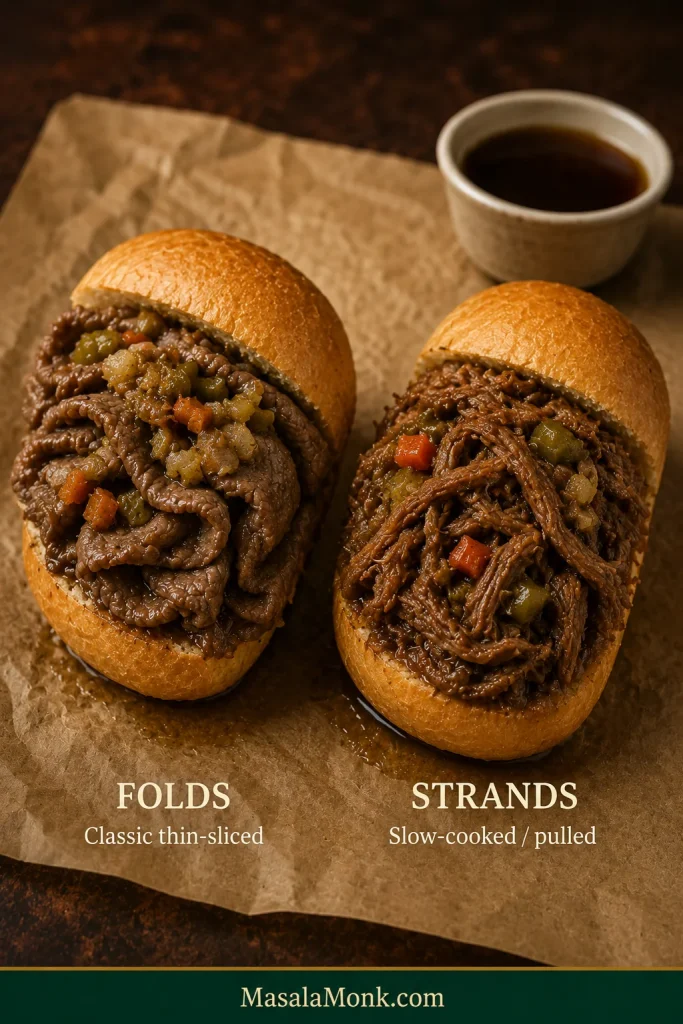
Which Italian Beef Are You Making?
Decide first whether you want folds or strands. Slow-cooker Italian beef gives you soft pulled meat; if the sandwich in your head has thin folds, use the roast → chill → shave route below.
Thin folds give cleaner bites and more jus control; pulled strands belong to the softer, slow-cooked route.
On a phone? Swipe sideways to see the full table.
What you want
Best route
Result
Classic thin Chicago-style beef
Roast → chill → shave → warm in jus
Loose, flexible slices with the most control over texture
Italian beef tonight
Thin cooked roast beef + quick homemade jus
A practical same-day sandwich without waiting overnight
Hands-off fall-apart beef
Slow cooker
Tender pulled or shredded beef instead of shaved slices
The full recipe below is the first route. A four-sandwich same-day shortcut appears later for the night when waiting for a roast to chill is simply not happening.
Chicago Italian Beef Recipe
Two days sounds excessive for a sandwich until you realize most of that time is the refrigerator doing something useful. Day 1 cooks the beef and builds the jus. The overnight chill makes genuinely thin home slicing much easier. Day 2 is mostly slicing, warming and assembling.
Yield 8 generous sandwiches. The 4 lb / 1.8 kg starting roast allows for cooking loss, trimming and portion flexibility; smaller sandwiches may stretch the batch further.
Active time About 1 hour, plus extra time if slicing entirely by hand
Plan ahead Best over 2 days; optional 4–12-hour seasoning rest before roasting
Oven 325°F / 165°C
Roast endpoint 145°F / 63°C
Slice About 1–2 mm to start
Timing note Begin checking around the one-hour mark; thickness and internal temperature decide when the roast is done.
Equipment
Roasting pan around 9 × 13 inches / 23 × 33 cm
Rack that fits over or inside the roasting pan
Instant-read or leave-in meat thermometer
Fine-mesh strainer
Large saucepan or Dutch oven for the jus
Long sharp slicing or carving knife
Meat slicer, optional but very helpful
Tongs and ladle
Ingredients
Beef
4 lb / 1.8 kg top round or bottom round, preferably 2 similarly sized roasts
14 g kosher salt, preferably weighed
2 teaspoons dried oregano
2 teaspoons garlic powder
1 teaspoon onion powder
1 teaspoon freshly ground black pepper
1 teaspoon dried basil
1 teaspoon fennel seeds, lightly crushed
½ teaspoon red pepper flakes, optional
2 tablespoons / 30 ml olive oil
Jus
6 cups / 1.4 L low-sodium beef stock
1 medium yellow onion, about 7 oz / 200 g, quartered
6 garlic cloves, about 18 g, smashed
1 teaspoon dried oregano
1 teaspoon freshly ground black pepper
½ teaspoon dried basil
½ teaspoon fennel seeds, lightly crushed
¼ teaspoon red pepper flakes, optional
2 bay leaves
2 teaspoons / 10 ml Worcestershire sauce, optional, added after tasting the finished jus
Up to 2 cups / 475 ml unsalted or low-sodium beef stock, reserved for adjusting the jus
Sweet Peppers
3 large green bell peppers, about 1 lb / 450 g
1 tablespoon / 15 ml olive oil
¼ teaspoon / about 1 g kosher salt
Assembly
8 soft, sturdy French or Italian-style rolls, about 6 inches / 15 cm each
4–5 oz / 115–140 g cooked beef from the roast per sandwich
1–1½ oz / 30–40 g cooked sweet peppers per sandwich, if using
4–6 oz / 120–160 g Chicago-style giardiniera solids total, about ½–¾ oz / 15–20 g per sandwich
Hot beef jus, for warming, spooning and dipping
About the salt: weighing the 14 g is more reliable than a single spoon conversion because kosher salts differ substantially in density. The beef itself does not need to taste aggressively salty; those thin slices will later pick up seasoning from the jus.
Instructions
Day 1 — 1. Season the Beef
Pat the beef dry. Mix the salt with the oregano, garlic powder, onion powder, black pepper, basil, fennel and red pepper flakes. Rub the meat with olive oil, then coat it evenly with the seasoning.
Have extra time? Refrigerate the seasoned beef uncovered for 4–12 hours. Starting later is fine; the chill after roasting matters much more to the final slice.
2. Build the Jus in the Roasting Pan
Heat the oven to 325°F / 165°C.
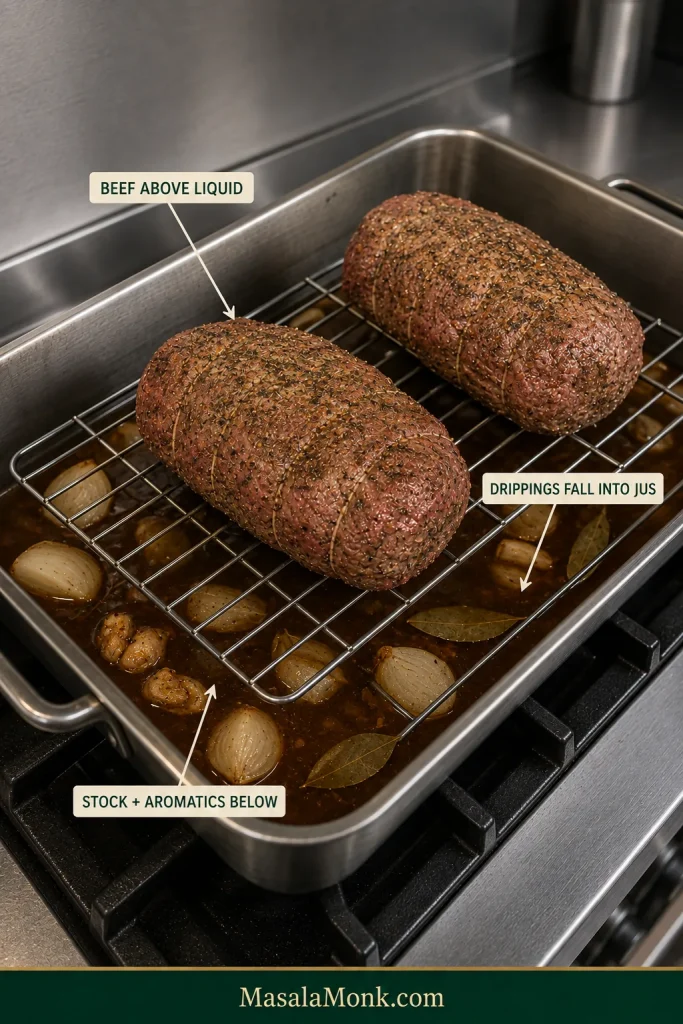
Pour the 6 cups / 1.4 L stock into a roughly 9 × 13-inch / 23 × 33-cm roasting pan. Add the onion, garlic, oregano, black pepper, basil, fennel, red pepper flakes and bay leaves.
Set the rack over the liquid and arrange the beef on top. Keep the meat above the stock so its drippings fall into the seasoned liquid while the outside still roasts.
The rack does more than hold the beef up. It keeps the roast exposed to oven heat while the liquid underneath catches drippings—so you build Italian beef jus without turning the roast into a braise.
3. Roast to 145°F / 63°C
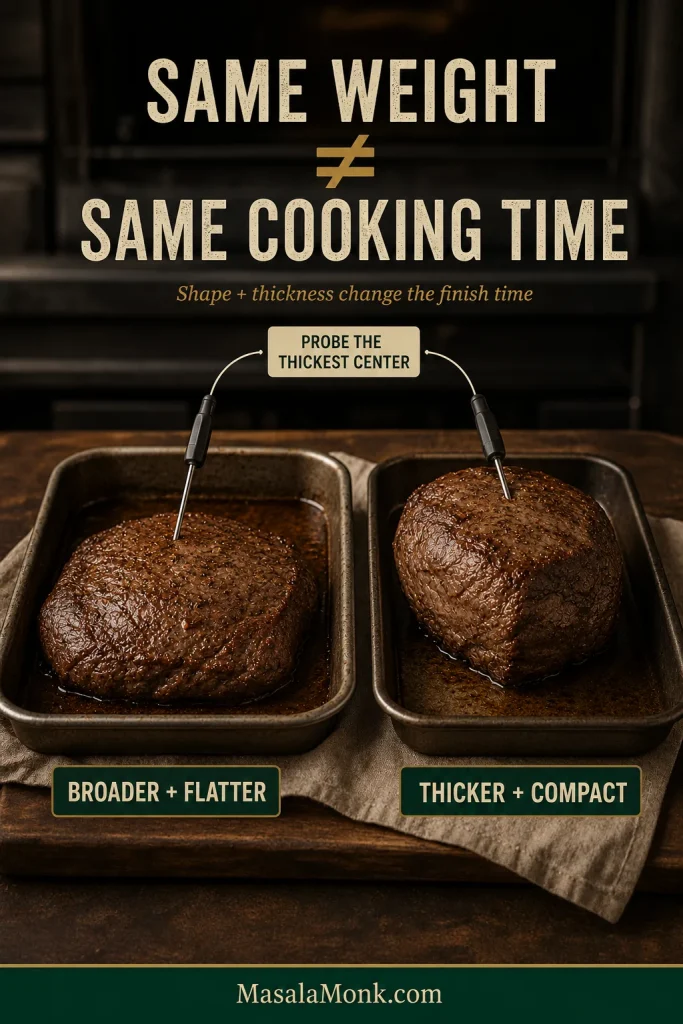
Roast until the thickest center of each piece reaches 145°F / 63°C. With two roughly 2 lb / 900 g roasts, begin checking around the one-hour mark. Remove each piece as it reaches temperature; one may finish well before the other.
A broad, flatter roast can finish sooner than a compact thick one of the same weight. The clock tells you when to check; the thermometer tells you when to stop.
4. Rest, Portion and Chill
Rest the beef for at least 15 minutes. That comfortably exceeds the USDA minimum three-minute rest for a whole beef roast cooked to 145°F / 63°C.
Look at the grain, then divide the roast into a few slicer-friendly pieces if needed. Keep each piece oriented so tomorrow’s cuts can still run across the grain.
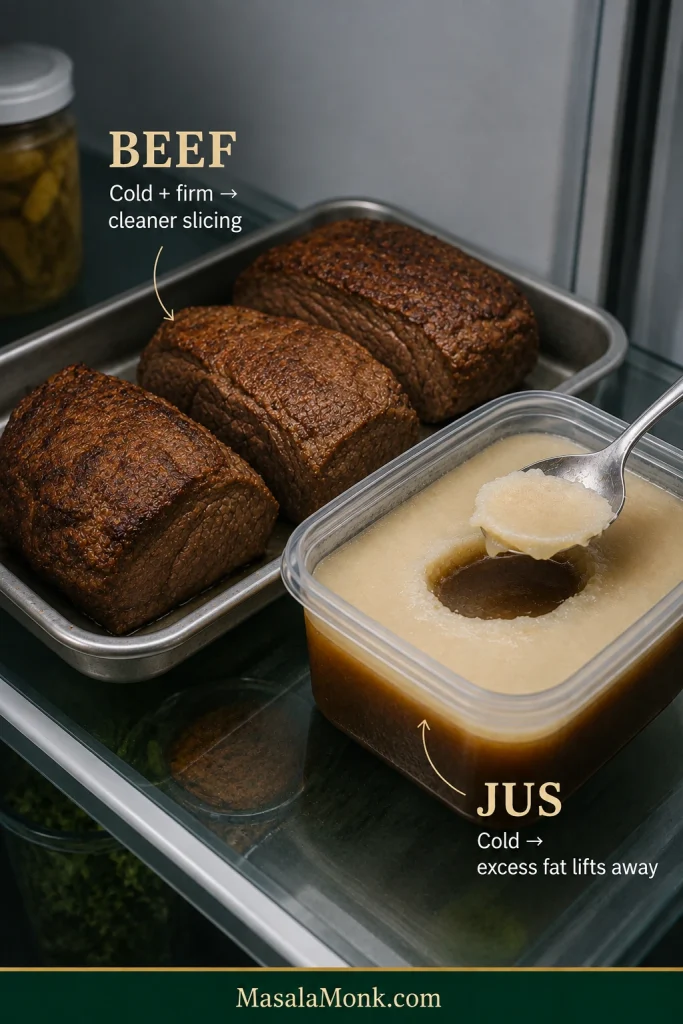
Arrange the pieces on a shallow tray and refrigerate promptly; don’t leave the roast sitting out to cool. Get it into the refrigerator no later than 2 hours after cooking. Cover tightly once chilled through.
The roast may look less exciting cold than it did coming out of the oven. That’s fine. Tomorrow, that firmness becomes folds.
5. Strain and Chill the Jus
Strain the roasting liquid into a shallow heat-safe container, pressing gently on the onion and garlic before discarding the solids. Refrigerate promptly.
Once cold, excess fat firms on the surface and becomes easy to remove. Leave a little behind for flavor and body.
The refrigerator is doing two different jobs here: firming the roast for cleaner slicing and making excess fat easy to lift from the jus. Treat both as prep for better control tomorrow.
Day 2 — 6. Roast the Sweet Peppers
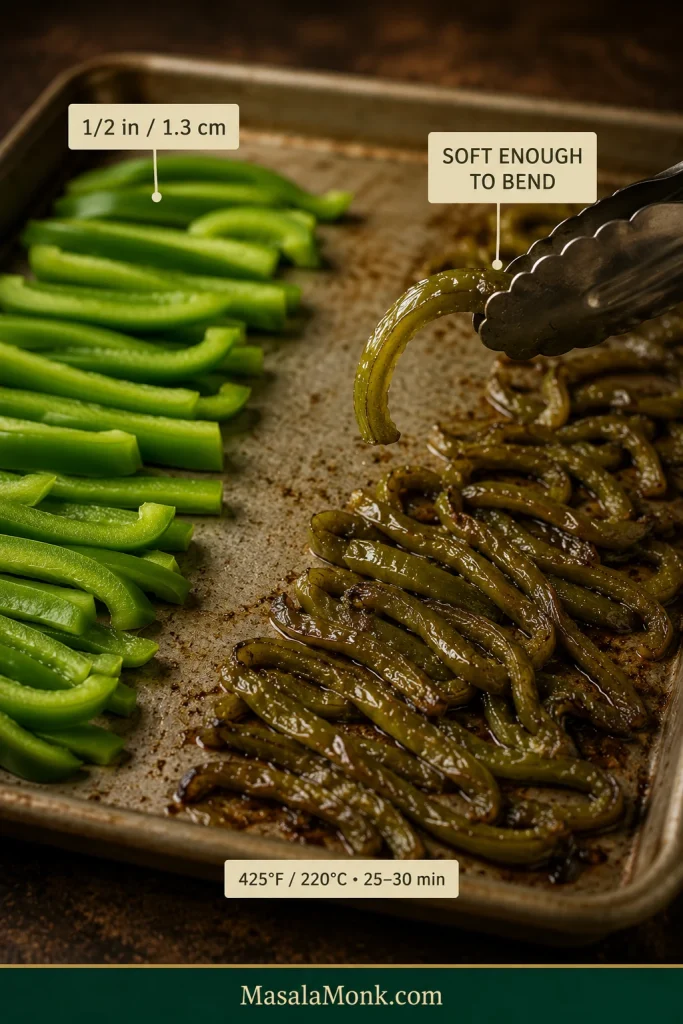
Heat the oven to 425°F / 220°C. Cut the peppers into strips about ½ inch / 1.3 cm wide, toss with the oil and salt, then roast for 25–30 minutes, stirring once.
Lift a strip. It should bend easily, with a soft collapsed texture that settles into the beef instead of crunching through the bite.
Broad bell-pepper pieces are easier to identify after roasting and less likely to disappear into stringy strips. Cook them until they fold with the beef instead of announcing themselves with a crunch.
7. Reheat and Finish the Jus
Lift away excessive hardened fat, leaving a little behind. Pour the jus into a wide saucepan or Dutch oven and bring it to a full rolling boil.
For eight sandwiches, about 5 cups / 1.2 L is usually enough for a mostly dry-or-wet table. Aim closer to 6 cups / 1.4 L when several sandwiches are likely to be dipped.
Reduce thin-tasting jus before the beef goes anywhere near it. A concentrated or salty batch needs some of the reserved unsalted or low-sodium stock instead. Taste again before adding Worcestershire or more salt.
Taste the jus on the actual bread: tear off a corner of the roll and dip it into the jus. The crumb should darken quickly and taste beefy, garlicky and peppery without tasting aggressively salty once the bread has absorbed it.
Use the roll to decide what happens next: bland once soaked means the jus can concentrate further; salty once soaked means dilute before the beef goes in.
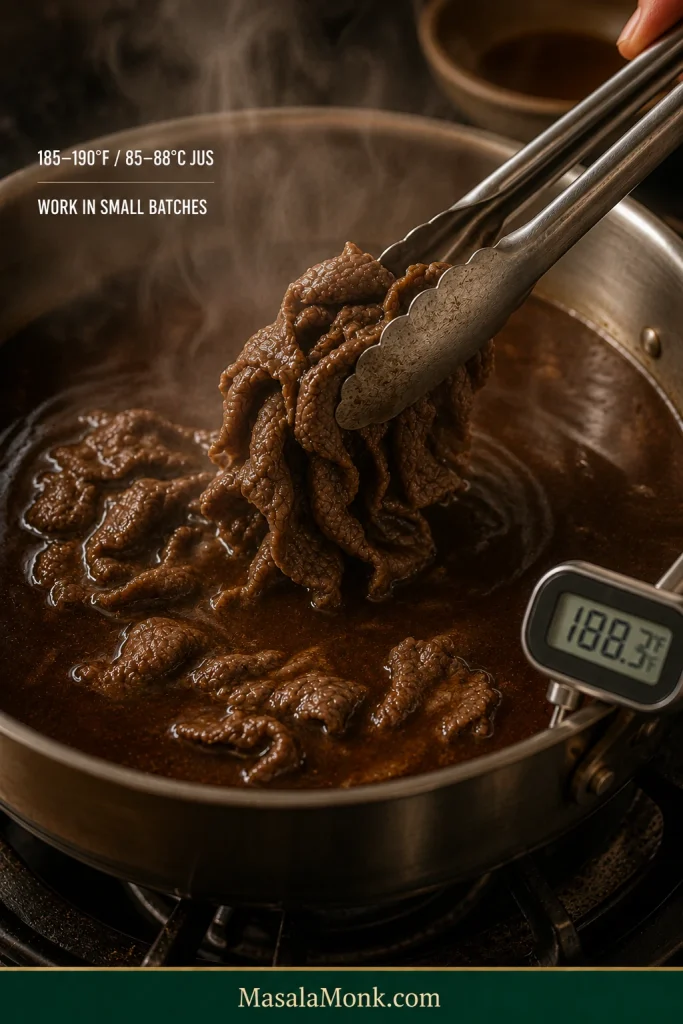
When that soaked piece of bread already tastes like the sandwich you want, lower the jus to roughly 185–190°F / 85–88°C.
8. Find the Right Slice
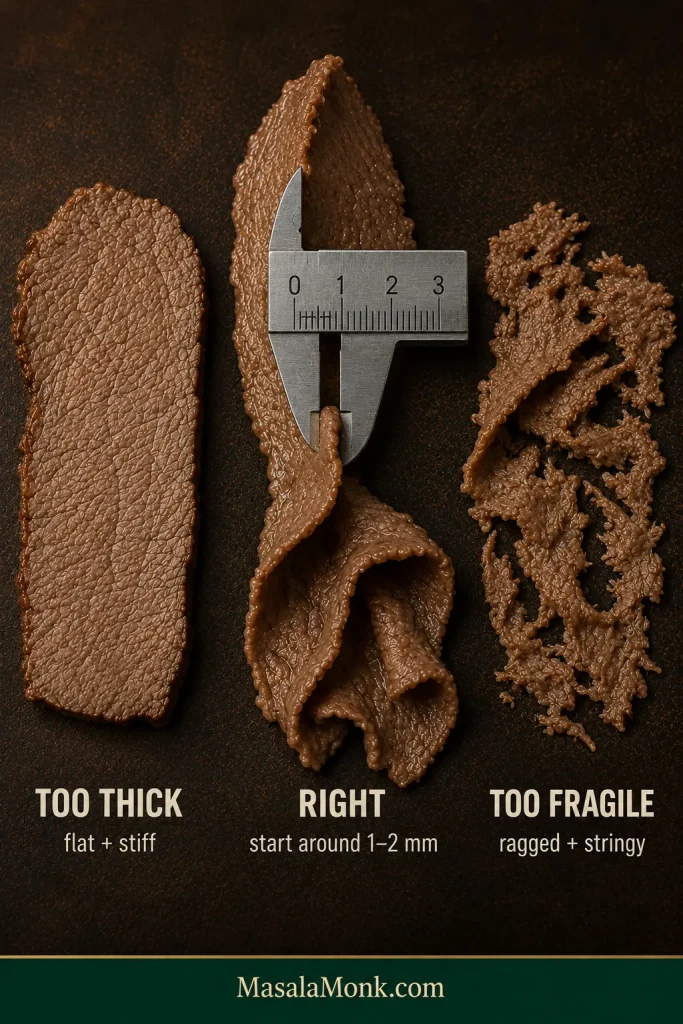
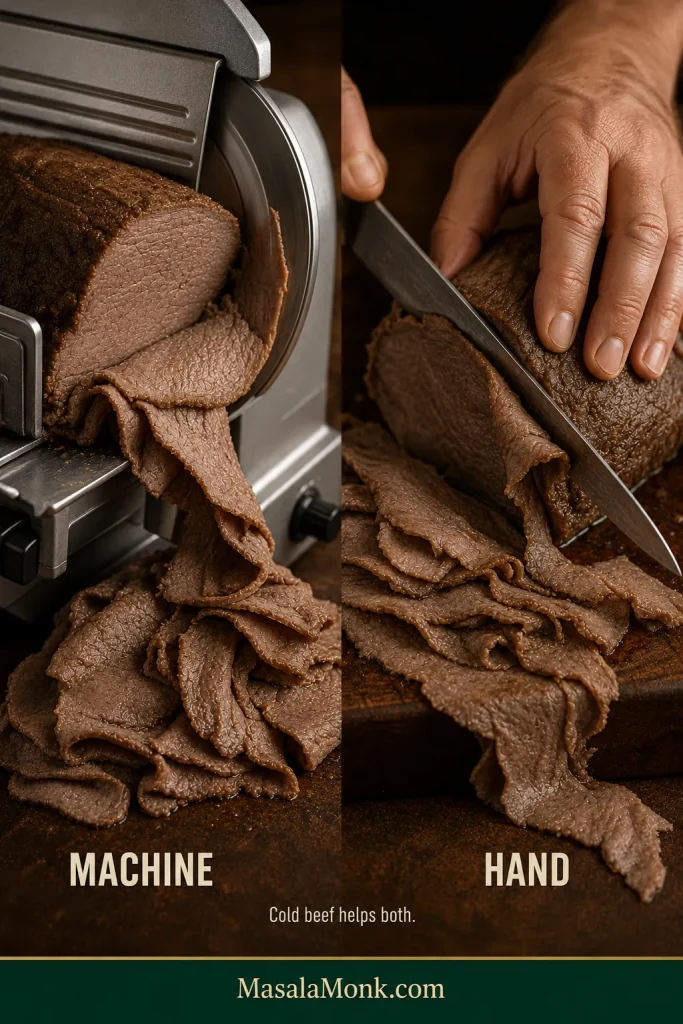
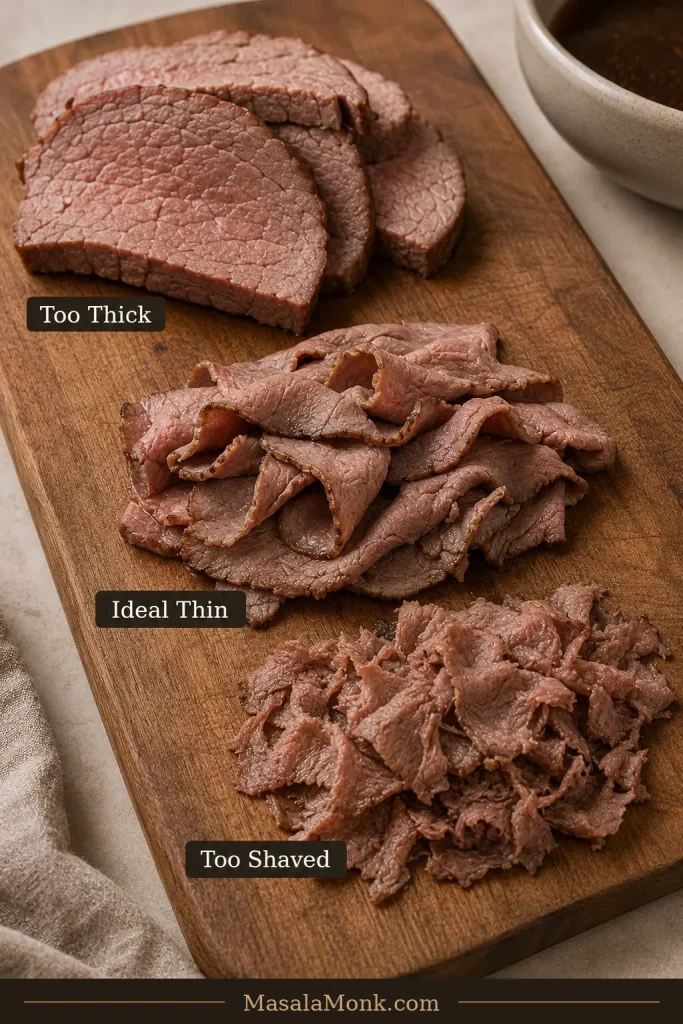
Working with one thoroughly cold piece, slice across the grain. With a meat slicer, begin around 1–2 mm. With a knife, aim for the thinnest clean, intact slices you can comfortably manage.
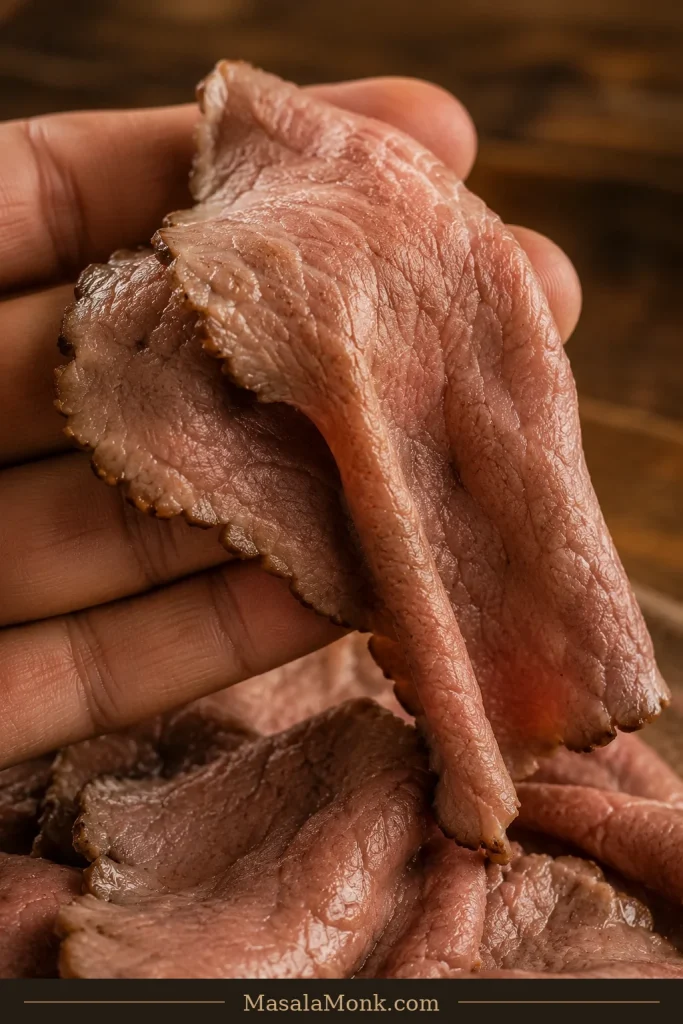
Cut three or four slices before committing the whole roast. Lift one. A good slice droops over your fingers, wrinkles and folds. A rigid, flat slice wants a thinner setting; ragged scraps mean you’ve gone a little too far.
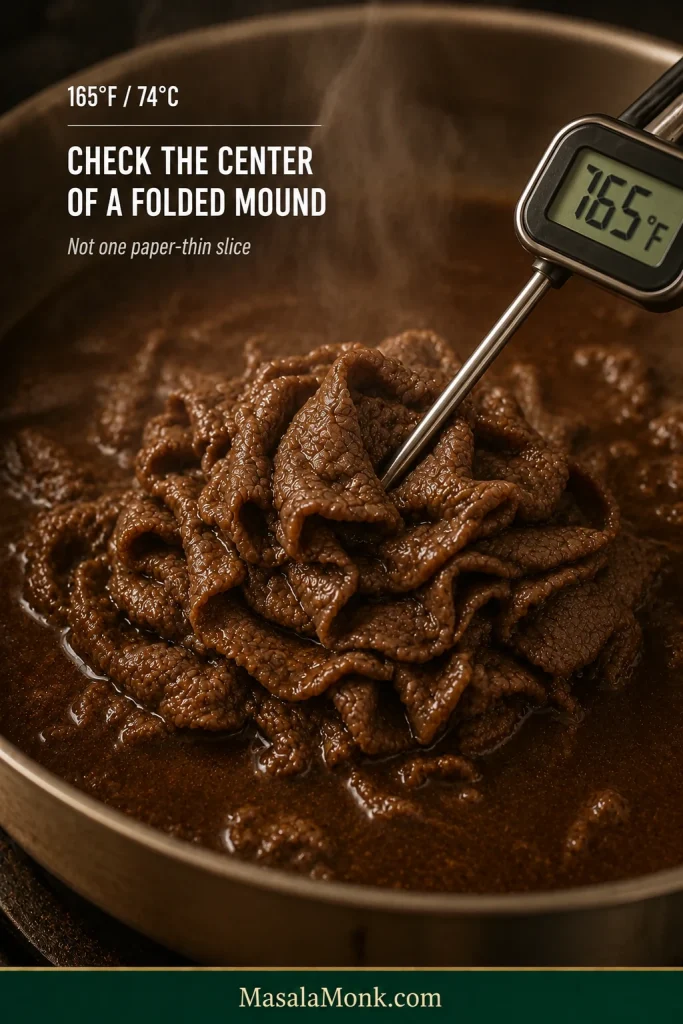
Warm a small folded handful in the jus until steaming hot throughout. To verify reheating temperature, gather the slices into a small mound and check the center for 165°F / 74°C rather than trying to probe a single paper-thin slice.
Judge the final thickness after warming a sample, not only while the beef is refrigerator-cold. The right slice should stay intact yet bite through without dragging half the filling from the roll.
Take a bite. A long strip that pulls away from the sandwich needs thinner slicing. Beef that falls apart before the tongs can lift it cleanly can go slightly thicker. Once the bite feels right, slice the rest.
A meat slicer makes the job easier; it is not the price of admission. Hand-cut slices that fold and bite cleanly are doing their job.
9. Warm the Beef in Small Batches
Add enough cold sliced beef for one or two sandwiches to the jus at roughly 185–190°F / 85–88°C. Loosen the slices gently with tongs and reheat each batch until steaming throughout and 165°F / 74°C at the center.
Watch the pot when cold beef enters. If the jus loses most of its steam and takes a long time to recover, the batch is too large; smaller portions keep the folds tender and service moving.
Very thin beef may be ready in roughly 1–2 minutes, but use that only as orientation. Batch size, slice thickness, beef temperature and the amount of jus all change the timing.
The cold slices should relax, darken with gravy and hang softly from the tongs. Lift them out once they’re hot and supple.
10. Build the First Sandwich, Then Adjust
Open one roll without cutting through the hinge. Add 4–5 oz / 115–140 g hot beef in loose folds, plus 1–1½ oz / 30–40 g sweet peppers and ½–¾ oz / 15–20 g giardiniera solids if using.
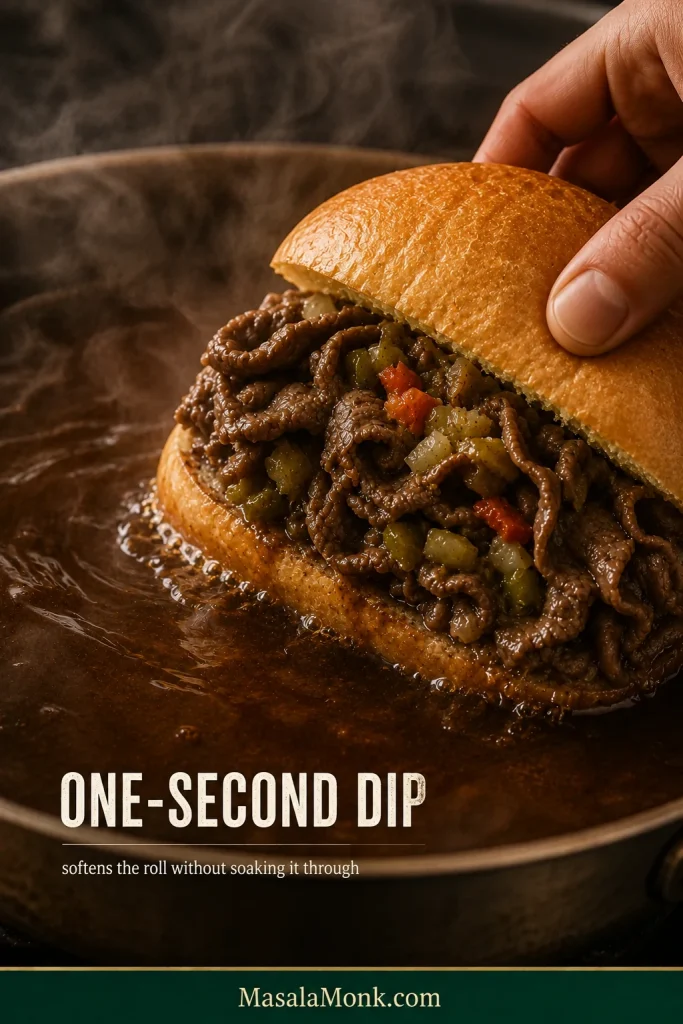
Start the first sandwich wet or give it an easy one-second dip, then take a bite.
Think of the one-second dip as the middle ground: enough exterior contact to soften and season the roll, but brief enough that the hinge still has work left to do.
A dark, tender crumb with a secure hinge tells you the roll can probably take more gravy. Bread already close to collapse has shown you its limit. Build the rest to order.
Eat a fully dipped sandwich now. Good bread can survive gravy. It cannot turn today’s dunk into tomorrow’s packed lunch.
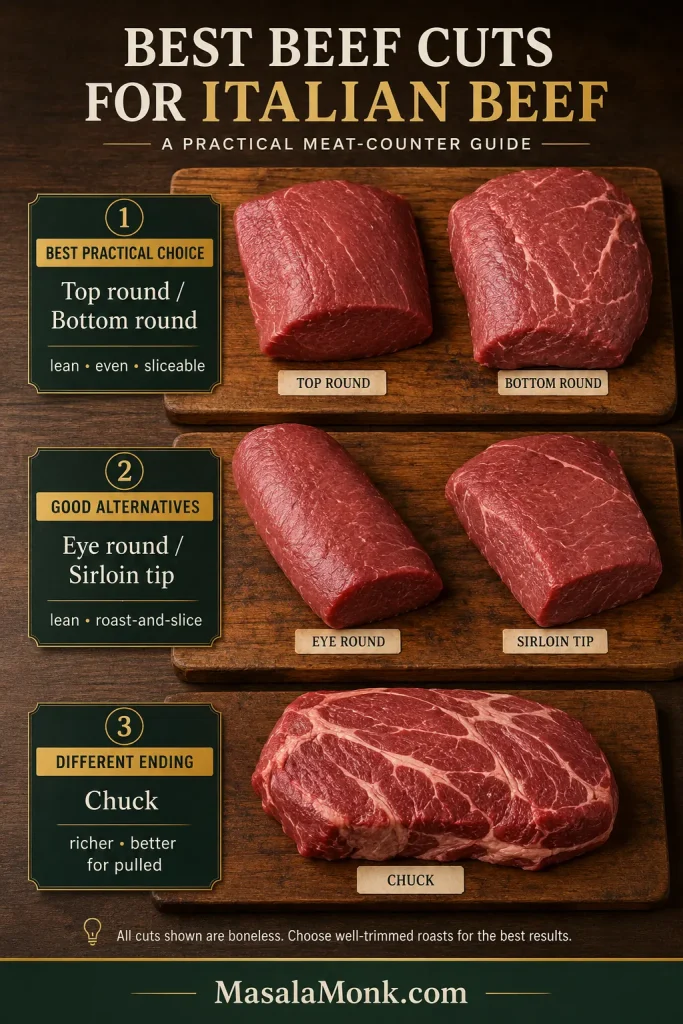
Top round and bottom round are the easiest practical choices for thinly sliced Chicago Italian beef at home. Sirloin also works well. Chuck makes more sense when the plan is long cooking and pulled beef.
On a phone? Swipe sideways to see the full table.
Cut
Thin sliced
Slow-cooked / pulled
Main tradeoff
Top round
Excellent
Fair
Lean, even-grained and easy to shave once cold
Bottom round
Excellent
Good
Beefy and usually economical; thin slicing matters
Eye of round
Very good
Poor
Very lean and less forgiving of thick slices
Sirloin / sirloin tip
Excellent
Fair
Often naturally tender, usually more expensive
Chuck
Poorer fit
Excellent
Rich and collagen-heavy; naturally suits fall-apart cooking
Top round and bottom round can both work beautifully. At the store, look almost as closely at shape as the label: a fairly even roast with a clear grain direction cooks and slices more predictably than one with a thick center and sharply tapered tail.
Choose an evenly shaped roast with a clear grain direction; shape and grain matter almost as much as the cut name.
You have not bought bad beef if chuck is already in your refrigerator; you have bought beef that wants a different ending. Its extra collagen and fat reward long cooking and naturally pull it toward shredding. If that sounds good, our slow cooker pot roast recipe is built around the same strengths.
How Long to Roast Italian Beef: Temperature, Shape and Timing
Roast weight gives you a place to start planning; thickness decides how quickly heat reaches the center. Two roasts with the same weight can finish surprisingly far apart when one is broad and flat and the other compact.
With two roughly 2 lb / 900 g roasts, begin checking around the one-hour mark. A single thick 4 lb / 1.8 kg roast will generally need longer, but the thermometer—not a predicted finish time—decides when each piece comes out.
One roast finishing well before the other does not mean anything has gone wrong. Take it out and let the thicker one catch up.
A tapered roast may effectively have two cooking zones: the thin end heats faster while the thick center is still catching up. Probe where the meat is deepest, and let each roast finish on its own schedule.
Why Italian Beef Recipes Use Such Different Temperatures
Italian beef recipes can look wildly contradictory because they are not all chasing the same texture. Some keep the roast closer to conventional roast-beef doneness before chilling and shaving it. Others cook round much further toward tenderness before cooling and slicing, while slow-cooker versions deliberately head toward meat that pulls apart.
We’re roasting this beef so it can be sliced later, not cooking it until it wants to fall apart. In this recipe, the roast reaches 145°F / 63°C, chills thoroughly, gets shaved very thin and then comes back to temperature briefly in the jus. A higher-temperature, long-cooked version follows another route and produces a different texture.
How Thin to Slice Italian Beef — and What “Thin” Looks Like
Chill the Roast First
Warm roast beef compresses; cold roast beef slices. Press the center gently before you start. It should feel thoroughly cold and firm rather than soft and springy.
A short freezer chill can firm a stubbornly soft roast further. Stop while the center is still easy to slice—you want firmer beef, not a frozen block.
Start around 1–2 mm. Lift a slice and look at what it does.
Too thick: it lies flat and stiff like carved roast beef and can pull from the sandwich in one long strip.
Right: it droops, wrinkles and folds over your fingers. Several slices can pile together without becoming one heavy slab.
Too fragile: it breaks into stringy scraps before a clean slice reaches the tray. Move slightly thicker.
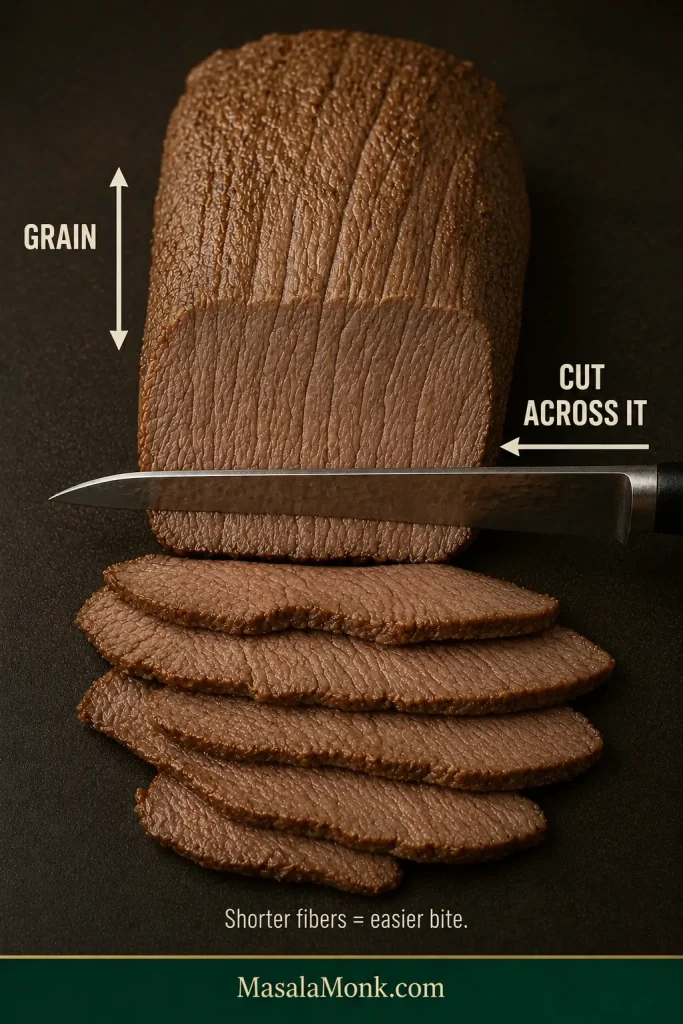
Cut Across the Grain
Look at the visible muscle fibers before you settle into a slicing rhythm. Cut across them rather than along them so the finished slices bite through more easily.
If the grain changes direction, turn or divide the roast before slicing so every cut still runs across the fibers.
No Meat Slicer?
Yes, you can make Italian beef without a meat slicer. Chill the roast completely, use a long sharp knife and cut as thinly as you comfortably can. Slightly thicker intact slices are better than shredded scraps.
A slicer buys repeatability; by hand, intact slightly thicker folds beat shredded scraps.
Smooth slicing strokes work better than pushing straight down. A butcher or deli may also be willing to slice chilled cooked meat, although store policies vary.
Hand-cut beef that folds and bites cleanly is thin enough, even if nobody would mistake it for commercial deli slicing.
How to Reheat Italian Beef Without Making It Tough
Cold beef drops the temperature of the jus as soon as it goes in, so give each portion enough room to loosen instead of packing the pot with a cold solid mass.
Keep the jus around 185–190°F / 85–88°C while reheating. The beef should become steaming hot throughout and reach 165°F / 74°C when checked in the center of a folded mound. Let the liquid recover before adding another cold portion.
The folded mound creates something a thermometer can actually measure: a real center. A single paper-thin slice is too shallow to give the probe tip a useful reading.
Hard bubbling around delicate slices or rapidly curling edges mean the heat is too aggressive. Once the beef is hot and hanging softly from the tongs, more time is not helping it.
The Jus Is Half the Sandwich
Good Italian beef jus should taste a little stronger than broth you’d happily sip from a mug. Beef and bread soften its impact, but the soaked crumb should never taste aggressively salty.
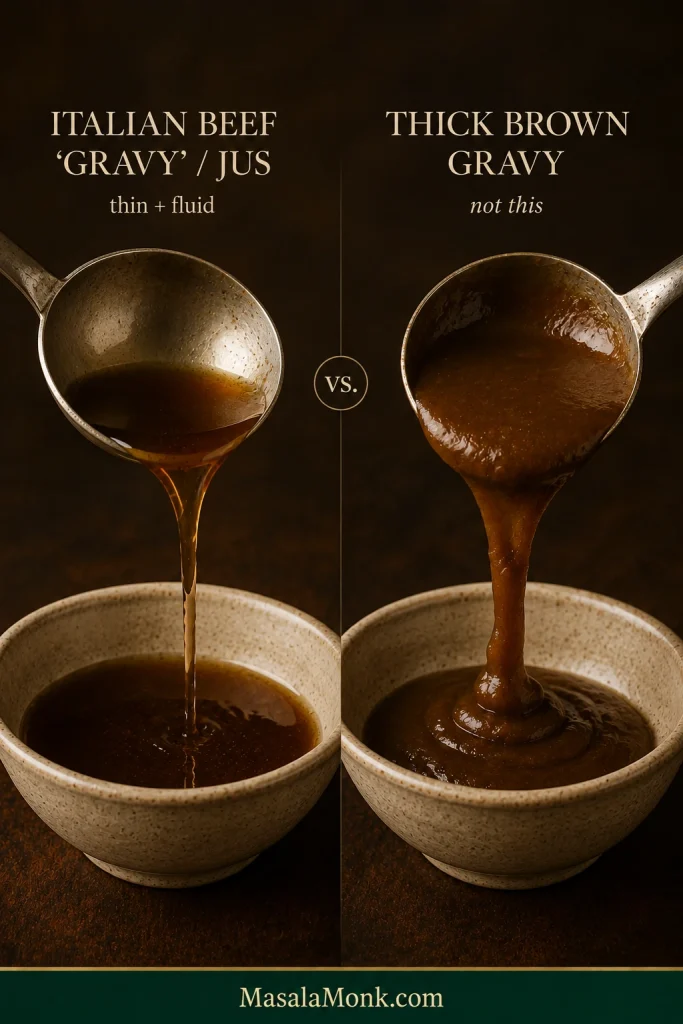
Chicago shops often call the seasoned roasting liquid gravy; cooks also say juice or jus. Here, those words mean the thin beef liquid used to warm and wet the sandwich, not a flour-thickened brown gravy.
Italian beef jus should penetrate the folds and crumb, not sit on top like a thick sauce.
The jus should taste primarily of beef, garlic and pepper. Oregano, fennel and basil belong in the background. When dried herbs are the first thing you notice, they’ve become too loud.
Volume matters too. A wide pan evaporates faster, ovens vent differently and roasts release different amounts of juice. About 5 cups / 1.2 L suits a mostly dry-or-wet table; move closer to 6 cups / 1.4 L when several sandwiches will be dipped.
Weak jus needs reduction without the beef in the pan. Over-concentrated jus needs unsalted stock or water. In both cases, bread is a better judge than another spoonful straight from the pot.
Best Bread for Italian Beef: What Can Take the Jus?
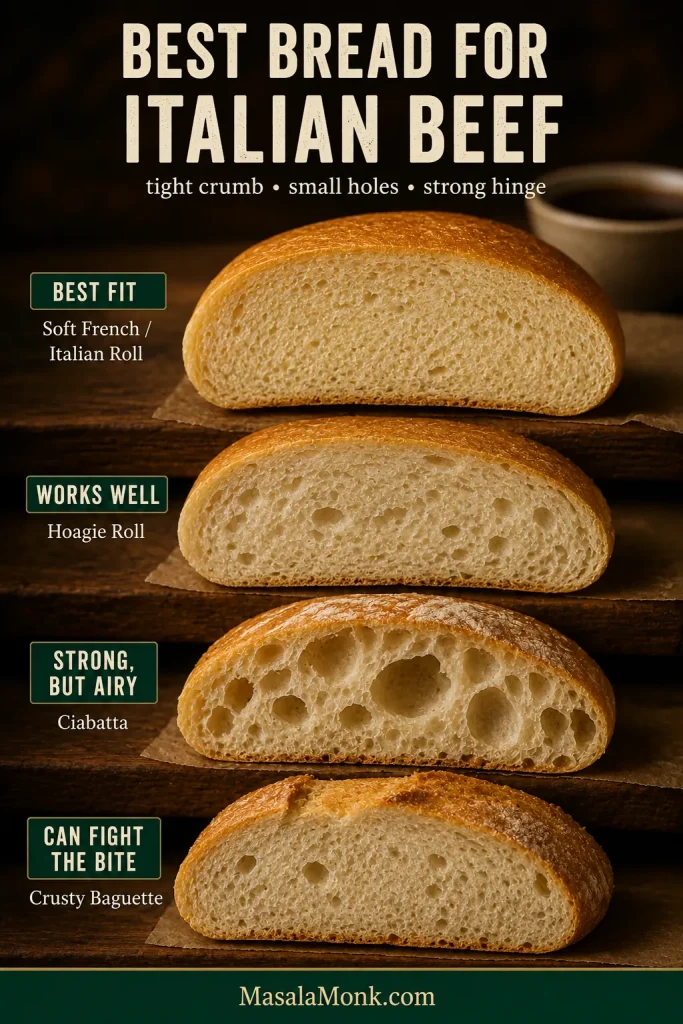
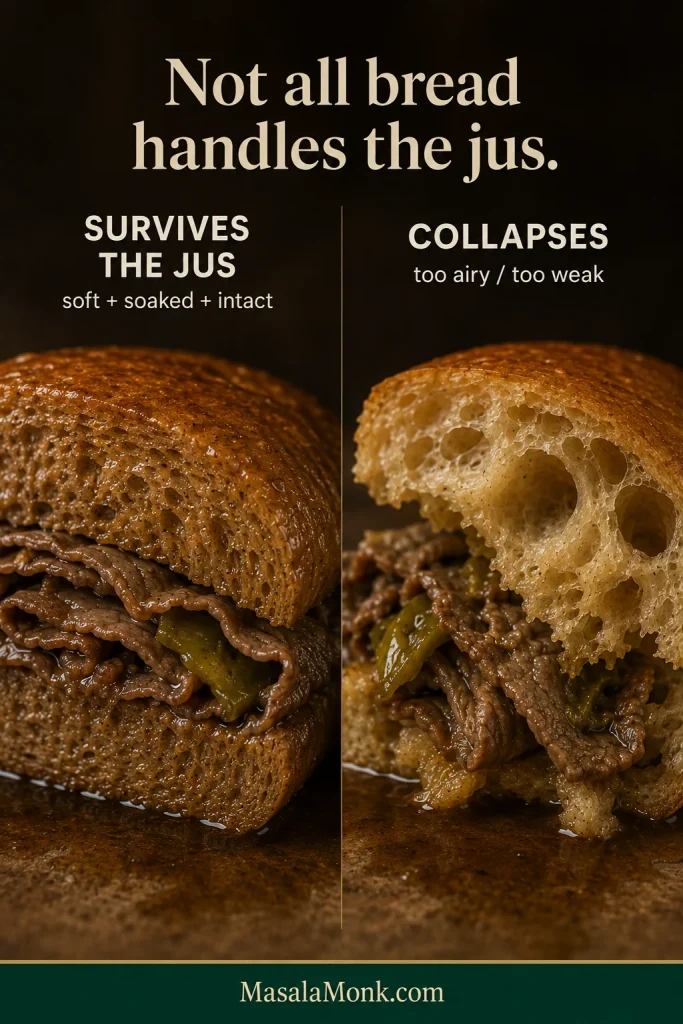
Use a soft French or Italian roll with a fairly tight crumb, light chew and strong hinge. It should absorb jus without collapsing or becoming harder to bite than the beef.
The best roll has a soft, tight crumb and enough structure to absorb gravy without collapsing.
Look for a fine, relatively tight crumb with small holes. Large open pockets soak unevenly and give the gravy easier places to weaken the roll. For a concrete Chicago reference, Portillo’s serves its Italian beef on Turano French bread.
A soft French or Italian sub roll is usually the easiest substitute. Sturdy hoagie rolls can work well too. Ciabatta has enough strength but its larger holes change the way gravy travels through the bread.
A very crusty baguette can fight the filling; an ultra-airy soft bun may absorb more than it can hold.
If a roll tastes great dry but falls apart after dipping, change the gravy exposure before changing the filling. A shorter dip can rescue a softer roll without rebuilding the whole sandwich.
Don’t toast the roll until crisp. A particularly soft substitute can benefit from brief warming or light surface-drying, but the center should still yield easily when pressed.
If you would rather make the bread yourself, our homemade hoagie and sub rolls are one route to a sturdy sandwich roll. Keep the crust on the softer side if you plan to dip it.
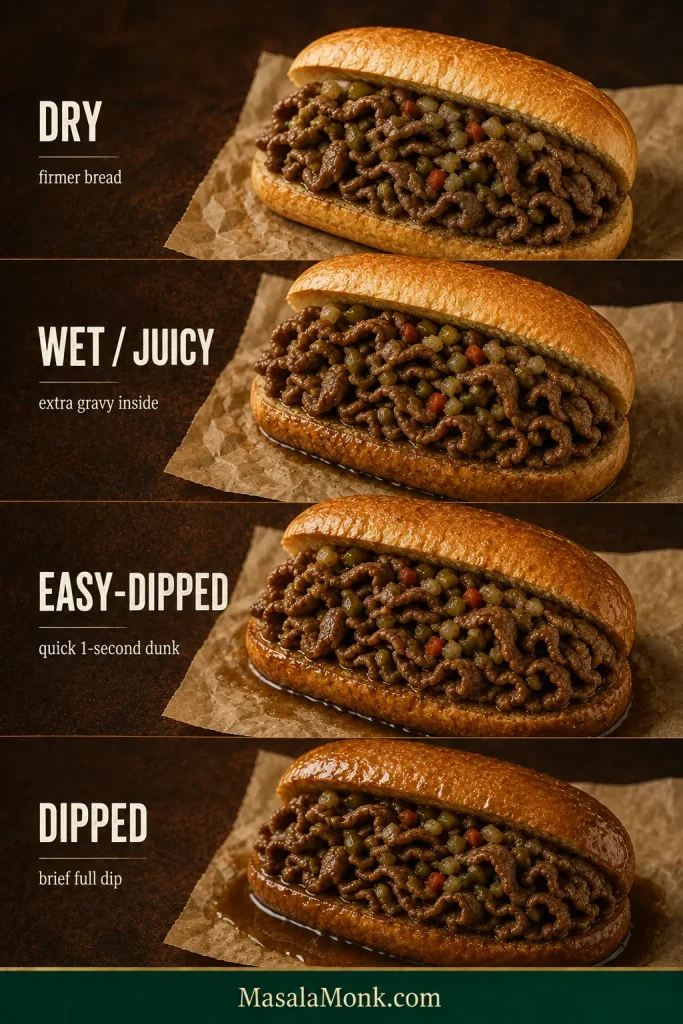
Dry, Wet (Juicy), Easy-Dipped or Dipped?
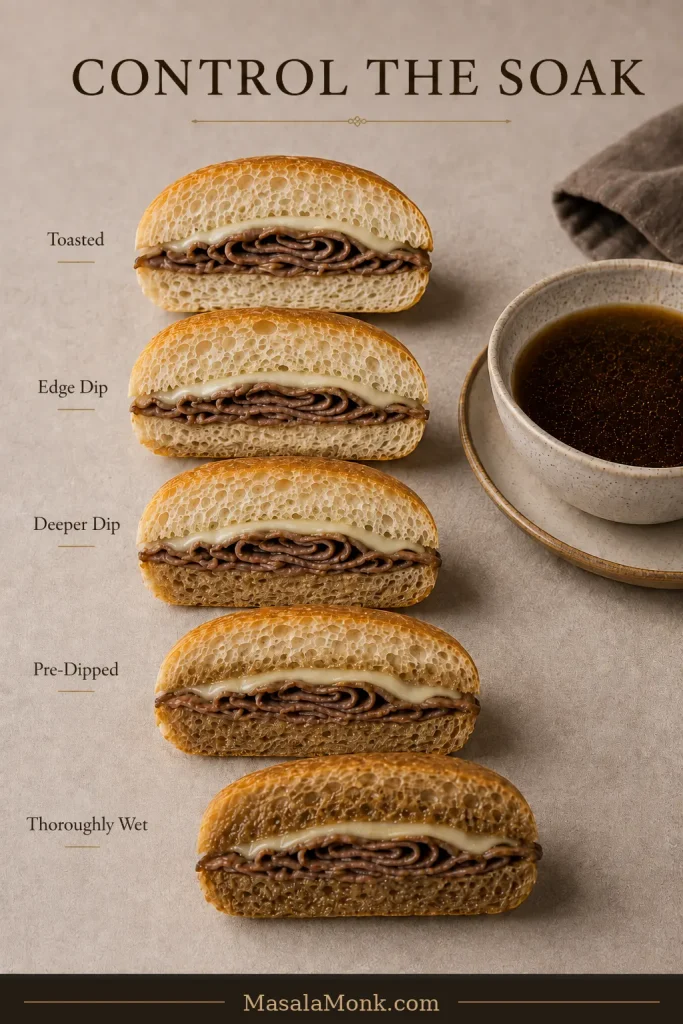
Dry keeps the roll relatively firm. Wet carries extra gravy into the bread. Easy-dipped gives the whole sandwich a quick one-second dunk. Dipped briefly submerges it for a few seconds.
How to Read a Chicago Italian Beef Order
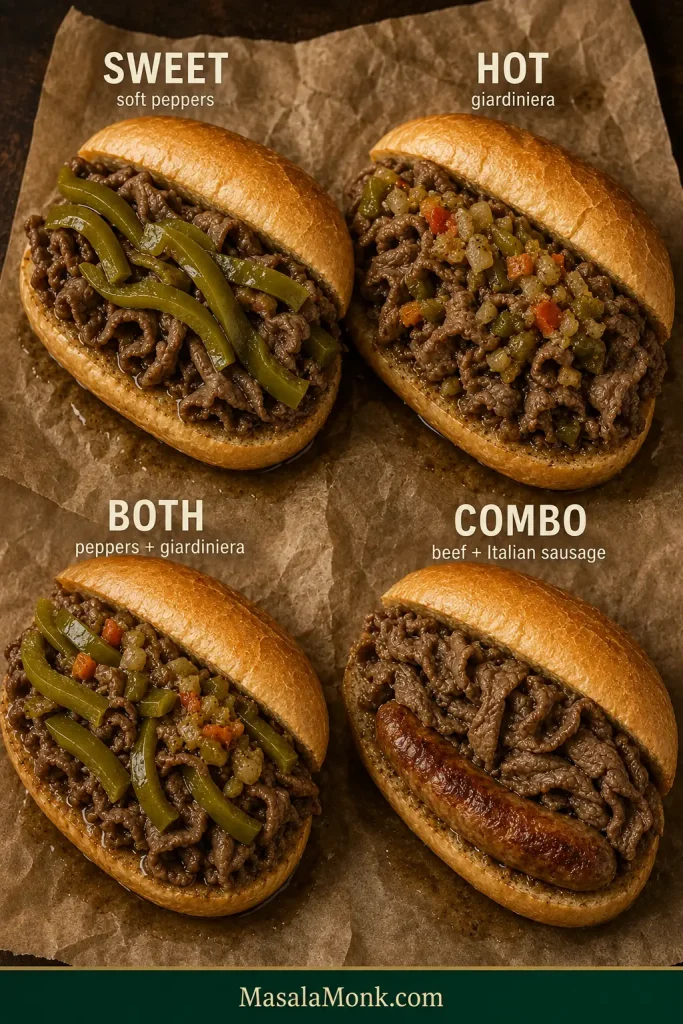
The exact wording varies from one beef stand to another, but the choice is essentially how much gravy reaches the bread. “Sweet” means cooked peppers, while “hot” points to giardiniera. If you see a combo on a Chicago beef menu, that means an Italian sausage has been added to the beef sandwich.
Order on three axes: peppers—sweet, hot or both; meat—beef or combo; gravy—dry, wet or dipped.
That shorthand is part of the pleasure of ordering Italian beef. This is a sandwich meant to be adjusted at the counter—sweet, hot, both, comparatively dry or soaked enough that you need to lean over the wrapper before taking the first bite. If The Bear sent you looking for it, this is the world of choices the show helped introduce to a much wider audience.
The amount of gravy is a preference, not an authenticity exam. Portillo’s ordering guide likewise distinguishes several gravy levels, including dry, easy-dipped, fully dipped and gravy on the side.
Choose Your Gravy Level
On a phone? Swipe sideways to see the full table.
Style
What happens
Best when
Dry
Beef drains well before filling the roll
Transporting the sandwich or keeping bread firmer
Wet / juicy
Plenty of jus travels with the beef and more may be spooned inside
You want lots of gravy flavor without soaking the whole exterior
Easy-dipped
The assembled sandwich gets about a one-second dunk
You want softened bread with some structure left
Dipped
The whole sandwich is briefly submerged for a few seconds
You want maximum saturation and will eat immediately
Jus on the side
The sandwich stays comparatively dry and each bite is dipped
Takeout, slow eating or maximum control
Drier sandwiches travel better; easy-dipped and dipped versions are best eaten immediately.
A fully dipped sandwich is deliberately messy. Keep the wrapper or plate underneath and lean in.
When an easy dip is exactly as wet as you enjoy it, you’ve found your level. The best gravy choice is the one that makes you want the next bite.
For a full sandwich-shop plate, hot crispy homemade French fries are an easy partner—especially when there happens to be enough jus nearby for the occasional fry dip.
Sweet Peppers and Hot Giardiniera
“Sweet” means soft cooked bell peppers, not a sugary sauce. They should bend easily and disappear into a bite of beef instead of crunching like fajita peppers.
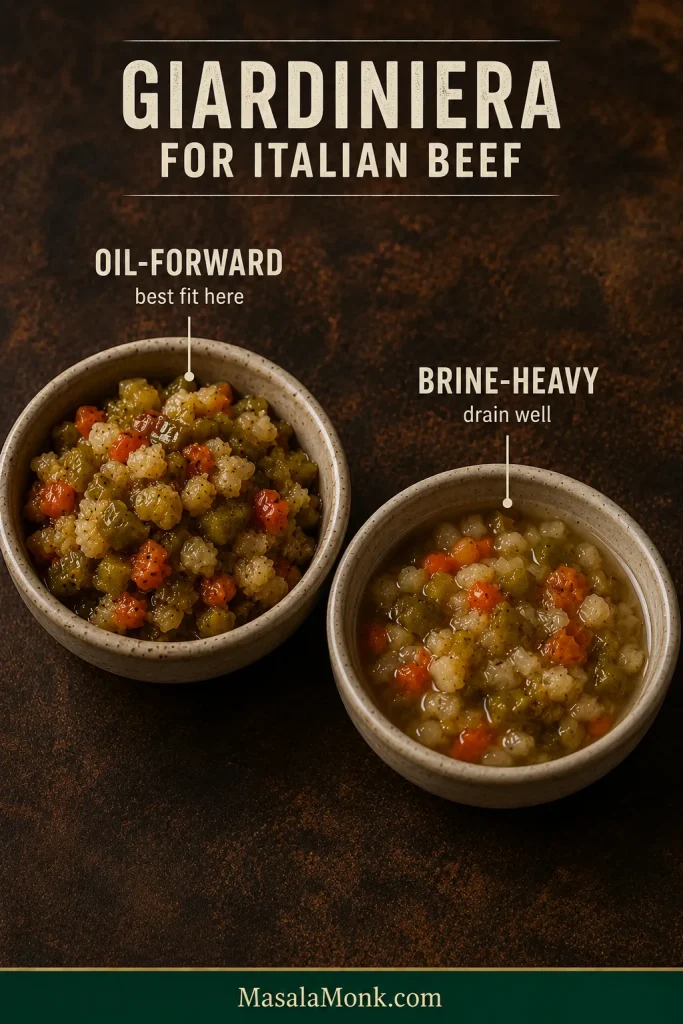
Chicago-style giardiniera is an oil-forward mix of chopped pickled vegetables and chiles that adds heat, acidity and crunch. Large cauliflower florets or chunky carrots are easier to eat when chopped finer.
Look at the liquid in the jar too. If the vegetables are swimming in sharp vinegar brine instead of seasoned oil, drain them particularly well before they reach the sandwich. Leave properly oil-packed giardiniera glossy rather than squeezing it dry.
Drain brine-heavy giardiniera; with oil-packed Chicago-style giardiniera, leave some seasoned oil clinging to the vegetables.
Start with about ½–¾ oz / 15–20 g per sandwich and put more at the table. It should sharpen the beef without covering up everything underneath.
Hot and sweet work especially well together: soft peppers deepen the juicy side of the sandwich while giardiniera brings crunch and brightness.
Use the toppings as a diagnostic. If every bite feels crunchy, the sweet peppers probably need more cooking; if chile heat hides the beef, pull back the giardiniera. Contrast should sharpen the sandwich, not compete with it.
Cheese is optional. Mozzarella or provolone can both work, but beef, gravy, bread and peppers define the sandwich without either one.
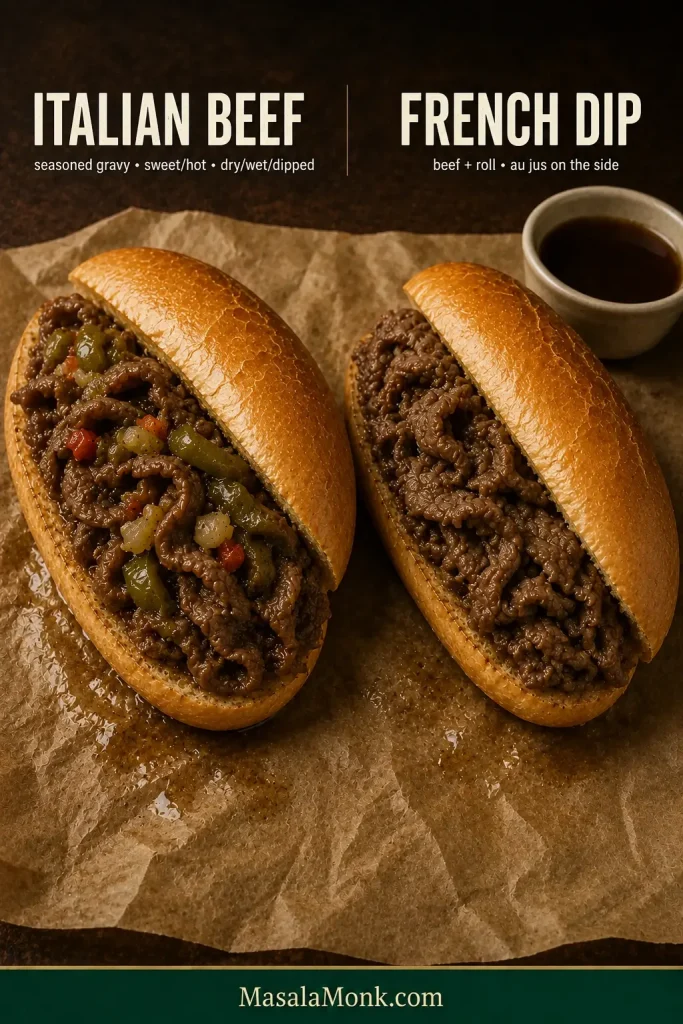
Italian Beef vs French Dip: What’s the Difference?
Both sandwiches can involve thin roast beef, a sturdy roll and beef jus, but they eat differently. Chicago Italian beef usually has a more assertively seasoned gravy, often includes sweet peppers or giardiniera, and builds the amount of gravy directly into the sandwich—dry, wet or dipped.
A French Dip is usually simpler: beef and bread with au jus served alongside for dipping. If that cleaner beef-and-jus combination is what you’re after, see our French Dip sandwich recipe.
Italian beef integrates seasoned gravy and peppers; French Dip keeps a simpler beef-and-bread build with jus on the side.
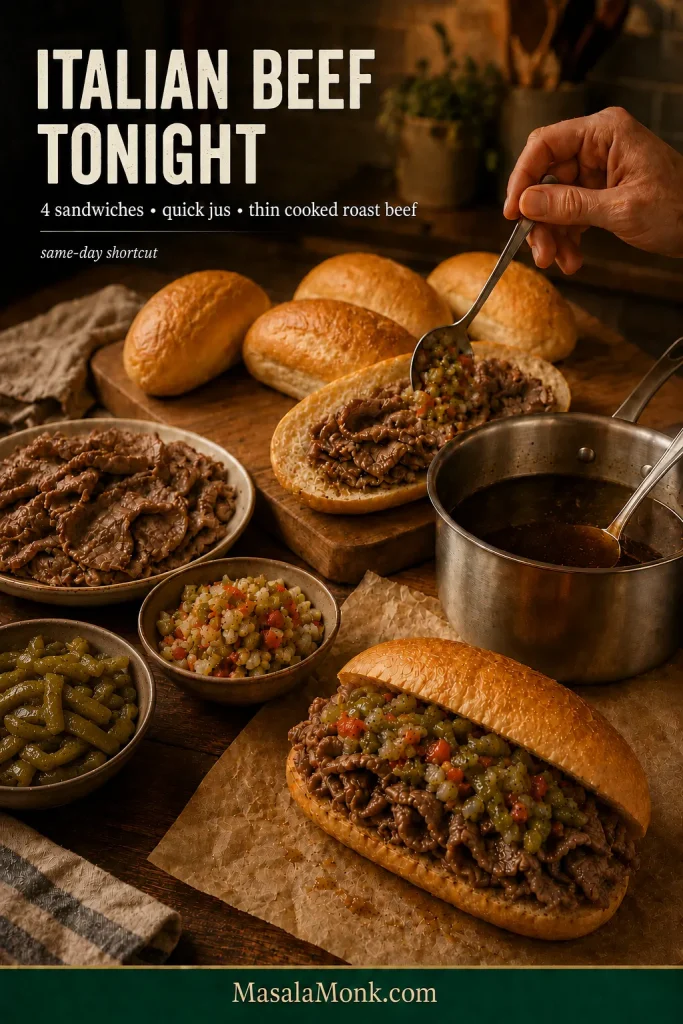
Italian Beef Tonight: A Fast 4-Sandwich Shortcut
If you found this page late in the afternoon, look for very thin plain or lightly seasoned cooked roast beef. Avoid heavily smoked, barbecue-flavored or heavily pepper-crusted versions; those flavors can pull the jus somewhere else entirely.
For quick Italian beef, choose plain or lightly seasoned thin roast beef so the homemade jus remains in charge.
This shortcut makes 4 sandwiches.
1–1¼ lb / 450–570 g thin cooked roast beef
3 cups / 700 ml low-sodium beef stock
½ medium yellow onion, roughly chopped
3 garlic cloves, smashed
½ teaspoon dried oregano
½ teaspoon black pepper
¼ teaspoon dried basil
¼ teaspoon fennel seeds, lightly crushed
Pinch red pepper flakes, optional
1 bay leaf
1 teaspoon Worcestershire sauce, optional, after tasting
Kosher salt, only if needed after tasting
4 sturdy soft rolls
Sweet peppers and giardiniera, as desired
Build the Quick Jus
Simmer the stock, onion, garlic, herbs, spices and bay leaf for about 20–25 minutes, then strain. Dip in a piece of bread. Reduce a little longer if the jus still tastes thin.
Once the concentration tastes right, decide whether it needs Worcestershire or salt. The roast beef may already contribute plenty of seasoning, so make those adjustments at the end.
Bring the jus to a rolling boil, then lower it to about 185–190°F / 85–88°C. Reheat the beef in modest portions until steaming hot throughout and 165°F / 74°C in the center of a folded mound.
Build with the same peppers, giardiniera and gravy choices as the full version. You lose some roast-and-drippings depth, but dinner still lands in the right neighborhood. If you want the roast-and-chill method next time, return to the full Chicago Italian beef recipe.
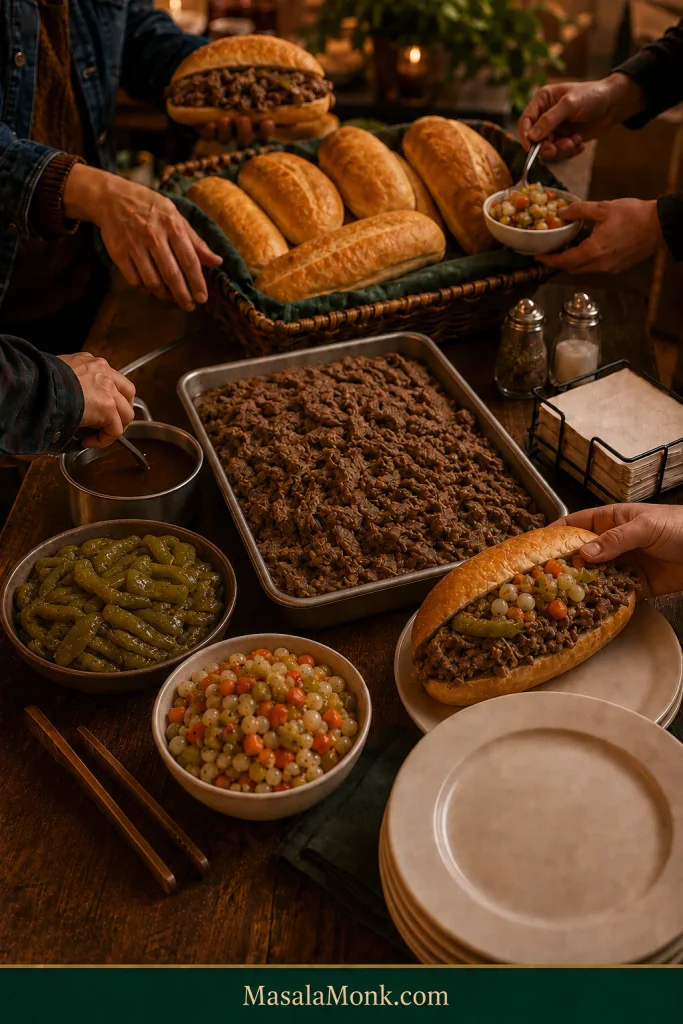
Making Italian Beef for a Crowd
Italian beef is excellent party food because nearly all the fiddly work can happen before anyone arrives. Keep plenty of gravy ready without making the entire shaved roast spend the evening sitting in it.
Build to order: beef and jus can wait hot, but gravy starts changing bread texture immediately.
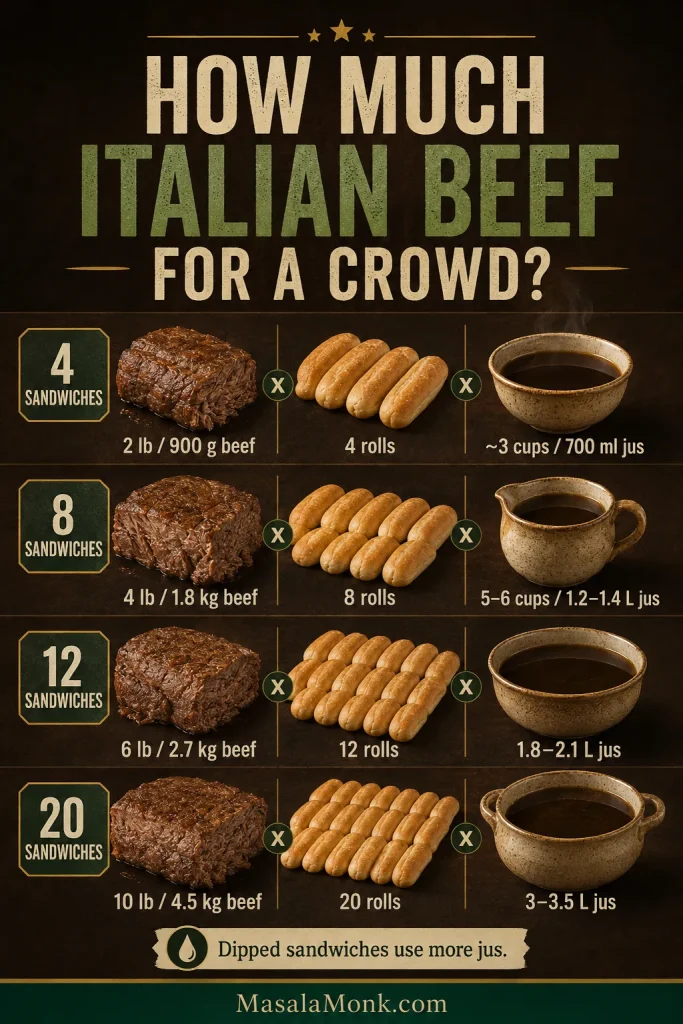
How Much Italian Beef for a Crowd?
For planning, work from the number of sandwiches you expect to serve. One sandwich per guest may be enough as part of a larger buffet. If Italian beef is the main event, extra rolls and beef give you breathing room for bigger appetites.
On a phone? Swipe sideways to see the full table.
Sandwiches
Raw beef
Rolls
Finished jus
Raw peppers
Giardiniera
4
2 lb / 900 g
4
About 3 cups / 700 ml
8 oz / 225 g
2–3 oz / 60–80 g
8
4 lb / 1.8 kg
8
About 5–6 cups / 1.2–1.4 L
1 lb / 450 g
4–6 oz / 120–160 g
12
6 lb / 2.7 kg
12
About 1.8–2.1 L
1½ lb / 675 g
6–8 oz / 180–240 g
20
10 lb / 4.5 kg
20
About 3–3.5 L
2½ lb / 1.1 kg
10–14 oz / 300–400 g
For a crowd, plan extra jus—dipped sandwiches use it fast. Keep unsalted stock nearby for extending the pot.
A mostly fully-dipped crowd will use more jus. Keep extra unsalted or low-sodium stock nearby so the pot can be extended without driving the salt upward.
Cook time does not simply double with the quantity of beef. Two 4-pound roasts do not automatically need twice as long as one 4-pound roast; thickness, spacing and airflow matter far more.
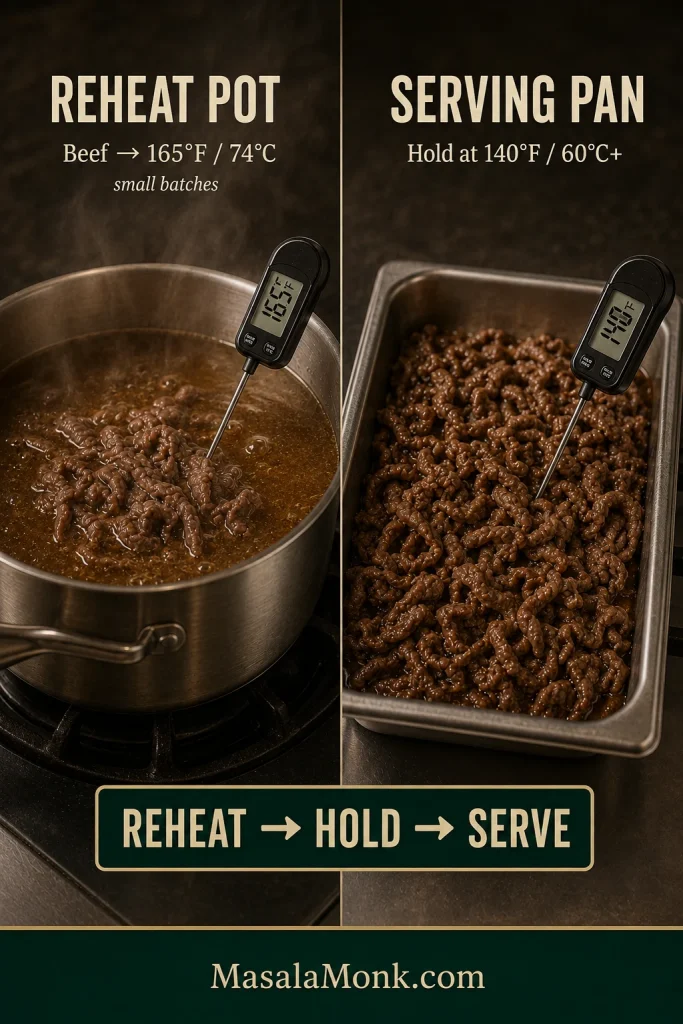
Use a Reheat Pot and a Serving Pan
For longer service, reheat the beef in one pot and hold it in a separate pan.
Reheat pot: keep a working pot of jus around 185–190°F / 85–88°C. Add chilled sliced beef in modest portions and reheat to 165°F / 74°C in the center of a folded mound.
Serving pan: move the reheated beef with enough jus to stay moist into a preheated pan and hold it at 140°F / 60°C or warmer.
Remaining beef: keep it refrigerated until its turn.
Rolls: dry and separate.
Sweet peppers: warm and separate.
Giardiniera: separate so everyone controls their own heat.
Reheat cold beef fully in the jus pot; use the serving pan only to hold already-hot beef.
After a cold batch enters the reheat pot, let the jus recover toward its working temperature before adding more. That keeps service moving without turning all the thin beef into an all-evening simmer.
The person who wants a relatively dry sandwich and the person who wants to baptize theirs in gravy can still eat from the same setup without negotiating.
For a bigger spread, a make-ahead potato salad can be finished before hot service begins, leaving your last-minute attention for the beef and jus.
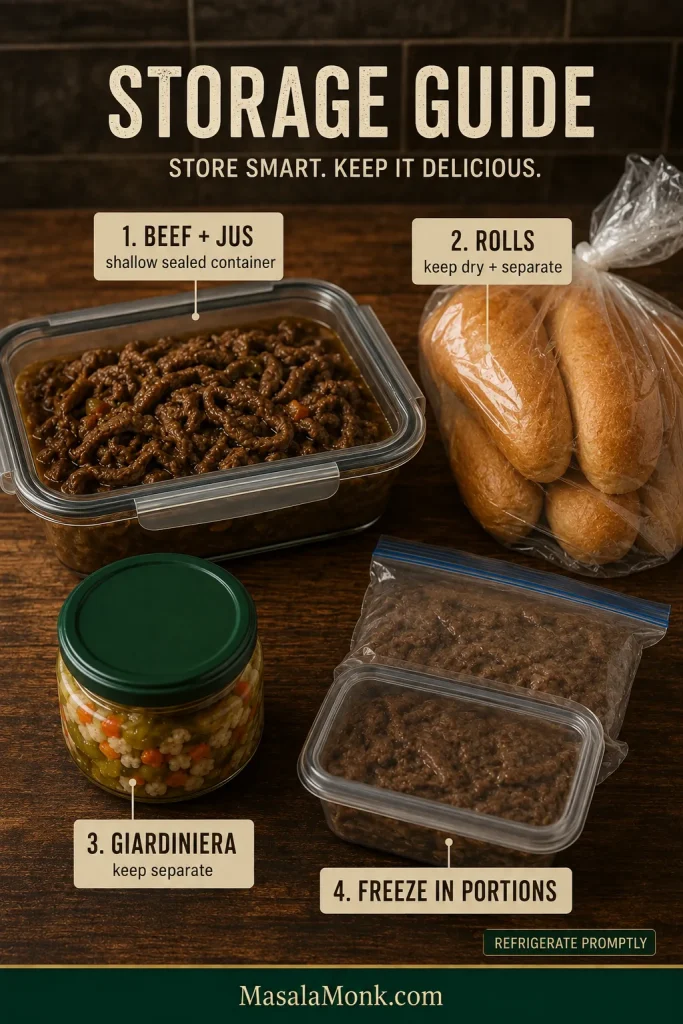
Make Ahead, Store, Freeze and Reheat
Day 1: roast the beef, divide it into manageable pieces if needed, strain the jus and refrigerate both promptly. Day 2: slice the beef, roast or reheat the peppers, finish the jus and warm the meat as needed.
Refrigerator: keep cooked beef and jus covered and refrigerated and use within 3–4 days. Keep the rolls and giardiniera separate.
Freezer: freeze sliced beef with enough jus to protect it from drying, divided into useful portions. For best quality, use frozen cooked beef within about 2–3 months. Freeze the bread separately.
Store in meal-size portions so you can reheat only what you need and leave the rest untouched.
To reheat: bring the jus back to a rolling boil first and make any concentration adjustments. Lower it to the gentler working temperature, then reheat the beef until steaming throughout and 165°F / 74°C.
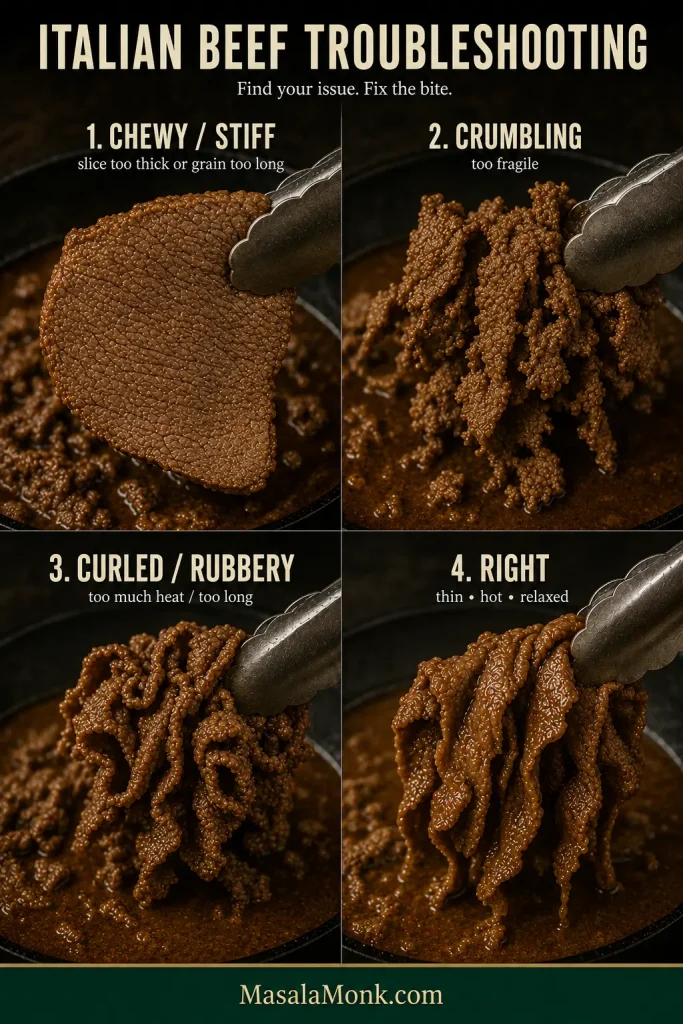
Troubleshooting Chicago Italian Beef
Start with the part that feels wrong: the beef, the jus or the assembled sandwich. Separating those three usually points to the useful fix much faster than throwing more seasoning at everything.
Beef Problems
On a phone? Swipe sideways to see the full table.
Problem
Likely cause
Rescue now
Next time
Thick and chewy
Slices too thick or cut with the grain
Cut large slices into smaller biteable pieces across the grain
Chill harder and slice thinner
Crumbles while slicing
Beef too soft, setting too thin or roast cooked too far
Increase slice thickness slightly
Chill fully and preserve a sliceable roast
Curled or rubbery in jus
Too much heat or too much time after reheating
Lift the beef out as soon as it is hot
Work in smaller portions at gentler heat
Mushy or shredding
Cut or cooking endpoint suited to pulled beef
Serve it as tender pulled Italian-style beef
Use round or sirloin when intact slices are the goal
Watch what happens when the tongs lift the beef. Good Italian beef hangs in relaxed folds; board-stiff slices, crumbling pieces or tight curls tell you where to look before changing the seasoning.
Jus Problems
On a phone? Swipe sideways to see the full table.
Problem
Likely cause
Rescue now
Next time
Weak or watery
Too much finished liquid or mild stock
Reduce the jus without the beef
Judge by finished volume and the bread test
Too salty
High-sodium stock or too much reduction
Dilute gradually with unsalted stock or water
Start low-sodium and season at the end
Too greasy
More rendered fat than the liquid needs
Skim the surface
Chill overnight and lift away hardened excess
Not enough for dipping
Wide pan or aggressive evaporation
Extend with unsalted or low-sodium stock
Watch pan width and target finished volume
Fix one variable at a time: reduce weak jus, dilute salty jus, skim grease, or extend a short pot.
If the Beef and Jus Both Taste Right
Bread and gravy: a roll that disintegrates needs a tighter crumb or shorter dip. A sandwich that still feels dry needs more jus traveling with the beef or spooned inside. When the bread is simply wetter than you enjoy, move one step down the gravy scale next time.
Toppings: excessive chile heat calls for less giardiniera or a milder jar. A sharp black-pepper bite points back to the jus, which can be diluted now and seasoned more gently next time. Crunchy sweet peppers simply need more cooking.
It still tastes like ordinary roast beef: look first at slice thickness, jus strength and how much gravy actually reaches the bread. Those three changes will move the sandwich further than another handful of dried herbs.
The deeper goal is integration: the beef should stop feeling like a separate layer sitting on bread. When slice, jus and crumb begin working together, the whole bite tastes seasoned rather than assembled.
When the Sandwich Is Right
You notice it before the second bite. The beef no longer looks like neat carved roast; it has relaxed into loose folds. The roll is darker where the gravy reached it but still intact in your hands. Sweet peppers disappear into some bites, while giardiniera catches you in others with enough crunch and heat to keep all that beef and soaked bread lively.
Once those pieces are working, the final few seconds are personal. Keep it fairly dry. Spoon on more gravy. Give it the one-second dip. Or lower the entire sandwich into the jus and accept that dinner now requires two hands and a serious stack of napkins.
At this point, stop adjusting and eat. A dipped Chicago Italian beef sandwich has a short sweet spot when the bread is thoroughly juicy but still strong enough to stay in your hands.
If you make it, tell us which beef cut you used, whether you sliced by hand or with a machine, and where you landed on the gravy scale—dry, wet, easy-dipped or fully dipped. Those details can help the next cook decide where to start.
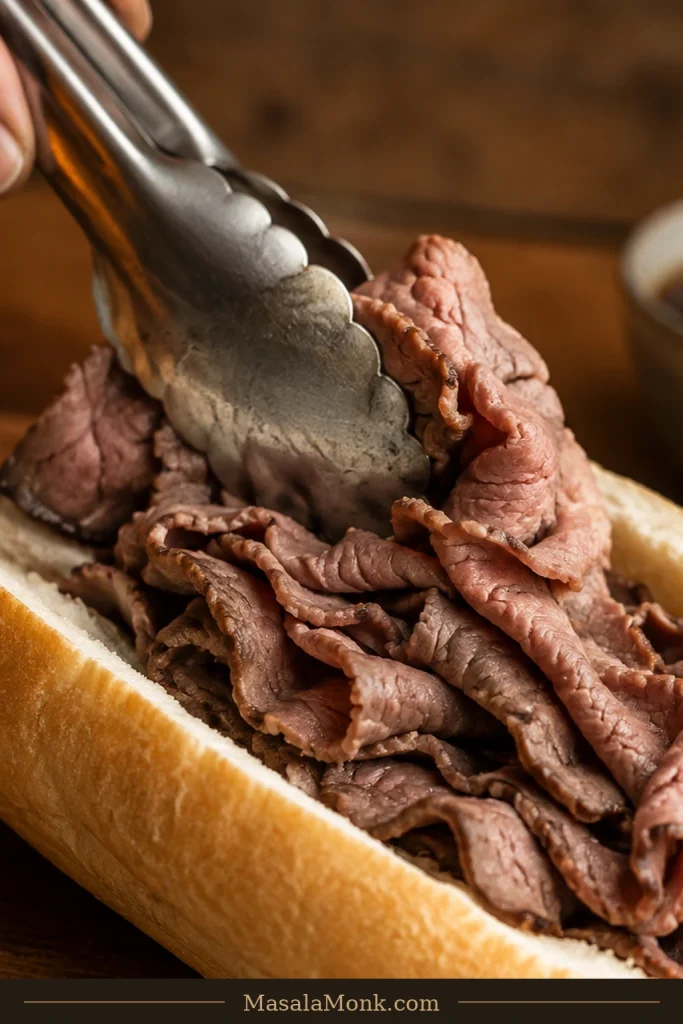
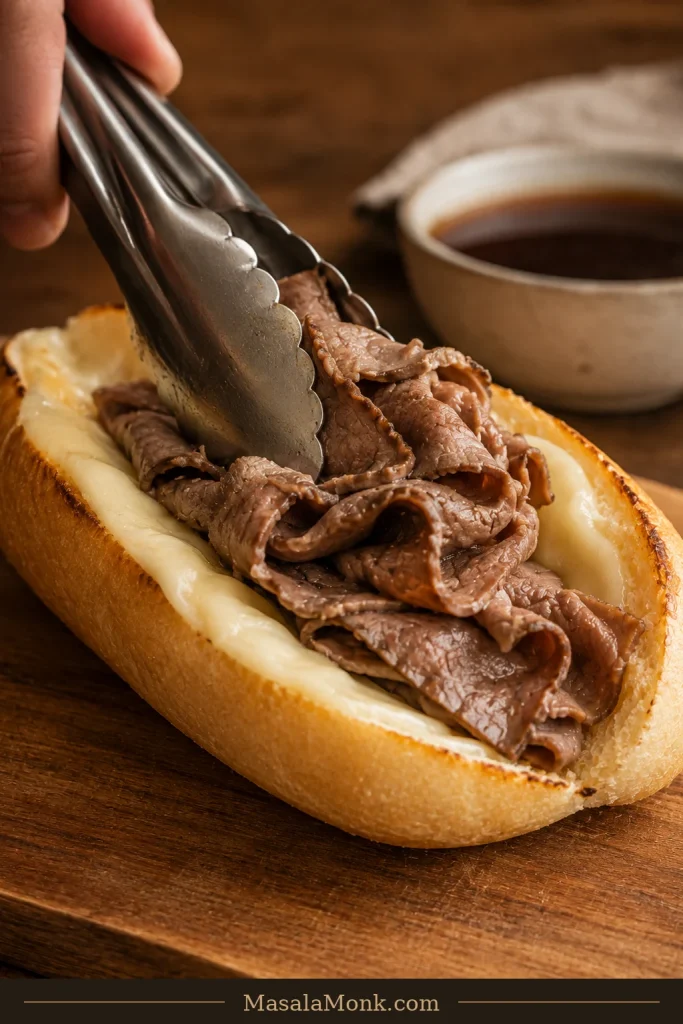
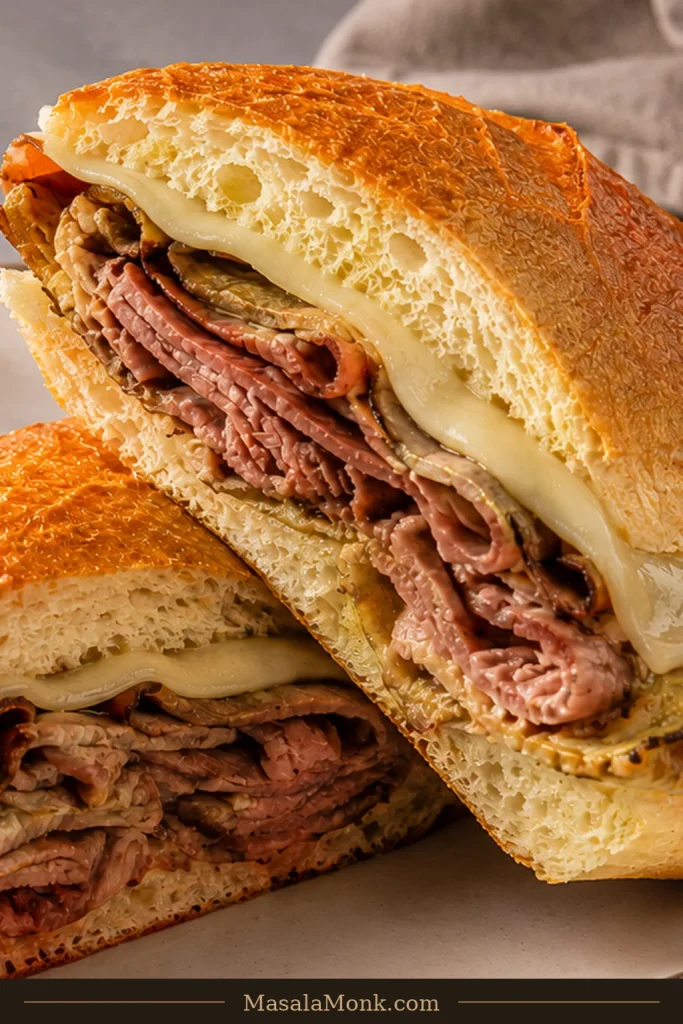
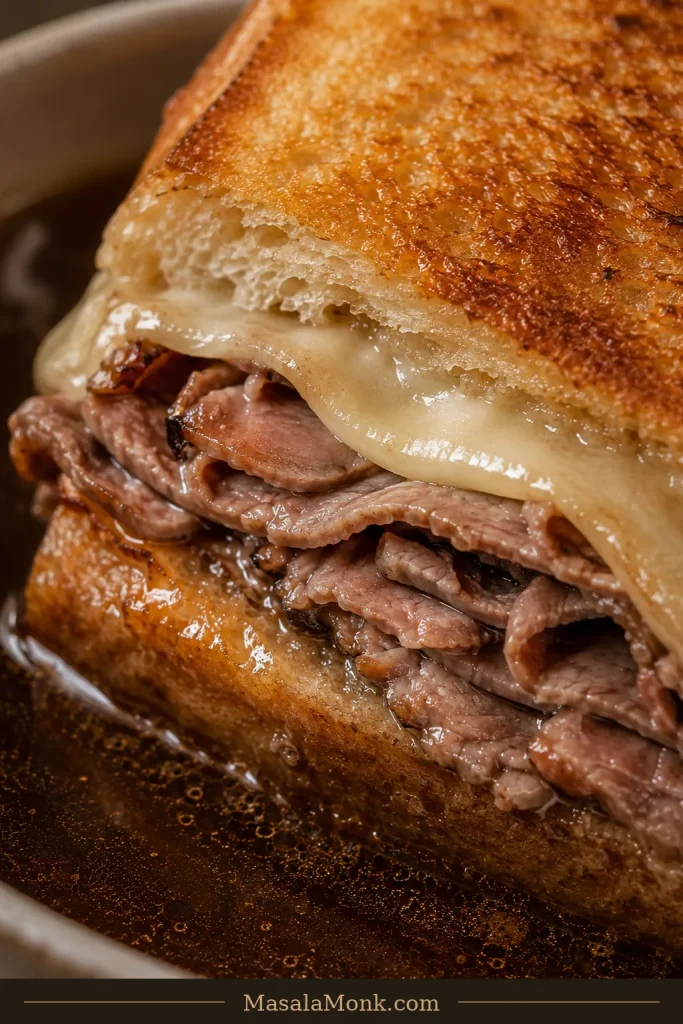
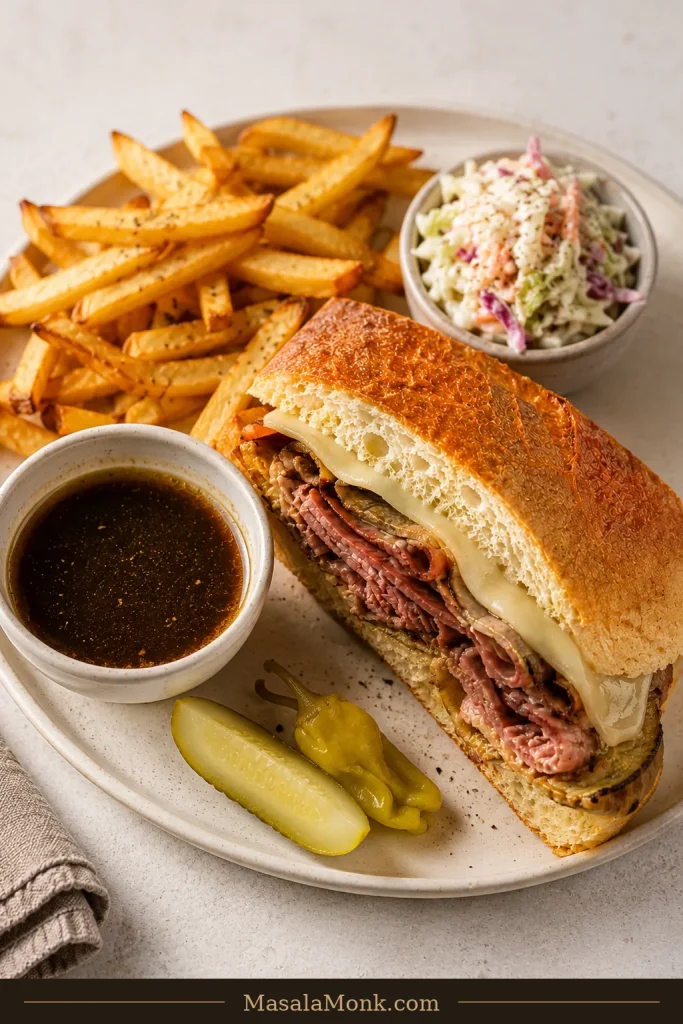
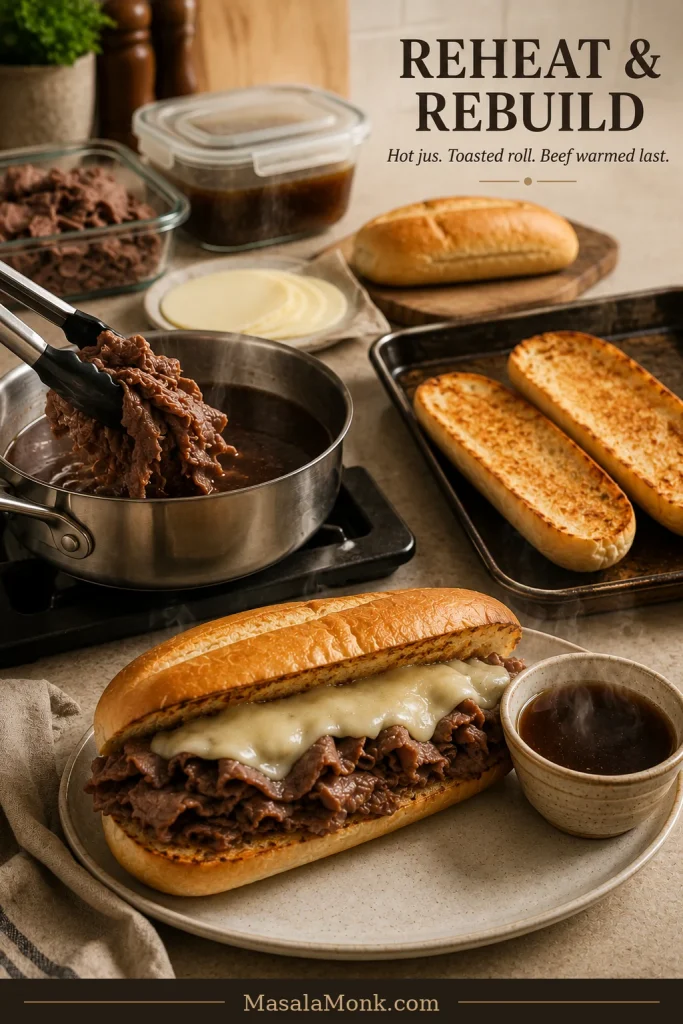
The first bite of a good French dip gives you several things at once: bread with a little chew, folds of hot roast beef, melted provolone and warm, oniony jus soaking into the cut edge.
The disappointing version loses that balance fast. Thin roast beef tightens from too much heat, the jus tastes saltier than savory, or the bread softens long before you wanted it to.
A French dip is one of the few sandwiches you keep finishing as you eat it. How much jus reaches the bread—and when—changes the whole experience. Keep some chew and dunk each bite as you go, or deliberately soften the roll for a wetter, old-school version. Both can be excellent. The important part is that you control the soak.
This easy version starts with sliced cooked roast beef, builds a quick jus while the rolls toast, and puts four substantial sandwiches on the table in about 30 minutes. No whole roast or long braise—just hot beef, good bread, melted cheese and a bowl of jus that changes the sandwich bite by bite.
Use thinly sliced cooked roast beef, a 6-inch / 15-cm roll that can absorb jus without falling apart, and mild provolone. Plan on 4–6 oz (115–170 g) beef per person; 5 oz / 140 g makes a generous sandwich. For four sandwiches, make about 2½ cups / 600 ml jus—enough for individual dipping bowls plus some for warming the beef.
Make It Now: Easy French Dip Sandwiches With Au Jus
Recipe at a Glance
Yield: 4 substantial sandwiches
Prep time: 10 minutes
Cook time: about 20 minutes
Total time: about 30 minutes
Equipment
Medium saucepan
Rimmed baking sheet
Tongs
Sharp knife, if slicing leftover roast beef
4 small bowls or ramekins for the jus
Fine-mesh strainer, optional
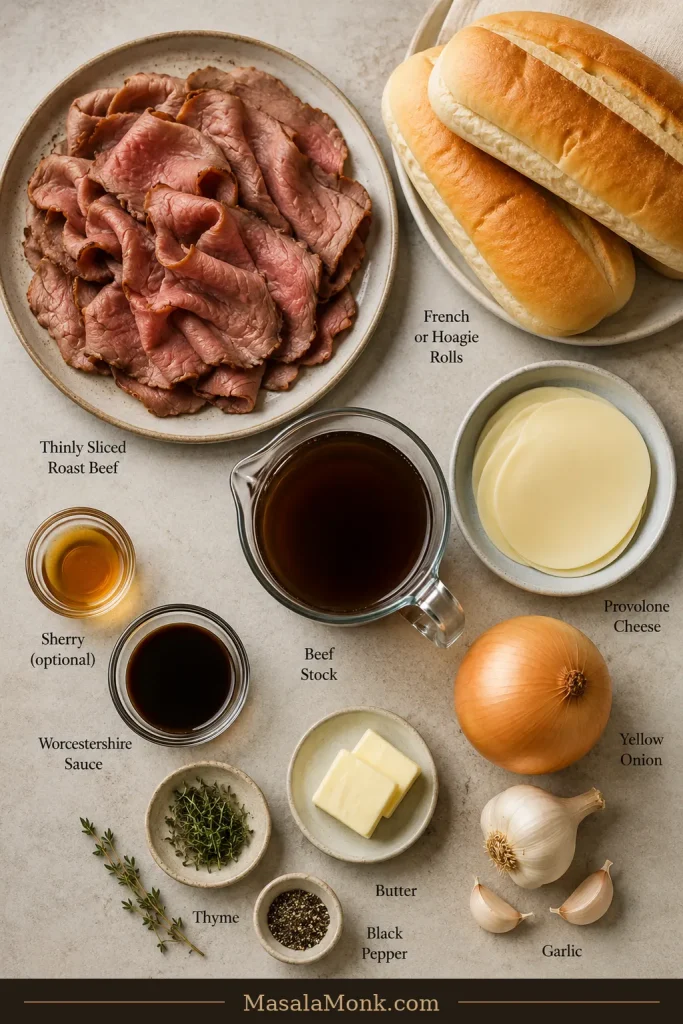
Ingredients
For the Au Jus
1 tablespoon (14 g) unsalted butter
1 large yellow onion, about 7 oz (200 g), halved and thinly sliced
2 garlic cloves, about 6 g, finely chopped
3 cups (710 ml) low-sodium beef stock
2 teaspoons (10 ml) Worcestershire sauce
½ teaspoon dried thyme, or 1 teaspoon fresh thyme leaves
½ teaspoon freshly ground black pepper
1 tablespoon (15 ml) dry sherry, optional
Kosher salt, only if needed after tasting
For the Sandwiches
1¼ lb (567 g) thinly sliced cooked roast beef
4 French, hoagie or Italian-style rolls, about 6 inches / 15 cm each
2 tablespoons (28 g) softened unsalted butter
8 thin slices mild provolone, about 4–6 oz / 115–170 g total depending on thickness
Low-sodium stock gives the jus room to reduce without turning salty; Worcestershire, roast beef and cheese bring additional seasoning once the sandwich comes together.
Instructions
1. Start the Au Jus
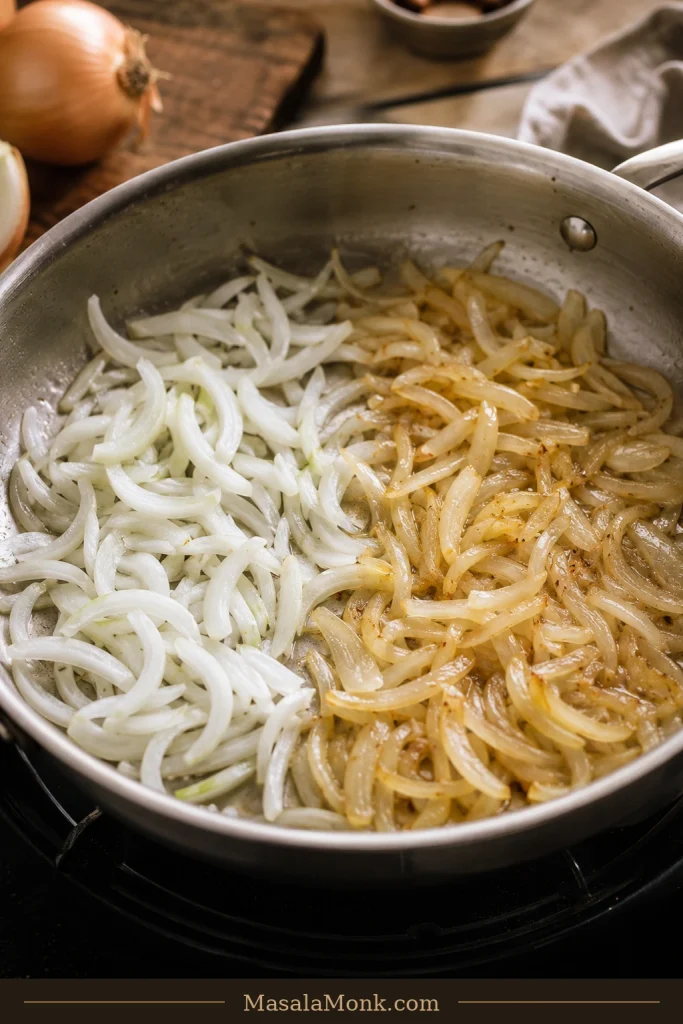
Melt 1 tablespoon butter in a medium saucepan over medium heat. Add the onion and cook for 8–12 minutes, stirring occasionally, until soft and lightly golden around some of the edges.
For this quick jus, lightly golden edges are enough. Once the onions bend easily and smell sweet, deeper caramelization adds more time than the sandwich needs.
Add the garlic and cook for 30 seconds. If using sherry, pour it in and let it bubble briefly while you scrape up the browned bits from the bottom of the pan.
Add the beef stock, Worcestershire sauce, thyme and black pepper. Bring to a gentle boil, lower the heat and simmer uncovered for 8–10 minutes, until the broth tastes fuller and more concentrated.
Quiet bubbling gives you more control. A hard boil reduces the jus faster, so salt and other concentrated flavors can overshoot before you notice.
While the jus simmers, toast the rolls in Step 2. Working on both at once keeps the meal comfortably around the 30-minute mark.
2. Toast the Rolls and Melt the Cheese
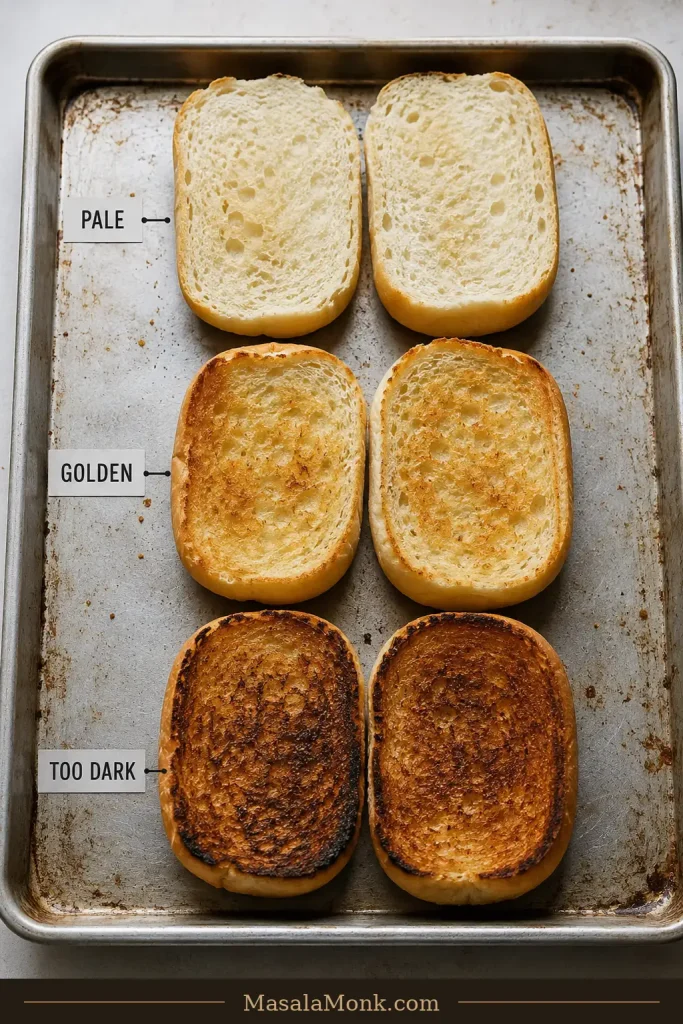
Heat the broiler (high, if adjustable) and position an oven rack about 5–7 inches / 13–18 cm from the element, if your oven allows. Split the rolls and butter the cut surfaces.
Arrange them cut-side up on a rimmed baking sheet and broil for 1–3 minutes, until golden and lightly crisp while the centers still give when pressed.
Aim for a golden cut face: enough toast to resist the first dip, but not so much that the roll becomes hard to bite.
Place 1 slice provolone on each cut half and return the rolls to the broiler for 30–60 seconds, just until the cheese turns glossy and melts against the bread. Stay close; a broiler can go from pale to scorched while you’re reaching for the tongs.
Melt the provolone before adding the beef so the delicate slices never need a second trip under the broiler.
No broiler? Toast the rolls in a preheated 425°F / 220°C oven for 5–7 minutes, adding the cheese for the final 1–2 minutes.
3. Finish the Jus and Warm the Beef
Return to the saucepan. You will usually have around 2½ cups / 600 ml jus, though pan width and simmer strength will affect the exact yield. Taste before adding salt.
Strain out the onions for a clearer dipping bowl and save them for the sandwiches. Leave them in and the jus becomes more rustic and onion-forward.
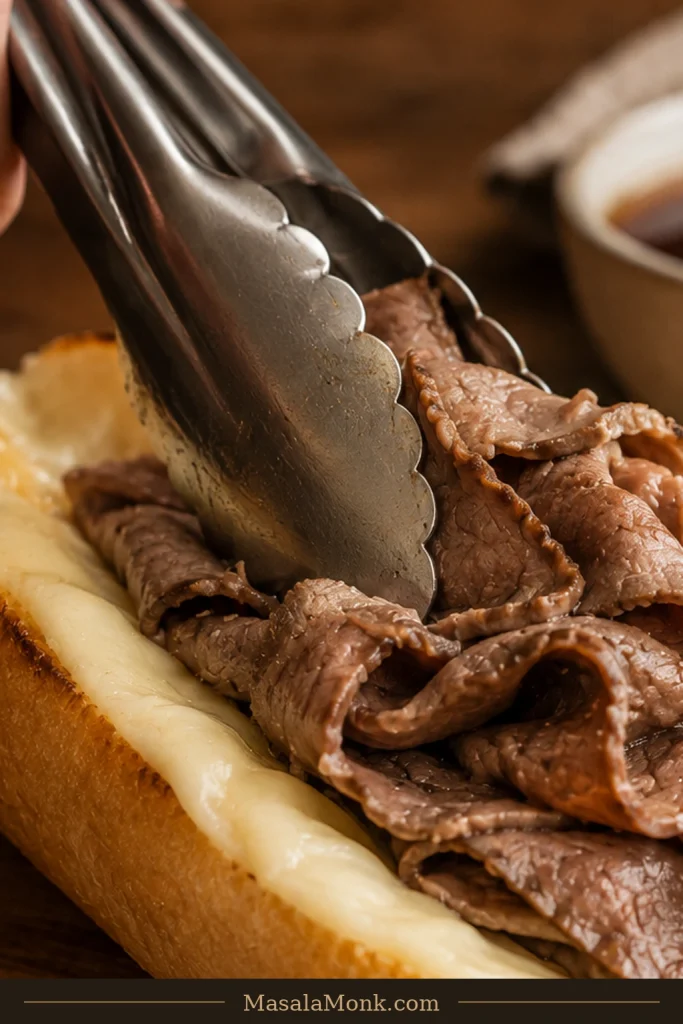
Turn the heat to low. Add the ready-to-eat deli roast beef in manageable batches and separate the slices gently with tongs. Warm until the meat loses its refrigerator chill and relaxes into soft folds, usually 1–2 minutes. Avoid a hard boil.
Lift the beef out and let excess jus drip back into the saucepan. For higher-risk diners, heat deli meat to 165°F / 74°C or steaming hot; see the food-safety note below.
Look for relaxed, glossy folds rather than curled edges. Once the beef is hot and supple, get it out of the jus.
4. Build the Sandwiches
Divide the beef among the four rolls, using about 5 oz / 140 g per sandwich. Pile the slices in loose folds. The layers stay tender and catch pockets of jus between them.
Stagger the slices instead of stacking them flat. The beef spreads from end to end, and fewer long slices pull out with the first bite.
Add some of the reserved onions if using, close the rolls and serve while everything is still warm.
Keeping the jus beside the sandwich preserves the bread’s starting texture until you decide how wet each bite should be.
5. Serve With Hot Jus
Divide the remaining hot jus among four small bowls, aiming for about ½ cup / 120 ml per person. Serve immediately and dip each bite as deeply as you like—the first one is especially good while the bread still has some toast left in it.
The exposed crumb softens first because the crust absorbs more slowly. A shallow dunk adds tenderness without sacrificing the roll’s structure.
Standing at the deli counter? Ask for roast beef sliced thinly, but not shaved into wispy pieces. Thick slices eat more like little steaks; meat shaved too finely can break apart as it warms.
Thin, intact slices give the jus plenty of surface area while still behaving like slices when warmed, folded and bitten.
A good slice should fold without immediately tearing. It should droop over your fingers rather than stand stiff. Those flexible folds stay tender and hold jus between the layers when you bite.
The fold test predicts warming too: flexible slices separate easily in hot jus, while stiff pieces stay slab-like.
Plain or lightly seasoned roast beef gives the oniony jus and cheese room to show up. Heavy smoke and thick pepper crusts can take over quickly.
How Much Roast Beef per Sandwich?
Plan on 4–6 oz (115–170 g) cooked beef per person. Four ounces gives you more bread and jus in each bite. Five ounces is a generous everyday portion. At six ounces, the beef becomes unmistakably the main event.
For four people, buy 1–1½ lb / 454–680 g. The 1¼ lb / 567 g in the recipe lands neatly in the middle.
About 5 oz / 140 g fills a 6-inch roll generously without forcing it open; go lighter or heavier depending on whether bread or beef should lead.
Leftover roast beef works beautifully. Chill it before slicing if necessary; cold meat firms up and is easier to cut thinly across the grain.
Prime rib makes a richer sandwich, especially with some of its defatted drippings in the jus. Horseradish or spicy mustard keeps those richer bites lively.
Starting With Raw Beef?
Match the cut to the cooking method. Top round or rump suits a sliced-roast approach. Chuck and shoulder need a longer, moist cook. Ribeye gives you a tender steak-style French dip at a much higher price.
Got a shoulder roast instead? Our beef shoulder roast Crock Pot guide covers the slower route for chuck shoulder, arm roast and shoulder clod.
Best Bread and Rolls for French Dip
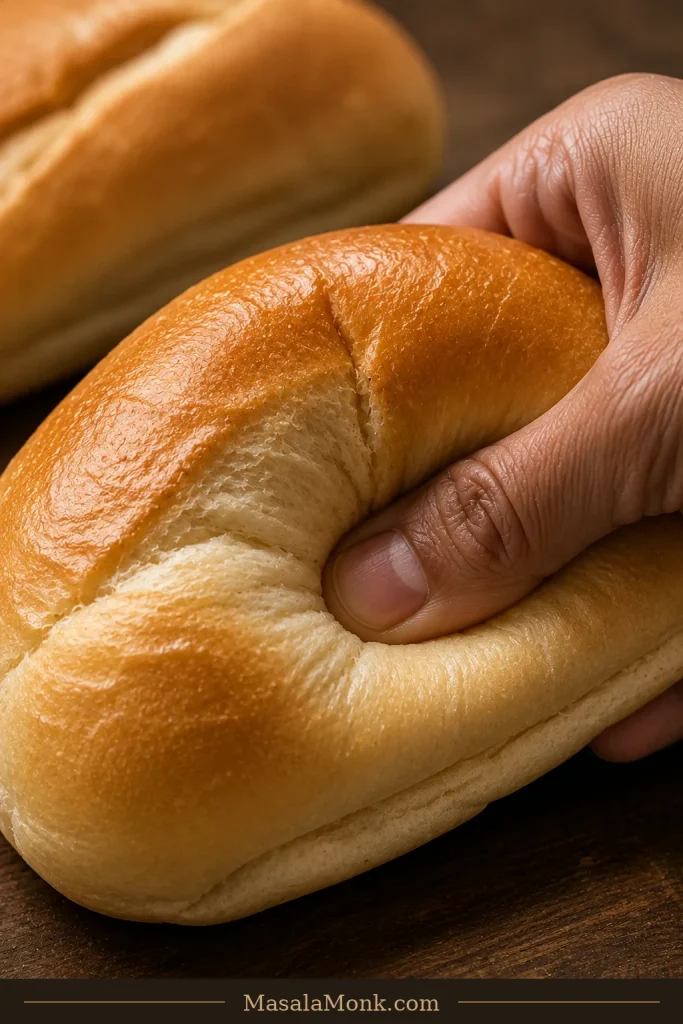
Once the beef is tender and thin, the roll decides what the jus feels like. It needs to absorb plenty without becoming unpleasant to hold or bite. At the store, give it a gentle squeeze. The crumb should spring back and the crust should yield easily when you bite through it.
Deeply dented rolls may soften too fast; barely yielding rolls can stay tough. The sweet spot is soft, springy and still structured.
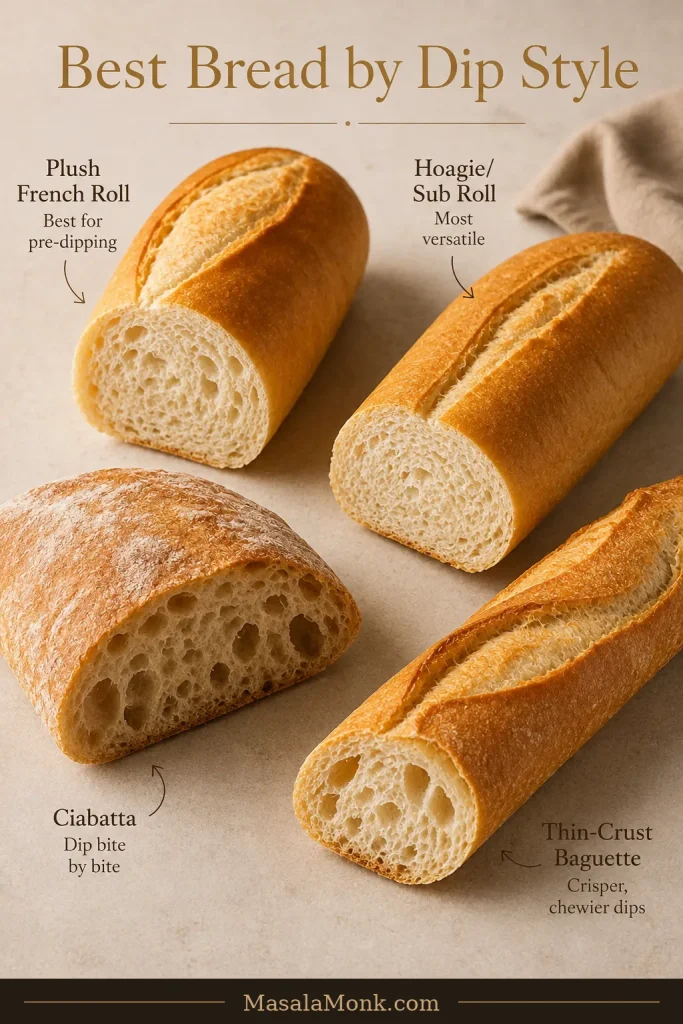
Plush French roll: soaks up plenty of jus and stays tender; ideal for a softer or pre-dipped sandwich.
Hoagie or sub roll: soft enough to soak, sturdy enough to hold together; a good middle ground between softness and structure.
Ciabatta: airier inside with more crust and chew; good for dipping bite by bite.
Thin-crusted baguette: crisp and slightly chewier, with more resistance at the bite.
The strongest roll is not automatically the best. Choose first for absorbency, then for how much crust and chew you want after dipping.
Very hard artisan baguettes are a different matter. They may survive the jus beautifully while making the sandwich far more work than your jaw would like.
Aim for rolls around 6 inches / 15 cm long. If you want to make the bread too, these sourdough hoagie and sub rolls have the chew and structure for a generously filled sandwich.
Provolone, Swiss or Gruyère?
I would reach for provolone first: mild, smooth and easy to melt. Swiss tastes nuttier, while Gruyère brings more richness and is especially good with prime rib. Two thin slices per sandwich are plenty. Skipping cheese entirely lets the roast beef and jus stand on their own.
How to Make Better Au Jus for French Dip
The roll controls how quickly the jus gets in. The jus decides whether that soak is worth chasing.
Deli roast beef does not give you a roasting pan full of fresh meat juices, so this quick version starts with beef stock, onion, garlic, Worcestershire and herbs.
Lightly golden onions provide enough sweetness for a 30-minute sandwich. Cook them until soft and fragrant, add the stock, then simmer until the separate ingredients begin tasting like one savory broth. For fully caramelized onions, our French onion soup recipe takes the slower route.
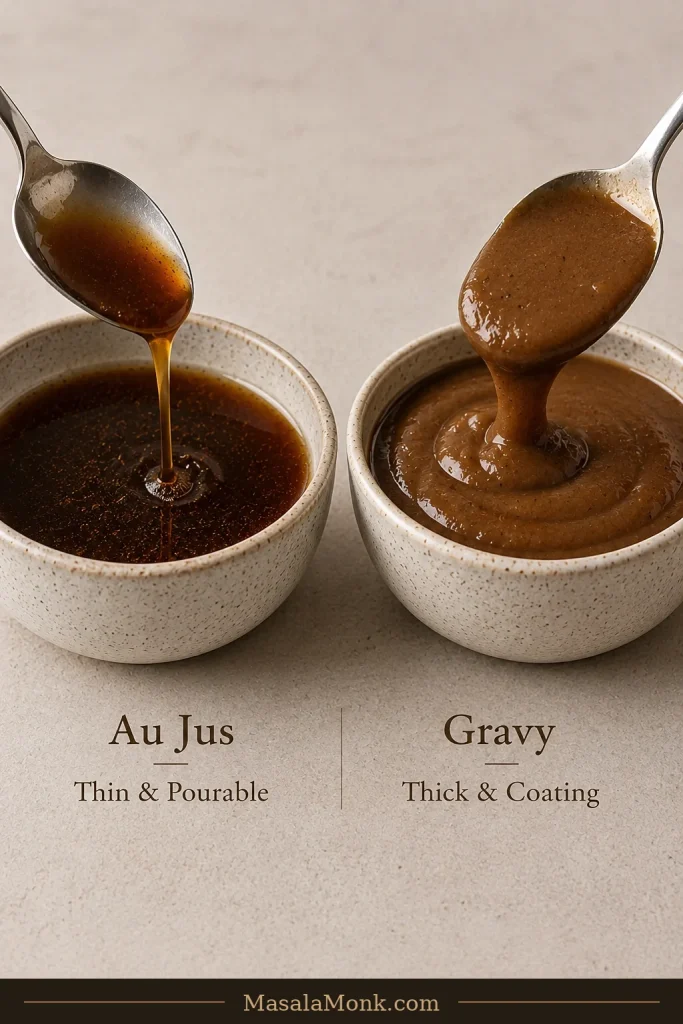
Keep the jus thin enough to soak into the bread. Flour, cornstarch and gravy mix produce a heavier coating. Low-sodium beef stock gives you the most control; broth works too. Consommé starts more concentrated, so taste before adding more salt.
Au jus should move into the bread; gravy tends to remain on it. That difference in flow is why thickening the dipping sauce changes more than its appearance—it changes how the sandwich eats.
Taste a spoonful. If you would happily take another sip, the jus is probably ready for the sandwich. If all you notice is salt, it still needs balancing.
Using Roast Beef or Prime Rib Drippings
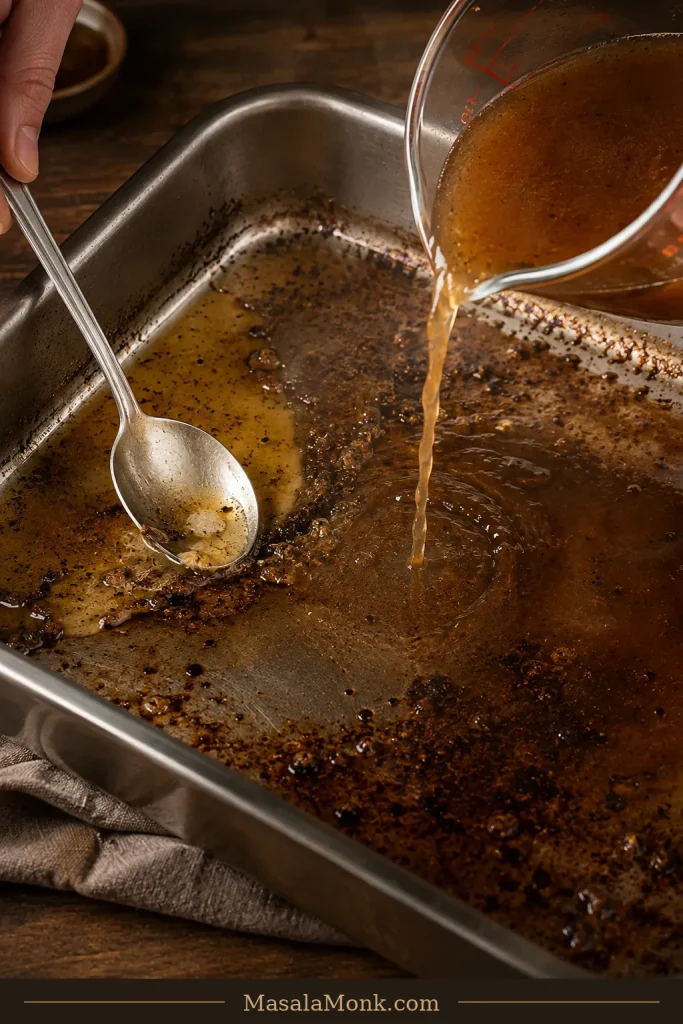
Have roast or prime-rib drippings? Separate excess rendered fat but keep the meat juices and browned bits. Add a splash of beef stock to the hot roasting pan, scrape up the fond, pour that liquid into a saucepan and add stock until you have the quantity of jus you need.
Fond and fat are not the same thing. Keep the browned bits in the pan, remove excess rendered fat, then deglaze so the jus tastes beefy rather than greasy.
Strain it for a clear bowl, or keep the softened aromatics for a more rustic dip.
How Wet Should a French Dip Be?
Once the jus tastes right, the last decision is how much of it should reach the bread.
A French dip is supposed to get wet. The real question is how wet, and when.
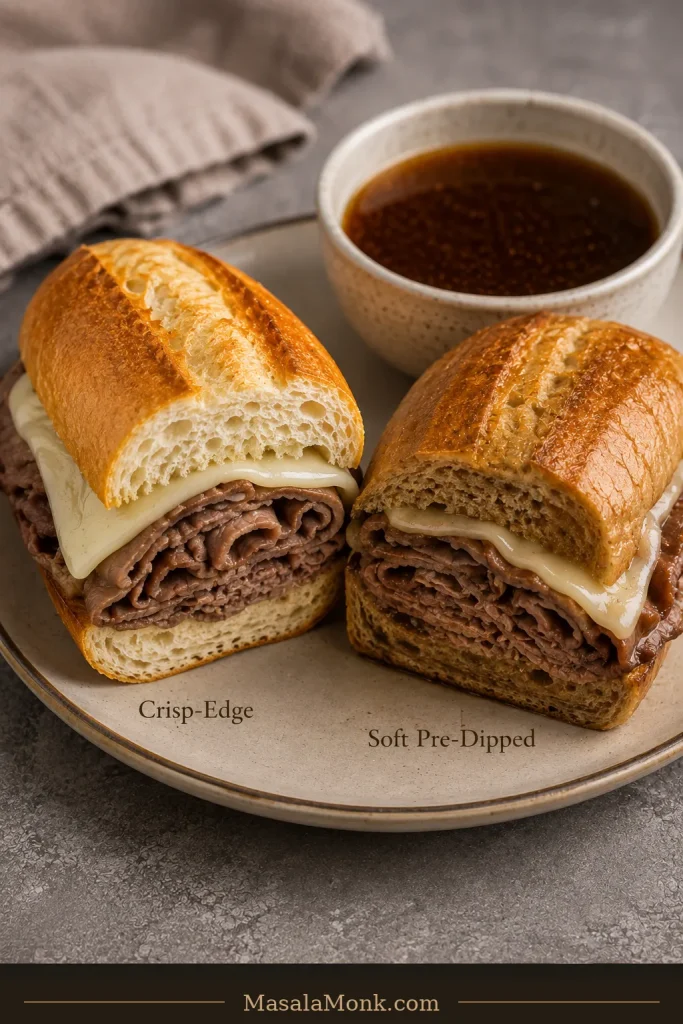
Crisp-Edge, Dip-at-the-Table Style
This is the default method in the recipe above. Toast the cut surfaces, melt the cheese against the bread, fill the roll with hot beef and bring the jus to the table. The first dunk softens the cut edge while the rest of the roll still has some chew.
For a first French dip, I would start here. Everyone gets to decide how far to take it.
Soft, Pre-Dipped Style
Soft is its own style of French dip. Historic Los Angeles versions deliberately moisten the bread before serving, from a light dip to sandwiches that are thoroughly wet.
For this version, change the assembly slightly: do not melt the cheese onto the bread before dipping. Lightly toast the plain buttered roll—or leave a plush roll untoasted if it already has enough structure—then briefly dip one cut half in hot jus for a lighter sandwich or both halves for a softer one.
Add the hot beef and provolone immediately. Thin cheese will soften against the warm meat; for a fully melted finish, place the cheese over the beef and put the open sandwich under a hot broiler for 30–60 seconds before closing it.
A pre-dipped sandwich keeps absorbing jus while it waits, whereas a crisp-edge version is more forgiving if dinner is delayed. Match the dipping style to when you can actually serve it.
The dipped crumb becomes tender and deeply savory, almost custardy where the jus has soaked all the way through.
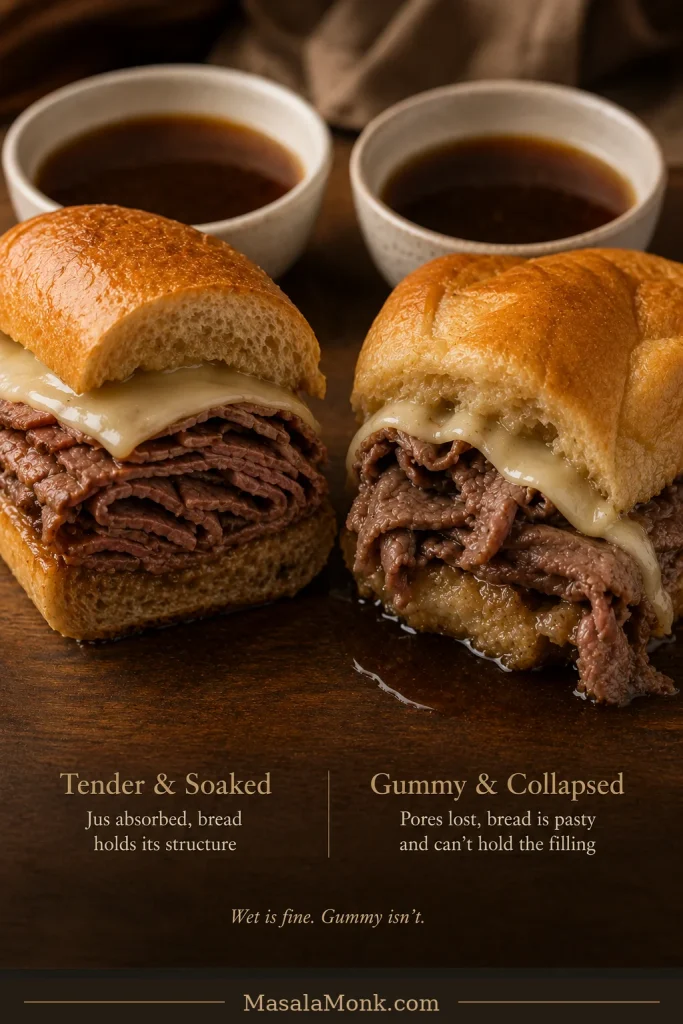
When Is a Pre-Dipped French Dip Too Soggy?
The bread has gone too far when it turns gummy, falls apart too early, or can no longer hold the filling. Let excess liquid drain from the beef, assemble close to serving, and adjust the dip to the roll in your hand.
If a pre-dipped roll sags before filling, shorten the dip or drain the beef more thoroughly. Once the crumb turns compressed and pasty, extra toasting will not restore it.
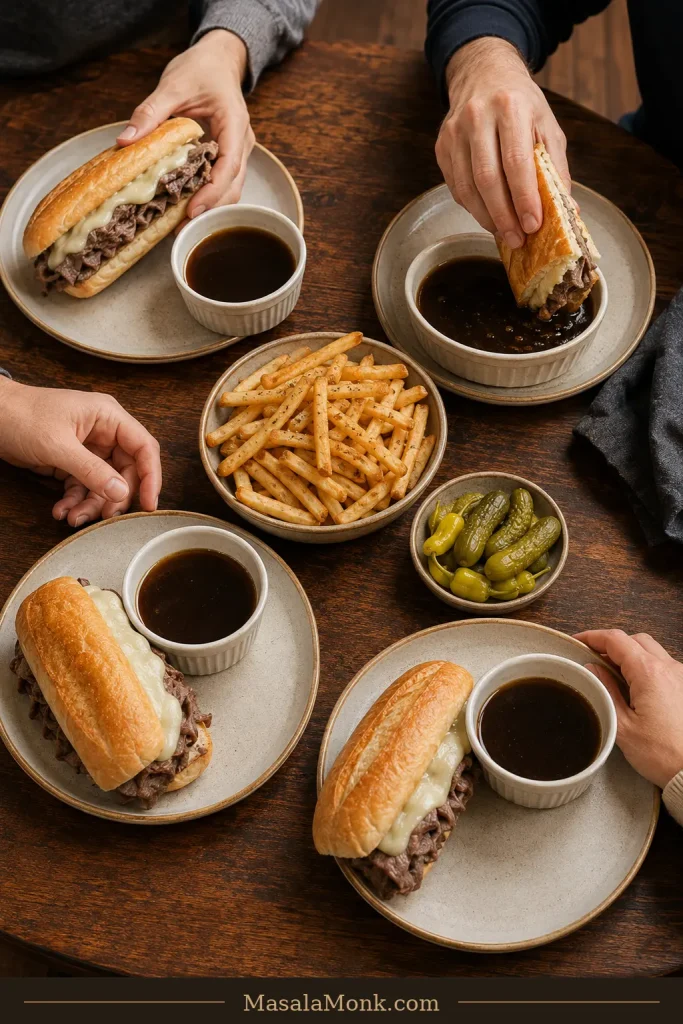
This is a good sandwich to finish at the table. Bring over the hot sandwiches and individual bowls of jus, then let everyone choose: careful edge dips, half the sandwich submerged, or progressively wetter bites as dinner goes on.
Dipping depth changes more than wetness. As the jus travels farther through the crumb, you steadily trade toasted resistance for tenderness, until bread and beef begin to feel almost like one continuous bite.
French Dip Troubleshooting
Salty jus, tight beef and failing bread account for most French dip trouble.
Problem
What Happened
Fix
Au jus tastes too salty
The stock and other salty ingredients became too concentrated
Dilute gradually with unsalted or very low-sodium stock; use small additions of water if needed. For the balance cues, return to the au jus guide.
Au jus tastes weak or flat
The stock is mild or has not concentrated enough
Simmer a little longer; if it is still flat, add a small splash of Worcestershire or some defatted roast drippings rather than simply adding salt.
Deli roast beef turned tight
It spent too long at a hard boil
Lower the heat and stop once the slices are hot and supple; revisit the gentle warming step.
Bread falls apart immediately
The roll is too fragile or took on more liquid than it could handle
Choose a more tender French or hoagie-style roll next time.
Easy French Dip Variations and Shortcuts
Leftover brisket: Sliceable brisket can stand in for roast beef if it still holds together rather than collapsing into shreds. Starting from raw? See our slow cooker brisket recipe.
Creamy horseradish: Stir 2 tablespoons mayonnaise with 1–2 teaspoons prepared horseradish, a squeeze of lemon and black pepper. Spread it thinly; the cool horseradish bite is especially good with richer beef.
Shortcut jus: Prepared au-jus mix works when dinner needs to move even faster. Dilute it according to the package directions and taste before adding anything else salty.
What to Serve With French Dip Sandwiches
Crispy homemade French fries with dill pickles or pepperoncini are the obvious classic. A few fries will probably find their way into the jus too, and there are worse things that can happen to a potato.
After several rich, dipped bites, cold creamy coleslaw or a sharp green salad tastes especially good. Roasted green beans or broccoli keep the plate lighter, while potato salad works well when you need a side that can be finished before the sandwiches.
Think in contrasts: pickles and pepperoncini add acidity, cold slaw refreshes, and crisp fries bring crunch back after a softer jus-soaked bite.
French Dip for a Crowd
For every four people, plan on 1–1½ lb / 454–680 g cooked roast beef, 4 rolls and about 2½ cups / 600 ml prepared jus. Keep the components separate and build the sandwiches in batches so the bread stays ready for the jus at the table.
Put the hot jus into individual bowls. It turns serving into part of the meal and saves you from guessing whether everyone wants a cautious dip or a sandwich approaching full submersion.
Set out the jus only when the sandwiches are ready; keeping it hot until the last moment gives every diner a better first dip.
Make Ahead, Store and Reheat French Dip
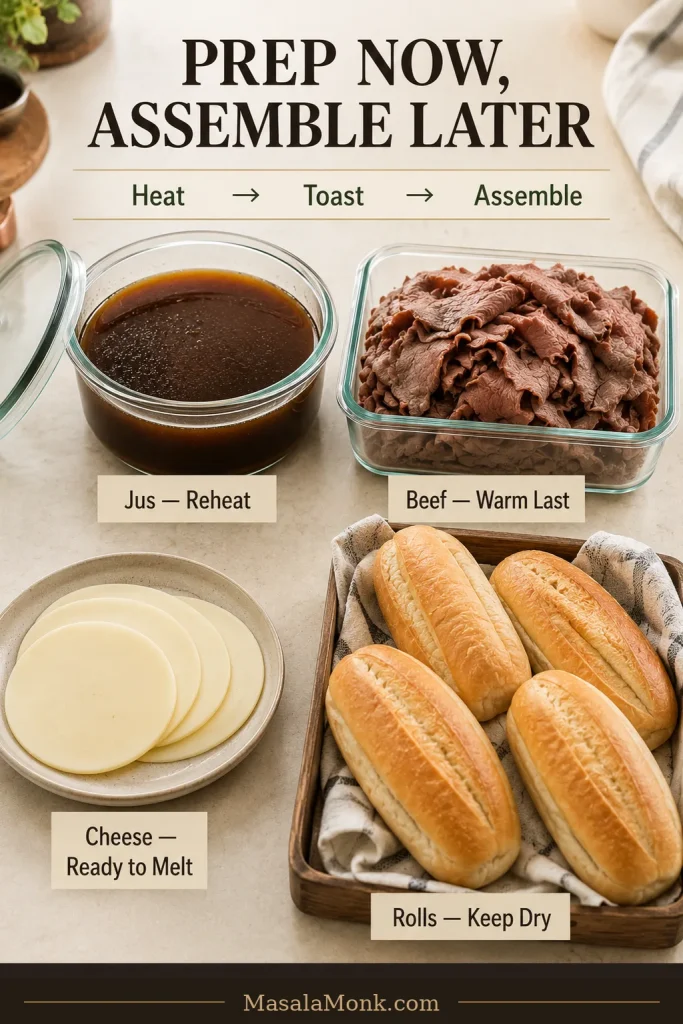
French dip is easy to prep ahead as long as you stop before assembly. Make the jus, portion or slice the beef, and have the cheese ready in the refrigerator. Leave the rolls whole and dry. At serving time, reheat the jus, toast the bread, melt the cheese and warm the meat last.
For the fastest finish, portion the beef and cheese before chilling so serving-time work is limited to reheating, toasting and assembly.
For leftovers, keep the beef, jus and cheese refrigerated separately and store the bread away from moisture. Cool the jus promptly in a covered container; if chilled roast drippings leave a firm cap of fat on top, remove the excess before reheating.
Refrigerate perishable food within 2 hours of serving—or within 1 hour when the surrounding temperature is above 90°F / 32°C. Most cooked leftovers should be used within 3–4 days. See the current USDA leftovers and food-safety guidance for the full recommendations.
Serving someone at higher risk from Listeria? People who are pregnant, aged 65 or older, or have weakened immune systems have a higher risk of serious illness. Current USDA guidance recommends heating deli meat to 165°F / 74°C or until steaming hot.
How to Reheat French Dip
Reheat the jus first. Previously cooked refrigerated beef should reach 165°F / 74°C; once safely hot, thin slices do not need to linger over high heat.
Toast the roll separately, melt the cheese, then rebuild the sandwich. Done in that order, yesterday’s French dip feels like a sandwich again instead of a container of reheated leftovers.
Bread and beef need different kinds of heat. Dry heat restores the roll’s toast, while brief moist heat is gentler on thin roast beef. That is why rebuilding works better than reheating the assembled sandwich.
French Dip Sandwich FAQs
What is a French dip sandwich?
A French dip is a hot sliced-meat sandwich—most commonly roast beef—served with savory meat juices or jus for dipping. Depending on the style, the bread may be dipped before serving, dunked bite by bite at the table, or both.
Is a French dip sandwich actually French?
No. Despite the name, French dip is an American sandwich strongly associated with Los Angeles. Its exact origin is disputed, with more than one historic Los Angeles restaurant connected to the story.
What does “au jus” mean?
“Au jus” means “with juice” and refers to serving meat with its juices. When a French dip starts with a freshly cooked roast, those juices and pan drippings can form the heart of the dip. With deli roast beef, a seasoned beef-stock dipping liquid fills the same practical role.
The moment to aim for is that first dunk: the bread darkens where it touches the jus, then gives way into hot beef and melted cheese. Maybe the rest of the roll still has some chew; maybe the next bite deserves a longer soak. That is part of what makes French dip so satisfying—the bowl beside it lets you keep changing the sandwich until you find exactly the version you like.
If you make it, tell us where you landed: deli roast beef or leftovers, provolone or Swiss, clear jus or onions left in—and whether you stayed with careful edge dips or eventually sent half the sandwich straight into the bowl.
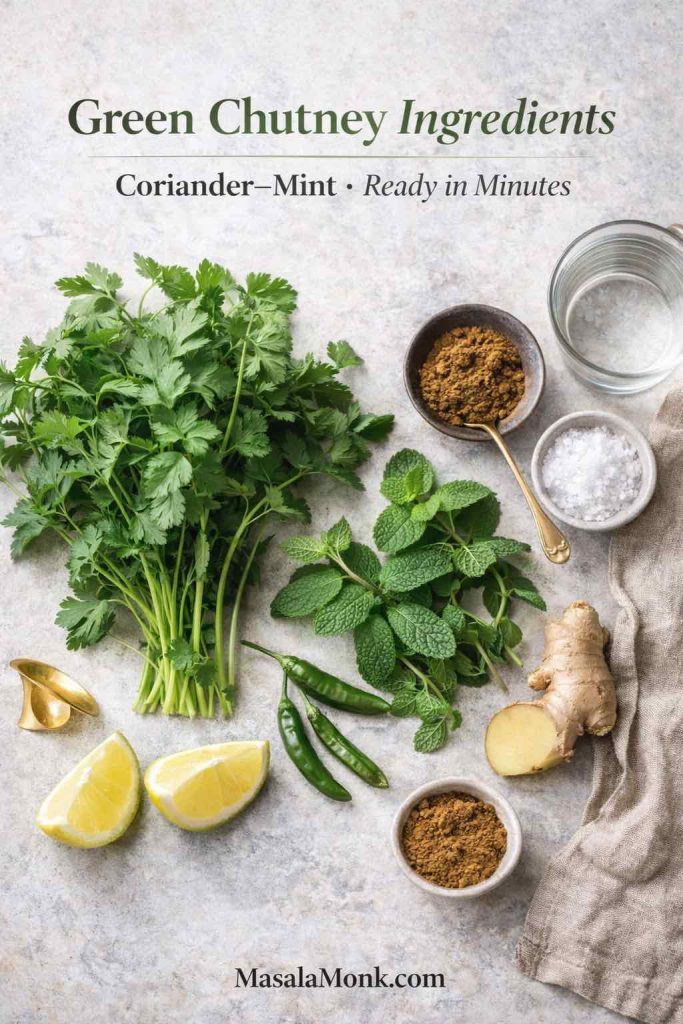
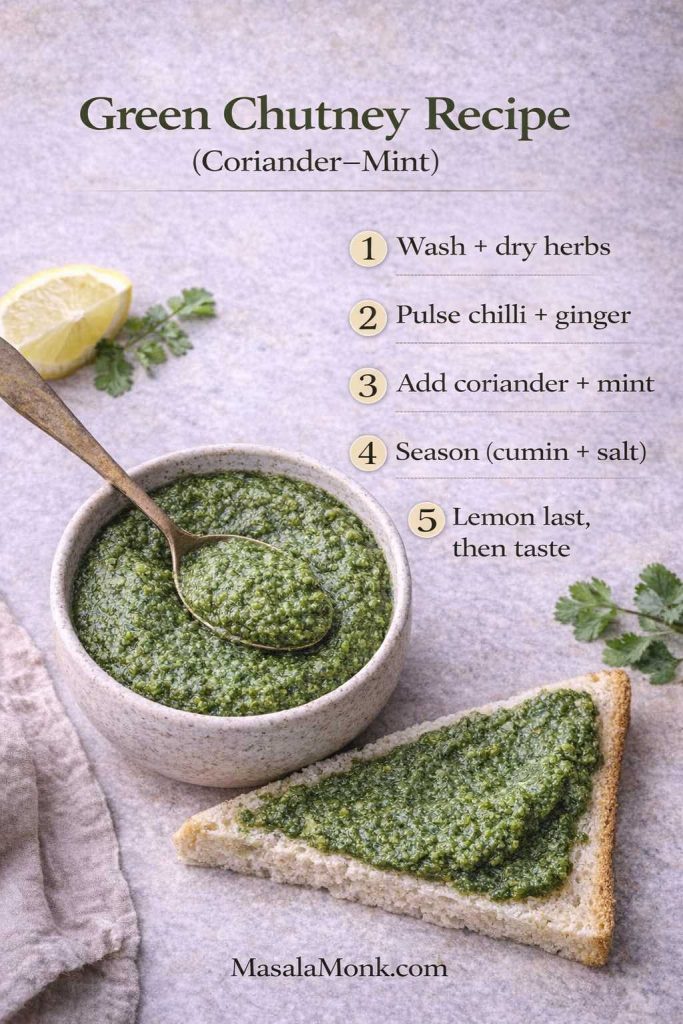
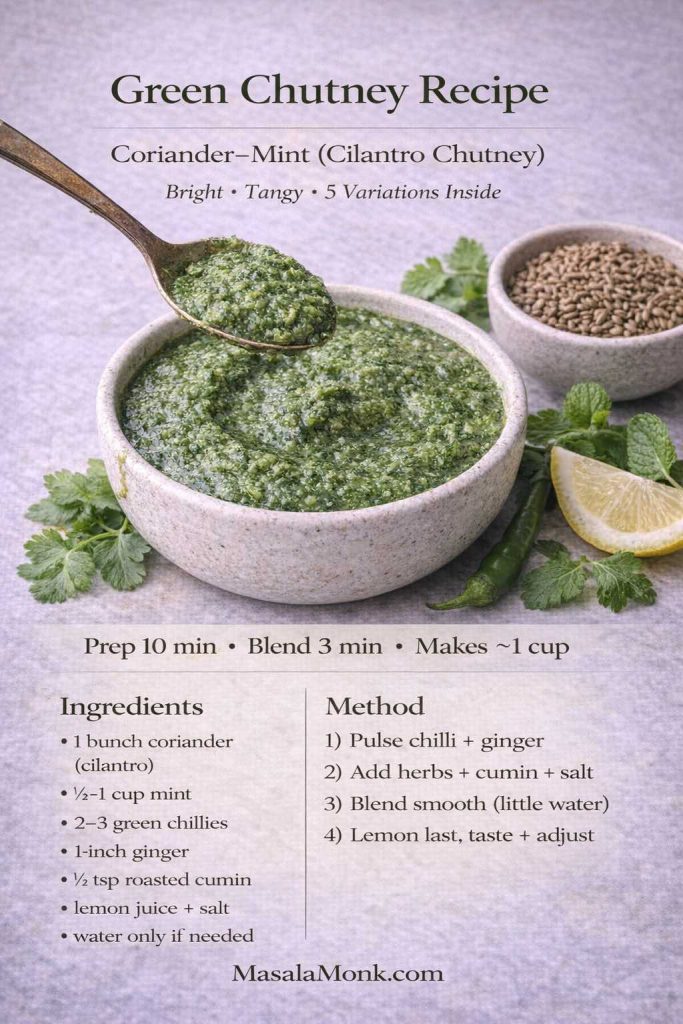
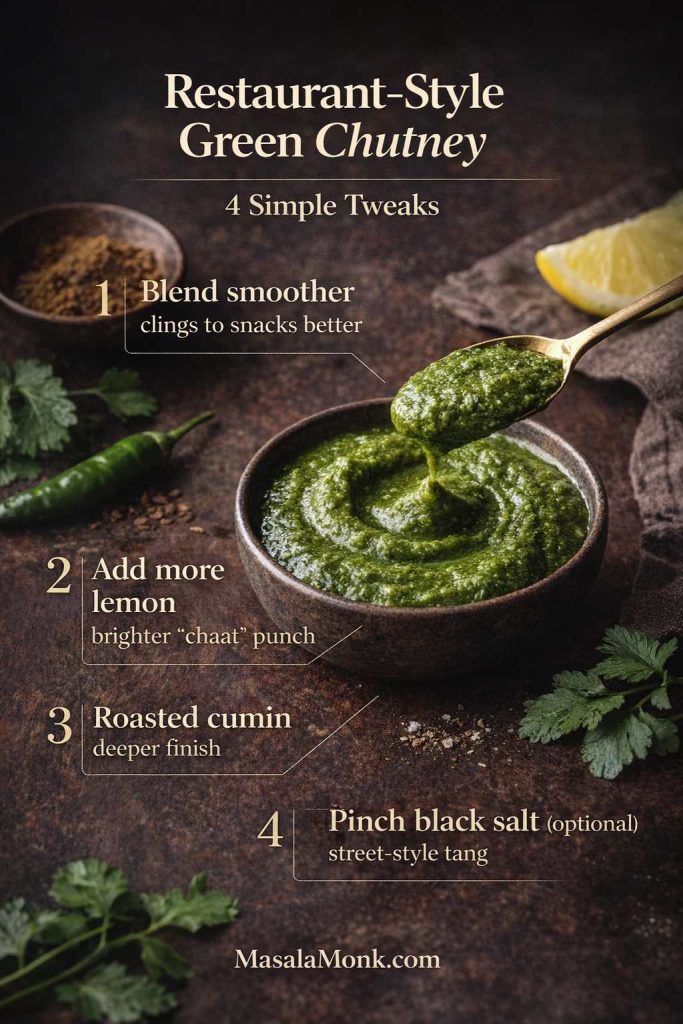
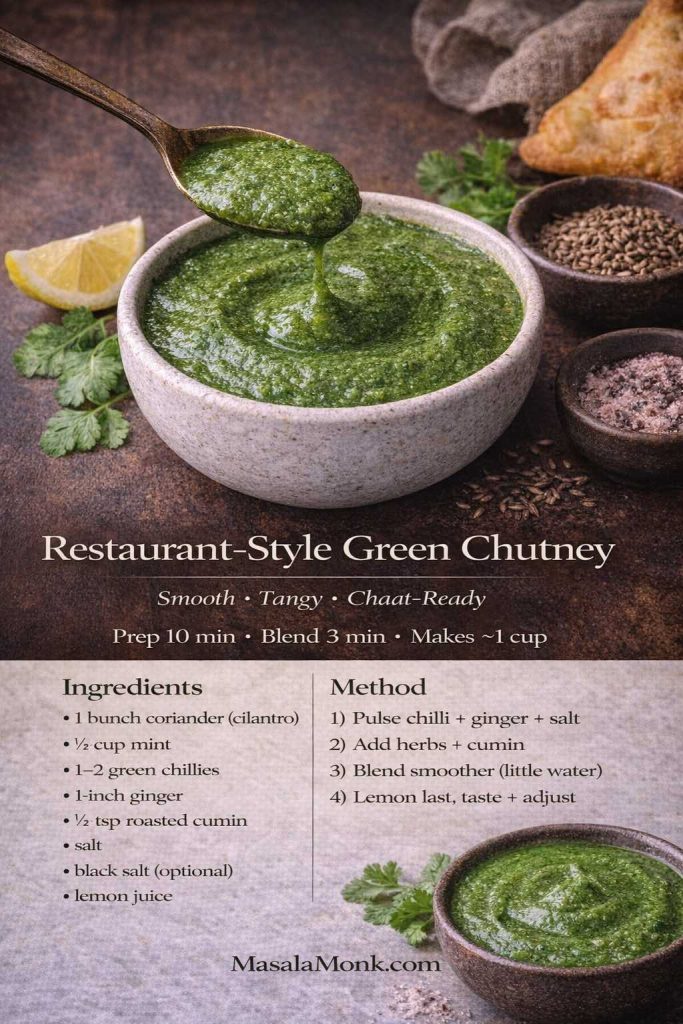
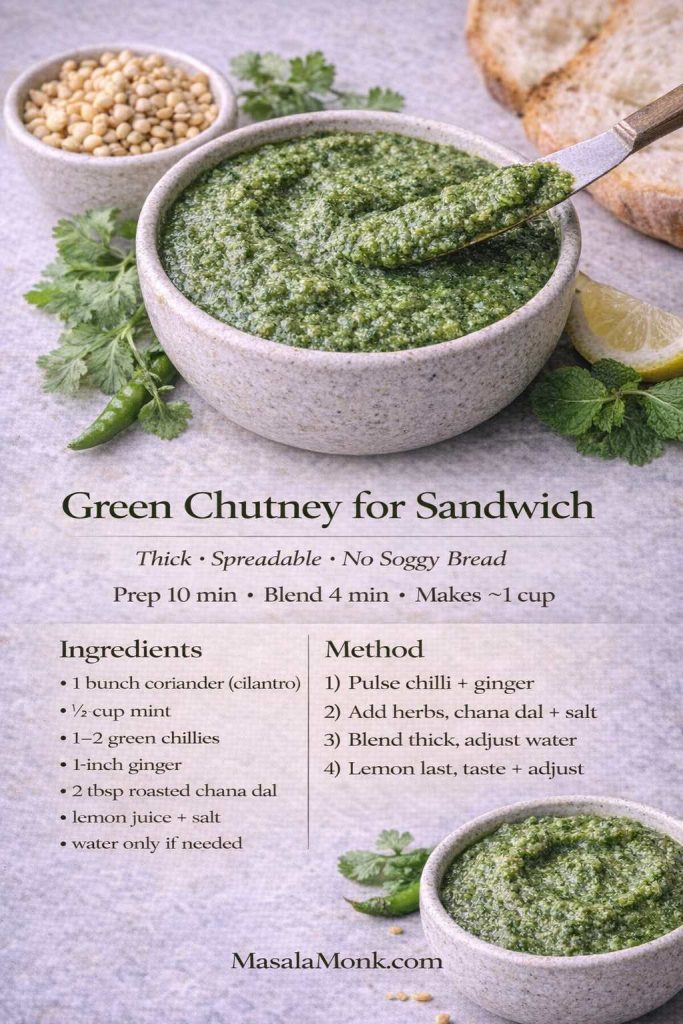
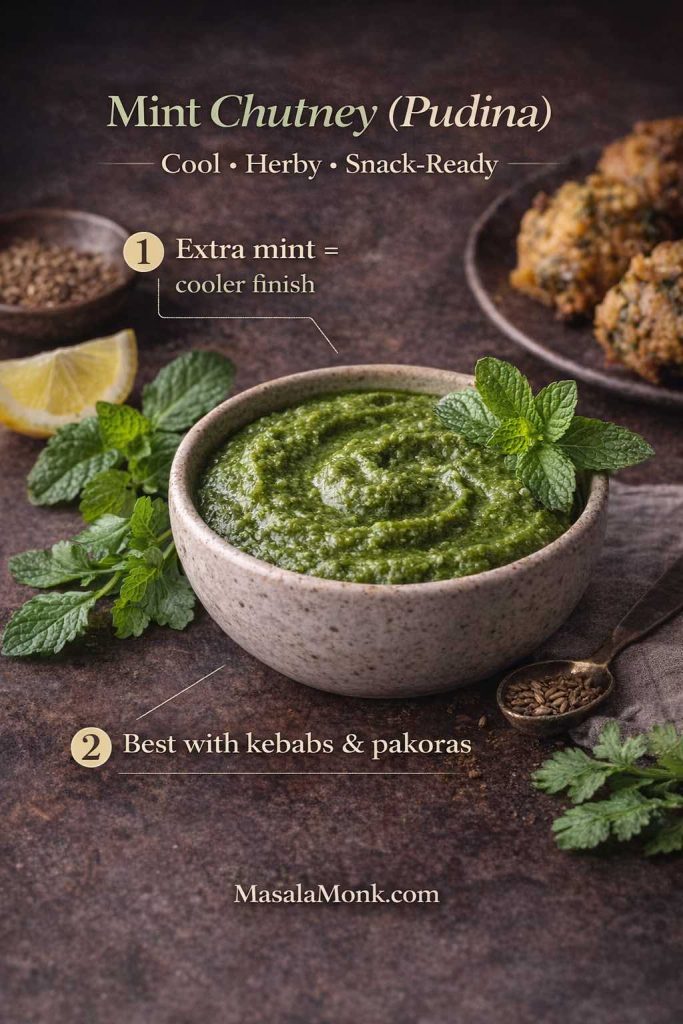
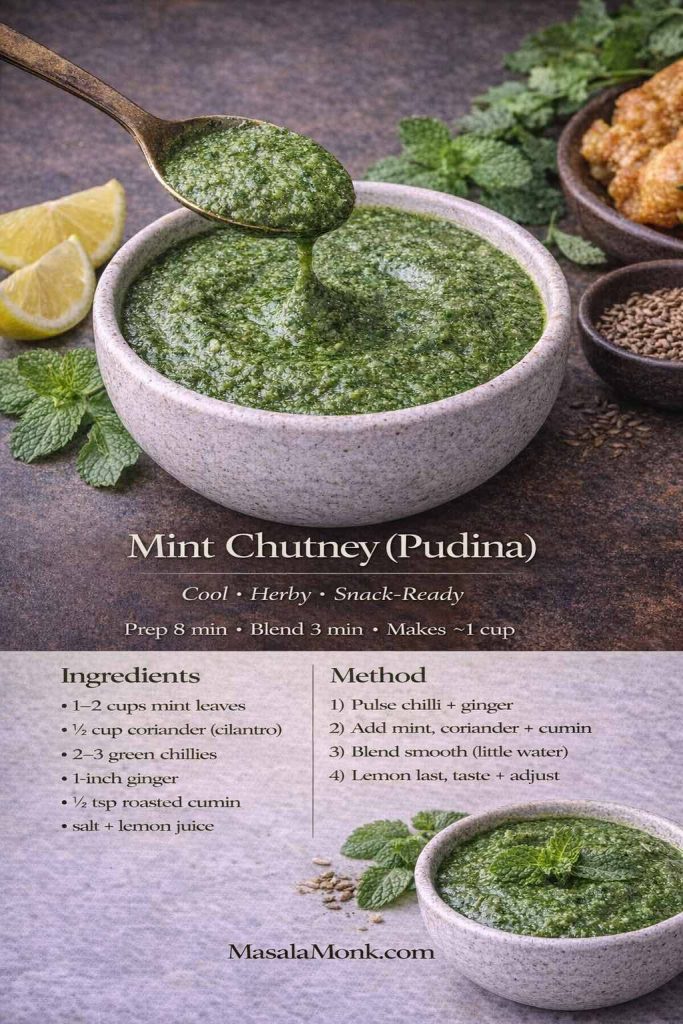
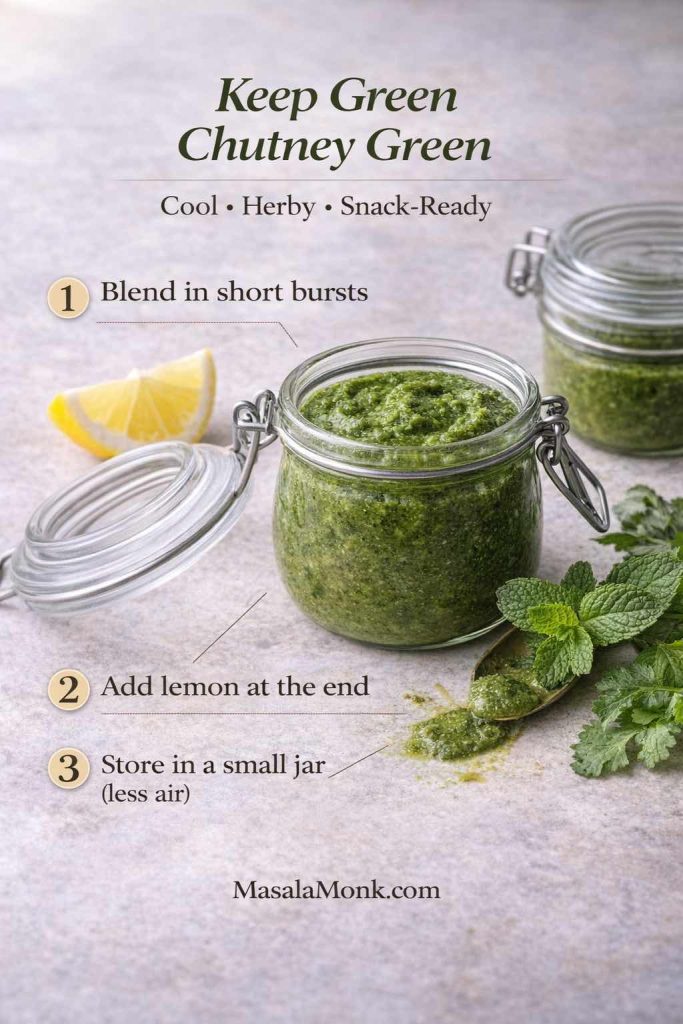
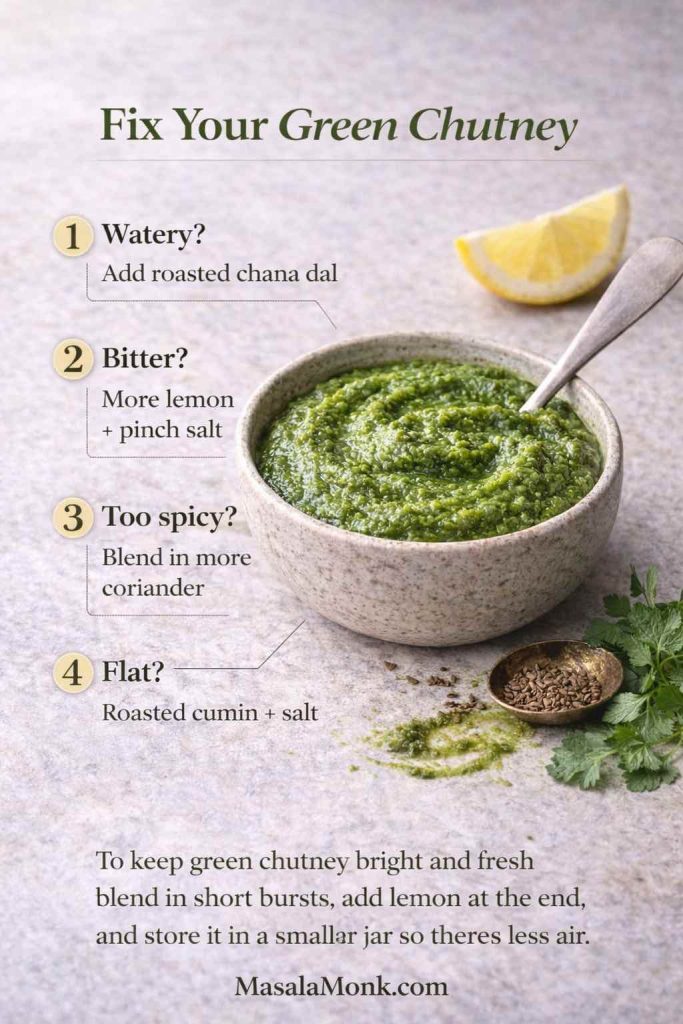
This green chutney recipe is the kind you start making “just for snacks,” and then—almost without noticing—you’re spreading it on toast, swirling it into yogurt, packing it for lunch, and finding excuses to dip everything into it. It’s fresh coriander (cilantro) and mint blended with green chilli, ginger, roasted cumin, salt, and citrus, so it tastes bright, punchy, and alive. Better still, the same base can become restaurant style green chutney for chaat nights, a thick green chutney for sandwich spreads, or a mellow coconut green chutney that belongs beside dosa and idli.
Depending on where you learned your kitchen language, you might call it coriander mint chutney, cilantro mint chutney, coriander chutney, cilantro chutney, dhania chutney, or dhaniya chutney. The name changes; the craving doesn’t. What matters is that you end up with a jar of green goodness that fixes the whole plate.
The green chutney that fixes everything
Some condiments behave like optional extras. Green chutney isn’t one of them. It’s a small, cold spoonful that can make hot food feel lighter, spicy food feel brighter, and plain food feel like you actually meant it to taste that good.
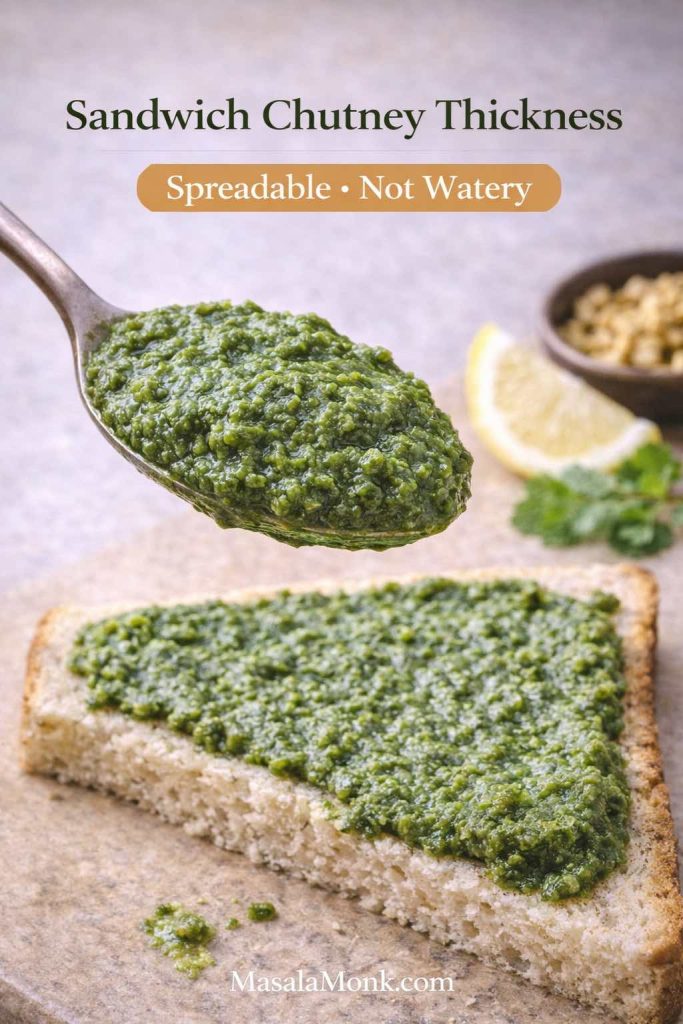
Think about the foods we naturally reach for it with: samosas, pakoras, kebabs, cutlets, chaat. Those are all rich or fried or boldly spiced, which means they love a contrast—something tangy and herbal to cut through the heaviness. Yet the real power of green chutney shows up outside snack plates. Spread it inside a sandwich and it instantly tastes more “street,” more layered, more addictive. Add it to a bowl of yogurt and it becomes a quick dip that tastes like you planned ahead. Stir a spoon into leftover rice and suddenly you’re not eating leftovers; you’re eating a clever lunch.
In other words, green chutney isn’t just a recipe. It’s a kitchen habit.
Names you’ll hear at home (and what they usually mean)
Before we blend anything, it helps to make peace with the names. The same chutney can wear different labels depending on region, language, and what your family grew up saying.
Cilantro and coriander
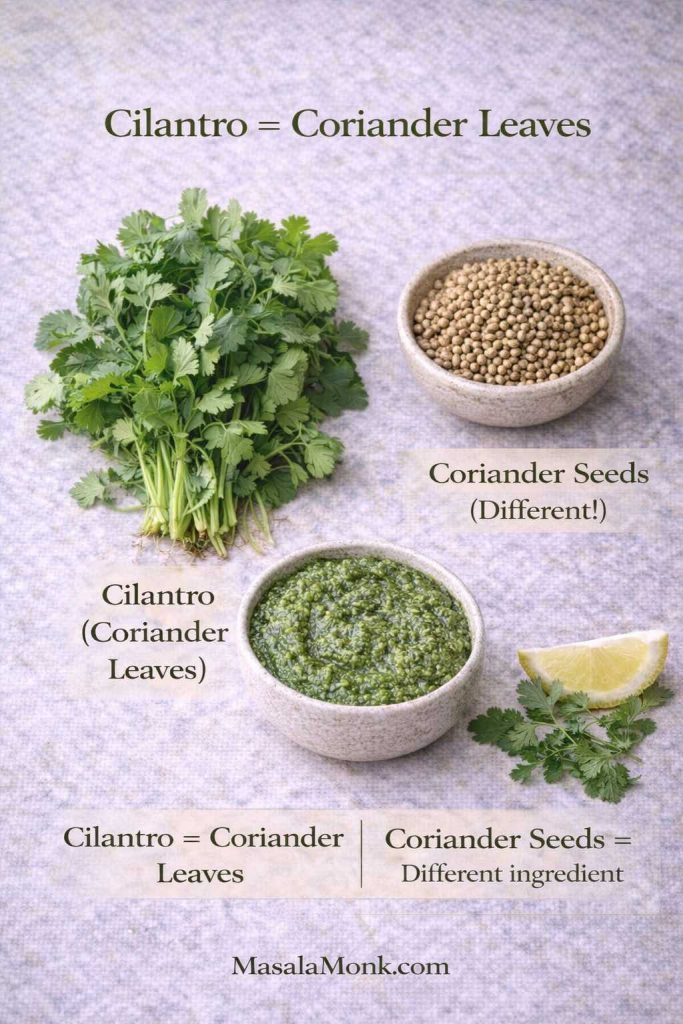
If you grew up calling the leafy herb “coriander,” then “coriander chutney” will sound natural. Meanwhile, if you’re used to the word “cilantro,” then “cilantro chutney” will feel like the obvious name. Both can point to the same chutney built on coriander leaves.
If you’re searching for a cilantro chutney recipe, you’re in the right place—cilantro is the same as coriander leaves. Coriander seeds are a different ingredient, so green chutney is made with the leaves (often with mint), not the seeds.
To keep it simple, treat “cilantro” and “coriander leaves” as interchangeable in your kitchen unless you’re specifically talking about coriander seeds.
Dhania and dhaniya
Dhania (and dhaniya) are common Hindi words for coriander. So a dhania chutney recipe or dhaniya chutney recipe is usually pointing you to this same green chutney family—sometimes with mint, sometimes without, but almost always brightened with lemon.
Mint chutney and green chutney
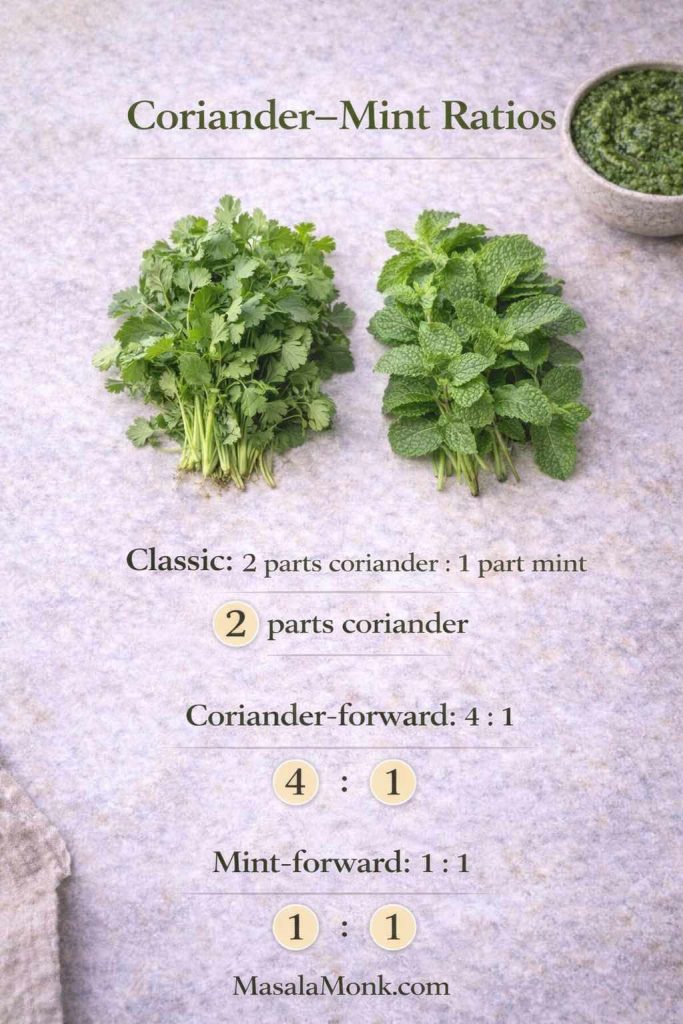
A mint chutney recipe often overlaps with green chutney, but the balance shifts. Mint becomes the main note, coriander supports, and the chutney feels cooler and more mint-forward. You’ll get that variation in this post too, because it’s genuinely useful.
A great green chutney doesn’t taste like “blended leaves.” It tastes like freshness with intention.
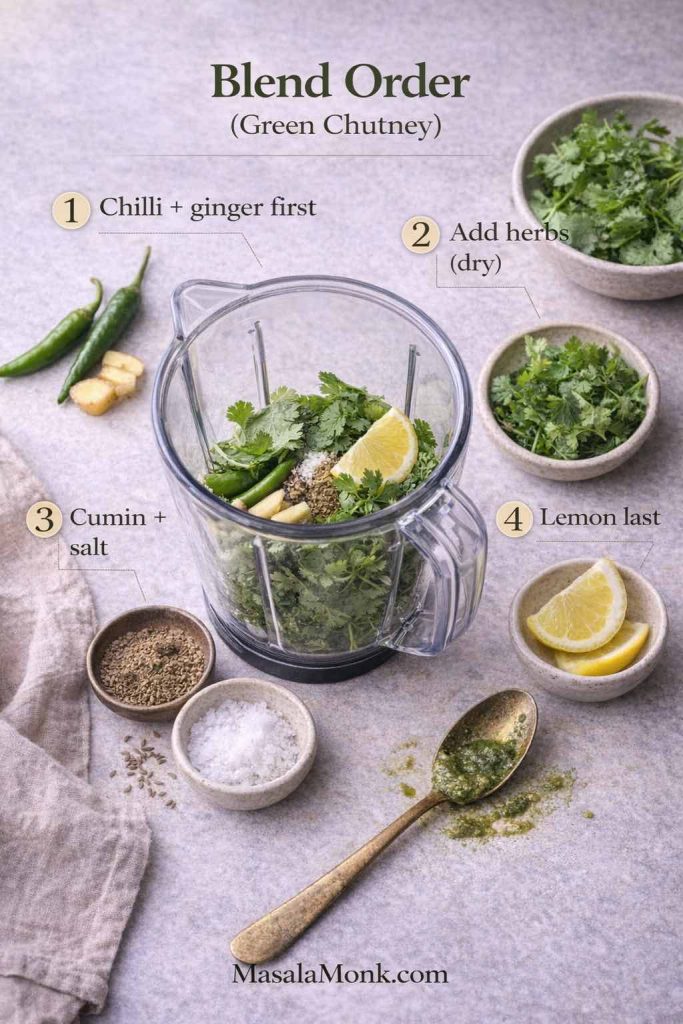
First comes tang—lemony brightness that makes your mouth water. Next comes the herb hit, clean and green without tasting raw or grassy. Then the chilli warmth arrives, not as a punch, but as a steady glow. Finally, roasted cumin shows up quietly in the background, giving the chutney that “snack-ready” depth that keeps it from feeling like a salad.
When green chutney is off, the flavor problems are usually predictable:
When it tastes flat, it often needs roasted cumin or salt.
When it tastes grassy, it usually needs lemon and better seasoning.
When it tastes harsh, chilli or ginger may be dominating and needs buffering.
When it tastes bitter, the herbs may have heated up during blending or too many thick stems made it into the jar.
The reassuring part is that most batches can be corrected. You don’t have to start over. You just have to nudge the chutney back into balance.
Before you blend: the small choices that change everything
Choose herbs that smell bright
This sounds almost too obvious, yet it’s the easiest quality check. Coriander should smell citrusy and fresh, not damp. Mint should smell cool, not muddy. If your herbs already smell tired, your chutney will taste tired too—no amount of lemon will fully fix it.
Use tender coriander stems, skip the thick ones
Tender stems carry aroma, so using them makes the chutney taste fuller. Thick, fibrous stems near the base, on the other hand, can blunt the flavor and sometimes add bitterness. So, trim the rough ends, keep the tender parts, and you’ll get the best of both worlds.
Dry your herbs more than you think you need to
Water is the most common reason green chutney becomes thin and bland. Since this chutney is meant to taste concentrated, shake off excess water and pat the herbs dry if you can. Even a quick towel pat changes the final texture.
This step matters even more if you want green chutney for sandwich spreads, because sandwich chutney has to be thick enough to stay put.
Blend in short bursts
Long blending runs heat up herbs. Short bursts keep things cooler, help preserve a brighter green, and give you more control over texture. In practice, this also makes it easier to keep the chutney thick without dumping in water too early.
Recipe Card: Classic Green Chutney Recipe (Coriander–Mint / Cilantro Chutney)
This is the everyday base—the one you’ll use as a dip, spoon beside meals, or turn into variations. It also naturally covers what most people mean by coriander chutney recipe and cilantro chutney recipe in daily kitchen language.
Yield: about 1 to 1¼ cups Prep time: 10 minutes Blend time: 2 to 4 minutes Best for: snacks, chaat, wraps, everyday meals
Everything you need for a classic green chutney recipe—fresh coriander (cilantro), mint, green chilli, ginger, lemon, and roasted cumin—styled here so you can prep fast and blend in minutes.
Ingredients
Coriander (cilantro), 1 large bunch (leaves with tender stems) Mint leaves, ½ to 1 cup (adjust to taste) Green chillies, 2 to 4 (adjust to heat) Ginger, 1 to 1½-inch piece Roasted cumin powder, ½ to ¾ teaspoon Salt, to taste (black salt optional) Lemon or lime juice, 1 to 2 tablespoons Water, only as needed (start with none)
Short on time? This green chutney recipe (coriander–mint / cilantro chutney) comes together fast—follow these five steps and you’ll have a bright, fresh chutney ready for snacks or sandwiches.
Method
Rinse coriander and mint thoroughly. Then shake off as much water as possible and pat dry if you have time.
Add green chillies and ginger to the blender jar first. Pulse once or twice until roughly broken down.
Add coriander, mint, roasted cumin, and salt. Blend in short bursts, scraping down the jar once or twice.
Add water only in tiny splashes if the blades struggle.
Add lemon juice last. Blend briefly, taste, and adjust slowly until the chutney feels bright and balanced.
For a brighter, smoother green chutney recipe, follow this blend order: start with chilli and ginger, add dry herbs next, season with cumin and salt, then finish with lemon last for the freshest coriander–mint (cilantro) chutney flavor.
The texture of green chutney you’re aiming for
Texture depends on where the chutney is headed. A smooth, spoonable blend is perfect for dipping, especially with fried snacks. If you’re serving it as a side with everyday meals, a slightly coarse grind can taste wonderfully fresh and rustic. Sandwiches are different, though: a thicker spread works better inside bread and won’t turn the layers soggy.
If you enjoy seeing how widely this base is used, the overall structure lines up with classic versions like Veg Recipes of India’s mint coriander chutney and Indian Healthy Recipes’ cilantro chutney. No need to copy either one exactly—think of them as familiar signposts rather than strict rules.
Save this classic green chutney recipe card: a bright coriander–mint (cilantro) chutney with a quick 4-step method—use it as a dip now, then explore the five variations in the post for restaurant-style, sandwich spread, coconut, and mint-forward versions.
Getting the texture right (because flavor isn’t the only job)
A lot of green chutney disappointment is really texture disappointment. The flavor might be good, but if the chutney is watery or uneven, it won’t behave the way you want.
Not sure if your green chutney is “right”? Use this quick guide: keep it spoonable for dipping, thicker for green chutney for sandwich spreads, and extra-smooth for restaurant-style green chutney.
When it’s too thin
Thin chutney happens when too much water enters the blender early, or when the herbs were very wet. Instead of adding more spices to “fix” it, solve the texture first. Later in this post, you’ll see the most reliable thickener for sandwich chutney; for now, remember this: you can always thin chutney later, but thickening watery chutney is harder than starting thick.
When it’s too coarse
Coarse chutney can taste wonderful, especially when served beside home-style meals. Still, if you want that restaurant style green chutney feel, smoothness matters. A smoother blend coats snacks better and tastes more “finished.” Instead of adding lots of water, blend in short bursts and scrape down more often. Usually, patience improves smoothness more than water does.
When it’s foamy or “air-y”
This happens when the blender runs too long, too fast, and pulls in air. The chutney can look lighter and feel less dense. Short bursts help. So does using a smaller jar where the blades catch the herbs properly.
Cilantro chutney, coriander chutney, and the green base you already made
With the base green chutney recipe ready, you’re already holding two common variations in your hands. You don’t need separate recipes as much as you need direction.
Dial in your flavor fast: use a 2:1 coriander–mint ratio for a classic green chutney recipe, go 4:1 for a coriander-forward cilantro chutney, or choose 1:1 when you want a cooler mint chutney vibe.
Cilantro chutney recipe style (coriander-forward Green Dip)
If you want coriander to lead, reduce mint to a small handful or skip it completely. Then keep ginger, chilli, cumin, salt, and lemon as usual. This coriander-forward chutney tastes cleaner and sharper, which makes it excellent in wraps, toasties, and quick lunches.
To make that version taste “complete,” be confident with lemon at the end and keep roasted cumin steady. That combination gives coriander chutney a satisfying finish rather than a raw edge.
Save this cilantro chutney recipe card for a coriander-forward green chutney without mint—bright, everyday, and easy to blend when you want a simpler chutney that still tastes fresh.
Coriander mint chutney style (mint-friendly & Green)
If you prefer the snack-stall feeling, use more mint. Keep coriander as the backbone, but let mint join more confidently. Blend a bit smoother. Add black salt if you love that chaat tang. This version tends to feel cooler and more “dip-ready,” especially beside fried snacks.
Dhania chutney and dhaniya chutney (both green) at home
If you call it dhania chutney or dhaniya chutney, you’re usually making one of the two styles above—either coriander-forward or coriander-and-mint. The name doesn’t force the method; your taste does.
The “restaurant” taste without overcomplicating your life
Restaurant style green chutney has a particular personality: it’s smoother, brighter, and slightly more intense. It also tastes like it was designed specifically for snacks, which is why it’s so satisfying on a chaat plate.
The simplest way to get that feel is to focus on three things: smoothness, tang, and finish.
Want restaurant-style green chutney at home? These four quick tweaks—smoother blend, extra lemon, roasted cumin, and a pinch of black salt—deliver that bright chaat-style punch and a deeper finish.
Smoothness comes from blending a little longer than your home version, but doing it in short bursts so the herbs stay cool. Tang comes from pushing lemon slightly further than you normally would. Finish comes from roasted cumin and, if you like it, a pinch of black salt. Used carefully, those two seasonings create the snack-stall memory without overpowering the herbs.
Recipe Card: Restaurant Style Green Chutney (Smooth and Chaat-Ready)
This is the version that feels like it belongs beside samosas, pakoras, and chaat. It also matches what many people mean when they say “green chutney restaurant style.”
Yield: about 1 cup Prep time: 10 minutes Blend time: 3 to 5 minutes Best for: chaat, samosas, pakoras, snack platters
Ingredients
Coriander (cilantro), 1 large bunch Mint leaves, ¾ cup (adjust to taste) Green chillies, 2 to 4 Ginger, 1-inch piece Roasted cumin powder, ¾ teaspoon Salt, to taste Black salt, a small pinch (optional) Lemon juice, 1½ to 2 tablespoons (taste as you go) Water, minimal and added only if needed
Save this restaurant-style green chutney recipe card for a smoother, tangier coriander–mint chutney—perfect as a chaat chutney for samosas, pakoras, and street-style snacks when you want that bright, punchy finish.
Method
Pulse ginger and chillies first.
Add coriander, mint, cumin, salt, and black salt (if using).
Blend smoother than your home version, using short bursts and scraping down.
Add lemon at the end, blend briefly, then taste.
Adjust until the chutney tastes bright and “snack-ready.”
If you enjoy contrasting chutney personalities, it’s fun to pair this with a bold red chutney like MasalaMonk’s Kara Chutney for idli and dosa on the same table. The flavors are entirely different, yet both do the same job: they make the plate exciting.
The sandwich factor (where green chutney becomes a daily habit)
If you’ve ever eaten a proper Bombay sandwich, you already know why green chutney matters. The potatoes and spices create comfort, while the chutney creates contrast. Together, they taste like street food even when you’re eating at home.
Still, green chutney for sandwich needs one special quality: it has to be thick enough to spread without soaking bread. Thin chutney migrates. It makes the bread soggy, the filling slippery, and the flavor uneven. Thick chutney, on the other hand, stays where you put it, so every bite tastes deliberate.
To build that thickness, you mainly need to control water and choose a helpful thickener.
Why roasted chana dal works so well
Roasted chana dal (bhuna chana/dalia) thickens chutney without making it heavy. It also gives the spread a satisfying body that feels very “sandwich shop.” Meanwhile, it keeps the herb flavor intact, which is exactly what you want.
Recipe Card: Green Chutney for Sandwich (Thick Spread)
This is designed to perform inside bread. It’s spreadable, stable, and concentrated enough to hold its own under fillings.
Yield: about 1 cup Prep time: 10 minutes Blend time: 4 to 6 minutes Best for: Bombay sandwich, toasties, wraps, lunchbox sandwiches
Save this green chutney for sandwich recipe card—thick, spreadable, and made with roasted chana dal so it stays put in a Bombay-style sandwich without turning the bread soggy.
Ingredients
Coriander (cilantro), 1 large bunch Mint leaves, ½ cup Green chillies, 2 to 3 Ginger, 1-inch piece Roasted cumin powder, ½ to ¾ teaspoon Salt, to taste Lemon juice, 1 to 1½ tablespoons Roasted chana dal (bhuna chana/dalia), 1 to 2 tablespoons Water, only by teaspoons if absolutely needed
Method
Pulse ginger and chillies first.
Add coriander, mint, cumin, and salt. Blend in bursts with almost no water.
Add roasted chana dal and blend again until thick and spreadable.
Add lemon at the end, blend briefly, and taste.
If it becomes too thick, loosen with a teaspoon of water. If it’s still thin, add a little more roasted chana dal.
This is the thickness you want for green chutney for sandwich—spreadable and sturdy, so it stays put on bread instead of soaking in and turning the sandwich soggy.
Where to use it immediately
This is the signature layer in MasalaMonk’s Authentic Grilled Bombay Sandwich Recipe, where green coriander chutney helps create that unmistakable street-style bite. It also works beautifully when you’re using leftovers creatively, like in this Paneer Sabji Sandwich. For mornings, it fits naturally into MasalaMonk’s Sandwich for breakfast ideas, especially when you want a toastie that tastes fresh and bold rather than merely filling.
Coconut green chutney: a softer, breakfast-friendly direction
Sometimes you don’t want sharp. You want calm. Coconut green chutney is that mood: creamy, mellow, and especially good with dosa, idli, or any breakfast plate that needs a comforting dip.
Coconut green chutney is the mellow, breakfast-friendly variation—creamier than classic green chutney, and especially good with dosa and idli when you want a softer, less sharp bite.
The beauty of coconut is that it rounds off harshness and softens chilli heat. Consequently, coconut green chutney feels soothing without becoming bland—especially if you remember to bring brightness back with lemon at the end.
Recipe Card: Coconut Green Chutney (Herb + Coconut)
This version keeps the green freshness, then adds coconut for a creamier finish.
Yield: about 1 to 1¼ cups Prep time: 10 minutes Blend time: 4 to 6 minutes Best for: dosa, idli, savory breakfasts, snack platters
Ingredients
Fresh grated coconut, ½ to ¾ cup (or desiccated coconut soaked briefly) Coriander (cilantro), 1 bunch Mint leaves, a small handful (optional) Green chillies, 1 to 3 Ginger, a small piece Roasted cumin powder, ¼ to ½ teaspoon Salt, to taste Lemon juice, about 1 tablespoon (adjust to taste) Water, minimal
Save this coconut green chutney recipe card for a mellow, creamy variation of green chutney—perfect with dosa and idli when you want a softer, breakfast-friendly chutney.
Method
Pulse ginger and chillies first.
Add coconut, coriander, cumin, and salt. Blend smooth with very little water.
Add lemon at the end and blend briefly.
Taste and adjust. If it feels too mellow, add a touch more lemon or an extra chilli.
If you want a more traditional coconut chutney profile for South Indian breakfasts, MasalaMonk’s South Indian Coconut Chutney is a great companion. It’s not the same chutney, yet it sits beautifully alongside a sharper green chutney on the same plate.
Mint chutney recipe: when mint leads the green melody
There are days when mint deserves the spotlight. A mint chutney recipe is cooler, more mint-forward, and often feels especially good with spicy foods because mint softens the heat without dulling flavor.
Mint chutney (pudina chutney) is the cooling, herb-forward cousin of classic green chutney—perfect when you want a fresher finish with kebabs, pakoras, and spicy snacks.
Although mint chutney and green chutney live in the same family, the balance changes. Mint becomes the main note, coriander supports, and lemon becomes especially important so the chutney feels bright rather than heavy.
Recipe Card: Mint Chutney (Pudina-Forward)
This is a mint-led chutney that still keeps enough coriander to taste rounded.
Yield: about 1 cup Prep time: 10 minutes Blend time: 3 to 5 minutes Best for: kebabs, pakoras, sandwiches, snack platters
Ingredients
Mint leaves, 1 to 1¼ cups Coriander (cilantro), ½ bunch Green chillies, 1 to 3 Ginger, ½ to 1-inch piece Roasted cumin powder, ½ teaspoon Salt, to taste Lemon juice, 1 to 1½ tablespoons Water, minimal
Save this mint chutney (pudina chutney) recipe card for a cooler, herb-forward green chutney—especially good alongside pakoras, kebabs, and spicy snacks when you want a fresh, clean finish.
Method
Pulse ginger and chillies first.
Add mint, coriander, cumin, and salt. Blend in short bursts, scraping down as needed.
Add lemon at the end and blend briefly.
Taste and adjust until it feels bright and complete.
If you like seeing a classic mint-led approach, Veg Recipes of India’s pudina chutney recipe is a helpful reference for how naturally mint can carry a chutney.
Green chutney is fresh and herby, yet sometimes you want something louder—more chilli, more punch, less silky smoothness. That’s where thecha comes in. It’s not the same chutney, but it scratches the same “one spoon changes the meal” itch in a fierier way. When you’re in that mood, MasalaMonk’s thecha recipe is a great one to explore.
How to use green chutney all week (without forcing it)
The jar empties fastest when you match the chutney style to the meal. Instead of treating it as “a snack condiment,” let it behave like a sauce you reach for whenever food needs contrast.
Green chutney isn’t just a dip—use it as a chaat chutney with samosas and pakoras, spread it into a Bombay sandwich, serve it with dosa and idli, or spoon it into wraps and bowls for an instant hit of freshness.
Breakfast: warm + crisp + cold chutney
A savory breakfast becomes instantly more complete when there’s something tangy on the side. For example, MasalaMonk’s Semolina Veggie Pancakes are perfect with a fresh green chutney beside them. The warm, lightly spiced pancake meets the cool, tangy chutney, and suddenly breakfast feels cheerful rather than routine.
Coconut green chutney also fits beautifully on breakfast plates, especially when you’re serving dosa or idli. Meanwhile, a sharper green chutney can sit beside it as contrast, so the plate doesn’t taste one-note.
Lunch: spread it, don’t dip it
For lunchbox sandwiches and wraps, thickness matters. That’s why the sandwich spread version earns its own recipe card. Once you use a thick green chutney for sandwich builds, you’ll notice how much cleaner the sandwich feels—less soggy, more evenly flavored.
If you’re using leftover sabji, chutney acts like a bridge between bread and filling. The Paneer Sabji Sandwich is a perfect example of how chutney makes leftovers taste intentional instead of accidental.
Snacks: the moment for restaurant-style punch
When snacks appear—pakoras, samosas, cutlets—restaurant style green chutney shines. It’s smoother, brighter, and designed to feel “ready” immediately. Even a simple plate of fried potatoes tastes more exciting when the chutney has that chaat-like pop.
Dinner: a small spoon as a fresh counterpoint
For heavier comfort meals, a fresh green chutney side can lift the whole plate. MasalaMonk’s Litti Chokha guide mentions serving it with green chutney, and the pairing makes perfect sense: smoky, hearty flavors love a tangy herbal contrast.
When the plate isn’t “Indian,” the chutney still works
Green chutney behaves like a universal herb sauce. It can sit beside roasted vegetables, grilled paneer, or even as a dip for snacks that aren’t traditionally Indian. MasalaMonk’s Falafel with Indian twists points toward mint-coriander chutney as a dip option, which is a gentle reminder that chutney doesn’t need a passport.
Condiment spreads: pair wet and dry
If you love building a snack spread, pair green chutney with something dry and bold for texture contrast. MasalaMonk’s Vada Pav Dry Chutney recipe is a great counterpart—sprinkleable, garlicky, and intense in a completely different way.
Keeping it vibrant: why green chutney darkens and what helps
Herb chutneys dull over time. That’s normal. When herbs are crushed, they’re exposed to oxygen, and natural enzyme activity can change color. You don’t need to treat this like a crisis; you simply need a few habits that make the chutney stay brighter for longer.
To keep green chutney bright and fresh, blend in short bursts, add lemon at the end, and store it in a smaller jar so there’s less air sitting on top.
To understand the “why” in plain language, IFST’s explainer on enzymic browning is a helpful read. If you enjoy practical kitchen experiments, Serious Eats has a deep dive into why pesto browns and what actually helps. Green chutney isn’t pesto, of course, but the herb-and-oxygen problem behaves similarly.
In daily cooking terms, these habits help the most:
Blend in short bursts so the herbs don’t warm up.
Add lemon at the end so the bright top notes stay bright.
Store in a smaller jar so there’s less headspace.
Smooth the top of the chutney so there’s less surface area exposed to air.
Those steps aren’t fussy. They’re simply the small things that keep your chutney looking and tasting fresher.
Storage and food safety (without turning it into a lecture)
Green chutney is typically uncooked, which means you should treat it like any prepared, ready-to-eat condiment. Keep it refrigerated, use clean spoons, and make batches sized for real life.
If you want an official reference point for general safe handling of prepared foods, the USDA page on leftovers and food safety is worth a quick skim. Even though chutney isn’t exactly “leftovers,” the mindset carries over: fresh prepared foods are best used within a reasonable window, and cleanliness matters.
Freeze green chutney in small cubes so you can thaw only what you need—spoon into trays, freeze, then refresh the thawed coriander–mint (cilantro) chutney with a squeeze of lemon.
For longer storage, freezing in small portions works well. The color may dull a bit after thawing, yet the flavor often stays surprisingly strong, especially if you refresh it with a squeeze of lemon before serving.
When a batch goes sideways (and how to rescue green chutney)
Even experienced cooks get a batch that’s almost right. Fortunately, green chutney is forgiving, so you can correct most problems without frustration.
If your green chutney goes off-track, don’t toss it—use these quick fixes for watery chutney, bitterness, too much heat, or a flat taste, and bring it back to a fresh, balanced green chutney recipe.
Too thin
If the chutney is watery, thicken it rather than adding more spices. Roasted chana dal is the most reliable thickener. If you don’t have it, reduce water next time and pat the herbs dry more thoroughly.
Too flat
When it tastes muted, it often needs roasted cumin and salt. Add a pinch of each, blend briefly, then taste again. Usually the chutney isn’t missing “more herbs”; it’s missing grounding.
Too grassy
Grassy chutney typically needs lemon and salt. Add lemon in small squeezes, then taste until the chutney feels “awake.”
Adjust your green chutney recipe to your comfort level: use 1 deseeded chilli for mild, 2 chillies for medium heat, or 3–4 chillies for a hotter, punchier coriander–mint (cilantro) chutney.
Too spicy
Instead of diluting with water, blend in more coriander. Water reduces flavor, while more herbs keep it tasting like chutney.
Slightly bitter
Bitterness can happen when herbs heat up during long blending runs, or when thick stems dominate. To soften bitterness in the moment, add lemon and a pinch more salt, then blend in a handful of fresh coriander if you have it. Next time, use short bursts and trim thick stems more carefully.
After making this green chutney a few times, a simple pattern shows up: the jar empties fastest when the chutney is thick enough to use without thinking. A watery batch, on the other hand, tends to linger—not because the flavor is bad, but because spreading and dipping start feeling messy.
Here’s the easiest rule to live by: begin with less water than you think you’ll need. You can always loosen the chutney later; thickening it after the fact is far more annoying. As a bonus, the flavor stays bolder, sandwiches hold up better, and the chutney feels like a daily staple rather than an occasional side.
That’s why green chutney becomes a habit. It brightens the plate, sharpens each bite, and makes even simple food feel intentional.
One base green chutney recipe, five directions—keep it classic coriander–mint, blend it extra-smooth for restaurant-style green chutney, thicken it for green chutney for sandwich spreads, mellow it with coconut, or go mint-forward for a cooler finish.
FAQs
1) What is green chutney made of?
Green chutney is usually made by blending coriander (cilantro) with mint, green chillies, ginger, salt, roasted cumin, and lemon or lime juice. Depending on the style, you may also add ingredients like black salt, roasted chana dal for thickness, or coconut for a milder, creamier version.
2) Is cilantro chutney the same as coriander chutney?
Often, yes. In many kitchens, “cilantro” and “coriander leaves” refer to the same herb, so cilantro chutney and coriander chutney commonly point to the same kind of green chutney. That said, some people use “coriander chutney” to mean a coriander-forward version with little or no mint.
3) What is dhania chutney and how is it different from dhaniya chutney?
Dhania chutney and dhaniya chutney are generally the same thing—both names commonly refer to coriander-based green chutney. The difference is usually spelling preference or regional language habits, not a different recipe.
4) How do I make restaurant style green chutney at home?
For restaurant style green chutney, blend the herbs smoother than usual, push the lemon a little further for extra brightness, and season confidently with roasted cumin. Additionally, a small pinch of black salt can give that familiar chaat-style tang, although it’s optional.
5) Why does my green chutney turn dark or brown?
Green chutney can darken because the herbs react with air after blending. To slow it down, blend in short bursts so the chutney doesn’t heat up, store it in a tightly sealed jar, and reduce the empty space at the top. Also, adding lemon at the end can help keep the flavor fresher.
6) How can I keep green chutney green for longer?
To keep green chutney greener, start with cold, dry herbs, blend quickly, and avoid adding too much water. Then, store it in a small jar so there’s less air exposure. In some cases, blanching herbs briefly and cooling them before blending can help, but many cooks prefer keeping it fully raw for the freshest taste.
7) What’s the best green chutney for sandwich spread?
The best green chutney for sandwich is thick and spreadable, not watery. For that reason, use very little water while blending and add roasted chana dal (bhuna chana/dalia) to thicken it. As a result, the chutney stays in place and the bread doesn’t turn soggy.
8) Why is my green chutney watery?
Green chutney becomes watery when herbs aren’t dried well or too much water is added during blending. Instead, blend in bursts and add water only by teaspoons if needed. If it’s already thin, roasted chana dal can thicken it quickly.
9) How do I fix green chutney that is too spicy?
To reduce heat, blend in more coriander (and a little mint, if you use it), rather than adding water. Alternatively, adding a spoon of yogurt can mellow the spice, although it will change the flavor slightly and make the chutney creamier.
10) How do I fix green chutney that tastes bitter?
Bitterness can come from too many thick coriander stems or from over-blending, which warms the herbs. To improve it, add more lemon and a pinch more salt, then blend in extra fresh coriander to rebalance. Next time, use tender stems only and blend in short bursts.
11) How much mint should I add to coriander mint chutney?
Mint quantity depends on how minty you want the chutney and how strong your mint is. Generally, a moderate handful gives a balanced coriander mint chutney, whereas a larger amount creates a more cooling, mint-forward chutney.
12) Can I make coconut green chutney without tempering?
Yes. Coconut green chutney can be made by simply blending coconut with coriander, green chilli, ginger, salt, and lemon. If you want it more traditional, you can add tempering, but it isn’t required for a tasty everyday version.
13) How long does green chutney last in the fridge?
Typically, green chutney is best used within 3 to 4 days when stored in a clean, airtight container in the refrigerator. After that, the flavor and color may degrade, even if it still looks fine.
14) Can I freeze green chutney?
Yes, green chutney can be frozen in small portions. For example, freezing in ice cube trays makes it easy to thaw only what you need. After thawing, the chutney may look slightly duller, so adding a little fresh lemon juice can brighten the flavor.
15) What can I serve with green chutney?
Green chutney pairs well with samosas, pakoras, cutlets, kebabs, chaat, sandwiches, wraps, and savory pancakes. Moreover, it works as a dip for snacks beyond Indian food when you want a fresh, herby sauce with a spicy kick.
A really good breakfast sandwich does two things at once. First, it tastes like you treated yourself—melty cheese, a warm egg, something crisp, something creamy. Then, almost secretly, it makes your morning easier because you can build it with whatever bread you already have: an English muffin, a croissant, a bagel, even waffles.
That’s the heart of this breakfast sandwich recipe. Instead of giving you one rigid version, we’ll start with a simple master build you can repeat, and then we’ll branch into the most-loved styles people actually search for and crave: egg and cheese, English muffin breakfast sandwich, breakfast croissant, croissant sandwiches, bagel with egg and cheese, scrambled egg sandwich, fried egg sandwich, high protein breakfast sandwich, vegetarian breakfast sandwich, gluten free breakfast sandwich, plus make-ahead frozen breakfast sandwiches for meal prep.
Along the way, we’ll lean on sauces and spreads that make a sandwich feel “finished” without being fussy—like a quick homemade mayo, a punchy pepper sauce, a bright pesto, or a thick tzatziki-style yogurt sauce—so every bite stays balanced instead of flat.
Breakfast sandwich: the master formula that works every time
Before we get into variations, it helps to have a dependable “base.” Think of it as a choose-your-own-adventure breakfast sandwich where each layer has a job.
Use this breakfast sandwich formula to mix and match your favorites—choose a bread base, add eggs and cheese, finish with a sauce, then layer on crunch for the perfect bite every time.
The five layers
Bread (or bread substitute) English muffin, croissant, bagel, biscuit, sliced bread, waffles, or an egg-based “eggwich.”
Eggs for sandwiches (the engine) Fried egg, scrambled egg, folded omelet, baked egg patty, or boiled eggs turned into a spread.
Cheese (the glue) Cheddar, mozzarella, gouda, pepper jack, or whatever melts well.
Sauce or spread (the comfort layer) Mayo, eggless mayo, vegan mayo, pesto, tzatziki, or a quick chili-mayo.
Texture + freshness (the wake-up layer) Crisp veggies, pickles, herbs, peppery greens, onions, tomatoes, even a little crunchy spice mix.
Once you understand those roles, breakfast sandwich ideas become effortless: swap the bread, switch the egg style, keep the sauce, change the crunch—suddenly you have a new breakfast without starting over.
First, toast or warm your bread. You’re not just adding crunch—you’re building a barrier so the sandwich doesn’t go soggy.
Next, cook your eggs in the style you want (fried or scrambled sections are coming up). While they’re still hot, add cheese and let it melt.
Then, spread sauce on the bread while it’s warm. That small detail matters: warm bread helps spreads cling instead of sliding.
After that, stack egg + cheese, add your texture layer, close the sandwich, and press gently for a few seconds so everything holds together.
Save this breakfast sandwich fixes guide: toast bread well to prevent sogginess, cook eggs low and pull early for softness, cover briefly to melt cheese fast, spread sauce on both sides to stop slipping, and add pickles/greens/onion for crunch.
If you like checking food safety temps (especially when you’re batch-cooking), egg dishes are commonly cooked to 160°F / 71°C, and leftovers reheated to 165°F / 74°C—guidance you can see on the USDA safe temperature chart and on FoodSafety.gov’s chart.
Egg and cheese: the classic egg & cheese breakfast sandwich
Sometimes you don’t want a “creative” breakfast. You want the one that always works: egg and cheese, warm bread, a little seasoning, done.
Fried egg sandwich recipe (crispy edges, runny or set yolk)
Heat a pan, add butter or oil, crack in an egg, season it. Let the edges crisp; cover briefly if you want the top to set faster. Once it’s nearly where you want it, lay cheese on top and cover for 20–30 seconds so it melts smoothly.
For the best fried egg sandwich, aim for crispy edges and melted cheese—choose a runny yolk for richness or cover the pan briefly for a set yolk that travels better.
This version is ideal when you want a clean, structured bite—especially on an English muffin or bagel.
Scrambled egg sandwich (soft, fluffy, and forgiving)
Whisk 2 eggs with salt and pepper. Cook on low heat, stirring slowly. Pull the eggs off the heat while they’re still slightly glossy; the residual heat finishes them.
A scrambled egg sandwich is the best make-ahead egg sandwich—cook low and slow for soft, fluffy eggs that reheat well, then melt the cheese onto the eggs so every bite stays creamy instead of dry.
Scrambled egg sandwiches are particularly good when you’re packing breakfast for later, because the eggs stay tender instead of turning rubbery.
Choose Your Bread Base for the Perfect Breakfast Sandwich
Before you cook a single egg, pick the bread. It decides almost everything: how tidy the sandwich feels, how rich the bite is, and whether it holds up for meal prep or needs to be eaten right away. Once the base is locked in, the “best” egg and sauce choices become obvious—so you’re not building a great filling on the wrong foundation.
Pick your base first: English muffin for tidy stacking, croissant for a flaky breakfast croissant, bagel for a hearty breakfast bagel sandwich, or waffle for sweet-savory brunch sandwiches.
English muffin: the neat, classic breakfast sandwich
If you want a café-style breakfast sandwich that’s easy to hold and doesn’t slide around, the English muffin is the safest bet. It toasts beautifully, stays sturdy under egg and cheese, and naturally supports the “stacked” look most people want in an English muffin breakfast sandwich.
Croissant: the premium, flaky breakfast croissant
A croissant makes breakfast feel like a treat. It’s buttery and delicate, so it works best when your fillings are bold but not watery. Choose it when you want croissant sandwiches with a “bakery morning” vibe—just keep sauces and fresh veggies controlled so it doesn’t turn soft.
Bagel: the hearty breakfast bagel sandwich
Bagels are dense and satisfying, which is why a bagel with egg and cheese can feel like a full meal. They shine when you want contrast—soft egg, melty cheese, plus something bright and crunchy like onion, cucumber, or pickles. If you’re hungry-hungry, this is the base that delivers.
Waffles: sweet-savory waffle breakfast sandwich energy
Waffles turn the same ingredients into brunch. Because waffles carry a gentle sweetness, they pair especially well with salty cheese, peppery sauces, and savory fillings. Pick this base when you want a waffle breakfast sandwich that feels fun, dramatic, and very shareable.
Quick rule to decide in 5 seconds
For a tidy, classic bite, choose an English muffin. For luxury and flaky layers, reach for a croissant. When you want something big and seriously filling, go with a bagel. And if you’re craving brunch-style sweet-savory energy, waffles are the move.
English muffin breakfast sandwich (café-style, sturdy, and easy to hold)
The English muffin breakfast sandwich is popular for a reason: it’s compact, it toasts beautifully, and it doesn’t fall apart mid-commute.
How to make round eggs for breakfast sandwiches (without special gear)
If you want that neat “egg patty” look, you don’t need a fancy ring. A wide mason jar lid ring, a cleaned metal cookie cutter, or even a DIY foil ring works.
Want café-style egg patties? This quick method shows how to make round eggs for breakfast sandwiches using a simple jar-lid ring—perfect for an English muffin breakfast sandwich that stacks neatly and stays easy to hold.
Warm the ring in the pan, grease it lightly, crack in the egg, and cover. As the egg sets, it becomes the perfect shape for English muffins.
Build: egg and cheese on English muffin
Toast muffin halves until crisp
Spread sauce on both sides
Add egg + cheese
Add one crisp layer (thin onion, tomato slice, spinach, or pickles)
Close, press gently, eat
This English muffin egg and cheese breakfast sandwich stacks neatly with a round egg patty and melty cheese—add a thin layer of spinach and onion for crunch and freshness without making the muffin soggy.
For a creamy base that can swing classic or spicy, a simple homemade mayo is hard to beat. If you want a versatile one with a lot of variations you can reuse for other sandwiches too, this guide is handy: homemade mayonnaise with 15+ easy variations.
If you’re feeding a mixed crowd—some people avoiding eggs in spreads or preferring egg-free condiments—you can also keep a jar of eggless mayonnaise or a fully dairy-free vegan mayo in rotation.
Breakfast croissant: when you want croissant sandwiches that feel like a treat
A breakfast croissant sandwich is the “I went out for breakfast” vibe—without leaving home. Because croissants are rich and flaky, the best versions keep fillings bold but not watery.
Croissant egg and cheese (the simple starter)
Warm the croissant (don’t over-toast—just warm and lightly crisp)
Add a soft scrambled egg layer
Add cheese while eggs are hot
Finish with pepper or chili flakes
Bacon egg and cheese croissant
Crisp bacon, melt cheese onto the egg, then add something fresh so it doesn’t feel heavy: a thin tomato slice, peppery greens, or even quick-pickled onions.
This bacon egg and cheese croissant delivers the classic breakfast croissant vibe at home—keep the croissant lightly warmed (not over-toasted), melt the cheese onto the eggs, then add crisp bacon and one fresh layer so it stays rich but balanced.
Sausage egg and cheese croissant
Sausage + egg + cheese is a classic breakfast sandwich trio for a reason. The croissant turns it into a weekend-level meal. If your sausage is strongly seasoned, keep the sauce simple—mayo or a yogurt-based spread—so it doesn’t clash.
Ham egg and cheese croissant
Ham loves mustard-mayo or herby mayo. Even a thin swipe makes the whole sandwich taste “designed,” not accidental.
If you want a sandwich spread that’s creamy yet tangy, Greek yogurt-style sauces are perfect on croissants too. This Greek tzatziki sauce recipe with variations gives you a thick, garlicky option that stays put instead of leaking out the sides.
Bagel with egg and cheese: the breakfast bagel sandwich that actually feels balanced
A bagel with egg and cheese is dense and satisfying, so it helps to build contrast—soft + crisp, rich + fresh, salty + bright.
This bagel with egg and cheese gets an easy avocado upgrade—add creamy avocado plus a sharp, crunchy layer like pickled onions to balance the richness and make a more satisfying breakfast bagel sandwich.
Bagel with egg and cheese (the core build)
Toast the bagel cut sides well. Spread sauce on both halves. Add egg + cheese, then add one “fresh” element: tomato, cucumber, avocado, or herbs.
Avocado egg sandwich on a bagel
Avocado and egg are a natural pair. Add black pepper, a squeeze of lemon, and something crunchy (onion or cucumber). The result feels like a healthy breakfast sandwich, even though it’s still comforting.
For a flavor blueprint you can borrow directly, this one is built for mornings: avocado, basil, and grilled tomato sandwich. You can adapt the same idea onto a bagel and add egg + cheese to turn it into a bigger breakfast.
Egg sandwich spread for bagels (when you want it creamy)
Instead of a whole egg, use a spreadable egg layer (egg mayo / egg salad style). It’s easier to eat, especially if you’re walking out the door.
We’ll do that properly in the egg mayo sandwich recipe section below.
Breakfast muffin sandwich: egg, cheese, and a sturdy base
“Breakfast muffin sandwich” can mean an English muffin sandwich, or it can mean a muffin-shaped bread base you toast and fill. Either way, the goal is the same: structure.
Egg and cheese muffin-style sandwich
Toast the base, add a folded omelet or egg patty, add cheese, then add a little sauce. Because this style is compact, it’s great for meal prep breakfast sandwiches as well.
If you’re making eggs in bulk for this, an easy workflow is to cook and peel a batch of eggs quickly. An air fryer is surprisingly effective for that—here’s a reliable method: air fryer hard boiled eggs.
Waffle breakfast sandwich: sweet-savory brunch energy
A waffle breakfast sandwich is where brunch gets playful. The key is using waffles that are crisp enough to hold fillings.
If you want to make waffles that stay golden and crisp even without dairy, this is a solid base: waffle recipe without milk. For more adventurous directions (including Indian twists that still feel natural), this is fun inspiration: Belgian waffle recipe + Indian twists.
This waffle breakfast sandwich turns a simple egg and cheese into a sweet-savory brunch—keep the waffles crisp, add melty cheese, then finish with spicy mayo for a bold contrast that still feels breakfast-friendly.
Waffle sandwich build ideas
Egg + cheese + spicy mayo
Scrambled egg + herbs + pepper sauce
Egg + cheese + avocado for a more “healthy breakfast sandwich” feel
Because waffles lean slightly sweet, a bright sauce works especially well. If you like heat, a pepper sauce can turn waffles and eggs into something unforgettable. This is a deep rabbit hole if you want options: pepper sauce recipe guide.
Egg sandwiches recipes: choosing the egg style that matches your morning
It’s easy to treat eggs like “one ingredient,” yet the cooking method changes the entire sandwich. So, instead of guessing, pick based on the kind of morning you’re having.
Not all egg sandwiches eat the same—use this guide to pick the best eggs for sandwiches (fried, scrambled, folded omelet, or boiled spread) and match them to the right bread for a better breakfast sandwich every time.
Fried egg sandwich (best for immediate eating)
Fried eggs are at their peak right out of the pan. That’s when the edges stay crisp and the yolk is still luscious. Consequently, this version shines for weekends or slow mornings.
Scrambled egg sandwich (best for reheating)
Scrambled eggs hold better than fried eggs in the fridge and reheat more evenly. Therefore, if you’re thinking meal prep, scrambled is your friend.
Folded omelet-style egg (best for neat layers)
Beat eggs, cook into a thin sheet, fold into a rectangle. This makes a tidy “egg patty” without tools. It’s also ideal for breakfast slider sandwiches because the pieces cut cleanly.
Boiled eggs for sandwiches (best for cold breakfast)
Boiled eggs can become a spread, which means you can eat your breakfast sandwich cold and still enjoy it. This is where egg mayo sandwich recipes, egg salad sandwiches, and even tuna egg sandwich variations come in.
If you want a broader set of ideas for using small egg counts creatively, this list can spark options: egg dishes with 2 eggs.
Egg mayo sandwich recipe: creamy, fast, and surprisingly breakfast-friendly
Egg mayo often gets treated as “lunch food,” yet it’s one of the best solutions for busy mornings. It’s fast, it’s filling, and it turns into a portable sandwich without needing to reheat anything.
Optional: chopped onion, dill, cucumber, chili flakes, a squeeze of lemon
This egg mayo sandwich filling doubles as a simple egg salad sandwich recipe—mix chopped boiled eggs with mayo (or Greek yogurt), then add dill and pickles for crunch and a fresher, lighter bite.
Method
Mash the eggs lightly, stir in mayo, season, then adjust texture. If you want it looser, add a tiny splash of milk or lemon. If you want it thicker, add more egg or a little grated cheese.
Turn egg mayo into egg salad sandwich recipe territory
If you want the “egg salad” vibe, fold in crunch: finely chopped celery (if you like), onion, pickles, or cucumber. Add a pinch of curry powder for a curried egg sandwich direction, or add paprika for a classic style.
Turn a basic egg mayo sandwich into a curried egg sandwich by stirring in curry powder, chopped pickles, onion, and a squeeze of lemon—an easy upgrade that adds brightness, crunch, and bold flavor.
Egg salad with greek yogurt (lighter, tangier)
Instead of all mayo, use thick yogurt or hung curd for part of the spread. It stays creamy, tastes fresher, and feels closer to a healthy breakfast sandwich.
Breakfast sandwich ideas that borrow from “real sandwich culture”
A breakfast sandwich doesn’t have to be only egg + cheese + meat. It can borrow from classic sandwich styles and still feel totally breakfast-appropriate.
The Bombay-inspired breakfast sandwich
If you’ve ever loved a spicy, chutney-forward sandwich, you can bring that energy to breakfast: toast bread, add green chutney or herby mayo, add egg + cheese, then add thin-sliced onion and tomato.
The hummus-and-veg morning sandwich (egg optional)
Some mornings you want breakfast without eggs. A hummus-based sandwich gives you protein and staying power while keeping things fresh.
Here’s a straightforward build to borrow: hummus veggie sandwich. Add a fried egg if you want it heartier, or keep it egg-free for a vegetarian breakfast sandwich that still satisfies.
Healthy breakfast sandwich and high protein breakfast sandwich variations
“Healthy” can mean a lot of things. For some people it means higher protein; for others it means lighter sauces; for many it means fewer ultra-processed ingredients. Thankfully, breakfast sandwiches can adapt without losing their comfort-food soul.
Build a healthy high-protein breakfast sandwich with simple swaps—use tzatziki or Greek yogurt sauce instead of mayo, double the eggs with a folded omelet layer, choose a more filling cheese, and add crunch with pickles, greens, or onions.
High protein breakfast sandwich (simple ways to level up)
Use 2 eggs instead of 1
Add an extra slice of cheese or use a higher-protein cheese
Vegetarian breakfast sandwich: options that don’t feel like “second place”
A vegetarian breakfast sandwich can be just as craveable as any meat-based version—provided you build for texture and seasoning.
Save these vegetarian breakfast sandwich ideas for easy morning variety—mushroom and cheese with egg, spinach pesto with egg, paneer with chutney, or hummus with crunchy veggies (egg optional) for a satisfying vegetarian breakfast sandwich.
Vegetarian breakfast sandwich (easy templates)
Egg + cheese + mushrooms + pepper sauce
Egg + cheese + spinach + pesto
Hummus + veggies + cheese (egg optional)
Paneer + egg + chutney (if you like a bigger, spiced bite)
If you want a leftover-friendly option that turns dinner into breakfast, this is a smart template: paneer sabji sandwich recipe. Add a fried egg and it becomes a powerful breakfast sandwich meal prep option.
Gluten free breakfast sandwich: easy swaps that still feel satisfying
Going gluten free doesn’t mean giving up the breakfast sandwich experience. It simply means switching the base while keeping the same layers.
For a gluten free breakfast sandwich, swap the base—not the whole idea: use a gluten-free muffin or bagel, crispy hash brown “buns,” gluten-free waffles, or an eggwich, then build with egg, cheese, sauce, and crunch.
Gluten free breakfast sandwich bases
Gluten-free English muffins or bagels
Hash brown “buns” (crispy potato rounds)
Waffles made with a gluten-free mix
Egg “buns” (eggwich style)
Once you pick the base, the rest is identical: egg + cheese + sauce + crunch. In other words, you’re not learning a new recipe—you’re just changing the vehicle.
An eggwich is essentially an egg sandwich where eggs replace bread. If you want a lower-carb or gluten-free breakfast sandwich that still feels indulgent, this is a strong move.
An eggwich is the easiest no-bread breakfast sandwich—use two thin egg “buns,” add melty cheese and a crunchy veggie layer, then finish with a sauce so it eats like a real breakfast sandwich while staying gluten-free.
How to build it
Cook two thin omelet “rounds,” let them cool slightly so they firm up, then use them as top and bottom. Add cheese, add filling, add sauce, press gently, and eat with a napkin because it’s joyfully messy.
Breakfast sandwich homemade sauces that make everything taste intentional
A sandwich can have perfect eggs and still taste “unfinished” without a good spread. Sauce isn’t extra; it’s the layer that ties everything together.
Use these breakfast sandwich sauce pairings to change the flavor fast—mayo for classic egg and cheese, pesto for a herby café-style sandwich, tzatziki for a fresh high-protein feel, and pepper sauce for a spicy, craveable bite.
If you’re cooking for pregnancy or generally avoiding raw-egg preparations, the FDA’s guidance for higher-risk groups is worth reading: Food Safety for Moms-to-Be.
Pepper sauce: the fastest way to make breakfast taste exciting
A little heat transforms egg and cheese into something you crave instead of something you tolerate. If you want options ranging from tangy vinegar hot sauces to creamy peppercorn-style sauces, this is a complete guide: pepper sauce recipe guide.
Tzatziki: cooling, thick, and perfect for breakfast sandwiches
Yogurt-based sauces are especially good when you’re building a healthy breakfast sandwich. They add creaminess without feeling heavy, and they pair beautifully with herbs and cucumbers: Greek tzatziki sauce recipe with variations.
Frozen breakfast sandwiches: make-ahead meal prep you’ll actually use
Frozen breakfast sandwiches have one job: save your morning when you have no time. The secret is building them in a way that reheats well. That means slightly drier eggs, sturdy bread, and sauces added after reheating.
Make-ahead frozen breakfast sandwiches work best when you freeze sturdy bread with a folded omelet or scrambled patty and melty cheese, then add fresh veggies and creamy sauces after reheating for the best texture.
What freezes well
English muffin breakfast sandwich builds
Bagel breakfast sandwich builds (slice thin so it reheats faster)
Biscuit-style builds (best reheated in oven/air fryer)
Folded omelet egg layers (they hold shape beautifully)
What to add later
Fresh tomato, cucumber, lettuce, delicate herbs, and most creamy sauces are better after reheating. Otherwise, you risk soggy bread or watery textures.
How to assemble frozen breakfast sandwiches
Cook eggs (scrambled patties or folded omelets work best). Melt cheese onto the eggs. Assemble on toasted bread. Wrap tightly. Freeze.
How to reheat
Microwave for speed, then finish in a pan or toaster oven for texture
Oven/toaster oven for the best overall result
Air fryer for crisp edges (especially on biscuits and croissants)
Reheat frozen breakfast sandwiches the café way: warm the center first in the microwave, crisp the outside in a pan or oven/air fryer, then finish with fresh toppings like pickled onions or greens for the best texture.
If you ever want a quick reference on storage timelines beyond “it seems fine,” the FoodKeeper app is a practical tool developed with USDA FSIS partners to help with fridge/freezer guidance.
For egg-specific safety basics, USFDA’s guidelines are clear and straightforward, including: methods for cooking eggs safely.
Meal prep breakfast sandwiches: a one-hour batch that changes your week
If you’re doing sandwich meal prep, it helps to commit to a single batch session. The goal isn’t perfection—it’s making weekday mornings almost automatic.
A simple batch plan
Toast a stack of English muffins or bagels
Cook eggs as folded omelets (fast, neat, scalable)
Breakfast sandwiches for a crowd: the easiest way to feed everyone without chaos
Sometimes you’re not making one breakfast sandwich. You’re making breakfast sandwiches—plural—because family is hungry, guests are over, or you want leftovers that actually feel useful.
Feeding a group? Use sheet-pan eggs for sandwiches: bake one large egg slab, slice into squares, then stack into slider rolls with cheese and warm—fast, tidy, and perfect for breakfast slider sandwiches.
Breakfast slider sandwiches (the party-friendly move)
Use a sheet of rolls, slice horizontally, layer eggs and cheese across the whole surface, add fillings, close, and bake until warm.
Sheet-pan eggs for sandwiches are the fastest way to prep a crowd—bake one tray, slice into tidy squares, then stack into breakfast sliders or meal prep breakfast sandwiches without the mess of cooking eggs one-by-one.
Sheet pan eggs for sandwiches (the cleanest bulk method)
Whisk eggs, season, pour into a sheet pan, bake until set, then cut into squares. This gives you uniform pieces that stack easily into every sandwich format: croissants, bagels, English muffins, and even waffles.
The reason breakfast sandwiches stay popular isn’t just convenience. It’s the way they adapt. On a slow day, you can make a fried egg sandwich with crisp edges and melty cheese. On a packed morning, you can grab a frozen breakfast sandwich, reheat it, and still feel like you ate something real. When you’re trying to eat lighter, you can pivot to yogurt sauces and veggie layers. When you’re craving comfort, you can go full breakfast croissant mode and lean into it.
If you take only one thing from this: build your breakfast sandwich recipe around layers with purpose—bread for structure, eggs for richness, cheese for glue, sauce for harmony, and crunch for contrast. Once that clicks, the rest becomes a rotation you can enjoy all year.
1) What is the best breakfast sandwich recipe for beginners?
The best breakfast sandwich recipe for beginners is a simple egg and cheese sandwich on toasted bread. Start with one fried or scrambled egg, add a slice of cheese while the egg is still hot, and finish with a light spread so the sandwich stays moist without turning soggy.
2) How do I make egg sandwiches that don’t fall apart?
To keep egg sandwiches from falling apart, toast the bread well, use cheese as a “glue” layer, and avoid overfilling with watery ingredients. If you’re adding tomato or cucumber, blot them first and keep the slices thin so the sandwich holds its shape.
3) What’s the easiest way to make round eggs for an English muffin breakfast sandwich?
For an English muffin breakfast sandwich, crack an egg into a lightly greased ring (a mason jar ring or cookie cutter works) and cover the pan so the top sets quickly. In this way, the egg cooks into a neat patty that matches the muffin size.
4) Which egg style works best for a breakfast sandwich: fried egg or scrambled egg?
A fried egg sandwich is ideal when you’re eating right away and want crisp edges or a runny yolk. By contrast, a scrambled egg sandwich is better for reheating and meal prep because the texture stays softer after warming.
5) Can I use boiled eggs for sandwiches?
Yes—boiled eggs for sandwiches are great when you want a no-reheat option. Simply chop or mash the eggs and mix with a spread to make an egg sandwich filling that’s easy to pack and quick to assemble.
6) What is an eggwich, and how is it different from an egg sandwich?
An eggwich is a breakfast sandwich made without bread, where eggs act as the “bun.” In other words, it’s a gluten free breakfast sandwich option that still includes classic fillings like cheese, veggies, and a sauce layer.
7) How do I make a high protein breakfast sandwich without changing the flavor too much?
A high protein breakfast sandwich can be made by using two eggs instead of one, adding an extra slice of cheese, or including a protein-forward filling like paneer or a thick yogurt-based spread. As a result, you get more staying power while keeping the taste familiar.
8) What’s the best bread for a breakfast sandwich?
The best bread depends on the texture you want. English muffins create a tidy breakfast muffin sandwich feel, croissants make a rich breakfast croissant, bagels give a chewy bite for a breakfast bagel sandwich, and waffles create a crisp-sweet waffle breakfast sandwich.
9) How do I keep croissant sandwiches from getting soggy?
Because croissants are delicate, warm them lightly, avoid watery fillings, and keep spreads thin. Additionally, add fresh items like tomato only right before eating so the layers stay flaky instead of soft.
10) What’s the simplest bagel with egg and cheese build?
Toast the bagel cut sides, spread a small amount of sauce, add egg and cheese, then finish with one fresh layer like tomato, cucumber, or avocado. Consequently, you get a bagel breakfast sandwich that feels balanced rather than heavy.
11) How can I make a healthy breakfast sandwich that still tastes satisfying?
A healthy breakfast sandwich can stay satisfying by focusing on texture and seasoning rather than extra fat. For example, use toasted bread, a well-seasoned egg, plenty of crunchy veggies, and a tangy spread such as yogurt-style sauce or a lighter mayo blend.
12) What are easy vegetarian breakfast sandwich options?
Vegetarian breakfast sandwich options include egg and cheese with sautéed mushrooms, egg with spinach and herbs, hummus with veggies (with or without egg), or paneer with onions and spices. Likewise, adding a crisp layer keeps it lively.
13) How do I make a gluten free breakfast sandwich at home?
For a gluten free breakfast sandwich, use gluten-free bread, a gluten-free bagel, or swap bread entirely by making an eggwich. Alternatively, you can use waffles made with a gluten-free mix for a sturdier base.
14) What are the best breakfast sandwich ideas when I’m bored of egg and cheese?
If you’re bored of egg and cheese, switch just one layer: try pesto instead of mayo, add mushrooms instead of bacon, use a croissant instead of an English muffin, or add avocado for a creamy contrast. Similarly, a peppery sauce can change the flavor without changing the structure.
15) Can I make frozen breakfast sandwiches for busy mornings?
Yes—frozen breakfast sandwiches are one of the easiest meal prep wins. Assemble sandwiches with egg and cheese, skip watery vegetables, wrap tightly, and freeze. Then reheat and add fresh toppings afterward for better texture.
16) What’s the best method for meal prep breakfast sandwiches that reheat well?
For meal prep breakfast sandwiches, use scrambled eggs or a folded omelet layer because they reheat evenly. Furthermore, toast the bread first, keep sauce minimal before freezing, and wrap each sandwich tightly to reduce freezer burn.
17) How long do frozen breakfast sandwiches last in the freezer?
Frozen breakfast sandwiches typically keep their best quality for about 1–2 months, although they can remain safe longer if stored properly. Even so, using airtight wrapping helps prevent dry edges and off flavors.
18) How do I reheat frozen breakfast sandwiches without making the bread rubbery?
To avoid rubbery bread, thaw slightly, microwave briefly to warm the center, then finish in a pan, toaster oven, or air fryer to crisp the outside. In short, heat for speed first, then crisp for texture.
19) What’s the difference between breakfast sandwich ideas and breakfast sandwich recipes?
Breakfast sandwich ideas are quick combinations or swaps you can try, whereas breakfast sandwich recipes include clear steps, timings, and a method you can repeat. Consequently, recipes are better when you want consistent results.
20) How do I make breakfast sandwiches for a crowd?
To make breakfast sandwiches for a crowd, cook eggs in a larger batch (scrambled or sheet-pan style), lay out bread bases, and assemble an assembly line. Afterwards, keep sandwiches warm in a low oven so everyone can eat together.