
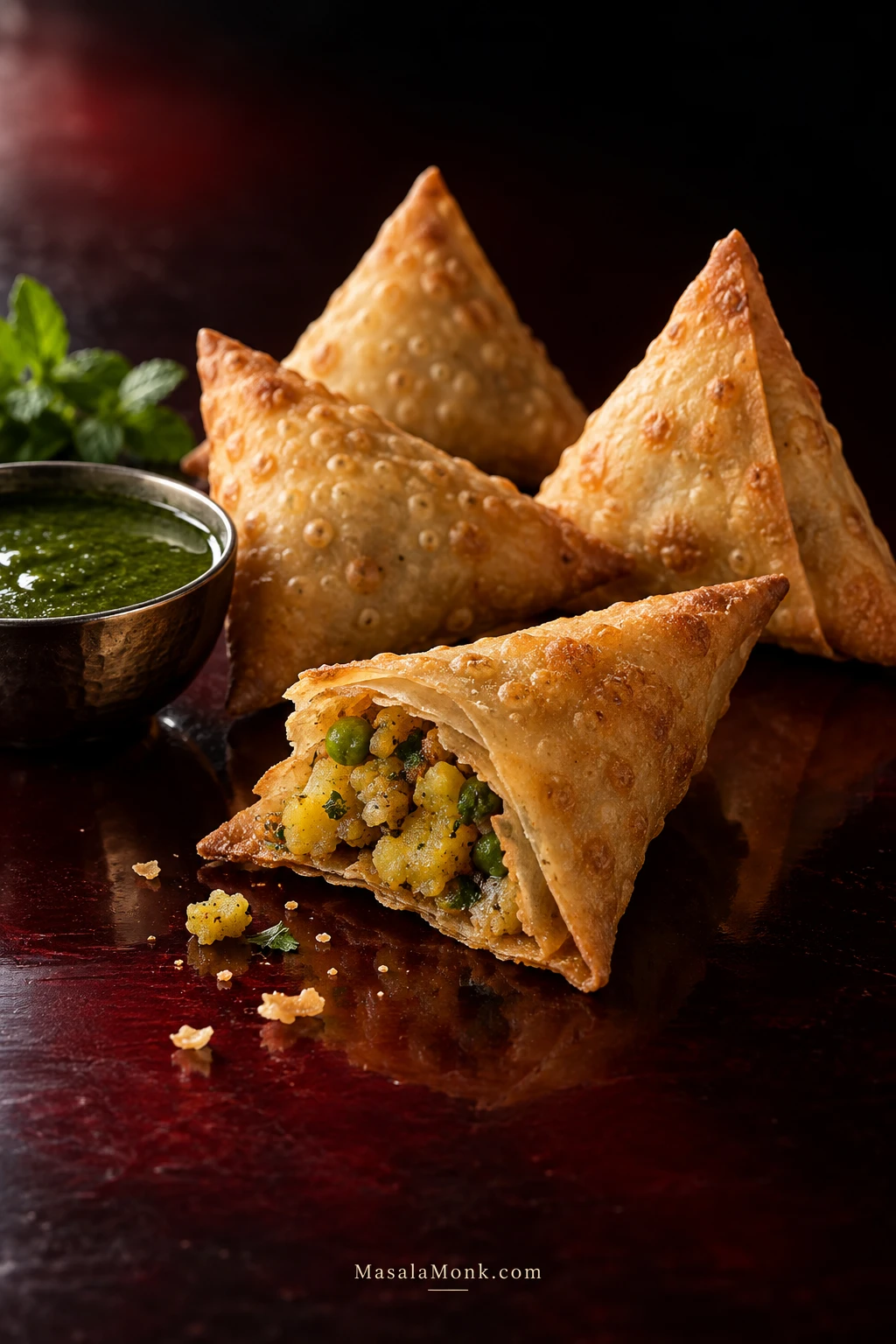
Break open a good patti samosa while it is still hot and the wrapper should give way almost instantly: thin, crisp layers around a filling that has stayed exactly where you put it. The corners should be crisp all the way through, without a thick doughy fold or a hidden pocket of frying oil.
The frustrating part is getting there. Frozen sheets crack halfway through the first fold. Thawed wrappers stick together. Homemade layers refuse to peel. A tiny opening at the pointed corner lets oil inside, or a flap that looked secure lifts as soon as it reaches the fryer.
Most of those failures are connected. Wrapper condition, filling moisture, the first fold, the final seal and the heat all affect what happens next. Get those five things under control and patti stops feeling nearly as fragile as it first appears.
This is the thin wrapper behind many little onion samosas, tea-shop triangles and big batches for sharing—not the thicker pastry shell of a Punjabi samosa. You can buy patti frozen, make it at home, or adapt the right kind of spring-roll wrapper.
Jump straight to what you need:
Quick Answer: What Makes Patti Samosas Work
- Wrapper: wait until frozen patti bends sharply without whitening, splitting or cracking.
- Filling: use it cool or chilled and fairly dry, with no loose liquid underneath.
- First fold: close the pointed corner completely before filling the pocket.
- Final seal: keep the edge clean and use a thick flour-and-water paste.
- Frying: begin around 165–175°C / 330–350°F; very thin patti often does better toward the lower end.
If the first frozen sheet cracks, stop there. Give the stack more time instead of sacrificing the next five.
↓ Jump to the Homemade Patti Recipe Card
What Is Samosa Patti?
Samosa patti is a thin flour wrapper, usually cut or sold as a long rectangle, used for folding triangular samosas. Depending on the market or manufacturer, the same wrapper may be labelled samosa sheets, samosa pastry sheets, samosa leaves, samosa wrappers, roll patti or manda patti. “Samosa leaves” simply means thin samosa wrappers; it does not refer to a literal leaf.
Frozen patti normally comes as narrow strips ready for triangular folding. Spring-roll wrappers are more often square. Homemade patti starts as rolled dough that is briefly set on a tawa, peeled into thin sheets and then cut into strips.
Patti samosa vs Punjabi samosa
Patti is thin and folded over itself several times, giving the finished shell a light, layered crunch. Punjabi samosa pastry has much more body: it is rolled thicker, shaped into a cone and cooked as raw pastry around the filling.
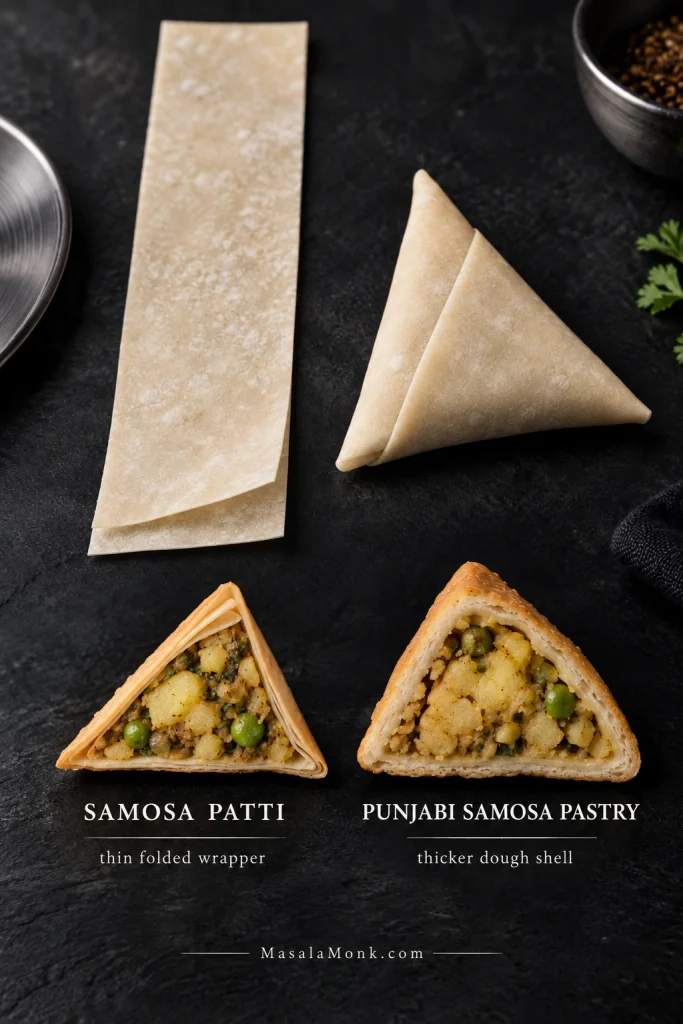
If what you want is that larger potato-and-pea samosa with a substantial flaky shell, use our Punjabi Samosa Recipe. Its dough and frying method are deliberately different.
Homemade Samosa Patti Recipe
The layered method is simpler on the counter than it sounds: roll four small discs, stack them with a little oil and flour between each one, roll the stack thin, then warm it just enough to peel the layers apart.
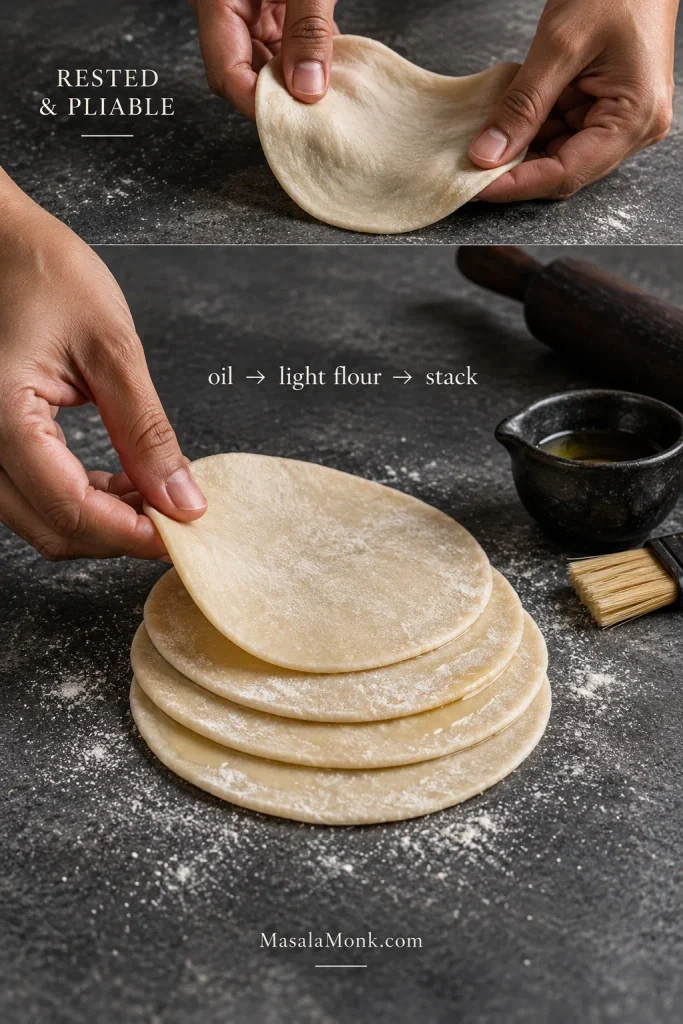
The first stack gets most of your attention. Once it separates cleanly, the next stacks usually go much faster.
Homemade Samosa Patti
Thin homemade samosa sheets made from a flexible flour dough, layered four at a time and briefly set on a tawa before peeling and cutting.
Ingredients
- 250 g / 8.8 oz all-purpose flour or maida
- 5 g fine salt, roughly ¾–1 teaspoon depending on the salt
- 30–35 ml / about 2–2⅓ tablespoons neutral oil
- 115–125 ml / about ½ cup water, added gradually
- Extra neutral oil for brushing between the layers
- Extra all-purpose flour for a light dusting between the layers
Equipment
- Mixing bowl
- Digital kitchen scale
- Rolling pin
- Large flat tawa, griddle or skillet
- Pastry brush
- Knife or pizza cutter
- Clean kitchen towel or covered container
Make, Rest and Layer the Dough
- Make the dough. Mix the flour and salt. Add the oil and work it through the flour, then pour in about 110 ml water. Add more only as needed until no dry flour remains and the dough comes together.
- Knead for 8–10 minutes. Keep going until the dough becomes smooth and elastic and stretches before it tears. It should feel pliable without becoming sticky.
- Rest for 20–30 minutes. Cover the dough. It should roll without immediately pulling itself smaller. Dough that still fights the rolling pin needs another 10 minutes under cover.
- Divide into 12 pieces. Each piece will be roughly 34 g. Keep the unused pieces covered.
- Roll four small discs. Work with four pieces at a time and roll each to around 11–13 cm / 4½–5 inches across.
- Layer them. Brush the first disc with a very thin film of oil, dust lightly with flour and place the next disc on top. Repeat until you have a four-layer stack.
Roll, Set, Peel and Cut the Patti
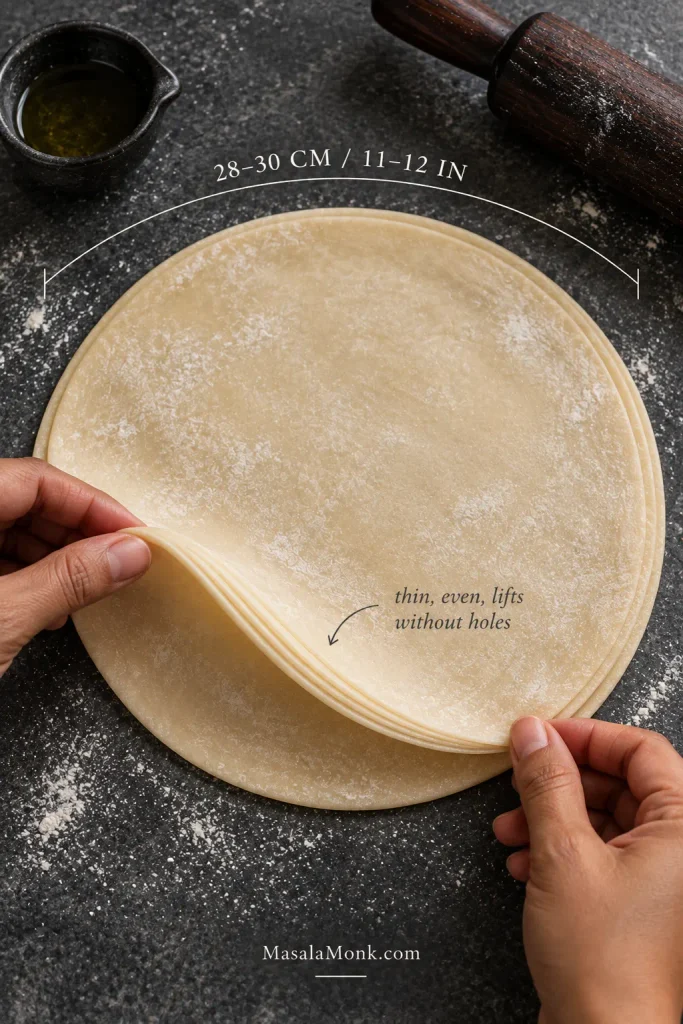
- Roll the stack thin. Dust the outside lightly and roll to roughly 28–30 cm / 11–12 inches across, or as large as your tawa comfortably takes. Rotate as you work so the centre and edges stay reasonably even. The stack should lift without developing holes.
- Set the surfaces. Warm the stack over low heat for roughly 10–30 seconds per side. The raw wet look should disappear and the layers should begin loosening. Keep the pastry pale.
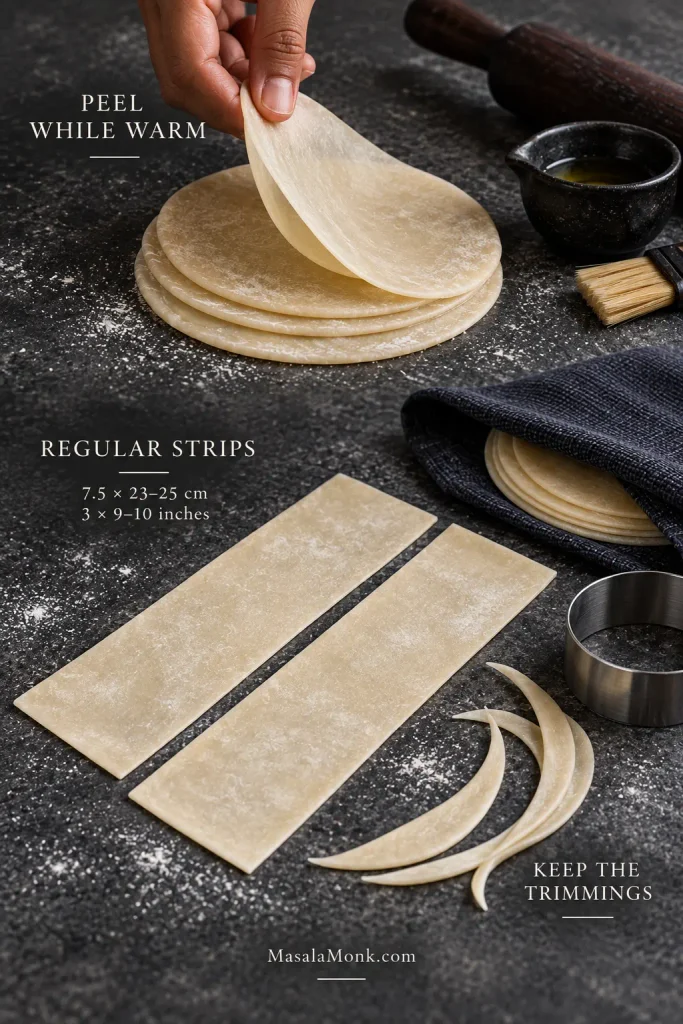
- Peel while warm. Lift an edge and separate one sheet gently. Work around an edge that already wants to release instead of pulling hard through the middle. A stubborn stack can go back onto the warm tawa for a few seconds.
- Cut and cover. Each large peeled sheet should give about two regular strips around 7.5 × 23–25 cm / 3 × 9–10 inches. Keep the curved pieces for mini samosas or small repairs. Cover everything immediately.
Watch the pastry, not only the stopwatch: it should come off the tawa pale, warm and easy to peel. Brown patches and a cooked-flatbread feel mean the stack has gone farther than necessary.
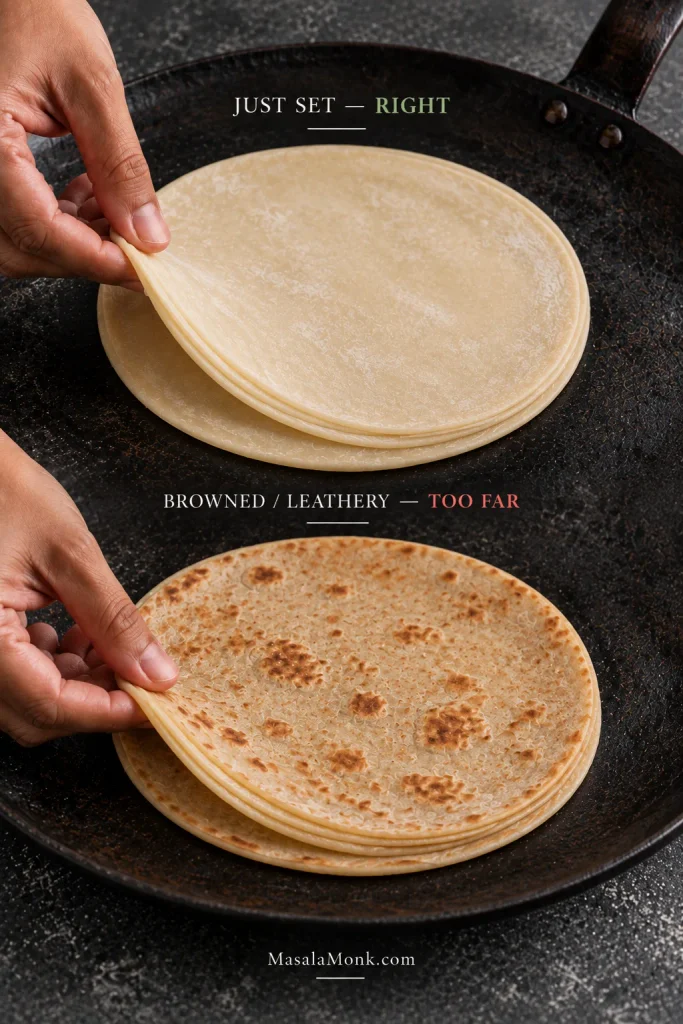
A good finished sheet almost drapes over your hand, but still lifts without tearing. That balance matters more than chasing an exact thickness with a ruler.
Why the Dough Rolls So Thin
The clearest sign is what happens under the rolling pin. A tense piece keeps shrinking after every pass. Give it another short rest and the same dough spreads with far less resistance.
Kneading gives the dough enough strength to become thin without falling apart; resting lets it relax. Between the discs, use only a fine film of oil and a light dusting of flour. Heavy flouring leaves dry patches, while poor separation can make the layers fuse.
Using frozen patti? · Patti ready? Start folding →
Using Ready-Made or Frozen Samosa Patti
Look in the frozen or chilled section of South Asian, Middle Eastern and international grocery stores, often near frozen parathas and spring-roll sheets. Patti may also be labelled samosa sheets, samosa pastry, samosa leaves, roll patti or manda patti.
Size and thickness
| Style | Starting strip size | Good for |
|---|---|---|
| Mini | About 5 × 15 cm / 2 × 6 in | Cocktail and party samosas |
| Small patti | About 5–6 × 20 cm / 2–2½ × 8 in | Tea-time and onion samosas |
| Regular patti | About 7.5 × 23–25 cm / 3 × 9–10 in | Potato, chicken, keema and larger patti samosas |
Check dimensions before relying on the number of sheets printed on the packet. For regular patti, start around 3 inches / 7.5 cm wide. Very delicate sheets can fry beautifully, but a slightly sturdier wrapper often gives a first-time folder more margin.
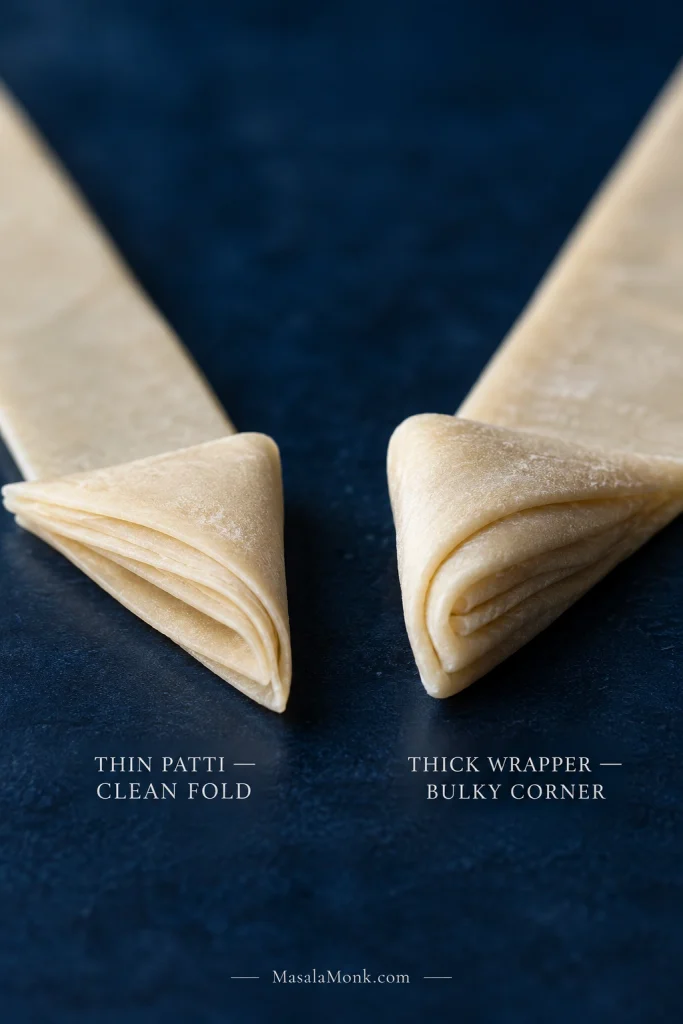
The flat sheet can also hide how thick it will feel later. Fold one corner several times. If that little stack already feels bulky, the finished samosa will have a heavy corner.
Frozen patti: cold, ready, dry or sticky?
Packet thawing times are only estimates. The wrapper itself tells you when to start. A thick stack can remain cold in the centre even after the outside feels soft.
| Condition | What you will notice | What to do |
|---|---|---|
| Too cold | Stiff; pale stress line at the bend; cracking | Give the closed pack more time |
| Ready | Flexible; bends cleanly; layers release without force | Start folding |
| Too dry | Crumbly edge; random splitting after thawing | Keep covered; reject badly damaged sheets |
| Too sticky | Layers drag, stretch or tear | Handle gently and avoid adding moisture |
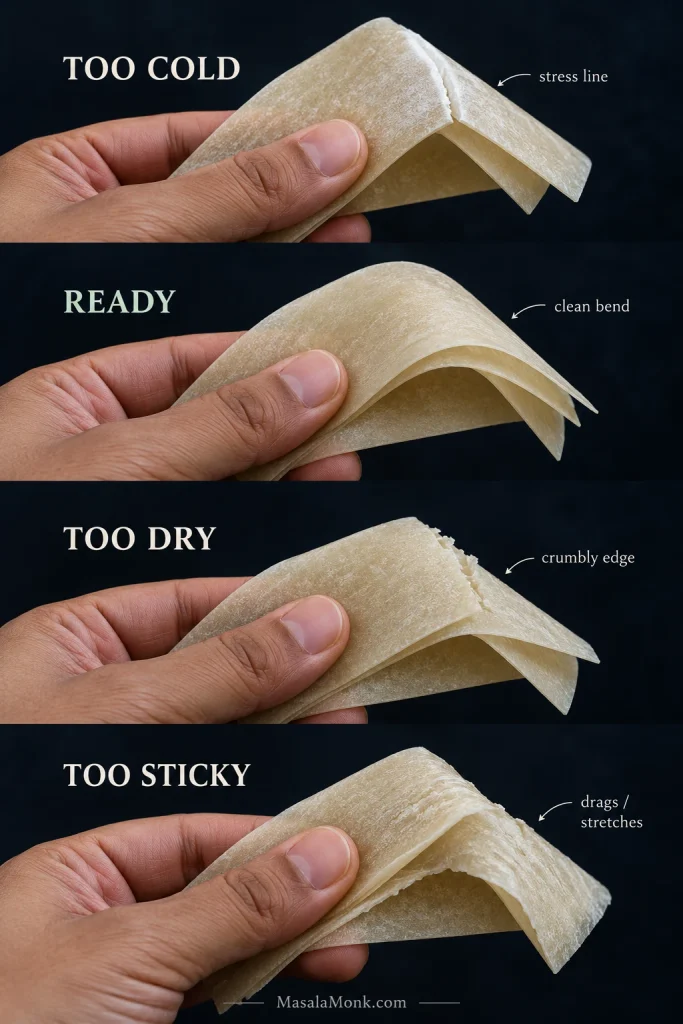
A sheet that starts tearing halfway across is usually still too cold. Cover the stack again instead of forcing the layers apart.
Take out only the sheets you can fill immediately and keep the rest covered. A clean, slightly damp towel or a covered container slows drying without leaving the pastry wet.
Fully thawed patti should not crumble in your fingers. Several sheets splitting or flaking in the same way usually points to the packet rather than your technique.
Patti ready? Start folding → · Still cracking or sticking? Troubleshoot →
How to Fold Samosa Patti: Fill, Fold and Seal the Triangle
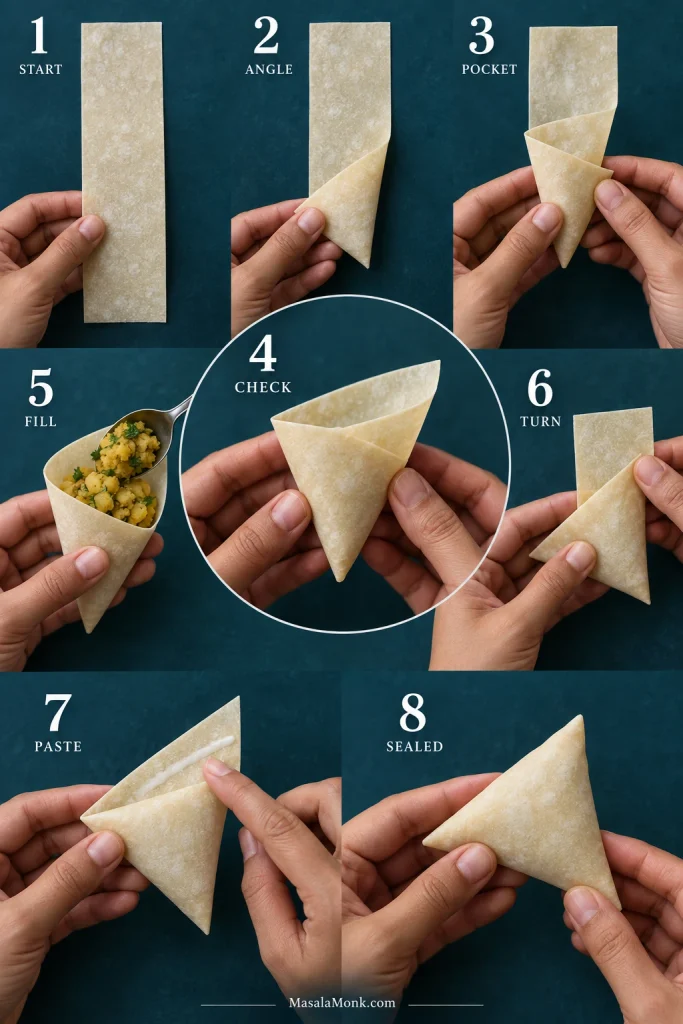
The first two turns do most of the thinking. The first gives you the angle; the second turns a flat strip into an actual pocket. Once that shape makes sense in your hands, the rest becomes much more repetitive.
Before you fold: use cool or chilled filling with no loose liquid underneath. Chicken, keema and other meat fillings should already be fully cooked.
1. Make the first triangle
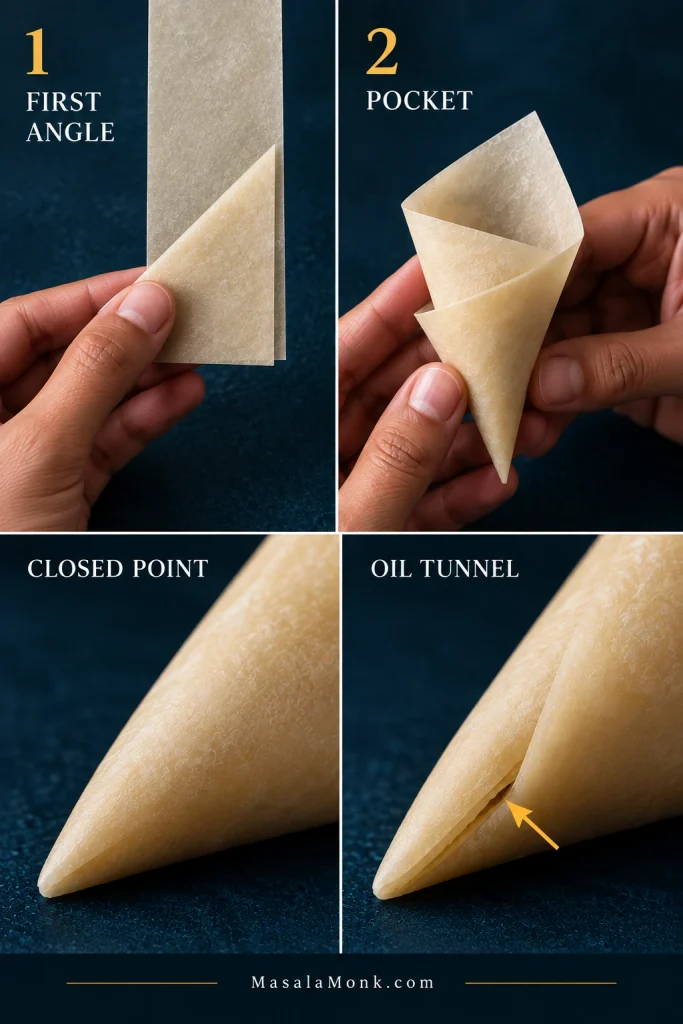
Lay the strip vertically. Bring the bottom-left corner diagonally upward to the right edge. The lower end now forms a neat triangle. You can mirror the direction and start from the bottom-right if that feels more natural.
Get this angle right now. A crooked first fold carries the mistake through every turn that follows.
2. Fold again to make the pocket
Turn the first triangle upward once along its straight edge. This is the moment the strip starts looking less like a wrapper and more like a samosa: you now have a pocket with an opening at the top and a pointed corner underneath.
Slip a fingertip gently into the opening and check the bottom point. It needs to be closed. A tiny tunnel here gives frying oil a direct route inside.
3. Fill without stretching the pocket
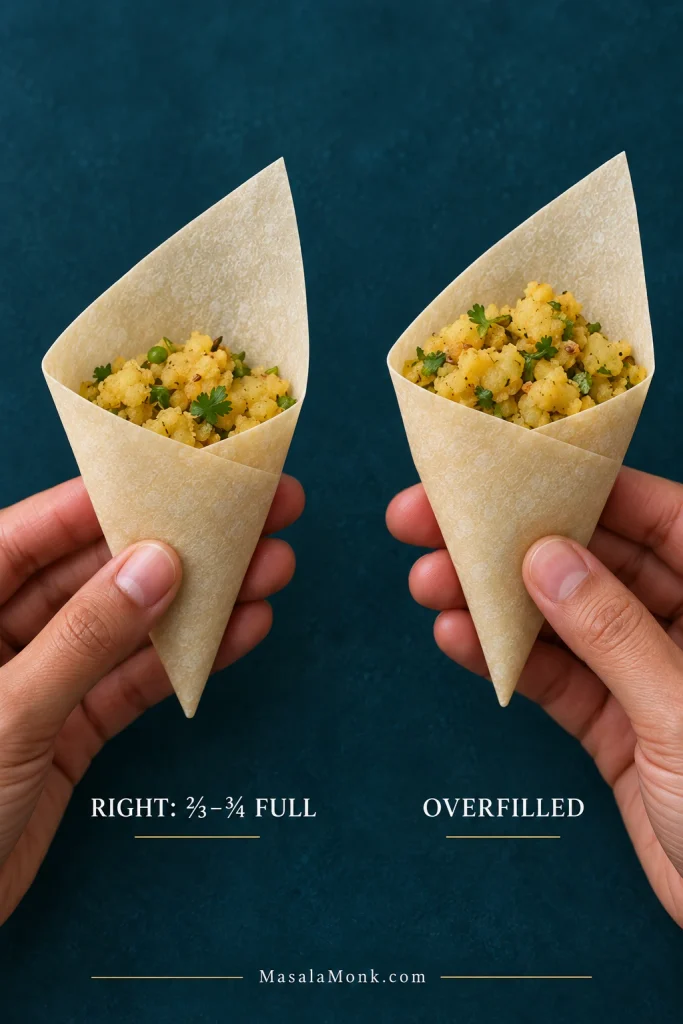
A small strip may need only 1–2 teaspoons. A regular-width wrapper can start with around 1 tablespoon.
Then look at the pocket rather than the spoon. Stop around two-thirds to three-quarters full. It should look comfortably filled, not swollen.
4. Keep turning the triangle
Fold the filled triangle over itself, following the straight edges of the strip. Keep the shape triangular and avoid squeezing the filling outward. After a few samosas, this part usually becomes the quickest step.
5. Seal the final flap
Keep the last edge clean. Potato, onion juice, rendered fat, melted cheese or sauce between the flap and the pastry can weaken the bond.
Mix 30 g all-purpose flour with about 20–22 ml / about 1½ tablespoons water to start. Add more water a teaspoon at a time until the paste is thick, smooth and brushable.
- Too thin: runs away from the sealing edge.
- Right: spreads in a narrow strip and stays where you brush it.
- Too thick: sits in lumps and stops the flap lying flat.
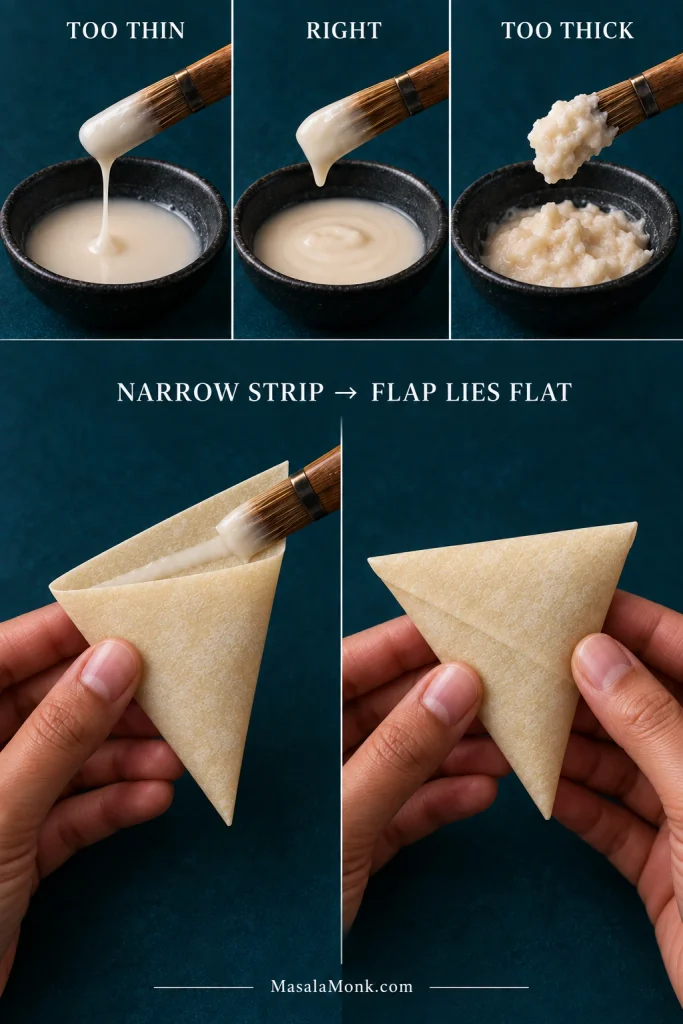
Press the flap onto clean pastry. A finished triangle should sit on the tray without your fingers holding it closed.
6. Give it a 10-second check
- Pointed corner: closed, with no visible tunnel?
- Sides: intact, with no filling showing?
- Final flap: flat and holding?
- Filling: sitting comfortably rather than forcing the wrapper outward?
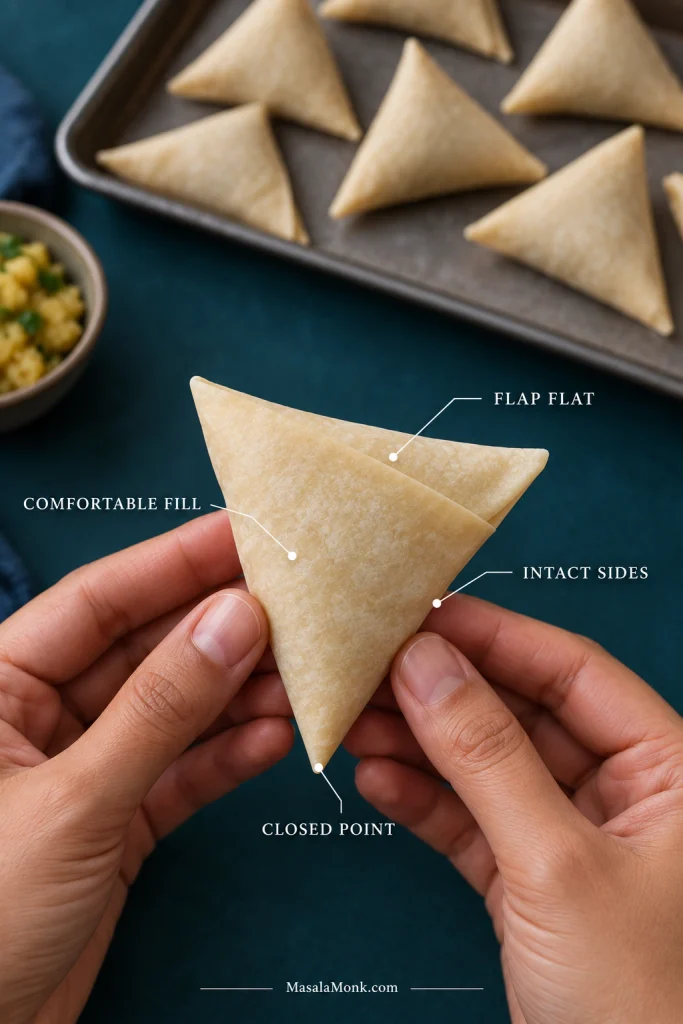
By this point the tray should begin looking more regular than the first few pieces did. That is normal: folding patti is one of those jobs your hands learn faster than your head expects.
Ready to cook? Fry, air fry or bake → · Flap or seam failing? Troubleshoot →
Fry, Air Fry or Bake
| Method | Starting temperature | What success looks like |
|---|---|---|
| Deep fry | 165–175°C / 330–350°F | Steady bubbling; gradual golden colour; light crisp layers |
| Air fryer | 180°C / 350°F | Even browning with a light oil coating; crisp corners |
| Oven | 180°C / 350°F | Crisp wrapper with no chewy fold lines |
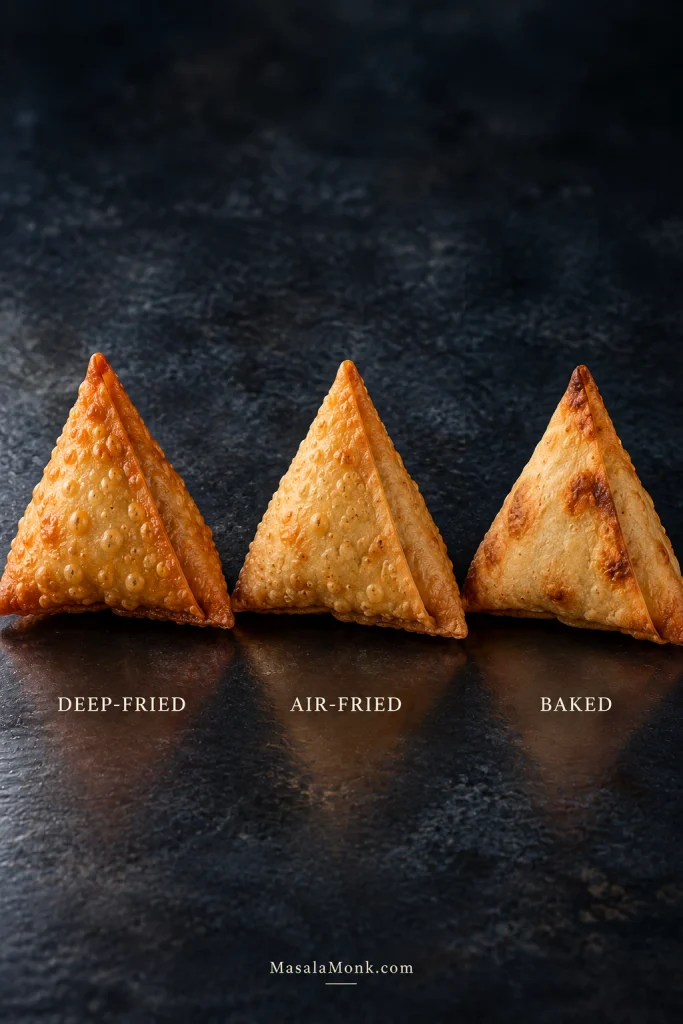
A properly cooked patti samosa feels light when you lift it. Break a corner and the wrapper should crack rather than bend.
Deep frying
Use enough neutral, high-smoke-point frying oil for the samosas to float without resting against the bottom of the pot.
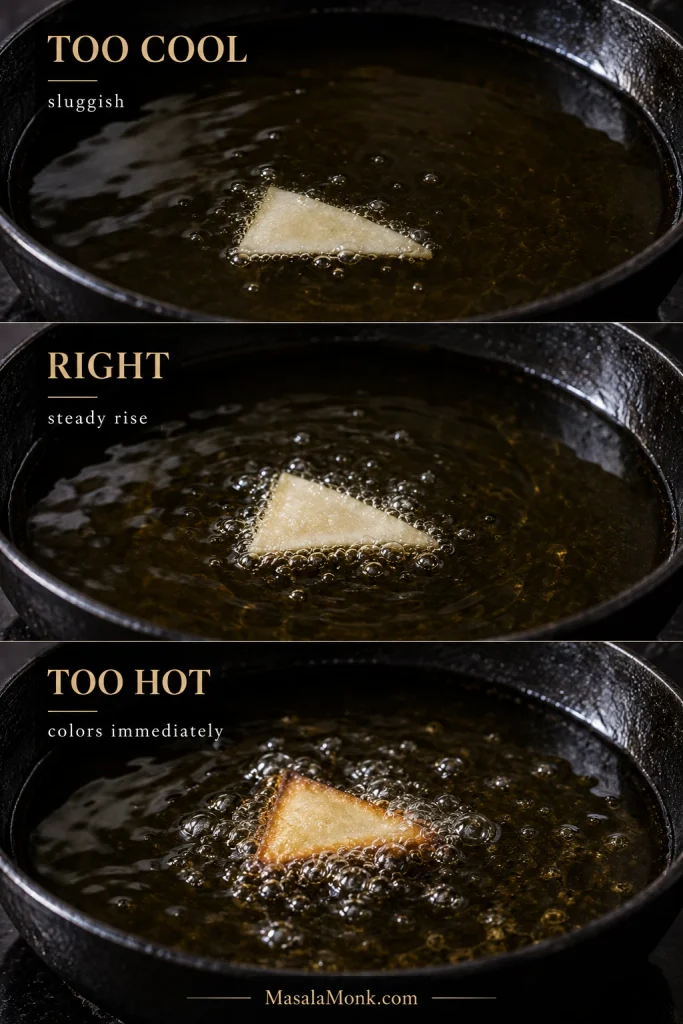
Start around 165–175°C / 330–350°F. Very thin commercial patti often does better toward the lower end. Frying time varies with wrapper thickness, samosa size and whether the filling is chilled or frozen.
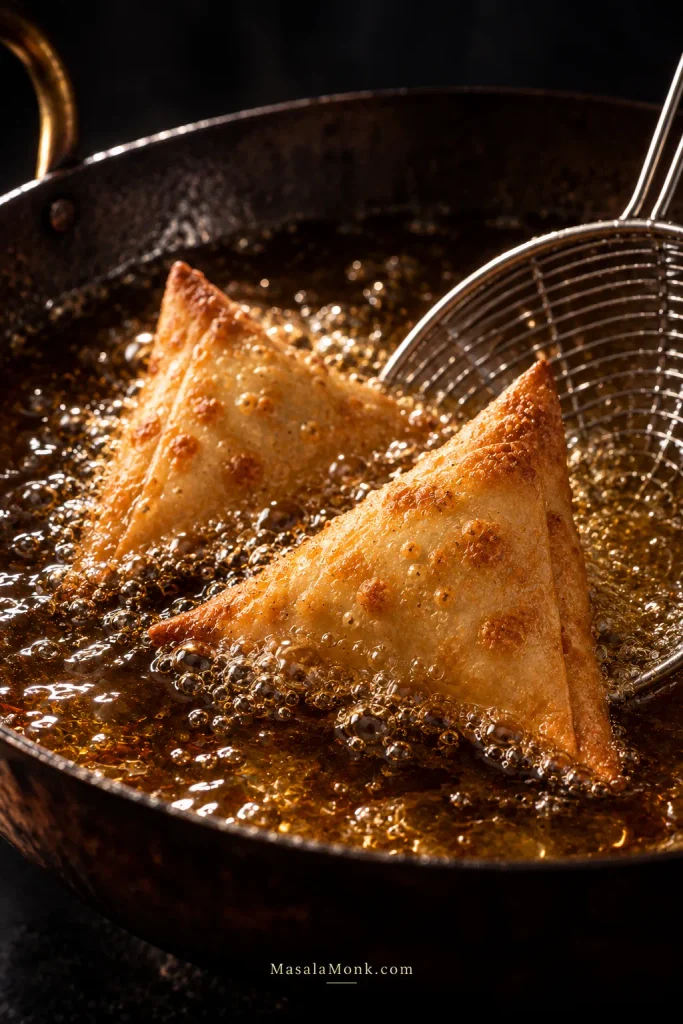
No thermometer? Drop in a small patti trimming. It should bubble and rise steadily without racing to dark brown: a sluggish scrap means the oil needs more heat; immediate colour means it needs less. Then fry one samosa before loading the pot. Its colour should build gradually while bubbling remains active around the folds, giving you a much better read on your particular wrapper than a universal timer will.
Frozen samosas pull the temperature down quickly, so begin with a small batch and let the oil recover. Brush away loose frost or visible ice before deep frying, and never lower a wet or ice-coated samosa into hot oil.
Lift finished samosas onto a wire rack when possible. Steam escapes instead of collecting under the pastry and softening the base.
For hot-oil handling and fryer safety, see the USDA deep-fat frying safety guide.
Air fryer
Brush or spray the samosas lightly with oil and air fry at about 180°C / 350°F. Begin checking around 10 minutes; many batches take roughly 12–15 minutes. Turn once so both faces and the layered edges crisp.
Pale, papery patches usually need better oil coverage, more airflow or more cooking time. These common air fryer mistakes are useful for checking crowding, airflow and preheating.
Oven
Brush or spray the samosas lightly with oil and bake at about 180°C / 350°F. Begin checking around 12–15 minutes, turn if needed and continue until the layered corners are crisp.
Reheating cooked samosas
Reheat fried samosas in an oven or air fryer around 165°C / 330°F, beginning to check after about 5–8 minutes. Continue until the wrapper is crisp again and the filling is hot.
For leftovers filled with cooked meat or another perishable filling, reheat the centre to 74°C / 165°F. A microwave heats the middle quickly but usually leaves thin patti soft.
More filling ideas → · Frying or finishing problem? Troubleshoot →
What Can You Fill Patti Samosas With?
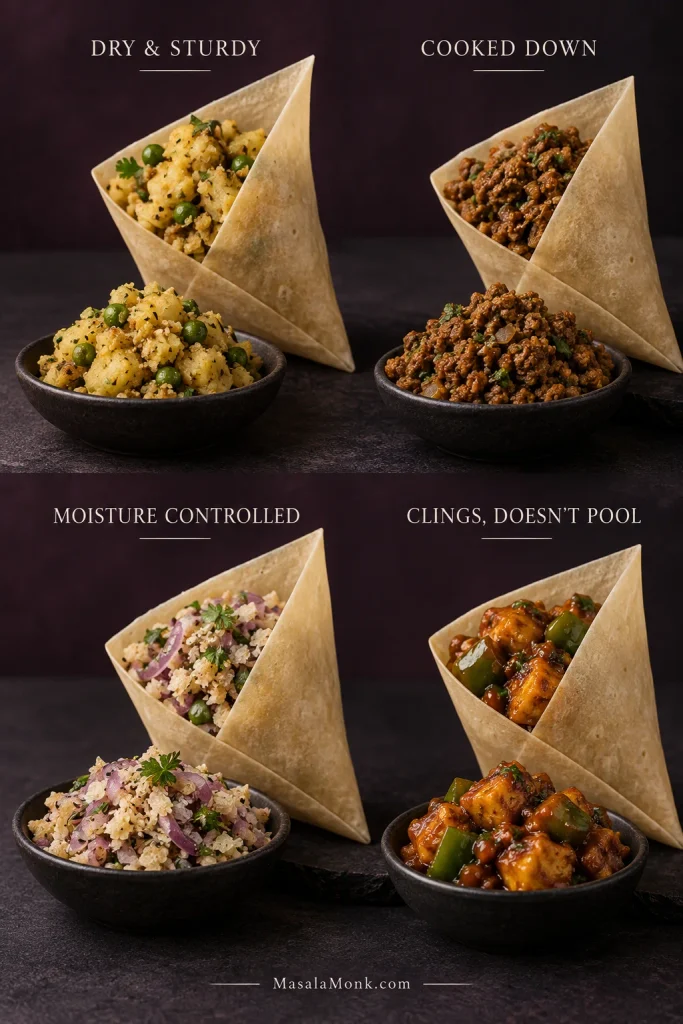
Patti works best with fillings that are already cooked or need only brief cooking, and that do not leave loose liquid sitting in the bowl. Meat fillings are best fully cooked before wrapping; onion-style fillings can go in uncooked when their moisture is properly controlled.
- Dry and sturdy: spiced potato is naturally forgiving. Chicken and keema also work beautifully when cooked down until no liquid or rendered fat is pooling in the pan.
- Fresh and punchy: onion or Irani-style fillings give patti samosas their tea-shop character, but excess onion moisture needs to be controlled before folding.
- Saucy: Chinese-style vegetables or chicken work when the sauce clings instead of collecting underneath. Our stir fry sauce guide goes deeper into that glossy, coating consistency.
- Rich and melty: cheese-corn and similar fillings need a little extra room. Hot cheese finds an overfilled seam quickly.
The smaller pieces left after cutting homemade patti are ideal for mini samosas. Nobody minds an extra tray of those.
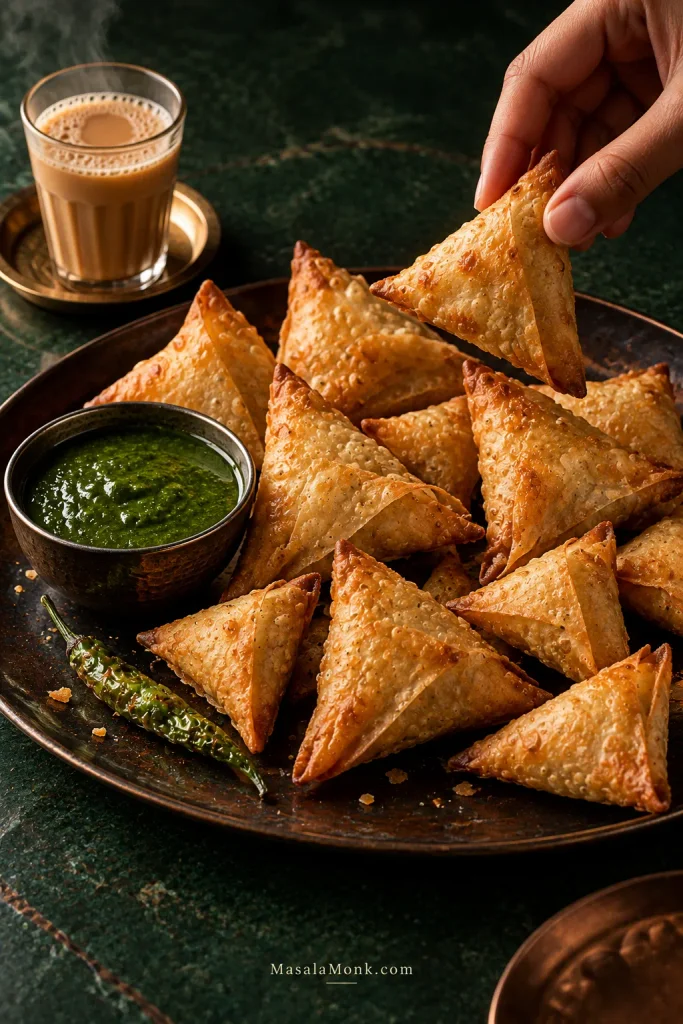
As the first batch comes out, the smell of hot fried pastry and spiced filling finally catches up with all that careful folding. Serve them while the edges still crackle; a bright coriander-mint green chutney gives the hot pastry a fresh, sharp contrast.
Other Ways to Get a Thin Samosa Wrapper
Rolled patti gives you the wrapper described above, but it is not the only way to get a thin sheet that folds well.
Batter-Made Samosa Sheets
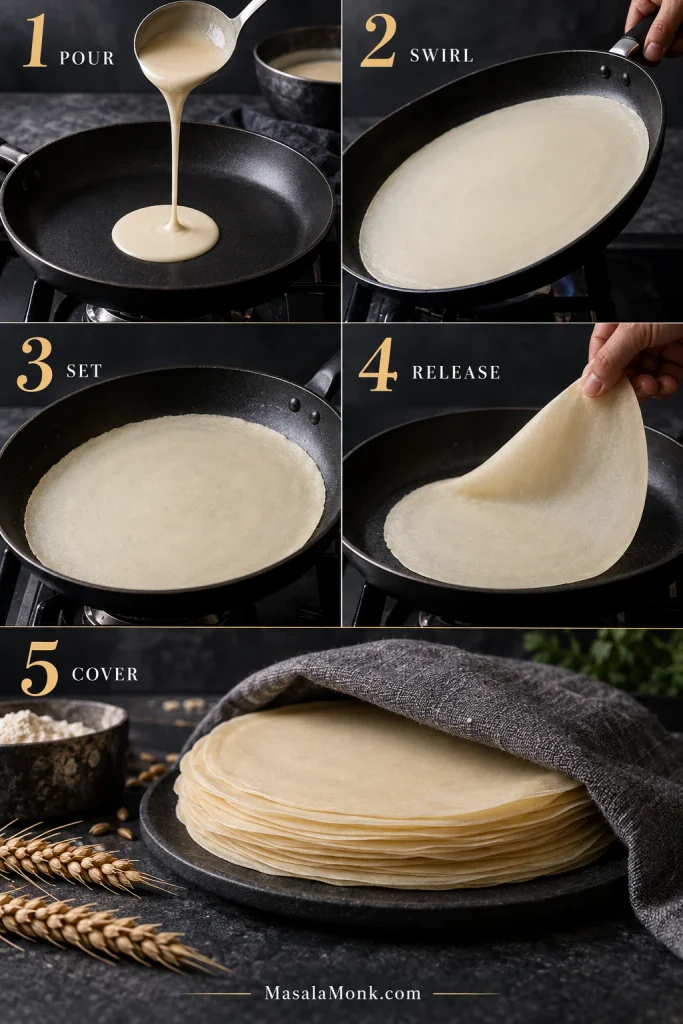
If rolling very thin dough is the part you would rather skip, batter-made sheets are another option. Their texture differs slightly from rolled patti, but they fold and crisp well.
Whisk together 240 g all-purpose flour, 15–20 g cornstarch, 3 g salt and about 480 ml water. Add more water gradually, up to roughly 600 ml if needed. The batter needs to flow easily enough to form a very thin layer in the pan.
Wipe a nonstick skillet with a trace of oil. Pour just enough batter to cover the base in a very thin layer, tilting or swirling the pan immediately. In a small skillet, about 2 tablespoons is a reasonable starting amount; larger pans will need more.
Once the wet shine disappears and the edge releases cleanly, lift the sheet. A tacky top needs only a few seconds on the second side. Keep the wrapper pale and flexible, and cover finished sheets as you work.
Can You Use Spring-Roll Sheets Instead?
Yes. Thin wheat spring-roll wrappers are one of the easiest substitutes when proper patti is unavailable. Square sheets may need cutting into strips before folding.
| Wrapper | Does it work? | What changes? |
|---|---|---|
| Samosa patti | Yes — ideal | Narrow strip already suited to triangular folding |
| Thin spring-roll sheet | Yes | Usually square; may need cutting |
| Thick egg-roll wrapper | Possible | Heavier shell and bulkier corners |
| Filo/phyllo | Possible, with a different method | Fragile layered pastry rather than a direct patti substitute |
| Puff pastry | Not equivalent | Puffs and flakes instead of forming the same thin shell |
| Punjabi samosa dough | A different samosa style | Thicker raw pastry shaped into a cone |
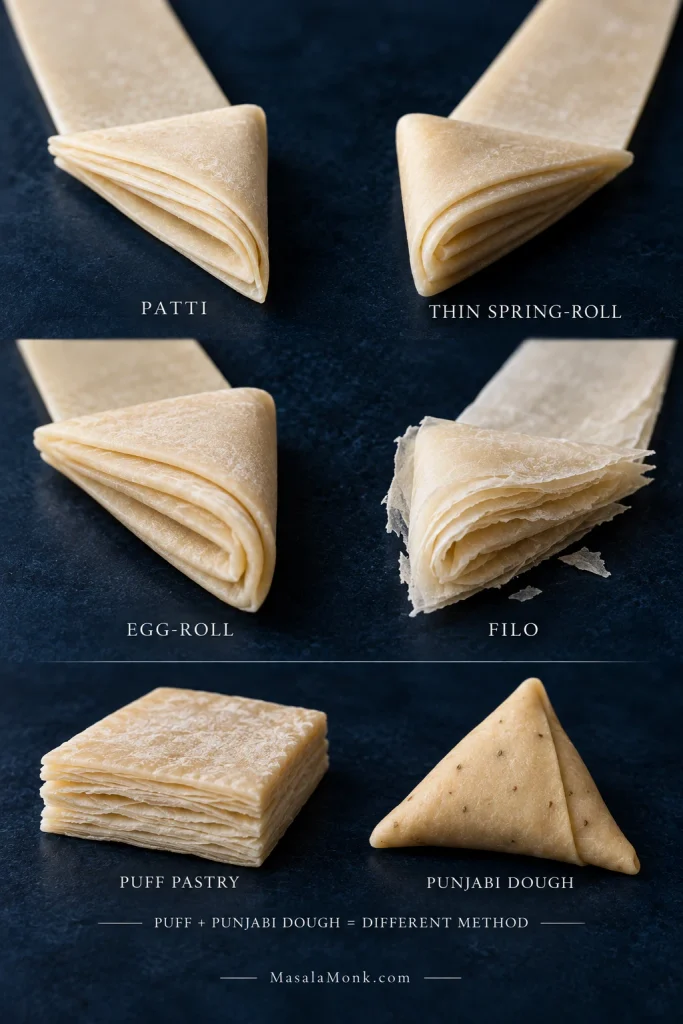
For the closest result, choose a thin, flexible wheat wrapper. Thick egg-roll-style wrappers become heavy quickly at the folded corners.
If square wrappers are what you have, our crispy spring roll recipe goes deeper into handling thin wrappers, controlling filling moisture and sealing them before frying.
Wrapper chosen? Start folding → · Making them ahead? Store or freeze →
Make Ahead, Refrigerate and Freeze
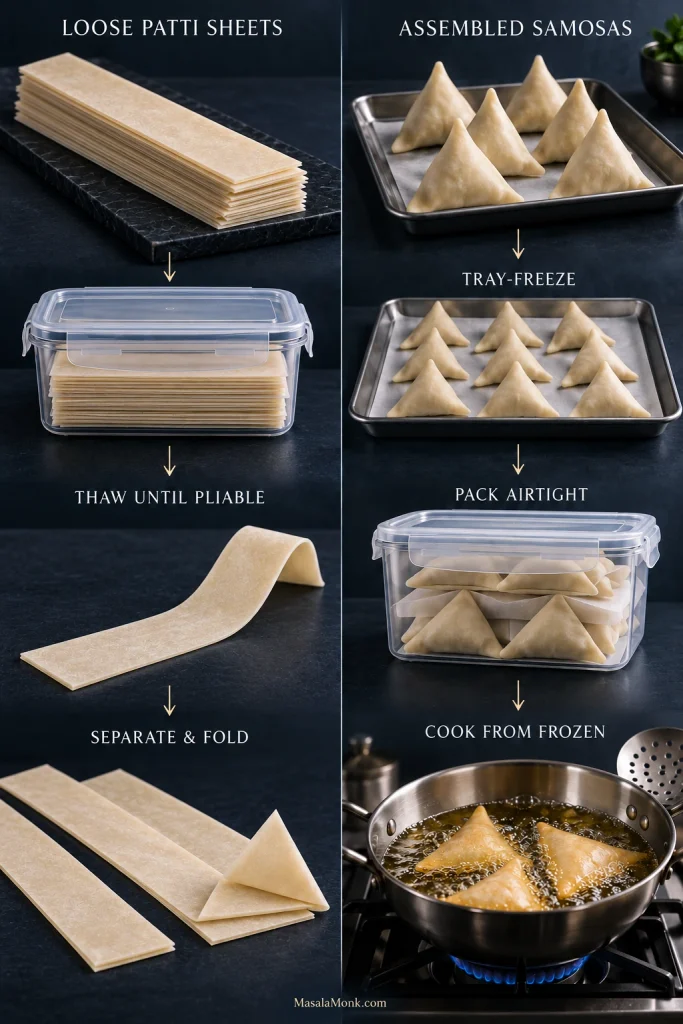
Cooking within a few hours? Arrange shaped samosas in a single layer, cover them and refrigerate them. For a longer hold, freezing preserves the wrapper better because even covered patti gradually softens as moisture moves from the filling into the pastry. The filling itself can be cooked, cooled promptly and refrigerated until you are ready to fold.
Loose homemade sheets
Cool the briefly set sheets completely, stack them neatly and seal them in a freezer-safe bag or airtight container. For the best texture, aim to use homemade patti within about 1 month. Thaw until pliable before separating and folding.
Commercial frozen patti
Follow the packet’s storage and refreezing directions. Commercial patti is commonly kept around −18°C / 0°F, and repeated thawing can leave thin wrappers drier, stickier or more fragile.
For general guidance on freezer temperature, thawing and refreezing, see the USDA guide to freezing and food safety.
Uncooked filled samosas
Freeze shaped samosas in a single layer until firm, then transfer them to an airtight container or freezer bag. They are generally cooked straight from frozen. Before deep frying, inspect the seams and brush away loose frost or visible ice.
A frozen filling heats more slowly than the thin wrapper crisps. If the samosas contain previously cooked meat, make sure the centre reaches 74°C / 165°F.
Already fried samosas
Let excess steam escape before packing fried samosas, but refrigerate cooked samosas within 2 hours. Reheat them with dry circulating heat when you want the exterior crisp again.
Cooking from frozen? Deep-frying guide → · Freezer or wrapper problem? Troubleshoot →
Troubleshooting: Cracks, Leaks and Open Seams
There is no reason to troubleshoot a batch that is already behaving itself. Come here when the same failure keeps repeating.
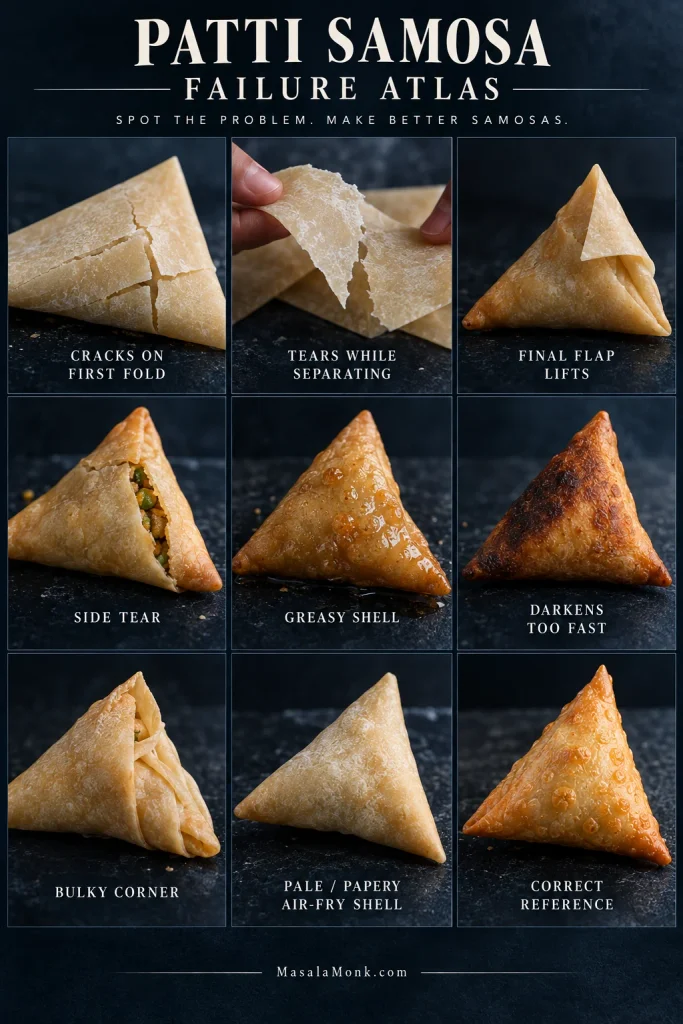
Wrapper and dough problems
| Problem | Likely reason | What to do now |
|---|---|---|
| Sheet cracks on first fold | Too cold, too dry or damaged | Cover the remaining sheets and let them soften further |
| Sheet tears while separating | Stack still too cold or layers sticking | Stop pulling and give the covered stack more time |
| Sheets stick together | Condensation, incomplete thawing or packet quality | Work from naturally releasing edges and avoid extra moisture |
| Fully thawed sheet crumbles | Likely dehydrated or freezer-damaged | Try another sheet or packet |
| Homemade dough springs back | Dough still tense | Cover and rest another 10–15 minutes |
| Homemade layers will not peel | Layers fused, under-set or cooled too far | Warm briefly and try a naturally releasing edge |
| Homemade sheet feels leathery | Too much time on the tawa | Shorten the pre-set on the next stack |
Folding and sealing problems
- A hole at the pointed corner: reopen the pocket and correct the first folds before adding filling.
- If the final flap keeps lifting: wipe the edge clean and reseal with thicker flour paste.
- Side tears while closing: remove some filling. A tiny split can be patched with a scrap of patti and flour paste; a badly torn wrapper is better replaced.
- The samosa softens while waiting: moisture is moving into the wrapper. Cook or freeze the batch sooner.
- The edges dry before frying: keep shaped samosas covered while the rest of the batch is folded.
Where the failure begins matters. A loose final flap and an open bottom corner can both leak, but they need different fixes.
Frying and finishing problems
| Problem | Likely reason | What to do now |
|---|---|---|
| Samosa opens in oil | Corner, flap or steam pressure failed | Find the exact opening before frying the next batch |
| Oil gets inside | Open pointed corner or seam tunnel | Inspect the next pockets before filling |
| Oil splatters badly | Surface water/ice or wet filling escaping | Keep wet pieces out of the fryer, brush away frost and remove any samosa that is visibly leaking |
| Samosa feels greasy | Oil too cool or batch too large | Let the oil recover before adding more |
| Wrapper darkens immediately | Oil too hot for that patti | Reduce the heat before the next batch |
| Folded corners are hard | Wrapper too thick | Choose or roll thinner patti next time |
| Air-fried shell stays pale and papery | Too little oil, crowding or too little cooking time | Add a light oil coat, leave more space and continue until the folds crisp |
One failed samosa can be useful. Look at where it failed before you fry the next six.
↑ Frozen patti · ↑ Folding & sealing · ↑ Cooking methods
Samosa Patti FAQs
1. What is samosa patti called in English?
Common English labels include samosa sheet, samosa wrapper and samosa pastry sheet. Depending on the market, you may also see samosa leaves, roll patti or manda patti.
2. Is samosa patti the same as a spring-roll sheet?
Not always. Patti is commonly sold as long strips, while spring-roll wrappers are usually square and vary in thickness. Thin wheat spring-roll sheets are the closest substitute.
3. Should frozen filled samosas be thawed before frying?
Usually not. Loose sheets need thawing before folding, but assembled samosas are generally cooked from frozen. Brush away visible frost or loose ice first and fry in small batches so the oil can recover.
The Fold Should Disappear Into the Bite
The first triangle can feel fiddly. Then you make another, and another, and somewhere along the tray your hands stop thinking about the geometry and simply follow the strip.
That is when the technique changes character. A pile of delicate sheets has become a row of neat little triangles, the later ones usually quicker and cleaner than the first.
Fry them, let the steam escape for a moment, then break one at the pointed end. The wrapper should crack into thin layers rather than fight back, leaving the filling hot inside and the fold almost disappearing into the bite.
If these are headed to the table for tea time, start the masala chai before the final batch so both arrive hot.








