
Acorn squash is slow; the filling isn’t. The trick with a good stuffed acorn squash recipe is getting those two timelines to meet. A half can look beautifully browned from above while the flesh underneath is still stubbornly firm. Leave everything in long enough for the squash to catch up and the sausage cooks twice, exposed rice dries around the edges, and the apple slowly disappears into the stuffing.
So most of the cooking happens before anything gets stuffed. The squash gets a head start in the oven while the sausage browns in the skillet. Wild rice goes in already tender, and the apple waits until near the end.
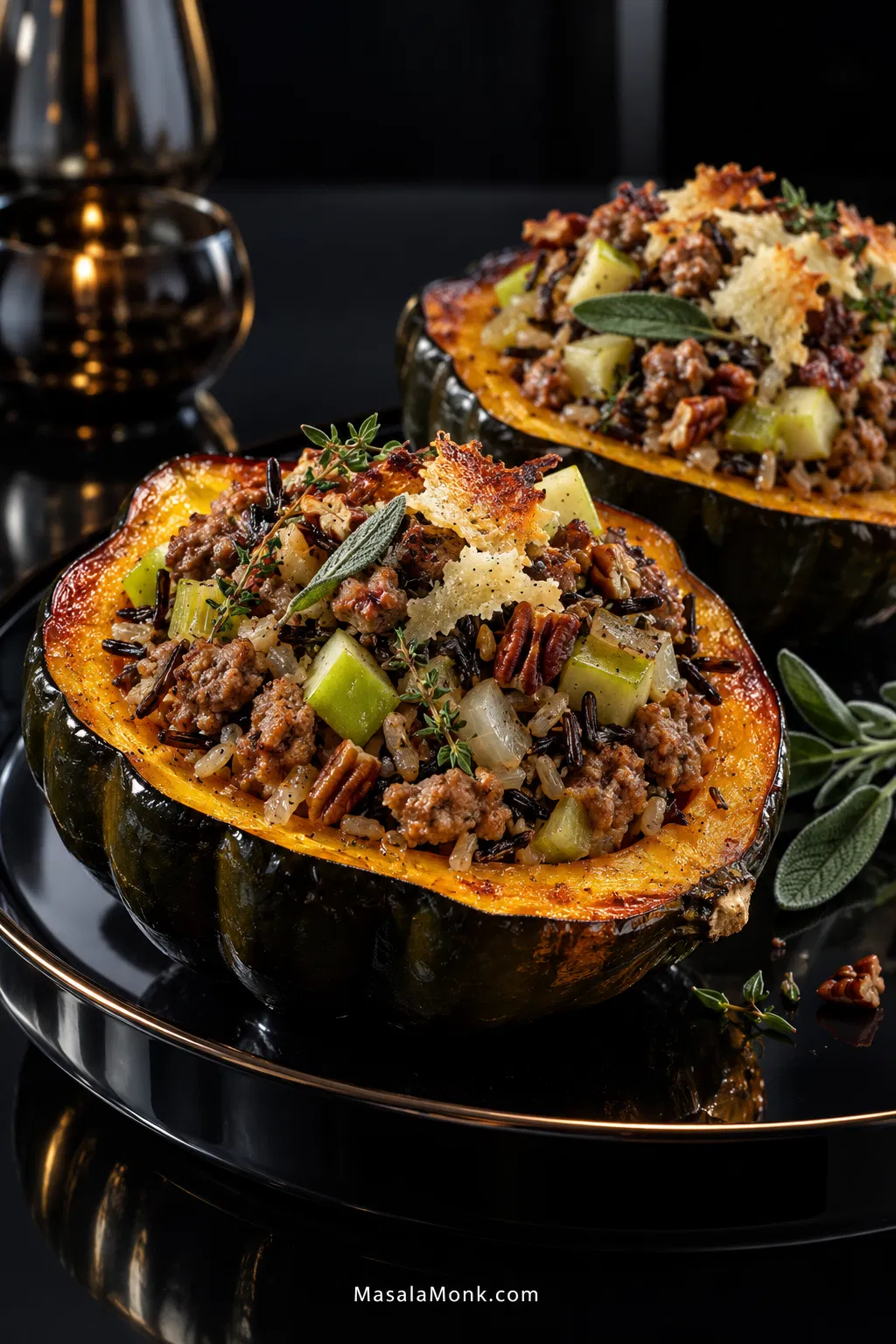
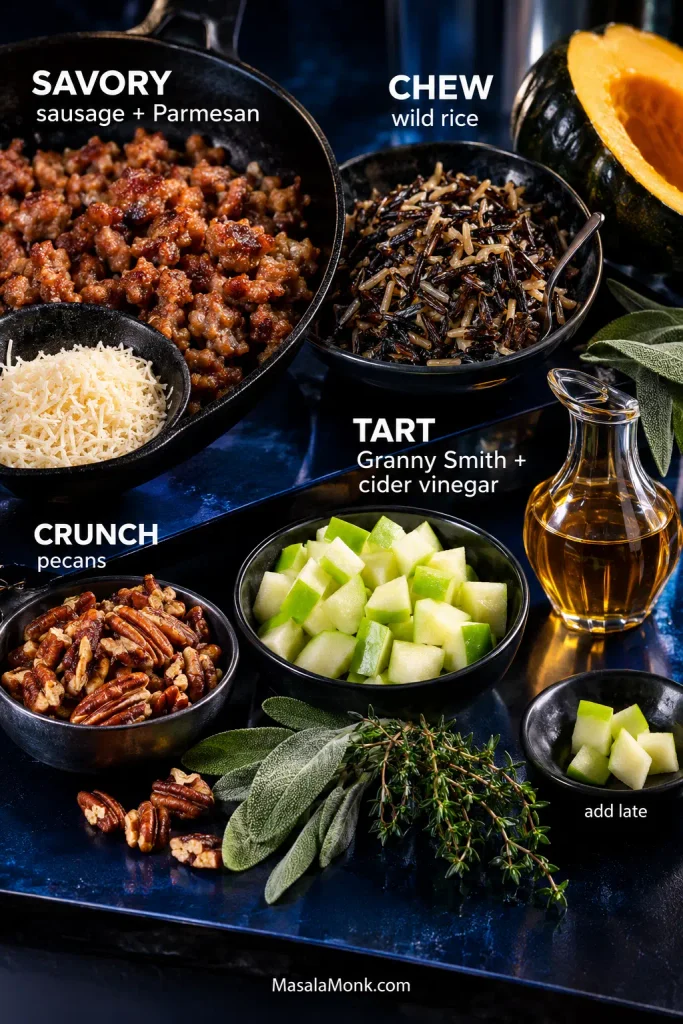
This version fills the roasted halves with mild Italian sausage, wild rice, Granny Smith apple, onion, celery, sage, thyme, toasted pecans and Parmesan. Wild rice has enough chew to stand up to the soft squash, the tart apple cuts through the sausage, and pecans keep a bit of crunch. Parmesan catches on exposed rice and sausage and browns in salty little patches.
Maple syrup and brown sugar aren’t required. This version stays savory, with cider vinegar, black pepper and herbs keeping the naturally sweet squash in balance. With a sharp salad or something green alongside, one stuffed half is plenty for dinner.
Jump to: Recipe · Filling ideas · Thanksgiving · Make ahead · Troubleshooting
Sausage, Apple & Wild Rice Stuffed Acorn Squash Recipe
The squash should give easily under a fork without collapsing. The filling should be moist and loose enough to mound, with browned sausage, tender rice and pieces of apple you can still pick out.
| Yield | 4 main-course servings or 6–8 smaller holiday-side portions |
| Active time | 25–30 minutes |
| Elapsed total | About 70–85 minutes; much of the filling work overlaps the first roast |
| Initial roast | 30–45 minutes |
| Final bake | 12–15 minutes |
| Oven | 400°F / 205°C conventional / about 185°C fan |
| Squash size | 2 similar squash, ideally around 1¼ lb / 570 g each |
| Make ahead | Up to 1 day |
Starting with dry wild rice? Put it on before prepping the squash; package timings vary, and you need 1½ cups cooked. Much of that cooking time overlaps the first roast. For ordinary rice, this guide to cooking rice covers several varieties and methods.
Ingredients
- 2 medium-large acorn squash, ideally about 1¼ lb / 570 g each; 1–1½ lb / 450–680 g each works
- 1 tablespoon / 15 ml olive oil for the squash, plus extra if the skillet looks dry
- ½ teaspoon fine salt for the squash, plus more after tasting
- Freshly ground black pepper, to taste
- 12 oz / 340 g mild pork Italian sausage, bulk or casings removed
- 1 small yellow onion, cut into ¼-inch / 6-mm dice
- 2 celery ribs, finely diced
- 2 garlic cloves, minced
- 1 teaspoon dried sage
- ½ teaspoon dried thyme
- 1 medium Granny Smith apple, cored and cut into ¼–⅜-inch / 6–10-mm dice; peel it for a softer filling
- 1½ cups cooked wild rice or cooked wild-rice blend
- ⅓ cup / about 40 g toasted pecans, roughly chopped
- 2 teaspoons / 10 ml apple cider vinegar, plus more as needed
- ½ cup / about 55 g finely grated Parmesan, divided
- ⅓ cup / about 40 g dried cranberries, optional
- Fresh parsley, sage or thyme for finishing, optional
Wait before adding extra salt. Italian sausage and Parmesan vary quite a bit, and rice cooked in broth may already bring salt of its own.
Equipment: a stable cutting board, sharp chef’s knife, sturdy spoon, large rimmed baking sheet, parchment, wide spatula or turner, large skillet, and a saucepan if you’re starting with dry rice.
How Long to Roast Acorn Squash at 400°F
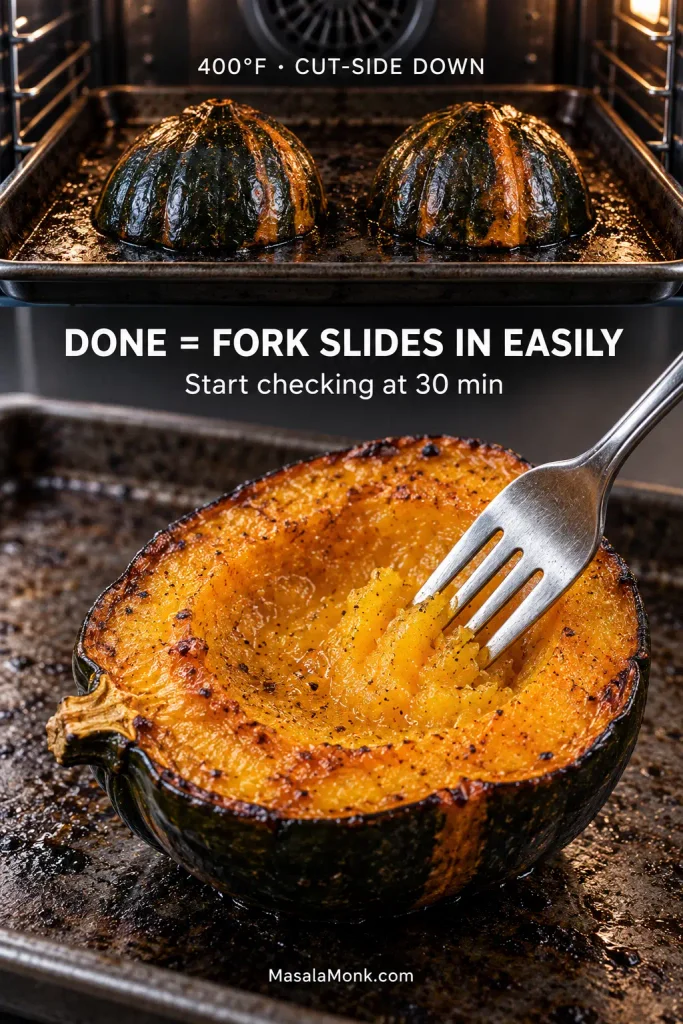
For acorn squash around 1¼ lb / 570 g each, start checking after 30 minutes at 400°F / 205°C. Most need 30–45 minutes before stuffing. A fork should slip easily into the thickest flesh while the shell remains sturdy enough to hold the filling.
How to Make Stuffed Acorn Squash
Start the Rice and Roast the Squash
- Cook the wild rice if needed. Follow the package until the grains are tender all the way through, then measure 1½ cups cooked. There shouldn’t be a hard center left in the grain.
- Heat the oven. Preheat to 400°F / 205°C conventional / about 185°C fan. Line a large rimmed baking sheet with parchment.
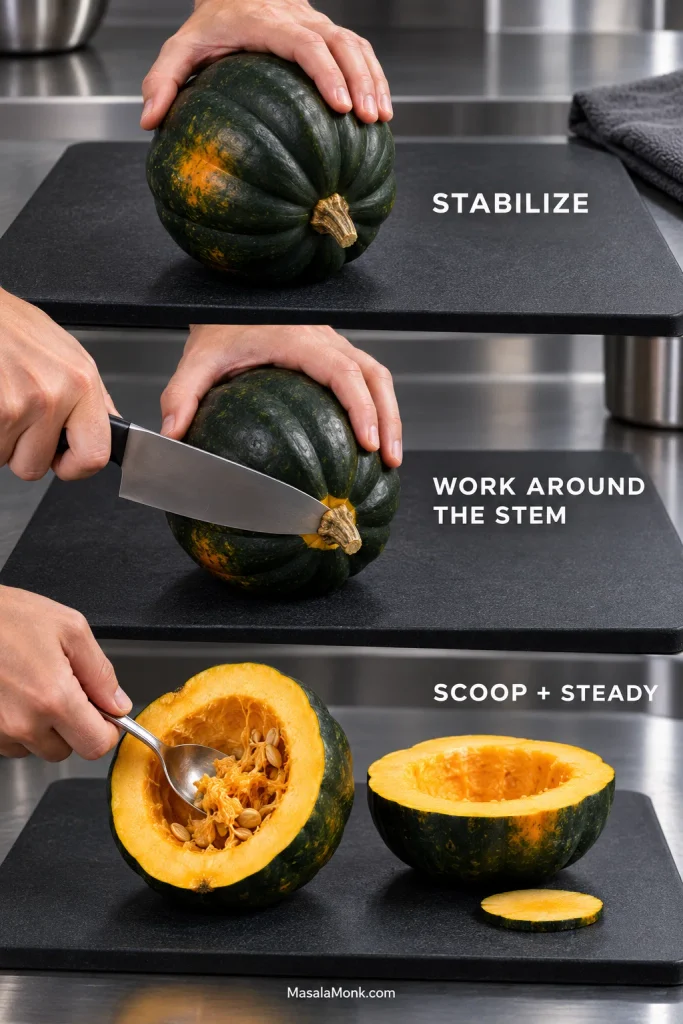
- Cut, scoop and steady the squash. Set one dry squash on a board that will not slide and cut it lengthwise with a sharp chef’s knife. Work around the woody stem when it resists, then scoop out the seeds and stringy center.
For a particularly hard rind, pierce the squash several times and microwave it for 1–2 minutes. Let it cool enough to handle before cutting. If a half rocks when placed cut-side up, shave a very thin piece from the rounded base so it sits securely.
- Season and roast cut-side down. Brush the flesh with the olive oil and season with the ½ teaspoon salt and black pepper. Set the halves cut-side down on the parchment-lined tray.
Begin checking at 30 minutes. A fork should slip easily into the thickest part of the flesh. Take out any half that finishes ahead of the others; similar-looking squash don’t always cook at the same speed.
Thirty minutes tells you when to pick up the fork. The fork tells you when the squash is ready.
Brown and Balance the Filling
- Brown the sausage while the squash roasts. Heat a large skillet over medium heat. Add the sausage, break it into small crumbles and leave it alone for short stretches so the edges brown. Cook pork sausage to 160°F / 71°C, in line with USDA safe-temperature guidance.
Spoon off any standing pool of fat, leaving enough to lightly coat the skillet. If the pan looks dry—especially with a leaner sausage—add about 1 teaspoon olive oil before the vegetables. - Add the onion, celery, herbs and apple. Cook the onion and celery with the sausage for 5–7 minutes, until softened and beginning to color. Add the garlic, sage and thyme and cook for 30–60 seconds. By now the skillet should smell unmistakably of browned sausage, onion and sage.
Add the apple and cook for another 2–3 minutes. Its edges should soften while the pieces remain distinct. - Finish the filling. Fold in the cooked wild rice, pecans, cider vinegar, about three-quarters of the Parmesan and the cranberries, if using. Let everything heat through.
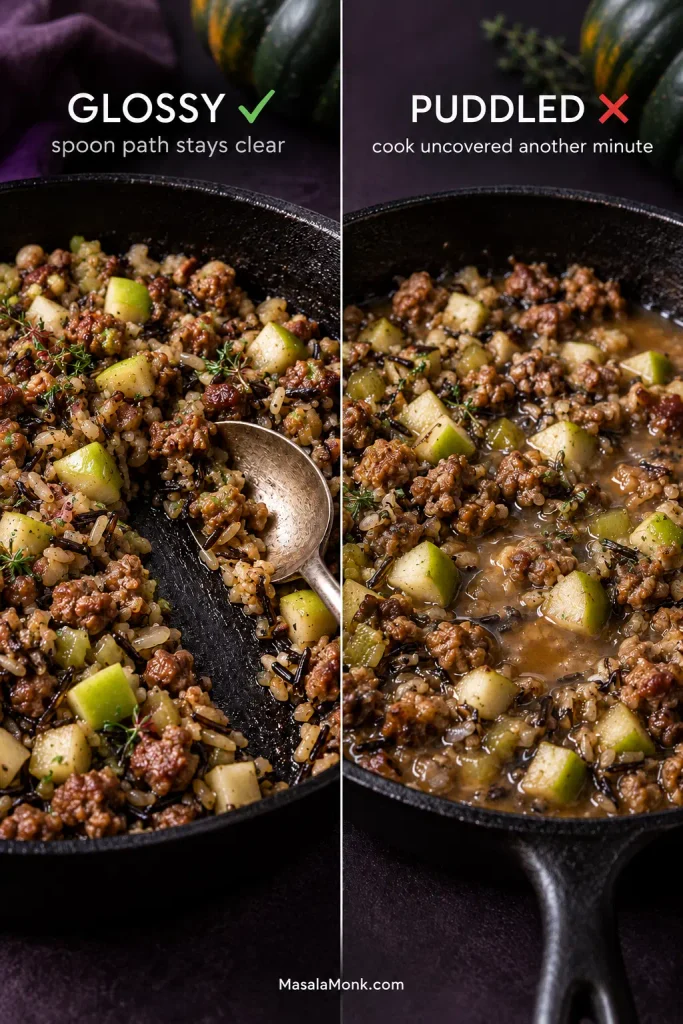
Glossy is good; puddled is not. Drag a spoon across the skillet. The filling should look moist without liquid immediately flooding the cleared path. Cook another minute uncovered if it is wet; add a small splash of broth or olive oil if it looks dry.
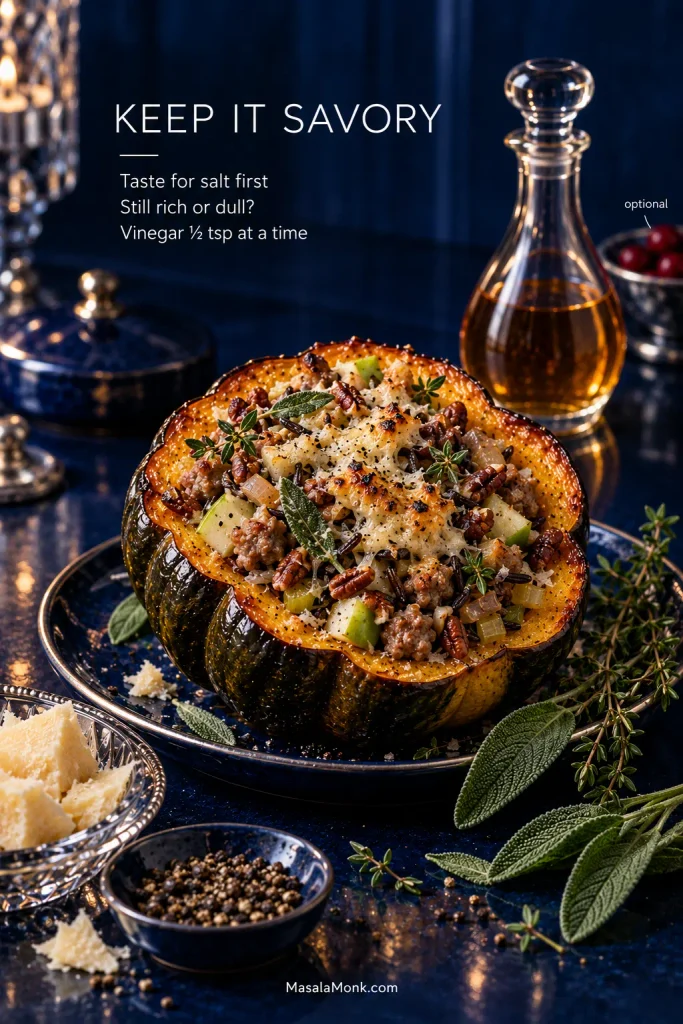
Taste for salt first. If the sausage and rice still taste heavy or dull, add cider vinegar about ½ teaspoon at a time. Stop when the filling tastes brighter; the vinegar itself shouldn’t stand out. Finish with black pepper as needed.
Fill, Bake and Rest
- Check the squash. Turn the roasted halves cut-side up with a wide spatula or turner. A fork should pass easily through the thickest flesh. Give a firmer half another five minutes if it needs it. Taste a little warm squash and season it again if the flesh seems flat.
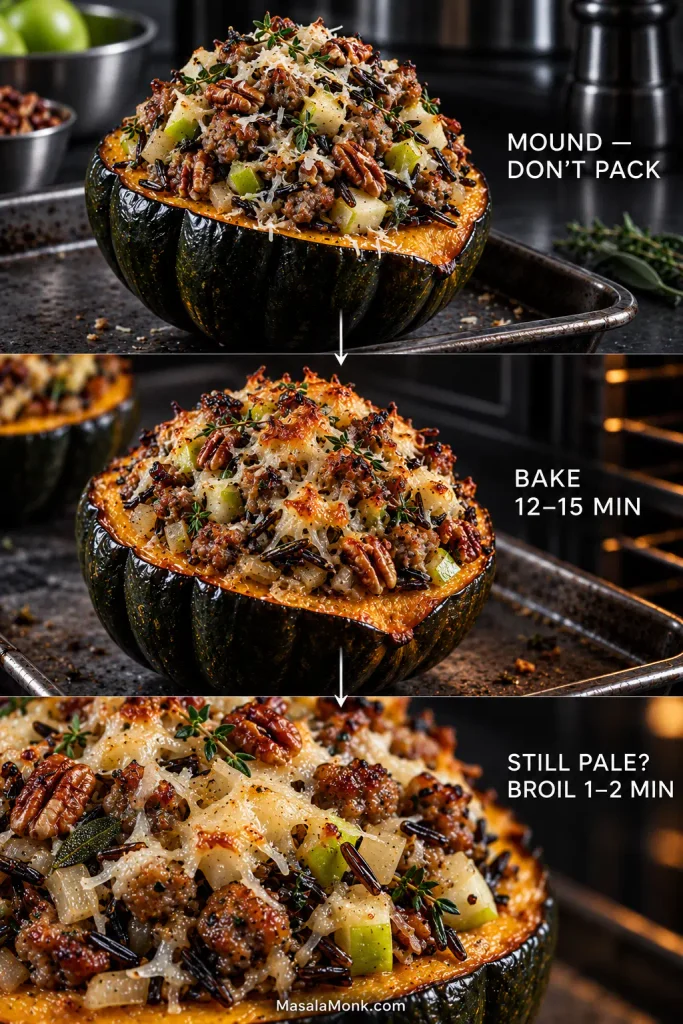
- Fill the halves. Spoon the filling into the cavities and mound it generously above the rim. A medium-large half takes around 1–1½ cups, though the space inside each squash will vary. Save any extra filling for another meal.
For an unusually tight cavity, scoop out 1–2 tablespoons of cooked squash and fold it into the filling. - Bake for another 12–15 minutes. Sprinkle over the remaining Parmesan, concentrating some on the exposed rice and sausage. Return the squash to the oven until the center is hot, the cheese has browned in spots and a few grains around the top are starting to crisp. If the top is still pale once the middle is hot, broil for 1–2 minutes.
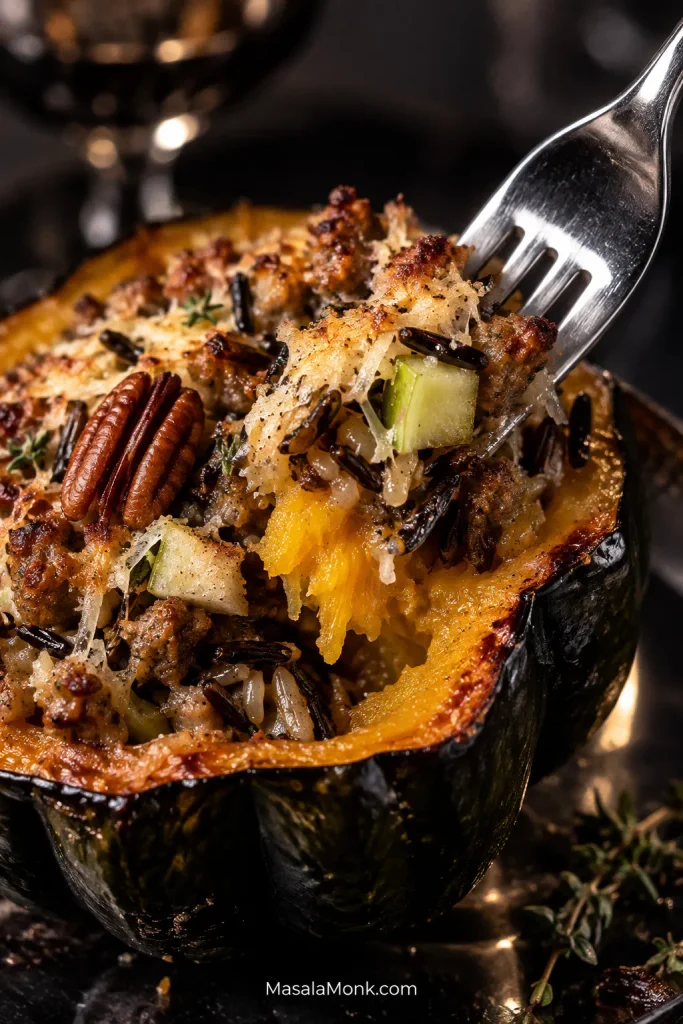
- Rest for 5 minutes. Scatter over fresh parsley, sage or thyme if using. Push the fork through the sausage and rice into the squash underneath. The best bite has chewy grain, tart apple, browned sausage and soft squash together.
Cooking for two? Use 1 squash and halve the remaining ingredients. The roasting time for that squash stays the same.
Want to adapt it? Filling ideas · Thanksgiving version · Make it ahead
Build the Filling
Plan on 2–3 cups of filling per medium squash—around 1–1½ cups per half. Some squash simply have more room than others.
When you change the filling, keep the contrasts that make the original work: something hearty, a cooked grain, aromatics, a tart note and some crunch. You don’t need to copy every ingredient exactly.
| Role | Good choices |
|---|---|
| Hearty element | Pork sausage, turkey/chicken sausage, seasoned ground poultry, or mushrooms + lentils/chickpeas |
| Grain | Wild rice, ordinary rice, farro, quinoa, barley or prepared stuffing |
| Aromatics | Onion, celery, garlic and herbs |
| Acid or tartness | Granny Smith apple, cider vinegar, lemon or cranberries |
| Crunch | Pecans, walnuts or pepitas |
| Savory depth | Parmesan-style cheese, feta, tamari or nutritional yeast |
How to Keep It Savory
The easiest way to stop the squash drifting too sweet is to balance its natural sweetness. Parmesan adds salt and savoriness; sage, thyme and black pepper push the filling further toward the savory side. Cider vinegar is especially helpful when sausage and rice taste rich but dull: add a little until the flavor lifts without tasting distinctly of vinegar.
Dried cranberries are optional. If the rest of dinner already includes something sweet—such as honey- or maple-roasted carrots—leave them out and keep maple syrup for anyone who wants a drizzle at the table.
Best Grains for the Filling
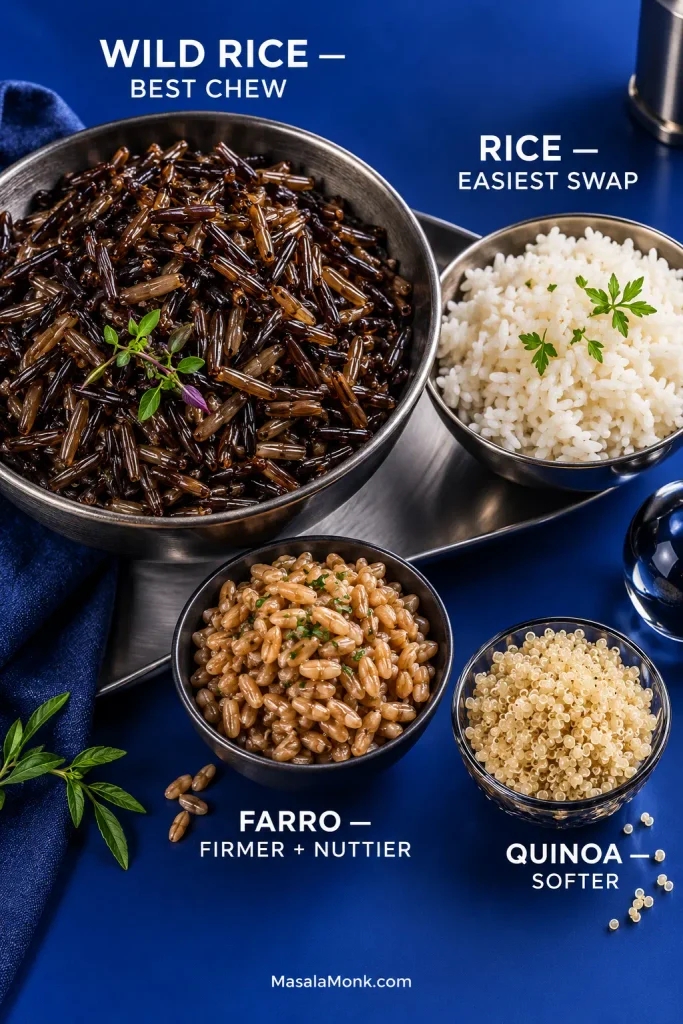
Wild rice remains the first choice for this filling. The easiest substitution is 1½ cups cooked brown or white rice, particularly when you already have some left over.
Farro is worth using when you want a firmer, nuttier bite. Quinoa makes the filling noticeably softer, so keep the pecans or pepitas. Barley gives it more of the cohesive feel of traditional stuffing. Whatever grain you choose, cook it before it goes into the squash.
Vegetable, Meat, Cheese & Crunch Swaps
Mushrooms are the vegetable addition that contributes the most savory flavor here. Give them enough skillet time for their water to cook away and the edges to brown. Kale can cook with the onion and celery; baby spinach only needs a quick wilt near the end. For a vegetable-heavy filling, reduce the cooked rice from 1½ cups to around 1 cup, or expect some filling left over.
The closest meat substitution is 12 oz / 340 g turkey or chicken Italian sausage. Very lean sausage may need a teaspoon or two of olive oil in the skillet. Cook poultry sausage to 165°F / 74°C.
Plain ground turkey or chicken works in the same quantity, but it needs the seasoning the sausage would have supplied. Add the sage and thyme as written, a pinch of fennel seed, black pepper and about ½ teaspoon fine salt. Wait until the rice and cheese are mixed in before deciding whether it needs more salt. A little olive oil helps very lean poultry brown without drying out.
Parmesan is still the best fit for the main recipe because it browns on the exposed grains without making the filling overly cheesy. Gruyère melts more deeply into the rice, while feta gives a meatless version a sharper edge. Walnuts can replace pecans, and toasted pepitas are the simplest nut-free option.
Vegetarian and Vegan Variations
For a meatless version, brown 8–10 oz / 225–285 g mushrooms well and add 1 cup cooked lentils or chickpeas. Choose cheese explicitly labelled suitable for vegetarians, whether that’s a hard Parmesan-style cheese or feta.
For a vegan version, keep the mushrooms and legumes, skip the cheese and start with 1 tablespoon low-sodium tamari plus 2 tablespoons nutritional yeast. Taste once the rice is mixed in. Add 1 tablespoon olive oil if the filling seems dry, and adjust the tamari only after tasting because it is already salty.
Stuffed Acorn Squash for Thanksgiving
This stuffed acorn squash recipe is especially useful at Thanksgiving because the long roast can happen the day before, leaving only the short finishing bake when the oven is busiest.
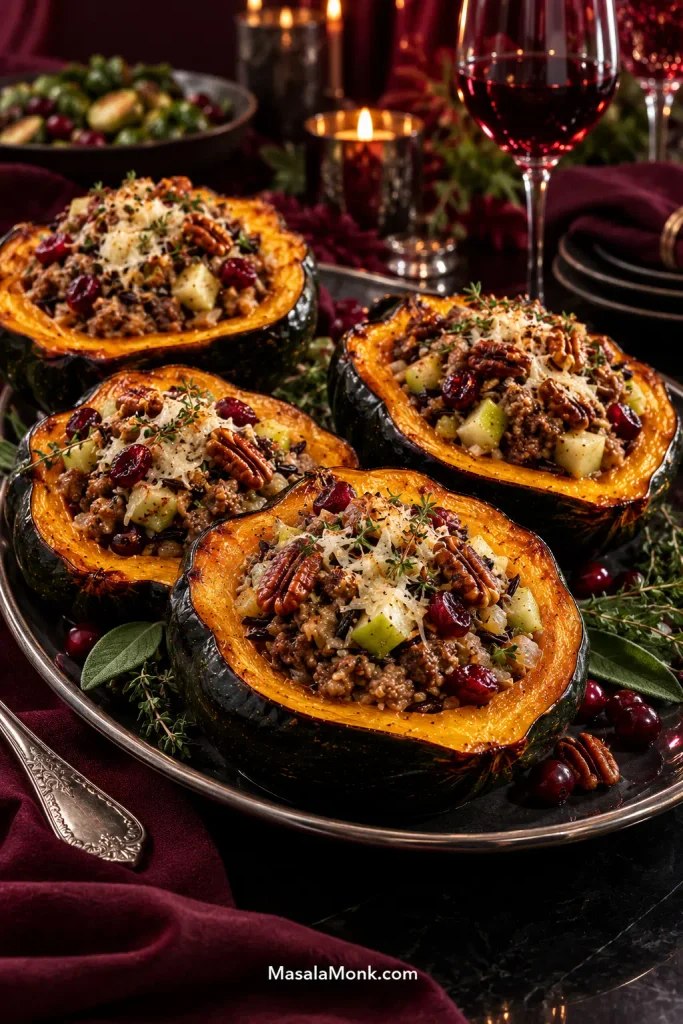
Keep the cranberries and pecans if you want more tart fruit and crunch on the holiday table, or replace some or all of the wild rice with prepared savory stuffing. Cornbread dressing fits especially well with the sage, onion and celery.
If you’re using leftover turkey, soften the onion and celery first, then add chopped cooked turkey near the end so it only needs to warm through. Expect to need a little more olive oil, sage, black pepper and salt because cooked turkey brings less fat and seasoning than Italian sausage.
Serve cranberry sauce alongside. A spoonful of cranberry sauce with orange juice gives the plate tart-sweet contrast without loosening the rice filling.
Once browned, the filled halves look at home among the rest of a holiday spread. A whole half is substantial enough for a main; when the squash is one of several side dishes, four large halves can be divided into 6–8 smaller portions. Spoon filling together with the squash underneath so each serving gets both.
Planning the rest of the meal? Make it ahead · What to serve with it · Storage & reheating
Make Ahead, Serving & Leftovers
Can You Make Stuffed Acorn Squash Ahead?
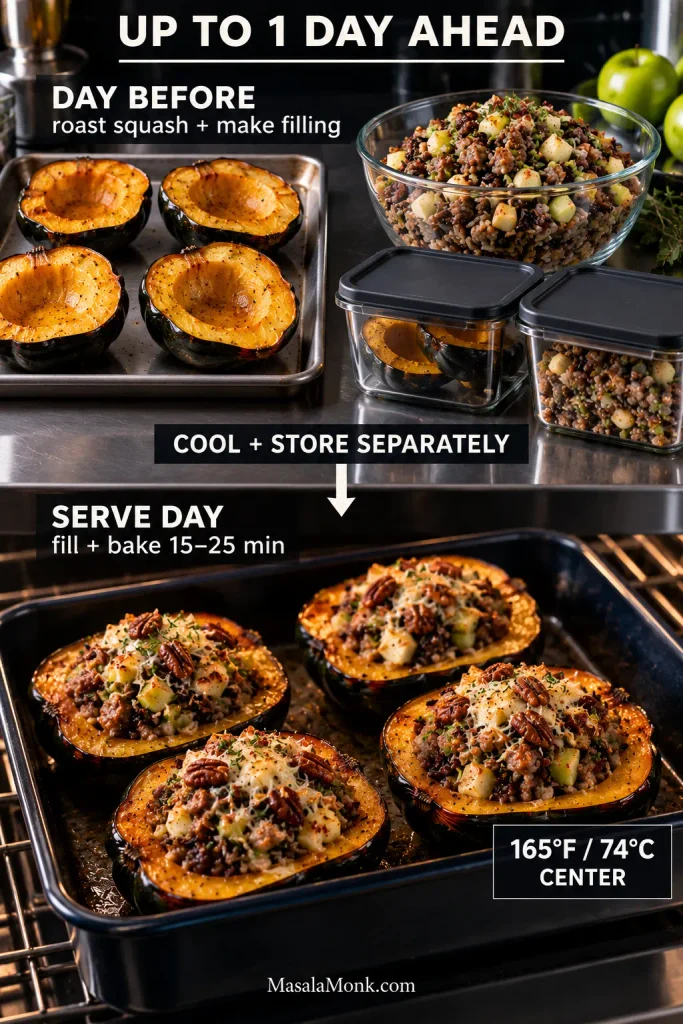
Yes. You can make this stuffed acorn squash recipe up to one day ahead. For the best texture, cool the roasted squash and filling separately, then cover and refrigerate them.
When you’re ready to serve, fill the chilled halves and bake at 400°F / 205°C for 15–25 minutes, until the center reaches 165°F / 74°C. Cover the top loosely with foil if it browns before the middle is hot.
What to Serve With Stuffed Acorn Squash
Bright, crisp sides keep a sausage-stuffed half from feeling too heavy. Try a lemony salad or cabbage slaw for acidity; roasted Brussels sprouts or green beans add a firmer green contrast; sautéed kale, chard or spinach keeps a weeknight plate lighter.
Meanwhile, a sharp vinaigrette makes the next forkful of sweet squash, sausage and browned Parmesan taste brighter.
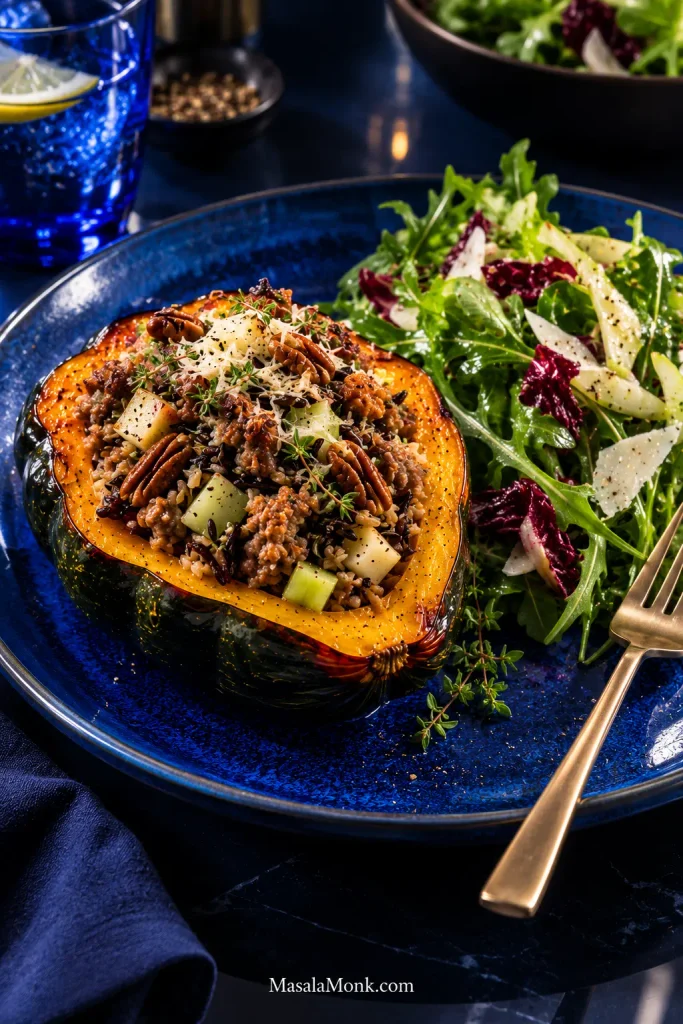
If another side is going into the oven at the same time, something that cooks comfortably around 400°F keeps the meal simpler. At Thanksgiving, the squash also sits naturally beside green bean casserole, dressing and potatoes.
Storage, Reheating & Freezing
Refrigerate: get leftovers into the refrigerator within 2 hours and keep them covered for 3–4 days. These timings follow USDA leftovers guidance.
Reheat in the oven: place the squash in a baking dish, add a small splash of water or broth to the dish around the squash if the filling looks dry, and cover loosely with foil. Warm at 350°F / 175°C until the center reaches 165°F / 74°C. Uncover near the end if you want the top to dry and brown again.
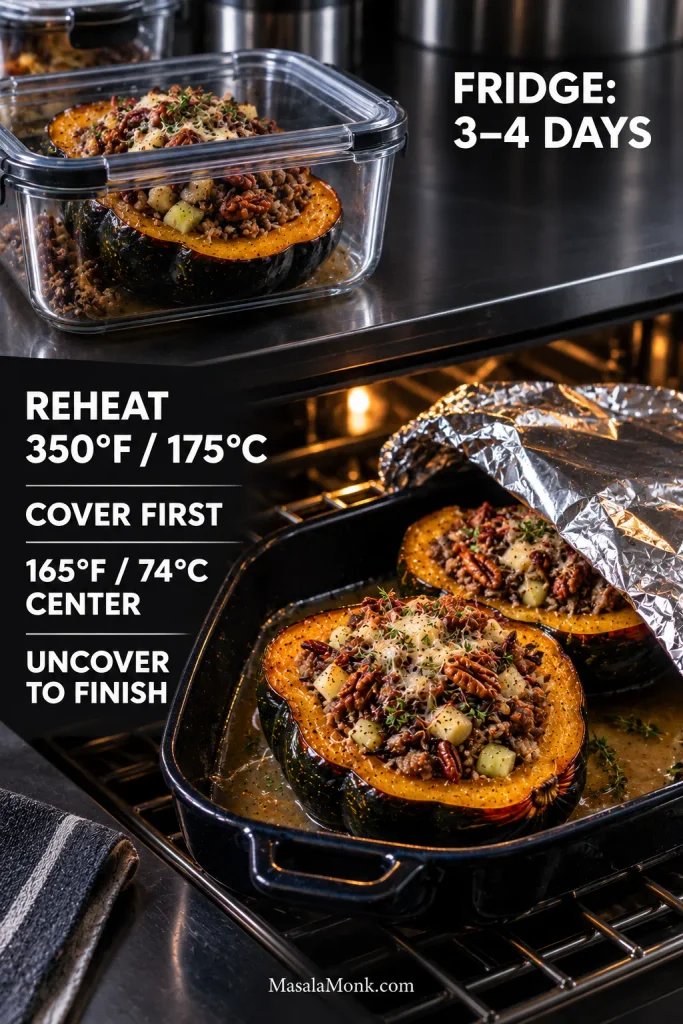
Microwave: place one portion in a microwave-safe dish, add a teaspoon or two of water if the filling looks dry, and cover loosely. Heat in 60–90 second bursts, turning or repositioning the squash between bursts, until the center reaches 165°F / 74°C. The squash will be softer than oven-reheated leftovers.
Freeze: assembled halves can be frozen, but cooked squash loses some firmness after thawing. Aim to use them within 2–3 months. For better texture, freeze extra filling on its own and roast fresh squash when you need it.
Stuffed Acorn Squash Troubleshooting
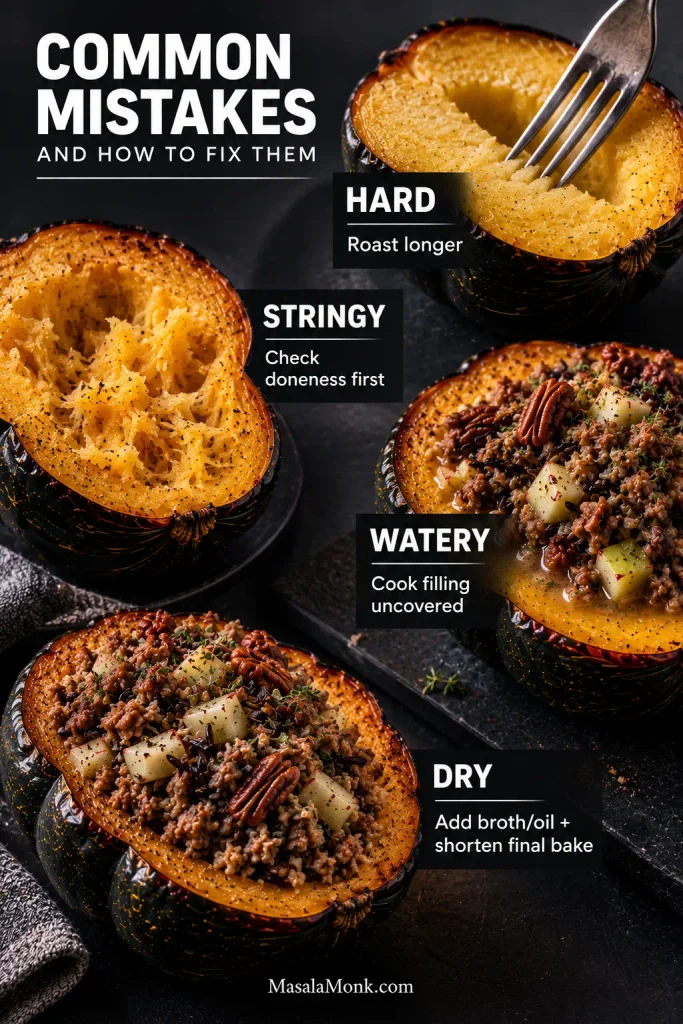
Most problems come back to one of three things: the squash needed more time, the skillet held too much or too little moisture, or the stuffed halves stayed in the oven too long.
Squash and Filling Problems
| Problem | What to do |
|---|---|
| Squash is still hard | Cover the filling loosely with foil and keep roasting until a fork slips into the flesh. Next time, let the squash reach that point before filling. |
| Squash collapsed | It went too far during the first roast. Pull the halves once the flesh is soft but the rind can still support them. |
| Filling tastes good, squash tastes bland | The flesh underneath needed more seasoning. Salt it before roasting, then taste a little warm squash before filling. |
| Filling is greasy | Spoon excess sausage fat from the skillet after browning. Leave enough to coat the vegetables, but no standing pool. |
| Filling is dry | Add a splash of broth or olive oil. Lean meat, too much grain or a long final bake can all pull moisture from the filling. |
| Filling is watery | Keep cooking it uncovered. Apple, vegetables and sausage can all release liquid. The spoon-path test should leave a glossy skillet without liquid flooding the gap. |
| Dish tastes too sweet | Leave out the cranberries and bring the filling back with black pepper, Parmesan, herbs and a little more cider vinegar. |
| Filling tastes flat | Check the salt first. If it is seasoned but still feels heavy or dull, add cider vinegar in small amounts until the flavors brighten. |
| Apple disappeared | The flavor will still be fine. Next time, give the apple only 2–3 minutes in the skillet. |
Grain, Browning and Leftover Problems
| Problem | What to do |
|---|---|
| Rice is hard | It went in undercooked. Wild rice, ordinary rice, quinoa, farro and barley should be tender before assembly. |
| Exposed grains are dry or crunchy | The stuffed squash baked too long, or the grain was already firm. Once the center is hot and the top has browned, take it out. |
| Top will not brown | Once the middle is hot, finish it for 1–2 minutes under the broiler. |
| Frozen leftovers are soft or watery | That is a normal texture change from freezing cooked squash. Freeze the filling separately next time if texture matters most. |
Why Is the Squash Stringy?
Check the doneness first. Undercooked squash can feel fibrous because the flesh still resists the fork. If it is fully tender yet unusually dry, coarse and stringy throughout, the squash itself may be older or lower quality. Firm squash that feel heavy for their size are a better starting point.
What if It Tastes Extremely Bitter?
Stop eating it. An intensely, abnormally bitter squash isn’t something to fix with maple syrup or seasoning. Poison Control advises spitting out very bitter squash and discarding the rest because elevated cucurbitacins can be responsible. Cooking does not make that problem safe.
Stuffed Acorn Squash FAQs
1. Can You Eat Acorn Squash Skin?
Yes. Cooked acorn squash skin is edible, but you don’t have to eat it. Some skins soften nicely; others remain fairly chewy. Eat it if you like the texture, or scoop the soft flesh away from the rind as you would with a baked potato.
2. Can I Use Butternut, Carnival or Kabocha Squash?
Yes. Carnival squash is the closest substitute. Butternut and kabocha vary more in shape, thickness and density, so use tenderness as your guide. The flesh should be nearly tender before the filling goes in.
3. Can I Use Prepared Stuffing Instead of Wild Rice?
Yes. Start with 1½ cups prepared, already-moistened stuffing in place of the 1½ cups cooked wild rice. Add more only if the filling needs it and your squash have room. Don’t add dry stuffing mix and expect it to hydrate during the short final bake. Taste before adding more salt because prepared stuffing may already be well seasoned. Savory herb stuffing or cornbread dressing both work naturally with the sausage, apple and sage.
If the squash is tender and the filling tastes right before assembly, the final bake only needs to heat everything through and brown the top.
Cook it now: Back to the recipe · Back to the top








