
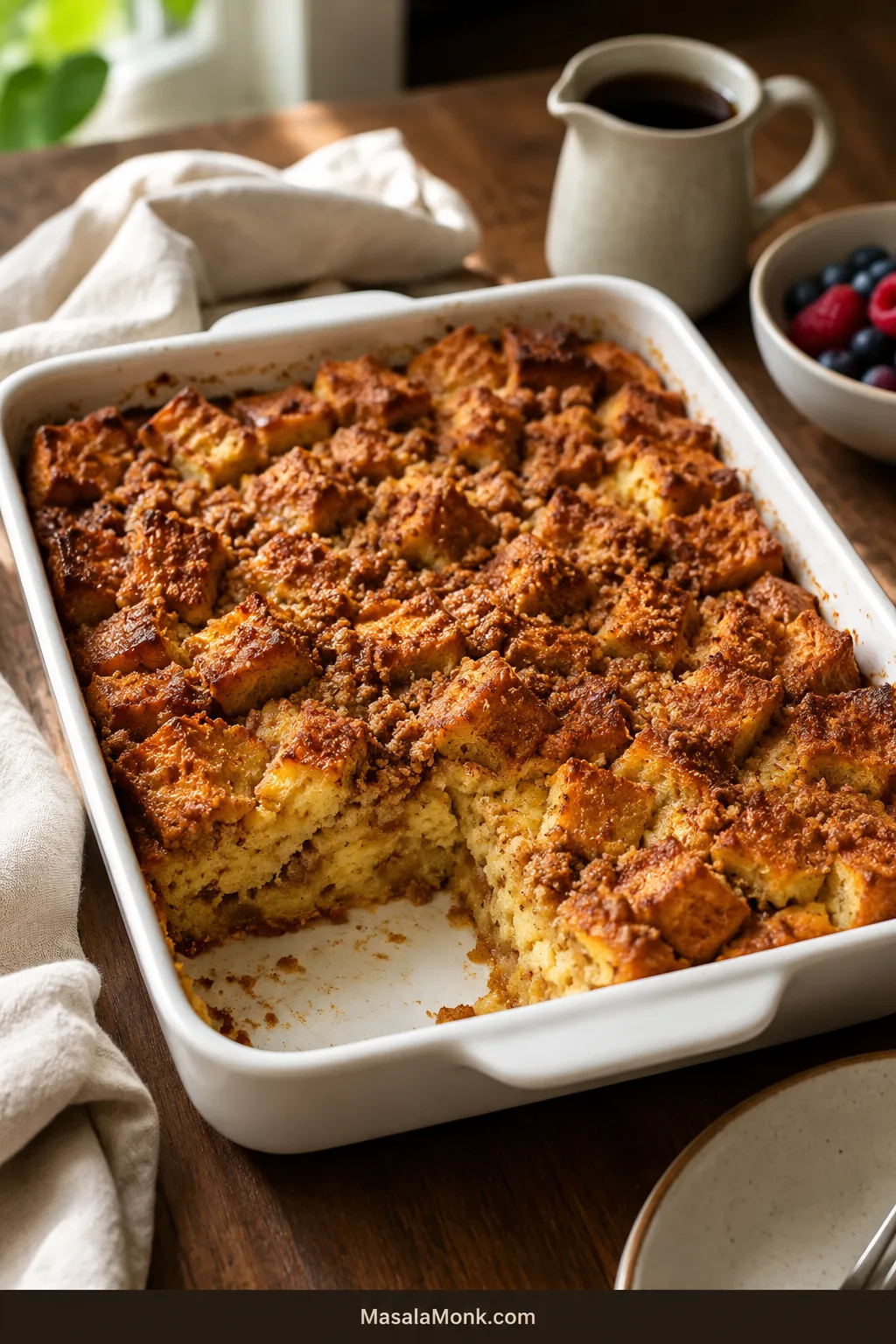
By the time the oven begins to warm, breakfast should already be decided. The bread has spent the night soaking in cinnamon-vanilla custard, the streusel is cold and crumbly, and the morning work is little more than scattering the topping, baking the pan and pouring the coffee.
The easy morning only pays off when an overnight French toast casserole comes out properly: crisp and buttery across the top, tender where the bread has absorbed the custard, and set enough that the first spoonful holds together. Here, the bread is weighed rather than guessed, the sweetness stays balanced, and the middle—not merely the golden topping—decides when the pan is ready.
Day-old French bread absorbs the custard without collapsing, which makes it the easiest loaf to use here. Brioche, challah, sourdough, plain Texas toast and sturdy gluten-free bread can also work with a few adjustments. Once the bread amount, pan depth and final doneness are right, the method is highly forgiving.
Start here
The Version to Make First
Use 16 oz / 450 g day-old French bread—about 10–12 loosely filled cups after cutting it into 1-inch / 2.5 cm pieces. Soak it overnight in a mixture of 8 eggs, 2 cups / 480 ml whole milk and ½ cup / 120 ml half-and-half or cream. Keep the streusel cold and separate until morning.
Bake in a standard 9×13-inch / 23×33 cm dish at 350°F / 175°C. Begin checking near 40 minutes; many pans finish in approximately 45–55 minutes. The topping should be golden, the middle should look set rather than fluid, and the thickest central area should reach at least 160°F / 71°C.
The clock tells you when to check; the center tells you when to stop.
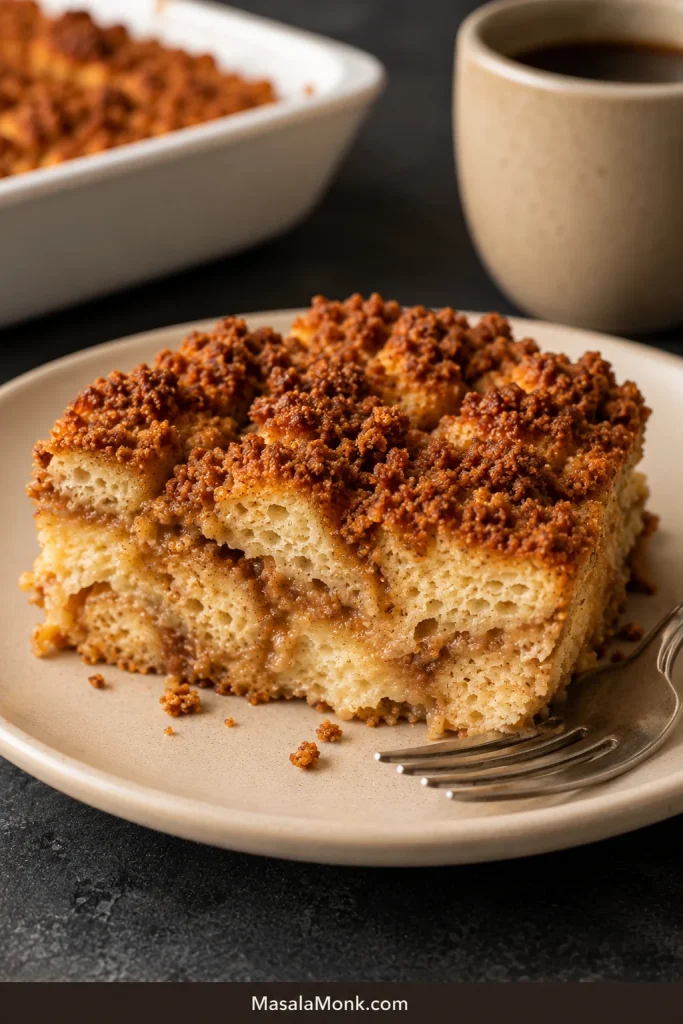
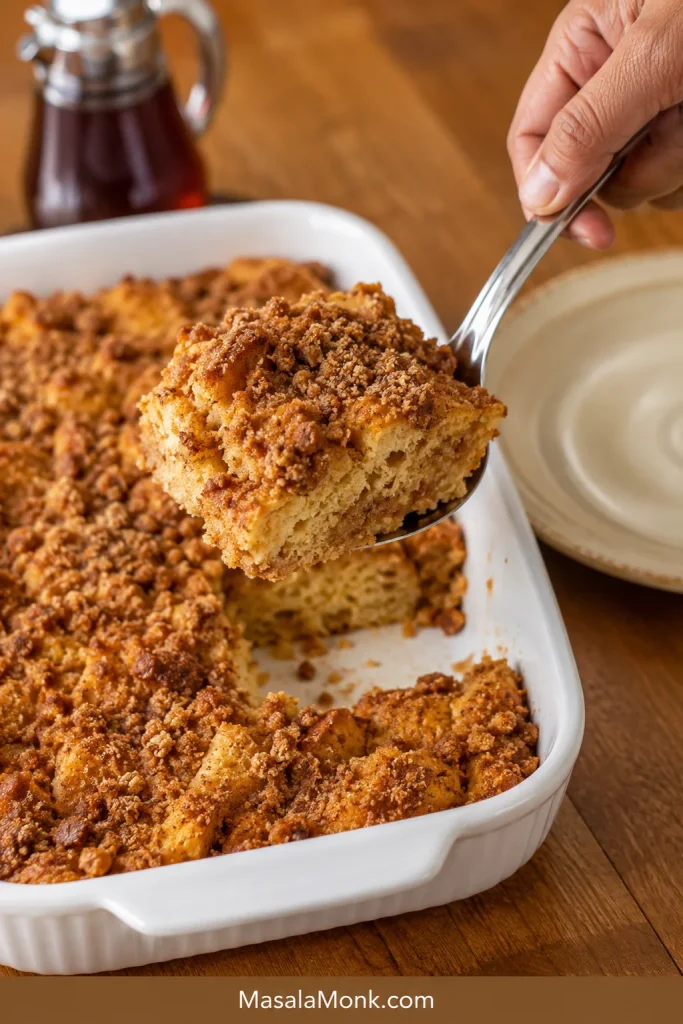
This is the texture to aim for: recognizable bread pieces held together by softly set custard, with a crisp top and no liquid collecting beneath the serving.
Make it tonight
Overnight French Toast Casserole Recipe
A make-ahead French toast bake with cinnamon-vanilla custard, crisp exposed bread edges and a cold brown sugar streusel added just before baking. It is moderately sweet on its own, leaving room for warm maple syrup at the table.
Recipe at a Glance
- Yield: 10 standard servings, 8 generous servings or up to 12 smaller brunch portions
- Active preparation: About 20 minutes at night, plus 5 minutes in the morning
- Chilling: 8–12 hours
- Bake and rest: Approximately 45–55 minutes, plus 10 minutes
- Total elapsed time: Approximately 9–13½ hours, mostly unattended
- Pan: Standard 9×13-inch / 23×33 cm dish, about 3 quarts / 2.8 liters
- Oven: 350°F / 175°C
- Doneness: The center looks set, a thin knife shows no raw custard, and the thickest area reaches at least 160°F / 71°C
Equipment
- Standard 9×13-inch / 23×33 cm baking dish, about 3 quarts / 2.8 liters
- Large mixing bowl and whisk
- Serrated bread knife and cutting board
- Kitchen scale
- Measuring cups and spoons
- Rimmed sheet pan if the bread needs drying
- Foil
- Instant-read thermometer, recommended
Ingredients
For the Bread and Custard
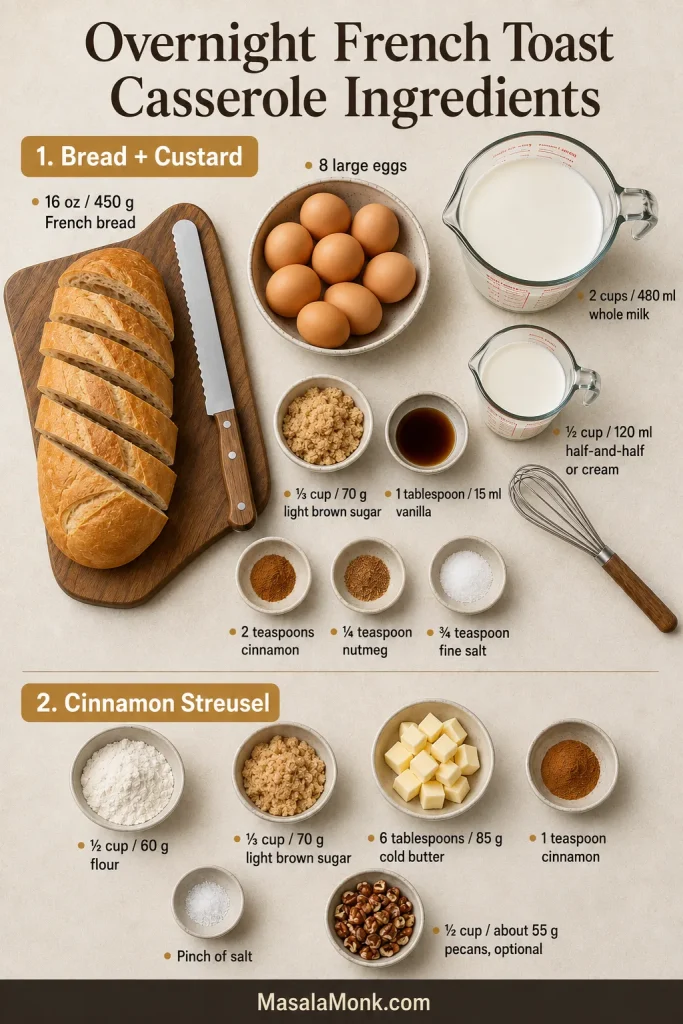
- 16 oz / 450 g French bread, preferably day-old, about 10–12 loosely filled cups after cutting
- 8 large eggs
- 2 cups / 480 ml whole milk
- ½ cup / 120 ml half-and-half or heavy cream
- ⅓ cup / 70 g packed light brown sugar
- 1 tablespoon / 15 ml vanilla extract
- 2 teaspoons ground cinnamon
- ¼ teaspoon ground nutmeg
- ¾ teaspoon fine salt
- Unsalted butter or nonstick cooking spray, for the dish
For the Cinnamon Streusel
- ½ cup / 60 g all-purpose flour
- ⅓ cup / 70 g packed light brown sugar
- 1 teaspoon ground cinnamon
- Pinch of fine salt
- 6 tablespoons / 85 g cold unsalted butter, cut into small cubes
- ½ cup / about 55 g chopped pecans, optional
For Serving
- Warm maple syrup
- Fresh berries, sliced apples or another fresh fruit
- Powdered sugar, optional
Measure the custard and streusel ingredients separately before beginning, especially the two portions of brown sugar.
Instructions
Before Bed
- Prepare the dish. Butter the base, sides and especially the corners of a standard 9×13-inch / 23×33 cm baking dish generously. Custard-soaked bread can cling where the pan is only lightly coated. Nonstick cooking spray can be used instead.
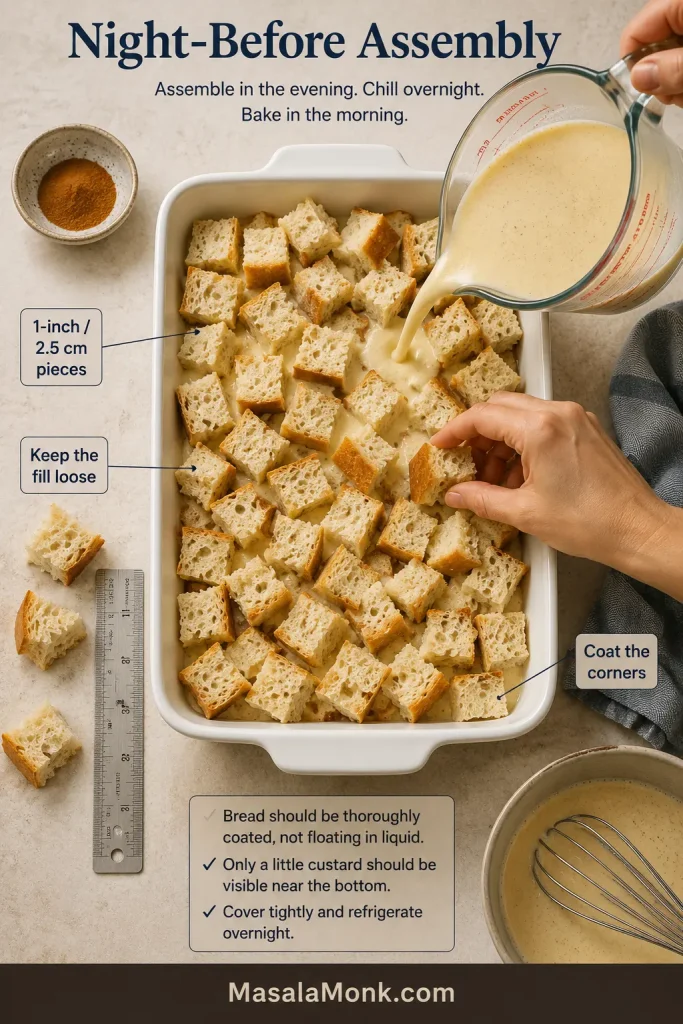
- Cut the bread. Cut the French bread into pieces around 1 inch / 2.5 cm. Keep the crusts unless they are unusually hard or thick; they add structure and create some of the crispest exposed edges. If the bread is fresh and soft, dry it using the method in the notes, then let it cool.
- Fill the pan loosely. Spread the bread through the dish. The pan should look comfortably full, with the pieces sitting loosely instead of being pressed into a dense layer.
- Whisk the custard. Whisk the eggs until the whites and yolks are fully blended. Add the milk, half-and-half or cream, brown sugar, vanilla, cinnamon, nutmeg and salt. Continue whisking until the sugar is mostly dissolved and no visible streaks of egg white remain.
Coat, Cover and Chill
- Coat the bread. Pour the custard in stages, pausing to turn the pieces gently so the liquid reaches the middle and corners. Press lightly until the dry edges touch the custard. Packing the bread down firmly can make the casserole dense.
- Check the pan. The bread should look well moistened, with a little custard visible near the bottom. It should not be floating in a deep pool.
- Cover and refrigerate. Cover tightly and refrigerate for 8–12 hours.
- Make the streusel. Mix the flour, brown sugar, cinnamon and salt. Work in the cold butter until it is coated and the topping contains fine crumbs with a few pea-sized clumps. Mix in the pecans when using, then cover and refrigerate separately.
Before covering the pan, make sure the bread still sits loosely, looks evenly moistened and rises above the small amount of custard at the base.
The Next Morning
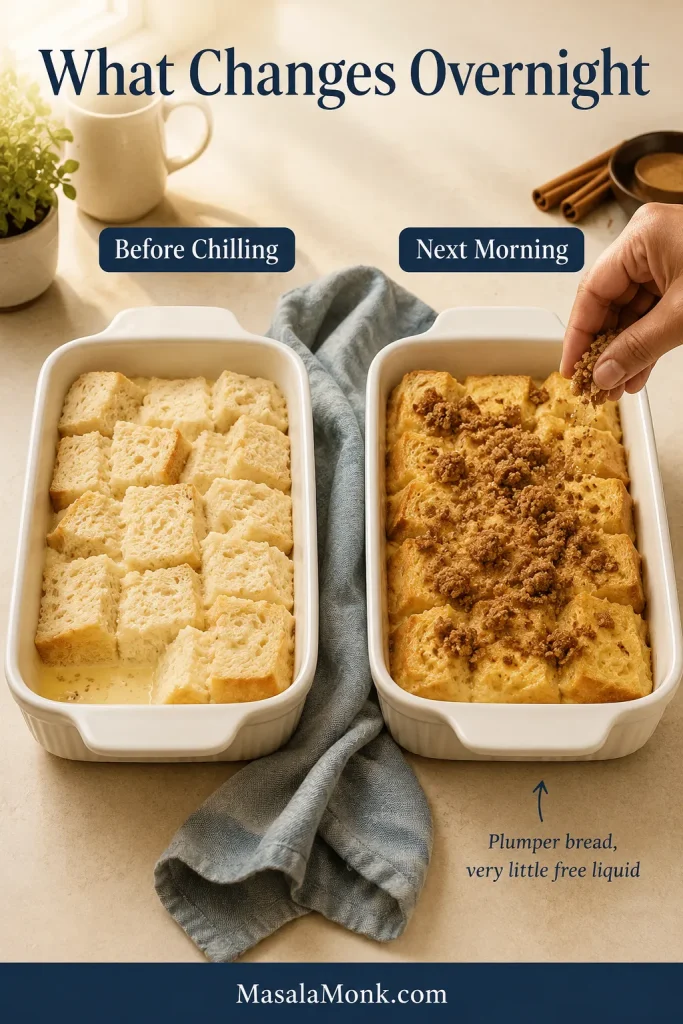
By morning, the bread should look fuller and darker with custard, while the dish remains stable rather than sloshing when moved.
- Heat the oven. Preheat to 350°F / 175°C. A metal pan can come out of the refrigerator while the oven heats. For glass or ceramic, first check the cold-bakeware guidance below.
- Check the overnight absorption. The pieces should look plumper and slightly darker with custard. A little liquid may remain visible low in the pan, but pressing the top should not make it surge across the dish.
- Add the topping. Uncover the dish and scatter the cold streusel over the bread. Leave a few edges exposed so they can crisp.
- Bake. Place the dish on the center rack and begin checking around 40 minutes.
Protect the Top and Check the Center
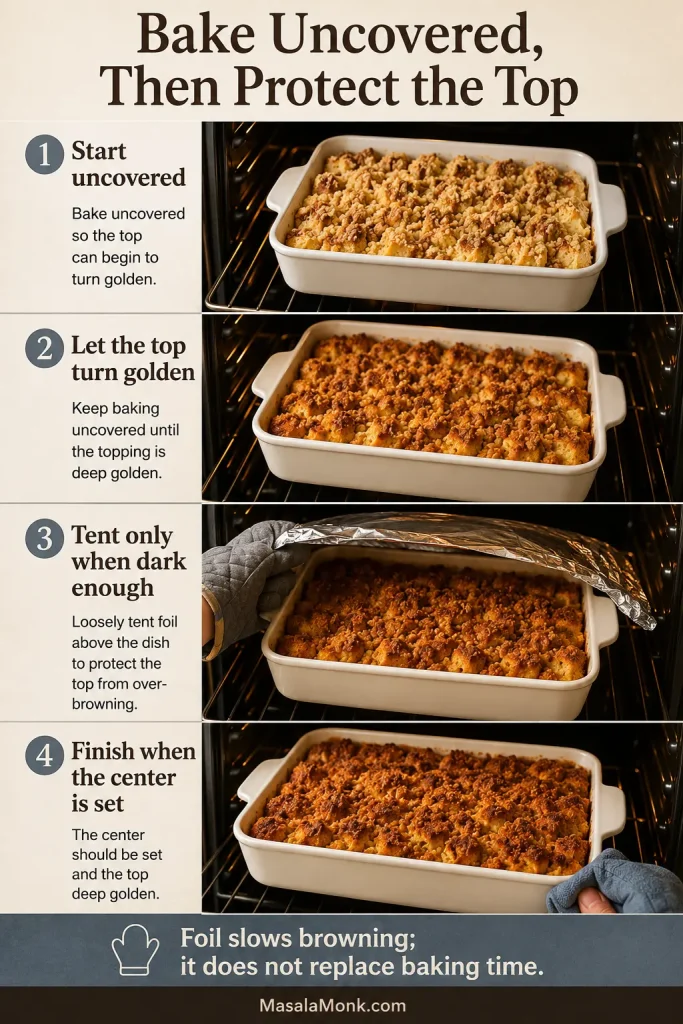
- Protect the top when needed. If the streusel and exposed bread are deeply golden while the center is still loose, tent the dish with foil and continue baking.
- Check the center. The edges should look puffed, and the middle should no longer appear shiny or liquid. Insert a thin knife through an area with less streusel; it should show moist crumbs, not raw custard.
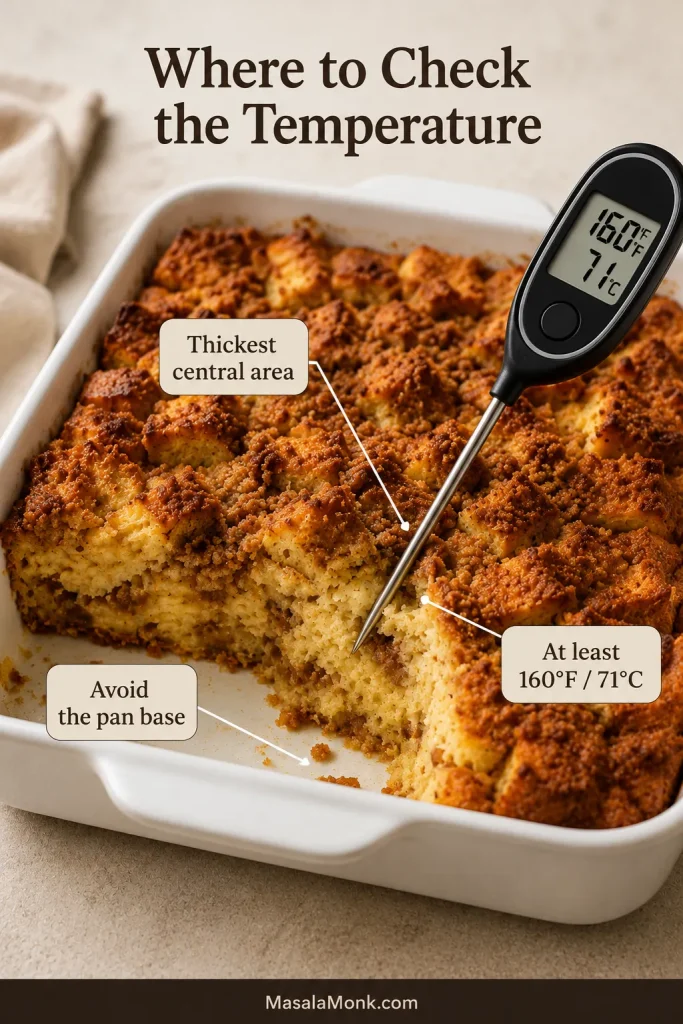
- Confirm the temperature. The thickest central area should reach at least 160°F / 71°C. Melted butter and brown sugar may cling to the knife even when the custard underneath is set.
- Rest before serving. Let the pan stand for 10 minutes. Use that time to warm the maple syrup, put out the fruit and call everyone to the table.
Cold Glass and Ceramic Bakeware
Avoid exposing very cold glass or ceramic bakeware to sudden high heat unless the manufacturer specifically approves refrigerator-to-oven use. Letting the dish stand while the oven preheats may reduce the temperature difference, but it does not replace the manufacturer’s instructions. A metal pan avoids this thermal-shock concern.
Success Notes
- Fresh bread: Dry the pieces at 300°F / 150°C for 10–15 minutes, turning once. Very soft, freshly baked bread may need up to 20 minutes. Stop while the pieces remain pale.
- Without cream: Replace the half-and-half or heavy cream with an equal amount of whole milk.
- Dairy-free: Use 2½ cups / 600 ml oat milk and plant-based butter; see the complete dairy-free adaptation below.
- Gluten-free: Use 450 g sturdy gluten-free bread and 1:1 gluten-free flour in the streusel; see the complete gluten-free adaptation below.
- Nut-free: Leave out the pecans. No replacement is needed.
- Same-day version: Dry the bread thoroughly and soak it for 45–60 minutes before baking.
- Sweetness: Keep the casserole moderately sweet and add more maple syrup at the table.
After a 10-minute rest, the casserole should scoop cleanly enough for the plate while still looking soft between the bread pieces.
Cooking now? The recipe above is all you need. Keep reading when you want help choosing bread, shortening the soak, scaling the pan or rescuing a soggy center.
Day-old bread has enough dryness to absorb the custard while still holding its shape. Weighing the loaf makes sure there is enough bread for the custard, and a shallow 9×13-inch dish gives the center time to set before the edges dry. When the top looks ready first, a thermometer removes the remaining guesswork.
Bread and Soaking
Tonight and Tomorrow
The Best Bread for French Toast Casserole
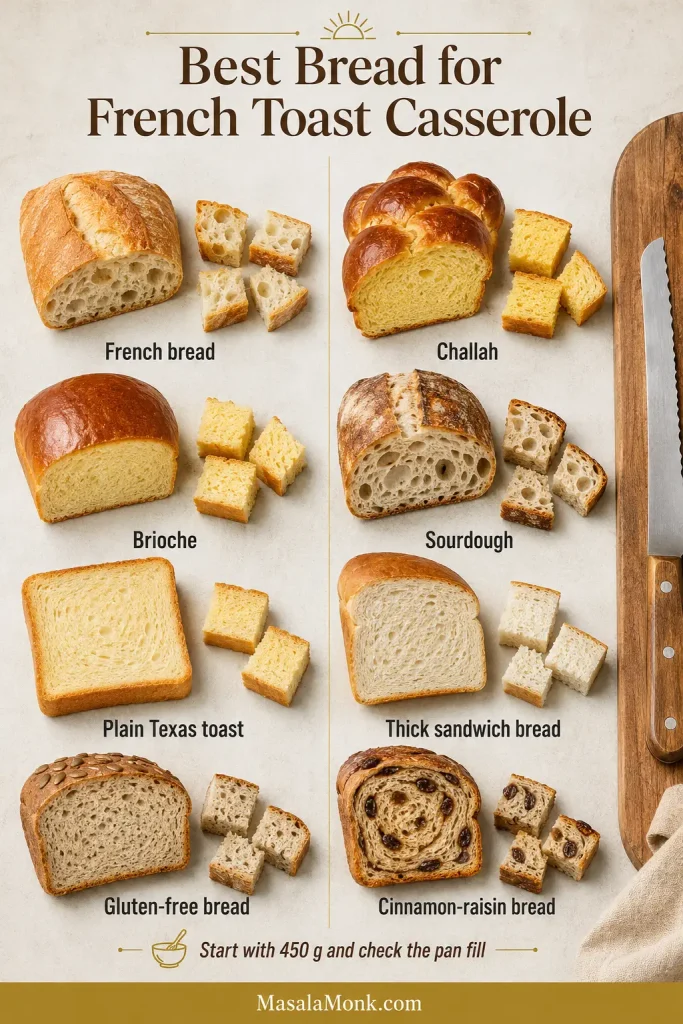
French bread has an open crumb that accepts the custard, while its crust and firmer interior help the pieces hold their shape overnight. With another type of loaf, start with 450 g and use the pan’s fill level as the final check. The cut pieces should loosely fill the dish to approximately the same level as 10–12 cups of French bread.
How Each Bread Changes the Casserole
| Bread | Result | Handling |
|---|---|---|
| French bread | Clear bread-and-custard contrast with crisp exposed edges | Use day-old bread or dry fresh pieces briefly |
| Challah | A softer, richer result with a slightly eggier flavor | Dry well; when noticeably sweet, reduce the custard sugar to ¼ cup / 50 g |
| Brioche | A very buttery, tender result | Dry thoroughly; when sweetened, reduce the custard sugar to ¼ cup / 50 g |
| Sourdough | Firmer pieces with a light tang | Allow the full overnight soak; especially good for a less-sweet pan |
| Plain Texas toast | A soft, familiar casserole with even pieces | Use plain thick-cut bread—not prepared garlic toast—and dry it when very fresh |
| Thick sandwich bread | A softer bake with less contrast from the crusts | Dry well and leave the pieces loose in the pan |
| Gluten-free bread | Results vary considerably by brand and loaf density | Choose a sturdy loaf, weigh it, dry it well and turn gently |
| Cinnamon-raisin bread | Built-in spice, sweetness and pockets of dried fruit | Use ¼ cup / 50 g custard sugar and reduce the custard cinnamon to 1 teaspoon |
No special bakery loaf is required. The bread already in your kitchen can usually work once you know whether it needs a little drying first.
Croissants soften and compress much faster than French bread. They need their own bread-to-custard ratio, so they are not a direct swap in this recipe.
Fresh, Stale or Oven-Dried?
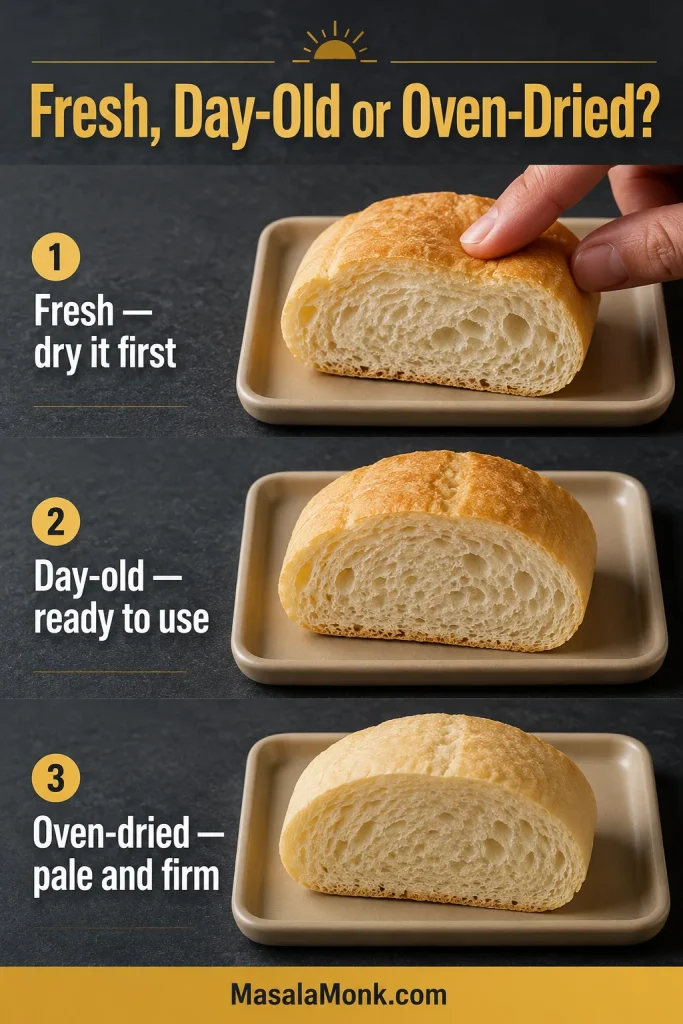
Day-old bread usually needs no extra drying. If the loaf has become very hard, trim any unusually tough crust and allow the full overnight soak.
Fresh bread should feel dry and slightly firm on the outside while the pieces still give when squeezed. Spread it over a rimmed sheet pan and bake at 300°F / 150°C for 10–15 minutes, turning once. Very soft bread may need up to 20 minutes. Keep the pieces pale instead of toasting them brown, then let them cool before adding the eggs.
What the Custard Ingredients Do
Eggs set the custard around the bread. Whole milk gives it enough richness without making the casserole unusually heavy, while a smaller amount of cream makes the baked custard richer and more tender. Whisk the eggs first so visible streaks of white do not bake into firm patches.
- Whole milk: Gives the custard body while keeping the casserole breakfast-like.
- Half-and-half or cream: Adds richness and a softer finish.
- Unsweetened oat milk: Gives the custard more body than most everyday plant milks.
- Unsweetened almond milk: Produces a lighter result.
- Evaporated milk: Can replace up to half of the whole milk for a richer dairy flavor.
Brown sugar brings a light caramel note without turning the casserole fully into dessert. Vanilla and cinnamon supply the familiar French toast aroma, nutmeg adds warmth underneath, and salt keeps the whole pan from tasting flat.
How Long Should French Toast Casserole Soak?
Soak the casserole for 8–12 hours when you can. That gives the custard time to reach the center of the bread and leaves almost nothing to do in the morning. Thoroughly dried bread can still produce a good same-day version after 45–60 minutes.
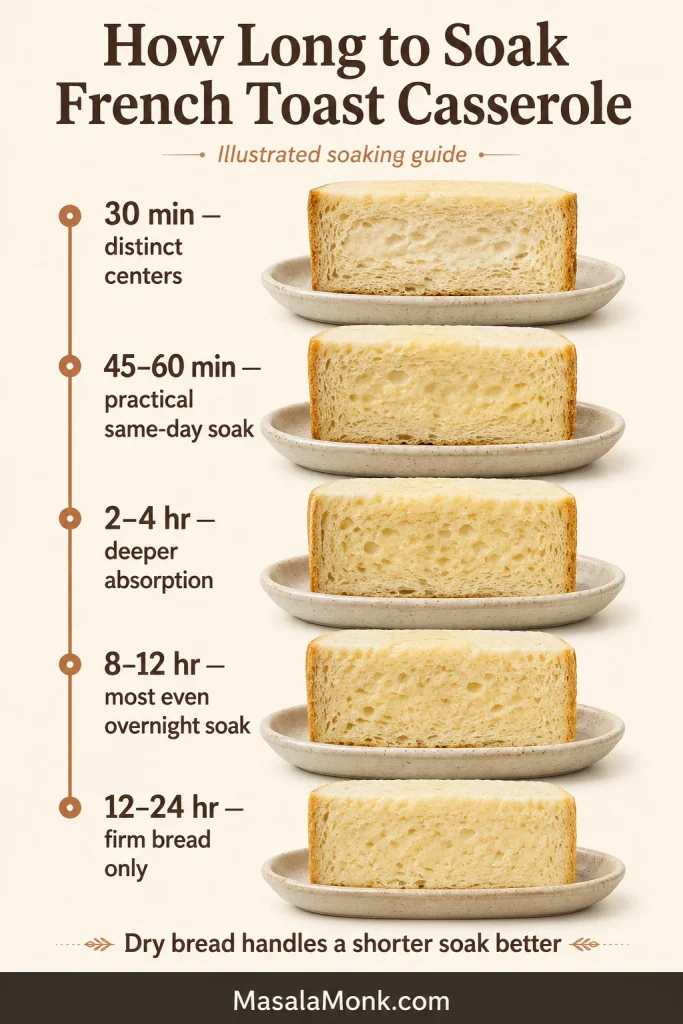
| Soaking time | When it works | What to expect |
|---|---|---|
| 30 minutes | When time is very short and the bread has been dried thoroughly | More distinct bread centers and less complete absorption |
| 45–60 minutes | A practical same-day casserole | Good results when the bread is dried and turned once |
| 2–4 hours | Firm or moderately dry bread | The custard reaches farther into the center of each piece |
| 8–12 hours | The easiest overnight schedule | Very little morning work and the most consistent soak |
| 12–24 hours | Firm, dry French bread or sourdough | Usually workable; softer breads may begin losing their shape |
Before Refrigerating: Three Assembly Checks
This is the last real bit of work for the night. Three details make the biggest difference once the pan is covered.
- Keep the bread pieces similar in size. Pieces around 1 inch / 2.5 cm absorb at a similar rate. Tiny pieces can compact into a soft layer, while oversized chunks may remain dry inside.
- Whisk the eggs completely. Blend the whites and yolks before adding the dairy and flavorings so firm patches of egg white do not appear in the finished custard.
- Distribute the custard throughout the pan. Add it in stages and turn the bread gently so the upper pieces and corners receive their share.
None of these checks has to be perfect. When the bread is well coated, the pan is not swimming in custard and the center is allowed to finish baking, the casserole is very forgiving.
In the Morning: Bake Until the Center Is Set
By morning, the pieces should look plumper and slightly darker with custard. A little liquid may remain low in the pan, but the dish should not slosh when nudged. Scatter over the cold streusel and begin baking uncovered so the exposed bread edges and topping can crisp.
As the streusel turns deep gold, cinnamon, vanilla and warm butter begin to fill the kitchen. By then, the smell has usually reached the rest of the house.
A golden top can look ready while the middle still needs time. Once the surface is dark enough, a loose foil tent lets the center continue baking without taking the streusel any further.
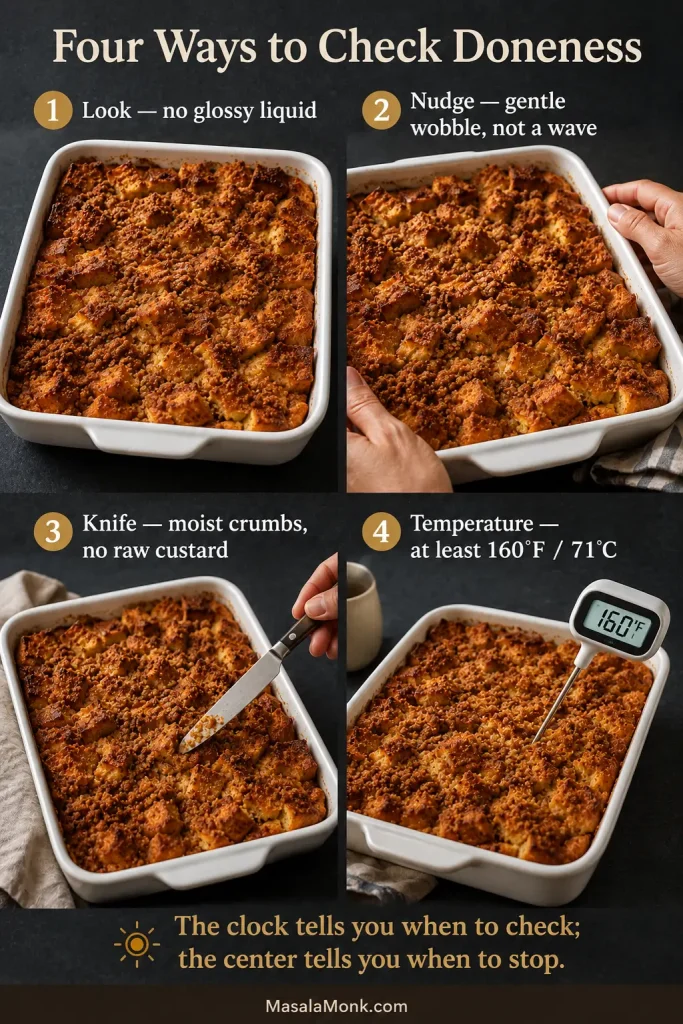
How to Tell When the Casserole Is Done
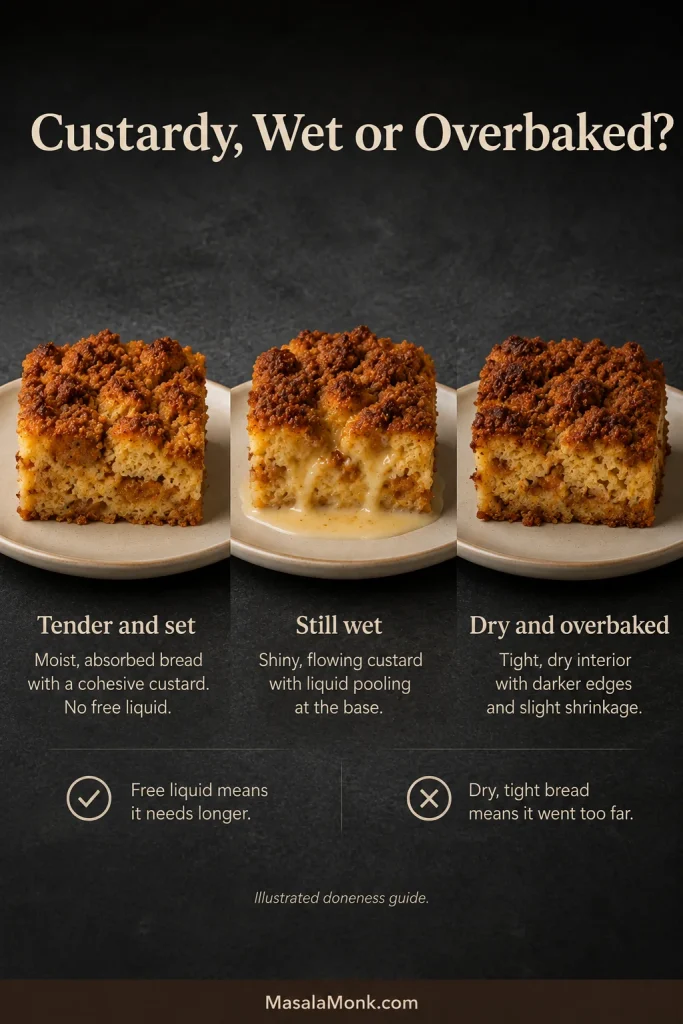
- Look: The center no longer appears glossy or filled with liquid custard.
- Nudge the dish: A gentle wobble through the center is fine; a flowing wave means it needs longer.
- Use a thin knife: Moist crumbs are expected. Raw custard coating the knife means the casserole needs more time.
- Check the temperature: Insert an instant-read thermometer into the thickest central area, avoiding the base of the dish.
The USDA recommends 160°F / 71°C for casseroles and other dishes containing eggs (opens in a new tab). Let that temperature confirm what you can already see: a set center, no flowing wave and no raw custard on the knife.
Forgot Last Night? Use the Same-Day Method
Remembered after waking? A full overnight soak is no longer possible, but the morning does not have to become a scramble. Thoroughly dried bread gives a shorter soak a much better chance to work.
- Cut the bread into pieces around 1 inch / 2.5 cm.
- Dry it using the oven method above, allowing up to 20 minutes when the bread is especially fresh and soft.
- Cool the bread before adding the egg mixture.
- Toss thoroughly so every piece makes contact with the custard.
- Let the assembled casserole stand for 45–60 minutes.
- Turn the upper pieces gently once midway through the soak.
- Add the streusel and bake using the same center-of-the-pan cues as the overnight version.
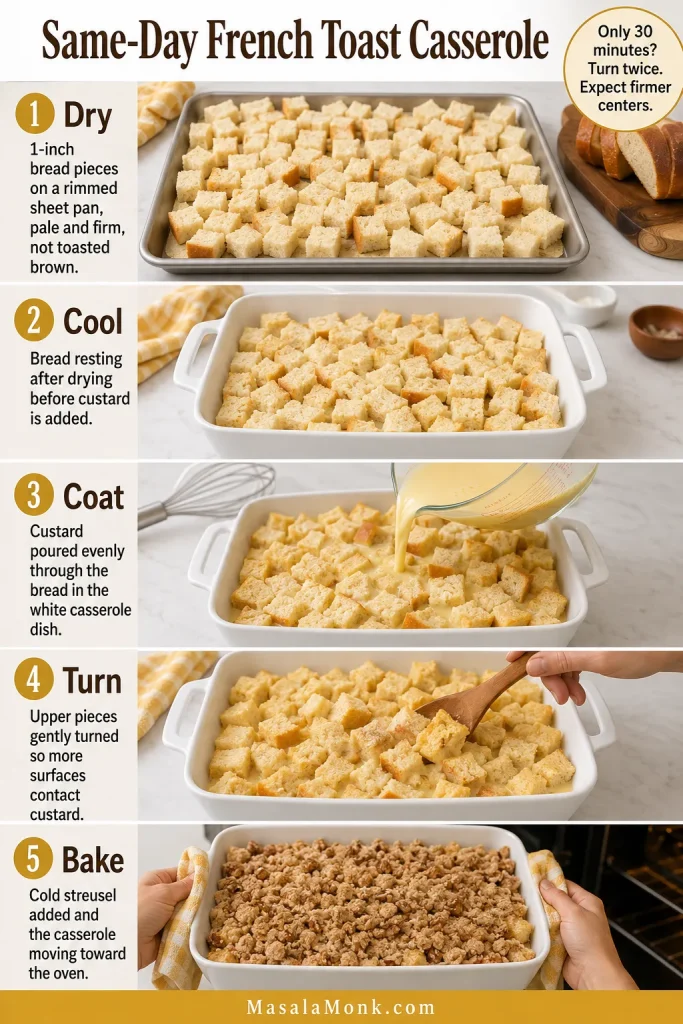
The casserole will still bake up warm and crisp-topped; the bread will simply keep more of its individual shape.
The 30-Minute Backup
Dry the bread thoroughly, keep the pieces close to 1 inch and turn them twice during the short soak. Those two turns help more of the surface meet the custard before the pan goes into the oven.
Whether the bread soaked for an hour or overnight, the same moisture cues determine whether the center finishes custardy or remains wet.
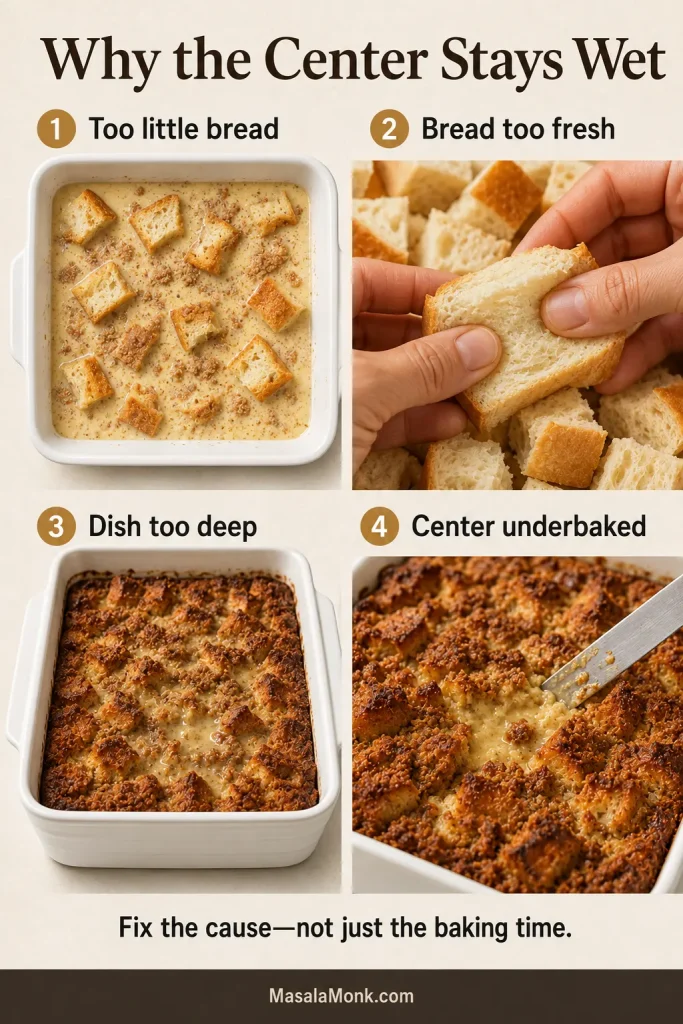
How to Keep French Toast Casserole From Getting Soggy
Softness belongs in the dish. Free liquid does not. Most soggy pans come back to four causes.
- Too little bread. An unusually small loaf leaves more custard than the pan can absorb. Use the full 16 oz / 450 g.
- Bread that was too soft or moist. Very fresh pieces lose their shape more easily during a long soak. Dry them until the surface feels firm but remains pale.
- A dish that is too deep. The edges can finish before enough heat reaches the middle. Two standard pans are more dependable than one very deep casserole.
- A center that needed more baking. A brown top does not guarantee that the custard underneath has set. Cover the surface with foil when it is dark enough and continue until the middle passes the visual, knife and temperature checks.
Custardy or Still Wet?
Custardy means the bread is tender and moist, with no liquid collecting around the serving spoon. Still wet means custard flows when the dish moves or coats a knife in the center.
Dietary Adaptations
These adaptations work best when the substitutes preserve the original structure: sturdy bread by weight, enough body in the custard and a firm fat that can still form streusel crumbs.
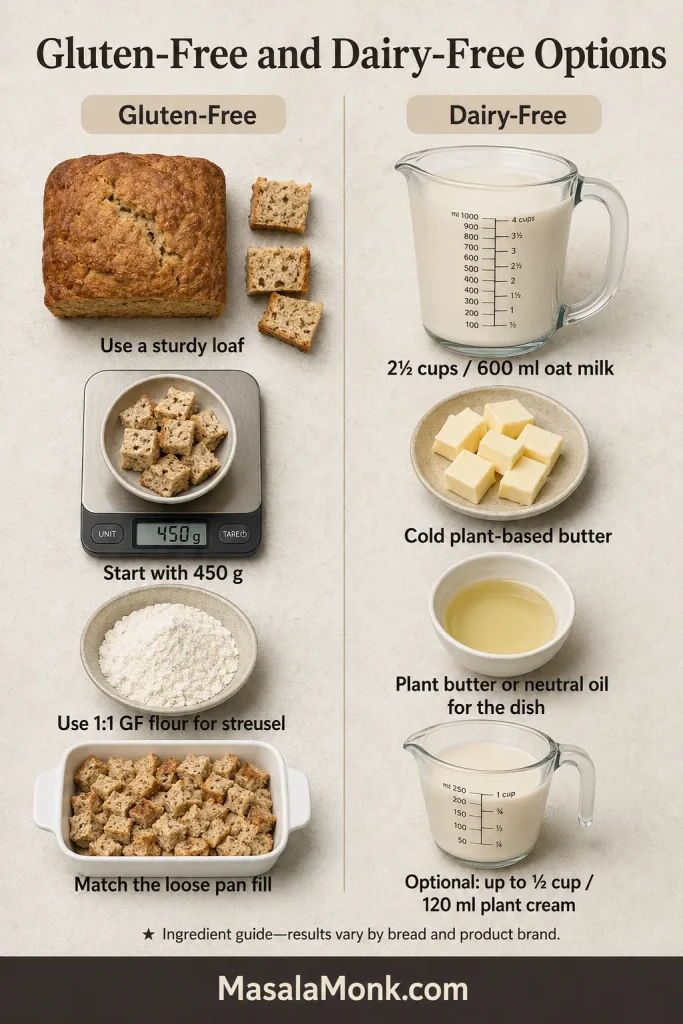
Gluten-Free
Use a certified gluten-free loaf and replace the all-purpose flour in the streusel with ½ cup / 60 g 1:1 gluten-free baking flour. Begin with 450 g bread and check that the pieces loosely fill the pan to roughly the same level as 10–12 cups of French bread.
A thick, sturdy loaf usually holds up better overnight than thin packaged slices. When cooking for someone with celiac disease or significant cross-contact concerns, check the certification of all packaged ingredients.
Dairy-Free
Use 2½ cups / 600 ml unsweetened oat milk. Replace the streusel butter with an equal weight of cold, firm plant-based butter, and grease the dish with plant-based butter or neutral oil. For a richer custard, replace up to ½ cup / 120 ml of the oat milk with an unsweetened plant-based cream suitable for cooking.
Egg-Free or Vegan
Eight eggs do most of the setting in this recipe, so replacing them changes the whole custard—not only the flavor. A general egg replacer is unlikely to hold a full 9×13-inch casserole together on its own. Begin with a vegan baked-French-toast custard designed for a full casserole. This vegan French toast guide explains several egg-free custard approaches and how each one helps the mixture set.
Pan Size, Servings and Scaling
A half batch suits a smaller table and still leaves room for one easy breakfast the following day. For a larger gathering, two ordinary pans bake more consistently and are easier to serve than one extra-deep casserole.
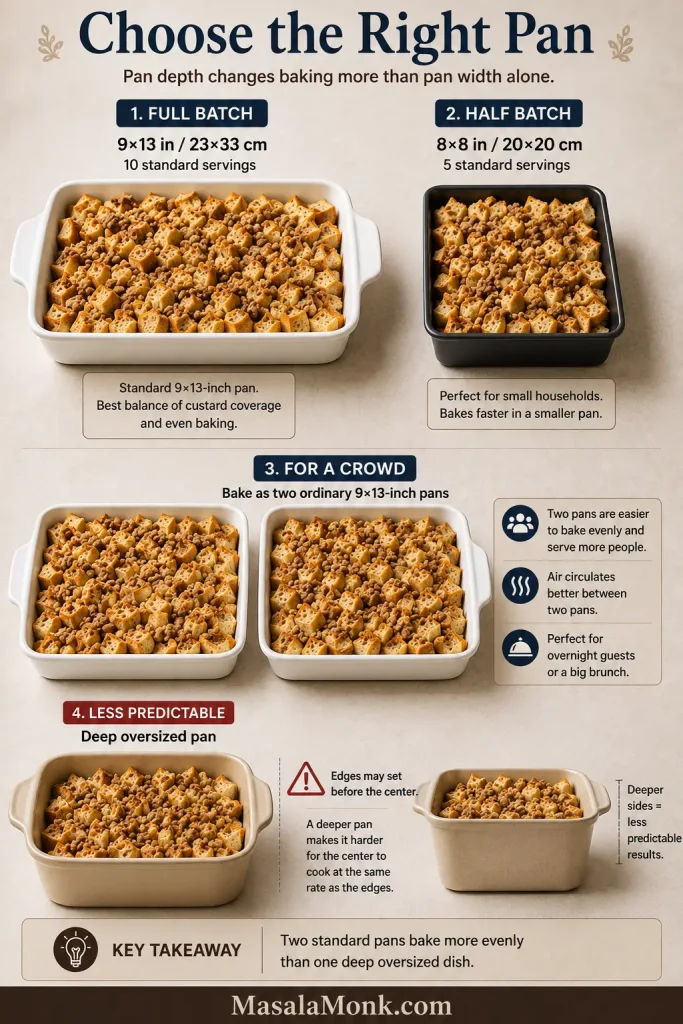
| Setup | Yield | Begin checking | Watch for |
|---|---|---|---|
| 9×13-inch full batch | 10 standard servings, 8 generous or up to 12 smaller brunch portions | About 40 minutes | The center setting before the top becomes too dark |
| 8×8-inch / 20×20 cm half batch | 5 standard, 4 generous or up to 6 smaller portions | About 30 minutes | Many dishes finish around 35–45 minutes |
| Two 9×13-inch pans | 20 standard servings, or 16–24 depending on the menu | Check each pan on its own | One pan finishing several minutes before the other |
| One deeper oversized batch | Varies with dish size | Later than the standard batch | The edges setting before the center |
Half Batch for an 8×8-Inch / 20×20 cm Dish
Quick guide: This smaller pan makes 5 standard, 4 generous or up to 6 smaller servings. Begin checking at 30 minutes; many half batches finish in approximately 35–45 minutes.
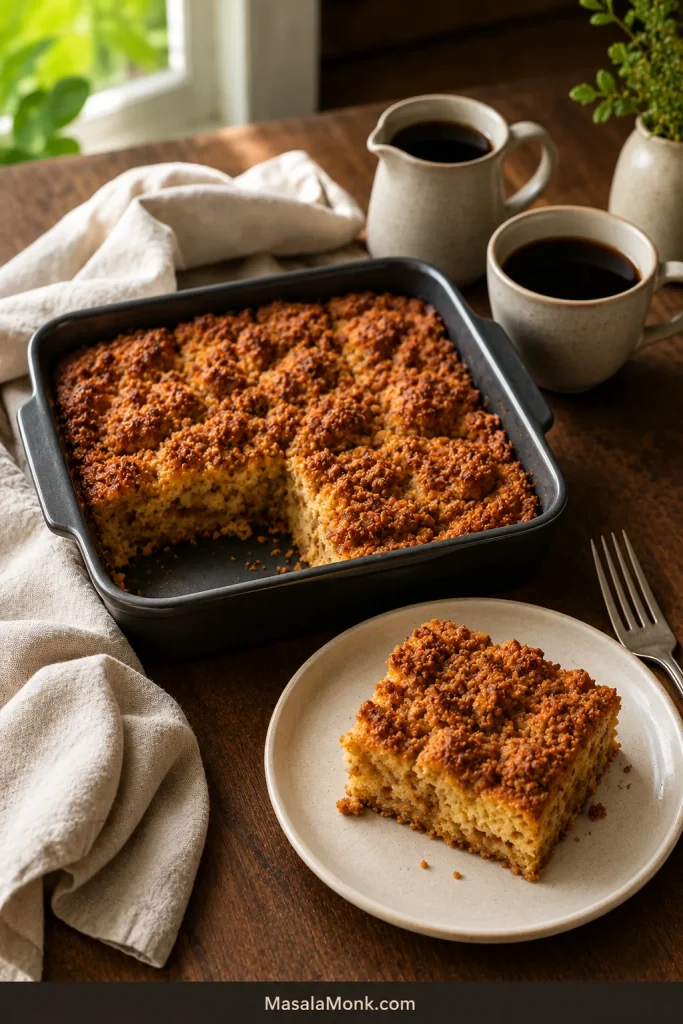
Follow the same night-before assembly, morning topping and center-doneness cues as the full recipe.
- 8 oz / 225 g bread
- 4 large eggs
- 1 cup / 240 ml whole milk
- ¼ cup / 60 ml half-and-half or cream
- 2 tablespoons plus 2 teaspoons / 35 g brown sugar
- 1½ teaspoons vanilla
- 1 teaspoon cinnamon
- ⅛ teaspoon nutmeg
- ⅜ teaspoon fine salt, or ¼ teaspoon plus ⅛ teaspoon
For the smaller streusel, use ¼ cup / 30 g flour, 35 g brown sugar, ½ teaspoon cinnamon, a pinch of salt, 3 tablespoons / 43 g butter and ¼ cup / about 28 g pecans when using.
Baking Two Pans for a Crowd
Leave space around both pans for airflow and rotate their positions when the oven browns unevenly. When guests are staying over, two pans also let breakfast reach the table without anyone cooking individual batches at the stove.
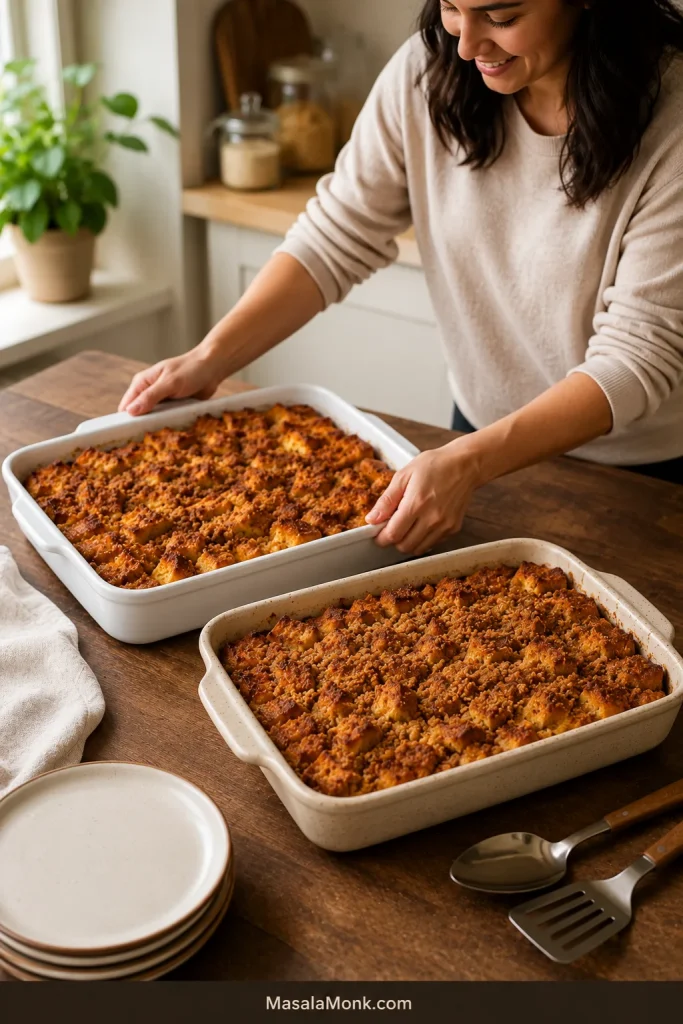
When the table needs one sweet pan and one savory pan, this breakfast casserole with hash browns can also be assembled ahead.
Blueberry, Apple and Cream Cheese Variations
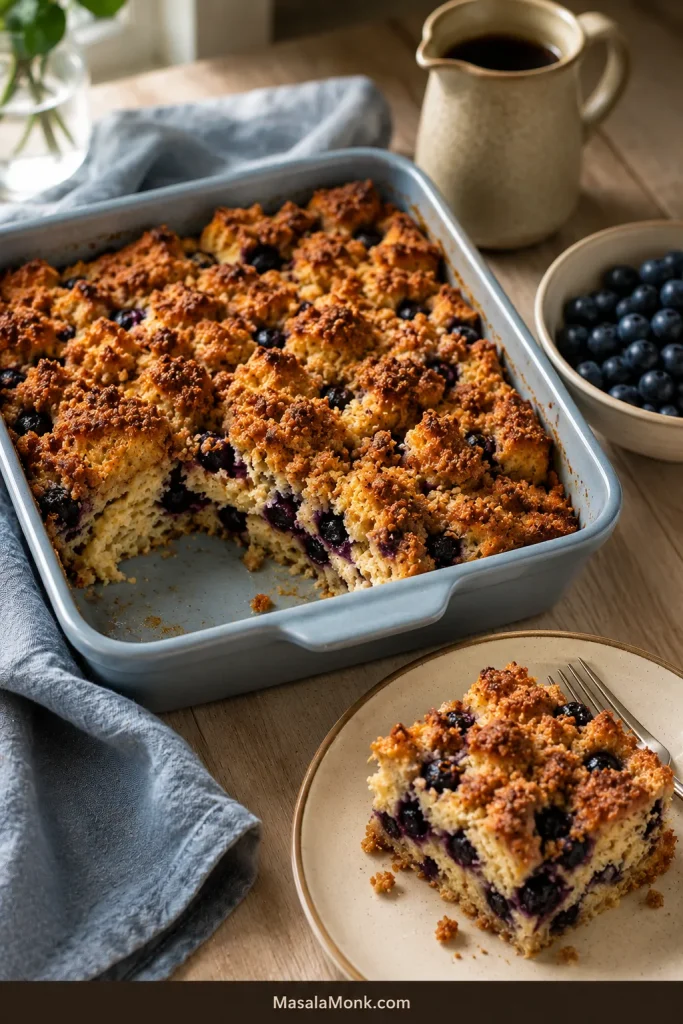
Blueberry
Blueberries add tart, juicy pockets against the cinnamon custard and brown sugar topping. Scatter 1 cup / 140 g through the bread. Fresh blueberries hold their shape better and release less juice. Frozen berries also work; add them straight from the freezer and expect the surrounding bread to become slightly softer.
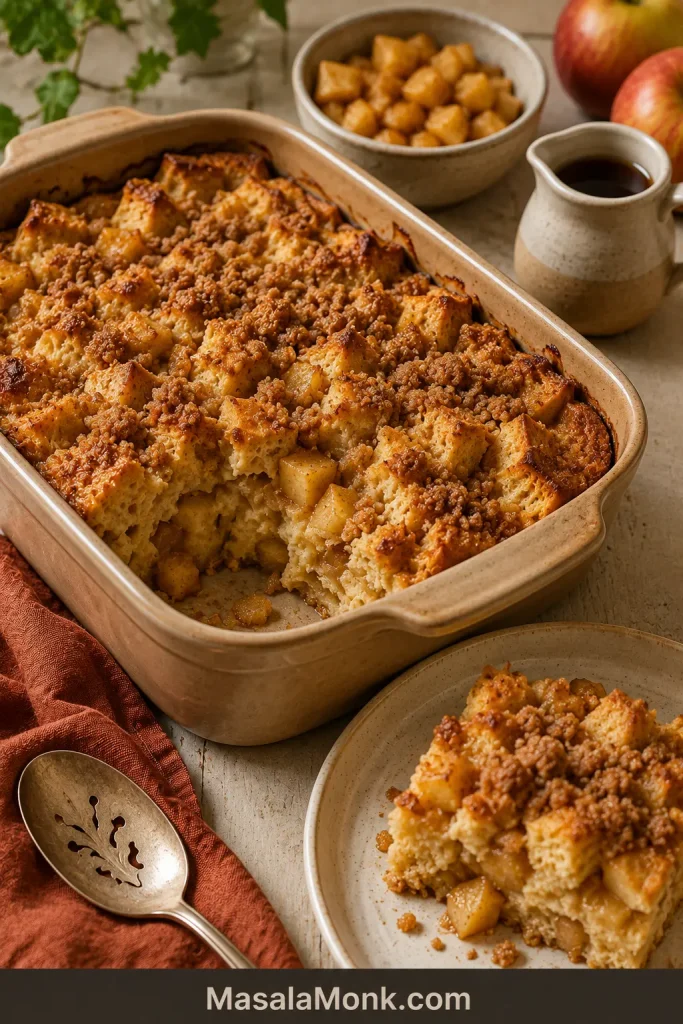
Apple-Cinnamon
Soft cinnamon apples make the casserole warmer, fruitier and especially well suited to an autumn or holiday brunch. Cook 1½ cups / approximately 180–200 g peeled, diced apples in 1 tablespoon / 14 g butter with a pinch of cinnamon until just tender but still holding their shape. Cool them on a plate before distributing them through the bread.
Cream Cheese
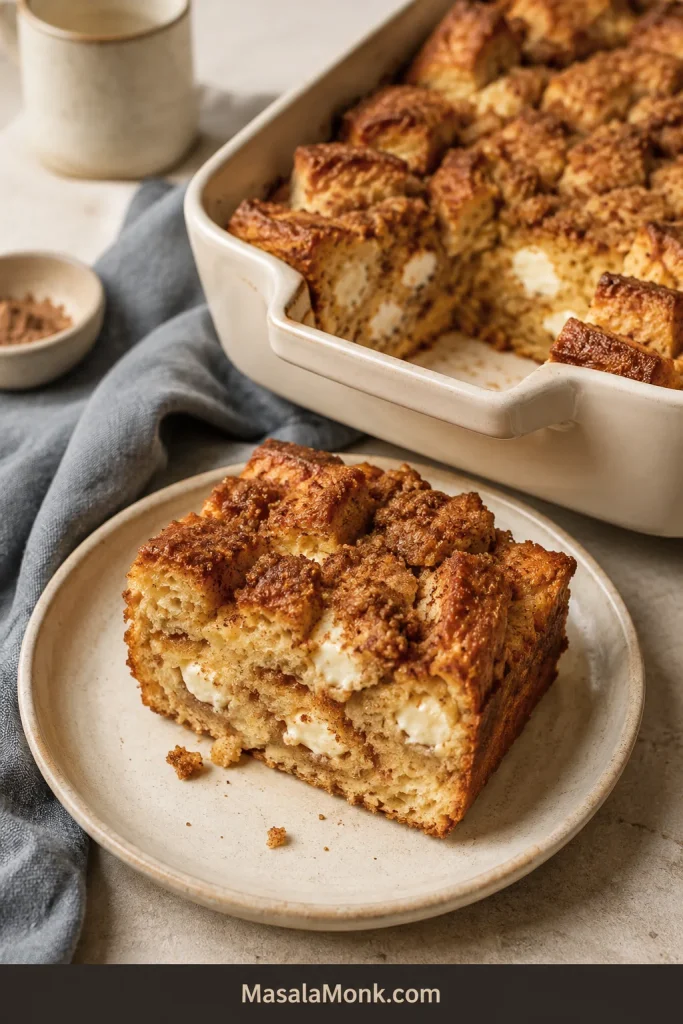
Cream cheese adds small tangy pockets that break up the sweetness of the custard and streusel. Use 4–6 oz / 115–170 g cold full-fat block cream cheese, cut into small pieces. Tuck them throughout the bread so every serving gets a few creamy pockets. Avoid whipped or spreadable tub cream cheese, which brings more moisture.
Less-Sweet Version
For a more breakfast-like pan, reduce the brown sugar in the custard to ¼ cup / 50 g and leave the crisp streusel unchanged.
What to Serve With French Toast Casserole
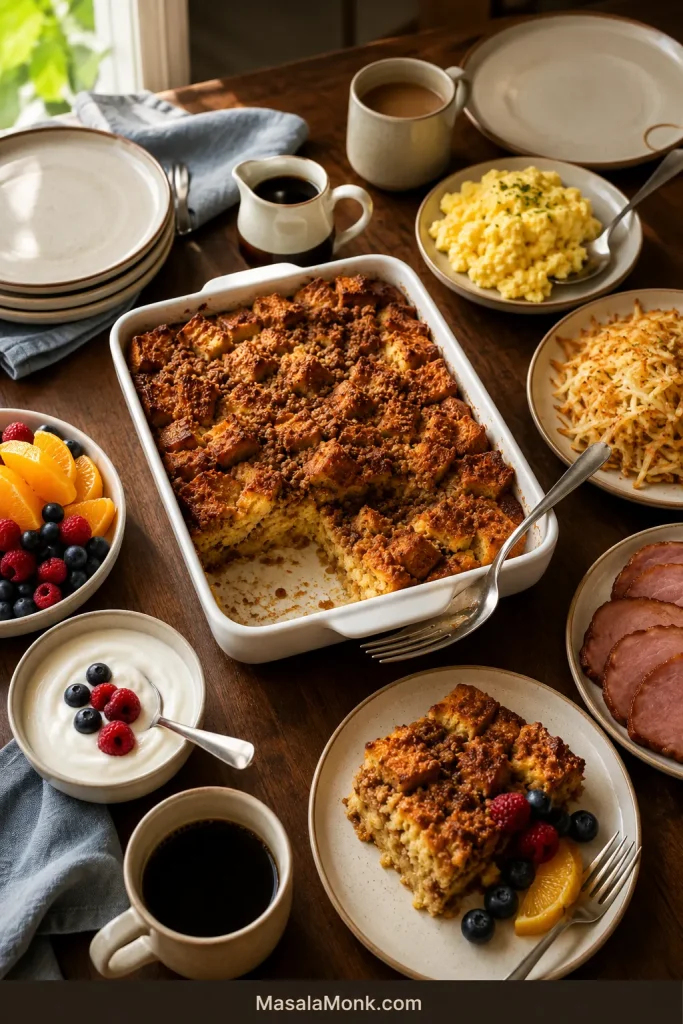
The casserole is rich, soft and sweet enough that the best sides usually bring freshness, salt or a crisper texture. Air-fryer hash browns add crisp potatoes without competing for oven space.
- Fresh fruit: Berries, orange segments, melon or lightly tart apples brighten the plate.
- Maple syrup: Warm it separately so each person can decide how sweet the serving should be.
- Eggs: Soft scrambled eggs or a simple egg bake make the meal feel more balanced.
- Breakfast meat: Bacon or breakfast sausage provides a salty contrast to the cinnamon topping.
- Holiday main: Sliced honey glazed ham works especially well for Christmas or Easter brunch.
- Yogurt: Plain or lightly sweetened yogurt adds tang and pairs naturally with berries.
- Coffee or tea: Often the only other thing a quiet weekend breakfast needs.
For a holiday spread with more than one sweet centerpiece, homemade cinnamon rolls can also be prepared the night before.
For a buffet, cut smaller portions first; people can always return for another spoonful. When the casserole is the main event, plan on eight generous servings.
Leftovers, Freezing and Reheating
The top softens in the refrigerator, but a little dry heat brings back enough crispness to make leftovers worth looking forward to.
Refrigerate or Freeze
Leftovers. Refrigerate within two hours of serving, then keep in covered containers for 3–4 days. The USDA leftovers guidance (opens in a new tab) recommends rapid cooling, covered storage and reheating leftovers to 165°F / 74°C.
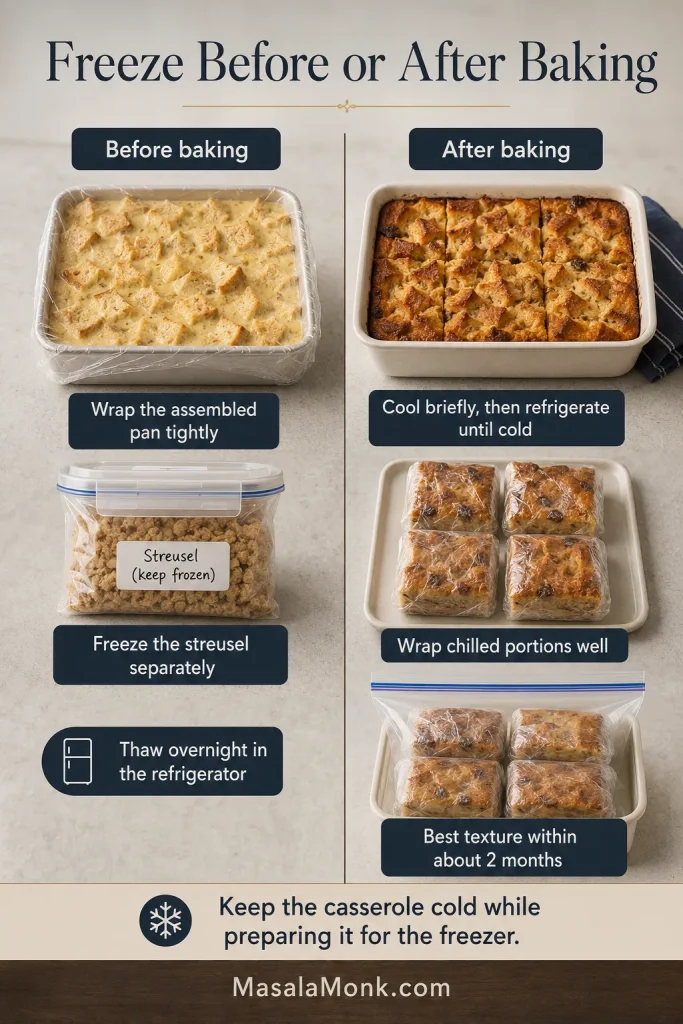
Freeze before baking. Assemble the bread and custard in a freezer-safe pan, wrap tightly and freeze the streusel separately. Thaw overnight in the refrigerator before topping and baking. Follow the cold-bakeware guidance in the recipe when choosing the pan.
Freeze after baking. Let the casserole cool briefly, then cut it into portions and refrigerate until cold. Wrap the chilled portions well and freeze for up to about two months for the best texture.
Reheat One Portion or Several
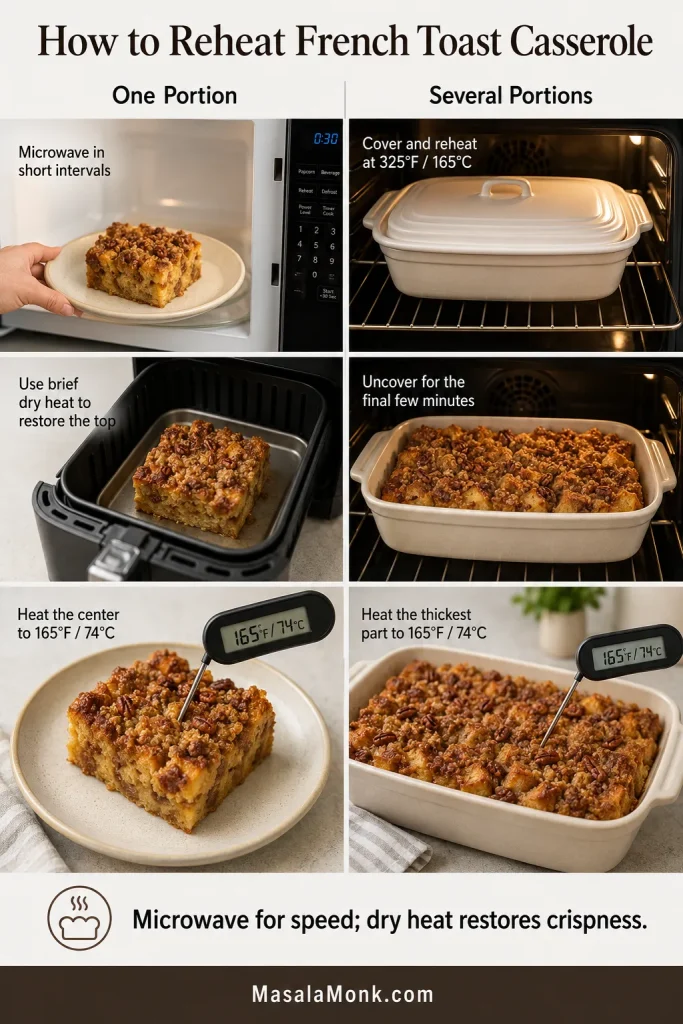
One portion. Microwave in 30-second intervals until nearly heated through. To restore the top, begin checking after about 2 minutes in a 350°F / 175°C air fryer or after about 5 minutes in a conventional oven. Confirm that the center has reached 165°F / 74°C before serving.
Several portions. Cover and reheat at 325°F / 165°C. Begin checking after 15 minutes and continue until the thickest part reaches 165°F / 74°C. Uncover for the final few minutes to refresh the streusel.
For the best second breakfast, chill the remaining casserole promptly and reheat only the portion you plan to serve.
Troubleshooting Overnight French Toast Casserole
Most problems are recoverable: cover a dark top, give a loose center more time, or revive dry pieces with warm syrup.
| Problem | Fix it now | Next time |
|---|---|---|
| Center is wet | Return the casserole to the oven and continue baking. Add a loose foil tent only if the top is already brown enough | Use the stated bread weight and check the thickest area; time alone can mislead |
| Top is dark but center is loose | Cover loosely with foil and continue baking | Keep the pan on the center rack and begin checking earlier |
| Casserole is dry | Serve with warm syrup, fruit or yogurt | Use the full custard amount and remove the pan once the center is set |
| Flavor is overly eggy | Tart fruit and maple syrup can make the egg flavor less noticeable | Avoid adding extra eggs, and whisk the custard thoroughly before pouring |
| Edges are rubbery | Trim only the driest edge when serving | Begin checking sooner, especially in dark metal pans |
| Some bread is still dry | Spoon warm syrup over those pieces | Pour in stages and turn the bread during assembly |
| Bread collapsed into mush | Let the casserole rest longer, then serve it by the spoonful instead of cutting clean portions. Add fresh fruit or toasted pecans for contrast | Use firmer or better-dried bread and avoid adding extra liquid |
| Streusel disappeared | Add a light dusting of cinnamon sugar after baking | Refrigerate the topping separately and add it in the morning |
Frequently Asked Questions
Can I assemble it more than one night ahead?
Firm, dry French bread or sourdough can usually remain refrigerated for up to about 24 hours. Softer breads may begin losing their shape, so 8–12 hours remains the usual target.
Can I bake it directly from the refrigerator?
Check the manufacturer’s guidance before moving cold glass or ceramic bakeware into a hot oven. A metal pan avoids that thermal-shock concern.
Should French toast casserole bake covered or uncovered?
Bake this streusel-topped version uncovered so the exposed bread and topping can crisp. If the top becomes dark before the center is set, tent it loosely with foil and continue baking.
Breakfast Is Waiting
The cinnamon streusel and soft vanilla custard make this pan feel special, but the real reward happened the night before. The bread was cut, the eggs were whisked and most of the kitchen was already cleaned while the morning was still hours away.
Now the top is crisp, the center is properly set and breakfast can be carried to the table all at once. No skillet line, no stack growing cold while the next pieces cook—just one warm casserole and a morning that began with the difficult part already handled.
What bread did you use? Tell us whether you made the casserole overnight or used the same-day method—and what you might add next time.








