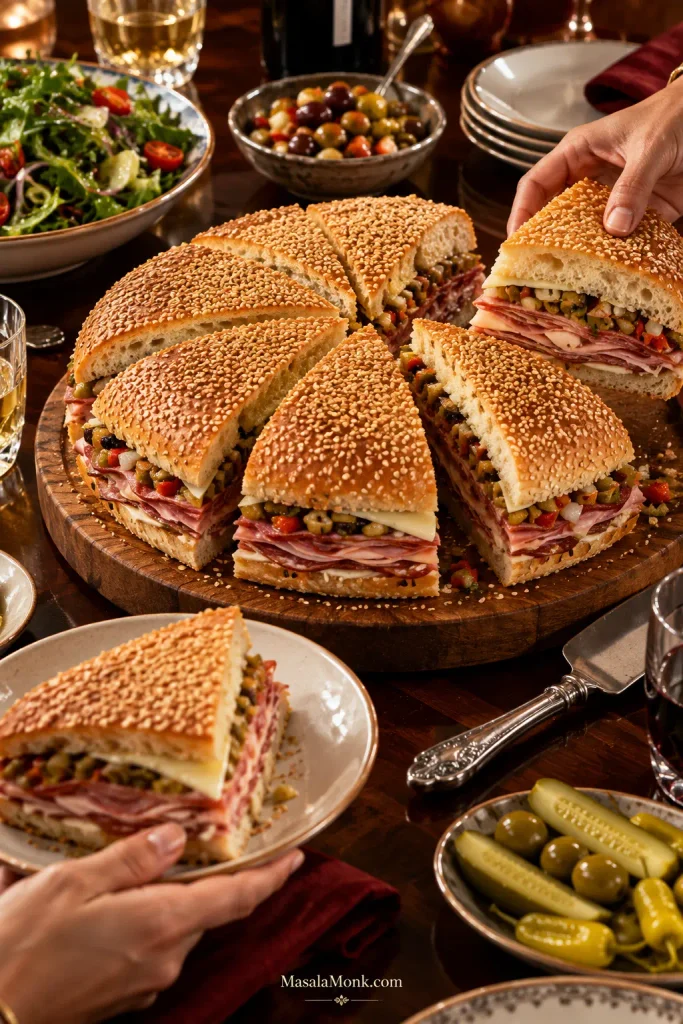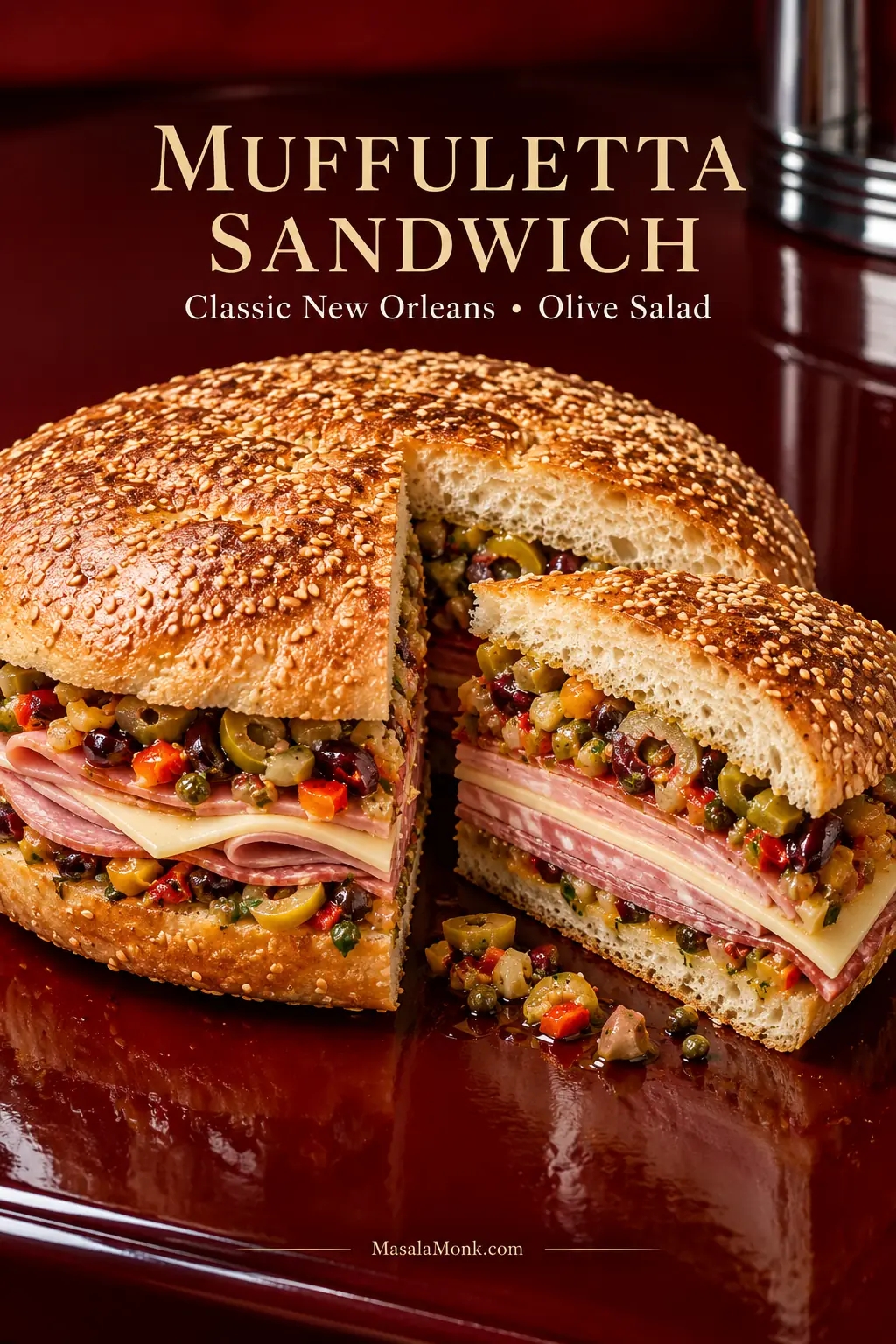
A muffuletta is one of the rare sandwiches where waiting is part of the recipe. Build the loaf, wrap it, put some weight on top and give the olive dressing time to work into the bread. When you finally cut through the round, what began as separate layers of meat, cheese, olives and bread should hold together as one sandwich.
A good wedge yields when you bite it. The sesame loaf bends around the filling, the crumb glistens with seasoned olive oil without feeling soaked, and a rough green-and-red line of olive salad runs through each slice. Thin folds of cured meat and cheese stay where they belong instead of pulling the sandwich apart.
Homemade versions usually go wrong at one of those points. A handsome loaf can be too hard or too tall. Extra meat can make the sandwich harder to eat. Olives, giardiniera, capers, salami and cheese can pile salt on top of salt, while too much loose dressing softens the bread before anyone is ready for a wedge. The method below keeps those parts in balance and gives the sandwich enough time to come together.
Build for the press. Use a broad, tender sesame loaf, control the olive-salad oil, keep the filling low and even, then refrigerate the wrapped sandwich under weight for 1–2 hours.
Classic Muffuletta Sandwich Recipe
A classic New Orleans muffuletta with a round sesame loaf, Genoa salami, mortadella, ham, provolone, Swiss, and coarse homemade olive salad. The loaf is dressed, filled, wrapped and pressed until it cuts into clean, satisfying wedges.
Equipment
- Serrated bread knife
- Large cutting board
- Medium mixing bowl
- Chef’s knife or food processor
- Measuring cups and spoons
- Kitchen scale, useful for the deli filling
- Plastic wrap; reusable food wrap or foil also works
- Second cutting board or tray for pressing
- Cast-iron skillet for weight; a Dutch oven or another broad, steady weight works too
Ingredients
For the Olive Salad
- 1 cup drained green olives / about 140 g, preferably pimiento-stuffed or another firm, flavorful green olive
- ½ cup drained Kalamata or other dark olives / about 70–75 g
- ½ cup well-drained mild giardiniera / about 90 g (Italian mixed pickled vegetables), unless you specifically want a hotter sandwich
- ¼ cup drained pepperoncini / about 35 g
- ¼ cup drained roasted red pepper / about 40 g
- 2 tbsp drained capers / about 18 g
- 2 medium garlic cloves, roughly chopped
- 1 tsp dried oregano
- ¼ tsp freshly ground black pepper
- 2 tbsp / 30 ml red wine vinegar
- ⅓ cup / 80 ml extra-virgin olive oil
- Fine salt only if needed after tasting
Drain the jarred vegetables until they no longer shed obvious brine when pressed lightly with a spoon; they do not need to be dried bone-dry.
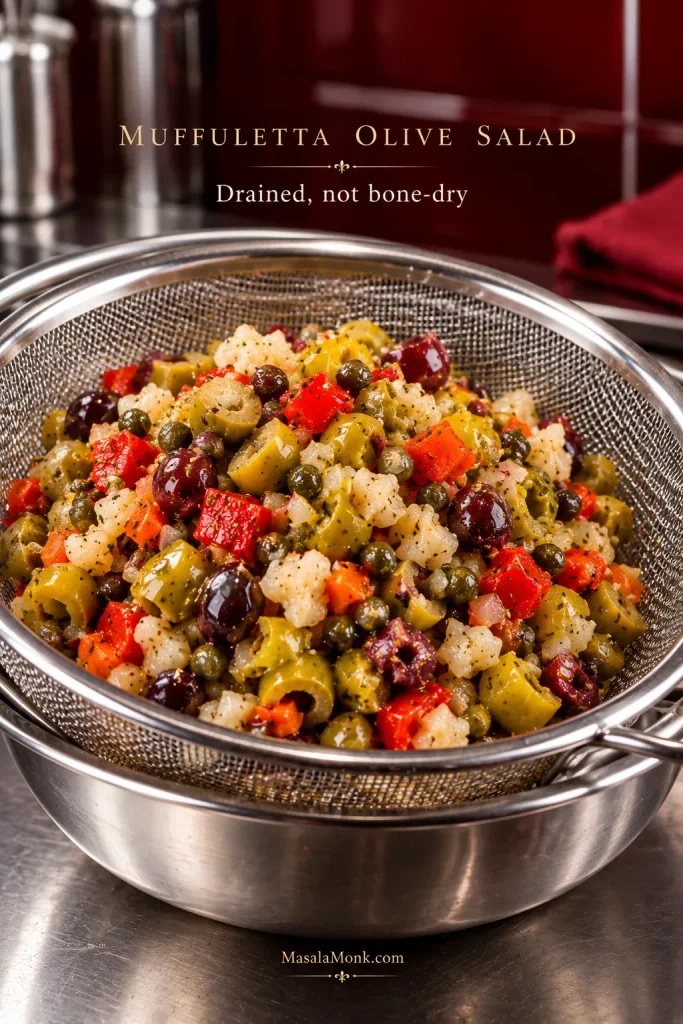
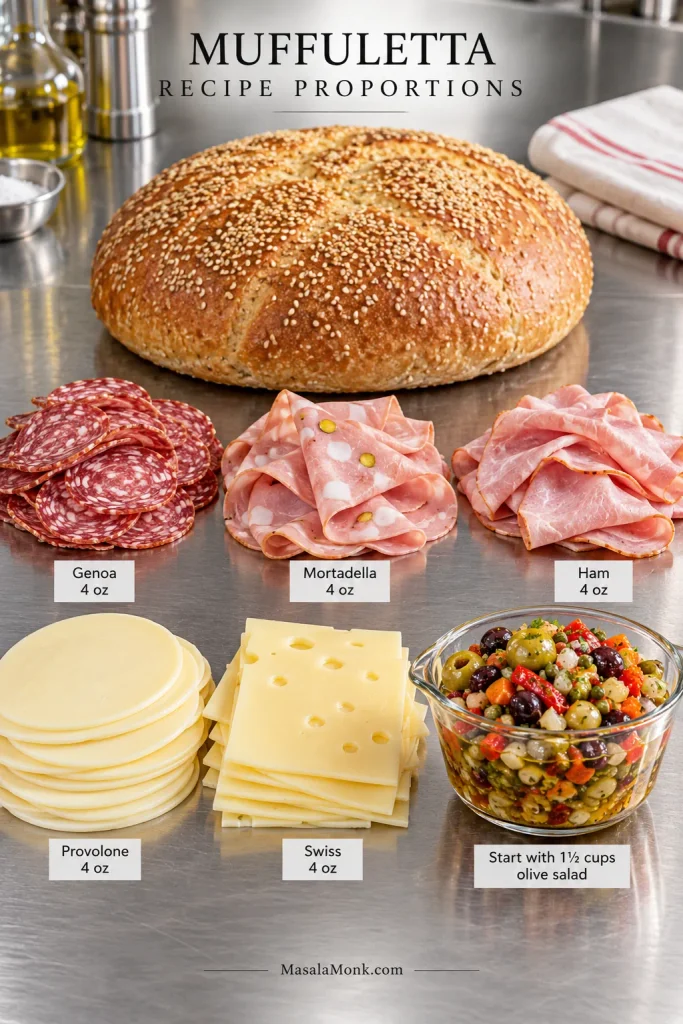
The finished mixture makes roughly 2½–3 cups, usually around 500 g, depending on the ingredients and how thoroughly they are drained. Plan on about 1½ cups / 300 g to start for the sandwich; a broad 9–10 inch loaf may comfortably take up to 2 cups / 400 g. You’ll probably have some olive salad left over. That’s intentional.
If your giardiniera is packed in oil, drain it especially well and begin with ¼ cup / 60 ml olive oil instead of the full ⅓ cup. Add more after the salad rests if it needs it. Oil trapped between chopped vegetables is easy to miss and difficult to take back out later.
For the Sandwich
- 1 round sesame loaf, 9–10 in / 23–25 cm across
- 4 oz / 113 g thinly sliced Genoa salami
- 4 oz / 113 g thinly sliced mortadella
- 4 oz / 113 g thinly sliced ham
- 4 oz / 113 g sliced provolone
- 4 oz / 113 g sliced Swiss
Ask the deli counter for slices that fold easily without being shaved into wisps. Mortadella especially likes to bunch into thick pillows; pull those folds apart as you build so one bite does not end up twice as tall as the next.
Method
1. Chop the Olive Salad
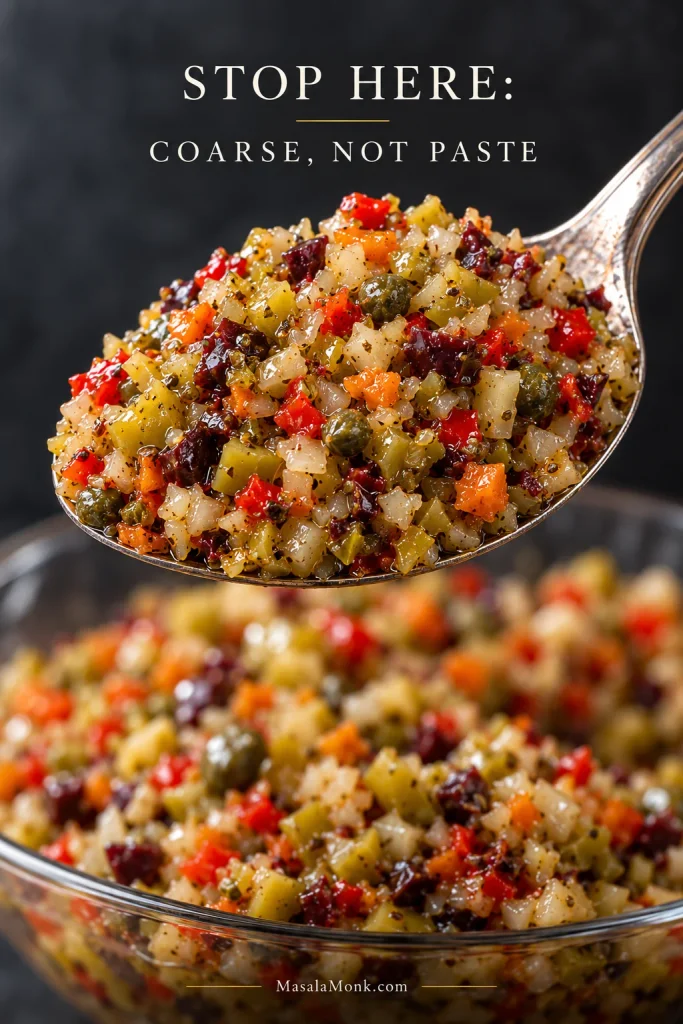
Combine the green olives, dark olives, giardiniera, pepperoncini, roasted red pepper, capers and garlic. Chop by hand or pulse briefly in a food processor until most pieces are roughly lentil-to-pea size.
Stop while you can still tell an olive from a pepper. A few uneven pieces are fine. Smooth olive paste loses the little flashes of crunch and pickle that make the sandwich interesting.
2. Dress and Rest the Olive Salad
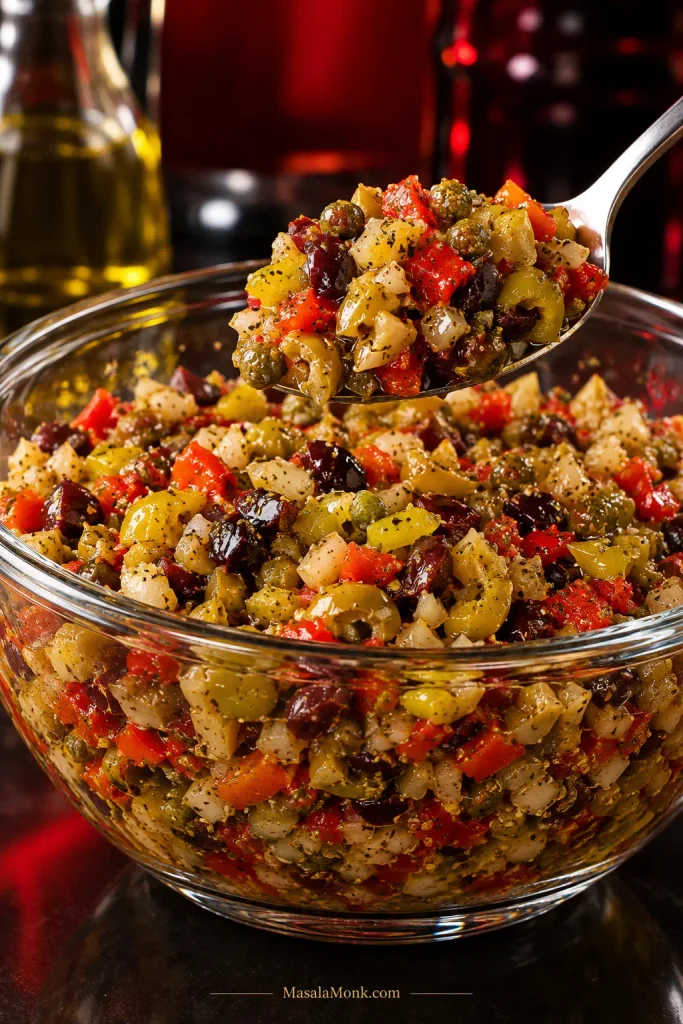
Stir in the oregano, black pepper, red wine vinegar and olive oil. Cover and refrigerate for at least 1 hour, preferably overnight.
Stir from the bottom before using it and taste before reaching for salt. The vegetables should no longer taste like several separate jars emptied into one bowl. You’re looking for a glossy, spoonable mixture with a little seasoned oil around the solids.
3. Slice and Assess the Loaf
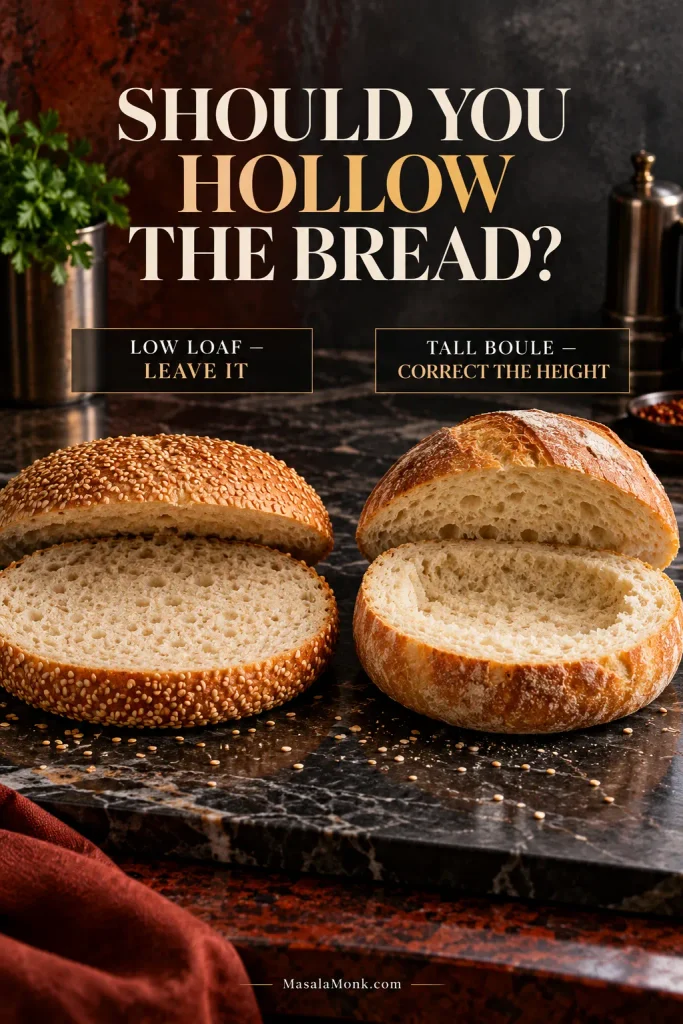
Cut the loaf horizontally with a serrated knife. A broad, relatively low loaf can keep its crumb intact. With a tall supermarket boule, pull out only enough soft interior to improve the bread-to-filling ratio, leaving roughly ¾–1 in / 2–2.5 cm of crumb beneath the crust.
Press the cut surface gently with a fingertip. The crumb should spring back a little. A loaf that already feels like a hard bread bowl will still be hard after pressing.
4. Dress the Bread
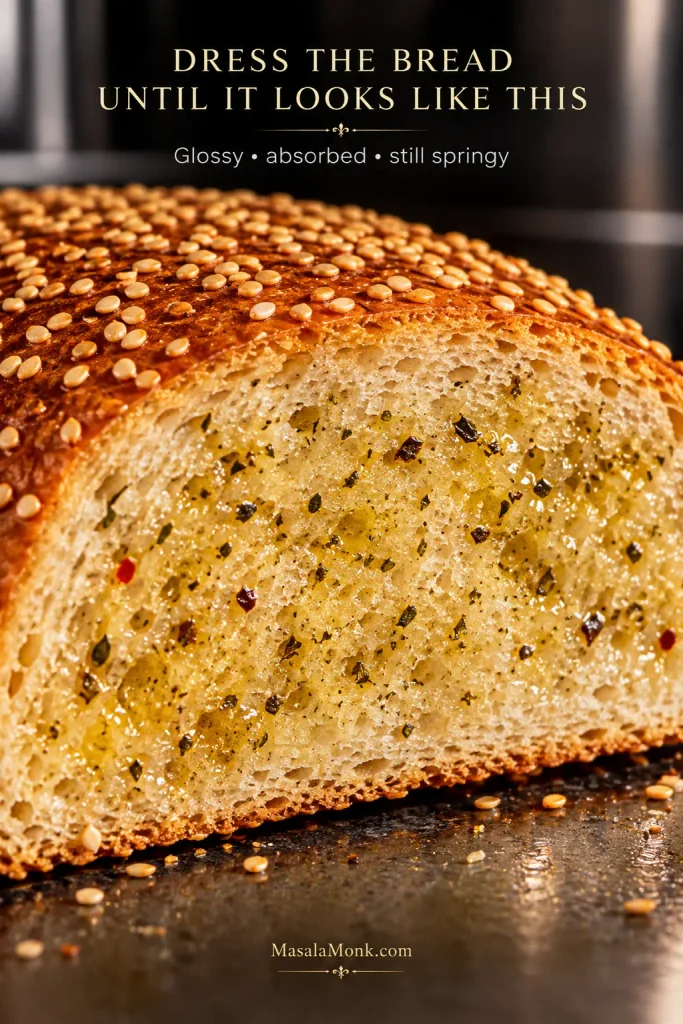
Spoon some seasoned oil from the olive salad over both cut faces. Give it a moment to disappear into the crumb.
Still pale and dry? Add another spoonful. Already glossy with some spring underneath? Stop there. The last spoonful is often the one you do not need.
5. Build the Sandwich
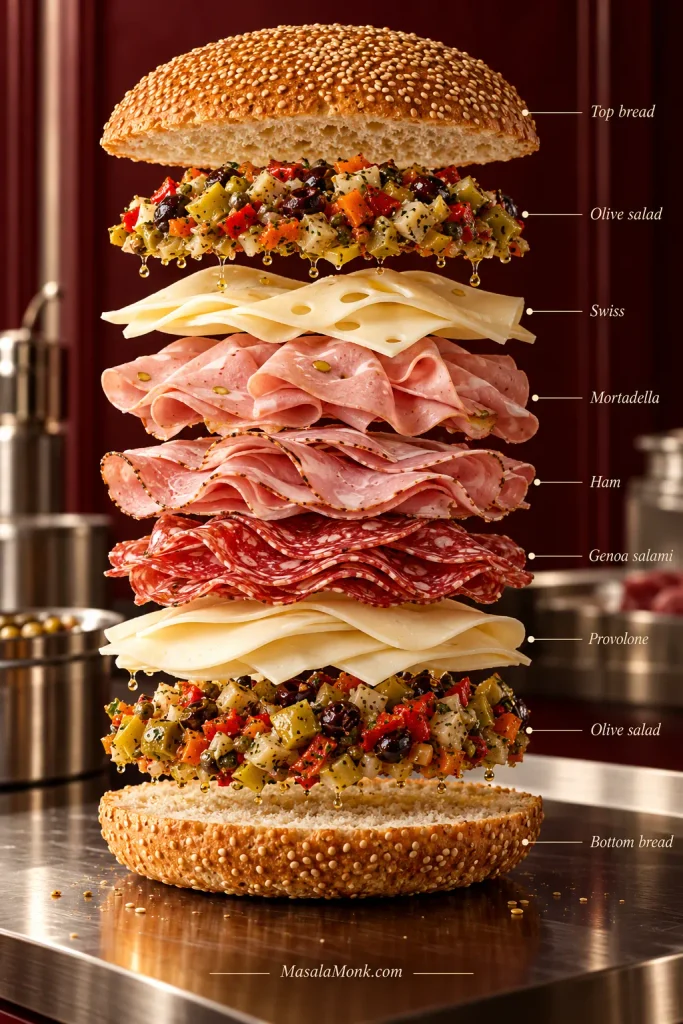
Spread about ¾ cup olive salad over the bottom bread, staying about ½–¾ in / 1–2 cm inside the edge.
Lay the provolone across the olive salad. Add Genoa salami, ham and mortadella in loose overlapping folds, spreading each meat across the full round. Finish with Swiss.
Spoon another ¾ cup olive salad over the upper cheese. That gives you the 1½-cup baseline; add more a spoonful at a time if the loaf still closes easily, up to about 2 cups total. Keeping the chunky salad on the filling also saves you from flipping an olive-covered top half onto the sandwich.
Look at the loaf from the side. It can be abundant without becoming awkward to bite. Move thick meat folds around now; an even sandwich presses more cleanly.
6. Close and Wrap
Lower the oil-dressed top bread straight onto the filling. Wrap it snugly in plastic wrap. Reusable food wrap or foil also works.
7. Press for 1–2 Hours
Put the wrapped sandwich on a cutting board or tray and place another flat board on top. Set a cast-iron skillet over it and refrigerate. A Dutch oven or another broad weight works too; roughly 5–8 lb / about 2–4 kg is a useful starting point.
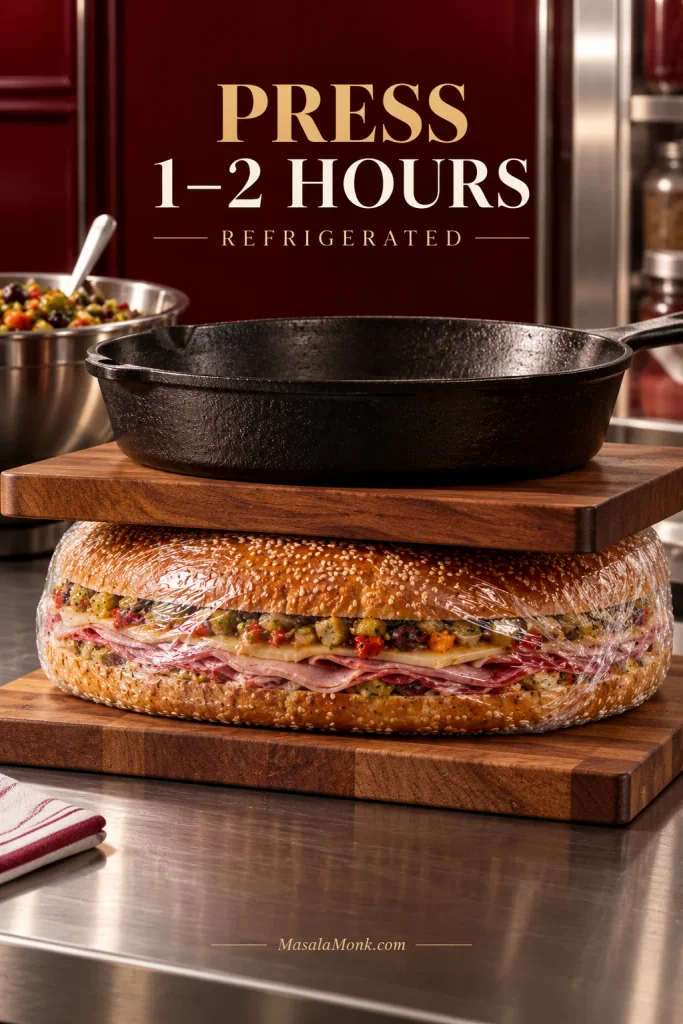
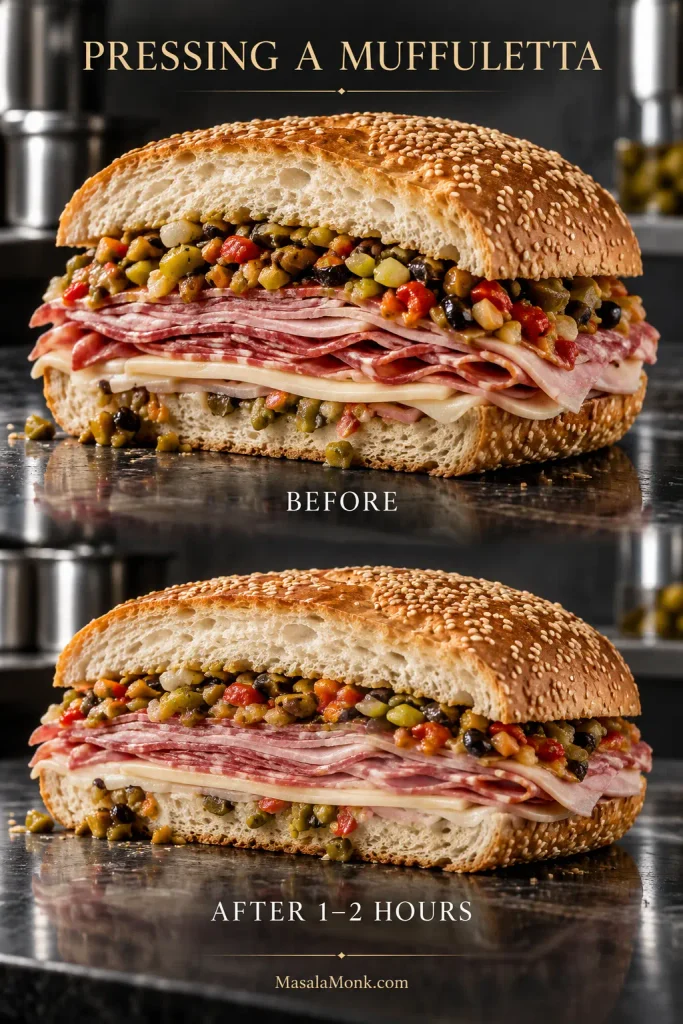
At first the loaf can look almost comically full. An hour or two later it should be lower and firmer, with the layers holding together when you lift it.
Some spring should remain in the bread. If dressing is squeezing steadily from the edges, ease up on the weight or check whether there’s too much loose oil.
8. Cut and Serve
Unwrap and saw gently with a serrated knife into 6 large wedges or 8 smaller portions. Once pressed, a wedge should lift cleanly without needing both hands to clamp it together.
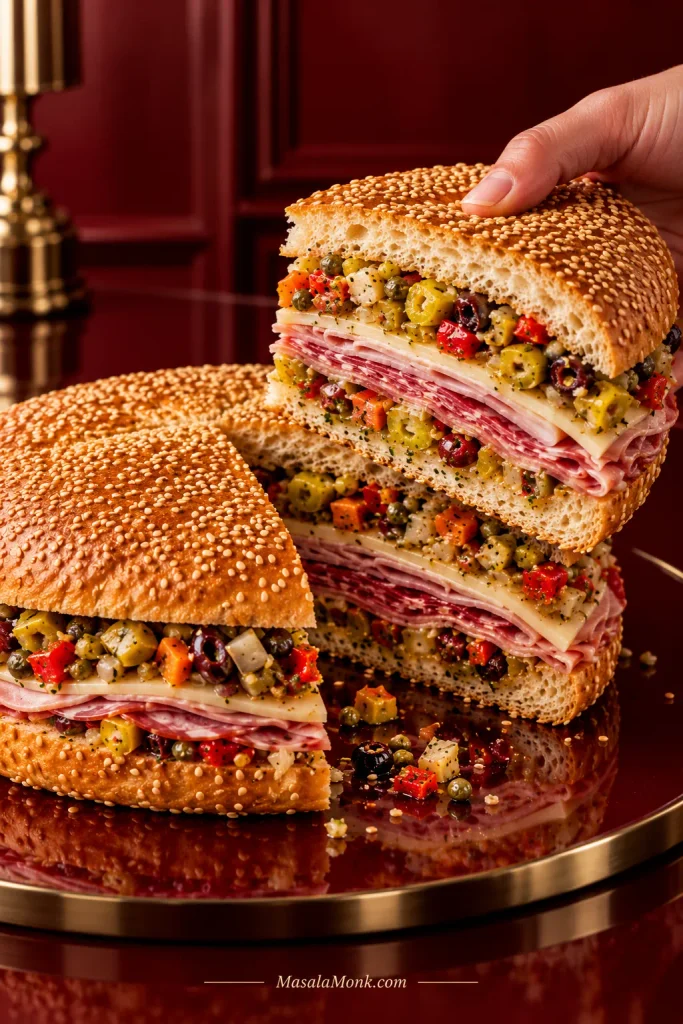
Serve it cool, or give a refrigerated sandwich a brief temper before eating if you prefer softer bread and cheese.
9. Warm It, If You Like
Wrap loosely in foil and warm at 350°F / 175°C. Start checking individual wedges after about 8 minutes; a refrigerator-cold whole loaf will need longer and may take 15 minutes or more.
The real finish line is softened cheese and fragrant cured meat. Pull the sandwich before the crust turns hard and dry.
A Few Useful Notes
- A same-day version still works: give the olive salad 30–60 minutes if that is all you have, then assemble and press the sandwich.
- Jarred olive salad can replace homemade. Taste both the solids and the oil first; stale or harsh oil is worth draining and refreshing with good extra-virgin olive oil and a little vinegar.
- Taste before salting. Between the olives, capers, pickled vegetables, cured meat and cheese, you may already have all the seasoning you need.
- Keep total unrefrigerated time within 2 hours, or 1 hour above 90°F / 32°C.
Most muffuletta problems come down to three things: the loaf, the moisture in the olive salad and the height of the filling.
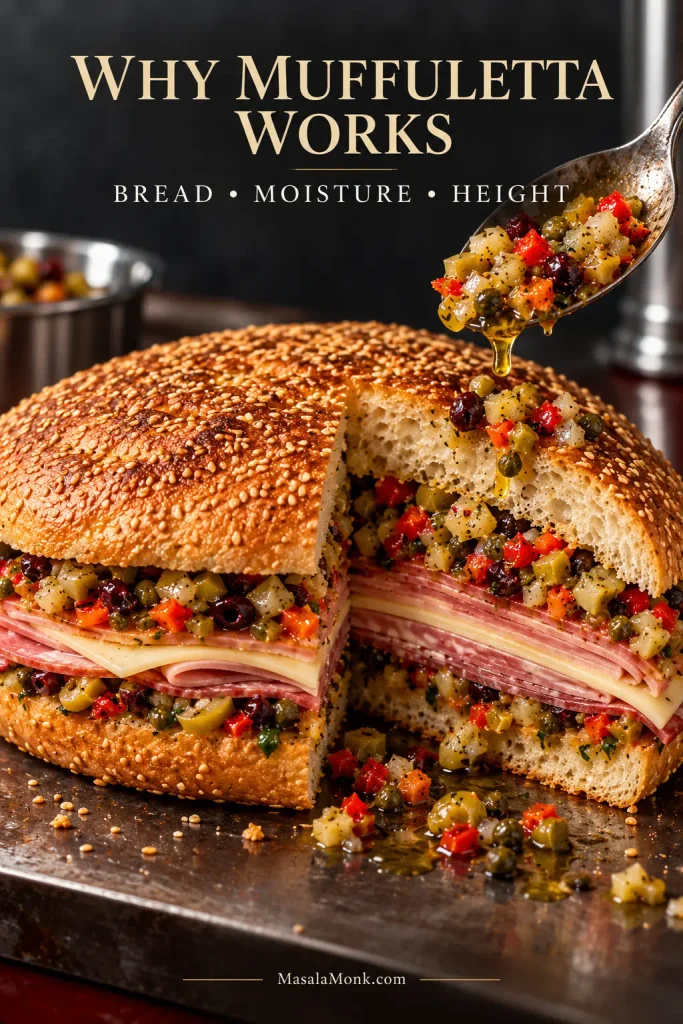
Muffuletta Guide
What Makes It a Muffuletta?
Strip away the variations and a muffuletta still comes down to a few unmistakable things: a broad sesame loaf, olive salad, cured meats and cheese. During the rest, seasoned olive oil works into the crumb, making the bread part of the flavor rather than simply its container.
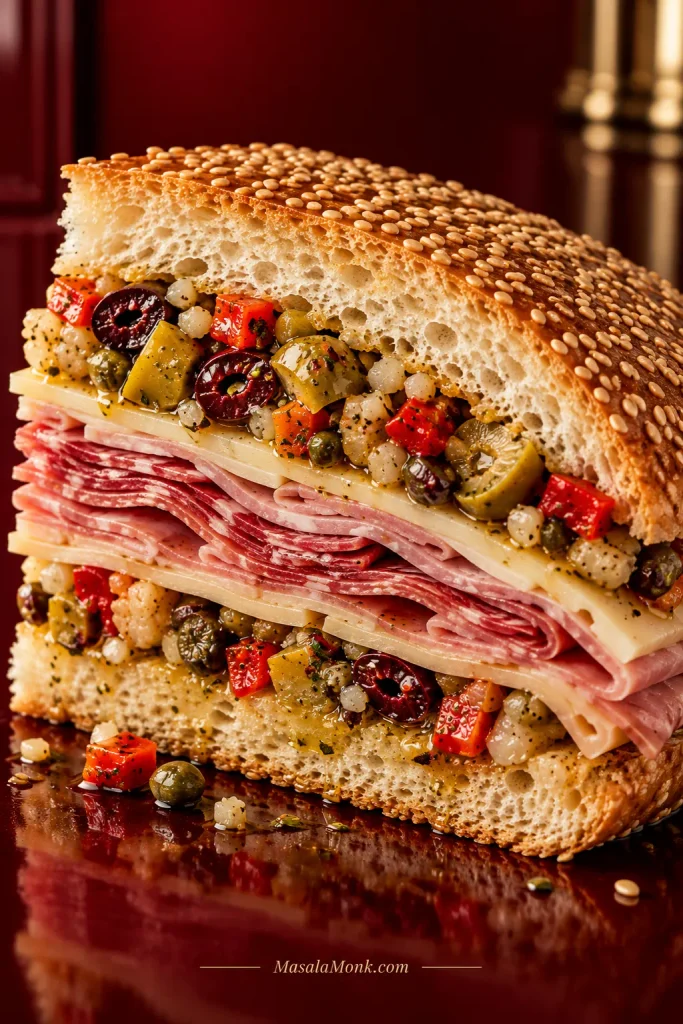
If you obsess over only two things, make them the bread and the olive salad. The exact deli meats and second cheese can vary. A hard loaf or weak olive salad changes the sandwich much more.
Central Grocery and the Muffuletta’s New Orleans Story
Central Grocery says its French Quarter store was founded in 1906 by Sicilian immigrant Salvatore Lupo, whom it credits with creating the muffuletta. Its sandwich brings together a round Sicilian sesame loaf, cured meats, cheese and briny Italian olive salad.
It gathers the pleasures of an Italian deli counter—bread, cured meat, cheese, olives and pickled vegetables—into one portable round loaf.
This recipe keeps that recognizable New Orleans structure. Low-moisture mozzarella can also replace Swiss as a common variation. You will also see the sandwich spelled muffaletta. The spelling changes; the sandwich does not.
The Best Bread for a Muffuletta
Bread is the one part worth being picky about. Get the loaf right and you have plenty of room to improvise at the deli counter. Start with a hard, towering boule and the rest of the sandwich spends its life trying to compensate.
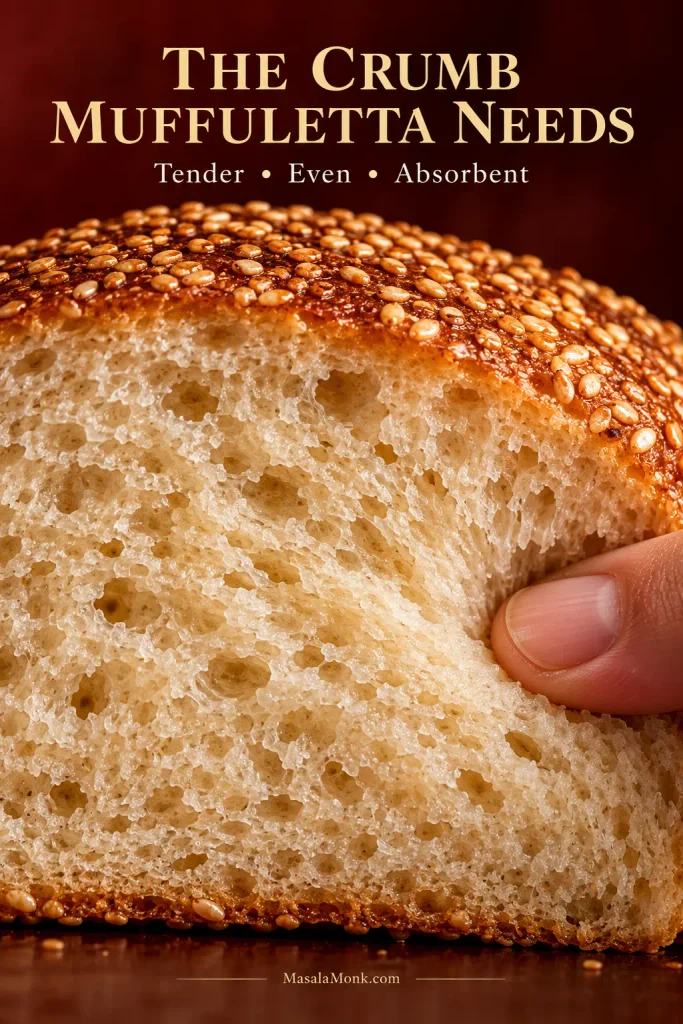
Look for a round loaf around 9–10 inches / 23–25 cm across and roughly 2–3 inches / 5–7.5 cm high. The crust can have some character, but it should yield easily when bitten. Inside, a moderately close, spongy crumb gives the olive dressing somewhere to go.
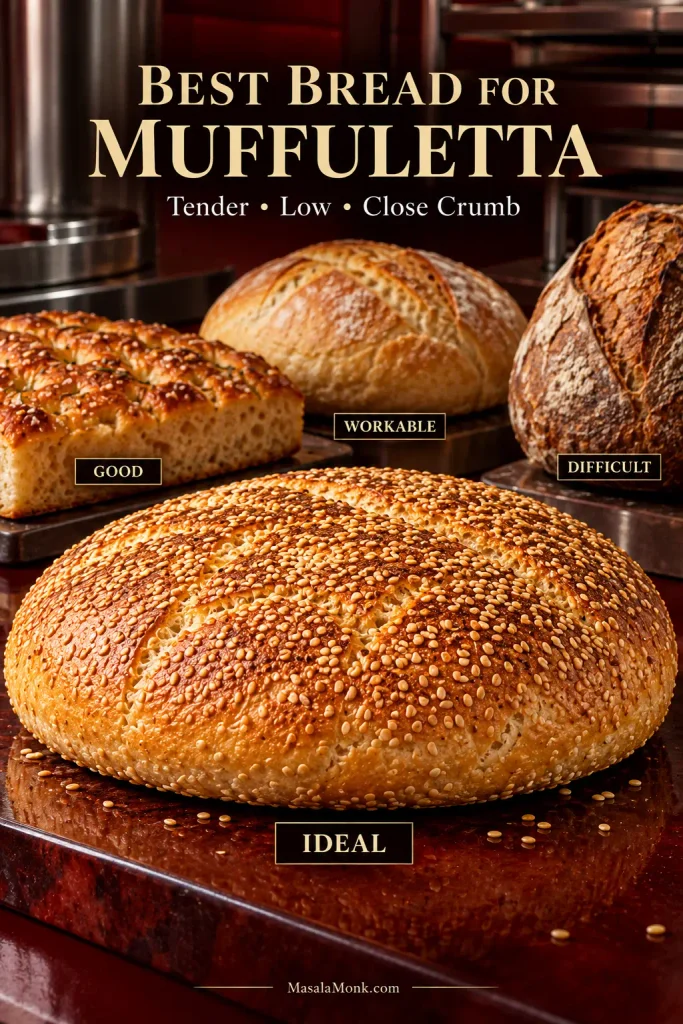
What you want is a tender bite with enough crumb strength to absorb seasoned oil without collapsing. Giant air pockets let dressing slip straight through; a heavy dense crumb makes every bite more work than it should be.
When You Can’t Find the Traditional Loaf
A low round sesame Italian loaf is the first substitute to look for. Sturdy focaccia comes next, especially when it has enough crumb to take the dressing. If you want to bake one, this no-knead focaccia recipe gives you the base method; choose a flatter, tighter section instead of the most dramatically bubbly part of the slab.
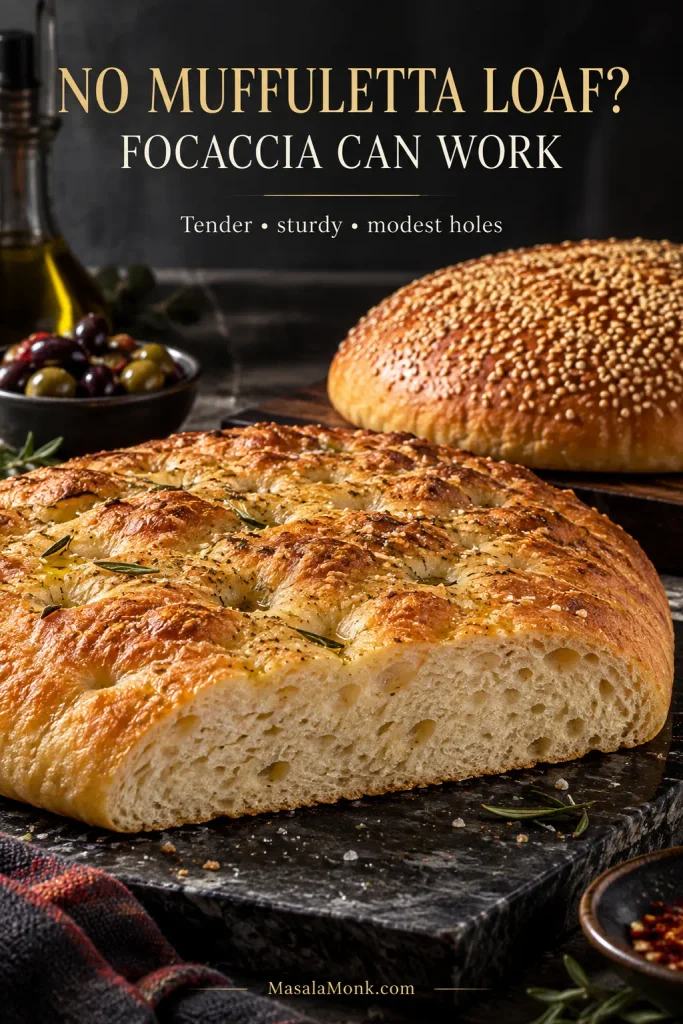
A wide soft boule also works when you correct its height. Softer ciabatta can work too, provided the crust is easy to bite and the holes are modest. Very crusty artisan bread and dense sourdough are much harder to press into the yielding sandwich we want.
Baking your own? Shape the loaf broad and low, add sesame to the top and aim for a tender crust with fairly even crumb. Spectacular air pockets are unnecessary here. For muffuletta, boring-looking crumb can be an advantage.
Should You Hollow Out the Bread?
Hollowing is a geometry correction, not an authenticity ritual. A low muffuletta-style loaf can stay intact. With a tall boule, remove only enough soft crumb to bring the bread back into proportion with the filling. Leave plenty behind to absorb dressing and cushion the crust.
Olive Salad: Chunky, Generous, but Not Swimming
If bread is the frame, olive salad is the part that makes the sandwich unmistakable. After a night in the refrigerator, the garlic loses some of its raw edge, the vinegar works through the vegetables, and the oil starts tasting like the salad rather than something poured over it.
Is Muffuletta Spread the Same as Tapenade?
Not quite. Despite the name muffuletta spread, the sandwich wants a chopped olive-and-pickled-vegetable salad rather than a smooth tapenade. The coarser texture gives you distinct bites of olive, pepper and giardiniera.
Jarred ingredients vary wildly in salt. Taste them before dressing the salad. An aggressively briny olive or giardiniera can be rinsed briefly and drained again; make the final salt decision only after everything has rested together.
Dress the Bread in Two Steps
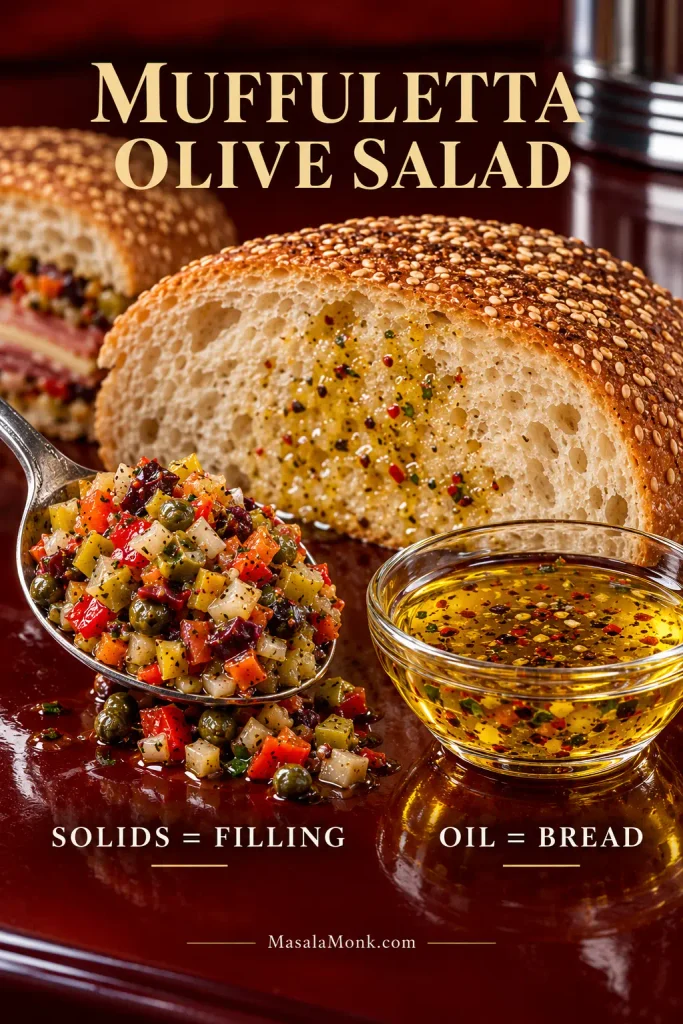
The chopped salad and its loose seasoned oil do different jobs. Keep enough solids in the filling for olive, pepper and pickle in every bite. Use the free oil on the bread, a little at a time.
Different loaves absorb it differently. Airy bread may take another spoonful; softer bread may already look glossy. A glossy surface does not mean the crumb is saturated.
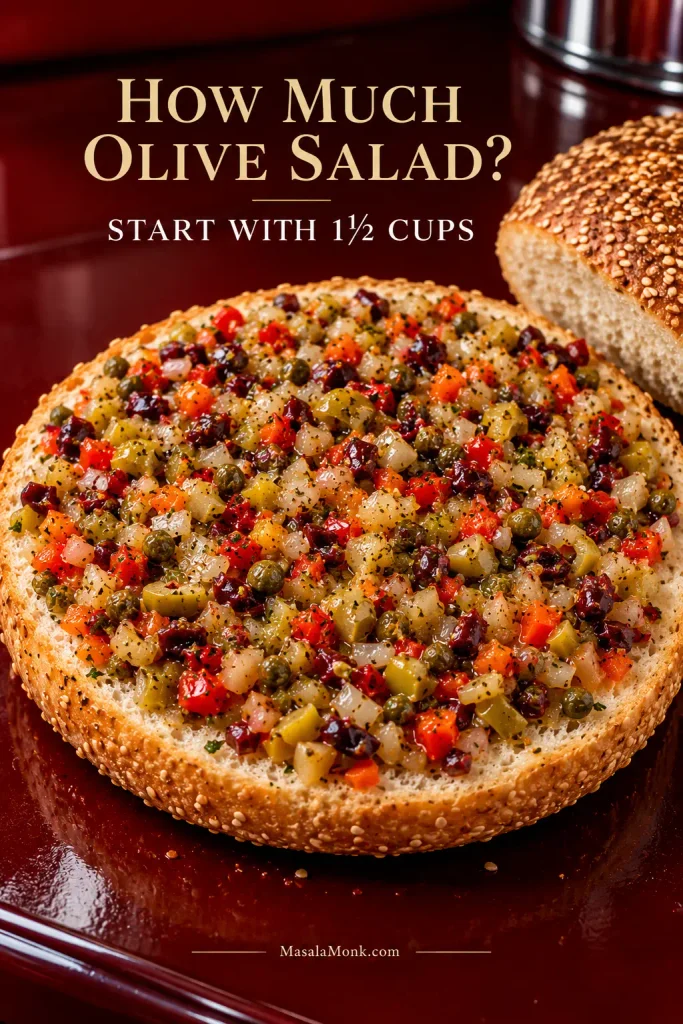
How Much Olive Salad to Use
About 1½ cups / 300 g is a good baseline for a 9–10 inch sandwich. A broad, sturdy loaf may take up to 2 cups / 400 g. If the loaf closes comfortably at 1½ cups, stop there instead of forcing in the last spoonful.
Use leftover olive salad in this lemony chickpea salad; add it a spoonful at a time because it already brings salt, oil and acidity.
Build a Sandwich You Can Actually Bite
For a 9–10 inch / 23–25 cm loaf, 12 oz / 340 g meat and 8 oz / 225 g cheese already make a substantial sandwich. Restaurant versions can go heavier. At home, extra height quickly gets in the way of a clean bite.
Thin slices help. Spread the meat across the whole round in loose folds instead of building a thick center, and pull apart clumps of mortadella or ham as you go. What matters here is even height from edge to edge.
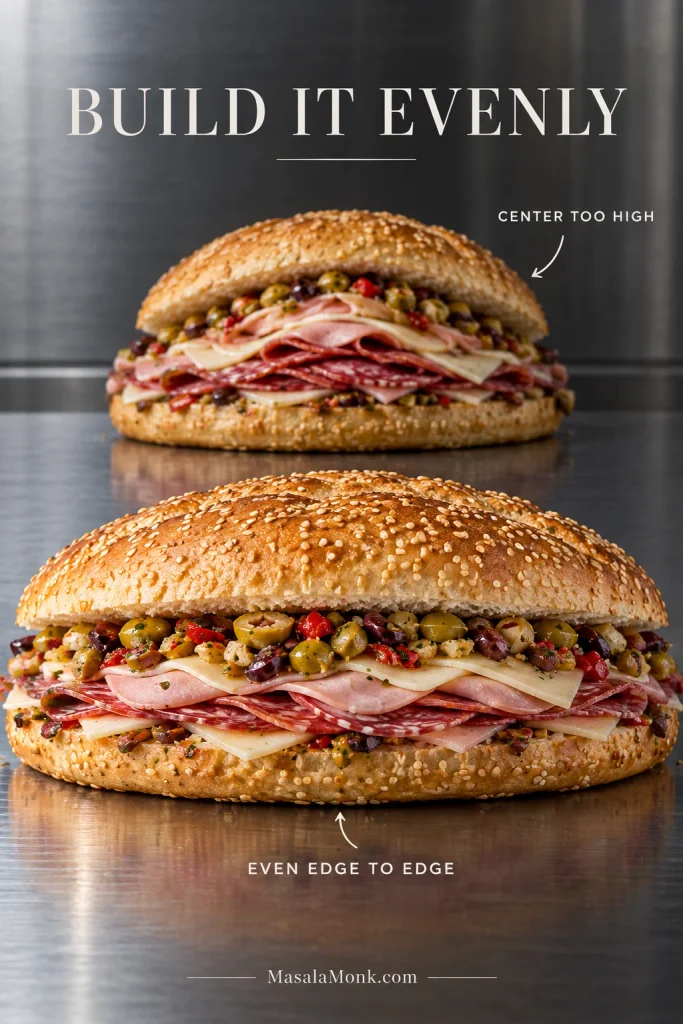
Before wrapping, look at the sandwich from the side. If it already needs both hands just to stay closed, correct the height now. Redistribute thick folds, remove a little filling or hollow a tall loaf further if needed.
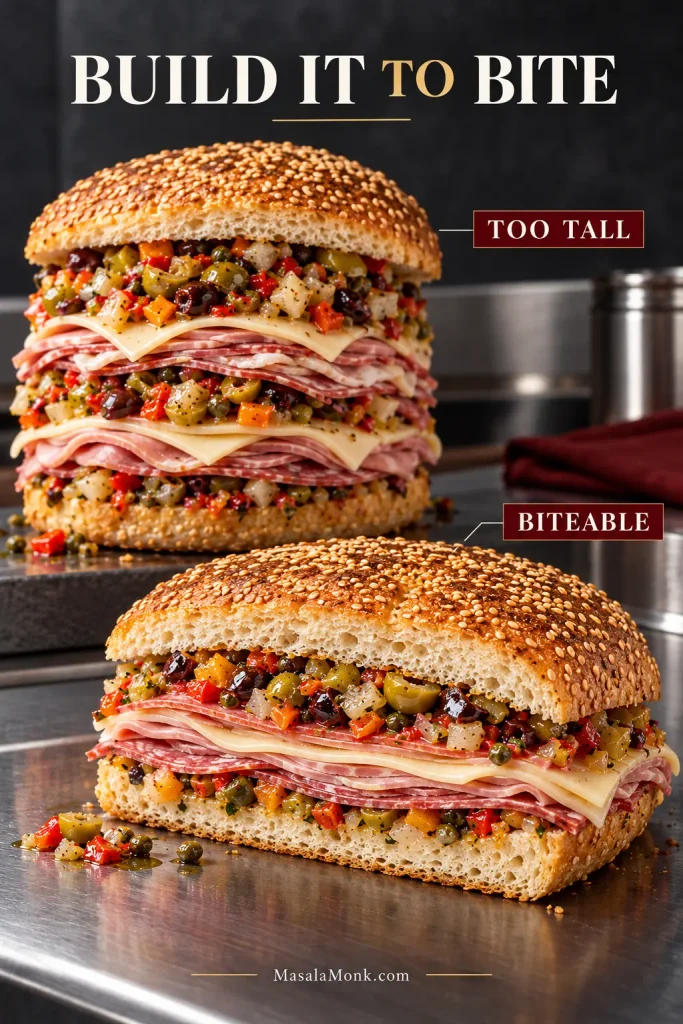
Once cut, the finished wedge should be easy to read: sesame crust around oil-darkened crumb, a rough green-and-red streak of olive salad, then ribbons of salami, ham and mortadella between pale layers of cheese. Garlic and olive oil hit first; the cured meat follows. Vinegar and pickled vegetables keep the richness in check.
Pressing the Sandwich
Pressing turns the awkward stack you just built into something you can cut, carry and eat. The loaf lowers, the layers grip one another and some of the seasoned oil moves farther into the crumb.
This is different from the hot press used for a Cuban sandwich. A Cubano browns and crisps as it is compressed. A muffuletta can do all of its pressing cold.
| Rest | Where | Result |
|---|---|---|
| 20–30 min | Cool room only when serving promptly and safely | Light compression, fresher bread, looser layers |
| 1–2 hr | Refrigerated | Recommended balance: cohesive layers, dressed crumb, clean wedges |
| 3–8 hr | Refrigerated | More melded flavor and noticeably softer bread |
| Overnight | Refrigerated | Very integrated filling; bread and dressing matter more |
For a 9–10 inch loaf, roughly 5–8 lb / about 2–4 kg is a useful starting point. A board between the sandwich and the weight spreads pressure across the full round.
Watch the bread more than the scale. It should become clearly shorter while keeping a little spring. If the skillet rocks because the middle sits much higher than the edges, redistribute the filling or use a broader tray before adding more weight.
Food safety: USDA guidance says perishable food should not remain unrefrigerated for more than 2 hours, or more than 1 hour above 90°F / 32°C. Assembly, room-temperature pressing, tempering and serving all count toward that same cumulative window.
Cool or Warm?
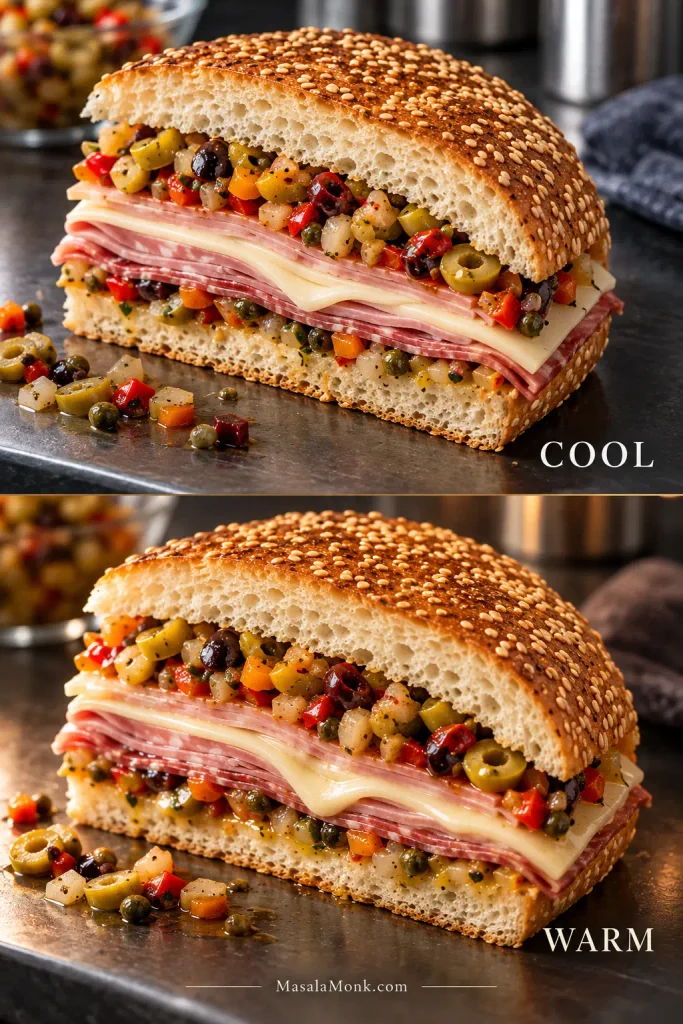
There isn’t one required serving temperature. Napoleon House is famous for its warm muffuletta, while Central Grocery’s version is traditionally sold ready to eat rather than hot-pressed.
For a cool muffuletta, cut after the refrigerated press; if the bread and cheese feel too firm straight from the fridge, give it a short temper within the safe serving window.
For a warm muffuletta, 350°F / 175°C is gentle enough. Warm it until the cheese softens and the cured meat becomes fragrant, then pull it before the crust hardens.
A rich, briny sandwich benefits from something cold and sharp beside it. This cucumber salad with vinegar, dill and onion adds crunch and acidity without making the plate heavier.
Once you’ve decided how you want to serve it, the filling itself is fairly flexible.
Ingredient Substitutions
Do not let the deli counter become a purity test. If the loaf is right, the olive salad tastes sharp and briny, and the sandwich still closes without a fight, you have plenty of room to change the meats and second cheese.
| Can’t find | Use | Difference |
|---|---|---|
| Muffuletta loaf | Low sesame Italian loaf or sturdy tender focaccia | Choose bread that compresses easily and catches the dressing |
| Mortadella | Mild good-quality bologna or extra ham | Less silky richness |
| Genoa salami | Mild or medium Italian salami | Very dry salami chews harder; spicy salami can dominate the olives |
| Ham | Capicola / coppa | Stronger cured flavor and usually more salt |
| Swiss | Low-moisture mozzarella | Milder, softer and milkier |
| Dark olives | Another ripe black or purple olive you enjoy from the jar | Very bitter olives become more obvious after pressing |
| Giardiniera | Well-drained mixed pickled vegetables | Choose something crisp and vinegary |
| Pepperoncini | Another mild pickled pepper | Adjust for heat and acidity |
Capicola, soppressata and prosciutto can all fit comfortably here. Just watch the total salt: a stronger cured meat may call for fewer capers, a milder cheese or a quick rinse of especially briny olives.
Mini Muffulettas for a Party
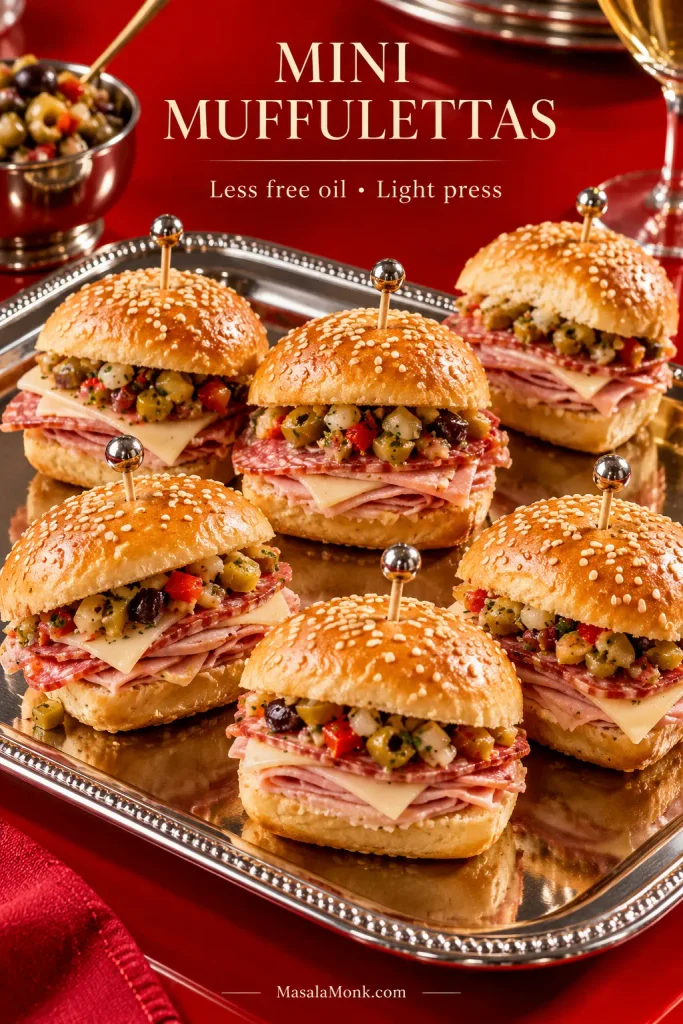
Small sesame rolls or pieces of tender focaccia make good mini muffulettas. Use the same basic layers, but go lighter on free olive oil because a small roll has much less crumb to absorb it. Spread the chopped olive salad first, add only enough dressing to make the bread glossy, then give the sandwiches a light press.
For a picnic or game-day table, put extra crunch beside them with a bowl of crisp homemade coleslaw instead of trying to squeeze slaw into every roll.
Make Ahead and Storage
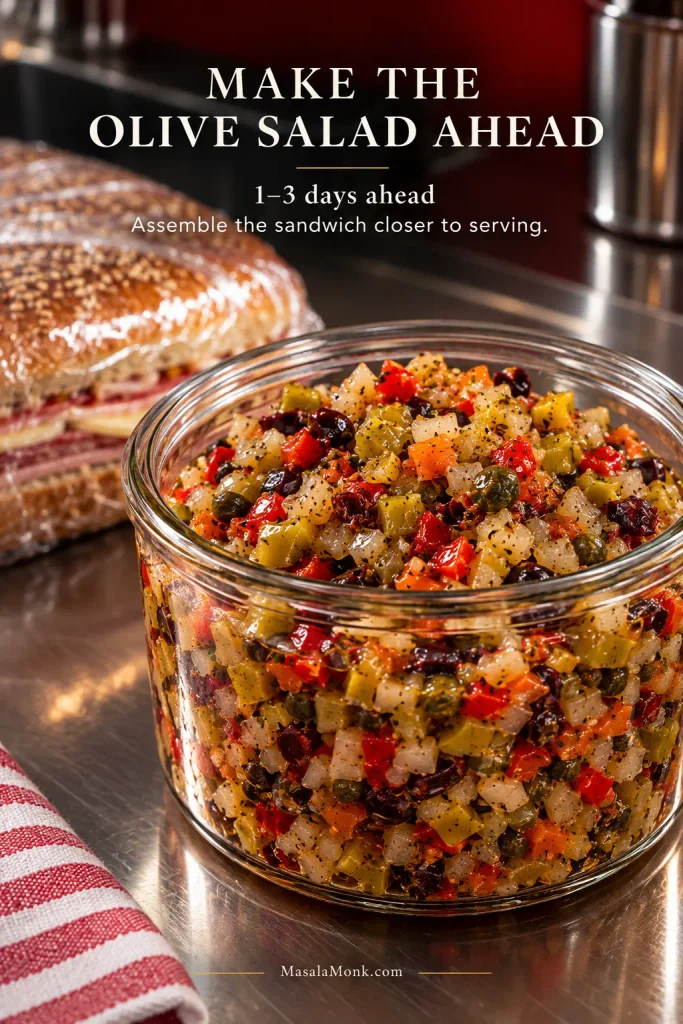
This is naturally good party and picnic food because most of the waiting can happen before anyone is hungry. Make the olive salad 1–3 days ahead if convenient. For a same-day sandwich, even 30–60 minutes helps.
Once assembled, time changes the bread too. For the texture described in this recipe, use the 1–2 hour refrigerated press. For an overnight sandwich, choose sturdy bread, keep the loose dressing under control and expect a softer loaf by morning.
Storing Leftovers
Wrap leftover wedges tightly and refrigerate promptly. For texture, the sandwich is best within the first 1–2 days; the bread keeps absorbing dressing as it sits.
USDA’s general guidance allows most properly refrigerated leftovers for 3–4 days, but that safety window is longer than this sandwich’s best-quality window. By day three, a safe muffuletta can still be much softer than you want.
A cold leftover wedge can feel tougher because the cheese and cured-meat fat have firmed up. Let it lose some chill within the safe serving window, or warm it gently.
Troubleshooting: Fix the Sandwich Before Serving
Bread, Height and Pressing Problems
- The bread is hard to bite. A thick artisan crust or dense crumb is usually responsible. A brief warm-up can help a cold sandwich, but next time use the bread guide to start with a more tender loaf.
- There is too much bread. A tall boule needs some interior crumb removed before filling. Leave enough behind to absorb dressing and support the crust.
- The sandwich is too tall. If it looks like you need to unhinge your jaw before it has even been pressed, fix the proportions now. Remove excess crumb, reduce the filling or spread thick meat folds more evenly.
- The loaf barely compresses. Make sure the weight reaches the whole sandwich. If the bread is rigid and dense, adding more weight usually squeezes the filling before it softens the loaf much at all.
- The meat pulls out in whole slices. The deli meat is too thick. Thin, flexible slices bite through more cleanly.
- The filling slides around. Large olive pieces, uneven meat layers and too little resting can all contribute. Chop the salad more evenly, spread the filling across the loaf and give it time under pressure.
Olive Salad, Salt and Moisture Problems
- The olive salad is too salty. Dilution is the real fix. Rinse and thoroughly dry an extra portion of olives or giardiniera before folding it in, or add more roasted red pepper and a little fresh olive oil.
- The olive salad tastes flat. Add a small splash of red wine vinegar first, taste, then refresh with good extra-virgin olive oil. Flat does not always mean under-salted.
Why a Muffuletta Turns Soggy or Oily
Use both the crumb and the board as clues instead of treating every soft loaf as the same problem. Excess free dressing, fragile bread and an overlong assembled rest can all push the sandwich toward sogginess.
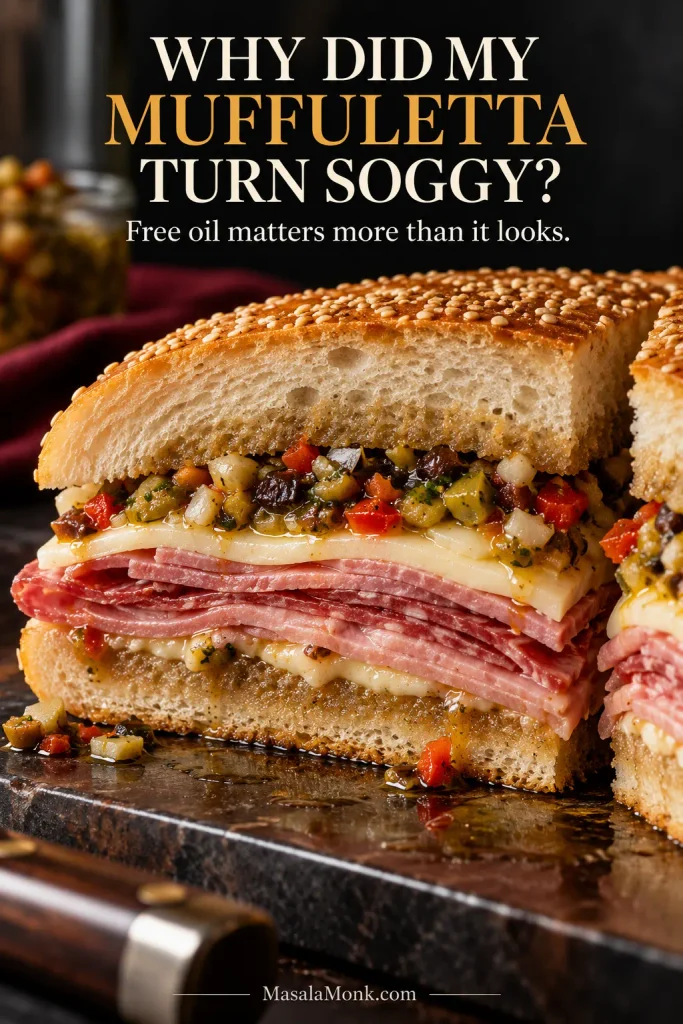
- The bread is soggy. Too much free dressing, fragile bread or a very long assembled rest are the usual causes. Revisit how the salad solids and seasoned oil are separated, then shorten the assembled rest next time.
- The sandwich tastes dry. Add more olive salad and a little of its seasoned oil. A dry muffuletta usually needs better bread dressing before it needs more meat.
- Oil runs onto the board. There’s too much free dressing. Next time, add the oil in stages and stop when the crumb begins absorbing it more slowly.
- The olive salad turned to paste. Fold in more hand-chopped olives or giardiniera to bring some texture back.
- Olive pieces keep falling out. Chop the largest pieces smaller, drain excess liquid and give the sandwich enough time under pressure.
- An overnight sandwich is too soft. Use a sturdier loaf, reduce loose dressing or return to the make-ahead timing and assemble closer to serving next time.
Bring It to the Table
Then cut the loaf into wedges and put it in the middle of the table. The bread has taken on the olive dressing, and each slice carries a little bit of everything. A muffuletta is abundant food, but the best ones never feel chaotic. All that bread, meat, cheese, pickle and olive finally finds the right shape.