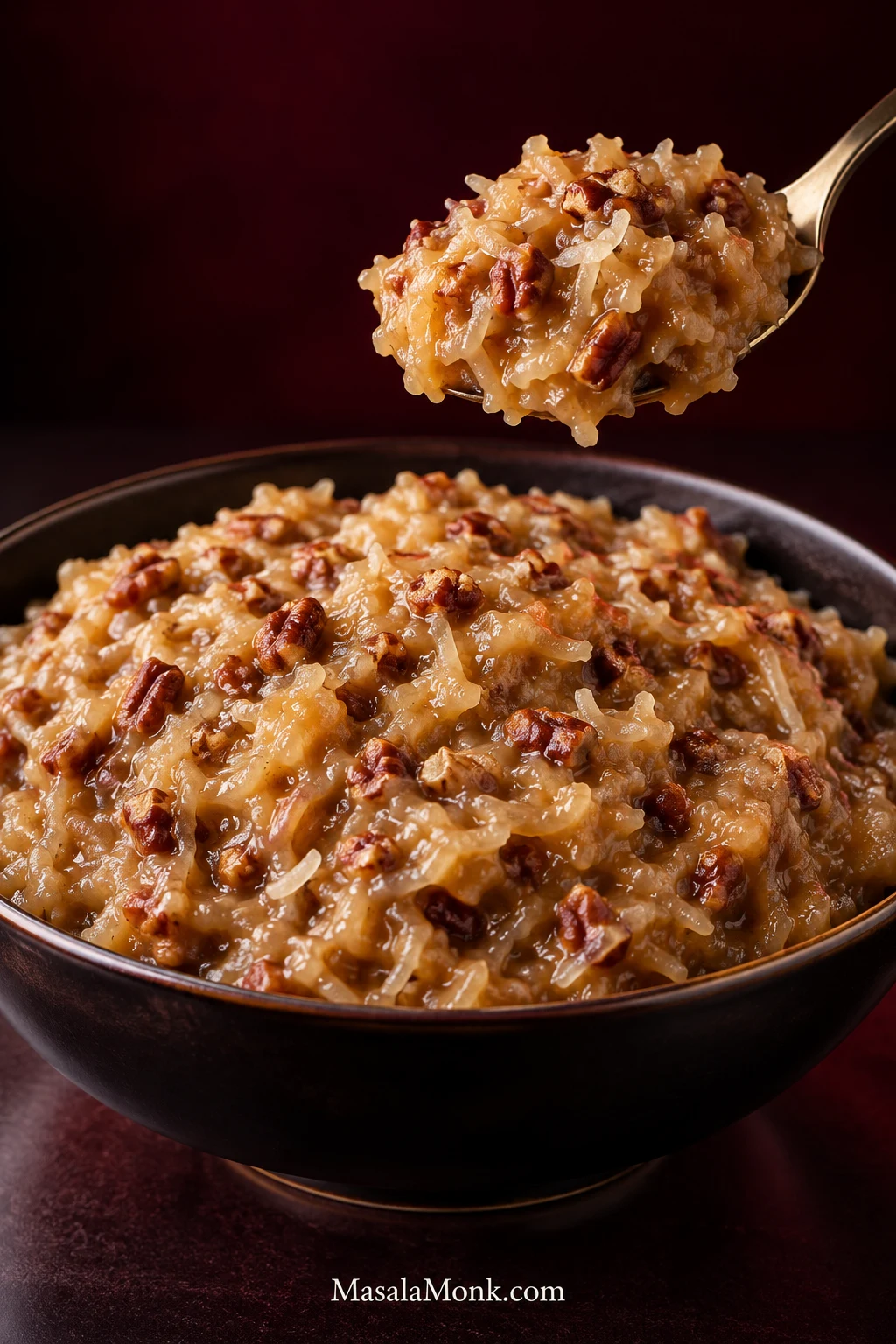
German chocolate frosting—also called German chocolate icing or coconut-pecan frosting—is the cooked topping and filling used on a classic German chocolate cake. What makes it special is the contrast: soft coconut, toasted pecans and buttery caramel-like custard against the chocolate cake underneath.
In the classic coconut-pecan version, the frosting itself contains no chocolate; the chocolate belongs in the cake. The tricky part is knowing when the custard is ready. Cook time gets you close, but texture tells you when to move on.
Two finish lines: First, thicken the custard on the stove. Then let the finished coconut-pecan frosting cool until a spoonful holds a soft mound instead of spreading into a puddle.
German Chocolate Cake Frosting Recipe
A gooey homemade coconut-pecan frosting made with evaporated milk, egg yolks, brown sugar, butter, moist shredded coconut and toasted pecans.
Equipment
- Medium heavy-bottomed saucepan
- Whisk
- Heatproof silicone spatula or wooden spoon
- Wide heat-safe bowl or shallow dish for cooling
- Small baking sheet for the pecans
- Optional but useful: digital kitchen scale, instant-read thermometer and fine-mesh strainer
Ingredients
- 4 large egg yolks
- 12 fl oz / about 355 ml full-fat evaporated milk
- 250 g packed light brown sugar, approximately 1 cup plus 3 tablespoons
- ¾ cup / 170 g unsalted butter, cut into pieces
- ½ teaspoon fine salt
- 1½ teaspoons / 7.5 ml vanilla extract
- 180 g sweetened shredded coconut, about 2 to 2¼ cups depending on the shred and how loosely it is packed
- 170 g pecan halves, about 1½ cups after chopping
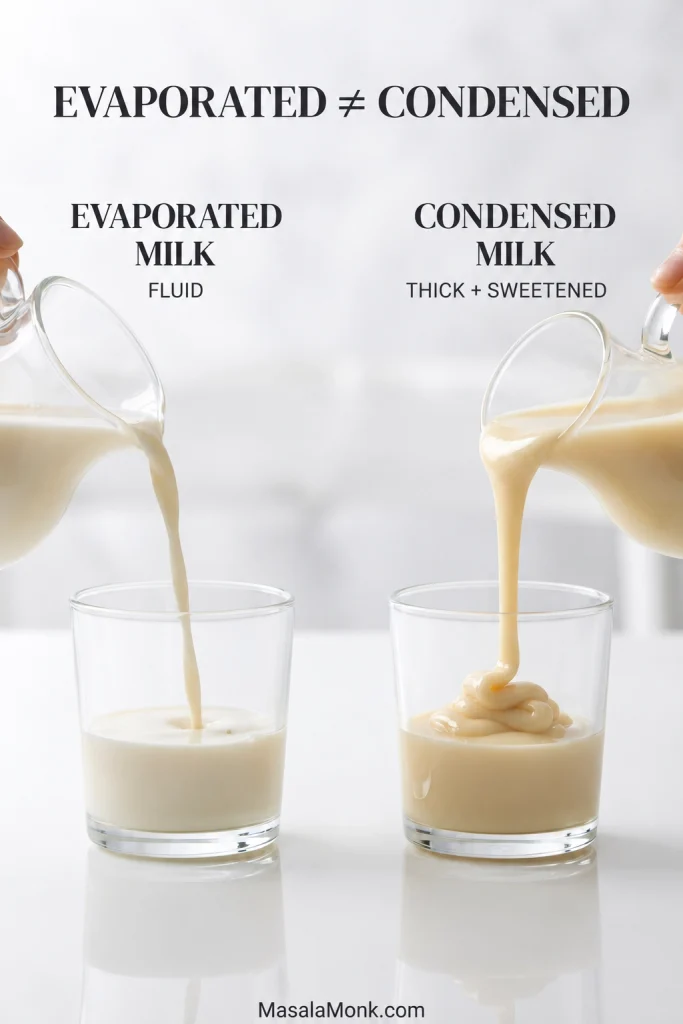
Check the can: Use evaporated milk, not sweetened condensed milk. Measure 12 fl oz / about 355 ml since can sizes can vary. For the difference in sugar and viscosity, see evaporated vs condensed milk ↓.
1. Toast the pecans
Heat the oven to 350°F / 175°C. Spread the pecan halves on a baking sheet and toast for 6–8 minutes.
Take them out when the kitchen starts to smell distinctly nutty and the pecans have deepened only slightly in color. They can move from fragrant to scorched quickly, so aroma is more useful here than dramatic browning.
Move them off the hot pan, let them cool briefly, then chop them into small but distinct pieces.
2. Whisk the custard base before heating
In the saucepan, whisk the egg yolks and evaporated milk together until smooth. You should not see streaks or little pieces of yolk.
Whisk in the brown sugar and salt, then add the butter. Mixing the yolks thoroughly into the cold milk helps them warm evenly once the pan goes on the stove, which lowers the chance of little cooked egg pieces later.
3. Cook until the custard coats the spoon
Set the saucepan over medium to medium-low heat and stir continuously, scraping across the bottom and into the corners.
At first, the butter melts and the sugar dissolves into a smooth, fairly loose mixture. That early looseness is normal. As it heats, keep any bubbling gentle and continue stirring.
Expect roughly 10–15 minutes on the stove, although your pan and burner may make it a little faster or slower.
How to recognize the cooked stage
The frosting is ready to leave the heat when all three are true:
- The custard looks glossy and noticeably thicker.
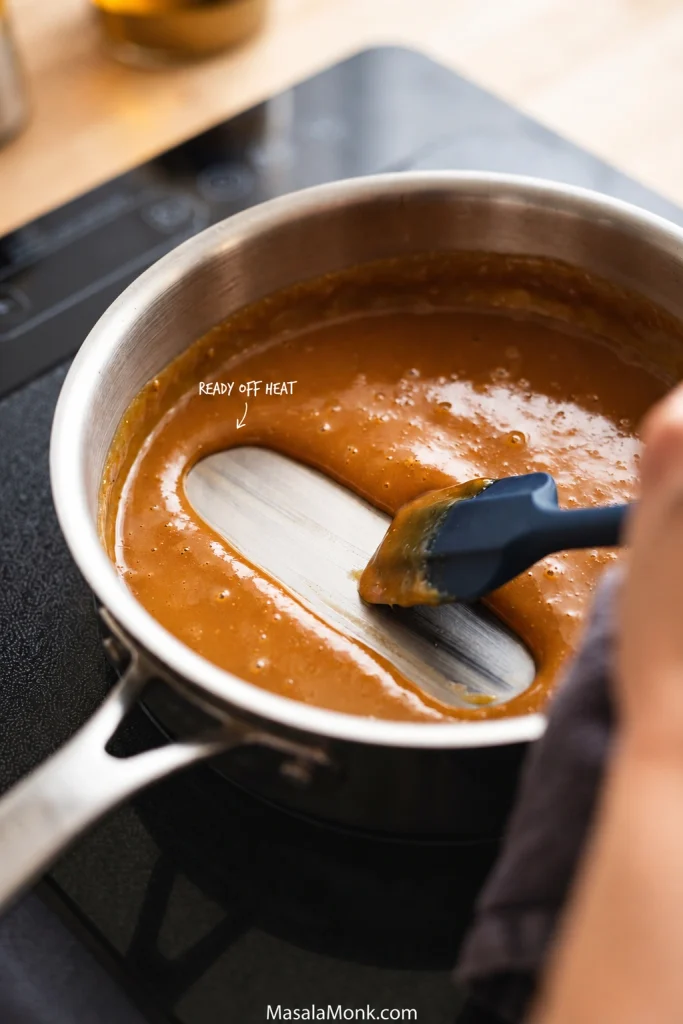
- It coats the back of your spoon or spatula, and a line drawn through that coating stays open.
- A spatula dragged across the bottom leaves a clean trail for a moment before the custard flows back over it.
Brown sugar makes this version darker from the start, so judge doneness by the way it moves and coats the spoon rather than by color.
If you use an instant-read thermometer, the egg mixture should reach at least 160°F / 71°C. The USDA recommends 160°F for dishes containing eggs. Use the thermometer for the safety check; use the physical cues above for texture.
See a few cooked egg pieces? If the rest of the mixture still looks smooth, take the pan off the heat and strain it through a fine-mesh strainer before adding the coconut and pecans. A panful of recognizable scrambled egg is better restarted.
Take it off while it still flows. The base must thicken in the saucepan, but it should not already look like cold frosting. Coconut, pecans and cooling will give it more body.
If the cooked stage still feels ambiguous, compare all five consistency stages ↓.
4. Add the vanilla, coconut and pecans
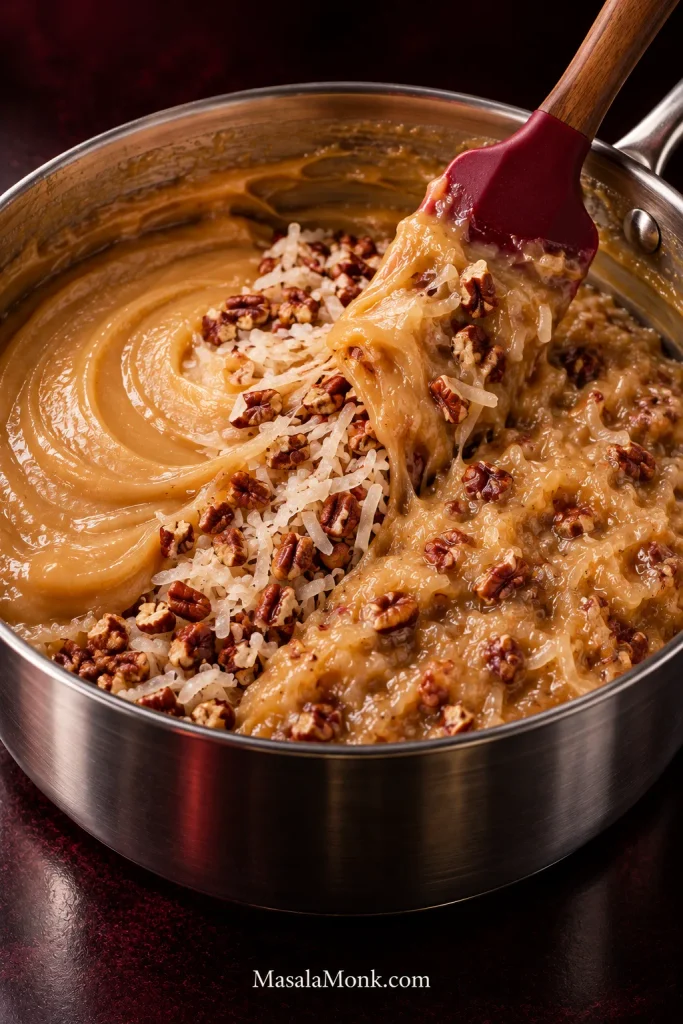
Remove the saucepan from the heat and stir in the vanilla. Fold in the shredded coconut and toasted chopped pecans until everything is coated in the glossy custard.
The mixture should immediately look fuller, with the coconut and pecans suspended through the custard instead of sitting in a pool of liquid.
5. Transfer it out of the saucepan
Scrape the frosting into a wide heat-safe bowl or shallow dish. Getting it out of the hot pan slows the cooking and helps it cool more evenly.
Give it a stir once or twice while it cools, then leave it alone to thicken.
6. Cool until a spoonful holds its shape
For same-day cake assembly, allow roughly 45–60 minutes at room temperature. A shallow dish will cool faster than a deep bowl, and a warm kitchen will take longer.
For a layer cake, the frosting is ready when it no longer feels warm and a spoonful sits in a soft mound instead of flattening into a puddle. Scoop through it and it should fold over itself slowly, with glossy custard still visible between the coconut and pecans. This frosting often looks least convincing while it is still warm.
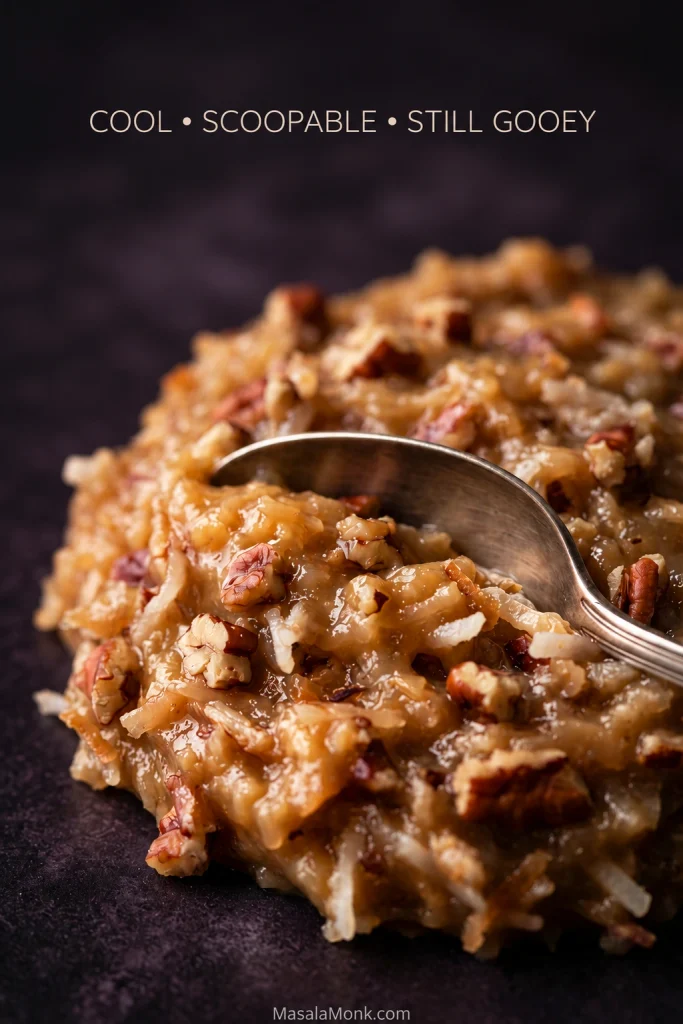
If the frosting stays loose after it has cooled, use the runny frosting diagnosis ↓ before adding anything to the batch.
Make sure the cake layers are cool too. Warm cake and warm filling make a slippery combination.
German Chocolate Frosting Consistency: 5 Stages
Use the visual below to decide whether the frosting needs more heat, more cooling, or simply time after the coconut and pecans go in.
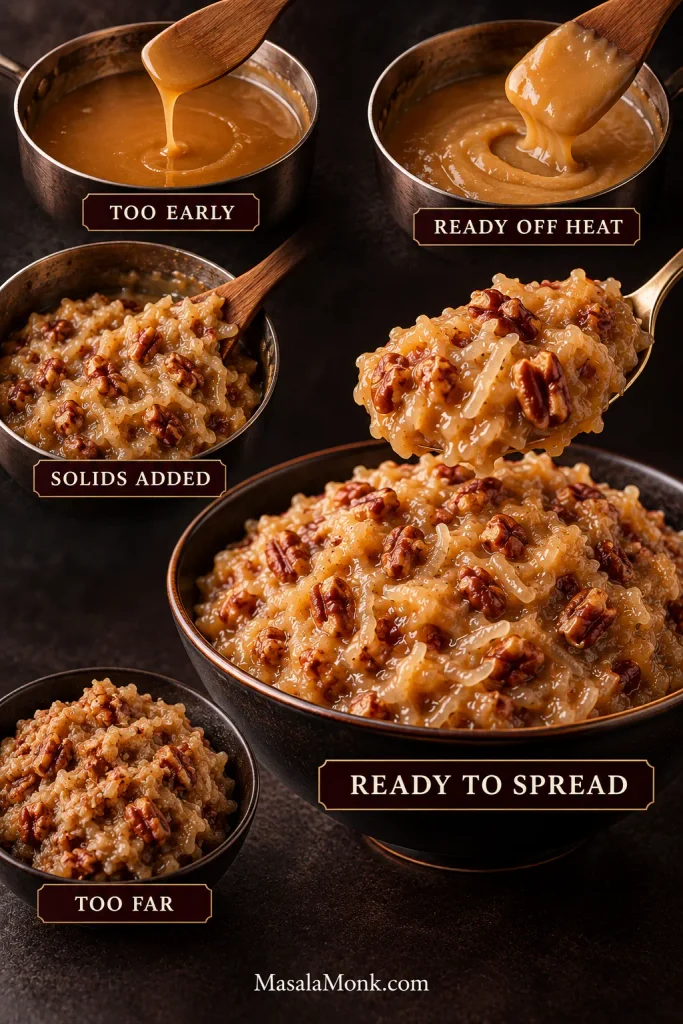
| Stage | What to look for |
|---|---|
| Too early | Thin and sauce-like. A spatula trail disappears almost immediately. Keep cooking and stirring. |
| Ready to leave the heat | Glossy and clearly thicker. It coats the spoon and leaves a brief trail across the pan. Remove it while it still flows. |
| Coconut and pecans added | Fuller and chunkier, with glossy custard holding the coconut and nuts together. Transfer it out of the hot pan. |
| Ready to spread | Cool, gooey and scoopable. A spoonful holds a soft mound and slowly folds over itself. |
| Too far | Very stiff while still hot, moving almost as one mass, or starting to look dry, rough or separated. Remove it from the heat immediately. |
The egg yolks thicken the milk mixture during cooking, coconut and pecans add bulk, and the butter firms as everything cools. Cooling can take a properly cooked frosting from soft to spreadable, but it cannot reliably turn an undercooked sauce into a stable cake filling.
German Chocolate Frosting Troubleshooting
Why is my German chocolate frosting runny?
German chocolate frosting is usually runny because it is still warm or because the custard did not cook long enough. If it reached the cooked stage, give it time to cool; if it came off the stove too early, it needs more cooking.
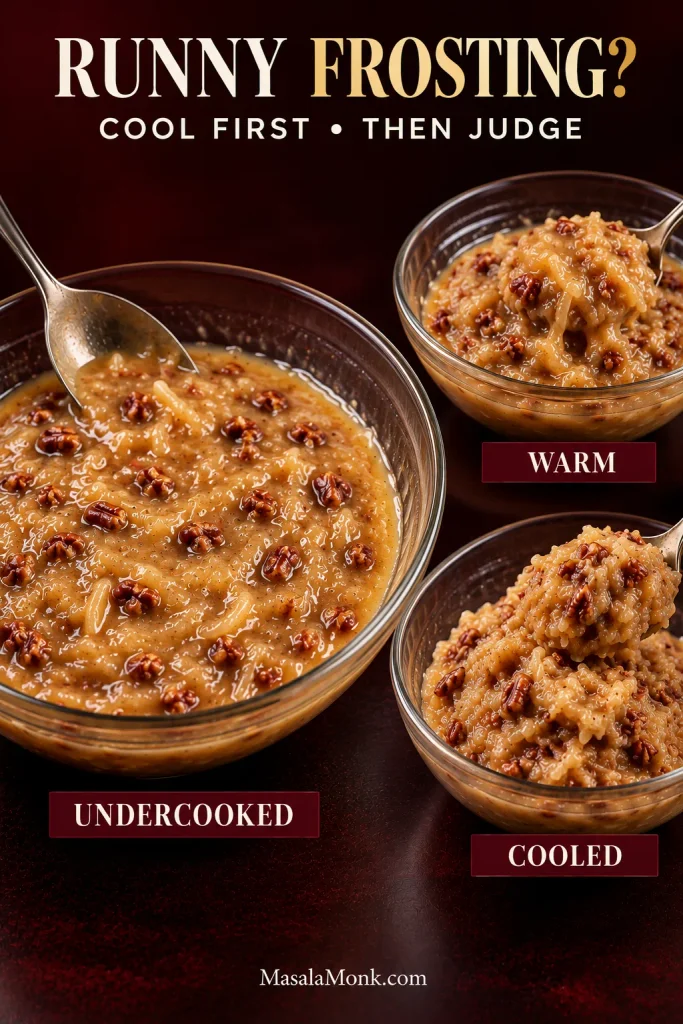
Still warm? That may be completely normal. If your cake layers are already cooling on the counter, resist adding extra ingredients just because the frosting still looks loose.
If it came off the stove thin like sauce and the coconut and pecans have not been added yet, return it to medium-low heat and keep stirring until it reaches the cooked stage described in the recipe.
Already stirred in the coconut and pecans? If the frosting remains loose after cooling, gentle reheating over low heat can sometimes help. Stir slowly and watch closely—the coconut makes the base harder to judge, and it will firm again as it cools.
If the frosting is still loose after cooling
If a fully cooled batch is still pouring, check the basics:
- Did the base reach the cooked stage before the coconut went in?
- Did you use the full measured amount of evaporated milk?
- Was the full-fat evaporated milk replaced with another dairy?
- Were all 4 egg yolks included?
- Were the coconut and pecans measured correctly?
A brief chill can help a correctly cooked batch that is simply softer than you want. Check the cooking and measurements before adding powdered sugar, melted chocolate or cornstarch; those ingredients change the frosting itself.
Why did my German chocolate frosting get too thick?
Frosting that feels very firm straight from the refrigerator may be completely fine once it loses the chill. Let it sit at room temperature briefly and stir before deciding it needs fixing.
Frosting that was already very stiff while still hot probably cooked too long. Move it out of the saucepan straight away. If it is only a little too firm while still warm, a teaspoon of warm evaporated milk at a time may loosen it; stir well after each addition and stop as soon as it spreads comfortably.
I can see little pieces of cooked egg
A few pale flecks can often be strained out before the coconut and pecans go in. If much of the pan has turned into recognizable scrambled egg, starting again is the better use of your time.
The frosting looks grainy, curdled or oily
These problems can look similar at first, but they do not always need the same response.
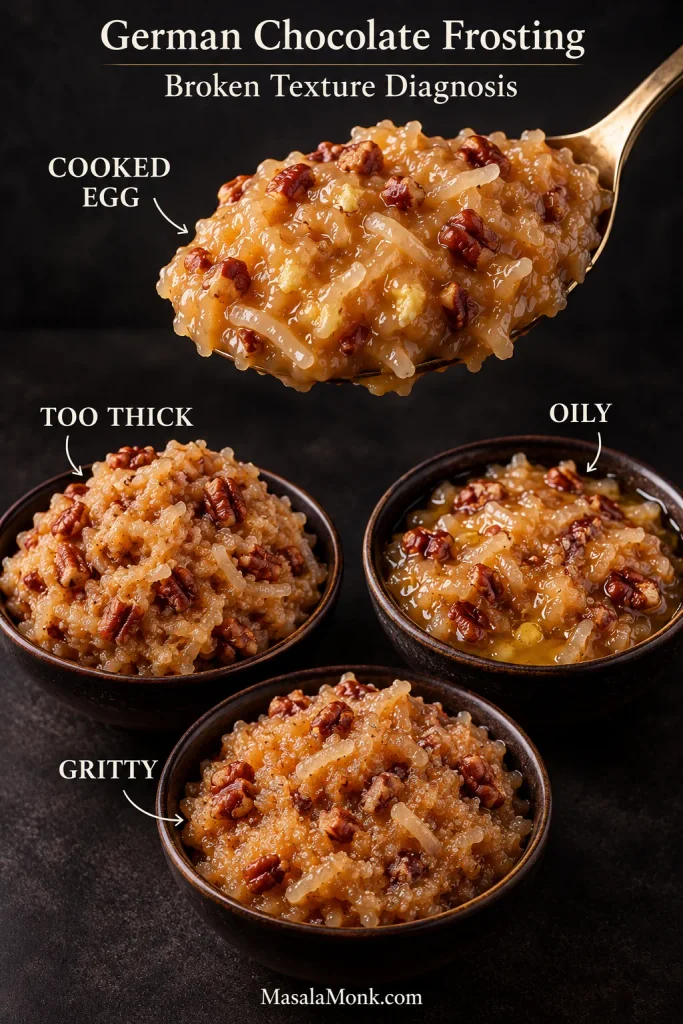
- Very thick and rough: the frosting may have cooked too long. Get it off the heat; continuing to reduce it will only make it stiffer.
- Oily separation: take the pan off the heat. If the separation is slight, gentle stirring as it cools may help it come back together.
- Fine grittiness: poorly dissolved sugar or overcooking can contribute.
If the frosting remains coarse, greasy or visibly separated after cooling, restarting is usually more reliable than trying to force it back together. Moderate heat and steady stirring are the best prevention.
The filling is sliding out between the cake layers
German chocolate filling usually slides because the cake or frosting is too warm, the filling layer is too thick, or both.
If the filling is already squeezing out, the fix is usually temperature and assembly rather than remaking the frosting.
- Cool the cake layers before assembling.
- Wait until the frosting is cool and scoopable.
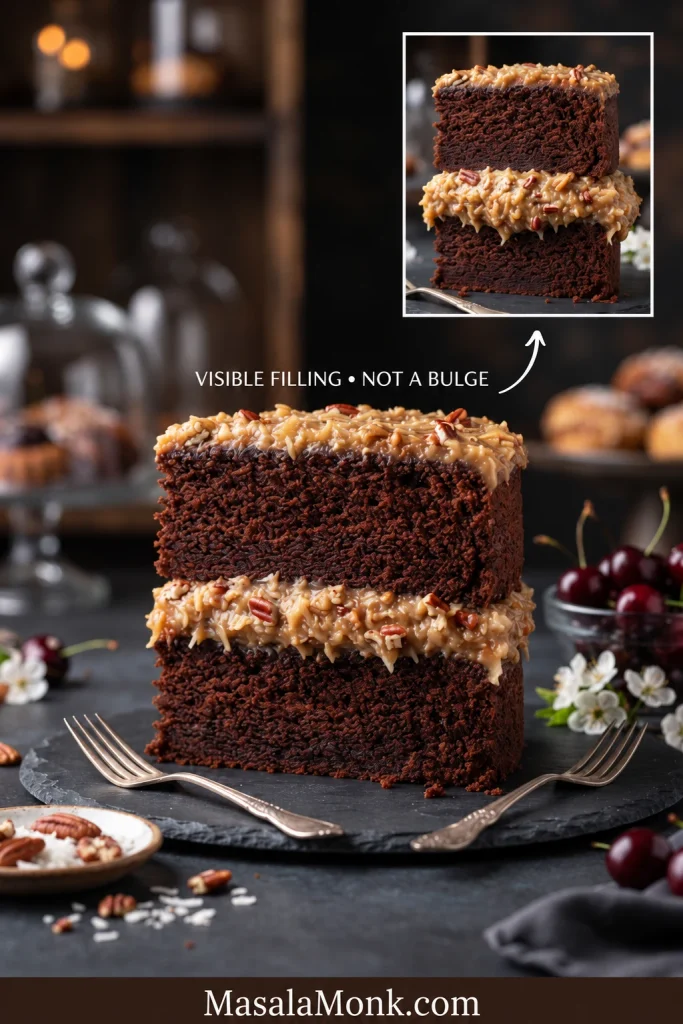
- Spread a moderate filling layer all the way to the edge, but do not build a thick bulge that gets squeezed outward when the next cake layer goes on.
- Chill the assembled cake briefly before moving or decorating it further.
Planning the layers before you stack? See how much frosting one batch gives you ↓.
Ingredient Choices That Change the Frosting
Why evaporated milk works here
Evaporated milk gives the custard concentrated dairy with less water than ordinary milk, helping it thicken without the heavy sugar load of sweetened condensed milk. Use the measured amount in the recipe rather than assuming every can is the same size.
Ordinary whole milk contains more water and will not behave the same way in a direct one-for-one swap. For this formula, evaporated milk is the dependable choice.
Egg yolks do the thickening
Egg yolks supply much of the thickening as well as richness, so an egg-free version needs a different thickening system rather than simply leaving them out.
Coconut and pecans
For the recipe as written, use moist sweetened shredded coconut. Moist unsweetened shredded coconut can work as a less-sweet variation, although the final set may differ slightly depending on the product. Fine desiccated coconut produces a drier, less chewy frosting; if it is your only option, add it gradually rather than automatically using the full weight. Chop unusually long coconut strands a few times before adding them.
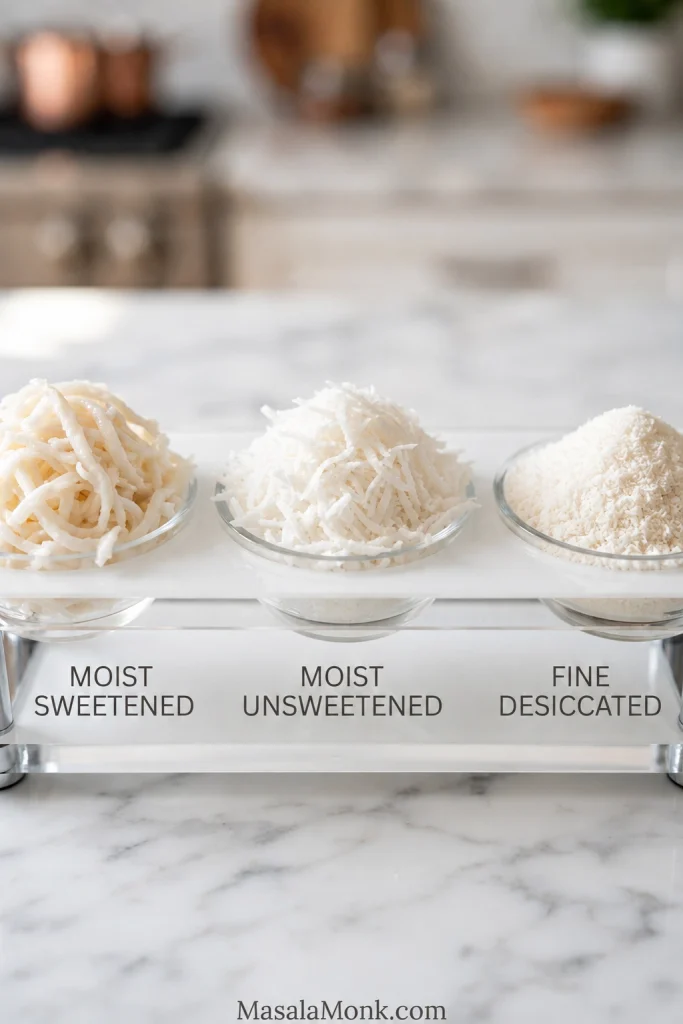
Keep the coconut untoasted here for its soft chew against the crisp pecans. Walnuts can stand in for pecans if needed; the flavor changes, but the texture still works.
Why this version uses brown sugar
Many classic coconut-pecan frostings use granulated sugar. Light brown sugar gives this version a deeper caramel note. Butter adds richness and helps the frosting settle into a soft, spoonable texture as it cools; vanilla and salt keep the sweetness from tasting one-dimensional.
Evaporated Milk vs Sweetened Condensed Milk
The cans are easy to confuse, but their sugar content and viscosity are different enough that you should not swap them can-for-can in this recipe.
| Evaporated milk | Sweetened condensed milk |
|---|---|
| Concentrated milk without a large amount of added sugar | Concentrated milk with a substantial amount of sugar already dissolved into it |
| This recipe adds 250 g brown sugar separately | A condensed-milk frosting needs much less or no additional sugar, depending on the recipe |
| Use the measured amount called for in this recipe | Needs a formula designed around the sugar already in the can |
Opened condensed milk by mistake? Save it for our Magic Cookie Bars, where condensed milk, coconut and pecans are supposed to be together.
How Much German Chocolate Frosting Do You Need?
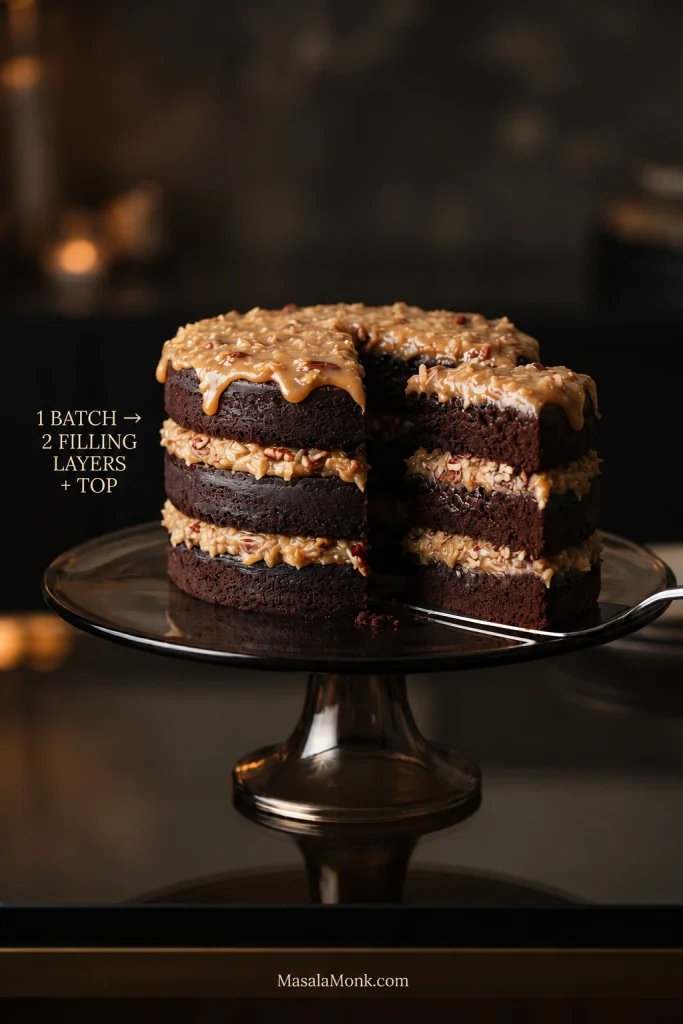
Before assembling a three-layer cake, reserve a generous portion for the top and divide the rest evenly between the two filling layers. You want enough coconut-pecan filling to see a generous layer when the cake is sliced without building either layer so thick that it gets pushed out at the edges.
| Use | What one batch gives you |
|---|---|
| Three-layer 9-inch cake | Two filling layers plus a generous coconut-pecan top. |
| Two-layer 8- or 9-inch cake | Plenty for the center and top, with room for a thicker finish. |
| 9×13-inch cake | A generous layer across the top. |
| Filling, top and fully covered sides | Make additional frosting or use a smoother frosting on the exterior. The chunky coconut-pecan mixture is harder to control on vertical sides. |
Using coconut-pecan frosting on cakes and cupcakes
Shredded coconut and chopped pecans make this frosting chunky on purpose. For cupcakes, spoon it on and shape it with the back of a spoon or a small offset spatula. For piped borders, rosettes or birthday-cake swirls, use a smooth frosting instead. The chocolate buttercream in our chocolate cake recipe is made for that job.
Do you have to frost the sides? No. German chocolate cake is commonly finished with coconut-pecan frosting between the layers and on top, with the chocolate cake left visible around the sides. Covering the sides works best with cool cake and cool frosting and gives a deliberately textured finish.
How to keep the finished cake from tasting too sweet
German chocolate frosting is meant to be sweet, but the finished cake does not need to feel heavy or cloying.
- For a less-sweet batch, use the moist unsweetened shredded coconut variation described above.
- Keep the salt in the recipe.
- Toast the pecans so their nutty flavor can stand up to the sweet custard.
- For the least-sweet finish, leave the sides bare and use the coconut-pecan frosting between the layers and on top.
- If you prefer frosted sides, choose something tangier rather than another very sweet buttercream. Our chocolate cream cheese frosting is one option.
Halving or doubling the batch
For a half batch, halve every ingredient—including using 2 egg yolks—and use a smaller saucepan so the shallow mixture does not reduce too aggressively.
For a double batch, use a larger, wider saucepan. More frosting takes longer to heat and reduce, so the original 10–15 minute stovetop window will change. Watch for the same cooked stage rather than trying to double the minutes.
Have some frosting left? Spoon it over fudgy brownies, blondies, cupcakes or cookie bars, or add a small spoonful to vanilla or chocolate ice cream.
Make Ahead and Storage
Can you make German chocolate frosting ahead?
Yes. For same-day cake assembly, cool it at room temperature until it reaches the spreadable stage in the recipe. For another day, transfer it to a shallow container and refrigerate it promptly; it does not need to sit out until fully cool first.
How long does it keep?
Keep the frosting refrigerated and use it within 3–4 days. Do not leave it at room temperature for more than 2 hours, or more than 1 hour if the room is above 90°F / 32°C.
Once a cake is filled with coconut-pecan frosting, store the assembled cake covered in the refrigerator as well. The frosting will feel much firmer once chilled.
How to soften refrigerated frosting
Let cold coconut-pecan frosting stand at room temperature briefly, then stir gently. Spreading it straight from the refrigerator can tug at or tear a tender cake layer.
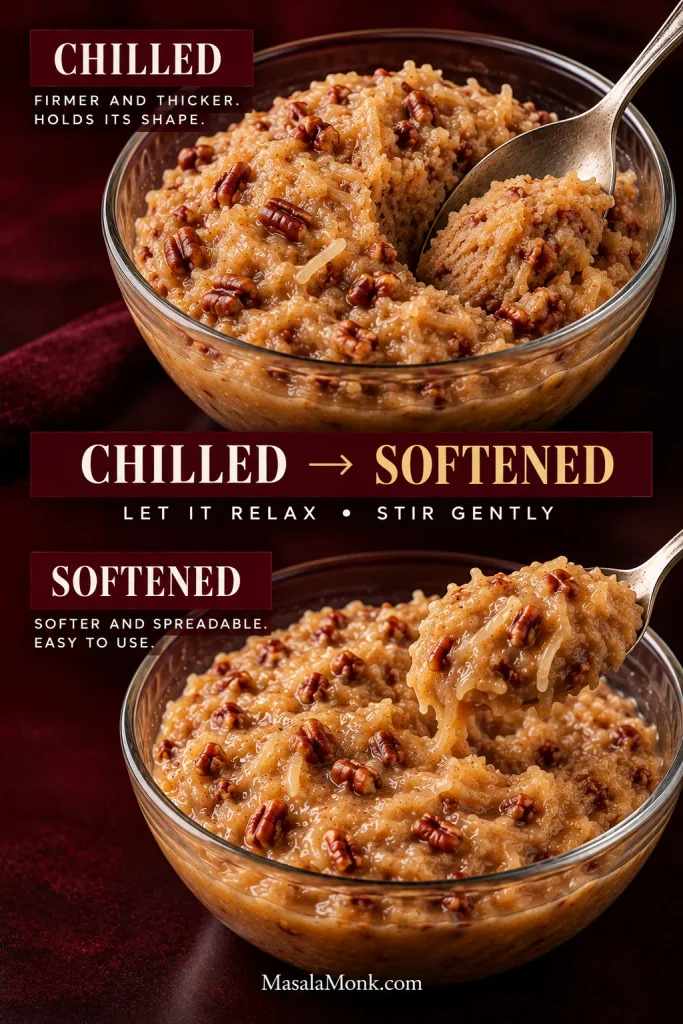
Once softened, it should be gooey and spoonable again, with soft coconut and toasted pecans held in a rich custard that spreads easily and stays where you put it.