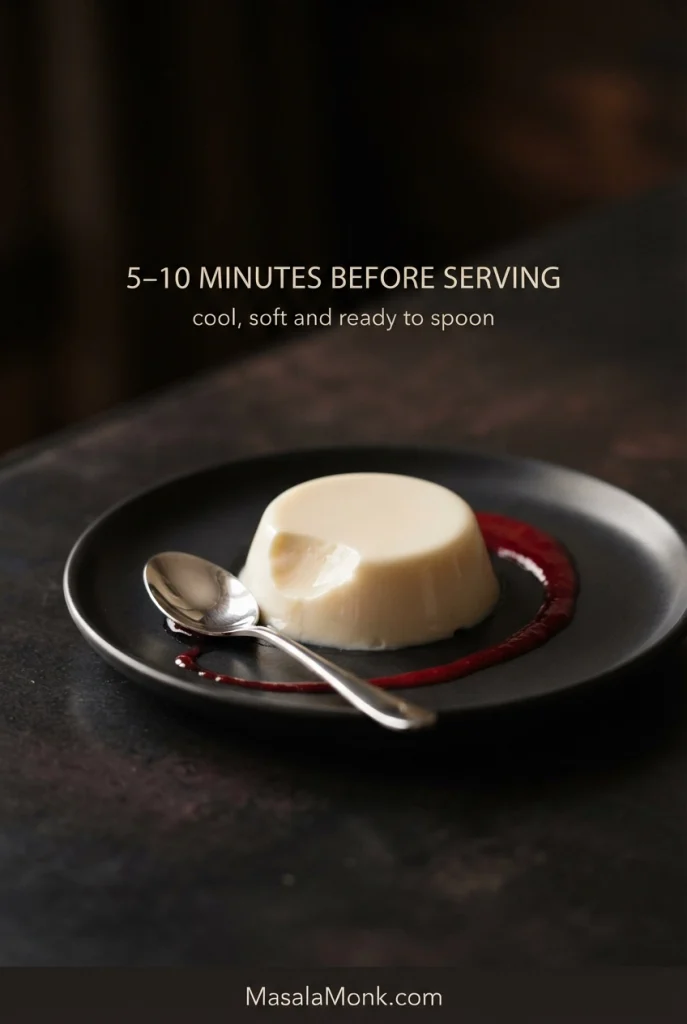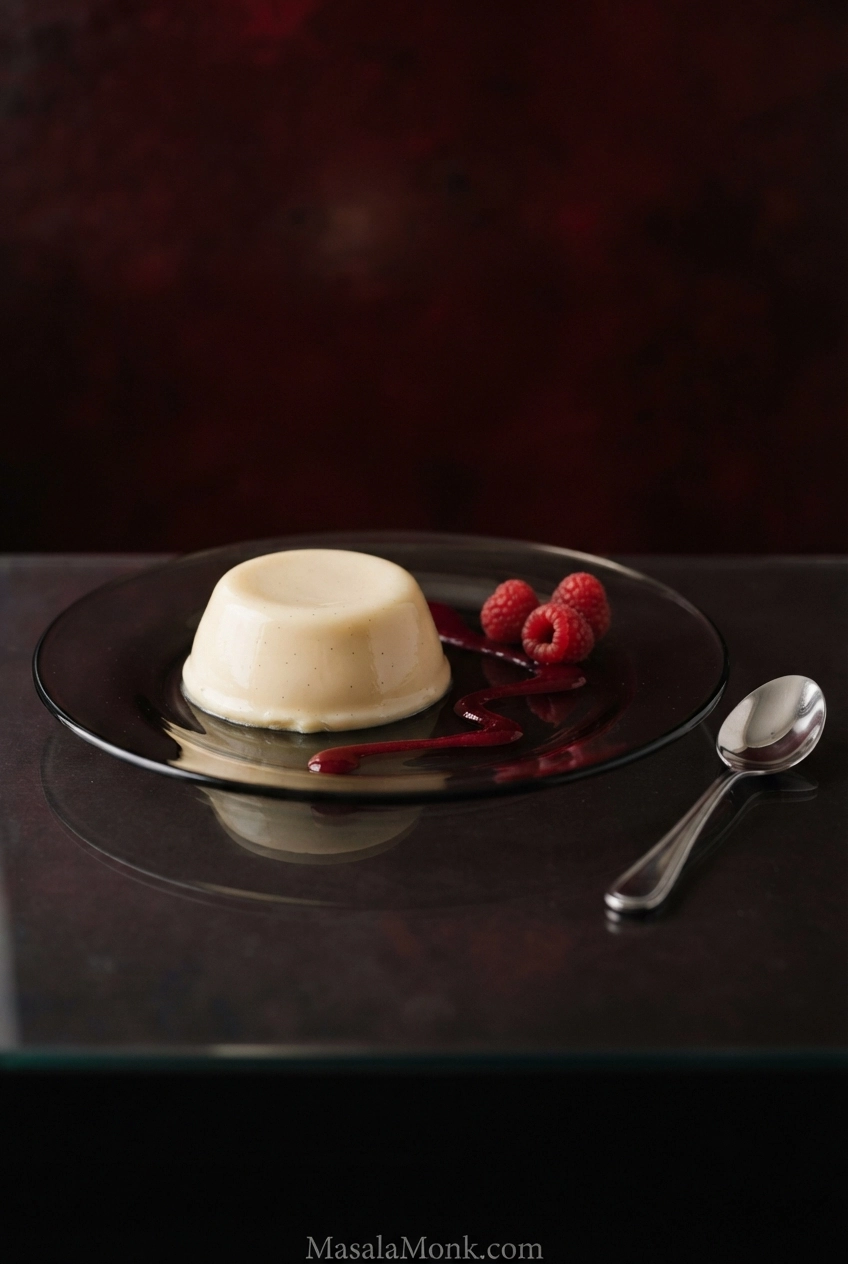
Good panna cotta should wobble when you move it, then give almost no resistance to the spoon. It should taste like cold vanilla cream that happens to hold its shape, then soften almost as soon as it reaches your mouth.
Panna cotta is a chilled Italian cream dessert associated with Piedmont in northern Italy, gently set with gelatin. Unlike crème brûlée, which relies on egg yolks for its custard set, panna cotta needs only a small amount of gelatin. This vanilla panna cotta combines heavy cream with whole milk so each spoonful stays lush without becoming heavy.
There are no eggs to temper and no oven or water bath—about 15 minutes of hands-on work, then the refrigerator takes over.
The main decision comes before you heat anything: will you serve it from a glass, or turn it out onto a plate? A glass-set panna cotta can stay softer. An unmolded one needs a little more support.
Before You Heat the Cream: Choose the Set
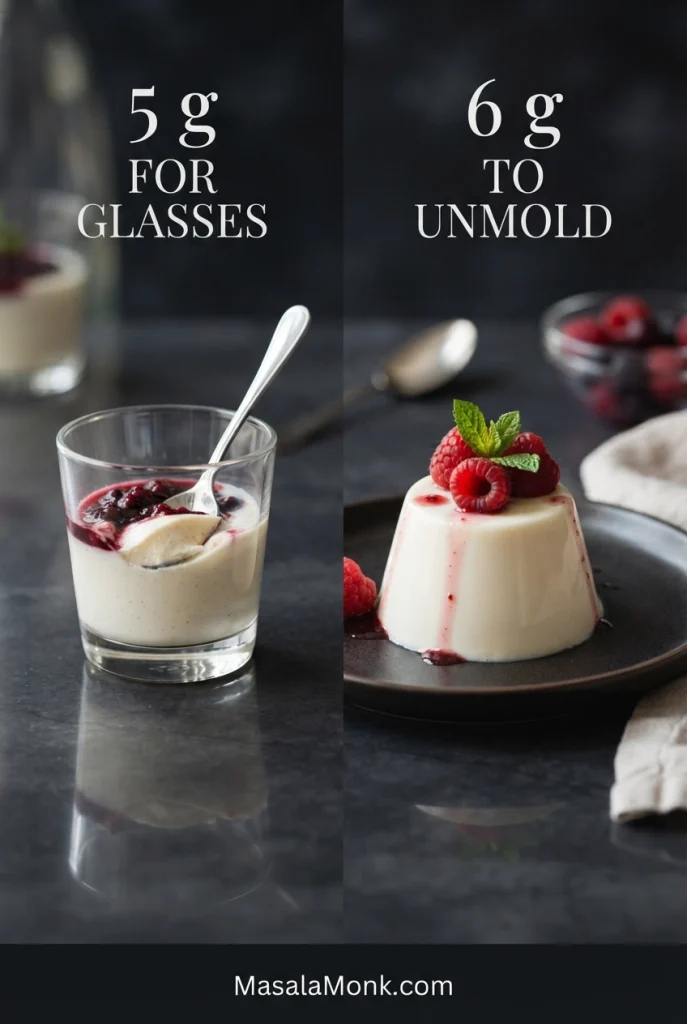
For this 600 ml cream-and-milk base, use 5 g powdered gelatin for panna cotta served in glasses or 6 g for small portions you plan to unmold.
| How you will serve it | What to use |
|---|---|
| In glasses or dessert cups | 5 g gelatin · chill at least 4 hours · softest, creamiest wobble |
| Unmolded onto plates | 6 g gelatin · chill at least 6 hours, preferably overnight · delicate but strong enough to stand |
A soft wobble in a glass is not a failed panna cotta. For the least-fussy option, use glasses and skip unmolding altogether. Choose the firmer set only when you specifically want the plated presentation.
Panna Cotta Recipe
A vanilla panna cotta with a creamy, delicate set.
Each serving is about 3½ fl oz / roughly 105 ml, ideal for a 4 oz ramekin or a 4–6 oz dessert glass when you want room for fruit or sauce.
Equipment
- 6 small glasses, dessert cups, ramekins or panna cotta molds
- Small bowl
- Medium saucepan
- Silicone spatula or wooden spoon
- Fine-mesh sieve and heatproof bowl or pouring jug
- A larger bowl with ice and cold water
- Digital kitchen scale, strongly recommended for the gelatin
A thermometer is optional. The visual cues in the method are enough.
Ingredients
- 1½ cups (360 ml) heavy cream or heavy whipping cream
- 1 cup (240 ml) whole milk, divided
- ⅓ cup (65 g) granulated sugar
- 5 g unflavored powdered gelatin for glasses, or 6 g for unmolding
- 2 teaspoons vanilla bean paste or pure vanilla extract, or 1 whole vanilla bean
- A few drops neutral oil, optional but helpful for unmolding
Weigh the gelatin if possible; partial packets are difficult to estimate accurately. These amounts assume ordinary supermarket unflavored powdered gelatin. Specialty products can have different setting strengths, often described as Bloom strength. Collagen peptides and hydrolyzed collagen will not set panna cotta.
Using a whole vanilla bean? Split it lengthwise, scrape the seeds into the pan and add the pod while the cream and milk heat. Once the mixture is steaming, take it off the heat and steep for about 15 minutes. Remove the pod, then rewarm gently until steaming before adding the bloomed gelatin.
Instructions
- Prepare the glasses or molds. Glasses need no preparation. For unmolding, wipe the molds with the thinnest film of neutral oil, then remove visible excess.
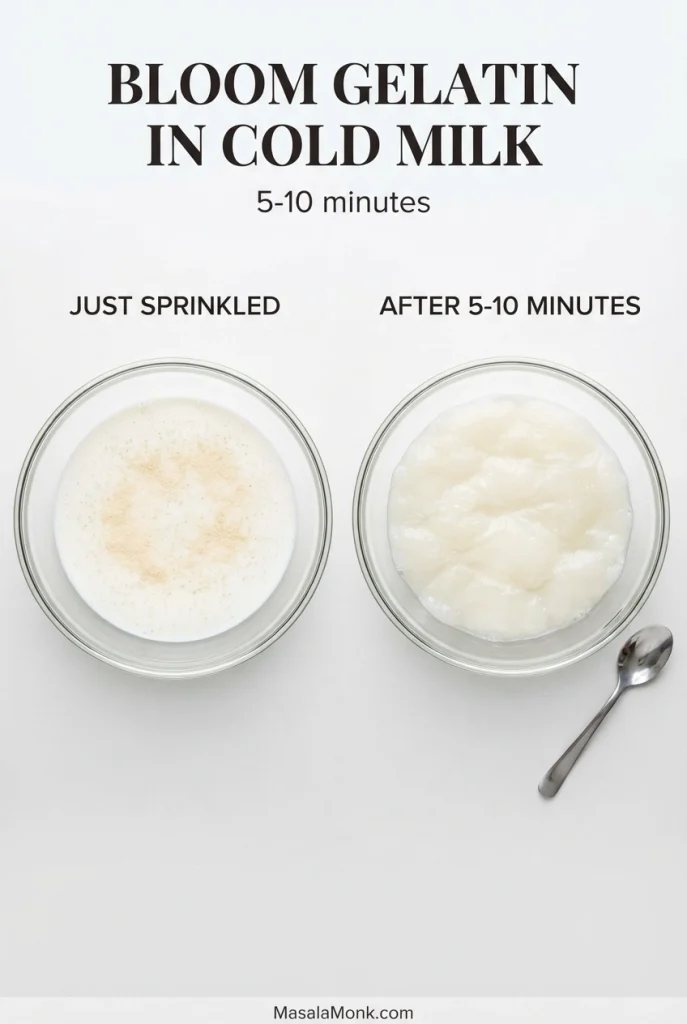
- Bloom the gelatin. Pour ¼ cup (60 ml) cold whole milk into a small, wide bowl. Sprinkle 5 g gelatin for glasses or 6 g for unmolding evenly over the surface. Leave for 5–10 minutes, until swollen and gel-like.
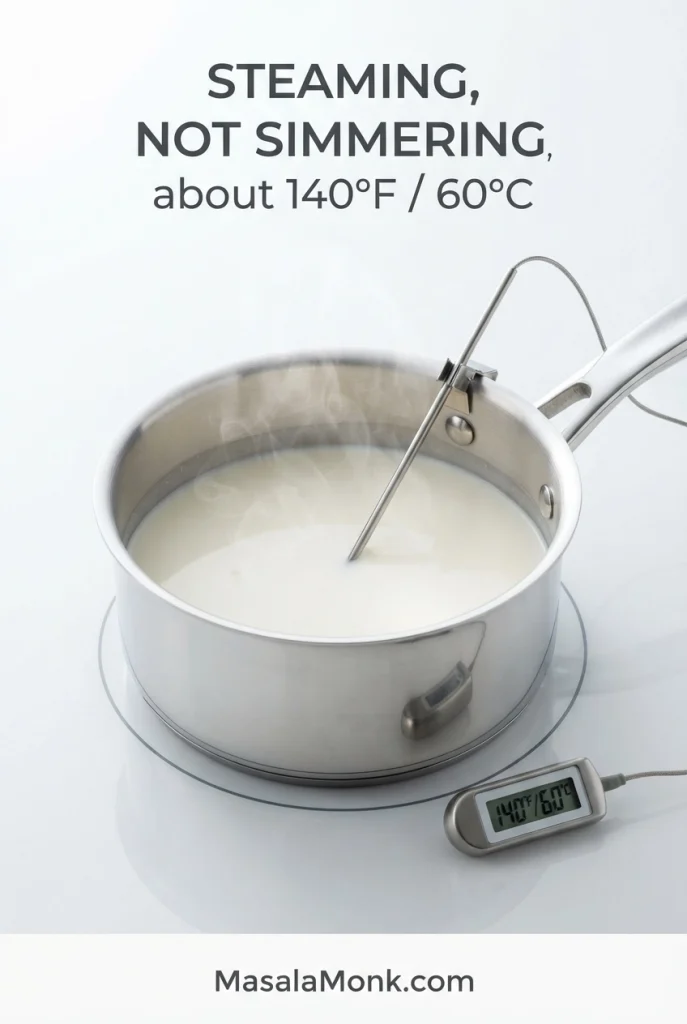
- Warm the cream and milk. Combine 1½ cups (360 ml) heavy cream, the remaining ¾ cup (180 ml) whole milk and ⅓ cup (65 g) sugar. Heat over medium-low until the sugar dissolves and you see light steam, not a simmer—about 140°F (60°C) if checking.
- Dissolve the gelatin. Take the pan off the heat. Stir in all of the bloomed gelatin until no grains, strings or gummy pieces remain. Do not boil after the gelatin is added.
- Add the vanilla. If using vanilla bean paste or extract instead of a whole bean, stir it in now.
- Strain. Pour through a fine-mesh sieve into a heatproof bowl or jug.
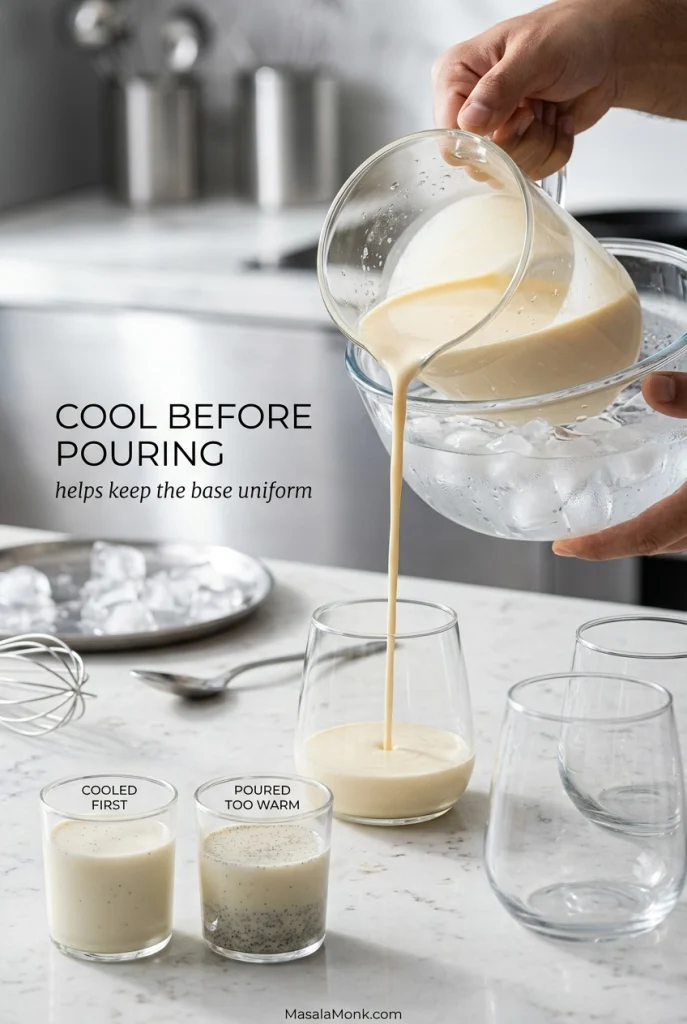
- Cool briefly. Set the bowl over ice water and stir slowly for 3–5 minutes. Stop when the base is cooler, has the first hint of body and still pours freely.
- Portion and chill. Divide among six glasses, ramekins or molds. Chill at least 4 hours in glasses or 6 hours before unmolding; overnight is easiest for unmolded portions. Cover once cold.
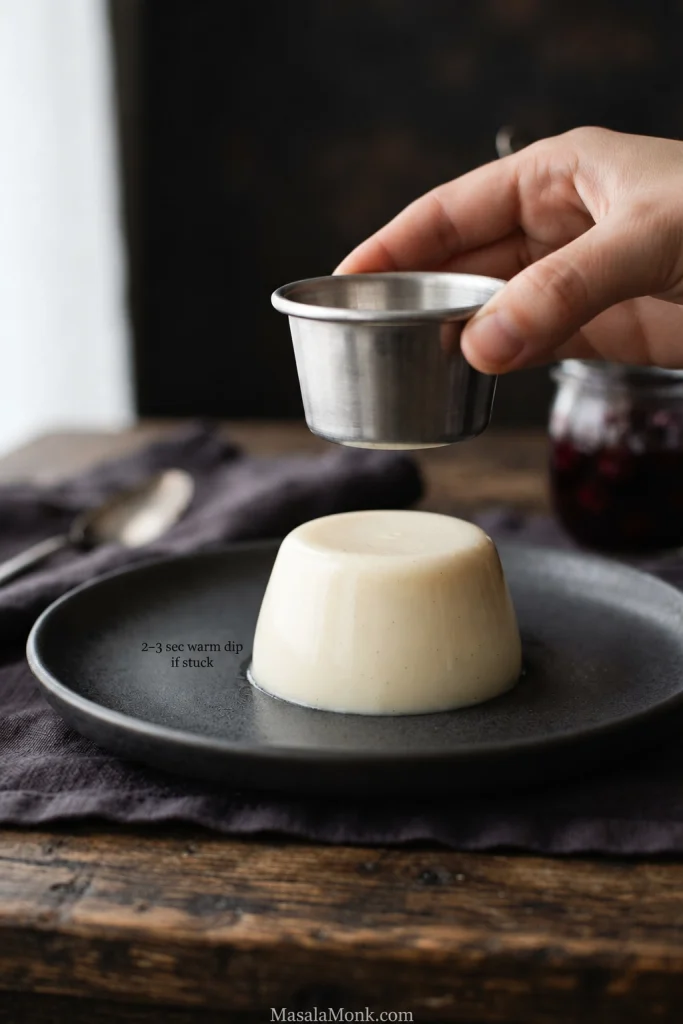
- Unmold, if needed. Invert a fully chilled mold onto a plate and give it one controlled shake. If it stays put, dip the bottom and sides in warm water for 2–3 seconds, dry the outside and try again. The released panna cotta should stand cleanly and still tremble.
Recipe Notes
- A brief bubble before the gelatin goes in is not a disaster. Take the pan off the heat and continue. Once the gelatin has dissolved, there is no reason to boil it again.
- To double the recipe, keep the proportions the same, use a larger saucepan and allow a little more cooling time.
About this recipe: This panna cotta is research-derived from established ratios, technical guidance and reported troubleshooting. MasalaMonk has not independently kitchen-tested this exact formulation.
More Panna Cotta Help
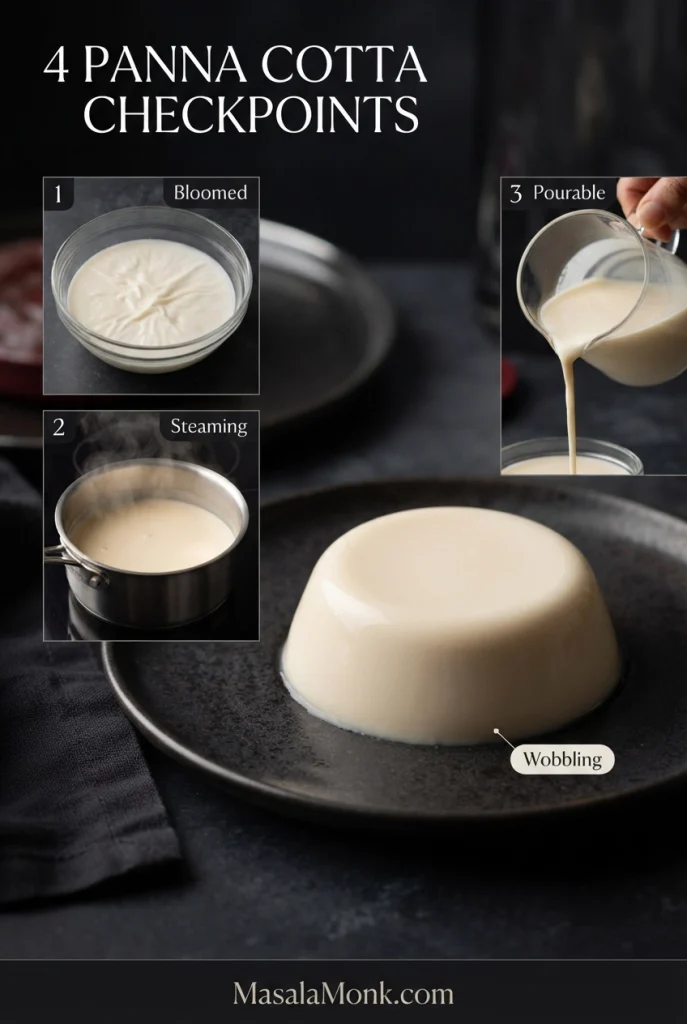
Four Useful Panna Cotta Checkpoints
Times help, but the mixture itself tells you more.
For the heating checkpoint, look for light steam rather than bubbles. The cream mixture should be hot but not simmering before the gelatin goes in.
- After blooming: the gelatin is swollen and hydrated, with no obvious dry patches.
- Before adding gelatin: the cream mixture is hot and lightly steaming, the sugar has dissolved, and nothing needs to be boiling.
- Just before pouring: the strained base is cooler and has the first hint of body, but flows easily from the jug.
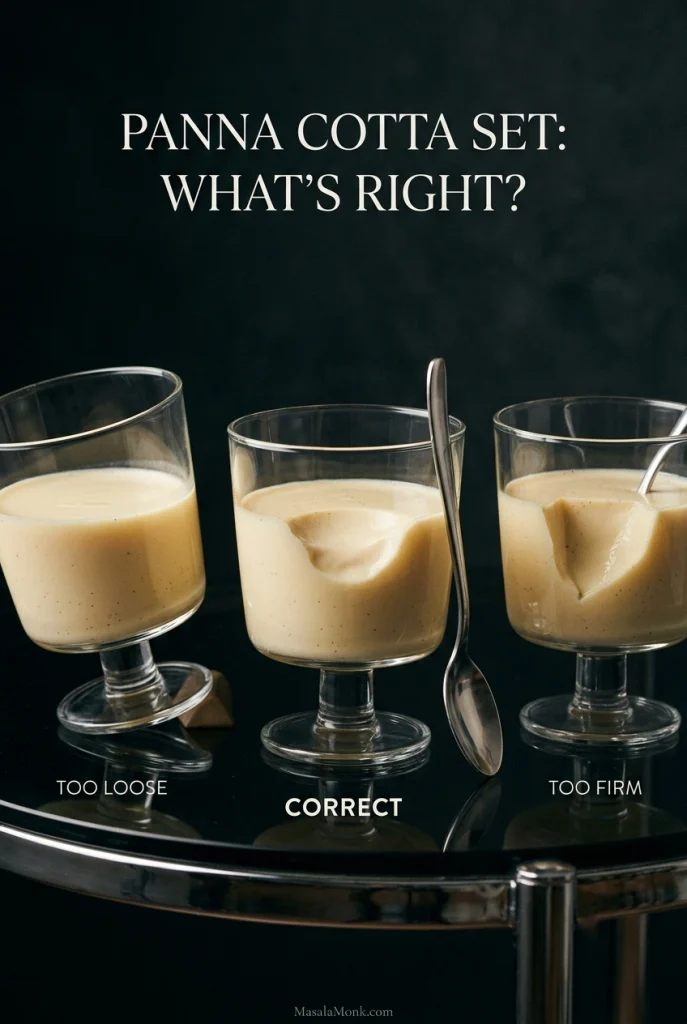
- After chilling: it moves as one soft mass. The center trembles, the edges stay put, and loose liquid does not slosh underneath.
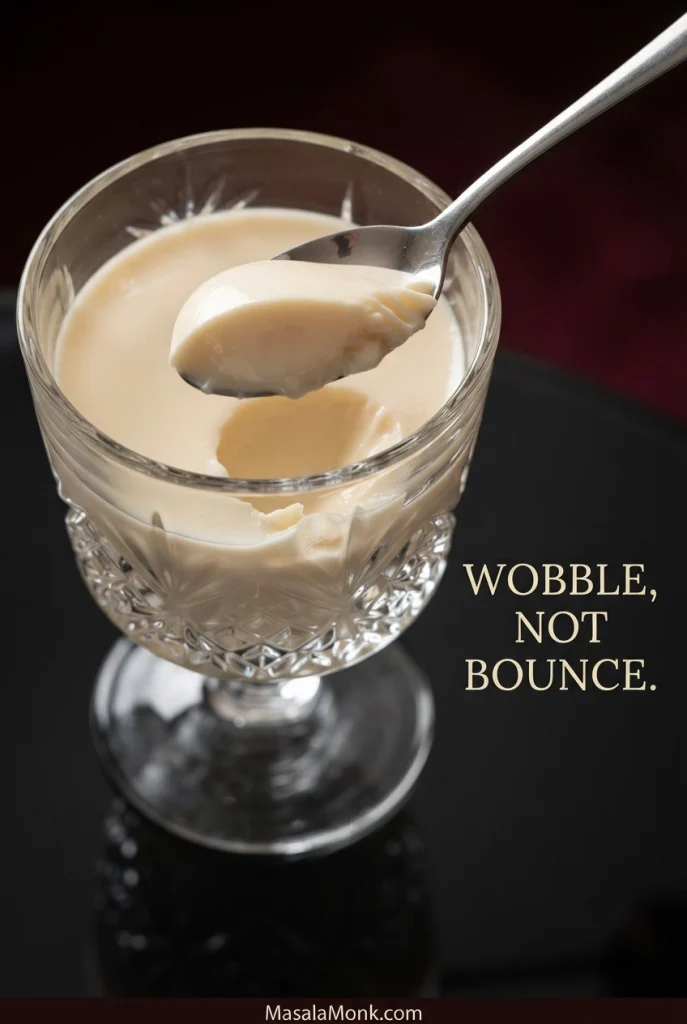
Push in a spoon and there should be very little resistance. Wobble, not bounce. A glass-set panna cotta can be very soft and still be exactly right.
Why This Panna Cotta Uses Cream and Milk
Heavy cream gives panna cotta its lushness. Whole milk pulls that richness back just enough that the last spoonful is as pleasant as the first.
The balance here is roughly 60% cream to 40% milk. A leaner base makes the gelatin more noticeable. Push the richness too far, though, and each spoonful starts to feel heavier on the palate.
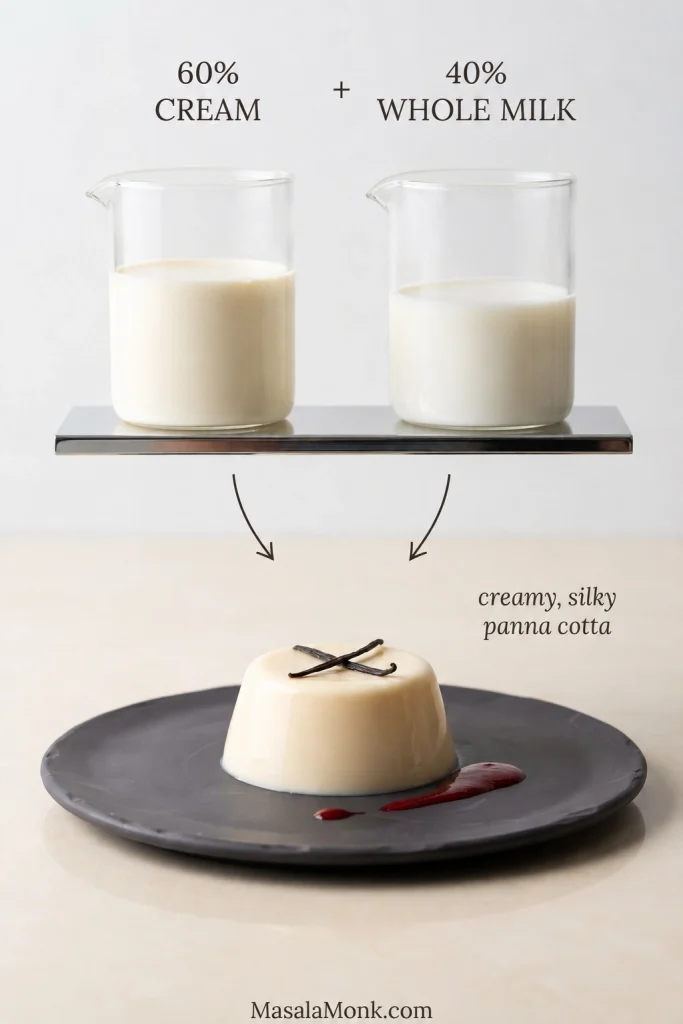
What you want is a spoon that slides through cleanly, followed by a panna cotta that softens almost immediately in your mouth. Vanilla and cream should linger; the sensation of chewing gelatin should not.
Getting the Gelatin Right
Gelatin should hold the cream and milk together and then mostly disappear when you eat it. One gram sounds tiny, but moving from 5 g to 6 g means using 20% more gelatin. That is enough to give an unmolded panna cotta more support without turning it rubbery.
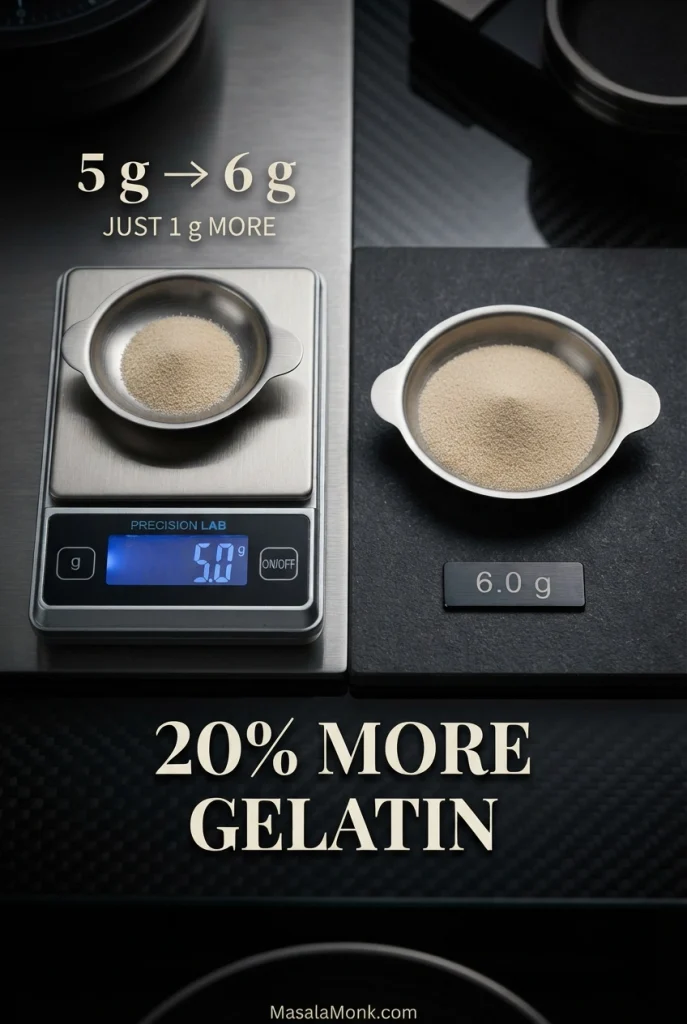
For reference, Knox lists a 7 g envelope as about 2½ teaspoons. That makes 5 g roughly 1¾ teaspoons and 6 g about 2⅛ teaspoons, but grams are far more dependable when the difference is this small.
The difference becomes easiest to judge after chilling: compare how the panna cotta moves with how a spoon passes through it. Those two cues reveal a loose set, a tender set and an overly firm one more reliably than appearance alone.
Bloom Powdered Gelatin Properly
Sprinkle the gelatin over cold liquid in an even layer. Give it 5–10 minutes to absorb the milk, then add the entire swollen mixture to the hot cream mixture. Nothing gets drained away.
If you can see grains or gummy pieces after stirring, rewarm the mixture over low heat until smooth and strain it again. The refrigerator will not dissolve leftover gelatin for you.
Using sheets or agar instead? See the gelatin and agar substitutions.
Why Cool the Panna Cotta Before Pouring?
Brief cooling lets the base gain a little body before you pour it. That helps keep the cream and milk uniform and the vanilla seeds suspended instead of settling at the bottom.
Cooling over ice makes the change happen evenly and quickly, before the edges begin to set. Use a spatula instead of a whisk; vigorous whisking can leave an otherwise silky surface dotted with tiny bubbles.
How to Unmold Panna Cotta Without Making It Too Firm
The goal is not to add enough gelatin to make release foolproof. Give the firmer set a complete chill and let the brief warm-water dip in the recipe card handle a stubborn mold. Adding more gelatin simply to make unmolding easier costs you the soft texture that makes panna cotta worth eating.
If a fully chilled panna cotta made for unmolding still slumps, give it more refrigerator time before increasing the gelatin. A softer glass-set panna cotta is doing a different job; leave that one in the glass.
Panna Cotta Troubleshooting
“It didn’t set” can describe several different problems. Start with what you can actually see and feel.
Set and Release Problems
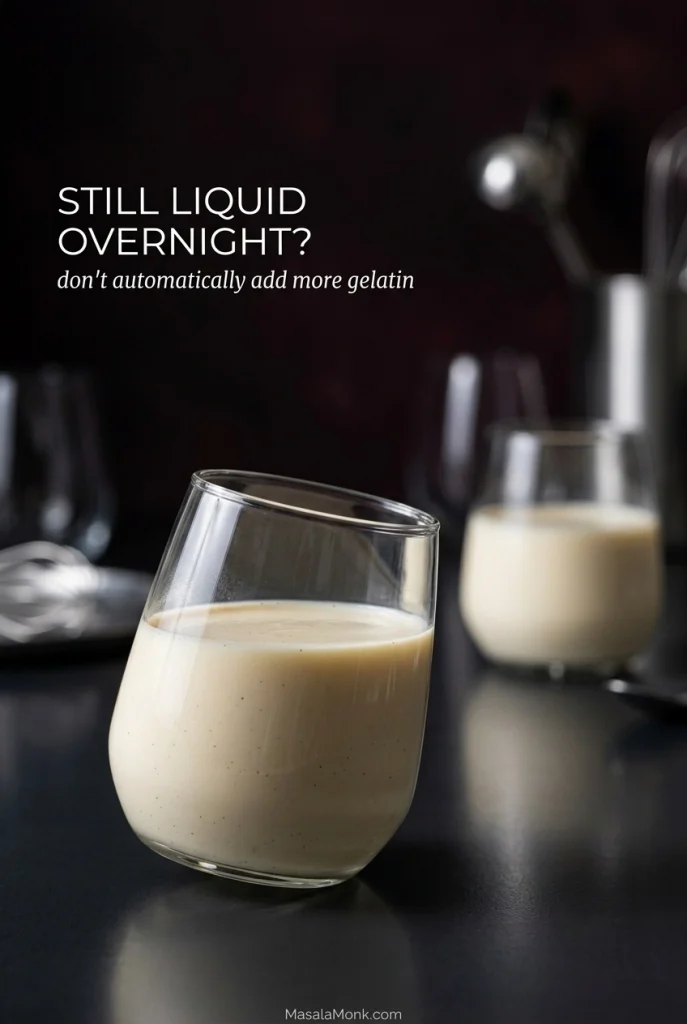
Still liquid after an overnight chill is different from a panna cotta that is simply soft. If it sloshes rather than moving as one mass, retrace the gelatin step before adding more gelatin next time.
| What happened? | Why it happened — and what to do |
|---|---|
| Still liquid after an overnight chill | Check the gelatin weight, blooming and dissolution. One of those is more likely than simply needing much more gelatin. |
| Very soft but spoonable | If it holds together in a glass and tastes creamy, this may already be exactly right. |
| Firm, springy or rubbery | There is too much gelatin for the serving style. Use less next time. |
| Won’t release from the ramekin or mold | Give it more chilling time, then use another very brief warm-water dip if needed. |
| Collapses after unmolding | With 6 g gelatin, chill it longer before changing anything. A 5 g batch is better kept in the glass if it is that soft. |
Appearance Problems
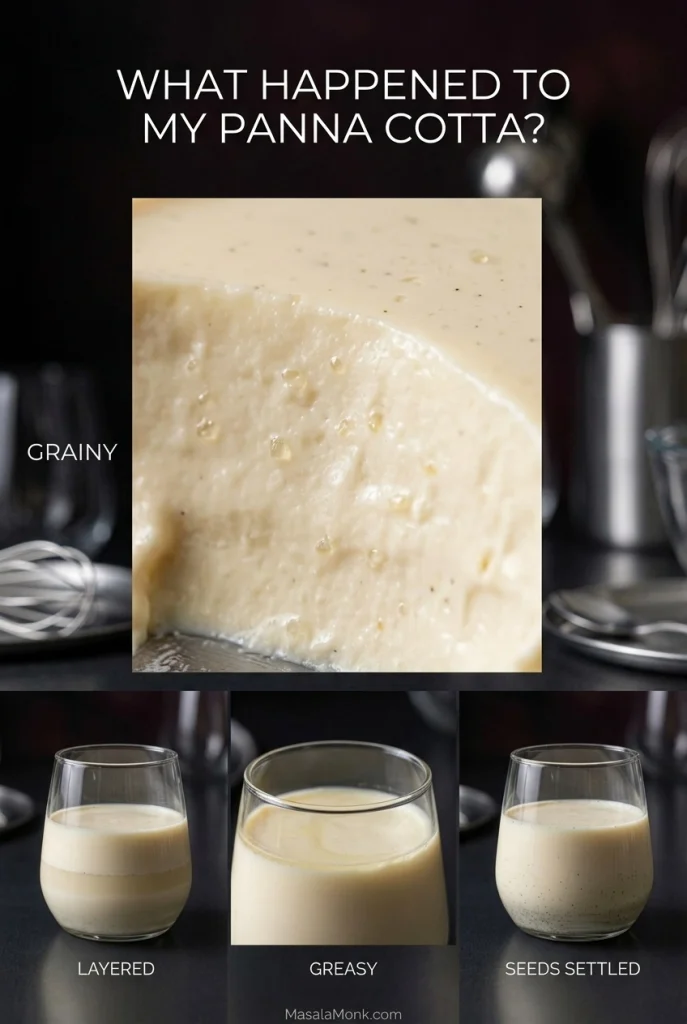
Visual clues can narrow the problem before you choose a fix. Grainy pieces suggest gelatin trouble, while distinct layers, a greasy ring or settled vanilla point to separation or settling.
| What you see | Likely cause and fix |
|---|---|
| Gummy or grainy pieces | The gelatin was not fully dissolved. Before chilling, rewarm over low heat until smooth and strain again. |
| Creamy layer over a clearer lower layer | The base separated while setting. Cool it until it gains a little body before portioning. |
| Yellow or greasy layer | This points to fat separation. Moderate heat is enough; unusually rich cream can also make separation more likely. |
| Vanilla seeds all at the bottom | The base was too warm and thin when poured. Cool it briefly first. |
What Can Be Rescued?
Undissolved gelatin and a batch beginning to set in the bowl can usually be saved with low heat. The goal is only to make the base smooth and pourable again.
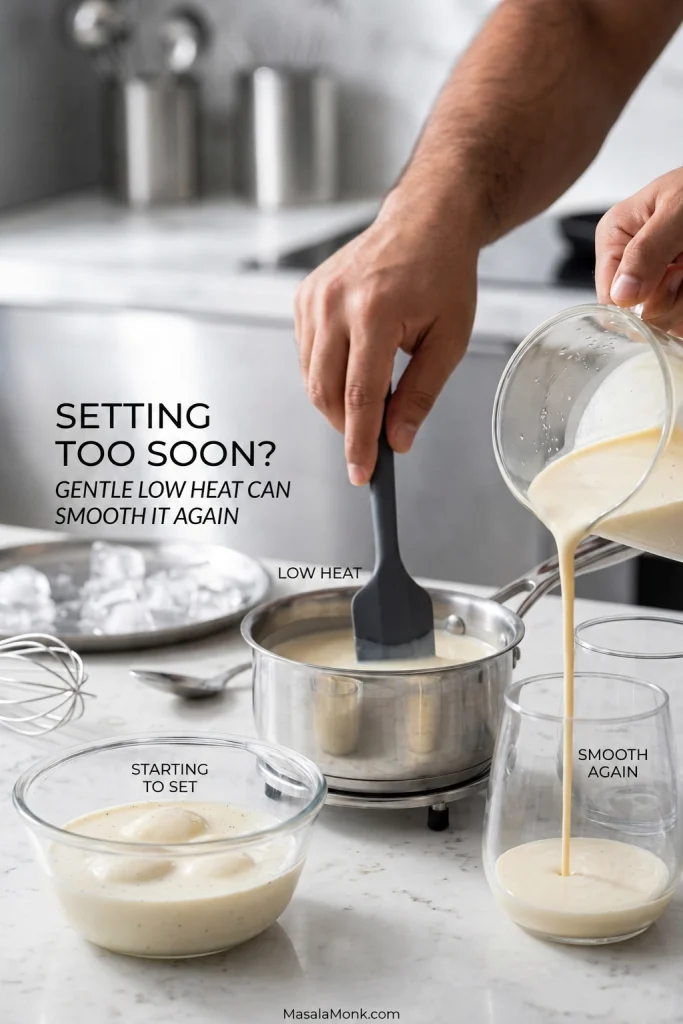
If the cream mixture has badly curdled or split, starting again is more likely to give you the silky texture you wanted. For bright lemon flavor without curdling the cream, add a small spoonful of lemon curd after the panna cotta has set.
Back to the recipe · Back to the guide · Back to top
Gelatin Sheets, Agar and Dairy Substitutions
Some swaps are straightforward; others change the dessert enough to need a different recipe.
Gelatin Sheets and Agar
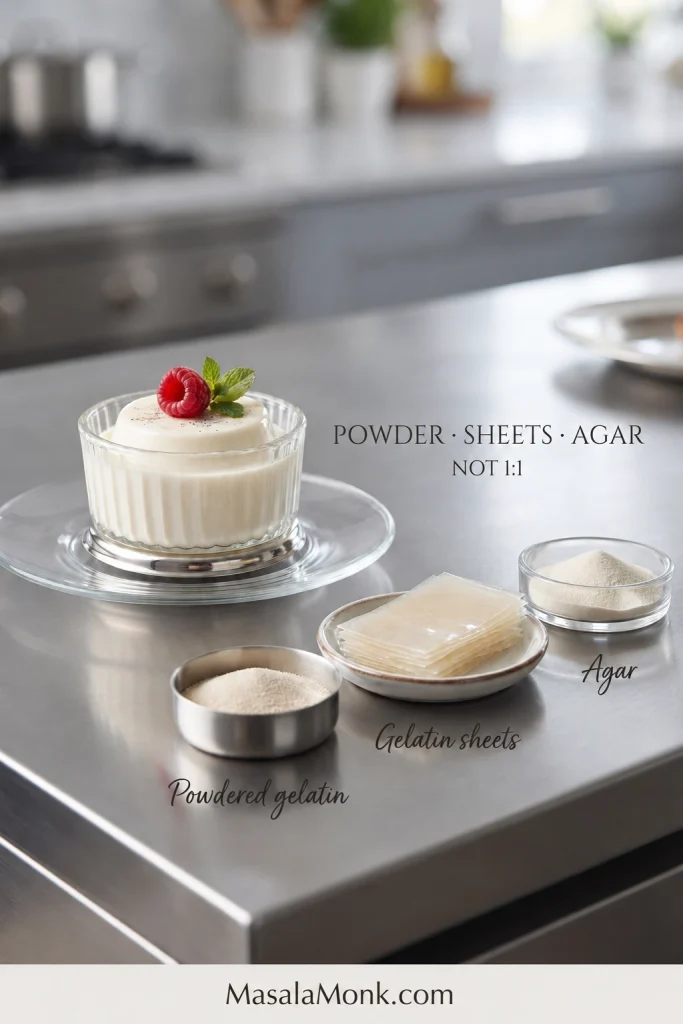
Powdered gelatin, gelatin sheets and agar can all create a set, but the form alone does not tell you how much to use. Strength and handling matter too.
| Swap | What changes |
|---|---|
| Gelatin sheets | Sheet size and Bloom strength vary by manufacturer. Use the manufacturer’s conversion for replacing 5 g or 6 g of standard powdered gelatin; there is no universal sheet count. |
| Agar | Unlike gelatin, agar needs a different recipe and much stronger heating to set properly. It also gives a firmer set with less of gelatin’s melt-away texture. |
| Beef or fish gelatin | These may suit some people avoiding pork gelatin, depending on certification. Check the manufacturer’s setting strength before using the same gram amount; they are still animal products and are not vegetarian. |
Using standard powdered gelatin? Go back to how to bloom it properly.
Dairy Substitutions
| Swap | What changes |
|---|---|
| UK double cream | It is richer than typical US heavy cream, so the finished panna cotta will feel heavier on the palate. |
| Half-and-half | It can make a good panna cotta, but it is leaner than this cream-and-milk blend, so the result will be less lush. |
| Low-fat or skim milk | It is not an equivalent replacement for the heavy cream. The panna cotta will be much leaner and the gel more noticeable. |
| Plant milks or coconut milk | Water, fat, protein and stabilizer levels vary widely. These milks need a recipe balanced for those differences. |
For a vegetarian or vegan panna cotta, start with a recipe built around its gelling system and base instead of converting this one ingredient by ingredient.
Back to the recipe · Back to the guide · Back to top
Flavor and Topping Ideas
Coffee, tea, strips of citrus zest and mild herbs can infuse the warm cream mixture without adding much extra liquid. Vanilla and other concentrated extracts are easiest stirred in after the pan comes off the heat.
Large amounts of fruit purée, citrus juice, chocolate or coconut milk change the balance of the base enough to need a recipe designed around them. Strong citrus juice can also destabilize hot cream, so it is usually better kept in a topping. For bright lemon flavor without adding juice to the hot cream, spoon a little lemon curd over the panna cotta once it has set.
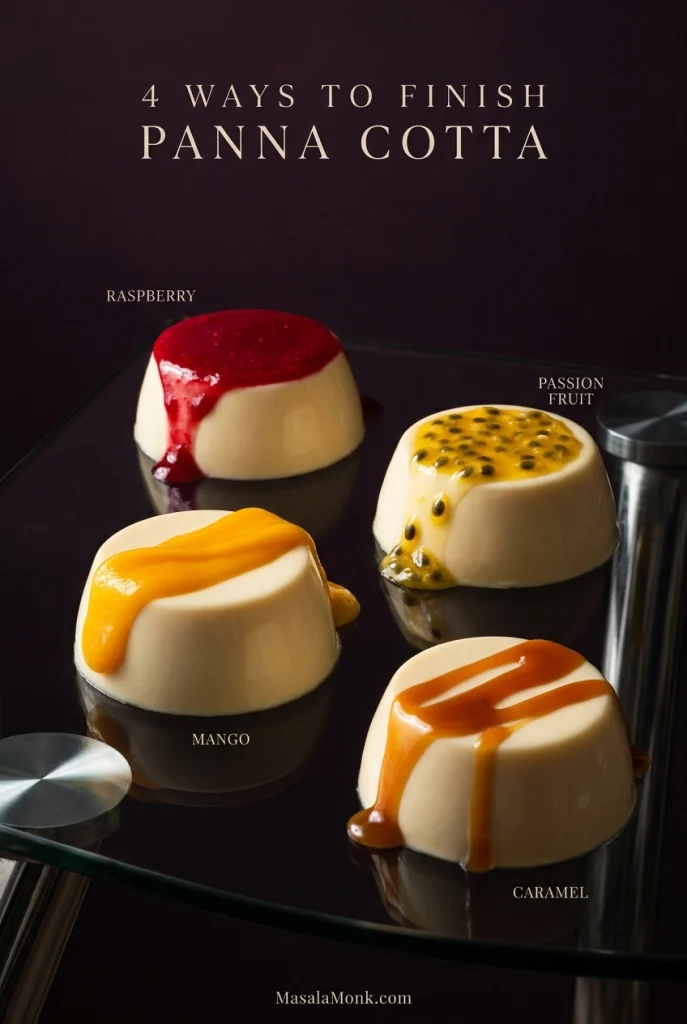
Ripe mango and berry coulis keep things bright and fruity, while a thin ribbon of caramel takes the dessert in a richer direction. A spoonful of sharp raspberry coulis running into the cold vanilla cream is particularly hard to improve on.
Fruit Toppings and Gelatin
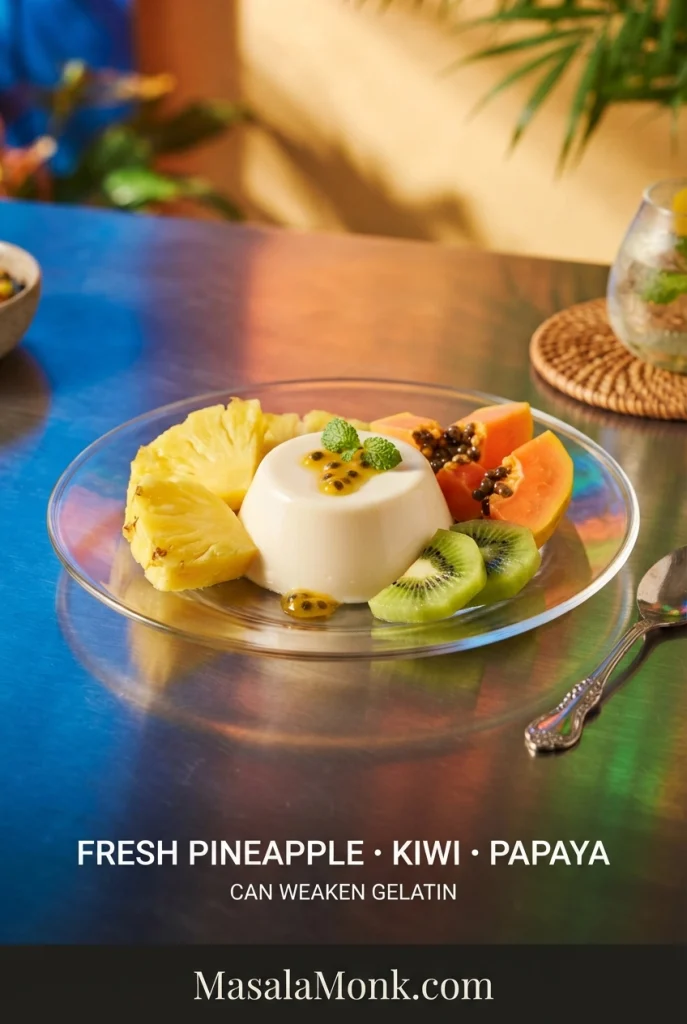
Fresh pineapple, kiwi and papaya contain protein-breaking enzymes that can interfere with gelatin setting. Avoid mixing them raw into a make-ahead panna cotta base. Illinois Extension recommends cooked or canned versions for gelatin desserts because heat deactivates those enzymes.
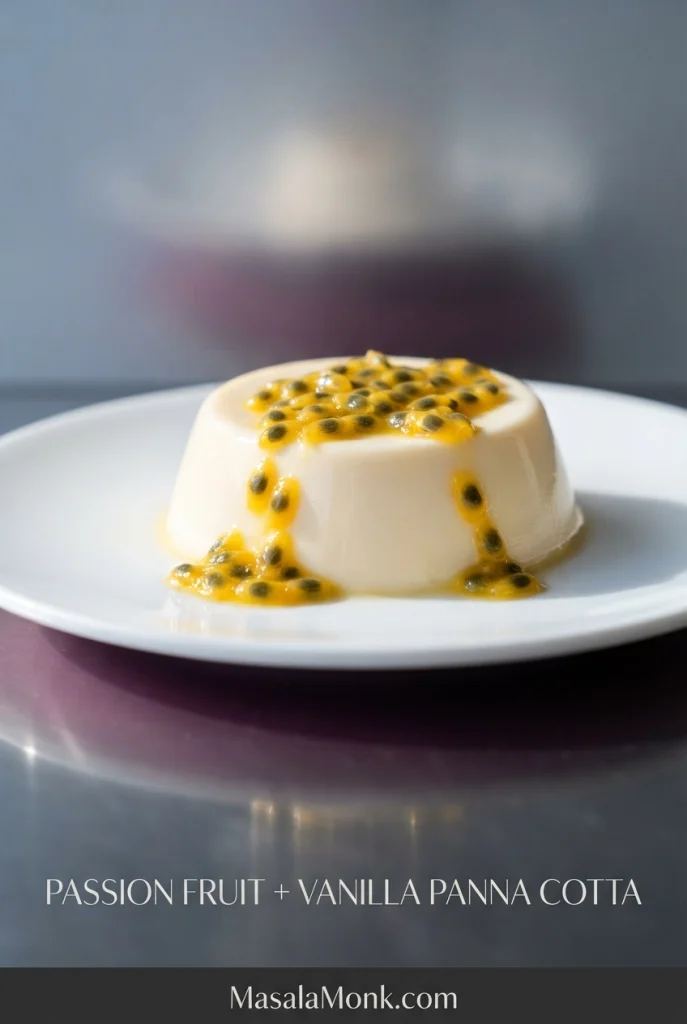
For serving, you barely need a recipe. Tart raspberries or passion fruit keep the cold vanilla cream from feeling too rich.
Make Ahead, Storage and Serving
For best texture and freshness, keep panna cotta covered in the refrigerator and use it within about 3 days.
Add berries, herbs, sauces and anything crunchy closer to serving so the garnish stays fresh and the panna cotta surface stays clean.
Skip freezing this panna cotta. Thawing can leave it grainy, watery or separated. For transport, keep the portions properly chilled in a cooler with ice packs.
Take the panna cotta out of the refrigerator about 5–10 minutes before serving. It should still be cool, but the brief rest softens the texture just enough for the vanilla and cream to come through more clearly.