
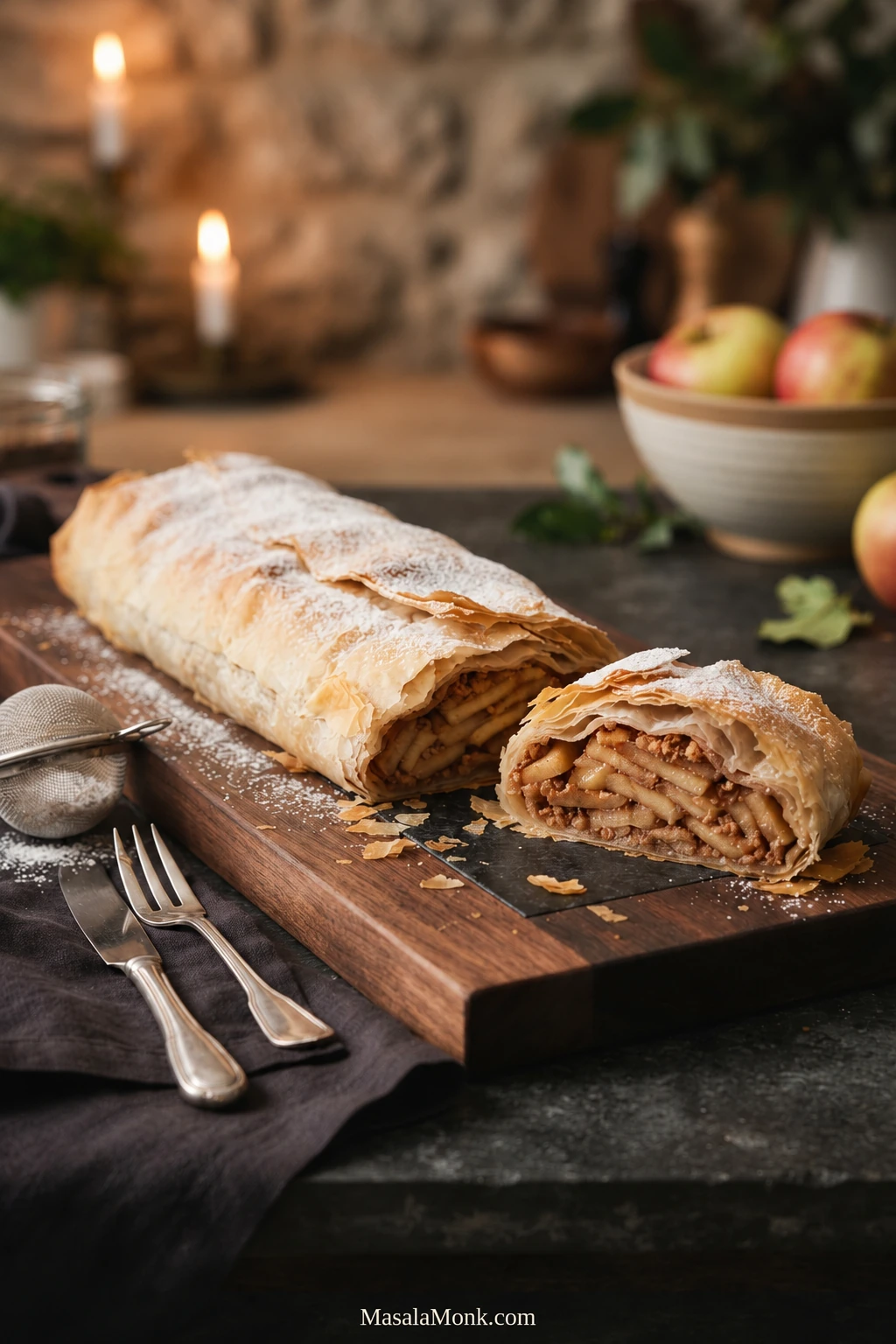
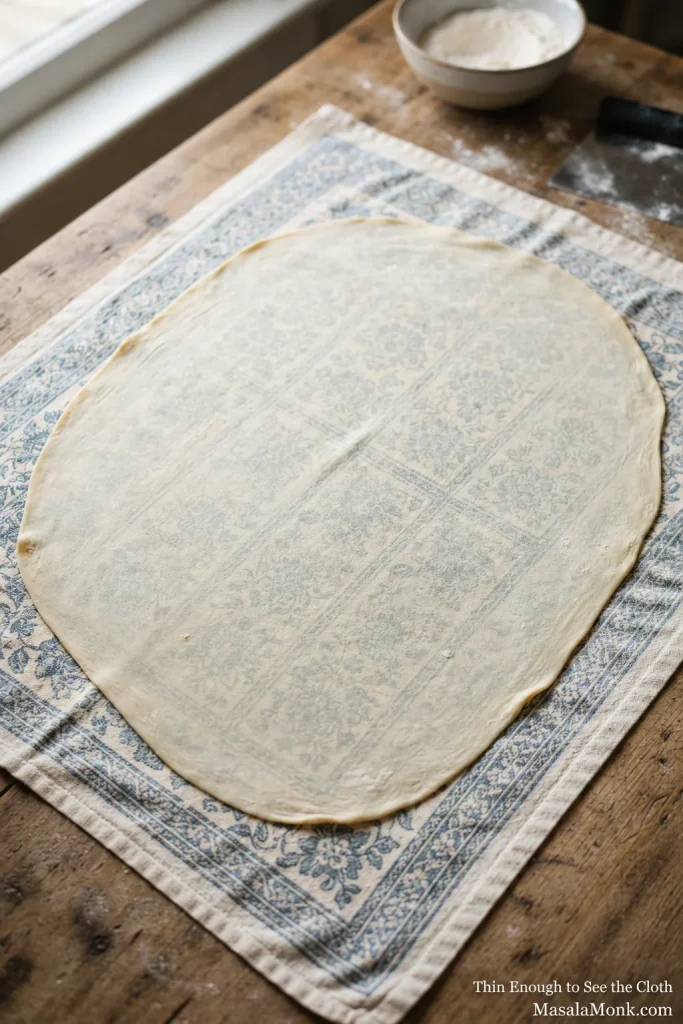
The first surprise in a traditional apple strudel recipe is how far a small ball of dough can stretch. Made with flour, water and oil, it becomes a sheet thin enough to show the tablecloth beneath it. That delicate pastry wraps around sliced apples, cinnamon and butter-toasted breadcrumbs to make Austrian Apfelstrudel.
A warm slice offers a contrast that’s quite different from apple pie: fine pastry layers around a generous filling of sweet-tart apples. The outside turns golden and lightly crisp, while the fruit inside softens with cinnamon and the toasted crumbs catch some of its juice.
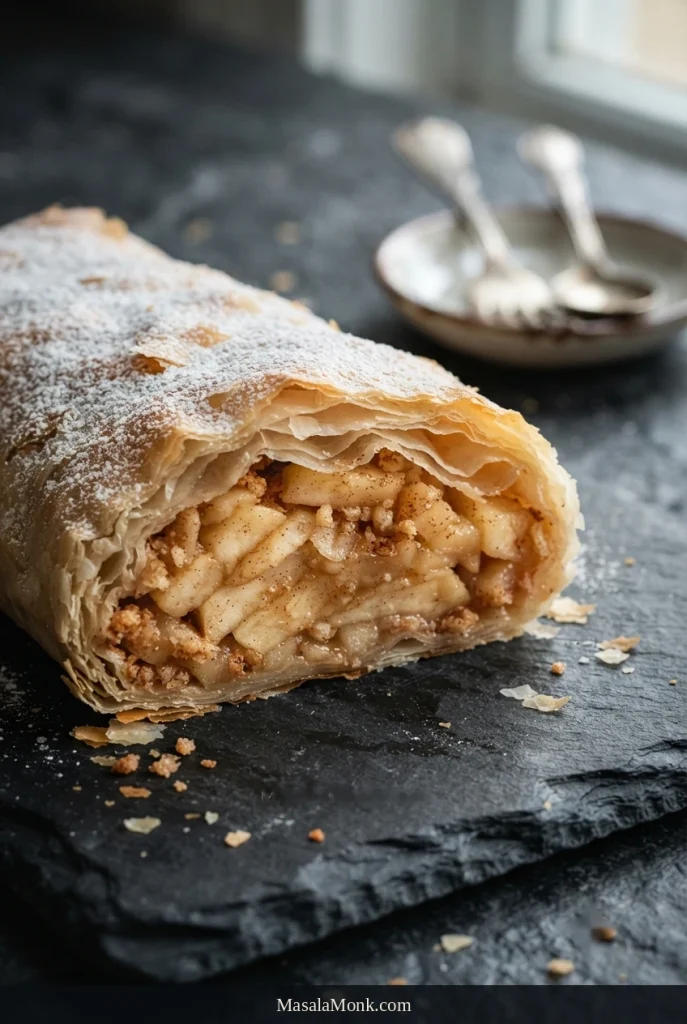
Hand-stretched dough looks ambitious, but the ingredients are simple and the technique becomes easier once you know the checkpoints. Focus on a supple dough, an evenly stretched sheet, apples arranged in a manageable layer and a cloth-assisted roll that supports the pastry.
Jump to the apple strudel recipe ↓
In This Apple Strudel Guide
- Authentic Austrian apple strudel recipe
- How thin to stretch the dough
- Filling, rolling and transferring strudel
- Best apples for apple strudel
- Baking and doneness
- Troubleshooting common problems
- Phyllo, puff pastry and variations
- Make-ahead, storage and serving
- Frequently asked questions
Authentic Austrian Apple Strudel Recipe
This makes one large apple strudel with egg-free, hand-stretched pastry, raw sliced apples and butter-toasted breadcrumbs. Raisins and walnuts are optional. Austrian recipes vary: some use egg in the dough, while others use flour, water, oil and a little vinegar. This version follows the latter tradition.
| Yield | 1 large strudel, about 8 servings |
|---|---|
| Active preparation | About 55–70 minutes |
| Dough resting | At least 60 minutes |
| Baking | About 35–45 minutes; longer if needed |
| Cooling | 15–20 minutes |
| Time to allow | About 2¾–3¼ hours from starting the dough to serving, including resting, baking and cooling; some preparation overlaps the rest |
| Conventional oven | 190°C / 375°F |
| Fan-assisted oven | About 170°C / 340°F |
| Difficulty | Intermediate technique; approachable with patience |
Plan the work: Knead the dough, then use its one-hour rest to toast the crumbs, prepare optional raisins and set up the workspace. Slice the apples near the end of the rest. Stretching, rolling, baking and cooling follow; allow some extra time for a first attempt. Planning for tomorrow instead? See what you can prepare ahead.
Equipment and Workspace
- Mixing bowl, kitchen scale and rolling pin
- Large, smooth, tightly woven cotton or linen cloth
- Stable table or countertop with room to stretch the dough
- Baking sheet around 33 × 46 cm (13 × 18 inches)
- Oven-safe parchment paper
- Flat, rigid board or rimless tray large enough to carry the completed roll
- Frying pan, knife, bowls, spoon and pastry brush
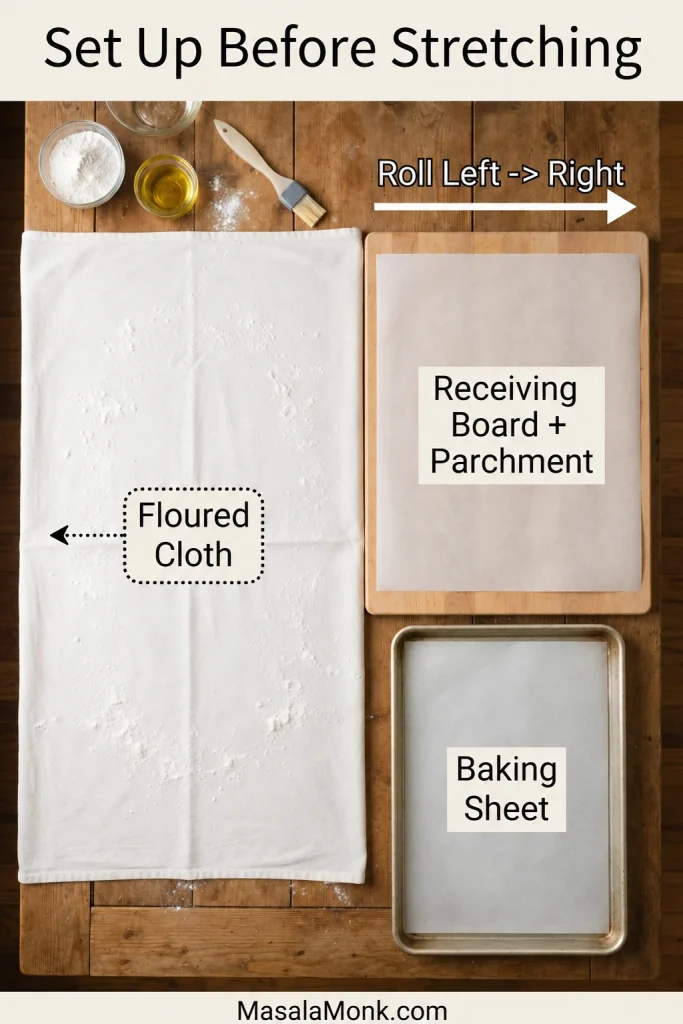
Set up before you begin: The stretched sheet will occupy roughly 70–75 cm left to right and 60 cm front to back. Place a parchment-covered board immediately to its right, on a sturdy level surface. The board’s front-to-back length must support the entire finished strudel; its left-to-right depth needs to accommodate the rolled pastry. A board around 50 cm long and 25–30 cm deep is an example, not a universal minimum. Use a larger board or a second level table if your roll or workspace needs it. Keep the receiving surface fully supported.
Apple Strudel Ingredients
For the Strudel Dough
- 160 g (5.6 oz) bread flour — about 1⅓ US cups; all-purpose flour can also work
- 88 ml lukewarm water — about 3 US fl oz
- 15 g neutral vegetable oil — about 16 ml, slightly more than 1 tablespoon
- ½ teaspoon (2.5 ml) white vinegar or lemon juice
- ¼ teaspoon fine salt
- A little oil for coating the dough and flour for dusting
Flour choice: Bread flour gives the dough strength for stretching. All-purpose flour works too, although lower-protein varieties may make the sheet more delicate. Weigh the flour and follow the dough-feel checkpoints below.
For the Apple Filling
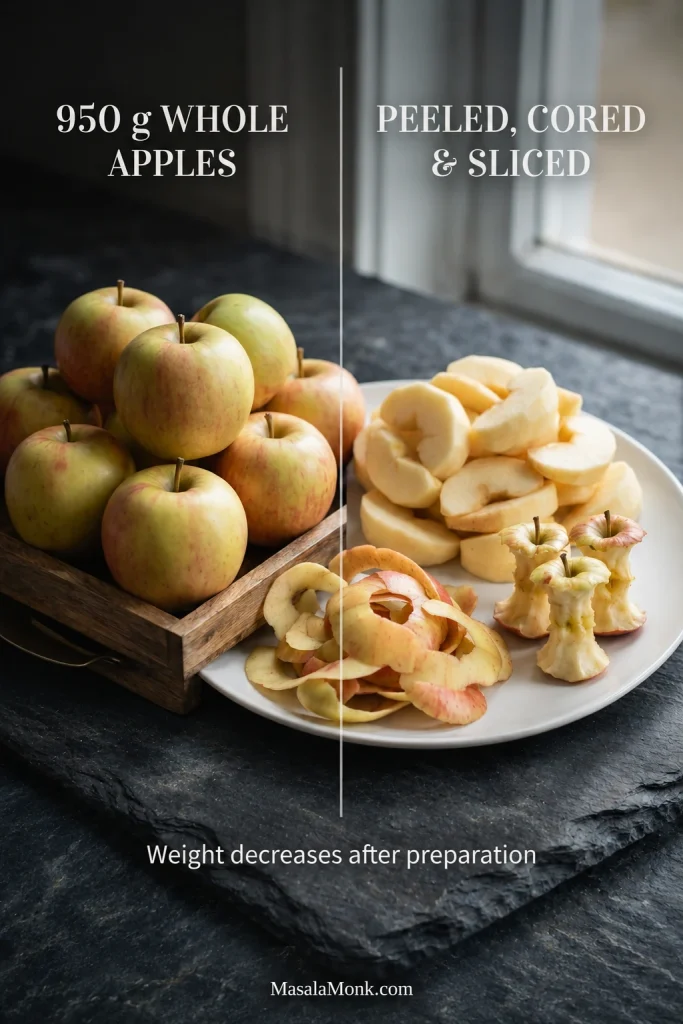
- 950 g (about 2 lb 1½ oz) whole apples — Granny Smith, Pink Lady, Braeburn or other firm, sweet-tart apples
- 70 g (2.5 oz) granulated sugar — about ⅓ US cup
- 1 teaspoon ground cinnamon
- 15 ml (1 tablespoon) lemon juice
- 45 g (1.6 oz) raisins, optional
- 30 ml (2 tablespoons) rum, warm water or apple juice, optional, to soak dry raisins
- 25 g (0.9 oz) finely chopped walnuts, optional
Start with whole apples before peeling and coring. The 950 g includes peel and cores. Starting with 950 g of ready-cut slices would produce too much filling for the intended pastry. If you are choosing fruit, see the apple varieties and texture guide.
For the Butter-Toasted Breadcrumbs
- 70 g (2.5 oz) fine, dry, plain breadcrumbs
- 30 g (1.1 oz) unsalted butter — about 2 tablespoons
For Assembly and Serving
- 40 g (1.4 oz) unsalted butter — about 3 tablespoons, melted when needed
- Powdered or icing sugar, for serving
Use 30 g butter for the breadcrumbs, about 25 g to drizzle on the stretched sheet and about 15 g to brush the finished roll: 70 g butter in total.
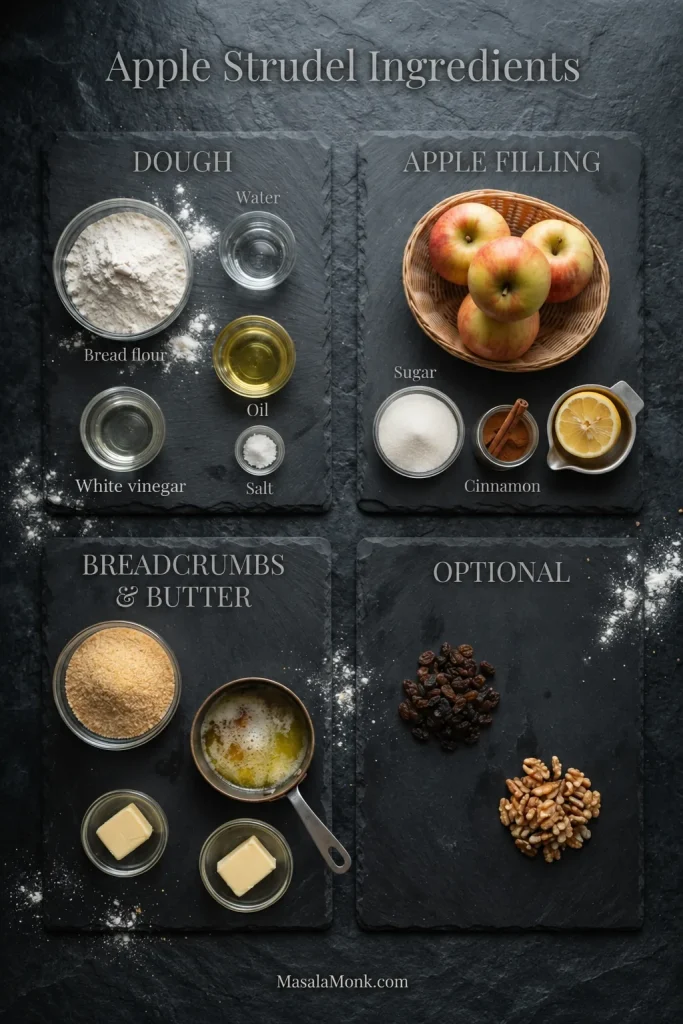
How to Make Apple Strudel from Scratch
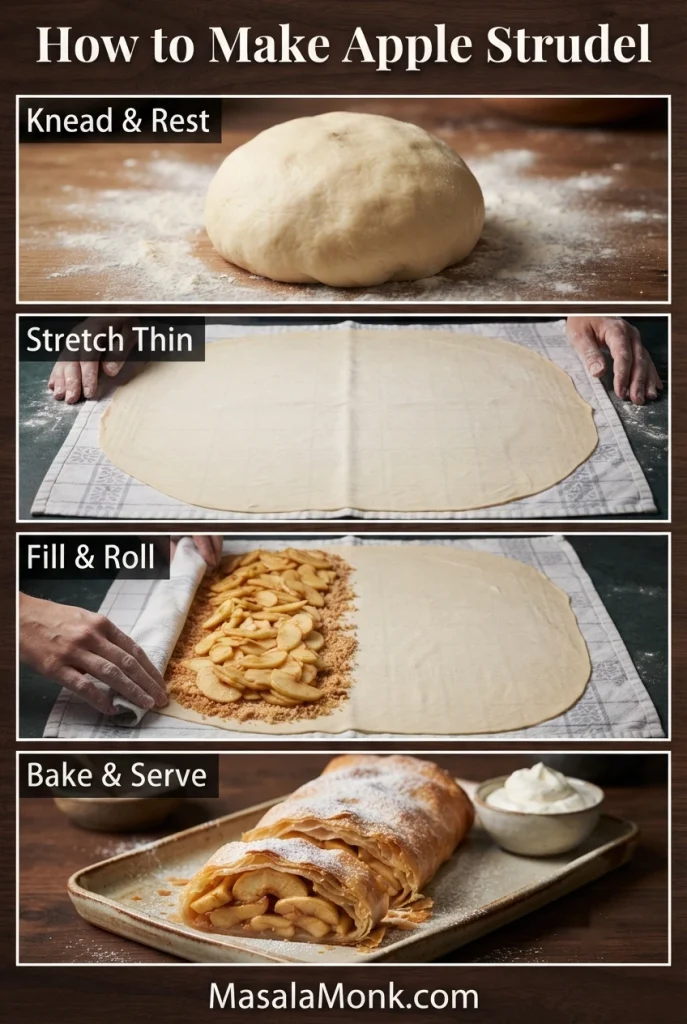
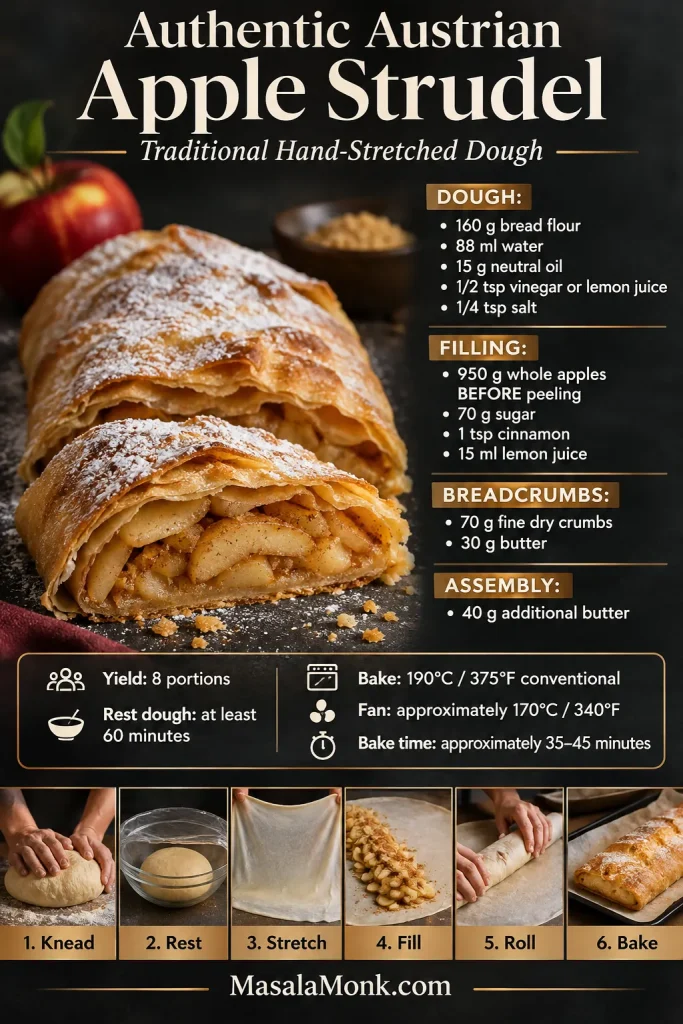
Keep this visual reference nearby for the ingredient quantities and oven settings. Follow the numbered steps for the techniques that need extra explanation.
Make and Rest the Dough
- Mix the dough. Combine flour and salt. Stir water, oil and vinegar or lemon juice together, then mix into the flour until a rough, slightly sticky dough forms.
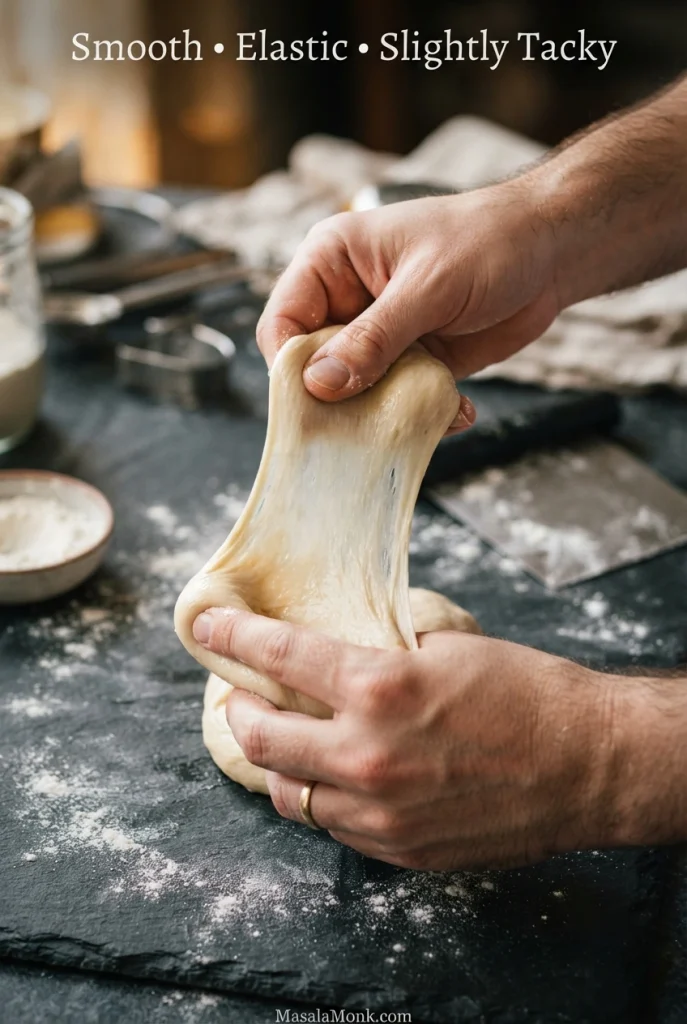
- Knead for 10–12 minutes. Fold, press and turn until smooth, elastic and slightly tacky. Ordinary early stickiness often improves with kneading; don’t bury the dough in extra flour.
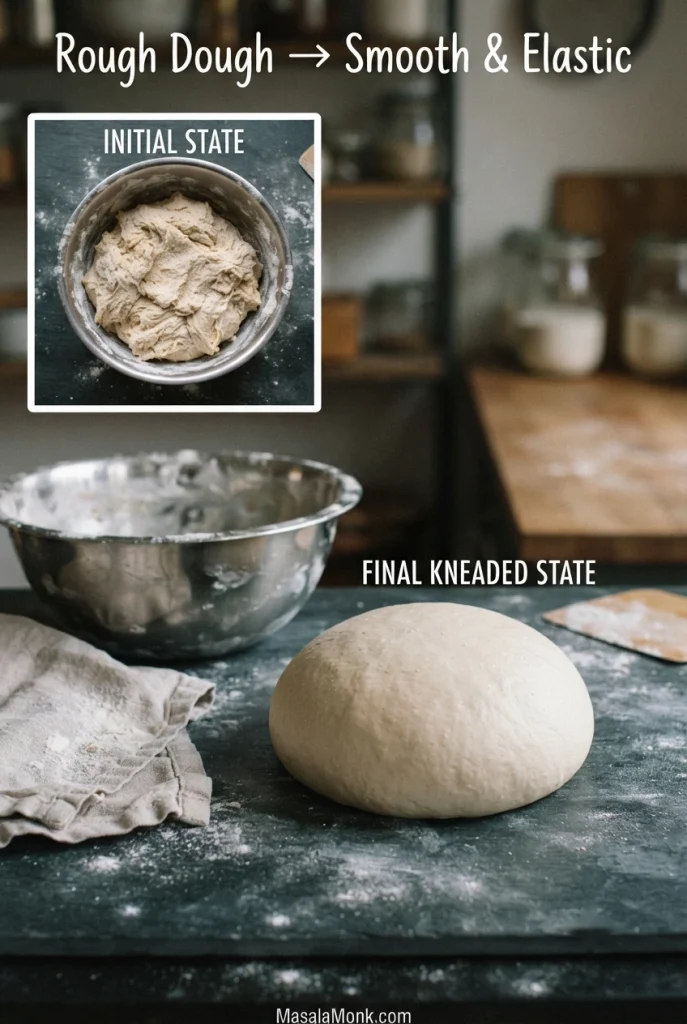
- Rest for at least 60 minutes. Shape into a ball, coat lightly with oil and cover at room temperature. It should stretch with less resistance afterward. Give it another 15–20 minutes if it pulls back strongly.
Dough checkpoint: Smooth and slightly tacky is the goal. If thoroughly kneaded dough stays wet and pasty, work in a little flour. For dough that feels stiff and cracks, add water a few drops at a time and knead again. If the rested dough tears, sticks or springs back during stretching, consult the stretching and troubleshooting guidance.
Prepare the Filling and Workspace
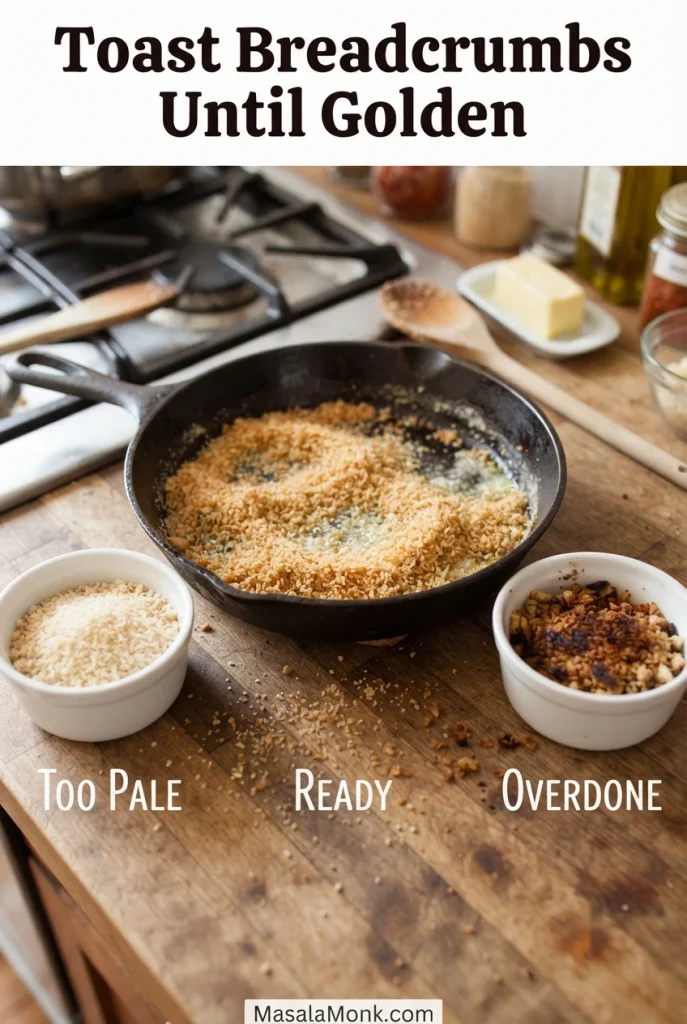
- Toast the breadcrumbs. During the dough rest, melt 30 g butter over medium-low heat. Stir in 70 g breadcrumbs for 4–7 minutes until evenly golden and smelling toasted and buttery. Transfer to a bowl to cool. Soak dry raisins for 10–15 minutes if using, then drain.
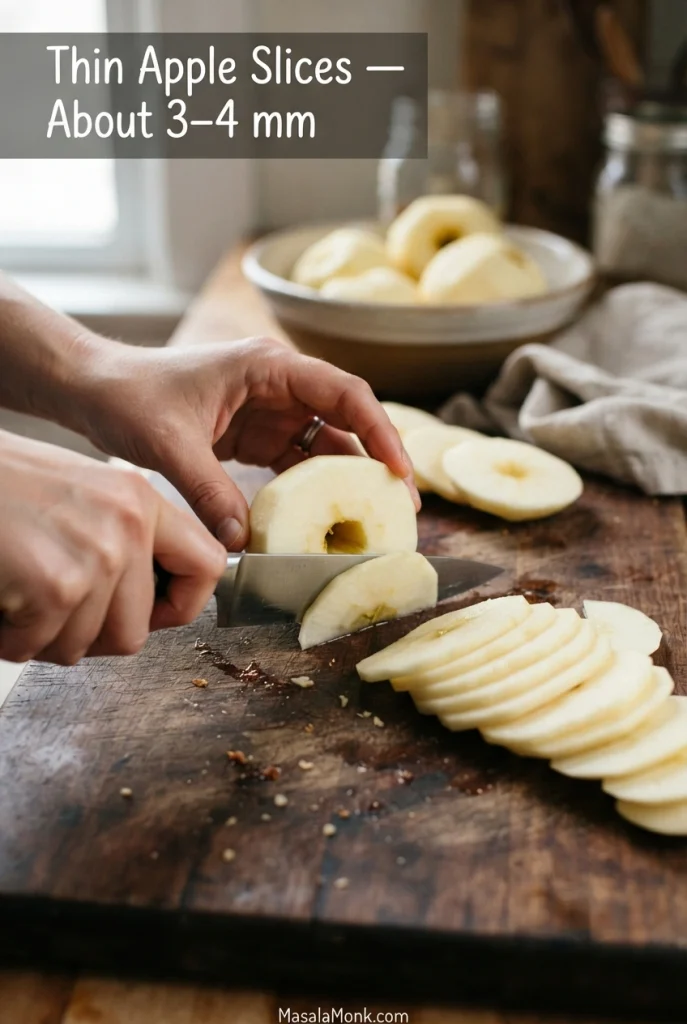
- Prepare the apples near assembly. Toward the end of the rest, peel and core the weighed apples. Slice 3–4 mm (⅛ inch) thick, toss with lemon juice and keep covered. Mix sugar and cinnamon separately; wait to combine them with the fruit.
- Prepare to stretch. Spread and lightly flour the cloth. Set the parchment-covered receiving board securely beside its right edge, with the baking sheet nearby. Begin preheating to 190°C / 375°F conventional, or about 170°C / 340°F fan-assisted, allowing for your oven’s preheat time. Have the 40 g assembly butter measured and ready to melt.
Before stretching: Dough rested; breadcrumbs cooled; apples sliced; cinnamon-sugar separate; cloth lightly floured; receiving board in place. The apples go into this strudel raw, unlike homemade apple pie filling, which is cooked and thickened before use.
Stretch the Strudel Pastry
- Roll out the dough. Place it on the cloth and use a rolling pin to form a broad circle or oval, about 30–38 cm (12–15 inches) across. Remove rings or sharp jewelry before hand stretching.
- Stretch over your hands. Slip your closed knuckles beneath the dough and gently extend it over the backs of your hands, moving around the sheet. Lower it onto the cloth once it becomes too large to support comfortably.
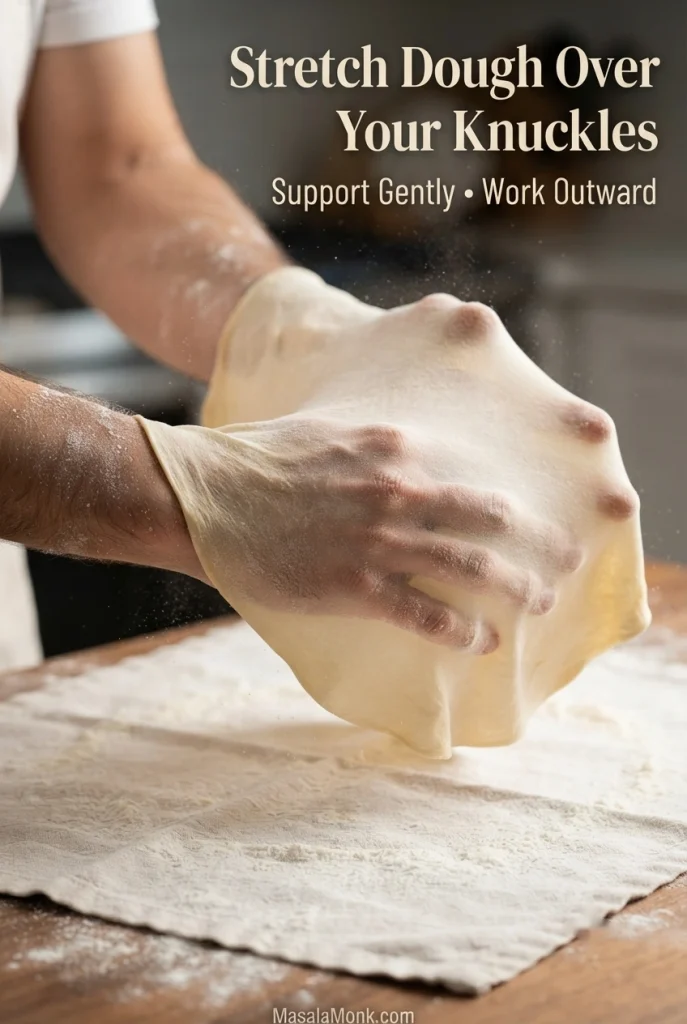
- Finish stretching. Work the thicker areas outward on the cloth until its color or pattern shows through most of the pastry. Aim for about 60 × 70–75 cm (24 × 28–30 inches), with the shorter side running front to back. Trim the thick rim. Before filling, gently lift an edge to check that the pastry releases from the cloth. Free stuck patches with lightly floured fingertips or a thin scraper.
Add Butter, Breadcrumbs and Apples
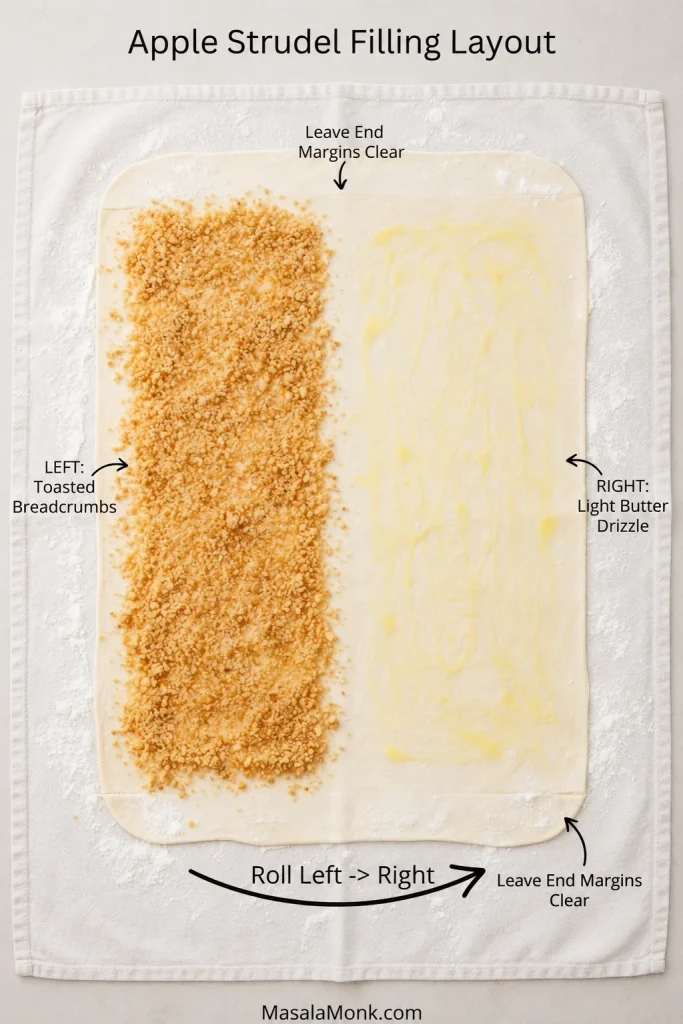
- Drizzle butter and scatter crumbs. Melt the 40 g assembly butter until warm and fluid. With the longer dough side running left to right, gently drizzle about 25 g over the right half without dragging a brush across the thin sheet. Scatter cooled breadcrumbs over the left half, leaving a small clear left border and 9–10 cm (3½–4 inches) clear at the near and far ends. This gives a filled length of roughly 40–42 cm for a 46 cm baking sheet.
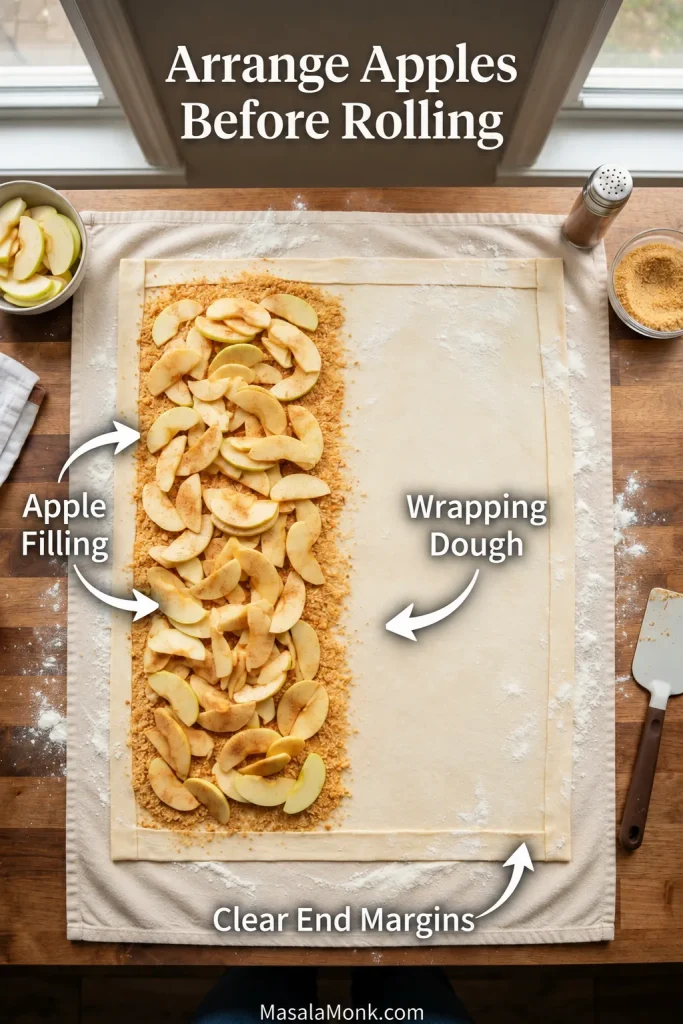
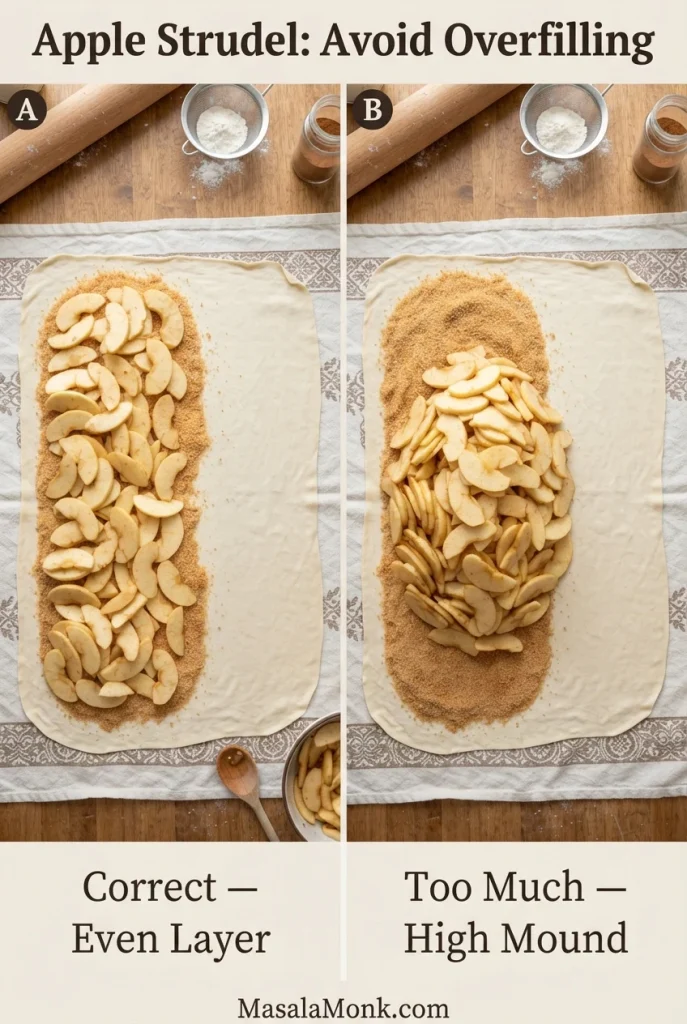
- Add the apples. Mix sliced apples with cinnamon-sugar just before filling. Spread evenly over the breadcrumbs and add drained raisins and optional walnuts. Keep the end margins clear and leave substantial pooled juice in the bowl.
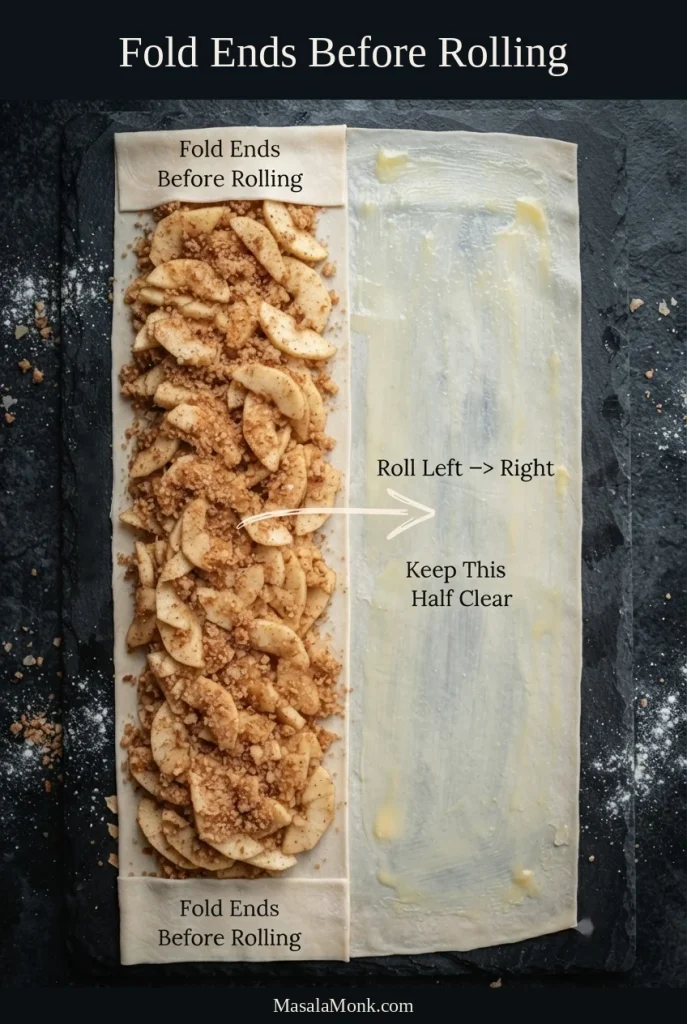
- Fold in the ends. Bring the clear dough at the near and far ends inward over the fruit.
Fold, Roll and Transfer the Strudel
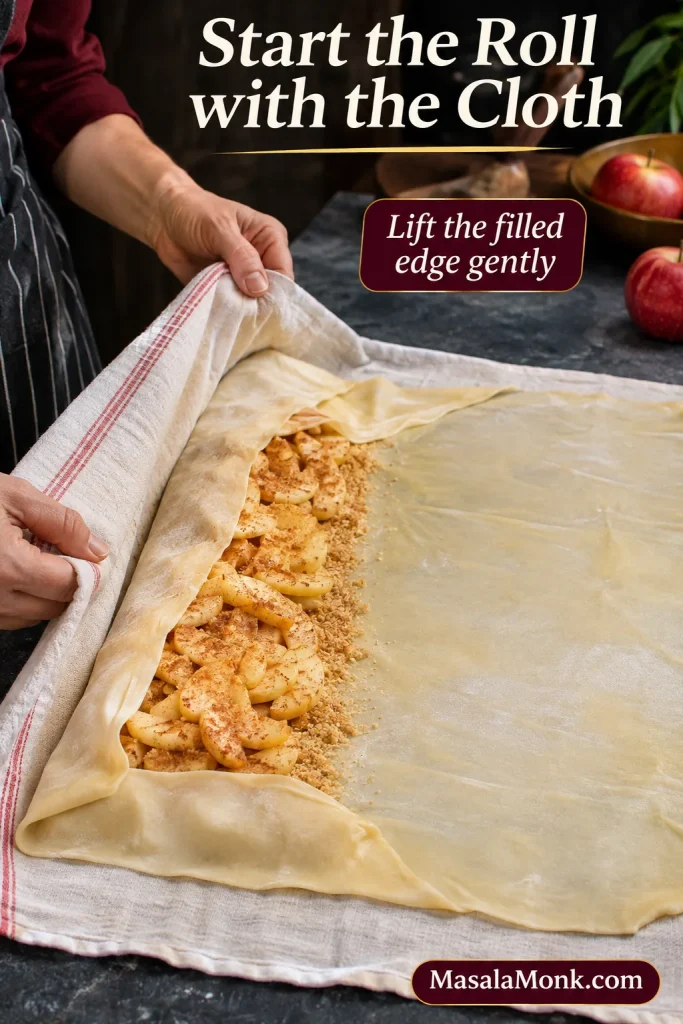
- Roll with the cloth. Lift the cloth beneath the filled left edge, allowing it to turn the apples toward the buttered right half. Continue lifting gradually; the cloth carries the weight while the pastry wraps around the fruit.
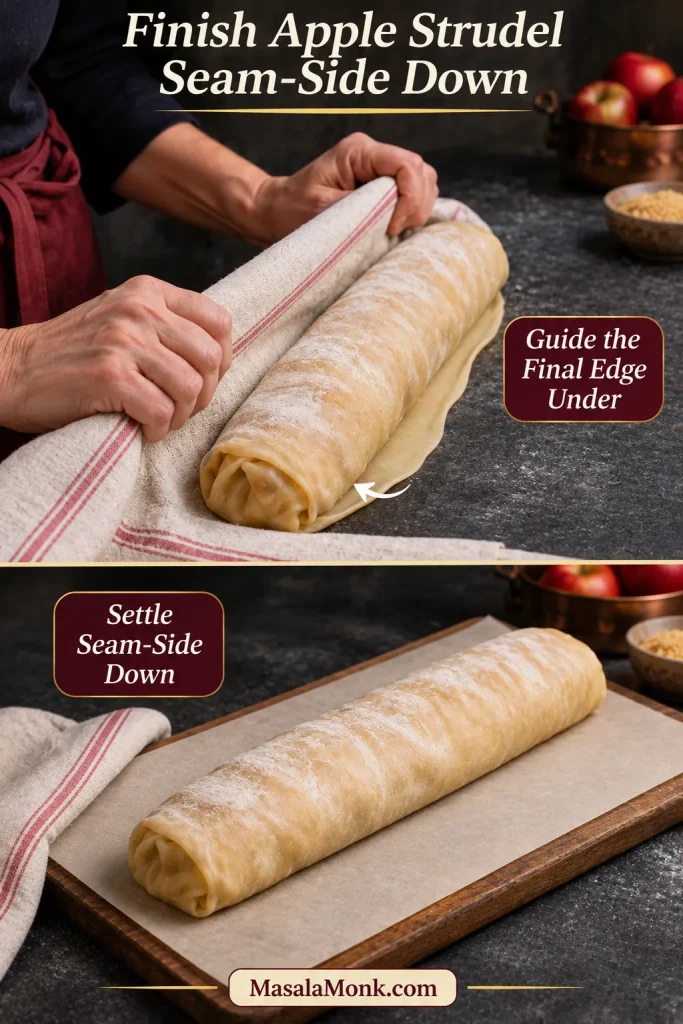
- Settle seam-side down. As the final loose flap approaches the underside, use the cloth to guide that edge beneath the roll before allowing the strudel’s weight to settle fully onto the parchment-covered board. Keep both ends tucked in; do not rotate the filled roll afterward.
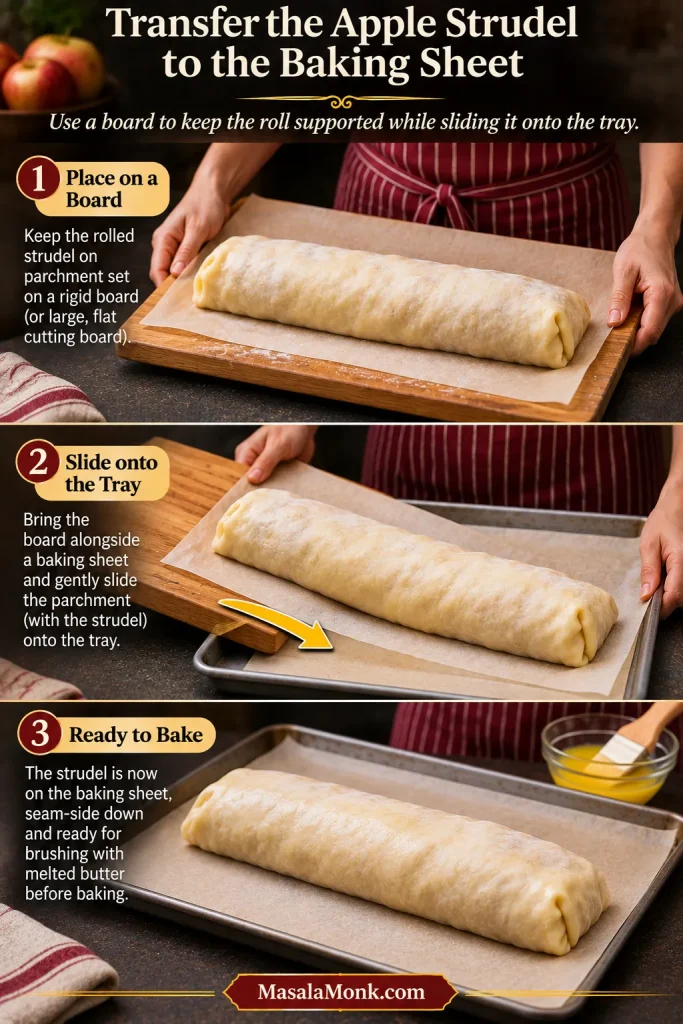
- Transfer and brush. Carry the roll on its supported board, align the board with the baking sheet, and slide the parchment and strudel onto the sheet. Curve gently or position diagonally if needed. Brush the exterior with the remaining about 15 g melted butter.
Bake and Serve
- Bake until done. Bake on the middle rack for about 35–45 minutes, checking the color from 30 minutes. Look for a golden outside, a cooked underside and tender apples. Shield the top loosely with foil if it darkens before the filling is ready.
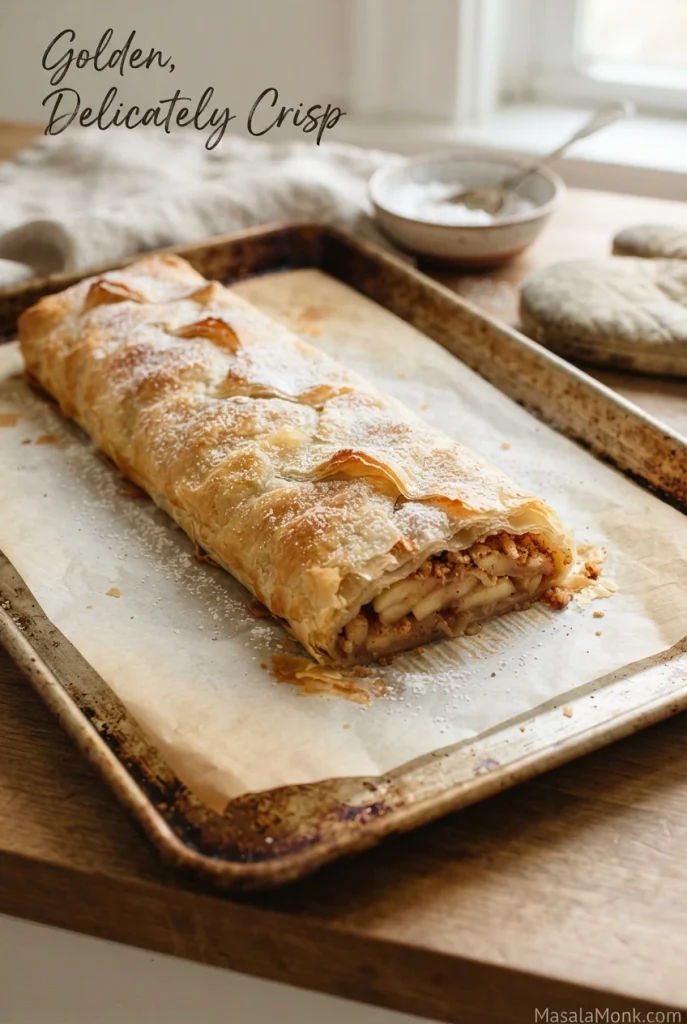
- Rest, slice and serve. Cool for 15–20 minutes, cut into about eight pieces with a serrated knife and dust with icing sugar.
The exposed pastry should be lightly crisp, while layers touching the apples remain more tender. A thick, floury or pasty seam is different from normal softness; it suggests dough that was too heavy or insufficiently baked.
How Thin Should Strudel Dough Be?
Thin enough to see the cloth through it, but elastic enough to fold. That’s the useful standard for stretched strudel dough. Kneading creates a cohesive gluten network; resting helps that strength become manageable instead of springing back against your hands.
When the Dough Keeps Shrinking Back
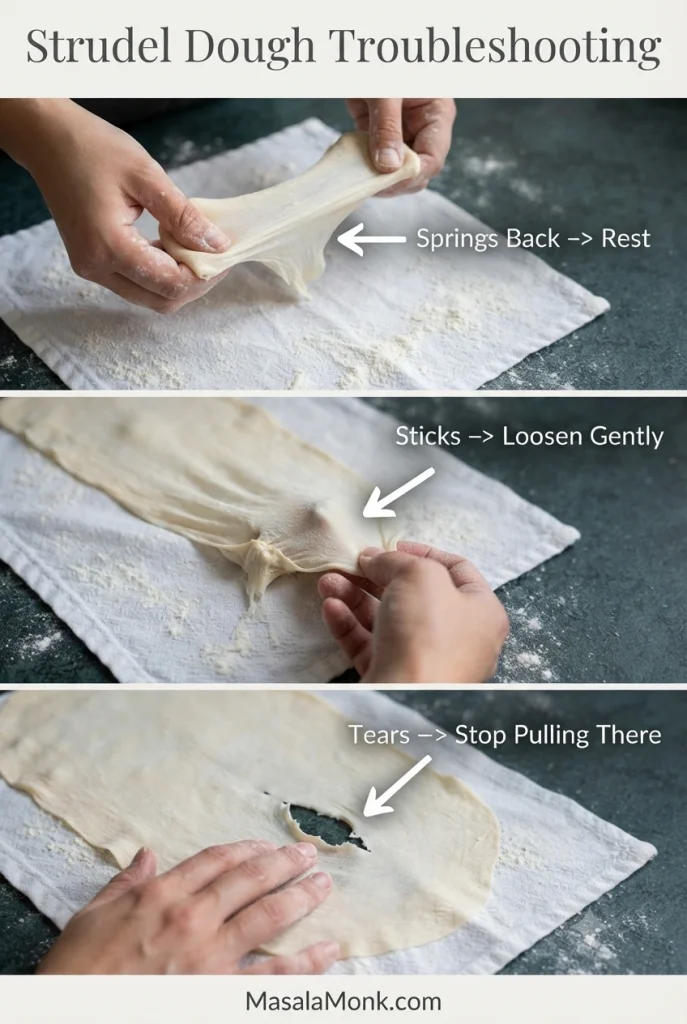
Stop stretching and cover the dough for another 15–20 minutes. Forcing dough that still resists creates thick spots beside fragile, overworked areas. When it’s relaxed, gentle movements should lengthen it steadily.
Tears, Sticking and Thick Edges
Small holes are usually manageable: stop working directly on them and thin the heavier areas instead. A large split beneath the filling can sometimes be covered with a thin patch of trimmed dough. Sticking calls for a different response—gently free the dough from the cloth before filling, rather than pulling against the resistance.
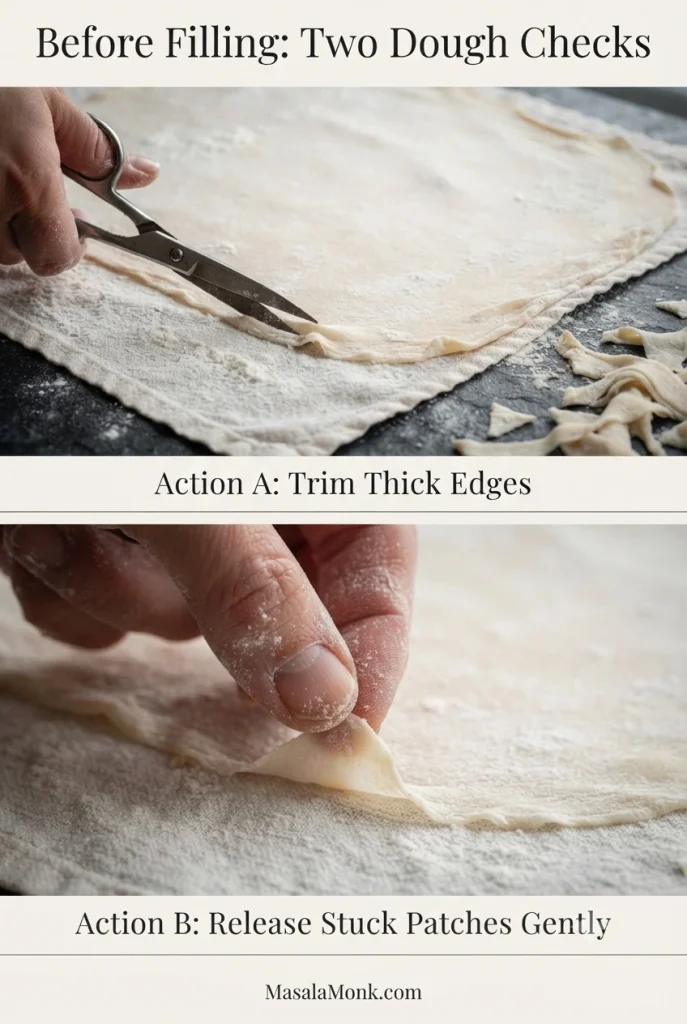
Trim the heavy perimeter because it can turn into a chewy fold inside the roll. Strudel differs from a flaky homemade apple pie crust: here the delicate, nearly transparent sheet is the point. The official Viennese apple strudel recipe also describes hand stretching and cloth-assisted rolling.
Back to the recipe and quantities ↑ · Guide contents ↑
How to Arrange the Filling and Roll Apple Strudel
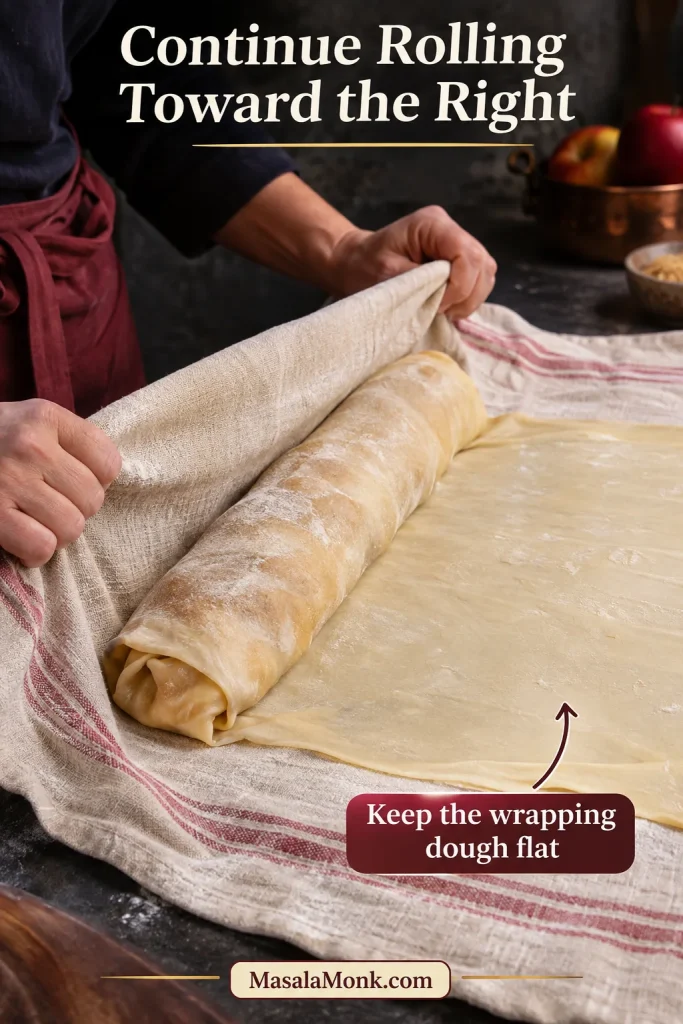
The crumbs and apples occupy the left portion of the dough; the buttered right portion wraps around them as you roll. Spread the fruit into a broad layer instead of a high mound, and keep the near and far margins clear so the ends can be tucked in.
Controlling the Last Turn
The seam’s position depends on the last turn. Guide the loose outer flap underneath with the cloth just before the roll settles on parchment. It’s easier to control that final movement than to reposition a large filled strudel afterward.
Moving the Strudel Without Lifting the Pastry
Remember the three supports: the cloth rolls, the parchment receives, and the rigid board carries. The board should already be at the end of the rolling path. It supports the finished strudel while you move the parchment onto the baking sheet; a second person can steady the setup if needed.
Best Apples for Apple Strudel
Firm, sweet-tart apples are the best starting point. Granny Smith adds acidity; Pink Lady and Braeburn offer balanced sweetness and firmness. A mixture gives a lively filling, but freshly cut, crisp local apples are more important than any particular imported variety.
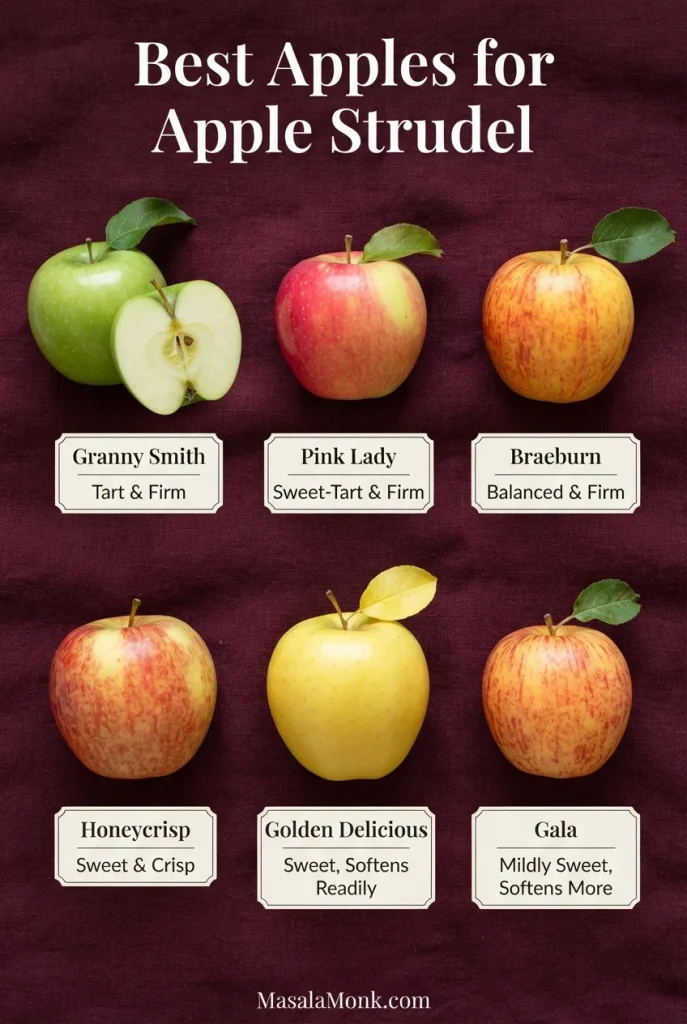
| Apple | Texture and flavor | How to use it |
|---|---|---|
| Granny Smith | Tart, firm | Excellent with sweeter apples |
| Pink Lady / Cripps Pink | Firm, sweet-tart | Excellent all-round choice |
| Braeburn | Balanced acidity and sweetness | Excellent all-round choice |
| Honeycrisp | Sweet, juicy, crisp | Mix with tart fruit if desired |
| Golden Delicious | Sweet, softens readily | Useful in a blend |
| Gala | Mild, tends to soften | Use when firmer apples are unavailable |
When a named variety is unavailable, use the texture and flavor characteristics in the table to select a local substitute. Avoid apples that already feel soft or mealy.
Balancing Sweetness, Texture and Juice
For very sweet apples, reduce the sugar modestly or add a tart variety. Taste particularly tart apples before deciding whether to increase the sugar. Juicy apples benefit from adding cinnamon-sugar only at filling time and leaving pooled liquid behind. Thin slices around 3–4 mm retain recognizable pieces, though softer varieties break down more; grated apples produce a finer filling in other strudel styles.
Why Butter-Toasted Breadcrumbs Matter
As the apples bake, the crumbs absorb some of the released juice and bring a toasted-butter flavor to the filling. This protects the fine pastry layers from becoming excessively wet. It’s a different arrangement from an apple crumble, where fruit sits beneath a topping rather than inside a roll.
How to Tell When Apple Strudel Is Done
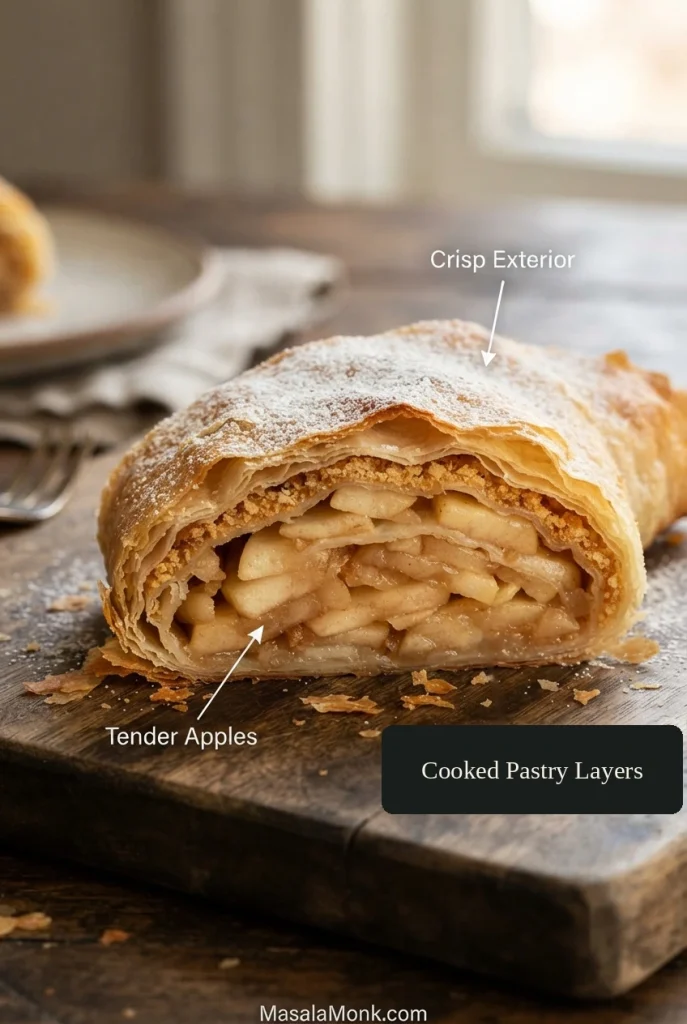
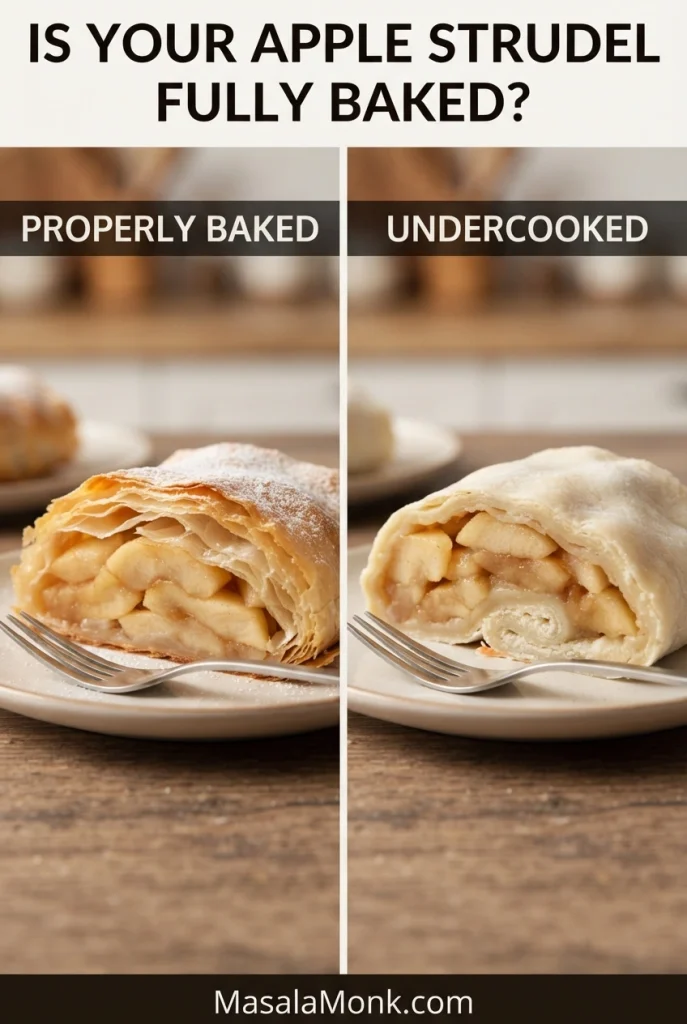
Look for a golden exterior, a cooked underside and tender apple slices. The outer layers can be lightly crisp, while pastry against the filling is naturally softer. Different apple varieties retain different amounts of shape, so tenderness matters more than picture-perfect slices.
- Top: Golden with no obvious raw patches
- Bottom: Baked rather than pale, wet and doughy
- Apples: Easily cut with a knife
- Inner pastry: Tender but cooked, without a thick floury seam
If the top darkens before the underside finishes, tent it loosely with foil and continue baking. Check a small accessible area underneath with a broad spatula rather than lifting the entire roll.
Apple Strudel Troubleshooting
| Problem | When you can act | Best response |
|---|---|---|
| Dough springs back | Before stretching | Cover and rest another 15–20 minutes |
| Dough remains pasty | During kneading | Knead thoroughly; add a little flour only if needed |
| Dough is dry and cracking | During kneading | Work in a few drops of water and knead again |
| Dough sticks to cloth | Before filling | Loosen with lightly floured fingers or thin scraper |
| Small tear appears | During stretching | Stop pulling there; stretch heavier areas instead |
| Apple layer is too bulky | Before rolling | Spread evenly or reserve some slices |
| Liquid pools in apple bowl | Before filling | Leave substantial pooled juice behind |
| Roll is too long for tray | Before baking | Position diagonally or in a gentle curve |
| Top browns too quickly | During baking | Tent loosely with foil and continue |
| Underside stays pale | During baking | Allow more time while shielding top if necessary |
| Chewy seam | Next attempt | Trim thick rim more thoroughly |
| Stored pastry softens | When serving leftovers | Reheat uncovered in oven |
Three baking clues to recognize: Juice escaping from a folded end, a pale underside and a thick pastry seam indicate different problems. Compare their appearance below, then use the troubleshooting table above to choose the right correction.
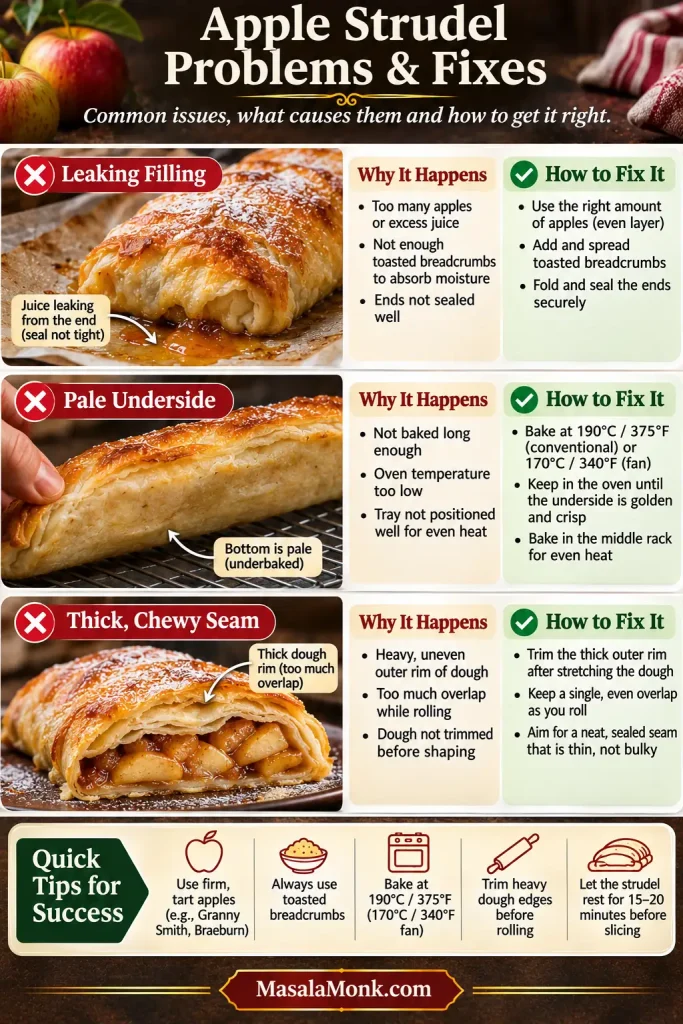
A Tear During Rolling or a Little Leaking Juice
When a tear opens during rolling, let the cloth take the weight and ease the surrounding pastry over the exposed fruit. For another look at hand stretching, King Arthur Baking’s strudel dough guide shows the handling method, though its formula differs from this egg-free version.
A little apple juice escaping onto the baking sheet is manageable. Let the strudel finish baking rather than moving a hot, fragile roll. For the next attempt, keep the filling evenly distributed and leave excess liquid in the apple bowl. Review how to arrange and roll the filling before trying again.
Back to the traditional recipe ↑ · Guide contents ↑
Traditional Dough, Phyllo or Puff Pastry?
Hand-stretched dough gives traditional Austrian-style strudel its characteristic fine layers. Phyllo offers a crisp, ready-made alternative; puff pastry creates a thicker, airy apple pastry. Their sheet sizes, filling quantities and baking methods differ from this recipe.
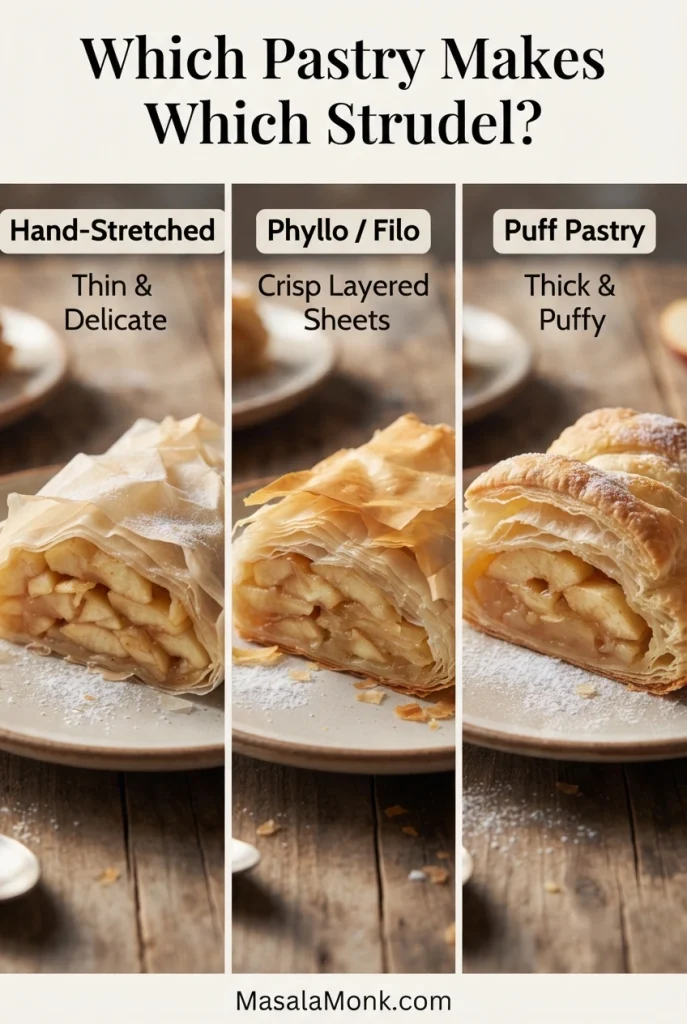
| Pastry | Method | Texture |
|---|---|---|
| Stretched strudel dough | One elastic sheet pulled thin and rolled | Fine, delicate layers |
| Phyllo / filo | Separate thin sheets layered with butter | Crisp, flaky |
| Puff pastry | Chilled laminated pastry folded around fruit | Thicker, puffier |
| Shortcrust pastry | Rolled crust enclosing fruit | Tender, substantial |
Puff pastry: Keep commercial pastry cold, use a modest amount of apple filling, close its edges and make steam vents. Choose a method suited to that pastry’s dimensions and bake until the underside is done. For a complete ready-made-pastry dessert, see our puff pastry apple tart. To make the traditional version, return to the hand-stretched apple strudel recipe.
Phyllo: Thaw as directed on the package, keep unused sheets covered and layer the sheets with melted butter or a suitable alternative. Use a phyllo-specific recipe for the number of layers, filling volume and baking temperature; the full filling above won’t necessarily suit a smaller roll.
Easy Filling Variations
Without raisins: Leave them out. Alcohol-free: Soak dry raisins in water or apple juice. With nuts: Use chopped walnuts or almonds. Less sweet: Reduce the sugar modestly with naturally sweet apples. Different spices: A little nutmeg or allspice works alongside cinnamon; our homemade apple pie spice guide explains the blend.
Vegan: The dough itself has no egg or dairy; substitute a suitable plant-based baking fat for butter. Gluten-free: This hand-stretched method relies on gluten, so ordinary gluten-free flour isn’t a dependable direct substitution. Use a recipe developed specifically for gluten-free pastry.
Make Ahead, Store and Serve Apple Strudel
Prepare These Parts the Day Before
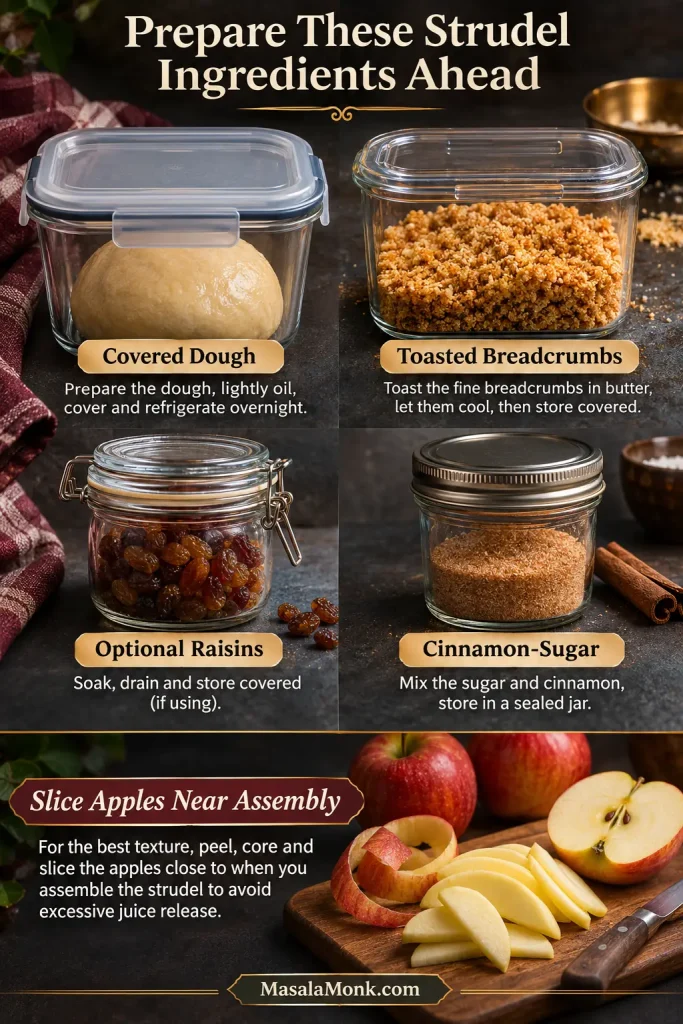
- Dough: Knead, oil lightly, cover tightly and refrigerate overnight. Let it warm and relax before stretching.
- Breadcrumbs: Toast in butter, cool and refrigerate covered.
- Raisins: Soak and drain, then refrigerate covered.
- Cinnamon-sugar: Mix ahead; keep away from the apples until filling time.
Slice apples closer to assembly and bake shortly after rolling. For a different apple dessert requiring less pastry handling, our apple cinnamon roll bake with prepared filling is another option.
Storing, Freezing and Reheating
Refrigerate leftovers in a covered container within two hours and use within 3–4 days. The layers will gradually soften as moisture moves from the apples into the pastry.

For freezing, cool baked strudel completely, wrap individual portions well and use within about 2–3 months for best quality. Thaw in the refrigerator. Freezing the assembled raw strudel is less predictable because the apples can release additional moisture.
Reheat refrigerated slices uncovered in an oven at about 170°C / 340°F, typically 10–15 minutes for individual portions and longer for larger pieces. Heat leftovers thoroughly; general leftover-safety guidance uses a center temperature of 74°C / 165°F. An oven restores more exterior crispness than a microwave.
Serving Apple Strudel
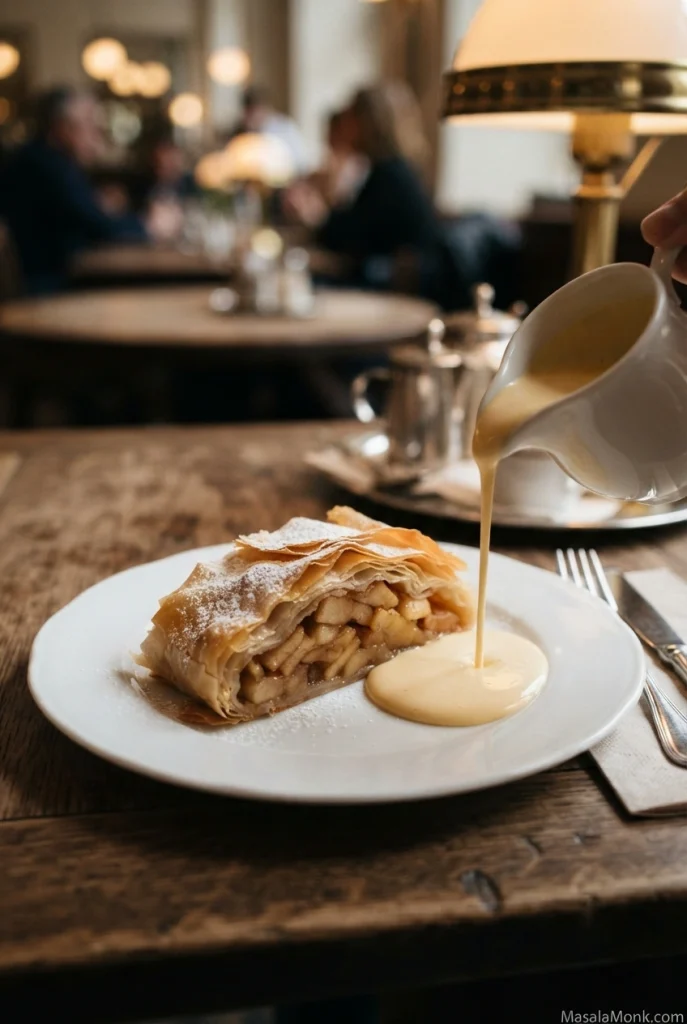
Dust the slightly warm strudel with icing sugar. It is lovely on its own, or with vanilla sauce, softly whipped cream or vanilla ice cream. A little vanilla sauce against the warm apples and fine pastry layers makes a particularly good finish.
Back to the recipe ↑ · Back to guide contents ↑
Frequently Asked Questions About Apple Strudel
Is apple strudel Austrian or German?
Apfelstrudel is especially associated with Vienna and Austrian cuisine, although related versions are also popular in Germany and other Central European regions.
Can strudel dough be made without eggs?
Yes. Traditional published recipes include egg-free and egg-enriched doughs. This version uses flour, water, oil, salt and a little vinegar or lemon juice.
What cloth should I use to stretch the dough?
Use a large, smooth, tightly woven, lint-free cotton or linen cloth and dust it lightly with flour. Avoid fluffy towels that catch the pastry.
Does all-purpose flour work for strudel?
Yes. Lower-protein flour can make stretching a little more delicate, so knead until elastic and rest fully before pulling the dough thin.
Can I use fresh breadcrumbs?
Dry them thoroughly first. Fine, dry crumbs toast more evenly and absorb apple moisture more reliably in this recipe.
Why did my strudel split during baking?
Unevenly piled apples, a weak patch of dough or poorly folded ends can let the filling escape. Spread fruit evenly and close the ends before rolling.
Must raisins be soaked?
No. Soft raisins can be used directly; soak dry ones briefly in rum, water or apple juice, then drain.
Can I freeze unbaked strudel?
Some methods permit it, but raw apples can give off more juice during freezing and thawing. Freezing baked portions is more predictable for this version.
Why does the pastry soften after cooling?
Moisture moves from the apple filling into the nearby pastry. Some softening is normal; a thick raw or gummy seam suggests a different baking or dough-thickness problem.
Is apple strudel better warm or cold?
Both are enjoyable. Slightly warm strudel offers the best contrast between the pastry and apples; room-temperature slices also work well with icing sugar or cream.








