
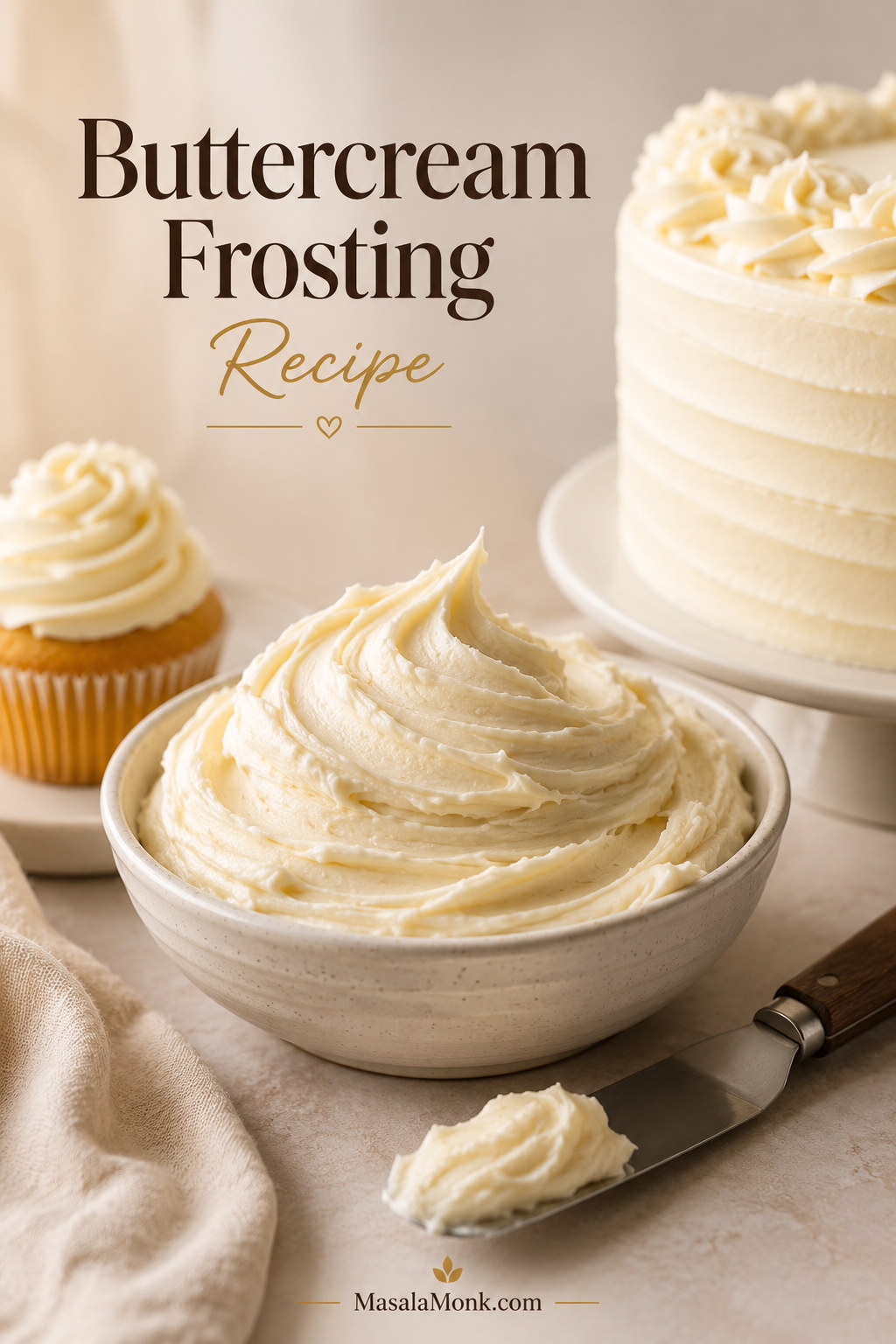
This buttercream frosting recipe is the one to make when the cake is cooling, the cupcakes are waiting, and you need frosting that will behave. It is classic American vanilla buttercream: fluffy, creamy, sweet, stable enough to pipe, and soft enough to spread.
The ingredients are simple — butter, powdered sugar, vanilla, cream or milk, and a little salt — but the real difference comes from butter temperature, gradual mixing, and knowing what the bowl is telling you.
This guide gives you the base recipe first, then the texture cues, quantity guide, piping help, storage notes, and practical fixes for the moments when the frosting looks too thick, too soft, or not quite right.
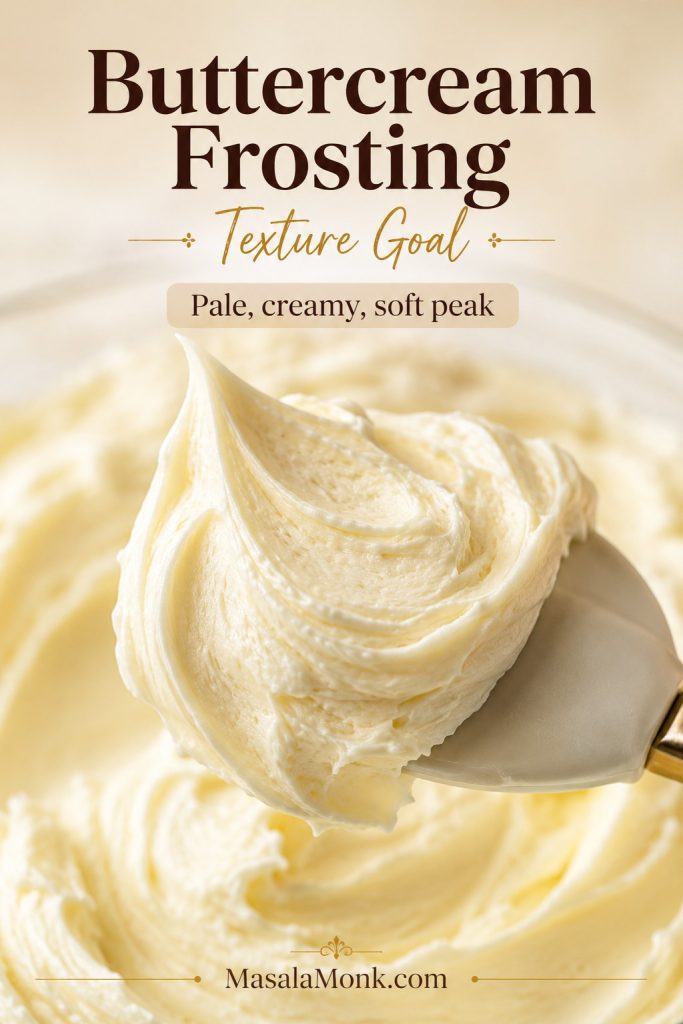
What finished buttercream should look like
Finished buttercream should look pale and creamy, feel soft but not loose, and hold a gentle swirl without slumping. That visual target matters more than the exact minute count on the mixer.
In This Guide
Make the Frosting
Use, Adjust, and Fix It
Quick Answer: The Best Buttercream Frosting Ratio
The easiest American buttercream ratio to remember is 1 cup butter to 4 cups powdered sugar, with just enough milk or cream to make it smooth. That gives you a classic homemade buttercream frosting that is fluffy, stable, and strong enough for cakes and cupcakes.
The buttercream ratio at a glance
Use this as the base batch, then adjust the final spoonfuls of milk or cream for spreading, piping, or decorating.
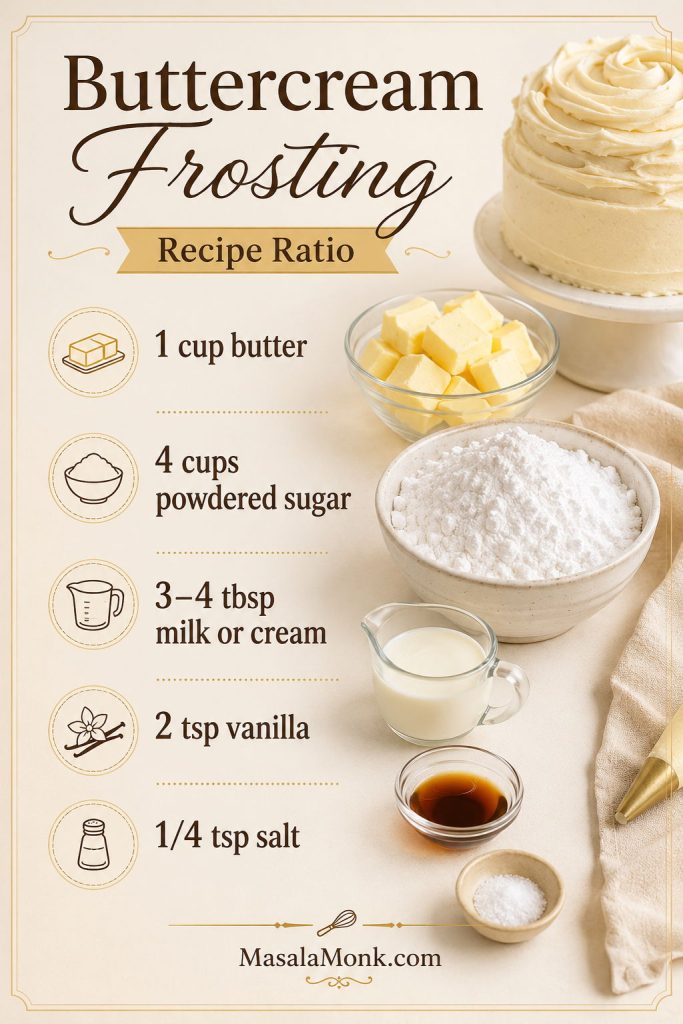
That ratio gives you a frosting that tastes rich, pipes cleanly, and still spreads without tearing soft cake.
| Ingredient | Amount | Why it matters |
|---|---|---|
| Unsalted butter | 1 cup / 2 sticks / 226g / 8 oz | Gives the frosting richness, body, and buttery flavor. |
| Powdered sugar / icing sugar | 4 cups / 480g / about 1 lb | Sweetens and thickens the frosting so it can hold shape. |
| Milk or heavy cream | 3–4 tbsp / 45–60ml / 1.5–2 fl oz | Loosens the texture so the frosting can spread or pipe smoothly. |
| Vanilla extract | 2 tsp / 10ml | Adds the classic vanilla buttercream flavor. |
| Fine salt | 1/4 tsp | Balances the sweetness and makes the flavor taste fuller. |
One base batch is enough for about 12 cupcakes with generous swirls, 18 cupcakes with a spread finish, or the top of one 9×13 sheet cake. For a full layer cake or heavy piping, check the quantity guide before you start.
Buttercream Frosting at a Glance
Quick recipe overview
Here is the practical snapshot before you start mixing.
What Is American Buttercream Frosting?
American buttercream is a thick, creamy frosting made by beating butter and powdered sugar together, then loosening the mixture with milk or cream and flavoring it with vanilla and salt. It is the simplest buttercream style because it does not need egg whites, sugar syrup, cooking, a double boiler, or a thermometer.
You may also see similar recipes called buttercream icing, butter icing, butter frosting, vanilla frosting, or cake frosting. The wording changes by region and habit, but home bakers are usually looking for the same thing: a simple, sweet, fluffy frosting that works for cakes and cupcakes.
American buttercream is sweet by design. Powdered sugar does more than sweeten the batch; it also gives the frosting structure, stability, and pipeable body. That sweetness is why a little salt, good vanilla, and a careful layer matter so much.
If you actually need a lighter topping for pies, fruit desserts, hot chocolate, pancakes, or no-bake desserts, MasalaMonk’s whipped cream recipe is a better fit than buttercream.
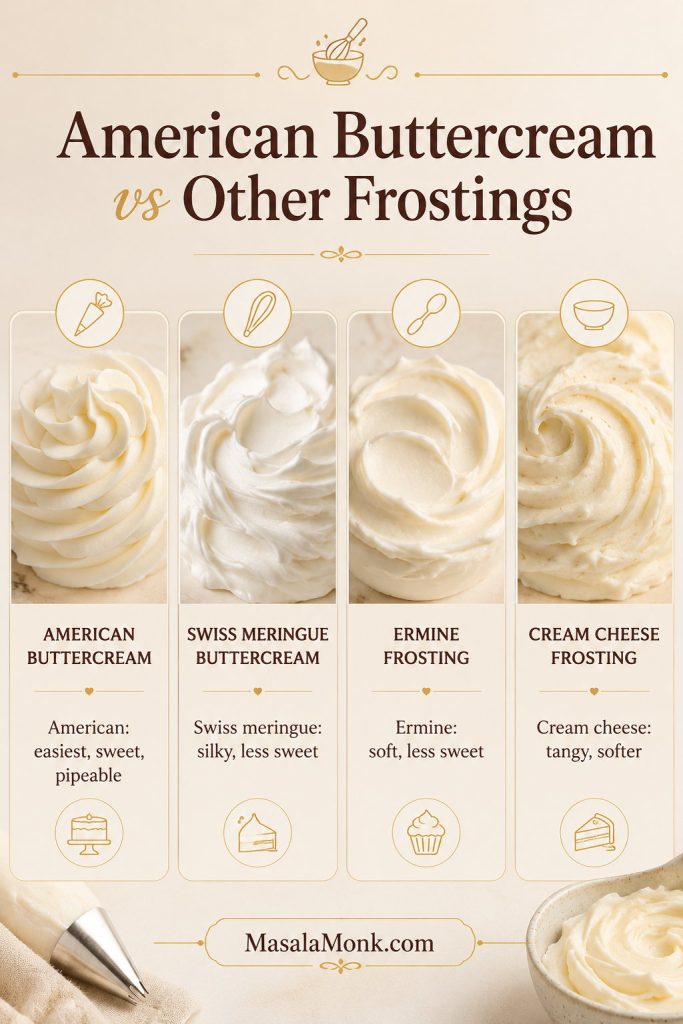
How American buttercream compares to other frostings
Use American buttercream when you need something fast, dependable, and easy to pipe. Choose another frosting family when the main goal is a silkier texture, lower sweetness, or tangy flavor.
| Frosting style | Best for | Sweetness | Difficulty |
|---|---|---|---|
| American buttercream | Quick cakes, cupcakes, piping, sheet cakes | High | Easy |
| Swiss meringue buttercream | Silky layer cakes, less-sweet finish | Medium | Medium |
| Ermine frosting | Soft, less-sweet cakes | Medium-low | Medium |
| Cream cheese frosting | Carrot cake, red velvet, spice cake | Medium | Easy |
Start here when you need something fast and dependable. Choose Swiss meringue buttercream or ermine frosting when you want a silkier, less-sweet finish and do not mind a more involved method.
Before You Start: 4 Things That Matter
Buttercream is forgiving, but a few small choices make the whole process easier.
- Use cool-soft butter, not greasy butter. The butter should press easily with a finger but still hold its shape.
- Add powdered sugar gradually. This keeps the frosting smoother and stops sugar from flying around the bowl.
- Sift only if the sugar is lumpy. Fresh powdered sugar usually mixes in fine, but clumpy icing sugar can leave tiny dry pockets.
- Do not add all the liquid at once. Start with less milk or cream, then add more only after the frosting has come together.
A calm buttercream is usually a better buttercream: slow sugar, small liquid additions, and short chill breaks beat panic-fixing almost every time.
Buttercream Frosting Ingredients
The ingredient list is short, so the recipe has nowhere to hide: butter texture, sugar texture, and liquid control do most of the work.
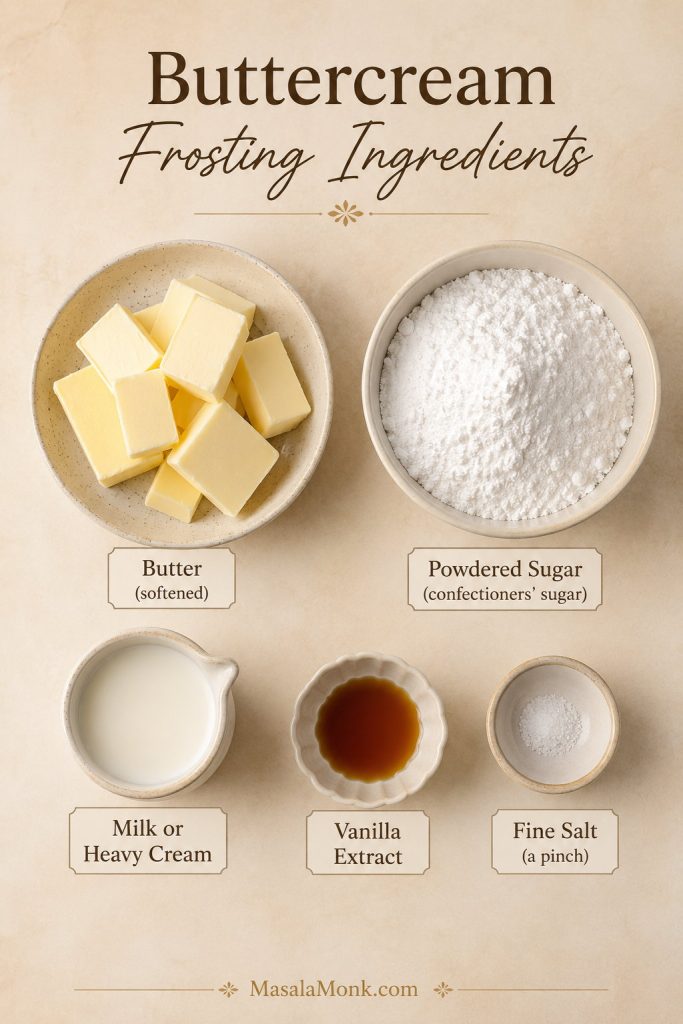
Butter
Use unsalted butter if possible. It gives you better control over the final flavor because you can add salt separately. Salted butter can still work, but different brands vary in saltiness, so reduce or skip the added salt if your butter already tastes salty.
The butter should be softened, not melted. It should press easily when touched, but it should not look shiny, oily, or greasy. Cold butter can leave lumps; overly warm butter can make the frosting loose, greasy, or weak for piping.
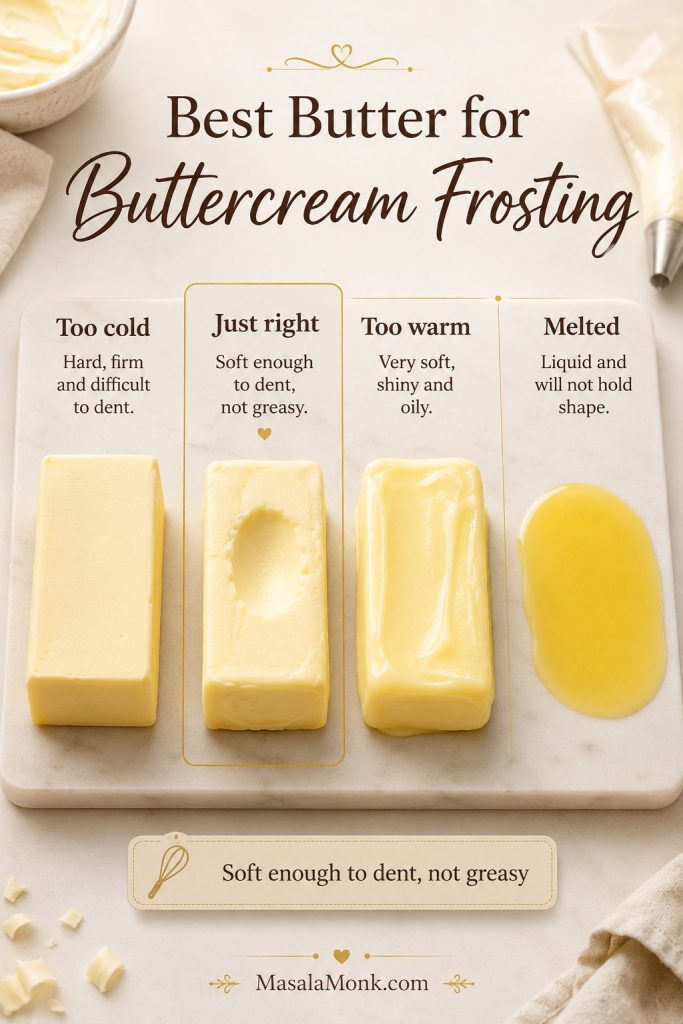
If you are not sure whether your butter has gone too far, use the butter-temperature guide before mixing the batch.
Powdered Sugar / Icing Sugar
Use powdered sugar, confectioners’ sugar, or icing sugar. It gives American buttercream its sweetness and structure. If it looks lumpy, sift it before adding it to the butter.
For the most consistent texture, weigh the powdered sugar if you can. Cups are fine for everyday baking, but packed or very fluffy cups can change how stiff the frosting feels.
Do not use granulated sugar in this recipe. It will not dissolve the same way and can leave the frosting gritty. Frosting without powdered sugar is a different style and needs a different method.
Milk or Heavy Cream
Both milk and heavy cream work. Heavy cream makes the frosting a little richer and fuller. Milk keeps it lighter and is easier if you do not keep cream at home.
Start with 3 tablespoons, then add more only if needed. The mixture loosens quickly, so it is better to add liquid slowly at the end than to pour in too much at the beginning.
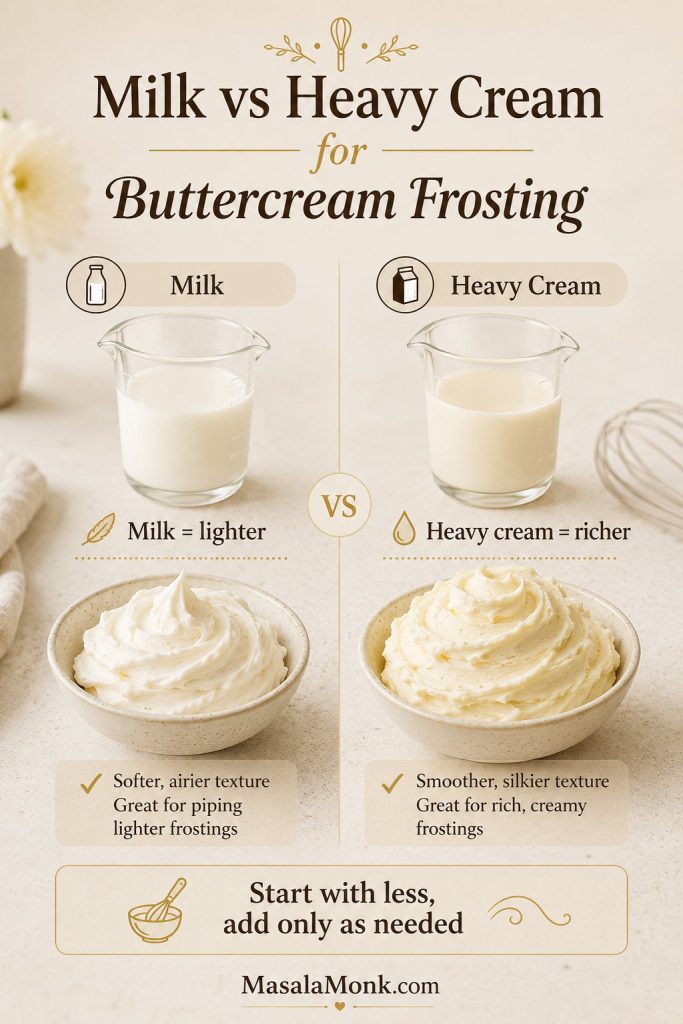
For spreadable, pipeable, and stiffer uses, use the texture guide before adding more liquid.
Vanilla
Vanilla gives this frosting its classic flavor. Use a good vanilla extract if you can because vanilla is one of the main flavors in a plain buttercream. Vanilla bean paste can also work if you like visible vanilla specks.
If you want a very white frosting, use clear vanilla. Regular vanilla extract often tastes better, but it can add a slightly beige tint.
Salt
Do not skip the salt. A small amount balances the sweetness and makes the butter and vanilla taste more rounded. Without salt, American buttercream can taste flat and sugary.
Equipment You Need
You do not need fancy tools, but the right mixer attachment can make the frosting smoother and less bubbly. A stand mixer with a paddle attachment is easiest, especially for a larger batch. A hand mixer works well for one batch, but you will need to scrape the bowl more often.
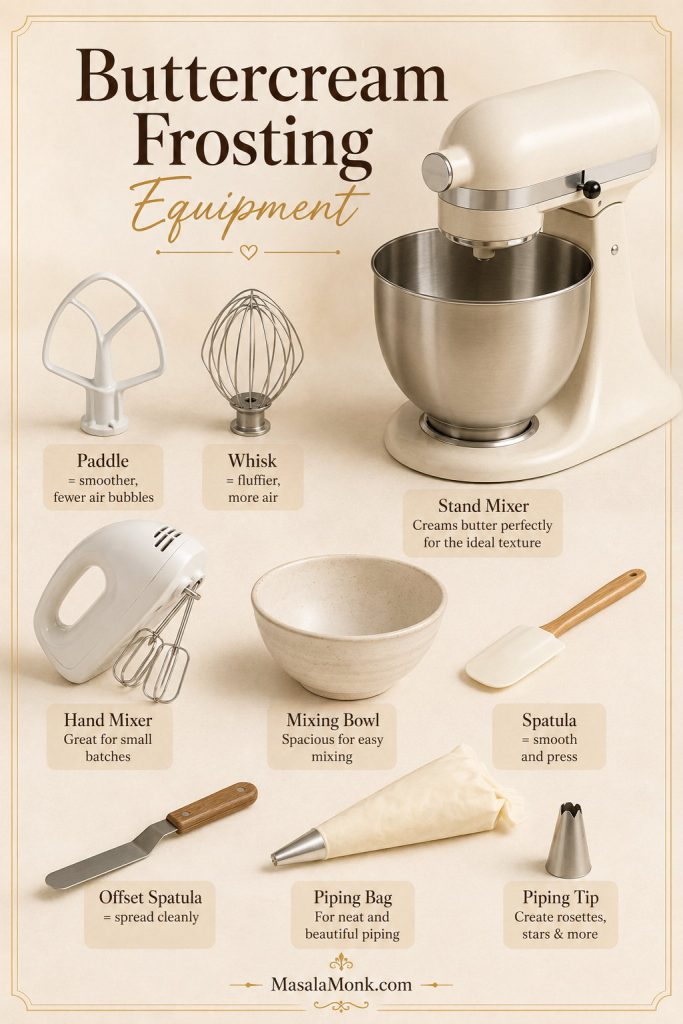
| Tool | Best use |
|---|---|
| Stand mixer with paddle attachment | Best for smooth, fluffy frosting with fewer air bubbles. |
| Hand mixer | Works well for a single batch; scrape the bowl often. |
| Large mixing bowl | Prevents powdered sugar from flying everywhere. |
| Rubber spatula | Useful for scraping the bowl and pressing out air bubbles. |
| Piping bag and star tip | Optional, but helpful for cupcake swirls, rosettes, and borders. |
| Offset spatula | Helpful for spreading frosting over cakes and sheet cakes. |
The Butter Temperature That Makes or Breaks Buttercream
If your frosting has ever turned greasy, lumpy, or strangely loose, the butter was probably the reason. “Room temperature” is not always clear because kitchens vary. In a warm kitchen, butter can move from perfectly soft to too greasy faster than expected.
If you like numbers, aim for about 65–67°F / 18–19°C: cool to the touch, easy to dent, but not shiny or greasy. If you remember only one thing from this section, remember this: soft butter is good, greasy butter is not. Buttercream needs butter that bends, not butter that melts.
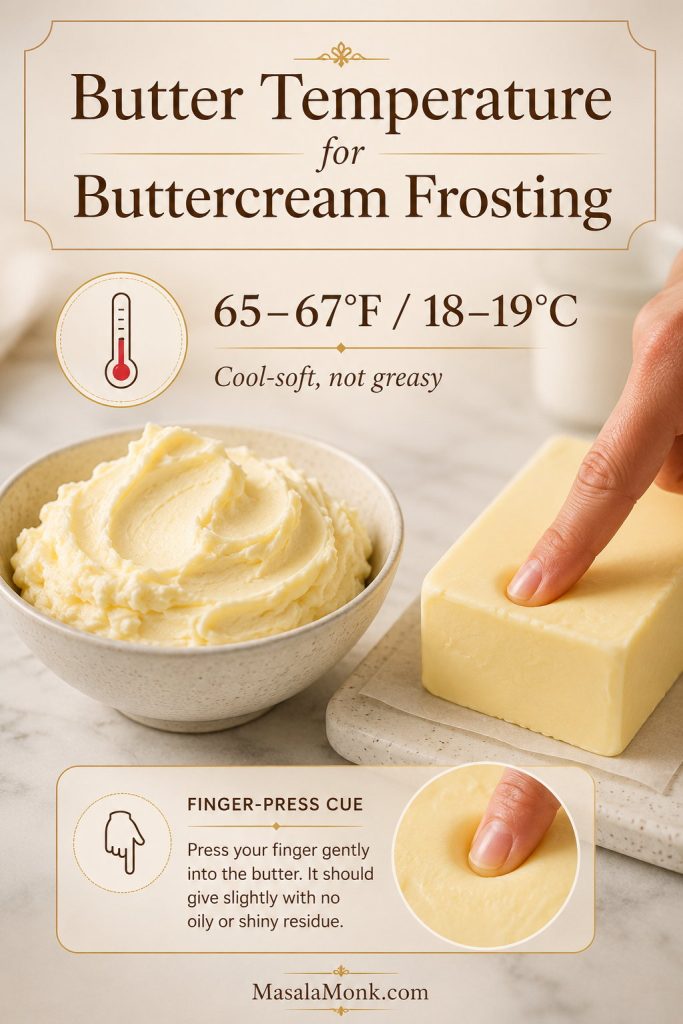
The butter should be soft enough to press with a finger, but not shiny, oily, or melted. It should still hold its shape. If it slumps, looks greasy, or has oily edges, it is too warm.
| Butter state | What happens | What to do |
|---|---|---|
| Too cold | Frosting can turn lumpy, hard to mix, or grainier. | Let the butter sit longer, or cut it into small cubes to soften faster. |
| Just right | Butter blends smoothly and holds enough structure for piping. | Use it now. |
| Too warm | The frosting can become greasy, loose, or weak. | Cool the butter briefly until it is soft-solid again. |
| Melted | The frosting will not hold properly. | Do not use melted butter. Chill until it becomes soft-solid again. |
In a warm kitchen, keep an eye on the bowl as you mix. Even a good batch can soften if the mixer, bowl, or your hands warm it too much. When that happens, pause and let the frosting cool before continuing.
How to Make Buttercream Frosting
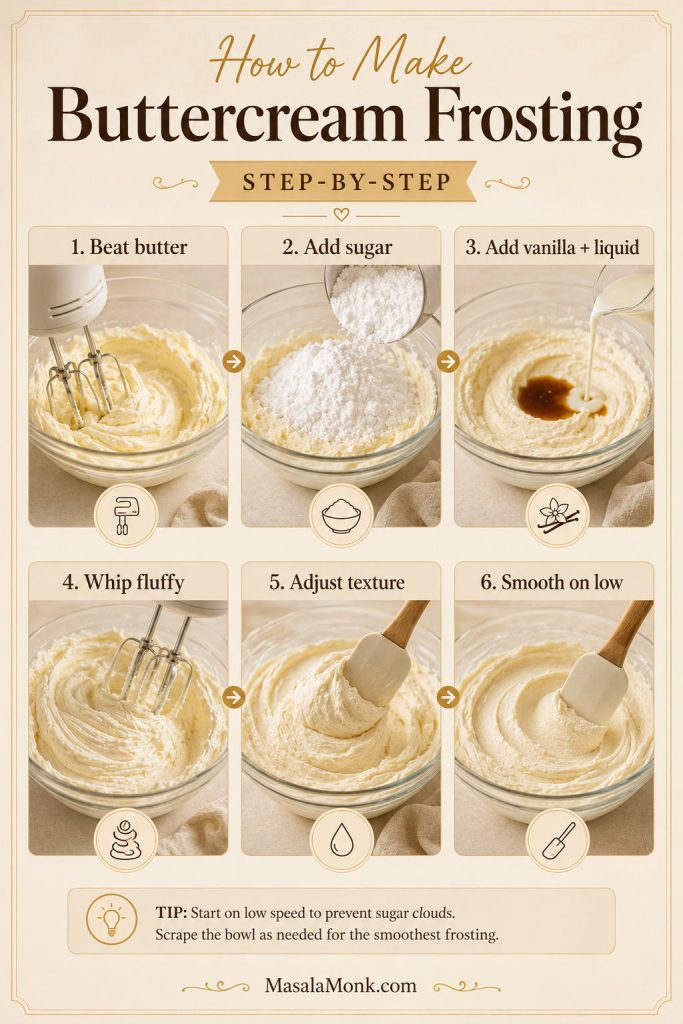
This is the point where buttercream gets easier: once the butter is right, the rest is mostly small adjustments. The method is simple, but the order matters: cream the butter first, add sugar slowly, whip only once the mixture is combined, then smooth it down at the end.
Step 1: Beat the Butter
Add the softened butter to a large mixing bowl. Beat for 2–3 minutes until it looks creamy, smooth, and slightly paler. This first step removes lumps and creates a better base.
Step 2: Add Powdered Sugar Gradually
Add the powdered sugar in 3–4 additions, mixing on low speed after each addition. Do not dump it all in at once. Gradual mixing keeps the texture smoother and prevents powdered sugar from flying out of the bowl.
Step 3: Add Vanilla, Salt, and Liquid
Add vanilla, salt, and 3 tablespoons of milk or cream. Mix on low until everything comes together. It may look thick at first; that is normal. Wait until the sugar is fully mixed in before deciding whether it needs more liquid.
Step 4: Whip Until Fluffy
Increase to medium speed and beat for about 2 minutes, or until the frosting looks lighter, creamier, and softer around the edges of the bowl. Scrape the sides and bottom so no butter or sugar pockets are left behind.
Step 5: Adjust the Texture
If the frosting is too thick, add milk or cream a little at a time. If it is too loose, add powdered sugar in small additions. Make one correction, mix, then check the bowl again before adding more. For use-by-use consistency, see the texture guide.
Step 6: Smooth on Low Speed
Mix on low speed for 1–2 minutes at the end. This helps knock out some air bubbles and gives the frosting a smoother finish. For an even cleaner texture, press and fold it with a rubber spatula before spreading or piping. If the bowl still looks wrong, jump to troubleshooting.
Why This Buttercream Frosting Works
The formula works because nothing is there by accident. Butter gives the frosting richness and body. Powdered sugar thickens it, sweetens it, and helps it hold shape for spreading or piping. Milk or cream loosens the texture just enough to make it workable. Vanilla gives the familiar bakery-style flavor, while salt keeps the sweetness from tasting flat.
Once you understand those jobs, the recipe stops feeling fragile. You can look at the bowl and know whether it needs more structure, more softness, or just a few minutes to cool down.
Buttercream Texture Guide: Spreadable, Pipeable, and Stiff
This is where buttercream becomes less mysterious: the same bowl can be adjusted for spreading, piping, or sharper decorating. The trick is not to keep fixing everything at once, but to match the texture to the job in front of you.
One batch can be made softer for spreading, medium for cupcake swirls, or stiffer for borders and simple decorations. Use this table as a control panel rather than a strict rulebook.
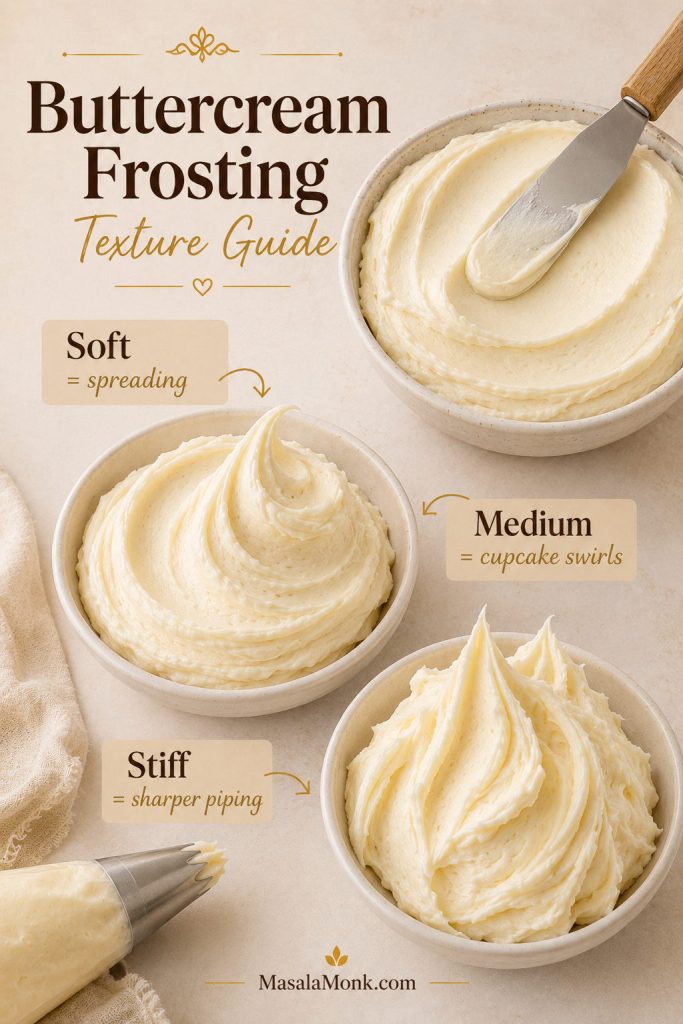
| Texture | Best for | How to adjust |
|---|---|---|
| Soft and spreadable | Sheet cakes, simple layer cakes, crumb coats | Add milk or cream in tiny amounts. |
| Medium and pipeable | Cupcake swirls, rosettes, borders | Use the recipe as written, then test with a spatula. |
| Stiff | Flowers, sharper borders, more defined piping | Add powdered sugar in small additions. |
| Extra smooth | Cake sides, clean spreading, polished finish | Mix on low with the paddle, then press with a spatula. |
Use the spatula test before piping
A quick lift from the bowl shows whether the frosting is loose, pipeable, or too stiff before it goes into a piping bag.
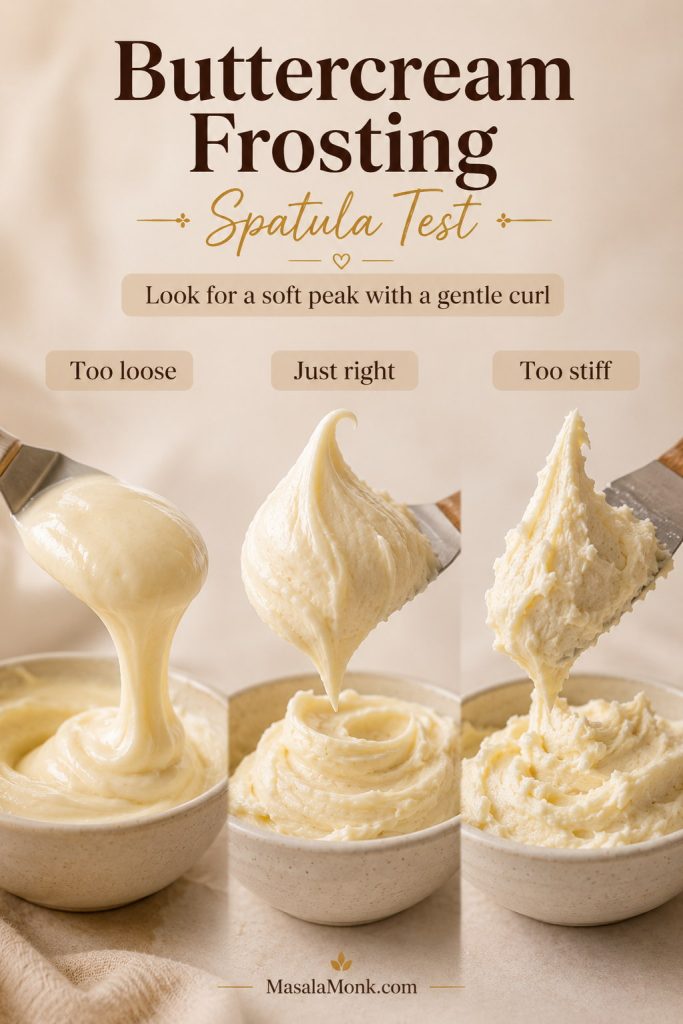
For cake decorating, do not thin the whole bowl immediately. Set aside a portion and adjust only what you need. A softer texture spreads more easily over a cake, while a slightly stiffer one gives cleaner piping. For exact cake and cupcake amounts, use the quantity guide.
Once you move into borders, rosettes, writing, and thin cake coverage, consistency matters more than the base recipe itself. Wilton’s buttercream frosting guide is useful here because it shows how stiff, medium, and thin frosting behave differently.
How Much Buttercream Frosting Do You Need?
A single batch gives you about 2.5–3 cups, which is plenty for cupcakes or a simple sheet cake but not always enough for a fully decorated layer cake.
Frosting amounts are not a test of precision. They are a planning tool, and it is almost always safer to have a little extra. Tall cupcake swirls, thick cake filling, and decorative borders all use more frosting than a simple spread layer.
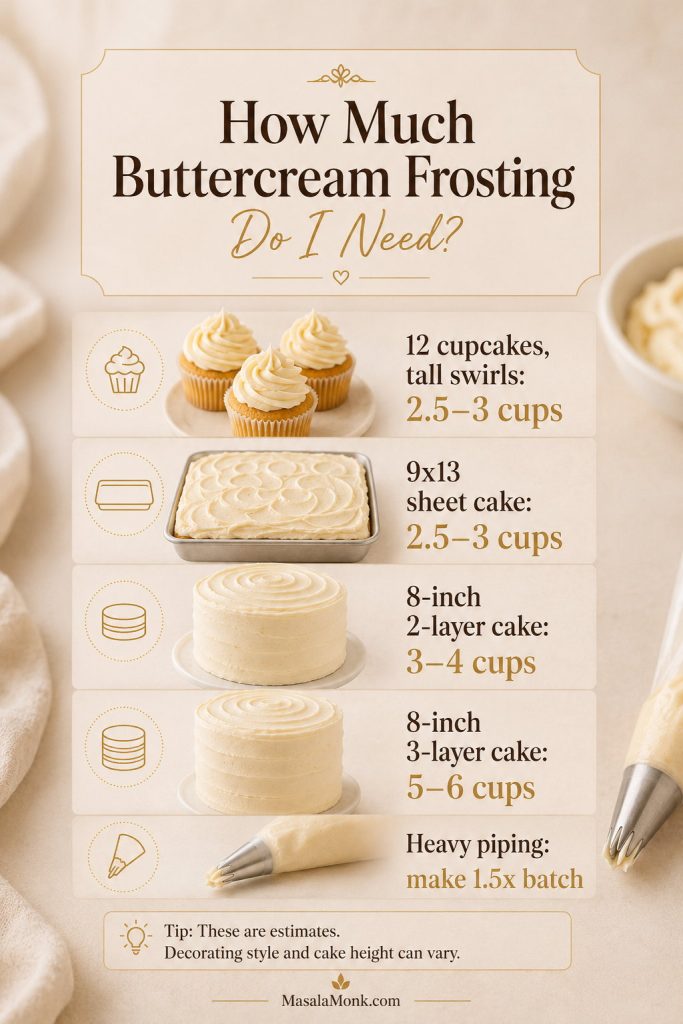
| Use | Approximate buttercream needed |
|---|---|
| 12 cupcakes, spread or low swirl | 1.5–2 cups |
| 12 cupcakes, tall swirls | 2.5–3 cups |
| 18 cupcakes, spread generously | About 3 cups |
| 24 cupcakes, modest swirl | 3–4 cups |
| 9×13 sheet cake, top only | 2.5–3 cups |
| 8-inch 2-layer cake, light filling and outside | 3–4 cups |
| 8-inch 2-layer cake with piping | 4–5 cups |
| 8-inch 3-layer cake | 5–6 cups |
| Heavy piping or decorating | Make 1.5x batch |
How to Scale This Buttercream Recipe
Scaling is where a lot of frosting stress happens. It is better to make a slightly larger batch than to scrape the bowl halfway through a cake. Half a cup extra feels much better than frosting the final side too thin.
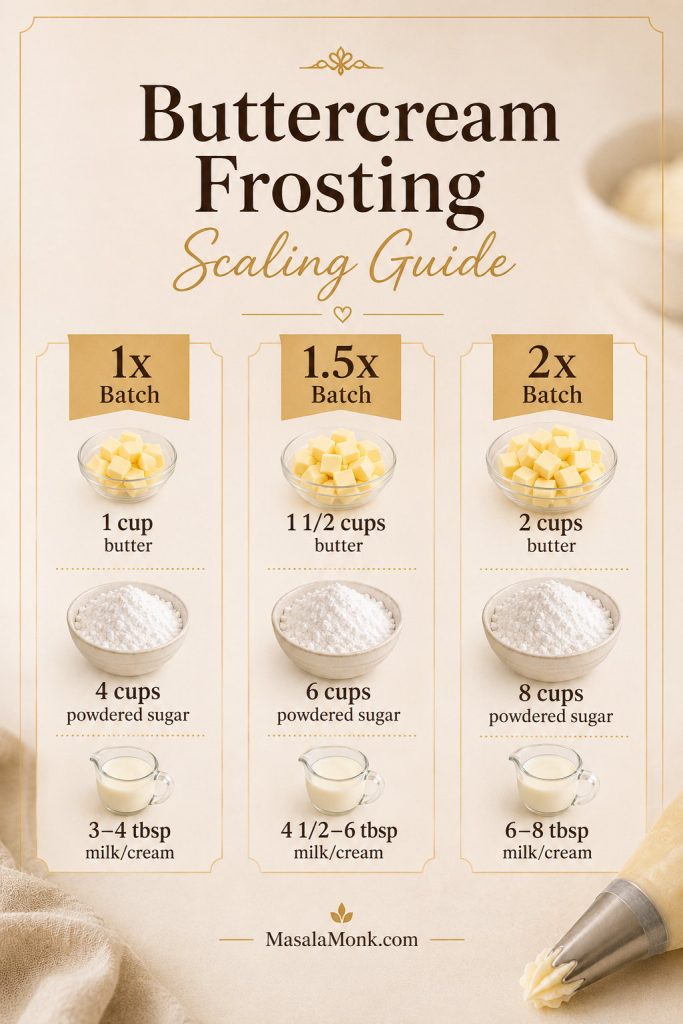
| Batch size | Butter | Powdered sugar | Milk or cream | Best for |
|---|---|---|---|---|
| 1x batch | 1 cup / 2 sticks / 226g | 4 cups / 480g / about 1 lb | 3–4 tbsp / 45–60ml | 12 cupcakes with tall swirls or one 9×13 top layer |
| 1.5x batch | 1 1/2 cups / 3 sticks / 339g | 6 cups / 720g / about 1.5 lb | 4 1/2–6 tbsp / 67–90ml | Layer cake with some piping |
| 2x batch | 2 cups / 4 sticks / 452g | 8 cups / 960g / about 2 lb | 6–8 tbsp / 90–120ml | Tall cakes, extra piping, or make-ahead frosting |
If you are unsure, make a little extra. Running out halfway through a cake is more frustrating than having leftover frosting to freeze. Extra buttercream can also be used on cookies, brownies, cinnamon rolls, cupcakes, or a small snack cake.
Using Buttercream Frosting for Cakes and Cupcakes
Cakes and cupcakes do not all need the same buttercream texture. A cupcake swirl needs lift, a sheet cake needs glide, and a layer cake needs enough structure to hold filling, crumb coat, and final coat.
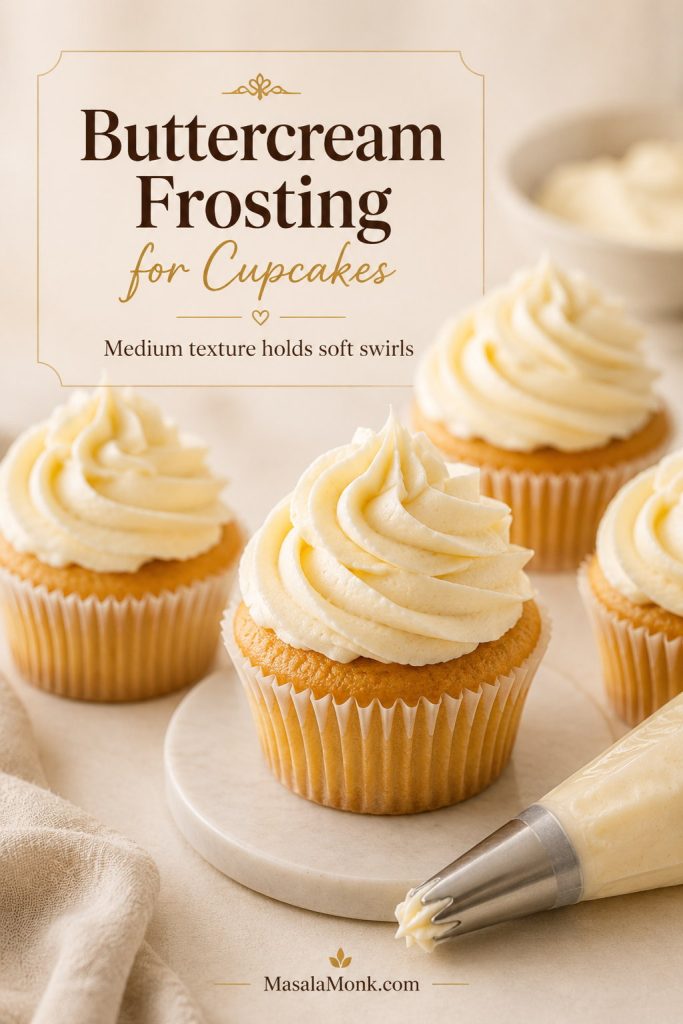
Buttercream for cupcakes
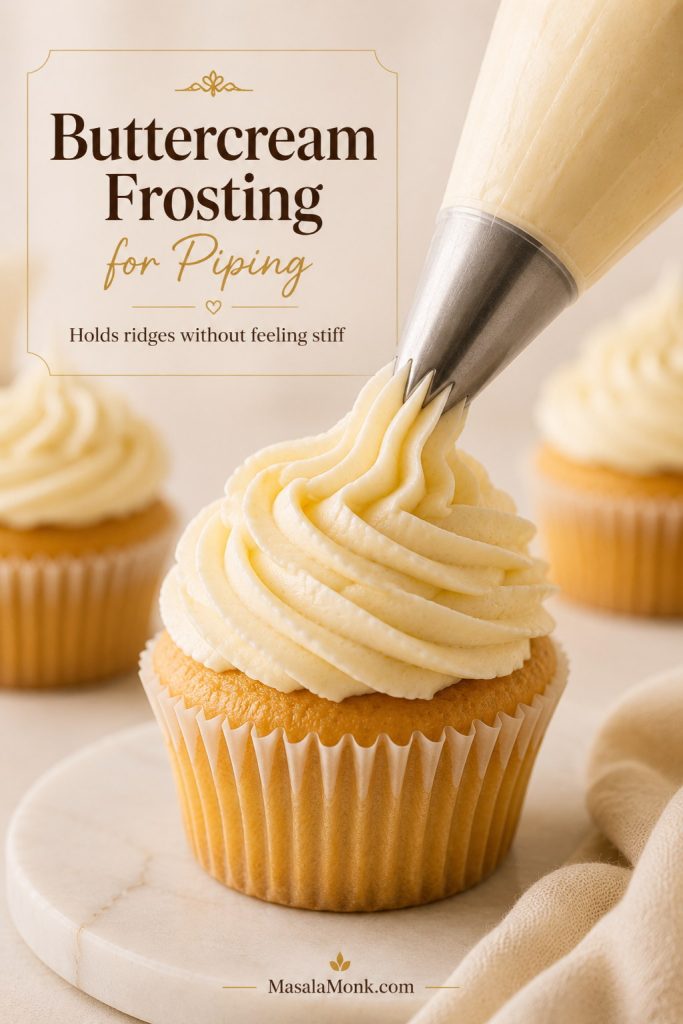
For cupcakes, the goal is a medium buttercream that holds ridges but still looks soft and creamy. If the swirl breaks at the edges, the frosting is probably too stiff. If the ridges melt into each other, it is probably too soft.
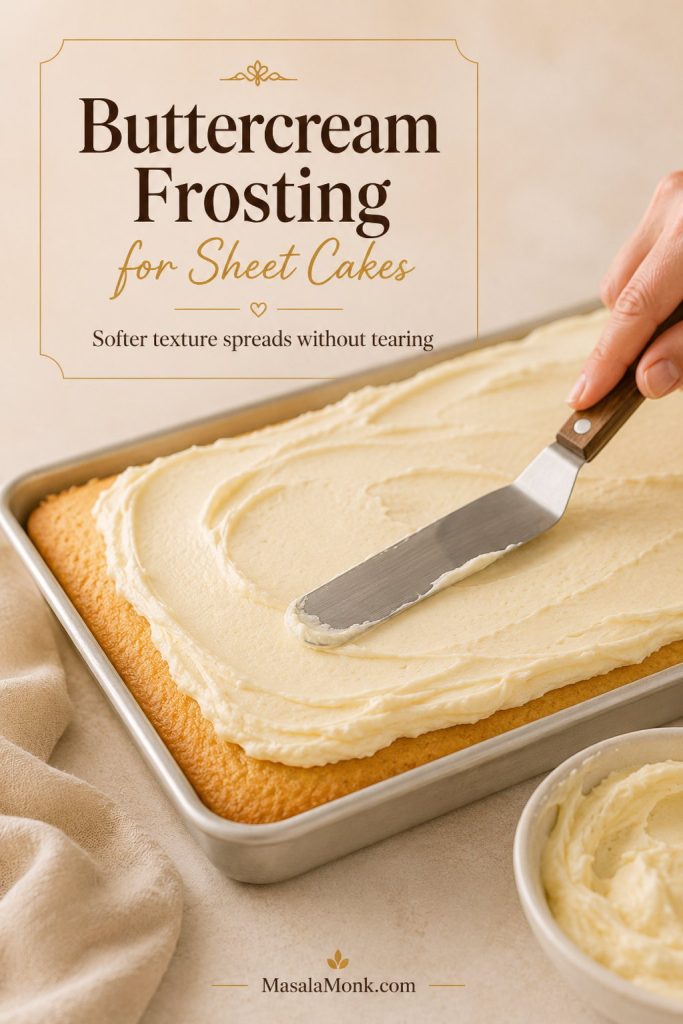
Buttercream for sheet cakes
For sheet cakes, use a slightly softer texture so the frosting glides instead of dragging crumbs across the top. If the cake is tender, stiff frosting can tear the surface before it spreads.
Buttercream for layer cakes
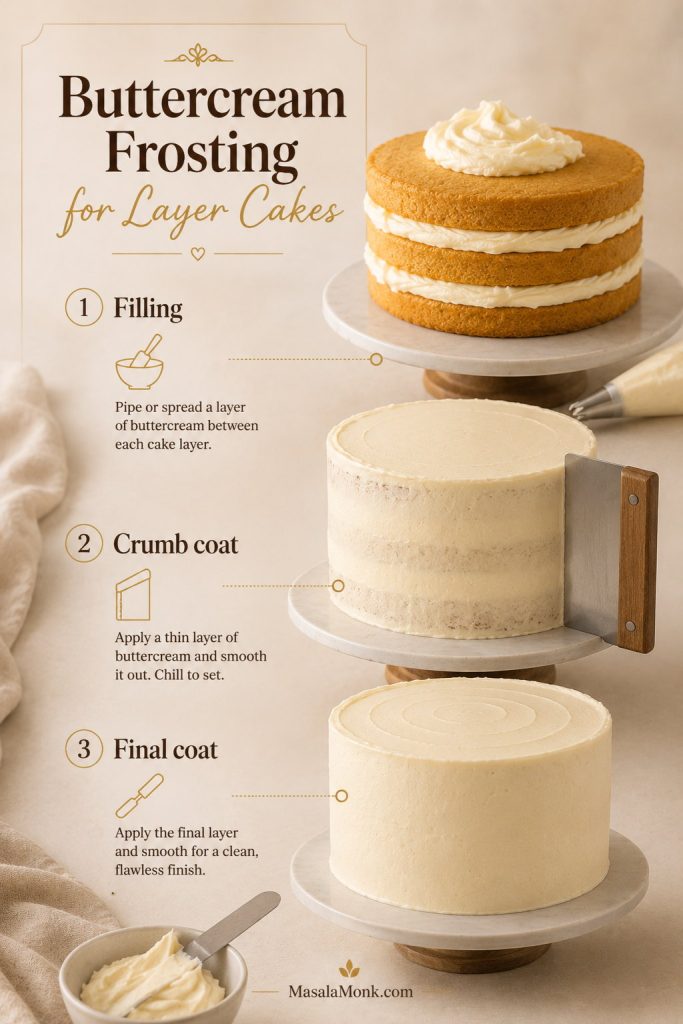
For layer cakes, think in stages: medium frosting for filling, slightly softer frosting for the crumb coat, and medium-smooth frosting for the final coat. A short chill after the crumb coat helps trap loose crumbs and makes the final layer easier to spread.
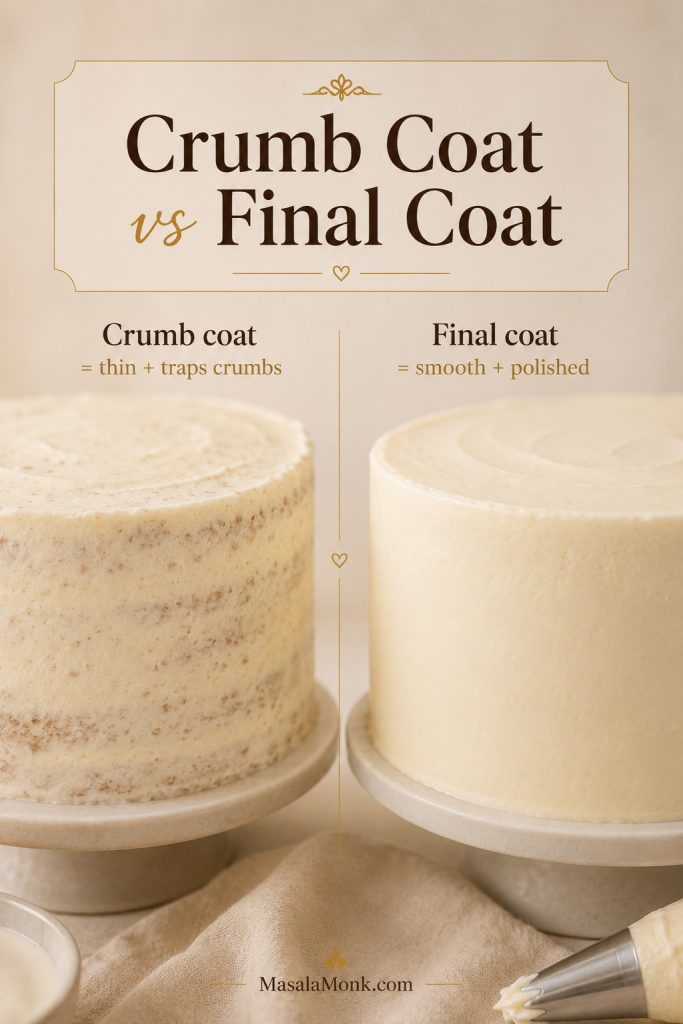
Crumb coat vs final coat
The crumb coat is not meant to be pretty. It is a thin working layer that traps crumbs, so the final coat can look cleaner and smoother.
For a fruit-forward cake direction, MasalaMonk’s mango cake guide is useful because mango buttercream shows how fruit puree changes frosting flavor and texture. If you are decorating with swirls or borders, go to the piping section before filling the bag.
The table below is not meant to make frosting feel fussy. It simply helps you choose the texture that matches the job in front of you.
| Use | Best texture | Tip |
|---|---|---|
| Cupcake swirls | Medium / pipeable | The frosting should hold a soft peak without collapsing. |
| Sheet cake | Soft / spreadable | Add liquid slowly so it spreads without tearing the cake. |
| Layer cake filling | Medium | Do not overfill or the layers may slide. |
| Crumb coat | Slightly soft | A softer texture spreads thinly and traps crumbs more easily. |
| Final cake coat | Medium-smooth | Mix on low and press with a spatula to reduce air bubbles. |
Buttercream Frosting for Piping and Decorating
Good piping texture sits in the middle: firm enough to hold shape, but soft enough that you are not fighting the bag. If the frosting breaks at the edges of the swirl, it is usually too stiff. If the ridges melt into each other, it is usually too soft.
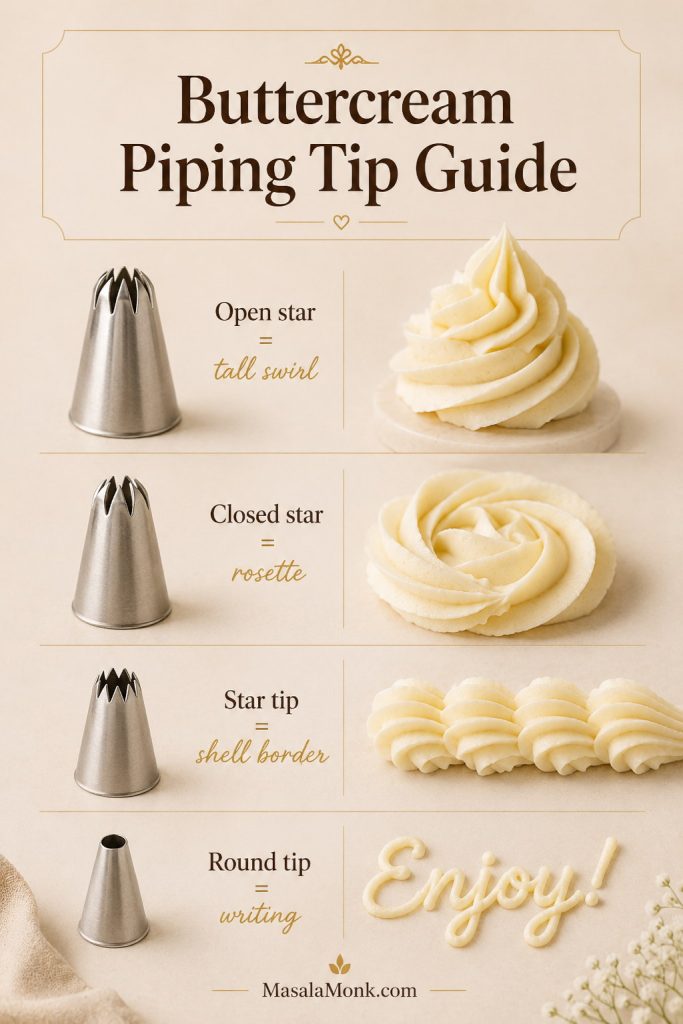
Which piping tip should you use?
The same buttercream can look very different depending on the tip. Use the table and image together to choose a shape before you fill the bag.
| Look | Piping tip | Best consistency |
|---|---|---|
| Tall cupcake swirl | Open star | Medium |
| Rosettes | Closed star | Medium |
| Shell border | Star tip | Medium-stiff |
| Writing | Small round tip | Slightly softer |
For smoother piping, mix on low speed before filling the bag. Air bubbles can cause broken lines, uneven swirls, or small holes in piped frosting. Pressing the batch with a spatula before filling the bag also helps.
How to Make Buttercream Less Sweet
American buttercream is naturally sweet because powdered sugar is not just there for flavor; it gives the frosting body and helps it hold shape. You can make it taste more balanced, but you cannot remove most of the sugar and expect the same structure.
That said, a few small choices make a big difference:
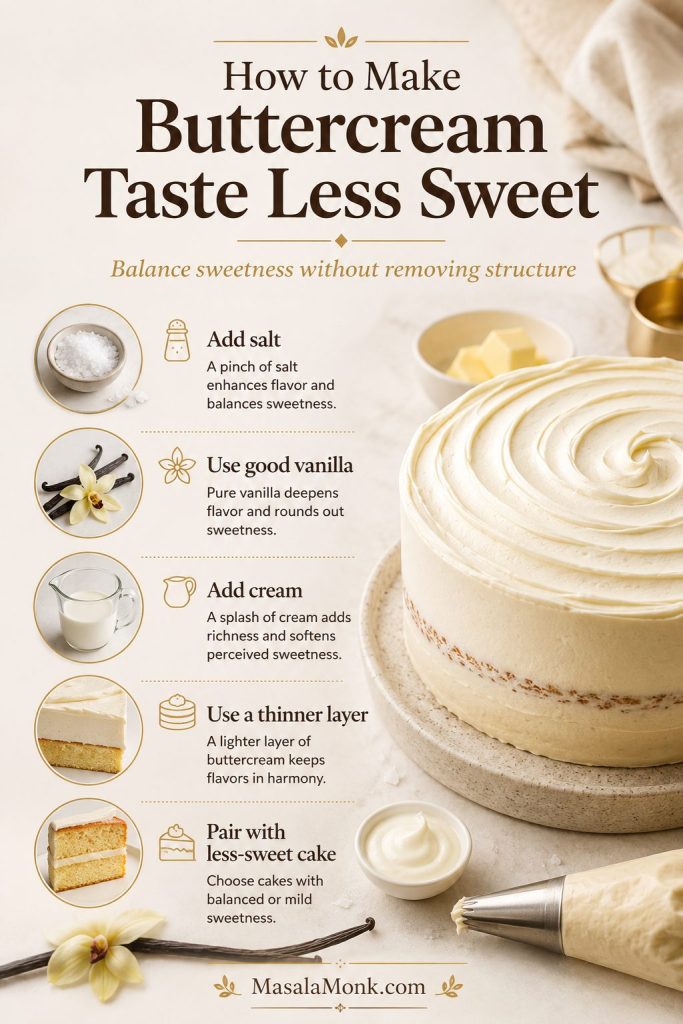
- Add salt. Even 1/4 teaspoon helps reduce the flat sugary taste.
- Use good vanilla. Better vanilla makes the flavor fuller.
- Use cream instead of only milk. Cream gives a rounder, richer finish.
- Whip the butter properly. A fluffy texture tastes lighter than a dense one.
- Use a thinner layer. A sweet cake plus thick sweet frosting can feel heavy.
- Pair it with less-sweet cake. Dark chocolate, coffee, citrus, spice, or lightly sweet cakes balance buttercream well.
If you know you dislike sweet buttercream, it may be kinder to choose a different frosting instead of fighting this one. RecipeTin Eats has a less-sweet fluffy vanilla frosting that shows why some bakers move away from American buttercream when they want a softer, less sugary finish.
Buttercream Frosting Troubleshooting
A bad-looking bowl is not always a failed bowl. Most buttercream problems are texture problems, and texture can usually be brought back.
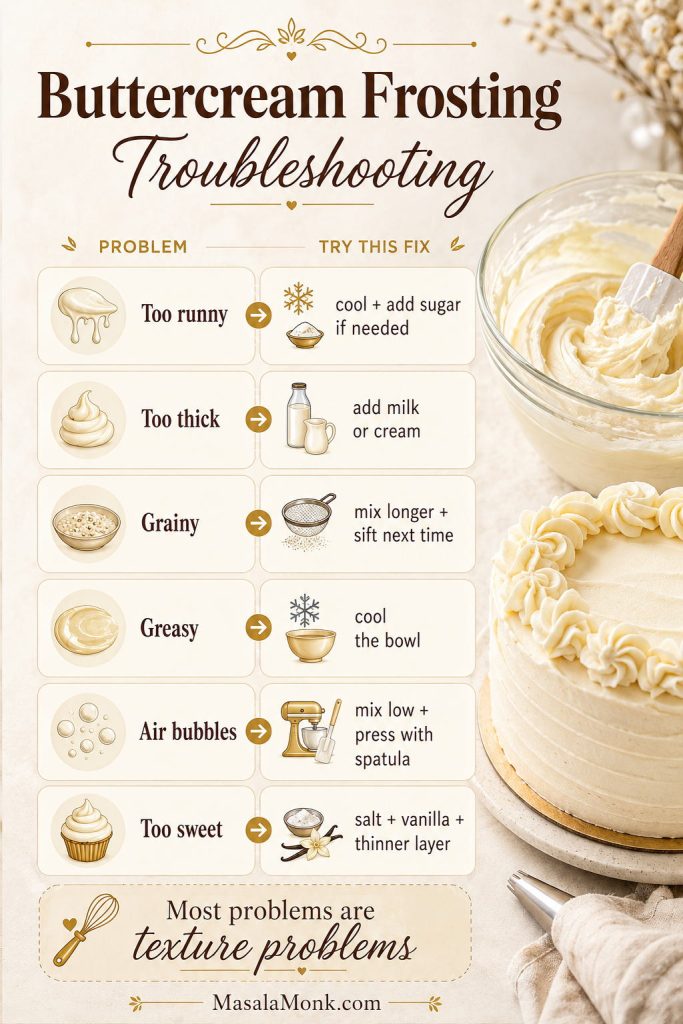
First, check the temperature
Before adding more sugar or liquid, check whether the frosting is simply too warm or too cold. Warm buttercream can look loose, greasy, or weak. Cold buttercream can look stiff, heavy, or slightly rough. If you are unsure, let the bowl sit for a few minutes, then mix again before making a bigger correction. If you are reviving a chilled batch, use the storage and make-ahead section instead.
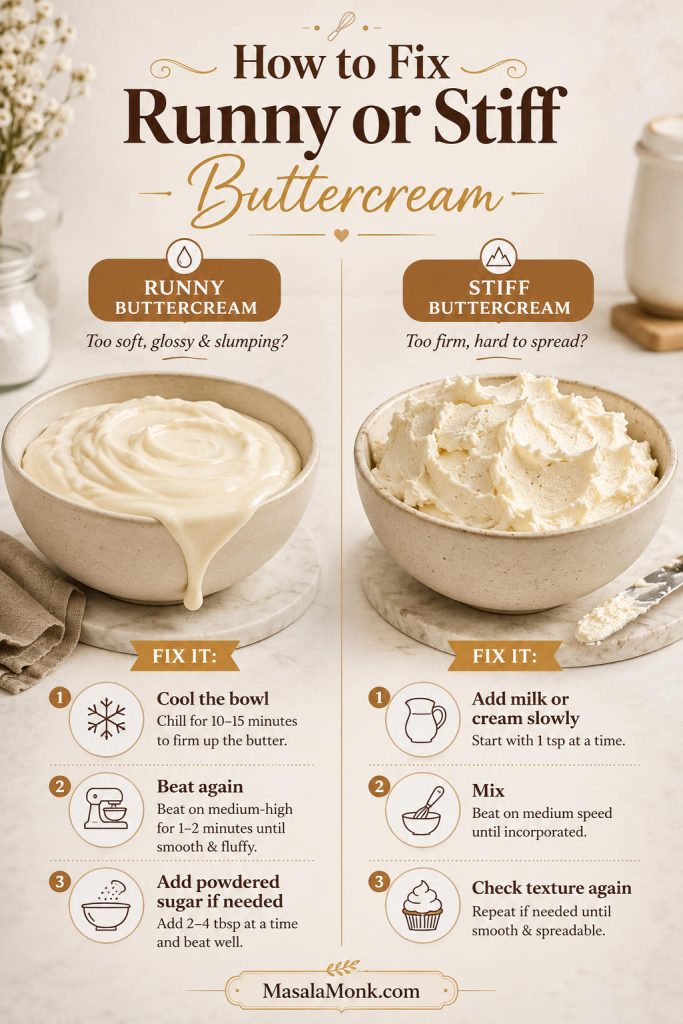
How to fix runny or stiff buttercream
Runny and stiff buttercream are the two most common texture problems, but they need opposite fixes. Check temperature first, then adjust the bowl in small steps.
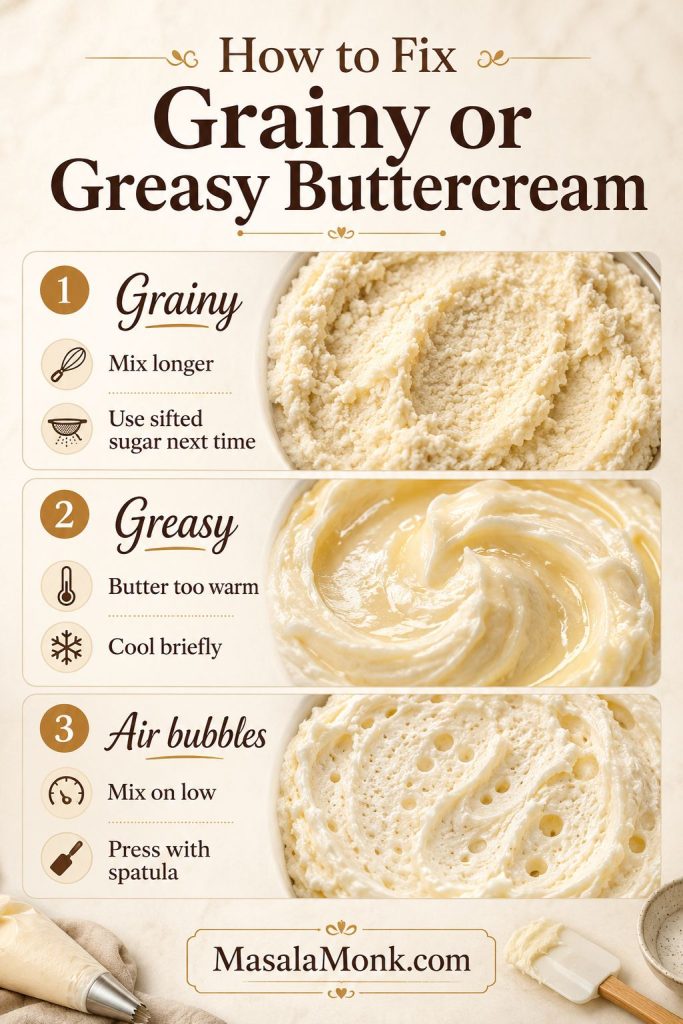
How to fix grainy, greasy, or bubbly buttercream
Grainy, greasy, and bubbly frosting can look dramatic, but they are usually signs of mixing, temperature, or air — not a ruined batch.
Common buttercream problems and fixes
Start with the symptom you see in the bowl, then make one small correction at a time. Big fixes often create a second problem.
| Problem | Why it happens | How to fix it |
|---|---|---|
| Too runny | Butter is too warm, or too much liquid was added. | Cool the bowl briefly and mix again. If needed, add powdered sugar in small additions. |
| Too thick | Too much powdered sugar or not enough liquid. | Loosen with milk or cream, adding only a little at a time. |
| Grainy | Lumpy sugar, cold liquid, or not enough mixing. | Sift powdered sugar next time. For this batch, mix longer on low and add a small splash of room-temperature milk. |
| Greasy | Butter is too warm or the kitchen is hot. | Cool briefly, then mix again. Avoid adding more liquid. |
| Air bubbles | Too much high-speed mixing or whisk attachment use. | Mix on low with the paddle and press/fold with a rubber spatula. |
| Too sweet | American buttercream is powdered-sugar based. | Add salt, vanilla, or cream. Use a thinner layer, or choose a less-sweet frosting style. |
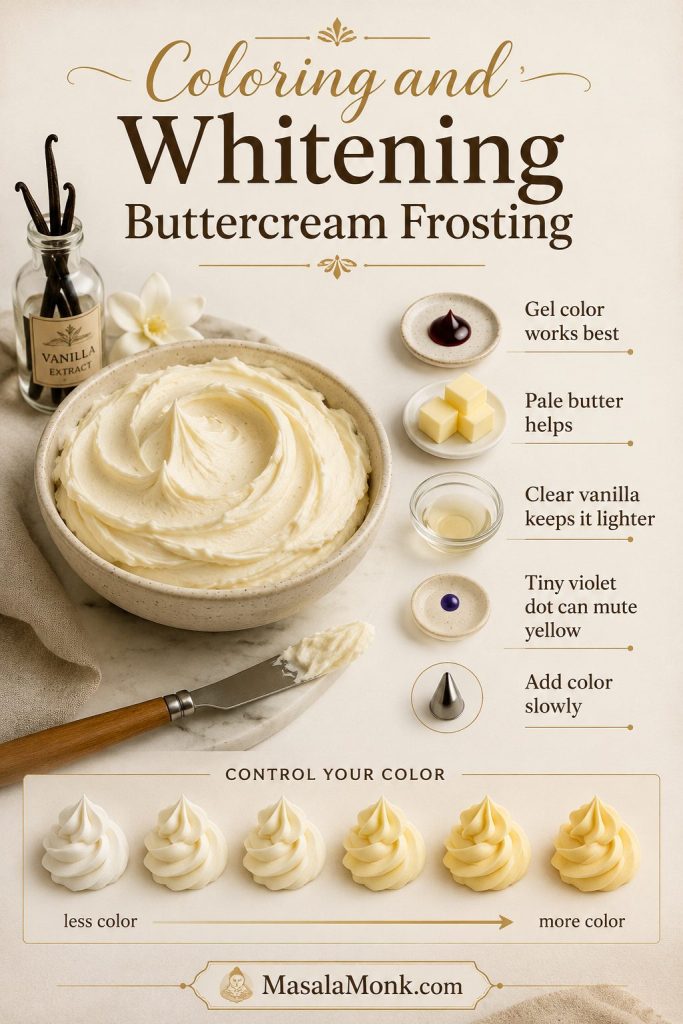
| Yellow color | Butter and vanilla both add color. | Use pale butter, clear vanilla, and whip longer. A tiny dot of violet gel can neutralize yellow, but add it cautiously. |
| Will not hold piping | Too soft, too warm, or over-thinned. | Add powdered sugar gradually, cool briefly, and avoid holding the piping bag too long. |
| Split or curdled | Temperature mismatch or ingredients too cold/warm. | Let it come to cool room temperature and mix again. If it is very cold, wait before mixing more. |
After fixing, smooth the frosting
If the frosting still tastes good, it is usually worth saving. Once the texture looks close, mix on low speed for 1–2 minutes and press it with a spatula to remove extra air bubbles. Texture problems often look worse than they are before the batch has been cooled, softened, or smoothed.
Coloring and whitening buttercream
Color is easiest to control once the texture is right. Use gel color for strong shades, and start with pale butter and clear vanilla when you want the cleanest white base.
Buttercream Frosting Variations
Once you know the base recipe, you can turn it into many flavors. Think of these as direction changes, not full new recipes. Once you add cocoa, fruit, cookies, or Nutella, the texture may need a little rebalancing.
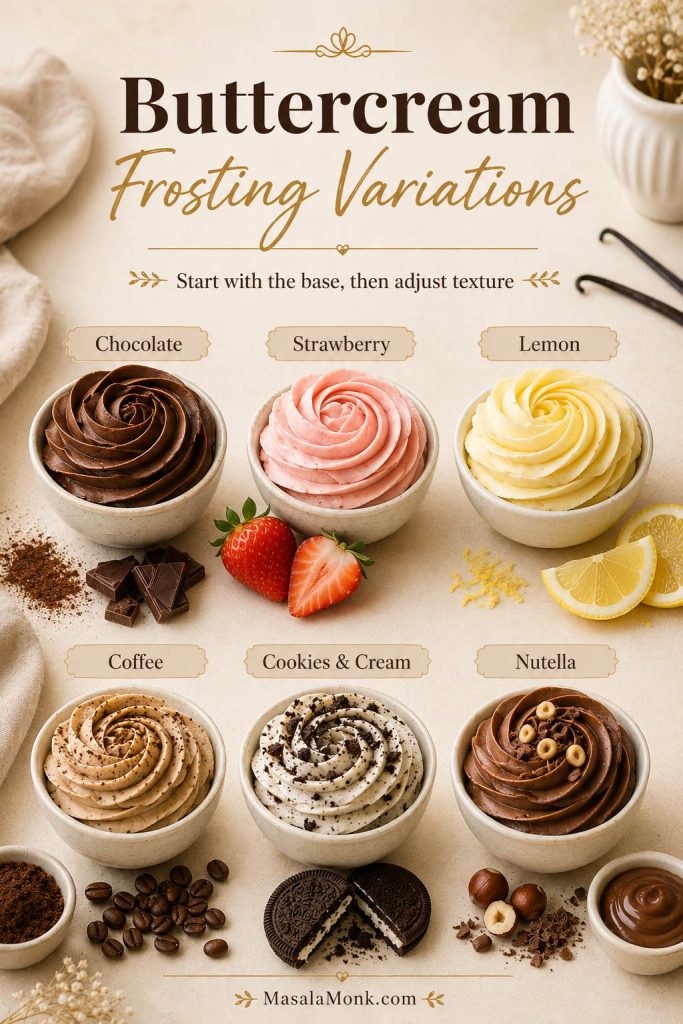
| Variation | What to add | Texture note |
|---|---|---|
| Chocolate | Start with 1/3–1/2 cup unsweetened cocoa powder | For a thicker chocolate frosting, add cocoa on top of the base. For a slightly less sweet version, replace part of the powdered sugar with cocoa. Either way, add cream as needed. |
| Strawberry | Freeze-dried strawberry powder or very thick reduced puree | Freeze-dried powder is best for piping. Reduced puree gives fruit flavor but can loosen the frosting if it is not thick enough. |
| Lemon | Lemon zest first, then a little lemon juice | Zest gives flavor without thinning; juice should be minimal and added slowly. |
| Coffee | Espresso powder dissolved in cream or milk | Dissolve espresso before adding it so the frosting tastes smooth instead of gritty. |
| Cookies & Cream | Very finely crushed dark sandwich cookies | Crush finely if piping so the tip does not clog. |
| Nutella | Nutella beaten into the butter | Adjust sugar and liquid because Nutella adds sweetness and fat. |
| Vegan | Firm vegan butter and dairy-free milk | Best treated as its own recipe because vegan butter behaves differently. |
| Swiss meringue | Egg whites, sugar, and butter | Silkier and less sweet, but more technical. |
If you want a dairy-free chocolate dessert to pair with a future vegan or chocolate frosting, MasalaMonk’s vegan chocolate cake recipes are a natural next stop.
How to Store, Freeze, and Make Buttercream Ahead
Buttercream can be made ahead, which makes it useful for birthdays, parties, cupcakes, and layered cakes. The important thing is to separate storage time from serving texture: cold buttercream is safe and sturdy, but it needs time before it feels creamy again.
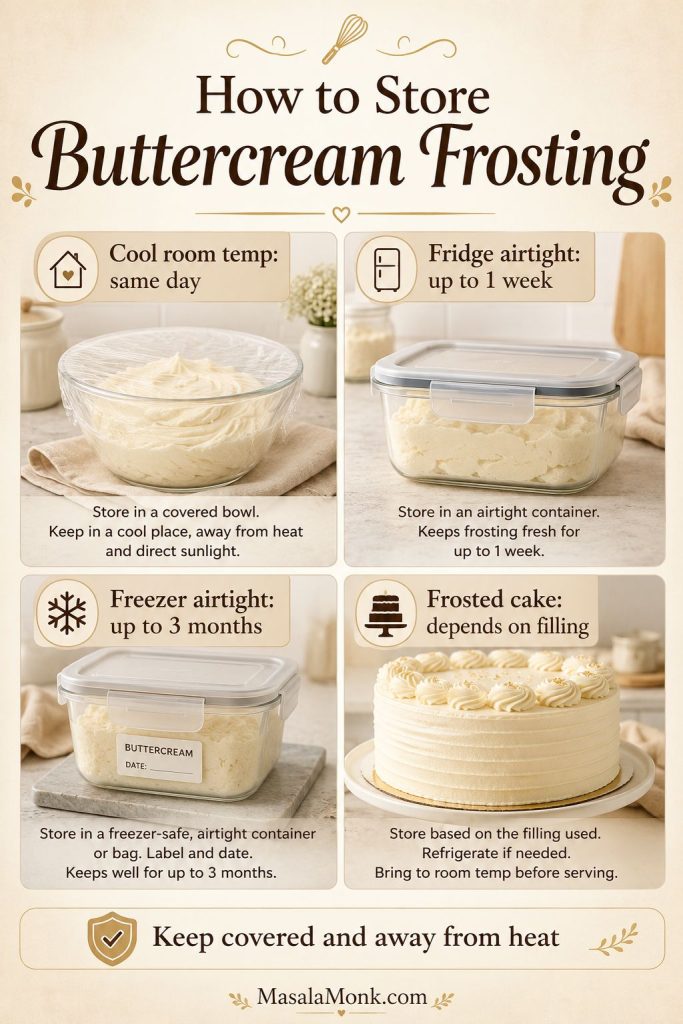
| Storage situation | How long | What to do before serving or using |
|---|---|---|
| Plain buttercream, covered at cool room temperature | Same day | Stir smooth if needed. In a warm kitchen, refrigerate instead. |
| Plain buttercream, refrigerated airtight | Up to 1 week | Bring to room temperature, then beat again until creamy. |
| Plain buttercream, frozen airtight | Up to 3 months | Thaw in the fridge, soften at room temperature, then beat smooth. |
| Frosted cake in a cool room | Same day | Keep covered and away from heat. Refrigerate if the filling is perishable. |
| Chilled frosted cake | Depends on the cake and filling | Let it sit briefly before serving so the buttercream softens again. |
How to revive make-ahead or frozen buttercream
For the easiest make-ahead plan, refrigerate the buttercream airtight, then let it soften before mixing. If it looks firm, rough, or slightly uneven straight from the fridge, wait before judging it; the texture usually comes back once it softens and gets mixed again.
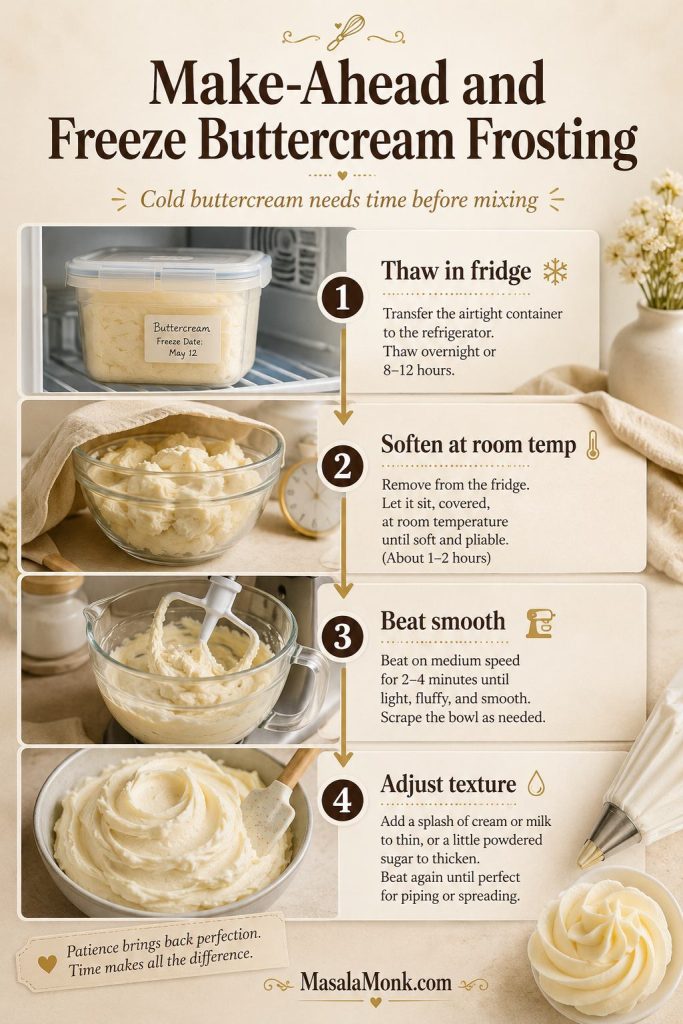
For the base batch and exact amounts, return to the recipe card.
Buttercream Frosting Recipe Card
Once you understand the butter temperature, the ratio, and the small fixes, this becomes the kind of frosting you can make without second-guessing every spoonful.
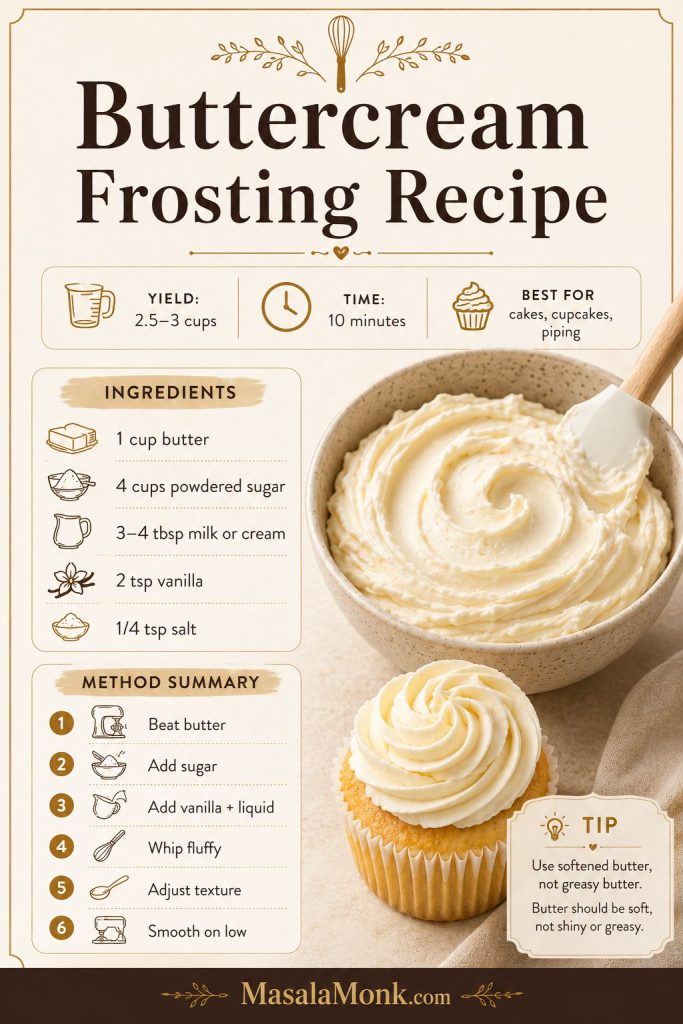
Buttercream Frosting Recipe
Easy American vanilla buttercream for cakes, cupcakes, piping, and decorating. This frosting is fluffy, stable, spreadable, and easy to adjust softer or stiffer.
Best for: 12 cupcakes with generous swirls, 18 cupcakes with a spread finish, or the top of one 9×13 sheet cake.
Method: Mixing / whipping
Category: Dessert, frosting
Cuisine: American
Ingredients
- 1 cup / 2 sticks / 226g / 8 oz unsalted butter, softened but not greasy
- 4 cups / 480g / about 1 lb powdered sugar, sifted if lumpy
- 3–4 tablespoons / 45–60ml / 1.5–2 fl oz heavy cream or milk
- 2 teaspoons / 10ml vanilla extract
- 1/4 teaspoon fine salt
Instructions
- Beat the softened butter for 2–3 minutes until creamy, smooth, and slightly paler.
- Add the powdered sugar in 3–4 additions, mixing on low speed after each addition.
- Add vanilla, salt, and 3 tablespoons milk or cream. Mix on low until combined.
- Beat for about 2 minutes on medium speed until fluffy and creamy.
- Adjust the texture. Add more milk or cream a little at a time to loosen, or powdered sugar in small additions to thicken.
- Mix on low speed for 1–2 minutes to smooth the frosting and reduce air bubbles.
- Use immediately, or store airtight and re-whip before using.
Notes
- Butter should be soft enough to press with a finger, but not oily or melted.
- If using a thermometer, aim for about 65–67°F / 18–19°C butter.
- Finished frosting should look pale and creamy, hold a soft peak, and spread smoothly without oily shine.
- Use heavy cream for richer frosting and milk for a lighter finish.
- For whiter frosting, use pale butter and clear vanilla.
- For less-sweet frosting, add salt and good vanilla, but do not remove too much powdered sugar or the frosting will lose structure.
- For stiffer decorating buttercream, add more powdered sugar gradually.
FAQs
These are the questions that usually come up once the frosting is mixed, the texture is close, and the cake is waiting.
What is the best butter for buttercream frosting?
Unsalted butter gives the best control over flavor and salt. Salted butter can work, but reduce or skip the added salt so the frosting does not become too salty.
How do I make buttercream frosting fluffy?
Start by beating the butter until it looks creamy and slightly paler, then add powdered sugar gradually. Once everything is combined, beat for about 2 minutes on medium speed, then finish on low speed to smooth the frosting after whipping.
How do I make buttercream frosting thicker?
Powdered sugar thickens buttercream. Add it in small amounts until the frosting holds the texture you need. For piping, stop when it holds a peak with a soft curl.
How do I make buttercream frosting softer?
Milk or cream softens the texture. Add only a little at a time because buttercream can loosen quickly.
Why is my buttercream frosting grainy?
Graininess usually comes from lumpy powdered sugar, cold liquid, or not enough mixing. Sift the sugar if needed, use room-temperature milk or cream, and mix on low until the texture becomes smoother.
Can I color buttercream frosting?
Gel food coloring works better than liquid coloring because it gives stronger color without thinning the frosting too much. Start with a small amount, mix well, and let the color deepen for a few minutes before adding more.
How do I make buttercream frosting whiter?
Use pale butter, clear vanilla, and beat the butter well before adding powdered sugar. A tiny dot of violet gel can help neutralize yellow, but add it carefully because too much can tint the frosting.
Can I use milk instead of heavy cream?
Milk works well and gives a slightly lighter finish than heavy cream. Heavy cream makes the frosting richer and fuller. Start with the smaller amount either way, then add more only if the frosting needs loosening.
Does buttercream frosting harden?
American buttercream firms up when chilled and may form a light crust as it sits, but all-butter buttercream does not harden like royal icing. For a firmer crusting finish, use a dedicated crusting buttercream with shortening.
Can I make buttercream frosting with margarine?
Butter gives the best flavor and structure. Margarine can make frosting softer, looser, or less stable because it often contains more water and less fat than butter. If you use it, expect a softer frosting and avoid heavy piping.
Is buttercream frosting good for cupcakes?
Cupcakes are one of the easiest uses for this recipe because the frosting is fluffy enough to pipe but stable enough to hold a swirl.
Is buttercream frosting good for layer cakes?
Layer cakes work well with this buttercream as long as you make enough for filling, crumb coating, and covering. For tall cakes or heavy piping, scale the batch up.
Does buttercream frosting need to be refrigerated?
For same-day use in a cool kitchen, it can usually stay covered at room temperature. For longer storage, warm kitchens, or cakes with perishable fillings, refrigerate it airtight and bring it back to room temperature before using.
Can buttercream frosting be frozen?
Buttercream freezes well in an airtight container for up to 3 months. Thaw it in the refrigerator, bring it to room temperature, and re-whip before spreading or piping.
How do I make buttercream less sweet?
Salt, good vanilla, cream, and a thinner layer can make American buttercream taste more balanced. For a truly less-sweet frosting, compare buttercream styles above and choose Swiss meringue buttercream or ermine frosting instead.
What is the difference between buttercream frosting and icing?
Buttercream frosting is thick, creamy, and spreadable. Icing is usually thinner, glossier, and more likely to set firm. Many home bakers use “buttercream frosting” and “buttercream icing” to mean the same thing.








