
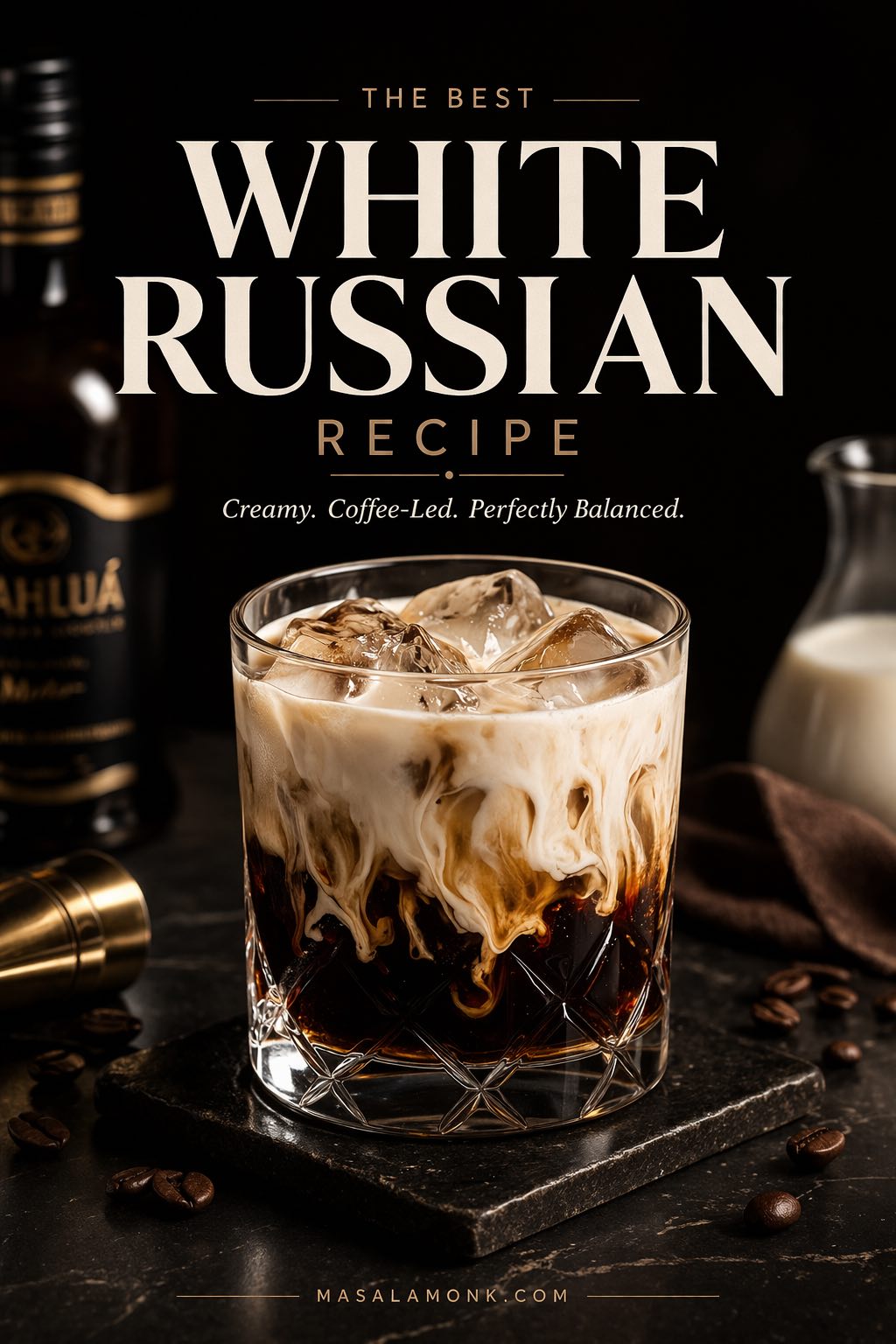
A White Russian recipe does not ask for much on paper, which is exactly why it goes wrong so easily in the glass. Vodka, coffee liqueur, dairy, and ice sound almost too straightforward to deserve careful treatment. Even so, the details matter more here than they do in many longer cocktails.
Cream can go in a little too heavily. Sometimes the liqueur turns the drink sweeter than expected. On other nights, the ice melts faster than it should and the whole thing loses shape before the glass is half finished. What should have felt smooth and rounded becomes flat, muddy, or oddly tired.
That is the difference between a White Russian that merely exists and one that is worth making again. Coffee should remain clear enough to matter. The vodka still needs to give the drink backbone. Meanwhile, the dairy should soften the finish without wiping out the darker flavors underneath it. When that balance holds, the White Russian feels rich without becoming heavy, sweet without becoming sticky, and creamy without becoming vague.
For most glasses, the strongest place to begin is 2 ounces vodka, 1 ounce coffee liqueur, and 1 ounce half-and-half or cream over ice. That build gives the drink enough body to feel indulgent while preserving enough structure for it to remain a cocktail rather than a melted dessert. Better still, it gives you room to move. If you want something richer, you can push it in that direction. If you want a firmer, more coffee-forward drink, you can tighten it.
Why a White Russian Goes Wrong So Easily
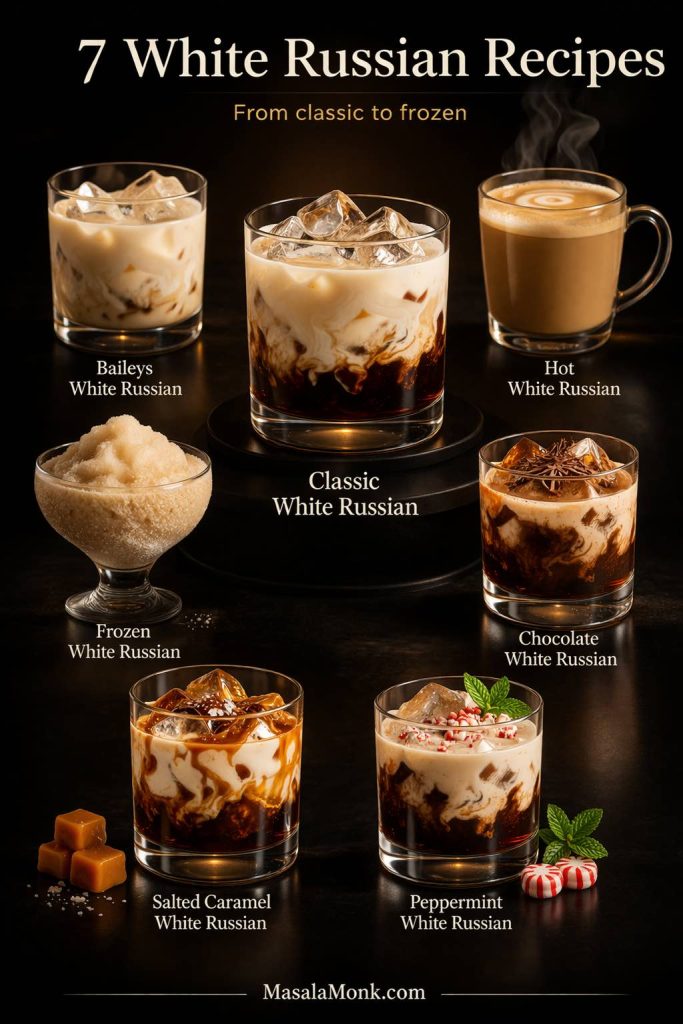
The classic comes first here, and it should. After that come the choices that actually change the drink in meaningful ways: the ratio, the dairy, the liqueur, the ice, and the small adjustments that keep the White Russian from drifting too sweet, too soft, or too thin.
Only then do the variations matter, because a Baileys White Russian, a Hot White Russian, a Chocolate White Russian, or a Frozen White Russian makes more sense once the classic version is doing its job properly.
Also Read: Mango Sorbet Recipe: Healthy & Plant Based Dessert
White Russian Recipe at a Glance
For a classic White Russian, use:
- 2 ounces vodka
- 1 ounce coffee liqueur
- 1 ounce half-and-half or heavy cream
- Ice
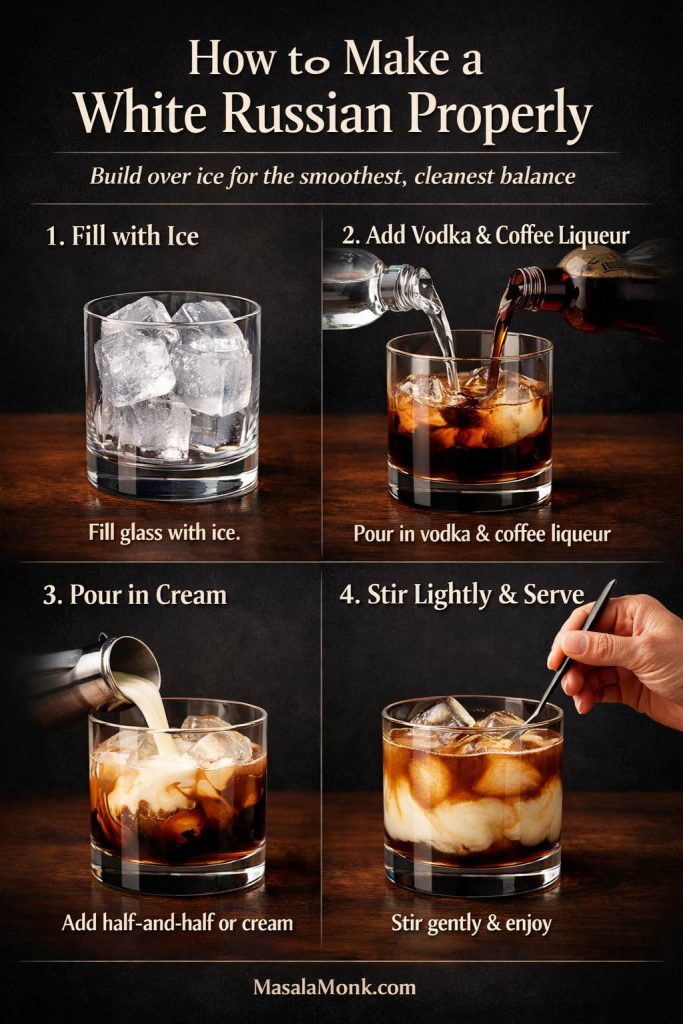
Fill a rocks glass with ice. Pour in the vodka, add the coffee liqueur, top with the dairy, stir gently, and serve immediately.
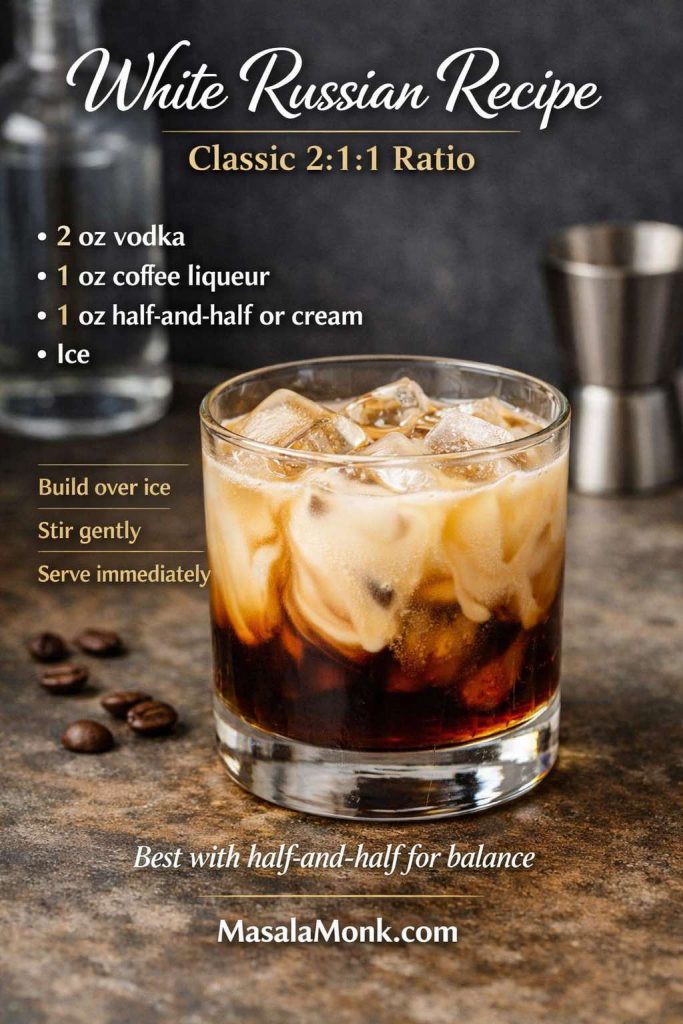
That is the shortest useful answer. Each ingredient has a clear role. Vodka gives the drink shape. Coffee liqueur supplies sweetness, roast, and slight bitterness. Dairy smooths the finish and gives the White Russian its signature texture. As for the ice, it chills the drink and gradually opens it up, though never so much that it should be allowed to dominate it.
If you only want the quick answer to how to make a White Russian, that is enough to get you there. The sections below are what make the result better.
Also Read: Protein Ice Cream Recipe: 10 Creamy Homemade Recipes
Best White Russian Recipe
The best White Russian is not the sweetest version, the richest version, or the heaviest-handed version. It is the one that still tastes like coffee, spirit, and cream in proportion. That sounds obvious, yet a lot of quick recipes either go too soft with the dairy or treat the coffee liqueur like an afterthought rather than the structural flavor that gives the drink its identity.
A properly balanced White Russian should feel calm, creamy, and satisfying from the first sip, but it should still read clearly as a cocktail. The vodka should not disappear. Coffee liqueur should do more than merely sweeten. At the same time, the dairy should not behave like a blanket thrown over the whole thing. Once those roles stay distinct, the drink becomes much more memorable.
Classic Recipe Card
Yield: 1 cocktail
Prep time: 5 minutes
Glass: rocks glass or old fashioned glass
Serve: over ice
Ingredients
- 2 ounces vodka
- 1 ounce coffee liqueur
- 1 ounce half-and-half or heavy cream
- Ice
Method
Fill a rocks glass with fresh ice. Pour in the vodka, then the coffee liqueur. Add the half-and-half or cream and stir gently until the drink is lightly blended. Serve immediately.
Best Dairy Choice
Half-and-half is the best all-around choice for a classic White Russian. It gives the drink enough body to feel creamy and satisfying without flattening the coffee note underneath it.
Easy Substitutions
Heavy cream makes a richer, slower, more dessert-like White Russian. Milk makes a lighter drink, but it also makes the cocktail lose strength more quickly as the ice melts.
What This Drink Should Taste Like
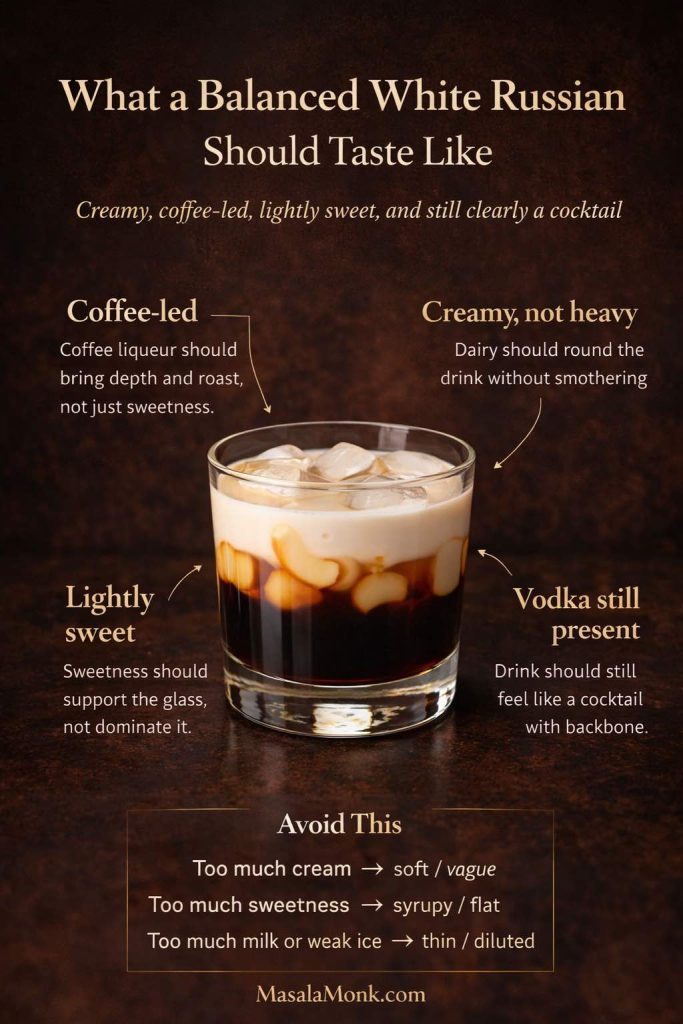
The best White Russian tastes smooth, lightly sweet, gently coffee-led, and creamy without becoming thick, sticky, or vague.
One Small Tip That Improves the Drink Immediately
Use cold dairy and solid ice. Warm cream and weak cubes soften the drink faster than most people expect.
What This White Russian Should Taste Like
A properly made White Russian should taste smooth, lightly sweet, gently coffee-led, and clearly creamy without turning thick or dull. The finish should feel rounded rather than sticky. Meanwhile, the dairy should soften the alcohol rather than bury it. Most importantly, the coffee liqueur should bring depth and sweetness without flattening the glass into syrupy sameness.
If your first sip tastes mostly like cream, the drink is too soft. When sweetness arrives before coffee, the liqueur has taken over. Likewise, a thin and milky texture usually means the dairy choice, ice, or ratio has drifted in the wrong direction.
Why This White Russian Recipe Works
This version works because it keeps the drink in proportion. Two ounces of vodka make sure the White Russian still tastes like a cocktail. One ounce of coffee liqueur gives it the darker flavor that defines it. Then one ounce of dairy rounds the finish and gives the drink its familiar texture without flattening the whole thing.
That balance matters more here than it would in a more crowded drink. A White Russian has nowhere to hide. Too much dairy makes the coffee disappear. Too much sweetness from the liqueur turns the glass soft and sticky. As for rough vodka, you notice it more than you should because the dairy and sweetness only soften the edges; they do not erase them.
Half-and-half is usually the best choice for the classic build. It gives enough body to make the White Russian feel creamy and satisfying, but it still leaves room for the coffee and vodka to show themselves. Heavy cream creates a richer, slower drink, which can be excellent after dinner or whenever a more openly indulgent finish is the point. Milk works if you want something lighter, though it nearly always weakens faster over ice and rarely feels as complete.
For classic context, Liquor.com’s White Russian keeps the structure traditional, while Inspired Taste’s White Russian recipe lands in a similarly balanced direction.
Also Read: Homemade Mango Ice Cream Recipe
What Is a White Russian?
A White Russian is a cocktail made with vodka, coffee liqueur, and dairy, usually served over ice. It belongs to a small group of drinks that are easy to like quickly but harder to make well than their short ingredient lists suggest. A lot of cocktails hide behind complexity. The White Russian does not. It puts a few ingredients in the glass, lets them show themselves, and leaves very little room for confusion once the balance slips.
The appeal is immediate: the drink feels familiar, smooth, and easy to like from the first sip. It is creamy, smooth, sweet, and just bitter enough around the edges to stay interesting. It also sits in a useful middle ground. Richer than a bright citrus cocktail and gentler than a more spirit-forward coffee drink, it can work as an after-dinner cocktail, a cold-weather comfort drink, or a slow evening pour that asks very little beyond basic restraint.
Its reputation for ease is deserved, but it can be misleading. Easy does not mean careless. Better ice, better dairy, a more sensible ratio, and a coffee liqueur that suits the result you actually want all make a noticeable difference. Those choices separate a White Russian that feels rounded and deliberate from one that feels like sweet cream thrown over a lazy pour.
White Russian vs Black Russian
A Black Russian contains vodka and coffee liqueur. A White Russian adds dairy. That sounds minor, but the difference in the glass is substantial.
The Black Russian feels darker, firmer, and more spirit-forward. It lets the vodka and coffee liqueur speak with much less softening. The White Russian takes those same bones and turns them smoother, rounder, and more indulgent. If the coffee note is what pulls you in but the drier edge of the Black Russian sounds too lean, the White Russian is usually the better choice.
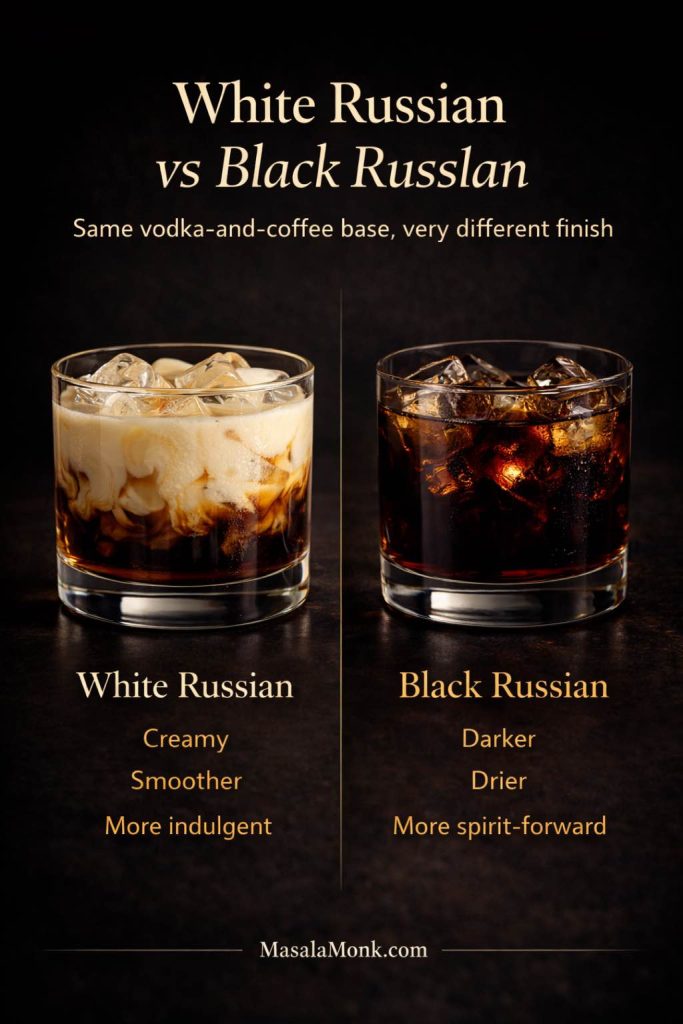
The practical difference becomes even clearer once both drinks are actually in front of you. A Black Russian is cleaner and sharper. It feels closer to a short, slightly sweet spirit drink. By contrast, a White Russian slows the whole experience down. Dairy changes not only the flavor but also the pace of the drink. The finish turns softer, the texture fuller, and the mood less severe.
That is why comparisons between the two matter more than they first appear to. The question is not simply whether dairy is present. Instead, it is what role you want the coffee liqueur to play. In a Black Russian, it sits much closer to the surface. In a White Russian, it becomes part of a richer, gentler structure. Black Russian for a darker, drier pour; White Russian for a creamier, more relaxed one.
Why Is It Called a White Russian?
The name is direct. “Russian” points to the vodka. “White” refers to the dairy that lightens the drink.
Is This the Drink From The Big Lebowski?
Yes. The White Russian is closely associated with The Big Lebowski, where it is also called a “Caucasian.” The film helped keep the drink visible in popular culture, but the cocktail survives because the combination works even without the movie attached to it. A good White Russian does not need nostalgia to justify itself.
Also Read: Cookie Pie Recipe: 10 Best Flavors, Fillings and Variations
The Ingredients That Make or Break a White Russian
A short ingredient list makes quality more obvious, not less. The White Russian does not require luxury bottles or elaborate tools, but it does benefit from sensible choices.
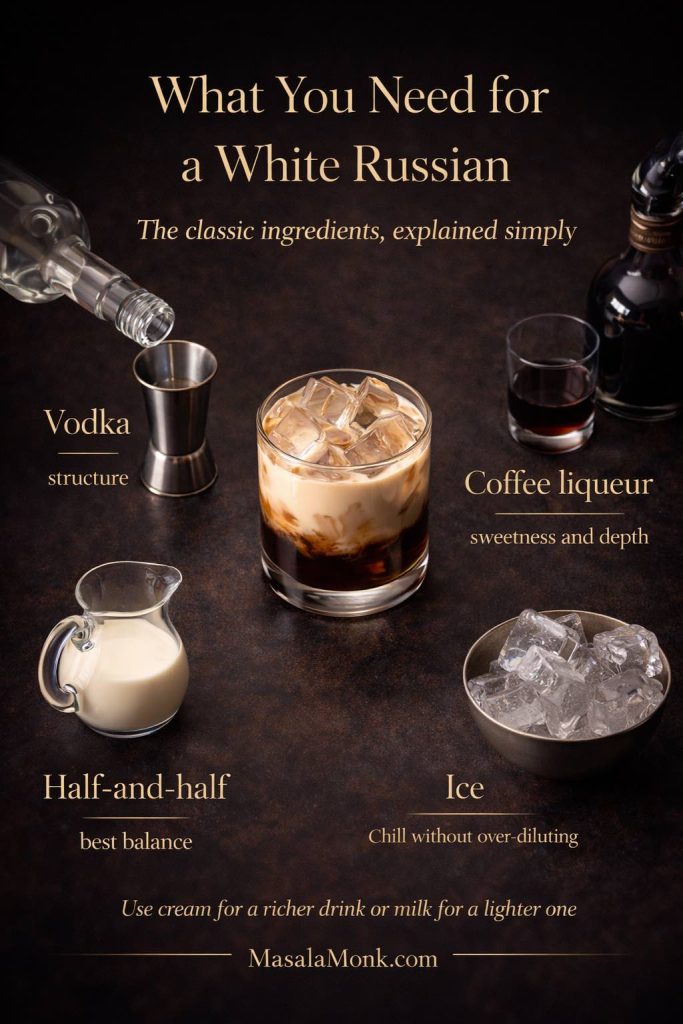
Vodka
Use a clean, neutral vodka that tastes smooth enough to support the drink without roughening it. This is not a cocktail where a harsh spirit disappears under layers of other flavors. The dairy softens, but it does not erase. If the vodka is aggressive, you will still feel it in the finish.
That does not mean expensive. A reliable mid-range vodka is usually perfect. The point is not prestige. The point is steadiness. In a drink as short and exposed as the White Russian, cheap burn matters more than people often expect.
Coffee Liqueur
Coffee liqueur gives the White Russian its identity. It brings sweetness, roasted depth, slight bitterness, and the darker flavor that makes the cocktail more than vodka softened with dairy. Without a proper coffee note, the White Russian loses the thing that makes it memorable.
Different bottles shift the drink more than many quick recipes admit. Some coffee liqueurs are soft, sweet, and vanilla-forward. Others taste darker, drier, and more coffee-led. A softer, sweeter bottle often needs a lighter hand with the dairy. A darker one can carry a richer pour without disappearing. That is why it helps to think of coffee liqueur not merely as the sweet element, but as the structural flavor of the drink.
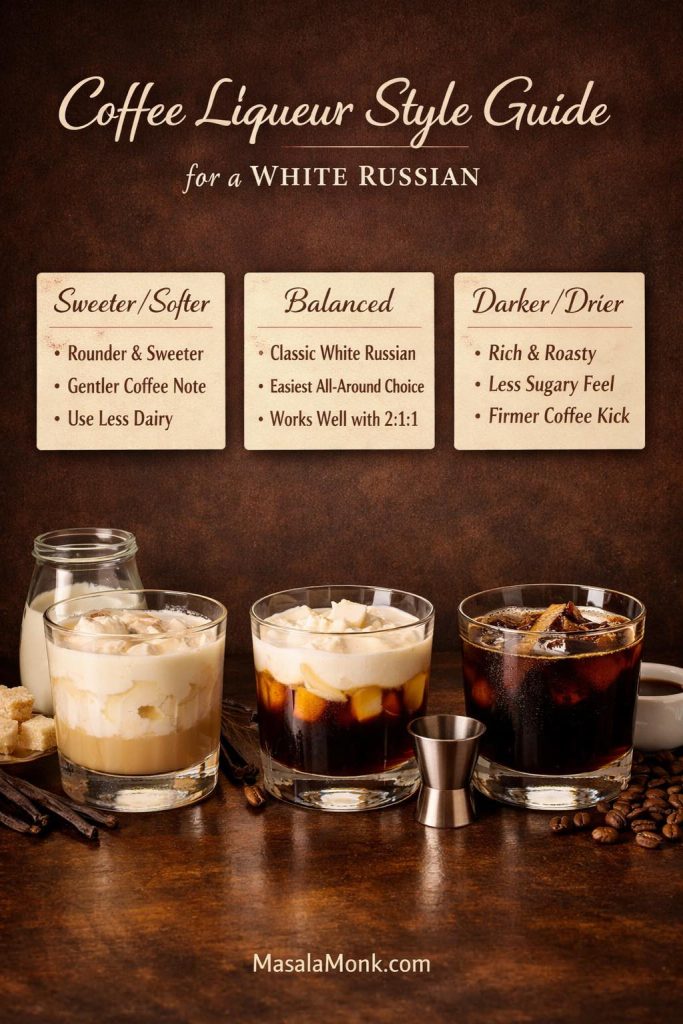
If coffee flavor is part of what attracts you to the White Russian in the first place, Quick Espresso Guide – Know Your Coffee and Coffee Brewing Methods: A Fusion of Art, Science, and Flavor sit naturally beside a post like this.
Cream, Half-and-Half, or Milk
This choice changes the White Russian more than almost any tiny ratio adjustment.
Heavy cream makes the drink lush, full, and openly indulgent. It works best when richness is the point and you want the White Russian to lean further toward dessert.
Half-and-half is the sweet spot for most glasses. It gives the drink enough body to feel creamy and satisfying without burying the coffee and vodka underneath it.
Milk makes a lighter White Russian. That can be pleasant when you want something easier to sip, but it also makes the drink more fragile. Once the ice starts to melt, milk is usually the first reason the cocktail feels washed out.
Dairy changes the drink more dramatically than many people expect. A White Russian made with half-and-half is usually the best all-around answer. One made with milk can be pleasant, but it is rarely the most complete version of the drink. Meanwhile, a White Russian made with heavy cream can be excellent when indulgence is the goal, though it can also become shapeless if the rest of the drink is not firm enough to support it.
If you want a practical outside reference on dairy swaps, The Spruce Eats’ White Russian recipe handles that part more practically than most short cocktail pages.
Ice and Glassware
Serve the drink in a rocks glass or old fashioned glass over ice. Since the White Russian is short, rich, and usually sipped slowly, that format suits it naturally.
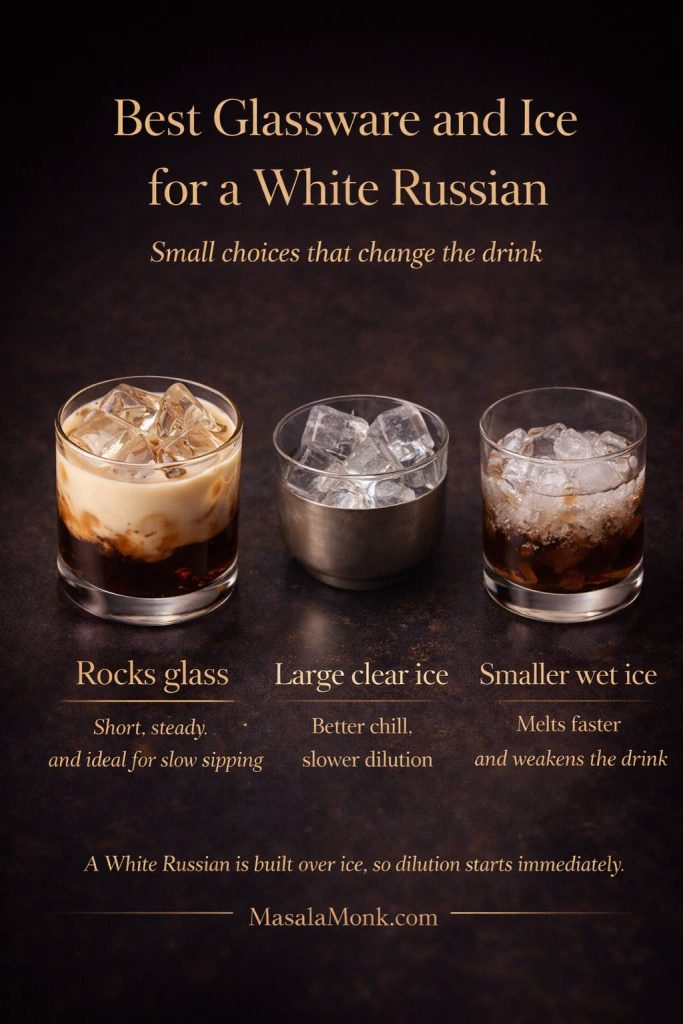
The ice matters too. Thin, wet cubes melt quickly and drag the drink down before it has a chance to settle. Firmer ice gives the coffee liqueur and dairy more time to stay in balance. Because the White Russian is built directly over ice rather than shaken and strained, dilution is not a background issue here. It is part of the drink from the beginning.
Also Read: Punjabi Mutton Bhuna – Amritsari Village-Style Gosht Recipe
The Best White Russian Ratio
A White Russian can move quickly from balanced to shapeless. The ratio is what decides where it lands.
The Classic 2:1:1 Ratio
For a balanced White Russian, use:
- 2 ounces vodka
- 1 ounce coffee liqueur
- 1 ounce half-and-half or cream
This works because the drink still has shape. The coffee stays clear. The vodka still matters. The dairy smooths the finish instead of taking it over. If what you want is a classic White Russian that feels reliable, repeatable, and easy to adjust, this is the build to trust first.
The classic 2:1:1 ratio also gives you room to move. Want a slightly richer glass? Add a touch more dairy or switch from half-and-half to cream. Want something firmer? Use a darker coffee liqueur or pull the sweetness back a little. The base stays stable.
The Equal-Parts Build
Equal parts vodka, coffee liqueur, and dairy create a softer, sweeter, more indulgent White Russian. There is nothing wrong with that version. It can be very enjoyable after dinner or whenever a richer, more plush pour sounds right. It simply aims at a different result. The drink becomes rounder, gentler, and more dessert-like from the first sip.
That richer approach shows up clearly on Kahlúa’s White Russian page, which leans into the more indulgent side of the spectrum.
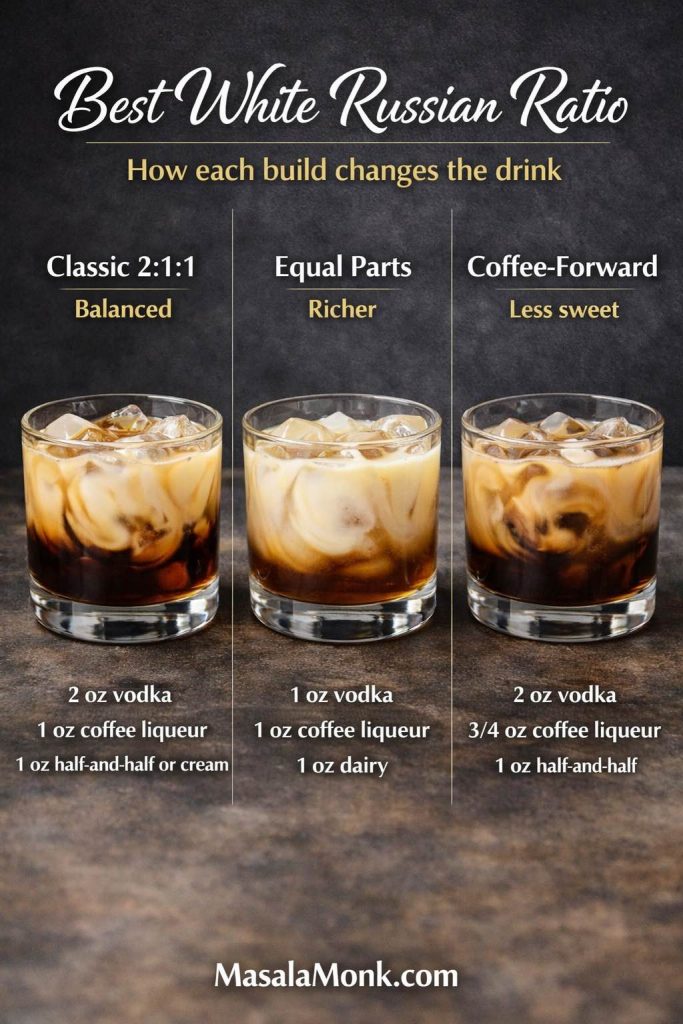
A Firmer Coffee-Forward White Russian
There is also a useful middle move for anyone who likes the White Russian idea but wants more edge: keep the vodka at 2 ounces, trim the coffee liqueur slightly, stay with half-and-half rather than heavy cream, and use a darker bottle if possible. That version is less sweet, more clearly coffee-led, and closer to an after-dinner cocktail than a cold dessert.
This version works better when you want the drink firmer, less sweet, and more clearly coffee-led. The trick is not inventing a new ingredient list. It is keeping the coffee note and the spirit visible inside the creamy texture.
How Ratio and Dairy Work Together
Ratio alone does not decide the result. Dairy choice changes how that ratio lands.
A 2:1:1 White Russian with half-and-half usually feels the most balanced. A 2:1:1 White Russian with heavy cream becomes slower and richer, even though the numbers have not changed. Equal parts with heavy cream can turn very plush very quickly. Equal parts with milk will be lighter, but it can also taste weak once dilution sets in.
That is why two White Russians made with the same spirit and the same liqueur can still feel very different. The ratio tells you the direction. The dairy tells you how heavy the result feels when it gets there.
Which Ratio Tastes Better?
For most situations, 2:1:1 tastes better because it keeps the White Russian from going vague. It stays creamy, but it still feels like a cocktail first. Equal parts makes more sense when the mood is sweeter and softer from the beginning. A firmer coffee-forward version works when the roasted note is what you want to emphasize.
The important thing is recognizing that these are not interchangeable builds with slightly different wording. They feel different in the glass. That is exactly why the ratio deserves more thought than it usually gets.
Also Read: Peach Cobbler with Canned Peaches (Dessert Recipe)
Cream vs Half-and-Half vs Milk in a White Russian
A White Russian made with cream is not the same drink as one made with milk. Even when the rest of the ingredient list stays the same, the texture, weight, and finish shift dramatically.
Cream gives the drink a velvety, heavier feel. The White Russian becomes richer and more obviously decadent. That can be exactly right after dinner or whenever comfort matters more than clarity. The tradeoff is that too much cream can turn the drink rich but indistinct.
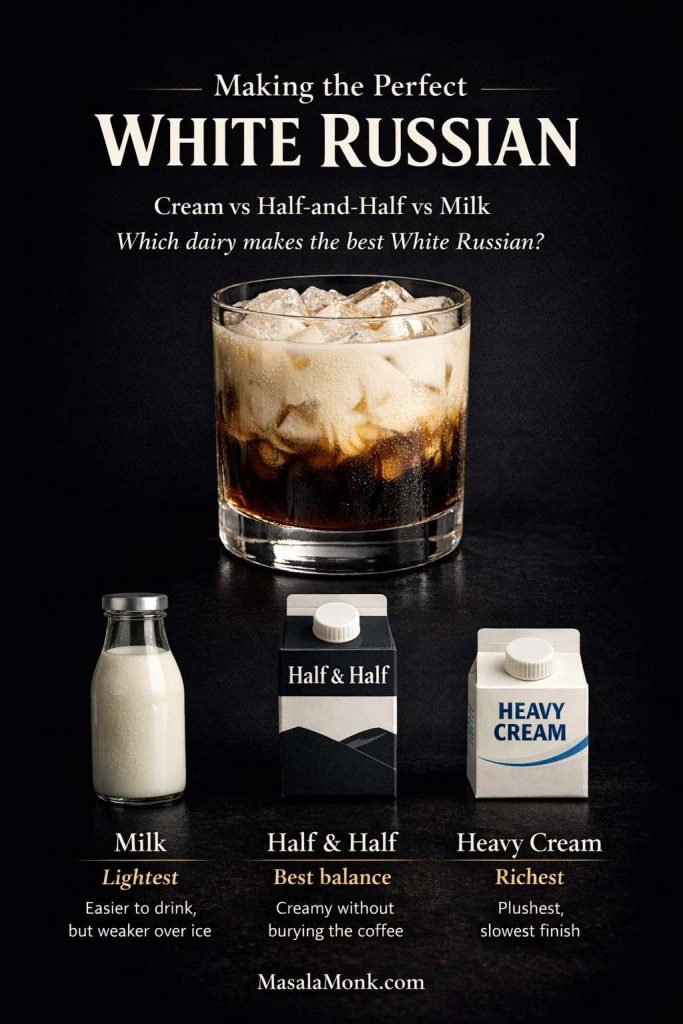
Half-and-half keeps more balance. The drink still feels creamy, but the coffee backbone remains present and the vodka still gives it a little shape. This is why half-and-half is such a reliable default. It gives enough without giving too much.
Milk creates the lightest White Russian of the three. That can sound appealing when you do not want a heavy drink, but it comes with a cost. Milk loses authority quickly over ice. Once dilution starts, the cocktail can move from pleasant to thin faster than expected, especially if the coffee liqueur already leans sweet.
The easiest way to think about it is simple. Use cream when indulgence matters most. Half-and-half is best when balance matters most. Use milk only when you knowingly want a lighter, less sturdy version of the drink.
A dairy-free White Russian can work too, though thin plant milks rarely help. The drink still needs body. If that version appeals, Cookie and Kate’s vegan White Russian is a thoughtful place to start because it treats texture seriously instead of treating “non-dairy” as a casual swap.
Also Read: Avocado Chocolate Mousse Recipe
Which White Russian Version Should You Make?
Not every White Russian variation gives you the same kind of drink, so choosing the right one makes a real difference. The classic White Russian recipe is still the best all-around choice when you want something creamy, coffee-led, easy to make, and clearly structured as a cocktail. If you like the same vodka-and-coffee foundation but want a darker, drier, more direct drink, a Black Russian makes more sense because it leaves out the dairy softness entirely. A Baileys White Russian, on the other hand, turns the drink gentler, sweeter, and more dessert-like from the first sip.
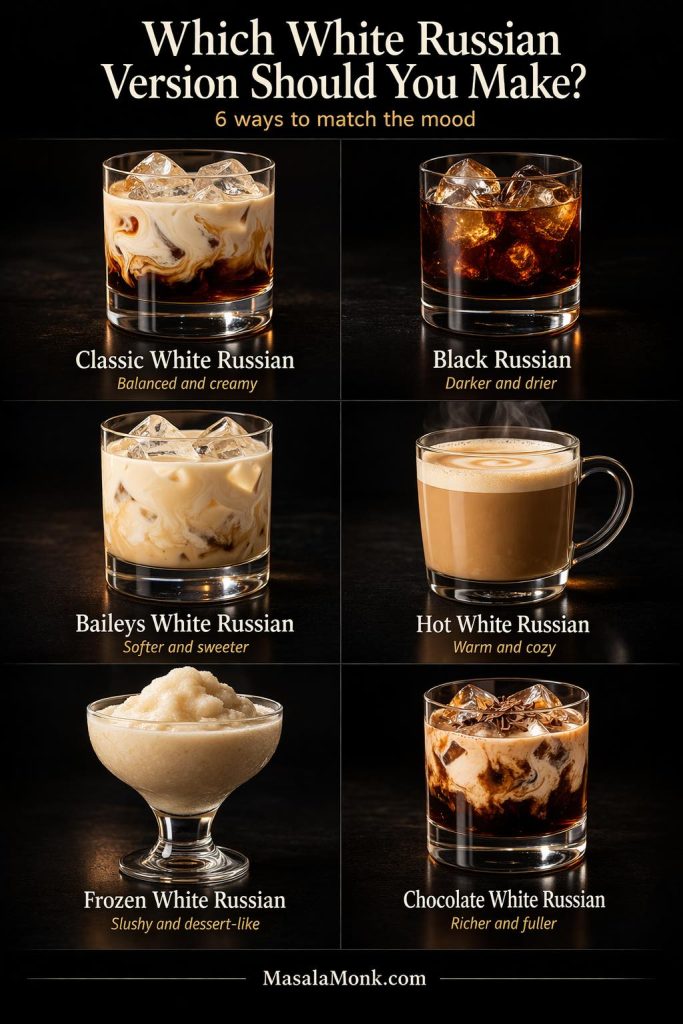
Temperature changes the mood just as much as flavor. A Hot White Russian suits colder weather and a slower, cozier kind of drink, while a Frozen White Russian moves in the opposite direction, becoming slushier, more playful, and more openly dessert-like without fully losing the coffee-and-cream core that makes the drink recognizable in the first place. If richness is what you want, a Chocolate White Russian gives the classic a deeper, fuller edge, while a Salted Caramel White Russian pushes the drink sweeter and rounder, with just enough contrast to keep it from feeling flat.
Then there are the more seasonal or mood-specific versions. A Peppermint White Russian works best when the drink is meant to feel sharper, cooler, and more festive, especially in colder months. Taken together, these variations are less about novelty for its own sake and more about choosing the version that matches the moment. Sometimes that means something classic and balanced, sometimes something softer and sweeter, and sometimes something warmer, colder, richer, or more playful.
Also Read: Falafel Recipe: Crispy Homemade, Air Fryer and Baked Falafel
White Russian Comparisons That Actually Matter
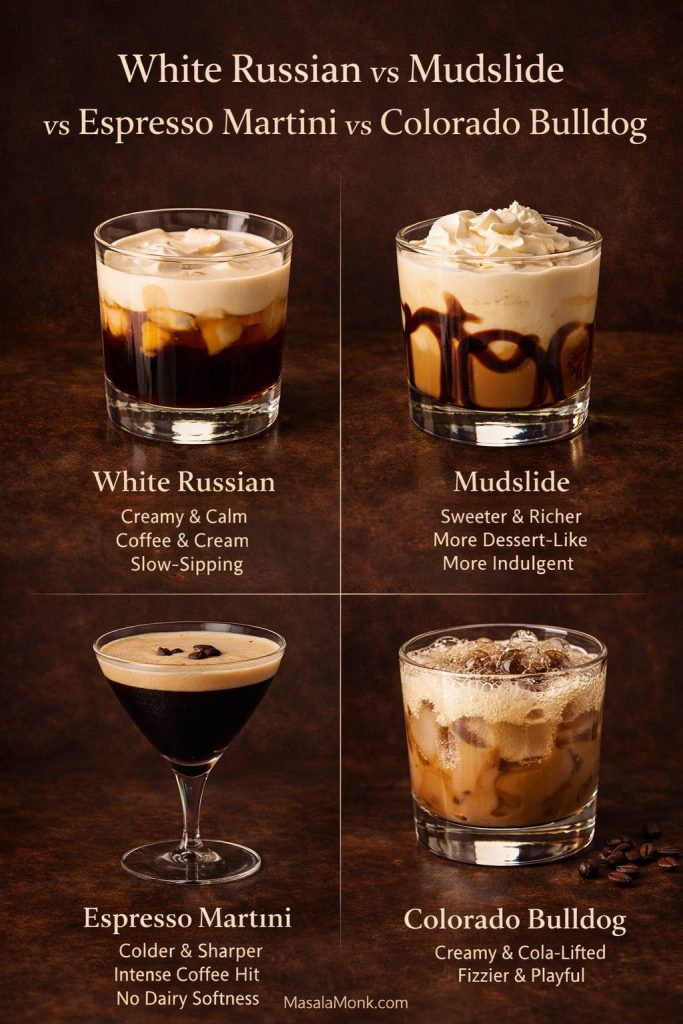
Comparisons help because the White Russian sits near several other drinks that share part of its flavor world without delivering the same experience.
White Russian vs Mudslide
A Mudslide is usually sweeter, richer, and more overtly dessert-like than a White Russian. Once Irish cream and chocolate enter the picture, the drink moves away from the cleaner structure of vodka, coffee liqueur, and dairy and toward a more confection-like profile. That does not make a Mudslide worse. It makes it a different kind of drink. A White Russian should still feel more restrained beside it.
Pick a White Russian when you want coffee, cream, and spirit in clearer proportion. Pick a Mudslide when you want something more openly indulgent and dessert-like from the start.
White Russian vs Espresso Martini
The Espresso Martini is sharper, colder, and more intense. It is about coffee aroma, chilled texture, and a cleaner, more focused edge. The White Russian is slower and softer. It leans on dairy instead of fresh espresso foam and occupies a more comfort-forward space.
Pick the White Russian when you want a creamy coffee cocktail that feels smooth and relaxed. Pick the Espresso Martini when you want a colder, tighter, more concentrated coffee hit with no dairy softness.
White Russian vs Colorado Bulldog
The Colorado Bulldog begins close to the White Russian, then adds cola. That changes the drink more than it first sounds. The White Russian is creamy and still. The Colorado Bulldog becomes fizzier, sweeter, and more playful. The coffee-and-cream core remains recognizable, but the mood shifts from slow and rich to livelier and more casual.
White Russian vs Baileys White Russian
A Baileys White Russian is softer and sweeter than the classic. It leans further into dessert territory. The classic White Russian keeps a cleaner line between vodka, coffee liqueur, and dairy. The Baileys version rounds everything off faster and needs more restraint to stay interesting.
Cold vs Hot vs Frozen
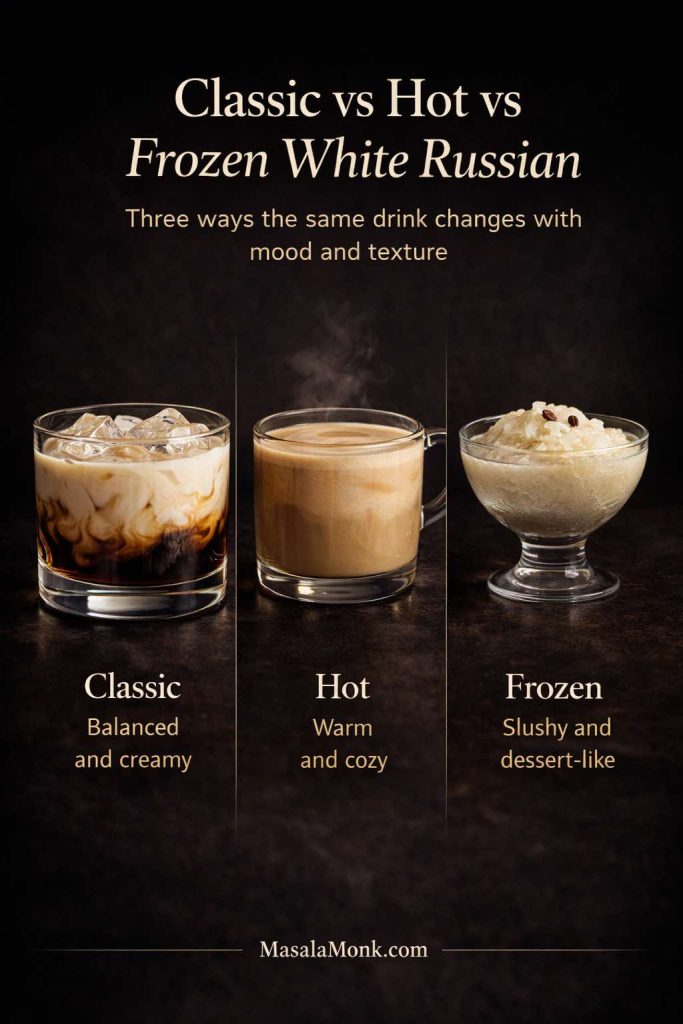
The classic cold version is the most balanced and versatile. A Hot White Russian becomes warmer, slower, and more comforting. The Frozen White Russian becomes more playful and more overtly dessert-like. The core flavors remain recognizable, but the drinking experience changes enough that each one earns its own place.
Also Read: Mango Margarita Recipe (Frozen or On the Rocks)
How to Make a White Russian Properly
The White Russian is a built drink, not a difficult one. Once the proportions are right, the method is almost effortless.
For the cleanest and most consistent glass, build it over ice and stir gently. That gives you a more even flavor from first sip to last. Some people prefer the layered look, where the dairy is floated on top over the back of a spoon. That presentation is attractive and part of the drink’s visual identity, but it is mostly a matter of appearance. Once the drink is stirred or partly sipped, it blends anyway.
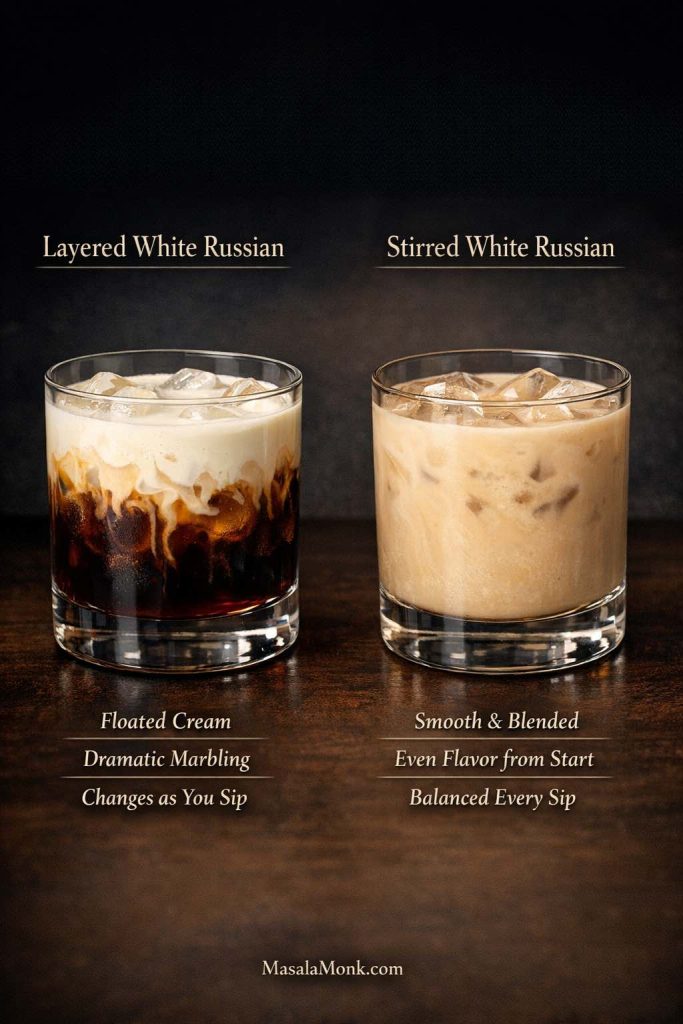
The best practical method is simple. Fill the glass with ice, add vodka, add coffee liqueur, pour in the dairy, stir lightly, and serve immediately. The White Russian tastes best before melting ice has too much time to soften the coffee and thin the body.
Its place in the evening matters too. This is not a bright, thirst-quenching highball and it is not meant to feel sharp or lively like a citrus-heavy cocktail. Instead, it is richer, rounder, and more comforting, which is exactly why it works so well after dinner. For a brighter contrast elsewhere on the site, the Paloma Recipe and the Mango Margarita Recipe pull in the opposite direction.
How to Fix a White Russian That Tastes Off
One of the best things about a White Russian is how easy it is to correct once you know what went wrong.
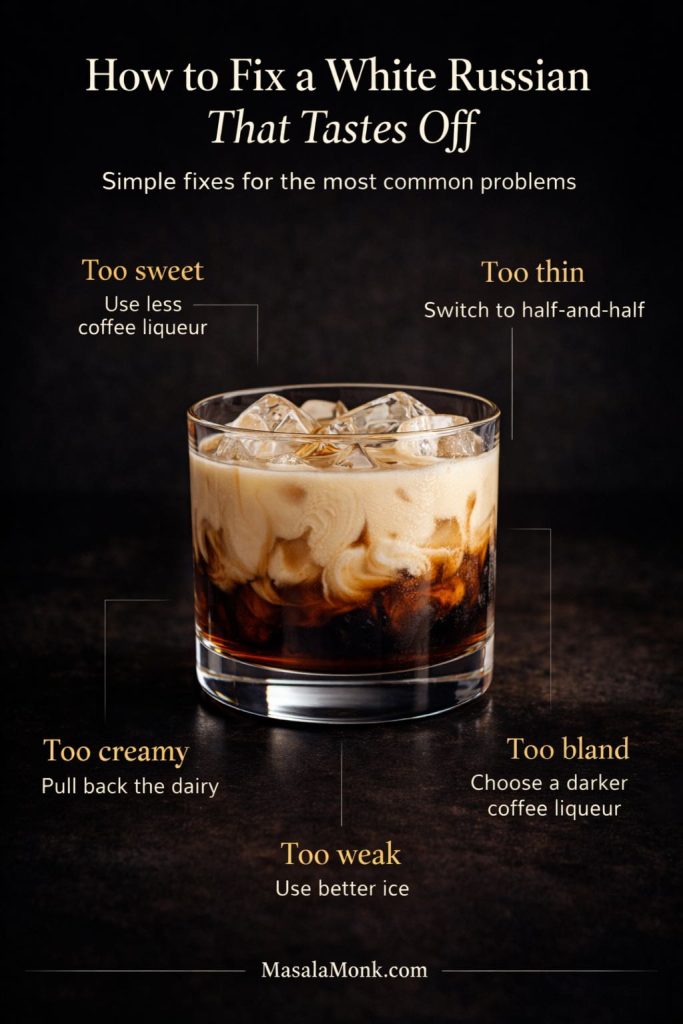
If Your White Russian Tastes Too Sweet
Usually, the answer is less coffee liqueur, not more vodka. Sweetness tends to feel louder as the glass warms slightly, so it often helps to start on the firmer side if your bottle already runs sugary.
If Your White Russian Tastes Too Thin
Milk is usually the problem. Switching to half-and-half helps more than changing the alcohol. Better ice helps too, especially if the cubes you are using melt quickly.
If Your White Russian Tastes Too Creamy
The dairy has probably buried the coffee note. Pull it back slightly next time or firm the drink up with a little more vodka. This happens most often with heavy cream or rich equal-parts builds.
If Your White Russian Feels Too Rich or Heavy
Do not try to fix that with more sweetness. Use half-and-half instead of cream, stick with the classic 2:1:1 build, and make sure the ice is not disappearing too quickly.
If It Is Not Coffee-Forward Enough
Your liqueur may be too soft or too sweet. A darker bottle or a slightly tighter hand with the dairy usually solves that. The goal is not bitterness for its own sake, but enough roasted depth to stop the White Russian from feeling bland.
If the Drink Turns Weak or Bland Too Quickly
Quick-melting ice, milk instead of half-and-half, or a base ratio that was already too soft can all cause that problem. In many cases, the dairy and the liqueur are the first things to check.
Cold ingredients help everywhere. So does matching the dairy to the mood. Cream suits indulgence. Half-and-half suits balance. Milk suits a lighter glass, though never the sturdiest one.
Also Read: Sourdough Pizza Dough Recipe (Crispy Crust & Easy Pizza Base)
The White Russian Variations Worth Making
Once the classic White Russian is secure, the variations become more rewarding because you can feel exactly what changes in the glass. Some push the drink further toward dessert. Others change the mood more dramatically by shifting the temperature or texture. The best riffs still taste recognizably tied to the original rather than using its name as an excuse for a different drink entirely.
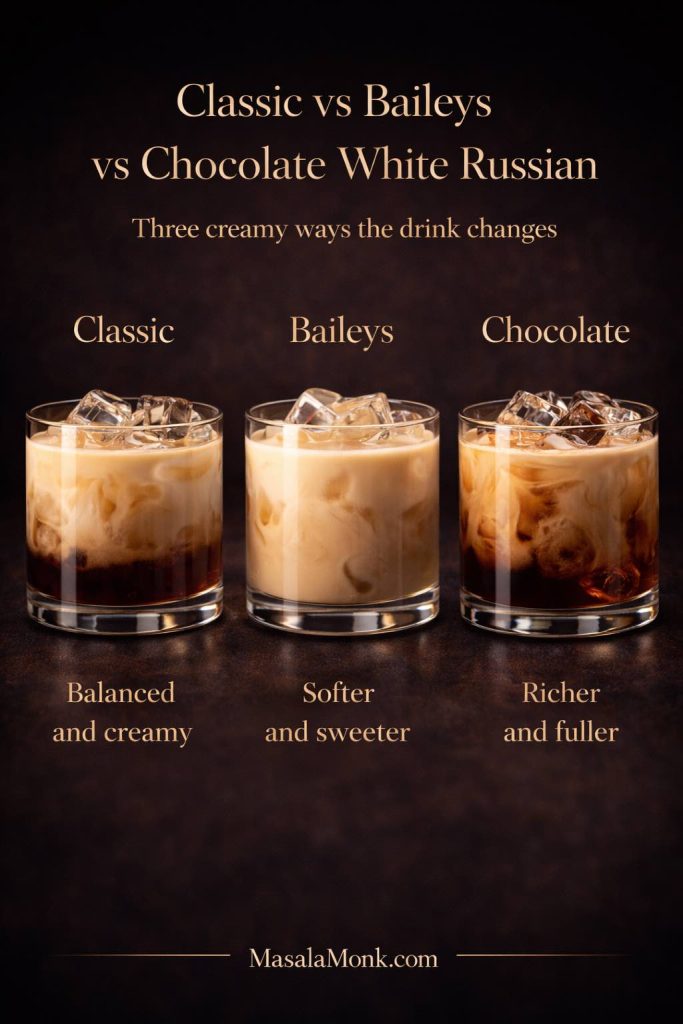
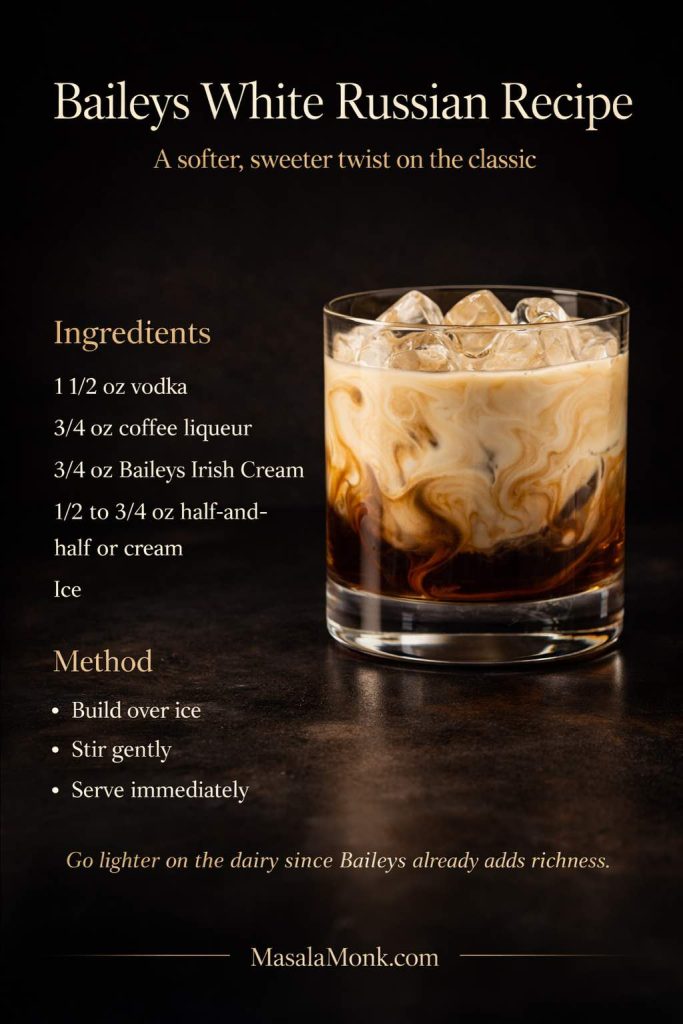
Baileys White Russian Recipe
A Baileys White Russian is one of the easiest variations to like because Irish cream fits naturally into the drink’s existing structure. It adds softness and sweetness immediately, which is both the attraction and the danger. Too much, and the cocktail loses its shape.
Recipe Card
Yield: 1 cocktail
Prep time: 5 minutes
Ingredients
- 1 1/2 ounces vodka
- 3/4 ounce coffee liqueur
- 3/4 ounce Baileys Irish Cream
- 1/2 to 3/4 ounce half-and-half or cream
- Ice
Method
Fill a rocks glass with ice. Add the vodka, coffee liqueur, and Baileys. Pour in the dairy, stir gently, and serve immediately.
Why This Version Works
Baileys already brings richness, so the dairy has to stay under control. That is why this version uses less of it than the classic. Done well, the drink tastes softer and sweeter than the original while still keeping enough coffee character to stay interesting. Done badly, it just tastes like sweet Irish cream over ice.
If you want to compare approaches, Baileys’ own White Russian-style recipe is useful context, though this version stays closer to the classic cocktail family.
Also Read: Masterclass in Chai: How to Make the Perfect Masala Chai (Recipe)
Hot White Russian Recipe
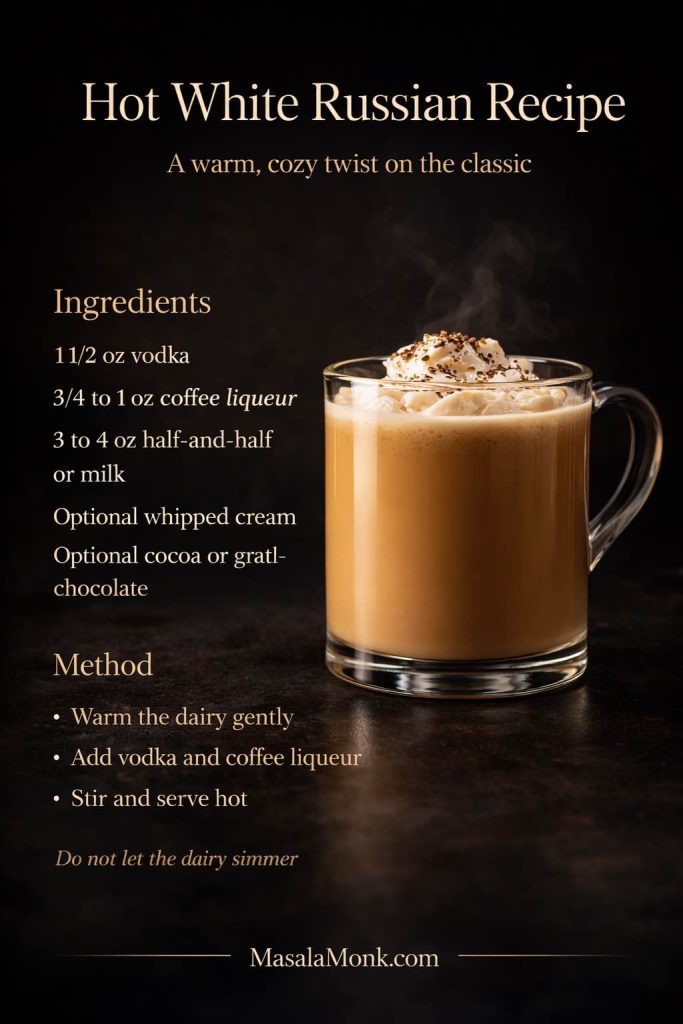
A Hot White Russian changes the feel of the drink more than a simple flavored riff does. Instead of an iced creamy cocktail, it becomes warm, slow, and openly cozy.
Recipe Card
Yield: 1 mug
Prep time: 7 minutes
Ingredients
- 1 1/2 ounces vodka
- 3/4 to 1 ounce coffee liqueur
- 3 to 4 ounces half-and-half or milk
- Optional whipped cream
- Optional cocoa or grated chocolate
Method
Warm the half-and-half or milk until hot but not simmering. Pour the vodka into a heat-safe mug, add the coffee liqueur, then pour in the warmed dairy. Stir gently. Top with a little whipped cream or cocoa if you like, and serve immediately.
Why This Hot White Russian Recipe Works
Without ice in the equation, the drink needs more dairy volume than the classic cold version. Half-and-half gives the richer balanced result. Milk keeps it lighter. The key is not overheating the dairy. Once it starts tasting cooked, the whole drink loses its charm.
Warmth also changes the perception of sweetness. A hot White Russian can feel sweeter and richer faster than the cold version, which is why restraint matters even more here.
This variation sits naturally beside more overtly cozy drinks like Homemade Hot Chocolate with Cocoa Powder.
Frozen White Russian Recipe
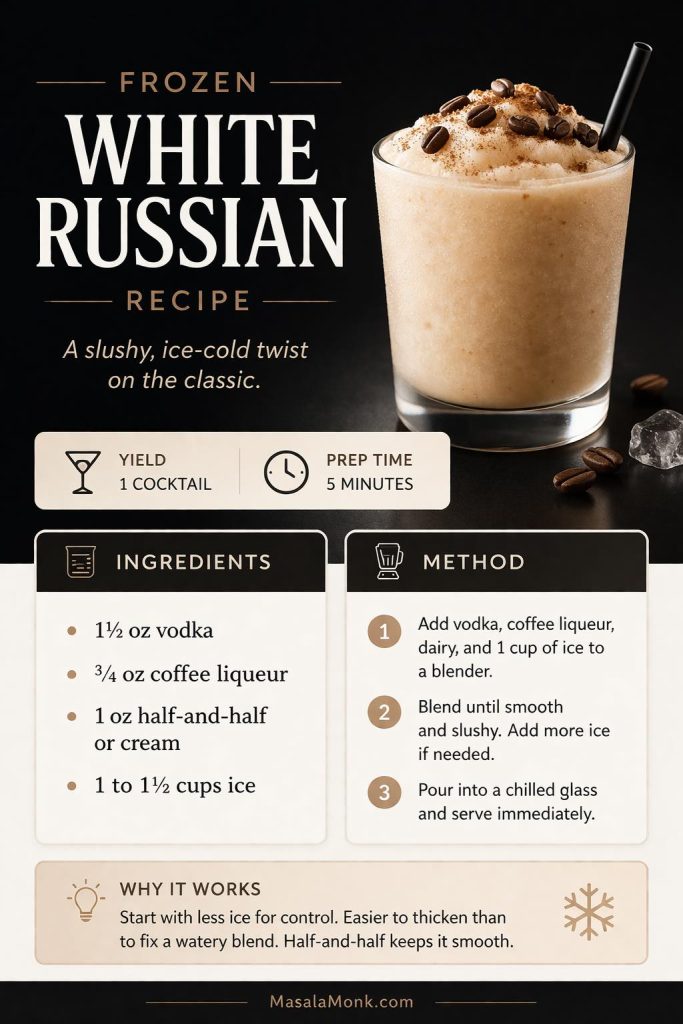
A Frozen White Russian works when it stays slushy and drinkable rather than turning into either a watery blender drink or a heavy milkshake.
Recipe Card
Yield: 1 frozen cocktail
Prep time: 5 minutes
Ingredients
- 1 1/2 ounces vodka
- 3/4 ounce coffee liqueur
- 1 ounce half-and-half or cream
- 1 to 1 1/2 cups ice
Method
Add the vodka, coffee liqueur, dairy, and 1 cup of ice to a blender. Blend until smooth and slushy. Add more ice a little at a time if needed. Pour into a chilled glass and serve immediately.
Why This Version Works
Starting with less ice gives you more control. It is easier to thicken the drink than to rescue one that has turned watery and overblended. Half-and-half usually keeps the texture cleaner, while heavy cream can make the frozen version feel heavier than it needs to. The goal is still a White Russian, just colder and slushier, not a milkshake wearing cocktail clothes.
Also Read: Crock Pot Pork Chops and Sauerkraut (No Dry Chops Recipe)
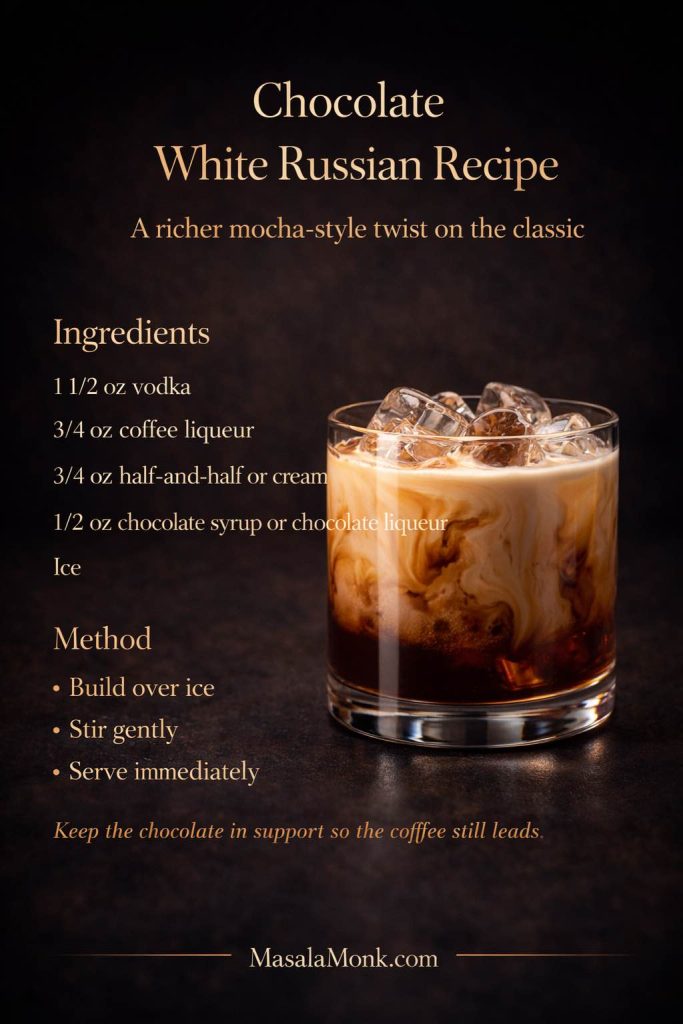
Chocolate White Russian Recipe
Chocolate is one of the most natural riffs because coffee and chocolate already fit together so well.
Recipe Card
Yield: 1 cocktail
Prep time: 5 minutes
Ingredients
- 1 1/2 ounces vodka
- 3/4 ounce coffee liqueur
- 3/4 ounce half-and-half or cream
- 1/2 ounce chocolate syrup or chocolate liqueur
- Ice
Method
Fill a rocks glass with ice. Add the vodka and coffee liqueur, then the chocolate component and dairy. Stir gently until lightly blended. Serve immediately.
Why This Version Works
Chocolate deepens the dessert side of the White Russian, but it should still support the coffee rather than replace it. That is why a smaller amount works better than a heavy-handed one. The drink should read as a chocolate White Russian, not as a chocolate milk drink with vodka.
For more on how chocolate ingredients shift flavor, What Is Cacao: Cacao vs Chocolate vs Dark Chocolate fits naturally here.
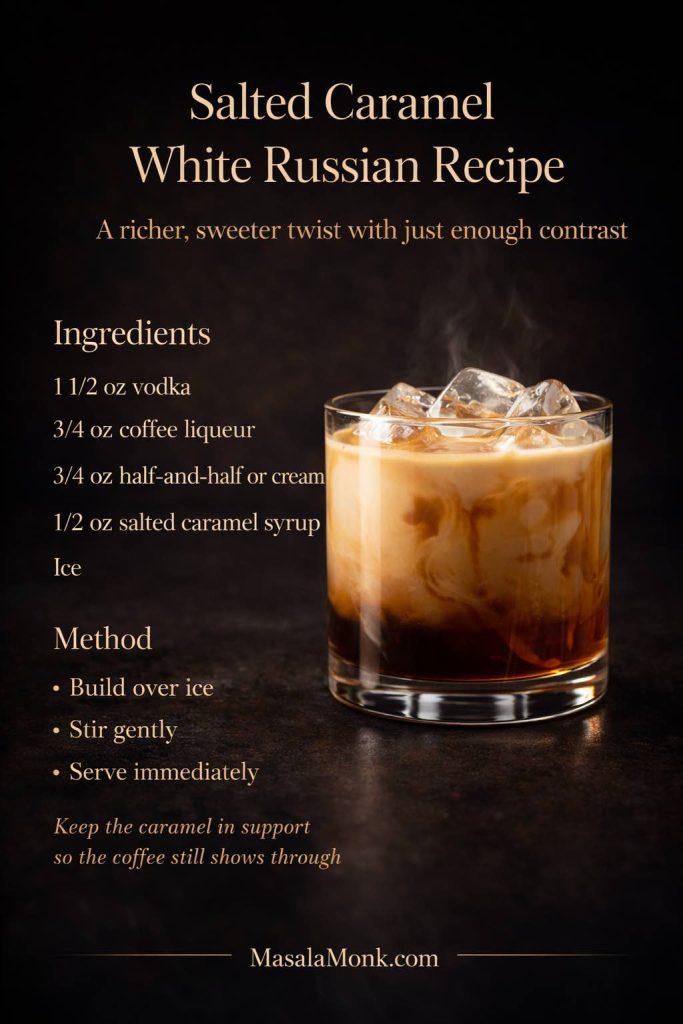
Salted Caramel White Russian Recipe
Caramel and coffee already make sense together. Salt helps stop the drink from sliding too far into sticky sweetness.
Recipe Card
Yield: 1 cocktail
Prep time: 5 minutes
Ingredients
- 1 1/2 ounces vodka
- 3/4 ounce coffee liqueur
- 3/4 ounce half-and-half or cream
- 1/2 ounce salted caramel syrup
- Ice
Method
Fill a rocks glass with ice. Add the vodka, coffee liqueur, caramel syrup, and dairy. Stir gently and serve immediately.
Why This Version Works
Salted caramel can make the White Russian richer and rounder without flattening it, but only when the caramel stays in support. The point is not to erase the coffee-and-cream structure. The point is to warm it.
Also Read: Keto Mocktails: 10 Low Carb, Sugar Free Recipes
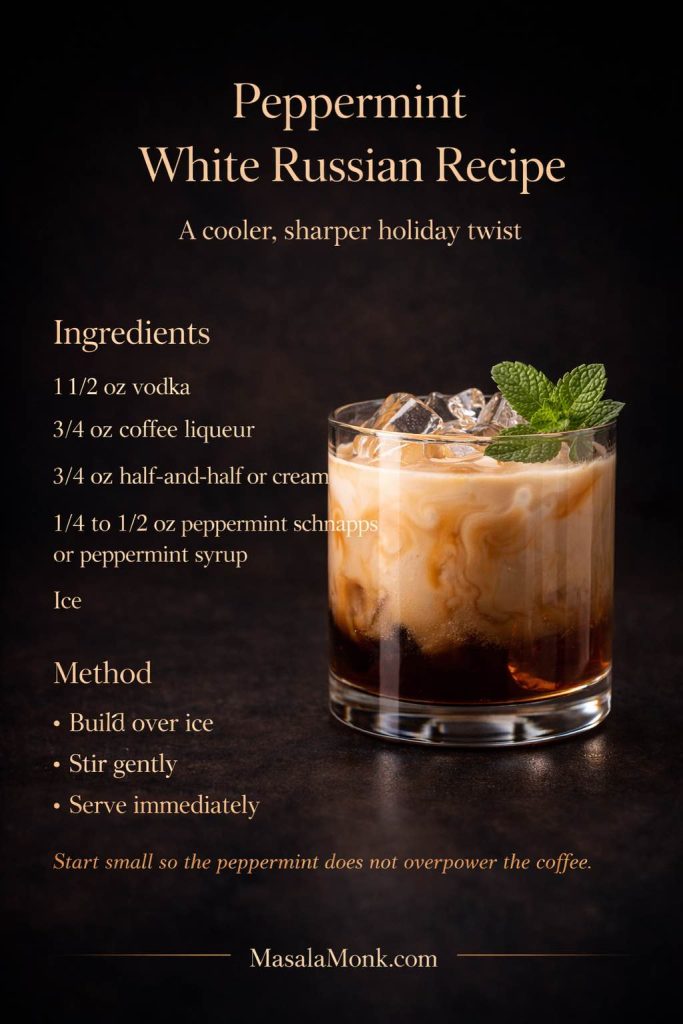
Peppermint White Russian
Peppermint belongs mostly to colder weather and holiday moods, and it needs a light touch.
Recipe Card
Yield: 1 cocktail
Prep time: 5 minutes
Ingredients
- 1 1/2 ounces vodka
- 3/4 ounce coffee liqueur
- 3/4 ounce half-and-half or cream
- 1/4 to 1/2 ounce peppermint schnapps or peppermint syrup
- Ice
Method
Fill a rocks glass with ice. Add the vodka, coffee liqueur, dairy, and peppermint element. Stir gently and serve immediately.
Why This White Russian Recipe Works
Peppermint gives the drink a cleaner, cooler edge, but it can overwhelm the coffee-and-cream core very quickly. Starting small is the smartest move. It is far easier to add more peppermint than to rescue an overminted White Russian that no longer tastes like coffee and cream.
Also Read: Balti Paneer Gravy (Restaurant-Style, Creamy + Bold Recipe)
A Few Smaller White Russian Riffs
Some variations are still worth mentioning without needing the same amount of space.
A Vanilla White Russian works best with just enough vanilla to round the edges rather than perfume the whole drink. It is a useful variation, but the change is modest when handled well, so it does not need the same space as the classic or hot version.
A Rum White Russian swaps vodka for rum and warms the profile noticeably. A lighter hand with sweetness is usually better here, because rum already changes the drink’s tone more than people often expect.
A White Russian shot can be fun, though it loses the slow, creamy appeal that makes the full drink satisfying. It is better treated as an offshoot than as a serious rival to the classic drink.
A Peanut Butter White Russian belongs more firmly in novelty dessert-cocktail territory. It can work, but it is not a core version. The same is true of strongly nutty riffs more broadly. Those are playful extensions, not foundations.
An ice cream White Russian can also be enjoyable, but that version is really a dessert crossover more than a classic cocktail extension. It can be excellent when treated that way, yet it should not replace the actual drink in a guide like this.
Also Read: Mojito Recipe (Classic) + Ratios, Pitcher, Mocktail & Easy Variations
Final Thoughts on This White Russian Recipe
The White Russian earns its place by doing something simple well. Vodka, coffee liqueur, dairy, and ice do not look like much on paper, yet when the balance is right the drink feels complete. It is smooth without becoming shapeless, sweet without turning sticky, and rich without becoming exhausting.
Start with the classic 2:1:1 build and half-and-half for the most reliable all-around result. From there, the variations make more sense because the foundation stays clear. A Baileys White Russian turns softer and sweeter. A Hot White Russian becomes warming and cozy. A Frozen White Russian pushes the drink further toward dessert without losing its coffee backbone. A Chocolate White Russian gives the classic a richer edge without asking it to become something else entirely.
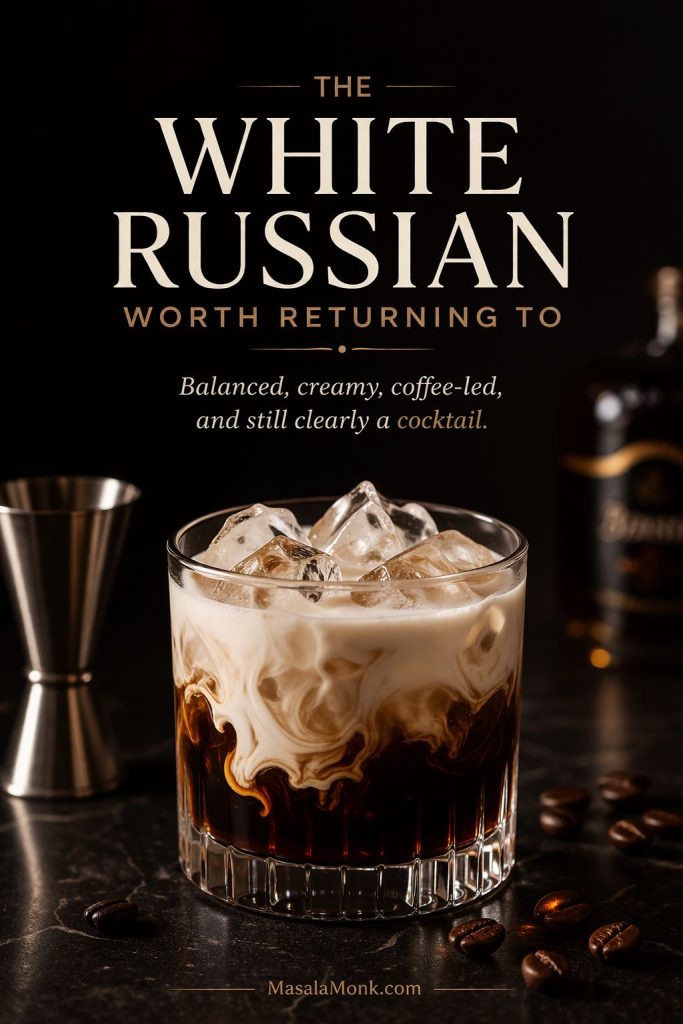
That is what makes the White Russian worth returning to. It is easy to make, quick to adjust, and far better when it is built with intention instead of treated like a lazy pour. If a reader comes here looking for the best White Russian recipe, an easy White Russian recipe, a simple White Russian recipe, or just the clearest answer to how to make a White Russian drink, the core lesson is the same: keep the drink balanced, keep the dairy under control, and let the coffee note stay visible enough to matter.
Also Read: Slow Cooker Pork Tenderloin (Crock Pot Recipe) — 3 Easy Ways
White Russian Recipe FAQs
1. What is in a White Russian?
A classic White Russian contains vodka, coffee liqueur, and dairy, usually half-and-half or cream, served over ice. That is the whole foundation of the drink. Some versions use milk for a lighter result, but the classic structure stays the same: spirit, coffee depth, creamy texture, and enough chill to keep it smooth and slow-sipping.
2. What is the best ratio for a White Russian Recipe?
For most readers, the best White Russian recipe ratio is 2 ounces vodka, 1 ounce coffee liqueur, and 1 ounce half-and-half or cream. That keeps the drink creamy without letting it turn vague or overly sweet. Equal parts can work, but they usually create a softer, more dessert-like glass. If balance matters more than indulgence, 2:1:1 is the better place to start.
3. Is half-and-half or heavy cream better in a White Russian?
Half-and-half is usually better for the classic version because it keeps the drink creamy while still letting the coffee and vodka show through. Heavy cream makes a richer and slower White Russian, which can be excellent when you want something more decadent. In other words, half-and-half is the better all-around choice, while heavy cream is the better indulgent choice.
4. Can you make a White Russian without Kahlúa?
Yes, you can make a White Russian without Kahlúa as long as you use another coffee liqueur. Kahlúa is the most familiar option, but it is not the only one. What matters is that the bottle brings enough coffee character to balance the dairy and vodka. A darker, less sugary coffee liqueur often makes the drink feel firmer and more coffee-led.
5. What is the difference between a White Russian and a Black Russian?
A Black Russian contains vodka and coffee liqueur. A White Russian adds dairy. That one change alters the drink far more than it sounds. The Black Russian feels darker, drier, and more spirit-forward, while the White Russian is smoother, rounder, and more indulgent. If you want the same core flavor family with a softer finish, the White Russian is the better choice.
6. How strong is a White Russian?
A White Russian is stronger than it tastes. The cream softens the edges, and the coffee liqueur adds sweetness, so the drink can feel gentler than it really is. In practice, it still contains a full pour of vodka, so it is best treated as a proper cocktail rather than a casual dessert drink. The exact strength depends on your proportions and the coffee liqueur you use.
7. Can you make a White Russian ahead of time?
You can prepare part of it ahead, but the full drink is best assembled just before serving. Vodka and coffee liqueur can be measured in advance, but the dairy and ice are better added at the last minute. That keeps the drink cold, smooth, and properly structured instead of watered down or tired by the time it reaches the glass.
8. What is the best coffee liqueur for a White Russian recipe?
The best coffee liqueur for a White Russian is the one that gives the drink enough roast and depth without making it cloying. Kahlúa is the classic starting point, but other coffee liqueurs can produce a darker or less sweet result. If you prefer a more dessert-like White Russian, a softer bottle works well. If you want a firmer coffee-forward drink, a drier bottle is often the better pick.








