Posted on — 2 Comments

Whipped Cream Recipe

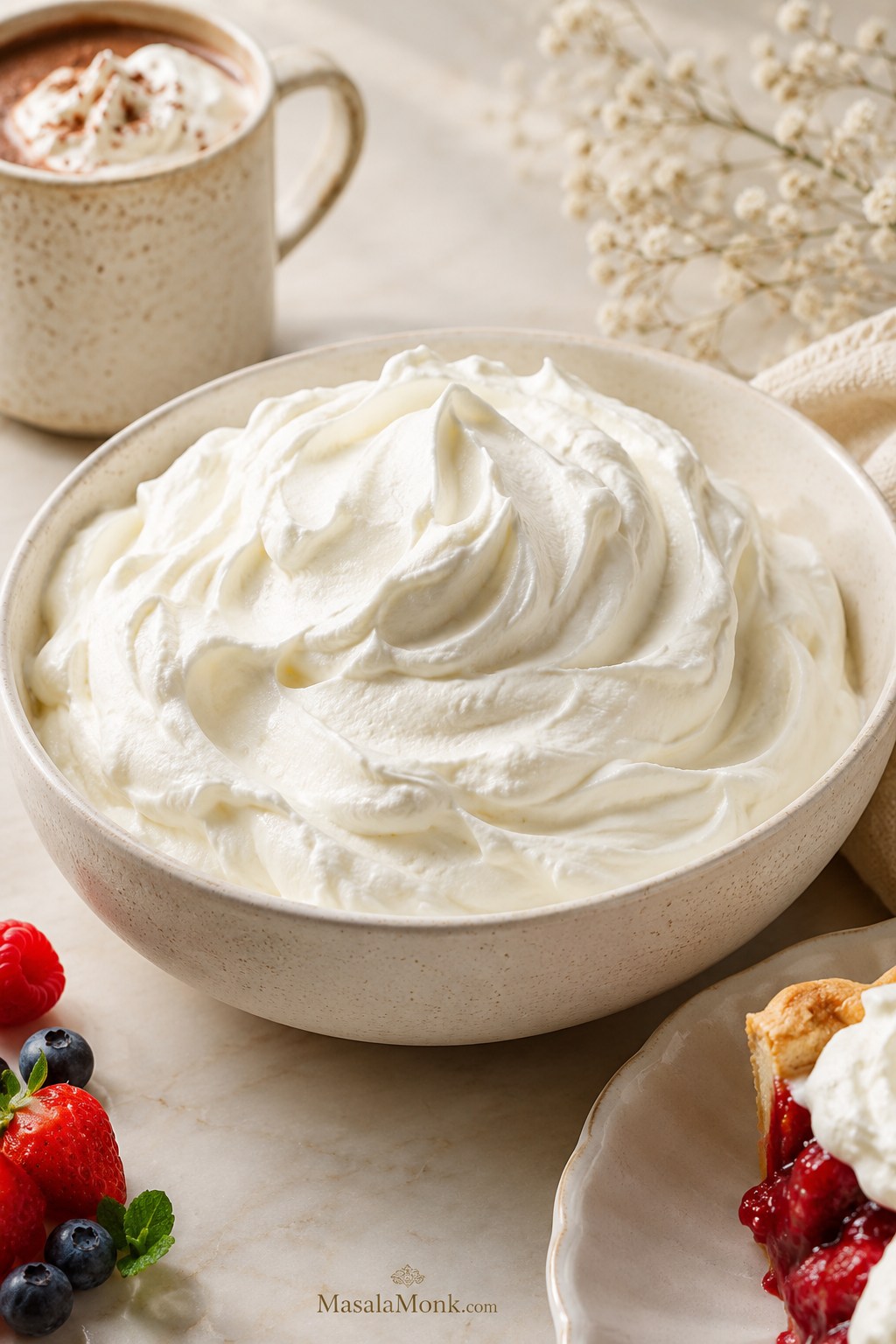
A bowl of homemade whipped cream with glossy soft peaks, served with berries, pie, and hot chocolate on a warm ivory surface.

This homemade whipped cream recipe turns heavy cream, powdered sugar, and vanilla into a soft, fluffy topping for pies, cakes, fruit, hot chocolate, pancakes, waffles, and no-bake desserts. Once you know the stopping point, it feels almost unfairly easy: fresher, softer, and cleaner-tasting than anything from a tub or can.

It is also one of the fastest ways to make a simple dessert feel intentional. A bowl of berries, a warm slice of pie, or a mug of hot chocolate suddenly feels finished when there is a spoonful of cool, billowy cream on top.

The method is simple: choose cream that can whip, sweeten it lightly, and stop while the texture is still glossy. The full recipe comes early, followed by the details that help you adjust sweetness, choose the right peak stage, fix mistakes, make it ahead, and use it on cakes or desserts.

What Good Whipped Cream Should Look Like

Before you start whipping, keep the target texture in mind: homemade whipped cream should look glossy, soft, and billowy, not dull, dry, or grainy.
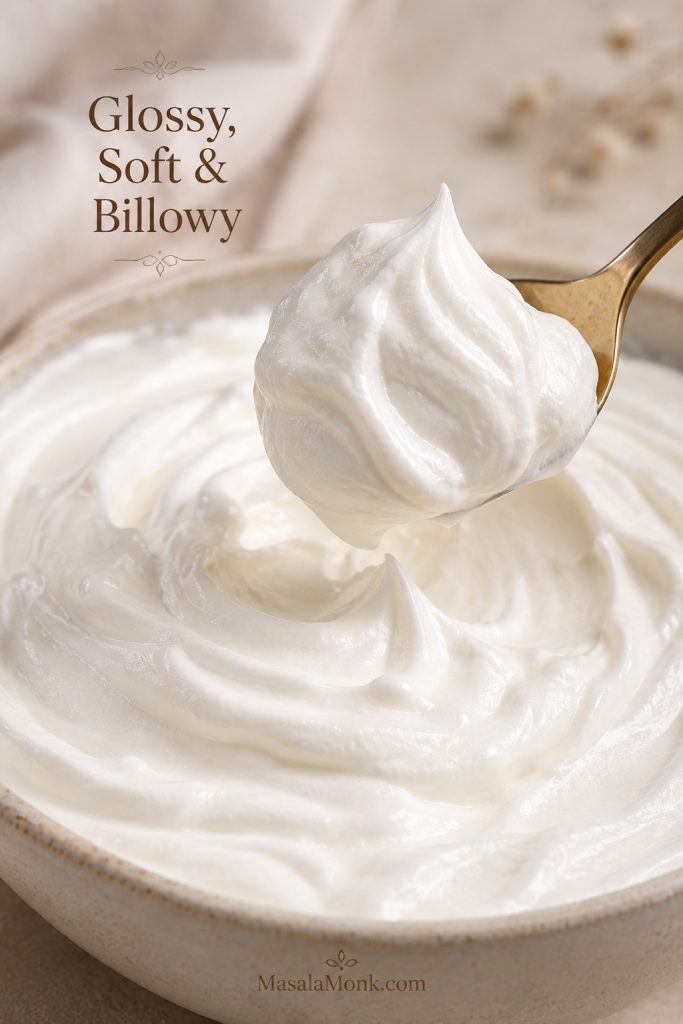
Close-up of glossy homemade whipped cream with soft folds and a spoon lifting a billowy mound.
Look for a surface that still shines. When whipped cream turns dull, clumpy, or dry-looking, it is usually moving past the ideal stage.

Quick Answer: How to Make Whipped Cream

Quick answer: To make whipped cream, beat 1 cup cold heavy cream with 2 tablespoons powdered sugar and 1/2 to 1 teaspoon vanilla until soft, medium, or stiff peaks form. One cup of cream makes about 2 cups whipped cream. For most desserts, aim for medium peaks: glossy, spoonable peaks that bend gently at the tip.

Start the mixer on low so the cream does not splash, then increase the speed once the sugar has blended in. The cream is ready when the beater leaves soft trails in the bowl and the lifted cream forms a peak that holds for a moment before gently bending.

For everyday desserts, do not chase stiff peaks unless you need a firmer topping. Once you see trails from the beaters, stay close — the final stretch happens quickly.

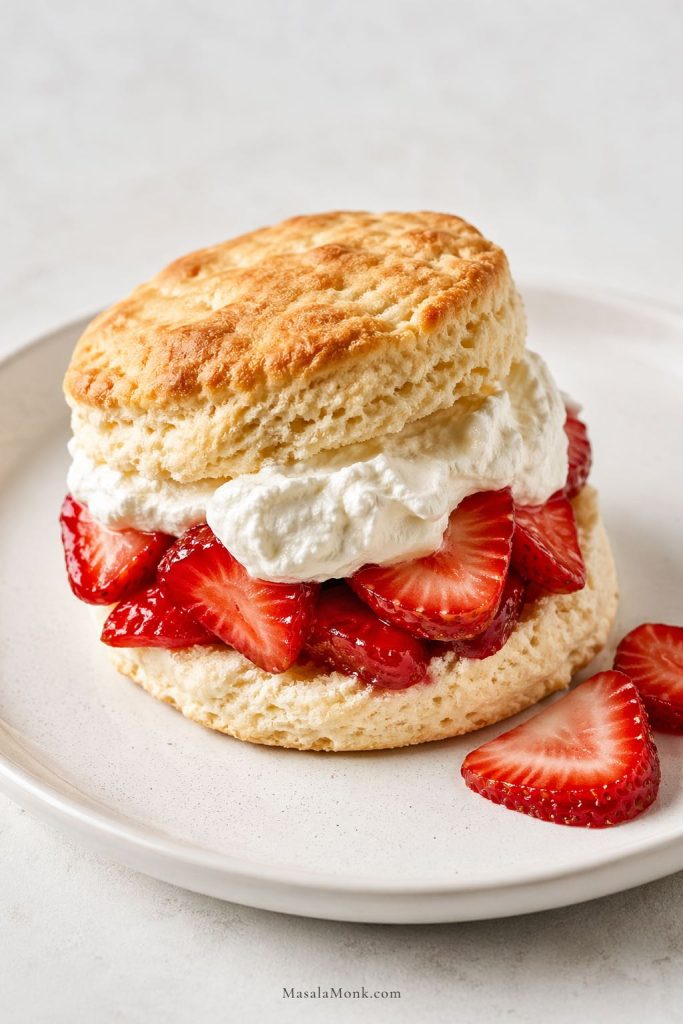
For strawberry shortcake, a gently bending texture is better than stiff peaks because the cream should soften into the berries and cake instead of sitting on top like frosting.

Whipped Cream at a Glance

Use this as the fast reference before making the recipe.

Detail Recommended answer
Prep time 5 minutes
Yield About 2 cups whipped cream, or 8 servings of about 1/4 cup each
Base ratio 1 cup cream + 2 tablespoons powdered sugar + 1/2 to 1 teaspoon vanilla
Best everyday texture Medium peaks: glossy, soft, and gently bending
Storage Best the same day; refrigerate 24–48 hours if needed

Homemade Whipped Cream Recipe Card

This is the full basic recipe. After the card, you’ll find scaling, ingredient notes, cream-type guidance, texture cues, fixes, storage, and variations.

Homemade Whipped Cream Recipe

This whipped cream recipe uses cold heavy cream, powdered sugar, and vanilla for a smooth, fluffy topping that works for pies, cakes, fruit, hot chocolate, pancakes, waffles, and no-bake desserts.

Prep Time
5 minutes
Cook Time
0 minutes
Yield
About 2 cups
Servings
8 servings
Serving Size
About 1/4 cup
Default Texture
Medium peaks
Cream
Heavy cream or heavy whipping cream
Best Used
Same day

Ingredients

  • 1 cup / 240 ml cold heavy cream or heavy whipping cream
  • 2 tablespoons / about 15 g powdered sugar
  • 1/2 to 1 teaspoon vanilla extract
  • Tiny pinch of fine salt, optional

Instructions

  1. Chill a metal mixing bowl for 10–15 minutes if your kitchen is warm.
  2. Add the cold heavy cream, powdered sugar, vanilla, and optional salt.
  3. Beat on low speed for 20–30 seconds to combine without splashing.
  4. Increase to medium or medium-high speed.
  5. Once visible trails form, check every few seconds. For most desserts, stop when the cream holds a soft mound on a spoon, looks glossy, and bends gently at the tip.
  6. Stop earlier for loose toppings, or continue carefully for firmer peaks.
  7. Use immediately, or refrigerate and gently re-whisk before serving if needed.

Notes

  • Do not walk away once beater trails stay visible; the final stage happens quickly.
  • For a less sweet topping, use 1 tablespoon powdered sugar.
  • For a sweeter dessert cream, use 3 tablespoons powdered sugar.
  • For cakes or piping, this fresh version is best served the same day; use a cake-stable version for longer hold.
  • Not sure what medium peaks look like? Use the peak guide before you keep beating.
  • If the cream turns grainy, stop mixing and fold in 1 tablespoon cold cream by hand.
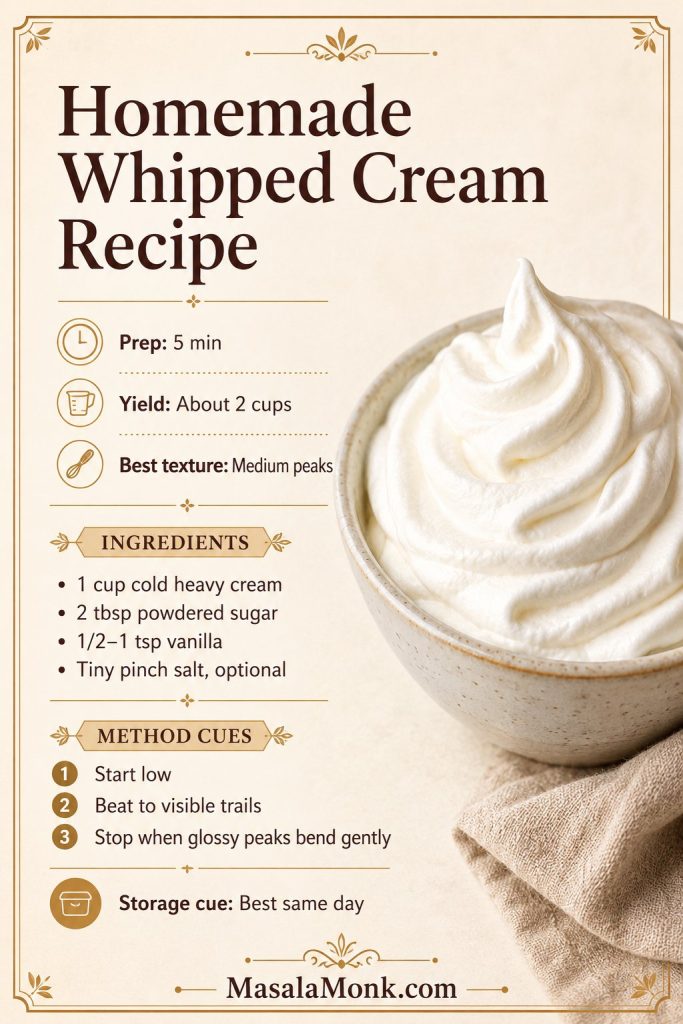
Saveable homemade whipped cream recipe card showing heavy cream, powdered sugar, vanilla, prep time, yield, and medium peak guidance.
The base ratio is easy to remember, but timing matters more than the clock. Once the cream forms visible trails, check the peaks often so you stop before the texture turns grainy.

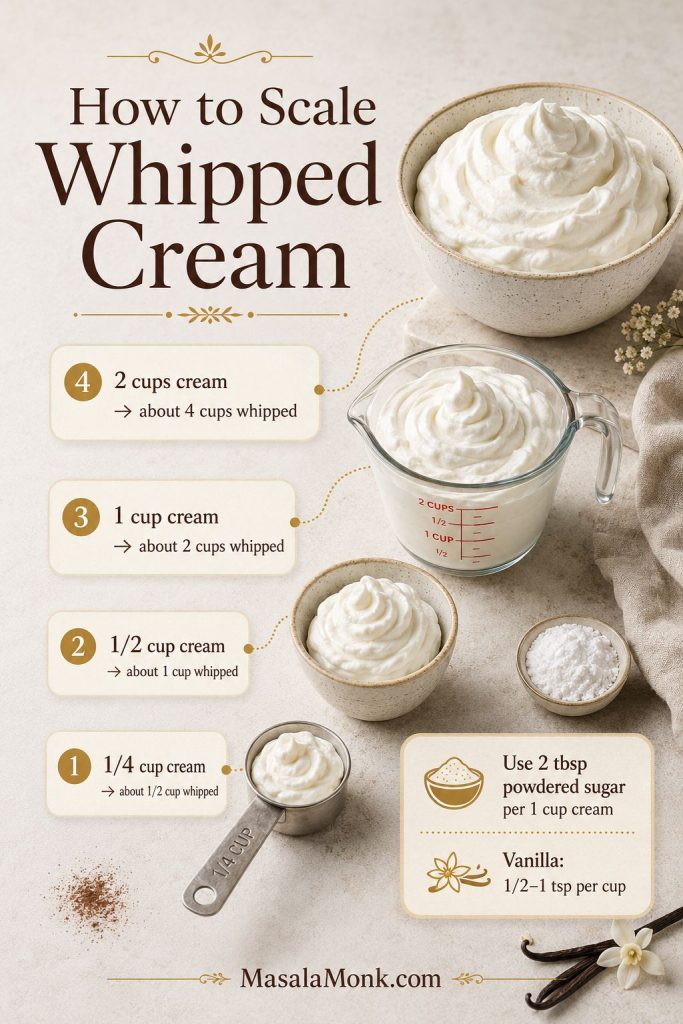
How to Scale This Whipped Cream Recipe

The recipe scales easily. You can make just enough for two mugs of hot chocolate or enough for a whole pie without changing the method.

Cream Powdered sugar Vanilla Approximate yield Best for
1/4 cup / 60 ml 1–2 teaspoons 1/8–1/4 teaspoon About 1/2 cup whipped cream Coffee, hot chocolate, berries for one or two.
1/2 cup / 120 ml 1 tablespoon / 7–8 g 1/4–1/2 teaspoon About 1 cup whipped cream Fruit, pancakes, waffles, or a small dessert.
1 cup / 240 ml 2 tablespoons / about 15 g 1/2–1 teaspoon About 2 cups whipped cream Pie topping, cake slices, shortcakes, pudding, or family dessert.
2 cups / 480 ml 1/4 cup / about 30 g 1–2 teaspoons About 4 cups whipped cream Dessert table, larger pie, trifle, or crowd serving.
Whipped cream scaling guide showing different cream amounts, powdered sugar, vanilla, approximate yield, and best uses.
Cream expands as it whips, so a small amount goes further than it looks. Make a tiny batch for coffee or berries, then scale up for pie, cake, trifle, or a dessert table.

If you are scaling whipped cream for a cake, cupcakes, or any dessert that needs to sit longer, check the regular vs stabilized whipped cream guide before choosing the final texture.

Why This Whipped Cream Recipe Works

This whipped cream recipe works because it does not ask you to do anything fussy. Cold cream, a smooth sweetener, and the right stopping point give you a topping that feels light, fresh, and homemade without turning stiff or grainy.

  • Cold cream traps air better. When the fat in the cream is cold, the cream whips faster and holds a smoother shape.
  • Powdered sugar dissolves easily. It sweetens the cream without leaving a gritty texture.
  • The right peak stage keeps it soft. The cream should hold a gentle mound but still taste cool, light, and fresh.
  • Stopping early prevents graininess. Once the beater trails stay visible, whipped cream can move from perfect to overworked quickly.

Homemade Whipped Cream Ingredients

With only three main ingredients, quality and balance matter. The cream gives body, the sugar smooths the flavor, and vanilla makes the topping taste like dessert instead of plain whipped dairy.
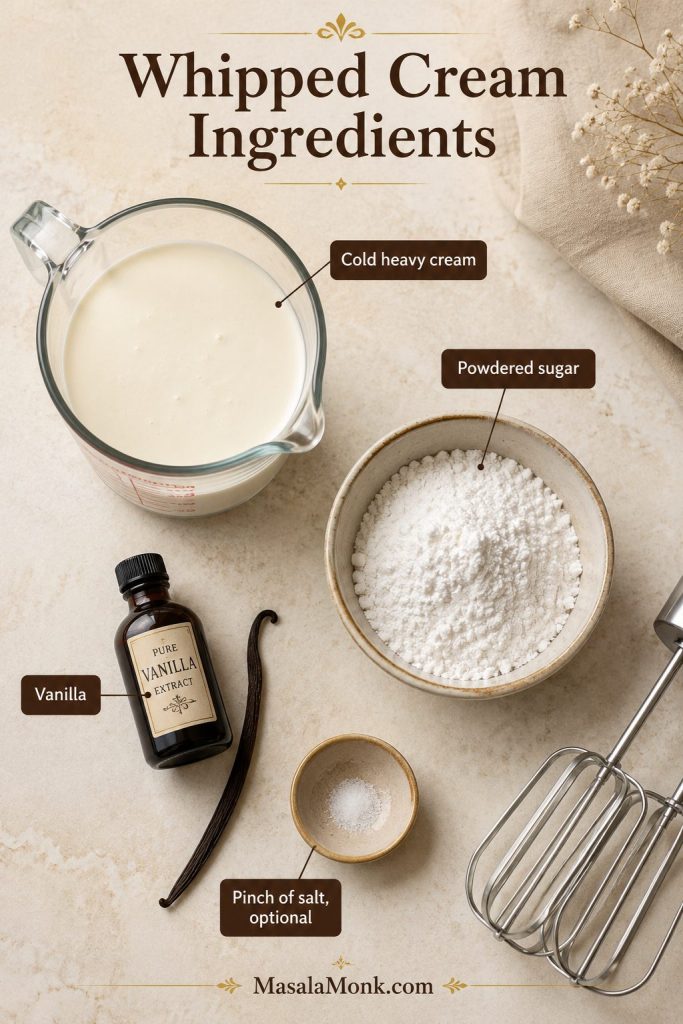
Ingredients for homemade whipped cream, including cold heavy cream, powdered sugar, vanilla, optional salt, and a whisk.
Each ingredient has a simple job: cream builds body, sugar smooths the flavor, and vanilla makes the topping taste like dessert. Because the list is short, cream quality matters.
Ingredient Amount Why it matters
Cold heavy cream or heavy whipping cream 1 cup / 240 ml The base of the recipe. Use it straight from the fridge.
Powdered sugar 2 tablespoons / about 15 g Sweetens smoothly without gritty crystals.
Vanilla extract 1/2 to 1 teaspoon / 2.5–5 ml Adds the classic dessert flavor.
Fine salt Tiny pinch, optional Balances sweetness, especially with chocolate, caramel, or very sweet desserts.

For a less sweet topping, use only 1 tablespoon powdered sugar per cup of cream. For a sweeter cream closer to Chantilly cream, use 3 tablespoons. The 2-tablespoon version is the easiest middle ground for pies, fruit, hot chocolate, pancakes, and no-bake desserts.

Heavy Cream vs Whipping Cream: Which One Works Best?

For the easiest success, use heavy cream or heavy whipping cream. In U.S. labeling, heavy cream is cream with at least 36% milkfat, which helps it whip into fuller peaks and hold its shape longer.

Outside the U.S., cream names vary. The label matters more than the name, so look for cream meant for whipping and check the fat percentage when it is listed.
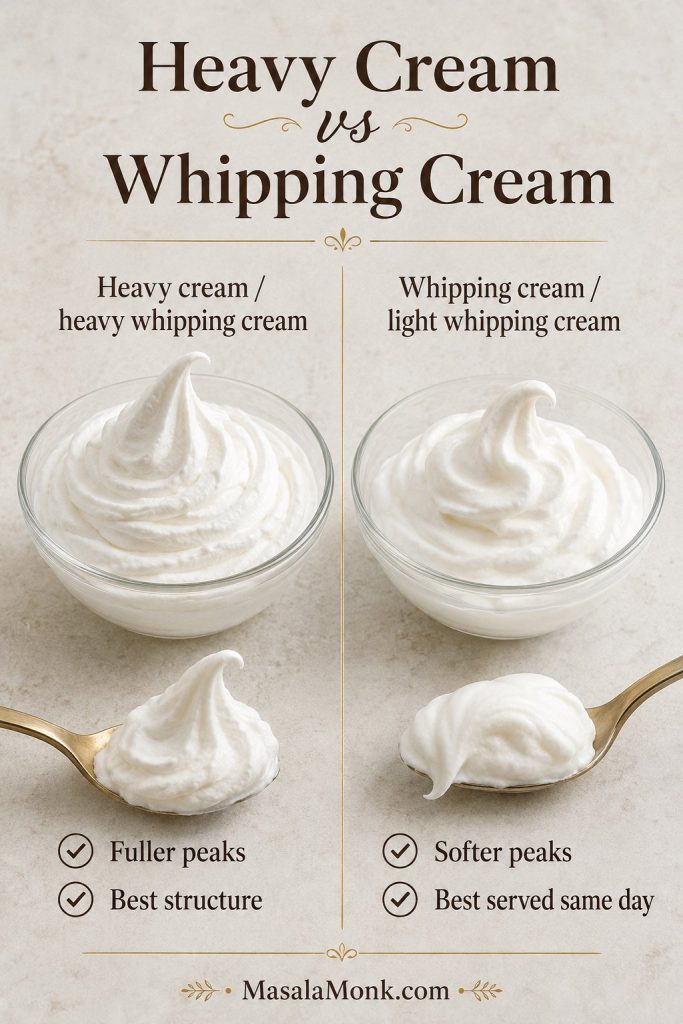
Side-by-side comparison of whipped cream made with heavy cream and lighter whipping cream, showing fuller and softer peaks.
Before blaming your mixer, check the carton. Heavy cream usually gives stronger peaks, while lighter whipping cream makes a softer topping that is best served soon.
Cream type Will it whip? Use it for
Heavy cream / heavy whipping cream Yes, most dependable Fuller whipped cream with the best structure.
Whipping cream / light whipping cream Yes, but softer A soft topping for same-day desserts.
Double cream Yes, very rich Rich whipped cream, though it can overwhip quickly.
Fresh cream / regional fresh cream Depends on fat percentage May thicken softly, but may not form firm, lasting peaks.
Lower-fat cream Usually not well Cooking, sauces, coffee, or desserts where whipped peaks are not required.
Milk or half-and-half No They do not have enough fat for classic whipped cream.

If your cream refuses to thicken, check the carton before blaming your technique. Cream meant for cooking, coffee, or sauces may not have enough fat to whip properly. In places where “fresh cream” is common, choose a whipping label or a higher fat percentage when you want lasting peaks.

What Will Whip and What Will Not

If the cream looks loose even after chilling and whipping, use this carton check before adding more sugar. The issue is often the product, not your effort.
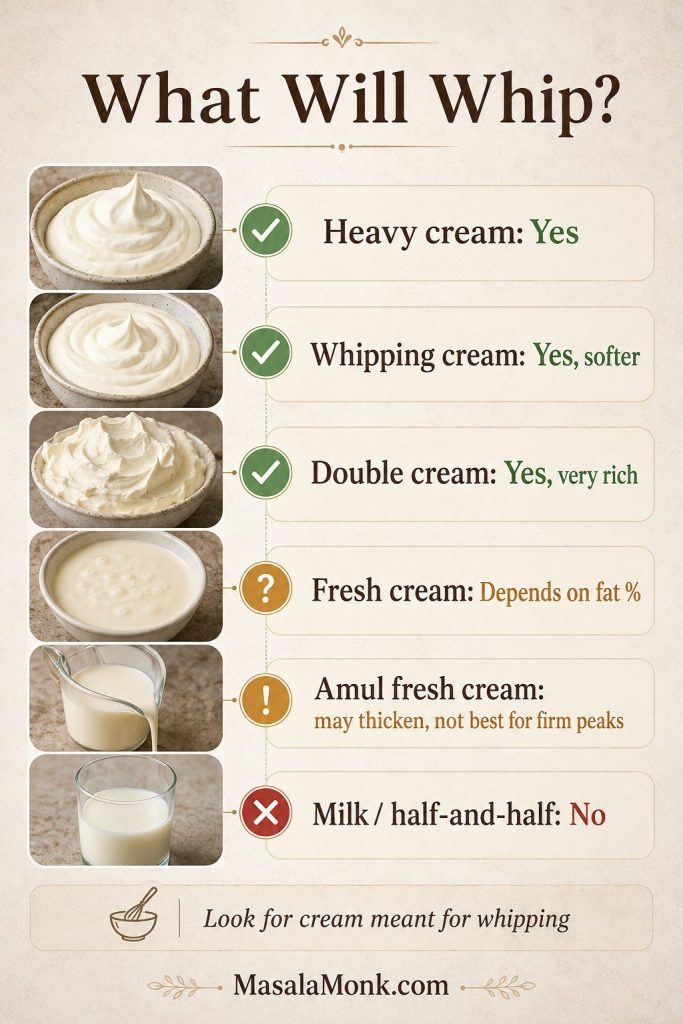
Guide showing which dairy products whip into whipped cream, including heavy cream, whipping cream, double cream, fresh cream, Amul fresh cream, milk, and half-and-half.
Not every dairy product can trap enough air to become whipped cream. For reliable peaks, choose cream labeled for whipping; milk, half-and-half, and many lower-fat creams stay too loose.

If your bowl still looks runny after choosing the right cream, jump to the troubleshooting guide before changing the recipe.

Sugar Options for Whipped Cream

Powdered sugar is the easiest sweetener because whipped cream is not heated. Larger sugar crystals can stay slightly gritty if they do not dissolve fully.

Sweetener Works well for Watch-out
Powdered sugar Smooth, classic whipped cream The easiest default for most desserts.
Granulated sugar Lightly sweet cream served soon Can feel grainy if it does not dissolve.
Maple syrup or honey Natural-sweetener variations Adds flavor and can make the cream slightly softer.
Sugar-free sweetener Lower-sugar desserts Use a powdered or very fine sweetener if possible.

Sweetness is flexible. The cream should taste gently sweet, not sugary, because most desserts already bring their own sweetness. For savory dishes or very low-sugar desserts, you can leave the sugar out entirely as long as the cream itself is suitable for whipping.
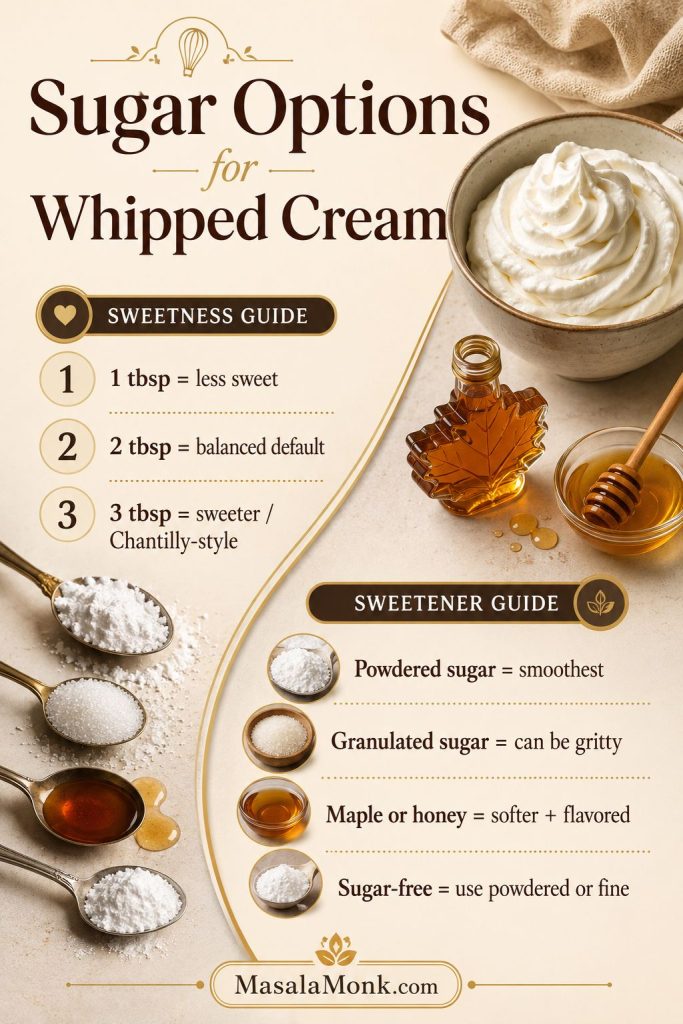
Sugar options for whipped cream showing powdered sugar, granulated sugar, maple syrup, honey, sugar-free sweetener, and different sweetness levels.
Use less sugar when the dessert is already sweet, and use a little more for a Chantilly-style cream. Powdered sugar stays the easiest default because it blends smoothly into cold cream.

How to Make Whipped Cream Step by Step

Once the cream and sugar are chosen, the actual whipping is quick. The only real skill is knowing when to stop.

If this is your first time making whipped cream, the change can feel slow at first and then sudden. At first it looks like nothing is happening. Then the cream thickens, the beater trails stay visible, and suddenly you are only a few seconds away from the perfect stage.
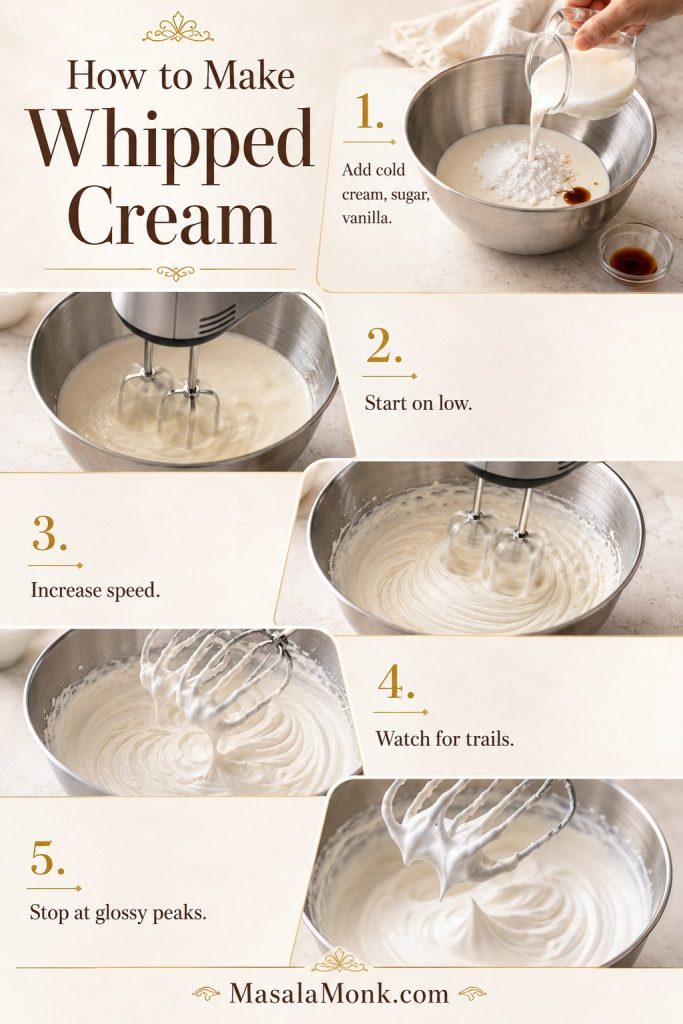
Step-by-step whipped cream process showing cream, sugar, and vanilla being added, mixed on low, whipped thicker, and stopped at glossy peaks.
Start slowly to avoid splashing, then increase the speed as the cream thickens. Once trails hold in the bowl, the recipe moves quickly from perfect to overdone.

Step 1: Chill the bowl if your kitchen is warm

If your kitchen is hot, chill a metal mixing bowl and beaters for 10–15 minutes. This is optional in a cool kitchen, but it gives you a little more control.

Step 2: Add the ingredients

Add 1 cup cold heavy cream, 2 tablespoons powdered sugar, 1/2 to 1 teaspoon vanilla extract, and a tiny pinch of salt if using.

Step 3: Start on low speed

Beat on low for 20–30 seconds. This keeps the cream from splashing and gives the sugar time to blend in.

Step 4: Increase the speed

Increase to medium or medium-high speed. For 1 cup of cream, a hand mixer usually takes about 2–4 minutes. A stand mixer can be faster, so watch closely.

Step 5: Stop at the right peak stage

First you will see bubbles, then loose foam, then visible trails from the beaters. Once those trails stay in the bowl, start checking every few seconds.

Whipping Stages to Watch For

The visual stages matter more than the exact minute mark. Once the bowl shows lasting trails, move slowly and use the peak guide to choose your final texture.
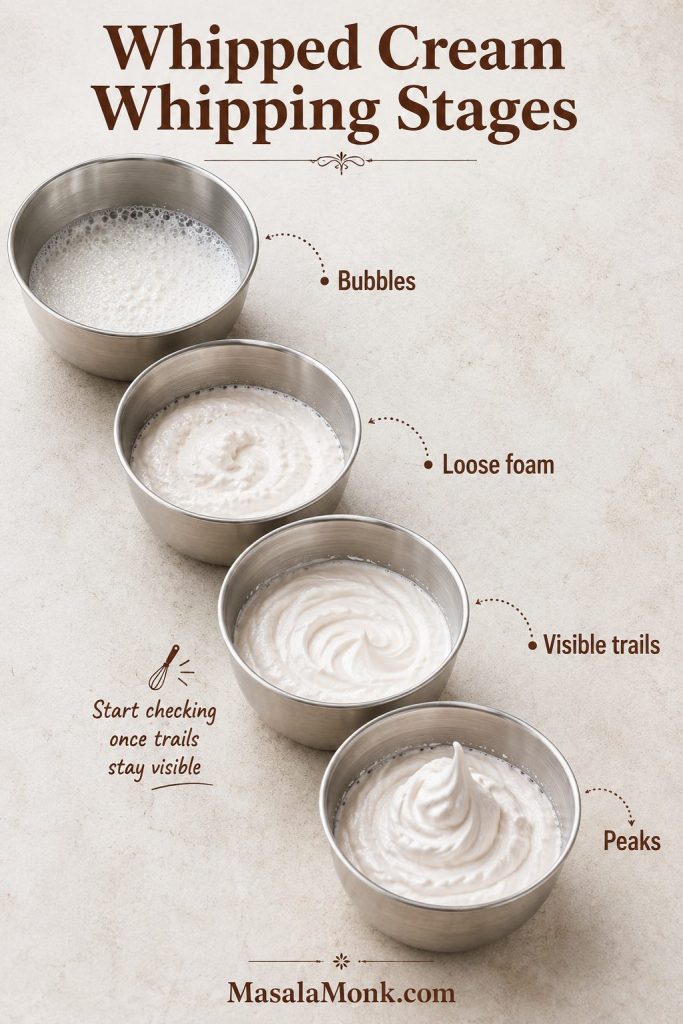
Whipped cream stages in a bowl showing bubbles, loose foam, visible trails, and formed peaks.
The bowl gives you the best clues: bubbles first, then foam, then trails, then peaks. As soon as those trails stay visible, stop relying on minutes and start checking texture.

Stop at soft peaks for a loose topping, medium peaks for most desserts, or stiff peaks for a firmer finish. Slow down, lift the beaters, and check the peak instead of trying to beat it for a fixed number of minutes.

Texture matters more than time. Different mixers, bowl sizes, cream brands, and kitchen temperatures change the timing. Watch the cream, not just the clock.

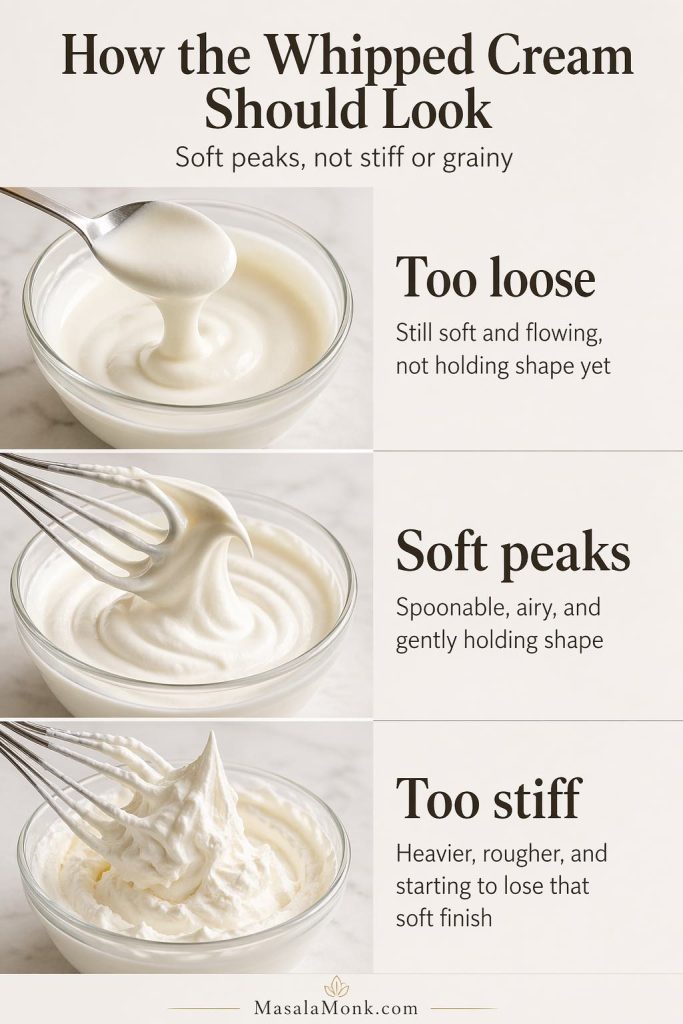
Soft Peaks vs Medium Peaks vs Stiff Peaks

The right texture depends on how you plan to use the cream. A soft spoonful for hot chocolate does not need the same structure as whipped cream for a pie topping.

Good whipped cream should feel cool and billowy, with just enough sweetness to make berries, pie, cake, or hot chocolate taste more finished — not buried under a sugary foam.
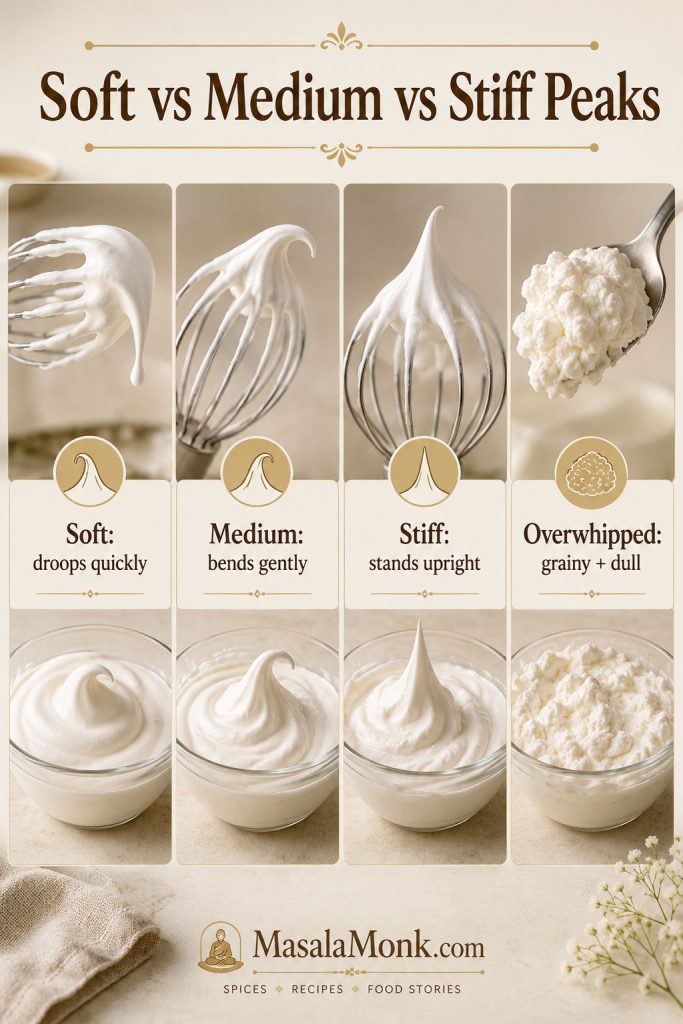
Comparison of soft peaks, medium peaks, stiff peaks, and overwhipped whipped cream with labeled texture examples.
Soft peaks droop, medium peaks bend gently, and stiff peaks stand tall. For most homemade whipped cream uses, the middle stage gives the best balance of hold and freshness.
Stage What it looks like Use it for
Soft peaks The cream falls back into itself and the peak droops quickly. Hot chocolate, fruit, pancakes, waffles, and folding into desserts.
Medium peaks The cream holds a spoonable mound and the tip bends gently. The most useful everyday texture for pies, cakes, fruit, and no-bake desserts.
Stiff peaks The peak stands upright, but the cream starts looking firmer and less glossy. Pie topping, firmer same-day dessert topping, or very simple piping served soon.
Overwhipped The cream looks grainy, dull, clumpy, or starts separating. Stop immediately and try the cold-cream rescue below.

For most home desserts, the middle stage is the sweet spot: soft enough to melt into warm pie, but structured enough to sit in pretty spoonfuls. Stiff peaks can be useful, but they are closer to overwhipping, so move slowly once the cream looks thick.

The Medium Peaks Spoon Test

When the cream holds a soft mound on a spoon and the tip bends gently, it is usually ready for most desserts.
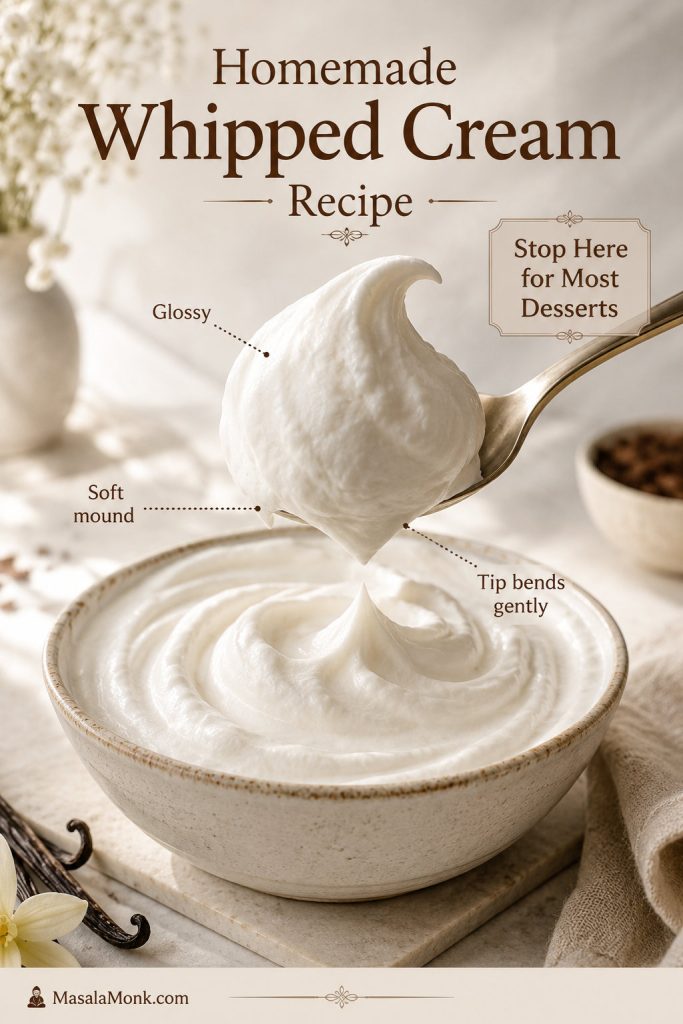
A spoon lifting whipped cream with a glossy soft mound and a gently bending tip to show medium peaks.
The spoon test makes the stopping point easier to judge. If the cream holds a soft mound without looking dry, it is ready for pies, berries, cakes, and no-bake desserts.

Stiff Peaks vs Overwhipped Cream

Stiff peaks can be useful, but they sit close to the overwhipped stage. If the bowl already looks dull or grainy, skip ahead to the overwhipped cream fix before mixing more.
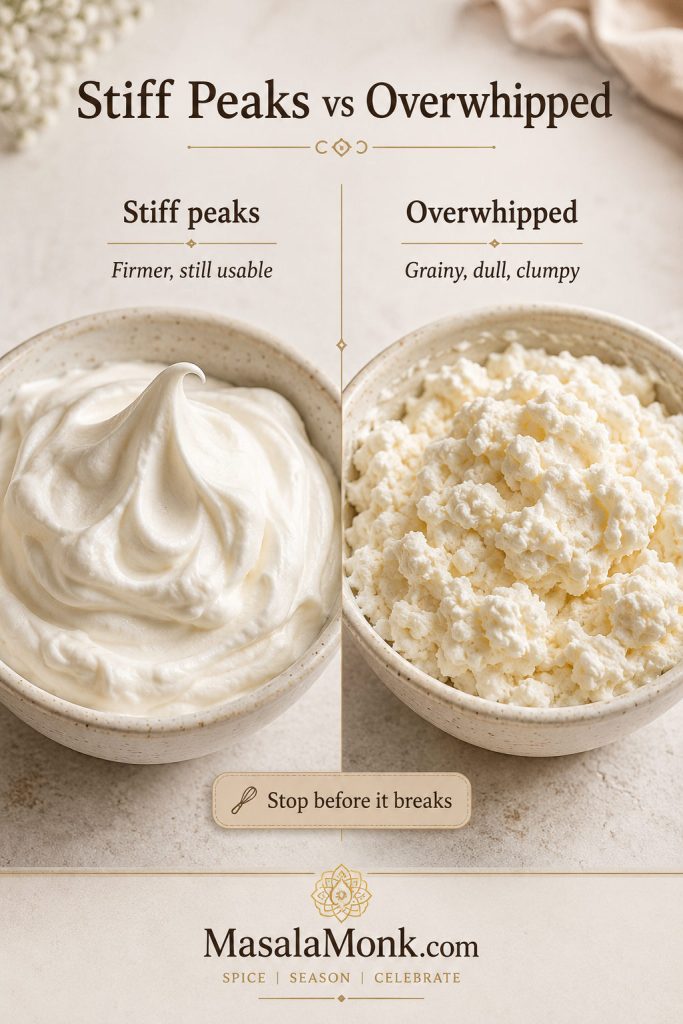
Side-by-side comparison of stiff whipped cream peaks and overwhipped grainy whipped cream.
Stiff peaks are still usable, but overwhipped cream starts looking dull, grainy, and clumpy. When the shine disappears, stop before the cream separates.

Some chilled desserts need firmer whipped cream for structure. For example, a no-bake cheesecake depends on properly whipped cream, full-fat cream cheese, and enough chill time so the filling sets cleanly.

How to Fix Runny, Grainy, or Overwhipped Cream

Most whipped cream problems come down to temperature, cream type, or whipping too far. If something looks wrong, stop and check the texture before adding more ingredients.

Why Is My Whipped Cream Runny?

If your cream is still loose after a minute or two, do not panic. It may be too warm, underwhipped, or too low in fat. Chill the bowl and cream for 10–15 minutes, then whip again.

Do not try to fix runny whipped cream by dumping in a lot more sugar. Extra sugar may make the cream sweeter, but it will not solve a temperature, fat, or cream-type problem.

How to Fix Overwhipped Cream

If the bowl suddenly looks grainy, stop right there. Add 1 tablespoon cold cream and fold it in gently by hand. Add another small spoonful if needed.

Fold gently instead of beating again; more speed can push grainy cream closer to butter. If it has separated into buttery clumps, it may be too far gone to rescue as whipped cream, but you can keep going and turn it into homemade butter.
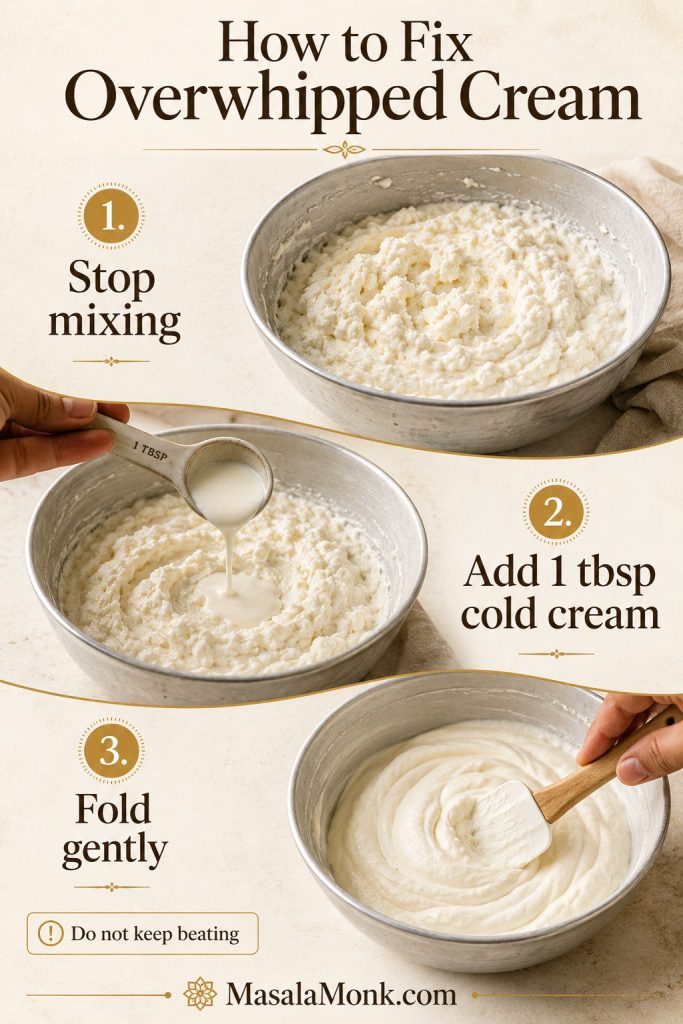
Overwhipped cream rescue steps showing grainy cream, cold cream being added, and the mixture being folded until smoother.
Slightly grainy cream can often be rescued if you stop early. Fold in cold cream by hand; beating again can push the mixture closer to butter.

If you want to understand that stage better, this homemade butter guide shows how cream moves from liquid to whipped cream to overwhipped cream and finally separates into butter and buttermilk.

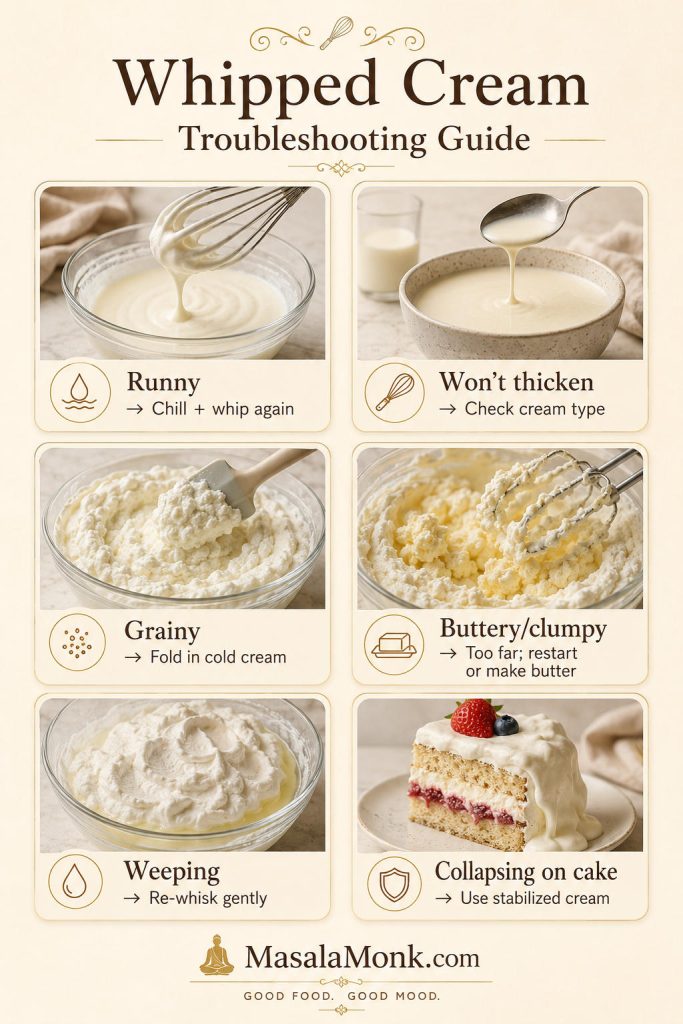
Problem Likely cause Fix
Runny cream Cream too warm, underwhipped, or too low in fat Chill for 10–15 minutes and whip again.
Cream will not thicken Wrong cream or not enough fat Use cream meant for whipping. Avoid milk and half-and-half.
Grainy cream Slightly overwhipped Fold in 1 tablespoon cold cream by hand.
Buttery or clumpy cream Severely overwhipped Restart, or keep going and turn it into homemade butter.
Weeping in the fridge Normal for fresh whipped cream Re-whisk gently before serving.
Collapsing on cake This basic version is too soft for long hold Use cream with extra support.
Whipped cream troubleshooting guide showing runny cream, cream that will not thicken, grainy cream, buttery cream, weeping cream, and cream collapsing on cake.
Runny cream, grainy texture, weeping, and collapsing all have different causes. Instead of adding more sugar, match the problem to temperature, cream type, or overwhipping first.

If the fix does not work, restarting is usually faster than fighting the bowl.

If the cream never thickens at all, the issue may be the carton rather than the clock. Recheck the cream-type guide before trying again.

Can You Make Whipped Cream Without a Mixer?

Yes. A hand mixer is easiest for most home cooks because it gives enough speed without feeling out of control. A stand mixer is useful for larger batches, but it can move quickly, so stay nearby once the cream begins to thicken.

A balloon whisk works well for small batches if the cream and bowl are cold. Use a wide bowl and a large whisk. There is no prize for whipping by hand if you are tired; the goal is smooth cream, not sore wrists.

For a tiny batch, you can shake cold cream in a chilled jar, stopping while it is still soft. A food processor or immersion blender can also work in short bursts, but the texture is usually denser and easier to overdo.
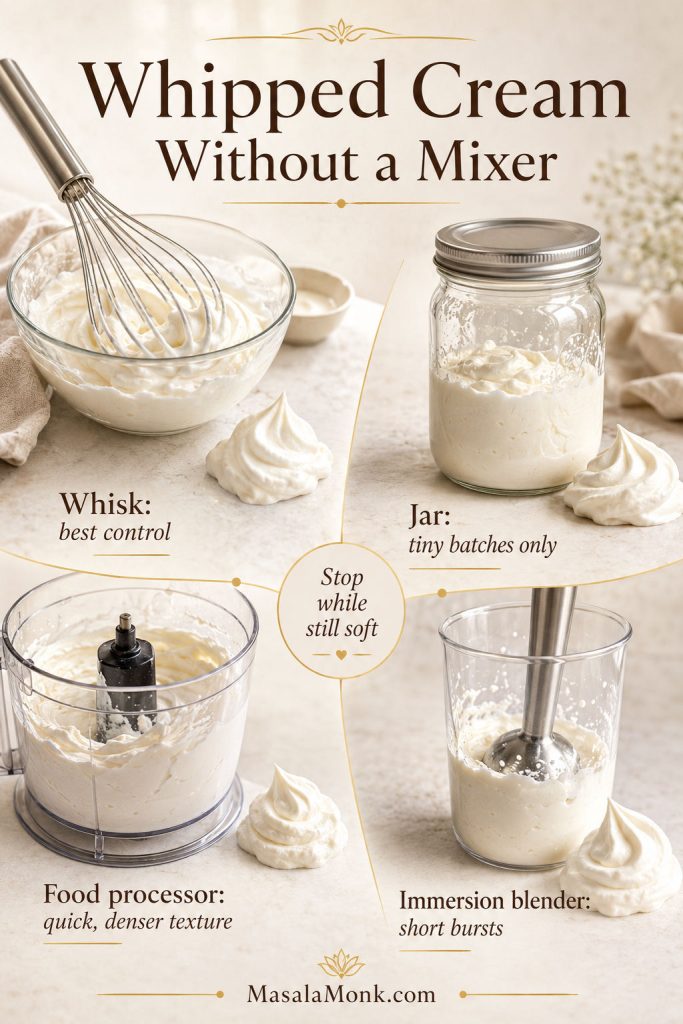
Whipped cream without a mixer guide showing a balloon whisk, jar method, food processor, and immersion blender.
A whisk gives the most control, while jars, food processors, and immersion blenders move faster than you expect. Smaller batches are safer when you are not using a hand mixer.

Make-Ahead, Storage, and Freezing

Homemade whipped cream tastes best the day it is made. For the nicest texture, use it within a few hours. If needed, refrigerate it in an airtight container for 24–48 hours and gently re-whisk before serving.
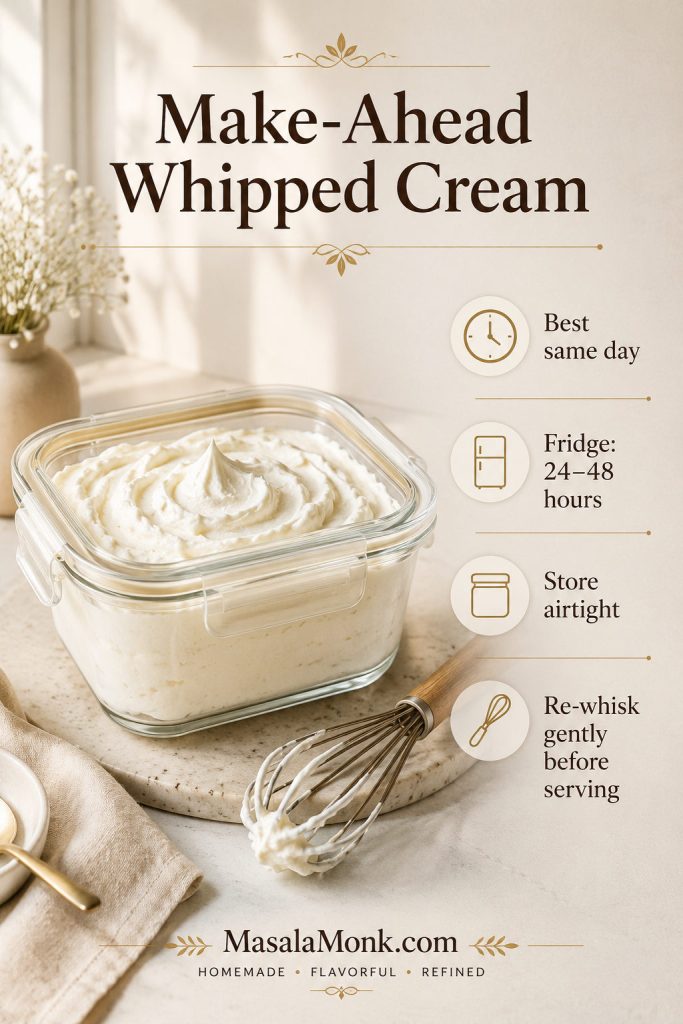
Make-ahead whipped cream stored in an airtight container with a whisk and labels for same-day use, refrigeration, and re-whisking.
Fresh whipped cream is most delicate after storage. Keep it cold and airtight, then re-whisk gently if it softens before serving.

Keep the cream cold until serving, then leave it out only for a short serving window. If the room is warm, return it to the fridge sooner. A little softening after refrigeration is normal, and a few gentle strokes with a whisk usually brings it back.

A little weeping after a night in the fridge is not a disaster; fresh whipped cream is airy and delicate in a way tub toppings are not.

If you need whipped cream to hold for piping, cupcakes, layer cakes, or overnight serving, read the regular vs stabilized section before making the batch.

Can You Freeze Whipped Cream?

Yes, but freeze it as small dollops rather than one large container. Spoon or pipe dollops onto a parchment-lined tray, freeze until firm, then transfer them to a freezer-safe box. Frozen whipped cream is useful for hot chocolate, coffee, pancakes, waffles, and quick dessert toppings; after thawing, it will not be as silky as freshly whipped cream.

Frozen dollops are especially nice for drinks. Drop one into a mug of keto hot chocolate and it melts slowly into the top while keeping the drink creamy.
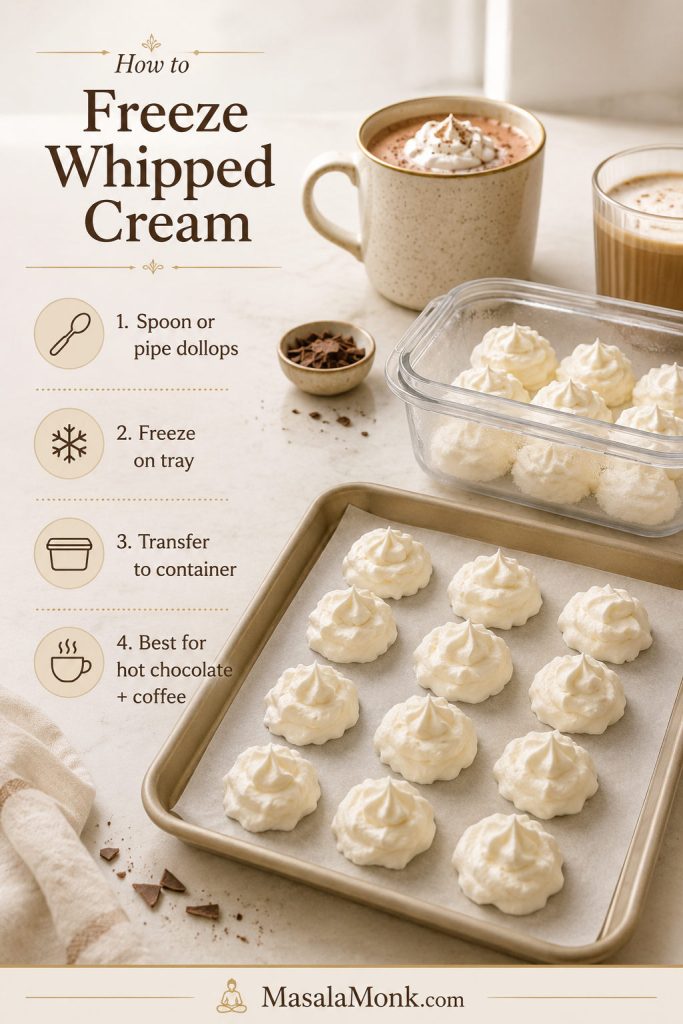
Whipped cream dollops on a parchment-lined tray with a storage container and hot chocolate in the background.
Freeze whipped cream in small dollops, not one large mass. Then you can add only what you need to hot chocolate, coffee, pancakes, or waffles.

Regular vs Stabilized Whipped Cream

Regular whipped cream is best when freshness matters: soft cream over pie, a cool topping for cake slices, a light layer on chilled desserts, or something airy to fold into no-bake fillings.

It also works beautifully as a soft cake topping when the cake stays cold and is served within a reasonable window. For example, a chilled tres leches cake is exactly the kind of dessert where regular whipped cream can feel light, creamy, and fresh.

Use stabilized whipped cream when the cream needs to hold its shape for piping, cupcakes, layer-cake filling, trifles, warm-weather serving, or overnight hold. For this basic recipe, keep the goal simple: soft whipped cream that tastes light and creamy, not a frosting replacement.
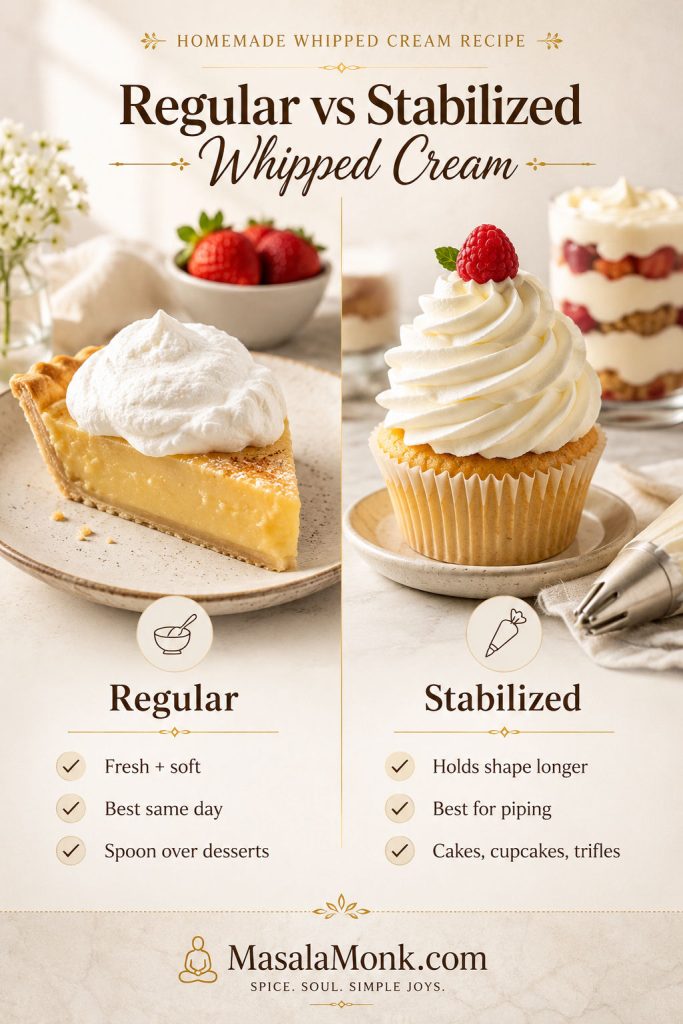
Comparison of regular whipped cream on a dessert and stabilized whipped cream piped on a cupcake with labels for same-day use and longer hold.
Regular whipped cream is best for fresh, soft toppings. However, stabilized whipped cream is better for piping, cupcakes, layer cakes, trifles, and longer hold.
Use Will this recipe work? Better choice
Spoon over a cake slice Yes Glossy, gently bending peaks
Top a cake served the same day Yes, if kept cold Soft to slightly firmer peaks
Frost a layer cake Not reliably Stabilized whipped cream
Pipe cupcakes Not reliably Stabilized whipped cream
Fill a cake overnight Not reliably Stabilized whipped cream or a cream-cheese whipped version

Ways to Use Homemade Whipped Cream

Homemade whipped cream is one of those small upgrades that makes simple desserts feel finished. Keep it softer for spooning, or whip it a little firmer when it needs to sit on top of a pie or no-bake dessert.
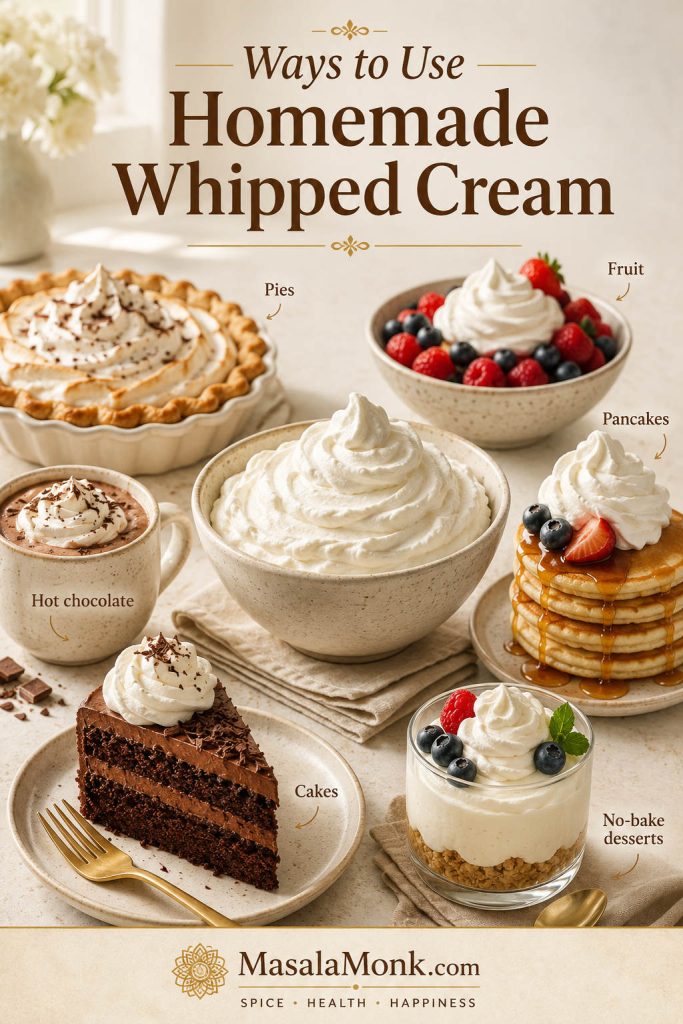
Homemade whipped cream served with pie, berries, pancakes, hot chocolate, cake, and a no-bake dessert.
Fresh whipped cream can finish dessert without making it feel heavy. Use it where contrast helps most: warm pie, tart berries, pancakes, hot chocolate, cake slices, and chilled no-bake desserts.

Warm desserts

Use softly structured peaks on warm pies, cobblers, crisps, and bread pudding. Think warm apple crisp, cinnamon steam, and the first spoonful where cool cream softens into the fruit instead of covering it up. That is why it works so well on desserts like apple crisp.
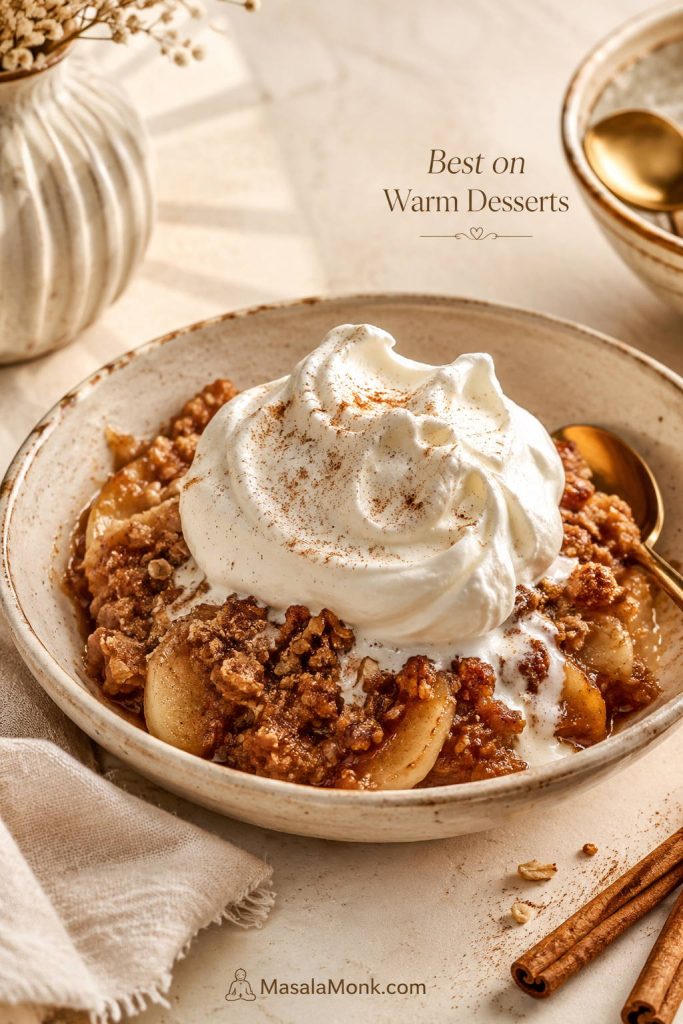
Homemade whipped cream melting softly over a warm apple crisp with cinnamon and a spoon nearby.
Cool cream against a warm dessert is the whole point. It softens into fruit, crumble, pastry, or bread pudding while keeping each bite lighter.

Fruit, breakfast, and drinks

Use soft to medium peaks for berries, pancakes, waffles, hot chocolate, coffee drinks, and simple spoon desserts. The cream should add softness and light sweetness without turning the whole plate heavy.
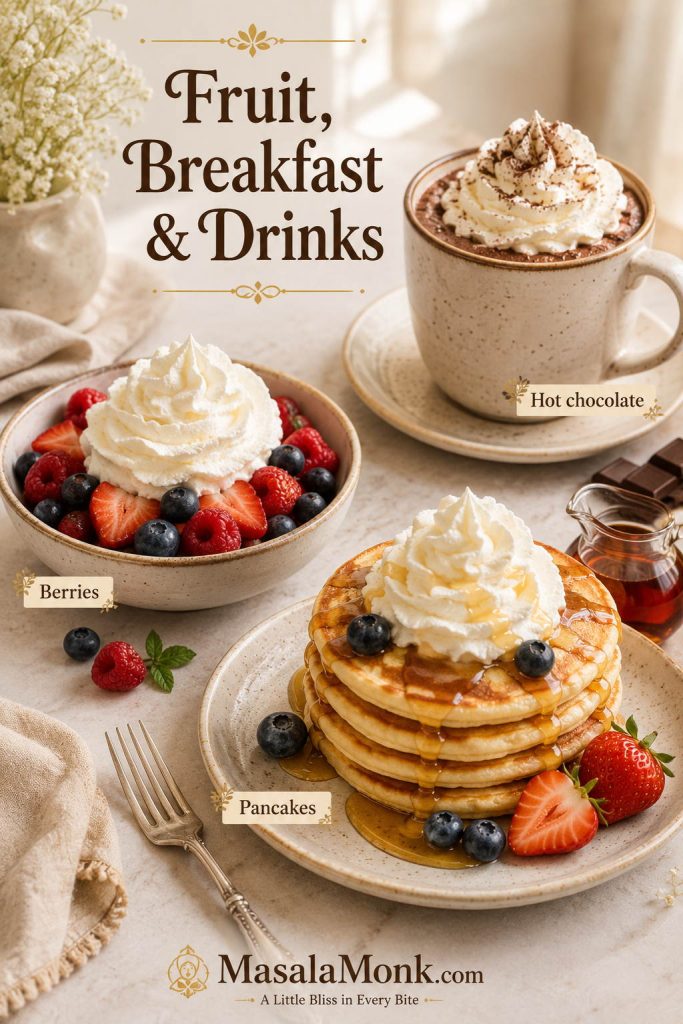
Whipped cream served with berries, pancakes with maple syrup, and a mug of hot chocolate.
For fruit, breakfast, and drinks, keep the cream soft rather than stiff. It should add lift to berries, pancakes, waffles, coffee, and hot chocolate instead of weighing them down.

Cold desserts and fillings

When whipped cream becomes part of the structure, follow the dessert’s own peak-stage instructions. In no-bake desserts like banana pudding, the cream is not just a topping — it helps the filling feel light and set properly.

For richer desserts, a lighter spoonful of cream can keep the whole bite from feeling too heavy, especially with something caramel-heavy like banoffee pie.

Once you know where you are serving it, the flavor variations can help match the cream to chocolate, fruit, coffee, citrus, or warm desserts.

Easy Whipped Cream Variations

Once the basic texture feels easy, the variations are where homemade whipped cream starts to feel personal: chocolate for richer desserts, maple for breakfast, cinnamon for apple pie, espresso for coffee drinks, and citrus for fruit. Add flavorings before whipping, then taste and adjust gently near the end.
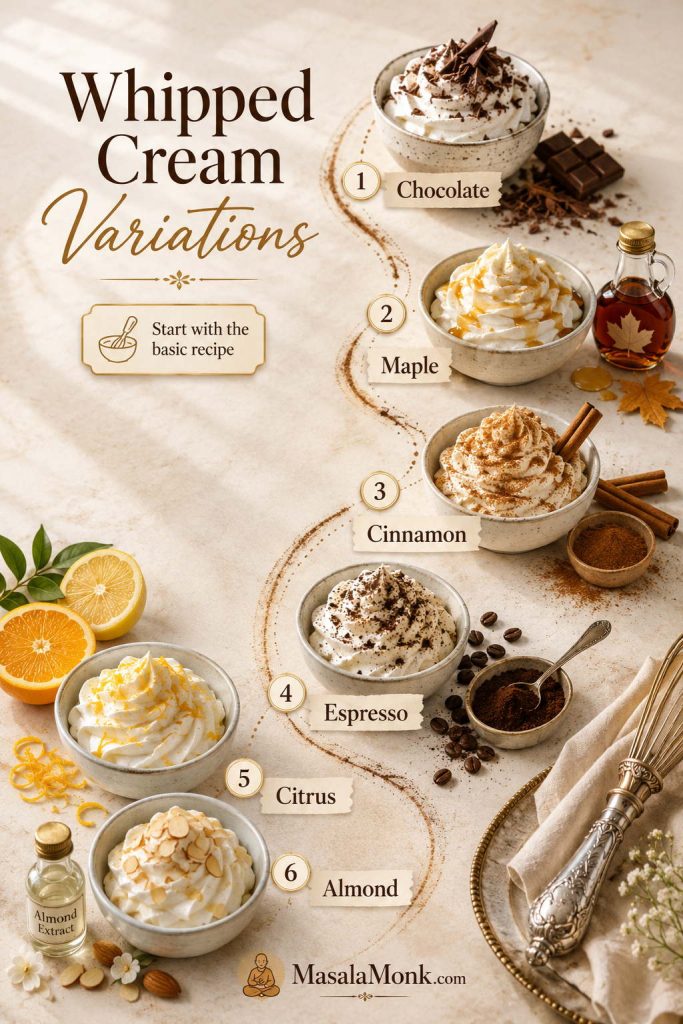
Whipped cream variations guide showing chocolate, maple, cinnamon, espresso, citrus, and almond flavor ideas with matching ingredients.
Once the base texture feels right, flavor variations become easy. Chocolate, maple, cinnamon, espresso, citrus, and almond can each shift the same cream toward a different dessert mood.
Variation How to make it Best with
Chocolate whipped cream Add 1 tablespoon cocoa powder and 1 extra tablespoon powdered sugar per cup of cream. Chocolate cake, brownies, pudding, hot chocolate.
Maple whipped cream Replace some or all of the powdered sugar with 1 tablespoon maple syrup. Pancakes, waffles, apple crisp, pumpkin desserts.
Cinnamon whipped cream Add 1/4 teaspoon ground cinnamon per cup of cream. Apple pie, apple crisp, hot chocolate, banana desserts.
Espresso whipped cream Add a small pinch of instant espresso powder. Chocolate desserts, tiramisu-style desserts, coffee drinks.
Citrus whipped cream Add finely grated orange or lemon zest. Berries, pound cake, fruit tarts, citrus desserts.
Almond whipped cream Add a tiny splash of almond extract; it is stronger than vanilla, so use less. Cherry desserts, chocolate cake, fruit crisps.

Chocolate Whipped Cream

Chocolate is the strongest variation when you want a deeper dessert topping. Keep the texture light, then use it on brownies, pudding, chocolate cake, hot chocolate, or berries.
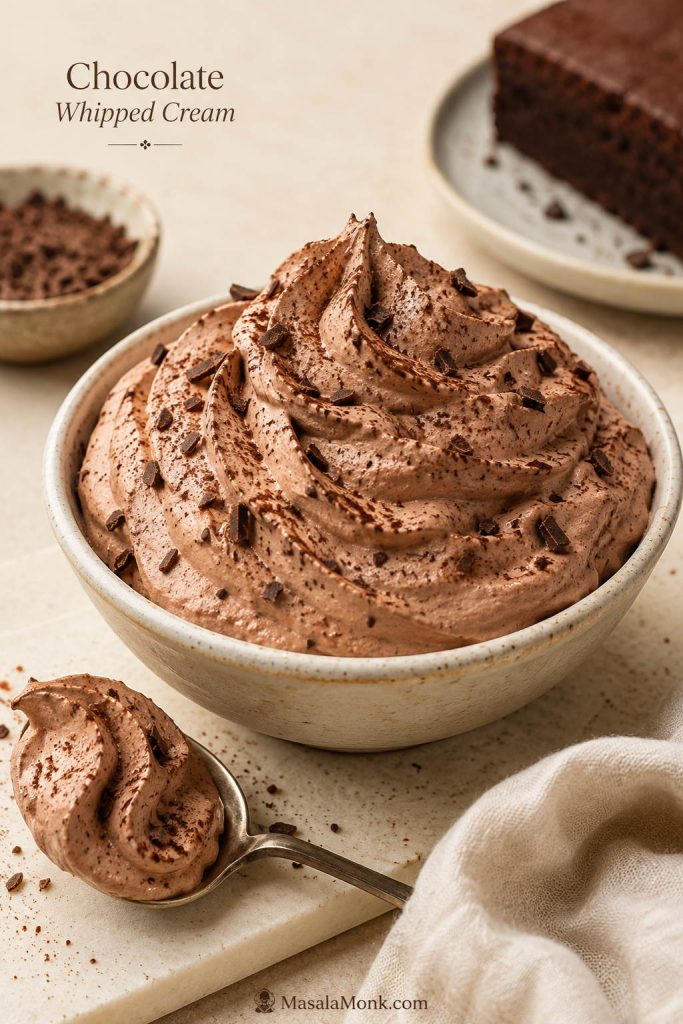
A bowl of chocolate whipped cream with cocoa powder, chocolate shavings, a spoonful of cream, and a chocolate cake in the background.
Chocolate whipped cream is the easiest richer variation because cocoa adds depth without changing the method much. Use it on brownies, chocolate cake, pudding, hot chocolate, or berries.

FAQs

What is the best cream for homemade whipped cream?

Heavy cream or heavy whipping cream is the most dependable choice because it has enough fat to hold air well and whip into a smooth, fluffy texture. Whipping cream can also work for a simple same-day topping, but it usually gives a softer result.

Can I make whipped cream with fresh cream?

It depends on the fat percentage and whether the cream is meant for whipping. Some fresh cream cartons may thicken softly when very cold, but they may not make firm, lasting peaks.

Does Amul fresh cream work for whipped cream?

Amul fresh cream is not the same as Amul whipping cream. It can thicken slightly when very cold, but it is not the best choice for firm whipped cream, piping, or frosting.

Is this the same as Chantilly cream?

Vanilla-sweetened whipped cream is often called Chantilly cream. This recipe works as a simple vanilla Chantilly cream for everyday desserts.

Will milk or half-and-half whip into whipped cream?

No. Milk and half-and-half do not have enough fat to trap and hold air like cream does. Use cream meant for whipping instead.

How long should I beat whipped cream?

For 1 cup of cream, a hand mixer usually takes about 2–4 minutes. A stand mixer may be faster, and a hand whisk may take 3–5 minutes. Watch the texture more than the clock.

What peak stage is best for pie or spooning over dessert?

Medium peaks are usually best. The cream should hold a soft mound on a spoon but still look glossy, light, and creamy.

What peak stage is best for folding into desserts?

Soft to medium peaks usually work best for folding. If the cream is too stiff, it can be harder to blend smoothly into puddings, mousses, or no-bake fillings.

Why is my whipped cream runny?

The cream may be too warm, underwhipped, or too low in fat. Chill the cream and bowl for 10–15 minutes, then whip again. If it still will not thicken, the cream may not be suitable for whipping.

Why did my whipped cream turn into butter, and can I fix it?

The cream was whipped too far. If it only looks grainy, stop mixing and fold in 1 tablespoon cold cream by hand. If it has separated into buttery clumps and liquid, it may be too far gone to rescue as whipped cream.

Can I make whipped cream ahead or freeze it?

Yes. It tastes freshest the day it is made, but you can refrigerate it for 24–48 hours and gently re-whisk before serving. For longer storage, freeze small dollops on a parchment-lined tray, then transfer them to a freezer-safe container.

Can I use this for piping or cake frosting?

This regular whipped cream works as a soft topping for cakes served the same day. For piping, layer-cake filling, cupcakes, or overnight hold, use stabilized whipped cream with extra support.
Back to top

Posted on — Leave a comment

Cream Puff Recipe

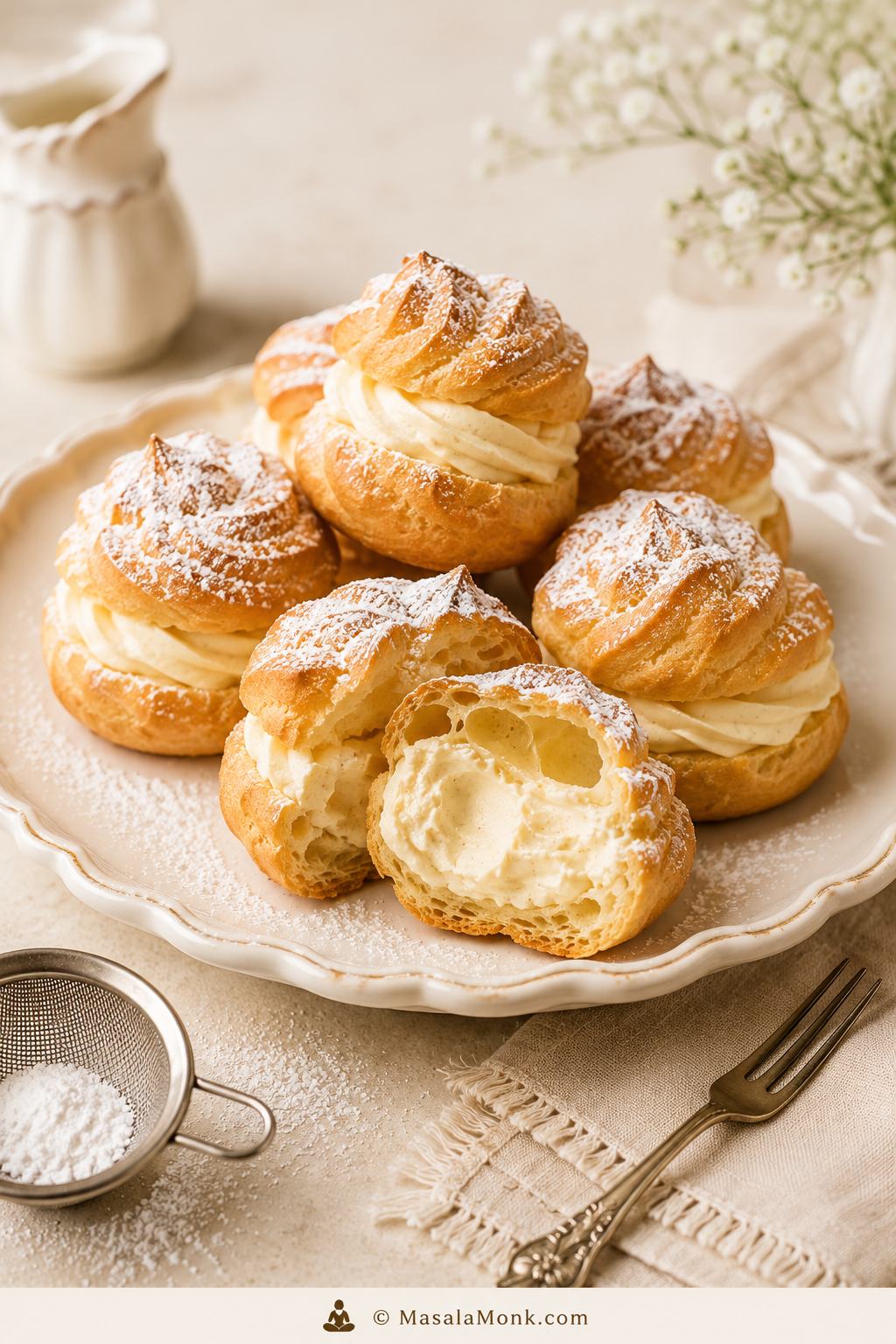
Golden cream puffs filled with vanilla cream and dusted with powdered sugar on an ivory plate.

Cream puffs look like bakery-case magic, but the dough is built from simple ingredients: water, milk, butter, flour, eggs, and a little patience. The best cream puffs feel light and crisp when you pick them up, then give way to soft vanilla cream inside. The real secret is knowing what the choux pastry should look like before it goes into the oven.

This cream puff recipe gives you golden choux pastry shells, a vanilla cream filling, and the practical cues that help the puffs rise, hollow out, and stay crisp enough to fill. You will learn when the dough is ready, how dark the shells should bake, what cream to use inside, why cream puffs collapse, and how to make them ahead without ending up with soggy pastry.

The reward is the contrast: a crisp, airy shell on the outside and cool vanilla cream tucked into the center. The method may feel strange the first time, especially when the dough looks rough, then smooth, then briefly broken after the eggs go in. That is normal. Once you understand the texture cues, cream puffs become much less intimidating.

Quick Answer: How to Make This Cream Puff Recipe

Cream puffs are made from choux pastry, a cooked dough that rises because steam expands inside it. To make them, cook water, milk, butter, sugar, salt, and flour into a thick paste, then beat in eggs gradually until the dough is glossy, smooth, and ready for the piping bag.

Pipe the dough into small mounds, bake until the shells puff and turn golden, then vent and dry them so they stay hollow. Once the shells cool completely, fill them with whipped cream, pastry cream, diplomat cream, custard, or ice cream.

The biggest mistake is underbaking. The shells need enough time to dry and set, not just enough time to puff. If they come out pale and soft, they may look done for a moment, then collapse as they cool.

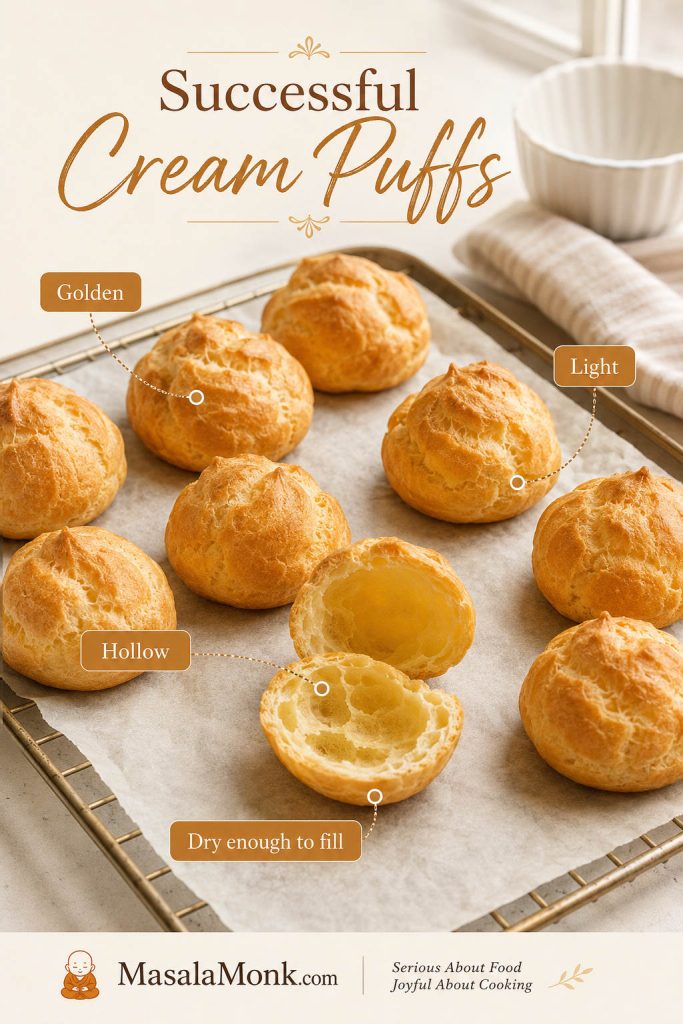
Quick success cue: cream puff shells should be golden, light for their size, hollow inside, and dry enough to hold their shape before you add the filling.

Cream Puff Recipe Snapshot

Yield:
24–28 medium cream puffs
Prep time:
35–45 minutes
Bake time:
30–35 minutes
Cooling and drying:
30–45 minutes
Total with whipped cream:
About 1 hour 45 minutes to 2 hours, depending on cooling time
Total with pastry cream:
About 4 hours, including chilling
Main technique:
Choux pastry
Easiest first filling:
Vanilla whipped cream

Whipped cream is the easiest filling for a first batch because it takes only a few minutes. Pastry cream gives a more classic pastry-shop result. Diplomat cream, which is pastry cream folded with whipped cream, tastes richer while still feeling soft and airy.

What Are Cream Puffs?

Cream puffs are round pastry shells made from choux pastry and filled after baking. Unlike cake batter or cookie dough, choux pastry is first cooked on the stovetop. That cooked flour paste is mixed with eggs, piped into mounds, and baked.

In the oven, the moisture in the dough turns into steam. That steam pushes the dough outward, creating a hollow center. Once the outside sets and dries, the shell can hold cream inside.

Cream puffs are often filled with sweetened whipped cream, vanilla pastry cream, custard, diplomat cream, chocolate cream, strawberry cream, or ice cream. The shell itself is only lightly sweet, so the filling gives the dessert most of its flavor.

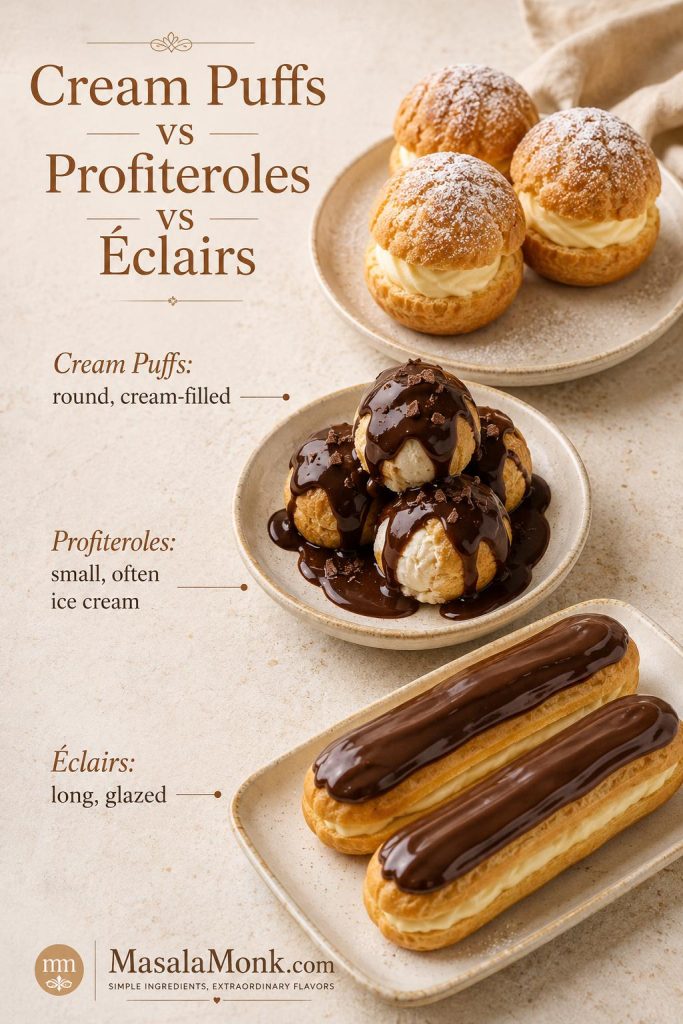
Cream Puffs vs Profiteroles vs Éclairs

These desserts are closely related because they all use choux pastry, but they are not exactly the same.

Comparison of round cream puffs, small profiteroles with chocolate sauce, and long chocolate-glazed éclairs.
Cream puffs, profiteroles, and éclairs all start with choux pastry; however, their shape, filling, and finish decide whether they feel like a cream-filled dessert, an ice cream dessert, or a glazed pastry.
Dessert Shape Usual Filling Common Finish
Cream puffs Round, medium shells Whipped cream, pastry cream, diplomat cream Powdered sugar, chocolate, or ganache
Profiteroles Small round puffs Ice cream, pastry cream, or whipped cream Chocolate sauce
Éclairs Long choux shells Pastry cream Chocolate glaze
Croquembouche Stacked cream puffs Usually pastry cream Caramel or spun sugar

For this recipe, we are focusing on classic round cream puffs. However, once you understand the dough, the same choux pastry technique opens the door to profiteroles, éclairs, gougères, and croquembouche.

In other words, this is the base skill. Learn the shell once, and a whole family of bakery-style desserts becomes easier.

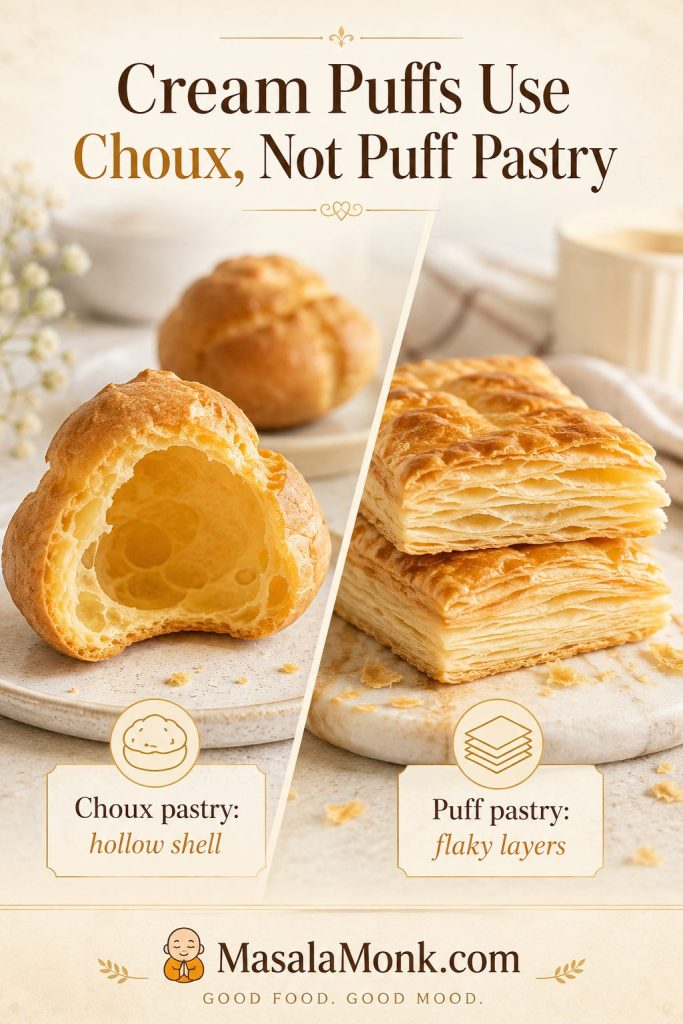
Are Cream Puffs Made with Puff Pastry?

Classic cream puffs are made with choux pastry, not puff pastry.

The names are easy to confuse, but the doughs behave very differently. Choux pastry is cooked on the stovetop, mixed with eggs, piped into mounds, and baked into hollow shells. Puff pastry is a laminated dough made with many layers of butter and dough, so it bakes into flaky layers instead of hollow centers.

Hollow choux pastry cream puff shell compared with flaky puff pastry layers.
Classic cream puffs use choux pastry, not puff pastry, because choux bakes into hollow shells while puff pastry separates into flaky layers.

If you came here expecting flaky pastry filled with cream, you may be thinking of cream horns, mille-feuille, cream slices, or puff pastry danish. For classic bakery-style cream puffs, use choux pastry. For a different kind of buttery pastry dough, this apple pie crust recipe is a useful cold-butter comparison.

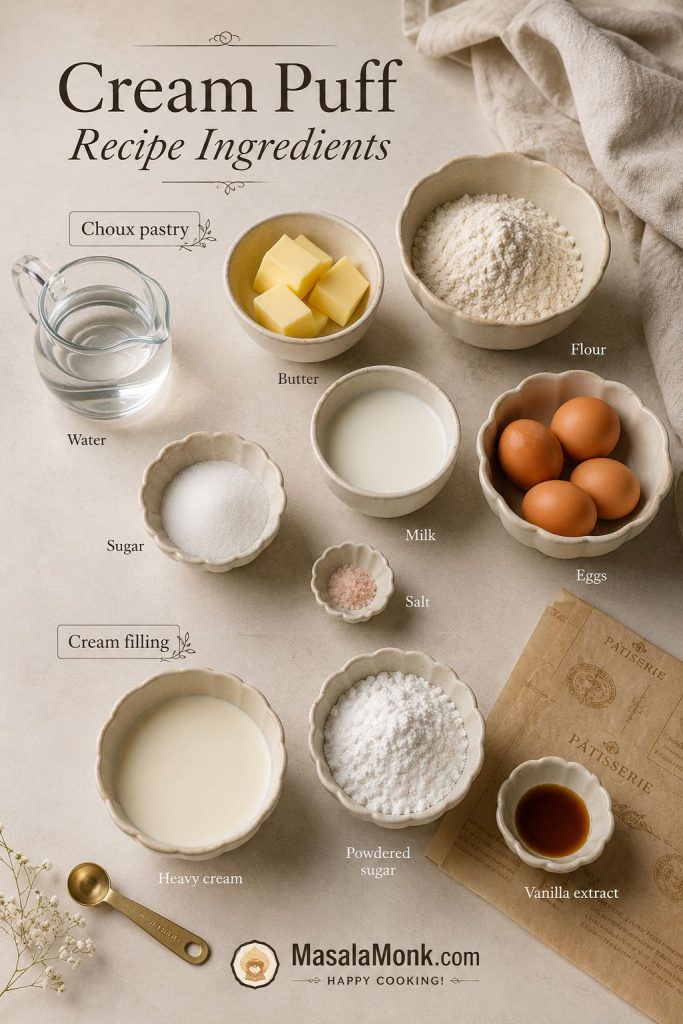
Cream Puff Recipe Ingredients

Cream puffs use everyday ingredients, but the measurements and order matter. Choux pastry is less forgiving than a casual cake batter because too much moisture or too much egg can make the shells spread instead of rise.

Ingredients for cream puffs including flour, eggs, butter, milk, water, sugar, salt, heavy cream, powdered sugar, and vanilla.
These simple cream puff ingredients become reliable only when the flour paste is cooked well, the eggs are added gradually, and the shells bake long enough to dry.

For the Choux Pastry Shells

  • ½ cup / 120 ml water
  • ½ cup / 120 ml whole milk
  • ½ cup / 113 g unsalted butter, cut into pieces
  • 1 tsp granulated sugar
  • ¼ tsp fine salt
  • 1 cup / 125 g all-purpose flour, spooned and leveled if using cups
  • 4 large eggs, room temperature, beaten and added gradually

The water helps create steam, the milk adds flavor and color, and the eggs help the shells puff and set. The flour weight matters, so use a scale if you can. A loosely scooped cup and a packed cup can behave very differently in choux pastry, which is why 125 g is the safest target.

The egg amount also needs judgment. Egg size, flour measurement, and how much moisture cooks out of the paste can all change the final texture. Start with the recipe amount, but add the final egg slowly. You may not need every drop if the dough already passes the V-shape test.

If you are unsure where to stop, use the V-shape dough cue before adding the last bit of egg.

For the Whipped Cream Filling

  • 2 cups / 480 ml cold heavy cream
  • 3–4 Tbsp powdered sugar
  • 1–2 tsp vanilla extract
  • Pinch of salt, optional

Powdered sugar dissolves quickly and gives a smooth filling. Granulated sugar also works, but the cream may need a little more whipping time.

For the Pastry Cream Option

For a richer custard-filled version, make pastry cream ahead and chill it fully before piping.

  • 2 cups / 480 ml whole milk
  • 4 large egg yolks
  • ½ cup / 100 g granulated sugar
  • ¼ cup / 30 g cornstarch
  • 2 Tbsp / 28 g unsalted butter
  • 2 tsp vanilla extract or vanilla bean paste
  • Pinch of salt

This gives a thick, pipeable custard-style filling. Pastry cream needs time to cool, so make it before the shells or several hours ahead.

Optional Toppings

  • powdered sugar
  • melted chocolate
  • chocolate ganache
  • caramel drizzle
  • fresh berries
  • sliced strawberries
  • toasted almonds

For the cleanest first version, dust the filled puffs with powdered sugar just before they go to the table.

Equipment You Need

You do not need bakery equipment to make cream puffs, but a few tools make the process easier.

Must-Have Equipment

  • medium saucepan
  • wooden spoon or sturdy silicone spatula
  • mixing bowl or stand mixer
  • baking sheet
  • parchment paper
  • wire rack

Helpful Equipment

  • piping bag
  • ½-inch round piping tip or large star tip
  • zip-top bag as a backup piping bag
  • skewer, toothpick, or small knife for venting
  • small scoop for even mounds

A piping bag gives the neatest shape, but you can still make cream puffs with a zip-top bag or two spoons. The shape may be less even, but the recipe will work as long as the dough texture and bake are right.

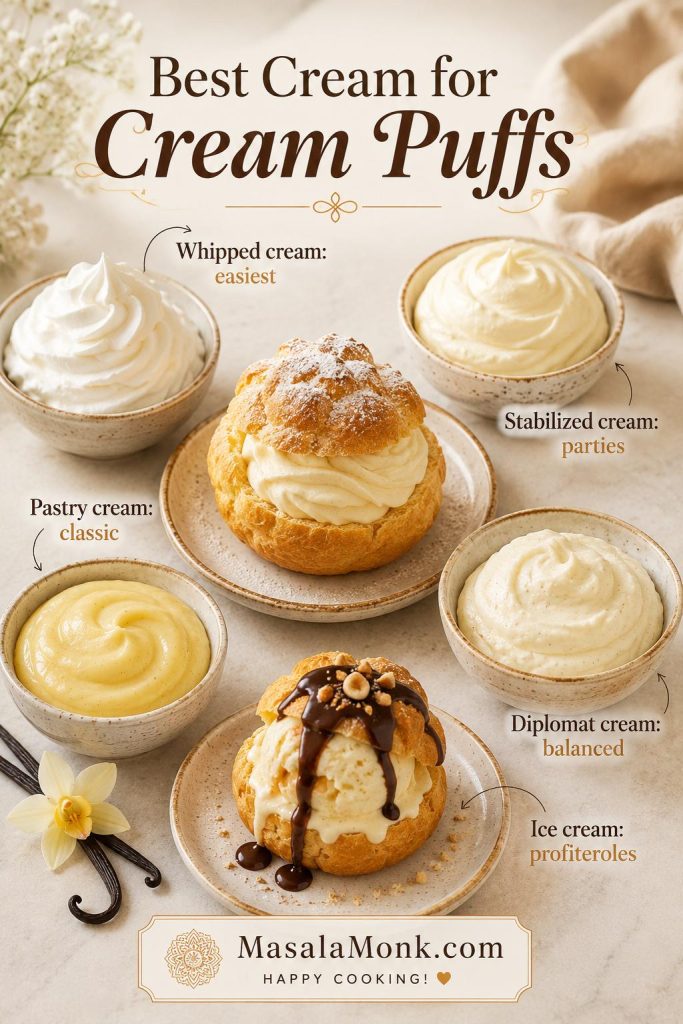
Best Cream for Cream Puffs

The shell gets the most attention, but the filling is what most people remember. The right cream for cream puffs depends on whether you want easy, classic, stable, rich, or light.

Filling chooser for cream puffs with whipped cream, stabilized cream, pastry cream, diplomat cream, and ice cream.
The best cream for cream puffs depends on timing: whipped cream is easiest, pastry cream is classic, diplomat cream feels balanced, and stabilized cream holds better for serving trays.
Filling Best For Texture Make-Ahead Strength
Whipped cream First batch, easiest version Light and airy Short hold
Stabilized whipped cream / mascarpone cream Parties and dessert trays Light but firmer Better hold
Pastry cream Classic custard-filled cream puffs Rich and custardy Very good
Diplomat cream Most balanced filling Creamy, light, stable Good
Pudding shortcut Emergency easy filling Sweet and thick Decent
Ice cream Profiterole-style dessert Cold and creamy Fill right before serving

For a first batch, whipped cream is the easiest choice because it is quick, light, and does not need cooking. For a more classic pastry-shop result, pastry cream works better. When you want something rich but still soft and airy, diplomat cream is the best middle ground.

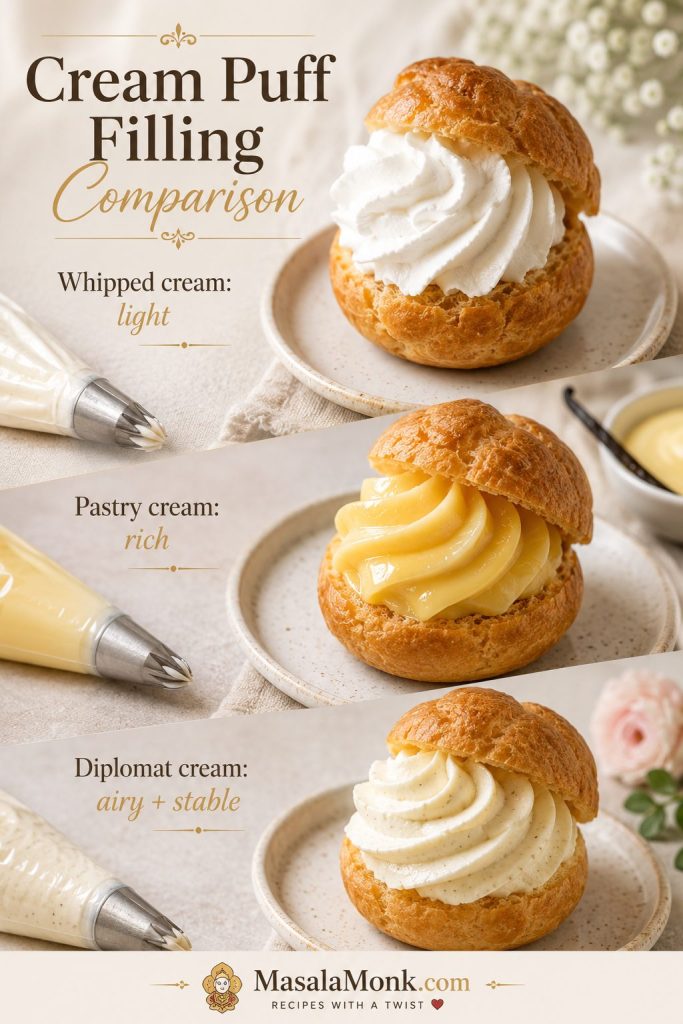
Still deciding? The cream puff filling comparison below shows how whipped cream, pastry cream, and diplomat cream behave differently.

Cream Puff Filling: Whipped Cream vs Pastry Cream vs Diplomat Cream

Keep the shell technique the same, then choose the filling based on the dessert you want. Whipped cream makes the puffs feel light and delicate; pastry cream gives them a richer bakery-style center.

Whipped cream, pastry cream, and diplomat cream shown as different cream puff filling textures.
Once the choux shells are baked, the filling changes the whole dessert: whipped cream keeps it light, pastry cream makes it richer, and diplomat cream gives a softer middle ground.

Whipped Cream Filling

Start with whipped cream when you want the simplest filling. It tastes light, sweet, and clean, and you can make it in a few minutes while the shells cool.

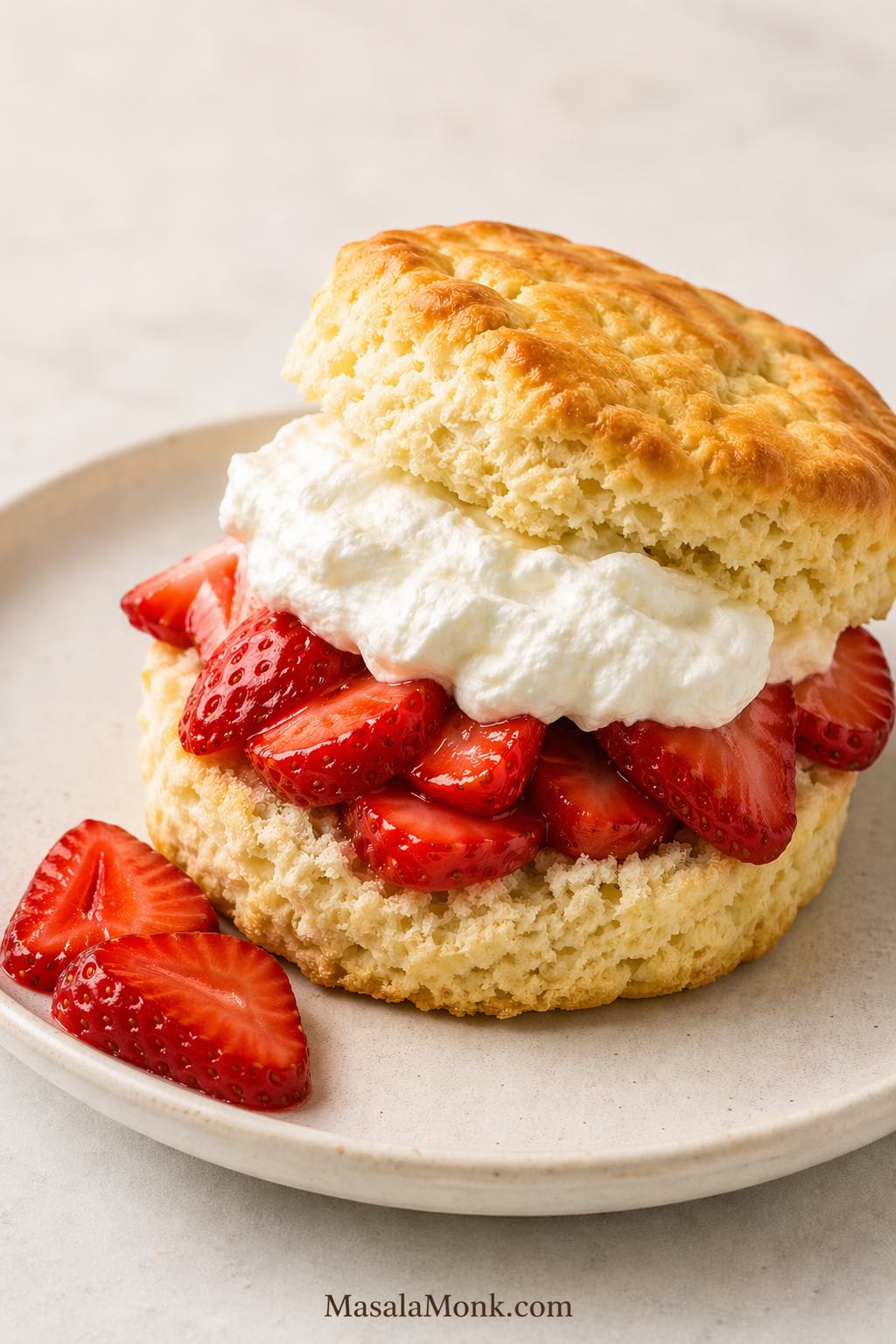
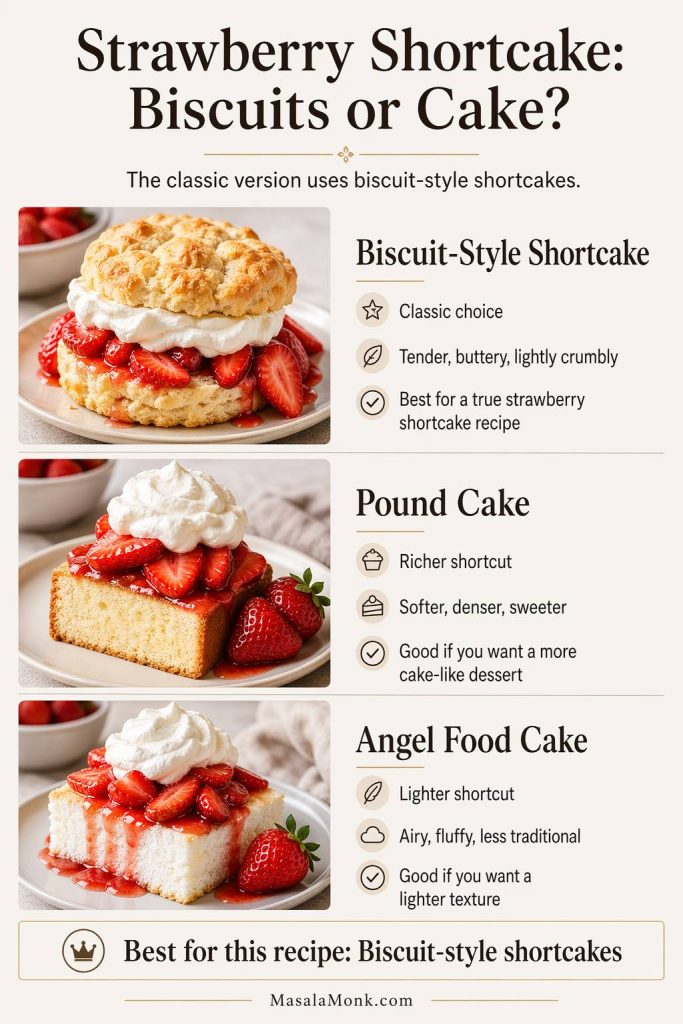
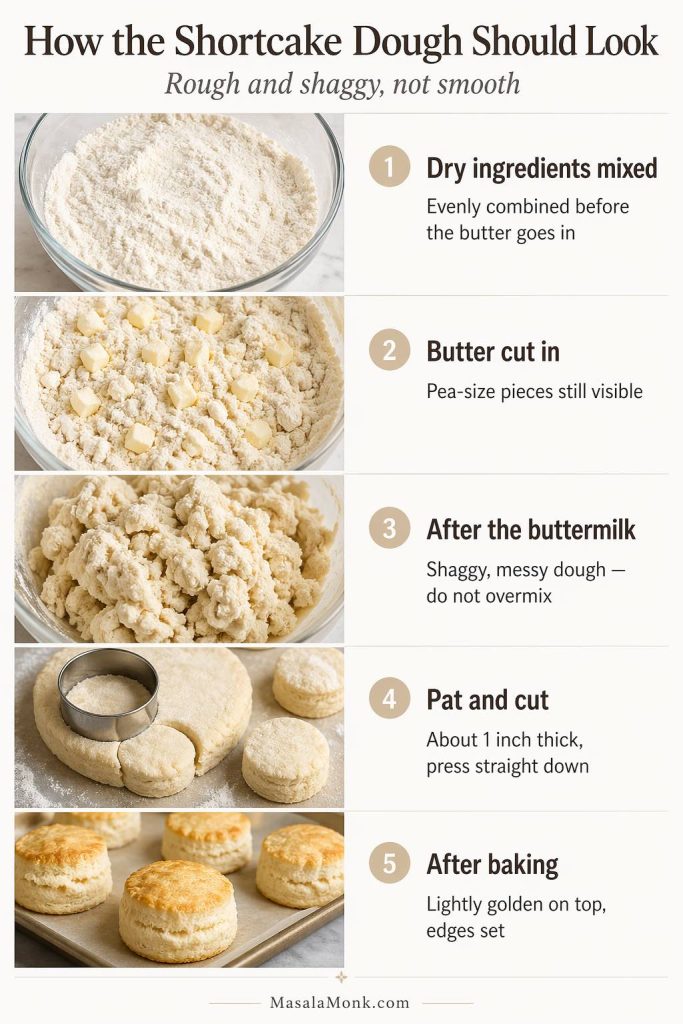
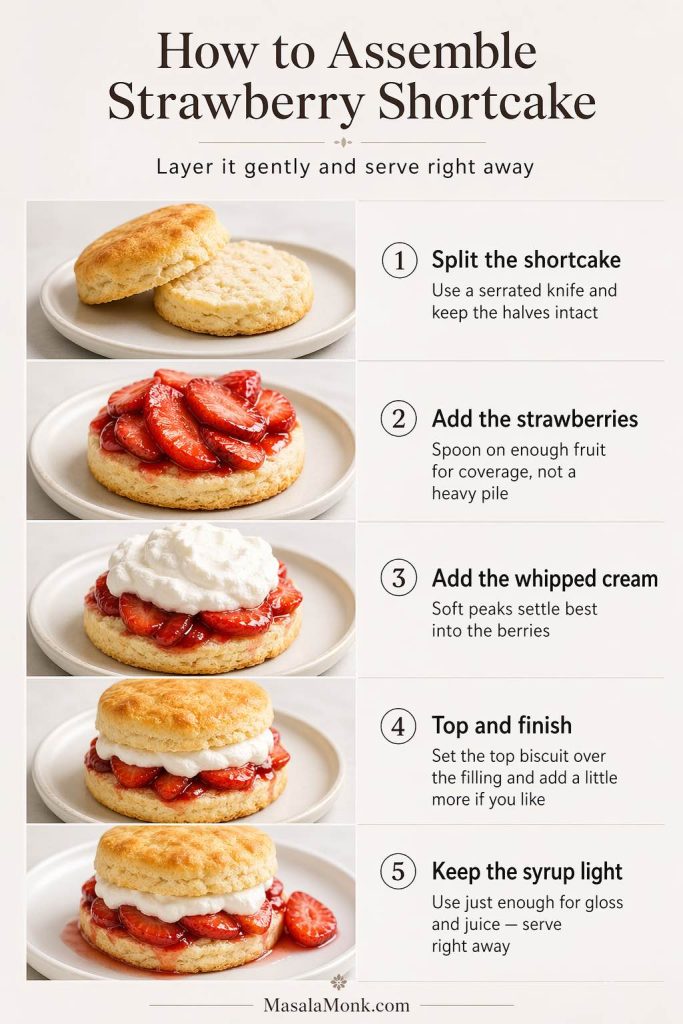
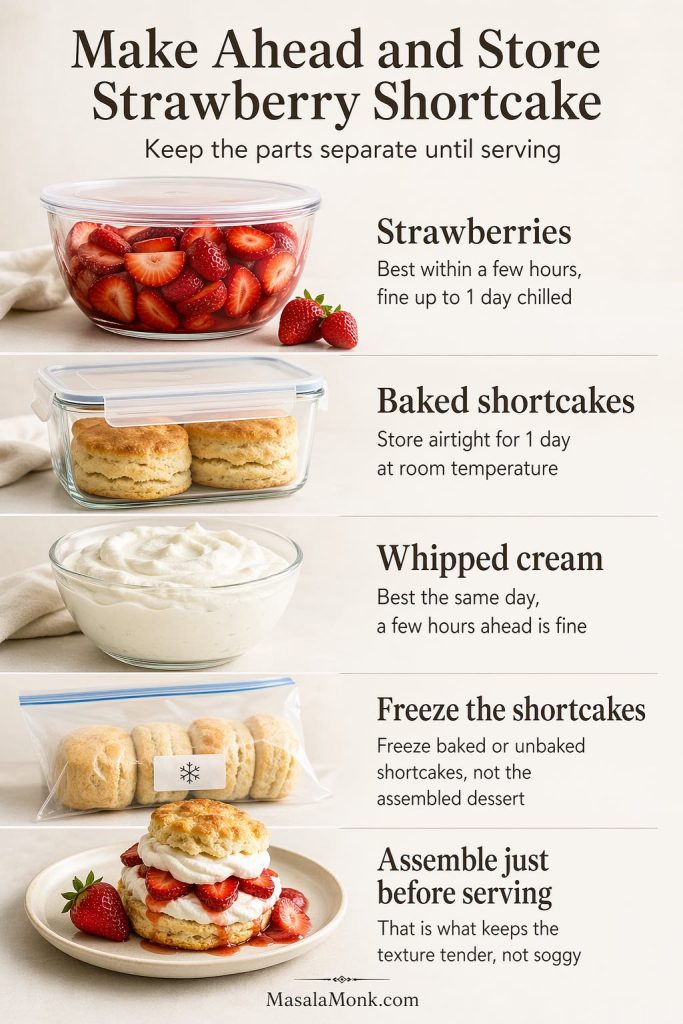
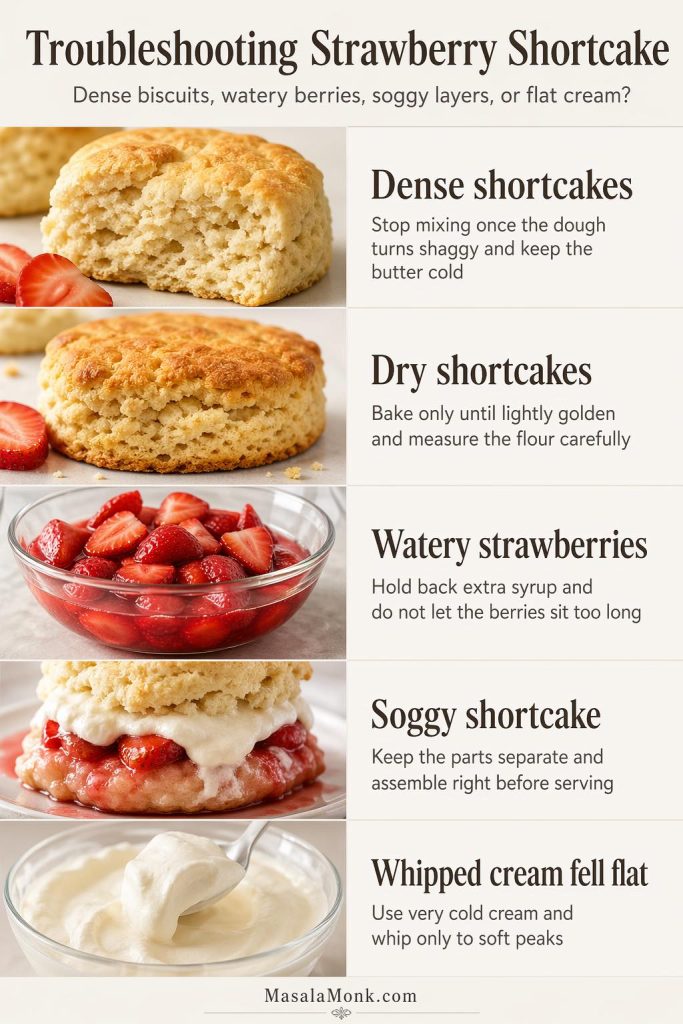
It is best for first-time cream puffs, light desserts, same-day serving, cut-and-fill cream puffs, berries, and powdered sugar finishes. Plain whipped cream softens faster than pastry cream, so assemble the puffs near serving time. A strawberry shortcake has the same serve-soon logic because whipped cream and fresh fruit soften as they sit.

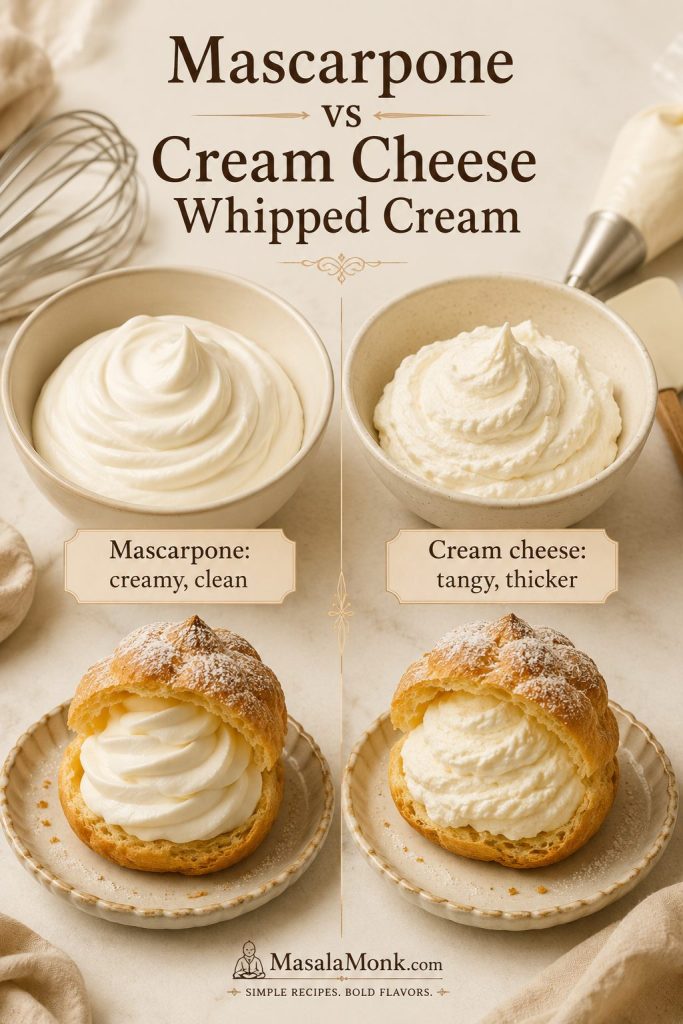
Mascarpone or Cream Cheese Whipped Cream

For a cream filling that still tastes light but holds better, beat 2 cups / 480 ml cold heavy cream with 3–4 Tbsp powdered sugar, 1 tsp vanilla, and 4 oz / 113 g softened mascarpone or cream cheese. Beat the mascarpone or cream cheese first until smooth, then slowly add the cold cream and whip until the filling holds medium-stiff peaks.

Mascarpone gives a cleaner, creamier flavor. Cream cheese adds a light tang and a slightly thicker texture.

Mascarpone whipped cream and cream cheese whipped cream compared as stabilized cream puff fillings.
Mascarpone gives stabilized whipped cream a clean, creamy taste, while cream cheese adds gentle tang and a firmer texture for cream puffs that need to sit longer.

This is not as classic as pastry cream, but it is very practical for parties because it pipes well and holds longer than plain whipped cream.

Pastry Cream Filling

Pastry cream is a cooked custard-style filling made with milk, egg yolks, sugar, cornstarch, butter, and vanilla. It gives cream puffs a richer center and holds better than plain whipped cream.

To make it, heat the milk until steaming. In a separate bowl, whisk egg yolks, sugar, cornstarch, and salt until smooth. Slowly whisk some hot milk into the yolk mixture, then return everything to the saucepan. Cook, whisking constantly, until thick and bubbling. Off the heat, whisk in butter and vanilla. Cover with plastic wrap directly on the surface and chill until cold.

For more pastry cream technique, Sally’s Baking Addiction has a detailed pastry cream guide.

Diplomat Cream Filling

Diplomat cream is pastry cream folded with whipped cream. It tastes rich without feeling heavy, which makes it one of the nicest fillings for cream puffs you plan to share.

For a practical filling, use 2 cups chilled pastry cream and 1 cup / 240 ml cold heavy cream whipped to medium peaks. Whisk the chilled pastry cream until smooth, then gently fold in the whipped cream. The filling should be soft, creamy, and pipeable, not loose or runny.

Pudding Shortcut Filling

For the easiest shortcut, use thick vanilla pudding, chill it well, then fold in a little whipped cream for a lighter texture. It will not taste as fresh as homemade pastry cream, but it works when you need a fast, kid-friendly filling.

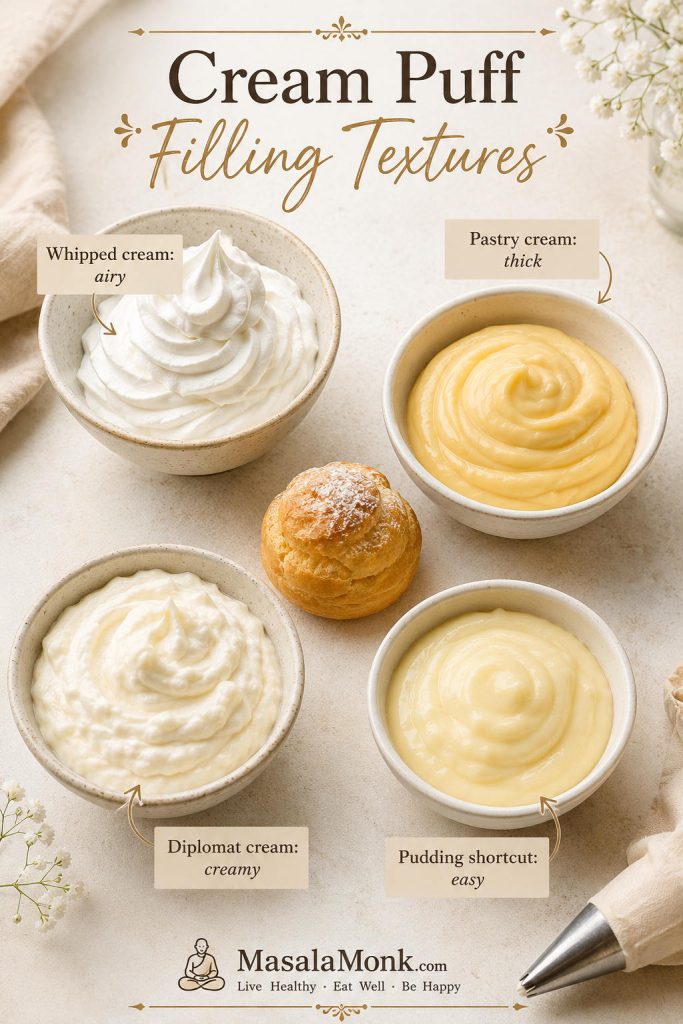
Cream Puff Filling Texture Guide

Before choosing a filling, look at how each option holds shape. Thicker fillings are easier to pipe and help the choux shells stay crisp longer.

Cream puff filling texture guide with whipped cream, pastry cream, diplomat cream, and pudding shortcut.
Texture matters as much as flavor here; a cream puff filling should hold a spoon or piping line without running into the shell.

Which Filling Should You Choose?

  • Easiest first batch: whipped cream
  • Classic custard-style center: pastry cream
  • Most balanced texture: diplomat cream
  • Party tray: mascarpone whipped cream, stabilized whipped cream, or pastry cream
  • Kid-friendly shortcut: whipped cream or pudding filling
  • Profiterole-style dessert: ice cream
Most balanced choice: whipped cream is easiest, pastry cream is classic, but diplomat cream gives the strongest mix of lightness, richness, and stability.

How to Make Choux Pastry for Cream Puffs

Choux pastry is the heart of this recipe. The dough starts on the stovetop, where the flour is cooked with hot liquid and butter. After that, eggs are added gradually to create a glossy, slow-moving dough. For a deeper technical look at why choux rises with steam, Serious Eats has a useful guide to choux pastry.

The method feels unusual the first time, but every stage has a clear cue.

Step 1: Melt the Butter with Water, Milk, Sugar, and Salt

Add the water, milk, butter, sugar, and salt to a medium saucepan. Warm over medium heat until the butter melts completely and the liquid reaches a boil.

Do not rush this step with high heat. You want the butter fully melted before the flour goes in, so the dough forms evenly.

Step 2: Add the Flour All at Once

Add the flour in one go and start stirring immediately. The mixture will look rough and lumpy at first. Keep stirring. Within a short time, it will come together into a thick paste.

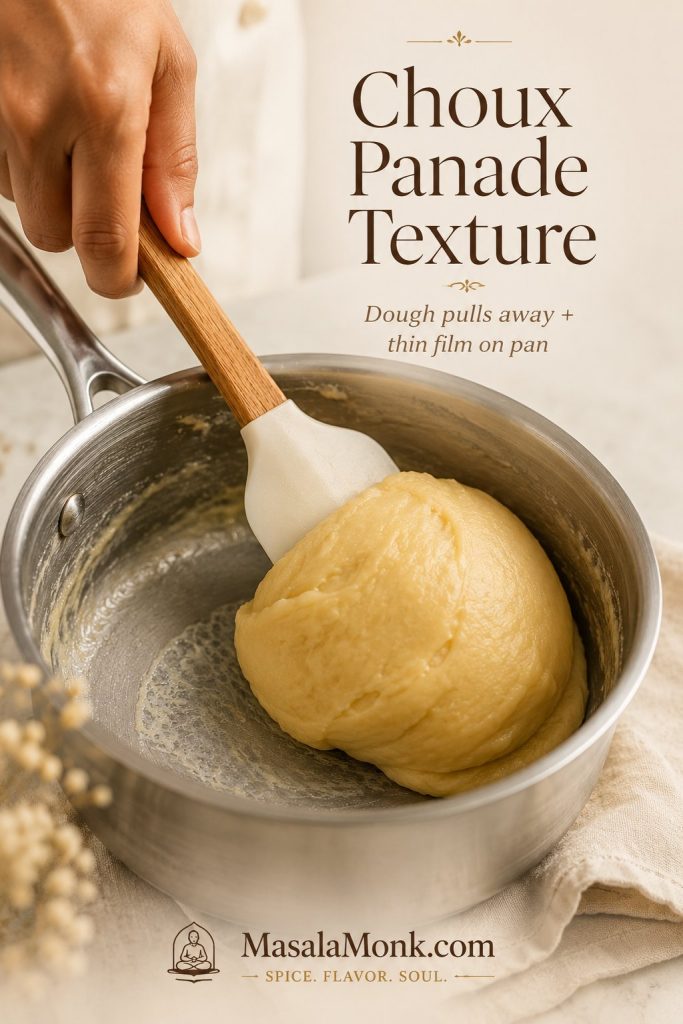
This paste is called the panade. It should pull away from the sides of the pan and begin forming a ball.

Step 3: Cook the Flour Paste

Keep cooking and stirring the paste for 1–3 minutes. A thin film may form on the bottom of the pan, and the dough should look cohesive rather than wet or greasy.

Cooking the paste for another minute or two drives off extra moisture before the eggs go in. If the paste stays too wet, the dough may become too loose and spread on the tray instead of puffing upward.

The panade is ready when it forms a smooth ball, pulls away from the sides, leaves a light film on the bottom, no longer looks wet with loose butter, and feels thick when stirred. At this point, the dough should feel sturdy and slightly resistant, not loose or oily.

Choux panade in a saucepan pulling away from the sides and leaving a thin film on the pan.
When the choux panade pulls away from the saucepan and leaves a thin film, it has cooked off enough moisture to give the eggs a stronger base.

Step 4: Cool Slightly Before Adding Eggs

Transfer the hot paste to a mixing bowl or the bowl of a stand mixer. Let it cool for a few minutes until it is warm but no longer steaming hot.

If the dough is too hot, it can scramble the eggs. You do not need it cold; just let the harsh heat come down.

Step 5: Add the Eggs Gradually

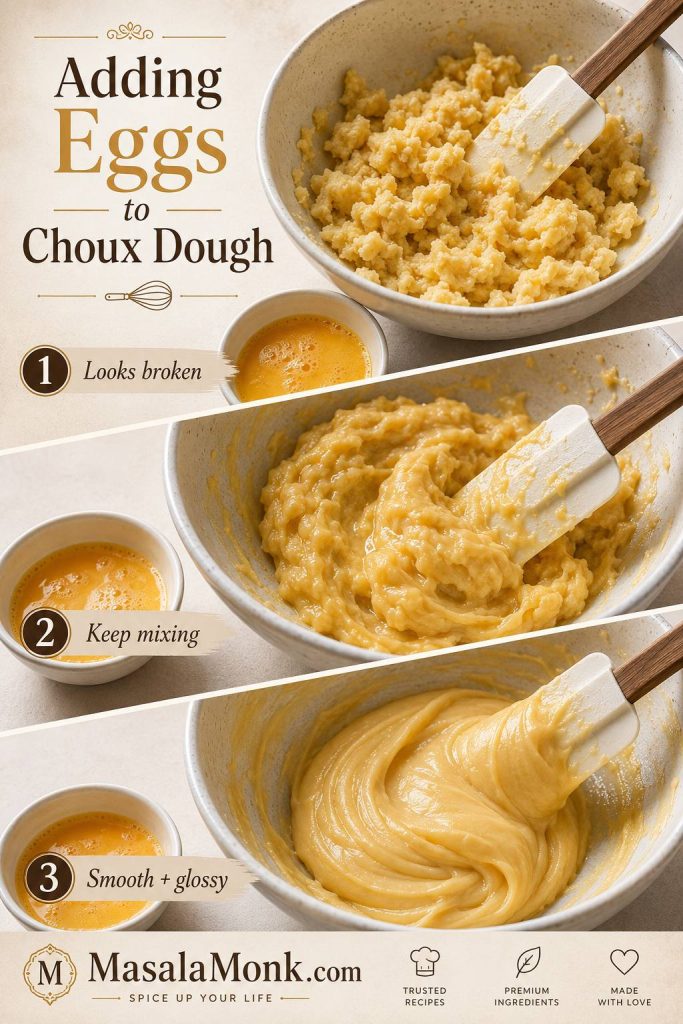
Beat the eggs lightly in a separate bowl if you want maximum control. Add about three eggs first, one at a time or in several additions, mixing well after each addition. Then add the final beaten egg a spoonful at a time.

At first, the dough may look broken, slippery, or curdled. Do not panic. Keep mixing and it will come back together. This is where patience matters more than speed.

Three stages of adding eggs to choux dough, from broken-looking dough to smooth glossy dough.
Choux dough can look broken when the eggs first go in; however, steady mixing brings it back to the smooth, glossy texture needed for cream puff shells.

The final egg is where the texture can change quickly. You may not need every drop, so stop when the dough is glossy, smooth, thick, and able to hold a piped shape.

Before you pipe, check the V-shape dough cue; it is the easiest way to avoid loose cream puff dough.

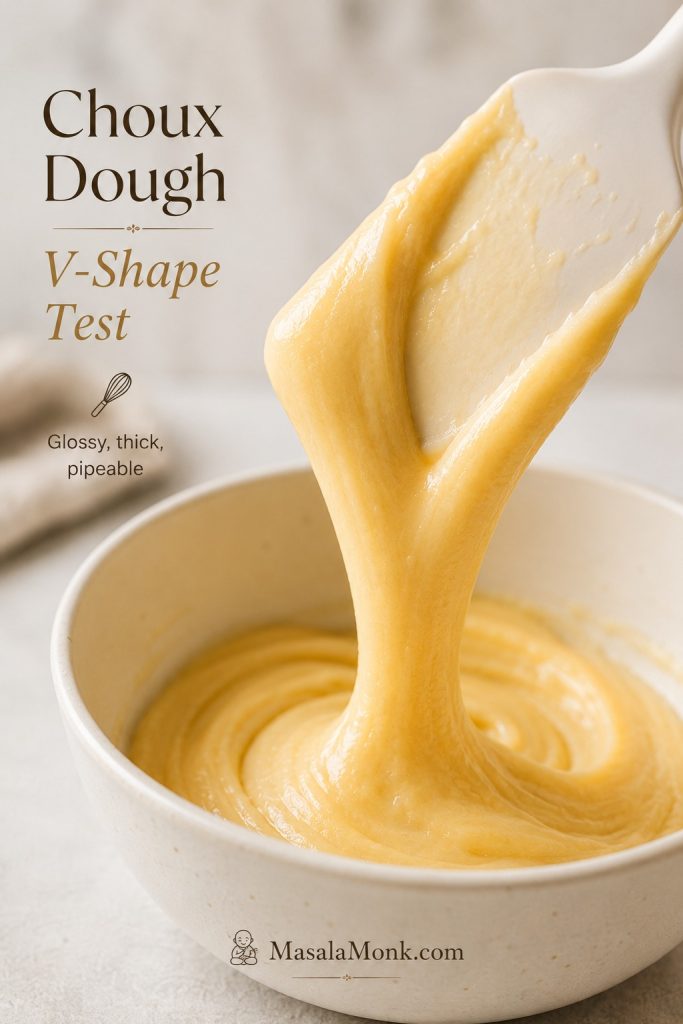
Important: do not blindly add all the egg if the dough already looks right. Choux pastry is ready when it falls from the spatula in a thick V shape and still holds its shape when piped.

How to Know Choux Dough Is Ready

This is the checkpoint that saves cream puffs from turning flat.

Finished choux dough should be smooth, glossy, thick, soft enough to fall slowly from a spatula, and firm enough to hold height on the baking sheet.

Choux Dough V-Shape Test

The best cue is the V-shape test. Lift the spatula from the dough. The dough should slowly fall and leave a thick V-shaped ribbon hanging from the spatula. Once you see that ribbon, the dough suddenly feels less mysterious.

Glossy choux dough falling from a spatula in a thick V-shaped ribbon.
The V-shape test shows when choux dough is ready: thick enough to pipe, glossy enough to expand, and not so loose that it spreads.

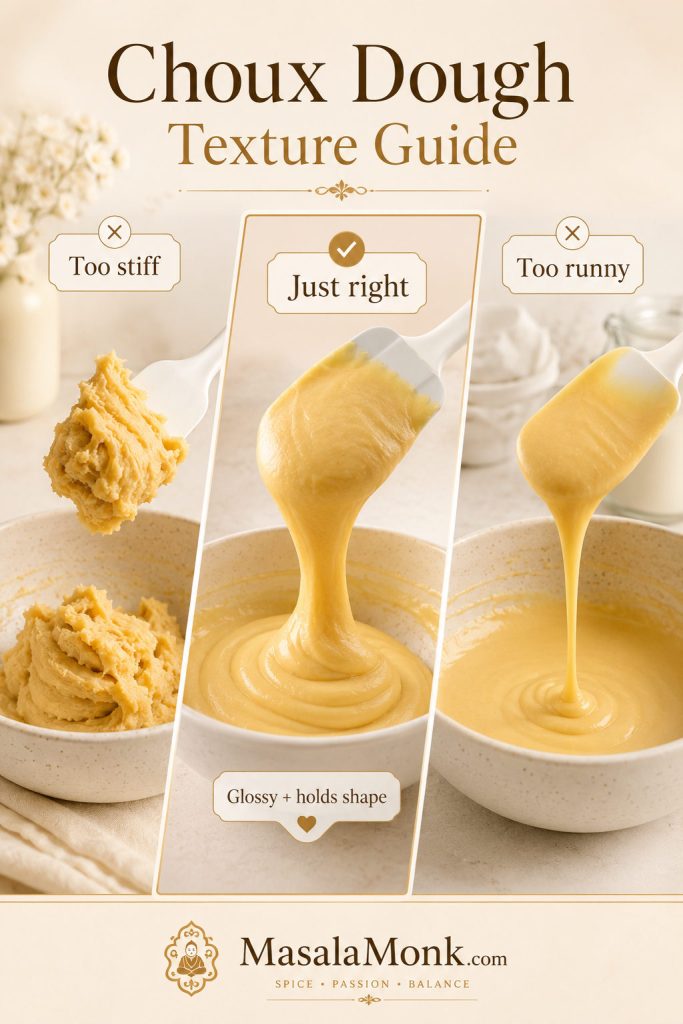
If the dough stands in a stiff peak and refuses to fall, it needs a little more egg. If it puddles or runs off the spatula like batter, it has gone too far.

Choux Dough Texture Guide

Use the visual differences below before adding more egg. The goal is dough that moves slowly, shines lightly, and still holds a mound when piped.

Choux dough texture guide showing too stiff, just right, and too runny dough in separate bowls.
Choux dough should be glossy and pipeable while still holding shape; too stiff can limit rise, while too runny can make the shells spread.

Just Right

The dough is glossy, smooth, and slow-moving. When piped, the mound holds its height and only relaxes slightly.

Too Stiff

The dough looks dry, rough, or heavy. It may hold a sharp peak and resist falling from the spatula. Add more beaten egg, one spoonful at a time.

Too Runny

The dough spreads quickly and cannot hold a piped mound. This usually means too much egg was added, the flour paste was not cooked enough, or the flour measurement was too low.

Runny choux is hard to fix perfectly. You can bake it, but the puffs may spread more. Next time, save the final egg for texture adjustment and stop at the V-shape stage.

Once the dough holds shape, move on to piping the cream puff shells.

How to Pipe Cream Puff Shells

Line your baking sheets with parchment paper. Transfer the choux dough to a piping bag fitted with a ½-inch round tip or large star tip.

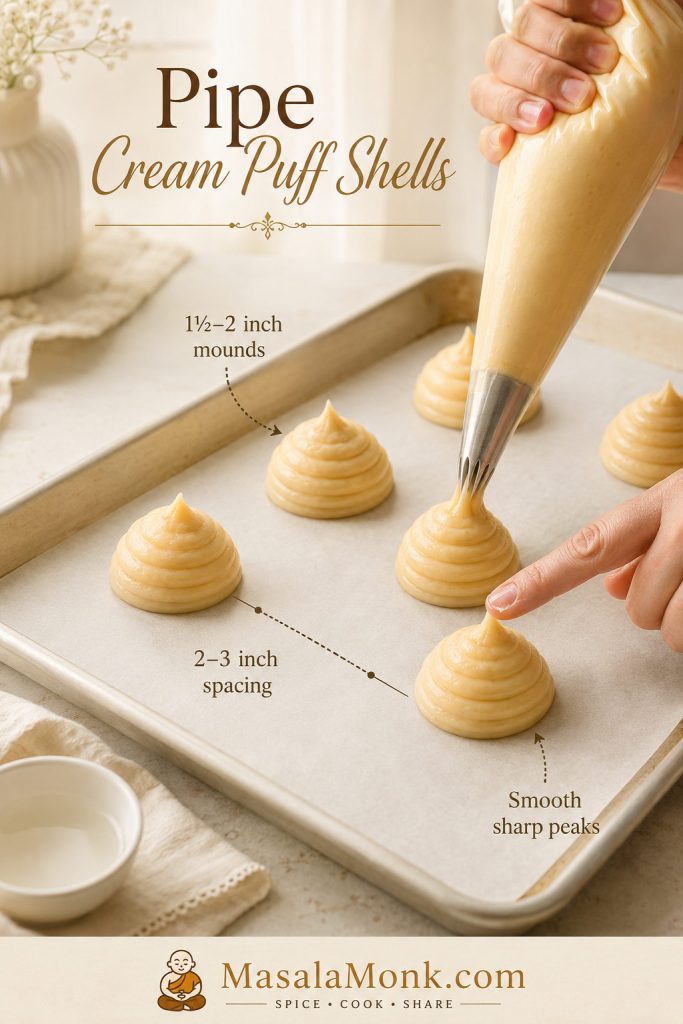
Pipe mounds about 1½–2 inches wide, leaving 2–3 inches of space between them. Cream puffs expand as they bake, and crowded dough can merge together.

If the tops have sharp peaks, smooth them gently with a damp fingertip. Peaks can burn before the rest of the shell finishes baking.

After the mounds are evenly spaced and the peaks are smoothed, the next important cue is baking the shells until they set.

Piping cream puff shells on parchment with spacing marks and a fingertip smoothing a sharp peak.
Even piping helps cream puff shells bake at the same rate; meanwhile, enough spacing and smoothed peaks prevent crowded, uneven, or burnt-tipped puffs.

No Piping Bag?

Use a zip-top bag with one corner snipped off, or use a small scoop and spoon. The puffs may look more rustic, but even mounds will still bake well.

The main goal is consistency. Similar-size puffs bake at the same rate. If some are tiny and others are huge, the small ones may dry out before the larger ones are fully hollow.

How to Bake Cream Puff Shells So They Rise and Stay Hollow

Cream puffs need heat for lift and enough time for structure. A shell that puffs beautifully but comes out too early can still collapse as it cools.

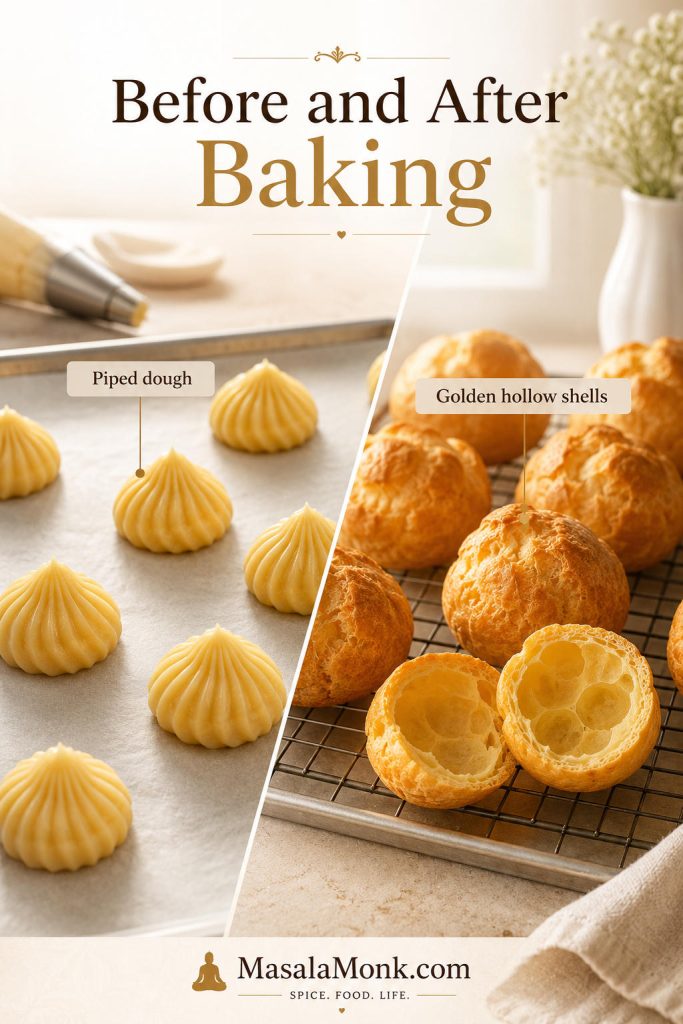
Before and After Baking Cream Puff Shells

Use the transformation from soft piped dough to puffed golden shells as a quick check that the oven heat is doing its job.

Piped choux dough mounds shown beside baked golden cream puff shells.
Choux pastry transforms in the oven as steam expands inside the dough, turning soft piped mounds into light, hollow cream puff shells.
  1. Preheat the oven to 425°F / 218°C.
  2. Bake the piped shells for 10 minutes.
  3. Reduce the oven to 325°F / 163°C without opening the oven door.
  4. Bake for 20–25 minutes more, until the shells are golden, firm, and dry.
  5. Turn the oven off.
  6. Poke or slit each shell to release steam.
  7. Return the shells to the turned-off oven with the door cracked for 10–20 minutes.
  8. Cool completely before filling.

Do not open the oven during the early rise. A sudden drop in heat can collapse the structure before the outside sets.

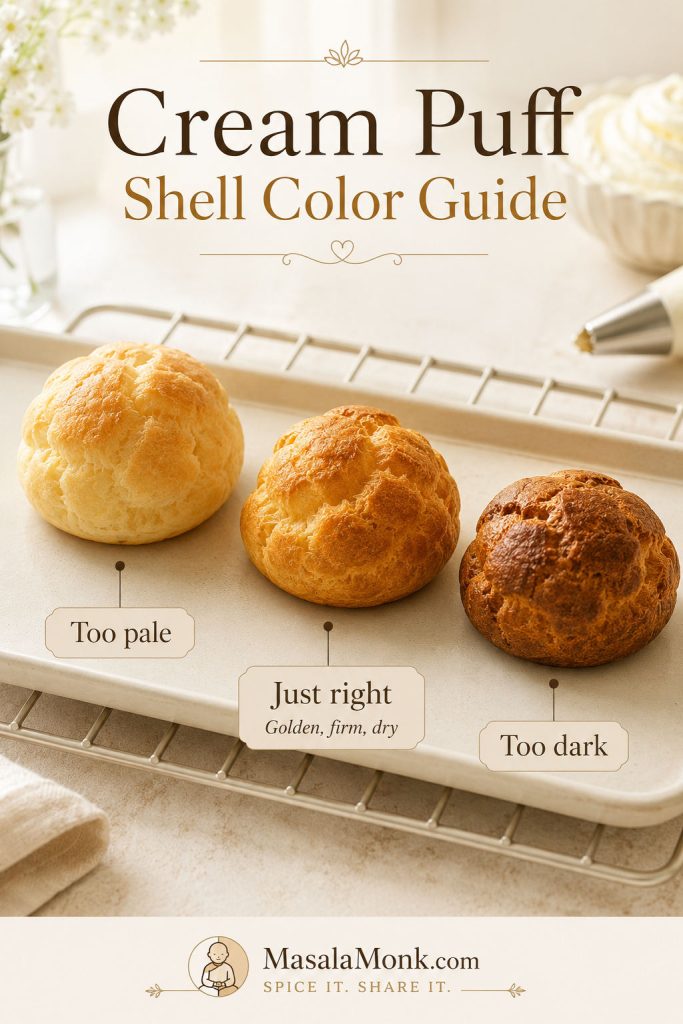
Cream Puff Shell Color Guide

The shells are ready when they feel light, firm, dry, and hollow. If they still look pale or feel soft, give them more time. A properly baked shell usually has a deeper golden color than many first-time bakers expect.

Cream puff shell color guide showing too pale, just right, and too dark baked shells.
Color is a doneness clue in cream puff shells; if they stay pale, the structure may not be dry enough to hold after cooling.

If the shells look pale, check this color guide before taking them out; underbaked choux is one of the most common reasons cream puffs collapse.

Remember: the goal is not only puffing. The goal is puffing, setting, and drying. That is what keeps the shells hollow after cooling.

How to Check One Hollow Cream Puff Shell

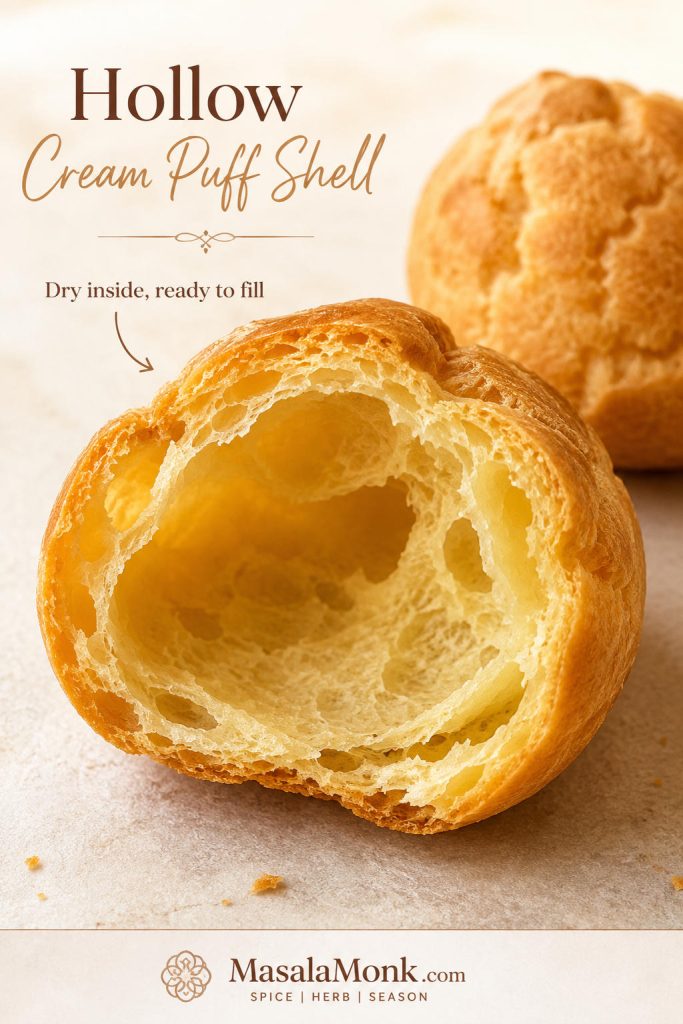
If you are unsure, sacrifice one shell before removing the whole tray. Split it open. The inside should be mostly hollow and not wet or doughy. A little soft webbing is normal, but the shell should not feel raw.

If the center looks damp, bake a little longer or give the shells more drying time in the turned-off oven.

Split cream puff shell showing a hollow, dry interior ready for filling.
A hollow cream puff shell means the choux pastry rose and dried properly, giving you enough space for whipped cream, pastry cream, or diplomat cream.

Once the shells are hollow and cool, continue to filling the cream puffs.

What Successful Cream Puffs Look and Feel Like

Successful cream puff shells should feel light when you lift them. The outside should be firm and dry, the inside should be hollow enough for filling, and the color should be golden rather than pale.

Tray of successful cream puff shells with callouts for golden color, light texture, hollow center, and dry structure.
This tray shows the visual standard to aim for: golden shells that feel light, hold their shape, and are ready for a cool vanilla cream center.

This is the moment where the recipe starts feeling like a real bakery project: a tray full of airy shells, ready for cold cream and a dusting of powdered sugar. Fill one, dust it, and taste it before serving the rest. That first crisp shell and cool cream center is the payoff for all the careful dough cues.

How to Fill Cream Puffs

Only fill cream puffs after the shells are fully cool. Warm shells melt the filling and create steam, which can make the pastry soft.

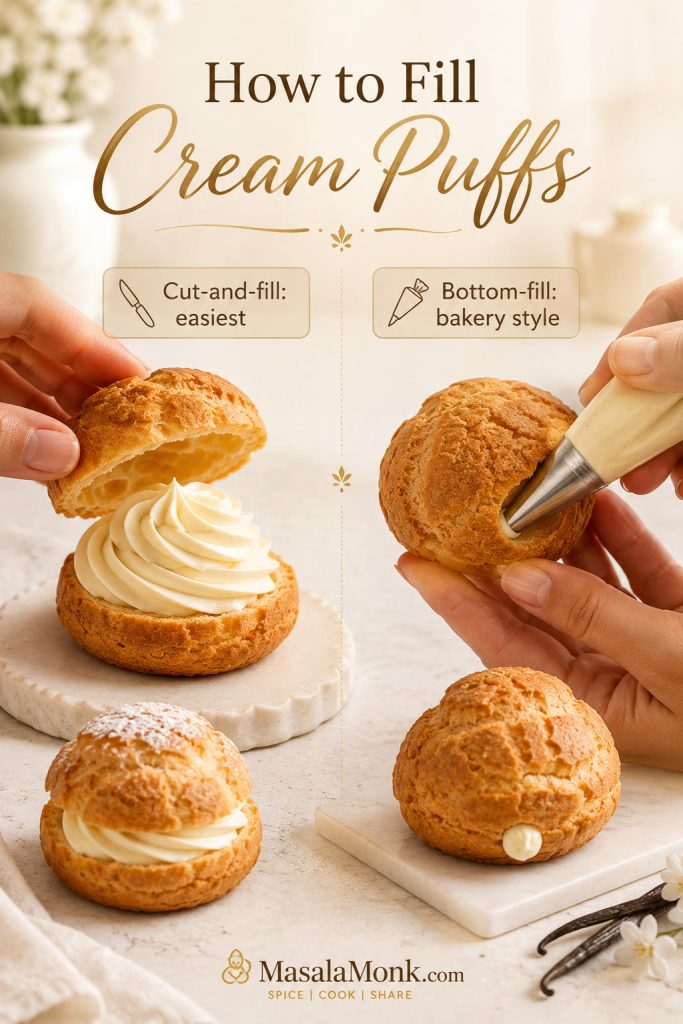
Cut-and-fill and bottom-fill methods for adding cream to cream puff shells.
Cut-and-fill is the easiest method for home bakers, while bottom-filling gives cream puffs a cleaner pastry-shop look.

Cut-and-Fill Method

This is the easiest and prettiest method for home serving. Slice off the top third of each shell, pipe or spoon cream into the hollow center, then place the top back on. Dust with powdered sugar or drizzle with chocolate.

This method works especially well with whipped cream, diplomat cream, berries, and decorative swirls.

Bottom-Fill Method

For a cleaner pastry-shop look, make a small hole in the bottom of each shell with a knife, skewer, or piping tip. Pipe pastry cream or diplomat cream into the shell until it feels slightly heavier.

This method is best for pastry cream, custard, or thicker fillings.

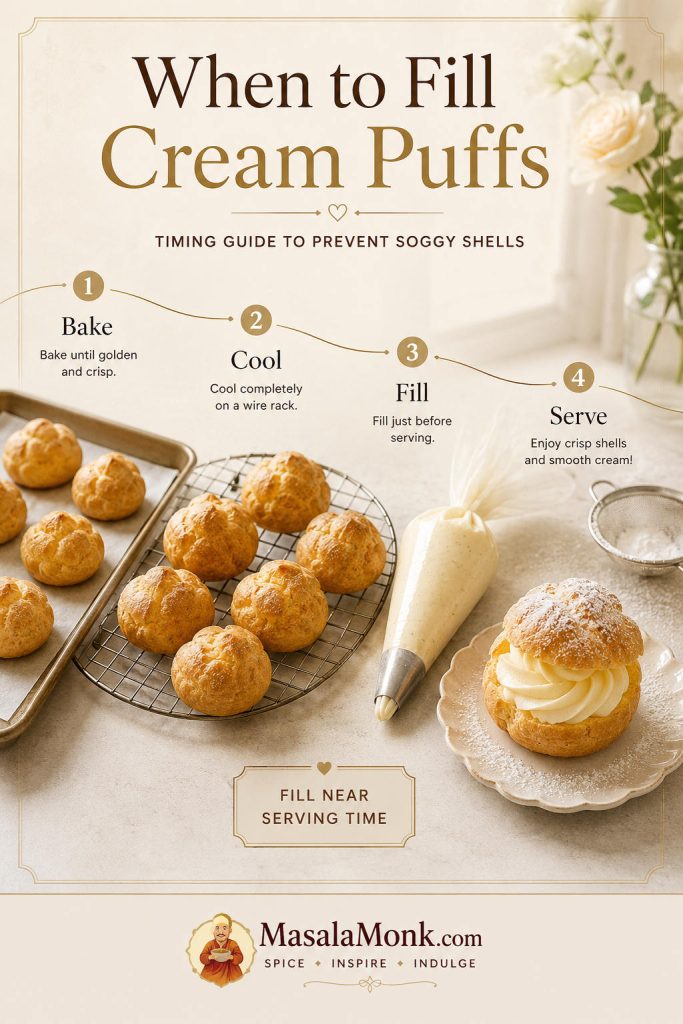
When Should You Fill Cream Puffs?

For the crispest bite, wait until the shells are cool and the filling is ready before assembling. Once filled, they soften in the refrigerator because the cream slowly releases moisture into the pastry.

Planning for a party? Use the make-ahead cream puffs timeline so the shells stay crisp.

Timeline showing bake, cool, fill, and serve steps for cream puffs.
The best filling window comes after the shells cool completely and before the tray sits too long, so the pastry keeps its crisp edge.

If you need to work ahead, bake the shells ahead and fill them later.

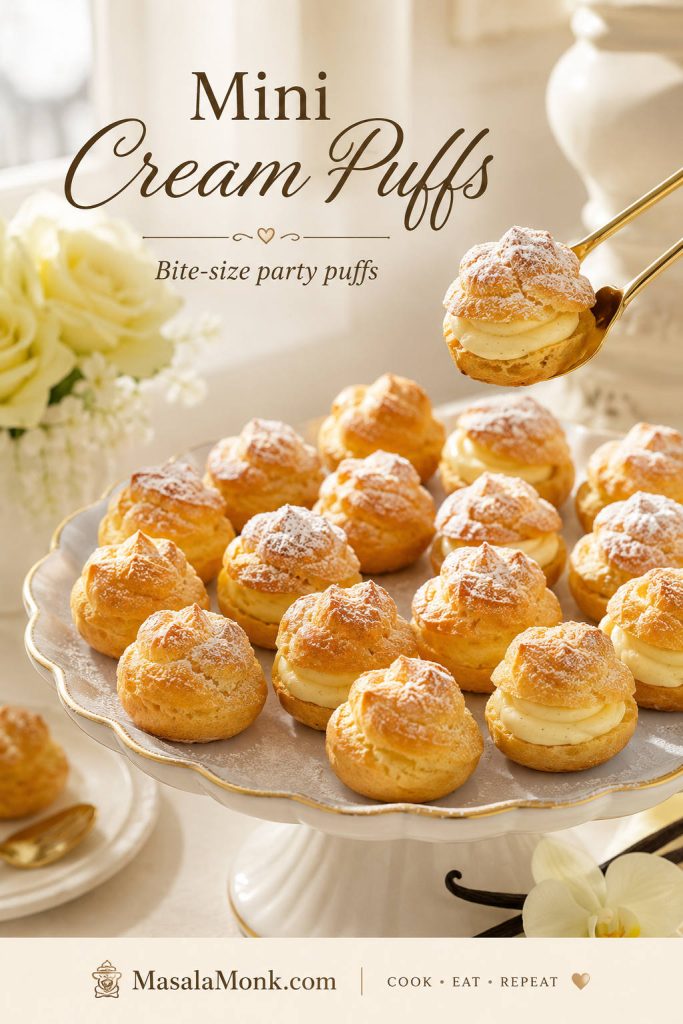
Mini Cream Puffs

Mini cream puffs use the same dough, but they are piped smaller and bake a little faster. They are perfect for parties, dessert trays, birthdays, brunch spreads, and bite-size holiday desserts.

Mini cream puffs arranged on a dessert tray with powdered sugar and visible vanilla cream filling.
Mini cream puffs use the same choux pastry technique, but their bite-size shape makes them especially useful for parties, dessert trays, and make-ahead serving.
  • Use the same dough and oven temperature.
  • Pipe 1-inch mounds.
  • Leave room between them.
  • Start checking 4–6 minutes earlier than regular puffs.
  • Keep the venting and drying step, even if the drying time is slightly shorter.
  • Fill from the bottom with a small round tip.
  • Assemble when you are ready to serve.
  • Expect about 40–50 mini cream puffs, depending on size.

Mini puffs can dry faster because they are small, but they can also overbrown faster. Look for the same signs: golden color, firm sides, light weight, and a hollow interior.

Do not skip the drying step just because they are small. A mini puff can still collapse if it is underbaked or trapped with steam inside.

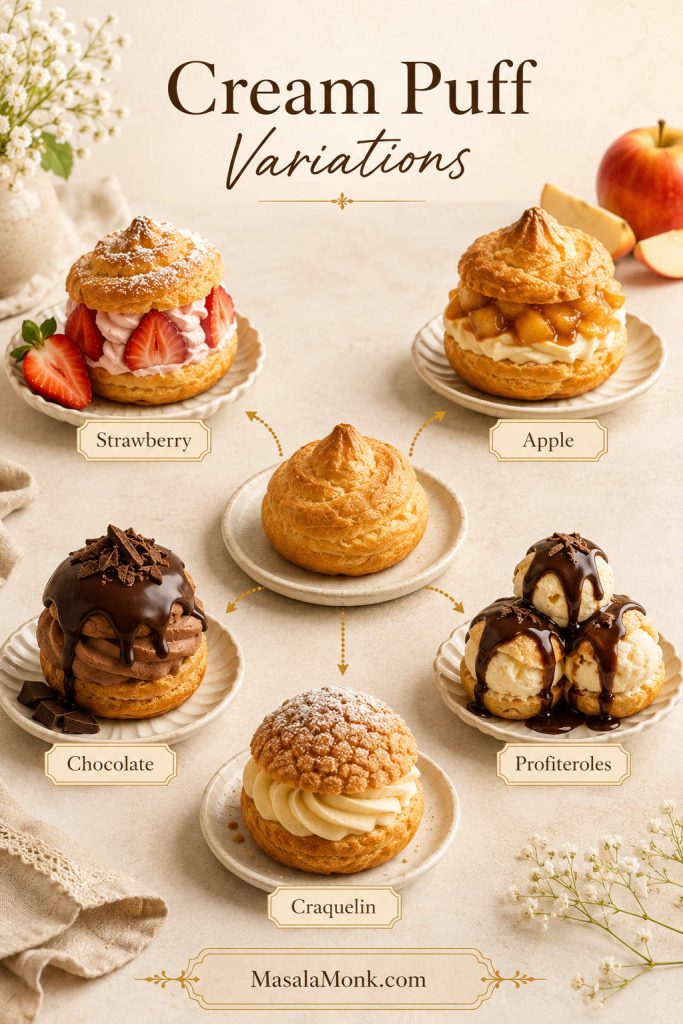
Cream Puff Variations

Once you understand the basic shell, the filling and topping can change easily.

Cream puff variations guide showing strawberry, apple, chocolate, profiteroles, and craquelin versions.
Once you can make hollow choux shells, the same base can become strawberry cream puffs, chocolate puffs, apple-topped puffs, profiteroles, or craquelin-style pastries.

Strawberry Cream Puffs

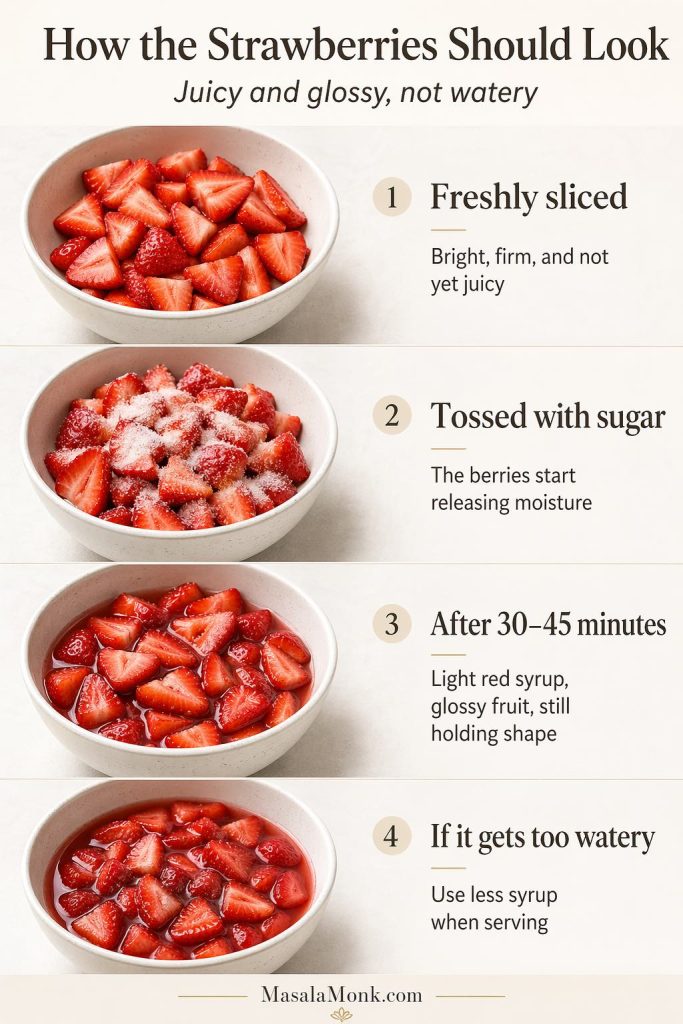
Add sliced strawberries inside the cream puffs or fold finely chopped strawberries into whipped cream. You can also use strawberry pastry cream or strawberry diplomat cream. Fresh strawberries release juice, so assemble these just before the tray goes out.

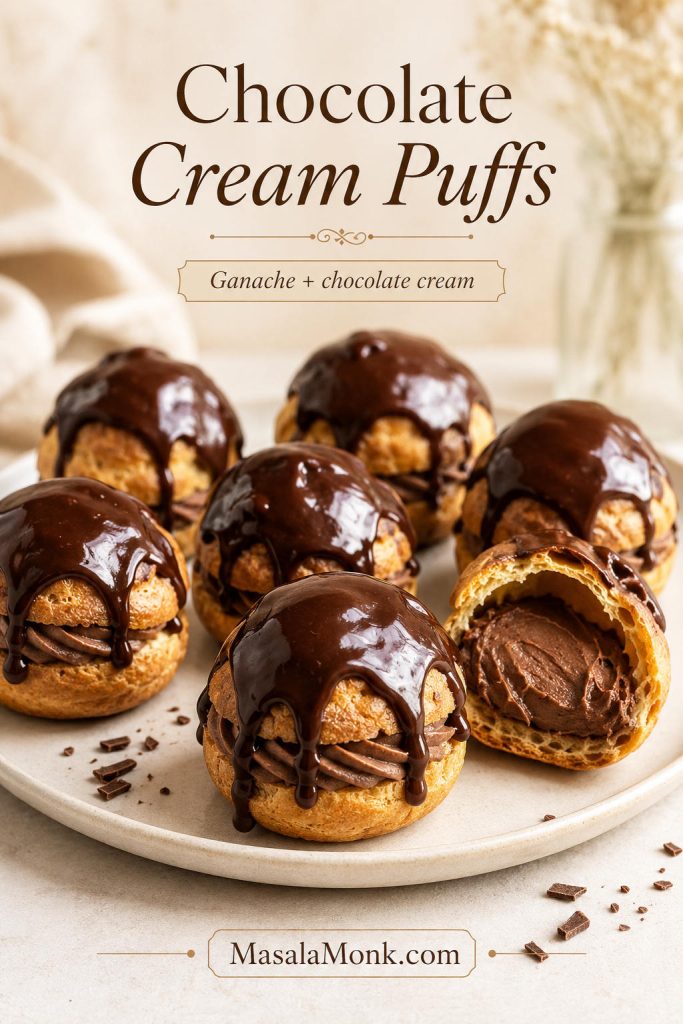
Chocolate Cream Puffs

Fill the shells with chocolate pastry cream, chocolate whipped cream, or vanilla cream with a chocolate ganache topping. Chocolate cream puffs are especially good with bottom-filled shells and a glossy chocolate finish.

Chocolate cream puffs filled with chocolate cream and topped with glossy ganache.
Chocolate cream puffs bring a richer finish to the same golden choux shell, with glossy ganache and soft cream for a more indulgent dessert direction.

Apple Cream Puffs

For an apple dessert version, keep the choux shells crisp and use a small spoonful of thick, cooled apple pie filling as a topping or plate sauce rather than packing the shell with wet fruit. Add the cream first, then spoon the apple filling over just before serving.

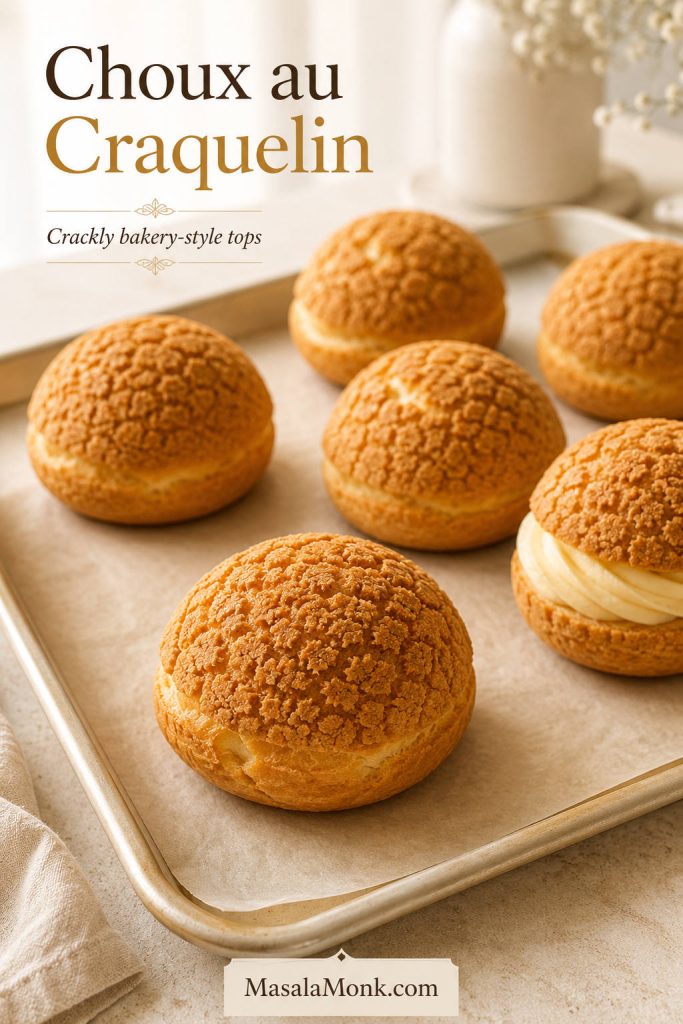
Choux au Craquelin

Choux au craquelin has a thin cookie-like dough placed on top of each choux mound before baking. It creates a crackly, more polished top and can help the puffs rise more evenly.

This is optional. You do not need craquelin for the base recipe, but it is a beautiful upgrade once you are comfortable with the dough.

Choux au craquelin pastries with golden crackly tops on a parchment-lined tray.
Choux au craquelin adds a thin cookie-like topping to choux pastry, giving the shells a more even rise and a crisp bakery-style surface.

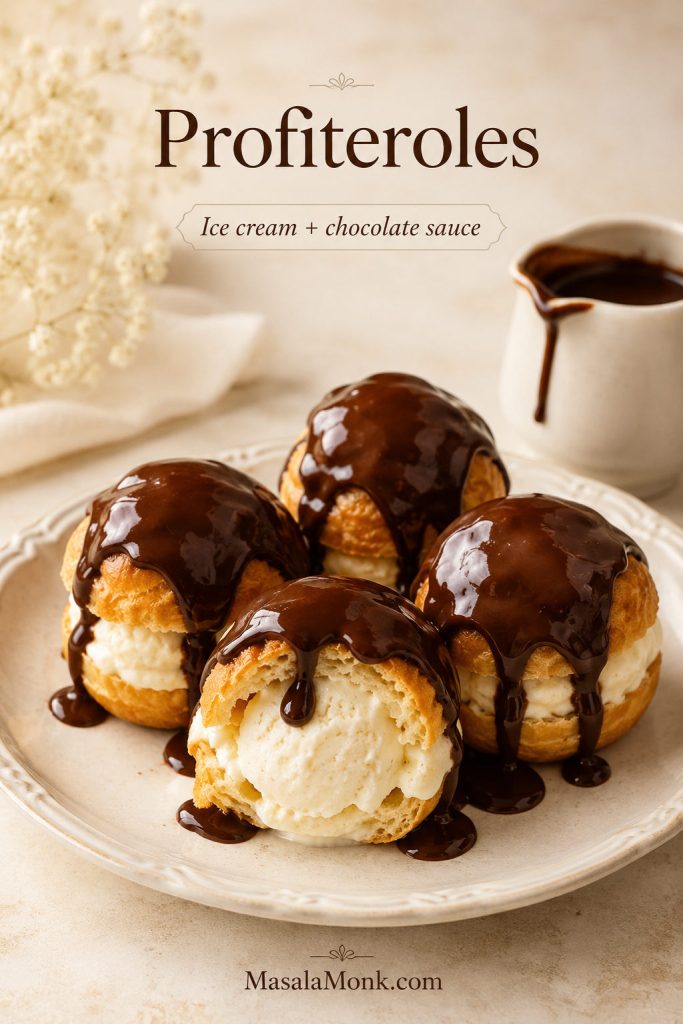
Ice Cream Puffs / Profiteroles

Fill cooled shells with small scoops of ice cream and top with warm chocolate sauce. Serve immediately, because the ice cream will soften the shells quickly. For a dairy-free tropical version, coconut ice cream makes a fun profiterole-style filling.

Profiteroles filled with vanilla ice cream and topped with glossy chocolate sauce.
Profiteroles are closely related to cream puffs, but they are often filled with ice cream and finished with warm chocolate sauce.

Croquembouche

Croquembouche is a tower of cream puffs held together with caramel. It is a separate advanced dessert, but it starts with the same basic choux pastry skill.

Cream Puff Recipe Troubleshooting

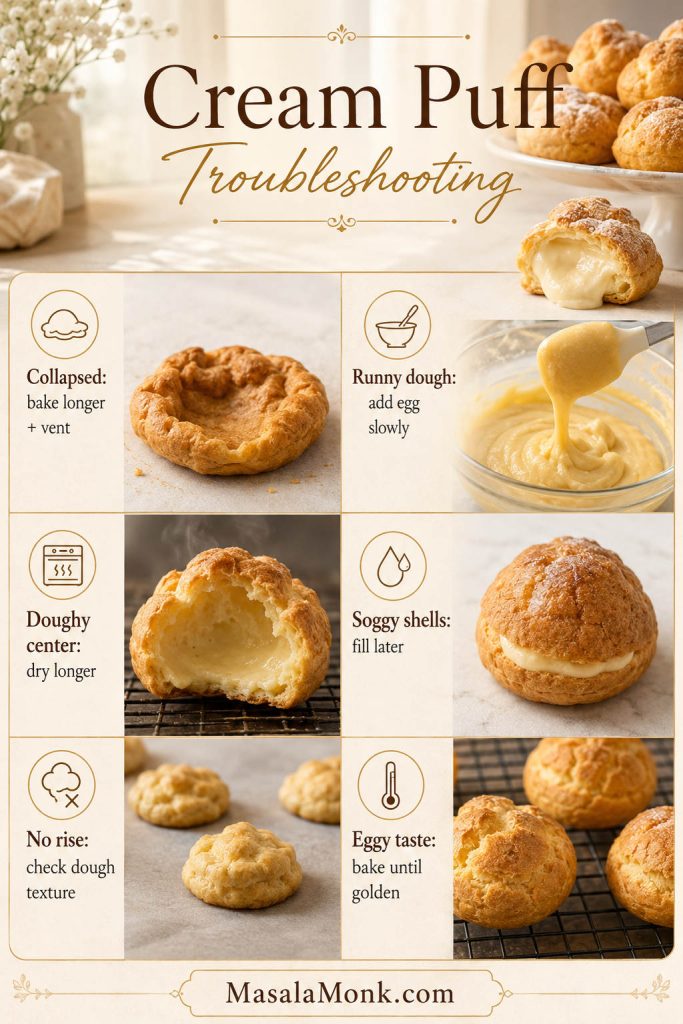
Most cream puff problems come back to moisture, egg quantity, oven timing, or assembling too early. Start with this quick diagnosis, then use the detailed fixes below.

Cream puff troubleshooting guide showing collapsed puffs, runny dough, doughy centers, soggy shells, no rise, and eggy taste fixes.
This troubleshooting guide turns common cream puff failures into visual checks: dough texture, shell color, steam release, and filling timing.
Problem Likely Cause Fix Next Time
Cream puffs collapsed Underbaked shells, oven opened early, trapped steam, or dough too wet Bake until firm and dry, do not open early, vent shells, and dry in the turned-off oven
Dough is runny Too much egg, panade not cooked enough, or too little flour Save the final egg for texture adjustment and stop at the V-shape test
Puffs did not rise Oven not hot enough, dough too loose, or panade too wet Preheat fully, cook the paste properly, and use visual dough cues
Centers are doughy Underbaked, shells too large, or not dried after baking Bake longer, pipe evenly, vent, and dry in the oven
Shells are soggy after filling Filled too early, filling too loose, or shells not fully cooled Fill near serving time and use pastry cream or stabilized cream for longer hold
Shells taste eggy Underbaked shells, too much egg, or pale pastry Bake until dry and golden, and use the dough test before adding all the egg

If your issue is dough texture, start with the choux dough test. If the shells collapse or taste eggy, go back to the shell color guide and baking cues.

Why Did My Cream Puffs Collapse?

Cream puffs usually collapse because they were underbaked, the oven was opened too early, the dough was too wet, or the shells were not vented and dried.

Fix it by baking until the shells are firm and dry, not just lightly colored. Vent steam with a small slit or hole, then let the shells dry in the turned-off oven with the door cracked.

A pale shell is usually an unstable shell.

Why Didn’t My Cream Puffs Rise?

If cream puffs do not rise, the dough may have been too runny, the panade may not have been cooked enough, or the oven may not have been hot enough at the start.
Make sure the liquid reaches a boil before adding flour, cook the flour paste for 1–3 minutes, and preheat the oven fully before baking. The piped dough should hold its mound shape before it goes into the oven.

Why Is My Choux Dough Runny?

Runny choux dough usually means too much egg was added or the flour paste stayed too wet. Egg size, humidity, and flour measurement can all affect the final texture.
The fix is prevention: add the last egg in small spoonfuls and stop when the dough is glossy, thick, and able to hold shape. If the dough already passes the V-shape test, do not force in the rest of the egg.

Why Are My Cream Puffs Doughy Inside?

Doughy centers mean the shells need more baking or drying time. Large puffs can also stay moist inside if they brown too quickly on the outside.

Bake until the shells feel light and firm, then vent and dry them in the turned-off oven. If one shell looks questionable, break it open and check the interior before removing the whole batch.

Why Are My Cream Puffs Soggy After Filling?

Filled cream puffs soften because cream adds moisture to the shell. This happens faster with plain whipped cream than with pastry cream or stabilized cream.

Fill near serving time, cool the shells fully before filling, and use a thicker filling if you need them to sit longer.

Why Do My Cream Puffs Taste Eggy?

An eggy taste often comes from underbaked shells, too much egg in the dough, or not enough filling balance. Cream puff shells should be baked until dry and golden, not pale and soft.

Adding vanilla to the filling and using the right amount of sugar also helps balance the egg-rich dough.

Make-Ahead, Storage, and Freezing for Cream Puffs

Cream puffs are best assembled close to serving, but the shells are very make-ahead friendly. The key is to store shells and filling separately whenever possible.

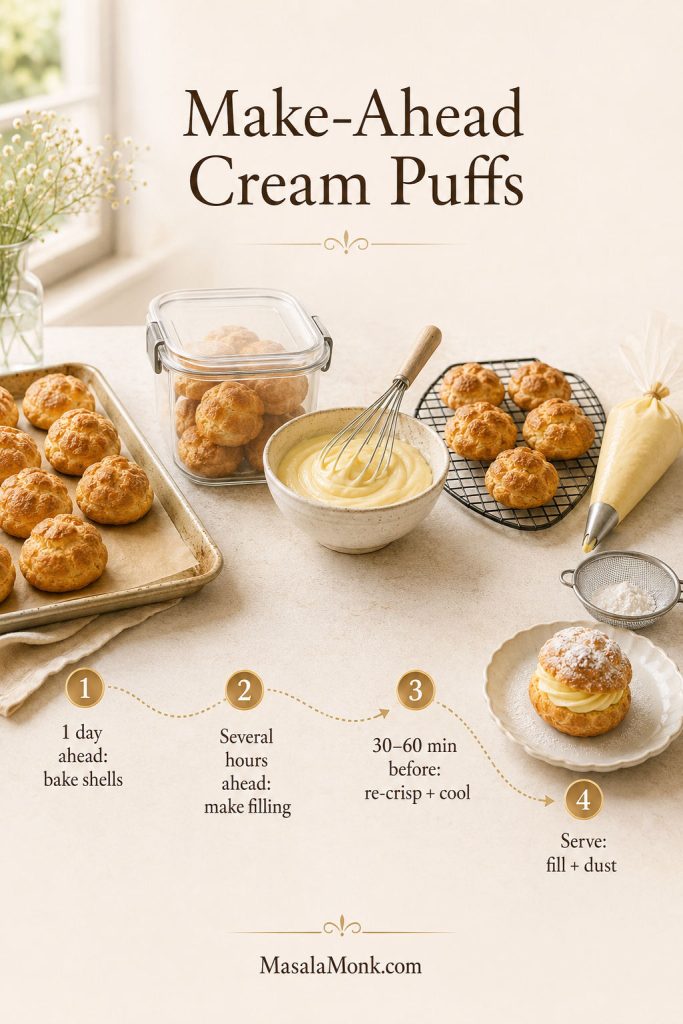
Best Make-Ahead Timeline for Cream Puffs

When What to Do
1 day ahead Bake the shells, cool them fully, and store them airtight.
Several hours ahead Make pastry cream, diplomat cream, or stabilized whipped cream and chill it.
30–60 minutes before serving Re-crisp shells if needed, then let them cool completely.
Right before serving Fill, dust with powdered sugar, and serve.
Make-ahead cream puff timeline showing baked shells, filling, re-crisping, cooling, and final filling.
Make-ahead cream puffs work best when the shell, filling, re-crisping, and final dusting happen as separate steps instead of one rushed assembly.

Making Cream Puff Shells Ahead

This is the best way to work ahead. Bake the shells, cool them completely, and store them in an airtight container for up to 1 day. If they soften, re-crisp them briefly in the oven, then cool again before filling.

Making Choux Dough Ahead

Freshly piped and baked choux gives the most reliable rise. You can refrigerate the dough briefly, but it may stiffen and become harder to pipe evenly.

For best results, especially if you are new to choux pastry, bake the dough soon after mixing. If you want to work farther ahead, freezing piped mounds is usually more reliable than holding a bowl of finished dough in the fridge.

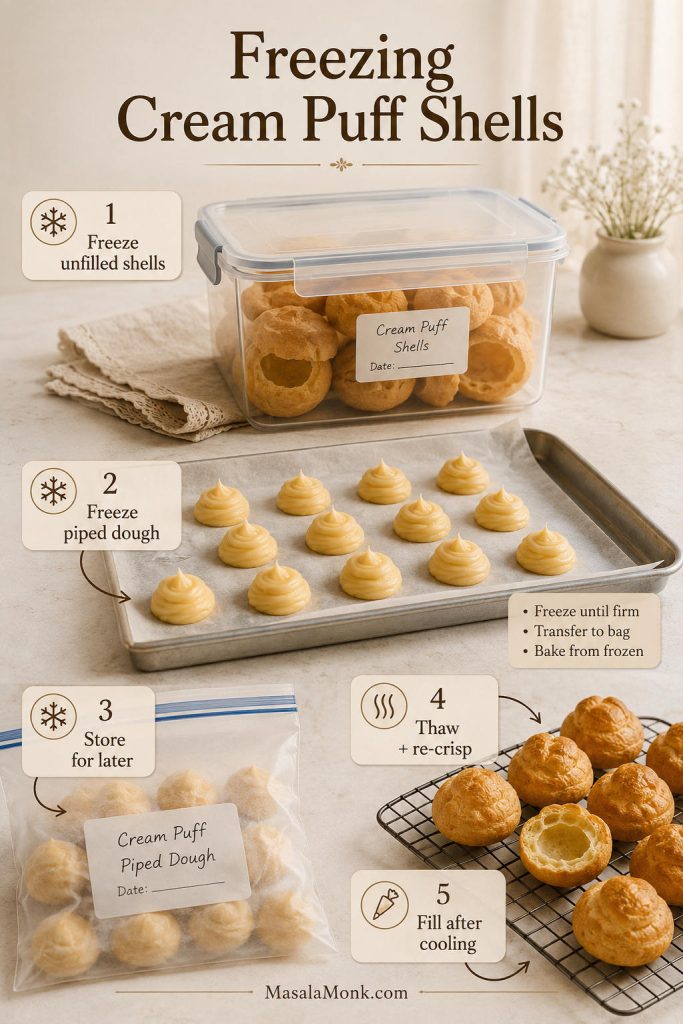
Freezing Cream Puff Shells and Piped Choux Dough

Piped unbaked choux can be frozen on a tray, then transferred to a freezer bag or container. Bake from frozen, adding a few extra minutes as needed.

This is useful for future batches, but the first time you make cream puffs, bake them fresh so you can learn how the dough behaves.

Freezing guide with unfilled cream puff shells in a container, piped choux dough on a tray, and baked shells cooling on a rack.
Unfilled cream puff shells and piped choux dough freeze better than filled cream puffs, because cream softens the pastry once it is added.

Refrigerating Filled Cream Puffs

Filled cream puffs should be refrigerated, but they taste best the same day. The longer they sit, the more the shells soften.

Pastry cream and diplomat cream hold better than plain whipped cream, but even those fillings will eventually soften the pastry.

Freezing Cream Puff Shells

Unfilled shells freeze better than filled cream puffs.

Freeze cooled, unfilled shells in an airtight container. Thaw at room temperature, re-crisp briefly in the oven if needed, cool completely, then fill.

How to Re-Crisp Cream Puff Shells

Place unfilled shells in a low oven until they feel dry again. Let them cool fully before filling. Do not fill warm shells, or the cream may melt and loosen.

Cream Puff Recipe

Recipe at a Glance

Cream Puff Recipe

Description: Golden choux pastry shells filled with vanilla cream. These cream puffs are crisp outside, hollow inside, and beginner-friendly when you follow the dough and baking cues.

Yield
24–28 cream puffs
Prep Time
40 minutes
Bake Time
30–35 minutes
Cooling/Drying Time
30–45 minutes
Total Time
About 1 hour 45 minutes to 2 hours with whipped cream, depending on cooling time
Method
Baked choux pastry
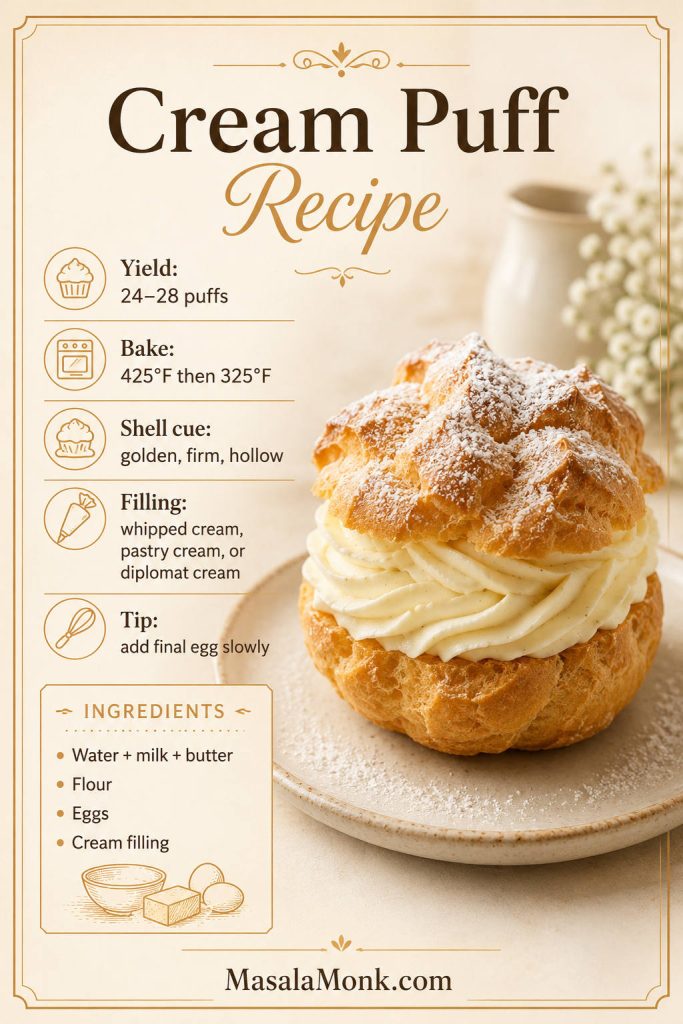
Cream puff recipe card with yield, baking temperatures, shell cues, filling options, and key ingredients beside a filled cream puff.
Keep this cream puff recipe card nearby for the decisions that matter most: egg texture, oven timing, hollow shells, and the right filling for your schedule.

Ingredients

For the Choux Pastry Shells

  • ½ cup / 120 ml water
  • ½ cup / 120 ml whole milk
  • ½ cup / 113 g unsalted butter, cut into pieces
  • 1 tsp granulated sugar
  • ¼ tsp fine salt
  • 1 cup / 125 g all-purpose flour, spooned and leveled if using cups
  • 4 large eggs, room temperature, beaten; add gradually and use only as much as needed

For the Whipped Cream Filling

  • 2 cups / 480 ml cold heavy cream
  • 3–4 Tbsp powdered sugar
  • 1–2 tsp vanilla extract
  • Pinch of salt, optional
  • Optional for a sturdier filling: 4 oz / 113 g mascarpone or softened cream cheese

Optional Pastry Cream Filling

  • 2 cups / 480 ml whole milk
  • 4 large egg yolks
  • ½ cup / 100 g granulated sugar
  • ¼ cup / 30 g cornstarch
  • 2 Tbsp / 28 g unsalted butter
  • 2 tsp vanilla extract or vanilla bean paste
  • Pinch of salt

Optional Topping

  • Powdered sugar, for dusting
  • Melted chocolate or ganache, optional

Instructions

Make the Choux Dough

  1. Preheat the oven. Preheat to 425°F / 218°C. Line baking sheets with parchment paper.
  2. Start the choux base. Add water, milk, butter, sugar, and salt to a medium saucepan. Warm over medium heat until the butter melts and the liquid reaches a boil.
  3. Add the flour. Add the flour all at once and stir immediately with a wooden spoon or sturdy spatula.
  4. Cook the paste. Keep stirring for 1–3 minutes, until the dough forms a ball, pulls from the sides, and leaves a light film on the pan.
  5. Cool slightly. Transfer the dough to a mixing bowl or stand mixer bowl. Let it cool for a few minutes until warm but not steaming hot.
  6. Add most of the eggs. Mix in about 3 beaten eggs gradually, mixing well after each addition. The dough may look broken at first, then smooth out.
  7. Adjust with the last egg. Add the last beaten egg a spoonful at a time. Stop when the dough is smooth, glossy, thick, and falls from the spatula in a thick V shape. You may not need every drop.

Pipe and Bake the Shells

  1. Pipe the shells. Transfer dough to a piping bag and pipe 1½–2 inch mounds, spacing them 2–3 inches apart. Smooth sharp peaks with a damp fingertip.
  2. Bake hot first. Bake at 425°F / 218°C for 10 minutes. Do not open the oven.
  3. Lower the heat. Reduce oven temperature to 325°F / 163°C without opening the oven. Bake 20–25 minutes more, until shells are golden, firm, and dry.
  4. Vent and dry. Turn the oven off. Poke or slit each shell to release steam, then return shells to the turned-off oven with the door cracked for 10–20 minutes.
  5. Cool completely. Transfer shells to a wire rack and cool fully before filling.

Make the Filling

  1. Make the whipped cream filling. Beat cold heavy cream, powdered sugar, vanilla, and optional salt until medium-stiff to stiff peaks form. For a sturdier version, beat the mascarpone or cream cheese smooth first, then slowly add the cold cream and whip to medium-stiff peaks.
  2. Or make pastry cream. Heat milk until steaming. Whisk egg yolks, sugar, cornstarch, and salt in a bowl. Slowly whisk in some hot milk, then return everything to the saucepan. Cook, whisking constantly, until thick and bubbling. Off heat, whisk in butter and vanilla. Cover directly on the surface and chill fully before piping.
  3. For diplomat cream. Whisk 2 cups chilled pastry cream until smooth, then fold in 1 cup whipped cream until light and ready to pipe.

Fill and Serve

  1. Fill the cream puffs. Slice shells and pipe cream inside, or fill from the bottom with a piping bag.
  2. Finish and serve. Dust with powdered sugar or drizzle with chocolate. Serve soon after filling for the crispest texture.

Notes

  • Do not open the oven during the early rise.
  • Use the last egg as a texture adjustment. You may not need every drop.
  • Golden, firm, dry shells hold better than pale shells.
  • Assemble near serving time for the best texture.
  • Use whipped cream for the easiest filling, pastry cream for classic custard-filled puffs, or diplomat cream for a richer but still airy center.
  • For a more stable whipped cream filling, beat in 4 oz / 113 g mascarpone or softened cream cheese before slowly adding the cold cream.
  • You may have a little pastry cream left over depending on how generously you fill the shells.

FAQs

What is the secret to good cream puffs?

Good cream puffs come from properly cooked choux dough, gradual egg addition, a hot oven start, and enough baking time for the shells to dry and set. The dough should be glossy and able to hold shape before baking, and the shells should be firm before cooling.

Why do cream puffs collapse after baking?

They usually collapse because they were underbaked, the oven was opened too early, the dough was too wet, or the shells were not vented and dried. Bake until the shells are firm, release steam, and let them dry before cooling fully.

Is whipped cream or pastry cream better for beginners?

Whipped cream is easier for a first batch because it does not need cooking. Pastry cream tastes more classic and holds better, but it needs extra time to cook and chill.

What should a baked cream puff look like inside?

The inside should be mostly hollow, dry enough to hold filling, and not wet or doughy. A little soft webbing inside the shell is normal, but it should not feel raw.

How far ahead can I fill cream puffs?

For the crispest texture, fill them just before the tray goes out. If you need to work ahead, bake the shells and prepare the filling separately, then assemble closer to the time you plan to serve them.

How do I keep cream puffs crisp for a party?

Bake and cool the shells ahead, store them airtight, re-crisp them if needed, and fill them shortly before the tray goes out. Pastry cream or stabilized whipped cream will hold better than plain whipped cream.

Can I make cream puffs without a piping bag?

A zip-top bag with the corner snipped works, and you can also use a spoon or scoop. A piping bag gives cleaner, more even shells, but the recipe can still work without one.

Are cream puffs and profiteroles the same?

They are closely related because both use choux pastry. Cream puffs are usually larger and filled with cream, while profiteroles are often smaller and served with ice cream or chocolate sauce.

Freezing Cream Puff Shells

Unfilled cream puff shells freeze well. Thaw them at room temperature, re-crisp briefly in the oven if needed, cool fully, then fill.

Why is my cream puff dough too runny?

Runny choux dough usually means too much egg was added, the flour paste was not cooked long enough, or the flour measurement was too low. Use the final egg as a texture adjustment and stop when the dough forms a thick V from the spatula.

Can I use puff pastry for cream puffs?

Classic cream puffs use choux pastry, not puff pastry. Puff pastry creates flaky layers, while choux pastry creates hollow shells that can be filled with cream.

Final Thoughts

Cream puffs feel intimidating until you understand the texture cues. Cook the dough long enough to remove extra moisture, add the eggs gradually, and give the shells enough oven time to dry and hold their shape.

Once the choux shells are hollow and dry, the rest is flexible. Fill them with whipped cream for the easiest version, pastry cream for a classic custard center, or diplomat cream when you want something light, rich, and stable.

Serve them soon after filling, and you get exactly what a good cream puff should be: crisp pastry, soft cream, and a dessert that feels far more impressive than the ingredient list suggests. Once you can make one batch of hollow choux shells, you can change the filling, size, topping, and finish without relearning the whole recipe.

That is the quiet confidence this recipe gives you: one reliable shell, many possible desserts.

Back to top ↑
Posted on — Leave a comment

Apple Tart Recipe

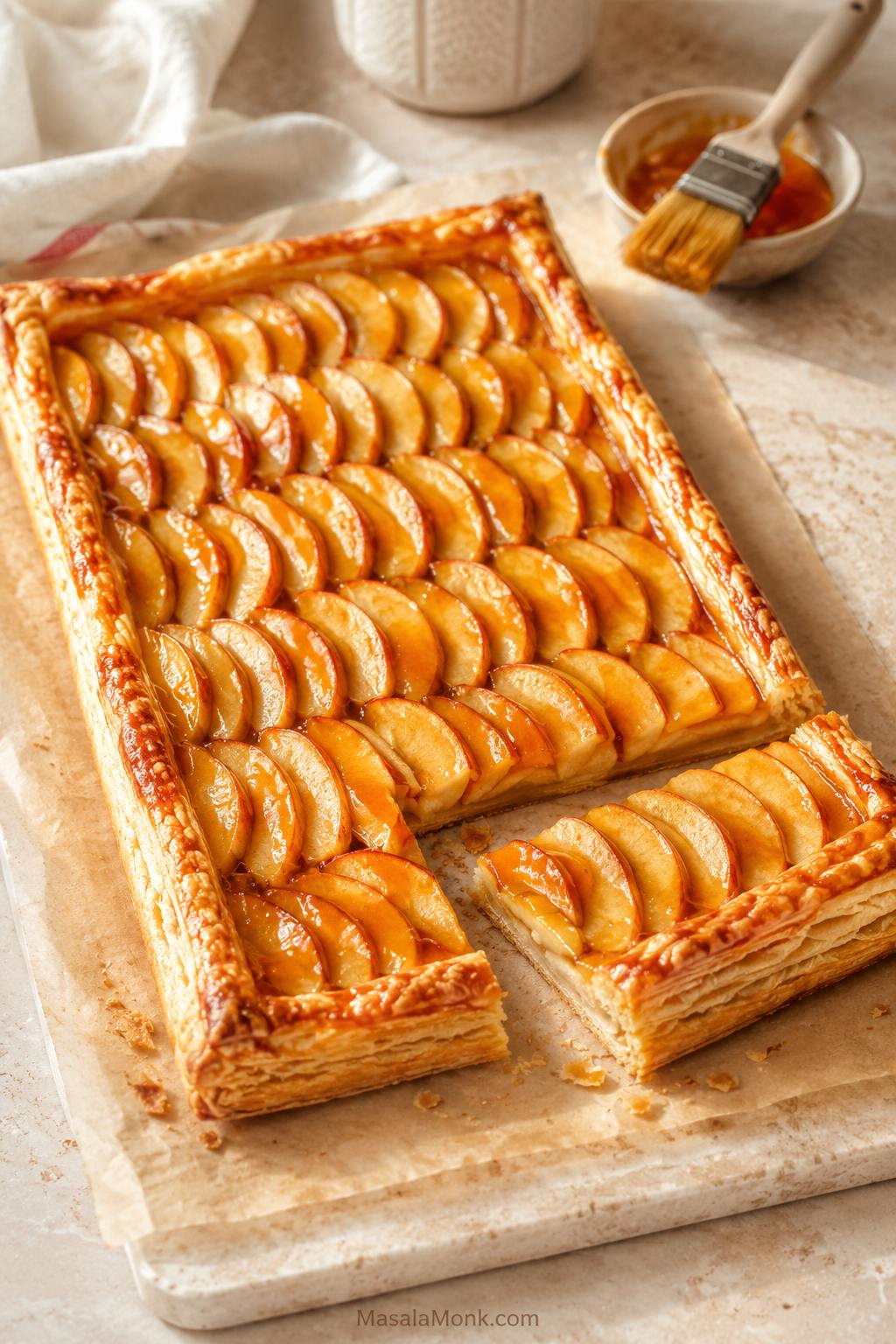
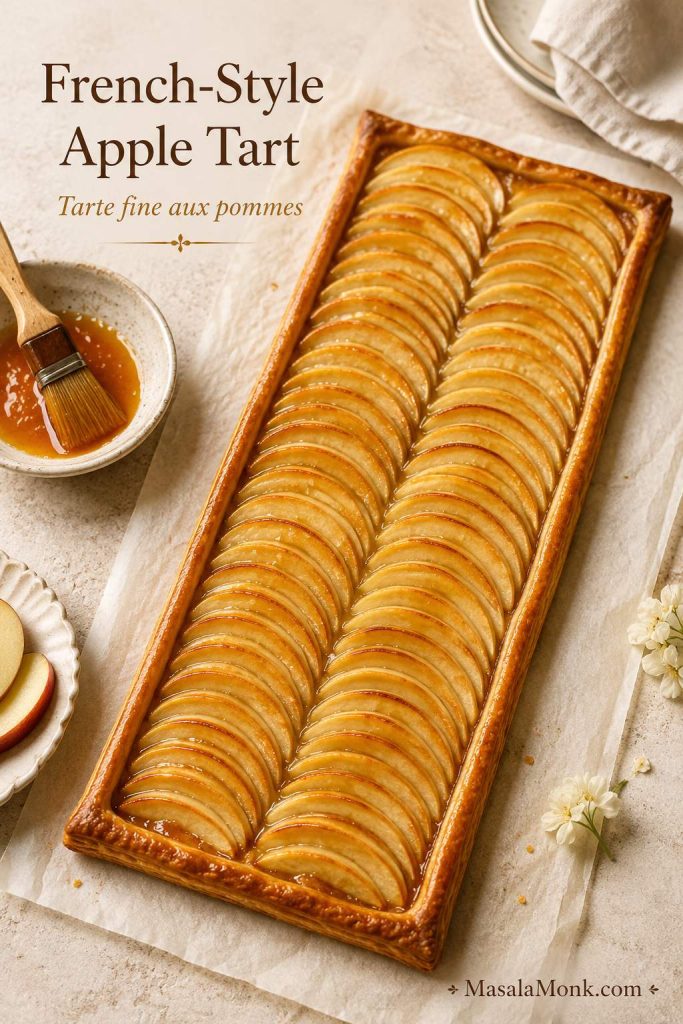
Rectangular apple tart with thin sliced apples, glossy glaze, and a golden puff pastry border on parchment.

This apple tart recipe is for the moment when you want something prettier than a basic apple dessert but easier than a full apple pie. Store-bought puff pastry, thin apple slices, cinnamon sugar, melted butter, and a glossy apricot finish bake into a crisp, bakery-style tart that smells like cinnamon apples and slices cleanly enough to serve with pride.

The method is simple, but the details matter. Keep the pastry cool, slice the apples evenly, and bake the tart until the base feels firm enough to lift with a spatula. The best slices have flaky pastry, soft cinnamon-scented apples, and just enough glaze to catch the light.

Start with the puff pastry version, then use the notes below when you want a round shortcrust tart, a French-style applesauce layer, mini tarts, or a fix for a base that keeps turning soft.

Quick Answer: How to Make Apple Tart

To make an easy apple tart, place cold puff pastry on parchment, score a border around the edge, dock the center with a fork, and arrange thin apple slices in one overlapping layer. Brush the apples with melted butter, sprinkle with cinnamon sugar, then bake at 400°F / 200°C, or 180°C fan, for 30–35 minutes, until the pastry is well browned and the apples are tender. Brush the warm tart with apricot jam or apple jelly for a glossy finish.

When it is right, the edges will puff into a flaky frame, the apples will look glossy and slightly curled at the tips, and the bottom will feel firm instead of bendy. The goal is not a mountain of apples. The goal is a crisp sheet of pastry with enough fruit to taste generous, but not so much that the juices flood the base.

For the full printable-style version, go straight to the recipe card. If your main worry is texture, the crisp base tips explain how to avoid a soggy apple tart.

Slice of apple tart lifted from a rectangular puff pastry tart, showing glossy apples and flaky pastry layers.
Once the tart cools slightly, a clean slice should show tender apples on top and a firm pastry base underneath.

Apple Tart at a Glance

Best pastry for the simple version Store-bought all-butter puff pastry
Apple amount 3 medium apples, about 450–550 g / 1–1¼ lb before peeling and coring
Apple slice thickness ⅛–¼ inch / 3–6 mm
Oven temperature 400°F / 200°C, or 180°C fan
Bake time 30–35 minutes for puff pastry
Best finish Warm apricot jam or apple jelly glaze
Most important texture cue The pastry should be crisp, browned underneath, and firm enough to lift
Apple tart at-a-glance guide showing bake temperature, apple amount, slice thickness, bake time, and apricot glaze.
Use these numbers as guardrails: three apples, thin slices, a hot oven, and apricot glaze keep the tart balanced.

Why This Apple Tart Works

The secret is giving puff pastry the conditions it likes: cold dough, a hot oven, a scored edge, and a thin apple layer that does not weigh down the center. Store-bought puff pastry is the shortcut here; it gives you a flaky, bakery-style apple tart without making dough from scratch.

  • Puff pastry keeps the recipe approachable. You get flaky layers without a homemade dough project.
  • A scored border gives the tart structure. The edge rises around the apples and creates a clean frame.
  • Docking the center keeps it flatter. The middle stays lower while the border puffs.
  • Thin apples bake quickly. Slices around ⅛–¼ inch / 3–6 mm soften before the pastry overbrowns.
  • A hot baking sheet helps the bottom set. This gives the pastry a better chance to crisp before apple juices collect.
  • A light glaze makes it look finished. Apricot jam or apple jelly gives shine without making the tart heavy.

The result is the kind of dessert that feels dressed up without being fussy: crisp enough to lift neatly, tender enough to eat with a fork, and glossy enough to look finished even if your apple rows were not perfect.

This is the tart you make when pie sounds too heavy but sliced apples on buttery pastry still feels special. It looks like it took more effort than it did, which is exactly the charm.

Ingredients You Need

The ingredient list is short, so each piece has to pull its weight: buttery pastry, flavorful apples, a little sugar, a little butter, and a glossy finish at the end.

Apple tart ingredients including puff pastry, apples, cinnamon sugar, lemon, butter, apricot jam, egg, and salt.
With a short ingredient list, choose flavorful apples and good puff pastry because there is nowhere for weak ingredients to hide.

If you are still choosing apples, the best apples for apple tart section gives a quick variety guide before you start slicing.

Store-Bought Puff Pastry

Use one sheet of all-butter puff pastry if you can find it. It bakes with better flavor and cleaner flaky layers than pastry made mostly with shortening. Thaw frozen puff pastry in the refrigerator, not on a warm counter, so it unfolds without getting greasy. Soft pastry should go back into the fridge before baking.

Cold pastry matters because firm butter layers create better lift in the oven. King Arthur Baking’s puff pastry guidance explains the same cold-dough, hot-oven principle in more detail.

Store-bought puff pastry unfolded on parchment with sliced apples and a pastry brush nearby.
Store-bought puff pastry gives the shortcut, but keeping it cold is what helps the tart rise cleanly in the oven.

Not sure whether puff pastry or shortcrust is better for your tart? See the puff pastry vs shortcrust comparison before you choose.

Apples

You need about 3 medium apples, or 450–550 g / 1–1¼ lb before peeling and coring. That amount covers one rectangular puff pastry tart without weighing down the center. Pink Lady and Honeycrisp give an easy sweet-tart balance, while Granny Smith makes a sharper tart when mixed with a sweeter apple.

Fresh Apples vs Apple Pie Filling

This tart works best with fresh thin apple slices, not thick cooked filling. A saucy apple pie filling recipe is better for pies, crisps, hand pies, and spoonable toppings because it has more moisture and body than this thin pastry base needs.

Fresh apple slices on puff pastry compared with saucy apple pie filling for an apple tart.
Fresh apple slices suit a thin puff pastry tart because cooked pie filling brings more sauce than this base can handle.

For a deeper, saucier apple dessert instead, compare this with the apple tart vs pie section.

Sugar

Granulated sugar gives a clean, light sweetness. Light brown sugar adds a warmer caramel note. Use 3 tablespoons for sweet apples or 4 tablespoons for sharper apples.

Butter

A little melted butter helps the apple edges soften, shine, and brown. You do not need much because puff pastry already contains fat.

Lemon Juice

Lemon keeps the apples bright so the tart does not taste flat or overly sweet. It also buys you a little time while you arrange the slices.

Cinnamon and Salt

Cinnamon gives warmth without making the tart taste like heavy apple pie filling. A pinch of salt makes the apples and pastry taste fuller.

Apricot Jam or Apple Jelly

A warm glaze brushed over the baked tart gives it shine. Apricot jam is classic because it looks glossy and does not overpower the apples. Apple jelly works well for a more apple-forward finish.

Egg Wash, Optional

Egg wash helps the pastry border brown and shine. Brush it only on the top of the border, not down the cut or scored sides, so the pastry layers can rise cleanly. The tart still works without egg wash; the edge will simply look a little softer.

Best Apples for Apple Tart

The best apples for apple tart should taste good, slice neatly, and soften without collapsing. Because this tart is thin, the apples do not need to stay as firm as apples in a deep pie. Flavor matters just as much as structure.

For the easiest first tart, use Pink Lady or Honeycrisp. They slice neatly, taste bright, and do not need much adjustment. For a sharper flavor, mix Granny Smith with a sweeter apple so the tart tastes lively without becoming too sour.

Apple variety guide for apple tart with Pink Lady, Honeycrisp, Granny Smith, Braeburn, Gala, Fuji, and Golden Delicious apples.
Pair a tart apple with a sweeter one when you want bright flavor, gentle sweetness, and slices that still hold together.
Apple Best For Flavor and Texture
Pink Lady Best overall apple tart Sweet-tart, firm, neat slices
Honeycrisp Sweet-tart, familiar flavor Juicy, crisp, and easy to like
Granny Smith Tarter apple tart Firm and sharp; best mixed with a sweeter apple
Braeburn Balanced baking flavor Warm, aromatic, holds shape well
Gala or Fuji Sweeter puff pastry tart Softer and sweeter; good for quick tarts
Golden Delicious Classic French-style tart Soft, mellow, aromatic

A mix of one tart apple and one sweeter apple often gives the best flavor. For example, use Granny Smith with Honeycrisp, Pink Lady, or Fuji. For a deeper baking-apple guide, see best apples for apple pie; the same flavor logic applies, but tart apples should be sliced thinner and arranged more evenly.

Puff Pastry vs Shortcrust for Apple Tart

For this specific recipe, puff pastry is the best first choice. It gives flaky, dramatic edges with very little work, and it keeps the tart feeling light instead of heavy. Shortcrust or pie crust gives a more classic tart-pan texture, but it needs a little more care.

Puff pastry apple tart compared with a shortcrust apple tart in a round fluted tart pan.
Choose puff pastry for a lighter, flakier apple tart, while shortcrust gives a sturdier, more classic tart-pan base.
Pastry Best For Texture Notes
Puff pastry Easy apple tart, French-style sheet tart Flaky, light, crisp edges Great for a quick, flaky tart; keep it cold and bake on a hot tray.
Shortcrust pastry Classic round apple tart Buttery, tender, sturdier Best in a 9–10 inch tart pan.
Pie crust Homemade tart-pan version Flaky but less puffy Works well if rolled thin and chilled.
Store-bought pie crust Shortcut tart-pan version Softer, simpler Chill before baking so it holds shape.

To make the tart with homemade crust, use a buttery pie dough and roll it thin. This apple pie crust recipe is a good base for a shortcrust-style apple tart when you want something more homemade than puff pastry.

How to Make a Shortcrust Apple Tart

For a shortcrust apple tart, line a 9–10 inch tart pan with chilled dough, prick the base with a fork, and chill the lined pan before adding apples. With especially juicy apples or an applesauce layer, partially blind bake the crust until it looks dry and lightly set before adding the fruit.

Shortcrust pastry in a fluted tart pan with a fork-pricked base and apple slices nearby.
Before the apples go in, a chilled and pricked shortcrust base gives the tart a better chance to bake evenly.

Shortcrust usually needs longer than puff pastry. Plan on 40–55 minutes, depending on the pan, crust thickness, and apple slice thickness. The tart is ready when the apples are tender and the crust is golden all the way through, not just browned at the rim.

How to Slice Apples for Apple Tart

For a neat apple tart, slice the apples evenly. Aim for ⅛–¼ inch / 3–6 mm. Thinner slices give a polished French-style look, while slices closer to ¼ inch / 6 mm feel more rustic and apple-forward. Whatever thickness you choose, keep the slices similar so they soften at the same pace.

Apple slice thickness guide showing thin and slightly thicker apple slices for an apple tart.
Aim for thinner slices when you want a polished French-style apple tart; go thicker for a softer, more rustic bite.

For easier prep, cut the apples into cheeks first, then slice each piece thinly. You can peel the apples or leave the skin on. Peeled apples give a softer, more classic finish. Unpeeled apples add color and a little bite, especially with Pink Lady, Honeycrisp, or another red-skinned apple. A little browning before baking is harmless, especially once cinnamon and glaze go on.

Need to slice the apples a little ahead of time? Lemon water or lemon juice can slow browning. This guide on how to keep sliced apples from turning brown is useful when you are prepping fruit before baking.

Once the apples are sliced, move to the arranging step for simple rows, shingles, or fans.

How to Make Apple Tart Step by Step

Do not worry about making every slice identical. Even slices help the tart bake evenly, but a slightly rustic pattern still looks lovely once the apples soften and the glaze goes on.

1. Preheat the oven and baking sheet

Heat the oven to 400°F / 200°C, or 180°C fan. Place a rimmed baking sheet on the middle rack while the oven preheats. A hot tray helps the pastry bottom set instead of steaming underneath the apples.

Empty rimmed baking sheet preheating in an oven with puff pastry and sliced apples ready on the counter.
A preheated sheet pan gives puff pastry heat from below, so the base starts setting before the apples release juice.

2. Prepare the puff pastry

Place the cold puff pastry on parchment paper. Roll it lightly to smooth creases or even out the shape. Keep it close to a standard sheet-pan tart size; pastry rolled too thin will not puff as well.

Score a ¾–1 inch / 2–2.5 cm border around the edge with a knife, without cutting all the way through. Dock the center with a fork, leaving the border untouched so it can rise.

Puff pastry scored around the border and docked in the center with fork marks for apple tart.
Score for lift and dock for control; together, those two small steps shape the raised border and flatter center.

3. Slice and season the apples

Slice the apples thinly and toss them with lemon juice, sugar, cinnamon, and a pinch of salt. When the apples release a lot of juice while they sit, leave the extra liquid behind instead of pouring it onto the pastry.

Thin apple slices tossed with cinnamon sugar and lemon juice, with extra liquid left in the bowl.
After seasoning the apples, lift the slices out of the bowl instead of pouring extra cinnamon-lemon juice onto the pastry.

4. Arrange the apples

Arrange the apple slices inside the scored border in overlapping rows, shingles, fans, or a simple diagonal pattern. Keep them in one tidy layer. Brush the apples with melted butter. Brush egg wash on the top border if using, but avoid the cut sides.

Rows, shingles, fans, or a loose spiral all work. The pattern matters less than keeping the apples in an even layer, so do not worry if it looks a little rustic before baking.

Hands arranging thin apple slices in overlapping rows on puff pastry for apple tart.
A neat apple tart comes from an even layer first; the exact pattern matters less once the apples soften and shine.

5. Chill the assembled tart

Refrigerate the assembled tart for 10–15 minutes while the oven finishes heating. This keeps the butter layers firm and helps the pastry puff more cleanly.

Unbaked apple tart on a baking sheet being chilled in the refrigerator before baking.
That quick fridge rest firms the butter layers, which helps the puff pastry hold its border instead of slumping.

6. Bake until crisp and browned

Carefully slide the parchment with the tart onto the hot baking sheet. Bake for 30–35 minutes, until the edges are puffed, the bottom is browned, and the apples are tender at the edges.

By the last 10 minutes, the kitchen should smell buttery and cinnamon-warm. Do not pull the tart when the border is only lightly golden; puff pastry tastes best when it has real color, and a pale base is the first sign it may soften as it cools.

Baked apple tart with browned puff pastry, tender apple slices, and a lifted edge showing the base.
Look underneath before you call it done; a pale base can turn soft even when the apples already look glossy.

For ovens that brown pastry quickly, bake on the middle rack or slightly lower. A lower rack can help the base cook before the top gets too dark. If the pastry is browning unevenly or the center looks soft, check the troubleshooting guide before changing the recipe next time.

7. Glaze and cool

Warm the apricot jam with a teaspoon of water until loose, then brush it mostly over the apples while the tart is still warm. For the smoothest glaze, strain out large fruit pieces before brushing, and avoid soaking the pastry border so the edge stays crisp.

Warm apple tart brushed with apricot glaze while the puff pastry border stays crisp.
Glaze adds shine after baking, but brushing mostly over the apples keeps the puff pastry edge crisp.

Let the tart cool for at least 10–15 minutes before slicing so the pastry can settle. Serve it warm when the apples are soft and fragrant, or at room temperature when you want cleaner slices for a dessert table.

Larger pastry sheet note: Puff pastry sheets vary by brand and country. If your sheet is closer to 300–320 g instead of 240–260 g, use 4 medium apples and add 3–5 minutes to the bake time if the center needs it.

How to Keep Apple Tart from Getting Soggy

A soggy apple tart usually comes from warm pastry, too many apples, excess apple juice, or underbaking. The fix is not one trick; it is a small chain of good habits that keep the pastry cool, the fruit layer controlled, and the base properly baked.

Crisp-base guide for apple tart showing cold pastry, a hot tray, one apple layer, excess juice control, and full baking.
Crispness is built in stages: cool pastry, controlled apple juice, heat from below, and enough time in the oven.

If you are still assembling the tart, the preheated baking sheet step, apple seasoning step, and chilling step are the most important places to prevent sogginess.

Before Baking: Keep the Pastry Cold and the Apples Controlled

  • Keep the pastry cool and firm. Warm puff pastry tends to slump before it rises.
  • Use a hot baking sheet. The heat hits the bottom quickly and helps the base set.
  • Score the border. This encourages the edges to puff around the apples.
  • Dock the center only. The middle stays flatter while the border rises.
  • Use one layer of apples. A heavy pile releases too much juice.
  • Leave excess juice behind. Season the apples, then avoid dumping watery liquid onto the pastry.
  • Add a light barrier when needed. For very juicy apples, sprinkle 1 tablespoon almond flour, fine breadcrumbs, or flour over the pastry center before adding apples.
  • Bake until the bottom is firm. The pastry should flake instead of bend.

After Baking: Diagnose What Went Wrong

If the tart has already gone wrong, use the table below to work out what happened. Most texture problems come back to the same few causes: soft pastry, too much moisture, thick apple slices, or pulling the tart from the oven too early.

Apple tart troubleshooting guide showing soggy center, flat edges, burnt edges, firm apples, leaking juice, and greasy pastry fixes.
Use the texture problem first, then fix the cause; apple tart issues usually trace back to moisture, heat, or slice thickness.
Problem Likely Cause Fix
Soggy center Too much apple juice or underbaked pastry Leave excess liquid behind and bake until the base is browned.
Flat edges Border was docked, cut too deeply, or pastry got too warm Dock only the center and chill the assembled tart before baking.
Burnt edges Oven too hot, sugar on the border, or tart baked too high in the oven Brush sugar off the border before baking and move the tart lower if needed.
Apples still firm Slices were too thick Slice apples ⅛–¼ inch / 3–6 mm thick.
Juice leaking everywhere Too many apples or too much liquid added to pastry Use one overlapping layer and leave extra apple liquid in the bowl.
Pastry tastes greasy Pastry was warm before baking Chill the tart for 10–15 minutes before it goes into the oven.

Final Texture Cue

Texture cue: The apple tart is done when the edges are puffed, the bottom feels firm when lifted slightly with a spatula, and the apple edges look tender and lightly caramelized.
Apple tart slice lifted sideways to show a browned underside and flaky puff pastry layers.
The underside tells the truth: if the pastry feels firm and layered, the tart will slice and eat better.

Apple Tart vs Pie, Tarte Tatin, and Galette

An apple tart gives you the apple-and-pastry feeling of pie, but in a lighter, neater form. Instead of a deep layer of saucy filling, the apples are sliced thin and baked right on top of the pastry.

Apple tart, apple pie, Tarte Tatin, and apple galette arranged together as a dessert comparison.
Apple tart is the lighter open-faced dessert, while pie, Tarte Tatin, and galette each bring a different apple texture.
Dessert What It Is Main Difference
Apple tart Open-faced pastry with sliced apples on top Thin, elegant, less filling-heavy
Apple pie Deeper apple filling baked in pie crust Juicier, taller, usually more filling
Tarte Tatin Upside-down caramelized apple tart Apples cook in caramel, then the tart is flipped
Apple galette Free-form rustic apple tart No tart pan or neat border needed

For a deeper, softer dessert with a fuller filling, make a pie instead. This apple pie with apple pie filling is better when you want a shortcut pie with a thicker apple center. For this apple tart recipe, fresh thin apple slices are the better choice because they bake neatly and do not flood the pastry.

French-Style Apple Tart: What Makes It Different?

A French-style apple tart is usually open-faced, neat, and lighter than apple pie. The apples are sliced thin, arranged in rows, shingles, spirals, or fans, and often brushed with apricot glaze after baking. Some versions use puff pastry, while others use shortcrust or a sweet tart dough.

A very thin puff pastry apple tart like this is close to tarte fine aux pommes, the slim French-style apple tart built on pastry, thin apples, and a glossy finish. Deeper tart-pan versions often use shortcrust and sometimes a thin applesauce or compote layer.

Thin French-style apple tart with overlapping apple slices, glossy glaze, and a slim puff pastry border.
Tarte fine aux pommes keeps the idea elegant: thin apples, slim pastry, glossy finish, and very little heaviness.

The classic look is polished but not complicated. Keep the apple layer even, leave a clear pastry border, and glaze the tart while it is still warm. That gives you the glossy bakery finish without turning the recipe into a pastry-school project.

Apple Tart Variations

Use these variations when you want the same apple-and-pastry idea in a different shape: quicker, richer, more classic, more party-friendly, or better suited to a specific diet.

Apple tart variations including puff pastry, shortcrust, applesauce layer, caramel, crumb topping, and mini tarts.
Once the basic apple tart works, you can shift it toward shortcrust, caramel, crumb topping, mini tartlets, or French-style layers.

For the simplest version, stay with the main apple tart recipe. For a more classic tart-pan version, jump back to the shortcrust apple tart notes.

Puff Pastry Apple Tart

Choose this when you want the flakiest apple tart with the least dough work. Store-bought puff pastry does most of the heavy lifting, so this is the best starting point for a weeknight dessert, a last-minute guest dessert, or a simple French-style tart.

Shortcrust Apple Tart

Choose shortcrust when you want a more classic round apple tart in a 9–10 inch tart pan. Chill the lined pan before baking. With juicy apples, a light partial blind bake helps the base set before the fruit goes in.

French-Style Apple Tart with Applesauce

For a more classic French-style apple tart, spread a thin layer of smooth, unsweetened applesauce or apple compote over the pastry before arranging the apple slices. For a puff pastry tart, use only 2–3 tablespoons. A tart-pan shortcrust version can take a slightly thicker layer, but keep it controlled because too much applesauce will soften the base.

Thin applesauce layer spread over puff pastry before apple slices are added for French-style apple tart.
If you add applesauce, spread it thinly because too much moisture can soften the pastry before it crisps.

Caramel Apple Tart

Drizzle a little caramel sauce over the baked tart just before serving. Avoid adding too much caramel before baking because it can burn around the pastry edges.

Apple Crumb Tart

Add a light crumb topping over the apples before baking if you want a Dutch-style feel. For a fuller crumb-topped apple dessert, this Dutch apple pie recipe is the better route.

Mini Apple Tarts

Mini apple tarts are the party-friendly version. Cut puff pastry into smaller squares or rounds, top each piece with a few apple slices, and start checking around 15–18 minutes because small tarts brown faster than one large sheet tart.

Mini apple tarts with glossy sliced apples on puff pastry, cooling on parchment and a wire rack.
Mini apple tarts brown faster than a full sheet tart, so start checking early once the edges puff and deepen.

Apple Frangipane Tart

For a richer bakery-style tart, add a thin layer of almond frangipane under the apples. Because the almond filling needs time to cook through, it is better treated as its own tart style rather than a quick add-on.

Prepared Apple Filling Dessert

Prepared apple pie filling is better in desserts designed for a softer, saucier texture. An apple cinnamon roll bake with apple pie filling is a much better fit when you want a quick dessert using ready-made filling.

Vegan Apple Tart

For a vegan apple tart, choose vegan puff pastry, brush the border with plant milk, and use vegan butter or a neutral oil on the apples. Most of the method stays the same; just check the jam if you are cooking for strict vegans.

Gluten-Free Apple Tart

Use a tested gluten-free puff pastry or a gluten-free tart crust. Do not assume regular pie dough can be swapped one-for-one with gluten-free flour, because pastry structure changes quickly without gluten.

For apple flavor without pastry at all, make an apple crisp recipe instead. It gives you tender cinnamon apples and a crunchy topping without worrying about tart dough.

Storage, Freezing, and Reheating

How to store apple tart

Apple tart is best the day it is baked, when the pastry is crispest. Store leftovers in an airtight container in the refrigerator for up to 3 days; this also stays in line with the USDA’s general leftovers and food safety guidance.

How to reheat apple tart

Reheat slices in a 325°F / 160°C oven or toaster oven for 8–12 minutes, until the pastry feels crisp again. Avoid microwaving if you care about texture; it softens puff pastry quickly.

Apple tart storage and reheating guide showing a slice in an airtight container, oven reheating, and a refreshed slice.
Refrigerate leftovers airtight, then use the oven to revive texture because the microwave softens puff pastry quickly.

Can you freeze apple tart?

You can freeze baked apple tart slices, but the pastry will not be quite as crisp after thawing. Reheat from chilled or partially thawed in the oven until warm and crisp at the edges.

Can you make apple tart ahead?

The best make-ahead plan is to prepare the small pieces, then assemble close to baking. Mix the cinnamon sugar ahead, measure the jam or jelly ahead, and keep thawed puff pastry cold in the refrigerator. Slice the apples shortly before assembly for the freshest texture and color, then warm the glaze just before brushing it over the tart.

For guests, bake the tart the same day and let it sit at room temperature before serving. It slices more neatly once it has cooled slightly, but still tastes special with ice cream, cream, coffee, or tea.

For serving ideas, jump to what goes well with apple tart near the FAQs.

Apple Tart Recipe Card

Apple tart recipe card with a tart slice, puff pastry, apples, bake temperature, bake time, and apricot glaze.
The core method stays simple: cold puff pastry, thin apples, a hot oven, full color, and a warm glaze.

Apple Tart Recipe

This easy apple tart recipe bakes thin apple slices over store-bought puff pastry with cinnamon sugar and a glossy apricot glaze. It looks bakery-style, but the method is simple enough for a casual dessert.

Prep Time20 minutes
Chill Time10–15 minutes
Cook Time30–35 minutes
Cooling Time10–15 minutes
Total Time1 hour 10 minutes to 1 hour 25 minutes
Yield6–8 servings

Ingredients

  • 1 sheet all-butter puff pastry, about 8–9 oz / 240–260 g, thawed but cold
  • 3 medium apples, about 450–550 g / 1–1¼ lb before peeling and coring
  • 1 tablespoon lemon juice / 15 ml
  • 3–4 tablespoons granulated sugar or light brown sugar / 38–50 g
  • ½ teaspoon ground cinnamon
  • Pinch of fine salt
  • 2 tablespoons unsalted butter / 28 g, melted
  • 2 tablespoons apricot jam or apple jelly / 35–40 g
  • 1 teaspoon water / 5 ml, for loosening the glaze
  • Optional egg wash: 1 egg beaten with 1 teaspoon water
  • Optional base barrier: 1 tablespoon almond flour, fine breadcrumbs, or all-purpose flour for juicy apples

Instructions

  1. Preheat the oven. Heat the oven to 400°F / 200°C, or 180°C fan. Place a rimmed baking sheet on the middle rack while the oven preheats.
  2. Prepare the pastry. Place the cold puff pastry on parchment paper. Roll lightly if needed to even it out. Score a ¾–1 inch / 2–2.5 cm border around the edge without cutting all the way through. Dock the center with a fork, leaving the border untouched.
  3. Slice the apples. Peel the apples if you like, then slice them ⅛–¼ inch / 3–6 mm thick.
  4. Season the apples. Toss the apple slices with lemon juice, sugar, cinnamon, and salt. Leave extra juice behind if the apples release a lot of liquid.
  5. Arrange the tart. If using the optional base barrier, sprinkle it lightly over the docked center of the pastry. Arrange the apples in overlapping rows or shingles inside the scored border. Brush the apples with melted butter. Brush egg wash only on the top border if using.
  6. Chill. Refrigerate the assembled tart for 10–15 minutes.
  7. Bake. Carefully slide the parchment and tart onto the hot baking sheet. Bake for 30–35 minutes, until the edges are puffed, the bottom is browned, and the apples are tender.
  8. Glaze. Warm the apricot jam with 1 teaspoon water until loose. Brush mostly over the warm apples.
  9. Cool and serve. Let the tart cool for 10–15 minutes before slicing. Serve warm or at room temperature.

Notes

  • For a sharper tart, use Granny Smith or mix Granny Smith with Honeycrisp or Pink Lady.
  • Honeycrisp, Gala, Fuji, and Golden Delicious make a sweeter, softer tart.
  • A larger 300–320 g puff pastry sheet can take 4 medium apples and may need 3–5 extra minutes in the oven.
  • Shortcrust or pie crust works best in a 9–10 inch tart pan and usually needs 40–55 minutes.
  • Do not overload the pastry with apples. One generous overlapping layer is enough.
  • For a French-style applesauce layer, use only 2–3 tablespoons of smooth, unsweetened applesauce on puff pastry so the base does not soften.
  • Leftovers keep in the refrigerator for up to 3 days. Reheat in the oven, not the microwave, for the best texture.

FAQs

Can I use puff pastry for apple tart?

Yes. Puff pastry works especially well for apple tart because it gives a flaky base and raised edge without homemade dough. The key is to bake it from cold and avoid piling on too many apples.

Do the apples need to be cooked first?

No. For this style of apple tart, thin raw apple slices bake directly on the pastry. Pre-cooked apple pie filling is usually too wet and thick for a thin puff pastry tart.

Can apple pie filling be used for apple tart?

Apple pie filling is not the best choice for this tart. It is saucier and heavier, so it can make puff pastry soggy. Use fresh thin apple slices for this recipe and save cooked filling for deeper pies, crisps, hand pies, cinnamon roll bakes, or shortcut desserts.

What temperature is best for apple tart?

For puff pastry apple tart, 400°F / 200°C, or 180°C fan, is reliable. It is hot enough to puff and brown the pastry, but not so aggressive that the apple edges burn before the base cooks.

How thin should apples be for apple tart?

Slice apples about ⅛–¼ inch / 3–6 mm thick. Thin slices soften quickly and create a neater tart. Thicker slices work, but they make the tart more rustic and may need a few extra minutes in the oven.

Should apples be peeled for apple tart?

Peeling is optional. Peeled apples give a softer, more classic tart. Unpeeled apples add color and a little bite, especially with red-skinned apples like Pink Lady or Honeycrisp.

Why is my apple tart soggy?

The most common reasons are warm pastry, too many apples, too much apple juice, or underbaking. Keep the pastry cold, bake on a hot sheet pan, leave excess apple juice behind, and bake until the bottom is crisp.

Does shortcrust pastry work for apple tart?

Shortcrust pastry works well for a classic round apple tart in a tart pan. Chill the lined pan before baking, prick the base, and bake long enough for the crust to turn fully golden.

Can apple tart be made in an air fryer?

Small puff pastry apple tarts can be made in an air fryer, but a full rectangular tart is usually better in the oven. For mini versions, use parchment, leave room for the pastry to puff, and check early because air fryers brown quickly.

What goes well with apple tart?

Warm slices love vanilla ice cream because the cold cream melts into the glossy apples. At room temperature, the tart is lovely with whipped cream, crème fraîche, plain Greek yogurt, coffee, or tea, especially once the pastry has settled and the apple flavor tastes a little deeper.

Apple tart slice served with vanilla ice cream, coffee, and the remaining tart in the background.
Serve apple tart warm when you want the ice cream to melt into the glossy apples, or let it cool slightly when clean dessert-table slices matter more.

Back to top

Posted on — 1 Comment

Mint Chocolate Chip Ice Cream Recipe

Homemade mint chocolate chip ice cream scooped into a bowl with fine chocolate pieces and a creamy pale green texture.

This mint chocolate chip ice cream recipe makes cool, creamy homemade mint chip ice cream with a clean mint flavor, little crisp bits of chocolate, and a smooth scoopable texture. It tastes bright and refreshing without turning sharp or toothpaste-like, and the chocolate stays small enough to melt nicely as you eat.

The main method stays simple: whisk, chill, churn, add chocolate, and freeze. You do not need to cook a custard for the basic version, and you do not need any unusual ingredients. No ice cream maker? There is a no-churn version below. Prefer a softer, more natural mint flavor? The fresh mint variation shows you how to steep real mint leaves into the base.

The small details make the biggest difference here. A little restraint with mint extract keeps the flavor clean, chopped chocolate gives a better bite than large frozen chips, and a fully chilled base helps the ice cream freeze creamy instead of icy.

Quick Answer: How to Make Mint Chocolate Chip Ice Cream

To make mint chocolate chip ice cream, whisk together whole milk, sugar, salt, vanilla, mint extract, and heavy cream to make a cold ice cream base. Chill the base for at least 2 to 4 hours, then churn it in an ice cream maker for about 20 to 25 minutes. Add chopped chocolate during the last 5 minutes of churning, transfer the ice cream to a freezer container, and freeze it for 2 to 4 hours until scoopable.

For the best first batch, start with mint extract or peppermint extract and chopped semisweet or dark chocolate. A more natural herbal flavor comes from steeping fresh mint leaves in the dairy first. Without an ice cream maker, the easiest route is the no-churn version with whipped cream and sweetened condensed milk.

Make this version first: Use the main eggless ice cream maker recipe with mint extract and chopped semisweet or dark chocolate. It gives you the easiest balance of creamy texture, classic mint flavor, and reliable results.
Bowl of homemade mint chocolate chip ice cream with three pale green scoops, chocolate flecks, and a mint garnish.
Once the ice cream has set, the scoops should hold their shape while still looking creamy, with fine chocolate flecks spread evenly through the mint base.

Once you know the basic method, the variations are easy to choose. The no-churn version is best when you do not have a machine, fresh mint gives a softer herbal flavor, and the custard upgrade is there when you want the richest texture.

Why This Mint Chocolate Chip Ice Cream Recipe Works

This is the kind of mint chip ice cream that feels easy enough for a weekend dessert but still gets the important details right: a cold base, balanced mint, enough creaminess, and chocolate pieces that do not freeze into hard chunks.

The goal is not to make the most complicated mint ice cream. It is to make the version most people will actually repeat: creamy, minty, easy to churn, and easy to scoop.

The best mint chocolate chip ice cream is not the strongest mint version or the greenest version; it is the one with balanced mint, creamy texture, and chocolate pieces that are easy to bite once frozen.

  • The main method is easy. The recipe uses an eggless ice cream maker base, so there is no cooking, tempering, or straining required.
  • The texture stays creamy. Heavy cream, whole milk, sugar, and proper chilling help the ice cream churn smoothly.
  • The mint flavor is controlled. You start with a modest amount of extract, then adjust only if you want it stronger.
  • The chocolate bite is better. Chopped chocolate gives smaller, more pleasant pieces than large frozen chips.
  • The color is flexible. Keep the ice cream naturally pale or add a few drops of green coloring for the classic look.
  • There are backup methods. You get no-churn, fresh mint, and custard-style upgrade options without changing the main recipe.

Ingredients for Mint Chocolate Chip Ice Cream

Because the ingredient list is short, each choice matters. Cream and whole milk create the body. Sugar sweetens the base and keeps it scoopable. Mint gives the flavor, but it needs restraint. Chocolate adds the familiar chip texture, provided the pieces are small enough to eat comfortably when frozen.

Ingredients for mint chocolate chip ice cream, including heavy cream, whole milk, sugar, salt, vanilla, mint extract, chopped chocolate, and optional green coloring.
Because this homemade mint chip ice cream uses a short ingredient list, cream builds richness, sugar helps scoopability, mint controls flavor, and chopped chocolate improves the frozen bite.

Heavy Cream and Whole Milk

Heavy cream gives the ice cream its rich, smooth body. Whole milk lightens the base so it stays refreshing instead of tasting overly heavy. The ratio here is simple: 2 cups heavy cream to 1 cup whole milk.

Avoid skim milk for this recipe. A leaner base is more likely to freeze icy, especially in a home freezer.

Sugar and Salt

Sugar does more than make ice cream sweet. It also helps the finished ice cream stay scoopable. Reduce it too aggressively and the ice cream can freeze very hard. A small amount of salt keeps the sweetness from tasting flat and makes the mint and chocolate clearer.

Mint Extract or Peppermint Extract

Mint extract gives the familiar ice cream-shop flavor. Peppermint extract tastes sharper and cooler, so it should be used carefully. Start with 1 teaspoon mint extract or 3/4 teaspoon peppermint extract, taste the chilled base, and add a little more only if you want a stronger mint flavor.

Too much extract is the fastest way to make homemade mint ice cream taste medicinal. You want refreshing, not mouthwash-like.

Vanilla Extract

Vanilla softens the mint and makes the base taste more rounded. One teaspoon is enough for the whole batch.

Chopped Chocolate

Use chopped semisweet or dark chocolate for the best everyday version. Large chocolate chips can freeze hard, while chopped chocolate gives smaller, thinner pieces that are easier to bite through.

For the main recipe, use 4 ounces / 115 grams chopped chocolate. If you love a finer chip texture, use the chocolate shard method below.

Optional Green Food Coloring

Green color is optional. It gives the ice cream the nostalgic mint chip look, but it does not change the flavor. Add 1 to 3 drops if you want a pale green scoop, or skip it for a natural white mint chip ice cream.

Mint Extract vs Peppermint Extract vs Fresh Mint

Your mint choice changes the whole personality of the ice cream. Mint extract gives you the familiar mint chip flavor most people expect, peppermint extract tastes colder and sharper, and fresh mint tastes softer, greener, and more herbal.

Mint option Flavor Best for Watch out for
Mint extract Classic, sweet, ice cream-shop style Easy homemade mint chocolate chip ice cream Strength varies by bottle
Peppermint extract Sharper, cooler, stronger Bold mint flavor Can taste medicinal if overused
Fresh mint leaves Herbal, natural, softer A fresher, more delicate mint ice cream Needs steeping and straining
Comparison board showing mint extract, peppermint extract, and fresh mint as flavor options for homemade mint chocolate chip ice cream.
Using mint extract is the easiest classic route; meanwhile, peppermint extract tastes cooler and sharper, while fresh mint gives a gentler herbal finish.

For the classic mint chip flavor most people expect, use mint extract. Peppermint extract gives a stronger cooling effect, so add it carefully. Fresh mint is best when you want a softer garden-fresh flavor and have extra time for steeping and chilling.

Fresh mint gives a beautiful flavor, but it usually will not make the ice cream bright green by itself. Add a small amount of food coloring separately if you want the classic green look.

Chocolate Chips vs Chopped Chocolate in Mint Ice Cream

Chocolate behaves differently once it is frozen. Regular chocolate chips are convenient, but they can become hard in ice cream. Chopped chocolate gives a better bite because the pieces are thinner and more irregular. Thin chocolate shards give the smoothest texture of all.

Chocolate type Texture in ice cream Best use
Mini chocolate chips Small, crisp, convenient Easiest classic choice
Regular chocolate chips Often too firm once frozen Better chopped lightly first
Chopped semisweet chocolate Uneven pieces with a better bite Best everyday choice
Chopped dark chocolate Cleaner flavor and less sweetness Best grown-up flavor
Melted chocolate shards Thin, crisp, quicker-melting pieces Best premium texture
Comparison of mini chips, regular chocolate chips, chopped semisweet chocolate, chopped dark chocolate, and melted chocolate shards for mint chip ice cream.
Instead of relying on large chips, use chopped chocolate or thin shards when you want chocolate pieces that stay easier to bite after freezing.
Best choice for most batches: Use chopped semisweet chocolate. It is easier than making shards, more pleasant than large frozen chips, and balanced enough for both kids and adults.

If you like the mint-and-chocolate pairing in baked desserts too, MasalaMonk’s double chocolate chip cookies include a mint chocolate variation that uses the same flavor logic in cookie form.

Easy Chocolate Shard Method

Melt 4 ounces / 115 grams semisweet or dark chocolate with 1 teaspoon neutral oil or coconut oil. Let it cool slightly so it is fluid but not hot. During the last 1 to 2 minutes of churning, drizzle the melted chocolate slowly into the moving ice cream. It will harden into thin, irregular shards.

You can skip this step and still get excellent ice cream. However, if you want the chocolate to feel thinner and more delicate, the shard method is worth the extra minute. This stracciatella-style approach is also used in more technical mint chip ice cream methods, where melted chocolate with a little oil is drizzled into the churned base for smoother pieces.

How to Make Mint Chocolate Chip Ice Cream in an Ice Cream Maker

The main method is simple, but the base needs to be cold. If your ice cream maker uses a freezer bowl, that bowl should be fully frozen before you begin. The base should also be chilled before churning. A warm base takes longer to churn and can freeze with a coarser texture.

If you are using a stand-mixer attachment, MasalaMonk’s guide to making ice cream with a KitchenAid mixer explains freezer-bowl timing, base chilling, and churning cues in more detail.

Step 1: Freeze the Ice Cream Maker Bowl

If your machine uses a freezer bowl, freeze it for at least 12 to 24 hours. It should be completely solid before you start.

Step 2: Make the Mint Ice Cream Base

Whisk the whole milk, sugar, salt, vanilla, and 1 teaspoon mint extract or 3/4 teaspoon peppermint extract until the sugar dissolves. Stir in the heavy cream. Add 1 to 3 drops of green food coloring now if you want green mint chocolate chip ice cream.

Step 3: Chill the Base

Cover and chill the base for at least 2 to 4 hours. Overnight is even better. A very cold base churns faster and gives a smoother texture.

Step 4: Churn Until Thick

Pour the chilled base into the ice cream maker and churn according to your machine’s instructions. Most home machines take about 20 to 25 minutes. The churned ice cream should mound on a spoon but still look soft; it will not be scoop-shop firm until after the freezer set.

Step 5: Add the Chocolate Late

Add chopped chocolate during the last 5 minutes of churning. If you are using the melted chocolate shard method, drizzle the chocolate in during the last 1 to 2 minutes instead.

Do not add the chocolate too early: Let the base thicken first, then add chopped chocolate during the last 5 minutes of churning. This keeps the pieces evenly distributed without weighing down the texture.
Step-by-step guide showing mint chocolate chip ice cream being whisked, chilled, churned, mixed with chocolate, and frozen until scoopable.
Chill first, churn second, and add the chocolate near the end; this order keeps the base smooth and the chocolate evenly distributed.

Step 6: Freeze Until Scoopable

Transfer the churned ice cream to an airtight freezer container. Press parchment paper directly onto the surface, cover, and freeze for 2 to 4 hours. The ice cream will be soft right out of the machine and firmer after hardening in the freezer.

Texture Cues: Soft Serve First, Scoopable After Freezing

Texture cue: Right after churning, homemade ice cream usually looks like soft serve. That is normal. Extra freezer time turns it into scoopable ice cream.
Texture comparison showing mint chip ice cream as soft-serve after churning and firmer scoops after freezing.
Freshly churned mint chip ice cream should look like soft serve at first; after a freezer set, it becomes firm enough to scoop cleanly.

Recipe Card: Mint Chocolate Chip Ice Cream Recipe

Mint Chocolate Chip Ice Cream Recipe

This creamy homemade mint chocolate chip ice cream recipe uses an easy eggless base, mint extract or peppermint extract, and chopped chocolate for a smooth, scoopable mint chip ice cream you can repeat all summer.

Yield About 1.5 quarts / 6 cups
Servings 8 to 10
Prep Time 10 minutes
Churn Time 20 to 25 minutes
Chill Time 2 to 4 hours
Freeze Time 2 to 4 hours
Total Time About 4½ to 8½ hours
Method Ice cream maker
Difficulty Easy

Equipment

  • Ice cream maker
  • Mixing bowl
  • Whisk
  • Rubber spatula
  • Measuring cups and spoons
  • Airtight freezer container

Ingredients

  • 2 cups / 480 ml heavy cream
  • 1 cup / 240 ml whole milk
  • 3/4 cup / 150 g granulated sugar
  • 1/4 teaspoon fine salt
  • 1 teaspoon vanilla extract
  • 1 to 1 1/2 teaspoons mint extract, or 3/4 to 1 teaspoon peppermint extract
  • 4 oz / 115 g semisweet or dark chocolate, finely chopped
  • 1 to 3 drops green food coloring, optional

Instructions

  1. Freeze the bowl if needed. If your ice cream maker uses a freezer bowl, freeze it until fully solid, preferably overnight.
  2. Make the base. In a mixing bowl, whisk the whole milk, sugar, salt, vanilla, and 1 teaspoon mint extract or 3/4 teaspoon peppermint extract until the sugar dissolves.
  3. Add cream and color. Stir in the heavy cream. Add 1 to 3 drops green food coloring if you want green mint chocolate chip ice cream.
  4. Chill. Cover and refrigerate the base for at least 2 to 4 hours, or overnight for the smoothest texture.
  5. Taste and adjust. Taste the cold base. Add another 1/4 to 1/2 teaspoon mint extract, or a few drops more peppermint extract, only if you want stronger mint flavor.
  6. Churn. Pour the chilled base into the ice cream maker and churn for 20 to 25 minutes, or until thick like soft serve.
  7. Add chocolate. Add the chopped chocolate during the last 5 minutes of churning.
  8. Freeze. Transfer to an airtight container, press parchment onto the surface, cover, and freeze for 2 to 4 hours until scoopable.
  9. Serve. Let sit at room temperature for 5 to 10 minutes if the ice cream is very firm.

Notes

  • Increase extract gradually for stronger mint flavor. A large splash can quickly turn harsh.
  • Chopped chocolate gives a better frozen bite than large chocolate chips.
  • For chocolate shards, melt the chocolate with 1 teaspoon neutral oil and drizzle it into the ice cream during the last 1 to 2 minutes of churning.
  • For fresh mint ice cream, steep 1 to 2 packed cups / about 25 to 40 g fresh mint leaves in warm milk and cream for 30 to 60 minutes, strain, then chill and churn.
  • For no-churn mint chip ice cream, use the condensed milk and whipped cream method below.
  • You can make the ice cream 1 day ahead. Let it soften for 5 to 10 minutes before scooping if it freezes very firm.

No-Churn Mint Chocolate Chip Ice Cream Without an Ice Cream Maker

No ice cream maker? Use this no-churn version. It is sweeter than churned ice cream because sweetened condensed milk provides both sweetness and structure, but it is easy, creamy, and reliable. For a broader no-machine method, MasalaMonk’s homemade ice cream without a machine guide is a useful companion.

No-churn mint chip ice cream is usually sweeter and slightly denser than churned ice cream. For the cleanest texture, whip the cream to firm peaks and fold gently so you keep as much air in the mixture as possible.

If you want to see how condensed milk and whipped cream behave in a fruit-based no-churn dessert, the homemade mango ice cream recipe is a good comparison.

No-Churn Ingredients

  • 2 cups / 480 ml cold heavy cream
  • 1 can / 14 oz / 397 g sweetened condensed milk
  • 1 teaspoon mint extract or 3/4 teaspoon peppermint extract
  • 1 teaspoon vanilla extract, optional
  • 3/4 to 1 cup chopped semisweet or dark chocolate
  • 1 to 3 drops green food coloring, optional

No-Churn Method

  1. Chill a mixing bowl for 15 to 20 minutes if your kitchen is warm.
  2. Whip the cold heavy cream until stiff peaks form.
  3. In another bowl, stir together the condensed milk, mint extract or peppermint extract, vanilla, and optional green color.
  4. Fold the whipped cream into the condensed milk mixture gently.
  5. Fold in the chopped chocolate.
  6. Spread into a 9×5-inch loaf pan.
  7. Cover and freeze for at least 6 hours, or overnight.
No-churn mint chocolate chip ice cream process with whipped cream, condensed milk, chopped chocolate, and a loaf pan.
When you do not have an ice cream maker, whipped cream and condensed milk create a no-churn mint chocolate chip ice cream that freezes into a creamy scoop.

Fresh Mint Chocolate Chip Ice Cream Variation

Fresh mint gives the ice cream a softer, more herbal flavor. It tastes less like candy and more like real mint leaves. The trade-off is time: you need to steep the mint in warm dairy, strain it out, and then chill the base before churning.

How to Use Fresh Mint

  1. Warm the milk and cream until steaming, not boiling.
  2. Add 1 to 2 packed cups / about 25 to 40 g fresh mint leaves.
  3. Remove from heat, cover, and steep for 30 to 60 minutes.
  4. Strain very well, pressing gently on the leaves.
  5. Whisk in sugar, salt, and vanilla while the dairy is still slightly warm.
  6. Chill completely before churning.
  7. Add chopped chocolate near the end of churning.

Use more leaves and steep longer for a stronger fresh mint flavor. A shorter steep tastes gentler. Fresh mint ice cream usually stays pale, so add a little green color only if you want the classic look.

Fresh mint flavor varies: Young, fragrant mint leaves may need only 30 minutes of steeping, while milder bunches may need closer to 60 minutes. If the chilled base tastes too gentle, add 1/4 teaspoon mint extract before churning.
Fresh mint chocolate chip ice cream process showing mint leaves, warm cream and milk, straining, churning, and a finished scoop.
For fresh mint flavor, steep the leaves in warm dairy and strain them out before churning so the ice cream tastes clean rather than grassy.

Green vs White Mint Chocolate Chip Ice Cream

Mint chocolate chip ice cream can be green, white, or somewhere in between. Green is the nostalgic ice cream-shop version. White or pale mint chip looks more natural and often means no food coloring was used.

Green and white mint chocolate chip ice cream scoops compared side by side, both with chocolate pieces and mint garnish.
Green mint chip ice cream gives the nostalgic look; however, a white or pale mint base can taste just as minty without added color.

Color does not decide flavor. Mint extract, peppermint extract, fresh mint, sugar, dairy, and chocolate do that. If you want green ice cream, use only a few drops of color. Too much color can make the ice cream look artificial even when the flavor is balanced.

Custard-Style Mint Chocolate Chip Ice Cream Upgrade

The main recipe is eggless because it is easier and still creamy. Choose this route if you want a richer, silkier scoop and do not mind cooking the base. Stay with the eggless version if you want the easiest repeatable batch.

Use 4 large egg yolks for the batch. Warm the milk, cream, sugar, and salt in a saucepan until steaming. Whisk the yolks in a separate bowl, slowly stream in some of the hot dairy while whisking, then pour the yolk mixture back into the saucepan. Cook gently, stirring constantly, until the custard thickens enough to coat a spoon and reaches about 170°F / 77°C. Do not boil it.

Strain the custard, stir in vanilla and mint extract, then chill until very cold, preferably overnight. Churn as usual and add the chocolate near the end. This approach takes more attention than the eggless recipe, but the texture is richer and silkier.

Use the custard upgrade when: you want a richer, more premium texture and do not mind cooking the base. Use the eggless version when you want the easiest reliable homemade mint chip ice cream.
Eggless and custard-style mint chip ice cream compared with a cold base, cooked custard, egg yolks, and a 170°F temperature cue.
Choose the eggless base when you want the easiest batch, or use the custard-style method when you want a richer, silkier mint chocolate chip ice cream.

Ice Cream Maker, Cuisinart, KitchenAid, and Ninja Creami Notes

This recipe is written for a standard home ice cream maker, including freezer-bowl machines and stand-mixer ice cream attachments. The same base works well in most Cuisinart-style ice cream makers and KitchenAid freezer-bowl attachments as long as the bowl is fully frozen and the base is very cold before churning.

Equipment comparison for mint chip ice cream showing Cuisinart, KitchenAid, and Ninja Creami methods with churned and frozen pint steps.
Cuisinart and KitchenAid-style machines churn a cold liquid base, whereas the Ninja Creami works from a frozen pint and mixes chocolate in later.

Cuisinart Mint Chocolate Chip Ice Cream

For a Cuisinart ice cream maker, freeze the bowl until completely solid, chill the mint ice cream base for at least 2 to 4 hours, then churn for about 20 to 30 minutes. Add the chopped chocolate during the last 5 minutes, when the ice cream is already thick like soft serve.

KitchenAid Ice Cream Maker Attachment

For a KitchenAid ice cream maker attachment, freeze the bowl for at least 15 to 24 hours, start the mixer on the recommended low speed before pouring in the base, and churn until the ice cream thickens. Add chocolate near the end so it distributes evenly without sinking.

Ninja Creami Mint Chocolate Chip Ice Cream

The Ninja Creami method is different from a traditional ice cream maker. Instead of churning a liquid base, you freeze the base solid in a Creami pint for 24 hours, process it in the machine, then add chocolate using the Mix-In function. If the texture looks crumbly after the first spin, add a small splash of milk and use Re-Spin before adding the chocolate.

Do not pour this churned ice cream maker base directly into a Ninja Creami and expect the exact same timing. Use a Creami-specific base if you want the most reliable result, because the machine is designed around frozen pints rather than traditional churning.

How to Keep Homemade Mint Chocolate Chip Ice Cream Creamy

Homemade ice cream is sensitive to temperature and balance. A good base needs enough fat, enough sugar, and enough chilling time. The way you store it matters too, because air exposure can create ice crystals on the surface.

  • Use whole milk and heavy cream. Lower-fat dairy makes icier ice cream.
  • Keep enough sugar in the base. Sugar helps the finished ice cream stay scoopable.
  • Chill the base fully. A cold base churns smoother and faster.
  • Stop at soft-serve texture. Over-churning can make the texture heavy.
  • Store airtight. Press parchment onto the surface before covering.
  • Soften before scooping. Five to ten minutes at room temperature usually helps.
Guide to keeping homemade mint chocolate chip ice cream creamy, with tips for fat, sugar, chilling, soft-serve texture, airtight storage, and softening.
To keep homemade ice cream creamy, use enough fat and sugar, chill the base fully, stop at soft-serve texture, and store it airtight.

Troubleshooting Mint Chocolate Chip Ice Cream

Most mint chocolate chip ice cream problems come from one of four things: the base was not cold enough, the extract was too strong, the chocolate pieces were too large, or the sugar and fat balance was changed too much.

Problem Likely cause Fix
Tastes like toothpaste Too much peppermint extract Start lower next time and increase only after tasting the cold base.
Not minty enough Mild extract or a very rich base Increase the extract by 1/4 teaspoon before churning.
Too icy Lean dairy, warm base, or heavy sugar reduction Whole milk, heavy cream, full chilling, and balanced sugar give a smoother freeze.
Too hard to scoop Very cold freezer or reduced sugar Rest the container for 5 to 10 minutes before scooping.
Chocolate pieces are too hard Large chips or thick chunks Chopped chocolate, mini chips, or thin chocolate shards are easier to bite.
Color looks too artificial Too much green coloring One to three drops are usually enough for a pale green scoop.
Ice cream did not thicken Bowl or base not cold enough Freeze the bowl longer and chill the base overnight before trying again.
Troubleshooting board for mint chocolate chip ice cream with problems such as toothpaste taste, weak mint, icy texture, hard chocolate, artificial color, and not thickening.
If the texture, color, chocolate, or mint flavor feels off, check four things first: base temperature, extract amount, chocolate size, and sugar balance.

How to Store Homemade Mint Chocolate Chip Ice Cream

Transfer the churned ice cream to a shallow airtight freezer container. Press parchment paper or plastic wrap directly onto the surface, then cover with the lid. This helps reduce ice crystals on top.

Homemade mint chocolate chip ice cream tastes best within 2 to 4 weeks. It will still be safe longer if frozen properly, but the texture is usually best when eaten fresh. FoodSafety.gov notes that freezer storage guidance is about quality, while foods kept continuously at 0°F / -18°C or below remain safe. You can read their cold food storage chart for the broader freezer guidance.

You can make this ice cream a day ahead. Churn it, freeze it overnight, then let it soften for 5 to 10 minutes before serving.

Storage guide for mint chocolate chip ice cream showing an airtight container, parchment on the surface, 2 to 4 week quality guidance, make-ahead note, and softening time.
Press parchment onto the surface before freezing; as a result, the ice cream is better protected from air exposure and surface ice crystals.

Mint Chocolate Chip Ice Cream Variations

Mint Ice Cream Without Chocolate Chips

For plain mint ice cream, simply leave out the chopped chocolate. The same base works well without chips, especially if you want a smoother scoop or plan to serve it with brownies, chocolate sauce, or cookies on the side. Taste the chilled base before churning and keep the mint balanced, because there will be no chocolate to soften a sharp extract flavor.

Plain mint ice cream without chocolate chips served as smooth pale green scoops in a bowl with mint garnish.
For a smoother plain mint ice cream, skip the chocolate pieces and serve the scoop with brownies, cookies, or chocolate sauce on the side.
Need the base recipe? Jump to recipe card · Main method · All variations

Mint Oreo Ice Cream

For a cookies-and-cream style mint ice cream, replace half of the chopped chocolate with crushed chocolate sandwich cookies. Add the cookie pieces during the last 2 to 3 minutes of churning so they stay visible and do not completely dissolve into the base. For a stronger cookie flavor, sprinkle a few extra crushed cookies over the top before the final freezer set.

Mint ice cream with crushed chocolate sandwich cookie pieces mixed through the scoops, with broken cookies nearby.
Fold crushed chocolate sandwich cookies in near the end of churning so this mint Oreo ice cream keeps visible cookie pieces and a creamy base.
Need the base recipe? Jump to recipe card · Main method · All variations

Mint Chocolate Chip Ice Cream Cake Shortcut

For a quick mint chip ice cream cake, press an Oreo-style crumb crust into a loaf pan or small square pan, spread softened mint chocolate chip ice cream over it, add a thin layer of fudge or ganache, and freeze until firm. This is not the full cake method, but it is an easy way to turn one batch into a make-ahead dessert.

Mint chip ice cream cake shortcut with a dark crumb crust, mint chocolate chip ice cream layer, and smooth chocolate fudge layer.
A crumb crust, softened mint chip ice cream, and thin fudge layer turn the same batch into an easy make-ahead ice cream cake shortcut.
Need the base recipe? Jump to recipe card · Main method · All variations

Mint Chocolate Chip Milkshake

Turn a few scoops into a thick milkshake by blending 3 cups mint chocolate chip ice cream with 1 to 1 1/2 cups cold milk. Use 1 cup milk for a spoon-thick shake, 1 1/4 cups for a classic thick milkshake, and 1 1/2 cups for a more sippable texture.

A spoon of chocolate syrup makes the milkshake more dessert-like. For a homemade topping, this 3-minute homemade chocolate syrup works well for drizzling over scoops or blending into the shake.

Tall glass of mint chocolate chip milkshake with chocolate flecks, chocolate drizzle, and a striped straw.
Use 1 cup milk for a spoon-thick mint chocolate chip milkshake, then add more only if you want a lighter, more sippable texture.
Need the base recipe? Jump to recipe card · Main method · All variations

Mint Chocolate Chip Sundae

For a quick sundae, scoop the ice cream into chilled bowls and top with chocolate syrup, whipped cream, extra chopped chocolate, or crushed cookies. Keep the toppings simple so the mint flavor still comes through.

Mint chocolate chip sundae in a glass dish with chocolate syrup, whipped cream, chopped chocolate, and mint garnish.
Keep toppings simple here; chocolate syrup, whipped cream, and a few chopped pieces should support the mint chip ice cream rather than hide it.
Need the base recipe? Jump to recipe card · Main method · All variations

Dairy-Free Mint Chocolate Chip Ice Cream

Use a rich dairy-free base such as full-fat coconut milk or cashew cream, and choose dairy-free dark chocolate. Coconut-based versions can taste slightly tropical, which works well with dark chocolate but changes the classic flavor. If you are building a dairy-free dessert table, MasalaMonk’s avocado chocolate mousse is another creamy chocolate dessert with vegan and keto-friendly options.

Dairy-free mint chocolate chip ice cream with a coconut milk or cashew base, dark chocolate pieces, and a mint garnish.
A rich coconut milk or cashew base can make dairy-free mint chocolate chip ice cream creamy, although the flavor will be different from dairy.
Need the base recipe? Jump to recipe card · Main method · All variations

Sugar-Free, Keto, Low-Calorie, or Protein Mint Chocolate Chip Ice Cream

Sugar-free, keto, low-calorie, and protein versions need a different base because sugar, fat, and protein all affect how ice cream freezes. Do not simply remove the sugar from this recipe; sugar helps homemade ice cream stay scoopable. For a low-carb or keto batch, start with a tested low-carb ice cream formula, then add mint extract and finely chopped sugar-free dark chocolate.

For a higher-protein version, use MasalaMonk’s protein ice cream recipe as the base and adapt it with mint extract plus chopped dark chocolate. If you only want a slightly lighter batch, reduce the sugar modestly in the main recipe rather than cutting it heavily. Too little sugar usually means a harder, icier scoop.

Guide to sugar-free, keto, low-calorie, and protein mint chip ice cream options with notes to use a tested base, avoid simply cutting sugar, and adjust mint carefully.
Sugar-free, keto, low-calorie, and protein versions need their own tested bases because changing sugar, fat, or protein changes how ice cream freezes.
Need the base recipe? Jump to recipe card · Main method · All variations

Final Serving Texture

Final serving of homemade mint chocolate chip ice cream with creamy pale green scoops, chocolate pieces, mint garnish, and a spoon nearby.
After the base is chilled, churned, and frozen, the final scoop should hold its shape, taste cleanly minty, and soften within a few minutes for easy serving.
Ready to make it? Jump to recipe card · Main method · Recipe guide

FAQs

Is mint chocolate chip ice cream made with mint or peppermint?

Either one works. Mint extract usually gives a more classic ice cream-shop flavor, while peppermint extract tastes sharper and stronger. Start with a small amount because peppermint extract can quickly become too intense.

How do I make mint chocolate chip ice cream without an ice cream maker?

Use the no-churn version with whipped heavy cream and sweetened condensed milk. It will be sweeter and a little denser than churned ice cream, but it still freezes into a creamy scoopable dessert.

Why is my mint chocolate chip ice cream white instead of green?

Mint ice cream is not naturally bright green. The green color usually comes from food coloring. Without coloring, homemade mint chocolate chip ice cream will usually be white, cream-colored, or very pale green.

How do I use fresh mint instead of mint extract?

Warm the milk and cream, add fresh mint leaves, steep for 30 to 60 minutes, strain well, then chill and churn the base. Fresh mint gives a softer herbal flavor, while extract gives the classic mint chip taste.

When should I add chocolate chips to ice cream?

Add chopped chocolate or mini chocolate chips during the last 5 minutes of churning. This keeps the pieces evenly distributed without interfering with the base as it thickens.

Why are my chocolate chips too hard in homemade ice cream?

Large chocolate chips freeze very firm. Chopped chocolate, mini chips, or melted chocolate drizzled into the ice cream near the end of churning will give you thinner pieces that are easier to bite.

Is this mint chocolate chip ice cream eggless?

The main recipe is eggless. It uses heavy cream, whole milk, sugar, mint extract, vanilla, salt, and chopped chocolate.

How do I make dairy-free mint chocolate chip ice cream?

Use a rich dairy-free base such as full-fat coconut milk or cashew cream, then choose dairy-free chocolate. The flavor will not be exactly the same as classic dairy mint chip ice cream, but it can still be creamy and satisfying.

How long does homemade mint chocolate chip ice cream last?

It tastes best within 2 to 4 weeks. Store it in an airtight freezer container with parchment pressed against the surface to reduce ice crystals.

What chocolate is best for mint chocolate chip ice cream?

Semisweet or dark chocolate works best because it balances the sweetness of the mint ice cream. Chopped chocolate gives a better frozen texture than large chocolate chips.

Posted on — 4 Comments

Strawberry Shortcake Recipe

Classic strawberry shortcake recipe with biscuit-style shortcake, fresh strawberries, and soft whipped cream on a plate

Strawberry shortcake works best when each part of the recipe stays simple: tender biscuit-style shortcakes, ripe strawberries sitting in a little syrup of their own juices, and soft whipped cream. When one part goes too far, the dessert loses its balance. The berries turn watery, the shortcakes go dense, or everything gets soggy before it reaches the table.

This version keeps everything where it should be. The shortcakes are buttery and lightly sweet, the strawberries stay fresh instead of cooked down, and the whipped cream stays soft and light. If you want a classic strawberry shortcake recipe that tastes like the real thing, this is the one to make.

Quick Answer

If you are looking for the classic American strawberry shortcake recipe, biscuit-style shortcakes are the version to make. Classic strawberry shortcake is a biscuit-style dessert made with tender shortcakes, sugared strawberries, and soft whipped cream. The strawberries stay fresh rather than cooked, and the dessert is best assembled just before serving so the shortcakes stay tender instead of soggy.

  • Biscuits or cake? Traditionally, strawberry shortcake is biscuit-style.
  • Do the strawberries get cooked? Not here. They sit with sugar until juicy and glossy.
  • Can you make it ahead? Yes, but keep the parts separate until serving.
  • What should it feel like? Tender shortcake, juicy berries, and soft whipped cream in the same bite.

Is Strawberry Shortcake Made With Biscuits or Cake?

Strawberry shortcake is a classic American dessert made with sweet biscuit-style shortcakes, juicy strawberries, and whipped cream. It is not just strawberries spooned over cake. The classic version starts with a rich, tender shortcake that is closer to a lightly sweet biscuit than to sponge cake or angel food cake. That base matters because it gives the berries and cream something to settle into. You get contrast instead of collapse.

Comparison guide showing biscuit-style strawberry shortcake, pound cake, and angel food cake, with biscuit-style shortcake highlighted as the classic choice.
Classic strawberry shortcake starts with a tender biscuit, while pound cake and angel food cake take the dessert in a richer or lighter direction.

That is why a good strawberry shortcake feels a little rustic in the right way. It should not eat like a frosted celebration cake. It should feel buttery, fresh, and generous, with enough structure to catch the berry juices without turning tough.

If you like bakes with a similarly tender crumb and a cream-and-fruit feel, this easy English scone recipe is another good one to keep around.

Why This Strawberry Shortcake Recipe Works

  • The shortcakes stay tender. Cold butter, buttermilk, and a lightly handled dough keep them delicate instead of heavy.
  • The berries stay bright. A short rest with sugar gives you enough syrup without turning them flat or jammy.
  • The whipped cream stays soft. Soft peaks keep the dessert light instead of thick or overworked.
  • Each part does its job. The shortcakes bring structure, the berries bring juice and sweetness, and the cream ties it together.

This strawberry shortcake recipe stays close to the classic biscuit-style approach. The shortcakes are sturdy enough to hold berries and cream, but still tender enough to split easily with a serrated knife. The berries stay fresh, which keeps the whole dessert tasting brighter and cleaner.

Strawberry Shortcake Ingredients

The ingredient list is short, but the details matter. If you want the most reliable result, weigh the flour, butter, and strawberries instead of estimating by eye.

Ingredient guide for strawberry shortcake showing strawberries, sugar, lemon juice, shortcake ingredients, and whipped cream ingredients grouped into three simple parts.
Breaking the recipe into strawberries, shortcakes, and whipped cream makes strawberry shortcake feel much easier to prep.

Fresh Strawberries for Strawberry Shortcake

  • 680g fresh strawberries (about 1 1/2 pounds), hulled and sliced
  • 50g granulated sugar (1/4 cup)
  • 1 teaspoon lemon juice, optional

Ripe, fragrant berries matter more than perfect looks. If the berries are very sweet, you can use a little less sugar. If they taste flat, keep the full amount and add the lemon juice.

Shortcake Ingredients

  • 240g all-purpose flour (2 cups, spooned and leveled)
  • 50g granulated sugar (1/4 cup)
  • 12g baking powder (1 tablespoon)
  • 1g baking soda (1/4 teaspoon)
  • 3g fine salt (1/2 teaspoon)
  • 85g cold unsalted butter (6 tablespoons), cut into small cubes
  • 160g cold buttermilk (2/3 cup)
  • 15g heavy cream (1 tablespoon), for brushing
  • 12g coarse sugar (1 tablespoon), optional, for the tops

The baking soda supports the buttermilk and helps the tops brown a little better. The butter should stay cold all the way to the oven. If it starts softening while you work, chill the shaped shortcakes for a few minutes before baking.

Whipped Cream Ingredients

  • 240g cold heavy cream (1 cup)
  • 16g powdered sugar (2 tablespoons)
  • 1 teaspoon vanilla extract

Ingredients and Easy Swaps

If you do not have buttermilk, use 160g heavy cream as a fallback. The shortcakes will still be good, but a little richer and a little less tangy. What matters most is keeping both the butter and liquid cold from the start.

If your strawberries taste sweet but a little flat, a small squeeze of lemon juice usually helps more than extra sugar. If they are very tart, let them sit with the full sugar amount and check them again before adding more. For the whipped cream, the colder the cream and bowl are, the easier it is to stop at soft peaks instead of overwhipping.

If you want a deeper biscuit-method reference, King Arthur Baking’s tips for better biscuits is useful on cold butter and gentle handling.

How to Make Strawberry Shortcake

A good strawberry shortcake recipe comes together in three simple parts: prep the strawberries, bake the shortcakes, and whip the cream. The main thing is to keep each part clean and simple so the finished dessert stays balanced.

How to Prep the Strawberries

The berries should end up juicy and glossy, not collapsed. Toss the sliced strawberries with the sugar and lemon juice if using, then let them sit for 30 to 45 minutes at room temperature. Give them a stir once or twice so the sugar dissolves evenly.

Four-stage strawberry shortcake guide showing freshly sliced strawberries, strawberries tossed with sugar, strawberries after 30 to 45 minutes, and berries that have become too watery.
For strawberry shortcake, the berries should look juicy and glossy after resting with sugar, but they should still hold their shape instead of turning loose and watery.

By the end, the berries should have released a light red syrup, but they should still hold their shape. That is the sweet spot. If they are sitting in a lot of liquid, just spoon the syrup on gradually when serving instead of pouring it all on at once.

If the berries still taste dull after 30 minutes, add 1 to 2 more teaspoons of sugar and let them sit another 10 to 15 minutes. And if they are sweet enough but still flat, a small squeeze of lemon juice usually helps more than extra sugar.

How to Make the Shortcake Biscuits

Once the strawberries are resting, the shortcakes come together quickly. The dough should look rough and slightly shaggy, not smooth like bread dough. Handle it lightly and stop as soon as it comes together.

Five-stage strawberry shortcake biscuit guide showing dry ingredients, butter cut into flour, shaggy dough after buttermilk, dough patted and cut, and baked shortcakes.
For tender strawberry shortcake biscuits, keep the dough rough and shaggy, leave visible butter pieces, and stop baking once the tops turn lightly golden.
  1. Heat the oven and mix the dry ingredients. Heat the oven to 425°F / 220°C. Line a baking sheet with parchment paper. In a large bowl, whisk together the flour, sugar, baking powder, baking soda, and salt until evenly combined.
  2. Cut in the butter. Add the cold butter and work it into the flour with a pastry cutter, your fingertips, or two knives until you have a mix of pea-size and slightly flatter pieces. Do not rub it in until the mixture looks sandy. Visible butter pieces help create steam pockets and tenderness as the shortcakes bake.
  3. Add the buttermilk. Pour in the cold buttermilk and stir with a fork or spatula just until the dough starts clumping together. It should still look a little messy. If you stir until it looks neat, you have probably gone too far.
  4. Bring the dough together. Turn the dough onto a lightly floured surface and pat it into a rectangle about 1 inch thick. If it feels sticky, dust lightly with flour, but do not keep adding flour unless you truly need it. The dough should feel soft and cool, not dry or stiff.
  5. Cut the shortcakes. Cut 6 rounds with a sharp 2 1/2- to 3-inch biscuit cutter, pressing straight down rather than twisting. Twisting can seal the edges and limit the rise. If you do not want to reroll scraps, divide the dough into 6 rustic portions instead.
  6. Chill if needed, then bake. Transfer the shortcakes to the prepared baking sheet. If the butter feels soft or the kitchen is warm, chill the tray for 10 minutes before baking. Brush the tops with heavy cream and sprinkle with coarse sugar if using. Bake for 14 to 16 minutes, until the tops are lightly golden and the sides look set.
  7. Cool before splitting. Let the shortcakes cool for 10 to 15 minutes. They should feel warm, not hot, when you split them. Use a serrated knife and a gentle sawing motion so you do not compress the crumb.

How to Make Whipped Cream for Strawberry Shortcake

For the best texture, start with very cold cream and a chilled bowl if you can. Beat the cream, powdered sugar, and vanilla until soft peaks form. When you lift the beaters, the cream should stand up but curl over at the tip.

Three-stage whipped cream guide for strawberry shortcake showing cream that is too loose, ideal soft peaks, and cream that has become too stiff.
For strawberry shortcake, whipped cream should stay soft and spoonable: too loose and it slides, too stiff and it loses the light finish that settles best into the berries.

Stop before the cream turns stiff or grainy. Soft peaks fit strawberry shortcake better because the cream stays spoonable and settles into the berries and biscuit instead of sitting on top like frosting.

How to Assemble Strawberry Shortcake

Split each shortcake with a serrated knife. Spoon some strawberries and a little syrup over the bottom half, add whipped cream, and set the top half over it. Finish with more berries and cream if you like. Serve right away for the best contrast between tender shortcake, juicy fruit, and soft cream.

Five-step strawberry shortcake assembly guide showing a split biscuit shortcake filled with strawberries, whipped cream, and the top biscuit half, then served right away.
Build strawberry shortcake in gentle layers and keep the syrup light so the biscuits stay tender instead of turning soggy.

Assembly is where the dessert either stays balanced or turns soggy. Keep the syrup gradual rather than heavy, and do not build the shortcakes too far ahead.

Strawberry Shortcake Recipe Card

Yield: 6 shortcakes
Prep time: 25 minutes
Berry resting time: 30 to 45 minutes
Bake time: 14 to 16 minutes
Total time: About 1 hour 15 minutes

Classic strawberry shortcake made with a split biscuit-style shortcake, fresh strawberries, and soft whipped cream on a plate.
Right before serving, strawberry shortcake should feel balanced: a tender biscuit, juicy berries, and soft whipped cream that settles into the layers instead of sitting stiffly on top.

Ingredients

  • For the strawberries
    • 680g fresh strawberries (1 1/2 pounds), hulled and sliced
    • 50g granulated sugar (1/4 cup)
    • 1 teaspoon lemon juice, optional
  • For the shortcakes
    • 240g all-purpose flour (2 cups)
    • 50g granulated sugar (1/4 cup)
    • 12g baking powder (1 tablespoon)
    • 1g baking soda (1/4 teaspoon)
    • 3g fine salt (1/2 teaspoon)
    • 85g cold unsalted butter (6 tablespoons), cubed
    • 160g cold buttermilk (2/3 cup)
    • 15g heavy cream (1 tablespoon), for brushing
    • 12g coarse sugar (1 tablespoon), optional
  • For the whipped cream
    • 240g cold heavy cream (1 cup)
    • 16g powdered sugar (2 tablespoons)
    • 1 teaspoon vanilla extract

Method

  1. Toss the strawberries with the sugar and lemon juice if using. Let sit for 30 to 45 minutes, stirring once or twice.
  2. Heat the oven to 425°F / 220°C and line a baking sheet with parchment paper.
  3. Whisk together the flour, sugar, baking powder, baking soda, and salt.
  4. Cut in the cold butter until the mixture has pea-size and slightly flatter pieces.
  5. Add the buttermilk and stir just until a shaggy dough forms.
  6. Pat the dough to about 1 inch thick and cut 6 rounds, or divide into 6 rustic portions.
  7. Transfer to the baking sheet, brush with heavy cream, and sprinkle with coarse sugar if using.
  8. Bake for 14 to 16 minutes, until lightly golden. Cool for 10 to 15 minutes.
  9. Whip the cream, powdered sugar, and vanilla to soft peaks.
  10. Split the shortcakes with a serrated knife, fill with strawberries and whipped cream, and serve immediately.

Recipe Notes

  • The dough should look rough and soft, not smooth.
  • If the butter softens before baking, chill the tray for 10 minutes.
  • Use a serrated knife to split the shortcakes without crushing them.
  • Assemble just before serving for the best texture.

Strawberry Shortcake Storage and Make-Ahead Tips

After the first bake, storage is simple as long as the parts stay separate. You can make most of strawberry shortcake ahead, but the berries, shortcakes, and whipped cream should stay apart until serving. That is what keeps the shortcakes from going soggy.

Make-ahead and storage guide for strawberry shortcake showing chilled strawberries, baked shortcakes stored airtight, whipped cream, frozen shortcakes, and the dessert assembled just before serving.
Prep the parts ahead if you like, but keep the berries, shortcakes, and whipped cream separate until serving so the dessert stays tender instead of soggy.

Make-Ahead Timing

  • Strawberries: Up to 1 day ahead in the refrigerator, though they are best within a few hours.
  • Baked shortcakes: 1 day ahead at room temperature in an airtight container.
  • Unbaked shortcakes: Refrigerate the shaped rounds for up to 1 hour before baking, or freeze them for longer storage.
  • Whipped cream: Best made the same day, though a few hours ahead in the refrigerator is fine.

How to Freeze the Shortcakes

Freeze either the baked, cooled shortcakes or the shaped unbaked rounds. For unbaked shortcakes, freeze them on a tray until firm, then transfer to a freezer bag or airtight container. Do not brush with cream until just before baking. Bake from frozen at 425°F / 220°C, adding a few extra minutes as needed.

How to Serve for the Best Texture

Assemble right before serving. If the shortcakes have been stored overnight, you can warm them lightly in a low oven before splitting if you want to freshen the texture.

If you are serving strawberry shortcake for a group, set out the shortcakes, strawberries, syrup, and whipped cream separately so everyone can build their own. It is easier to serve, and it keeps the shortcakes from going soggy before they reach the table.

If you like fruit desserts that feel simple and comforting, this peach cobbler with canned peaches is another good one to keep in rotation.

Can You Use Pound Cake or Angel Food Cake for Strawberry Shortcake?

If you want a shortcut or a more cake-like dessert, you can. Pound cake makes strawberry shortcake richer and denser, while angel food cake makes it lighter and airier. Both can work, but they give you a different result from the classic biscuit-style version.

If you want a classic strawberry shortcake recipe, stay with the shortcakes in this post. If you want something faster or softer, pound cake or angel food cake can still carry the strawberries and cream well.

Troubleshooting Strawberry Shortcake Recipe

If something feels off, the cause is usually easy to spot. Most strawberry shortcake problems come down to overworked dough, overly juicy berries, or assembling the dessert too early.

Troubleshooting guide for strawberry shortcake showing dense shortcakes, dry shortcakes, watery strawberries, soggy assembled shortcake, and whipped cream that fell flat.
When strawberry shortcake goes off, it is usually a texture problem: overworked biscuits, berries that sat too long, layers assembled too early, or cream whipped past the sweet spot.

My Shortcakes Turned Dense

Cause: The dough was overmixed, overhandled, or the butter got too warm.
Fix: Stir only until the dough comes together, keep the butter cold, and pat the dough gently instead of kneading it.

My Shortcakes Turned Dry

Cause: They baked too long, or the dough had too much flour.
Fix: Pull them when the tops are lightly golden, and weigh the flour or spoon and level it carefully.

My Strawberries Got Too Watery

Cause: They sat too long with sugar, or they were very juicy to begin with.
Fix: Spoon the syrup on gradually and hold some back if needed.

My Strawberry Shortcake Got Soggy

Cause: The dessert was assembled too early.
Fix: Keep the berries, shortcakes, and cream separate until right before serving.

My Whipped Cream Fell Flat

Cause: The cream was not cold enough, or it sat too long after whipping.
Fix: Start with cold cream and beat only to soft peaks. If it loosens slightly, whisk it briefly by hand before serving.

Strawberry Shortcake FAQs

Is strawberry shortcake made with biscuits or cake?

The classic American version is biscuit-style. Cake versions exist, but the traditional first answer is the biscuit-style dessert.

Can I use frozen strawberries?

Fresh strawberries are better for this recipe, but frozen strawberries can work in a pinch. Thaw them first, drain off excess liquid if needed, then toss them gently with sugar. Expect a softer texture and a looser syrup than you would get from fresh berries.

Why is it called shortcake?

In baking, short points to a tender, crumbly texture created by fat worked into the flour. That is why strawberry shortcake is traditionally based on a rich biscuit-like shortcake rather than a fluffy cake layer.

How long should strawberries sit with sugar?

About 30 to 45 minutes is a good starting point. That gives them enough time to release juice while still tasting fresh.

Can I freeze the shortcakes?

Yes. Freeze only the shortcakes, not the fully assembled dessert.

↑ Back to top