Posted on Leave a comment

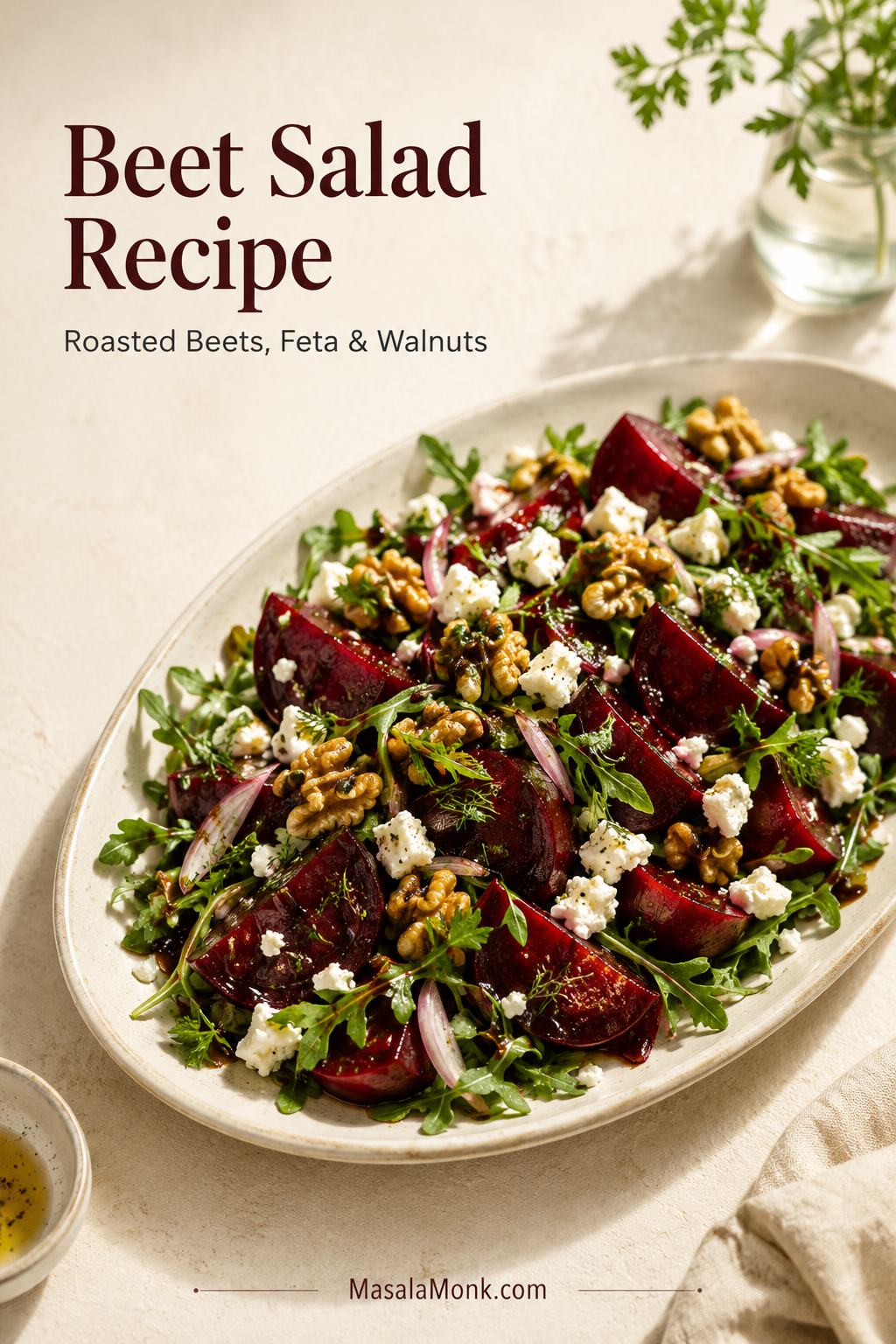
Beet Salad Recipe with Roasted Beets, Feta & Walnuts

This roasted beet salad stands out because it combines sweet beet wedges with salty feta, toasted walnuts, peppery greens, herbs, and a bright lemon-balsamic finish.

A good beet salad recipe should be more than earthy beets with cheese sprinkled on top. It should feel bright, crisp, salty, sweet, and fresh in the same bite: tender roasted beets, briny feta, toasted walnuts, peppery greens, fresh herbs, and a lemon-balsamic dressing that keeps everything lively.

It should look as good as it tastes too: ruby beet wedges, white feta, green herbs, toasted walnuts, and glossy greens that still look fresh.

This version looks like a special-occasion salad, but most of the work is simple: roast the beets, cool and peel them, dress the greens lightly, then layer everything so the salad stays colorful instead of wet, muddy, or fully pink.

Beets are dramatic. They stain the board, tint the vinaigrette, and can turn feta pink if the salad is tossed too hard. They can also taste muddy without enough acid, salt, herbs, and crunch. This recipe gives them a fair chance: roasted until sweet, dressed until bright, and finished with enough contrast to make every bite lively. If you know them as beetroot, same idea: roasted beetroot, feta, walnuts, greens, herbs, and a tangy vinaigrette.

Quick Answer: Beet Salad at a Glance

Fast recipe snapshot: Roast whole beets at 400°F / 200°C until tender, cool and peel, then layer with arugula or rocket, feta, toasted walnuts, herbs, shallot, and lemon-balsamic Dijon dressing. For a 15-minute version, use cooked, canned, vacuum-packed, or leftover roasted beets.

Go-to beet methodRoasted whole beets for the deepest, sweetest flavor
Roast time35–45 minutes for small beets, 45–60 minutes for medium, 60–75 minutes for large
Serves4 as a side, or 2 as a larger salad
GreensArugula / rocket for peppery bite; spinach for a milder salad
DressingLemon-balsamic Dijon vinaigrette
Make-ahead planRoast beets and make dressing ahead; assemble close to serving

The image below shows the bite this salad is built around: beet, feta, walnut, greens, herbs, and just enough dressing to bring everything together.
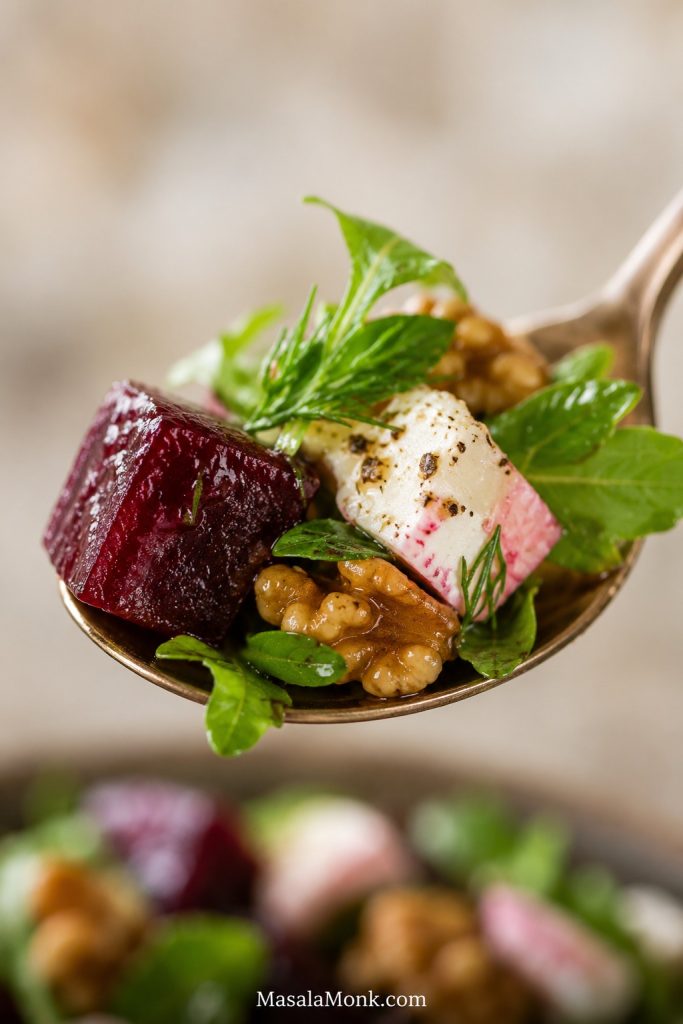
Close-up of a spoon holding roasted beet, feta, walnut, greens, herbs, and glossy dressing.
For the best bite, aim for sweetness, salt, crunch, freshness, and a little dressing together. That balance keeps beet salad lively instead of earthy or heavy.

The Beet Salad Balance Formula

Once you know the balance, you can change the salad without losing the point. Great beet salad needs five things: sweet beets, salty contrast, bright acid, crisp texture, and something fresh. Miss one, and the salad can taste flat, earthy, too soft, too sweet, or heavy.

  • Sweet: roasted beets or beetroot
  • Salty: feta, goat cheese, capers, olives, or salted seeds
  • Acid: lemon, orange, balsamic, vinegar, or pickled beets
  • Crunch: walnuts, pecans, pistachios, pumpkin seeds, apple, or cucumber
  • Freshness: arugula, rocket, parsley, mint, dill, basil, spinach, or kale

The trick is not making beets less like beets. It is giving them enough contrast to make their sweetness work. When those pieces are in place, the salad tastes bright instead of muddy, crisp instead of soft, and fresh instead of heavy.

What the finished salad should taste like: sweet roasted beets, salty-creamy feta, crisp toasted nuts, fresh herbs, lightly dressed greens, and a clean lemony finish.

Ingredients You’ll Need

You do not need many ingredients, but quality and timing matter. Medium beets roast more evenly, block feta stays creamier than pre-crumbled feta, toasted walnuts taste far better than raw walnuts, and fresh herbs make the salad feel brighter.
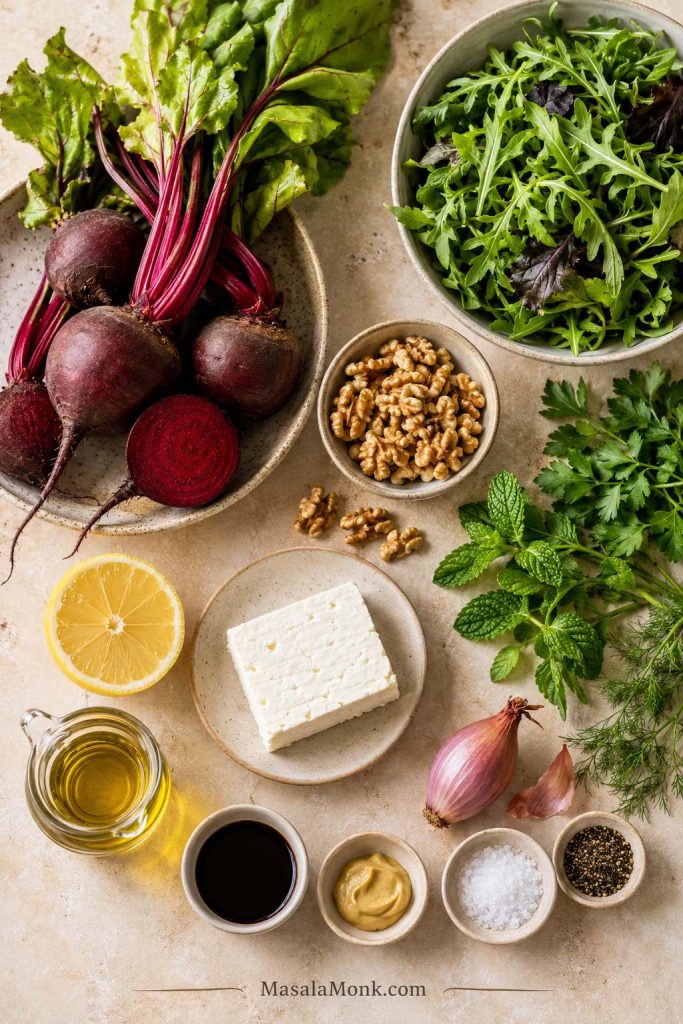
Raw beets, feta, walnuts, greens, herbs, lemon, balsamic vinegar, Dijon mustard, olive oil, salt, and pepper.
Start with a short ingredient list, but make each part count: tender beets, something salty, something crisp, fresh herbs, greens, and a sharp dressing.

Beets / Beetroot

Use 600–700 g / 1⅓–1½ lb raw beets, about 4 medium beets. Red beets are classic and easy to find. Golden beets are milder, stain less aggressively, and look beautiful mixed with red beets. Not starting with raw beets? The beet options section explains how to use cooked, canned, pickled, boiled, or raw beets.

Choose beets that feel firm and heavy for their size. Small to medium beets usually have the nicest texture for salad. Very large beets can take longer to roast and may be a little woody in the center.

Feta

Use 85–100 g / 3–3½ oz feta, crumbled into small pieces. Block feta is creamier and less dry than pre-crumbled feta, so it is the better choice when you have it. Goat cheese gives a softer, creamier salad; blue cheese is stronger and works best with pear, walnuts, and bitter greens. For a dairy-free version, skip the cheese and add avocado, toasted seeds, capers, olives, or tahini-lemon dressing.

Walnuts

Use 50–60 g / ½ cup walnuts, toasted. This is one place not to skip the pan: toasted walnuts taste deeper, crisper, and much better against sweet beets than raw walnuts. Pecans, pistachios, almonds, or pumpkin seeds also work.

Greens, herbs, and shallot

Use 120–140 g / 4–5 oz arugula/rocket, baby spinach, or mixed greens. Arugula is best when you want peppery contrast; spinach is softer and milder; kale works better for lunch bowls with grains or chickpeas.

Use one or two fresh herbs, not every herb at once. Parsley keeps it clean, mint makes it brighter, dill is excellent with cucumber or pickled beets, and basil works well with orange or balsamic. A little shallot or red onion gives the salad bite; soak it in cold water for 10 minutes if it tastes too sharp.

How to Roast Beets for Salad

Roasting beets is mostly hands-off. I get the cleanest flavor from medium beets roasted whole, then peeled after cooling. Very large beets work, but they take longer and can taste less sweet in the center. Skipping the oven? Use the 15-minute shortcut with cooked, canned, or vacuum-packed beets.
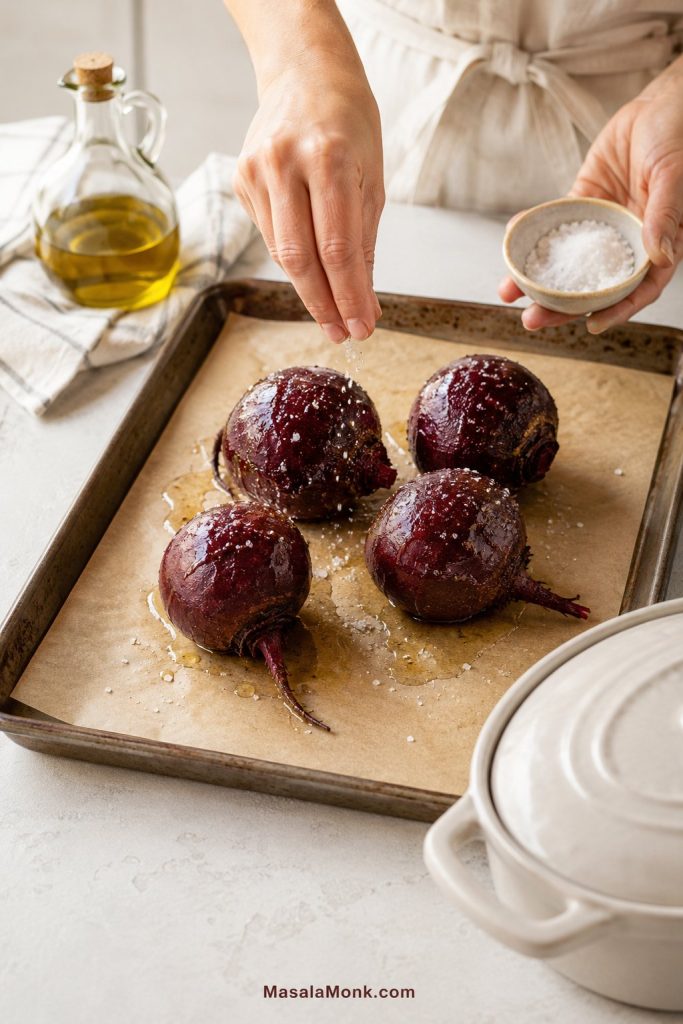
Whole beets on a parchment-lined tray being seasoned with olive oil and salt before roasting.
Before roasting, coat the beets with olive oil and salt. This simple step helps build flavor and makes the skins easier to remove later.

Whole roasted beets

  1. Heat the oven to 400°F / 200°C.
  2. Scrub the beets well. Trim the greens, leaving about 1 inch of stem if attached. This helps reduce bleeding while roasting.
  3. Rub the beets with 1 tbsp / 15 ml olive oil and a pinch of salt.
  4. Wrap the beets in foil, or place them in a covered baking dish. Set foil packets on a rimmed baking sheet in case any juices leak.
  5. If using red and golden beets together, wrap or roast them separately so the red beets do not stain the golden ones.
  6. Roast until tender: 35–45 minutes for small beets, 45–60 minutes for medium beets, and 60–75 minutes for large beets.
  7. The beets are done when a small knife slides into the center of the largest beet with little resistance.
  8. Let the beets cool for 10–15 minutes, or until comfortable to handle.
  9. Rub off the skins with paper towels or gloved hands.
  10. Slice into wedges, half-moons, cubes, or ¼-inch rounds.

Check, peel, and slice

Use the knife test on the largest beet in the batch, because smaller beets may be tender before the biggest one is ready. This is the simplest way to avoid firm centers.
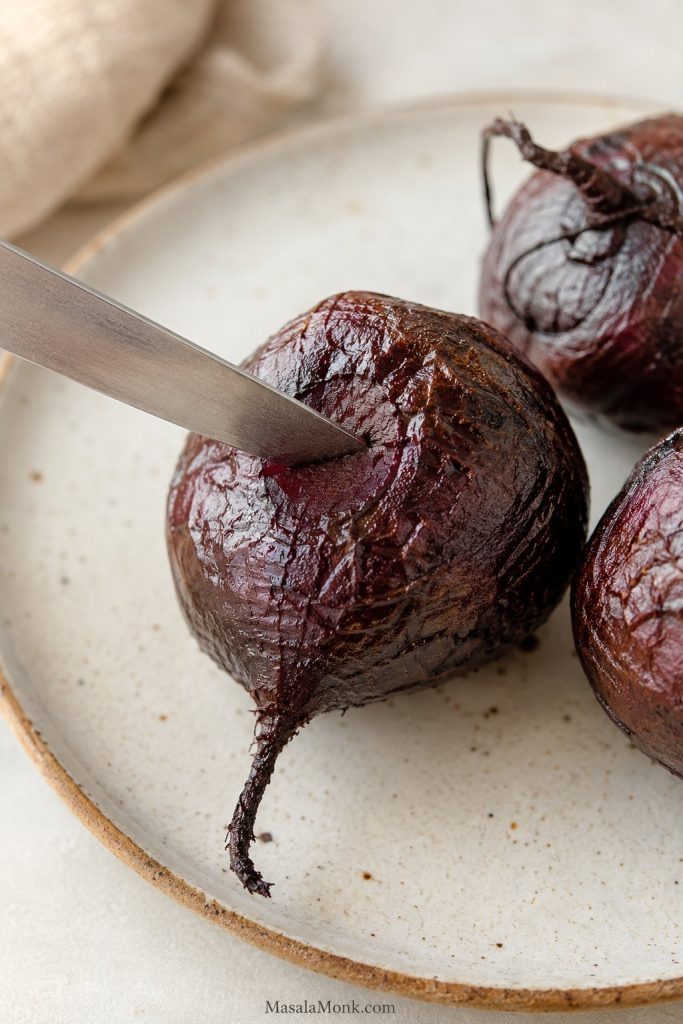
Knife inserted into the center of a roasted beet to test tenderness.
Next, check the largest beet, not the smallest one. When a knife slides into the center easily, the whole batch is ready.

For whole roasted beets, peel after roasting. The skins slip off more easily, the beets stay juicier, and the prep is less messy. If the skins do not rub off easily, the beets may need a little more time in the oven.
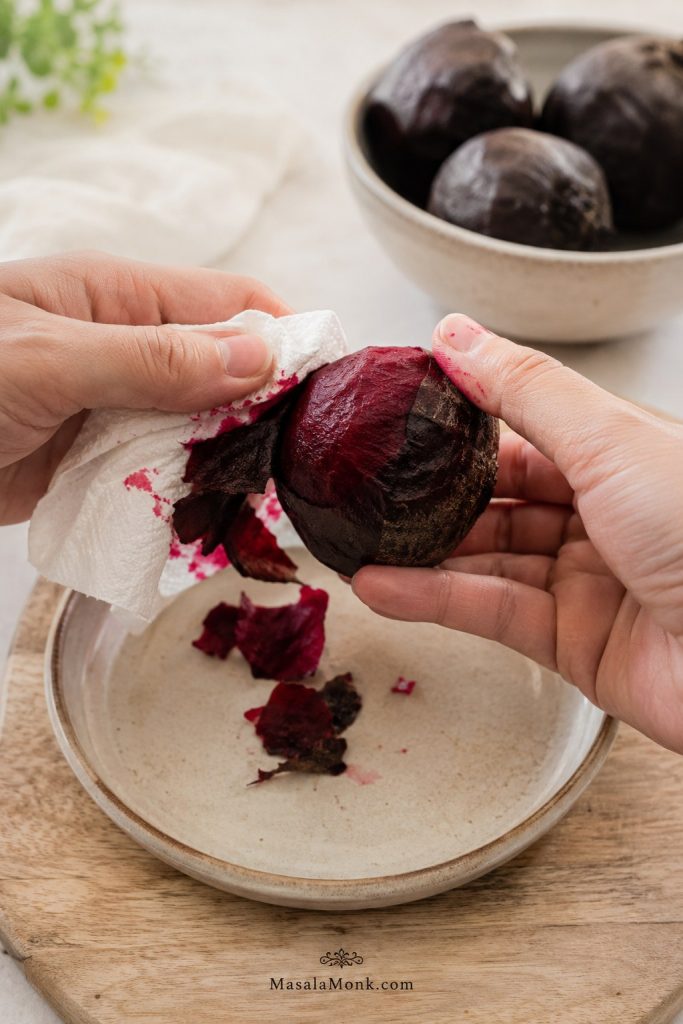
Hands peeling the skin from a roasted beet with a paper towel on a light plate.
Once the beets are cool enough to handle, rub the skins off with a paper towel or gloves. If they resist, roast them a little longer next time.

After slicing, taste one beet. If it tastes flat, sprinkle the sliced beets lightly with salt or toss them with 1 teaspoon of the vinaigrette before adding them to the salad.
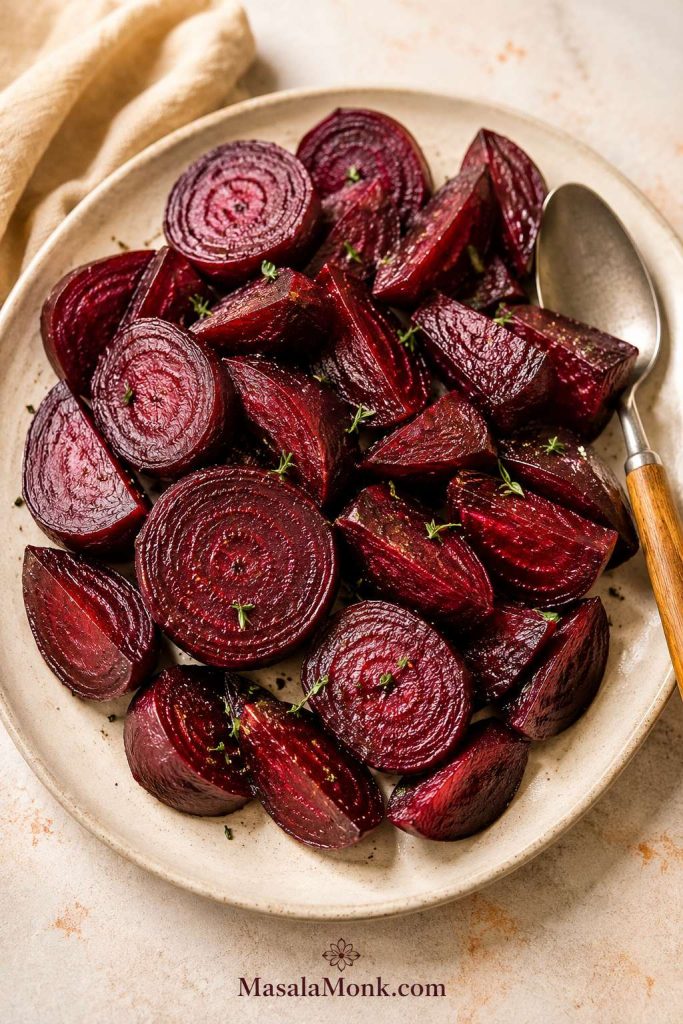
Sliced roasted beets in wedges and rounds on a cream plate with a spoon beside them.
After peeling, cut the beets into wedges, half-moons, or rounds. They should look tender and glossy, not watery, dry, or mushy.

Sliced roasted beets

If you want more roasted edges and a shorter cooking time, peel the beets first and slice them into wedges or ¼-inch rounds. Toss with olive oil and salt, spread on a lined baking sheet, and roast at 425–450°F / 220–230°C for about 25–35 minutes, turning once.

This route is faster, but it is messier because you peel and cut the beets while raw. It is helpful when you want a stronger roasted flavor and do not mind a stained cutting board.

Foil vs no foil

Foil traps steam around whole beets, which helps them cook evenly and makes the skins easier to rub off. A covered baking dish works in a similar way and is the most reliable no-foil option. Uncovered roasting gives more caramelization, but it can dry out whole beets before the centers are tender. Use uncovered roasting mainly for sliced beets.

No-foil method: Place scrubbed beets in a small covered baking dish with a splash of water and a little olive oil. Cover tightly and roast until tender. The goal is to trap enough steam for easy peeling while still concentrating the beet flavor.

How to Make Beet Salad

Once the beets are roasted, the rest is assembly. Start with less vinaigrette than you think you need, then add more only after tasting. Beet salad should look glossy, not wet.

  1. Roast, cool, peel, and slice the beets. If using cooked or canned beets, drain and pat them dry.
  2. Toast the walnuts. Warm them in a dry skillet for 3–5 minutes, stirring often, until fragrant. Let them cool so they stay crisp.
  3. Make the vinaigrette. Shake or whisk together olive oil, balsamic vinegar, lemon or orange juice, Dijon, honey or maple syrup, salt, and pepper.
  4. Dress the greens lightly. Toss the greens with 1–2 tablespoons of vinaigrette before adding the beets.
  5. Add the beets gently. Arrange them over the greens, then drizzle with a little more if needed.
  6. Finish with feta, walnuts, herbs, and shallot. Add these at the end so the salad keeps its texture and color.
  7. Taste a complete bite. Try beet, feta, walnut, greens, and dressing together. Adjust with lemon, salt, pepper, or herbs before serving.

Dress the greens first and keep the beets out until the leaves are lightly coated. This gives the salad flavor from underneath without turning the greens heavy.
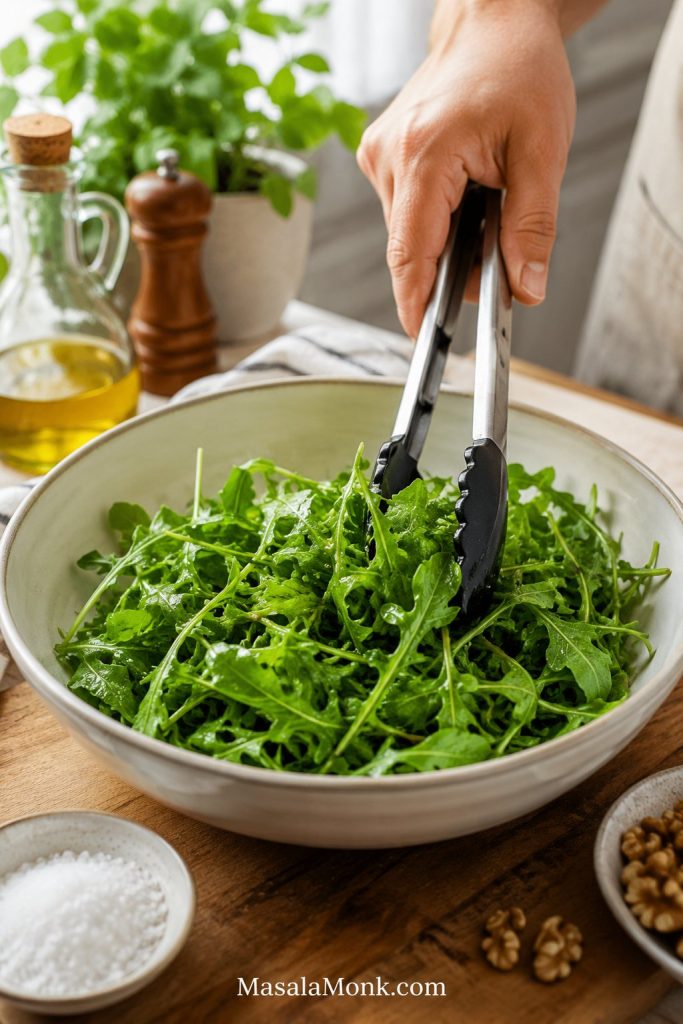
Tongs tossing arugula and mixed greens with a small amount of dressing in a shallow bowl.
First, dress the greens lightly before adding the beets. This gives the salad a flavorful base without soaking the leaves or staining everything pink.

Platter vs Bowl

Use a platter when presentation matters. Dress the greens lightly, layer the beets, then finish with feta, walnuts, herbs, and a final drizzle. A wide platter keeps the feta white, the walnuts crisp, and the beets from staining every leaf before serving.
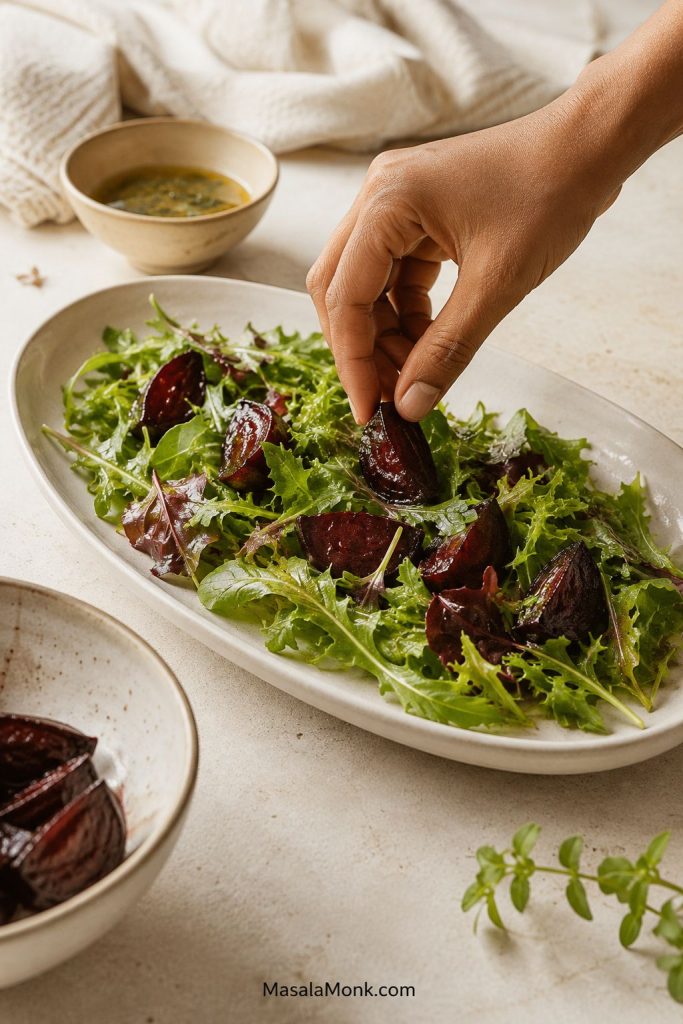
Hand placing roasted beet wedges over lightly dressed greens on a cream platter.
Then layer the beets over the greens instead of tossing hard. As a result, the salad stays cleaner, fresher-looking, and easier to serve.

Once the beets are arranged, add the delicate toppings at the end. This is the easiest way to keep the salad bright instead of fully stained pink.
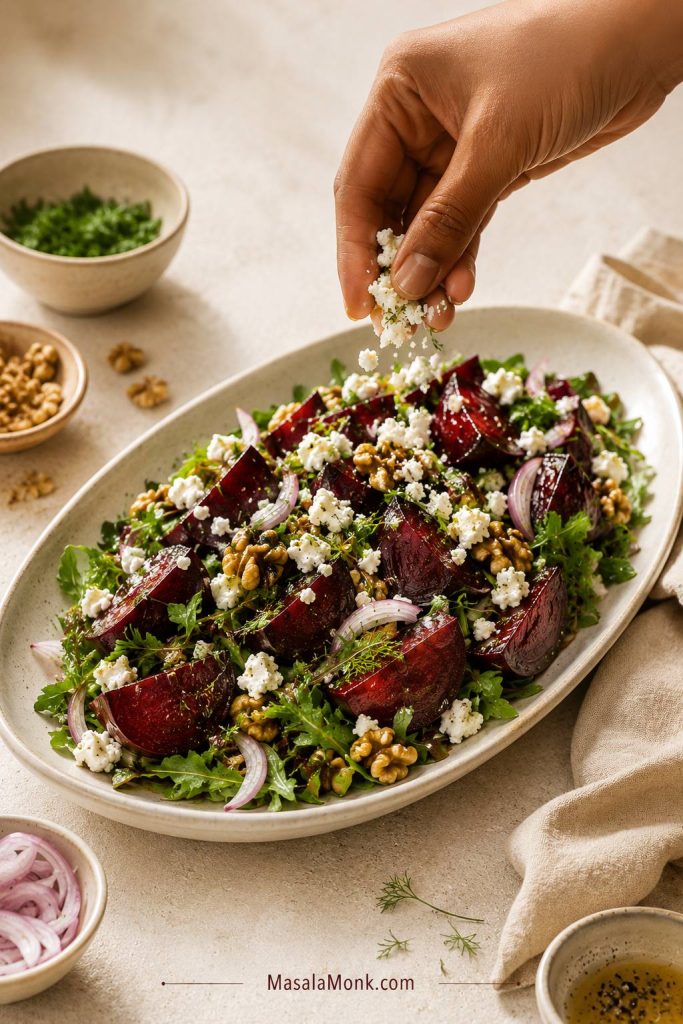
Hand sprinkling feta over roasted beet salad with walnuts, herbs, and greens on a cream platter.
Finish with feta, walnuts, herbs, and shallot at the end. That way the toppings stay bright, crisp, and visually fresh.

Use a bowl when you are adding quinoa, chickpeas, lentils, beans, eggs, chicken, or salmon. Cut the beets into cubes or half-moons so every forkful gets a little sweetness, salt, acid, and crunch.

Avoid these beet salad mistakes: Let the beets cool, dress lightly, add feta near the end, use enough salt and acid, and give soft canned beets something crisp.

The Best Dressing for Beet Salad: Lemon-Balsamic Dijon

With beets, the vinaigrette is what keeps the salad from tasting heavy. Think of it as the no-muddy-beets dressing: balsamic for depth, lemon for lift, Dijon for body, and just enough sweetness to round the edges without making the salad sugary.
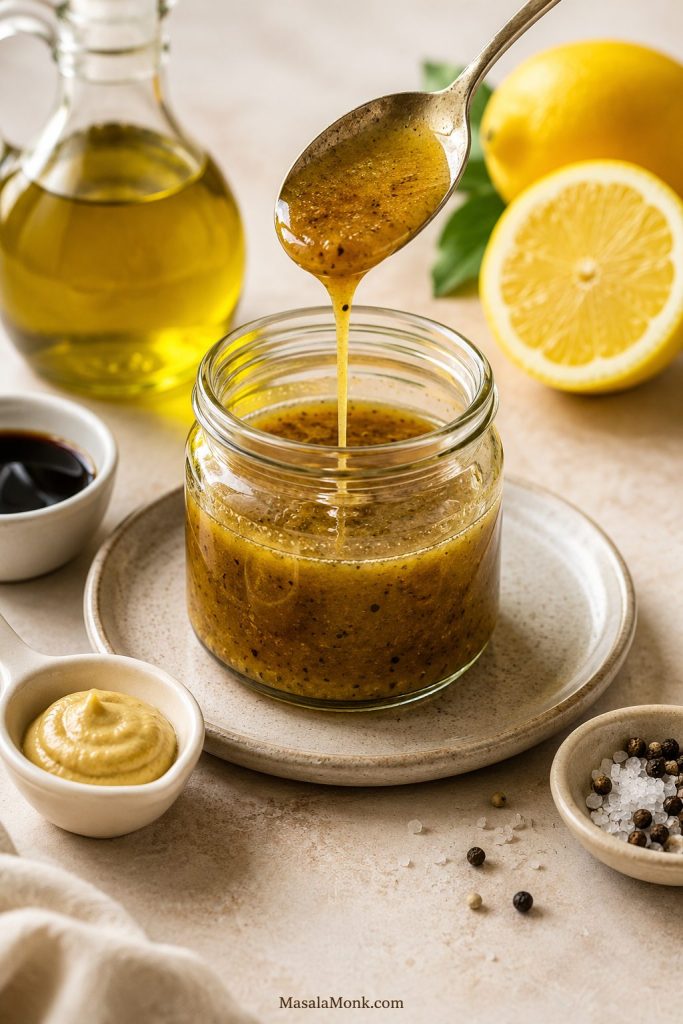
Lemon-balsamic Dijon dressing dripping from a spoon into a glass jar with lemon, mustard, olive oil, vinegar, salt, and pepper nearby.
The dressing should taste slightly sharper than you want at first. Once it coats the sweet beets and salty cheese, the flavor settles into balance.
IngredientAmountWhy it is there
Extra-virgin olive oil3 tbsp / 45 mlGives body and carries the flavor
Balsamic vinegar1 tbsp / 15 mlMatches the sweetness of roasted beets
Lemon juice or orange juice1 tbsp / 15 mlLifts the salad and reduces earthiness
Dijon mustard1 tsp / 5 mlHelps emulsify the dressing and adds bite
Honey or maple syrup1–2 tsp / 5–10 mlRounds the sharp edges without making the salad sweet
Fine salt¼ tsp, plus more to tasteBalances the beets without over-salting the feta
Black pepperTo tasteAdds warmth and contrast

Use 1 teaspoon honey or maple for a sharper vinaigrette, or 2 teaspoons if your vinegar is harsh or your beets taste especially earthy. Skip the sweetener for very sweet roasted beets or pickled beets.

How Much Dressing to Use

Dressing rule: Start with 1–2 tablespoons on the greens, then add more only after the beets are on the salad. If the salad tastes flat, add salt first; if it tastes earthy, add lemon and herbs; if it tastes too sweet, add vinegar, lemon, or peppery greens.

The easiest visual cue is the surface of the salad. The beets and greens should shine lightly, but the plate should not have dressing pooling at the bottom.
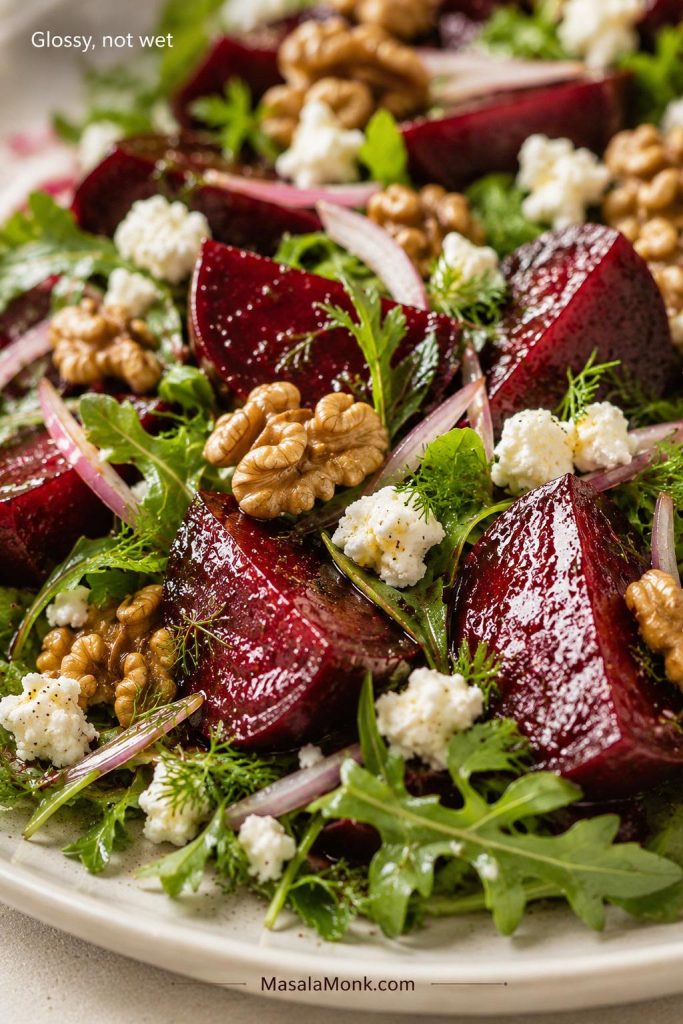
Close-up of roasted beet salad with glossy beets, greens, feta, walnuts, herbs, and the words “Glossy, not wet.”
The finished salad should look glossy, not wet. If liquid starts pooling, stop adding dressing and adjust with salt or lemon instead.

How to Change the Vinaigrette

Use orange vinaigrette when fruit is involved, lemon-herb dressing when the salad has cucumber or chickpeas, and honey-Dijon when you switch from feta to goat cheese. For a deeper dinner-party version, add roasted garlic or finely chopped toasted walnuts to the vinaigrette.

Recipe Card: Roasted Beet Salad with Feta & Walnuts

Sweet roasted beets, briny feta, toasted walnuts, greens, herbs, and a lemon-balsamic dressing come together in a colorful salad that works as a side dish or a larger salad with lunch add-ins.

Prep Time15 minutes
Roast Time45–60 minutes for medium beets
Cooling Time15 minutes
Total TimeAbout 1 hour 15–30 minutes for medium beets

Timing note: Small beets may roast in 35–45 minutes. Large beets can take 60–75 minutes.

Shortcut time: 15 minutes if using cooked, canned, vacuum-packed, or leftover roasted beets.

Yield: 4 side servings, or 2 larger salad servings. For a fuller lunch, add quinoa, chickpeas, lentils, eggs, beans, or another protein.

Equipment: rimmed baking sheet or small covered baking dish, foil or lid, sharp knife, cutting board, small skillet, small jar or bowl for dressing, paper towels or gloves, salad bowl or platter.

Ingredients

For the beets and salad

  • 600–700 g / 1⅓–1½ lb raw beets, about 4 medium
  • 1 tbsp / 15 ml olive oil, for roasting
  • Pinch of salt, for roasting
  • 120–140 g / 4–5 oz arugula/rocket, baby spinach, or mixed greens
  • 85–100 g / 3–3½ oz feta, crumbled
  • 50–60 g / ½ cup walnuts, toasted
  • 1 small shallot or ¼ small red onion, thinly sliced or minced
  • 2–3 tbsp chopped fresh parsley, mint, dill, or basil
  • Optional: 1 orange, segmented; 1 crisp apple, sliced; or a mix of red and golden beets

For the lemon-balsamic Dijon dressing

  • 3 tbsp / 45 ml extra-virgin olive oil
  • 1 tbsp / 15 ml balsamic vinegar
  • 1 tbsp / 15 ml lemon juice or orange juice
  • 1 tsp / 5 ml Dijon mustard
  • 1–2 tsp / 5–10 ml honey or maple syrup
  • ¼ tsp fine salt, plus more to taste
  • Freshly ground black pepper, to taste

Method

  1. Roast the beets. Heat the oven to 400°F / 200°C. Scrub the beets, rub with olive oil and a pinch of salt, then wrap in foil or place in a covered baking dish. Roast until a knife slides easily into the center: 35–45 minutes for small beets, 45–60 minutes for medium beets, or 60–75 minutes for large beets.
  2. Cool and peel. Let the beets cool for 10–15 minutes, or until comfortable to handle. Rub off the skins with paper towels or gloved hands. Slice into wedges, half-moons, cubes, or ¼-inch rounds.
  3. Toast the walnuts. Place walnuts in a dry skillet over medium-low heat for 3–5 minutes, stirring often, until fragrant. Cool before adding to the salad.
  4. Make the vinaigrette. In a jar or small bowl, combine olive oil, balsamic vinegar, lemon or orange juice, Dijon, honey or maple syrup, salt, and pepper. Shake or whisk until combined. Taste; it should be tangy and lightly salty before it goes on the salad.
  5. Dress the greens lightly. Toss the greens with 1–2 tablespoons of dressing before adding the beets. You may not need all of it.
  6. Add the beets. Arrange the sliced beets over the greens. Drizzle with another spoonful if needed.
  7. Finish the salad. Add feta, toasted walnuts, shallot or red onion, and herbs. Add orange or apple if using.
  8. Taste and serve. Taste a bite with beet, feta, walnut, greens, and dressing together. Adjust with lemon, salt, pepper, or herbs before serving.

Shortcut Version

Use about 3 cups cooked beets, or 500–600 g / 18–21 oz cooked, canned, vacuum-packed, or leftover roasted beets. Drain and pat dry, then slice and assemble the salad with the same dressing and remaining salad ingredients. Total time: about 15 minutes.

Notes

  • Cool beets fully and add feta last for the cleanest presentation.
  • Start with 1–2 tablespoons dressing; beet salad should be glossy, not wet.
  • For canned beets, use two standard 14–15 oz / 400 g cans, drain, rinse if needed, and pat very dry.
  • For pickled beets, reduce or skip the balsamic vinegar and use more lemon, dill, cucumber, and red onion.
  • Store roasted beets and dressing separately for 3–4 days. Assemble close to serving.

Use the recipe card above for the main roasted beet version. The sections below help you adapt it if you are starting with canned, cooked, pickled, raw, or boiled beets, or if you want a lunch bowl, no-greens version, storage plan, or quick fix.

Roasted, Raw, Canned, Pickled, or Boiled Beets?

Roasted beets give the fullest flavor, but this salad does not fall apart if you start with cooked, canned, pickled, boiled, or raw beets. The key is knowing what each type needs before it goes into the bowl.
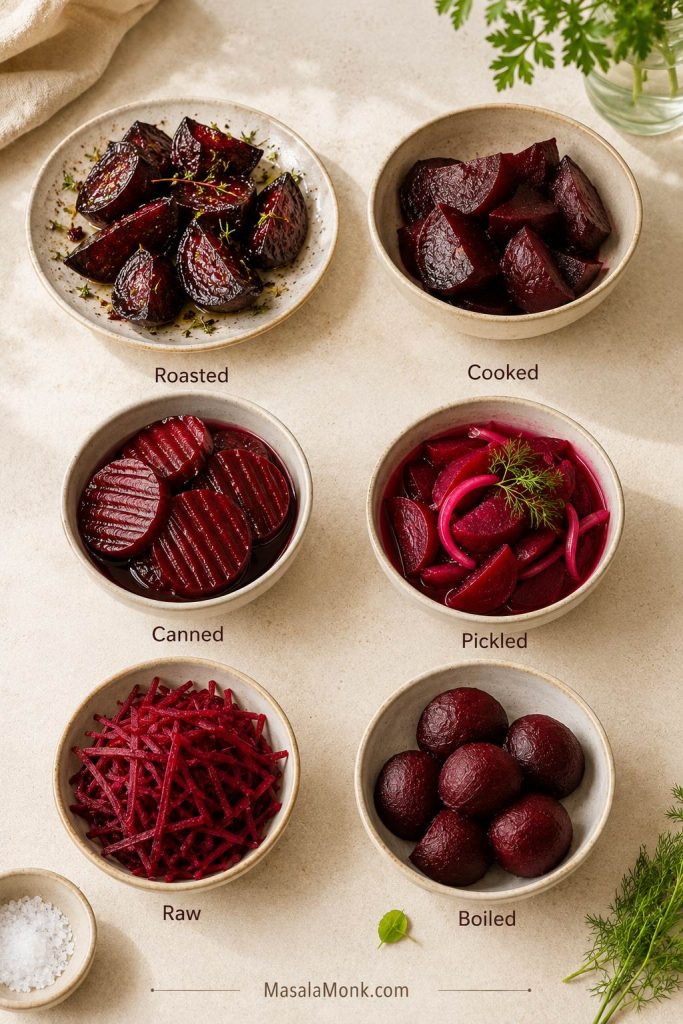
Six labeled bowls showing roasted, cooked, canned, pickled, raw, and boiled beets for beet salad.
Choose the beet style based on what you need: roasted for depth, canned for speed, pickled for tang, raw for crunch, and boiled for a softer bite.
Beet optionBest forWhat to know
Roasted beetsFullest flavorSweet, deep, tender, and less watery than boiled beets.
Vacuum-packed cooked beetsFastest no-roast optionClosest shortcut to roasted texture. Pat dry before using.
Canned beetsPantry shortcutDrain, rinse if needed, and pat very dry. Add extra crunch because canned beets are soft.
Pickled beetsTangy no-cook saladUse less vinegar in the dressing because the beets already bring acidity.
Raw beetsCrunchy slaw-style saladPeel, grate, julienne, or slice very thin. Thick raw beet pieces are too hard for this style.
Boiled beetsAlready cooked beetsSofter and often wetter than roasted beets. Dry them well and use a punchy dressing.

The shortcut versions are not second-best if you build them well. They just need more drying, more crunch, and a brighter finish.

If you are shopping specifically for this recipe, buy raw medium beets for the fullest flavor or vacuum-packed cooked beetroot for the easiest shortcut. Use canned or pickled beets when they are what you already have.

15-Minute Beet Salad with Cooked, Canned, or Vacuum-Packed Beets

For a fast beet salad, use about 3 cups cooked beets, or 500–600 g / 18–21 oz cooked, canned, vacuum-packed, or leftover roasted beets. Slice into wedges, half-moons, or cubes, then pat dry before adding dressing.
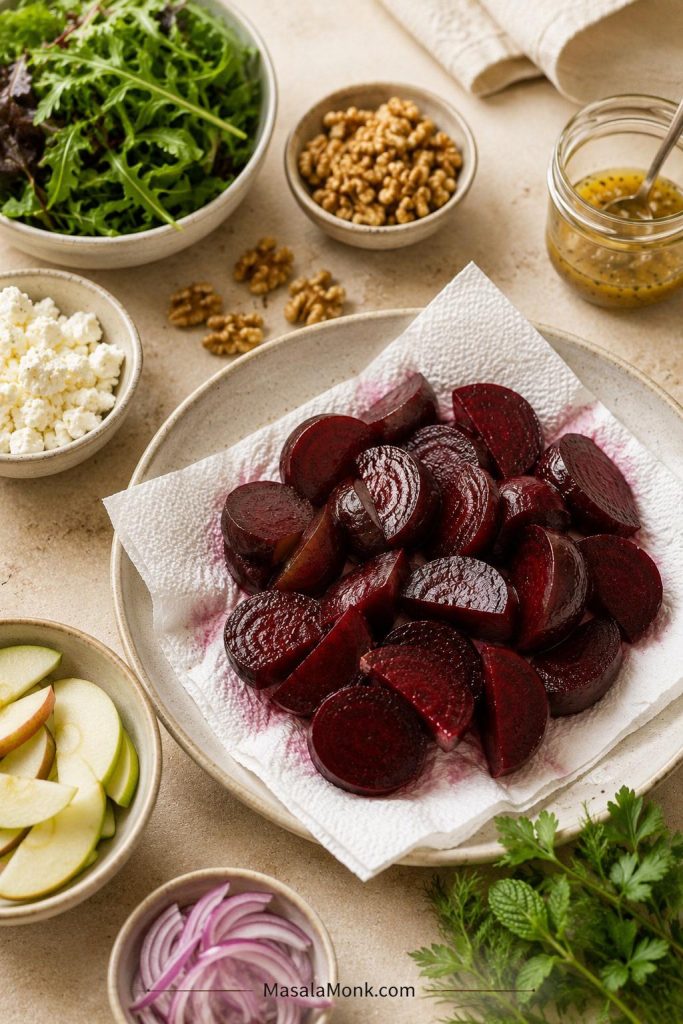
Cooked beet slices on paper towel with feta, walnuts, greens, apple slices, herbs, onion, and dressing nearby.
For canned or cooked beets, drying matters most. Pat them well, then add crunch, herbs, cheese, and a sharper dressing to keep the salad fresh.
  • Vacuum-packed cooked beets: The closest no-roast option to roasted beets. Drain, pat dry, slice, and build the salad the same way.
  • Canned beets: Use two standard 14–15 oz / 400 g cans, drained, or about 3 cups sliced canned beets. Rinse if they taste metallic, salty, or too sweet, then pat very dry and add extra texture.
  • Pickled beets: Use less balsamic or skip it. Pair with cucumber, red onion, dill, feta, walnuts or pistachios, olive oil, and lemon.

If I am using canned beets, I am more generous with walnuts, cucumber, or apple because canned beets are softer and need more crunch.

For pickled beets, a good quick combination is: 2 cups sliced pickled beets + 1 cucumber + ¼ red onion + ½ cup feta + ⅓ cup walnuts or pistachios + fresh dill + olive oil + lemon juice.
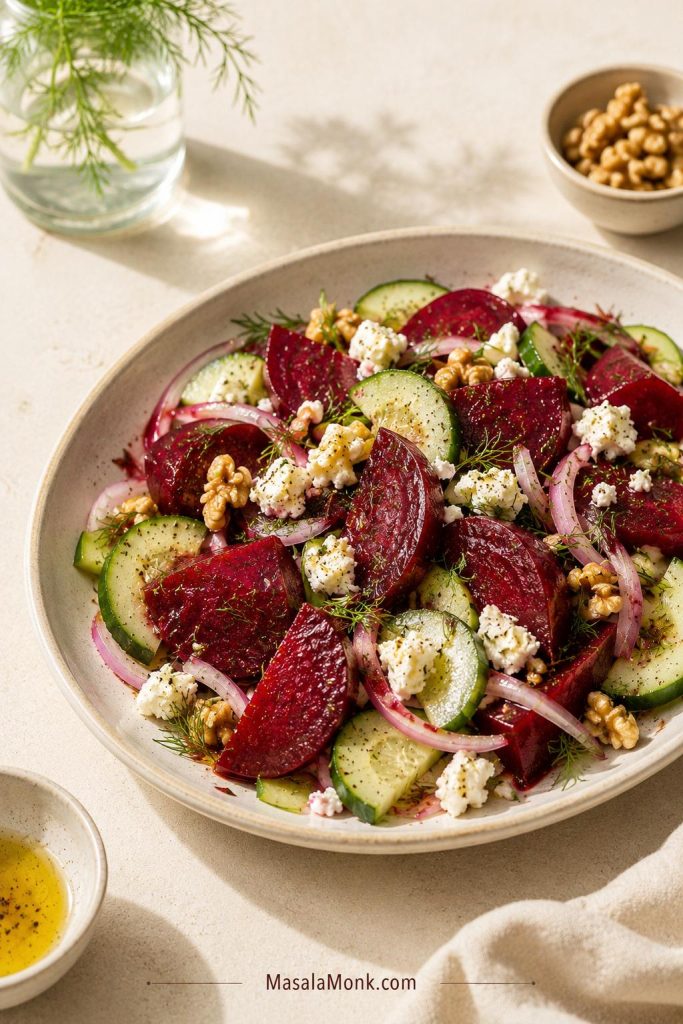
Pickled beet salad with cucumber slices, dill, red onion, feta, walnuts, and light dressing in a shallow bowl.
Because pickled beets already bring acid, pair them with cooling cucumber, dill, onion, and feta instead of a heavy balsamic-style finish.

How to Keep Beet Salad from Turning Everything Pink

Beets will always share some color. The goal is not to stop the color completely; it is to keep the salad from becoming one flat pink bowl before it reaches the table.

  • Cool the beets fully before adding them to greens or feta.
  • Pat cooked, canned, or pickled beets dry before slicing or tossing.
  • Dress the greens first instead of tossing everything together at once.
  • Add the beets gently and avoid aggressive mixing.
  • Add feta last so the white pieces stay visible.
  • Use a platter instead of a deep bowl when presentation matters.
  • Add walnuts right before serving so they stay crisp.
  • Roast red and golden beets separately if you want clean color contrast.

If leftovers turn pink, they are still good. Beet, feta, walnut, and herb salad without delicate greens can taste even better after sitting; it simply becomes more of a marinated beet side.

Beet Salad Variations

Use the variations by need: grains or legumes when it has to be lunch, orange or apple when it needs brightness, cucumber or raw beet when you want crunch, and no greens when it needs to sit.

To make beet salad a meal: Add 1½ cups cooked quinoa, 1 can chickpeas, 1½ cups lentils, boiled eggs, white beans, salmon, chicken, or tofu. Use sturdier greens like kale, arugula, or spinach, and keep the walnuts separate until serving.
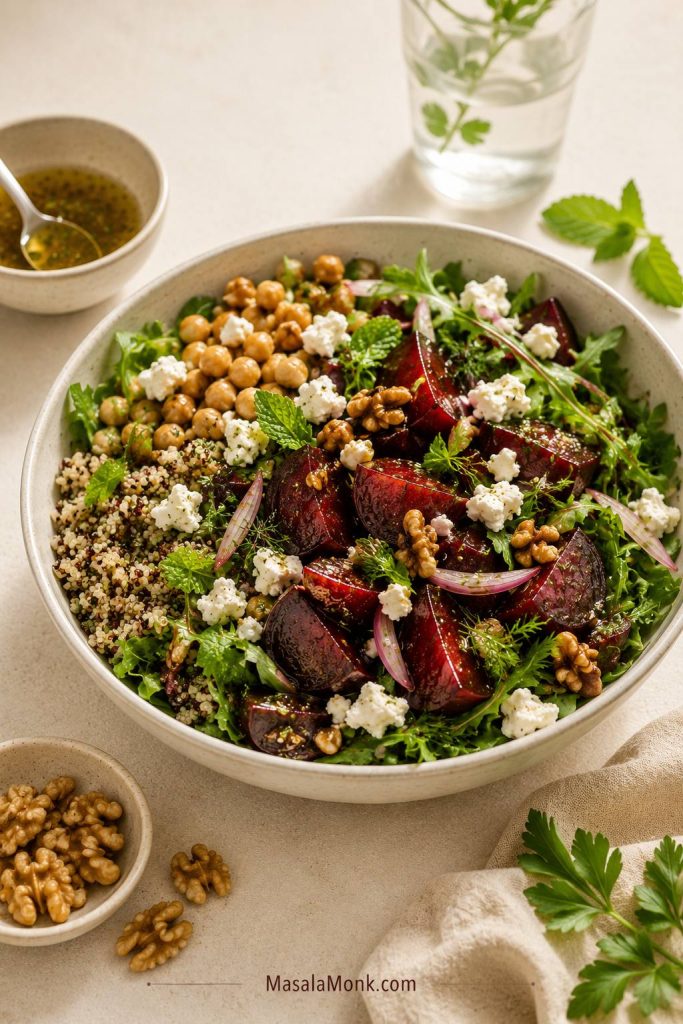
Beet salad lunch bowl with quinoa, chickpeas, roasted beets, feta, and walnuts.
To make beet salad filling enough for lunch, add quinoa or chickpeas. The extra base turns a side salad into a proper meal.

Turn it into lunch

Beet and quinoa salad: Fold in 1½ cups cooked and cooled quinoa and use a little extra dressing. Arugula, spinach, or finely chopped kale hold up best.

Beet and chickpea salad: Add 1 can chickpeas, drained and rinsed. Chickpeas make the salad more filling and work especially well with lemon, parsley, mint, cucumber, and feta. If you want another fresh, protein-friendly salad, this chickpea salad recipe is a useful next stop.

Beet and lentil salad: Add 1½ cups cooked green or brown lentils. Use extra lemon, vinegar, feta, and herbs so the salad stays bright instead of heavy.

Make it brighter

Beet and orange salad: Add 1–2 oranges, segmented or sliced. Use orange juice in the dressing and finish with mint or basil. Pistachios are especially good here.
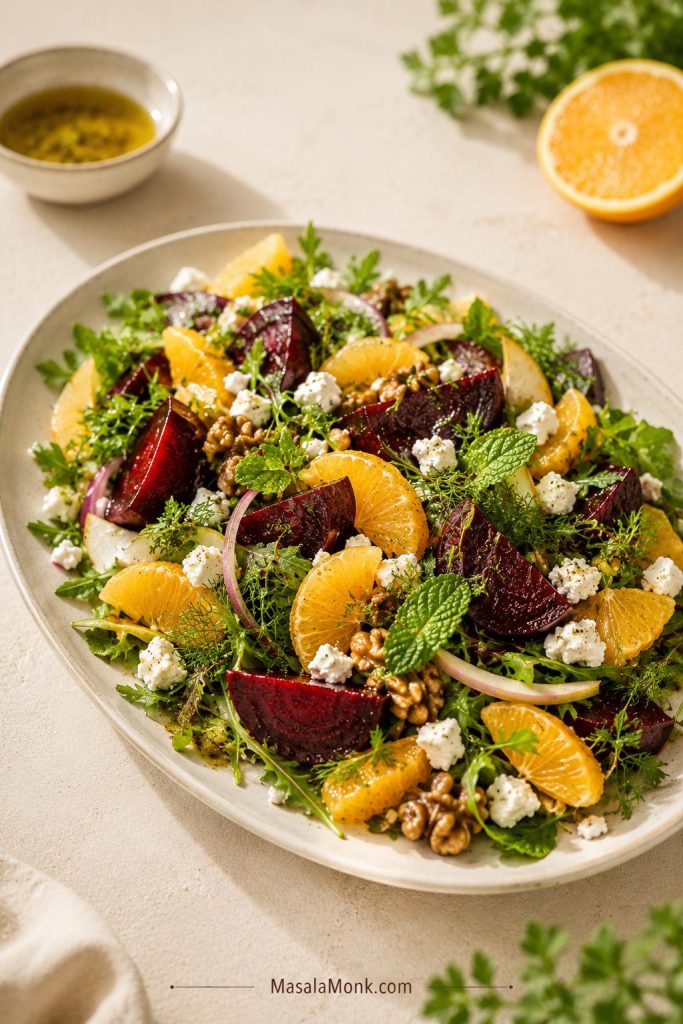
Beet and orange salad with roasted beet wedges, orange segments, greens, feta, and walnuts.
For a brighter variation, add orange segments. Citrus makes roasted beet salad juicier and helps cut through the earthy sweetness.

Apple beet salad: Add 1 crisp apple, thinly sliced just before serving. It gives the salad a sweet-tart snap that works well with walnuts, feta, and lemon.

Pear and beet salad: Add 1 ripe but firm pear when you want a softer, dinner-party style salad. Goat cheese, walnuts, and honey-Dijon are the best match here.

Make it crunchier

Raw beet salad: Peel 1–2 raw beets, then grate, julienne, or slice very thin. Toss with lemon or orange juice and salt, rest for 10 minutes, then add apple, carrot, herbs, seeds, or feta. Use a mandoline guard if slicing thinly.
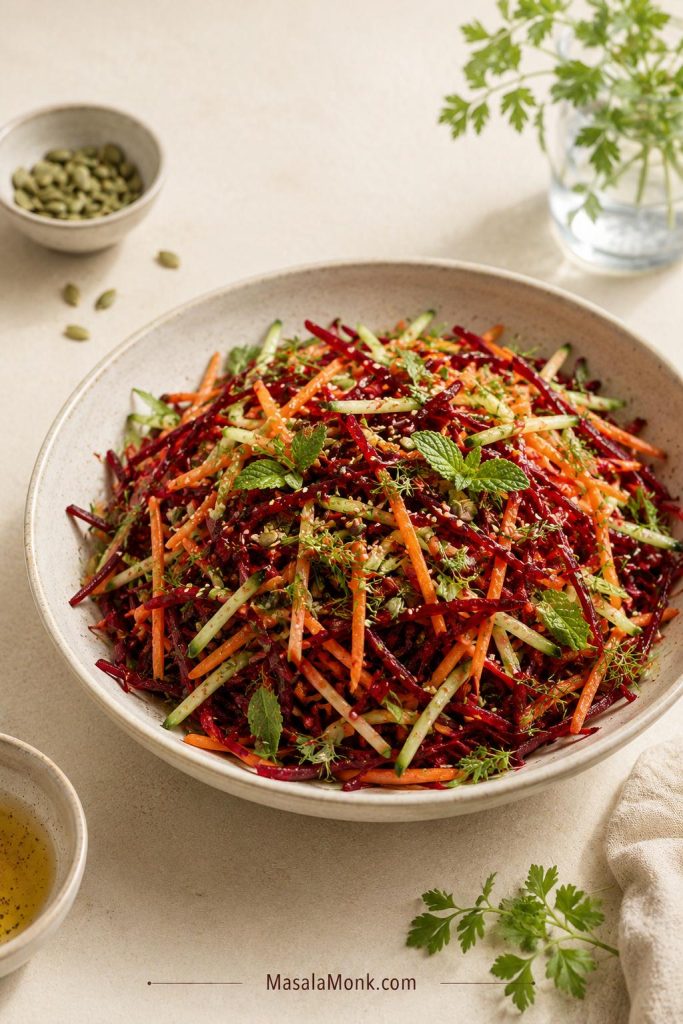
Raw beet salad with shredded beet, carrot, cucumber, herbs, seeds, and light dressing.
For raw beet salad, cut the beets thin. Shredding or julienning keeps the texture crisp and pleasant instead of hard or bulky.

Beet and carrot salad: Grate 1 raw beet + 1 large carrot, then add lemon juice, olive oil, parsley or mint, salt, and toasted seeds. This eats more like a beet slaw than a roasted beet salad.

Beet and cucumber salad: Combine 2 cups cooked or pickled beets + 1 cucumber, sliced. Add dill, feta, red onion, lemon, olive oil, and walnuts or pistachios. If cucumber is the part you love most, this crisp cucumber salad recipe is a good companion.

Make it ahead

No-greens beet salad: Make it more like a marinated beet side with 3 cups cooked beets + ½ cup feta + ½ cup walnuts + 2–3 tbsp herbs + 1 small shallot + enough dressing to coat. It is less delicate, more make-ahead friendly, and good for holiday or picnic tables. It will turn pink as it sits, but the flavor holds well for 2–3 days.
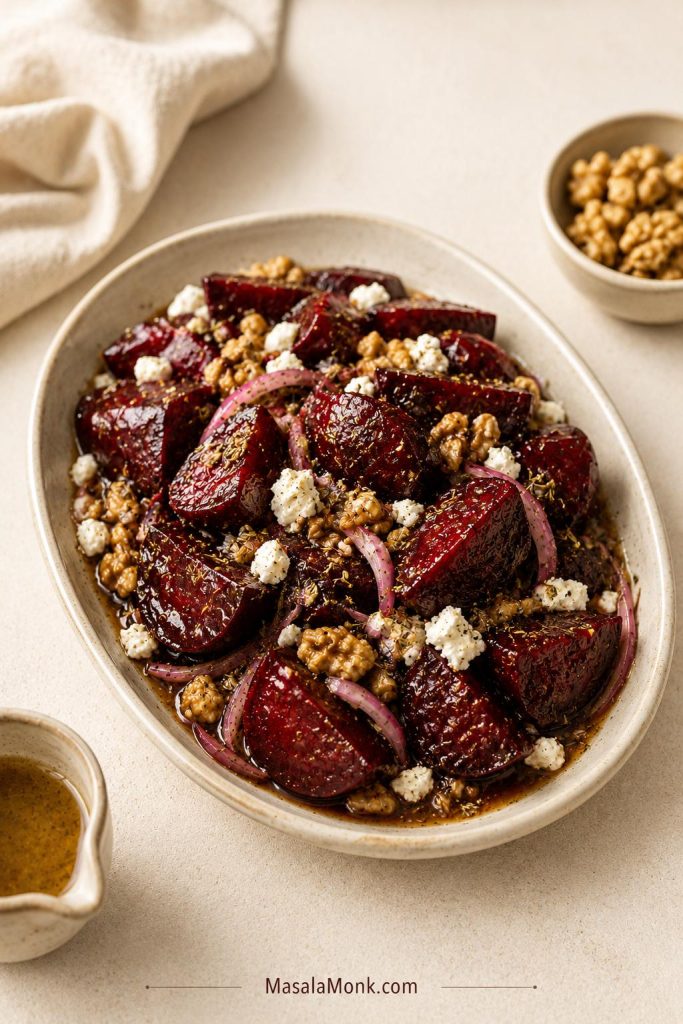
No-greens beet salad with roasted beet wedges, feta, walnuts, herbs, and shallot.
For a make-ahead beet side, skip the leafy greens. Marinate the beets first, then add feta, walnuts, and herbs closer to serving.

Change the cheese

Goat cheese beet salad: Use soft goat cheese instead of feta when you want a creamier salad, especially with honey-Dijon, walnuts, arugula, and pear.

Blue cheese beet salad: Use less cheese because the flavor is stronger. Add pear, walnuts, and bitter greens for balance.

Dairy-free beet salad: Skip the cheese and add avocado, toasted seeds, capers, olives, or tahini-lemon dressing. Increase salt slightly because feta normally provides much of the seasoning.

What to Serve with Beet Salad

Use this salad when the rest of the meal is simple and you need one dish that brings color, freshness, and a little drama. It is especially good next to anything rich or beige: roast chicken, salmon, steak, lentils, grains, or creamy soups.

  • With rich mains: serve it with roast chicken, steak, lamb, salmon, or trout. For a simple chicken plate, this baked chicken breast recipe keeps the protein easy and meal-prep friendly.
  • With simple soups: pair it with lentil soup, bean soup, tomato soup, or vegetable soup for a colorful lunch.
  • With grains: serve it over quinoa, farro, barley, rice, or couscous and add chickpeas or lentils.
  • For holiday or summer meals: use a wide platter, red and golden beets, feta, walnuts, herbs, cucumber, dill, or pickled beets.

If you bought a big bag of beets and still have a few left, use the extras in this beet juice recipe with carrot, apple, lemon, and ginger.

Make-Ahead and Storage

Beet salad is make-ahead friendly if you store the parts separately. Delicate greens and walnuts are best added close to serving. For a version that holds better after assembly, use the no-greens beet salad variation above.
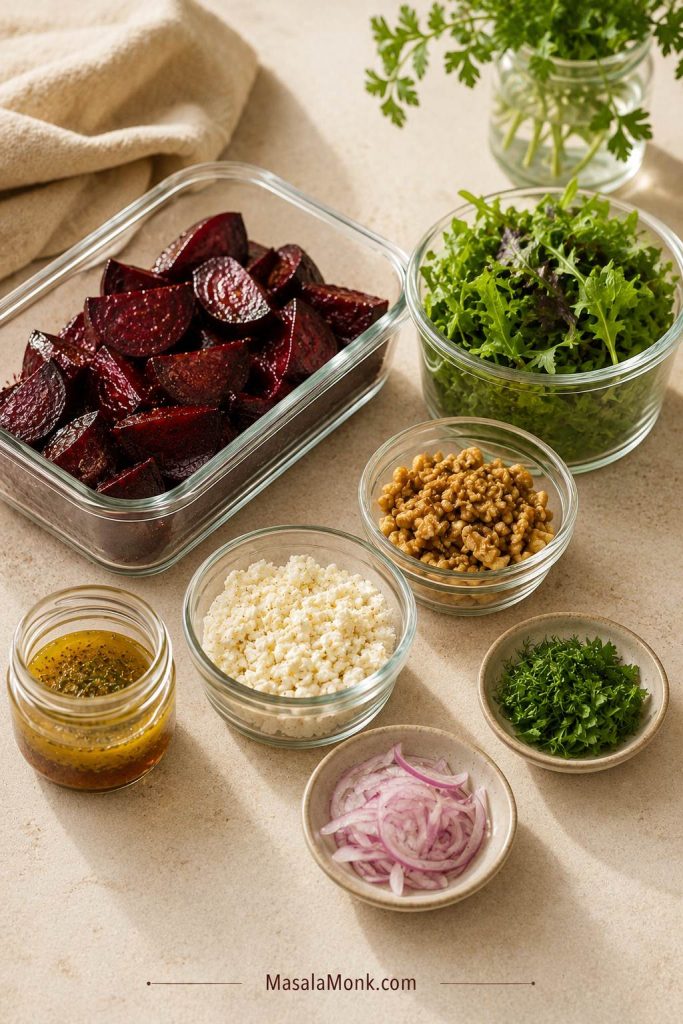
Separate containers of roasted beets, greens, feta, walnuts, herbs, red onion, and dressing.
Store the parts separately for the best texture: beets, greens, feta, walnuts, herbs, and dressing all hold better on their own.
ComponentHow long it keepsHow to store it
Roasted peeled beets3–4 daysRefrigerate in an airtight container
Dressing3–4 daysRefrigerate in a jar; shake before using
Toasted walnutsUp to 1 weekStore airtight at room temperature once cool
Washed greens2–3 daysKeep dry in a lined container or bag
Fully assembled salad with greensBest same dayServe soon after dressing
Beet, feta, walnut, and herb salad without greens2–3 daysRefrigerate, but expect the color to bleed

For entertaining, roast the beets the day before, make the dressing ahead, toast the walnuts, and wash the greens. Shortly before serving, slice the beets, dress the greens lightly, arrange everything on a platter, and finish with feta, walnuts, herbs, and a final drizzle.

For broader storage questions beyond this salad, the FoodSafety.gov cold food storage chart is a helpful reference for refrigerated prepared foods.

Troubleshooting Beet Salad

If the salad is not quite landing, do not start over. Beet salad is easy to correct once you know whether it needs salt, acid, texture, or gentler assembly.

Quick Fix Guide
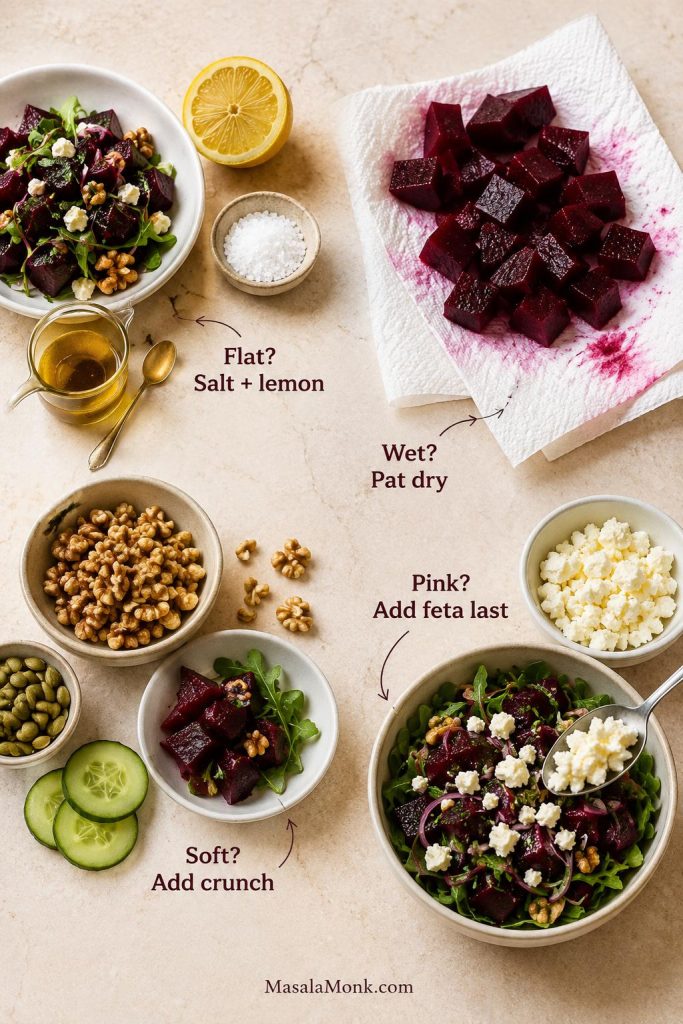
Beet salad troubleshooting guide showing lemon and salt, patted dry beets, walnuts and cucumber for crunch, and feta added last.
Flat salad usually needs salt and lemon. For a wet salad, dry the beets before adding more greens. When the texture feels soft, bring in crunch. If the feta turns pink, add it last next time.

Problem-by-Problem Fixes

ProblemFix nowFix next time
Salad tastes earthy or muddyAdd lemon juice, salt, feta, herbs, or a little extra vinegarRoast the beets longer and use smaller, fresher beets
Salad tastes blandAdd salt first, then acid and herbsTaste the dressing before tossing and season the beets lightly
Salad is too sweetAdd lemon, vinegar, peppery greens, black pepper, or more fetaUse less honey/maple and avoid sweetened canned beets
Salad is too acidicAdd olive oil, feta, walnuts, or a few more beetsBalance the dressing before adding it to the salad
Salad is wateryDrain excess liquid and add more greens or walnutsPat cooked or canned beets dry and avoid overdressing
Greens are soggyAdd fresh greens if availableDress close to serving and store components separately
Feta turned pinkIt is still fine to eatAdd feta last and arrange the salad instead of tossing heavily
Beets are too firmRoast or steam them longer until tenderTest the largest beet with a knife before cooling
Beets are too softUse them in a bowl-style salad with grains or beansRoast whole beets and avoid overcooking sliced pieces
Walnuts taste bitterUse fewer or swap with pecans, pistachios, or pumpkin seedsToast gently and avoid old walnuts
Raw beet salad is too hardLet grated beets rest with lemon and salt for 10 minutesGrate or julienne raw beets instead of cutting thick pieces

Most of the time, the fix is small: a little more lemon, a pinch of salt, a handful of herbs, or something crisp on top. If the salad tastes flat, add salt and lemon before adding more oil. For cleaner color next time, use the layering method and add feta last.

FAQs About Beet Salad

What cheese goes best with beet salad?

Feta is the easiest choice because it is salty, tangy, and crumbly. Goat cheese is creamier and more restaurant-style. Blue cheese is stronger and works best with pear, walnuts, and bitter greens.

Are roasted beets better than boiled beets for salad?

Roasted beets usually taste better because they are sweeter, deeper, and less watery. Boiled beets can work, but they need extra drying, salt, lemon, and herbs.

Should I peel beets before or after roasting?

For whole roasted beets, peel after roasting because the skins slip off more easily and the beets stay juicier. For sliced roasted beets, peel before cutting.

Should beet salad be served warm or cold?

Beet salad is best cool or at room temperature. Warm beets can wilt greens and stain feta faster, so let them cool before assembling.

Why does my beet salad taste muddy?

It usually needs more acid, salt, herbs, or contrast. Add lemon juice, balsamic vinegar, feta, parsley, mint, peppery greens, or toasted nuts.

What dressing works best with beets and feta?

A lemon-balsamic Dijon vinaigrette works well because balsamic matches the sweetness of beets, lemon lifts the salad, and Dijon gives the dressing body.

What nuts go with beet salad?

Walnuts are classic. Pistachios are excellent with orange, pecans work well with goat cheese or pear, almonds add clean crunch, and pumpkin seeds are a good nut-free option.

What herbs go with beet salad?

Parsley, mint, dill, and basil all work. Use parsley for an everyday salad, mint with orange, dill with cucumber or pickled beets, and basil with summery versions.

Is it okay to use canned beets?

Yes. Drain, rinse if needed, and pat canned beets very dry. Since they are softer than roasted beets, add crunch with walnuts, cucumber, apple, red onion, or seeds.

How do raw beets work in salad?

Raw beets work best grated, julienned, or sliced very thin. Toss with lemon or orange juice and salt, rest for 10 minutes, then add apple, carrot, herbs, feta, nuts, or seeds.

Can I make beet salad the day before?

Yes, but store the parts separately. You can roast and peel beets 3–4 days ahead. Keep beets, dressing, greens, feta, and walnuts separate, then assemble close to serving.

Should I toss beet salad or layer it?

Layer it when you want the salad to look pretty. Toss the greens lightly with dressing first, then arrange the beets, feta, walnuts, herbs, and shallot on top.

You do not need to make beet salad the same way every time. Roast the beets when flavor matters, use cooked beets when speed matters, and taste one complete bite before serving. If the beets are sweet, the feta is salty, the walnuts are crisp, and the last bite still tastes lemony and fresh, the salad is doing exactly what it should.
Posted on Leave a comment

Beet Juice Recipe

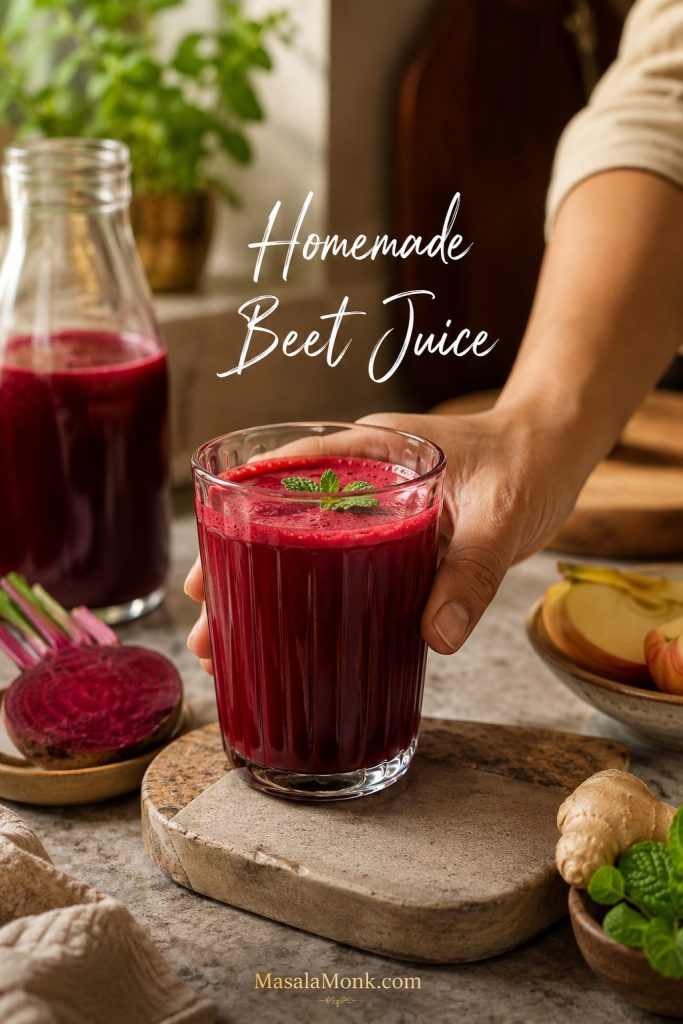
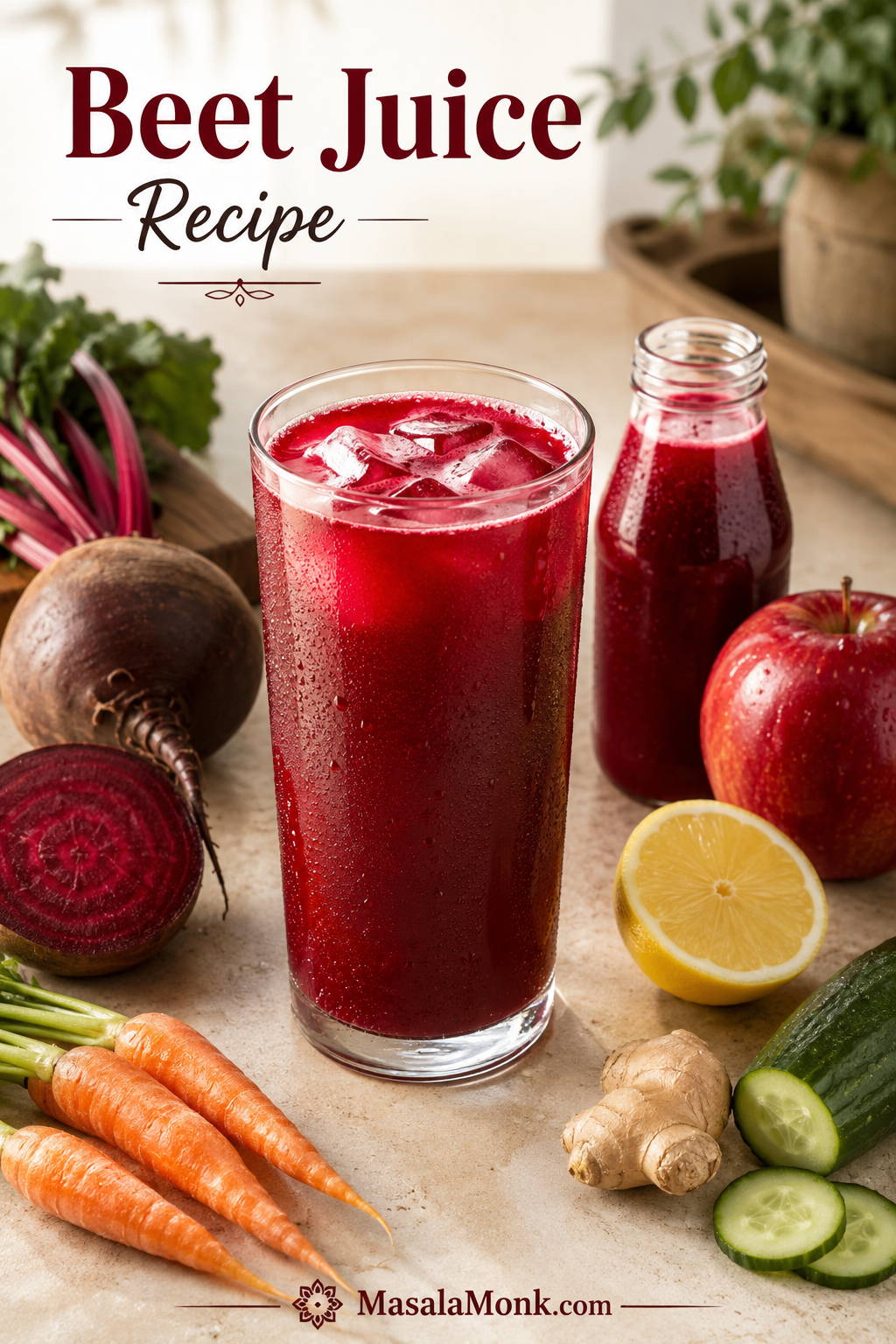
Chilled glass of ruby-red homemade beet juice with ice, a small bottle of juice, and fresh beetroot, carrots, apple, lemon, ginger, and cucumber on a light kitchen surface.

Beet juice can go one of two ways. Made carelessly, it tastes earthy, heavy, and a little too close to drinking a glass of soil. Made with the right balance, it turns into a chilled, ruby-red juice that tastes lively, lightly sweet, tart, and just spicy enough from ginger.

This beet juice recipe is for that second version. It uses raw beetroot for color and depth, carrot and apple for natural sweetness, lemon for brightness, ginger for lift, and optional cucumber to make the whole glass easier to sip. The first taste should feel clear and awake, not muddy.

This is not straight beetroot juice. It is a balanced beet-carrot-apple juice designed to taste cool, tart, lightly sweet, and easy to finish.

You can make this beetroot juice recipe in a juicer for the smoothest texture, or in a blender if you do not own a juicer. The blender version needs water and proper straining, but it still works beautifully when you know what the mixture should look and feel like. It is especially helpful if you are making it for the first time, dislike plain beetroot juice, or want a balanced glass without added sugar.

No juicer at home? Skip to the blender method. Already ready to make it? Jump to the full recipe card.

Start with the quick recipe, then come back to the sections below when you want to adjust the flavor, make it without a juicer, store it safely, or understand what the health claims actually mean.

Beet Juice Recipe Guide

Use this as a quick recipe first, then as a troubleshooting guide whenever you want a smoother blender batch, a less earthy glass, or a safer way to store leftovers.

Quick Answer: How to Make Beet Juice

To make beet juice, juice or blend raw beetroot with carrot, apple, lemon, ginger, and optional cucumber. If using a juicer, feed the produce through the machine, then stir in the lemon juice and serve over ice. If using a blender, add cold water, blend until smooth, then strain through a nut milk bag, cheesecloth, or fine mesh strainer.

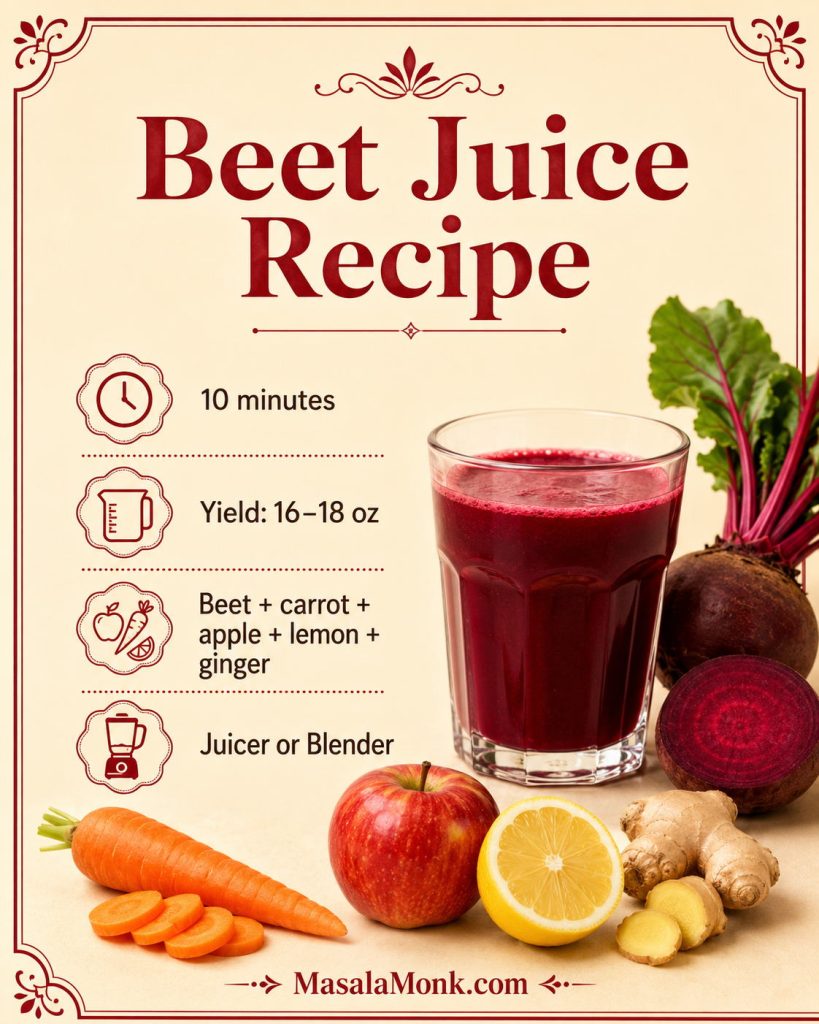
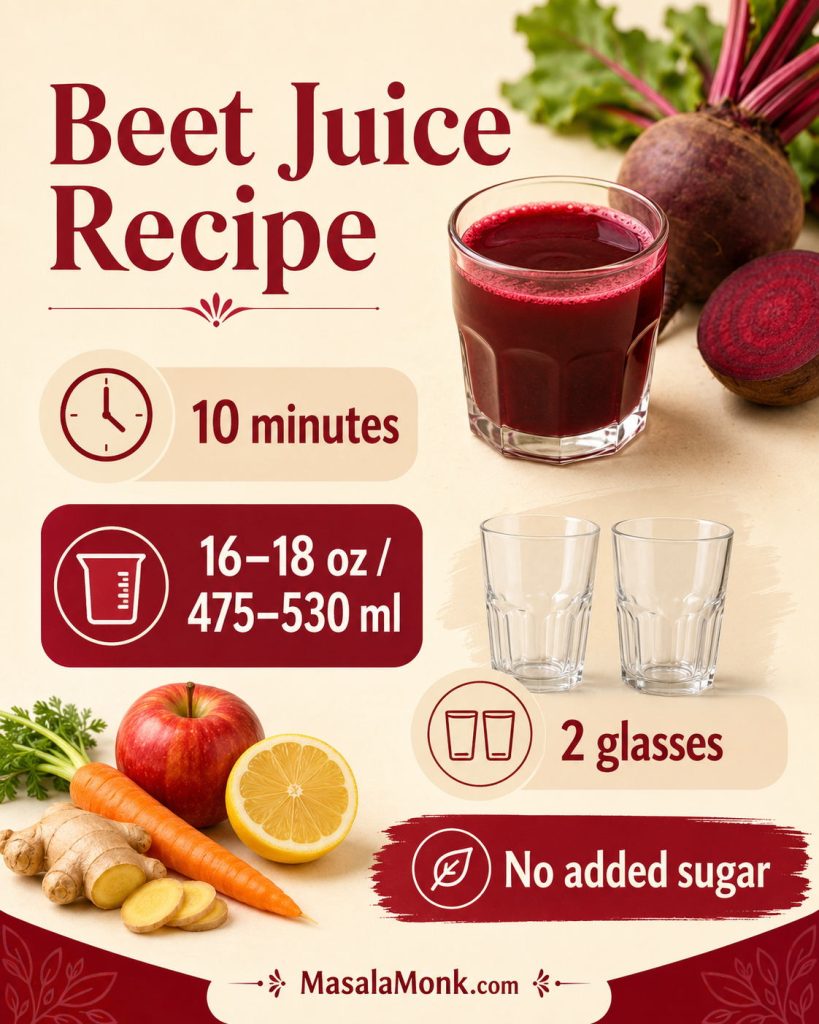
This beetroot juice recipe makes about 16–18 oz / 475–530 ml, enough for 2 standard 8 oz / 240 ml glasses or 3 smaller 5 oz / 150 ml servings. It takes about 10 minutes, uses no added sugar, and tastes brightest right after making. Here, beet juice and beetroot juice mean fresh juice made from raw red beetroot, not pickled beet brine, canned beet liquid, or beet powder mixed into water.

At-a-glance beet juice recipe graphic showing a glass of beet juice, 10 minutes, 16–18 ounces, two glasses, and no added sugar.
Since this fresh beet juice takes about 10 minutes and makes two glasses, it works best as a quick just-made drink rather than a big storage batch.

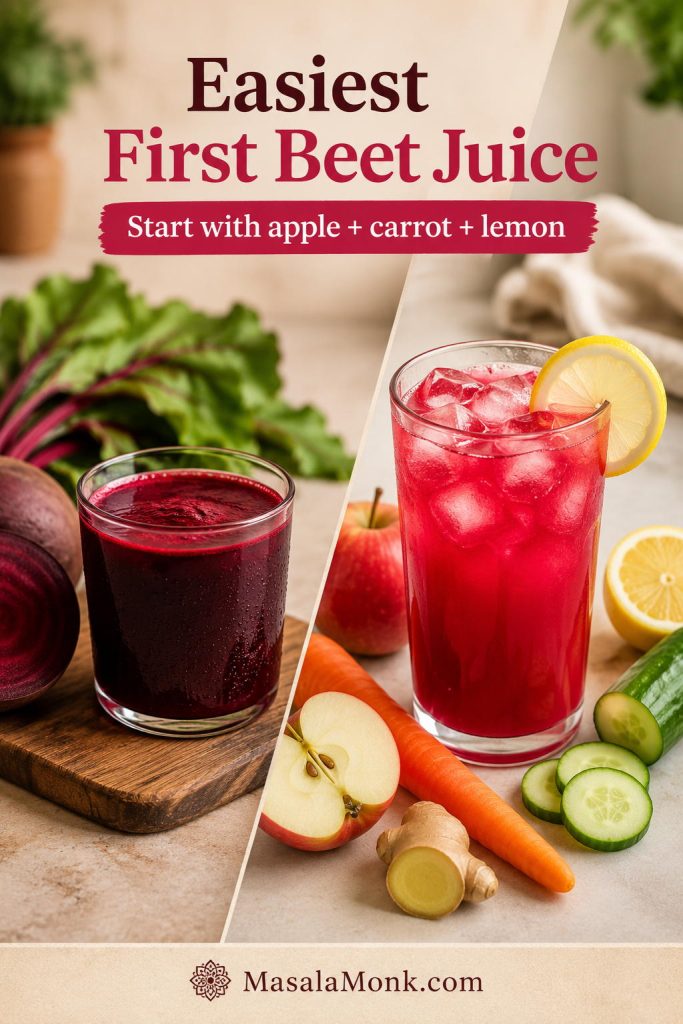
Easiest first glass: if your first memory of beet juice is something thick, muddy, or aggressively earthy, do not start with straight beetroot. Make the apple-beet-carrot version first, serve it over ice, then adjust lemon, cucumber, or ginger after tasting.

Split image comparing a darker straight beetroot juice with a brighter beginner-friendly apple, beet, carrot, lemon, ginger, and cucumber juice over ice.
When plain beetroot juice tastes too earthy, apple and carrot make the first glass gentler; then lemon, ginger, cucumber, and ice help it feel refreshing.

Still worried about the earthy flavor? See the taste fixes before you make your first batch.

Quick Beet Juice Formula

  • Base: 1 medium-large beetroot or 2 small beets, about 225–250 g / 8–9 oz
  • Balance: 2 carrots and 1 large apple for natural sweetness
  • Brightness: ½ lemon, about 15–20 ml juice
  • Lift: ½–1 inch fresh ginger, about 5–10 g
  • Lightness: ½ cucumber, optional, about 75–100 g / 3–4 oz
  • Blender only: ½–1 cup / 120–240 ml cold water
  • Serve: over ice, right after making

The 10-Minute Version

Juice or blend 1 beetroot, 2 carrots, 1 apple, ½ lemon, ½–1 inch ginger, and optional cucumber. If blending, add ½ cup / 120 ml cold water, blend for 45–60 seconds, strain well, and serve over ice. Add more water only if the blender needs help.

Serve it with breakfast, as an afternoon caffeine-free drink, or as a small pre-workout glass after you know how your body handles it.

Why This Beet Juice Recipe Works

The trick is not hiding the beetroot. It is balancing it. Beetroot gives the drink its deep color, earthy sweetness, and unmistakable flavor, but it needs the right supporting ingredients so the glass does not taste flat or muddy.

Carrot is the quiet helper here: it softens beetroot’s rooty edge without making the glass taste like fruit punch. Apple makes the drink more beginner-friendly. Lemon is the difference between a dull beet juice and one that tastes like it belongs in a glass with ice. Ginger adds a bright, spicy finish. Cucumber is the ingredient to add when the juice feels a little too serious, dense, or beet-forward.

For a beginner-friendly glass, keep beetroot to roughly one-third of the total produce volume and let carrot, apple, cucumber, and citrus do the balancing. If your batch tastes too rooty or heavy, it usually does not need sugar first. It needs acid, coldness, dilution, or a better mix.

Temperature matters too. Room-temperature juice tastes flatter and heavier than a chilled glass, so use refrigerated produce when possible or serve the finished glass over plenty of ice. The final drink should pour easily, taste lightly sweet and tart, and finish with gentle ginger warmth.

What Does Beet Juice Taste Like?

The drink tastes earthy, lightly sweet, mineral-like, and bold. That rooty note is the part people either love or struggle with. Straight beetroot juice can feel intense, especially if you are new to it.

The first sip of this version should be cool and lightly tart, with apple-carrot sweetness in the middle and gentle ginger warmth at the end. Juicer beet juice will feel thinner and clearer. The blender version, even after straining, may feel slightly fuller. Both should still pour like juice, not spoon like a smoothie.

Best beginner version: Use 1 small beet, 2 carrots, 1 apple, ½ lemon, ½ inch ginger, and ½ cucumber. This keeps the beet flavor present but not overpowering.

Once you like the base, adjust one thing at a time: more lemon for tartness, more apple for sweetness, more cucumber for lightness, or more ginger for heat.

Ingredients for the Best Beet Juice

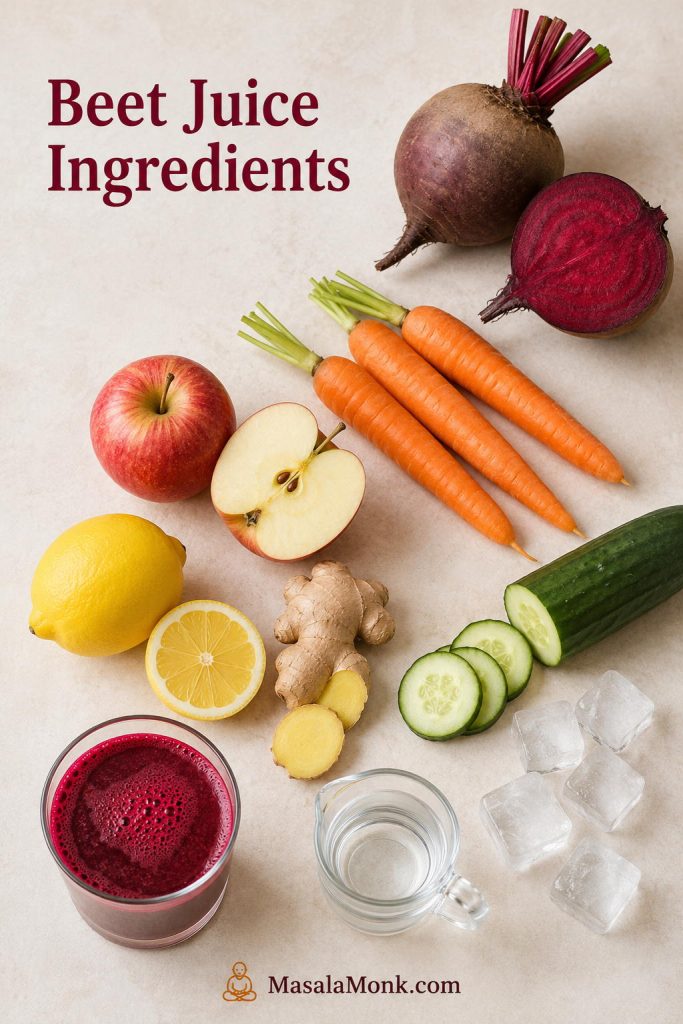
The best glass needs contrast. You want enough beetroot for color and flavor, enough natural sweetness to soften the mineral notes, enough citrus to keep it crisp, and enough chill or cucumber to make it easy to sip.

Overhead layout of beet juice ingredients including cut beetroot, carrots, apple, lemon, ginger, cucumber, ice, and water for the blender method.
Each ingredient has a purpose: beetroot adds depth, carrot and apple soften the flavor, lemon lifts it, and ginger gives the juice a cleaner finish.
IngredientAmountWhy it matters
Raw red beetroot1 medium-large or 2 small beets, about 225–250 g / 8–9 ozThe base of the juice; gives color, earthy sweetness, and the classic beet flavor.
Carrots2 medium, about 120–150 g / 4–5 ozAdds natural sweetness and helps round out beetroot’s deeper edge.
Apple1 large, about 170–200 g / 6–7 ozMakes the juice more beginner-friendly and naturally sweet without added sugar.
Lemon½ lemon, about 15–20 ml juiceBrightens the juice and keeps the beet flavor from tasting flat.
Fresh ginger½–1 inch, about 5–10 gAdds warmth, sharpness, and a lively finish.
Cucumber, optional½ small cucumber, about 75–100 g / 3–4 ozLightens the flavor and makes the juice more refreshing.
Cold water½–1 cup / 120–240 ml, blender method onlyHelps the blender move and controls thickness. Do not add it when using a juicer.
IceAs neededMakes the finished glass more refreshing.

Juice yield varies by beet size, carrot freshness, apple variety, juicer type, and how firmly you press the pulp in the blender method. The amounts above usually make about 16–18 oz / 475–530 ml strained juice. A juicer usually gives the clearest yield without added water, while the blender version may make a little more volume because of the water, but with a slightly softer flavor.

Beetroot

Use raw red beets for the brightest color and crispest flavor. Scrub them well because beets grow in soil and often carry grit around the root end. Peeling is optional if the beets are tender-skinned and scrubbed well, but peel them if the skin is rough, bitter, waxed, or hard to clean.

How to Choose Beets for Juice

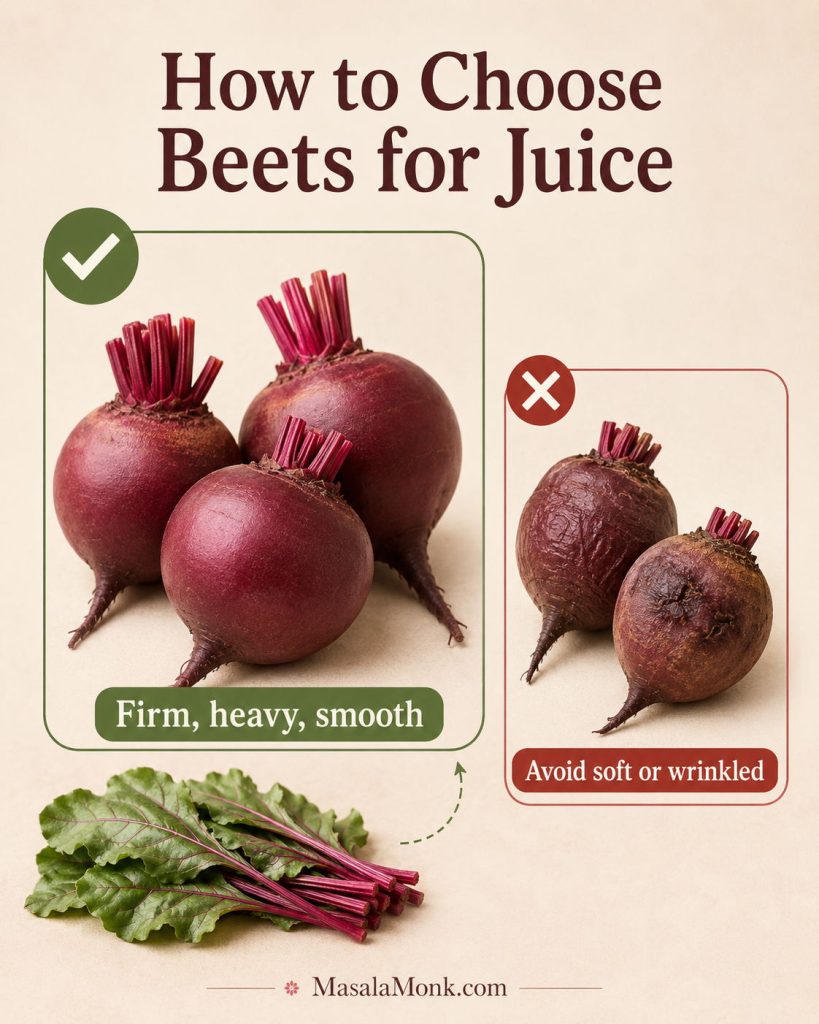
Choose firm, heavy beets with smooth skin and no soft, wrinkled, moldy, or badly bruised spots. Small to medium beets often taste sweeter and less woody than very large ones. If the beets come with greens attached, trim the greens off before storing, then scrub the roots well before peeling or cutting.

Produce guide showing firm fresh beets for juicing next to softer or wrinkled beets to avoid, with beet greens trimmed nearby.
Better beetroot juice starts before you juice anything, so choose firm, heavy, smooth roots and skip soft or wrinkled beets that can taste woody.

If your beets come with greens, save the tender leaves for cooking rather than adding a large handful to this juice. Beet greens can make the drink taste more grassy and bitter.

Carrot

Carrot is one of the easiest ways to make this drink taste better. It brings mellow sweetness without turning the glass into a fruit-heavy juice, and it also works beautifully in apple beet carrot juice, often called ABC juice. MasalaMonk’s guide to vitamins in carrots goes deeper into carrot juice, raw carrots, cooked carrots, and their key nutrients.

Apple

A crisp sweet-tart apple is ideal. Gala, Fuji, Honeycrisp, Pink Lady, or any good eating apple will work. Green apple gives a sharper, less sweet result. Red apple gives a softer, sweeter glass.

Lemon or Lime

Citrus makes the beet taste awake. Stir lemon juice in at the end if you are using a juicer, or peel the lemon and blend it with the produce if you are using a blender. Avoid blending too much white pith because it can make the drink bitter.

Ginger

Fresh ginger makes the flavor lighter and less heavy. Start with ½ inch if you are sensitive to heat. Use the full inch if you want a stronger beet ginger juice with a spicy finish.

Cucumber or Celery

Cucumber is optional, but it is one of the most useful ways to make the glass easier to drink. It increases the yield, cools the flavor, and gives the juice a more refreshing finish. Celery works too, though it tastes more savory and slightly salty. If you like the cucumber-lemon-ginger side of this recipe but want something lighter than juice, MasalaMonk’s guide to cucumber, lemon, and ginger water is a good companion.

Raw Beets vs Cooked Beets for Juice

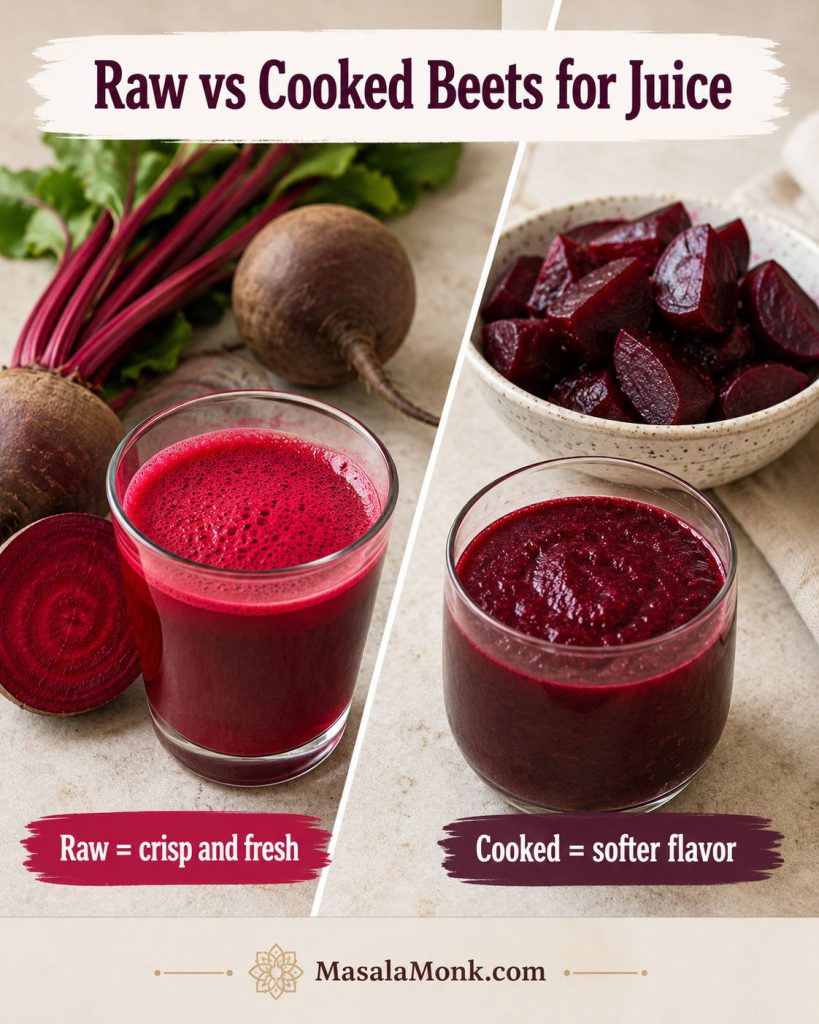
Use raw beets for the most refreshing beet juice. Raw beetroot gives the drink a crisp, earthy-sweet flavor. Cooked beets are softer and sweeter, but they make the drink taste more like cooked beet puree than just-made juice.

Comparison image showing raw beets with bright beet juice and cooked beets with a softer, thicker blended beet drink.
Raw beets make the crispest beet juice, whereas cooked beets create a softer blended drink that tastes closer to beet puree.

If you only have cooked beets, you can blend them with apple, lemon, ginger, and cold water, then strain the mixture. However, cooked beets do not work well in most juicers, and they will not give the same lively flavor as raw beetroot.

Avoid pickled beets for this recipe unless you specifically want a vinegar-heavy drink. Pickled beet juice has a completely different flavor profile because it usually contains vinegar, salt, and sometimes sugar.

How to Make Beet Juice in a Juicer

The juicer method is the fastest way to make a smooth, clear glass. It gives you the crispest flavor because you do not need to dilute the produce with water.

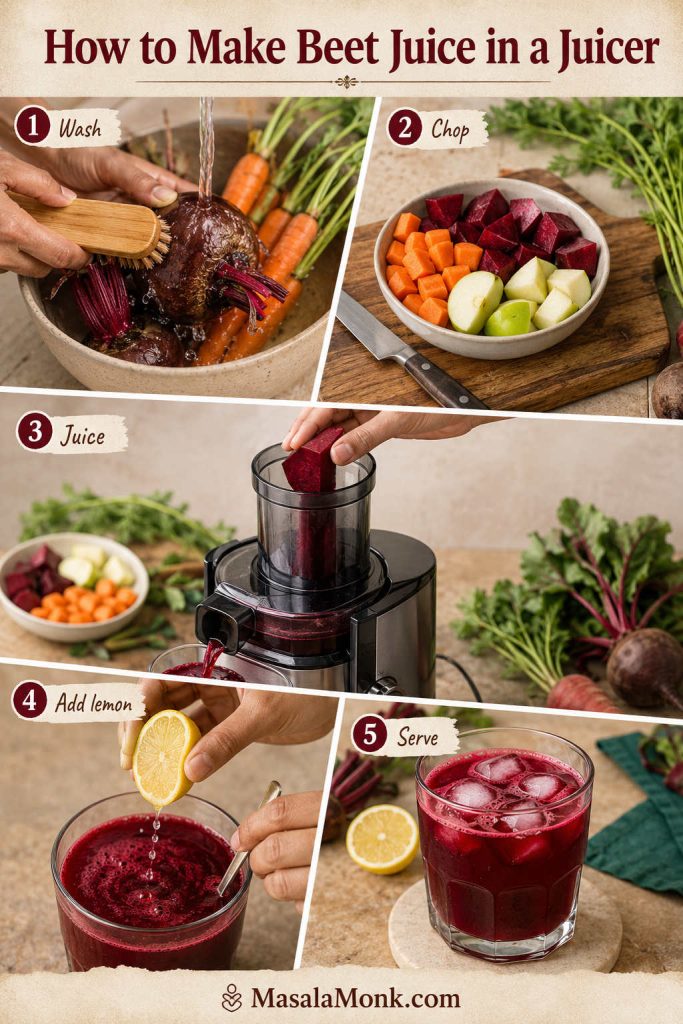
Step-by-step juicer method showing beets and carrots being washed, chopped produce, beetroot going into a juicer, lemon added to juice, and beet juice served over ice.
Because the juicer presses the produce directly, this method gives a smoother, more concentrated glass without needing blender water.
  1. Wash and scrub the produce. Pay special attention to the beetroot and carrots.
  2. Trim the beetroot. Cut off the root end and any rough top area.
  3. Peel if needed. Peeling is optional for tender-skinned beets that have been scrubbed well. Peel rough, waxed, or dirty beets.
  4. Cut everything to fit the juicer chute. Do not force oversized beet chunks through the machine.
  5. Juice the beet, carrots, apple, cucumber, and ginger. Alternate hard and softer produce so the juicer runs smoothly.
  6. Stir in lemon juice. Adding lemon at the end keeps the citrus flavor lively.
  7. Serve over ice. Drink right away for the brightest taste.

The finished juice should pour easily and look deep ruby-red, not thick like puree. Fresh juice naturally separates as it sits, so stir or shake it before drinking. If the flavor tastes flat, add a little more lemon. If it feels too heavy, pour it over extra ice or add cucumber next time.

How to Make Beet Juice in a Blender Without a Juicer

If you came here wondering how to make beetroot juice without a juicer, the blender method is the easiest place to start. It asks for one extra step — straining — but that step is what turns a thick beet puree into something you actually want to sip.

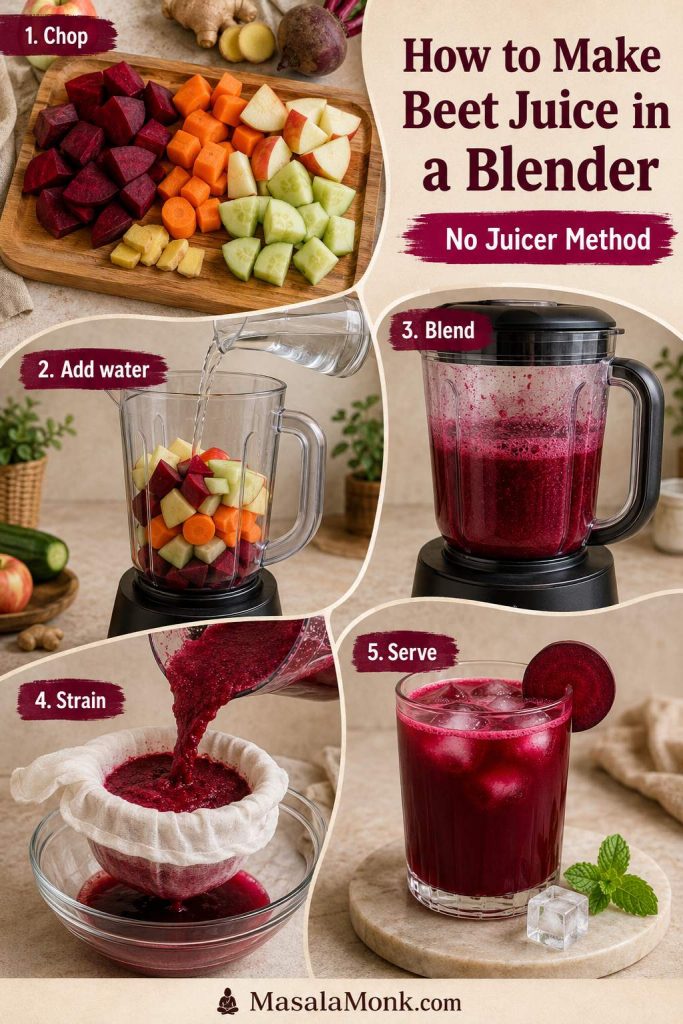
Step-by-step blender method showing chopped beetroot, carrot, apple, cucumber, and ginger, water added to a blender, blended beet puree, straining, and a final glass of juice.
For the no-juicer method, the goal is not a thick smoothie; use just enough water to blend, then strain until the juice pours cleanly.

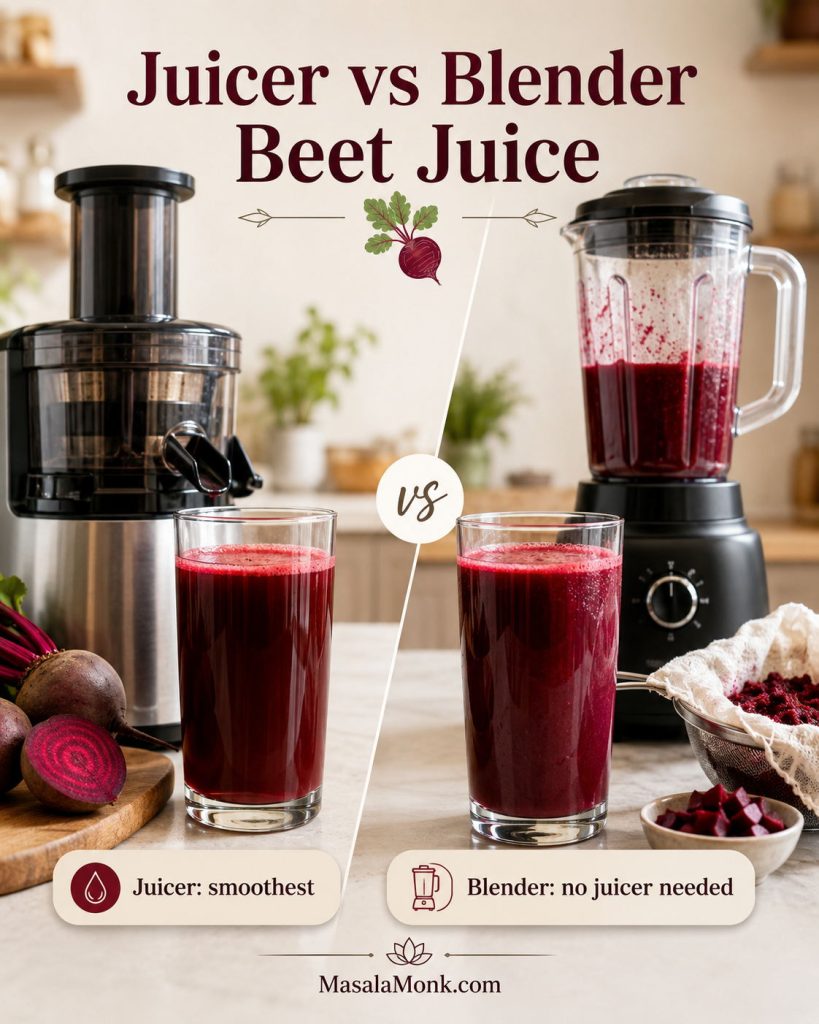
Still deciding between tools? Compare juicer vs blender beet juice before choosing your method.

  1. Chop the produce smaller than you would for a juicer. Dice the beetroot, carrot, apple, cucumber, and ginger so the blender can handle them.
  2. Add ½ cup / 120 ml cold water first. This helps the blades move without making the juice weak.
  3. Blend on high for 45–60 seconds. The mixture should look like a smooth, thick ruby puree.
  4. Add more water only if needed. If the blender stalls or groans, pause, scrape down the sides, and add water 2 tablespoons / 30 ml at a time, up to 1 cup / 240 ml total.
  5. Strain the mixture. Pour it into a nut milk bag, cheesecloth-lined strainer, or fine mesh strainer set over a bowl or jug.
  6. Let it sit briefly, then squeeze. Give it 2–5 minutes to drain, then press or squeeze to extract as much juice as possible.
  7. Serve over ice. Drink while the flavor is still lively.

How to Strain Beet Juice Smoothly

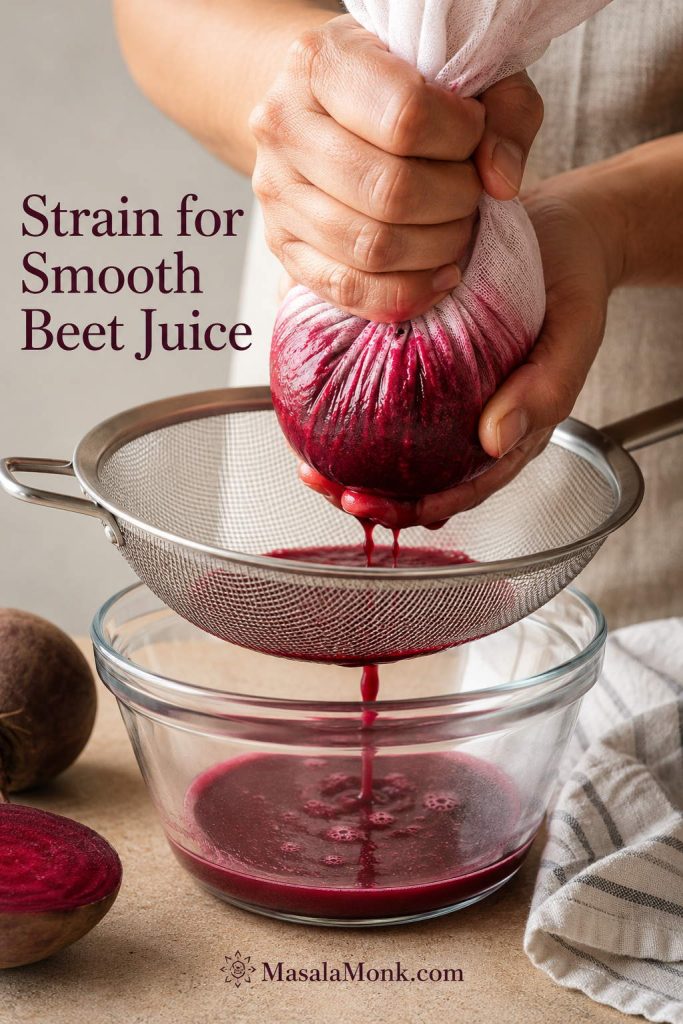
For blender beet juice, the straining step is where the texture changes from thick puree to a lighter drink. Give the pulp a few minutes to drain before squeezing, especially if you are using a nut milk bag.

Close-up of hands straining blended beet juice through a nut milk bag or fine mesh strainer into a bowl.
Straining is the step that turns blended beet puree into a lighter, smoother glass of drinkable beet juice.

Blender note: If your first batch looks more like a thick smoothie than juice, you have not failed. It just needs better straining, smaller beet pieces, or a little more patience while the pulp drains. If your blender is not very powerful, use the full 1 cup / 240 ml water and blend in two rounds if needed.

For a little more yield, add 2–3 tablespoons / 30–45 ml cold water to the squeezed pulp, stir or briefly blend again, then strain once more. Skip this second press if you want the strongest flavor.

If your batch is already too thick, watery, or sharp, jump to the troubleshooting guide.

Equipment Needed

Beet juice is simple, but it is not tidy. A little setup saves you from pink fingers, stained towels, and a blender that refuses to move. A juicer gives the smoothest glass, while a blender works well as long as you give it enough liquid and strain properly.

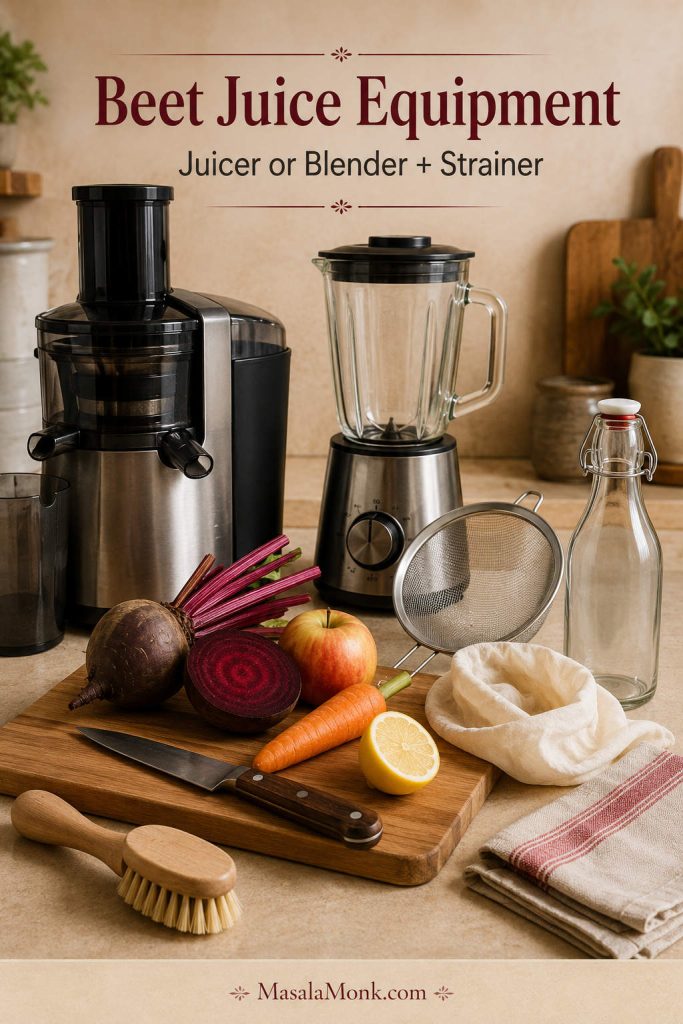
Kitchen counter with beet juice equipment including a juicer, blender, strainer, knife, cutting board, vegetable brush, glass bottle, towel, and fresh produce.
Set up the juicer or blender, strainer, cutting board, and bottle before you start; as a result, beet juice prep stays cleaner and faster.
  • Juicer: best for thin, smooth juice with no added water.
  • Blender: useful if you do not own a juicer; you will need water and a strainer.
  • Nut milk bag, cheesecloth, or fine mesh strainer: needed for the blender method.
  • Vegetable brush: helpful for scrubbing raw beets and carrots.
  • Washable cutting board and knife: important because beet juice stains.
  • Glass bottle or jar: useful if refrigerating leftovers.

Stain warning: Beet juice is beautiful in the glass and ruthless on white towels. Wipe spills quickly, rinse tools right away, and use gloves if you do not want pink fingers.

Juicer vs Blender: Which Method Is Better?

Both methods work, but they do not produce exactly the same drink. A juicer gives you a clearer, lighter result. A blender gives you more flexibility if you do not own a juicer, but you need water and straining.

Side-by-side comparison of beet juice made in a juicer and beet juice made in a blender with a strainer nearby.
Choose the juicer when you want the clearest texture, or use the blender when accessibility matters more than a perfectly light finish.
MethodBest forTextureProsCons
JuicerSmooth beet juiceThin, smooth, brightFast, no added water, smoothest juice textureRequires a juicer
Blender + strainerNo-juicer homesSlightly thicker but still juice-likeAccessible, flexible, works with common equipmentNeeds water and straining
Blender, unstrainedThicker blended drinkPulpy, smoothie-likeKeeps more fiber, less wasteNot a true clear juice
Beet powderConvenienceDepends on brand and mixingFast, shelf-stableNot the same flavor or texture as fresh beet juice

If you are deciding whether to buy a juicer, a cold press juicer is often preferred for fresh juice quality, while centrifugal juicers are usually faster and more affordable. MasalaMonk’s guide to cold press vs centrifugal juicers explains the difference in more detail.

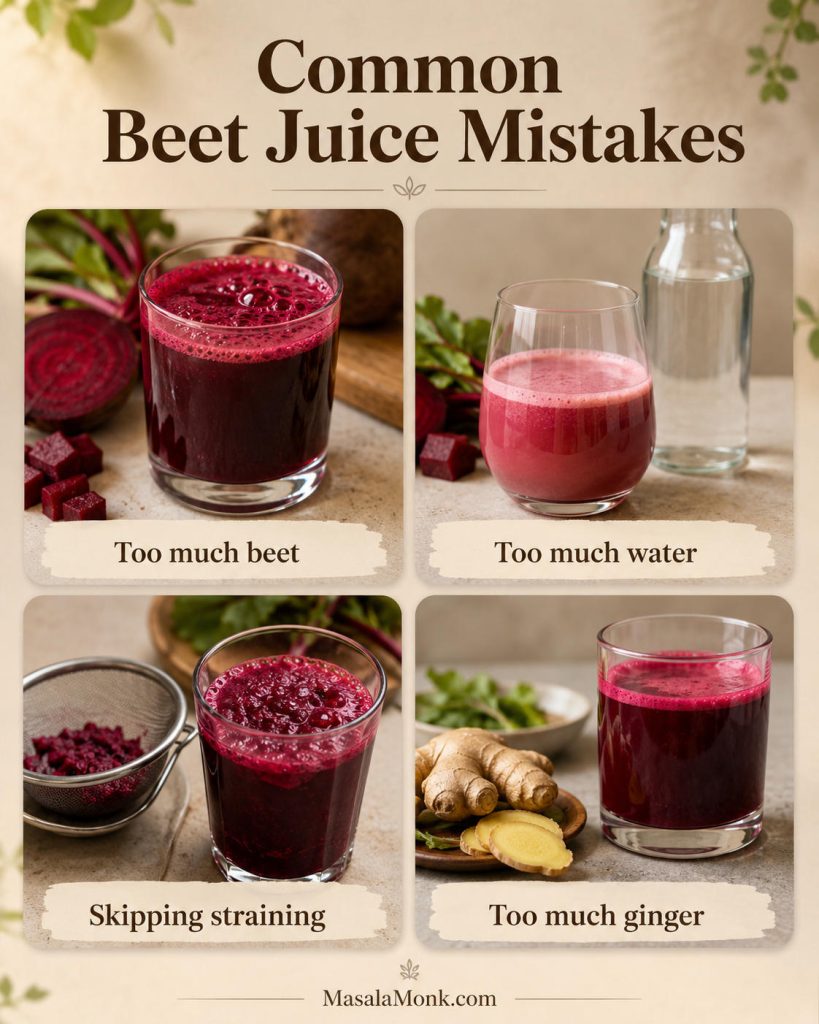
Common Beet Juice Mistakes to Avoid

Most disappointing batches come from a few simple mistakes. Before you start, avoid these and the drink becomes much easier to love.

Four-panel beet juice mistakes graphic showing too much beet, too much water, skipping straining, and too much ginger.
Most disappointing batches come from balance issues: too much beet, water, pulp, or ginger can make the glass taste heavy, weak, thick, or harsh.
  • Using only beetroot as a beginner: a pure beetroot batch can taste too intense. Start with apple, carrot, lemon, and ginger.
  • Adding too much blender water: begin with ½ cup / 120 ml and add more only if the blender needs help.
  • Skipping the strainer: unstrained blender juice will be thick and pulpy, closer to a smoothie.
  • Overdoing sharp ingredients: too much ginger or citrus pith can make the juice harsh or bitter, so start small and use lemon juice or peeled citrus.

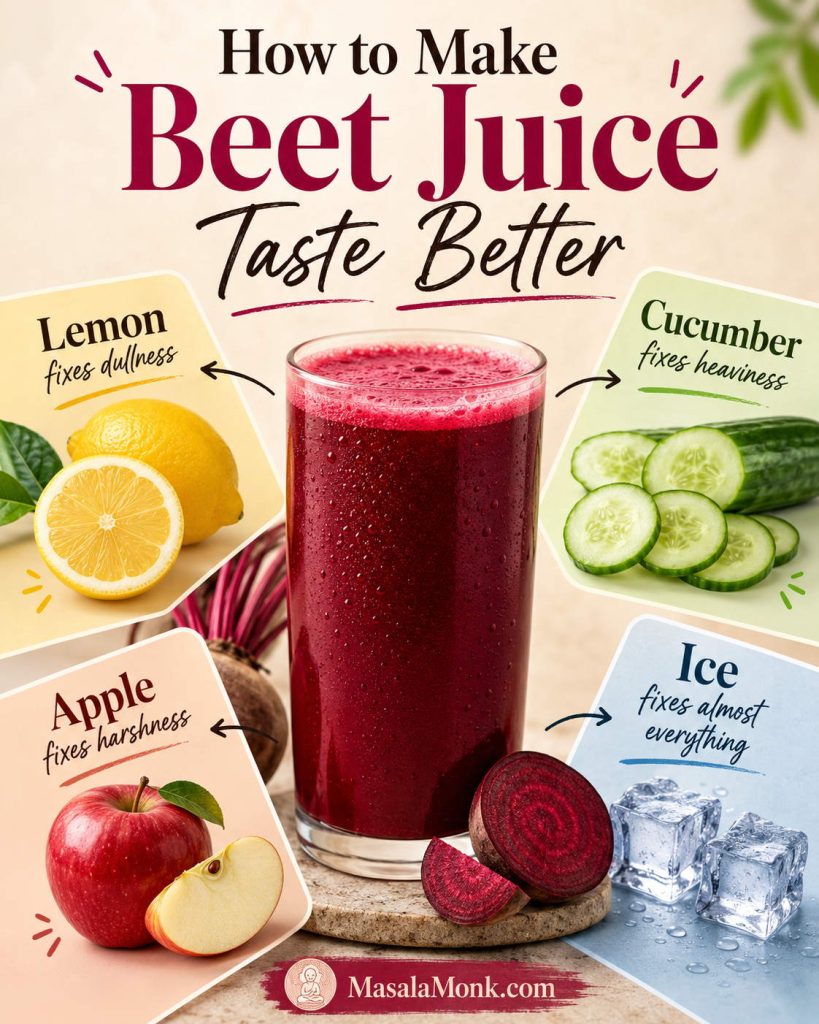
How to Make Beet Juice Taste Better

The main reason people give up on this drink is not the color or the effort. It is the taste. Beetroot is naturally earthy, so it needs brightness, sweetness, chill, or dilution to feel balanced.

Beet juice taste-fix graphic with lemon, cucumber, apple, and ice around a glass of beet juice.
A strong beet flavor usually needs contrast, not sugar; citrus, cucumber, apple, or ice can shift the drink from heavy to refreshing.
ProblemFix
Too earthyAdd more apple, orange, lemon, cucumber, or carrot.
Too sweetAdd lemon or lime, cucumber, celery, or a little extra ginger.
Too sharp from gingerUse ½ inch ginger instead of 1 inch next time. Dilute this batch with more apple, carrot, or cucumber juice.
Too thickUse a nut milk bag or cheesecloth and squeeze well. Add a little cold water if needed.
Too wateryUse less water next time. Start with ½ cup / 120 ml for blender juice and add only as needed.
Too bitterPeel citrus fully and avoid blending too much white pith.
Too strong for beginnersUse half a beet and increase the carrot or apple.
Not refreshingServe over ice or chill the juice before drinking.

The easiest beginner version is beetroot with both apple and carrot. The crispest version adds cucumber and lemon. The punchiest version leans on ginger and citrus. If the glass tastes flat, it almost always needs lemon. If it tastes heavy, it needs cucumber, ice, or less beet next time.

Remember this flavor rule: lemon fixes dullness, cucumber fixes heaviness, apple fixes harshness, and ice fixes almost everything.

Once the basic glass tastes right, the variations become much easier. You are not guessing anymore; you are choosing whether you want the drink sweeter, sharper, lighter, or stronger.

For the gentlest first variation, try the apple beet carrot juice version.

Best Beet Juice Variations

Once you know the base formula, this juice is easy to adjust. Use these variations as mini-recipes. The juicer method works as written. For the blender method, add ½–1 cup / 120–240 ml cold water and strain unless the variation says it is a smoothie.

Easy Beet Juice Combinations

VariationMini formulaBest for
Apple Beet Carrot Juice / ABC Juice1 beet + 1 apple + 2 carrots + ½ lemon + optional ½ inch gingerBeginner-friendly sweetness and a softer beet flavor
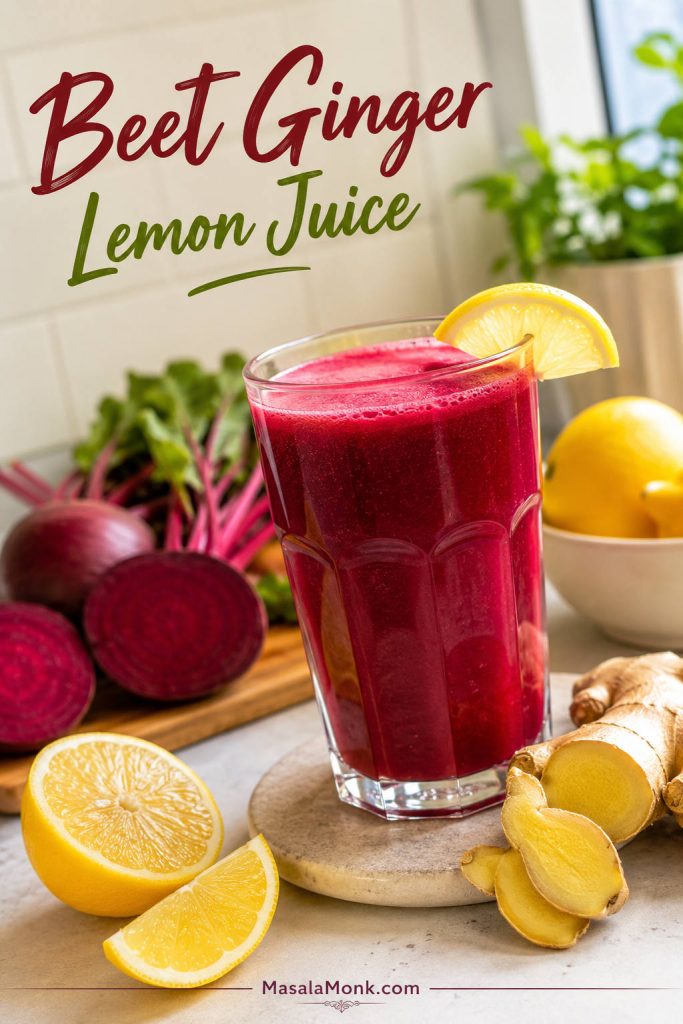
Beet Ginger Lemon Juice1 beet + 1 apple + ½ lemon + 5–10 g ginger + optional cucumberA sharper, livelier juice
Beet Orange Juice1 beet + 1 peeled orange + 1 carrot + 5 g gingerA citrusy breakfast-style glass
Beet Pineapple Juice1 beet + 1 cup pineapple chunks + ½ cucumber + ½ lemonA sweeter tropical version
Beet Pomegranate Juice1 beet + ½–¾ cup unsweetened pomegranate juice + ½ lemonA tart, deep red juice
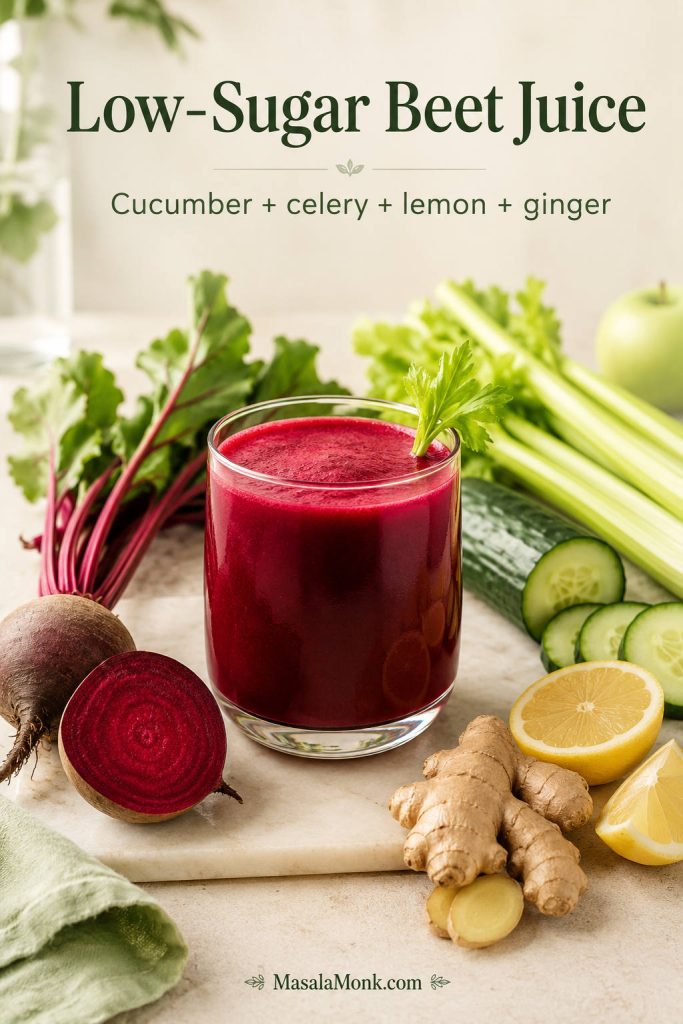
Low-Sugar Beet Juice½–1 beet + ½ cucumber + 1 celery stalk + ½ lemon + ½ inch gingerA lighter vegetable-forward version
Beet Turmeric Ginger Juice1 beet + ½ inch ginger + small piece fresh turmeric or ¼ tsp ground turmeric + ½ lemonA strong, spicy flavor
Beet Juice ShotBeet + lemon + ginger + small apple piece if neededSmall 2–3 oz / 60–90 ml servings
Beet Juice SmoothieBeet juice or blended beet + banana or berries + yogurt or plant milkA thicker, more filling drink

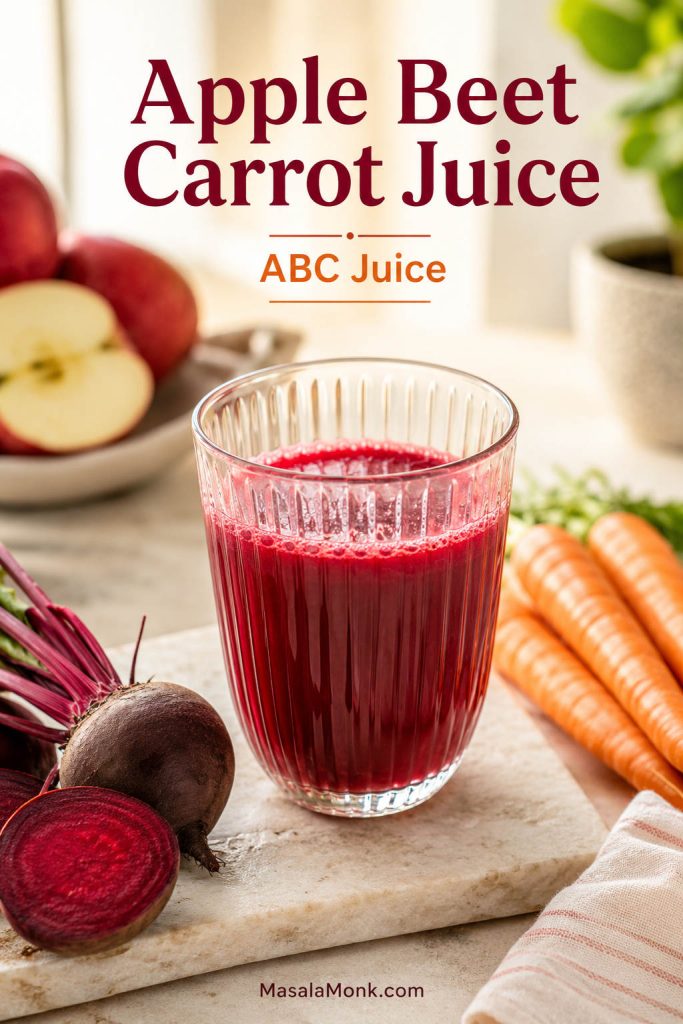
Apple Beet Carrot Juice / ABC Juice

This is the safest first version if beetroot usually tastes too strong to you. Use a sweet apple for a softer drink or green apple for a sharper one. The carrot keeps the juice mellow, so the beet still shows up without taking over the glass. For more beetroot drink ideas, including beet-ginger-turmeric and ABC-style combinations, see MasalaMonk’s guide to the power of beetroot and beet juice.

Glass of apple beet carrot juice with fresh apple, beetroot, and carrots on a bright breakfast-style kitchen surface.
Apple beet carrot juice, often called ABC juice, is the gentlest variation because carrot and apple mellow beetroot’s earthy edge.

Beet Ginger Lemon Juice

This version is sharper and less sweet. It is the one to make when you want beet ginger juice with a brighter, spicier finish. Start with less ginger unless you already know you like the heat.

Glass of beet ginger lemon juice with fresh lemon wedges, lemon half, ginger slices, and beetroot nearby.
Beet ginger lemon juice is the sharper variation, so it works well when you want more citrus brightness and a warmer ginger finish.

Beet Orange Juice

Orange makes the drink rounder and more breakfast-friendly. Peel the orange well so the white pith does not make it bitter. This is a good choice when you want something sweeter than lemon but brighter than apple alone.

Beet Pineapple Juice

Pineapple gives this variation tropical sweetness that helps soften the deep beet flavor. Cucumber keeps the drink from becoming too syrupy. This is especially useful when you want the juice to taste more fruity and less vegetable-heavy.

Beet Pomegranate Juice

Pomegranate makes the juice tart, deep, and bold. For the easiest version, use unsweetened pomegranate juice. If using fresh pomegranate arils, blend gently and strain very well, or juice them only if your juicer handles pomegranate arils cleanly.

Low-Sugar Beet Juice

This version skips most of the fruit and uses cucumber, celery, lemon, and ginger for a cleaner vegetable-forward flavor. It will not taste as sweet as the apple-carrot version, but it is lighter and more refreshing.

Glass of low-sugar beet juice with beetroot, cucumber, celery, lemon, ginger, and a small green apple in a light kitchen scene.
For low-sugar beet juice, lean on cucumber, celery, lemon, and ginger; that way, the drink stays vegetable-forward without tasting flat.

Beet Turmeric Ginger Juice

This has a strong, spicy flavor. Use turmeric carefully because it can dominate the drink. Add black pepper only if you already like that taste; it is not needed for the recipe to work.

Beet Juice Shot

A beet shot is stronger and smaller than a full glass. Keep the beet, lemon, and ginger more concentrated, then use just enough apple to soften the edge if needed. Serve 2–3 oz / 60–90 ml at a time.

Beet Juice Smoothie

To turn this into a smoothie, do not strain the blended mixture. Add banana, berries, yogurt or plant milk, and a little ginger. A smoothie keeps more pulp and fiber, so it will be thicker and more filling than strained beet juice. For more smoothie-style ideas, MasalaMonk’s guide to high-iron smoothies and shakes includes beetroot-friendly combinations that lean more filling than juiced.

Flavor comes first. Once the drink is something you actually enjoy, then it makes sense to talk about where it fits in a routine.

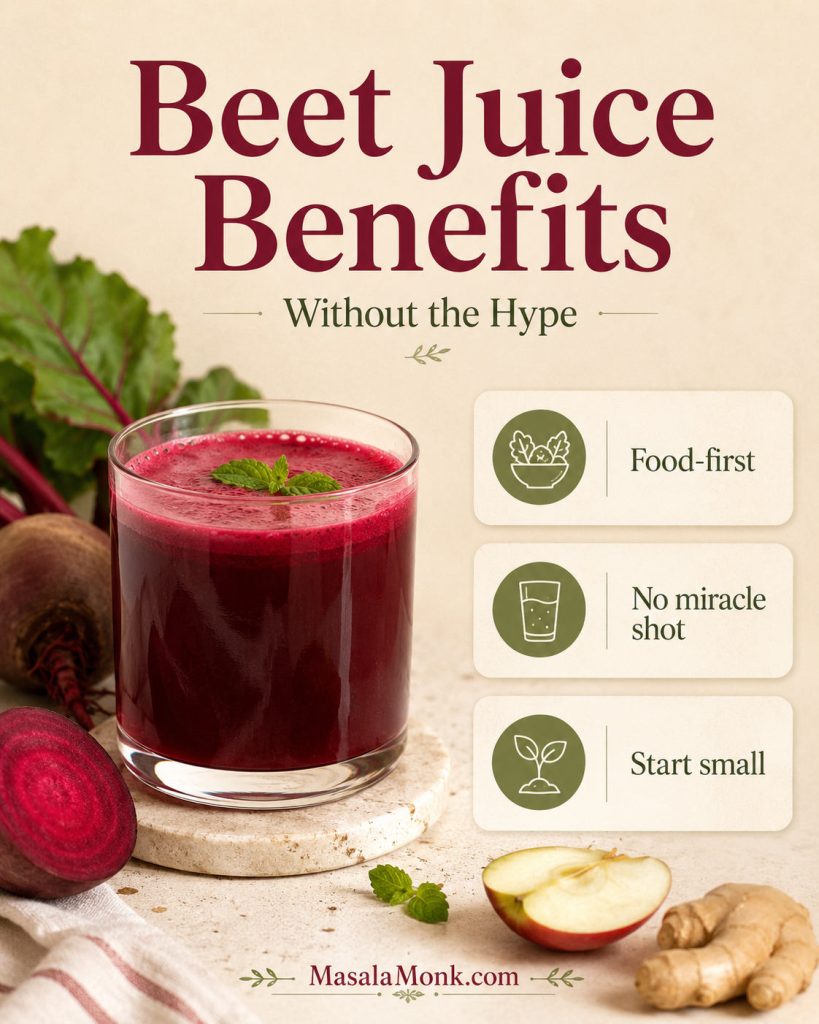
Beet Juice Benefits, Without the Hype

Once the flavor is right, the next question is usually what this drink actually does for you. The honest answer is that beet juice can be useful, but it works best when you treat it as food, not as a miracle shot.

Think of this as a bright vegetable drink with a few smart use cases: a small pre-workout serving, a lower-sugar vegetable-forward version, or an occasional way to enjoy beets when you do not feel like eating them.

Calm beet juice benefits graphic with a glass of beet juice, beetroot, and cards reading food-first, no miracle shot, and start small.
Beet juice can fit into a healthy routine, although it is still best treated as a food-first drink rather than a miracle wellness shortcut.

Planning to drink it often? Read the safety notes before making beet juice a daily habit.

Beetroot is naturally colorful, plant-rich, and known for dietary nitrates. Much of the research interest comes from those nitrates and their possible effects on cardiovascular markers. You can read more about that research background on PubMed.

At the same time, juice is not the same as eating whole beets. When you juice and strain beets, carrots, and apples, you remove much of the fiber. That makes the drink lighter and easier to sip, but it also means it is less filling than whole vegetables or a smoothie.

If you care about…Best way to use this juice
Blood pressure interestKeep servings moderate and check with a qualified professional if you take medication or tend to run low.
Workout useTry a small strained serving first, not a huge pulpy glass right before training.
Weight-conscious drinkingUse cucumber, celery, lemon, ginger, less fruit, and no added sugar.
Daily nutritionRotate it with whole vegetables, smoothies, meals, and other drinks instead of making it your only “healthy” habit.
Detox-style flavorUse cucumber, celery, lemon, and ginger for a crisp, light glass without treating it as a cleanse.

For a broader look at whole beets beyond juice, MasalaMonk’s guide to what beets are good for covers beetroot as a food, not just as a drink.

Is Beet Juice Good for Weight Loss?

For weight-conscious readers, the most useful approach is a moderate, vegetable-forward drink — especially when you keep fruit lower and skip added sugar. It is not a fat-loss shortcut, but it can fit into a balanced routine when the portion and ingredients make sense.

The same idea applies to other “weight loss drink” combinations too. MasalaMonk’s article on pineapple, cucumber, and ginger for weight loss separates useful habits from miracle claims without treating the drink as a shortcut.

Lighter Beet Juice Formula

  • ½–1 beetroot
  • ½ cucumber
  • 1 celery stalk
  • ½ lemon
  • ½ inch ginger
  • Optional: ½ green apple if you need a little sweetness

This version is less sweet and more vegetable-forward. For more fullness, choose an unstrained beet smoothie instead of strained juice because the smoothie keeps more fiber.

Beet Juice and Blood Pressure

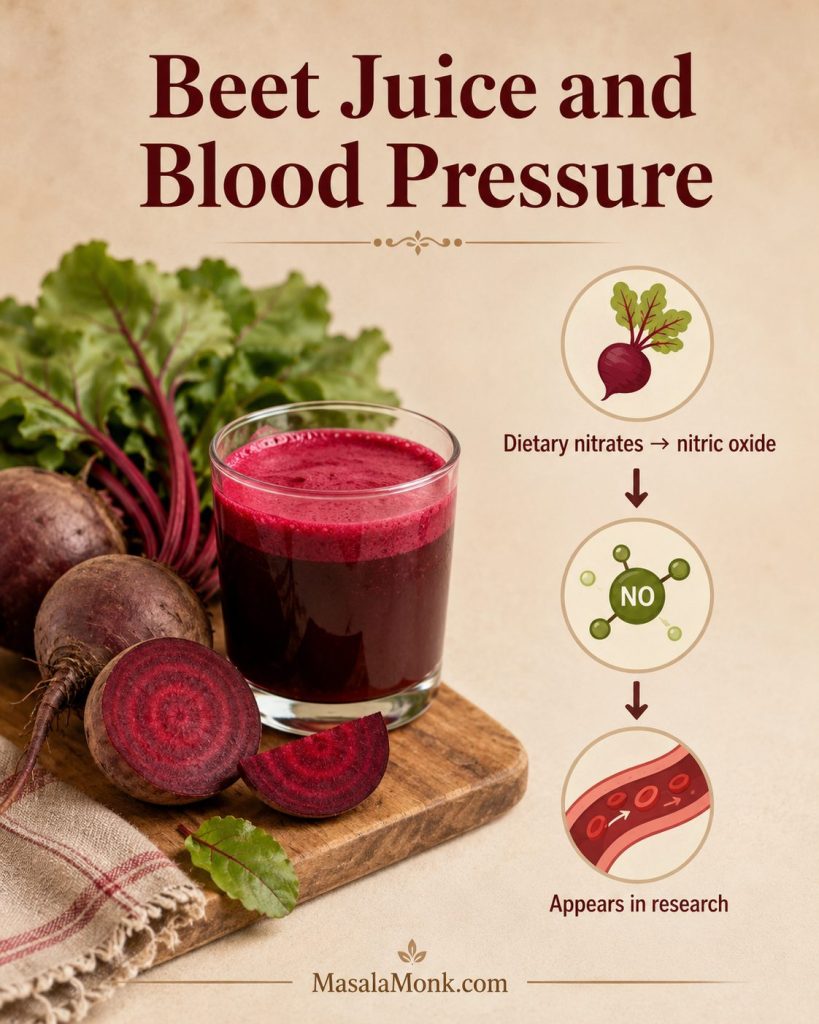
Beetroot contains dietary nitrates, which is why this drink often comes up in blood pressure conversations. Still, drinking it once in a while is different from turning it into a daily habit; regular use matters more if you already take medication or tend to run low.

Beetroot’s dietary nitrates can be converted in the body into nitric oxide, a compound involved in blood-vessel relaxation and blood flow, which is why beet juice appears in blood pressure research.

Educational graphic showing beet juice, beetroot, dietary nitrates converting to nitric oxide, and a simple blood-flow research cue.
The blood-pressure conversation around beetroot juice starts with dietary nitrates, so this is a research-aware food habit rather than a cure claim.

Any blood-pressure effect can vary by person, serving size, timing, and overall diet, so treat this as a food habit to discuss if it overlaps with medication or a medical condition.

If you have low blood pressure, take blood pressure medication, have kidney concerns, or manage a medical condition, treat regular beet juice as something to discuss with your healthcare professional rather than a casual daily habit.

For the broader caution list, see side effects and safety notes.

MasalaMonk has a deeper article on beets and blood pressure if you want a more focused discussion of fresh, canned, pickled, and juiced beets.

Is Beet Juice a Detox or Liver Cleanse?

If you like the word “detox” because you mean light, cold, vegetable-forward, and refreshing, beet juice can fit that mood. If you mean a drink that cleanses the liver, flushes toxins, or resets the body, it does not work that way.

Your liver and kidneys already do the work of filtering and processing waste. A glass of beet juice can be colorful and refreshing, but it should not be treated as a liver cleanse or cure.

For a detox-style flavor without the misleading promise, use beetroot, cucumber, celery, lemon, and ginger. It will taste crisp and clean, but it is still just a drink.

Beet Juice for Energy or Pre-Workout

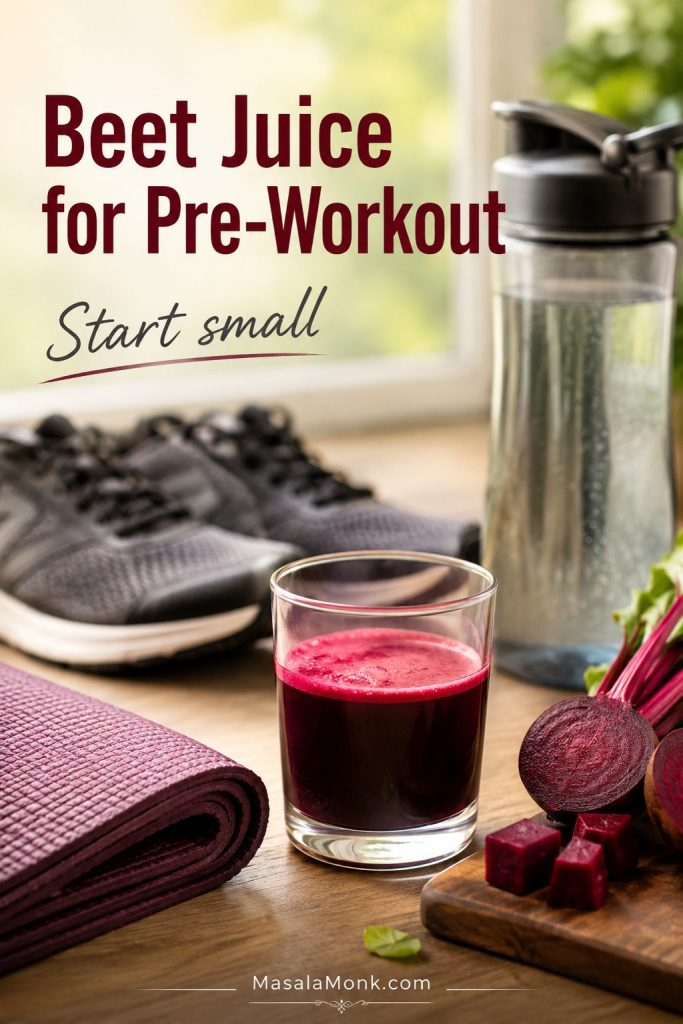
Runners, cyclists, and workout-focused readers often pay attention to beet juice because of beetroot’s natural nitrate content. If you want to try it before exercise, start with a small serving first. Some people tolerate it easily; others find that a large or pulpy drink feels too heavy before movement.

Small glass of beet juice near running shoes, a water bottle, a workout mat, and fresh beetroot in natural morning light.
Before using beet juice as a pre-workout drink, try a small strained serving first so you can see how your stomach handles it.

For a pre-workout style version, keep the flavor bright and the texture light: beetroot, orange or apple, lemon, and ginger works well. If you are using the blender method, strain it thoroughly so the drink is easier to sip before exercise.

For performance use, many beetroot juice studies focus on nitrate dose and timing rather than casual sipping, so treat a small pre-workout glass as an experiment, not a guaranteed effect.

When to Drink Beet Juice and How Much to Start With

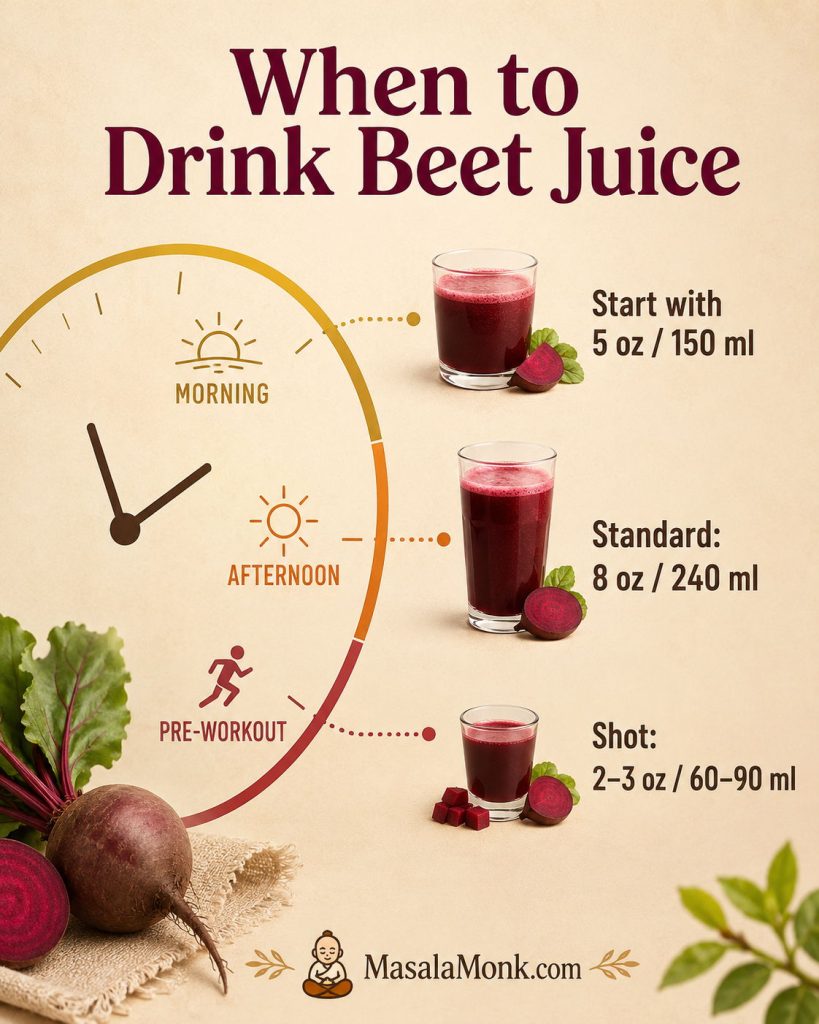
There is no single perfect time to drink beet juice. Choose the moment that fits how you want to use it and how your body responds. If you are new to this drink, start with a smaller serving because the flavor, color, and digestive effect can surprise people, especially if the glass is strong or ginger-heavy.

Timing and serving-size guide for beet juice with morning, afternoon, pre-workout cues and 5 ounce, 8 ounce, and 2–3 ounce serving sizes.
Start with 5 oz of beet juice, then adjust the timing and portion based on your routine, taste, digestion, and reason for drinking it.
  • Morning: a simple option with or after breakfast, especially if raw juice bothers your stomach on its own.
  • Afternoon: useful when you want something cool, colorful, and caffeine-free.
  • Before a workout: try a small strained serving first; avoid a large pulpy glass right before training.
  • Night: fine for many people, but skip it late if it bothers your digestion or makes you wake up to use the bathroom.
  • Daily: keep portions reasonable and rotate with whole vegetables, fruits, smoothies, meals, and other drinks.
  • Small serving: 5 oz / 150 ml
  • Standard serving: 8 oz / 240 ml
  • This recipe yield: about 16–18 oz / 475–530 ml
  • Beet shot: 2–3 oz / 60–90 ml

You do not need to turn beet juice into a daily project to enjoy it; a good glass now and then still counts. Occasional beet juice and daily beet juice are not the same decision, especially if you have blood pressure, kidney-stone, digestive, or blood sugar concerns.

After drinking beet juice, some people notice pink or red urine or stool. This is often called beeturia and can happen after eating or drinking beets. It is usually harmless, but if you are unsure whether the color is from beets or something else, or if you have pain or unusual symptoms, seek medical advice.

The sections below cover storage and safety because homemade beet juice is raw, deeply pigmented, and more concentrated than eating a few slices of beetroot.

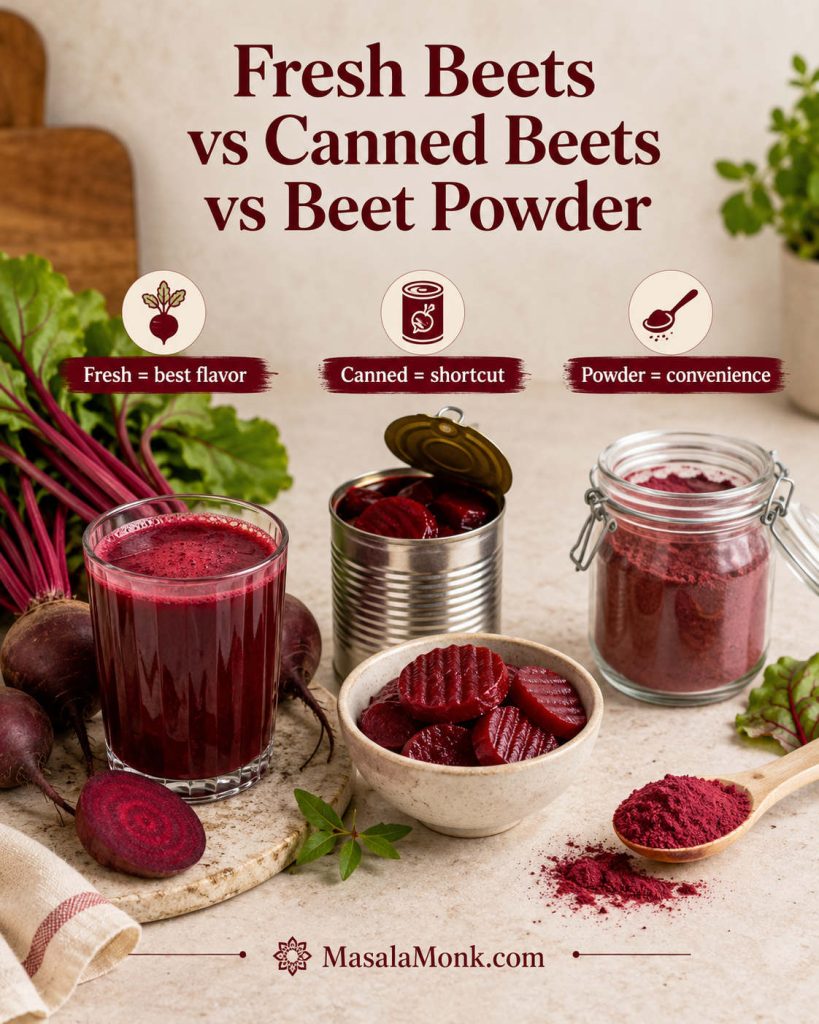
Fresh Beets vs Canned Beets vs Beet Powder

Fresh raw beetroot gives the best glass: brighter color, clearer flavor, and a more refreshing finish. Canned, cooked, pickled, and powdered beets can help in a pinch, but they each move the drink away from that just-made taste.

Comparison of fresh beets with beet juice, canned beets in a can and bowl, and beet powder in a jar and wooden spoon.
Fresh beets give homemade beet juice the brightest flavor; however, canned beets and beet powder can still work when convenience matters more.
OptionCan you use it?Best use
Fresh raw beetsYes, best choiceMain beet juice recipe
Cooked beetsYes, blender onlyEmergency shortcut, softer flavor
Canned beetsPossibleBlended shortcut; check salt, sugar, and additives
Pickled beetsNot idealOnly if you want a vinegar-style drink
Beet powderDifferent productConvenience drink, not the same as fresh juice

If you use canned beets, drain them well and check the label. Some canned beets contain added salt or sugar, and pickled beets contain vinegar that will completely change the flavor. If you use beet powder, treat it as a separate convenience drink rather than a true fresh beet juice recipe.

What to Do With Beet Juice Pulp

Beet pulp is not glamorous, but it does not have to go straight into the bin. If you use a juicer or strain the blender mixture, you will have pulp left behind. It is fibrous and deeply colored, so use it in small amounts where the color and earthiness make sense. Think of it as a small add-in, not the main event.

  • Add small amounts to veggie patties or fritters.
  • Stir into soups or stews where the color makes sense.
  • Mix into muffins, quick breads, or pancakes.
  • Blend into hummus or bean dips.
  • Freeze in small portions for later cooking.
  • Compost it if you do not want to cook with it.

Remember that beet pulp stains. If the pulp includes ginger and lemon, use it in recipes where those flavors will not feel out of place.

How to Store Beet Juice

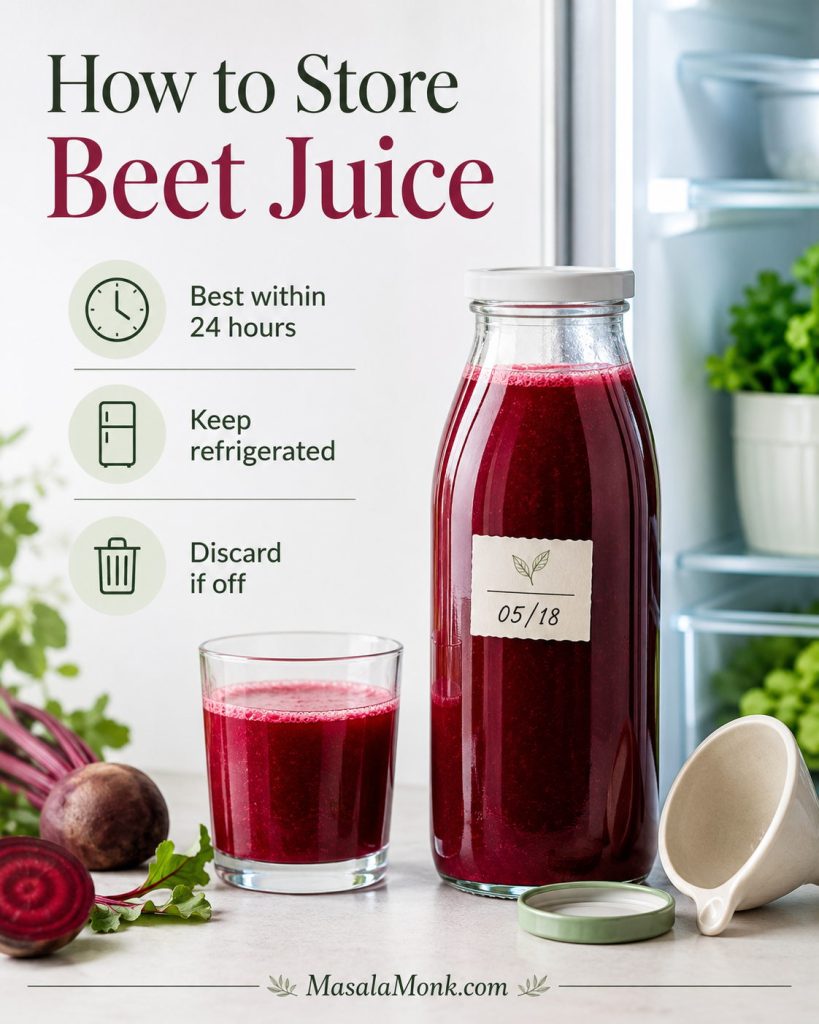
Just-made beet juice loses its sparkle quickly, so treat leftovers gently. It tastes best right after making, when the lemon is sharp, the ginger still tastes lively, and the beet flavor has not dulled. Because homemade raw juice is not pasteurized, it also needs careful storage if you are not drinking it right away.

Storage guide showing beet juice in a sealed glass bottle with a date label beside a glass of juice near an open refrigerator.
Since homemade raw juice is not pasteurized, the safest flavor window is short: chill it quickly, seal it well, and drink it soon.
  • Best flavor: drink immediately.
  • Best refrigerated quality: within 24 hours.
  • Maximum practical home storage: 24–48 hours in a clean airtight glass bottle in the refrigerator.
  • Room temperature: do not leave fresh juice out for more than 2 hours.
  • Refrigerator temperature: keep chilled at 40°F / 4°C or colder.
  • Serving after storage: shake or stir before drinking.
  • Discard if: it smells sour, fizzy, fermented, moldy, or off.

You can wash and chop the beetroot, carrot, apple, and cucumber a few hours ahead and refrigerate them in a covered container. Juice or blend just before serving for the liveliest flavor.

The FDA has a useful overview of fresh juice safety, especially because homemade raw juice is not pasteurized.

You can freeze beet juice in ice cube trays or small containers, but the flavor and texture will be less crisp after thawing. Frozen beet juice cubes are better for smoothies than for drinking plain.

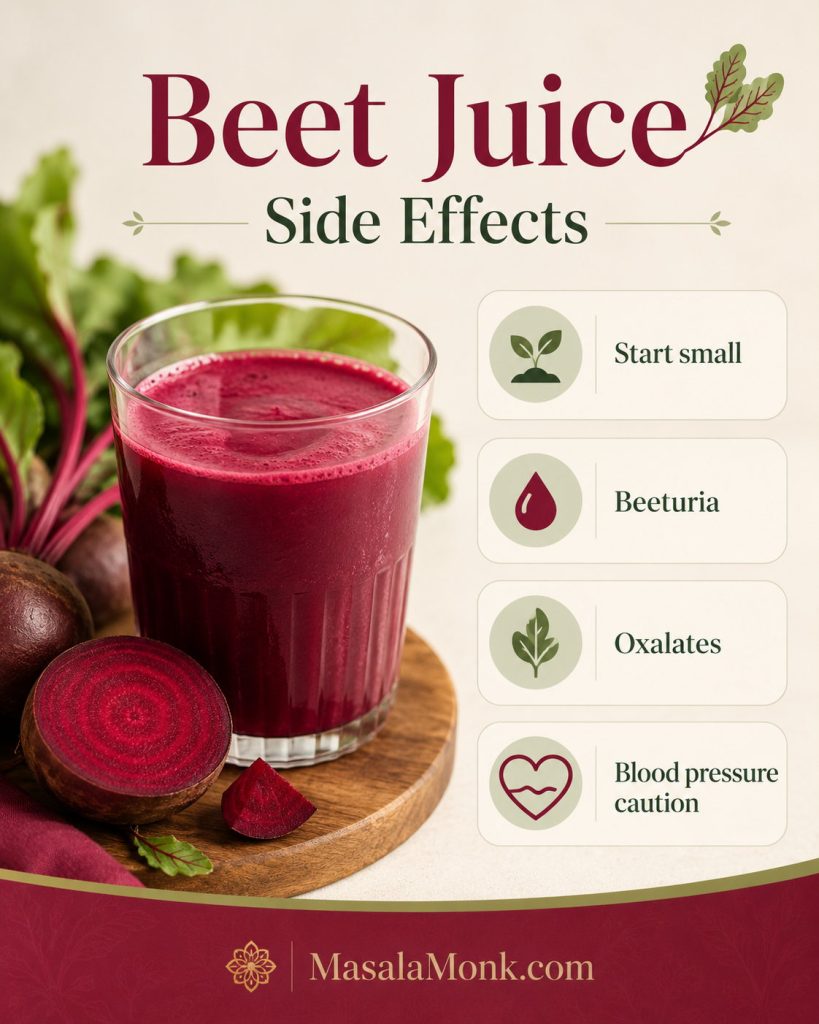
Side Effects and Who Should Be Careful

For most people, a moderate glass is simply a colorful way to enjoy beetroot. Still, start small the first time, especially if you plan to drink it often. Beet juice has a strong color, strong flavor, and for some people, a strong digestive effect too.

Beet juice side effects graphic with a glass of beet juice and safety cards for start small, beeturia, oxalates, and blood pressure caution.
Start with a modest serving if beet juice is new to you, especially if oxalates, digestion, beeturia, or blood pressure changes are concerns.
  • Red or pink urine/stool: Beet juice can cause beeturia, a temporary red or pink color change after eating or drinking beets.
  • Kidney-stone concerns: Beets contain oxalates, so people prone to certain kidney stones should be cautious.
  • Low blood pressure or medication: If you take blood pressure medication or have low blood pressure, ask a healthcare professional before drinking beet juice regularly.
  • Digestive sensitivity: Start with a smaller serving if raw juices bother your stomach.
  • Blood sugar management: If you manage blood sugar, fruit-heavy beet juices may need smaller portions or more vegetable-forward formulas.

For more detail on oxalates and beetroot, see MasalaMonk’s guide to beetroot and kidney health.

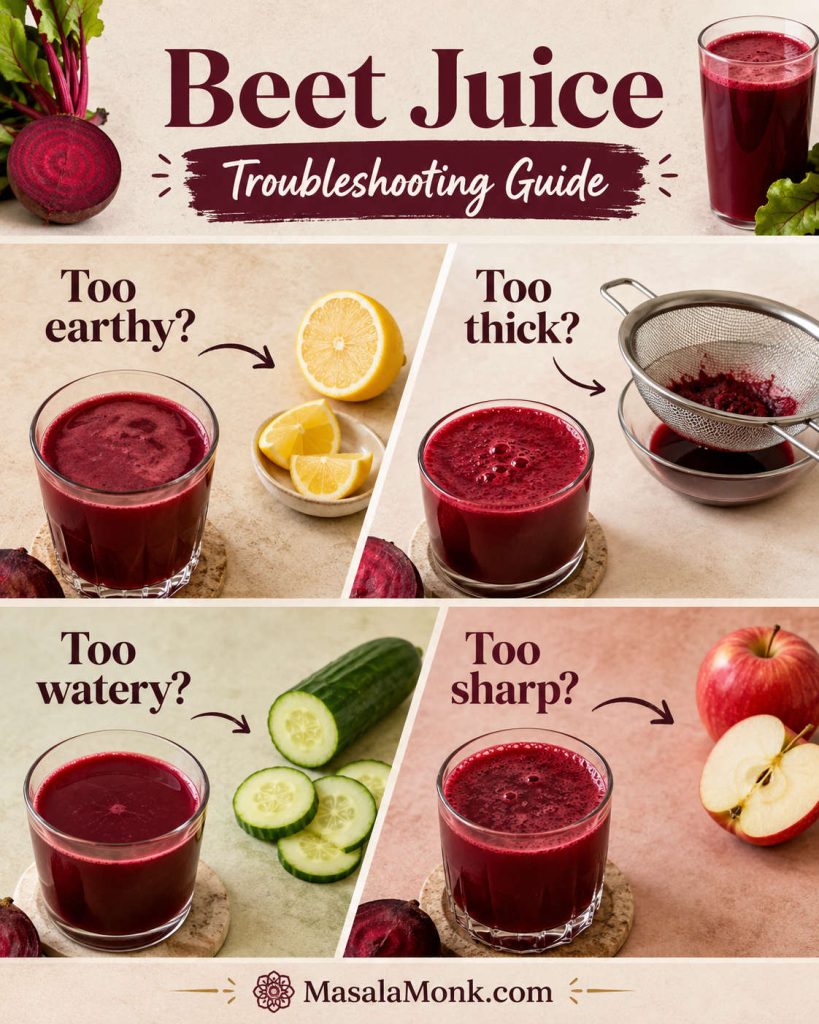
Beet Juice Troubleshooting

Beet juice is forgiving if you know what to adjust. If the batch did not taste the way you expected, do not throw it out yet. Most problems are fixable with lemon, cucumber, ice, apple, or another pass through the strainer.

Troubleshooting guide for beet juice with panels for too earthy, too thick, too watery, and too sharp, plus lemon, cucumber, apple, and strainer cues.
A failed batch is usually adjustable: sharpen a dull glass, lighten a heavy one, dilute harsh ginger, or strain again for smoother texture.
IssueWhy it happenedFix nowFix next time
Too earthyToo much beet or not enough acid/sweetnessAdd lemon, orange, apple, or cucumber juiceUse less beet and more carrot/apple
Too thickBlender juice was not strained enoughStrain again through cheesecloth or a nut milk bagChop smaller, blend smoother, and squeeze pulp well
Too wateryToo much water in the blenderAdd lemon, ginger, or a little more fresh juiceStart with ½ cup / 120 ml water only
Too sharpToo much ginger or lemonDilute with apple, carrot, cucumber, or iceStart with ½ inch ginger
Too sweetToo much apple, orange, pineapple, or pomegranateAdd lemon, cucumber, celery, or gingerUse the low-sugar variation
Separates in the glassFresh juice naturally separatesStir or shakeThis is normal

FAQs About Beet Juice

These are the small questions that usually come up after the first batch.

Juicer or blender: which is better for beet juice?

A juicer makes lighter, smoother juice without added water. A blender works well if you do not own a juicer, but the juice needs water and straining.

How much water do you add when making beet juice in a blender?

Start with ½ cup / 120 ml cold water. Add more only if the blender needs help, up to 1 cup / 240 ml total. Too much water makes the juice taste thin.

How do you make beet juice without a juicer?

Blend chopped beetroot, carrot, apple, lemon, ginger, and cold water until smooth. Then strain through a nut milk bag, cheesecloth, or fine mesh strainer and squeeze the pulp well.

Should you use raw or cooked beets for juice?

Raw beets are best for fresh juice. Cooked beets can be blended in a pinch, but they taste softer and less crisp. They are not ideal for juicing.

Do you need to peel beetroot before juicing?

Peeling is optional if the beetroot is fresh, tender-skinned, and scrubbed very well. Peel it if the skin is rough, dirty, waxed, or bitter.

How many beets make one glass of juice?

One medium-large beet, about 225–250 g / 8–9 oz, combined with carrot, apple, lemon, and ginger usually makes about two standard glasses of mixed beet juice. A medium beet on its own may give roughly ⅓–½ cup juice in many home juicers, though freshness, size, and machine efficiency can change that noticeably.

Why does beet juice taste earthy?

Beetroot naturally has an earthy, mineral-like flavor. Apple, carrot, lemon, ginger, cucumber, orange, and pineapple all help balance that flavor.

How do you make beet juice sweeter without sugar?

Add apple, carrot, orange, pineapple, or pomegranate. Apple and carrot are the easiest everyday choices because they sweeten the drink without overpowering the beetroot.

Is it okay to drink beet juice every day?

You can drink it regularly if it suits you, but you do not need to make it a daily habit to enjoy the recipe. Keep portions moderate, especially if you have kidney-stone risk, low blood pressure, digestive sensitivity, blood sugar concerns, or take blood pressure medication.

What is the best time to drink beet juice?

Morning is simple, afternoon works when you want something cool and caffeine-free, and pre-workout use is best tested with a small strained serving before you make it a routine.

Why does beet juice turn urine or stool red?

Beets can turn urine or stool pink or red. This is common after eating or drinking beetroot. If you are unsure whether the color is from beets, or if you have pain or unusual symptoms, seek medical advice.

What should you know about beet juice and blood pressure?

Beetroot contains dietary nitrates, so occasional juice is one thing; a daily habit is worth discussing with your healthcare professional if you take blood pressure medication or tend to run low.

How long does homemade beet juice keep?

Homemade beet juice tastes best immediately. Refrigerate it in a clean airtight bottle and drink within 24 hours for best flavor, or within 24–48 hours at most.

Can you use canned beets in beet juice?

You can blend canned beets with water, apple, lemon, and ginger in a pinch, but the flavor will be softer and less fresh than raw beetroot. Check the can for added salt, sugar, or vinegar.

How do you turn this recipe into a beet juice shot?

For a beet shot, use less apple and cucumber, keep the beet, lemon, and ginger more concentrated, and serve just 2–3 oz / 60–90 ml at a time. Beet shots are intense, so start small.

Tried it with apple, orange, cucumber, or ginger? Share which version finally made beet juice work for you — the best fixes often come from small adjustments.

Beet Juice Recipe

This is the balanced base version: beetroot for color, carrot and apple for sweetness, lemon for brightness, ginger for lift, and cucumber if you want a cooler, easier sip.

Make it in a juicer for crisp, smooth juice, or use a blender and strain it. Once you like the base, adjust lemon, apple, cucumber, or ginger to make the glass sharper, sweeter, lighter, or spicier.

The finished juice should pour easily, taste sweet-earthy and tart, and finish with gentle ginger warmth.

Saveable beet juice recipe card with a glass of beet juice, beetroot, carrot, apple, lemon, ginger, 10 minutes, 16–18 ounce yield, and juicer or blender method.
Save this beet juice recipe formula for the essentials: beetroot, carrot, apple, lemon, and ginger, made in either a juicer or a blender.
Prep Time10 minutes
Total Time10 minutes
Servings2 glasses
YieldAbout 16–18 oz / 475–530 ml

Estimated nutrition: One 8 oz / 240 ml serving is roughly 135–150 calories, with about 32–36 g carbohydrates depending on produce size and juicing method. Most sweetness comes naturally from the apple, carrot, and beetroot. Strained juice has much less fiber than whole produce or an unstrained smoothie.

Equipment: juicer or blender, fine mesh strainer or nut milk bag, knife, cutting board, and a clean bottle or jar if storing.

Ingredients

  • 1 medium-large raw beetroot or 2 small beets, about 225–250 g / 8–9 oz
  • 2 medium carrots, about 120–150 g / 4–5 oz
  • 1 large apple, about 170–200 g / 6–7 oz
  • ½ lemon, about 15–20 ml juice
  • ½–1 inch fresh ginger, about 5–10 g
  • ½ small cucumber, optional, about 75–100 g / 3–4 oz
  • ½–1 cup cold water, blender method only, 120–240 ml
  • Ice, to serve

Juicer Method

  1. Wash and scrub the beetroot, carrots, apple, cucumber, lemon, and ginger.
  2. Trim the beetroot and peel it if the skin is rough, waxed, or not fully clean.
  3. Cut the beetroot, carrots, apple, cucumber, and ginger to fit your juicer chute.
  4. Juice the beetroot, carrots, apple, cucumber, and ginger, alternating hard and soft produce as needed.
  5. Stir in the lemon juice.
  6. Pour over ice and drink immediately.

Blender Method

  1. Chop the beetroot, carrots, apple, cucumber, and ginger into small pieces.
  2. Add them to a blender with ½ cup / 120 ml cold water and the lemon juice.
  3. Blend on high for 45–60 seconds, until smooth. Add more water only if needed, up to 1 cup / 240 ml total.
  4. Pour the mixture through a nut milk bag, cheesecloth-lined strainer, or fine mesh strainer.
  5. Let it drain for 2–5 minutes, then press or squeeze the pulp to extract the juice.
  6. Optional: add 2–3 tablespoons / 30–45 ml cold water to the squeezed pulp, stir or briefly blend, then strain once more for a little extra yield.
  7. Serve over ice.

Notes

  • For a milder glass, use half a beet and increase the apple or carrot.
  • Use green apple for a sharper juice or red apple for a sweeter one.
  • For a lighter flavor, add cucumber.
  • For a sharper flavor, use the full inch of ginger and extra lemon.
  • If using a blender, strain the mixture for true beet juice. Unstrained beet juice will be thicker and smoothie-like.
  • Drink immediately for best flavor, or refrigerate in a clean airtight glass bottle for 24–48 hours.
  • For regular use or medical concerns, read the safety section above.

Once the recipe is made, serve the juice cold, taste before adjusting, and keep the glass balanced enough that it feels like a drink you chose — not a health chore.

Hand placing a glass of homemade beet juice on a kitchen counter with a bottle of juice, beetroot, apple slices, ginger, and herbs nearby.
A good homemade beet juice should taste balanced enough to sip slowly, not like something you have to force down for health reasons.

Back to top

Posted on Leave a comment

Beets & Blood Pressure: Fresh, Canned, Pickled, & Juice

South Asian woman holding beet juice beside a blood pressure cuff and fresh beets—beets and blood pressure cover image

When people talk about food that genuinely nudges numbers in the right direction, beets often top the list. That’s because beets are rich in dietary nitrate, which your body can convert into nitric oxide, a signaling molecule that helps blood vessels relax. As a result, blood pressure inside the arteries can ease a little. Notably, controlled trials and systematic reviews suggest the effect is most consistent when nitrate intake is adequate—especially from beetroot juice in realistic daily amounts. For a clear, recent synthesis, see this Frontiers in Nutrition meta-analysis on beetroot juice and hypertension, which reports modest yet meaningful drops in systolic readings with standardized nitrate doses (open-access article; PubMed record here).

Of course, food isn’t a substitute for medical care. Rather, it’s a helpful lever alongside medication (if prescribed), movement, sleep, and—critically—sodium management. For pragmatic daily targets that actually move the needle, the American Heart Association recommends no more than 2,300 mg sodium/day, with an ideal limit of 1,500 mg/day for most adults—especially those already managing hypertension (AHA overview here and quick fact sheet here).


How beets and blood pressure connect (in plain English)

Let’s keep the mechanism simple yet accurate. The nitrate in beets (NO₃⁻) isn’t magic by itself. First, beneficial oral bacteria reduce nitrate to nitrite (NO₂⁻). Next, in the acidic stomach and throughout the body, nitrite converts to nitric oxide (NO). That nitric oxide tells smooth muscle in your vessel walls to dilate, which reduces resistance and eases the pressure your heart pumps against. The pathway is sometimes called the enterosalivary nitrate–nitrite–NO cycle; if you want a broad scientific overview, a recent review of dietary nitrates and NO biology is a good primer (example review).

There’s a crucial practical wrinkle: strong antiseptic mouthwash can disrupt those nitrate-reducing bacteria. In both observational and intervention work, antibacterial rinses (for example, chlorhexidine) have been shown to blunt the rise of nitrite after nitrate intake and even increase blood pressure in treated hypertensives. Therefore, if you’re using beets for cardiovascular reasons, it’s reasonable to avoid antiseptic rinses around beet-rich meals. For details, see this accessible paper on mouthwash and the nitrate pathway (open-access review) and an earlier trial in hypertensive adults (American Journal of Hypertension study).


Beets and blood pressure in everyday life: which form actually helps?

Plenty of people love beets raw, roasted, canned, or pickled; others prefer a quick glass of juice. Each route can contribute nitrate, yet each also comes with trade-offs—mostly about dose, sodium, and consistency. Below, we’ll keep the keyphrase front-and-center while staying practical.

Beetroot juice: the strongest research signal

If you’re looking for the most consistently studied option, beetroot juice leads by a comfortable margin. In the meta-analysis above, interventions typically delivered ~200–800 mg nitrate/day, commonly via ~250–500 ml of standardized beet juice depending on the product. Across trials, the reduction in systolic blood pressure is small to moderate but clinically relevant—particularly for people already living with hypertension. In practice, many readers find that ~250 ml (8 oz) each morning works as a sustainable starting point; others time a serving 2–3 hours before activity, when the nitric-oxide effect window tends to peak.

Because nitrate content in commercial juices can vary, standardized products (those that disclose nitrate in mg per serving) are preferable. If a label doesn’t list nitrate, a modest daily serving is still reasonable, but consider tracking your readings for a couple of weeks to see whether the habit makes a tangible difference. For background on how variable nitrate can be across beet products, this analysis of juices and concentrates is useful reading (open-access nutrient profile).

For readers who want recipe-level inspiration and everyday uses beyond a glass, we’ve compiled practical ideas in Power of Beetroot and Beet Juice—a friendly internal explainer that pairs science with kitchen moves.


Canned beets: convenient, affordable—watch the salt

Do canned beets still fit into a beets and blood pressure routine? Absolutely—nitrate is relatively heat-stable, and while boiling or canning can leach some nitrate into surrounding liquid, the beets themselves remain useful. The bigger swing factor is sodium, since many canned vegetables include added salt. That doesn’t disqualify canned beets; it simply means you’ll want to choose “no salt added” labels when possible and rinse and drain before tossing into salads or bowls.

Because sodium is the one variable that can quietly undermine the benefits of beets, it’s wise to keep the AHA day-total in mind as you plan meals (AHA sodium advice overview; “Answers by Heart” one-pager pdf). If your day includes bread, cheese, sauces, or deli meats, the room left for a salty canned veg shrinks fast—so the no-salt-added can truly shines.

By the way, if you’d like potassium-forward context that complements a beets and blood pressure pattern, see our internal primer Pineapple Juice for High Blood Pressure: 5 Important Insights—a handy refresher on balancing sodium with potassium in everyday menus.


Pickled beets: flavorful and fun—portion with purpose

What about pickled beets? They still provide nitrate, and they bring big flavor to a plate. Nevertheless, brines often add considerable sodium, and that’s where moderation becomes vital. Typical composition tables and brand labels hover around ~150 mg sodium per 100 g, though recipes vary widely. If pickled beets make you happy, keep them as a garnish—think a few slices folded through a salad—rather than the main attraction. If you’re the DIY type, making a reduced-sodium pickle at home is straightforward, letting you control the brine. For neutral numbers to quote when readers ask “how salty is salty?”, we love to point them to snapshot entries like pickled beets per 100 g (example breakdown).

If you love the pickled profile but want lower sodium, another route is to pair no-salt-added canned beets with a bright quick-pickle dressing—lemon juice, a splash of vinegar, dill, and crushed garlic—so you get the acidity and aroma without relying on a salty brine.


Making beets and blood pressure work together (without overthinking it)

Shifting from theory to practice, let’s connect the dots. The goal isn’t chasing a single “superfood,” but building a steady pattern that compounds. With that in mind:

First, prioritize consistency. Smaller but daily beet servings typically outperform occasional mega-doses. Studies that observed benefits often ran for 4–12 weeks with regular intake; leaning into routine is what turns a nudge into a trend. If you’ve ever taken your blood pressure over a few weeks, you know how helpful patterns are compared with one-off readings.

Second, time it thoughtfully. Because the nitrate-to-nitric-oxide effect often peaks 2–3 hours after a serving, some people drink juice in the morning or before a walk. Others spread intake with lunch or a mid-afternoon snack. There’s no universal “best” time, but it helps to be deliberate.

Third, mind the mouthwash. As mentioned earlier, antibacterial rinses can blunt nitrate conversion and even push BP up in treated hypertensives. If oral care is non-negotiable (of course it is), consider separating antiseptic rinses from nitrate-rich meals and relying on mechanical cleaning most of the time. The evidence is surprisingly strong for such a simple detail (read the open-access review on the nitrate pathway and mouthwash here and the hypertensive trial summary here).

Fourth, keep sodium honest—relentlessly. Because salt can silently flatten the vascular benefits you’re working for, keep an eye on day totals. The AHA suggests ≤2,300 mg as a ceiling and 1,500 mg as a smart target (guidance here as well as the quick reference pdf). Choosing no-salt-added canned beets, rinsing any salty liquids, and using herbs, citrus, and vinegar to season are painless ways to stack the deck.

For broader, pantry-level inspiration that plays nicely with beets and blood pressure, explore two handy internal reads: Flax Seed and Blood Pressure (an evidence-backed companion to beet-based meals) and our longer list of anti-inflammatory drinks, which includes beet ideas you can rotate without boredom.


How much is “enough”? Practical dose pointers (without the jargon)

Let’s translate study ranges into kitchen-level choices. Since many trials delivered ~200–800 mg of nitrate/day, and common research products cluster around ~250–400 mg nitrate per serving, a daily 250 ml (8 oz) glass of beetroot juice is a realistic starting point. If your product lists nitrate in mg, fantastic—use that to aim for a total in the middle of the range. If it doesn’t, let your body be the guide: stick with a consistent serving for two weeks, take morning readings, and then decide whether to maintain, adjust, or scale back. That self-audit is more valuable than any single claim.

Prefer whole foods? Great—roasted beets, steamed beets, and no-salt-added canned beets still contribute, though nitrate content naturally varies by soil, season, and processing. Therefore, it’s wise to treat whole-beet dishes as supportive—delicious, colorful, fiber-rich—and let juice be the precise dial when you need a measurable bump. If you want to geek out about how different products vary, this open-access nutrient profile of beetroot juices and concentrates is enlightening (research snapshot).

Finally, don’t forget the rest of the plate. Leafy greens like arugula and spinach carry their own nitrate load, while legumes, nuts, seeds, and whole grains bring minerals that support vascular tone. Tie the elements together and the effect can feel larger than the sum of parts.


Who should be cautious with beets and blood pressure?

Although beets are foods—not drugs—there are sensible caveats:

  • If your baseline BP runs low, substantial nitrate intake plus medication could overshoot. Discuss any big changes with your clinician.
  • If you take antihypertensives, loop your care team in when adding daily beetroot juice; together you can watch for over-correction.
  • If you’re prone to kidney stones, note that beets are high in oxalate. That doesn’t mean you must avoid them completely, but moderation and hydration matter. For nuances, our internal explainer Beetroot and Kidney Health walks through benefits and caveats.
  • If you’re pregnant or dealing with complex kidney issues, personalized advice beats general tips every time.

Simple, low-sodium ways to use beets (that keep the benefits intact)

Because repetition kills motivation, here are varied ways to keep beets and blood pressure support rolling without palate fatigue:

  • Morning mini-shot: 150–250 ml beetroot juice most days. If you exercise, try it 2–3 hours before a brisk walk or gym session.
  • Roasted beet & yogurt raita: roast wedges until tender; fold into thick yogurt with grated garlic, cumin, mint, and lemon. Season lightly and let citrus do the heavy lifting.
  • No-salt-added canned beets, bright salad: rinse and drain; toss with orange segments, sliced red onion, dill, olive oil, and lemon juice. Finish with toasted walnuts for crunch and a little omega-3.
  • Pickled beet accent: add a few thin slices to a grain bowl with chickpeas, cucumber, parsley, and tahini-lemon dressing. Keep the portion small; let the dressing’s acidity carry the flavor.
  • Beet-citrus smoothie: small roasted beet, orange, ginger, and water; optional spoon of ground flaxseed for a heart-healthy lift (and a nod to flax seed & blood pressure).
  • Lunchbox hack: layer roasted beets with arugula, a few slivers of onion, and a smear of soft cheese; drizzle with balsamic and olive oil. Sprinkle crushed pistachios for texture and potassium.

For readers who want even more kitchen ideas, our internal collection Power of Beetroot and Beet Juice offers approachable variations; for day-to-day hydration and recovery, you’ll find additional options inside 8 Anti-Inflammatory Drinks as well.


Bringing it together

When you put the pieces in sequence, the picture is straightforward. Beetroot juice—at realistic daily doses—has the strongest evidence for easing systolic readings. Canned beets remain helpful if you choose no-salt-added and rinse well. Pickled beets can fit beautifully as a garnish so long as you’re watching sodium. Meanwhile, a handful of small practices—consistency, timing, and skipping antiseptic mouthwash near beet-rich meals—make the beets and blood pressure strategy more reliable in the real world.

If you’d like to wander deeper into the science, start with the Frontiers in Nutrition meta-analysis on beetroot juice and BP (full text), browse the AHA’s plain-language sodium pages (overview; how to cut back), and, for a practical twist, read about mouthwash and the nitrate pathway in this open-access review (backgrounder). When you’re curious about nutrient specifics, USDA FoodData Central is a reliable place to check numbers (Nutrients in per 100 gms of Raw Beets).

Finally—because everyone love clear next steps— track three weeks of morning readings while keeping a simple log of when (and how much) you take beet juice, whether you used no-salt-added canned or pickled servings, and how your day’s sodium looked. Small, steady changes are the ones that stick—especially when they taste this good.

FAQs

1) Do canned beets lower blood pressure?

Generally yes. Canned beets still contain nitrates that support nitric oxide, which may help reduce systolic readings. For best results with beets and blood pressure, choose no-salt-added cans and rinse/drain to keep sodium in check.

2) Are canned beets good for high blood pressure?

Often, provided the label is low in sodium. Because salt can blunt benefits, prioritize “no salt added,” then pair canned beets with potassium-rich foods for a smarter plate.

3) Will pickled beets lower blood pressure?

Sometimes, although brine can add notable sodium. Therefore, enjoy pickled beets as a garnish or in small portions, or look for reduced-sodium versions.

4) Are pickled beets high in sodium?

Usually moderate to high, depending on the recipe. Consequently, portion control matters if you’re using pickled beets to support beets and blood pressure goals.

5) What amount of beetroot juice actually helps?

Most trials use beetroot juice delivering roughly 200–800 mg nitrate per day. Practically, many people start with ~250 ml (8 oz) daily and reassess after two weeks.

6) How fast does beetroot juice work?

Often within 2–3 hours, with effects lasting several hours. Nevertheless, consistent daily intake over weeks is what tends to move average readings.

7) Do cooked or roasted beets still work?

Yes. Heat doesn’t destroy nitrate; however, boiling can leach some into water. Hence, roasting or steaming is a sensible everyday approach.

8) Are beets and blood pressure improvements the same for everyone?

Not exactly. Baseline diet, sodium intake, oral microbiome, medications, and genetics all influence response. So, track your own readings rather than relying on anecdotes.

9) Can mouthwash reduce the benefits?

Frequent antiseptic mouthwash can disrupt nitrate-reducing oral bacteria. Accordingly, avoid strong antibacterial rinses close to beet-rich meals.

10) What’s better: fresh, canned, pickled, or juice?

For evidence, standardized beetroot juice leads. Even so, fresh/roasted and no-salt-added canned beets support the pattern; pickled works best as an accent due to sodium.

11) Do beet powders, crystals, or “SuperBeets” help?

Potentially—if the product discloses actual nitrate (mg) per serving. Otherwise, potency varies widely. Start low, check your readings, and adjust.

12) What’s the “best beet juice” for blood pressure?

The best one clearly states nitrate content and keeps sodium low. Additionally, consistent sourcing and taste you’ll stick with matter more than a flashy label.

13) Can beets raise blood pressure?

Unlikely by themselves. However, salty pickled versions or high-sodium meals alongside beets can push numbers up, offsetting nitrate’s effect.

14) Are beets good for people with diabetes?

Beets can fit a balanced plan. They contain carbs but also fiber and micronutrients. Still, watch juice portions, monitor glucose, and prioritize whole-food forms.

15) Are pickled beets good for diabetics?

They can be, though sodium and added sugars in some recipes require caution. Therefore, check labels and stick to modest servings.

16) Are there risks with beets and blood pressure?

A few. Individuals with low baseline BP, those on antihypertensives, or people prone to kidney stones (beets are high in oxalate) should moderate and consult their clinician.

17) Do beets help diastolic blood pressure too?

Effects are most consistent for systolic reductions; diastolic changes are smaller and less consistent. Even so, overall vascular function may still improve.

18) Can I drink beet juice every day?

Yes, if it suits your health status. To be prudent, begin with 150–250 ml daily, observe your home BP trend for two weeks, then fine-tune.

19) What time of day should I drink it?

Morning works for many, yet timing 2–3 hours before activity can also be strategic. Ultimately, the best time is the one you’ll repeat.

20) Do I need to cycle off beet juice?

Not necessarily. Nevertheless, periodic check-ins on BP, overall diet, and kidney health are wise, especially if you use concentrated products.

21) Will “red beets” differ from “beetroot” for BP?

They’re the same plant (different naming). Variation in nitrate comes more from soil, season, and processing than from the name on the tag.

22) Can kids or pregnant people use beet juice for BP?

This guide targets adults with elevated BP. Pregnancy and childhood require individualized advice; always consult a healthcare professional first.

23) Is low-sodium the only thing that matters with pickled beets?

It’s the major lever, yet not the only one. Portion size, overall daily sodium, and the rest of your meal (potassium, fiber, fats) influence outcomes as well.

24) What if I don’t like beet flavor?

Blend in citrus, ginger, or berries; or choose roasted beets in salads and raitas. Crucially, sustainability beats perfection for long-term beets and blood pressure support.

25) How should I measure progress?

Use a home monitor, take two morning readings (seated, five minutes quiet), log them for 14 days, and evaluate your average—not a single spike or dip.

Posted on 5 Comments

Power of Beetroot and Beet Juice

Beetroot, known for its vibrant hue and earthy flavor, has been a staple in various cultures for its medicinal properties. With the rise in health-conscious diets, beetroot and its juice have gained immense popularity. This guide dives deep into the myriad health benefits of beetroot, providing answers to common queries and concerns.

Beetroot: A Nutritional Powerhouse

Beetroot is a treasure trove of essential vitamins and minerals. Rich in folate, potassium, vitamin C, and iron, it also boasts beneficial compounds like nitrates and antioxidants.

Key Health Benefits of Beetroot and Beet Juice

1. Cardiovascular Health:

  • Blood Pressure Regulation: Beetroot’s high nitrate content can help lower blood pressure. These nitrates transform into nitric oxide in the body, dilating blood vessels and improving circulation.
  • Cholesterol Management: Beetroot contains soluble fiber, which can help reduce bad cholesterol levels, promoting heart health.

2. Liver Health:

  • Detoxification: Betalains in beetroot support liver detoxification.
  • Protection Against Fatty Liver: Antioxidants in beetroot can help reduce fatty deposits in the liver.

3. Blood Sugar and Diabetes:

  • Beetroot has a moderate glycemic index, ensuring a slow release of sugar into the bloodstream. This property can be beneficial for diabetics when consumed in moderation.
  • Carrot and Beetroot Juice: Combining beetroot with carrot juice can offer a nutrient-rich drink that’s beneficial for blood sugar regulation.

4. Kidney Health:

  • Protection Against Kidney Stones: The antioxidants and anti-inflammatory properties of beetroot can help reduce the risk of kidney stones.
  • Supporting Kidney Function: Regular consumption of beetroot can support overall kidney health.

Read more about Beetroot and Kidney Health.

5. Weight Management:

  • Beetroot is low in calories and high in fiber, promoting satiety and aiding in weight loss.

6. Blood Health:

  • Anemia and Iron Deficiency: Beetroot is a good source of iron and can help in the management of anemia.
  • Blood Circulation: The natural nitrates in beetroot support enhanced blood flow, ensuring that vital organs receive adequate oxygen.

7. Pregnancy:

  • Beetroot Juice During Pregnancy: Rich in folic acid, beetroot juice can support fetal development and reduce the risk of neural tube defects.

8. Bone and Joint Health:

  • Arthritis: The anti-inflammatory properties of beetroot can help reduce symptoms of arthritis.

Beetroot and Glycemic Impact

Beetroot is a nutrient-rich vegetable that’s often considered for its impact on blood sugar levels, an important consideration for individuals with conditions like diabetes. Understanding the glycemic index (GI) and glycemic load (GL) of beetroot and its juice is essential in dietary planning.

Glycemic Index of Beetroot

Beetroot has a moderate GI, typically around the mid-60s. This means it has a medium-level impact on blood sugar compared to high-GI foods. However, its overall effect on blood sugar levels is moderated by its fiber content, which slows sugar absorption.

Glycemic Load for a Balanced Perspective

The GL of beetroot is low due to its high fiber content and the nature of its carbohydrates, most of which are indigestible dietary fiber. This low GL indicates that in typical serving sizes, beetroot doesn’t significantly impact blood sugar levels.

Beetroot Juice and Blood Sugar

Beetroot juice typically has a higher GI compared to whole beetroot because the juicing process removes fiber, which helps to slow down sugar absorption. This can lead to a quicker spike in blood sugar levels. However, the actual GI can vary depending on how the juice is prepared and consumed.

Beetroot in Diabetic Diets

Incorporating beetroot into a diabetic diet requires balancing its moderate GI against its low GL and high nutrient content. While beetroot can fit into a well-managed diet, portion control and mindful preparation are key to avoiding significant impacts on blood sugar levels.

Incorporating Beetroot into Your Diet

From raw salads to refreshing juices, beetroot can be consumed in various ways:

  • Beet-Ginger-Turmeric Juice: A potent blend that combines the benefits of beetroot with the anti-inflammatory properties of ginger and turmeric.
  • ABC Juice: A mix of apple, beetroot, and carrot, this juice is known for its liver-cleansing properties.

You can also consider this delightful fusion of beetroot’s earthy taste with the tang of pickling, Himalayan Beetroot Pickle by Masala Monk is a gourmet treat. Made with the finest beetroots from the Himalayan region, this pickle is a blend of health and taste.

Conclusion

Beetroot and beet juice offer a plethora of health benefits. From cardiovascular health to aiding in detoxification, beetroot is a versatile and potent vegetable that can be a valuable addition to any diet.


FAQs

  1. Is beetroot juice beneficial for high blood pressure? Yes, the nitrates in beetroot juice can help lower blood pressure by improving blood vessel dilation.
  2. How does beetroot support liver health? Beetroot contains compounds like betalains that aid in liver detoxification. Additionally, its antioxidant properties can help protect the liver from oxidative stress.
  3. Can beetroot juice help with weight loss? While beetroot juice alone won’t lead to weight loss, its low-calorie and high-fiber content can promote feelings of fullness, aiding in weight management when combined with a balanced diet.
  4. Is beetroot safe for diabetic patients? Beetroot has a moderate glycemic index, which means it releases sugar slowly into the bloodstream. However, it’s essential for diabetic individuals to consume it in moderation and monitor blood sugar levels.
  5. Are there any side effects to excessive beetroot consumption? Excessive beetroot or beet juice intake can lead to beeturia, where urine and stool might turn pink or red. It’s also essential to be aware of its impact on blood sugar levels, especially for diabetics.

Blog Tags: Beetroot, Beet Juice, Cardiovascular Health, Liver Health, Blood Sugar, Kidney Health, Weight Loss, Blood Health, Pregnancy, Bone Health, Dietary Tips.

Posted on 2 Comments

Beetroot and Kidney Health

Beetroot, with its rich crimson hue, is not just a feast for the eyes but also a powerhouse of nutrients. Its benefits span from heart health to athletic performance. But when it comes to the kidneys, the relationship between beetroot and kidney health is multifaceted. This guide delves deep into the world of beetroot, addressing its impact on kidney health, potential concerns, and the various products available in the market.

Beetroot: A Nutritional Marvel

Beetroot is a root vegetable that’s brimming with essential nutrients. It’s packed with vitamins like folate, potassium, and vitamin C. Moreover, its antioxidant properties, primarily from betalains, make it a sought-after vegetable for health enthusiasts.

Read more about the Power of Beetroot and Beet Juice.

Beetroot and Its Influence on Kidney Health

1. Potential Benefits:

  • Blood Pressure Management: Beetroot is rich in nitrates, which can help in dilating blood vessels, leading to better blood flow and reduced blood pressure. Since high blood pressure can be detrimental to kidney health, beetroot’s role in its regulation is crucial.
  • Antioxidant Boost: The betalains in beetroot have potent antioxidant properties, which can combat oxidative stress, a factor that can harm kidneys.

2. Points of Caution:

  • Oxalate Content: Beetroot contains oxalates, which, in excess, can contribute to the formation of kidney stones. Those with a predisposition to oxalate kidney stones should be mindful of their beetroot consumption.
  • Chronic Kidney Disease (CKD): People with CKD should approach beetroot with caution. It’s essential to consult with a healthcare professional before making beetroot a regular part of the diet.

Beetroot Products and Their Impact on Kidney Health

1. Beetroot Juice:

  • Pros: A concentrated source of beetroot’s benefits, beetroot juice can be a quick and easy way to incorporate this vegetable into one’s diet.
  • Cons: Like the whole vegetable, its juice is also high in oxalates. Those prone to kidney stones should consume it in moderation.

2. SuperBeets:

  • What is it?: SuperBeets is a beetroot powder supplement that offers a concentrated form of beetroot’s benefits.
  • Kidney Considerations: As with natural beetroot, those with kidney concerns should consult a healthcare provider before using SuperBeets or similar supplements.

3. Himalayan Beetroot Pickle by Masala Monk:

  • What is it?: A delightful fusion of beetroot’s earthy taste with the tang of pickling, Himalayan Beetroot Pickle by Masala Monk is a gourmet treat. Made with the finest beetroots from the Himalayan region, this pickle is a blend of health and taste.
  • Kidney Considerations: While the pickle offers a unique way to enjoy beetroot, it’s essential to consider its salt content, especially for those with kidney issues. Always consume in moderation and as part of a balanced diet.

Conclusion

Beetroot’s myriad health benefits make it a valuable addition to our diets. However, when it comes to kidney health, a balanced approach is crucial. Whether you’re sipping on beetroot juice, taking supplements, or relishing the Himalayan Beetroot Pickle, always keep your health considerations in mind and enjoy the goodness of beetroot responsibly.


Frequently Asked Questions (FAQs)

  1. How does beetroot impact kidney health? Beetroot offers several benefits for kidney health, primarily due to its ability to help regulate blood pressure. However, its high oxalate content can be a concern for those prone to kidney stones. It’s essential to balance its consumption, especially if you have kidney-related issues.
  2. Is beetroot juice safe for those with chronic kidney disease (CKD)? Beetroot juice provides a concentrated dose of the vegetable’s nutrients. While it can offer benefits like blood pressure regulation, its high oxalate content can be a concern for CKD patients. It’s always best to consult with a healthcare provider before making it a regular part of your diet.
  3. I’ve heard about SuperBeets. Is it safe for kidney health? SuperBeets is a beetroot powder supplement that offers a concentrated form of beetroot’s benefits. Like natural beetroot, those with kidney concerns should approach SuperBeets with caution and consult a healthcare provider before use.
  4. What’s special about the Himalayan Beetroot Pickle by Masala Monk? The Himalayan Beetroot Pickle by Masala Monk is a gourmet treat made from the finest beetroots from the Himalayan region. It offers a unique blend of health and taste. However, due to its salt content, those with kidney issues should consume it in moderation.
  5. Can beetroot help with high creatinine levels? While beetroot has numerous health benefits, there’s limited evidence to suggest it can directly reduce creatinine levels. However, its potential benefits for blood pressure might indirectly support kidney health.
  6. Are beets and beetroot the same when it comes to kidney health? Yes, beets and beetroot refer to the same vegetable. Whether consumed as a whole vegetable, juice, or in supplement form, the considerations for kidney health remain the same.
  7. I have a history of kidney stones. Should I avoid beetroot? Beetroot is high in oxalates, which can contribute to the formation of oxalate kidney stones. If you have a history of this type of stone, it’s advisable to consume beetroot in moderation and consult with a healthcare provider.
  8. How does beetroot influence blood pressure, and how is it related to kidney health? Beetroot’s high nitrate content can help dilate blood vessels, promoting better blood flow and potentially lowering blood pressure. Since high blood pressure is a risk factor for kidney disease, beetroot’s role in its regulation is beneficial for kidney health.
  9. Is the salt content in the Himalayan Beetroot Pickle a concern for kidney health? Yes, salt content can be a concern, especially for those with kidney issues or high blood pressure. It’s essential to consume the pickle in moderation and be mindful of overall salt intake.
  10. Are there any side effects of consuming too much beetroot? Overconsumption of beetroot can lead to beeturia, where urine and stool might turn pink or red. Additionally, due to its high oxalate content, it can contribute to the formation of kidney stones in susceptible individuals. Always consume beetroot in balanced amounts.

Blog Tags: Beetroot, Kidney Health, Blood Pressure, Oxalates, Beetroot Juice, SuperBeets, Himalayan Beetroot Pickle, Masala Monk, Kidney Stones, Antioxidants.