Introduction: Why Vitamin B12 Matters
Have you ever felt unusually tired, low in energy, or struggled with brain fog even after getting a full night’s sleep? Many people immediately think of stress, busy schedules, or poor sleep habits as the culprit. But sometimes, the real issue is hidden deep within your diet — a lack of Vitamin B12 and foods rich in the same.
Vitamin B12, also known as cobalamin, is one of those nutrients that doesn’t always get the spotlight, but it quietly powers some of the most important functions in your body. From supporting your nervous system to fueling your red blood cells, it’s like the behind-the-scenes engine that keeps everything running smoothly (NIH Vitamin B12 fact sheet).
The problem? Your body cannot make Vitamin B12 on its own. That means every ounce of this essential vitamin has to come from the foods you eat or supplements you take. And here’s another twist: if you’re vegetarian, vegan, or even over the age of 50, your risk of being low in Vitamin B12 is much higher. To see the bigger picture, here’s a guide to understanding micronutrients and vitamins in your diet.
That’s why this guide is here: to help you confidently understand where to find foods high in Vitamin B12, how to add them into your daily routine, and when to consider supplements. We’ll look at rich animal-based sources, vegetarian and vegan options, the reality of B12 in fruits and vegetables, and how this vitamin works in harmony with other nutrients like folate and iron. And since practicality matters, you’ll also get a Vitamin B12 foods chart to quickly reference whenever you’re planning meals.
So let’s dive in — starting with what makes this nutrient so special in the first place.
What is Vitamin B12 and Why Is It Essential?
Vitamin B12, or cobalamin, belongs to the family of B vitamins, which are often described as “energy vitamins.” While each B vitamin has its own role, B12 is unique because it contains a trace element called cobalt — that’s actually where the “cobalamin” name comes from.
But what makes Vitamin B12 truly remarkable is the sheer range of critical tasks it performs in your body:
- Energy production → Without B12, your body struggles to convert food into usable energy. That’s why fatigue is one of the earliest signs of deficiency.
- Red blood cell formation → B12 works with folate to make healthy red blood cells. Low B12 leads to fewer but larger blood cells, a condition known as megaloblastic anemia.
- Nervous system health → B12 helps form the protective covering around your nerves called myelin. Without it, nerve signals slow down, leading to tingling, numbness, or even memory problems.
- DNA synthesis → Every cell in your body relies on DNA. B12 plays a role in building and repairing this genetic material.
Here you might want to read Fueling Your Energy with Vitamin B12: Boost Your Vitality Naturally

And here’s the kicker: Vitamin B12 is water-soluble, which means it doesn’t get stored in your body the same way fat-soluble vitamins (like A, D, E, and K) do. Instead, it’s stored mainly in your liver, but you need a regular supply from food to keep levels steady.
Signs You Might Be Low in Vitamin B12
Before we move into the foods, it helps to understand what deficiency looks like. Some of the most common symptoms include:
- Constant tiredness and weakness
- Pale skin or feeling lightheaded
- Tingling or numbness in hands and feet
- Mood swings, irritability, or depression
- Difficulty concentrating or memory lapses
- Loss of appetite or unexplained weight loss
These symptoms can creep in gradually, making them easy to dismiss at first. But left unchecked, B12 deficiency can lead to serious neurological issues and chronic anemia. Do read more on Symptoms of Vitamin B12 Deficiency.
This is why regularly eating Vitamin B12 rich foods — or taking the right supplements — is one of the best gifts you can give your body.
Foods High in Vitamin B12: Best Animal-Based Sources
Now that you know why Vitamin B12 is so vital, the next question is simple: where do you actually get it? The richest and most natural sources of Vitamin B12 come from animal-based foods.
Unlike some nutrients that can be found in a wide range of fruits, vegetables, and grains, Vitamin B12 is almost exclusively stored in animal tissues. That means seafood, meat, poultry, dairy, and eggs are where you’ll find the most concentrated amounts.
Let’s walk through these categories one by one, so you can see exactly which foods deliver the biggest B12 boost.
Seafood Rich in Vitamin B12: Fish and Shellfish Sources
When it comes to Vitamin B12, seafood wears the crown. In fact, some shellfish contain more than 3,000% of your daily requirement in just a single serving. Seafood like clams, sardines, and trout are among the top foods high in Vitamin B12 (Healthline; Harvard Health).
| Seafood | Serving Size | Vitamin B12 (mcg) | % Daily Value* |
|---|---|---|---|
| Clams | 3 oz (cooked) | 84 mcg | 3,500% |
| Sardines | 3 oz (canned) | 8.2 mcg | 340% |
| Trout | 3 oz (cooked) | 5.4 mcg | 225% |
| Salmon | 3 oz (cooked) | 4.8 mcg | 200% |
| Tuna | 3 oz (cooked) | 2.5 mcg | 104% |
*Based on 2.4 mcg daily recommended intake.
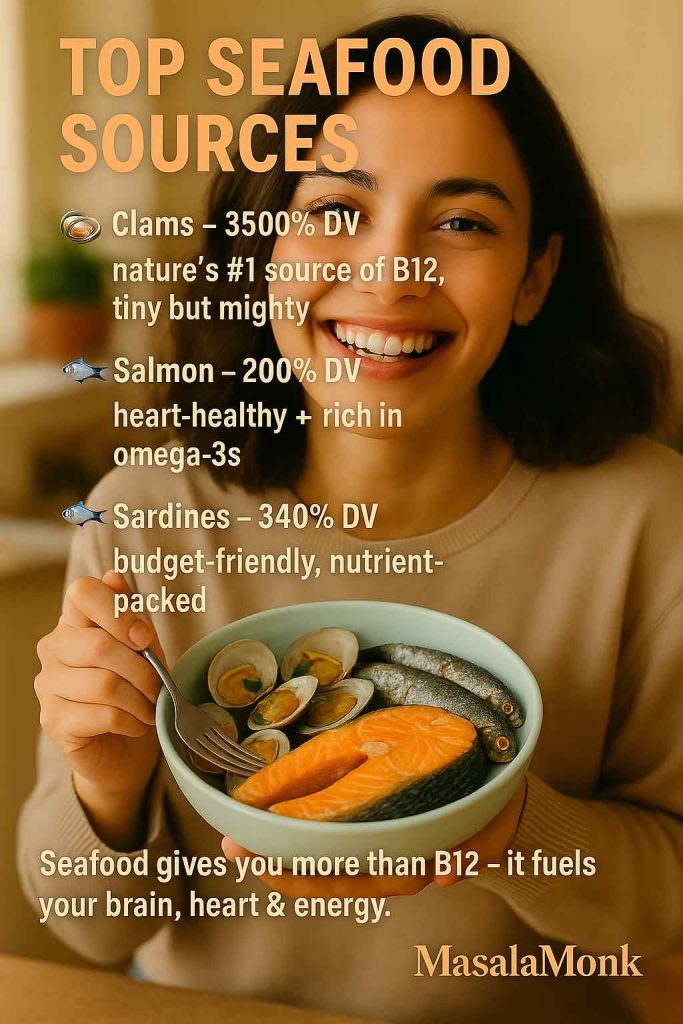
What’s beautiful about seafood is that it’s not just about B12. Alongside this powerful vitamin, you also get high-quality protein, omega-3 fatty acids, and vitamin D — a nutrient trio that supports your brain, heart, and immune system.
👉 Imagine this: enjoying a simple dinner of grilled salmon with roasted vegetables doesn’t just taste good — it gives you almost double your daily Vitamin B12 needs without even trying.
Meat and Poultry: Reliable Vitamin B12 Rich Food Sources
If seafood isn’t your favorite, meat and poultry are still strong players in the Vitamin B12 game. Organ meats, in particular, are like nature’s multivitamins.
| Meat & Poultry | Serving Size | Vitamin B12 (mcg) | % Daily Value |
|---|---|---|---|
| Beef Liver | 100 g | 83 mcg | 3,450% |
| Beef (lean cuts) | 3 oz (cooked) | 1.3 mcg | 54% |
| Chicken | 3 oz (cooked) | 0.3 mcg | 13% |
| Turkey | 3 oz (cooked) | 0.5 mcg | 21% |
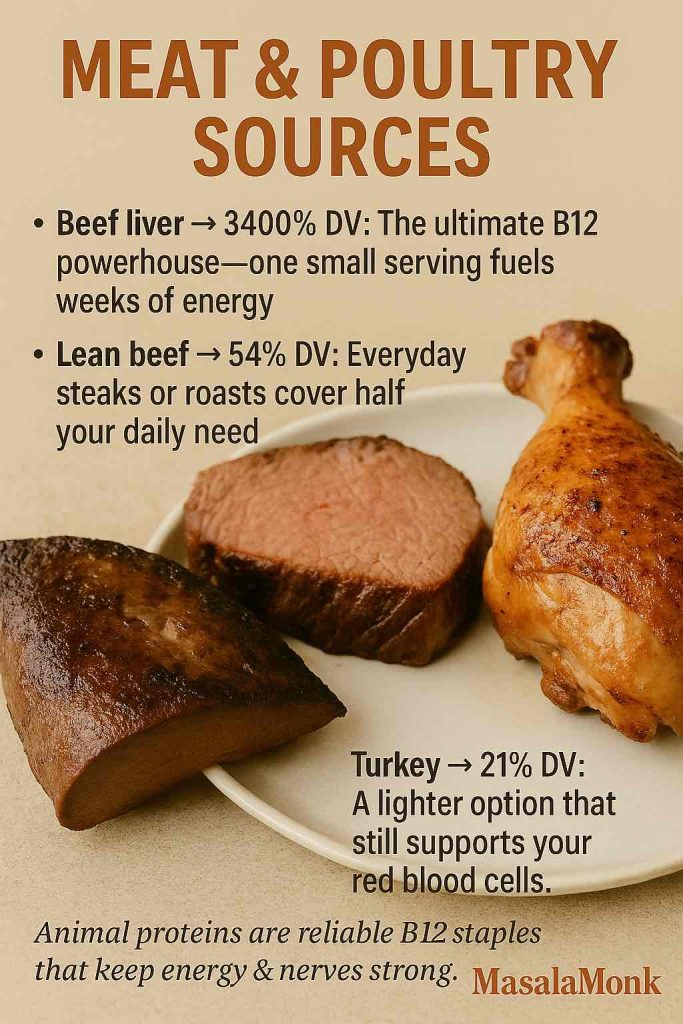
Beef liver is the undisputed superstar, packing more than 3,000% of your daily needs in just 100 grams. But even lean cuts of beef give you a decent boost, and adding turkey or chicken to your diet can help diversify your protein sources while still contributing to your B12 intake.
👉 If you enjoy traditional dishes like liver and onions, you’re not just indulging in comfort food — you’re giving your body one of the most nutrient-dense meals on earth.
Dairy Foods Rich in Vitamin B12: Milk, Cheese, Yogurt
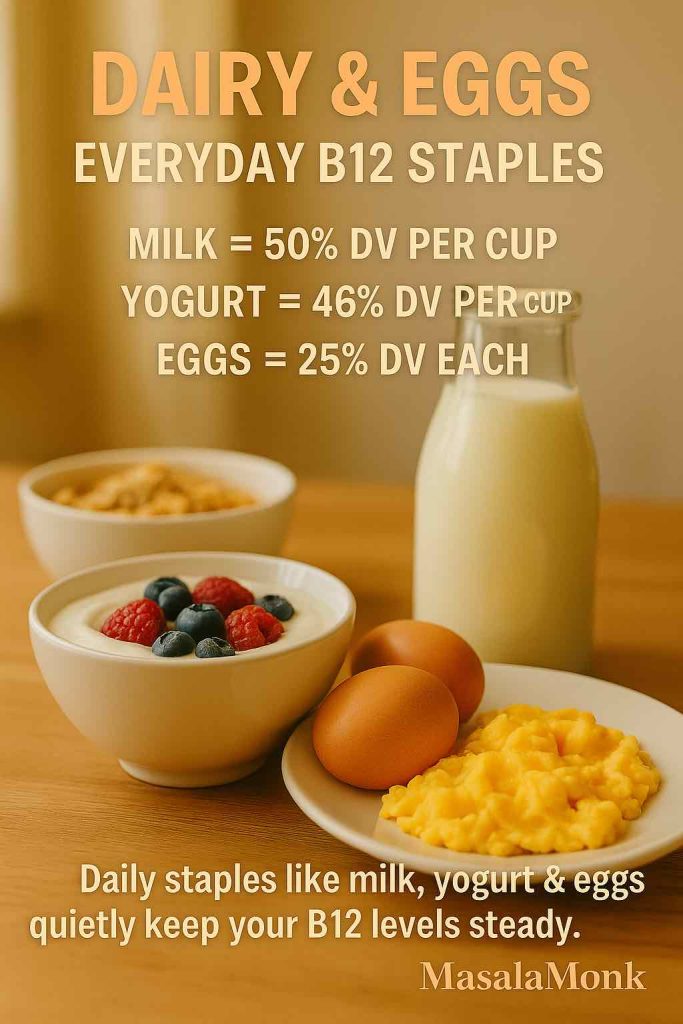
For those who enjoy milk, cheese, or yogurt, dairy foods offer a gentle but steady stream of Vitamin B12. They may not be as concentrated as seafood or liver, but because they’re easy to include daily, they add up. Interestingly, B12 from dairy may be more bioavailable than from meat (NIH Fact Sheet).
| Dairy | Serving Size | Vitamin B12 (mcg) | % Daily Value |
|---|---|---|---|
| Milk (whole) | 1 cup | 1.2 mcg | 50% |
| Yogurt (plain) | 1 cup | 1.1 mcg | 46% |
| Cheddar Cheese | 1 oz | 0.9 mcg | 38% |
👉 Think of your morning latte, a serving of Greek yogurt with fruit, or a slice of cheese with whole grain bread — each of these little moments is a small but meaningful contribution to your daily B12 needs.
Eggs as a Food Source Rich in Vitamin B12
Eggs might be small, but they carry a surprising punch of nutrition. Most of the B12 is concentrated in the yolk, so if you’re eating only egg whites, you’re missing out on this vital nutrient.
| Food | Serving Size | Vitamin B12 (mcg) | % Daily Value |
|---|---|---|---|
| Egg (whole) | 1 large | 0.6 mcg | 25% |
👉 A two-egg omelet at breakfast could cover half of your daily B12 requirement while also giving you protein, healthy fats, and choline — another nutrient that supports brain health.
Now that we’ve looked at the most powerful animal-based Vitamin B12 rich foods — from clams and salmon to liver and eggs — you might be wondering: what about those who don’t eat meat or fish?
This is where it gets tricky, because plant-based sources are far more limited. But don’t worry — the good news is that food manufacturers and nutrition science have created reliable ways for vegetarians and vegans to get enough B12.
Let’s explore those next.
Vitamin B12 Rich Vegetarian and Vegan Foods
Now that we’ve explored seafood, meat, and dairy, let’s pause for a moment. What if you don’t eat these foods? Maybe you’re vegetarian, vegan, or simply cutting back on animal products for health or ethical reasons. Does that mean Vitamin B12 deficiency is inevitable?
The answer is no — but it does mean you need to be more intentional. Unlike protein or iron, which can be found in a wide range of plant-based foods, Vitamin B12 doesn’t naturally occur in plants in meaningful amounts. That;s why fortified cereals, plant-based milks, and nutritional yeast are excellent vegetarian and vegan sources (Medical News Today; Vegan Society).
Let’s look at the best plant-friendly ways to get your daily dose of B12.
Fortified Cereals as Foods Rich in Vitamin B12
If you start your morning with a bowl of cereal, you may already be getting a solid dose of B12 without realizing it. Many breakfast cereals are fortified, meaning Vitamin B12 is added during processing.
| Food | Serving Size | Vitamin B12 (mcg) | Notes |
|---|---|---|---|
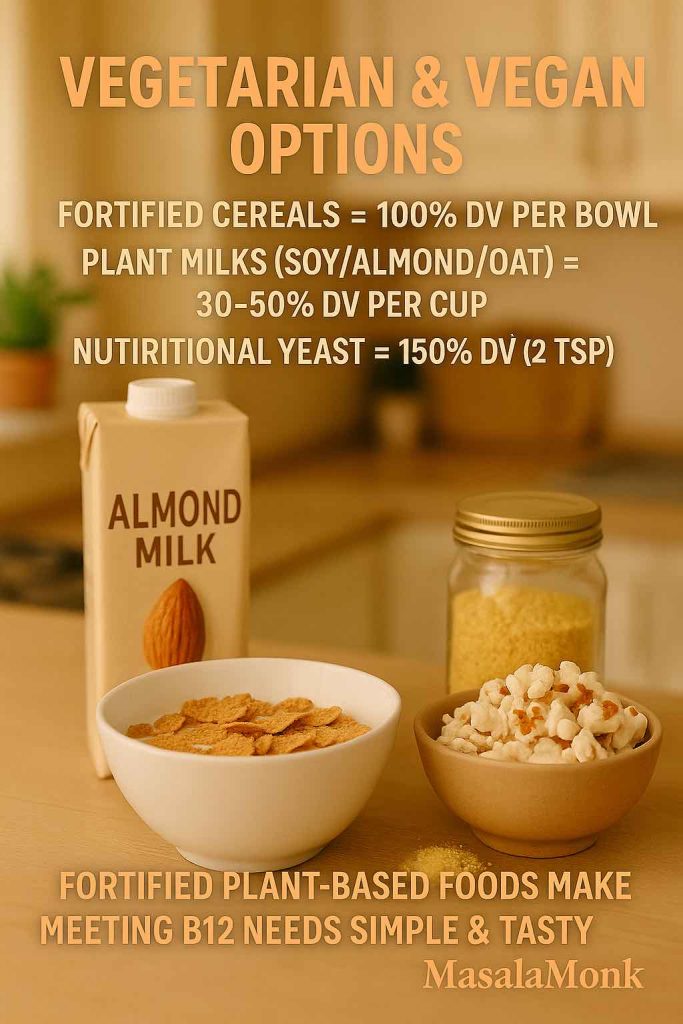
| Fortified Cereal | 1 cup | ~6.0 mcg | Often 100% of daily value |
👉 Imagine this: a bowl of fortified cereal topped with almond milk can give you your entire day’s worth of B12 before you’ve even finished breakfast. It’s quick, convenient, and especially helpful for kids, busy adults, and anyone who struggles to remember supplements.
Fortified Plant Milks are Rich Food Sources of Vitamin B12
With more people choosing dairy-free lifestyles, fortified plant milks have become one of the easiest and most reliable vegetarian-friendly sources of Vitamin B12.
| Food | Serving Size | Vitamin B12 (mcg) | Notes |
|---|---|---|---|
| Soy Milk (fortified) | 1 cup | 2.6 mcg | Excellent vegan choice |
| Almond Milk (fortified) | 1 cup | 2.5 mcg | Dairy-free alternative |
| Oat Milk (fortified) | 1 cup | 2.3 mcg | Creamy, versatile option |
👉 Whether you use them in coffee, smoothies, or cooking, these plant-based milks can easily cover 30–50% of your daily B12 needs per cup.
Nutritional Yeast Fortified with Vitamin B12
If you’ve ever heard a vegan friend rave about “nooch,” they’re talking about nutritional yeast. It’s a deactivated yeast that has a nutty, cheesy flavor and is often fortified with Vitamin B12.
| Food | Serving Size | Vitamin B12 (mcg) | Notes |
|---|---|---|---|
| Nutritional Yeast (fortified) | 2 tbsp | 4.0 mcg | Adds cheesy flavor to dishes |
👉 Sprinkle it on popcorn, mix it into pasta, or blend it into sauces — not only does it taste amazing, but just two tablespoons can give you more than 150% of your daily B12.
Yeast Extract Spreads: Marmite and Vegemite
These savory spreads are popular in the UK, Australia, and beyond, and they’re often fortified with Vitamin B12.
| Food | Serving Size | Vitamin B12 (mcg) | Notes |
|---|---|---|---|
| Marmite / Vegemite (fortified) | 1 tsp | 0.5–1.0 mcg | Strong taste, used sparingly |
👉 Just a teaspoon on toast may not seem like much, but it adds a steady B12 boost to your diet.
Putting It All Together: A Plant-Based Day of B12
To see how easy it can be, imagine this plant-based menu:
- Breakfast → Fortified cereal + soy milk (8.6 mcg B12)
- Lunch → Avocado toast with a thin layer of Marmite (1 mcg B12)
- Dinner → Vegan mac and cheese with nutritional yeast (4 mcg B12)
That’s a total of 13+ mcg of Vitamin B12 in one day — more than 5 times the recommended daily intake — all without animal products.
As you can see, even if you’re vegetarian or vegan, you don’t have to miss out on Vitamin B12. Fortified foods like cereals, plant milks, and nutritional yeast make it surprisingly simple to meet your needs.
But what about the idea of getting Vitamin B12 directly from fruits and vegetables? You might have heard claims about mushrooms, seaweed, or even algae being good sources. Let’s unpack that next, because the truth is a little more complicated.
Are there any Fruits and Vegetables as Vitamin B12 Rich Foods?
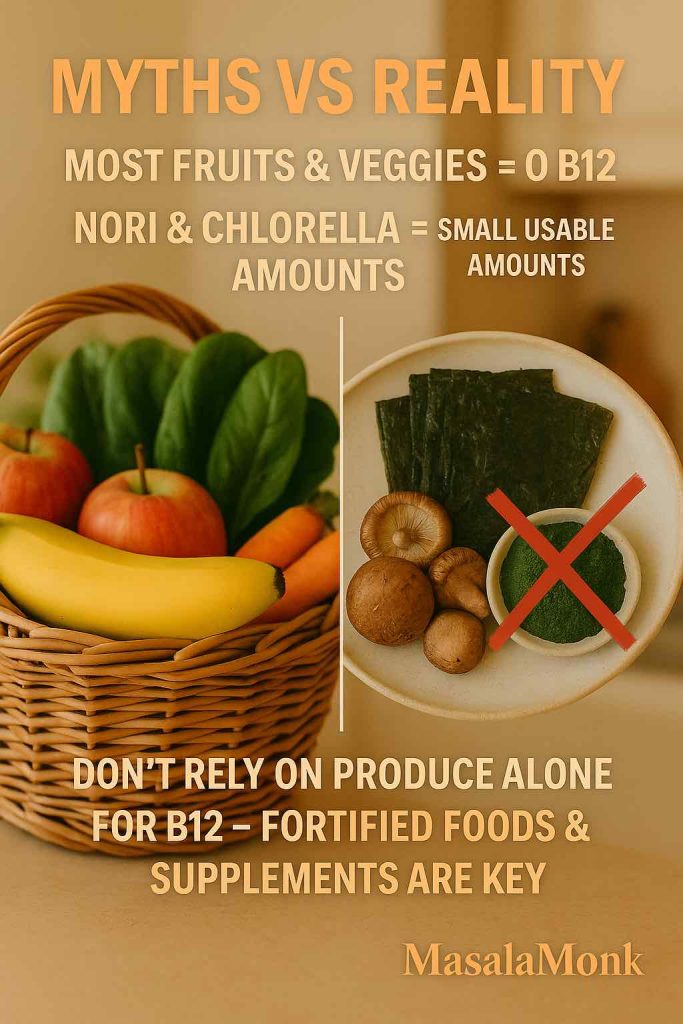
At this point, you might be wondering: “Can’t I just eat more fruits and vegetables to get my Vitamin B12?” After all, they’re packed with vitamins, minerals, and fiber. But here’s the reality: most fruits and vegetables contain little to no Vitamin B12 since plants don’t naturally produce it (NIH).
That might sound surprising, but it makes sense once you understand where B12 comes from. This vitamin is made by bacteria found in soil and in the digestive tracts of animals. Over time, animals store it in their tissues, which is why seafood, meat, dairy, and eggs are so rich in B12. Plants, on the other hand, don’t naturally produce or store Vitamin B12 in significant amounts.
So does that mean fruits and vegetables are completely useless for B12? Not exactly. There are a few exceptions and special cases worth knowing about.
Mushrooms: Trace Amounts of B12
Some mushrooms, particularly shiitake mushrooms, have been found to contain small amounts of Vitamin B12.
| Food | Serving Size | Vitamin B12 (mcg) | Notes |
|---|---|---|---|
| Shiitake Mushrooms | 100 g (cooked) | ~1.5 mcg | Absorption may vary |
While this is a fascinating discovery, it’s not enough to rely on mushrooms alone for your daily B12 needs. You’d need to eat large amounts every single day just to meet the minimum requirement. As Medical News Today notes, these provide only trace amounts and can’t replace fortified foods or supplements.
👉 Still, if you love stir-fries or soups with mushrooms, think of them as a little bonus boost on top of fortified foods or supplements.
Seaweed: Nori and Other Algae can be Rich Sources of Vitamin B12
You may have heard claims that seaweed, spirulina, or chlorella are “superfoods” rich in Vitamin B12. There’s some truth to this, but it comes with important caveats. Again as Medical News Today notes, these provide only trace amounts and can’t replace fortified foods or supplements.
| Food | Serving Size | Vitamin B12 (mcg) | Notes |
|---|---|---|---|
| Nori (dried seaweed) | 4 g | 2.4 mcg | Some studies show good absorption |
| Chlorella (algae supplement) | 3 g | 1.0–2.0 mcg | Often used as powder/tablet |
| Spirulina (algae) | — | Contains “B12 analogs” | Not usable by the body |
👉 While nori and chlorella may offer some usable B12, spirulina mostly contains “pseudo-B12” — a form your body cannot absorb. That means relying on spirulina could actually make deficiency worse by giving a false sense of security of consuming Vitamin B12 Rich Food.
Fortified Fruit Juices as a Food High in Vitamin B12
Some brands of orange juice and other fruit juices are fortified with Vitamin B12.
| Food | Serving Size | Vitamin B12 (mcg) | Notes |
|---|---|---|---|
| Fortified Orange Juice | 1 cup | 1.0–2.0 mcg | Only fortified versions |
This can be a convenient way to sneak in extra B12, especially for children or people who don’t like taking supplements. But as always, it’s important to read the nutrition label — not all juices are fortified.
Fruits and Vegetables: The Honest Truth
Apart from these rare cases, the average fruits and vegetables you find in the produce aisle — apples, bananas, carrots, spinach, and so on — simply do not contain meaningful amounts of Vitamin B12.
👉 This is why vegetarians and vegans are encouraged to focus on fortified foods and supplements instead of relying on fresh produce alone.
Fruits and vegetables will always be cornerstones of a healthy diet. They give us vitamins, minerals, antioxidants, and fiber. But when it comes to Vitamin B12, they play only a supporting role.
Now that we’ve sorted out the plant-based confusion, let’s move on to something just as important: the nutrient partnerships. Did you know Vitamin B12 works hand in hand with folate and iron to keep your blood healthy? In the next section, we’ll explore which foods provide this powerful trio together, so you can plan meals that do double — even triple — duty for your health.
Foods High in Vitamin B12 and Iron/Folate
By now, we’ve seen how Vitamin B12 keeps your nerves sharp and your energy steady. But here’s something many people don’t realize: B12 doesn’t work alone. It has a few trusted “teammates” that it partners with to keep your body thriving — especially your blood and brain.
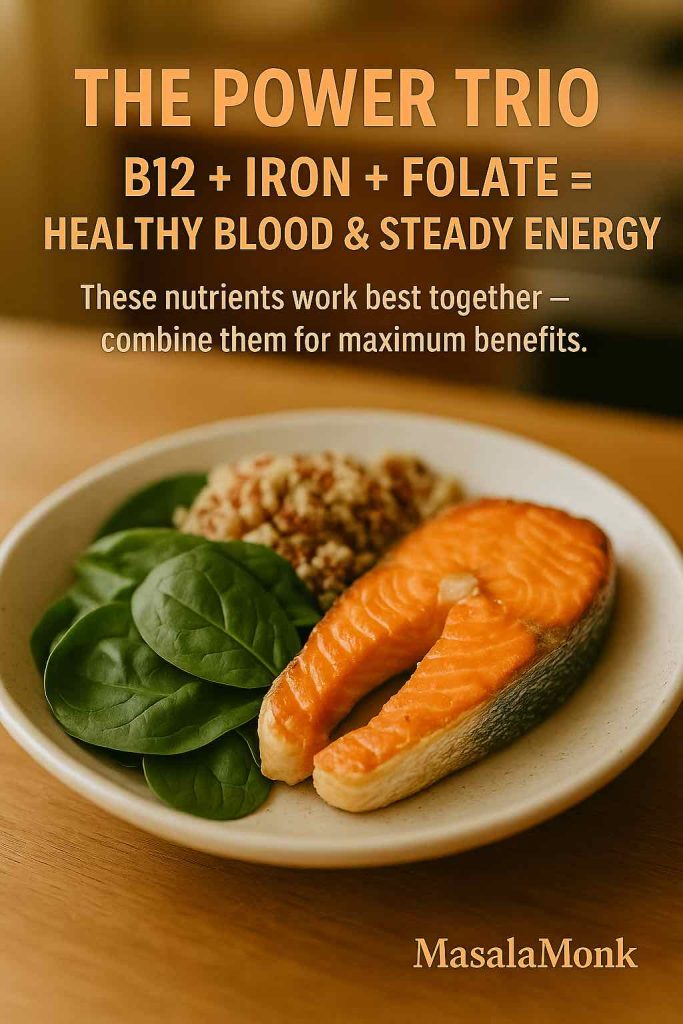
The most important partners are folate (Vitamin B9) and iron. Together, these three nutrients are like the ultimate trio for healthy red blood cells and oxygen transport. Without them, your blood can’t deliver enough oxygen to your tissues, leaving you feeling weak, pale, or out of breath. That’s why foods rich in both B12 and iron/folate are so powerful (NHS Resource).
So instead of thinking of B12 in isolation, it helps to focus on meals and foods that bring these nutrients together naturally. Let’s look at some of the best examples.
Salmon: Omega-3s Plus B12 and Folate
Salmon is already a superstar when it comes to Vitamin B12 — one fillet can give you nearly 200% of your daily needs. But here’s the bonus: salmon also provides folate and omega-3 fatty acids, which support brain function, reduce inflammation, and keep your heart healthy.
👉 Picture this: a dinner of baked salmon with a side of leafy greens (rich in folate) and quinoa (packed with iron) creates a meal that delivers a perfect blend of B12, folate, and iron.
Eggs: The Everyday Multitaskers
Eggs are one of the most versatile foods out there. Beyond being a steady source of Vitamin B12, they also contain folate, choline (important for brain health), and high-quality protein.
| Food | Serving Size | Nutrients |
|---|---|---|
| Eggs (whole) | 2 large | B12, Folate, Protein, Choline |
👉 Starting your day with scrambled eggs and spinach (a folate-rich green) is a quick way to give your body this powerful nutrient combo.
Spinach with Fortified Cereal: A Plant-Based Power Pair
On their own, spinach is rich in folate and iron but lacks Vitamin B12. Fortified cereals, on the other hand, often contain 100% of your daily B12. Pair them together, and you have a nutrient-packed meal that supports your blood health, even if you don’t eat meat.
👉 Imagine a spinach smoothie paired with a bowl of fortified cereal and soy milk — a fully plant-based breakfast that still covers all three nutrients.
Lean Beef: B12 Meets Iron
Beef is often highlighted as a source of iron, but it’s also a good source of Vitamin B12. Together, these nutrients help produce red blood cells and prevent anemia.
| Food | Serving Size | Vitamin B12 (mcg) | Iron (mg) |
|---|---|---|---|
| Lean Beef | 3 oz (cooked) | 1.3 mcg | 2.7 mg |
👉 A small portion of lean beef, served with a lentil salad (for extra folate and plant-based iron), creates a meal that ticks all the boxes.
Lentils with Yogurt: A Vegetarian-Friendly Combo
For vegetarians, pairing foods is key. Lentils provide iron and folate, while yogurt adds Vitamin B12 and protein. Combined, they create a balanced and satisfying meal.
👉 A warm bowl of lentil curry served with a side of plain yogurt not only tastes comforting but also delivers a blend of nutrients that work beautifully together.
When you think of nutrition this way — in combinations instead of single nutrients — it becomes much easier to build meals that truly support your health. Whether it’s salmon with greens, eggs with spinach, or lentils with yogurt, these pairings bring B12, folate, and iron together in delicious ways.
Now that we’ve explored the power of food combinations, let’s turn to another important question: what if diet alone isn’t enough? For many people, especially seniors, vegans, or those with absorption issues, food isn’t the whole story. This is where Vitamin B12 supplements come in — and choosing the right one can make all the difference.
Best Vitamin B12 Supplements: Choosing the Right One for Your Needs
So far, we’ve looked at how to get Vitamin B12 through food. But what if that isn’t enough? Some people — especially vegans, seniors, and those with absorption problems — need supplements. That’s because Vitamin B12 deficiency is often caused by malabsorption, not just poor diet (Times of India).
Certain groups are more likely to need extra help:
- Vegans and vegetarians → because plant foods don’t naturally contain B12.
- Seniors → since absorption decreases with age.
- People with digestive conditions → such as celiac, Crohn’s disease, or low stomach acid.
- Those recovering from anemia or chronic fatigue → where higher doses are needed to restore levels.
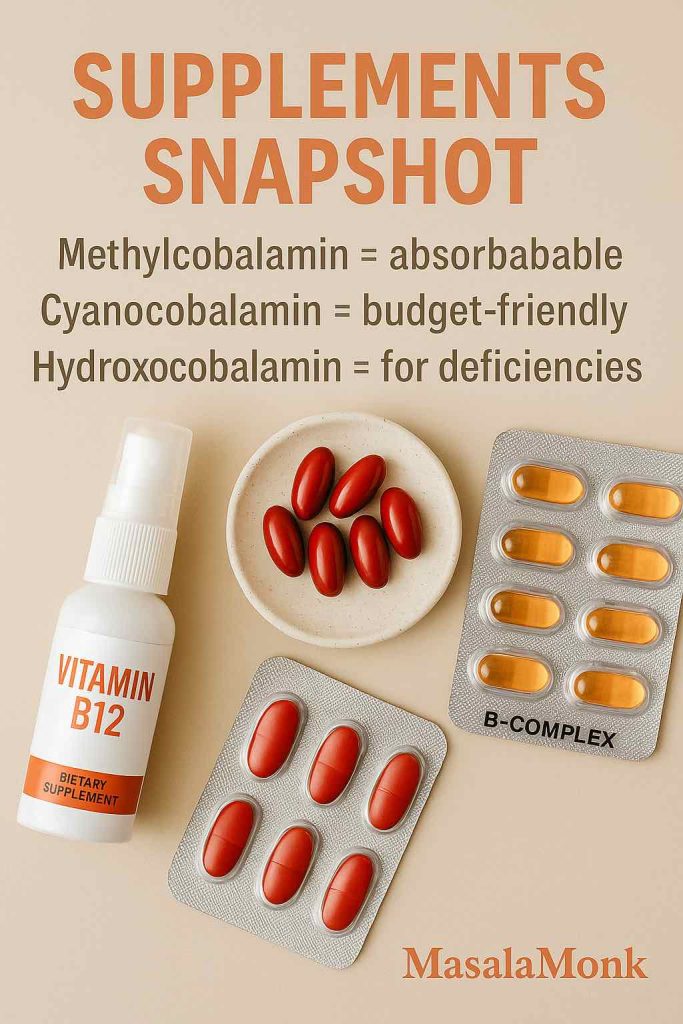
The good news? There’s no shortage of options when it comes to Vitamin B12 supplements. But not all forms are created equal. Let’s walk through the most common types and when to use them.
However before you get into supplementation, it’s important to consider the risks, which we talk about in Vitamin B12 Side Effects and Vitamin Supplements and Cancer Risk: What You Should Know.
Methylcobalamin: The Most Natural Form
Methylcobalamin is often considered the gold standard of B12 supplements. It’s the form your body naturally uses, which means it’s highly bioavailable and easy to absorb.
- Best for: Most people looking for a daily boost.
- Why choose it: It supports energy, nerve health, and cognitive function.
- Common forms: Tablets, lozenges, sprays.
👉 Imagine you’re a busy professional struggling with fatigue — a daily methylcobalamin lozenge under the tongue could help restore your energy levels without needing complicated routines.
Adenosylcobalamin: Energy and Mitochondrial Support
Adenosylcobalamin is another bioactive form of Vitamin B12, working deep in the mitochondria — the “powerhouses” of your cells.
- Best for: People needing extra energy support.
- Why choose it: Helps with cellular energy production and muscle function.
- Common forms: Capsules, sublingual drops.
👉 Athletes or those recovering from fatigue often find adenosylcobalamin gives them that extra edge for stamina and performance.
Cyanocobalamin: Affordable and Reliable
Cyanocobalamin is a synthetic form of Vitamin B12. It’s widely available, inexpensive, and effective for most people. The body converts it into active forms (methylcobalamin and adenosylcobalamin) once ingested.
- Best for: Budget-friendly supplementation.
- Why choose it: Cost-effective, stable, and easy to find in multivitamins.
- Common forms: Tablets, capsules, gummies.
👉 If you’re just starting with supplements and want a simple option, cyanocobalamin is a great first step.
Hydroxocobalamin: Long-Lasting Option
Hydroxocobalamin is typically used in medical settings, especially for treating severe B12 deficiencies. It lasts longer in the body, which makes it especially useful for injections.
- Best for: Severe deficiencies, under medical supervision.
- Why choose it: Longer storage in the body; effective for injections.
- Common forms: Intramuscular injections prescribed by doctors.
👉 For someone with advanced B12 deficiency symptoms like numbness or severe fatigue, hydroxocobalamin injections can make a dramatic difference.
Best Vitamin B12 Supplements by Situation
- For absorption issues (seniors, digestive problems): Sublingual methylcobalamin or adenosylcobalamin.
- For anemia: Hydroxocobalamin injections or high-dose oral supplements (doctor guided).
- For vegans and vegetarians: Daily methylcobalamin tablets, sprays, or fortified foods.
- For budget-conscious users: Cyanocobalamin tablets or multivitamins.
- For all-round coverage: B-complex supplements containing B12, folate, and B6.
Supplements can be life-changing, but they’re not a one-size-fits-all solution. The right choice depends on your lifestyle, your health status, and even how your body absorbs nutrients.
Now that we’ve covered the best supplements, let’s step back and look at the bigger picture. Vitamin B12 doesn’t work in isolation — it’s part of a family of B vitamins that support one another. In the next section, we’ll explore how B12 teams up with vitamins like B6 and folate to boost your energy, mood, and overall well-being.
How Vitamin B12 Works with Other B Vitamins
By now, you’ve seen how important Vitamin B12 is on its own. But here’s something fascinating: B12 rarely acts alone in the body. It’s part of a larger family — the B vitamins — that work together like a team. When one is missing, the others can’t perform at their best.
Think of them as musicians in an orchestra. Each plays a different instrument, but together, they create harmony. In the same way, Vitamin B12 partners with vitamins like B6, folate (B9), and even B1, B2, and B3 to keep your body energized, your nerves calm, and your blood healthy.
Let’s explore how these partnerships work in practice.
Vitamin B6 and Vitamin B12: Partners in Energy and Nerve Health
Vitamin B6 (pyridoxine) and Vitamin B12 (cobalamin) are both deeply involved in your nervous system and metabolism.
- B6 helps the body make neurotransmitters like serotonin and dopamine, which regulate mood.
- B12 supports the protective myelin sheath around your nerves.
Together, they help convert food into glucose, stabilize your mood, and keep your nervous system strong.
👉 Example: A meal of grilled salmon (rich in both B6 and B12) with roasted potatoes (a good source of B6) is not just satisfying — it’s a perfect example of nutrient teamwork. (Find more about Vitamin B6 in Foods)
Folate (Vitamin B9) and Vitamin B12: Essential for Blood and DNA
Folate (also known as folic acid in supplement form) and B12 are inseparable partners when it comes to blood and DNA health.
- B9 and B12 together help produce red blood cells and prevent anemia.
- They also support DNA synthesis and repair — critical for growth, fertility, and pregnancy health.
👉 Example: A breakfast of scrambled eggs (B12) with avocado toast (folate) shows how easy it is to combine these nutrients in everyday meals.
The Broader B Vitamin Family: B1, B2, B3, B5 with B12
While B6 and folate are the closest partners, other B vitamins also play a role alongside B12:
- Vitamin B1 (Thiamine): Supports energy metabolism and nerve function.
- Vitamin B2 (Riboflavin): Helps release energy from food and supports eye health.
- Vitamin B3 (Niacin): Important for brain health and cholesterol balance.
- Vitamin B5 (Pantothenic Acid): Supports hormone production and energy release.
Together with Vitamin B12, these nutrients turn food into energy, maintain a healthy nervous system, and keep your brain sharp.
B-Complex Supplements: A Balanced Approach
Because B vitamins are so interconnected, many people choose to take a B-complex supplement, which contains all eight B vitamins in one capsule or tablet.
- Best for: People with restricted diets, chronic stress, or increased energy needs.
- Why it helps: Ensures you’re not missing one vitamin that could throw off the balance of the others.
👉 Think of it like having the whole orchestra in tune. With a B-complex, you’re not just supporting B12 — you’re supporting the entire family.
Understanding how Vitamin B12 works with its fellow B vitamins helps you see the bigger picture: nutrition is about synergy, not isolation. When you eat balanced meals that combine these nutrients, you get more energy, better focus, and stronger overall health.
Now that we’ve explored the teamwork of the B vitamins, let’s bring everything together. In the final section, we’ll look at how to incorporate Vitamin B12 into your daily life, with simple strategies and practical meal ideas you can start using right away.
Adding Vitamin B12 to Life: Foods, Supplements, and Lifestyle Tips
Learning about Vitamin B12 rich foods is one thing — but the real power comes when you put that knowledge into action. The good news is that weaving B12 into your everyday meals doesn’t need to be complicated. With a little planning, you can create a diet that supports your energy, memory, mood, and long-term health.

Here are some simple strategies to make Vitamin B12 a natural part of your lifestyle.
Build a Balanced Plate
Instead of obsessing over one “superfood,” think about balance. Each meal is an opportunity to combine sources of Vitamin B12 with other nutrients your body needs.
- Seafood lovers: Try salmon with quinoa and roasted vegetables.
- Meat eaters: Enjoy lean beef with lentil salad for B12 + iron + folate.
- Vegetarians: Scrambled eggs with spinach and whole grain toast.
- Vegans: A bowl of fortified cereal with soy milk and a sprinkle of nutritional yeast.
👉 Over time, these small, consistent choices add up to a big impact on your energy and well-being.
Use Fortified Foods Wisely
If you’re vegetarian or vegan, fortified foods can be your best friend. Fortified cereals, plant milks, and nutritional yeast are not only practical but also versatile.
- Add fortified almond milk to smoothies.
- Sprinkle nutritional yeast on popcorn or pasta.
- Choose cereals that list Vitamin B12 on the label.
👉 This way, you can easily meet your daily B12 needs without overthinking it.
Consider Supplements When Needed
Sometimes food isn’t enough — and that’s perfectly okay. For seniors, people with absorption issues, or anyone following a fully plant-based diet, B12 supplements are a safe and reliable choice.
- Daily sublingual tablets or sprays work well for most people.
- Injections may be necessary for severe deficiencies (doctor guided).
- B-complex supplements can ensure you’re covering all bases.
👉 Remember: supplements aren’t a weakness — they’re a smart tool to protect your health.
Just a reminder : Before you get into supplementation, it’s important to consider the risks, which we talk about in Vitamin B12 Side Effects and Vitamin Supplements and Cancer Risk: What You Should Know.
Pay Attention to Your Body
Your body often sends signals when something is off. If you’re feeling unusually tired, weak, or forgetful, it could be your way of saying: “I need more B12.” Read more on Symptoms of Vitamin B12 Deficiency.
👉 Regular check-ups and simple blood tests can confirm your B12 status. Catching a deficiency early means you can correct it before it leads to bigger problems like anemia or neurological symptoms.
Lifestyle Tips to Maximize B12
Beyond just diet, here are a few extra habits that support healthy B12 levels:
- Cook smart: Steaming or grilling retains more nutrients than boiling.
- Plan variety: Rotate between fish, dairy, eggs, or fortified foods to avoid monotony.
- Stay consistent: Aim for daily intake — your body absorbs B12 better in smaller, regular amounts.
Vitamin B12 Rich Foods Chart: Quick Reference
| Category | Top Foods Rich in Vitamin B12 |
|---|---|
| Seafood | Clams, Trout, Salmon, Sardines, Tuna |
| Meat & Poultry | Beef liver, Lean beef, Chicken, Turkey |
| Dairy & Eggs | Milk, Yogurt, Cheese, Eggs |
| Vegetarian Options | Fortified cereals, Fortified soy/almond/oat milk |
| Vegan-Friendly | Nutritional yeast, Marmite/Vegemite, Fortified juices |
| Fruits/Vegetables (limited) | Shiitake mushrooms, Nori, Chlorella |
Conclusion: Nourish Your Body, Protect Your Energy
At the end of the day, Vitamin B12 is more than just a nutrient — it’s the spark that keeps your body’s engine running. As Vogue highlights, modern diets can absolutely support your B12 needs — whether through animal foods, fortified vegan options, or supplements. From protecting your nerves to producing healthy red blood cells, from boosting your memory to supporting your mood, this vitamin touches nearly every corner of your health.
The best part? Getting enough B12 is absolutely doable, no matter what kind of diet you follow. Whether it’s through seafood and dairy, vegetarian staples like eggs and cheese, or vegan-friendly fortified foods and supplements, you have plenty of Vitamin B12 Rich Foods to choose from.
👉 Think of B12 not as a chore, but as a daily act of self-care. With every meal, you have a chance to fuel your body with energy, protect your brain, and safeguard your future health.
So, the next time you enjoy a plate of salmon, a bowl of fortified cereal, or even just sprinkle a little nutritional yeast on your dinner, remember: you’re not just eating — you’re investing in your energy, your vitality, and your well-being.
FAQs on Vitamin B12 Rich Foods
1. What are the top foods rich in Vitamin B12?
The richest natural sources of Vitamin B12 are clams, liver, salmon, trout, tuna, sardines, milk, yogurt, cheese, and eggs. These foods provide far more than your daily needs in small portions, making them easy to include in your weekly diet.
2. Which vegetarian foods contain Vitamin B12?
Since plant foods don’t naturally provide B12, vegetarians can rely on eggs, dairy products (milk, cheese, yogurt), and fortified foods like cereals or nutritional yeast. Together, these offer a reliable way to prevent deficiency without eating meat.
3. Are there vegan foods high in Vitamin B12?
Naturally, very few plant-based foods contain B12. However, fortified cereals, plant milks (soy, almond, oat), nutritional yeast, and fortified juices are vegan-friendly sources that can help meet your needs.
4. Do fruits contain Vitamin B12?
Most fruits do not naturally contain Vitamin B12. However, fortified fruit juices, such as some brands of orange juice, may provide B12 if added during processing. Always check the label to be sure.
5. Can vegetables be a good source of Vitamin B12?
Not really. Most vegetables contain no usable Vitamin B12. Exceptions include shiitake mushrooms and seaweed (nori, chlorella), which have small amounts. However, relying on vegetables alone is not enough to meet your daily B12 needs.
6. Which fish are the best sources of Vitamin B12?
Fish like salmon, trout, sardines, and tuna are excellent choices. Not only are they high in B12, but they also provide omega-3 fatty acids and protein, making them one of the healthiest all-in-one foods.
7. What are the best Vitamin B12 rich foods for anemia?
If you are managing anemia, foods like beef liver, clams, salmon, eggs, fortified cereals, and lean beef are particularly helpful. They supply both Vitamin B12 and iron, which work together to support healthy red blood cell production.
8. Can Vitamin B12 deficiency be reversed with food alone?
In mild cases, yes — eating B12 rich foods daily can correct low levels. But in more serious deficiencies (especially with neurological symptoms), you may need supplements or injections prescribed by a doctor.
9. What is the daily requirement of Vitamin B12?
Most adults need 2.4 mcg per day. Pregnant or breastfeeding women may need more. To put this in perspective: one serving of clams or beef liver provides more than 1000% of your daily requirement, while a cup of milk covers about half. Know more about What are Methylated Prenatal Vitamins?
10. Should I take a Vitamin B12 supplement if I eat B12 rich foods?
Not always. If you regularly eat animal-based foods, you likely get enough naturally. However, vegans, vegetarians, seniors, or people with absorption issues often benefit from B12 supplements to stay healthy.