
If you want to know how to make ice cream with a KitchenAid mixer, the process becomes much easier once you understand the rhythm. Freeze the bowl until it is deeply cold, chill the base until it is fully settled, churn until the mixture turns thick and airy like soft serve, then freeze it again until it becomes scoopable. That is the pattern. Once it clicks, homemade ice cream stops feeling fussy and starts feeling wonderfully doable.
Part of the confusion is that ice cream sounds more technical than it really is. There is so much talk of custards, freezer bowls, aging the base, mix-ins, and timing that the whole thing can seem harder than it needs to be. In practice, the best batches usually come down to a few simple things done well. The bowl needs to be properly frozen. The base needs to be fully chilled. The churn needs to stop at the right stage. After that, the freezer quietly finishes the work. KitchenAid’s own notes on the ice cream maker attachment reinforce just how much good texture depends on that cold-and-churn sequence.
What makes this method especially satisfying is the control it gives you over flavor and texture. You can keep it simple with an easy eggless vanilla base, or go richer with a custard-style version that tastes fuller and more luxurious. You can fold in cookie pieces, swirl through chocolate, blend in mango, or deepen it with coffee. The logic behind chilling the base well is explained beautifully by Serious Eats, and once that part makes sense, the rest feels far more natural.
Also Read: Peach Cobbler with Canned Peaches (Dessert Recipe)
Can you make ice cream with a KitchenAid mixer?
Yes, you absolutely can, and when everything is properly cold, a KitchenAid stand mixer can make excellent homemade ice cream. The classic route uses the frozen ice cream maker attachment, which chills the base while the dasher keeps it moving. That pairing matters because homemade ice cream is not just sweet dairy that happens to freeze. It is a base that freezes gradually while air is worked into it, which is what gives the finished scoop a lighter, smoother texture.
The stand mixer helps because it makes that motion steady. Rather than stirring by hand, pausing, and hoping for the best, you get a consistent churn that encourages a more even freeze. The frozen bowl does the cooling. The dasher keeps the mixture moving. The base thickens bit by bit instead of hardening all at once against the sides.
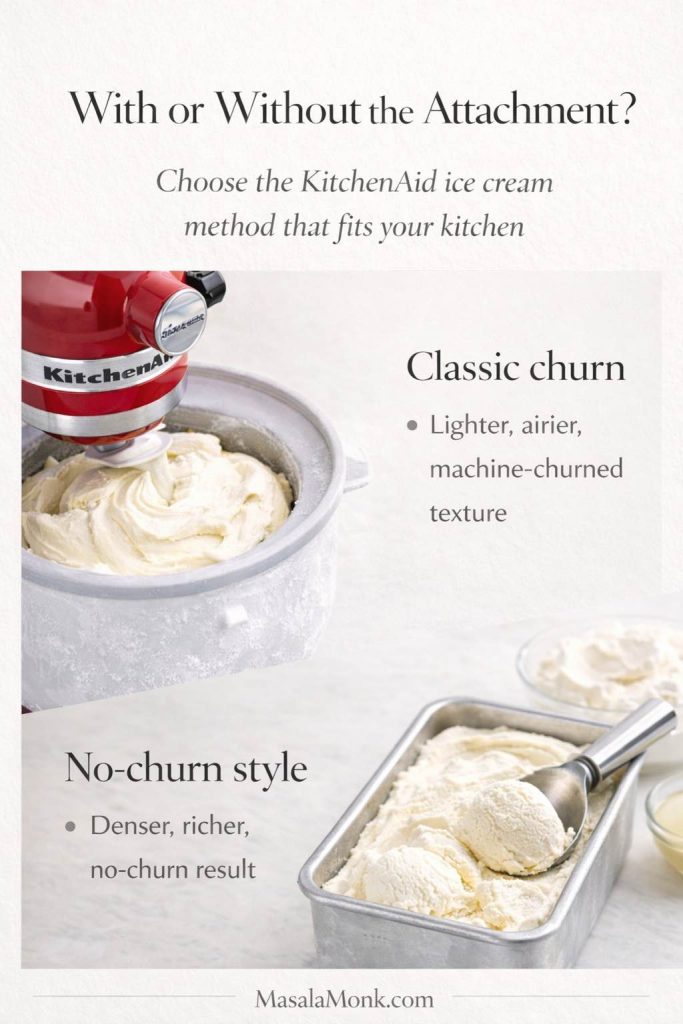
There is also a second path worth taking seriously. You can make ice cream in a stand mixer without the attachment by whipping structure into a rich base and letting the freezer finish the rest. That version is different rather than inferior. It is usually denser, a little less airy, and often richer-feeling when you first scoop it. Still, it can be excellent in its own right, especially for coffee, chocolate ripple, cookie-heavy, or condensed-milk-style versions.
So the honest answer is that a KitchenAid mixer can make two different kinds of frozen dessert. With the attachment, you get a more classic churned result. Without it, you get a simpler no-machine-style frozen dessert that can still be creamy, rich, and extremely satisfying.
Why the attachment method feels more like classic ice cream
The attachment method creates the texture most people are imagining when they picture homemade vanilla ice cream. It has more air, a lighter body, and a softer, more traditional churned finish once it sets. If your goal is the closest homemade version to classic scoop-shop texture, the attachment is the better route.
Why the no-attachment method is still worth making
The no-attachment version shines because it lowers the barrier. You do not need the frozen bowl. You do not need to time the churn in the same way. And thankfully, you still get a deeply enjoyable frozen dessert with very little stress. For many kitchens, that practicality matters just as much as perfect texture.
Also Read: Avocado Chocolate Mousse Recipe
What you need to make ice cream with a KitchenAid mixer
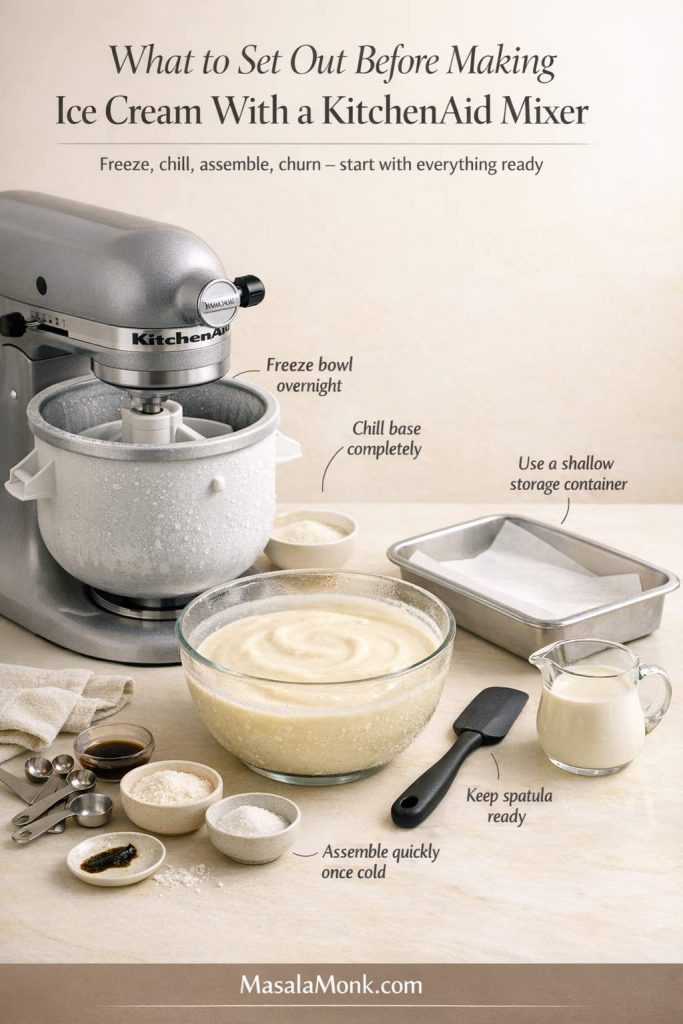
The process feels much calmer when you set everything out before you begin. Once the bowl comes out of the freezer, you do not want to waste precious cold while searching through drawers for a spatula or opening three cupboards looking for the right container.
KitchenAid stand mixer and ice cream maker attachment
For the classic method, you need the stand mixer, the freezer bowl, and the dasher. KitchenAid’s own guidance on the ice cream maker attachment is helpful because it reinforces the practical basics: freeze the bowl thoroughly, use a fully chilled base, start the mixer before pouring, and churn until the texture resembles soft serve.
Mixing bowls, whisk, spatula, and measuring cups
You will need a bowl for mixing the base, a whisk to combine it smoothly, measuring cups for consistency, and a spatula for transferring the churned ice cream. Those tools sound ordinary, yet they matter because the easier the setup feels, the more likely you are to stay calm and move quickly once the bowl is out of the freezer.
Freezer-safe container for the final set
A loaf pan works well if you want the batch to firm up quickly. An airtight tub works well if you care more about tidy storage. Either way, a proper freezer-safe container matters because homemade ice cream loses quality more quickly when it sits loosely covered or exposed to too much air.
Ingredients for a KitchenAid ice cream recipe
For most batches, you are looking at heavy cream, whole milk, sugar, vanilla, and salt. Egg yolks come into play if you want a richer custard base. Sweetened condensed milk becomes useful if you want to make ice cream in a stand mixer without the attachment.
Also Read: Falafel Recipe: Crispy Homemade, Air Fryer and Baked Falafel
How the KitchenAid ice cream attachment works
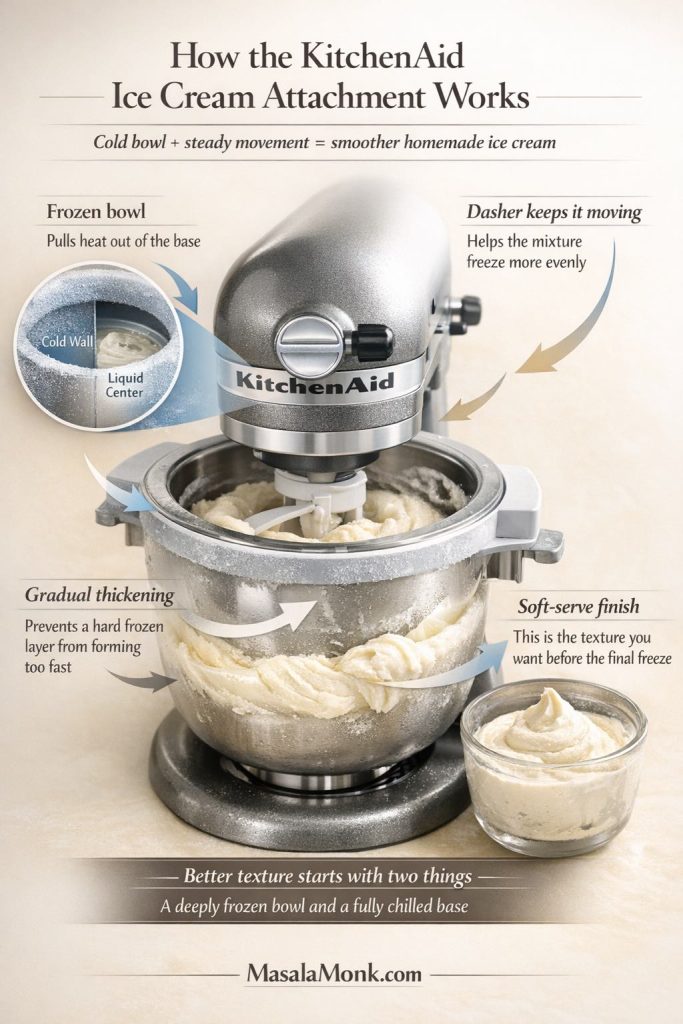
The attachment works because it handles cooling and movement at the same time. The frozen bowl removes heat from the base while the dasher keeps the mixture moving around the cold surface. That movement is what helps prevent the base from freezing into a stiff layer against the edge while the center stays too loose.
This is one of those kitchen details that becomes more obvious once you see it happen. In the early minutes, the base looks only slightly thicker. Then it begins to cling to the bowl more noticeably. Then it starts to look billowy and softly mounded. That gradual transformation is the result of cold and movement working together.
Why the bowl has to be deeply frozen
A partly frozen bowl causes more disappointment than almost anything else. If the bowl is not fully solid with cold, the base may stay slushy or loose long past the point where it should have thickened. Instead of building toward a soft-serve texture, it just spins and softens. That is why freezing the bowl thoroughly is not a suggestion. It is one of the central conditions of the whole method.
Why the base has to be fully chilled
The base matters just as much. A warm mixture instantly works against the bowl by melting away some of the freezing power you need for the churn. A fully chilled base, on the other hand, begins thickening more quickly and more cleanly. This is also why resting a base in the refrigerator for several hours, or even overnight, tends to improve results.
Why the setup can feel looser than expected
First-time users often expect the freezer bowl and dasher to feel more rigid than they actually do before the mixer starts moving. In reality, the setup can feel a little lighter or less “locked in” than people imagine. That is normal. Once the bowl is properly assembled, the mixer is running, and the base is going in slowly, the system behaves much more confidently.
Also Read: Mango Margarita Recipe (Frozen or On the Rocks)
How long to freeze and chill before you make ice cream with a KitchenAid mixer
Homemade ice cream becomes easier the moment you stop guessing about timing. When you know the usual windows, the process stops feeling uncertain and starts feeling manageable.
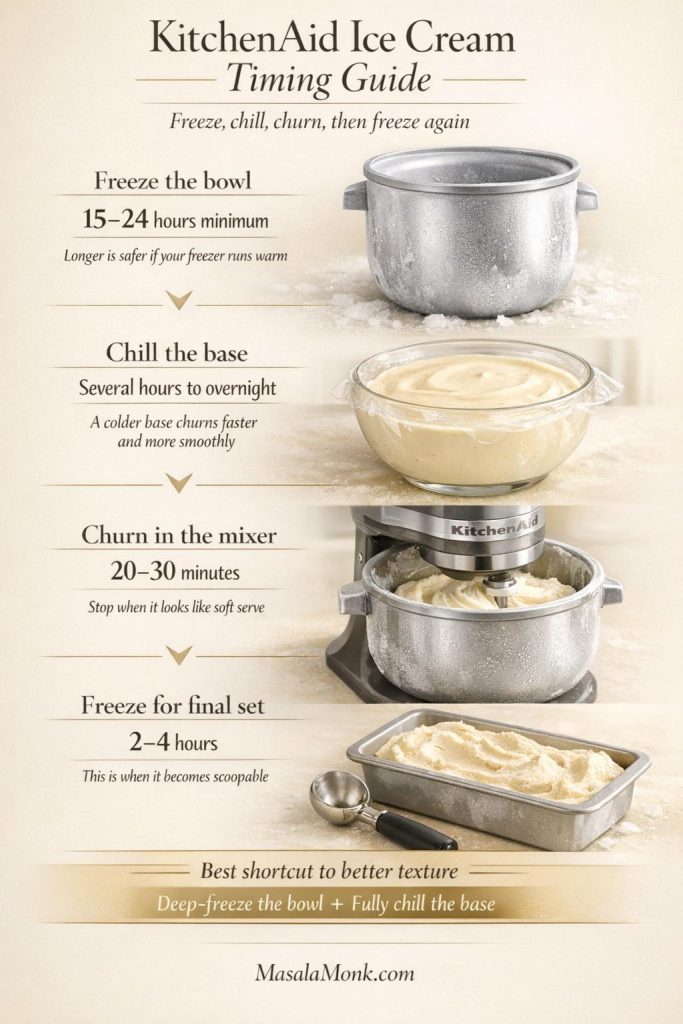
How long to freeze the KitchenAid ice cream bowl
Freeze it overnight at minimum. Longer is usually safer, especially if your freezer gets opened often or tends to run warmer than ideal. The bowl needs deep, even cold, not just “it feels cold enough” cold.
How long to chill the base
For an eggless base, several hours in the refrigerator is a reasonable minimum. Overnight is even better. For a custard base, overnight chilling is especially valuable because the texture becomes more settled as well as colder. That extra time helps the churn behave more smoothly.
How long to churn in a KitchenAid mixer
Once the bowl and base are both properly cold, many batches reach soft-serve texture in about 20 to 30 minutes. If you find yourself waiting far beyond that while the base still looks loose, the issue is usually not a lack of patience. It is usually a temperature problem somewhere in the setup.
How long to freeze after churning
Freshly churned ice cream is typically soft, airy, and spoonable. If that is the texture you want, you can absolutely enjoy it right away. However, if you want a firmer, more scoopable result, it usually needs another 2 to 4 hours in the freezer.
Also Read: Sourdough Pizza Dough Recipe (Crispy Crust & Easy Pizza Base)
Best ingredients for a KitchenAid ice cream recipe
A good KitchenAid ice cream recipe is not just about the machine. It is also about balance. The ingredients determine whether the final texture feels creamy, too hard, too soft, icy, or dense.
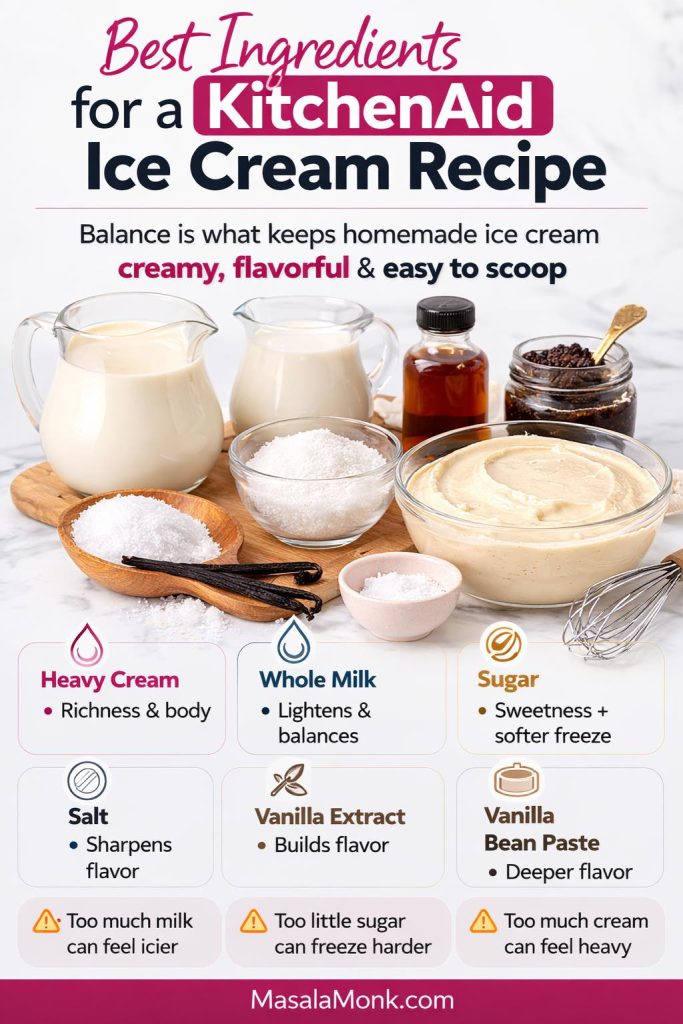
Heavy cream vs milk in homemade ice cream
Heavy cream brings richness, smoothness, and body. Whole milk lightens the base enough so it does not feel overly heavy or greasy. Together, they create the kind of balance most home cooks want. Too much milk can push the batch toward iciness. Too much cream can make it feel almost heavy rather than silky.
Why sugar matters for more than sweetness
Sugar does much more than make ice cream taste sweet. It also affects how the mixture freezes, which is why cutting it too aggressively can lead to ice cream that hardens too much or feels dry and stubborn to scoop.
Why a pinch of salt improves the whole batch
Salt is easy to underestimate. Yet a small pinch sharpens vanilla, deepens chocolate, rounds out caramel notes, and keeps the whole dessert from tasting flat. It does not announce itself. It just makes the rest of the flavors feel more awake.
Vanilla extract vs vanilla bean paste
Vanilla extract works beautifully and keeps things easy. And then vanilla bean paste adds a slightly richer aroma and a more luxurious feel, especially in a pure vanilla batch. If vanilla is the whole point, paste can make the result feel more special. If vanilla is simply the base for stronger mix-ins, extract is often all you need.
Also Read: Balti Paneer Gravy (Restaurant-Style, Creamy + Bold Recipe)
Easy vanilla ice cream with a KitchenAid mixer
Vanilla is the best place to begin because it lets the method stay visible. There is nothing distracting you from the texture, the timing, or the way the base changes during the churn.
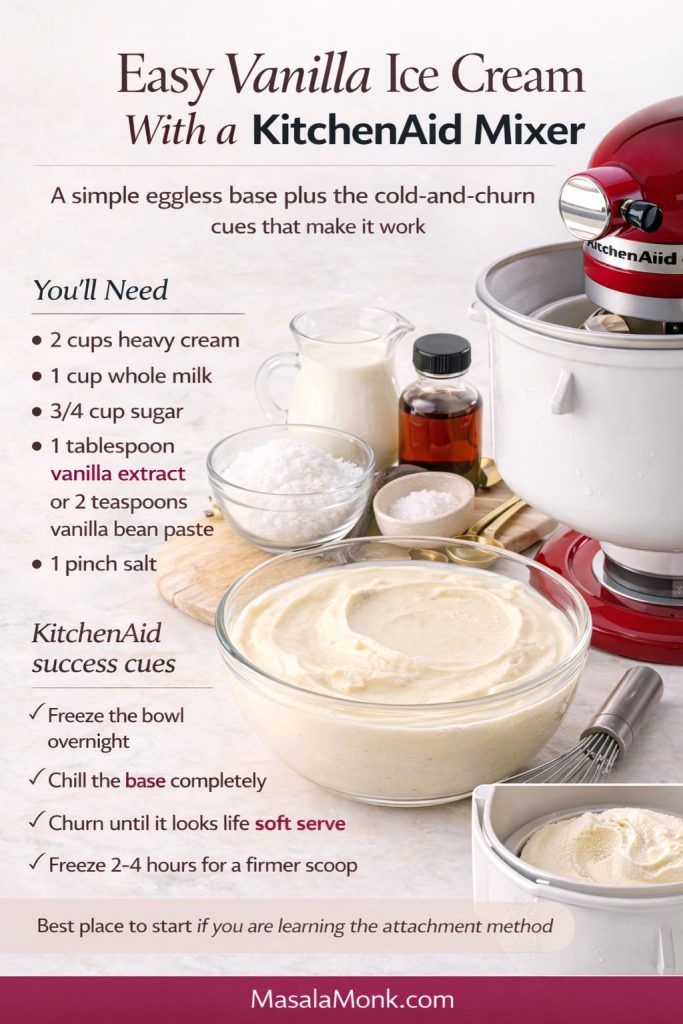
Eggless vanilla ice cream with a KitchenAid mixer
For an easy vanilla batch, use:
- 2 cups heavy cream
- 1 cup whole milk
- 3/4 cup sugar
- 1 tablespoon vanilla extract or 2 teaspoons vanilla bean paste
- 1 pinch salt
Whisk the ingredients together until the sugar is mostly dissolved, then chill the mixture thoroughly. This is the simplest version to make and the easiest one to build on later with other flavors.
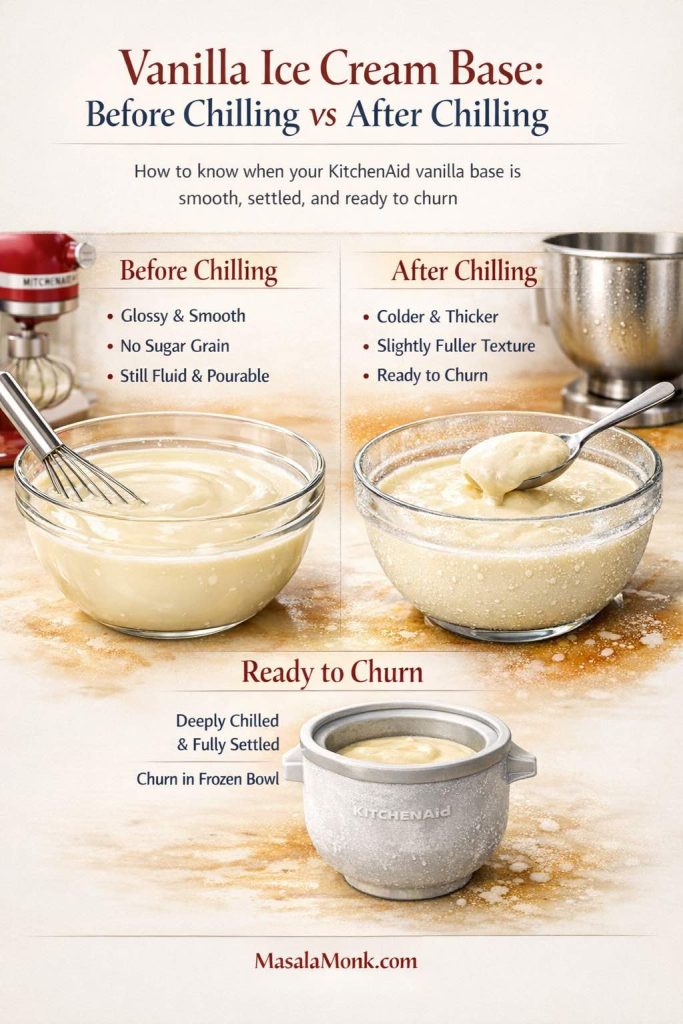
What the eggless base should look like before chilling
Before chilling, the mixture should look glossy, smooth, and fully combined. It should not look separated or visibly grainy. If you still see stubborn sugar crystals, keep whisking a bit longer.
What the eggless base should feel like after chilling
After chilling, the base should feel distinctly colder and a little fuller on the spoon, even though it is still liquid. It should smell clean and creamy rather than thin or flat. That cold, settled feeling is one of the signs that it is ready to churn properly.
Also Read: Mojito Recipe (Classic) + Ratios, Pitcher, Mocktail & Easy Variations
Custard-style vanilla ice cream with a KitchenAid mixer
If you want a richer batch with more body and a softer-feeling scoop, the custard route is worth the extra effort.
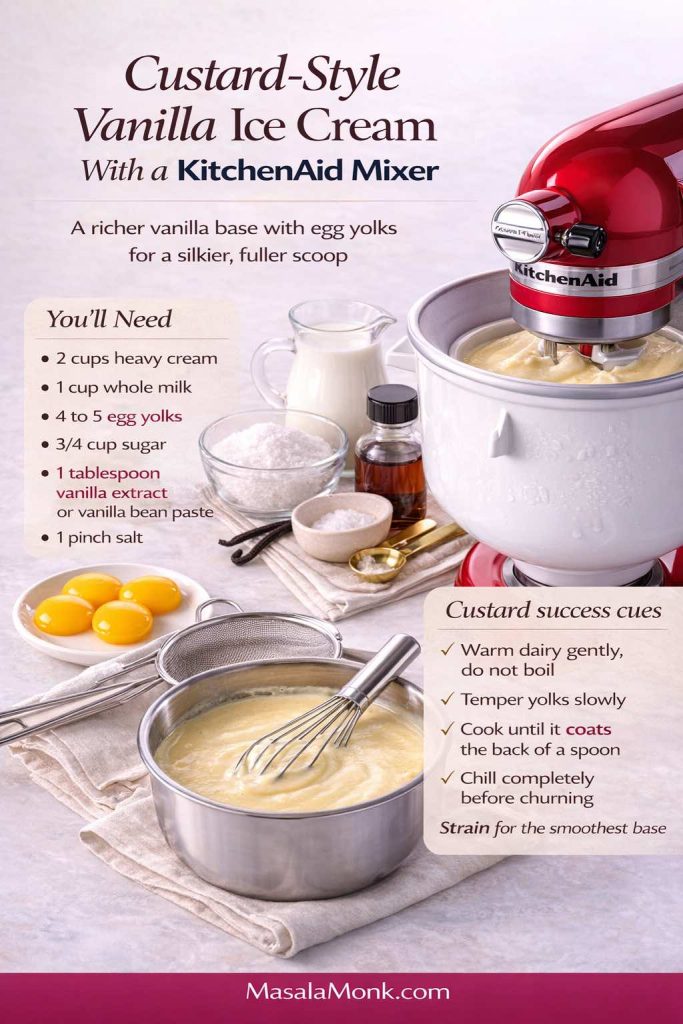
Custard-style vanilla ice cream ingredients
Use:
- 2 cups heavy cream
- 1 cup whole milk
- 4 to 5 egg yolks
- 3/4 cup sugar
- 1 tablespoon vanilla extract or vanilla bean paste
- 1 pinch salt
How to make the custard base
Warm the milk and cream gently until hot but not boiling. In another bowl, whisk the yolks and sugar until combined. Slowly pour in some of the warm dairy while whisking so the yolks temper rather than scramble. Then return everything to the pan and cook gently until the mixture thickens enough to coat the back of a spoon. Strain it, cool it, and then chill it thoroughly before churning.
What the custard base should feel like
A good custard base feels smooth, lightly thickened, and silky rather than heavy. Once chilled, it often feels more settled and richer than the eggless version. That extra richness carries through into the finished scoop.
Also Read: Ravioli Recipe Reinvented: 5 Indian-Inspired Twists on the Italian Classic
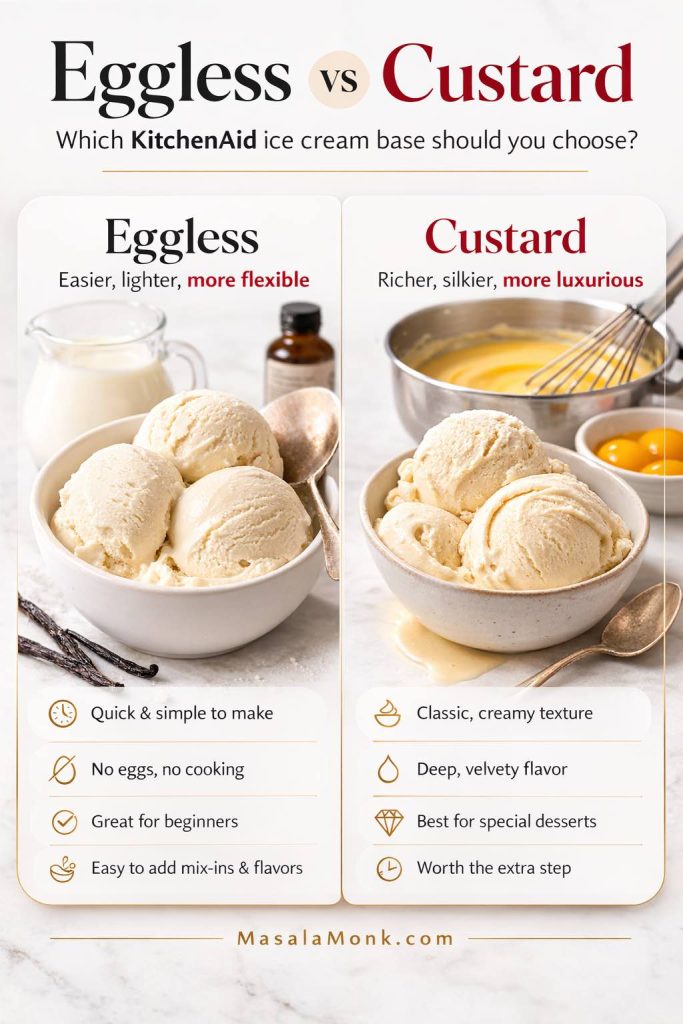
Eggless vs custard: which KitchenAid ice cream recipe should you choose?
The better choice depends on what kind of dessert you want rather than on some absolute hierarchy.
Choose the eggless version when you want ease
If you want something simple, flexible, and quick to prepare, the eggless base is ideal. It is especially good for batches where mix-ins, swirls, or syrups will provide much of the personality.
Choose the custard version when texture matters most
If you want a batch that feels more luxurious even before you add anything else, the custard route is the better fit. It gives the ice cream a rounder, fuller body and a more classic rich-dessert feel.
Neither version is a compromise
That distinction is important. The eggless version is not the “lesser” one. It is simply lighter, simpler, and often better for variation-heavy batches. The custard version is richer and more indulgent. They serve different moods.
If you enjoy creamy chilled desserts more generally, MasalaMonk’s no-bake banana pudding and mango shrikhand show how satisfying that richness can be in completely different formats.
Also Read: Croquettes Recipe: One Master Method + 10 Popular Variations
Before you churn: five habits that make a KitchenAid ice cream recipe work
The strongest batches are usually the product of a few simple habits rather than special tricks.
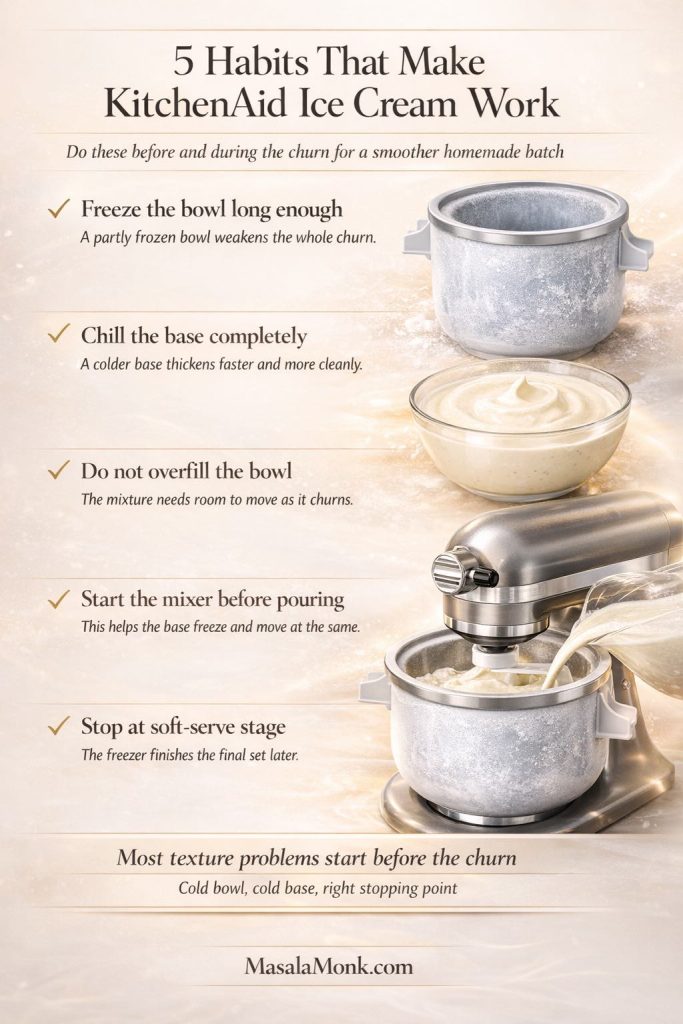
Freeze the bowl long enough
A partly frozen bowl weakens the whole churn. If there is one thing to overdo slightly, it is freezer time for the bowl.
Chill the base completely
A base that is merely cool instead of deeply cold often leads to a sloppier churn and a less confident final texture.
Do not overfill the bowl
The mixture needs room to move as it churns. Crowding the bowl slows down the freezing process and makes the texture less even.
Start the mixer before pouring the base
This helps the base begin freezing and moving at the same time rather than pooling in one place.
Stop at the soft-serve stage
This is one of the most important ideas in the entire method. Freshly churned ice cream should look like soft serve, not like a hard-packed freezer tub. The freezer finishes the job later.
Also Read: How to Make a Flax Egg (Recipe & Ratio for Vegan Baking)
Soft-serve stage vs scoop-ready stage
This distinction deserves extra attention because it solves one of the most common points of confusion.
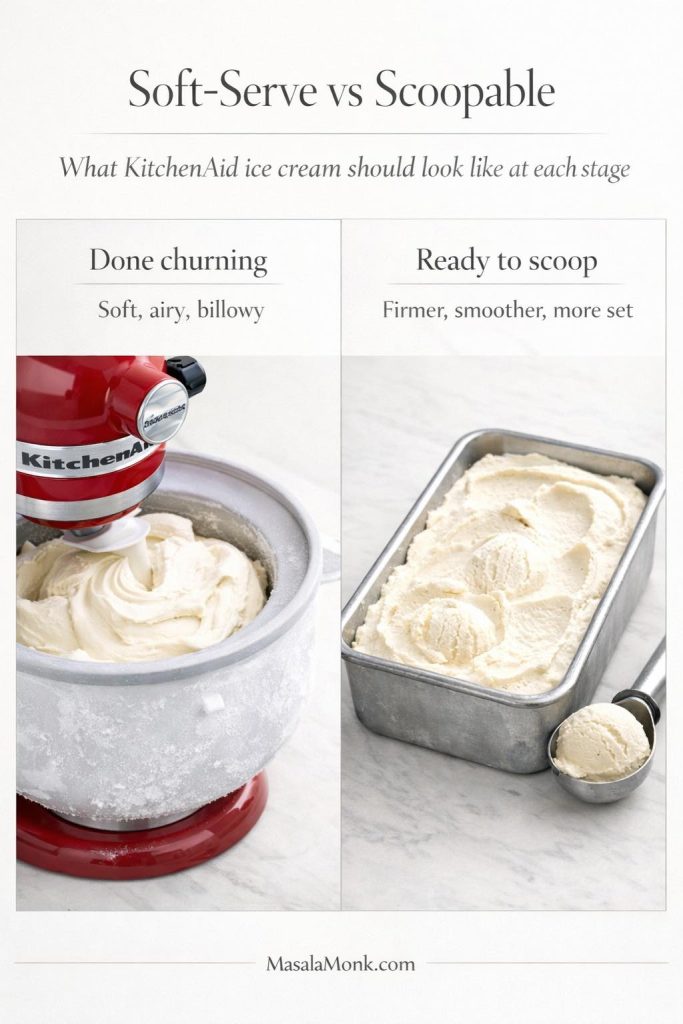
What done churning looks like
Done churning means the ice cream is airy, softly mounded, and able to hold visible lines from the dasher. It should still be soft. It should still look spoonable. And it should feel thick and creamy, not stiff.
What done churning does not look like
Done churning does not mean dense, hard, or fully scoop-ready. If you are waiting for the mixture to look like a freezer tub while it is still in the machine, you are asking the churn to do work that belongs to the post-churn freeze.
What scoop-ready looks like
Scoop-ready comes later. After a few hours in the freezer, the soft-serve texture settles into a firmer, calmer structure. The ice cream feels more stable, the scoop cuts more cleanly, and the shape holds better in the bowl.
Also Read: Pork Tenderloin in Oven (Juicy, Easy, 350°F or 400°F) Recipe
How to make ice cream with a KitchenAid mixer step by step
Once the prep is done, the actual method is refreshingly straightforward.
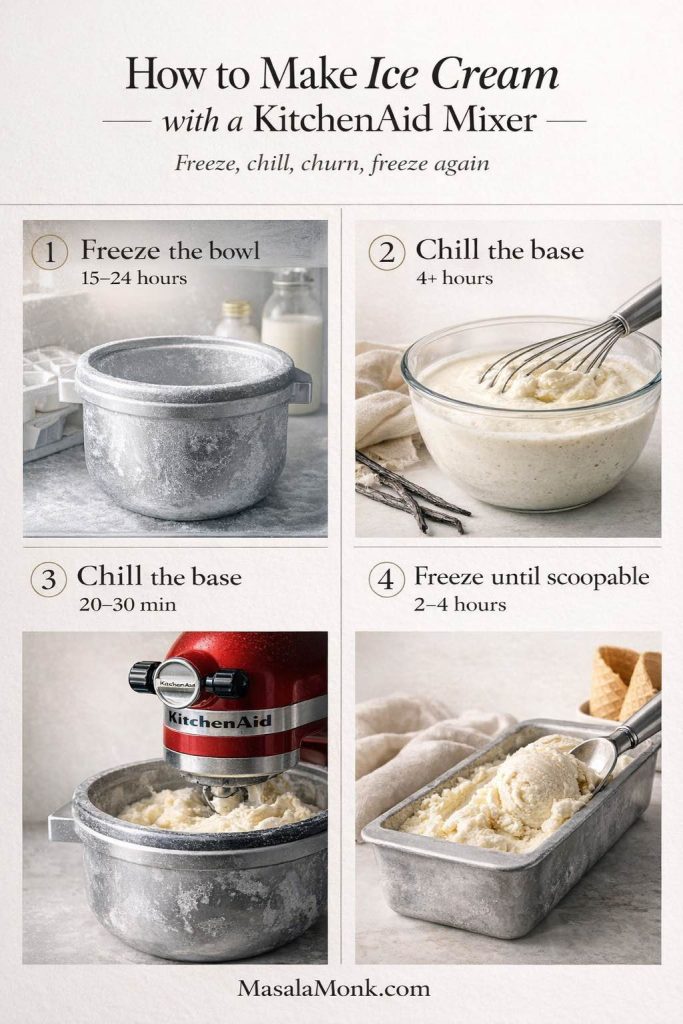
Step 1: Freeze the KitchenAid bowl
Place the bowl in the coldest part of your freezer and leave it there until fully solid.
Step 2: Make and chill the base
Prepare the eggless or custard base and chill it thoroughly. Do not rush this step.
Step 3: Assemble the KitchenAid ice cream attachment
Fit the frozen bowl and attach the dasher. Work with a little purpose so the bowl stays as cold as possible.
Step 4: Start the mixer and pour in the cold base
Turn the mixer to low and pour in the chilled base slowly. Let it churn until the mixture reaches soft-serve texture.
Step 5: Add mix-ins near the end
If you are using chopped cookies, nuts, chips, or brittle, add them only after the base has already thickened.
Step 6: Freeze for a firmer scoop
Transfer the churned batch to a chilled airtight container, cover it well, and freeze until scoopable.
Also Read: Chicken Pesto Pasta (Easy Base Recipe + Creamy, One-Pot, Baked & More)
How to make ice cream in a stand mixer without the attachment
This version is not just a backup plan. In some kitchens, it is the more practical and more realistic route.
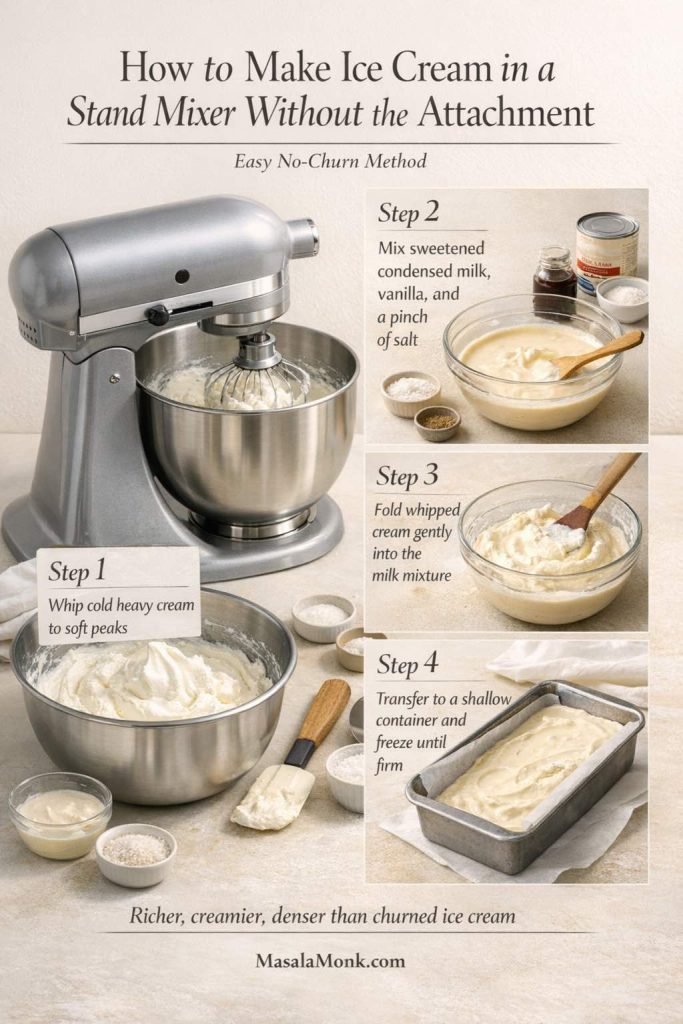
Why the no-attachment version works
Instead of freezing the base while it churns, this method builds body first and freezes second. The mixer helps whip air into a rich base, and the freezer sets that structure into something creamy and sliceable or scoopable, depending on how long it rests.
A simple no-attachment method
Whip 2 cups of cold heavy cream to soft peaks. In a separate bowl, stir together 1 can of sweetened condensed milk, vanilla, and a pinch of salt. Fold the whipped cream gently into the condensed milk mixture in several additions. Then transfer everything to a loaf pan or airtight container and freeze until firm.
How to fold the mixture without deflating it
Use a spatula. Scoop from the bottom and fold the mixture over itself gently rather than stirring in circles. The goal is to keep the whipped cream airy while combining everything thoroughly.
Also Read: Slow Cooker Pork Tenderloin (Crock Pot Recipe) — 3 Easy Ways
Best flavors for no-attachment ice cream in a stand mixer
Some flavor directions fit the no-attachment method especially well.
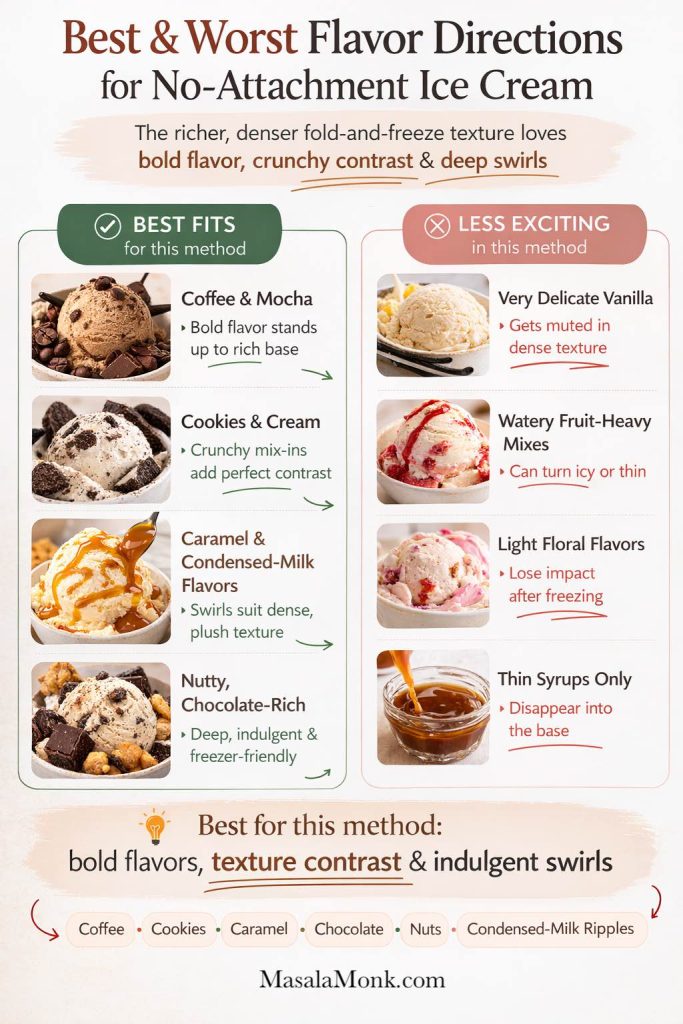
Coffee and mocha flavors
Espresso powder, coffee concentrate, and cocoa pair beautifully with the richer, denser feel of this style.
Cookie-heavy flavors
Cookies and cream, chocolate biscuit crumble, and other crumbly mix-ins work especially well because the base already leans indulgent.
Caramel and condensed-milk-friendly versions
Chocolate ripple, caramel swirl, and toasted nut additions all feel at home here.
Storage for no-attachment ice cream
Store it the same way you would churned ice cream: tightly covered in an airtight container. It also benefits from a short rest at room temperature before scooping. If condensed milk desserts appeal to you more broadly, MasalaMonk’s sweetened condensed milk fudge recipes are a fitting companion read.
Also Read: Keto Mocktails: 10 Low Carb, Sugar Free Recipes
What texture should homemade ice cream look like at each stage?
Learning to read the texture is one of the most useful parts of getting better at homemade ice cream with a stand mixer.
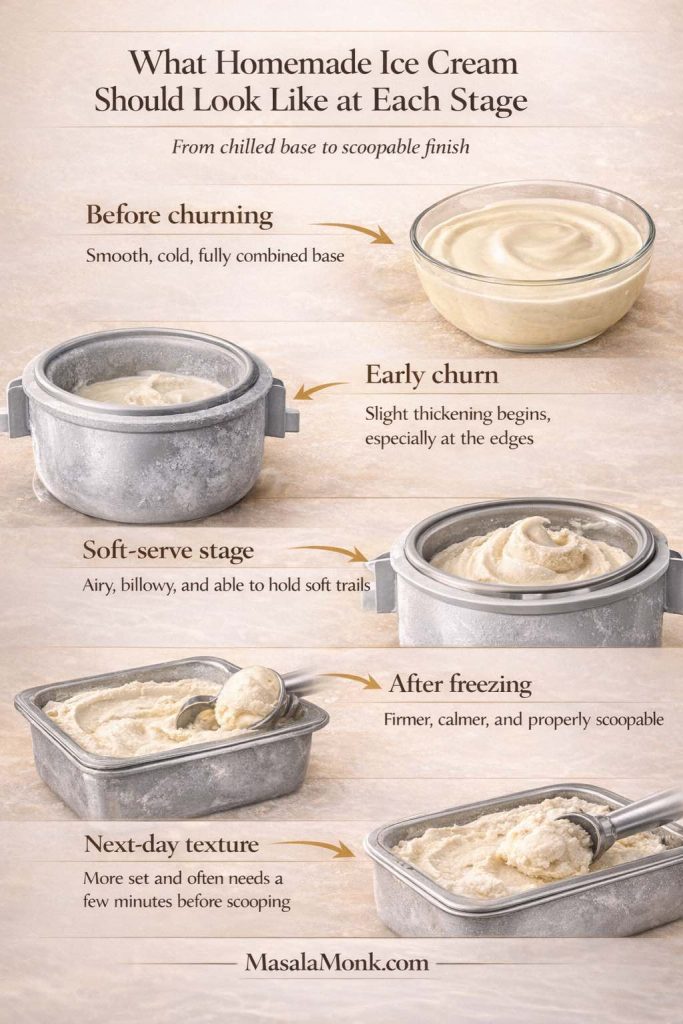
Before churning
The base should be smooth, cold, and fully combined.
Early churn stage
The mixture only thickens slightly at first, especially around the edges. That is normal.
Soft-serve stage after churning
This is the key visual cue. The ice cream should look airy, billowy, and thick enough to hold trails.
Scoopable stage after freezing
After a few hours in the freezer, the texture should become firmer and easier to scoop.
Next-day texture
By the next day, homemade ice cream is often firmer than commercial tubs. That is normal. It usually just means it needs a few minutes at room temperature before serving.
Also Read: Keto Mocktails: 10 Low Carb, Sugar Free Recipes
When to add mix-ins to a KitchenAid ice cream recipe
Mix-ins are where the recipe becomes unmistakably yours.
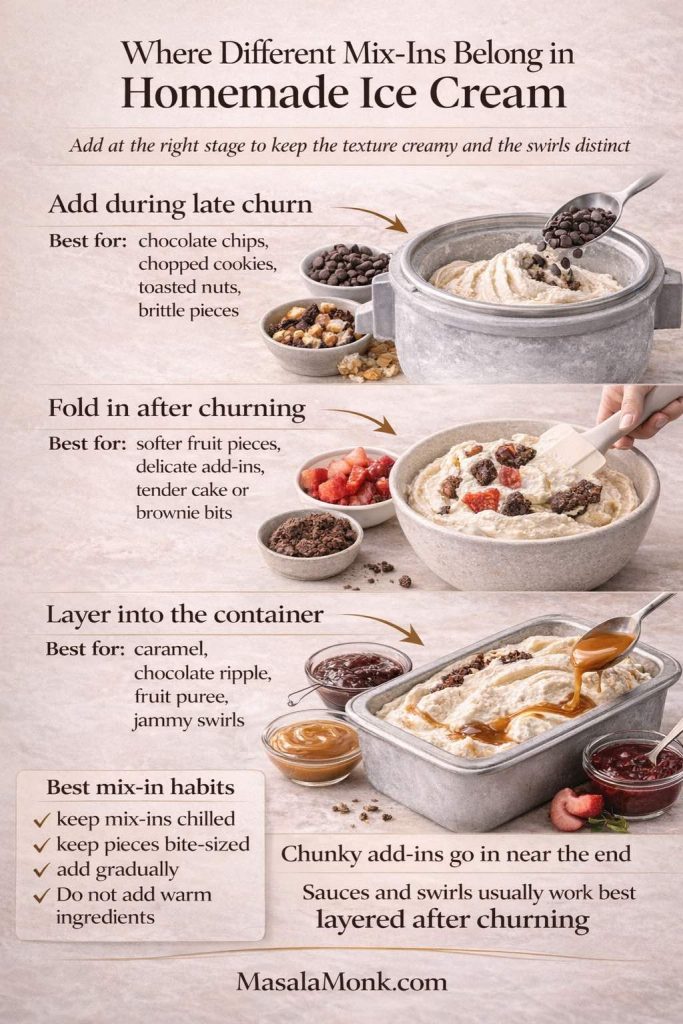
Chocolate chips, chopped cookies, and nuts
Add them near the end of the churn, once the base is already thick. For a richer cookies-and-cream direction, chopped pieces from MasalaMonk’s double chocolate chip cookies work beautifully.
Fruit swirls and puree ribbons
Fruit is better folded in at the end or layered into the container. That way, the ribbons stay distinct instead of disappearing into the whole batch.
Syrups, caramel, and chocolate ripples
Layer these into the container instead of fully mixing them through. A little homemade chocolate syrup can turn a simple chocolate or vanilla batch into something far more dessert-like.
How to keep mix-ins from clumping
Chill them first, keep them bite-sized, and add them gradually. Warm additions can soften the base and muddy the texture.
Also Read: Crock Pot Pork Chops and Sauerkraut (No Dry Chops Recipe)
KitchenAid ice cream troubleshooting
A good troubleshooting section can save your next batch even when it cannot save the current one.
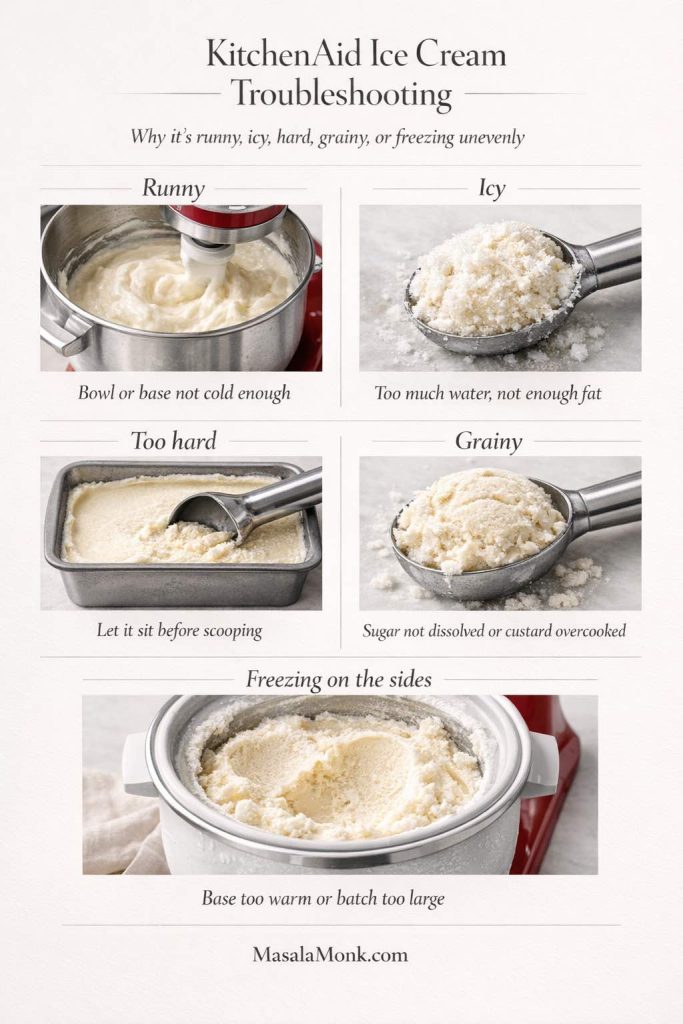
Why is my KitchenAid ice cream still runny?
Check the bowl freeze time first. Then check whether the base was fully chilled. After that, look at the batch size. If all of those seem right, consider whether the formula itself is too sugar-heavy or contains ingredients that soften the freeze too much.
Why did my homemade ice cream turn icy?
Look first at water-heavy ingredients, low fat content, and insufficient chilling. Fruit additions can also cause trouble if they bring too much moisture into the base without enough balance.
Why is homemade ice cream too hard after freezing?
Some firmness is normal. Let it sit out for 10 to 15 minutes before scooping. If every batch is rock hard, rethink the sugar and fat balance.
Why is my KitchenAid ice cream grainy or sandy?
Undissolved sugar can cause this. Overcooked custard can cause it too. So can poorly blended flavor additions.
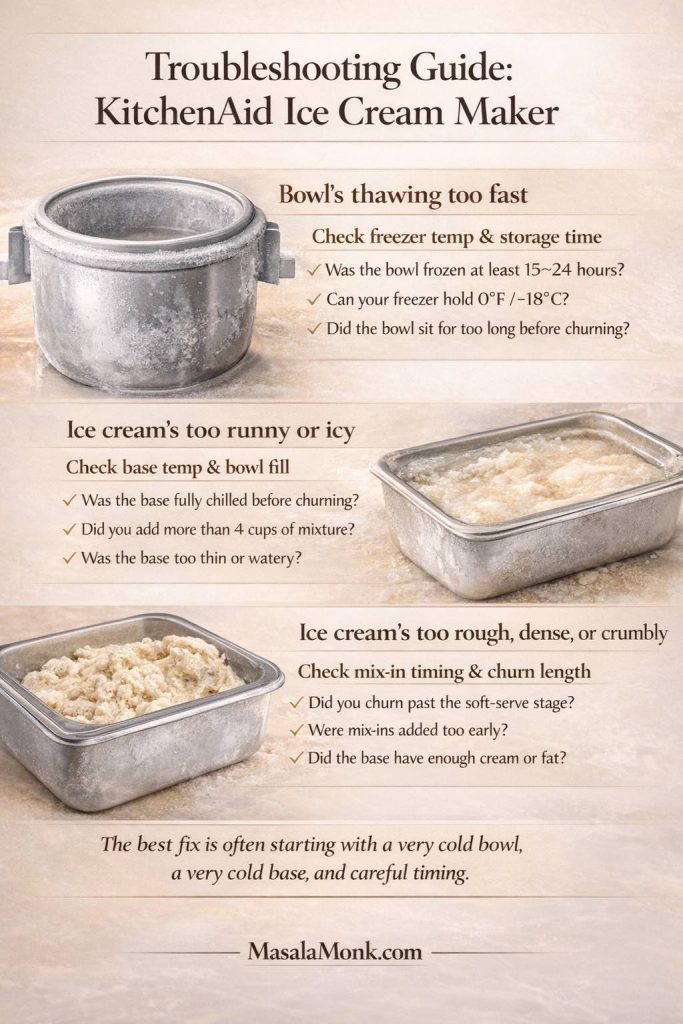
Why is it freezing at the sides but not in the middle?
That usually means the bowl is doing its job, but the base is too warm or too abundant for the churn to keep up.
Why does the ice cream feel buttery or greasy?
Over-churning or too much cream can push the texture away from creamy and toward buttery.
Why does the attachment click or feel awkward?
Sometimes a clicking or slipping sound means the churn is actually finished rather than broken. The mixture may simply have thickened as far as it should inside the bowl.
Also Read: Masterclass in Chai: How to Make the Perfect Masala Chai (Recipe)
How to store homemade ice cream made in a KitchenAid mixer
Storage changes the experience more than many people expect.
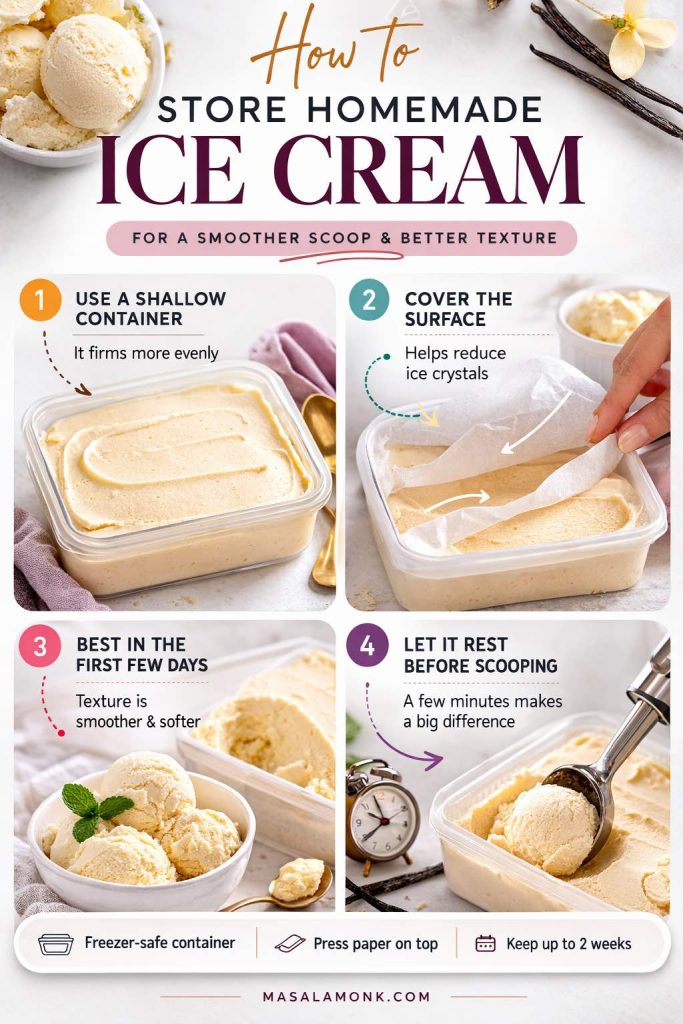
Best container for homemade ice cream
Use a shallow airtight container when possible. Pressing parchment or plastic wrap directly on the surface can help reduce ice crystals.
When the texture is at its best
Homemade ice cream is often most pleasant within the first few days, once it has set properly but before it has spent too long in the freezer.
Why homemade ice cream changes in storage
Without commercial stabilizers, it tends to become firmer and slightly drier over time.
How to soften it before scooping
Let it rest for a few minutes at room temperature before serving. That one habit can make a dramatic difference.
For more chilled dessert inspiration, MasalaMonk’s mango chia pudding ideas and no-bake banana pudding bring a different kind of make-ahead pleasure.
Also Read: Air Fryer Salmon Recipe (Time, Temp, and Tips for Perfect Fillets)
Best flavor variations for homemade ice cream with a stand mixer
Once you know how to make ice cream with a KitchenAid mixer, the base becomes a starting point rather than a finish line.
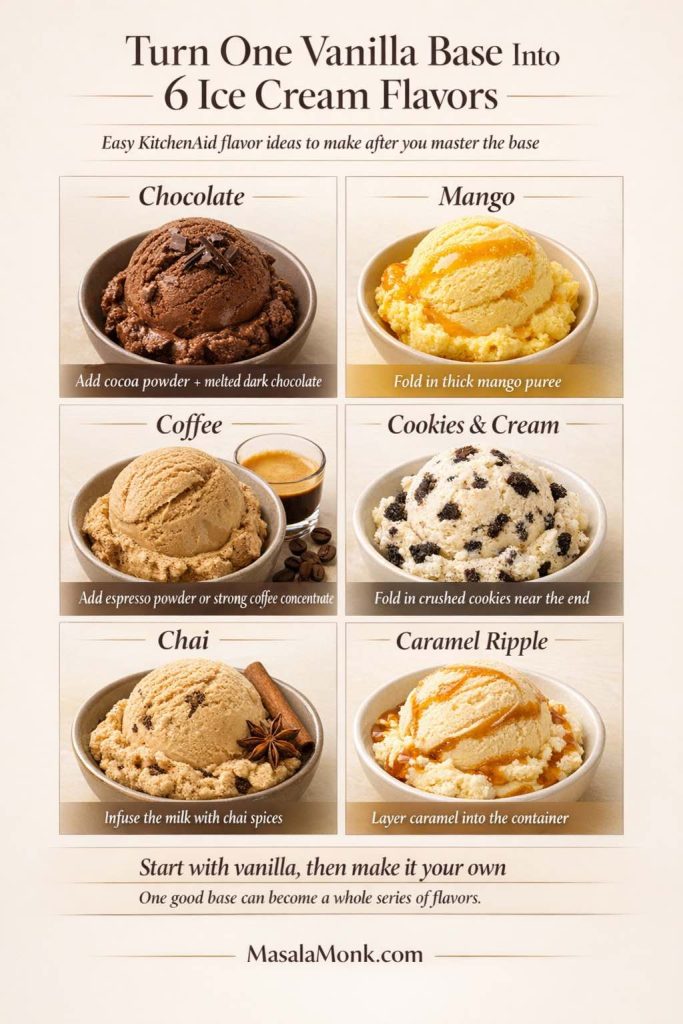
Chocolate ice cream with a KitchenAid mixer
Add cocoa powder and melted dark chocolate for a richer, deeper batch.
Mango ice cream with a KitchenAid mixer
Fold mango puree into the base for a fruit version that adds body as well as flavor. MasalaMonk’s mango dessert recipes are a lovely follow-on if you want to stay in that direction.
Coffee ice cream with a stand mixer
Espresso powder or strong coffee concentrate turns vanilla into an easy grown-up dessert. If you like the overlap between frozen desserts and coffee, MasalaMonk’s guide to cold brew, iced latte, frappe, and affogato pairs beautifully here.
Cookies and cream with a KitchenAid ice cream recipe
Crushed cookies folded in near the end remain one of the easiest crowd-pleasers.
Chai ice cream with a KitchenAid mixer
Infuse the milk with chai spices before making the base. For a stronger sense of spice balance, MasalaMonk’s masala chai masterclass is an excellent companion.
Also Read: Tapas Recipe With a Twist: 5 Indian-Inspired Small Plates
More ways to serve homemade ice cream with a stand mixer
A good batch deserves more than one way to be enjoyed.
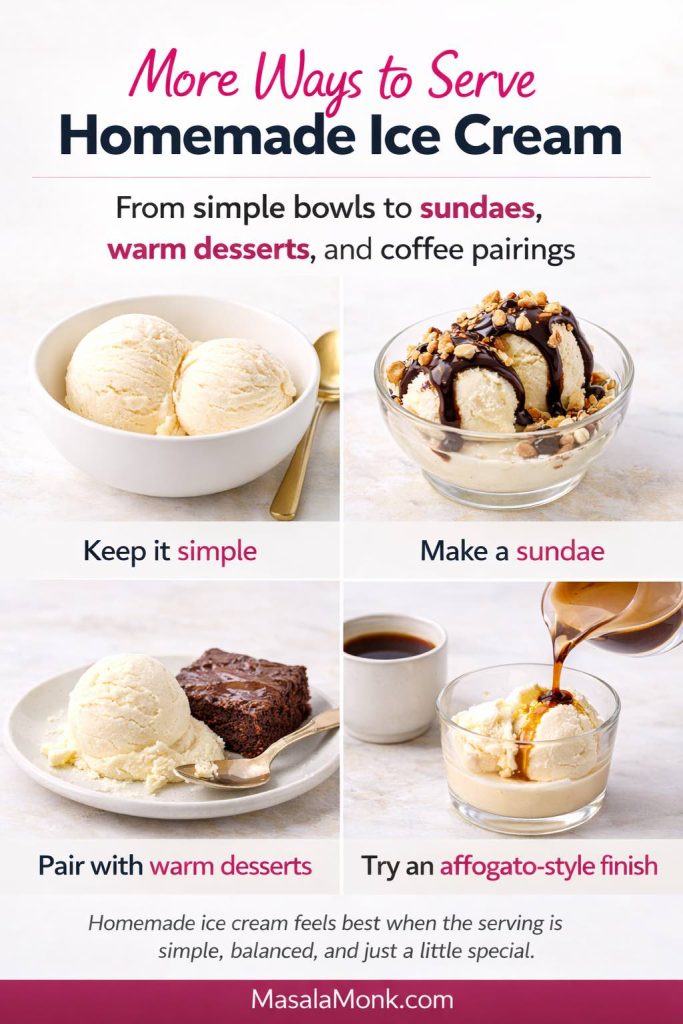
Serve it simply
A small bowl and a spoon are often enough, especially for the first taste when the texture is still the main thrill.
Turn it into a sundae
Chocolate syrup, toasted nuts, cookie crumbs, or a ripple of caramel can make the scoop feel much more abundant.
Pair it with warm desserts
Brownies, blondies, fruit crisps, and warm cookies all welcome a scoop of homemade ice cream beautifully.
Try coffee-dessert pairings
Vanilla or coffee ice cream served affogato-style can feel especially satisfying after dinner.
Also Read: Air Fryer Donuts Recipe (2 Ways): Glazed Homemade Donuts + Biscuit Donuts
A simple vanilla recipe summary
For the shortest version to return to often, whisk together:
- 2 cups heavy cream
- 1 cup whole milk
- 3/4 cup sugar
- 1 tablespoon vanilla extract
- 1 pinch salt
Chill the base thoroughly. Freeze the bowl until fully solid. Assemble the attachment, start the mixer on low, and pour in the cold base. Churn until it looks like soft serve. Add mix-ins near the end if you like. Then freeze the mixture in a covered container until scoopable.
Final thoughts on how to make ice cream with a KitchenAid mixer
How to make ice cream with a KitchenAid mixer becomes much less mysterious once you understand the rhythm. Freeze the bowl thoroughly. Chill the base completely. Start the mixer before pouring. Churn to the soft-serve stage. Freeze for the final set. That is the pattern.
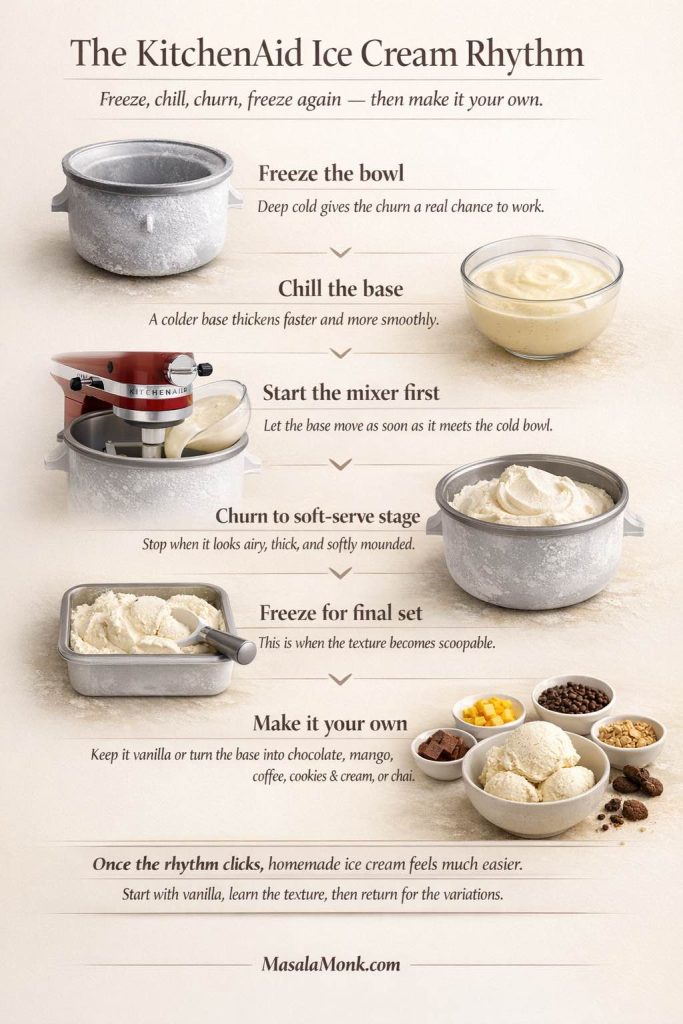
More importantly, learning how to make ice cream with a KitchenAid mixer gives you a method rather than just one dessert. The same base can become vanilla, chocolate, mango, coffee, cookies and cream, or chai. It can be eggless and easy or richer and custard-based. It can be churned with the attachment or adapted into a no-attachment frozen dessert when that is the version your kitchen allows.
That flexibility is part of the real pleasure. Homemade ice cream tastes fresher, feels more personal, and gives you more control over sweetness, richness, and texture than most store-bought tubs. Start with vanilla, let the first batch teach you the texture, and then come back for the variations. Once that first good scoop lands in a bowl, the whole process tends to feel much simpler and much more enjoyable than it ever sounded at the beginning.
Also Read: Paloma Recipe: 12 Paloma Cocktail Drinks
FAQs
1. Can you make ice cream with a KitchenAid mixer?
Yes, you can make ice cream with a KitchenAid mixer, and the easiest method uses the ice cream maker attachment with a fully frozen bowl and a thoroughly chilled base. Once the mixer starts churning, the base gradually thickens until it reaches a soft-serve texture, after which it needs extra freezer time for a firmer scoop. Even if you do not have the attachment, a no-attachment version is still possible with whipped cream and a sweetened base, although the texture will be denser and less airy.
2. How do you make ice cream with a KitchenAid mixer?
To make ice cream with a KitchenAid mixer, freeze the ice cream bowl until deeply cold, chill the ice cream base completely, assemble the attachment, start the mixer on low, and pour the base in slowly while the dasher is moving. Then churn until the mixture looks thick and airy like soft serve. Afterward, transfer it to a covered container and freeze it until scoopable. In most cases, the real key is not complexity but temperature. The colder the bowl and base, the better the result.
3. How long do you churn ice cream in a KitchenAid mixer?
Most homemade ice cream takes about 20 to 30 minutes to churn in a KitchenAid mixer when the bowl is fully frozen and the base is properly chilled. If the mixture is still very loose after that point, the problem is often that the bowl was not cold enough or the base went in too warm. By comparison, a well-chilled base in a deeply frozen bowl usually thickens much more confidently.
4. How long should you freeze the KitchenAid ice cream bowl?
The KitchenAid ice cream bowl should usually be frozen overnight at minimum. In many kitchens, longer is even better, especially if the freezer is opened often or runs a little warm. A bowl that is only partly frozen can lead to a runny or slushy batch, so it is better to give it more time rather than less.
5. Why is my KitchenAid ice cream not thickening?
If your KitchenAid ice cream is not thickening, the most common causes are a bowl that was not frozen long enough, a base that was not chilled completely, or a batch that was too large for the bowl to handle efficiently. Sometimes the formula can also be part of the problem, especially if it contains too much sugar or alcohol. Generally speaking, the first thing to check is temperature, since that is where most churning problems begin.
6. Why is my homemade ice cream runny after churning?
Freshly churned homemade ice cream should be soft, but it should not be pourable. If it is still runny, the bowl may have warmed up too quickly, the base may have gone in too warm, or the recipe may need better balance. On the other hand, if it resembles soft serve and holds soft mounds, that is normal. At that stage, it still needs freezer time before it becomes firm enough to scoop neatly.
7. Why is homemade ice cream hard after freezing?
Homemade ice cream often freezes harder than store-bought ice cream because it contains fewer stabilizers and commercial texture enhancers. Even so, that does not mean anything went wrong. Usually, it just needs a few minutes at room temperature before scooping. If it becomes rock hard every single time, however, the base may need a little more sugar or fat for better balance.
8. What should homemade ice cream look like when it is done churning?
When homemade ice cream is done churning, it should look like soft serve. It should be thick, airy, softly mounded, and able to hold visible lines from the dasher. By contrast, it should not look like a fully frozen tub straight from the freezer. That firmer, scoop-ready texture comes later, once the churned ice cream has rested in the freezer for a few more hours.
9. Can you make ice cream in a stand mixer without the ice cream attachment?
Yes, you can make ice cream in a stand mixer without the ice cream attachment, although the method is different. Instead of freezing while churning, you whip structure into the base first and then let the freezer finish the work. This version is often made with whipped cream and sweetened condensed milk. As a result, it tends to be denser than churned ice cream, yet it can still be very creamy and satisfying.
10. What is the best base for vanilla ice cream in a KitchenAid mixer?
The best base depends on what kind of result you want. An eggless base is easier, faster, and lighter, which makes it ideal for beginners and for batches with mix-ins. Meanwhile, a custard-style base made with egg yolks is richer, silkier, and more luxurious. Therefore, the better choice is not universal. It depends on whether you want convenience or a deeper dessert-style texture.
11. Can you make eggless ice cream with a KitchenAid mixer?
Yes, eggless ice cream works very well in a KitchenAid mixer. In fact, it is one of the easiest ways to start because the base is simple to prepare and still gives you a creamy result when the bowl and mixture are fully cold. Eggless vanilla ice cream is especially useful if you plan to add cookies, fruit, chocolate, coffee, or other strong flavor additions later.
12. When do you add mix-ins to a KitchenAid ice cream recipe?
Mix-ins are best added near the end of churning, once the ice cream base has already thickened. At that point, the texture is strong enough to hold chopped cookies, chocolate chips, nuts, or fruit pieces without losing too much structure. If you add them too early, they can sink, clump, or interfere with the freezing process before the base is ready.
13. How do you store homemade ice cream made in a KitchenAid mixer?
Homemade ice cream should be stored in a shallow, airtight container in the freezer. For even better protection, press parchment paper or plastic wrap directly onto the surface before sealing the lid. That helps reduce ice crystals and keeps the texture smoother. Then, before serving, let the ice cream sit out for a few minutes so it softens enough to scoop more easily.
14. What flavors work best when you make ice cream with a KitchenAid mixer?
Vanilla is the best place to begin because it teaches the method clearly, but once you know how to make ice cream with a KitchenAid mixer, many flavors work beautifully. Chocolate, coffee, mango, cookies and cream, chai, caramel, and fruit swirls are all excellent options. In particular, flavors with strong texture contrast or rich mix-ins tend to feel especially rewarding in homemade ice cream.
15. Is homemade ice cream better with a custard base or without eggs?
Both versions can be excellent, although they create slightly different results. A custard base made with egg yolks usually tastes richer and feels silkier, while an eggless base is cleaner, easier, and more flexible. Consequently, the choice depends on whether you want a more luxurious scoop or a more straightforward recipe that is easy to adapt.
16. Why does my KitchenAid ice cream freeze on the sides but stay soft in the middle?
This usually happens when the bowl is freezing the outer edge of the base but the mixture overall is too warm or too abundant for the churn to keep up. In that case, the solution is often to chill the base longer, use a slightly smaller batch, or freeze the bowl more thoroughly next time. Once those conditions improve, the freezing tends to become much more even.
17. Can you make chocolate ice cream with a KitchenAid mixer?
Yes, chocolate ice cream works beautifully in a KitchenAid mixer. You can make it by adding cocoa powder, melted chocolate, or both to the base. For a deeper result, using both often gives the best flavor because cocoa adds intensity while melted chocolate adds body. After that, the method stays almost exactly the same as vanilla: chill the base thoroughly, churn to soft-serve stage, and freeze until scoopable.
18. Is making ice cream in a KitchenAid mixer worth it?
Yes, making ice cream in a KitchenAid mixer is worth it if you enjoy homemade desserts and want more control over flavor, sweetness, richness, and texture. Once the method becomes familiar, it stops feeling complicated and starts feeling dependable. Besides that, it gives you the freedom to make flavors and mix-in combinations that are much harder to find in ready-made tubs.








