Posted on 2 Comments

Whipped Cream Recipe

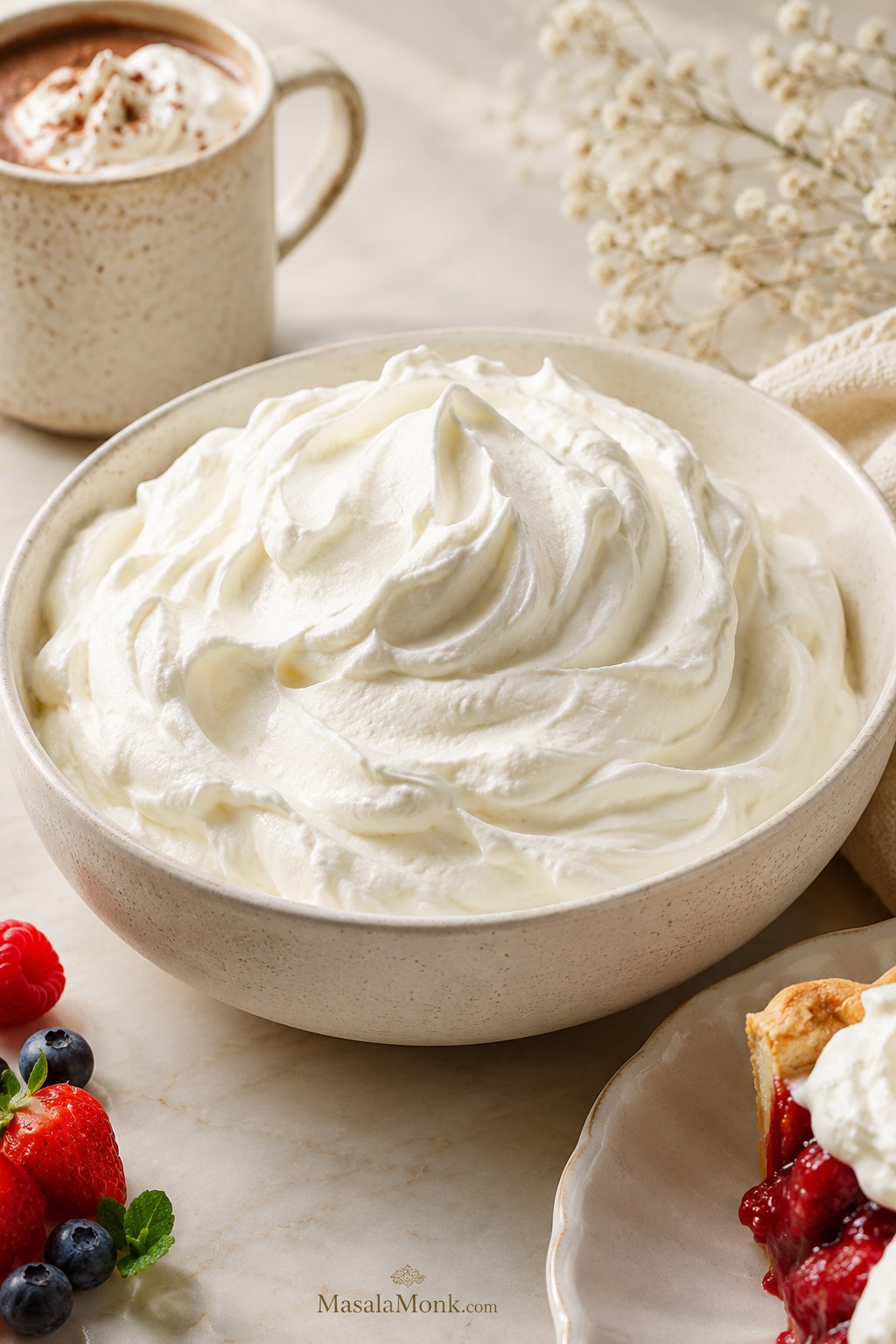
A bowl of homemade whipped cream with glossy soft peaks, served with berries, pie, and hot chocolate on a warm ivory surface.

This homemade whipped cream recipe turns heavy cream, powdered sugar, and vanilla into a soft, fluffy topping for pies, cakes, fruit, hot chocolate, pancakes, waffles, and no-bake desserts. Once you know the stopping point, it feels almost unfairly easy: fresher, softer, and cleaner-tasting than anything from a tub or can.

It is also one of the fastest ways to make a simple dessert feel intentional. A bowl of berries, a warm slice of pie, or a mug of hot chocolate suddenly feels finished when there is a spoonful of cool, billowy cream on top.

The method is simple: choose cream that can whip, sweeten it lightly, and stop while the texture is still glossy. The full recipe comes early, followed by the details that help you adjust sweetness, choose the right peak stage, fix mistakes, make it ahead, and use it on cakes or desserts.

What Good Whipped Cream Should Look Like

Before you start whipping, keep the target texture in mind: homemade whipped cream should look glossy, soft, and billowy, not dull, dry, or grainy.
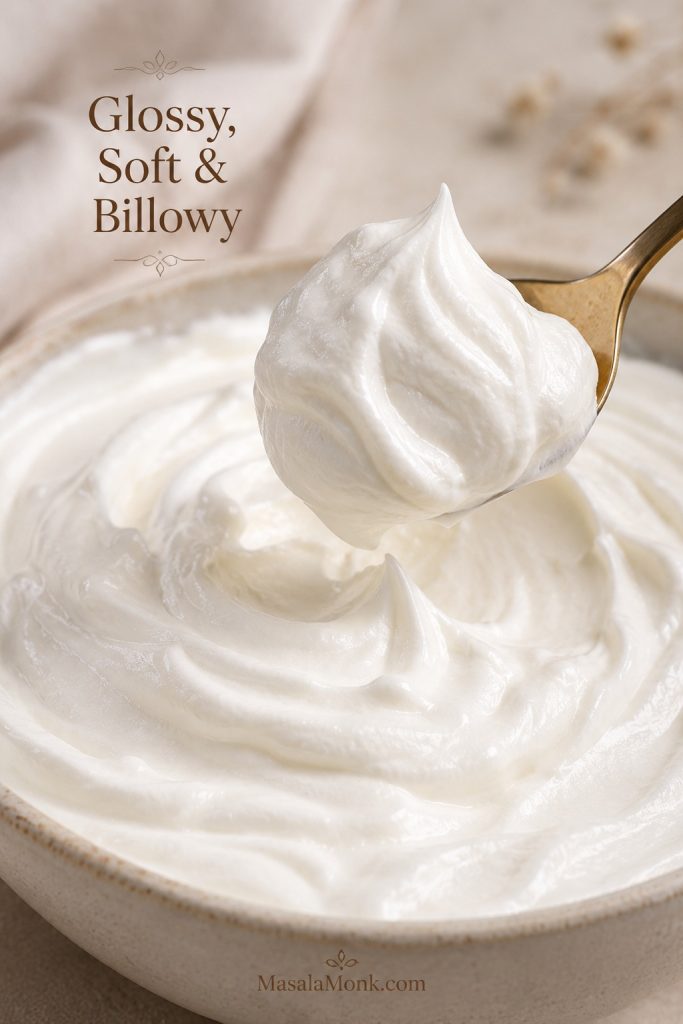
Close-up of glossy homemade whipped cream with soft folds and a spoon lifting a billowy mound.
Look for a surface that still shines. When whipped cream turns dull, clumpy, or dry-looking, it is usually moving past the ideal stage.

Quick Answer: How to Make Whipped Cream

Quick answer: To make whipped cream, beat 1 cup cold heavy cream with 2 tablespoons powdered sugar and 1/2 to 1 teaspoon vanilla until soft, medium, or stiff peaks form. One cup of cream makes about 2 cups whipped cream. For most desserts, aim for medium peaks: glossy, spoonable peaks that bend gently at the tip.

Start the mixer on low so the cream does not splash, then increase the speed once the sugar has blended in. The cream is ready when the beater leaves soft trails in the bowl and the lifted cream forms a peak that holds for a moment before gently bending.

For everyday desserts, do not chase stiff peaks unless you need a firmer topping. Once you see trails from the beaters, stay close — the final stretch happens quickly.

For strawberry shortcake, a gently bending texture is better than stiff peaks because the cream should soften into the berries and cake instead of sitting on top like frosting.

Whipped Cream at a Glance

Use this as the fast reference before making the recipe.

Detail Recommended answer
Prep time 5 minutes
Yield About 2 cups whipped cream, or 8 servings of about 1/4 cup each
Base ratio 1 cup cream + 2 tablespoons powdered sugar + 1/2 to 1 teaspoon vanilla
Best everyday texture Medium peaks: glossy, soft, and gently bending
Storage Best the same day; refrigerate 24–48 hours if needed

Homemade Whipped Cream Recipe Card

This is the full basic recipe. After the card, you’ll find scaling, ingredient notes, cream-type guidance, texture cues, fixes, storage, and variations.

Homemade Whipped Cream Recipe

This whipped cream recipe uses cold heavy cream, powdered sugar, and vanilla for a smooth, fluffy topping that works for pies, cakes, fruit, hot chocolate, pancakes, waffles, and no-bake desserts.

Prep Time
5 minutes
Cook Time
0 minutes
Yield
About 2 cups
Servings
8 servings
Serving Size
About 1/4 cup
Default Texture
Medium peaks
Cream
Heavy cream or heavy whipping cream
Best Used
Same day

Ingredients

  • 1 cup / 240 ml cold heavy cream or heavy whipping cream
  • 2 tablespoons / about 15 g powdered sugar
  • 1/2 to 1 teaspoon vanilla extract
  • Tiny pinch of fine salt, optional

Instructions

  1. Chill a metal mixing bowl for 10–15 minutes if your kitchen is warm.
  2. Add the cold heavy cream, powdered sugar, vanilla, and optional salt.
  3. Beat on low speed for 20–30 seconds to combine without splashing.
  4. Increase to medium or medium-high speed.
  5. Once visible trails form, check every few seconds. For most desserts, stop when the cream holds a soft mound on a spoon, looks glossy, and bends gently at the tip.
  6. Stop earlier for loose toppings, or continue carefully for firmer peaks.
  7. Use immediately, or refrigerate and gently re-whisk before serving if needed.

Notes

  • Do not walk away once beater trails stay visible; the final stage happens quickly.
  • For a less sweet topping, use 1 tablespoon powdered sugar.
  • For a sweeter dessert cream, use 3 tablespoons powdered sugar.
  • For cakes or piping, this fresh version is best served the same day; use a cake-stable version for longer hold.
  • Not sure what medium peaks look like? Use the peak guide before you keep beating.
  • If the cream turns grainy, stop mixing and fold in 1 tablespoon cold cream by hand.
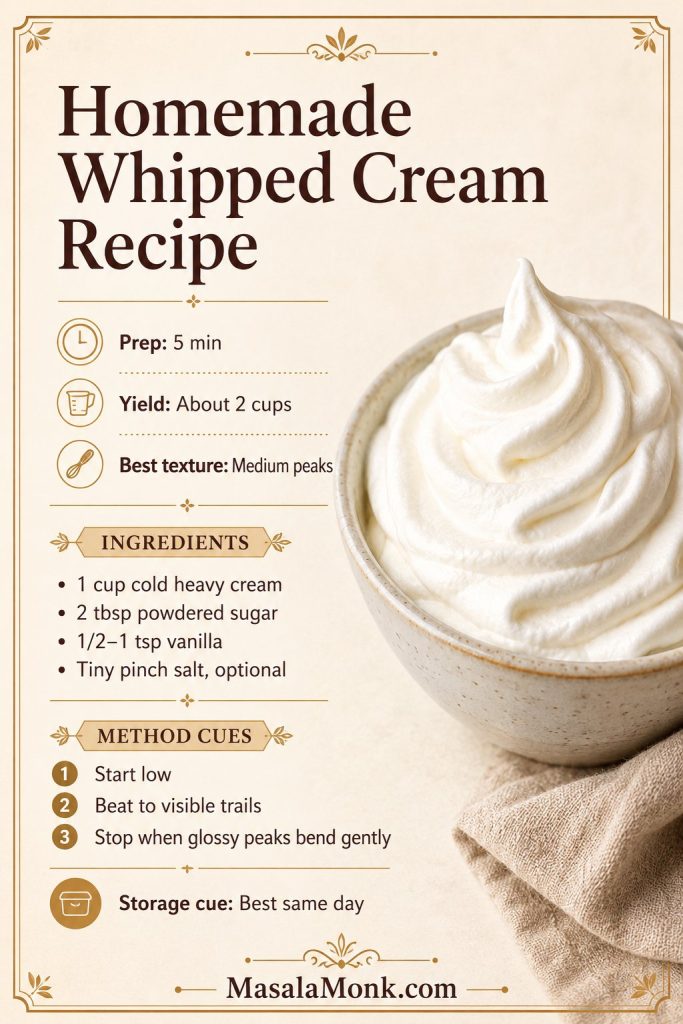
Saveable homemade whipped cream recipe card showing heavy cream, powdered sugar, vanilla, prep time, yield, and medium peak guidance.
The base ratio is easy to remember, but timing matters more than the clock. Once the cream forms visible trails, check the peaks often so you stop before the texture turns grainy.

How to Scale This Whipped Cream Recipe

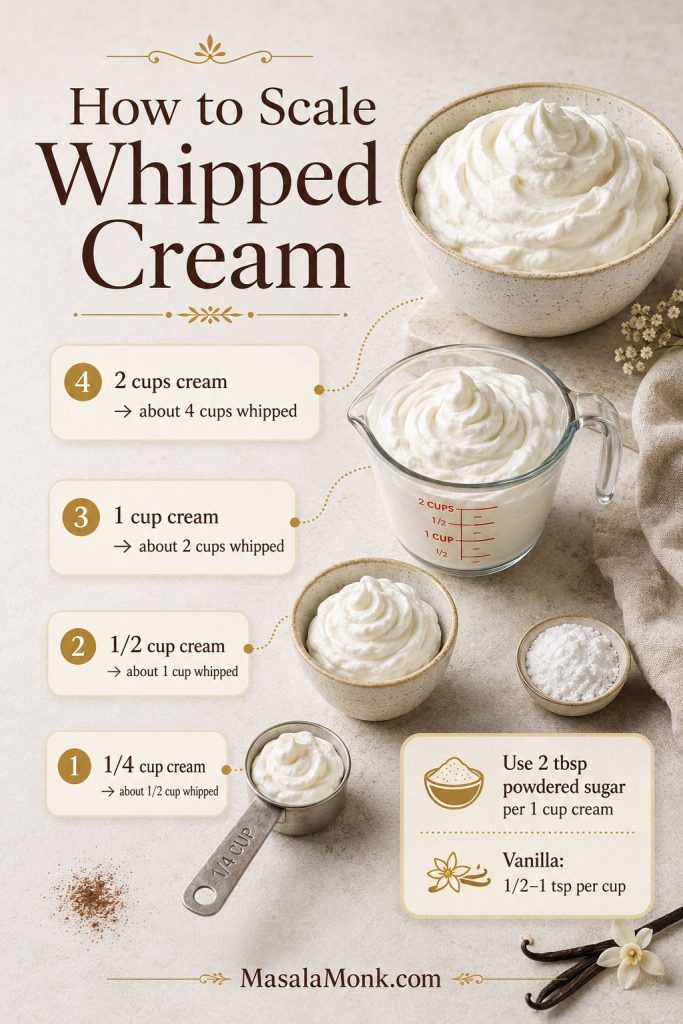
The recipe scales easily. You can make just enough for two mugs of hot chocolate or enough for a whole pie without changing the method.

Cream Powdered sugar Vanilla Approximate yield Best for
1/4 cup / 60 ml 1–2 teaspoons 1/8–1/4 teaspoon About 1/2 cup whipped cream Coffee, hot chocolate, berries for one or two.
1/2 cup / 120 ml 1 tablespoon / 7–8 g 1/4–1/2 teaspoon About 1 cup whipped cream Fruit, pancakes, waffles, or a small dessert.
1 cup / 240 ml 2 tablespoons / about 15 g 1/2–1 teaspoon About 2 cups whipped cream Pie topping, cake slices, shortcakes, pudding, or family dessert.
2 cups / 480 ml 1/4 cup / about 30 g 1–2 teaspoons About 4 cups whipped cream Dessert table, larger pie, trifle, or crowd serving.
Whipped cream scaling guide showing different cream amounts, powdered sugar, vanilla, approximate yield, and best uses.
Cream expands as it whips, so a small amount goes further than it looks. Make a tiny batch for coffee or berries, then scale up for pie, cake, trifle, or a dessert table.

If you are scaling whipped cream for a cake, cupcakes, or any dessert that needs to sit longer, check the regular vs stabilized whipped cream guide before choosing the final texture.

Why This Whipped Cream Recipe Works

This whipped cream recipe works because it does not ask you to do anything fussy. Cold cream, a smooth sweetener, and the right stopping point give you a topping that feels light, fresh, and homemade without turning stiff or grainy.

  • Cold cream traps air better. When the fat in the cream is cold, the cream whips faster and holds a smoother shape.
  • Powdered sugar dissolves easily. It sweetens the cream without leaving a gritty texture.
  • The right peak stage keeps it soft. The cream should hold a gentle mound but still taste cool, light, and fresh.
  • Stopping early prevents graininess. Once the beater trails stay visible, whipped cream can move from perfect to overworked quickly.

Homemade Whipped Cream Ingredients

With only three main ingredients, quality and balance matter. The cream gives body, the sugar smooths the flavor, and vanilla makes the topping taste like dessert instead of plain whipped dairy.
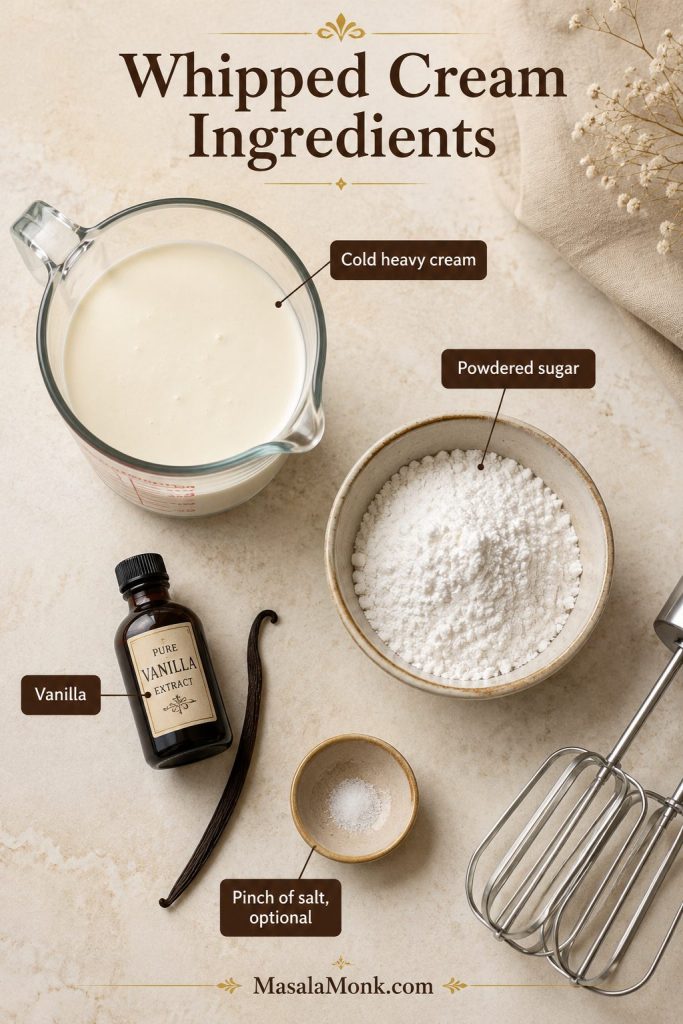
Ingredients for homemade whipped cream, including cold heavy cream, powdered sugar, vanilla, optional salt, and a whisk.
Each ingredient has a simple job: cream builds body, sugar smooths the flavor, and vanilla makes the topping taste like dessert. Because the list is short, cream quality matters.
Ingredient Amount Why it matters
Cold heavy cream or heavy whipping cream 1 cup / 240 ml The base of the recipe. Use it straight from the fridge.
Powdered sugar 2 tablespoons / about 15 g Sweetens smoothly without gritty crystals.
Vanilla extract 1/2 to 1 teaspoon / 2.5–5 ml Adds the classic dessert flavor.
Fine salt Tiny pinch, optional Balances sweetness, especially with chocolate, caramel, or very sweet desserts.

For a less sweet topping, use only 1 tablespoon powdered sugar per cup of cream. For a sweeter cream closer to Chantilly cream, use 3 tablespoons. The 2-tablespoon version is the easiest middle ground for pies, fruit, hot chocolate, pancakes, and no-bake desserts.

Heavy Cream vs Whipping Cream: Which One Works Best?

For the easiest success, use heavy cream or heavy whipping cream. In U.S. labeling, heavy cream is cream with at least 36% milkfat, which helps it whip into fuller peaks and hold its shape longer.

Outside the U.S., cream names vary. The label matters more than the name, so look for cream meant for whipping and check the fat percentage when it is listed.
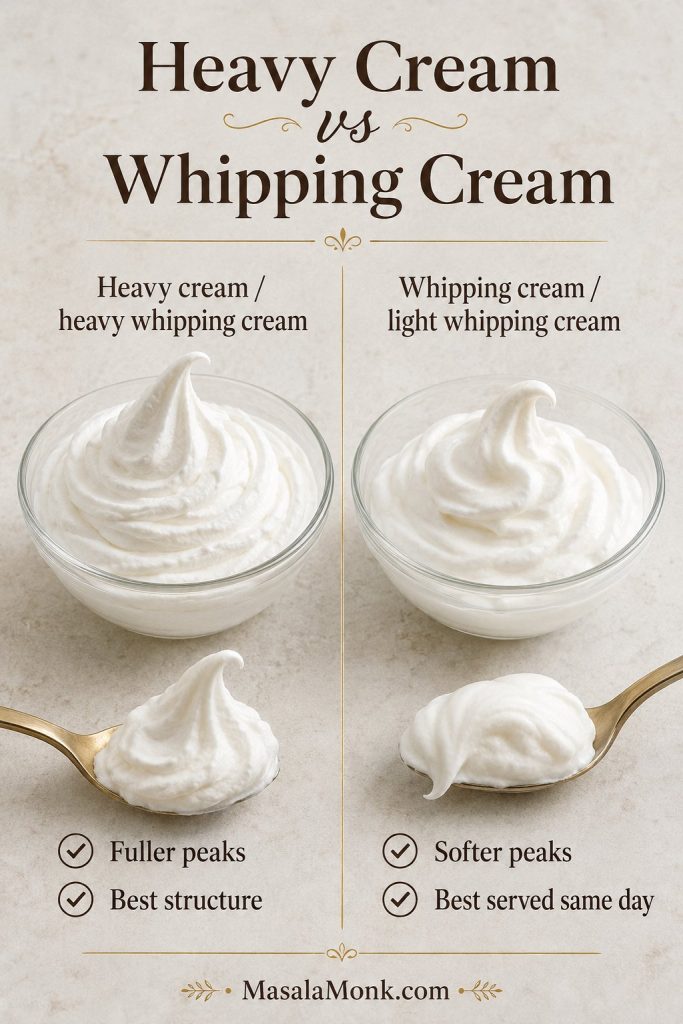
Side-by-side comparison of whipped cream made with heavy cream and lighter whipping cream, showing fuller and softer peaks.
Before blaming your mixer, check the carton. Heavy cream usually gives stronger peaks, while lighter whipping cream makes a softer topping that is best served soon.
Cream type Will it whip? Use it for
Heavy cream / heavy whipping cream Yes, most dependable Fuller whipped cream with the best structure.
Whipping cream / light whipping cream Yes, but softer A soft topping for same-day desserts.
Double cream Yes, very rich Rich whipped cream, though it can overwhip quickly.
Fresh cream / regional fresh cream Depends on fat percentage May thicken softly, but may not form firm, lasting peaks.
Lower-fat cream Usually not well Cooking, sauces, coffee, or desserts where whipped peaks are not required.
Milk or half-and-half No They do not have enough fat for classic whipped cream.

If your cream refuses to thicken, check the carton before blaming your technique. Cream meant for cooking, coffee, or sauces may not have enough fat to whip properly. In places where “fresh cream” is common, choose a whipping label or a higher fat percentage when you want lasting peaks.

What Will Whip and What Will Not

If the cream looks loose even after chilling and whipping, use this carton check before adding more sugar. The issue is often the product, not your effort.
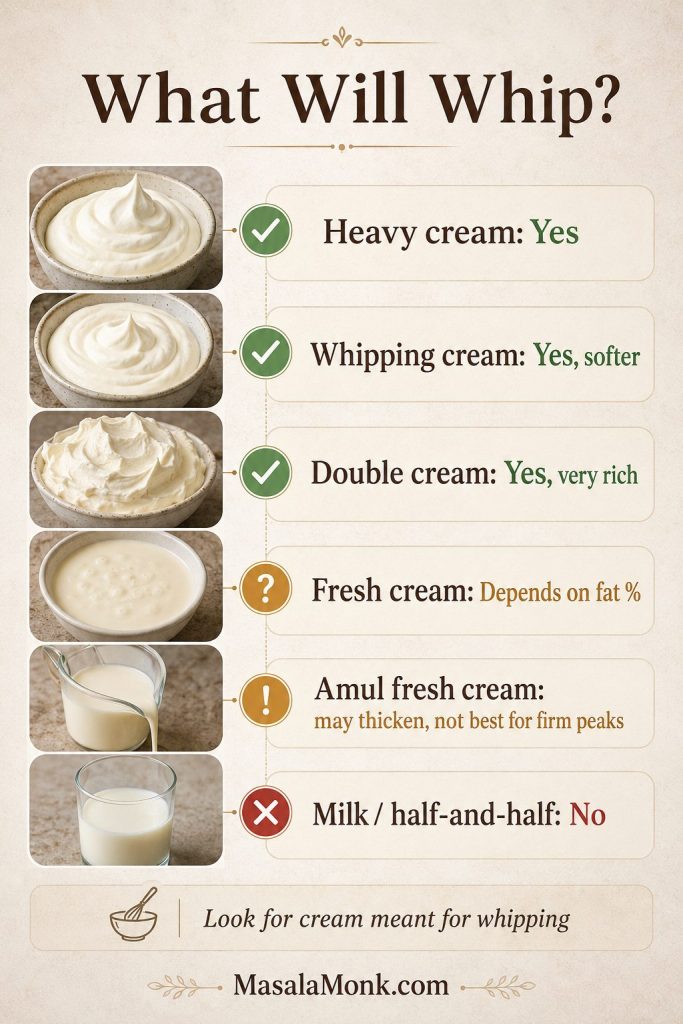
Guide showing which dairy products whip into whipped cream, including heavy cream, whipping cream, double cream, fresh cream, Amul fresh cream, milk, and half-and-half.
Not every dairy product can trap enough air to become whipped cream. For reliable peaks, choose cream labeled for whipping; milk, half-and-half, and many lower-fat creams stay too loose.

If your bowl still looks runny after choosing the right cream, jump to the troubleshooting guide before changing the recipe.

Sugar Options for Whipped Cream

Powdered sugar is the easiest sweetener because whipped cream is not heated. Larger sugar crystals can stay slightly gritty if they do not dissolve fully.

Sweetener Works well for Watch-out
Powdered sugar Smooth, classic whipped cream The easiest default for most desserts.
Granulated sugar Lightly sweet cream served soon Can feel grainy if it does not dissolve.
Maple syrup or honey Natural-sweetener variations Adds flavor and can make the cream slightly softer.
Sugar-free sweetener Lower-sugar desserts Use a powdered or very fine sweetener if possible.

Sweetness is flexible. The cream should taste gently sweet, not sugary, because most desserts already bring their own sweetness. For savory dishes or very low-sugar desserts, you can leave the sugar out entirely as long as the cream itself is suitable for whipping.
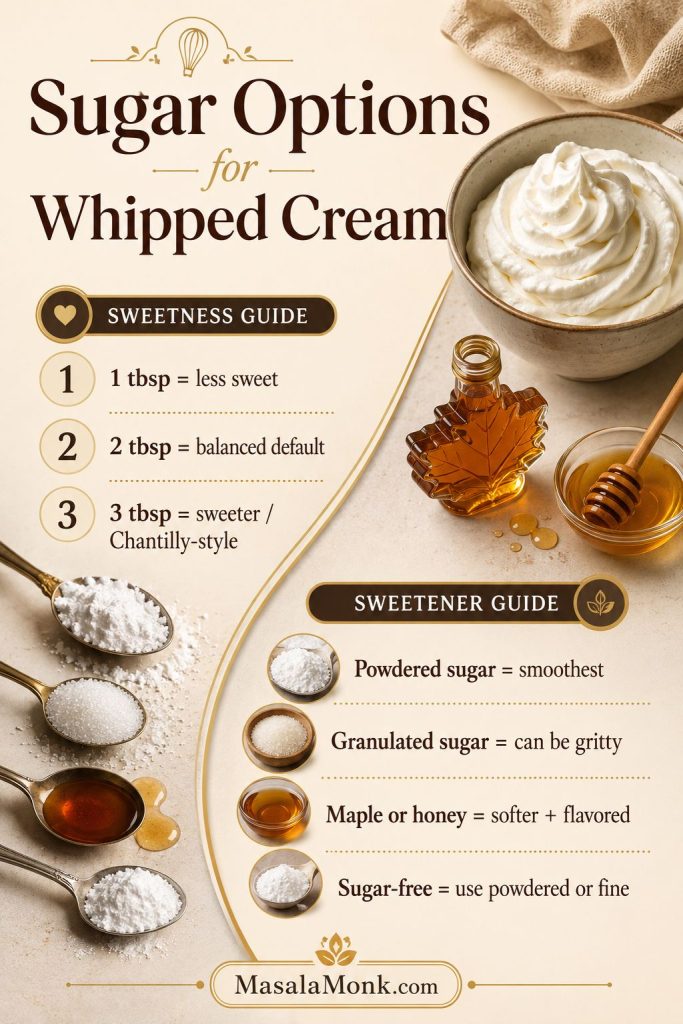
Sugar options for whipped cream showing powdered sugar, granulated sugar, maple syrup, honey, sugar-free sweetener, and different sweetness levels.
Use less sugar when the dessert is already sweet, and use a little more for a Chantilly-style cream. Powdered sugar stays the easiest default because it blends smoothly into cold cream.

How to Make Whipped Cream Step by Step

Once the cream and sugar are chosen, the actual whipping is quick. The only real skill is knowing when to stop.

If this is your first time making whipped cream, the change can feel slow at first and then sudden. At first it looks like nothing is happening. Then the cream thickens, the beater trails stay visible, and suddenly you are only a few seconds away from the perfect stage.
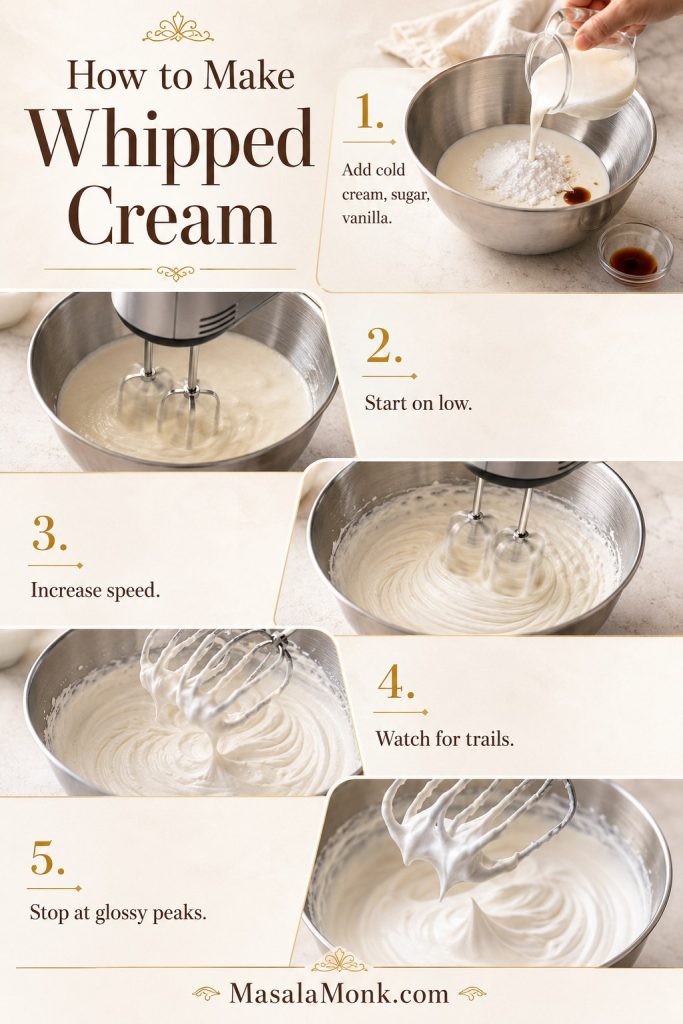
Step-by-step whipped cream process showing cream, sugar, and vanilla being added, mixed on low, whipped thicker, and stopped at glossy peaks.
Start slowly to avoid splashing, then increase the speed as the cream thickens. Once trails hold in the bowl, the recipe moves quickly from perfect to overdone.

Step 1: Chill the bowl if your kitchen is warm

If your kitchen is hot, chill a metal mixing bowl and beaters for 10–15 minutes. This is optional in a cool kitchen, but it gives you a little more control.

Step 2: Add the ingredients

Add 1 cup cold heavy cream, 2 tablespoons powdered sugar, 1/2 to 1 teaspoon vanilla extract, and a tiny pinch of salt if using.

Step 3: Start on low speed

Beat on low for 20–30 seconds. This keeps the cream from splashing and gives the sugar time to blend in.

Step 4: Increase the speed

Increase to medium or medium-high speed. For 1 cup of cream, a hand mixer usually takes about 2–4 minutes. A stand mixer can be faster, so watch closely.

Step 5: Stop at the right peak stage

First you will see bubbles, then loose foam, then visible trails from the beaters. Once those trails stay in the bowl, start checking every few seconds.

Whipping Stages to Watch For

The visual stages matter more than the exact minute mark. Once the bowl shows lasting trails, move slowly and use the peak guide to choose your final texture.
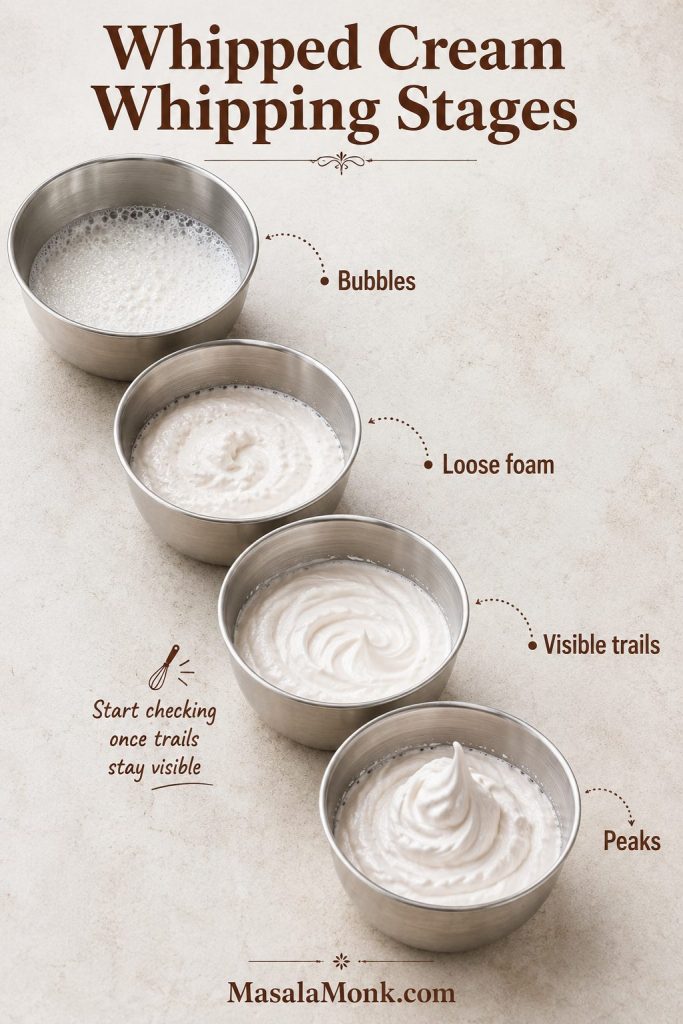
Whipped cream stages in a bowl showing bubbles, loose foam, visible trails, and formed peaks.
The bowl gives you the best clues: bubbles first, then foam, then trails, then peaks. As soon as those trails stay visible, stop relying on minutes and start checking texture.

Stop at soft peaks for a loose topping, medium peaks for most desserts, or stiff peaks for a firmer finish. Slow down, lift the beaters, and check the peak instead of trying to beat it for a fixed number of minutes.

Texture matters more than time. Different mixers, bowl sizes, cream brands, and kitchen temperatures change the timing. Watch the cream, not just the clock.

Soft Peaks vs Medium Peaks vs Stiff Peaks

The right texture depends on how you plan to use the cream. A soft spoonful for hot chocolate does not need the same structure as whipped cream for a pie topping.

Good whipped cream should feel cool and billowy, with just enough sweetness to make berries, pie, cake, or hot chocolate taste more finished — not buried under a sugary foam.
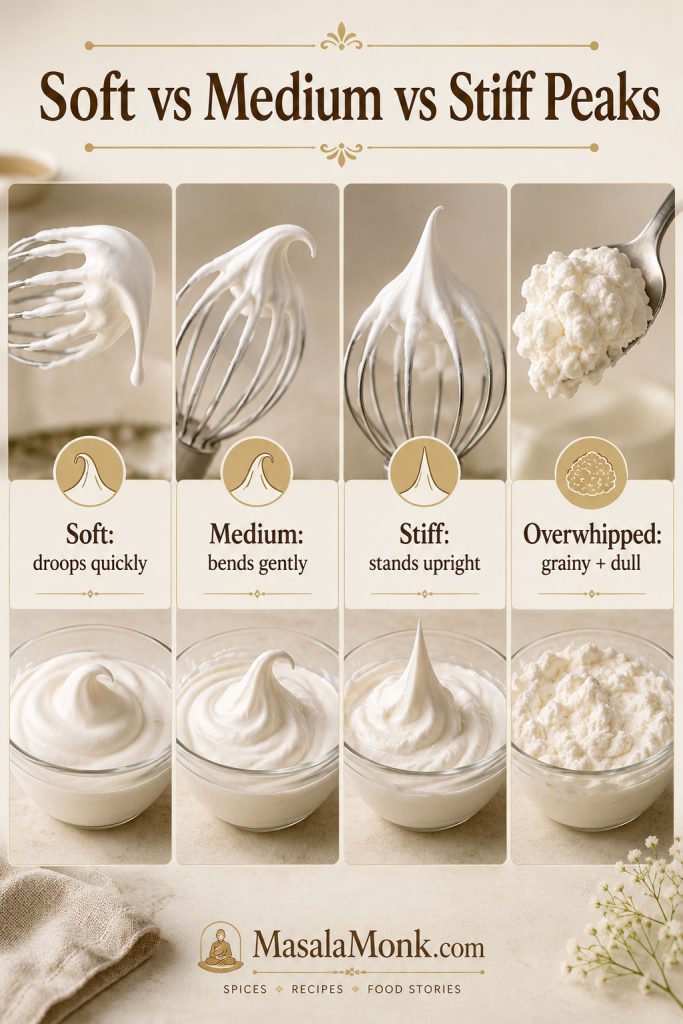
Comparison of soft peaks, medium peaks, stiff peaks, and overwhipped whipped cream with labeled texture examples.
Soft peaks droop, medium peaks bend gently, and stiff peaks stand tall. For most homemade whipped cream uses, the middle stage gives the best balance of hold and freshness.
Stage What it looks like Use it for
Soft peaks The cream falls back into itself and the peak droops quickly. Hot chocolate, fruit, pancakes, waffles, and folding into desserts.
Medium peaks The cream holds a spoonable mound and the tip bends gently. The most useful everyday texture for pies, cakes, fruit, and no-bake desserts.
Stiff peaks The peak stands upright, but the cream starts looking firmer and less glossy. Pie topping, firmer same-day dessert topping, or very simple piping served soon.
Overwhipped The cream looks grainy, dull, clumpy, or starts separating. Stop immediately and try the cold-cream rescue below.

For most home desserts, the middle stage is the sweet spot: soft enough to melt into warm pie, but structured enough to sit in pretty spoonfuls. Stiff peaks can be useful, but they are closer to overwhipping, so move slowly once the cream looks thick.

The Medium Peaks Spoon Test

When the cream holds a soft mound on a spoon and the tip bends gently, it is usually ready for most desserts.
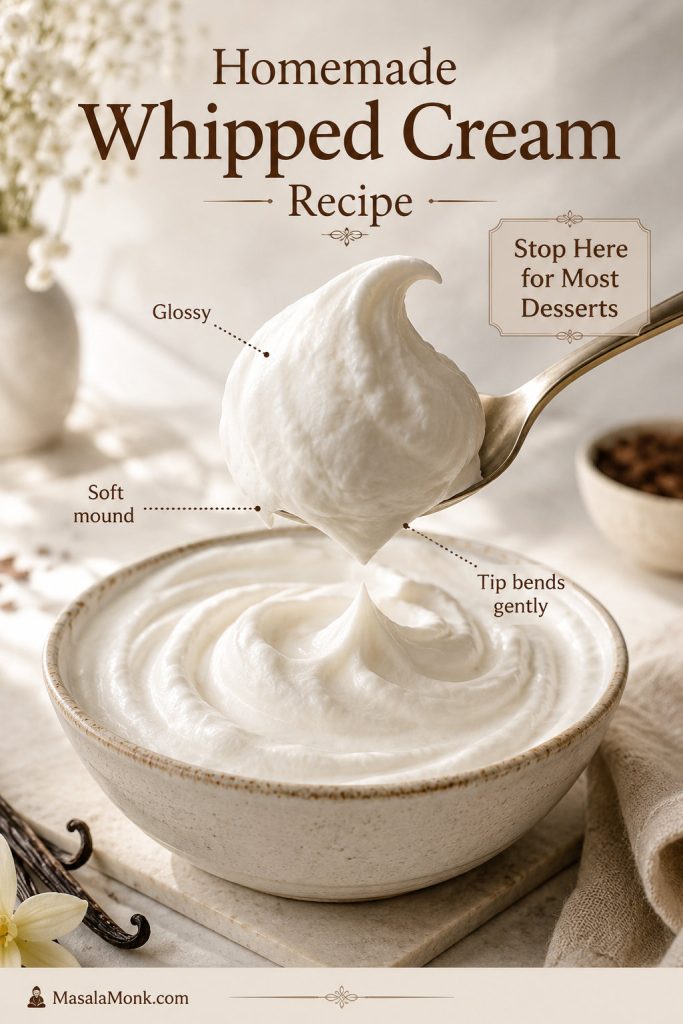
A spoon lifting whipped cream with a glossy soft mound and a gently bending tip to show medium peaks.
The spoon test makes the stopping point easier to judge. If the cream holds a soft mound without looking dry, it is ready for pies, berries, cakes, and no-bake desserts.

Stiff Peaks vs Overwhipped Cream

Stiff peaks can be useful, but they sit close to the overwhipped stage. If the bowl already looks dull or grainy, skip ahead to the overwhipped cream fix before mixing more.
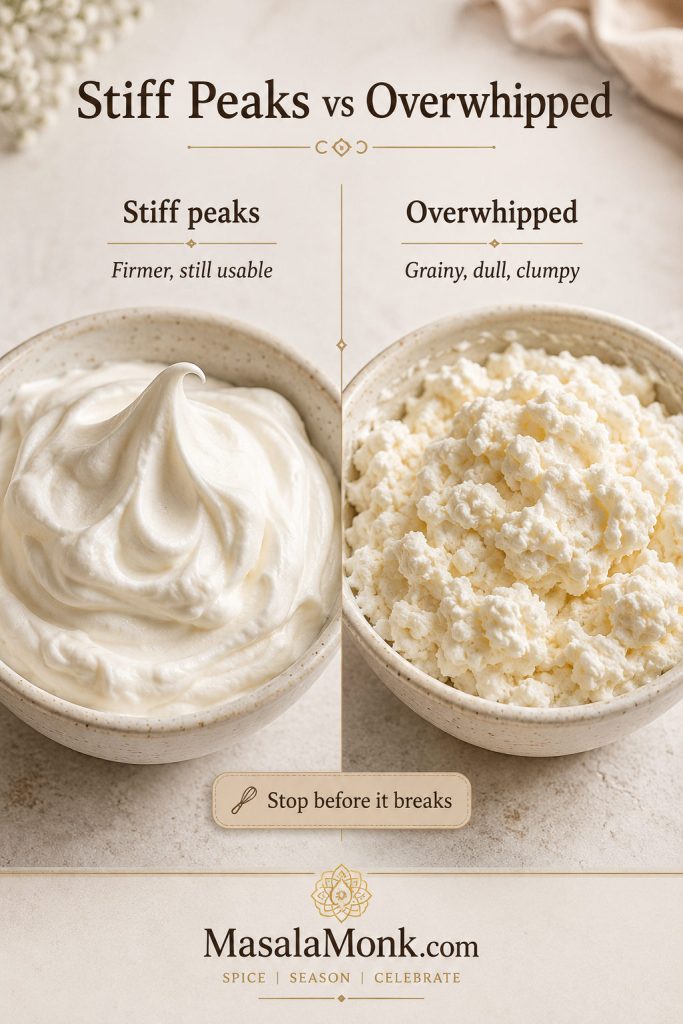
Side-by-side comparison of stiff whipped cream peaks and overwhipped grainy whipped cream.
Stiff peaks are still usable, but overwhipped cream starts looking dull, grainy, and clumpy. When the shine disappears, stop before the cream separates.

Some chilled desserts need firmer whipped cream for structure. For example, a no-bake cheesecake depends on properly whipped cream, full-fat cream cheese, and enough chill time so the filling sets cleanly.

How to Fix Runny, Grainy, or Overwhipped Cream

Most whipped cream problems come down to temperature, cream type, or whipping too far. If something looks wrong, stop and check the texture before adding more ingredients.

Why Is My Whipped Cream Runny?

If your cream is still loose after a minute or two, do not panic. It may be too warm, underwhipped, or too low in fat. Chill the bowl and cream for 10–15 minutes, then whip again.

Do not try to fix runny whipped cream by dumping in a lot more sugar. Extra sugar may make the cream sweeter, but it will not solve a temperature, fat, or cream-type problem.

How to Fix Overwhipped Cream

If the bowl suddenly looks grainy, stop right there. Add 1 tablespoon cold cream and fold it in gently by hand. Add another small spoonful if needed.

Fold gently instead of beating again; more speed can push grainy cream closer to butter. If it has separated into buttery clumps, it may be too far gone to rescue as whipped cream, but you can keep going and turn it into homemade butter.
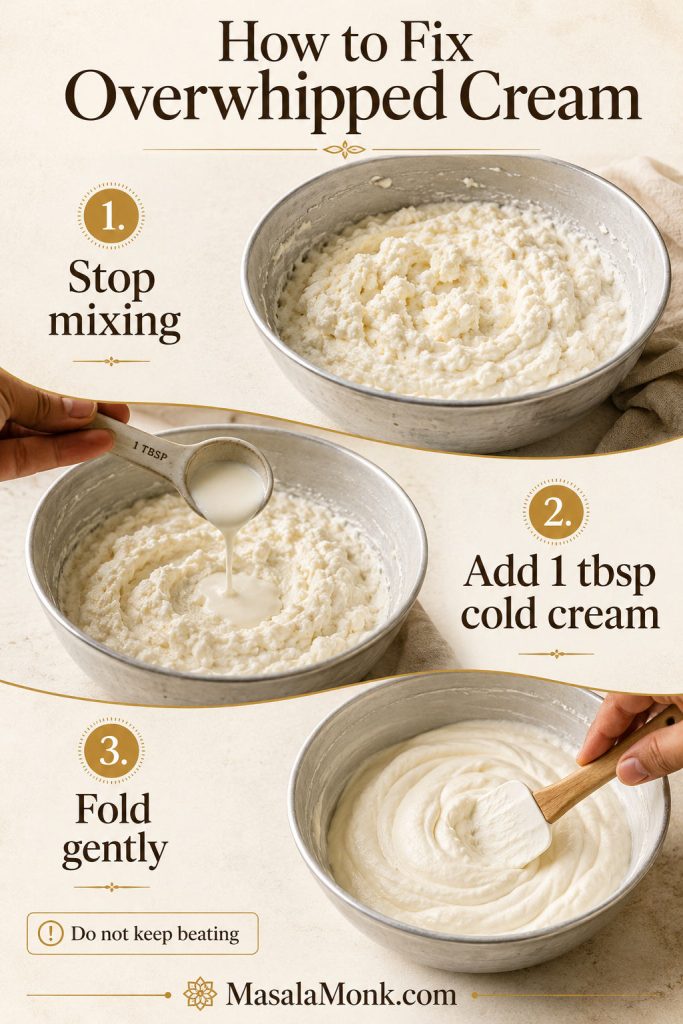
Overwhipped cream rescue steps showing grainy cream, cold cream being added, and the mixture being folded until smoother.
Slightly grainy cream can often be rescued if you stop early. Fold in cold cream by hand; beating again can push the mixture closer to butter.

If you want to understand that stage better, this homemade butter guide shows how cream moves from liquid to whipped cream to overwhipped cream and finally separates into butter and buttermilk.

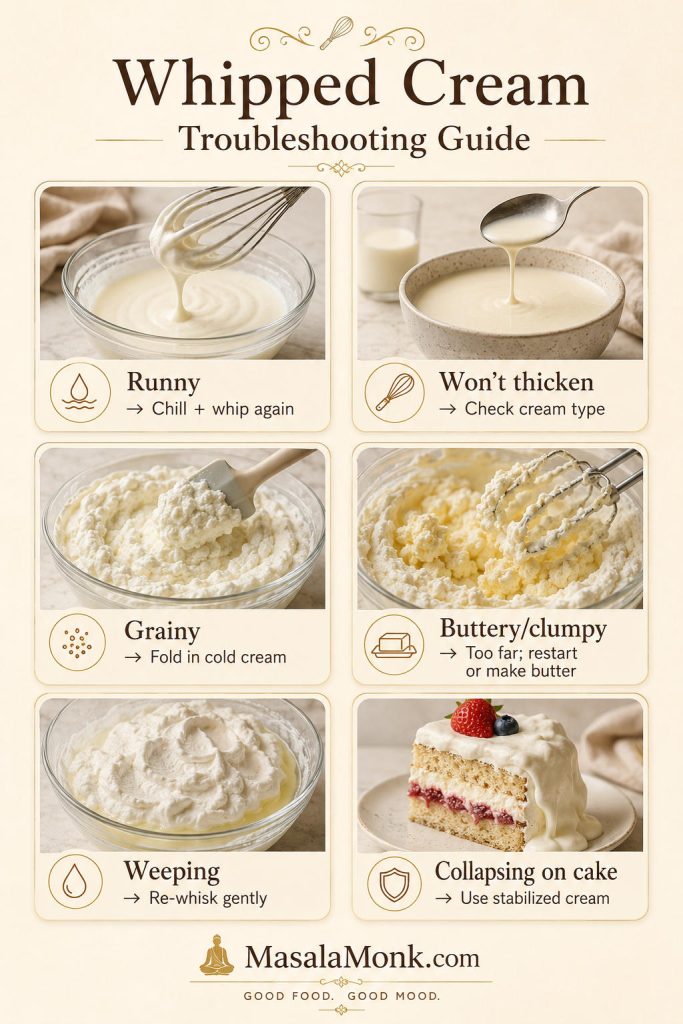
Problem Likely cause Fix
Runny cream Cream too warm, underwhipped, or too low in fat Chill for 10–15 minutes and whip again.
Cream will not thicken Wrong cream or not enough fat Use cream meant for whipping. Avoid milk and half-and-half.
Grainy cream Slightly overwhipped Fold in 1 tablespoon cold cream by hand.
Buttery or clumpy cream Severely overwhipped Restart, or keep going and turn it into homemade butter.
Weeping in the fridge Normal for fresh whipped cream Re-whisk gently before serving.
Collapsing on cake This basic version is too soft for long hold Use cream with extra support.
Whipped cream troubleshooting guide showing runny cream, cream that will not thicken, grainy cream, buttery cream, weeping cream, and cream collapsing on cake.
Runny cream, grainy texture, weeping, and collapsing all have different causes. Instead of adding more sugar, match the problem to temperature, cream type, or overwhipping first.

If the fix does not work, restarting is usually faster than fighting the bowl.

If the cream never thickens at all, the issue may be the carton rather than the clock. Recheck the cream-type guide before trying again.

Can You Make Whipped Cream Without a Mixer?

Yes. A hand mixer is easiest for most home cooks because it gives enough speed without feeling out of control. A stand mixer is useful for larger batches, but it can move quickly, so stay nearby once the cream begins to thicken.

A balloon whisk works well for small batches if the cream and bowl are cold. Use a wide bowl and a large whisk. There is no prize for whipping by hand if you are tired; the goal is smooth cream, not sore wrists.

For a tiny batch, you can shake cold cream in a chilled jar, stopping while it is still soft. A food processor or immersion blender can also work in short bursts, but the texture is usually denser and easier to overdo.
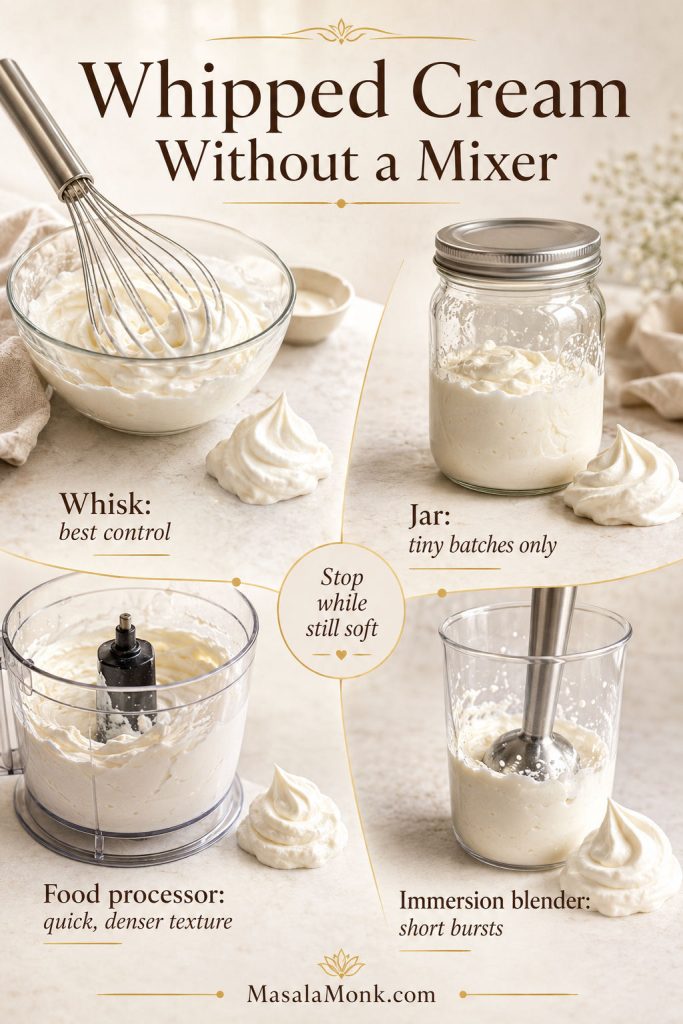
Whipped cream without a mixer guide showing a balloon whisk, jar method, food processor, and immersion blender.
A whisk gives the most control, while jars, food processors, and immersion blenders move faster than you expect. Smaller batches are safer when you are not using a hand mixer.

Make-Ahead, Storage, and Freezing

Homemade whipped cream tastes best the day it is made. For the nicest texture, use it within a few hours. If needed, refrigerate it in an airtight container for 24–48 hours and gently re-whisk before serving.
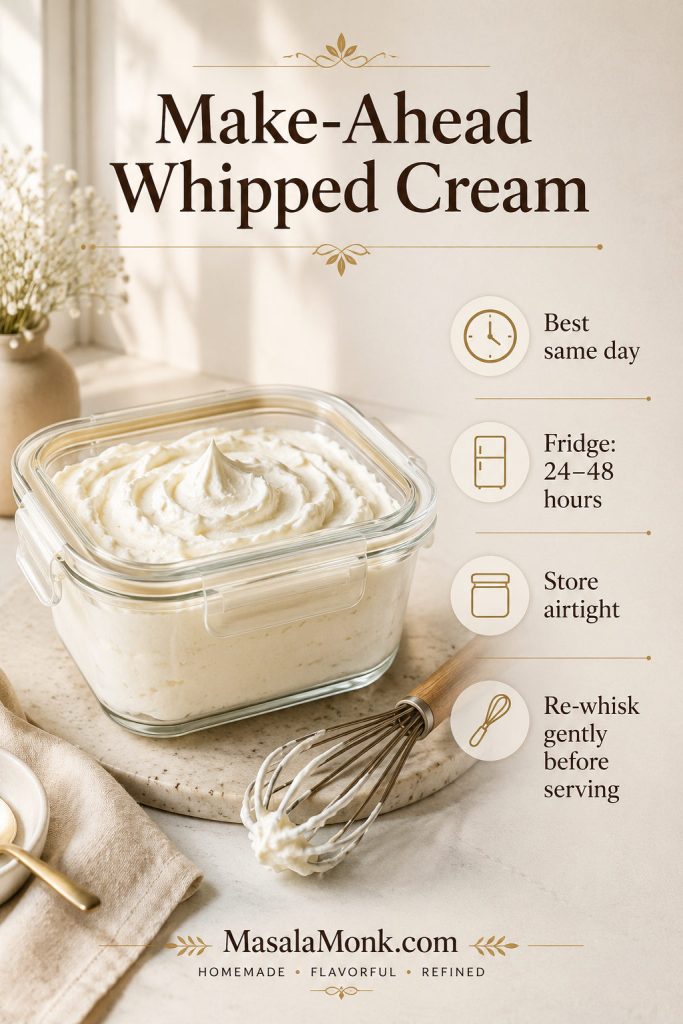
Make-ahead whipped cream stored in an airtight container with a whisk and labels for same-day use, refrigeration, and re-whisking.
Fresh whipped cream is most delicate after storage. Keep it cold and airtight, then re-whisk gently if it softens before serving.

Keep the cream cold until serving, then leave it out only for a short serving window. If the room is warm, return it to the fridge sooner. A little softening after refrigeration is normal, and a few gentle strokes with a whisk usually brings it back.

A little weeping after a night in the fridge is not a disaster; fresh whipped cream is airy and delicate in a way tub toppings are not.

If you need whipped cream to hold for piping, cupcakes, layer cakes, or overnight serving, read the regular vs stabilized section before making the batch.

Can You Freeze Whipped Cream?

Yes, but freeze it as small dollops rather than one large container. Spoon or pipe dollops onto a parchment-lined tray, freeze until firm, then transfer them to a freezer-safe box. Frozen whipped cream is useful for hot chocolate, coffee, pancakes, waffles, and quick dessert toppings; after thawing, it will not be as silky as freshly whipped cream.

Frozen dollops are especially nice for drinks. Drop one into a mug of keto hot chocolate and it melts slowly into the top while keeping the drink creamy.
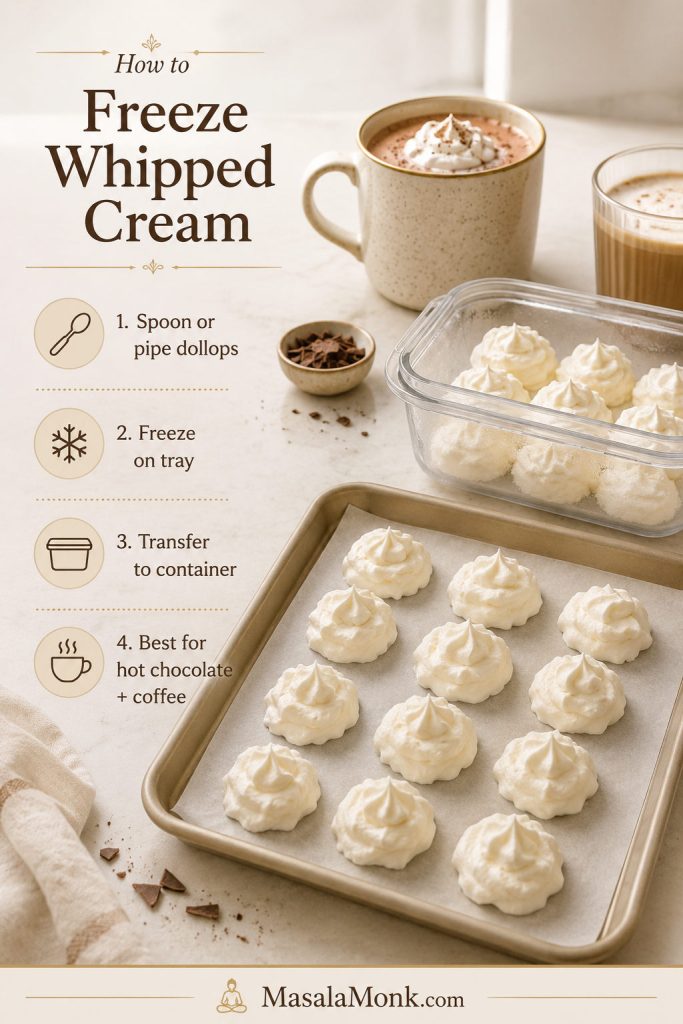
Whipped cream dollops on a parchment-lined tray with a storage container and hot chocolate in the background.
Freeze whipped cream in small dollops, not one large mass. Then you can add only what you need to hot chocolate, coffee, pancakes, or waffles.

Regular vs Stabilized Whipped Cream

Regular whipped cream is best when freshness matters: soft cream over pie, a cool topping for cake slices, a light layer on chilled desserts, or something airy to fold into no-bake fillings.

It also works beautifully as a soft cake topping when the cake stays cold and is served within a reasonable window. For example, a chilled tres leches cake is exactly the kind of dessert where regular whipped cream can feel light, creamy, and fresh.

Use stabilized whipped cream when the cream needs to hold its shape for piping, cupcakes, layer-cake filling, trifles, warm-weather serving, or overnight hold. For this basic recipe, keep the goal simple: soft whipped cream that tastes light and creamy, not a frosting replacement.
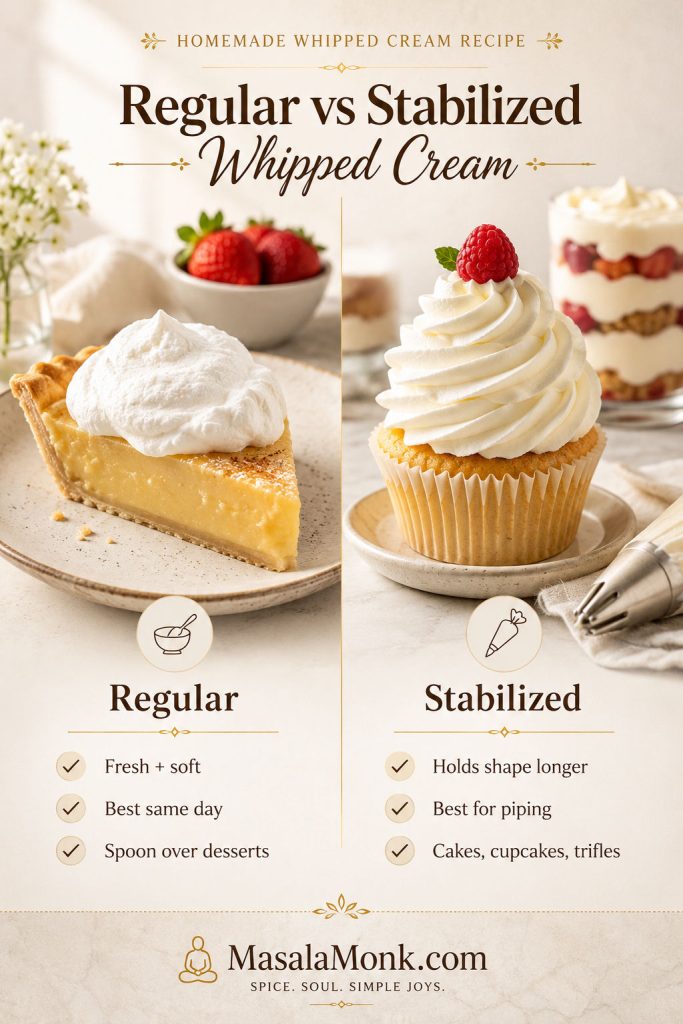
Comparison of regular whipped cream on a dessert and stabilized whipped cream piped on a cupcake with labels for same-day use and longer hold.
Regular whipped cream is best for fresh, soft toppings. However, stabilized whipped cream is better for piping, cupcakes, layer cakes, trifles, and longer hold.
Use Will this recipe work? Better choice
Spoon over a cake slice Yes Glossy, gently bending peaks
Top a cake served the same day Yes, if kept cold Soft to slightly firmer peaks
Frost a layer cake Not reliably Stabilized whipped cream
Pipe cupcakes Not reliably Stabilized whipped cream
Fill a cake overnight Not reliably Stabilized whipped cream or a cream-cheese whipped version

Ways to Use Homemade Whipped Cream

Homemade whipped cream is one of those small upgrades that makes simple desserts feel finished. Keep it softer for spooning, or whip it a little firmer when it needs to sit on top of a pie or no-bake dessert.

Homemade whipped cream served with pie, berries, pancakes, hot chocolate, cake, and a no-bake dessert.
Fresh whipped cream can finish dessert without making it feel heavy. Use it where contrast helps most: warm pie, tart berries, pancakes, hot chocolate, cake slices, and chilled no-bake desserts.

Warm desserts

Use softly structured peaks on warm pies, cobblers, crisps, and bread pudding. Think warm apple crisp, cinnamon steam, and the first spoonful where cool cream softens into the fruit instead of covering it up. That is why it works so well on desserts like apple crisp.
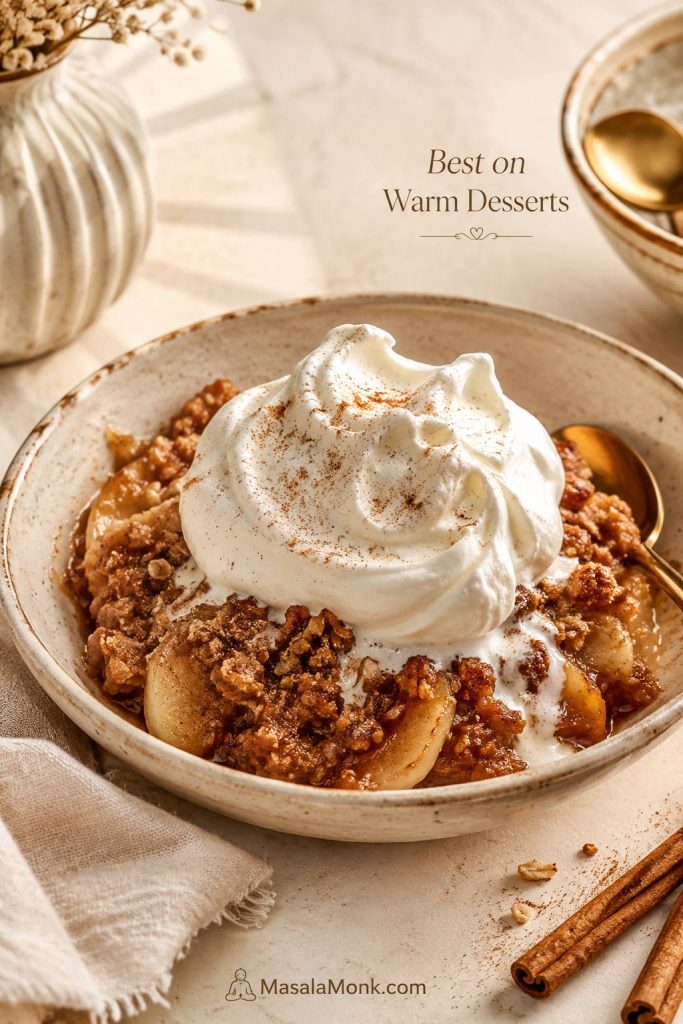
Homemade whipped cream melting softly over a warm apple crisp with cinnamon and a spoon nearby.
Cool cream against a warm dessert is the whole point. It softens into fruit, crumble, pastry, or bread pudding while keeping each bite lighter.

Fruit, breakfast, and drinks

Use soft to medium peaks for berries, pancakes, waffles, hot chocolate, coffee drinks, and simple spoon desserts. The cream should add softness and light sweetness without turning the whole plate heavy.
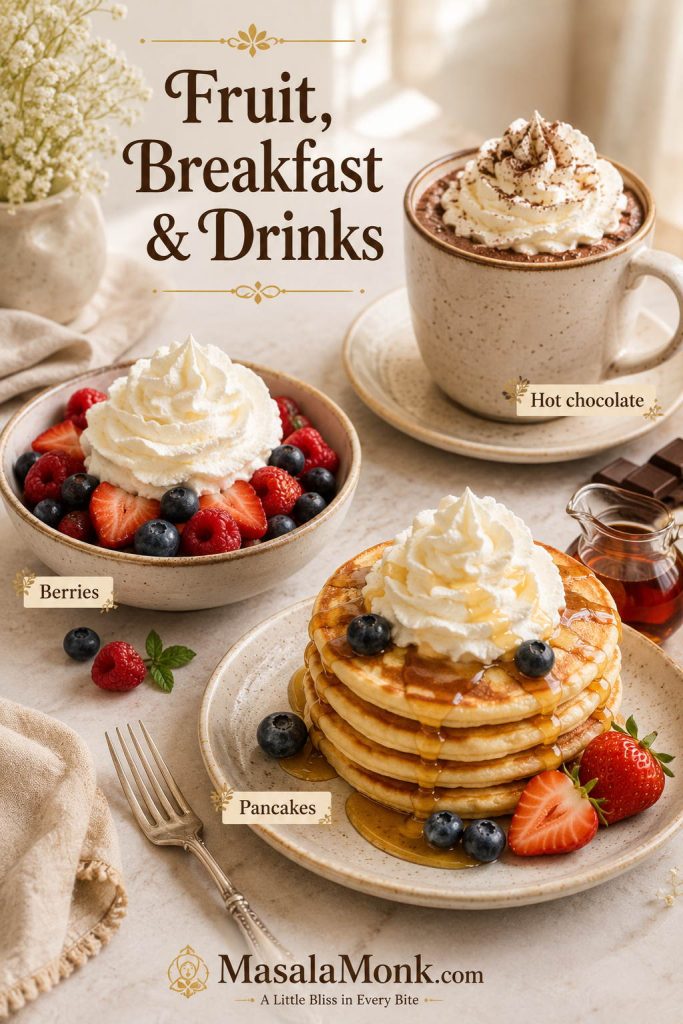
Whipped cream served with berries, pancakes with maple syrup, and a mug of hot chocolate.
For fruit, breakfast, and drinks, keep the cream soft rather than stiff. It should add lift to berries, pancakes, waffles, coffee, and hot chocolate instead of weighing them down.

Cold desserts and fillings

When whipped cream becomes part of the structure, follow the dessert’s own peak-stage instructions. In no-bake desserts like banana pudding, the cream is not just a topping — it helps the filling feel light and set properly.

For richer desserts, a lighter spoonful of cream can keep the whole bite from feeling too heavy, especially with something caramel-heavy like banoffee pie.

Once you know where you are serving it, the flavor variations can help match the cream to chocolate, fruit, coffee, citrus, or warm desserts.

Easy Whipped Cream Variations

Once the basic texture feels easy, the variations are where homemade whipped cream starts to feel personal: chocolate for richer desserts, maple for breakfast, cinnamon for apple pie, espresso for coffee drinks, and citrus for fruit. Add flavorings before whipping, then taste and adjust gently near the end.
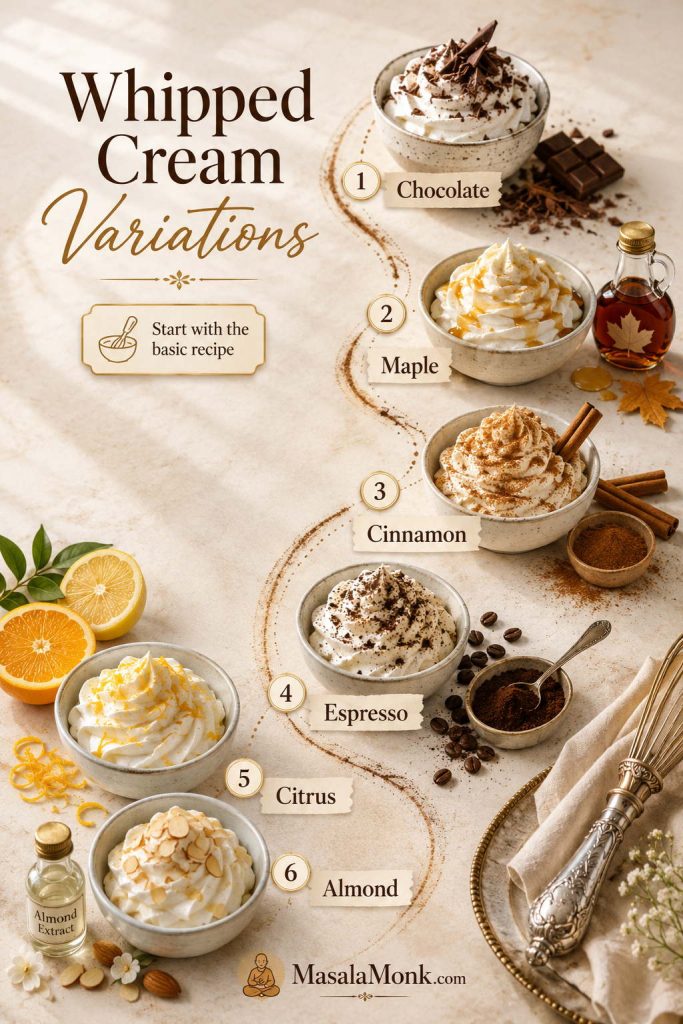
Whipped cream variations guide showing chocolate, maple, cinnamon, espresso, citrus, and almond flavor ideas with matching ingredients.
Once the base texture feels right, flavor variations become easy. Chocolate, maple, cinnamon, espresso, citrus, and almond can each shift the same cream toward a different dessert mood.
Variation How to make it Best with
Chocolate whipped cream Add 1 tablespoon cocoa powder and 1 extra tablespoon powdered sugar per cup of cream. Chocolate cake, brownies, pudding, hot chocolate.
Maple whipped cream Replace some or all of the powdered sugar with 1 tablespoon maple syrup. Pancakes, waffles, apple crisp, pumpkin desserts.
Cinnamon whipped cream Add 1/4 teaspoon ground cinnamon per cup of cream. Apple pie, apple crisp, hot chocolate, banana desserts.
Espresso whipped cream Add a small pinch of instant espresso powder. Chocolate desserts, tiramisu-style desserts, coffee drinks.
Citrus whipped cream Add finely grated orange or lemon zest. Berries, pound cake, fruit tarts, citrus desserts.
Almond whipped cream Add a tiny splash of almond extract; it is stronger than vanilla, so use less. Cherry desserts, chocolate cake, fruit crisps.

Chocolate Whipped Cream

Chocolate is the strongest variation when you want a deeper dessert topping. Keep the texture light, then use it on brownies, pudding, chocolate cake, hot chocolate, or berries.
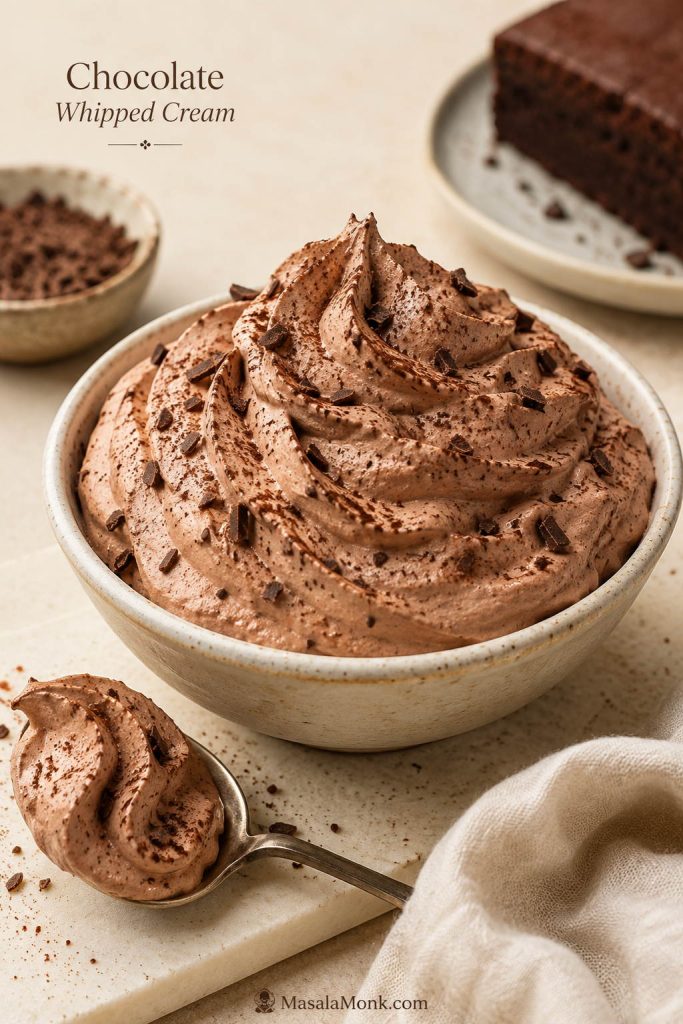
A bowl of chocolate whipped cream with cocoa powder, chocolate shavings, a spoonful of cream, and a chocolate cake in the background.
Chocolate whipped cream is the easiest richer variation because cocoa adds depth without changing the method much. Use it on brownies, chocolate cake, pudding, hot chocolate, or berries.

FAQs

What is the best cream for homemade whipped cream?

Heavy cream or heavy whipping cream is the most dependable choice because it has enough fat to hold air well and whip into a smooth, fluffy texture. Whipping cream can also work for a simple same-day topping, but it usually gives a softer result.

Can I make whipped cream with fresh cream?

It depends on the fat percentage and whether the cream is meant for whipping. Some fresh cream cartons may thicken softly when very cold, but they may not make firm, lasting peaks.

Does Amul fresh cream work for whipped cream?

Amul fresh cream is not the same as Amul whipping cream. It can thicken slightly when very cold, but it is not the best choice for firm whipped cream, piping, or frosting.

Is this the same as Chantilly cream?

Vanilla-sweetened whipped cream is often called Chantilly cream. This recipe works as a simple vanilla Chantilly cream for everyday desserts.

Will milk or half-and-half whip into whipped cream?

No. Milk and half-and-half do not have enough fat to trap and hold air like cream does. Use cream meant for whipping instead.

How long should I beat whipped cream?

For 1 cup of cream, a hand mixer usually takes about 2–4 minutes. A stand mixer may be faster, and a hand whisk may take 3–5 minutes. Watch the texture more than the clock.

What peak stage is best for pie or spooning over dessert?

Medium peaks are usually best. The cream should hold a soft mound on a spoon but still look glossy, light, and creamy.

What peak stage is best for folding into desserts?

Soft to medium peaks usually work best for folding. If the cream is too stiff, it can be harder to blend smoothly into puddings, mousses, or no-bake fillings.

Why is my whipped cream runny?

The cream may be too warm, underwhipped, or too low in fat. Chill the cream and bowl for 10–15 minutes, then whip again. If it still will not thicken, the cream may not be suitable for whipping.

Why did my whipped cream turn into butter, and can I fix it?

The cream was whipped too far. If it only looks grainy, stop mixing and fold in 1 tablespoon cold cream by hand. If it has separated into buttery clumps and liquid, it may be too far gone to rescue as whipped cream.

Can I make whipped cream ahead or freeze it?

Yes. It tastes freshest the day it is made, but you can refrigerate it for 24–48 hours and gently re-whisk before serving. For longer storage, freeze small dollops on a parchment-lined tray, then transfer them to a freezer-safe container.

Can I use this for piping or cake frosting?

This regular whipped cream works as a soft topping for cakes served the same day. For piping, layer-cake filling, cupcakes, or overnight hold, use stabilized whipped cream with extra support.

Back to top

Posted on 2 Comments

Easy Cheese Sauce Recipe for Mac, Broccoli, Nachos and More

Smooth cheddar cheese sauce lifted with a spoon, served with mac and cheese, broccoli, fries and grated cheddar.

A good cheese sauce recipe should give you a smooth, creamy, cheesy sauce that is easy to control. It should work for mac and cheese, broccoli, cauliflower, fries, baked potatoes, pasta, nachos, pretzels, burgers, rice bowls, and casseroles without turning grainy, oily, lumpy, or gluey.

This easy cheese sauce recipe uses a simple butter-flour roux, milk, and freshly grated cheddar. The method is quick, but the details matter: cook the roux long enough, add the milk slowly, remove the pan from heat before adding cheese, and adjust the texture based on how you plan to serve it.

The main recipe turns cheddar cheese, milk, butter, and flour into a medium-thick sauce for vegetables, fries, potatoes, sandwiches, and pasta. It tastes fresher than a jarred sauce because it starts from scratch with real ingredients. From there, you can adapt the same base for mac and cheese, broccoli, cauliflower, pasta, nachos, no-flour sauce, gluten-free sauce, keto sauce, microwave sauce, thicker dips, thinner drizzles, and reheated leftovers.

Cheese Sauce Guide

Use this guide to make a smooth basic cheese sauce first, then adjust the texture, ingredients, and method for the way you want to serve it.

Quick Answer: How to Make Cheese Sauce

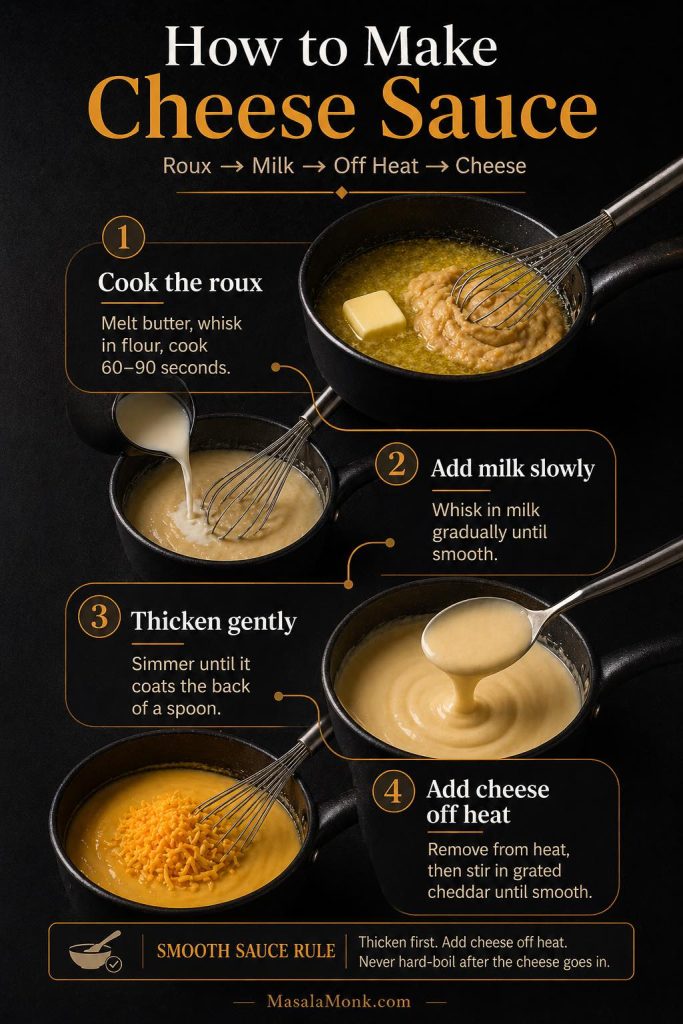
To make a smooth cheese sauce, melt butter, whisk in flour, cook the roux briefly, then slowly whisk in milk. Once the base thickens, remove the pan from heat and stir in freshly grated cheddar until melted.

The most important step is adding the cheese away from direct heat. That way, the sauce stays creamy instead of turning grainy, oily, or separated.

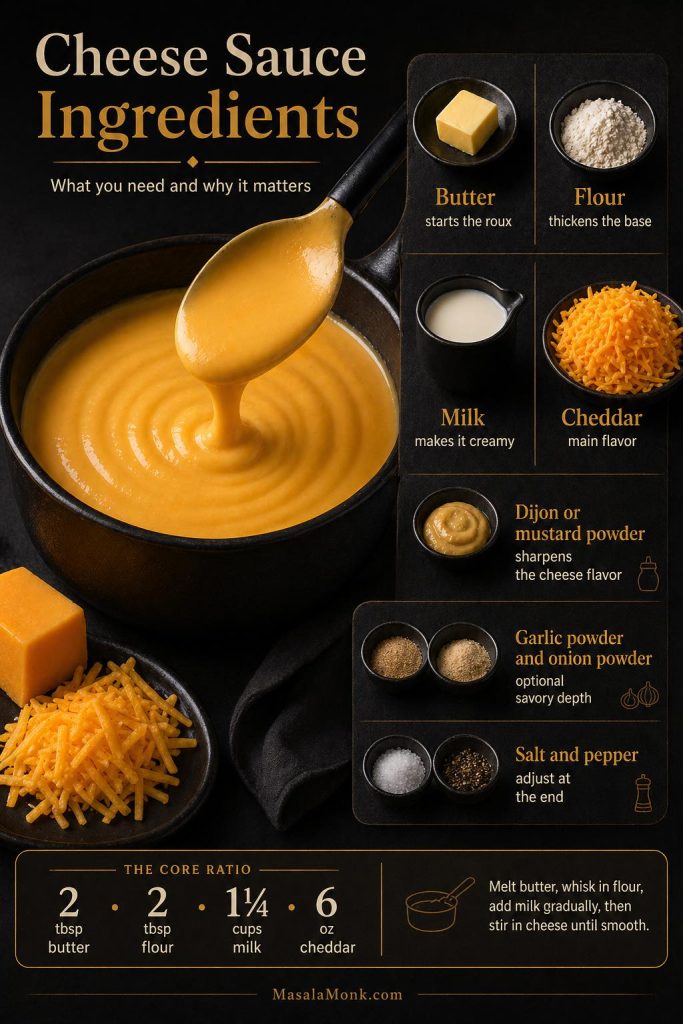
For a reliable all-purpose sauce, this recipe uses 2 tablespoons butter, 2 tablespoons flour, 1¼ cups milk, and 6 ounces freshly grated cheddar cheese. That gives you a medium-thick sauce for mac and cheese, broccoli, cauliflower, baked potatoes, fries, pasta, and nachos-style drizzling.

The smooth sauce rule: thicken the milk base first, then turn off the heat before adding cheese. Cheese does not need hard boiling to melt. Gentle residual heat is enough.

At a Glance

At a glance: This cheese sauce recipe makes about 2 cups / 480 ml / 0.48 L of smooth cheddar sauce in about 12 minutes. It uses 2 tbsp butter, 2 tbsp flour, 1¼ cups / 300 ml milk, and 6 oz / 170 g cheddar cheese. Keep it thick for broccoli, fries, potatoes, and sandwiches, or thin it with warm milk for pasta, mac and cheese, and rice bowls.

Practically speaking, that means you can start with one reliable base and adjust it without guessing. The same cheese sauce can stay thick for fries, loosen into a pasta coating, cover broccoli and cauliflower, or shift into a no-flour version with one small method change.

Why This Cheese Sauce Recipe Works

This recipe works because the cheese is added to a thickened milk sauce instead of being melted directly over high heat. As a result, the cheddar has a smoother base to melt into and the finished sauce is easier to control.

The butter and flour create a smooth base, the milk gives the sauce enough moisture, and the cheddar melts in gently after the pan comes off the heat. The same butter-flour-milk logic also shows up in béchamel sauce. Here, however, the base becomes richer because cheddar cheese is stirred in at the end.

That order matters. When cheese is boiled too hard, the sauce can turn grainy, oily, or separated. With a thickened milk base, though, the cheese has a smoother place to melt.

For a homemade cheese sauce, the goal is not just melting cheese. The recipe needs enough liquid, enough thickening power, and gentle heat so the sauce stays smooth after the cheddar melts.

This recipe also starts with a medium-thick texture on purpose. It is thick enough for vegetables, fries, potatoes, and sandwiches, while still being easy to loosen with warm milk or pasta water when you want a thinner sauce for noodles, mac and cheese, or rice bowls.

Cheese Sauce Ingredients

Although this recipe uses basic ingredients, each one has a specific job. The butter and flour create the thickened base, the milk makes it creamy, and the cheddar cheese gives the sauce its main flavor.

Cheese sauce ingredients guide showing butter, flour, milk, cheddar, mustard, garlic powder, onion powder, salt and pepper with the core ratio.
The basic cheese sauce ingredients are simple, but each one has a job: butter and flour build the roux, milk makes the sauce creamy, cheddar gives flavor, and seasonings sharpen the final taste.

Main Ingredients and What They Do

Ingredient Amount Why it matters
Unsalted butter 2 tbsp / 28 g / 1 oz Combines with flour to make the roux. Salted butter works too, but reduce added salt.
All-purpose flour / plain flour 2 tbsp / 16–18 g / 0.6 oz Thickens the milk and helps stabilize the sauce so the cheese melts smoothly. Do not use self-rising flour.
Whole milk 1¼ cups / 300 ml / 10 fl oz / 0.3 L Gives the sauce body and creaminess. Whole milk gives the smoothest everyday result.
Freshly grated cheddar cheese 6 oz / 170 g / about 1½ cups The main cheese. Medium cheddar is the easiest default; sharp cheddar gives stronger flavor.
Dijon mustard or mustard powder 1 tsp Dijon / 5 ml, or ¼ tsp mustard powder / about 1 g Optional, but it sharpens the flavor and makes the sauce taste more cheesy.
Garlic powder ¼ tsp / about 0.7 g Optional background flavor, especially good for potatoes, fries, broccoli, and pasta.
Onion powder ¼ tsp / about 0.6 g Optional savory depth without making the sauce taste onion-heavy.
White pepper or black pepper Pinch to ⅛ tsp / about 0.3 g Adds gentle warmth. White pepper keeps the sauce paler; black pepper is easier to find.
Salt ⅛–¼ tsp / about 0.75–1.5 g Add after the cheese melts because cheddar can vary a lot in saltiness.

Measurement note: cheese is best measured by weight. If using cups, lightly spoon the grated cheese into the cup instead of packing it down. For this recipe, 1 cup of liquid is treated as 240 ml.

Milk Options

The milk you choose changes the richness of the sauce. Whole milk is the best everyday choice for this cheese sauce recipe, although other dairy options can work depending on the texture you want.

  • Whole milk: best everyday choice for a smooth, creamy cheese sauce.
  • 2% milk: works, but the sauce will taste slightly lighter.
  • Skim milk: not ideal because the sauce can taste thinner and less creamy.
  • Half-and-half: richer and thicker; useful when you want a heavier sauce.
  • Heavy cream: very rich; better for keto-style sauce than the basic roux version.

Can I Use Pre-Shredded Cheese?

Freshly grated cheese melts more smoothly. Pre-shredded cheese is convenient, but many bags contain anti-caking ingredients that can make the sauce less silky. If pre-shredded cheese is all you have, use gentle heat, add it slowly, and avoid boiling after it goes in.

Best Cheese for Cheese Sauce

In general, the best cheese for cheese sauce is flavorful but still easy to melt. Medium cheddar is the safest default because it gives a classic cheddar taste without becoming as temperamental as very aged cheese.

Best cheeses for cheese sauce including medium cheddar, sharp cheddar with Monterey Jack, Colby Jack, young Gouda, and Gruyère with cheddar.
Medium cheddar is the easiest everyday choice for cheese sauce, while Monterey Jack, Colby Jack, young Gouda and Gruyère can help adjust the flavor, smoothness and richness.

For the smoothest everyday result, start with medium cheddar or a cheddar-Monterey Jack blend. Sharp cheddar gives stronger flavor, but it works best when blended with a smoother melting cheese.

Cheese Best use Notes
Medium cheddar Best everyday choice Balanced flavor, good melting, and classic color.
Sharp cheddar Stronger cheddar flavor Use gentle heat. Sharp cheddar tastes great but can turn grainy if overheated.
Mild cheddar Kid-friendly sauce Smooth and mellow, but less bold.
White cheddar White cheese sauce Good when you want a pale sauce for pasta, potatoes, or vegetables.
Monterey Jack Smooth melting blend Excellent mixed with cheddar when you want a softer, creamier melt.
Colby or Colby Jack Mild creamy sauce Good for kids, nachos-style drizzling, and burgers.
Young Gouda Creamy, mellow sauce Use young gouda rather than very aged gouda for smoother melting.
Gruyère Cauliflower, potatoes, gratins Nutty and excellent, but more expensive. Good blended with cheddar.
Parmesan Flavor accent Use a small amount with cheddar or Jack. Parmesan alone can make the texture gritty.
Mozzarella Stretchy accent Not ideal as the main cheese sauce cheese. It can become stringy.
Blue cheese or Gorgonzola Specialty sauces Better for dedicated blue cheese or Gorgonzola sauce, not the basic cheddar version.

Once you know the texture you like, you can experiment with sharper cheddar, smoked cheddar, white cheddar, gouda, Gruyère, or small amounts of Parmesan.

How to Make Cheese Sauce

Before you start cooking, it helps to understand that the method is simple but heat-sensitive. Timing and temperature control make the difference between a smooth cheese sauce and a grainy one. This recipe works best in a small to medium heavy-bottomed saucepan, about 1.5–2 qt / 1.5–2 L.

Step-by-step guide showing how to make cheese sauce by melting butter, whisking in flour, adding milk and stirring in cheddar.
The key to smooth cheese sauce is the order of steps: make the roux, add milk slowly, thicken the base, then remove the pan from heat before stirring in cheddar.

1. Grate the Cheese First

Grate the cheddar before you start cooking. Cheese melts more evenly when it is ready to add in small handfuls. If it is very cold, let it sit at room temperature for a few minutes while you make the roux.

2. Melt the Butter Gently

Place the saucepan over medium-low to medium heat. Add the butter and let it melt without browning. If the butter starts sizzling aggressively, lower the heat.

3. Whisk in the Flour

Add the flour and whisk for 60–90 seconds. The mixture should look pale, foamy, and smooth. This step cooks out the raw flour taste. Do not brown the roux for this recipe; a pale roux keeps the sauce creamy and mild.

4. Add the Milk Slowly

Whisk in the milk in 3 additions. Add a splash first, whisk until smooth, then add more. This gradual method helps prevent lumps. Once all the milk is in, keep whisking until the sauce looks smooth.

5. Simmer Until the Base Thickens

Cook the milk base until it reaches a gentle simmer and coats the back of a spoon. This usually takes 3–5 minutes. At this stage, you want gentle bubbling around the edges, not a hard boil.

6. Remove From Heat Before Adding Cheese

Turn off the heat and move the pan away from the burner if your stove stays hot. Wait until the bubbling settles. Then stir in the grated cheese by handfuls, letting each handful melt before adding the next.

7. Season and Adjust

Once the cheese is melted, taste the sauce. Add salt only after tasting because cheddar can be mild or salty depending on the brand and age. To build more flavor, add mustard, pepper, garlic powder, onion powder, cayenne, or a small splash of hot sauce.

Cheese Sauce Temperature Guide

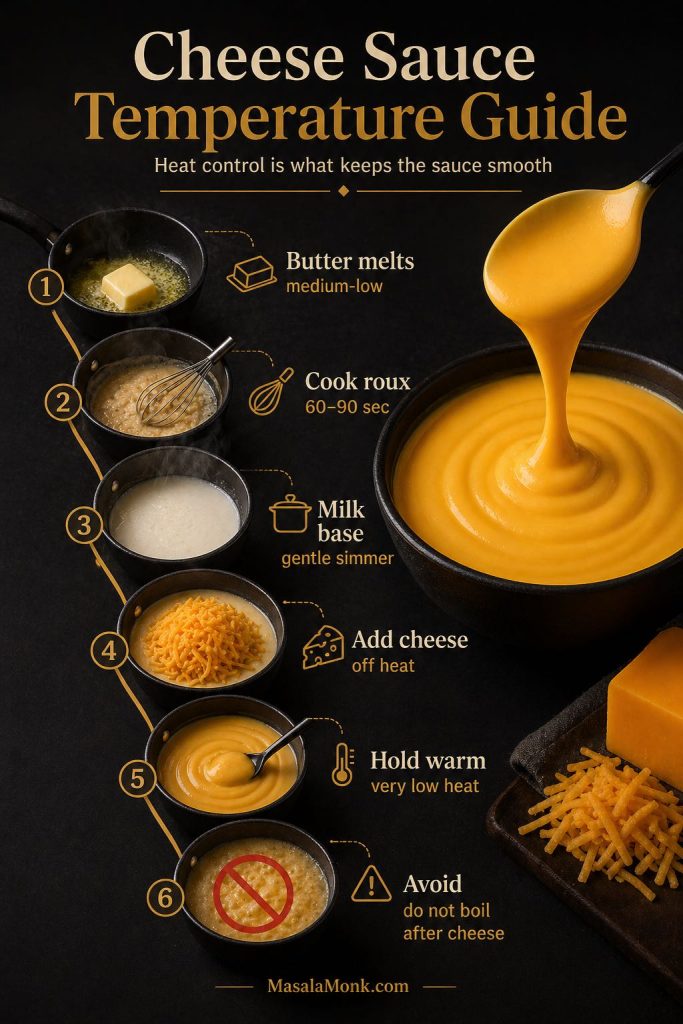
Cheese is most fragile after it melts, so temperature control is one of the easiest ways to protect the texture. You do not need to measure every stage, but the cues below help when you want the sauce to turn out the same way every time.

Cheese sauce temperature guide showing butter melting, roux cooking, milk simmering, cheese added off heat and sauce held warm.
Heat control is what keeps cheese sauce smooth. Cook the roux and milk base gently, then add the cheese off heat so the sauce does not turn grainy or oily.
Stage Best temperature / heat cue Why it matters
Melting butter Medium-low to medium heat The butter should melt gently without browning.
Cooking the roux 60–90 seconds over medium-low heat This removes the raw flour taste while keeping the sauce pale.
Thickening the milk base Gentle simmer, about 82–88°C / 180–190°F The flour fully thickens the milk before the cheese is added.
Before adding cheese Turn off heat and let bubbling stop Cheese melts best with residual heat, not aggressive boiling.
Melting cheese Ideally about 65–75°C / 150–167°F This helps the cheese melt smoothly without separating.
Holding warm Very low heat, about 55–60°C / 130–140°F if using a thermometer This keeps the sauce warm without pushing it toward splitting.
Danger zone for texture Do not hard-boil after cheese is added Hard boiling can make cheese sauce grainy, oily, or separated.

Cheese Sauce Ratio

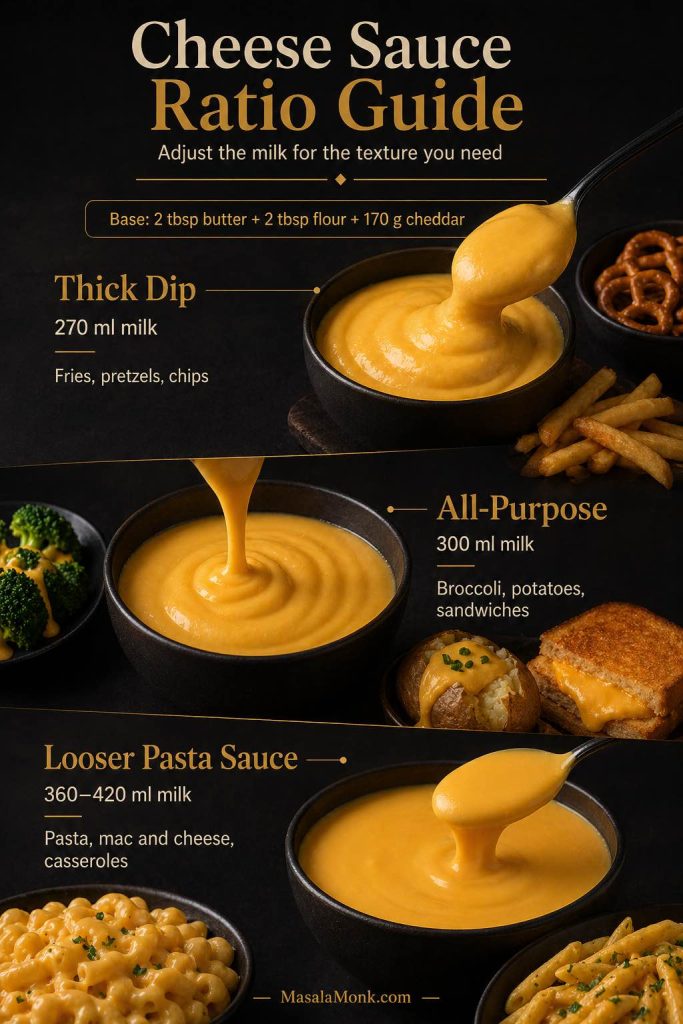
Once you understand the base ratio, the recipe becomes easier to adjust. Instead of starting over, you can change the amount of milk or cheese depending on whether you want a dip, a topping, or a looser pasta sauce.

The easiest cheese sauce ratio for this recipe is 2 tbsp butter + 2 tbsp flour + 300 ml milk + 170 g cheese. That gives you a medium-thick sauce. For dipping, reduce the milk slightly; for pasta, add more liquid after the cheese melts.

Cheese sauce ratio guide showing thick dip, all-purpose cheese sauce and looser pasta sauce with different milk amounts.
Use the same butter, flour and cheddar base, then adjust the milk to make a thick dip, an all-purpose sauce, or a looser cheese sauce for pasta and casseroles.
Style Milk Cheese Best for
Thick dip 270 ml / 9 fl oz 170 g / 6 oz Fries, pretzels, chips, burgers
All-purpose sauce 300 ml / 10 fl oz 170 g / 6 oz Broccoli, cauliflower, potatoes, sandwiches
Looser pasta sauce 360–420 ml / 12–14 fl oz 170 g / 6 oz Pasta, macaroni, rice bowls, casseroles

Texture cue: when the sauce is hot, it should fall from a spoon in a thick ribbon. If it sits in a heavy blob, whisk in warm milk. If it runs like plain milk, simmer the base longer next time before adding cheese.

How to Scale This Cheese Sauce Recipe

Fortunately, this recipe scales well as long as you keep the butter, flour, milk, and cheese in balance. For the smoothest result, use a larger pan when doubling the recipe so the milk base thickens evenly.

Yield Butter Flour Milk Cheese
1 cup / 240 ml / 0.24 L 1 tbsp / 14 g 1 tbsp / 8–9 g 150 ml / 5 fl oz 85 g / 3 oz
2 cups / 480 ml / 0.48 L 2 tbsp / 28 g 2 tbsp / 16–18 g 300 ml / 10 fl oz 170 g / 6 oz
4 cups / 960 ml / 0.96 L 4 tbsp / 56 g 4 tbsp / 32–36 g 600 ml / 20 fl oz 340 g / 12 oz

Easy Homemade Cheese Sauce Recipe

This recipe makes a smooth cheddar cheese sauce that is thick enough for vegetables, fries, and baked potatoes, but easy to thin for pasta, mac and cheese, rice bowls, or drizzling.

Prep Time5 minutes
Cook Time7 minutes
Total Time12 minutes
YieldAbout 2 cups / 480 ml / 0.48 L

Equipment

  • Small to medium heavy-bottomed saucepan, about 1.5–2 qt / 1.5–2 L
  • Whisk
  • Box grater or fine grater

Ingredients

  • 2 tbsp unsalted butter / 28 g / 1 oz
  • 2 tbsp all-purpose flour or plain flour / 16–18 g / 0.6 oz
  • 1¼ cups whole milk / 300 ml / 10 fl oz / 0.3 L, warmed slightly if possible
  • 6 oz freshly grated cheddar cheese / 170 g / about 1½ cups
  • 1 tsp Dijon mustard / 5 ml, or ¼ tsp mustard powder / about 1 g
  • ¼ tsp garlic powder / about 0.7 g, optional
  • ¼ tsp onion powder / about 0.6 g, optional
  • Pinch to ⅛ tsp white pepper or black pepper / about 0.3 g
  • ⅛–¼ tsp salt / about 0.75–1.5 g, added to taste after the cheese melts
  • Warm milk, as needed, for thinning

Instructions

  1. Grate the cheese. Grate the cheddar from a block and set it aside. Freshly grated cheese melts more smoothly than most bagged shredded cheese.
  2. Make the roux. Melt the butter in a saucepan over medium-low to medium heat. Add the flour and whisk for 60–90 seconds, until pale, smooth, and lightly foamy.
  3. Add the milk. Slowly whisk in the milk in 3 additions, smoothing out the sauce before adding more. Keep whisking until no lumps remain.
  4. Thicken the base. Cook for 3–5 minutes, whisking often, until the sauce reaches a gentle simmer and coats the back of a spoon.
  5. Remove from heat. Turn off the heat and let the bubbling settle. This helps keep the cheese from overheating.
  6. Add the cheese. Stir in the grated cheddar by handfuls, letting each handful melt before adding the next.
  7. Season. Stir in Dijon, garlic powder, onion powder, pepper, and a small amount of salt. Taste and adjust.
  8. Adjust the texture. For a thinner cheese sauce, whisk in warm milk 1 tbsp / 15 ml at a time. For a thicker dip, add a little more grated cheese off heat.

Recipe Notes

  • Do not boil the sauce after the cheese is added.
  • For pasta or mac and cheese, thin this recipe with warm milk or pasta water until the cheese sauce is glossy and loose enough to coat noodles.
  • For fries, pretzels, burgers, or sandwiches, keep the sauce slightly thicker.
  • For extra smoothness, use medium cheddar or a cheddar-Monterey Jack blend.
  • Cheese is best measured by weight. Cup measurements vary depending on how finely the cheese is grated and how tightly it is packed.

How Thick Should Cheese Sauce Be?

In practice, the best thickness depends on how you want to use the sauce. A cheese sauce for fries should be thicker than a cheese sauce for pasta, while a sauce for casseroles should start slightly loose because it thickens in the oven.

Cheese sauce thickness guide showing different textures for vegetables, fries, pasta, mac and cheese, burgers and sandwiches.
The best cheese sauce texture depends on how you serve it: spoonable for vegetables, thick for fries and pretzels, loose for pasta, creamy for mac and cheese, and clingy for burgers or sandwiches.
Use Best texture How to adjust the main recipe
Broccoli or cauliflower Spoonable and coating Use the main recipe as written.
Fries, pretzels, chips Thick dip Use 270–300 ml milk, or add 30 g / 1 oz extra cheese off heat.
Pasta Looser, glossy, coating Add 60–120 ml / 2–4 fl oz warm milk or pasta water after the cheese melts.
Macaroni and cheese Creamy and loose before mixing Thin slightly before adding pasta because noodles absorb sauce.
Baked potatoes Medium-thick Use the main recipe as written.
Rice bowls or grain bowls Pourable drizzle Add 30–60 ml / 1–2 fl oz warm milk.
Casseroles and bakes Slightly loose before baking Add about 60 ml / 2 fl oz extra milk because oven heat thickens it.
Burgers and sandwiches Thick and clingy Use a little less milk or add extra cheese.

If the sauce cools down, it will thicken. However, that does not mean you made the recipe wrong. Warm the cheese sauce gently and whisk in a splash of milk to bring it back to a pourable texture.

Cheese Sauce for Mac and Cheese

For mac and cheese, the sauce should be slightly looser than a dip because pasta absorbs liquid as it sits. Therefore, instead of making the sauce extra thick in the pan, keep it glossy and pourable before mixing it with the macaroni.

Creamy macaroni and cheese coated with smooth cheddar cheese sauce in a dark bowl.
For mac and cheese, keep the sauce slightly loose and glossy before mixing because pasta absorbs liquid as it sits.

One batch of this recipe is usually enough for 8 oz / 225 g pasta when making creamy stovetop mac and cheese. A larger batch with 1 lb / 450 g pasta needs a doubled sauce recipe, or about 4 cups / 960 ml sauce. If you are baking the mac and cheese, loosen the sauce with an extra 60–120 ml / 2–4 fl oz milk because the oven will thicken it.

For the smoothest mac and cheese sauce, use medium cheddar with a smoother melting cheese such as Monterey Jack, Colby Jack, or young gouda. Sharp cheddar adds flavor, but too much aged cheese can make the sauce more likely to turn gritty if it gets too hot.

If you want a full pasta build instead of only the sauce, use this macaroni and cheese recipe for stovetop, baked, and Southern-style options.

Cheese Sauce for Broccoli, Cauliflower, and Vegetables

For broccoli, cauliflower, and other vegetables, the goal is different. Instead of making a loose pasta sauce, you want a spoonable sauce that coats the florets without clumping on top.

Broccoli and cauliflower served with smooth cheddar cheese sauce spooned over the vegetables.
For broccoli and cauliflower, the cheese sauce should be spoonable and coating, thick enough to cling to the florets without clumping heavily on top.

For steamed broccoli or cauliflower, use the main recipe as written. If the vegetables are very wet, drain them well first, because extra water can thin the sauce and make it slide off. For roasted vegetables, the sauce can be slightly looser because the dry edges help it cling.

For cauliflower cheese or a vegetable bake, keep the sauce a little looser before baking. As the dish sits in the oven, the cheese sauce thickens and the vegetables release moisture, so a sauce that looks perfect in the pan can become too heavy after baking.

For a full comfort-food dinner, this cheesy chicken broccoli rice shows how broccoli and cheese can move from a side dish into a complete meal.

Cheese Sauce for Pasta, Lasagna, and Casseroles

When cheese sauce is used for pasta, lasagna, or casseroles, it needs extra looseness because starches and oven heat both thicken the final dish. For that reason, a sauce that looks slightly thin before baking often finishes at the right texture.

Pasta in a dark baking dish coated with looser glossy cheddar cheese sauce for casseroles and pasta bakes.
Pasta, lasagna and casseroles need a slightly looser cheese sauce because noodles, starches and oven heat all thicken the final dish.

For pasta, thin the finished sauce with 60–120 ml / 2–4 fl oz warm milk or pasta water before tossing. Pasta water adds starch and helps the sauce cling, while milk keeps the flavor creamier. If the pasta sits for more than a few minutes, loosen it again with a small splash of warm milk.

For lasagna, pasta bakes, and casseroles, use the looser pasta-sauce ratio from the table above. A thicker sauce can work for topping, but it can make layered dishes feel heavy or gluey once baked.

For another creamy pasta direction, this chicken Alfredo pasta is useful because it stays in the same creamy sauce family while using a different method. If you want a baked pasta idea, this baked ziti recipe collection gives more casserole-style inspiration.

Nacho Cheese Sauce for Fries, Pretzels, Chips, and Dips

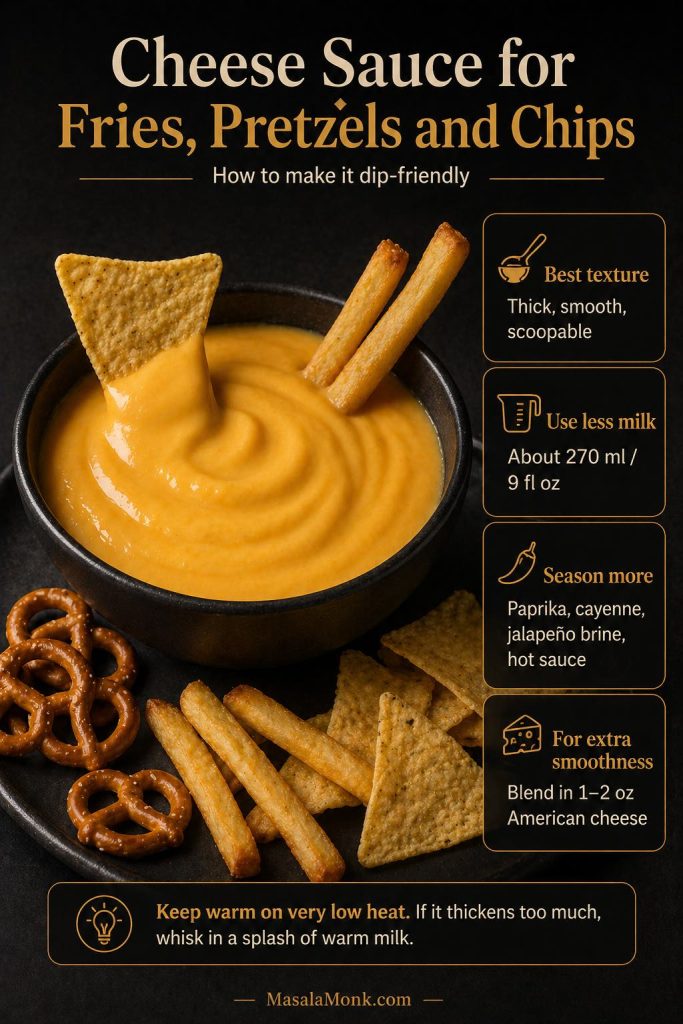
For fries, pretzels, chips, and dips, the sauce should be thicker and more seasoned than a pasta sauce. Otherwise, it can taste too mild once it is spread over salty snacks or used as a dip.

Thick cheddar cheese sauce served as a dip with fries, pretzels and tortilla chips.
For fries, pretzels and chips, make the cheese sauce thicker and more seasoned so it stays scoopable, flavorful and dip-friendly.

To make this recipe work more like a nacho cheese sauce, use the thick-dip ratio: 270 ml / 9 fl oz milk with 170 g / 6 oz cheese. Then season it with paprika, cayenne, jalapeño brine, hot sauce, garlic powder, or a little mustard. These additions make the sauce taste more like a dip instead of a plain cheddar topping.

For a smoother processed-style dip, replace 1–2 oz / 30–55 g of the cheddar with American cheese or another easy-melting processed cheese. Alternatively, a small amount of sodium citrate can make a very glossy sauce, but that is an advanced option rather than a requirement for this homemade version.

For a snack-style pairing, serve the thicker version with crispy homemade French fries. For a bigger game-day board, add pretzels, chips, roasted potatoes, or a scoopable dip on the side.

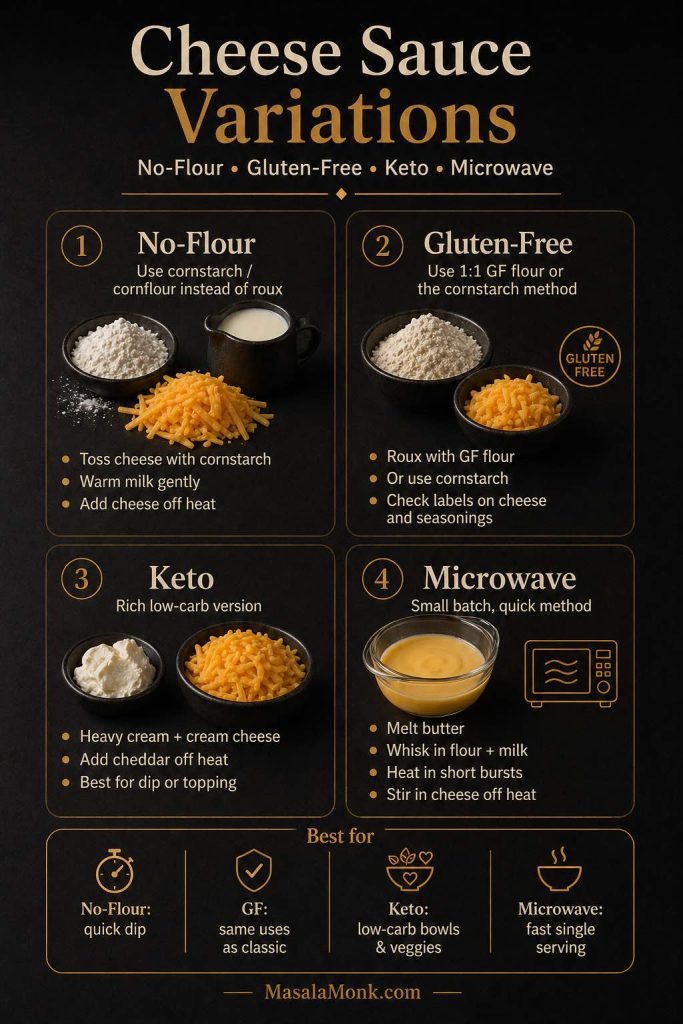
The classic roux method is the best starting point, but it is not the only option. If you need a no-flour, gluten-free, keto, or microwave cheese sauce, use the quick guide below before choosing the version that fits your kitchen.

Cheese sauce variations guide showing no-flour, gluten-free, keto and microwave cheese sauce methods.
The same cheese sauce idea can be adapted into no-flour, gluten-free, keto and microwave versions depending on how you cook and what ingredients you want to avoid.

Cheese Sauce Without Flour

Still, a roux is not the only way to make a smooth sauce. If you want to skip flour, cornstarch can help the cheese melt into the liquid without making the sauce gritty.

You can make cheese sauce without flour by using cornstarch, also called cornflour in the UK and India. This version is useful if you want a flourless cheese sauce, a gluten-free cheese sauce, or a quicker sauce that does not start with a roux.

The no-flour version of this recipe uses cornstarch to help the cheese melt into the sauce smoothly. It makes a glossy sauce that is especially useful for dipping, drizzling, and quick snacks.

No-flour cheese sauce made with cornstarch, milk and cheddar stirred into a smooth sauce.
For cheese sauce without flour, cornstarch or cornflour helps the cheddar melt smoothly into the milk without starting from a classic butter-flour roux.
Ingredient US Metric
Evaporated milk or whole milk 1 cup 240 ml / 8 fl oz / 0.24 L
Freshly grated cheddar cheese 6 oz 170 g
Cornstarch / cornflour 1½ tsp 4–5 g
Butter 1 tbsp 14 g / 0.5 oz
Dijon mustard or mustard powder 1 tsp Dijon or ¼ tsp powder 5 ml Dijon or about 1 g powder
Salt and pepper To taste To taste

How to Make No-Flour Cheese Sauce

  1. Toss the grated cheddar cheese with the cornstarch until lightly coated.
  2. Warm the milk and butter in a saucepan over medium-low heat until steaming, not boiling.
  3. Lower the heat or remove the pan from heat.
  4. Add the cheese by handfuls, stirring until smooth.
  5. Add mustard, pepper, and salt to taste.
  6. If the sauce is too thick, loosen it gradually with warm milk, about 1 tbsp / 15 ml at a time.

Important: cornflour here means white cornstarch, not yellow cornmeal, maize flour, or makki atta. Cornmeal will not make a smooth cheese sauce.

Gluten-Free Cheese Sauce

As a result, the no-flour method also becomes the easiest gluten-free path for many readers. Still, a gluten-free flour blend can work well if you prefer the classic roux technique.

There are two easy ways to make gluten-free cheese sauce. The best choice depends on whether you want the recipe to feel like a classic roux-based cheese sauce or a faster cornstarch-thickened sauce.

  • Use a 1:1 gluten-free flour blend in the main roux recipe. This keeps the method almost the same.
  • Use the cornstarch/cornflour method above. This is the cleanest option if you want to avoid wheat flour completely.

If you are cooking for someone who needs a strictly gluten-free meal, check the labels on the cheese, mustard, seasonings, and any toppings you serve with the sauce.

Keto Cheese Sauce

On the other hand, keto cheese sauce needs a different base, since the classic version relies on both flour and milk. This version skips the roux and uses cream, cream cheese, butter, and cheddar instead.

Ingredient Amount
Heavy cream ½ cup / 120 ml / 4 fl oz / 0.12 L
Cream cheese 2 oz / 55 g
Freshly grated cheddar cheese 4 oz / 115 g
Butter 1 tbsp / 14 g / 0.5 oz
Mustard powder ¼ tsp / about 1 g
Pepper, cayenne, or hot sauce To taste

Warm the cream, butter, and cream cheese over low heat until smooth. Remove from heat and stir in the cheddar gradually. Do not boil after adding cheddar. This keto version is richer and heavier than the classic sauce, so it works best as a dip, topping, or low-carb drizzle.

For low-carb dipping, pair this richer sauce with sturdy options from this keto chips guide, especially if you want something scoopable for nachos, dips, or snack plates.

Microwave Cheese Sauce

Although the stovetop method gives you the best control, the microwave works for a small batch when speed matters more than precision. For best results, heat the base in short bursts and stir often.

Ingredient Amount
Butter 1 tbsp / 14 g / 0.5 oz
Flour 1 tbsp / 8–9 g / 0.3 oz
Milk ½ cup / 120 ml / 4 fl oz / 0.12 L
Freshly grated cheddar cheese 2–3 oz / 55–85 g
Salt, pepper, mustard To taste
  1. Melt the butter in a microwave-safe bowl for 20–30 seconds.
  2. Whisk in the flour until smooth.
  3. Whisk in the milk gradually.
  4. Microwave for 45 seconds, then whisk.
  5. Microwave for another 30–45 seconds, or until thickened.
  6. Stir in the grated cheese off heat until smooth.
  7. Thin with a small splash of warm milk if needed.

Use short microwave bursts and stir often. The sauce can overheat quickly in the microwave, especially after the cheese is added.

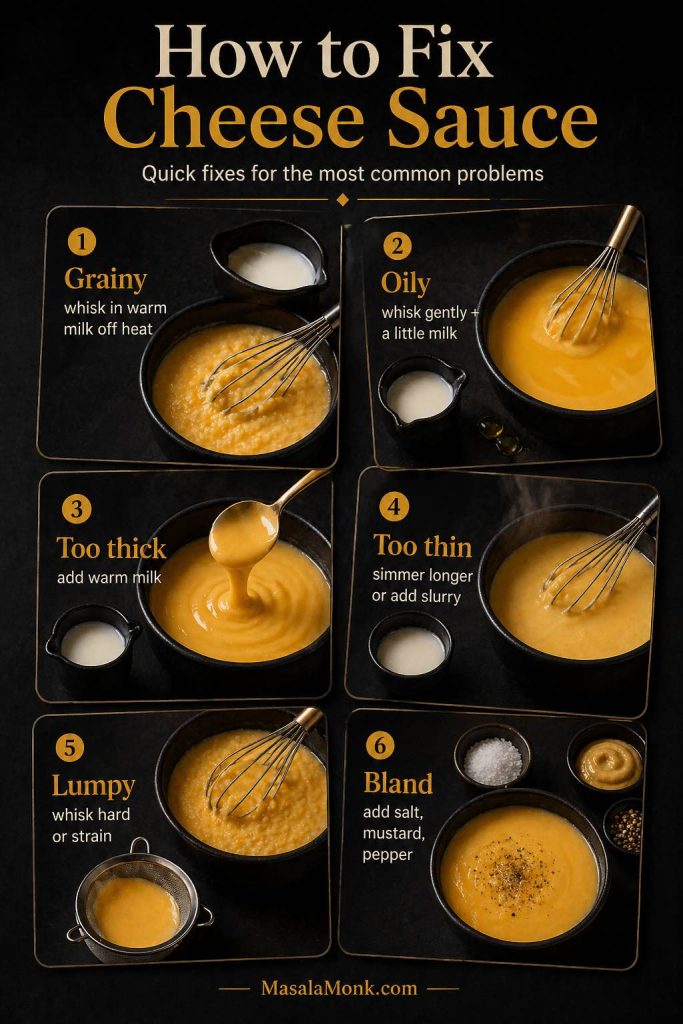
How to Fix Grainy, Oily, Thick, Thin, or Lumpy Cheese Sauce

When cheese sauce goes wrong, the problem usually comes from heat, cheese choice, or the order of steps. Fortunately, many issues can be fixed, especially if you catch them early.

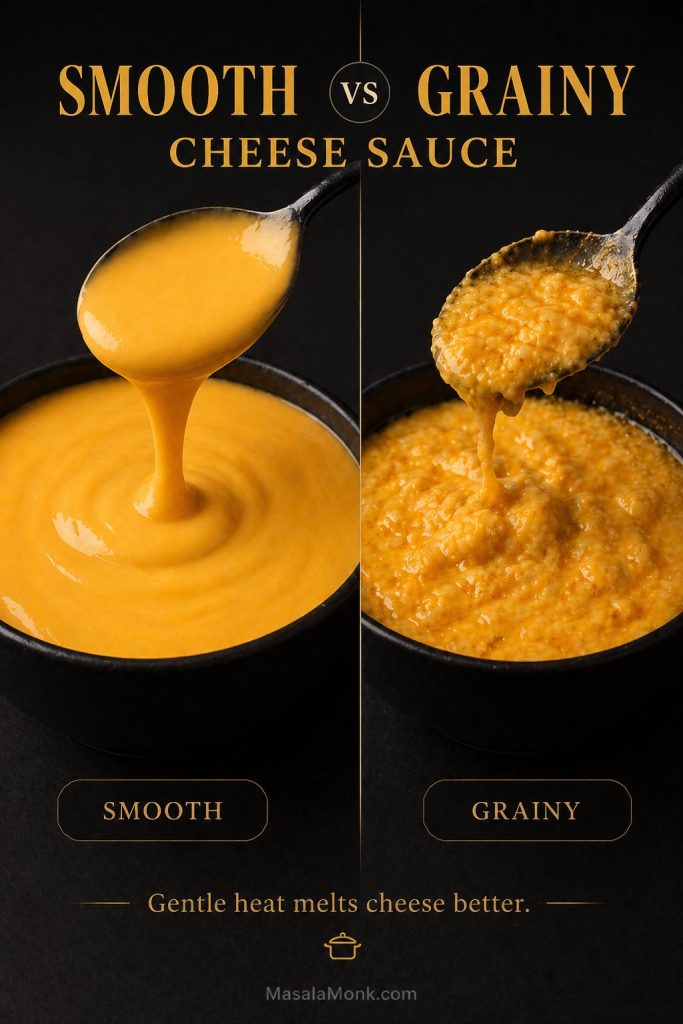
Comparison of smooth cheese sauce and grainy cheese sauce showing the difference between silky and broken texture.
Smooth cheese sauce comes from gentle heat and gradual melting. Grainy cheese sauce usually happens when the cheese overheats, separates, or is added before the base is ready.

Quick Fixes for Common Cheese Sauce Problems

Problem Likely cause How to fix it
Grainy or gritty cheese sauce The cheese overheated, the sauce boiled after cheese was added, or the cheese was very aged. Remove from heat. Whisk in warm milk 1 tbsp / 15 ml at a time. If needed, blend briefly or strain. Next time, add cheese off heat.
Oily or separated sauce The emulsion broke and fat separated from the cheese. Lower the heat immediately. Whisk in warm milk, or add a tiny cornstarch slurry made with ½ tsp cornstarch and 1 tbsp / 15 ml cold milk.
Lumpy sauce Milk was added too quickly to the roux, or the sauce was not whisked enough. Whisk firmly. If lumps remain before adding cheese, strain the sauce, then continue.
Floury taste The roux was undercooked. Cook the butter and flour for 60–90 seconds before adding milk. It should smell lightly buttery, not raw.
Too thick Too much cheese, too little milk, too much simmering, or the sauce cooled down. Whisk in warm milk 1 tbsp / 15 ml at a time until it loosens.
Too thin The milk base did not thicken enough before cheese was added. Simmer the base longer next time. To fix now, use a small cornstarch slurry and heat gently until thicker.
Stringy sauce Too much mozzarella or another stretchy cheese, or cheese was overheated. Use cheddar, Monterey Jack, Colby, or young Gouda as the base. Keep stretchy cheeses as accents.
Bland sauce Mild cheese, not enough salt, or no sharp/acidic seasoning. Add salt carefully, then mustard, pepper, garlic powder, onion powder, cayenne, or a small splash of hot sauce.
Too salty Salty cheese, salted butter, or too much added salt. Whisk in unsalted milk or cream. Serve with unsalted potatoes, pasta, rice, or vegetables.

How to Prevent Cheese Sauce Problems Next Time

To prevent most problems, grate the cheese fresh, cook the roux briefly, thicken the milk before adding cheese, and remove the pan from heat before stirring in the cheddar. Rather than using more heat to force the cheese to melt, give it time to melt gently in the hot sauce base.

Guide showing how to fix grainy, oily, thick, thin, lumpy and bland cheese sauce.
Most cheese sauce problems can be corrected if you catch them early: lower the heat, whisk gently, add warm milk, strain lumps, or adjust seasoning once the sauce is smooth again.

Why Cheese Sauce Turns Grainy

Cheese sauce turns grainy when the cheese proteins tighten and the fat separates instead of staying evenly dispersed in the sauce. High heat makes this more likely. Very sharp, aged, or dry cheeses can also be more difficult to melt smoothly.

For that reason, the safest method is to thicken the milk first, turn off the heat, and then stir in the cheese gradually. The residual heat melts the cheese without pushing it into a hard boil.

For a deeper look at why cheese sauces break, Serious Eats explains how heat can separate cheese fat, water, and proteins, which is why gentle heat matters so much here.

Can I Use Sodium Citrate for Extra-Smooth Cheese Sauce?

Yes, but treat it as an advanced option rather than a requirement. Sodium citrate is an emulsifying salt that helps cheese melt into a very smooth, glossy sauce. It is most useful when you want a processed-style dip or nacho-style sauce that stays more fluid as it cools.

If you already use sodium citrate in your kitchen, follow the ratio on your product or use a tested sodium-citrate sauce formula. For this homemade cheese sauce recipe, though, the roux method is the easier and more familiar starting point.

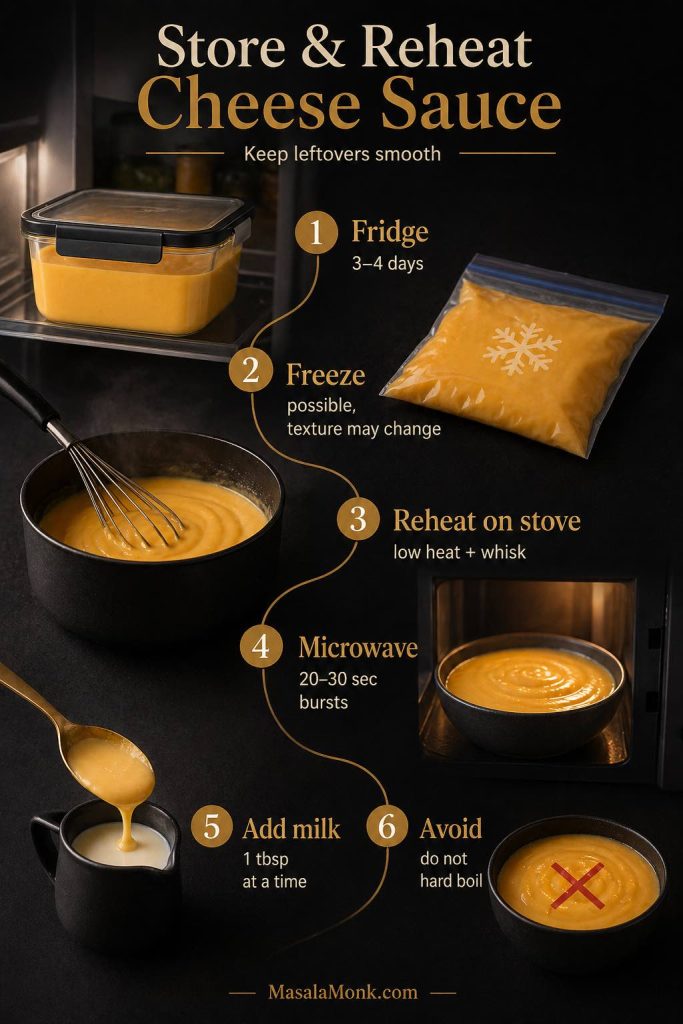
How to Store and Reheat Cheese Sauce

Even though cheese sauce is best fresh, leftovers can still work well if you reheat them gently. Cool leftover sauce quickly, transfer it to a shallow airtight container, and refrigerate it within 2 hours.

For general leftover safety, FoodSafety.gov recommends keeping refrigerators at 40°F / 4°C or below and freezers at 0°F / -18°C or below.

Guide showing how to store and reheat cheese sauce in the fridge, freezer, saucepan and microwave.
Leftover cheese sauce is best reheated gently. Use low heat, whisk often, and add a splash of milk to bring the sauce back to a smooth, pourable texture.

After that, reheat only the amount you need. Repeated cooling and reheating can make the sauce more likely to split, especially because this recipe contains both cheese and milk.

Storage method Best guidance
Refrigerator Store in an airtight container for 3–4 days.
Refrigerator temperature Keep at or below 4°C / 40°F.
Freezer Possible, but not ideal for texture. Freeze for up to 1–2 months for best quality.
Freezer temperature Keep at about -18°C / 0°F for longer storage.
Stovetop reheating Reheat over low heat, whisking often. Add milk 1 tbsp / 15 ml at a time.
Microwave reheating Use 20–30 second bursts and stir between each burst.
Keeping warm Use very low heat or a warm setting. Stir occasionally and add milk if it thickens.
What to avoid Do not hard-boil leftover cheese sauce. It can split or turn grainy.

If refrigerated cheese sauce looks thick or slightly set, that is normal. To bring it back, warm it gently and whisk in a splash of milk until it becomes smooth again.

What to Serve With Cheese Sauce

By this point, you can treat the sauce as a flexible base rather than a single-use recipe. It can work as a vegetable sauce, pasta sauce, potato topping, snack dip, sandwich sauce, or creamy base for simple dinners.

Vegetables

  • Broccoli
  • Cauliflower
  • Roasted carrots
  • Green beans
  • Asparagus
  • Brussels sprouts
  • Roasted potatoes

Pasta, Rice, and Potatoes

  • Macaroni
  • Shells
  • Penne
  • Rotini
  • Baked potatoes
  • Rice bowls
  • Casseroles

Snacks, Sandwiches, and Game-Day Food

  • French fries
  • Potato wedges
  • Pretzels
  • Nachos-style chips
  • Burgers
  • Chicken sandwiches
  • Grilled cheese
  • Paneer wraps
  • Tofu wraps

If you are building a game-day table, this sauce can sit next to a warmer, scoopable dip like buffalo chicken dip instead of trying to do every job on the table by itself.

Cheese Sauce FAQs

Can I Make This Cheese Sauce From Scratch?

Yes. This recipe makes cheese sauce from scratch with butter, flour, milk, and cheddar cheese. You do not need a packaged mix, jarred sauce, or processed cheese unless you want a glossier processed-style version.

Can I Make Cheese Sauce Without Flour?

Yes. Use cornstarch/cornflour instead of flour. Toss the grated cheese with cornstarch, warm the milk, then stir the cheese in gently. This is also a good gluten-free method if all your ingredients are certified gluten-free.

Is Cheese Sauce Gluten-Free?

The main recipe is not gluten-free because it uses all-purpose flour. To make it gluten-free, use a 1:1 gluten-free flour blend or use the cornstarch/cornflour method.

Is Cheese Sauce Keto?

The main recipe is not keto because it uses flour and milk. For keto cheese sauce, use heavy cream, cream cheese, butter, and cheddar instead.

Why Is My Cheese Sauce Grainy?

Cheese sauce usually turns grainy when the cheese gets too hot. Remove the sauce from heat before adding cheese, add the cheese gradually, and avoid boiling after the cheese melts.

How Do I Thin Cheese Sauce?

Whisk in warm milk 1 tablespoon / 15 ml at a time until the cheese sauce reaches the texture you want. For pasta, you can also use warm pasta water.

How Do I Thicken Cheese Sauce?

If the sauce is only slightly thin, let the milk base simmer a little longer before adding cheese. If the finished cheese sauce is thin, whisk in a small cornstarch slurry and heat gently, or add more grated cheese off heat.

Can I Make Cheese Sauce Without Milk?

Yes, but the sauce will change. Unsweetened oat milk, almond milk, or another neutral dairy-free milk can work, but the sauce may taste lighter and less creamy. Water works in an emergency, but milk gives this recipe a smoother cheese sauce with better flavor.

Can I Make Cheese Sauce With Water?

You can, but milk gives a much better texture and flavor. Water makes the sauce thinner and less creamy. If you need to avoid milk, use an unsweetened dairy-free milk that works well in savory sauces.

Can I Make Cheese Sauce With Cream?

Yes, but cream makes the cheese sauce richer and heavier. You can replace part of the milk with cream, or use cream in the keto version. For an everyday recipe, whole milk gives a better balance.

Can I Add American Cheese for a Smoother Sauce?

Yes. If you want a smoother, more processed-style cheese sauce, replace 1–2 oz / 30–55 g of the cheddar with American cheese or another easy-melting processed cheese. It makes the sauce glossier and more stable, but the flavor will be less purely cheddar.

Can I Freeze Cheese Sauce?

You can freeze cheese sauce, but the texture may change after thawing. Reheat it slowly over low heat and whisk in milk to bring it back together. For the smoothest texture, cheese sauce is best made fresh or refrigerated for a few days.

What Cheese Melts Best for Cheese Sauce?

Medium cheddar, mild cheddar, Monterey Jack, Colby Jack, young gouda, and Gruyère melt well. Very aged cheddar, Parmesan, and mozzarella can be used, but they are better as accents rather than the entire sauce base.

Is Cheese Sauce the Same as Mornay Sauce?

They are related. A classic Mornay sauce is a cheese sauce made from béchamel, usually with cheeses such as Gruyère, Parmesan, or other melting cheeses. This recipe is a practical cheddar cheese sauce for everyday cooking.

Can I Use This Cheese Sauce Recipe for Mac and Cheese?

Yes. Thin it slightly with warm milk or pasta water before tossing it with cooked macaroni because pasta absorbs sauce quickly. For baked mac and cheese, keep the sauce even looser before it goes into the oven.

Can I Use This Cheese Sauce Recipe for Nachos?

Yes, for a quick nachos-style drizzle. Keep it warm, make it slightly thicker, and season with cayenne, paprika, jalapeño, or hot sauce. For a more stadium-style nacho cheese sauce, use a smoother melting blend, a little American cheese, or an emulsifying-salt method.

Easy cheese sauce recipe graphic with smooth cheddar sauce for mac and cheese, broccoli, nachos, fries and dips.
Save this easy cheese sauce recipe for a smooth cheddar sauce you can use with mac and cheese, broccoli, nachos, fries, dips and more.

Back to top

Posted on 1 Comment

Mastering the Perfect Mashed Potatoes: Gordon Ramsay’s Signature Recipe

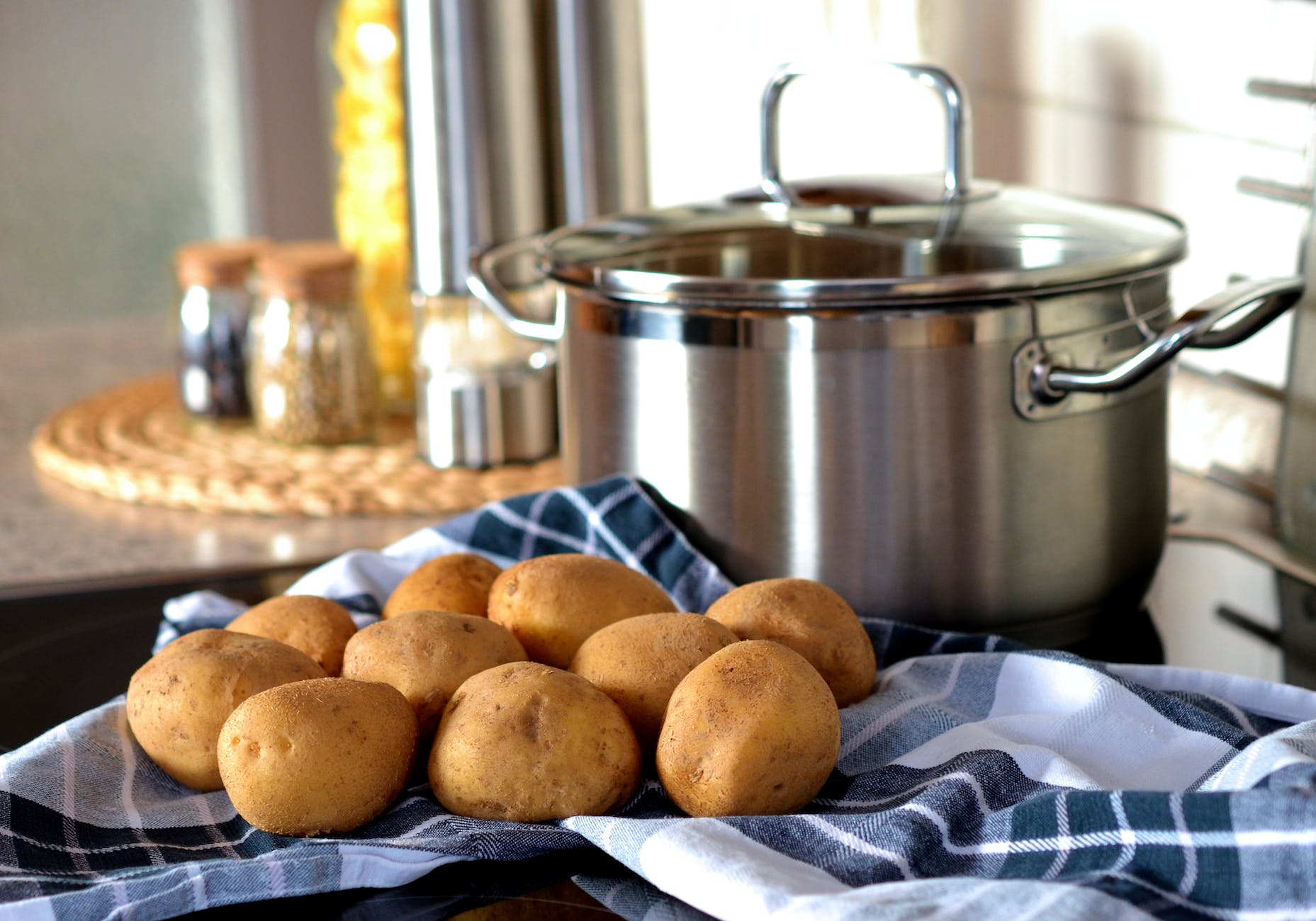
potatoes beside stainless steel cooking pot

When it comes to mashed potatoes, few chefs have mastered the art quite like the renowned Gordon Ramsay. Known for his culinary expertise and exceptional flavor combinations, Ramsay’s mashed potatoes are a true delight. In this tantalizing blog post, we’ll guide you through the steps to recreate Gordon Ramsay’s signature mashed potatoes, ensuring you achieve creamy, fluffy, and flavorful results that will elevate your dining experience. Get ready to impress your family and friends with this show-stopping side dish straight from the culinary genius himself! 🥔🍽️

🍟 Ingredients for Gordon Ramsay’s Mashed Potatoes To recreate Gordon Ramsay’s iconic mashed potatoes, you’ll need the following ingredients:

  • 2 pounds (900 grams) of Yukon Gold or Russet potatoes, peeled and cut into chunks
  • 1 cup (240 ml) of heavy cream
  • 1/2 cup (115 grams) of unsalted butter
  • 4 cloves of garlic, minced
  • Salt and freshly ground black pepper, to taste
  • Chopped fresh chives, for garnish (optional)

🍟 Step-by-Step Instructions Follow these steps to create Gordon Ramsay’s exquisite mashed potatoes:

1️⃣ Boil the Potatoes: Place the peeled and cut potatoes in a large pot of salted water. Bring the water to a boil and cook the potatoes until tender, about 15-20 minutes. Test for doneness by inserting a fork into the potatoes; they should be easily pierced.

2️⃣ Heat the Cream: While the potatoes are cooking, in a separate saucepan, heat the cream over low heat until warm. This will ensure that the cream incorporates smoothly into the mashed potatoes.

3️⃣ Prepare the Garlic Butter: In a small saucepan, melt the butter over low heat. Add the minced garlic and cook for a minute or two until fragrant. Be careful not to brown the garlic, as it can turn bitter.

4️⃣ Drain and Mash the Potatoes: Once the potatoes are cooked, drain them well and return them to the pot. Using a potato masher or a ricer, mash the potatoes until they are smooth and free of lumps. Take care not to over-mash, as this can result in a gluey texture.

5️⃣ Incorporate the Cream and Garlic Butter: Gradually pour the warm cream into the mashed potatoes, stirring gently with a wooden spoon or spatula. Continue adding the cream until the desired consistency is achieved. Next, pour the garlic butter into the mashed potatoes and mix well to distribute the flavors evenly.

6️⃣ Season to Perfection: Season the mashed potatoes with salt and freshly ground black pepper to taste. Give them a final stir to incorporate the seasoning throughout the dish. Taste and adjust the seasoning as needed.

7️⃣ Serve and Garnish: Transfer the mashed potatoes to a serving dish. For an extra touch of freshness and visual appeal, sprinkle chopped fresh chives over the top as a garnish.

See the YouTube video by Chef Gordon Ramsay’s Guide to Potatoes.

🍟 Join Our Foodie Community! We invite you to join our vibrant community of food lovers on our Facebook group. Share your creations, get inspired by others, and exchange ideas to take your culinary skills to new heights. There’s no better way to elevate your cooking game than by connecting with fellow foodies who share the same passion.

🥔💡 Now that you’ve learned the secrets behind Gordon Ramsay’s exquisite mashed potatoes, it’s time to put your skills to the test. Follow these steps, savor the creamy and flavorful results, and delight your taste buds with this culinary masterpiece. Remember, great mashed potatoes require patience, attention to detail, and quality ingredients. So gather your tools and ingredients, and let’s embark on a mashed potato adventure that would make Gordon Ramsay proud! 🍽️🥔

Posted on Leave a comment

The Place of Heavy Cream in a Keto Diet: Creamy Goodness without the Carbs

wooden bowl of sour cream with spoon on table

he ketogenic, or keto, diet has taken the world by storm, and for good reason! It’s a high-fat, low-carb diet that can help with weight loss, improve mental clarity, and more. One ingredient that’s a staple in many keto kitchens is heavy cream. But why is it so popular, and how can you use it in your diet? Let’s dive in! 🏊‍♀️

What is Heavy Cream and Is It Keto-Friendly? 🍶

Heavy cream, also known as heavy whipping cream, is a high-fat dairy product that’s made from the high-fat part of fresh milk. When milk is left to settle, the cream rises to the top and can be skimmed off.

The high fat content of heavy cream makes it a perfect fit for a keto diet. With virtually no carbs and a high-fat content, it can help you stay within your macros and keep your body in ketosis. So, to answer the question, “Is cream keto?” – Yes, heavy cream is definitely keto-friendly! 🎉

Here are some key points to remember about heavy cream and keto:

  1. High in fat: Perfect for meeting your daily fat macros.
  2. Low in carbs: Helps you stay within your daily carb limit.
  3. Versatile: Can be used in a variety of keto recipes.
  4. Delicious: Adds a creamy, indulgent flavor to your meals.

The Nutritional Profile of Heavy Cream 📊

A single tablespoon of heavy cream contains about 5 grams of fat, less than 1 gram of carbs, and about 50 calories. This makes it a great choice for those following a keto diet, as it can help you meet your daily fat intake without adding too many carbs. So, “Does heavy cream have carbs?” – Yes, but very few!

Here’s a quick breakdown of the nutritional content of heavy cream:

  1. Fat: 5 grams per tablespoon.
  2. Carbs: Less than 1 gram per tablespoon.
  3. Calories: About 50 per tablespoon.
  4. Protein: Less than 1 gram per tablespoon.

Health Benefits of Heavy Cream on Keto 🌿

Heavy cream isn’t just delicious – it’s also packed with nutrients! It’s a good source of vitamin A, which is important for eye health, and calcium, which is essential for bone health. Plus, the high fat content can help keep you feeling full and satisfied, which can aid in weight loss. So, “Is heavy cream good for weight loss?” – It can be, as part of a balanced keto diet!

Here are some health benefits of heavy cream:

  1. High in Vitamin A: Important for eye health.
  2. Rich in Calcium: Essential for strong bones and teeth.
  3. High in Fat: Can help keep you feeling full and satisfied.
  4. Low in Carbs: Perfect for a keto diet.

Using Heavy Cream in Your Keto Diet 🍽️

There are plenty of ways to incorporate heavy cream into your keto diet. You can add it to your morning coffee for a creamy, indulgent start to your day. It’s also great in soups and sauces, giving them a rich, creamy texture without adding too many carbs. And of course, it’s perfect for making homemade whipped cream to top off your favorite keto desserts!

Here are some ways to use heavy cream in your keto diet:

  1. In coffee: Add a splash to your morning coffee for a creamy twist.
  2. In soups and sauces: Gives them a rich, creamy texture.
  3. In desserts: Perfect for making homemade whipped cream.
  4. In scrambled eggs: Makes them extra fluffy and delicious.

Delicious Keto-Friendly Recipes with Heavy Cream 🍰

Ready to start using heavy cream in your kitchen? Here are a few keto-friendly recipes to get you started:

  1. Keto Coffee with Heavy Cream: Start your day off right with a creamy, energizing cup of keto coffee. Just brew your favorite coffee, then blend it with a tablespoon of heavy cream for a delicious and satisfying morning drink. ☕
  2. Creamy Keto Soup: Make a comforting, creamy soup that’s perfect for chilly days. Sauté some onions and garlic, add your favorite low-carb veggies, then pour in chicken broth and a splash of heavy cream. Simmer until everything is tender and flavorful. 🍲
  3. Keto Whipped Cream: Whip up some homemade whipped cream for a delicious dessert topping. Just whip heavy cream until it forms soft peaks, then sweeten with a keto-friendly sweetener like stevia or erythritol. It’s perfect on top of a bowl of berries or a slice of keto cheesecake! 🍓

Frequently Asked Questions (FAQs) about Keto Heavy Cream

🥛 Q: Is Heavy Cream a Keto-Approved Ingredient? A: Absolutely! Heavy cream, also known as heavy whipping cream, is a keto-approved ingredient. It’s packed with high-fat content (36-40%) derived from raw milk fat, making it a perfect choice for those following a ketogenic diet.

🍽️ Q: Can I Incorporate Heavy Cream into My Keto-Friendly Meals? A: Yes, you can! Heavy cream is not only high in energizing fats but also versatile enough to be used in a variety of keto-friendly breakfasts, lunches, and dinners. You can even use it as a meal substitute in your keto coffee to help accelerate weight loss.

🧀 Q: Are All Dairy Products Equal on a Keto Diet? A: No, not all dairy products are created equal when it comes to a low-carb or keto diet. While heavy cream is a fantastic choice due to its high-fat content, other dairy products may have a higher carb content and may not be as suitable for a keto diet.

💪 Q: Is Cream a Good Source of Protein on a Keto Diet? A: Heavy cream does contain protein, with 2 to 4 grams of protein per 100 grams. However, it shouldn’t be your only source of protein intake on a keto diet. It’s essential to incorporate other high-protein, low-carb foods into your diet.

🐄 Q: Can I Use Heavy Cream from Grass-Fed Cows on a Keto Diet? A: Yes, you can! Choosing heavy cream from grass-fed cows not only increases the nutritional value of your keto treat but also enhances the levels of healthy fats, vitamins, and other beneficial antioxidant compounds. Grass-fed cows offer more nutritious meat and dairy, making this a perfect choice for a low-carb diet and your overall health.

Conclusion 🎈

Heavy cream is a versatile and delicious ingredient that can help you stick to your keto diet. Whether you’re adding it to your coffee, cooking up a creamy soup, or whipping up a dessert, heavy cream is a keto kitchen staple. So go ahead and enjoy the creamy goodness of heavy cream on your keto journey! 🎉

Remember, as with all things, moderation is key. While heavy cream is keto-friendly, it’s also high in calories, so be sure to use it in a way that fits into your overall diet and health goals. Happy keto cooking! 🍳

Blog tags: Keto Diet, Heavy Cream, Low-Carb Diet, Keto-Friendly Meals, Dairy Products, Protein Source, Grass-Fed Cows, Nutritional Value, Healthy Fats, Antioxidant Compounds.